

In 2021, Eric Kansa and Sarah Whitcher Kansa wrote a digital review for this journal entitled “Digital Data and Data Literacy in Archaeology Now and in the New Decade.” This contribution explored the relationships between digital data, data literacy, and current archaeological practice. Now, halfway through this decade, we have seen continued advances in digital approaches in archaeology and the stewardship of digital data (Gupta et al. Reference Gupta, Martindale, Supernant and Elvidge2023; Kansa et al. Reference Kansa, Gupta, Martinez and Nicholson2025; Nicholson et al. Reference Nicholson, Kansa, Gupta and Fernandez2023). These build on years of development in cyberinfrastructure (Kintigh Reference Kintigh2006), online repositories (McManamon et al. Reference McManamon, Kintigh, Ellison and Brin2017), data publication (Atici et al. Reference Atici, Kansa, Lev-Tov and Kansa2013; Kansa Reference Kansa, Averett, Gordon and Counts2016; Parker and Cobb Reference Parker and Cobb2012), digital research networks and projects (Chaco Research Archive 2010; Cradic Reference Cradic2023; Kansa et al. Reference Kansa, Gupta, Martinez and Nicholson2025), and a shift in the nature of technological use in the field (Fagan and Mirijanyan Reference Fagan and Mirijanyan2024; Petrosyan et al. Reference Petrosyan, Azizbekyan, Gasparyan, Dan, Bobokhyan and Amiryan2021). Yet, for each article discussing technological advances, we lack one that investigates the significant training that goes into effectively and regularly using these resources in research contexts and in private-sector or government jobs.
This means that despite continued increase in the usage of digital data in archaeology since Kansa and Kansa (Reference Kansa and Kansa2021), few other archaeologists have discussed the specific necessity for archaeological data literacy—the skill that enables people to use new technologies and reuse existing data—in the field. Rather than repeat a call for action, this review presents archaeological data literacy in terms of practical necessity, addressing needs identified by multiple current working groups in archaeology (Airlie House Revisited Workforce Training Working Group [AHRWTWG] et al. Reference Ford, Boutin, Head, Doershuk, Nolan and Palmiotto2025; Kansa et al. Reference Kansa, Gupta, Martinez and Nicholson2025). Archaeological data literacy is a necessary skill invaluable for the future of archaeological pedagogy and should be explored as an avenue for professional development among current practitioners.
In support of this, this review shares responses from a 2023–2024 archaeological data skills survey conducted by the Data Literacy Program (DLP) of the Alexandria Archive Institute/Open Context that explored the data skills desired by cultural resource management (CRM) and government archaeological personnel. In addition, although we focus on the 2023–2024 data, we continue to track data literacy in our field. This means that those interested in the survey may still take it—available at https://berkeley.qualtrics.com/jfe/form/SV_cvDpqm559DTN5L8—and continue contributing to our ongoing assessment of archaeological data literacy.
Archaeological Data Literacy
While many people are technologically capable today (Fagan and Mirijanyan Reference Fagan and Mirijanyan2024), most lack formal training in digital skills. Often, people only learn to use technologies, software, and data by working with them regularly. In fact, some “digital natives,” those who grew up using digital technology almost from birth, may lack an understanding of how or why such technologies work. For example, Fagan and Mirijanyan (Reference Fagan and Mirijanyan2024) point out that, although savvy with recent technologies such as smartphones, members of their workshop had never learned the concept of a file-tree. This, and other examples of theirs, demonstrates that although new technologies hold great potential for use in archaeology, many practitioners, whether archaeologists, students, volunteers, or hired workers, still require underlying data literacies to apply that potential.
While each technology requires its own specific skill set, ultimately what people need in order to transfer skills from one technology to the next is “to understand the underlying principles and challenges of data and [how to] create information from those data” (Przystupa Reference Przystupa2021), aka data literacy. Although data literacy can be learned in an ad hoc manner, and many people do become data-literate through practice rather than through explicit education, direct education in data literacy provides learners with guidelines that improve their comprehension of the materials, techniques, technologies, and data they use.
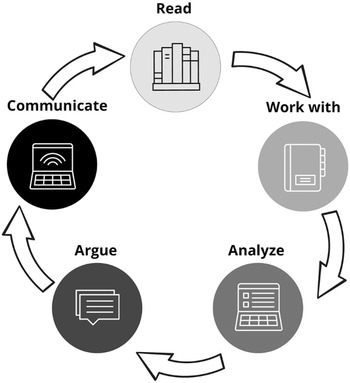
Specifically, we should teach how to “read, work with, analyze, argue, and communicate with and through archaeological data” (Przystupa Reference Przystupa2024:52, referencing Bhargava et al. Reference Bhargava, Kadouaki, Bhargava, Castro and D’Ignazio2016). Thus, we technologically inclined archaeologists and cultural heritage practitioners can empower others—such as our less technologically inclined colleagues and students—in their use of data by clarifying and formalizing many of the implied and opaque aspects of the data creation and research process. Alongside how to use a technology or dataset, students, volunteers, new hires, and anyone looking to use that technology or data would learn how and why it works by moving through the components of data literacy, as illustrated in Figure 1. Learning how and why should come alongside and help support best practices, such as encouraging “metadata standards for collections management, research, and other uses” (Banks et al. Reference Banks, Childs, Douglass, Hawkins, Jones, Klein and Lindsay2025:39), that might exist and be published for specific technologies and digital research approaches in archaeology.
The components of data literacy work together and can be used to scaffold data skills for those new to data exploration. Graphic composited by Paulina F. Przystupa in 2026, incorporating symbols designed by L. Meghan Dennis to illustrate the components of data literacy for the Data Literacy Program based on icons from the Noun Project. See the Acknowledgments for more detail.

Figure 1 Long description
A cyclic infographic displays the data literacy process with five interconnected components. The first component is 'Read,' represented by an icon of books. The second is 'Work with,' shown with a notebook icon. The third component is 'Analyze,' depicted with a computer screen icon. The fourth is 'Argue,' represented by a speech bubble icon. The final component is 'Communicate,' illustrated with a laptop icon. Arrows connect each component, indicating a continuous cycle.
For example, current practitioners cannot develop or enforce metadata standards across projects, subfields, or institutions if they lack training in what metadata are. More commonly, rather than recognizing generalizable similarities and then enacting interoperability amongst data structures, cultural heritage practitioners create bespoke systems based on personal preferences and experiences or repeat the bespoke practices of others who also lacked formal data literacy training (Kansa and Kansa Reference Kansa and Kansa2013). While this works within the context of small projects where people do not expect to share data, and potentially wait decades to publish, increasingly archaeologists are asked, and in some cases are required, to share their findings in a prompt and legible manner (Bollwerk et al. Reference Bollwerk, Gupta and Smith2024; Kansa and Kansa Reference Kansa and Kansa2021; Kansa et al. Reference Kansa, Gupta, Martinez and Nicholson2025).
In addition, the use of new technologies by academic, private-sector, government, and nonprofit archaeology increasingly generates huge amounts of, often, born-digital data. To properly steward these new data, as well as the data created by generations past, our field requires practitioners who can competently read, work with, and analyze data in a technologically agnostic way (Kansa and Kansa Reference Kansa and Kansa2021). However, this requires significant training in both the specific technologies and analyses relevant to the goals of specific projects, as well as the basics of data as a concept and structure. Unfortunately, according to our survey results, the current expectation from hiring archaeologists is that such training will be done “on the job,” likely in response to immediate needs, rather than as a necessary part of archaeological skills development for the existing and future workforce.
Data Skills Survey
We collected information on the expectations for data-related skills training for careers in archaeology through a survey completed by working archaeologists in 2023–2024. This included people who indicated that they were job creators—those looking for employees—as well as people who indicated they were looking for a job. Before undertaking this work, DLP team members took a Protecting Human Research Participants training in 2021 and submitted surveys conducted through the program for assessment by an external, independent Institutional Review Board (IRB). The IRB review team determined that this work, such as the survey included in this Digital Review, qualified for exemption from the need for IRB review.
Our preliminary assessment asserts that data literacy is a necessary skill for future practitioners and is likely to be an important part of professional development for current practitioners who wish to remain current with developments in technology and data. In addition to exploring whether certain data-oriented skills were important for employees starting their first job—the preliminary results of which are available in Przystupa (Reference Przystupa2024), with full analysis upcoming in Przystupa (Reference Przystupa2026)—our survey also asked when people should learn various data skills.
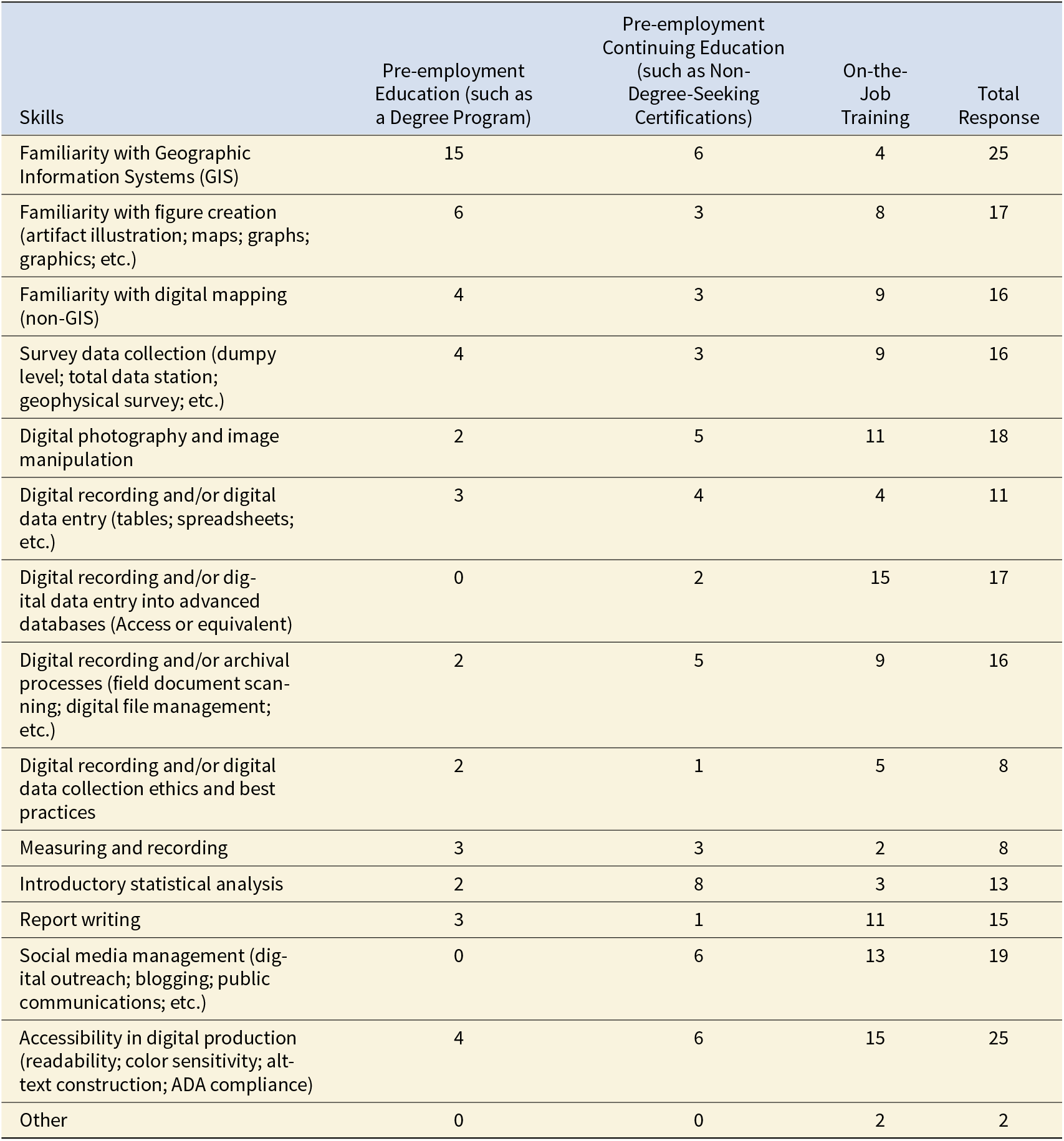
Table 1 presents the expectations of 31 out of 64 total respondents who answered the question: “Of the following skills, please indicate which do you feel should be provided through pre-employment education (such as a degree program), which should be provided through pre-employment continuing education (such as non-degree-seeking certifications), which should be provided through on-the-job training?” The majority of those who responded to this portion of the survey, n = 25, were people who indicated that they were a “Job creator (I’m looking for employees.)”
Responses Regarding When Respondents Preferred Each of the Data Skills Should Be Taught.

Table 1 Long description
The table reports how many respondents preferred each data skill be taught in pre-employment education, pre-employment continuing education, or on-the-job training, with totals per skill. Overall, on-the-job training is the most-selected option for most skills, especially advanced database entry (15 of 17), social media management (13 of 19), report writing (11 of 15), and digital photography/image manipulation (11 of 18). Two skills have the highest total responses: GIS familiarity (25) and accessibility in digital production (25); GIS is most often preferred in degree programs (15), while accessibility is split between on-the-job (15) and pre-employment options (4 degree, 6 continuing). Several skills lean strongly toward on-the-job training, including digital mapping (9 of 16), survey data collection (9 of 16), and digital archival processes (9 of 16). Introductory statistical analysis is the main exception, with continuing education most preferred (8 of 13). Lower-response items include digital data ethics and best practices (8 total) and measuring and recording (8 total), while “Other” has 2 total responses. Counts reflect respondent preferences and may not indicate skill importance or actual training availability.
Respondents felt most strongly about where the skills “Familiarity with Geographic Information Systems (GIS),” n = 25, and “Accessibility in digital production (readability; color sensitivity; alt-text construction; ADA compliance),” n = 25, should be taught. Interestingly, familiarity with GIS was the only skill that the majority of respondents indicated that people should learn during their degree programs. Based on how we phrased the question, respondents thought that all but three other data skills from our list should be learned on the job. The other three skills that people thought should be provided “off the job” were “Digital recording and/or digital data entry (tables; spreadsheets, etc.),” although it tied with “on the job,” “Measuring and recording,” which tied with “in a degree program,” and “Introductory statistical analysis,” which respondents felt should be provided through “continuing education.” In general, though, fewer respondents provided their opinions for where these skills should be learned, ranging from 8 to 13 responses for each of these skills, roughly half the responses received for “Familiarity with GIS” and “Accessibility in digital production.”
Discussion
Overall, respondents to our survey felt that people should bring an average of 7 of the 15 data skills we listed to their first paid archaeological position (Przystupa Reference Przystupa2026). At the same time, respondents to the question of where data skills should be taught indicated an overwhelming expectation of on-the-job training in those same data skills. This provides evidence supporting the trends that others have noted about archaeological training: namely, that academic archaeology shifts the pedagogical burden onto employers by either lacking training in or inadequately teaching necessary job skills.
In fieldwork (Altschul and Patterson Reference Altschul, Thomas C., Wendy, Dorothy T. and Barbara J.2010; Banks et al Reference Banks, Childs, Douglass, Hawkins, Jones, Klein and Lindsay2025; Larkin and Slaughter Reference Larkin and Slaughter2021; Whitely Reference Whitley2004) and based on our survey in data skills, the training that most students receive in higher education does not prepare them for the archaeological jobs they are likely to obtain after graduating. There are many reasons for on-the-job training, and there are cases where it is necessary to work within specific systems or the scope of a specific project. Yet, our respondents, most of whom indicated that they were looking for employees, expect to do a lot of teaching, even if that is not what they are paid to do, trained to do, or have scoped within the the projects they undertake.
This mismatch between archaeological education and the training needed to be a professional in the field is something that various groups and archaeologists are working to address (AHRWTWG et al. Reference Ford, Boutin, Head, Doershuk, Nolan and Palmiotto2025; Banks et al. Reference Banks, Childs, Douglass, Hawkins, Jones, Klein and Lindsay2025; Larkin and Slaughter Reference Larkin and Slaughter2021). However, many of the published recommendations focus on big changes to curriculum and degree programs (e.g., Morgan Reference Morgan2023). Alongside these major alterations, archaeological educators and practitioners concerned with training should also consider minor changes. One example would be to discuss how databases work before asking students to work with or create archaeological datasets. Another would be discussions between academic educators and CRM firms to ensure that students learn relevant job skills during their academic training in a way that appropriately prepares them to use those skills on the job, a suggestion by Larkin and Slaughter (Reference Larkin and Slaughter2021) based on their comparison between academic and private-sector perceptions of job preparedness.
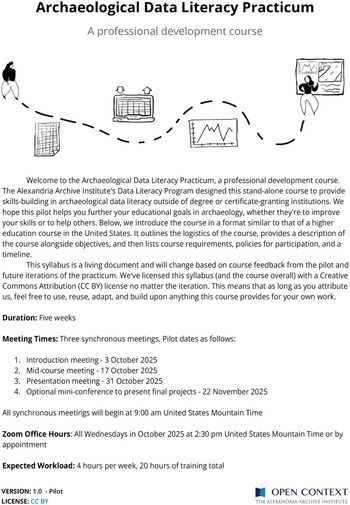
Although archaeologists responsible for hiring rarely selected “pre-employment continuing education” as an option for most of the skills on our list, there are many ways and places that data literacy skills for archaeology can be learned outside of degree programs. Such programs can help current practitioners improve and/or expand their skill sets or act as supplements when degrees lack certain training. In fact, a benefit of continuing education is that it can pivot more quickly to meet industry needs than degree programs can. For example, based on the unpublished results of our 2023 survey, the DLP developed and ran an Archaeological Data Literacy Practicum (ADLP) in October 2025, whose syllabus I present as Figure 2. This free online training used the five components of data literacy illustrated in Figure 1 as a framework to teach people invaluable data creation, cleaning, management, and preliminary analysis skills. Our practicum demonstrated that data literacy is an invaluable skill for archaeology, as well as related professions, and one that can be cultivated outside of degree-granting programs through continuing education. Considering continuing education avenues, particularly for CRM and government employees, may be a useful stopgap for the field, while degree programs start to shift their practice toward providing more options for jobs-oriented education.
The ADLP pilot syllabus, which we designed based on the data skills survey, is now available on Zenodo for anyone who wants to incorporate these skills into their archaeological training (Przystupa Reference Przystupa2025). Graphic adapted from the first page of the ADLP syllabus on Zenodo by Paulina F. Przystupa in 2026, incorporating symbols based on icons from the Noun Project. See the Acknowledgments for more detail.

Figure 2 Long description
Archaeological Data Literacy Practicum A professional development course Welcome to the Archaeological Data Literacy Practicum, a professional development course. The Alexandria Archive Institute's Data Literacy Program designed this stand-alone course to provide skills-building in archaeological data literacy outside of degree or certificate-granting institutions. We hope this pilot helps you further your educational goals in archaeology, whether they're to improve your skills or to help others. Below, we introduce the course in a format similar to that of a higher education course in the United States. It outlines the logistics of the course, provides a description of the course alongside objectives and then lists course requirements, policies for participation and a timeline. This syllabus is a living document and will change based on course feedback from the pilot and future iterations of the practicum. We've licensed this syllabus (and the course overall) with a Creative Commons Attribution (CC BY) license no matter the iteration. This means that as long as you attribute us, feel free to use, reuse, adapt and build upon anything this course provides for your own work. Duration: Five weeks Meeting Times: Three synchronous meetings. Pilot dates as follows: 1. Introduction meeting - 3 October 2025 2. Mid-course meeting - 17 October 2025 3. Presentation meeting - 31 October 2025 4. Optional mini-conference to present final projects - 22 November 2025 All synchronous meetings will begin at 9:00 am United States Mountain Time Zoom Office Hours: All Wednesdays in October 2025 at 2:30 pm United States Mountain Time or by appointment Estimated Workload: 4 hours per week, 20 hours of training total Version: 1.0 - 1101 LICENSE: CC BY OPEN CONTEXT THE ALEXANDRIA ARCHIVE INSTITUTE.
Next Steps
Data literacy skills for archaeology are necessary for an increasingly digitized science, but they also hold great potential for increasing the accessibility of the field for the public and a wider array of practitioners. Learning data literacy skills for archaeology does not require going to an expensive field school (Heath-Stout and Hannigan Reference Heath-Stout and Hannigan2020; Przystupa Reference Przystupa2024), and expertise in managing and analyzing digital data for archaeology can accommodate a wider variety of disabled archaeologists (Heath-Stout Reference Heath-Stout2022). In addition, a data-literate archaeological workforce ensures that the huge financial investment of creating archaeological data leads to proper stewardship of the only records we have of many archaeological sites, places, and events (Altschul and Klein Reference Altschul and Klein2022; Kansa et al. Reference Kansa, Gupta, Martinez and Nicholson2025; Petrosyan et al. Reference Petrosyan, Azizbekyan, Gasparyan, Dan, Bobokhyan and Amiryan2021).
Data literacy as continuing education also addresses some needs identified by multiple ongoing working groups and networks. Increasing the data literacy of all archaeologists, regardless of career stage or where they work, addresses the FAIR+CARE Network’s desire for discipline-wide improvements to our approach to data stewardship (Kansa et al. Reference Kansa, Gupta, Martinez and Nicholson2025). It also allows us to implement the systems approach that Bollwerk and colleagues (Reference Bollwerk, Gupta and Smith2024) suggest to preserve and better use digital archaeological data. Lastly, archaeological data literacy is the foundation for the AHRWTWG’s desire for “Improving Preservation of Digital Records and Data” (Banks et al. Reference Banks, Childs, Douglass, Hawkins, Jones, Klein and Lindsay2025), because without data literacy it will be very difficult for the field to implement standardized protocols for the long-term preservation of any kind of digital records and data.
The need for data-literate archaeologists is increasing, and some current educators have already incorporated data literacy into cultural heritage education through courses developed for that purpose (Gartski Reference Gartski2022; Przystupa Reference Przystupa2024). Courses on data literacy in archaeology can also be supplemented through self-paced continuing education, such as through a collection of open educational resources on the topic (Przystupa and Dennis Reference Przystupa and Dennis2022). In addition, exploring data literacy training through nontraditional education and shorter-duration interventions, such as invited workshops or professional development training, can prepare the existing workforce for those present and future needs.
Above all, it is important that the field sees data literacy training as mandatory for practitioners, because it is essential to the practice of the discipline right now and the only way we will be able to preserve data for the future.
Acknowledgments
Figures 1 and 2 include icons from the Noun Project paid for through a subscription of the Alexandria Archive Institute/Open Context that does not require attribution. However, full attribution for those icons is available upon request. The author would like to thank Peter Cobb and Sarah Whitcher Kansa for their thoughtful feedback on this Digital Review and to acknowledge L. Meghan Dennis for her work in helping develop the DLP from 2020 to 2023.
Funding Statement
The work of the Data Literacy Program is supported by grants to the Alexandria Archive Institute from various sources. See https://alexandriaarchive.org/community/ for more details.
Data Availability Statement
The cleaned and anonymous data referenced in this publication will be published alongside Przystupa (Reference Przystupa2026).
Competing Interests
The author declares no competing interests.

 Open access

