


Introduction
In the light of the climate crisis, economic changes are inevitable to address the environmental harm caused by ‘fossil capitalism’. Reform approaches range from ecological modernisation and green growth to encompassing societal transformation in the direction of de- or postgrowth (Adloff and Neckel Reference Adloff and Neckel2019). Current strategies—e.g. the European Green Deal—clearly tend towards the former; emphasising economic structural change within the existing capitalist paradigm as the route to go; a route I will refer to as ‘green transition’.Footnote 1 Whilst climate research warns that this will not be enough to prevent serious climate collapse (ICPP 2022), the political reality deals with the specific design of such ecological modernisation: which sectors shall be ‘greened’, which new technologies be relied on? Obviously, not only the aim to reduce as much CO2 as possible drives the decision-making processes, but also questions that can be regarded as a ‘political economy of green transitions’: who wins, who loses; who supports, who opposes which kind of green transition—and why?
As I will outline, a revision of core analytical perspectives of comparative welfare state research can help to structure further analyses of this ‘political economy of green transitions’. By ‘political economy’, I refer—in a more ‘classical’ understanding of the very diversely used concept—to the interplay of the economy and the state, including politics and civil society (Bieling et al. Reference Bieling, Coburger and Klösel2021: 13). As we will see, the welfare state lays at the intersection of these spheres, and its analysis has brought forth analytical tools that serve very well to understand what I call the ‘social dimension of a green transition’: the societal dynamics, structures, setups, outcomes and baselines of ‘green’ economic structural change.Footnote 2 The aim of the analytical exercise put forward in the present article is to put at least some theoretical flesh to the bones of an emerging strand of empirical research that seeks to analyse the interaction of environmental and social policies, politics, performance, attitudinal support and outcomes (e.g. Garcia-Garcia Reference García-García, Buendía and Carpintero2022; Im et al. 2022; Zimmermann and Graziano Reference Zimmermann and Graziano2020; Otto and Gugushvili Reference Otto and Gugushvili2020; Koch and Fritz Reference Koch and Fritz2014). These studies all point to the existence of relevant cross-country differences in eco-social interactions, but are at the same time confronted with a lack of theoretical concepts to structure their choice of analytical angles and variables, or to make sense of their findings. Against this backdrop, I do not only unravel why the existence and development of different varieties of green transitions across different welfare systems is very plausible, I also highlight a number of dimensions that can lead to such varieties. Due to required brevity, the article’s focus is on the interaction of green transitions and welfare systems rather than on the broader interaction of ‘green states’ (e.g. Duit Reference Duit2016; Jahn Reference Jahn and Duit2014) and welfare systems, or on more specific characteristics of different eco-social varieties; however, I nevertheless hope to provide a starting point for further—both broader and more in-depth—collective theoretical work on eco-social interactions from a political economy point of view.
As I will show in the further course of the article, political science literature on comparative welfare state research has a great deal to offer for analytically capturing the social dimension of a green transition. I introduce the welfare state research strands of functionalism, class interests (or power resource theory), material and ideational approaches. Whilst the former two (functionalism and class interest/power resource theory) provide insights into the questions why welfare states developed and what their general role in modern society is, the latter two (material and ideational approaches) are especially helpful in understanding why different varieties of welfare systems emerged. A reflection on both facets of classical welfare theory will help us to not only analytically approach the question why the social dimension plays such a fundamental role in green transitions, but also to grasp the complexity of the challenges posed on welfare systems in times of decarbonisation.
Green transitions and their social dimension
To get a basic understanding of the role of welfare states in green transitions, let us in a first step draw on two classic welfare state approaches: (1) functionalism, and (2) class interest/power resource theory. As these approaches provide answers to the questions how welfare states evolve in the context of changing social and economic circumstances, they can also help us to grasp their role in green transitions.
The first approach teaches us that welfare states have a functional dimension. A broadly accepted viewpoint, here, is that the welfare state developed as a reaction to changing economic and social circumstances in the context of industrialisation, or to modernity itself. Previous forms of social security (i.e. family, household, community) and social integration (religion, monarchy) did, due to changing social and economic circumstances, not prove functional anymore. Welfare states developed to fill this void and established a new functional relationship between the state and citizens (Briggs Reference Briggs1961; Flora and Heidenheimer Reference Flora and Heidenheimer1981). Other scholars add that the welfare state is also about a new functional relationship between the state and the market, as it fosters economic stability and provides the reproductive functions necessary for capitalist production (e.g. Offe Reference Offe1972; Gough Reference Gough1979).
From this functionalist perspective, the role of the welfare state in a green transition is particularly one of stabilising the social and economic dimensions of green growth. In times of climate crisis and green transitions, new subsistence risks can arise (floods, heat, droughts), specific forms of deprivation might increase (energy, housing, mobility), workers in particular sectors (fossil energy, agriculture, tourism) are especially at risk of job loss, and new skills become essential (renewable energy, ecological agriculture, circular economy engineering). Welfare states are functionally necessary, one could argue, to guarantee social inclusion, prevent widespread poverty and stabilise economies by explicitly targeting new ‘green social risks’ (i.e. social risks emerging from climate change and climate change adaptation and mitigation); e.g. via specific social assistance measures, new insurance schemes, tailored unemployment protection, or active labour market schemes.
The functional features of the welfare state, however, are also dependent on and embedded in questions of class struggles and power resources (i.e. interests), as welfare state theory also teaches us. T.H. Marshall’s prominent concept of social citizenship points to the welfare state’s legitimating role: social protection—which he conceptualises as social rights—is necessary to reconcile social inequalities in market economies with the promise of equality in liberal democracies (Marshall Reference Marshall1950; Esping-Andersen Reference Esping-Andersen1990). With more or less direct reference to this concept of social citizenship, the prominent ‘power resource approach’ developed (e.g. Korpi Reference Korpi1983). Power resource approaches emphasise the role of class coalitions and corporatism for understanding welfare systems. In their perspective, welfare states are an outcome of class struggles, a compromise of labour and capital, and fundamentally the basis for the social legitimacy of market inequalities. Institutionalised interest constellations and power resources, we learn from this strand of literature, fundamentally shape voting behaviour, social cleavages, and the politics of the welfare state in general (Pierson Reference Pierson1996).
From this interest-based perspective, the role of welfare systems in a green transition is first and foremost one of interest mitigation and the legitimation of unequal affectedness of transition processes. Demands for a ‘just transition’ (e.g. Silverman Reference Silverman2004) and promises to “leave no one behind” (EC 2019: 16) reflect the salience of this genuinely political role of the social dimension in a green transition. In the light of redistributive conflicts and scarce resources, balancing social rights of current generations with rights of nature and future generations becomes a new challenge for citizenship in Western democracies. This is also related to institutionalised interest representation and power resources: Which alliances and oppositions exist and will emerge, for instance, between green and social democratic parties, between environmental and social NGOs, between trade unions and the fossil industry, or between other forms of environmental and social interest representation? Last but not least: What does this mean for voting behaviour and social movements? The French yellow vest movement, which emerged as protest against diesel tax increases, pointed already in 2018 to new social cleavages that might emerge around the social question in a green transformation, and protests against rising energy prices (Euronews 2022) bring the issue of class struggles onto the agenda.
The following section will draw on these two perspectives (functionalism and interest-based) in engaging with the question of which challenges the green transformation might pose for different welfare setups.
Welfare varieties in green transitions
Particularly since Esping-Andersen’s seminal book Three Worlds of Welfare Capitalism (Reference Esping-Andersen1990), welfare state research is not only concerned with the question of how welfare states evolved, but also with how and why different varieties of welfare systems developed. Within the research strand, scholars discuss how many ‘worlds’, ‘regimes’ or ‘varieties’Footnote 3 exist, on which basis varieties of welfare should be assessed empirically, and whether it even makes sense to differentiate between such clusters of countries sharing (or not?) similar economic and/or welfare setups (Powell et al Reference Powell, Yörük and Bargu2019). Whilst engaging in greater detail with these debates within comparative welfare state research goes beyond the scope of this article, I aim to unravel how the research strand can help us to identify—at least theoretically—particular challenges a green transition poses to specific setups.
Welfare institutions and welfare culture: why different welfare systems developed
For a discussion of welfare state differences that matter for dealing with green transitions, I will draw on the analytical differentiation between material and ideational approachesFootnote 4 towards welfare state development. Both research strands provide us with very helpful insights regarding differences in welfare systems and their interaction with economies. As I will outline below, adding the material and cultural dimension on welfare state differences to the two theoretical perspectives on welfare state development (functionalism and interests) provides us with a comprehensive analytical perspective towards welfare systems’ diverse roles in green transitions. But let us discuss the material and the cultural approaches first.
The material approach to welfare state differences is mostly rooted in neo-institutionalism, and especially in its historical variant (Bonoli and Palier Reference Bonoli and Palier2000). A general argument is that the historically—and path-dependently—developed concept of state, administration and democracy in a country fundamentally shaped the development of welfare institutions. As historical circumstances differed at the time of industrialization and nation-state building, also, the path-dependent design of welfare systems differs. Esping-Andersen (Reference Esping-Andersen1990) argues that the circumstances of the rural economies in the early days of industrialization were decisive for the later development of welfare state institutions, as rural classes—due to constituting a large group of voters—were necessary allies for social democrats: “Where the rural economy was dominated by small, capital-intensive family farmers, the potential was greater than where it rested on large pools of cheap labour. And where farmers were politically articulate and well-organised (as in Scandinavia), the capacity to negotiate political deals was vastly superior” (ibid: 30). These different class coalitions then led to the development of different welfare regimes across Western states, with different path-dependent institutions as well as class interests and power resources in today’s systems:
In the corporatist regimes, hierarchical status-distinctive social insurance cemented middle-class loyalty to a peculiar type of welfare state. In liberal regimes, the middle classes became institutionally wedded to the market. And in Scandinavia, the fortunes of social democracy over the past decades were closely tied to the establishment of a middle-class welfare state that benefits both its traditional working-class clientele and the new white-collar strata (ibid.: 32).
Analyses of welfare states’ adaptation to post-industrial times showed that different welfare regimes perform differently in addressing old (i.e. old age, sickness, unemployment) and new (e.g. single parenthood, low skills) social risks (Huber and Stephens Reference Huber, Stephens, Armingeon and Bonoli2007): “Christian democratic [corporatist] and liberal welfare state regimes perform worse in dealing with new than with old social risk groups, whereas social democratic welfare state regimes perform equally well towards both kinds of risks” (ibid.: 18). Furthermore, as economic systems structure social risks differently and have different human capital demands or different wage bargaining institutions, it comes at no surprise that welfare systems also interact with the so-called ‘varieties of capitalism’ (VoC; see Hall and Soskice Reference Hall and Soskice2001, on the interaction of VoC with welfare systems, see Schröder Reference Schröder2013: 63).
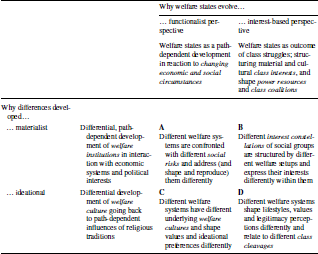
Simplifying, the materialist approaches teach us that welfare states address social risks—which differ across economic systems and sectors—in specific functional ways and based on specific interest constellations (see also Table 1). Following historical institutionalist arguments, welfare state change is perceived as an inert process that happens in path-dependent ways, which is why historically differently developed welfare systems also differ in functionally addressing today’s social risks and in structuring the material interests of different social groups, as well as in shaping power resources and class coalitions.
Without denying the role of path-dependent institutional development (and partly also drawing on cultural approaches within neo-institutionalism; e.g. Béland Reference Béland2005), the ideational approach adds another layer to the observation of welfare institutions: “welfare culture” (Pfau-Effinger Reference Pfau-Effinger2005; Kaufmann Reference Kaufmann2013; see also Mau Reference Mau2003 who speaks of “moral economy”). Welfare systems, the argument goes, developed following ideationally different guiding problems; “a ‘social question’, to be addressed by social policy. The guiding problems reflect national understandings of social policy priorities and in turn give rise to national peculiarities of institutional developments” (Kaufmann Reference Kaufmann2013: 35). Consequently, ideas about redistribution, poverty, the state-market relationship or social citizenship differ across different welfare systems (Pfau-Effinger Reference Pfau-Effinger2005: 8–9). Drawing on Weber (2012[1904/05]), some scholars argue that it was different variants of Christianity (Calvinist ethic in Anglo-Saxon countries, Catholicism in continental Europe, Lutheranism in Scandinavia) that led to the development of different ideational variants of welfare states (Schröder Reference Schröder2013: 96; Pfau-Effinger Reference Pfau-Effinger2005).
The essential arguments from the cultural approach can also be interpreted in a functionalist and an interest-based manner (see also Table 1): From a functionalist point of view, we can argue that welfare systems and welfare measures develop in a way that fits the dominant welfare culture in a country (or regime), whilst at the same time also having a preference-shaping dimension (Mau Reference Mau2003: 195). From an interest-based perspective, we need to acknowledge that the ideational dimension of welfare institutions does not only shape material preferences but also morally supports specific lifestyles which are related to cultural class interests (e.g. of a “new” and an “old middle class” with different class values; Reckwitz Reference Reckwitz2021: 52). These differences can also be understood as related to cleavages between, for instance, “cosmopolitans” and “communitarians” (de Wilde et al. Reference De Wilde, Koopmans, Merkel, Strijbis and Zürn2019).
Summarising, comparative welfare state research teaches us that different varieties of welfare systems exist which are interrelated with economic systems, emerged out of different historical contexts, and differ with regard to their institutional setup and their underlying and cultural ideas dimensions. The literature points towards both functional and interest-based differences across welfare systems, which results in four different analytical perspectives on welfare state varieties (see Table 1): Countries (or regimes) may address different social risks (A), have different interest constellations of social groups (B), have different underlying welfare cultures (C), or show different prevalent cultural cleavages (D). In a next step, I will discuss how this complex picture of welfare state variation can help us to assess the challenges of a green transition in different welfare systems.
Four analytical perspectives on welfare state varieties

Varieties of welfare in a green transition
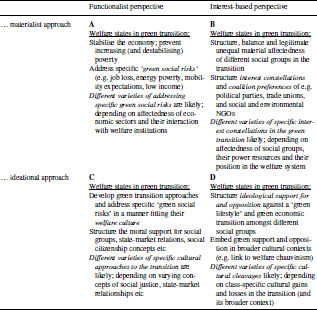
As outlined above, welfare states in a green transition are on the one hand functionally necessary to guarantee social inclusion, prevent widespread poverty and stabilise economies by explicitly targeting ‘green social risks’ and changing labour market demands. On the other hand, they also serve to legitimate and balance the unequal affectedness of transition processes and to mitigate interests of different social groups. As the previous subsection showed that social risk coverage, interest constellations, welfare culture and social cleavages differ across different welfare systems, it seems obvious that different welfare systems are also differently affected by and respond differently to a green transition—and this is also what the rare empirical studies on cross-country differences in eco-social policies, politics, institutions and outcomes point to. However, as mentioned, so far there are almost no theoretical lenses to grasp these empirically observed differences, and to make sense of them. Hence, to provide an analytical starting point for a more systematic inclusion of different dimensions of welfare state variation in the analysis of green transitions, I will now briefly discuss some exemplary results from the literature and will link them to the analytical differentiation between material welfare institutions and welfare culture, as well as between functionalist and interest-based perspectives.
From a functionalist and materialist perspective on welfare institutions (quadrant A in the upper left of Table 2), the analytical focus on welfare states in a green transition lies on their interaction with the economy. The rare cross-country quantitative studies on the matter usually include macroeconomic dimensions to assess economies’ ‘affectedness’ of the climate crisis and/or green structural change. For instance, Zimmermann and Graziano (Reference Zimmermann and Graziano2020) deploy the Yale Environmental Performance Index, Im et al (2022) include countries’ reliance on carbon-polluting industries, and Otto and Gugushvili (Reference Otto and Gugushvili2020) use CO2 emissions per capita. Case studies applying VoC to green transition scenarios teach us that different types of economies face different challenges. Ćetković and Buzogány (Reference Ćetković and Buzogány2016) show, for instance, that coordinated market economies with specialised production face less structural constraints in transforming their economies, and Mikler and Harrison (Reference Mikler and Harrison2012) find that liberal market economies are better equipped to implement technical innovations to reduce carbon emissions. Therefore, studies have to consider which sectors in different economies are affected by a green transition and how these sectors are embedded in the economic coordination and the welfare system in a given economy. Addressing social risks of low paid workers in an agricultural sector which transitions towards greener farming will obviously pose different challenges to welfare states than the winding-up of a coal industry with insider jobs in industrial production. Hence, research is required that explicitly studies which ‘green social risks’ emerge from a green transition in specific economic sectors in different economies, and how these risks are (and can/should be) addressed by different welfare institutions.
Sectoral contexts and their path-dependent embeddedness in the economic and welfare system also play a crucial role in structuring interest constellations and power resources (quadrant B in the upper right of Table 2). With sectoral case studies, Haas (Reference Haas2021), for instance, shows for the energy sector how the institutionalised channels of the environmental and anti-nuclear movement in Germany (environmental organisations such as BUND and NABU; Green party) had at least a certain mobilising power vis-à-vis strong pro-nuclear and coal industry lobby actors (ibid.: 667), whilst in the field of mobility, the interest constellations and power resources were highly different and did not support the “establishment of a green capital fraction of the kind that has emerged in the energy sector” (ibid.: 670). Taking the legitimatory and redistributive role of the welfare state into account, it is again vital to link such studies on different interest constellations in the green transition to research on the material affectedness of different social groups (e.g. Markkanen and Anger-Kraavi Reference Markkanen and Anger-Kraavi2019). Crucial questions to be studied are hence: Who benefits, who loses from energy, mobility and other transitions—and how are power resources and voice distributed amongst stakeholders (political parties, social and environmental NGOs, trade unions etc.)? Well-organised trade unions in core industries have, for instance, probably a much easier game in demanding social support in the case of a re-structuring of their sectors (and in co-designing the re-structuring) than social NGOs in demanding heating, housing and food subsidies for social assistance beneficiaries in times of increasing prices.
Turning towards the cultural dimension of welfare states in a green transition, the literature suggests that welfare systems will engage with green transition approaches and address specific ‘green social risks’ in a (path-dependent) manner that fits their welfare culture (quadrant C in the lower left quadrant of Table 2). To the best of my knowledge, there are no studies addressing the issue explicitly; however, the perspective can help to offer some explanatory interpretation for puzzling findings in other contexts. For instance, Im et al. (2022: 18) find that “Germany focuses on easing the [job] fallout by compensating [industry workers] with early retirement even if it has adequately functioning social investment”. From an economic perspective, this seems puzzling and counterintuitive—but considering the crucial cultural role of individual work effort and performance justice in Germany (Mau Reference Mau2003; Sachweh Reference Sachweh, Sabbagh and Schmitt2016), it appears only natural that core workers who have ‘contributed their fair share’ cannot be ‘burdened with labour market mobility’ in the eyes of the public and of policy-makers. Similarly, we could interpret Otto and Gugushvili’s finding that “the proportion of ‘eco-social enthusiasts’ is particularly large in Norway, Iceland, Finland, and Sweden” (Otto and Gugushvili Reference Otto and Gugushvili2020: 12) also in the light of underlying morals of universality and egalitarianism (Sachweh Reference Sachweh, Sabbagh and Schmitt2016). Which groups deserve social support in the transition in the eyes of the public? Who can be expected to bring sacrifices, who not? What is the expected role of the state in managing a green transition, what of the market—and what of the individual?
A final analytical perspective then is the interest-based perspective on the cultural approach (quadrant D in the lower right of Table 2). Here, research suggests to acknowledge that welfare states, in framing the broader social structure of a society and morally supporting specific lifestyles, also contribute to structuring ideological support for and opposition against a ‘green lifestyle’ and green economic transition amongst different social groups. As, for instance, Neckel points out, sustainability has become a “contested category” which appears as a “dispute over lifestyle design” (Neckel Reference Neckel2020: 83, 84; own translation). Simplifying, for the urban new middle classes with jobs in the knowledge economy, a sustainable lifestyle with eating vegan, avoiding air travel, and using bike and public transport implies a cultural gain, whilst old middle classes with a traditionally fossil-intensive lifestyle (car usage, meat consumption, package holidays with air travel etc.) experience cultural devaluation (ibid.: 85). This also corresponds with Otto and Gugushvili’s finding that “’environmental devotees’ are most likely young women living in big cities, with a good income, a high level of education, high levels of trust in public institutions, and strong preferences for egalitarianism. Conversely, the electorate which is opposed to both environmental and welfare agendas is more likely to be financially insecure people, rural residents, males, elderly, people with very low educational qualifications and those who oppose equality in living standards.” (Otto and Gugushvili Reference Otto and Gugushvili2020: 13). In several European countries, it is visible how radical or populist right parties take up on such ‘eco-opposition’ and also link it to broader ‘regressive agendas’ (e.g. welfare chauvinism, anti-LGBTQI* policies). Power resources in a given welfare setup are hence also shaped by this broader political cleavage, and in order to better understand the political dynamics of a green transition, we thus also need to ask which social groups will experience cultural gains and losses in this transition—something which will also vary according to the class structures in a given country and their involvement in the structural changes.
Table 2 summarises the reflections on the four different analytical perspectives on welfare states in a green transition and highlights relevant aspects that should be taken into account in future analyses on ‘welfare varieties in green transitions’.
Welfare state varieties in green transitions

Conclusion
Who wins, who loses, who supports, who opposes the green transition—and why? As I argued in this article, the answer to these questions is strongly dependent on the welfare setup of an economy. The welfare state not only stabilises the economy, prevents deprivation and balances class interests; it also structures interest constellations, material living conditions, and cultural lifestyles. Hence, which ‘green social risks’ need to be addressed, which social groups will seek to have a voice in a green transition, which transition routes are seen as legitimate, and which societal cleavages emerge around the transition—all these factors are shaped by the welfare setup of a country. Considering the country-specific factors and their interactions can therefore help us to make sense of currently emerging green transition routes, but it can hopefully also contribute to assess potential for—and also socially—successful implementation of green transitions.
In practice, this requires engaging in interdisciplinary theoretical debates on how concepts of, for instance, decommodification, stratification, labour market dualization, market innovation, deservingness perceptions, statutory risk mitigation, human-nature relationships, or class cleavages can be jointly deployed to understand the economic and ecological processes of green transitions and their interaction with welfare states and social dynamics. One way of systematising this enormous effort could be to address the interdependencies of the four quadrants in Table 2 stepwise: deploying labour market dualization theories and trade union studies to understand how green social risks interact with power resources in a green transition (quadrants A and B) might, for instance, suggest that if fossil sector work is mostly by labour market outsiders, the relatively weak power resources of affected stakeholders may facilitate a transition of this sector. Similarly, bringing together power resource perspectives and cultural class approaches (quadrants B and D) we might assume that strong power resources of fossil workers relate to increasing resistance against the devaluation of fossil lifestyles. Of course, in the empirical practice, these dynamics will be more nuanced, and a careful theoretical and empirical conceptualization is required to move beyond simple stereotypes. Here, it will also be vital to engage in debates on relevant variables to distinguish between different outcomes, output, drivers, or dimensions of green transitions and the related social aspects—similar to the very fruitful discussion in early comparative welfare state research (Arts and Gelissen Reference Arts and Gelissen2002; for a very fruitful starting point on eco-welfare see García-García et al. Reference García-García, Buendía and Carpintero2022).
Understanding the various dynamics between green transitions and welfare systems can also provide important lessons for policy-making, as it may allow to systematically assess different states’ and societies’ capacities and potentials for economically functional and socially acceptable green transitions. However, it should not be forgotten that the welfare state first and foremost did not develop as a protector of the working class, but as a functional class compromise which also serves to legitimise social inequalities (and depends on economic growth itself). Hence, if taking the warnings seriously that green growth and ecological modernisation cannot sufficiently reduce climate change (ICPP 2022), policy-makers should not overestimate the welfare state’s potential to accompany or even guide a decommodification of natural resources, to create a ‘just’ (whatever this blurry term may mean) green transition, or to increase acceptability of climate protection measures. Just as the welfare state as a class compromise is a “a stratification system in its own right” (Esping-Anderson Reference Esping-Andersen1990: 4), capitalist green economies can be expected to (re)produce their own patterns of exploitation of natural resources and only provide compromises between this exploitation and the interests of a potential ecological class (Latour and Schultz Reference Latour and Schultz2022).
To sum up, whilst this article provided an analytical starting point in outlining why we can expect to observe different ‘varieties of green transitions’ and which aspects are likely to matter in this context (i.e. sectoral affectedness and green social risks, stakeholder positions and power resources, welfare institutions and welfare culture, material and ideational class interests), future research is strongly required—and not only along the routes sketched out here, but also much beyond: How to bring in climate-crisis-related welfare challenges in the picture? How to add the environmental state perspective? And, most importantly, how can this—admittedly status quo, and hence, green-growth-oriented perspective—help to analyse welfare states’ roles in a more encompassing transformation towards a sustainable economy and society? I hope that the present article provides a fruitful starting point for collective scholarly efforts in the field of eco-social political economy.
Funding
Open Access funding enabled and organized by Projekt DEAL.

 Open access

