

El debate: El muralismo zapatista como revuelta estética
La transformación social que pretende (y emprende) el zapatismo no se puede analizar sin tener en cuenta los cambios estéticos que el movimiento impulsa en sus comunidades. Por ello este texto trata sobre cómo el zapatismo ha abordado estéticamente su proyecto general de transformación en las comunidades y a qué frutos estéticos ha llegado.
Con este fin el artículo ofrece una interpretación de cómo se ha creado y recreado la identidad zapatista a través del lenguaje visual de los murales que están en los territorios donde se asientan los Municipios Autónomos Rebeldes Zapatistas (MARZ a partir de ahora), y cómo esta identidad interpela a la imaginería revolucionaria mexicana oficial y crea una nueva iconografía activista para el movimiento de solidaridad —nacional e internacional— con la rebelión zapatista, y sobre todo para la misma comunidad.
El trabajo se inspira teóricamente en la obra de Zubrzycki (Reference Zubrzycki2013) sobre creación y reestructuración iconográfica. Para Zubrzycki (Reference Zubrzycki2006) las identificaciones colectivas se construyen tanto a través de interacciones personales cotidianas y prácticas institucionales, como de eventos transformadores específicos, y en estos eventos la atención a lo visual cobra un gran y novedoso protagonismo (Bonnell Reference Bonnell1997).
El reto del ensayo es señalar como la forma estética y material del universo icónico del muralismo zapatista consiguió dotar de elementos de identidad y memoria en el seno de las comunidades zapatistas vinculando su lucha con elementos de su entorno y vida cotidiana; confrontar la imaginería revolucionaria oficial de la República mexicana,Footnote 1 disputándole sus atributos principales, a saber, las figuras de Zapata y Villa, el mito del mestizaje (frente a lo indígena) y la bandera nacional; y generar nuevos elementos icónicos para los colectivos activistas nacionales y transnacionales.
Se utiliza el concepto de revuelta estética desarrollado por Zubrzycki (Reference Zubrzycki2013, 431) que significa un proceso por el cual los actores sociales disputan y reelaboran símbolos icónicos en la esfera pública. Y esos símbolos adquieren, a través de esas manipulaciones materiales, significaciones que impulsan la articulación de nuevas identidades y con ello los cambios políticos. Se parte así que la identidad se (re)modela no solo en y a través de ideologías, sino también a través de la estética.
Según Zubrzycki (Reference Zubrzycki2013, 431) para que se dé “una revuelta estética” deben concurrir cinco dimensiones del ser y la vida de los objetos culturales en cuestión, que son las siguientes:
-
un evento histórico, político y social crítico que suponga la creación, interpretación, uso y transformación de los objetos-iconos;
-
un nuevo contenido relacionado con ideologías y significados que los “llenan”;
-
una nueva forma visual y material específica;
-
la elaboración de discursos y concursos sobre los nuevos iconos, tanto en relación con su contenido como con su forma; y
-
su representación, reproducción, praxis militante e interpretación en la esfera pública.
De estas cinco dimensiones las dos primeras —el contexto político (del levantamiento zapatista en 1994) y las ideologías y significados con que se relaciona— están extensamente estudiadas y analizadas.Footnote 2 Sin embargo las tres últimas han sido muy poco tratadas y son sobre las que versa este artículo.Footnote 3
Con este propósito este texto inicia señalando el origen de los datos con los que se basa el ensayo, que son originales, la naturaleza del trabajo de campo realizado, haciendo hincapié en los usos que tienen los murales para las comunidades, la solidaridad internacional y sus adversarios, y la relevancia que tienen la materialidad de esta expresión visual. Posteriormente, se analiza cómo el muralismo zapatista genera una nueva forma visual y material de la iconografía activista a partir de un estudio pormenorizado de los elementos iconográficos de 203 murales, y cómo a través de ellos se elaboran discursos innovadores tanto en relación con el contenido como con su forma. Finalmente, a modo de conclusión se muestra como el muralismo zapatista crea elementos de identidad y memoria para sustentar la lucha de las comunidades en resistencia, crea una nueva iconografía activista, y se contrapone al muralismo oficial mexicano. Con ello se afirma que dicha expresión supone un proceso de revuelta estética mediante el cual los actores sociales en lucha reelaboran símbolos icónicos y redefinen la identidad colectiva para enfrentarse a sus adversarios.
La naturaleza de las fuentes, el trabajo de campo y la relación entre el espacio zapatista y los murales
Este artículo sigue la tendencia de emplear enfoques etnográficos en estudios de cultura política y cultura visual con el fin de comprender tanto el poder de las imágenes en la reconfiguración de la vida política como la importancia de la materialidad de los objetos (McDonnell Reference McDonnell2010; Mukerji Reference Mukerji1994; Murphy y Kraidy Reference Murphy and Kraidy2003). Con dicho propósito se entrevistaron a muralistas, promotores culturales de las comunidades de los MARZ y miembros de la red nacional e internacional de solidaridad con el zapatismo. También se observó la relación de los pobladores de las comunidades de los MARZ con los murales en el medio del rural donde se asientan, y la mirada de los campamentistas de las brigadas de solidaridad con ellos. Finalmente, se dialogó con personas que viven y trabajan, y pasan por los lugares donde están los murales. Estos datos se recopilaron en varias estancias de trabajo en México durante la década de 2010–2019, tanto en los MARZ de Chiapas como en diversas ciudades del país, donde se entrevistaron personas vinculadas con la causa zapatista y su muralismo. La mayoría de encuentros se realizaron en Ciudad de México, Cuernavaca, Puebla, Tepoztlán, Xalapa y Oaxaca. También en este mismo período se entrevistaron a miembros pertenecientes a la red de solidaridad internacional con el movimiento zapatista en Barcelona y Madrid.
Destaca especialmente el trabajo de campo realizado durante los meses de febrero, marzo y abril de 2008 en el territorio de los MARZ en Chiapas. El viaje lo realizaron cuatro personas (entre ellas el autor) con el fin de transitar y hacer fotografías por todo el territorio zapatista. La posibilidad de hacerlo se debió a la confianza que tenían las autoridades zapatistas en uno de los miembros de la expedición que, durante ocho años, fue promotor cultural en un municipio del Caracol de Morelia.Footnote 4 Eso es así porque para desplazarse y fotografiar los murales presentes en los MARZ es necesario que cada Junta de Buen Gobierno (JBG) lo autorice.Footnote 5
En dicho viaje se registraron hechos cotidianos y reflexiones de las personas que allí viven y transitan (Martí i Puig Reference Martí i Puig2012), y se hizo un inventario de todos los murales existentes.Footnote 6 Eso supuso realizar un registro de todos los murales que había dispersos por el territorio zapatista desde 1994 hasta la fecha del viaje, desde las comunidades más humildes, hasta en las cinco sedes de los Caracoles de entonces. El viaje empezó en el Caracol de Morelia para posteriormente trasladarse al de Oventic, la Realidad, la Garrucha y Roberto Barrios. La estancia en cada uno de ellos empezaba pidiendo permiso a las autoridades de las JBG. Posteriormente se iba a las comunidades donde había murales. El itinerario realizado, con el nombre de las comunidades que se visitaron, aparece en la figura 1.
Mapa de la ruta en busca de murales (Martí i Puig Reference Martí i Puig2012, 3).

La expedición realizó 12 004 fotografías de murales, carteles y motivos pintados en el territorio zapatista. Entre las fotos había muchas de repetidas (buscando el mejor enfoque, ángulo y luz) y varias de fragmentos y detalles. Para este artículo se seleccionaron 512 fotografías de los 203 murales más representativos del territorio, clasificándolos primero según su ubicación. Los 203 se distribuyeron territorialmente de la siguiente manera: veintitrés en la zona de Morelia, sesenta y tres en Oventic, treinta y cinco en La Realidad, sesenta y tres en La Garrucha y diecinueve en Roberto Barrios.
Antes de proceder al análisis de los murales cabe señalar que el elemento más singular del muralismo zapatista es su propia geografía, ya que se trata de un espacio que no es continuo, ni fijo ni oficialmente reconocido. Se trata del espacio que el Ejército Zapatista de Liberación Nacional (EZLN) y sus bases de apoyo arrebataron a algunos propietarios latifundistas y al Estado en 1994.
El origen de este territorio es el levantamiento del 1 de enero de 1994, y la ocupación de tierras por parte de campesinos de comunidades vinculadas al zapatismo (Villafuente Solís Reference Solís1999; Van der Haar Reference Van der Haar1998a). Quienes viven en dicho territorio profesan lealtad y conforman la parte civil del EZLN, y son conocidos como “bases de apoyo”. Sus tareas son proteger el secreto de la existencia de la guerrilla, salvaguardar el anonimato y la clandestinidad de los insurgentes, garantizar víveres al EZLN, participar en las movilizaciones políticas de protesta, y realizar trabajos colectivos de infraestructura y servicios comunitarios (Rovira Reference Rovira1997). La administración y organización de dicho territorio significó la re-municipalización de la zona nororiental de Chiapas, y la creación en 1998 de más de treinta municipios autónomos, generando una estructura paralela a la de los municipios oficiales (Van der Haar Reference Van der Haar1998b).
Los MARZ son un desafío al gobierno, ya que tienen sus propios representantes, sus leyes y sus recursos. Pero los MARZ no se extienden geográficamente de manera continua, sino según la afiliación de sus bases, pues en un mismo espacio pueden convivir comunidades de diversa adscripción política. Los MARZ asumen la jurisdicción sobre la población afiliada al zapatismo, sobre la tierra ocupada y los servicios que se prestan, rechazando los servicios que se ofertan desde la administración oficial (Olesen Reference Olesen2005; Rovira Reference Rovira2009). Así el territorio zapatista es un espacio de la geografía mexicana en el cual el Estado tiene una presencia discontinua, siendo intensa en algunos enclaves —a través de cuarteles militares u oficinas gubernamentales que dispensan programas sociales— y ausente en otras, como es en las controladas por el EZLN. Fue en este espacio en el que se llevó a cabo el trabajo de campo y se obtuvieron las fotos de los murales que se van a analizar.
Las características del espacio zapatista son relevantes porque están estrechamente relacionadas con el estudio de la materialidad que se preocupa por comprender como los objetos y las personas interactúan con ellos (Appadurai Reference Appadurai1986; Keane Reference Keane2003; Woodward Reference Woodward2007). Desde las teorías culturales de la materialidad, las cosas ejercen una especie de agencia, como extensiones de personalidad que inciden y provocan respuestas de los actores sociales (Gell Reference Gell1998). Así, los murales, en tanto que objetos culturales, se convierten en vehículos de significado que permiten un tipo preciso de comunicación y mensaje dependiendo de dónde están ubicados (en las comunidades, en los Caracoles, en las carreteras, etc.), el tipo de edificio que los exhibe (espacios comunitarios, casas particulares, vallas, etc.), su soporte material (pared de ladrillo, de madera, planchas de zinc, etc.) y por la calidad de los materiales y su desgaste. Esto es relevante porque la materialidad de los símbolos restringe y permite su significado, a través de un proceso de interacción entre las cualidades materiales y simbólicas de un objeto, el interpretante y el contexto de esa interacción (McDonnell Reference McDonnell2010).
En este caso, los murales no se han producido con un objetivo de disfrute homologable a las pinturas de los museos, sino que se insertan en un proyecto político en marcha como experiencia de autonomía, con unas rutinas iconográficas, con consignas concretas, generando un compromiso y una comprensión común de lo que es la lucha en ese lugar. Así, los murales —además de recrear una identidad y un imaginario de y entre la comunidad y para los activistas— desarrollan las tres funciones de gran trascendencia política, que se exponen a continuación.
La primera de ellas es delimitar el espacio zapatista en una geografía discontinua y con ello señalar y manifestar la lealtad política de los pobladores (y la comunidad) en dicho territorio. El hecho de que la geografía zapatista no sea un espacio continuo, sino una especie de archipiélago que se vincula entre sí por su lealtad política con el EZLN, hace que la pintura mural sea la señal física que indica y delimita un territorio. En este sentido se puede afirmar que la adscripción de las comunidades en resistencia se manifiesta físicamente a través de los murales que señalan la entrada, la salida y la pertenencia de un orden político singular. Los murales dan la bienvenida, lanzan consignas y, sobre todo, muestran una iconografía diferente a la oficial, hecho que denota la existencia de otro orden.
La segunda función es la de generar aprendizaje comunitario y debate sobre los elementos clave y esenciales del ser zapatista. El muralismo se utiliza para contar historias de eventos significativos y fundacionales de la causa política, y también para señalar actividades cruciales de la comunidad, como las de ir a la escuela, cuidar la milpa o atender la salud (Vargas Santiago Reference Santiago2012, Reference Santiago2015). Además, el muralismo sirve para activar memorias. Como señala Híjar (Reference Híjar2007, Reference Híjar2017), los murales son vehículos de memoria en una doble dimensión, ya que por un lado son medios que comunican y que transmiten una experiencia crítica, y por el otro son espacios que dan voz a grupos y colectivos constituidos en agentes sociales —a los que Híjar (Reference Híjar2017) llama “emprendedores de memoria”— que buscan materializar un sentido del pasado y que se asumen como sujetos resistentes.
La tercera y última es la de desafiar a las autoridades y los adversarios, tal y como ocurre con todo el muralismo combativo (Crettiez y Piazza Reference Crettiez and Pierre2013). En el caso particular del zapatismo se trata de retar y desautorizar lemas oficiales, frustrar la censura, hacer propaganda, usar a veces un idioma que no es oficial, conmemorar y recuperar una historia alternativa, dejar huella en un territorio y disputarlo con las autoridades y con comunidades rivales, y, evocando una realidad proclamada, materializándola de una manera gráfica y visible.
En el sentido expuesto, los murales sirven para delimitar, para mirarse (las comunidades, las bases de apoyo), para ser mirados (los simpatizantes y la red de solidaridad), y para increpar y retar (a las autoridades y al resto de la sociedad). Precisamente por ello, y aunque primero de forma intuitiva, las autoridades zapatistas desde sus inicios impulsaron la creación de murales. Desde los primeros encuentros en los Aguascalientes hasta la actualidad, el muralismo se ha afianzado en todo el territorio zapatista. Algunas veces a través de brigadas de apoyo nacionales e internacionales que en sus estancias solidarias pintan murales, algunas a partir del apoyo de algunos muralistas comprometidos, y muchas otras a través de promotores de educación y cultura anónimos que inducen de forma pedagógica a elaborar murales y otros materiales didácticos con la comunidad impulsando la autoproducción, y siempre con una voluntad política vinculada al activismo.
Para terminar el epígrafe señalamos que el lugar en donde se realizan estos murales no es un asunto menor, porque se trata de un territorio remoto, en medio de selvas y cañadas del sureste de Chiapas, donde para llegar a él deben de cruzarse retenes militares y comunidades hostiles al proyecto zapatista. Además, casi todos los murales están en espacios de uso comunitario no enajenable, con un fuerte componente anónimo y colectivo, y con criterio de durabilidad a pesar de que a menudo se pintan en bases perecederas como tablones de madera, zinc y en mantas. Este dato nos remite a la reflexión de McDonnell (Reference McDonnell2010) cuando expone que las intersecciones de las cualidades materiales de los soportes gráficos y los entornos geográficos —conjunción que él denomina “entornos de objetos”— modulan la recepción de los mensajes, señalando que “el lugar es importante”. También McDonnell (Reference McDonnell2010) señala que los objetos y los entornos son igualmente relevantes para la fabricación de significado, hasta el punto de que uno no puede entender uno sin el otro; y afirma que el carácter material de los lugares restringe y permite la visión y los significados porque el lugar (su ubicación y dificultad de acceso) limita las audiencias disponibles que interactúan con el objeto cultural. En el caso que tratamos, las audiencias son de cuatro tipos: los miembros de las comunidades zapatistas; los pobladores de comunidades vecinas aliadas o enfrentadas al proyecto político del EZLN; los viajeros que transitan por el territorio zapatista; y, finalmente, las personas que pertenecen a redes de solidaridad nacional e internacional con el zapatismo. Para los primeros el mensaje es de afirmación, identidad y memoria; para los segundos de identificación del espacio y de la soberanía; para los terceros (en caso de que se percaten de su presencia según su perceptibilidad) de anuncio de un proyecto político alternativo en el territorio; y para los últimos de creación y recreación del compromiso político y —al igual que los primeros— de gozo simbólico y estético. Sin duda, en esta experiencia, cada individuo se acerca a los murales con sus propias ideas sobre lo que espera encontrar en estos; y dichas ideas dependen del marco social y cultural en que se encuentran, es decir, de su horizonte de expectativas.
Iconografía y mundo simbólico
El muralismo zapatista se enmarca dentro de una doble tensión. De un lado bebe de la tradición muralista popular-revolucionaria mexicana, pero del otro la contradice y resignifica.Footnote 7 Sin embargo, el muralismo zapatista tiene un elemento crucial que lo diferencia del oficial, a saber, que se produce casi siempre de forma comunitaria con el propósito de crear una subjetividad que incorpore una identidad (la del sujeto colectivo de las comunidades en resistencia), un conocimiento apropiado (el de la vida en los MARZ), un proyecto colectivo (de la rebelión zapatista) y, sobre todo, un reconocimiento desde el exterior (Híjar Reference Híjar2017). El muralismo zapatista pretende mostrar una nueva forma visual y material específica alejada de los códigos y espacios del muralismo oficial. Además, también se diferencia del oficial, tal como se ha señalado, por el espacio donde aparece y por el soporte material que lo sustenta.
Sorprende que hasta ahora haya tan poca atención sobre este aspecto del zapatismo, a pesar de la gran producción reflexiva sobre este episodio insurgente. Con el fin de llenar este vacío la presente investigación comienza elaborando un análisis descriptivo de las características de los 203 murales registrados y una muestra de los hallazgos a partir de quince murales clave. De la sistematización de los murales aparecieron datos reveladores que se detallan seguidamente en las cuatro tablas a continuación,Footnote 8 las cuales dan cuenta de la ubicación y autoría de los murales (tabla 1), de las figuras que exhiben (tabla 2), del entorno de referencia (tabla 3) y de las historias y consignas que muestran (tabla 4).
Ubicación y autoría de los murales (en %).

Figuras presentes en los murales (en %).

Elementos del entorno de referencia de los murales (en %).

Relatos gráficos y consignas presentes en los murales (en %).

Como se muestra en la tabla 1, respecto a la ubicación, el 55,2 por ciento de los murales registrados estaban en las sedes de los Caracoles, y el 44 por ciento en comunidades. Tanto en un sitio como en otro, más de la mitad de los murales se ubicaban en “casas grandes” (53,2 por ciento),Footnote 9 y el resto en otros emplazamientos, que podían ser muros exteriores de casas particulares, mantas, vallas o señales. En lo que respecta a la autoría, solo el 23,7 por ciento de todos los murales están firmados, pues la mayoría de los murales son de autoproducción comunitaria. El 6,9 por ciento lo están por Gustavo Chávez y/o el grupo La Gárgola; el 1,9 por ciento por el colectivo de “Pintar Obedeciendo” que fundó Checo Valdés, y el 15,4 por ciento por otras personas que aparecen de forma esporádica.Footnote 10
En cuanto a los elementos básicos de la iconografía mural (Dézé Reference Dézé2013; Ryan Reference Ryan2017), se tomó nota de lo siguiente: las figuras que se plasman (distinguiendo líderes y personas singulares, de comunidad-sujeto revolucionario) que se muestra en la tabla 2; el entorno de referencia que se muestra en la tabla 3; y la presencia de relatos gráficos (episodios, eventos o historias) en el cuerpo de los murales que se muestra en la tabla 4.
En el caso de los personajes a que se hace referencia, estos son los líderes revolucionarios, los combatientes anónimos (en sentido literal o figurado) y los personajes relacionados a los pueblos indígenas o a la teología católica. Por ello en cada mural se examina si aparecen las siguientes figuras, que hacen referencia a líderes revolucionarios, miembros de la comunidad, luchadores figurados y motivos religiosos.
En los datos que se muestran en la tabla 2, uno de los hallazgos más significativos es que los personajes que más aparecen son los miembros de las comunidades en resistencia (que son los “compas”) y de ellos el 39,9 por ciento son varones y el 33,8 por ciento mujeres (13 por ciento como madres) y 15,1 por ciento son niños o bebés. Después le siguen los insurgentes (guerrilleros con pasamontañas, miembros de la tropa del EZLN), de los cuales el 38,2 por ciento son varones y el 25,5 por ciento son mujeres (6,9 por ciento madres) y 8,1 por ciento niños o bebés. También aparecen combatientes y compas de forma figurada a través de unos ojos en un pasamontaña en el 17,3 por ciento, milpas con granos que emulan caras de compas con paliacate o combatientes con pasamontañas (un 12,2 por ciento) y personajes zapatistas estilo naíf —alados o volando (un 4,6 por ciento). En tercer lugar, aparece la figura del Subcomandante Insurgente Marcos que se reproduce en el 33,1 por ciento de los murales. Del resto de líderes revolucionarios aparece Emiliano Zapata con el 17,7 por ciento, Che Guevara con el 13,6 por ciento, Ricardo Flores Magón con el 2,9 por ciento, la Comandanta Ramona con el 3 por ciento, Pancho Villa con el 0,6 por ciento y otras figuras (miembros del EZLN que murieron antes del levantamiento, guerrilleros locales o mártires) con el 7,3 por ciento. Debe señalarse que en un 20,2 por ciento de los murales aparecen figuras que evocan a los pueblos originarios. Respecto a personajes religiosos, está la Virgen de Guadalupe en un 3,6 por ciento, personajes de las Sagradas Escrituras en un 2,3 por ciento, ángeles o belenes en un 2,5 por ciento, y personas rezando y yendo a la iglesia en un 6,6 por ciento.
En cuanto al entorno de referencia (que en este caso es la comunidad y la naturaleza), se registra si aparecen imágenes de tareas o servicios que se prestan desde la administración zapatista, y los motivos sobre la naturaleza (Figura 2). Por ello se registra (con la frecuencia en porcentajes) si en los murales aparecen (o no) estos elementos que luego aparecen en la tabla 3: tareas propias de la comunidad (personas haciendo labores agrícolas o de otro tipo); imágenes relacionadas con servicios que se ofrecen en los MARZ (escuelas o actividades educativas, centros de salud o actividades relacionadas con la salud); motivos de la naturaleza (maíz o milpas, luna, sol, estrellas, arcoíris, ríos, selva); y motivos culturales (elementos mayas o precolombinos).
La vida de la comunidad.

De los datos de la tabla 3 destaca la presencia de tres elementos: el maíz (35,4 por ciento), las estrellas, a veces como estrellas insurgentes y otras como estrellas en el cielo (38,6 por ciento), y la selva (32,2 por ciento). Le siguen el sol (27,7 por ciento), la luna (27,3 por ciento), los ríos (18,9 por ciento) y el arcoíris (7,6 por ciento). Respecto a las actividades comunitarias, aparecen personas realizando tareas del campo un 15,6 por ciento, y otras tareas (cocinar, artesanía, carpintería) un 14,8 por ciento. Y en cuanto a la educación o la salud, hay un 16,2 por ciento de escenas relacionadas con la primera y un 7,1 por ciento con la segunda.
En cuanto a las historias y relatos de episodios clave del imaginario zapatista se indaga en los eventos relacionados con la conquista y el expolio de los pueblos indígenas y sus territorios, y con episodios propios de la rebelión zapatista. En este sentido se registró cuando los murales hacían referencia a relatos históricos o eventos de lucha y opresión, que calificamos como distopía. Sobre todo, relatos históricos clave (imágenes de la conquista española, imágenes de las agresiones del ejército a las comunidades zapatistas, imágenes del levantamiento zapatista) y distopías (hechos que representan deforestación, al neoliberalismo o a la globalización, referencia a partidos tradicionales en el poder, el Partido Revolucionario Institucional o el Partido Acción Nacional).
En la misma tabla también se señala si en los murales había consignas, fijándonos específicamente si se repetían las tres más tatareadas en el mundo de la solidaridad con el movimiento zapatista que son: “Para todos todo, para nosotros nada”, “Un mundo donde quepan muchos mundos” y “Basta Ya”. Sobre este tema sorprende que, a pesar de que el 43,1 por ciento de los murales contiene consignas, solo el 1,4 por ciento reproducen las tres mencionadas: la primera con 1 por ciento, la segunda con un 0,7 por ciento, y la última con un 0,9 por ciento. El resto de las consignas que aparecen en los murales son variadas, algunas relacionadas con la lucha indígena (incluso en lenguas mayenses), otras de carácter revolucionario y muchas de cariz irónico o poético —nota Martí i Puig (Reference Martí i Puig2012, 44–45).
De la tabla 4 se observa que solo aparece un 1,5 por ciento de murales que muestran escenas de la conquista, un 7,2 por ciento de ataques del ejército a las comunidades y un 2,6 por ciento de historias vinculadas al levantamiento (u otras hazañas) del EZLN. En cuanto a escenas que representen distopías también hay pocas: el 4,6 por ciento hablan de ataques a la naturaleza, el mismo porcentaje al que se hace referencia al neoliberalismo, y el 1,6 por ciento son sobre los gobiernos del PRI o al PAN, partidos mexicanos en el poder cuando se pintaron los murales.
Los datos que se han descrito, sin embargo, no son homogéneos a lo largo de todo el territorio zapatista, ya que en cada uno de los Caracoles hay singularidades a destacar. Respecto a la autoría hay mucha diferencia entre Oventic y el resto, ya que en dicho Caracol el 55,6 por ciento de los murales tienen autoría: el 34,9 por ciento está firmado por Gustavo Chávez, y el 23,8 por ciento por otros. Mientras que los de Morelia solo están firmados el 13 por ciento, en La Realidad el 20,6 por ciento, en La Garrucha el 24,2 por ciento y en Roberto Barrios el 5,2 por ciento. No es casual que en el Caracol de Oventic y alrededores haya más murales firmados y que algunos de ellos se identifiquen con el zapatismo internacional, pues dicho Caracol es el más cercano a San Cristóbal de Las Casas y, en cierta forma, es la vitrina del zapatismo. Por otro lado, en las otras zonas encontramos pinturas menos homogéneas, con mezcla de murales bien confeccionados y otros más bien sencillos. Hay trabajo colectivo, a menudo itinerante, que dan al mural un formato amateur. En estas zonas solo están firmados algunos de los murales de los campamentistas nacionales o internacionales. Destaca, a la vez, la labor realizada por el equipo “pintar obedeciendo” impulsado por Checo Valdés en la zona de La Garrucha (Híjar Reference Híjar2013, Reference Híjar2011).
También hay diferencias entre las zonas en cuanto a las figuras revolucionarias. El Subcomandante está muy presente en La Realidad (donde se presume que era su lugar habitual de residencia) apareciendo en el 47 por ciento de los murales, mientras en La Garrucha figura con el 40,3 por ciento, en Roberto Barrios con el 31,5 por ciento, en Morelia con el 26,1 por ciento, y en Oventic con el 20,6 por ciento. Así, el Subcomandante es la figura revolucionaria más presente en todo el territorio a excepción de Oventic, donde Zapata se registra más veces (26,9 por ciento). A nivel agregado después del Sub está Zapata en segundo lugar, menos en Morelia donde el Che (8,7 por ciento) tiene la misma presencia. El argentino es, en el resto de Caracoles, el tercero más reproducido. A mucha distancia están Flores Magón —a pesar de que está en el 8 por ciento de los murales de La Garrucha, si bien nunca en Morelia ni en La Realidad—, Pancho Villa y la Comandante Ramona. Los compas y los insurgentes, por otro lado, están muy presentes: el 52,1 por ciento y 39,2 por ciento en Morelia; el 38,1 por ciento y el 39,7 por ciento en Oventic; el 52,9 por ciento y 29,4 por ciento en La Realidad; el 35,4 por ciento y 35,4 por ciento en La Garrucha; y el 21 por ciento y 47,4 por ciento en Roberto Barrios, respectivamente.
A nivel agregado, para todos los Caracoles, destaca que motivos de la naturaleza como el maíz, el sol, la luna, la selva y las estrellas siempre forman parte del entorno de los murales de manera reiterativa. De forma más moderada, aunque bastante homogénea, se hace alusión a la educación y a la salud; así como a tareas cotidianas de las personas de la comunidad, como el trabajo en el campo. Por otro lado, destaca que no están muy presentes (aunque aparecen) imágenes de ojos que miran a través de pasamontañas, si bien suelen ser iconos gráficos del movimiento zapatista internacional. Tampoco hay muchas figuras religiosas a pesar de que algunos murales con la Virgen de Guadalupe se han reproducido y se han hecho muy populares. Aún así, persisten algunas imágenes de las Sagradas Escrituras y de iglesias, en señal de la relación que ha existido entre las comunidades zapatistas y la Iglesia Católica, sobre todo a partir de la pastoral indígena de la Diócesis de San Cristóbal de Las Casas.
Los relatos históricos también aparecen en todos los Caracoles (aunque no con abundancia) y en ellos se representan ataques del ejército a las comunidades y episodios del levantamiento zapatista; mientras que son excepción las imágenes relacionadas con la conquista o con agresiones al medioambiente, al igual que casi no hay imágenes de fenómenos que hagan referencia a la lucha contra el neoliberalismo y la globalización. De los datos que se exponen se puede afirmar que el muralismo zapatista presenta una forma visual y material específica, cuestión que se desarrolla en el próximo epígrafe.
Caracterización del muralismo zapatista: Los elementos de la revuelta estética
El muralismo zapatista da cuenta de una iconografía original y particular que lo hace especial y que reconfigura la identidad revolucionaria oficial, a la vez que crea una comunidad imaginada zapatista que se sistematiza a partir de un discurso iconográfico basado en el entorno, la comunidad, y unos protagonistas y eventos particulares. De todo ello resultan los elementos clave que lo caracterizan y que, a la postre, dan cuenta de la presencia de una revuelta iconográfica sin precedentes en la izquierda latinoamericana de fines del siglo XX (Knight Reference Knight2019), tanto por el imaginario que despliega como por su ubicación rural y diseminada. Seguidamente se detalla cómo esta expresión trata el entorno, la comunidad, los protagonistas y la historia.
Respecto del entorno, este hace referencia al mundo precolombino y a la naturaleza. Para lo primero destaca la presencia de figuras y motivos que evocan el mundo indígena como son las pirámides, el alfabeto maya (glifos), personas vestidas con indumentaria tradicional, serpientes emplumadas, caracoles, cultivos endémicos como el maíz, dioses propios (a veces de forma sincrética con imaginería religiosa católica, sobre todo haciendo referencia a la guadalupana), y frases en tseltal, tsotsil y tojolabal. Junto a ello están las referencias al entorno natural chiapaneco, donde aparecen jaguares, mariposas, quetzales, así como milpas, ríos, cañadas y senderos. En este sentido destaca la presencia de la naturaleza como un punto de intersección entre cosmovisiones que se entremezclan y que forman parte del universo indígena, con reclamos precolombinos. Además, los motivos de la naturaleza (sol, estrellas, selva, arcoíris, luna, etc.) están muy presentes, estableciendo también puentes con las sensibilidades ecologistas. Con ello se muestra una cosmovisión distinta a la occidental, donde la naturaleza, la vida, la lucha, los seres humanos, los dioses y las fieras están entrelazados. A partir de ello se crea un entorno encantado que se opone al desencantamiento que fomentó la razón instrumental capitalista, colonialista y ecocida. Con esta misma voluntad abunda el estilo naíf, tanto en la composición de las escenas y el colorido de las mismas, como por la creación de personajes figurados, donde se pueden encontrar una niña con una gran melena de color azul que simboliza las olas del mar, y dentro de cada ola objetos como mazorcas donde los granos llevan paliacate o vacas con pasamontañas.Footnote 11 Esta ausencia de reglas de representación realista —apostando por lo metafórico— da cuenta de la voluntad de encantamiento.
Por otro lado está la comunidad o, mejor dicho, la vida cotidiana en la comunidad, donde se hace referencia a labores del campo como la de cuidar la milpa o pasturar el ganado, aunque también se hace mención a las reuniones y asambleas comunitarias (a veces frente a las iglesias), y a la salud y la educación enmarcadas en el proyecto zapatista. Esta comunidad, a la vez, está compuesta por protagonistas cotidianos, y dando una especial relevancia a los insurgentes (con pasamontañas) y los compas (con paliacate), señalando la centralidad de la gente común —y de las mujeres en particular (Millán Reference Millán2014)— en los proyectos radicales. Además, estas personas aparecen realizando tareas ordinarias —como trabajar la milpa, hacer artesanía o cuidar niños— otorgando así, valor a lo común.
De lo expuesto es crucial apuntar que hay un contraste entre la épica revolucionaria y belicista guerrillera y la humildad de la vida cotidiana de los miembros de las comunidades en resistencia, muchas de ellas mujeres (Baronnet, Mora y Stahler-Sholk Reference Baronnet, Bayo and coords2011). En los murales de los municipios hay más vida cotidiana que épica, destacando la importancia que se le da a la educación y a la salud, y al trabajo de la tierra. Sobre este último punto (la tierra) el hecho de que los protagonistas sean indígenas se vincula con las revueltas campesinas, pero ahora con el elemento autóctono.
En cuanto a la comunidad, destacan los nuevos protagonistas, que son los iconos del zapatismo. Además de los compas e insurgentes anónimos aparecen con perfil propio, el Subcomandante Insurgente Marcos y la comandanta del Comité Clandestino Revolucionario Indígena Ramona. A ellos se les suman otros personajes clásicos que se reinterpretan, como es Emiliano Zapata,Footnote 12 Flores Magón, Pancho Villa o el Che, que al situarlos con, y a la par, de los compas e insurgentes y del Subcomandante cobran una nueva dimensión que los distancia del oficialismo revolucionario mexicano y los sitúa en el campo ideológico del EZLN y en un proyecto político-visual diferente. La reelaboración de los héroes de la patria robustece al proyecto zapatista, a la par que le arrebata al Estado mexicano sus figuras fundacionales y les otorgan un halo alternativo, libertario e indígena.
Pero es importante señalar que los personajes anónimos aparecen más veces que los héroes revolucionarios, si bien el Subcomandante y Emiliano Zapata están muy presentes. Este último destaca como abanderado de las revueltas campesinas por la tierra, ahora con el elemento indígena y desafiando al Gobierno mexicano. Esta resignificación supone también un cambio en el imaginario étnico del mestizaje, señalando a los pueblos indígenas como “parte sin parte” que interpelan el modelo de Estado nación y el modelo neoliberal (Rovira Reference Rovira1999, Reference Rovira2012).
En esta nueva iconografía resaltan, a la vez, tres elementos. El primero es la mirada que da cuenta del acto de mirar y ser mirado, generalmente a partir de la imagen de dos ojos enmarcados en un pasamontaña que otea el horizonte. El segundo es el pasamontañas para mirar y cubrir, para enmascarar y desenmascarar. Y el tercero es la bandera nacional que es recuperada para señalar que los excluidos (los indígenas) y rebeldes también son parte de la nación y que no quieren —nunca más— un país sin ellos.
A la vez, el muralismo zapatista también mantiene algunos elementos clásicos de todo muralismo combativo, como la exposición de eventos épicos propios —como son el levantamiento zapatista del 1 de enero de 1994, los combates entre insurgentes y el ejército, la Convención Nacional Democrática que se realizó en Guadalupe Tepeyac en agosto de 1994, o los diálogos de paz de San Andrés— o la referencia, aunque en menor medida, del martirologio como semilla de un nuevo mundo, como en el mural de los “mártires de Morelia” dedicado a los pobladores asesinados en enero de 1994 por el ejército. Pero es preciso indicar que el muralismo zapatista invoca mucho más a la cotidianidad y a la utopía que al combate y a la agresión.
Finalmente, en cuanto a la relación dialéctica entre utopía y distopía, esta se decanta a favor de la primera. El análisis de los murales da cuenta que hay mucha más utopía que premonición de desastres, y más imágenes armónicas, alegres y horizontes luminosos que guerra, agresión o lucha. En este sentido el muralismo zapatista es diferente al de otros muralismos radicales contemporáneos que enfatizan la lucha como guerra (Sánchez Estévez Reference Estévez2015) y no la lucha como vida. Sin duda esta imagen se relaciona con el marco de motivación de lucha zapatista. El muralismo aparece como una construcción de ánimo para la lucha día a día y a largo plazo, donde lo alegre, lo inocente, e incluso lo fantasioso, está presente. Finalmente cabe señalar como en los murales a menudo aparecen imágenes que hacen referencia a lo prehispánico (generalmente maya) y, en menor medida, resonancias católicas derivadas de la influencia de la teología de la liberación, como aliados que se invocan para la lucha.
Sintetizando lo arriba expuesto es posible señalar (y ejemplificar con once fotos) que hay cinco elementos que están presentes en casi todos los murales, a saber:
-
Una representación espacial donde se muestra una organicidad simbiótica entre la comunidad y la naturaleza (Figura 2), donde la vida comunitaria fluye armónicamente;
-
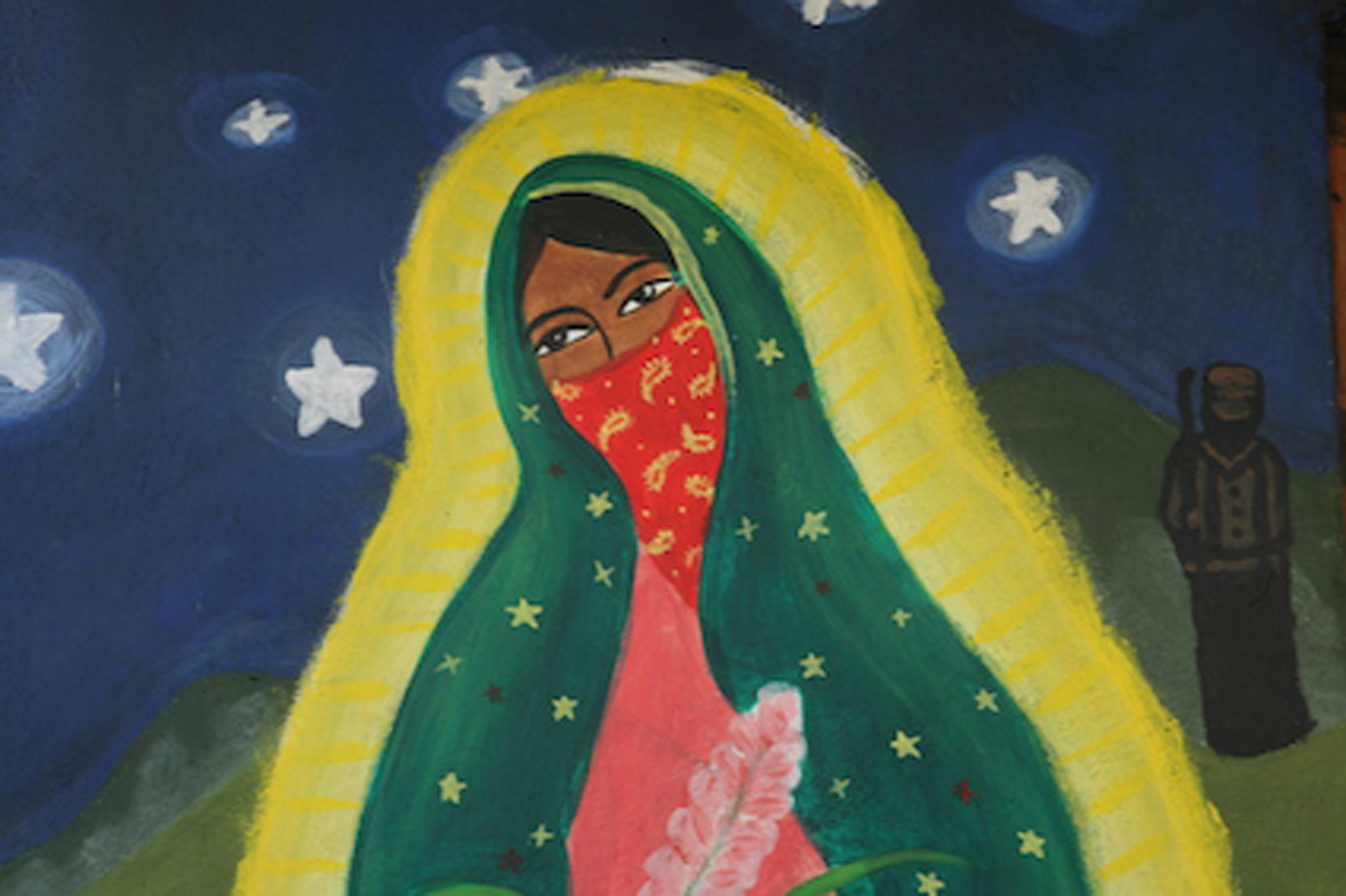
una temporalidad que conecta el presente con épocas de la historia que se visualiza a partir de personajes o mitos, donde destacan figuras y mitos prehispánicos (Figura 3), personajes de la Revolución Mexicana, como Emiliano Zapata, Pancho Villa o Flores Magón (Figura 4), o figuras fundacionales de la identidad mexicana, como es la Virgen de Guadalupe (Figura 5);
-
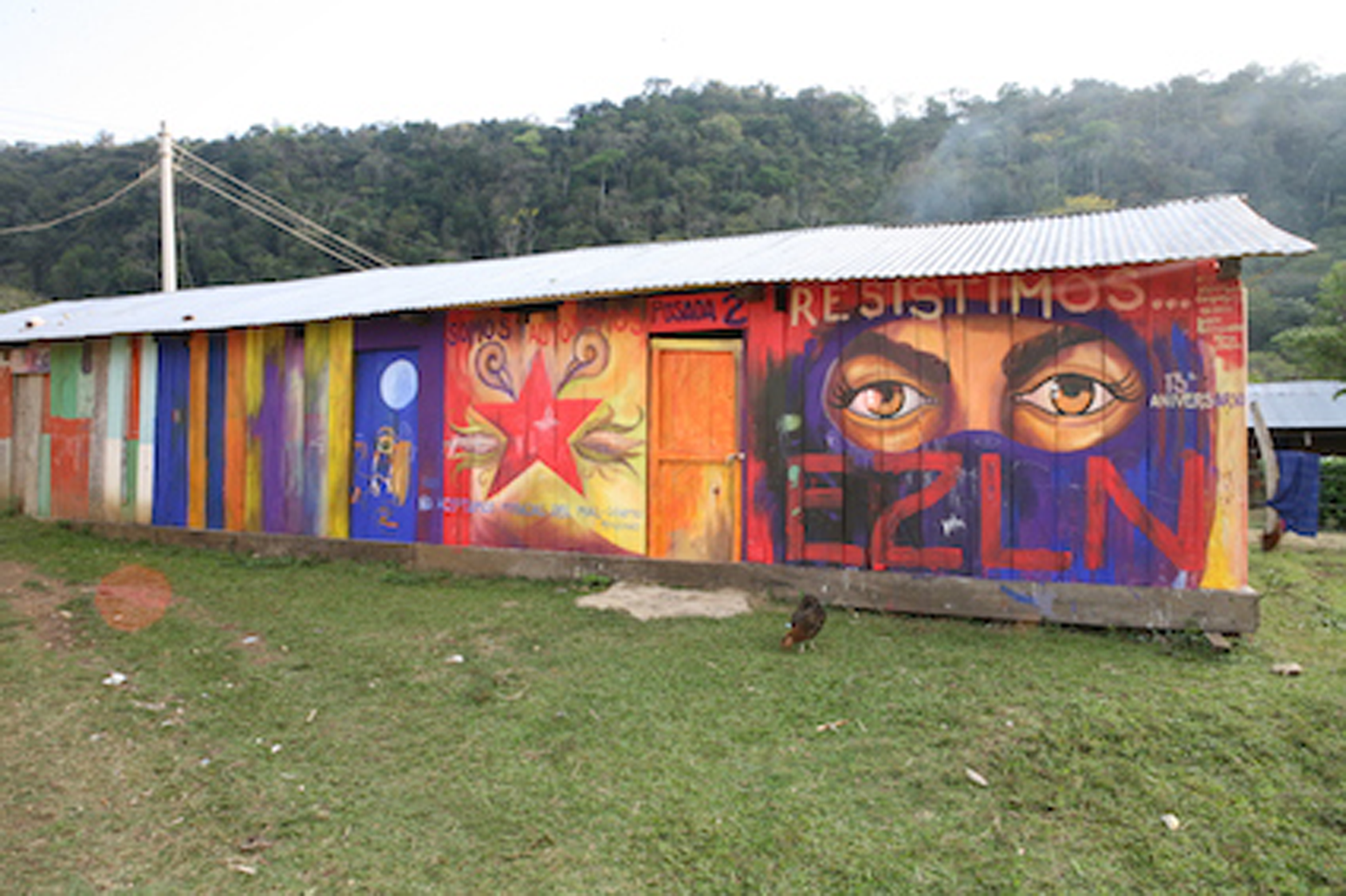
la presencia de un sujeto colectivo específico representado por los “compas” e “insurgentes” (Figuras 6 y 7), con un liderazgo propio, con el Subcomandante a la cabeza, y unos mitos icónicos también propios, como es el pasamontañas que enmarca una mirada (Figura 8), así como episodios de la lucha del EZLN (Figura 9);
-
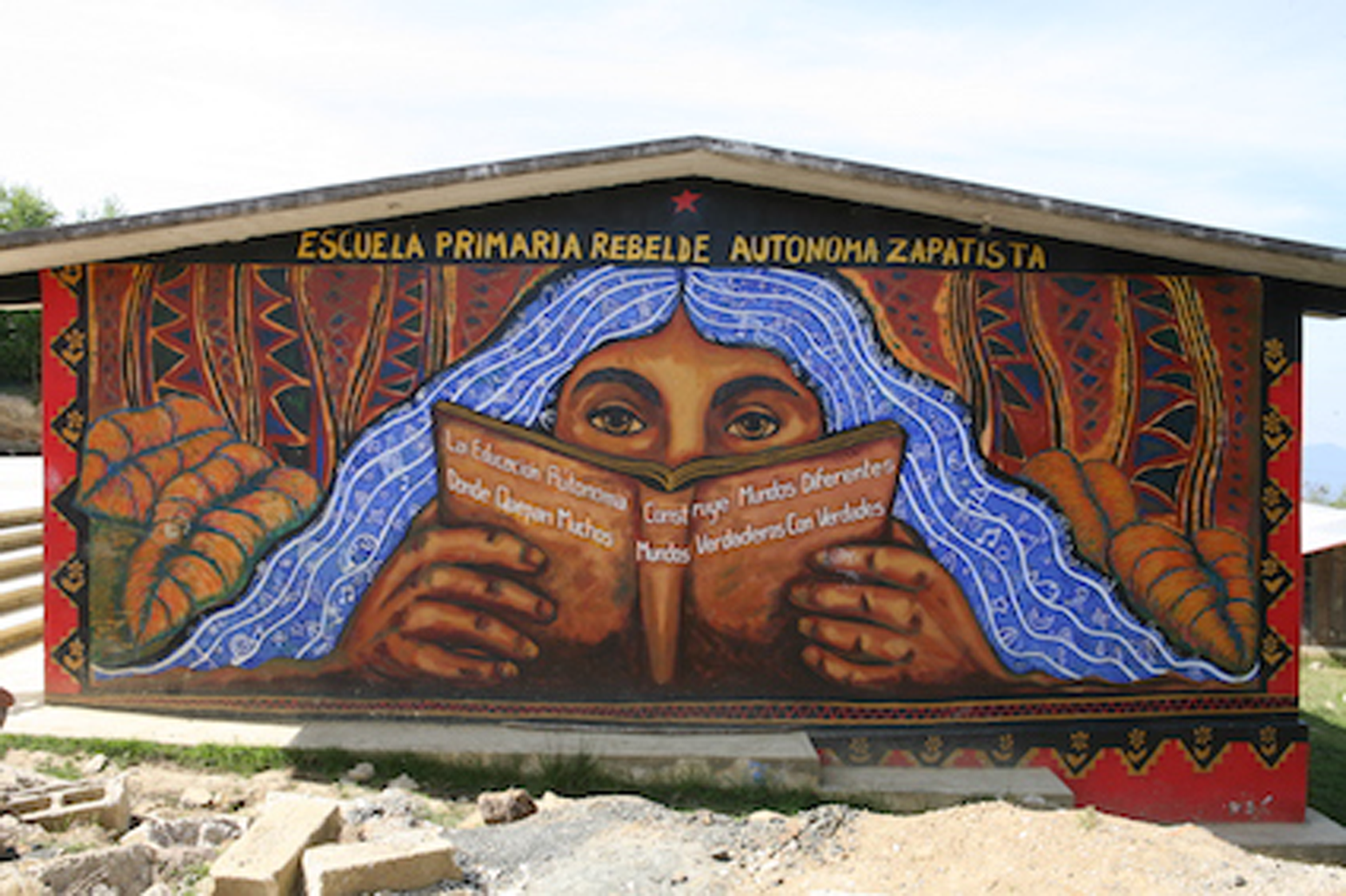
un destino-utopía concreto, vinculado a determinados derechos, entre los que destaca el acceso a la tierra, la salud y la educación (Figura 10); y
-
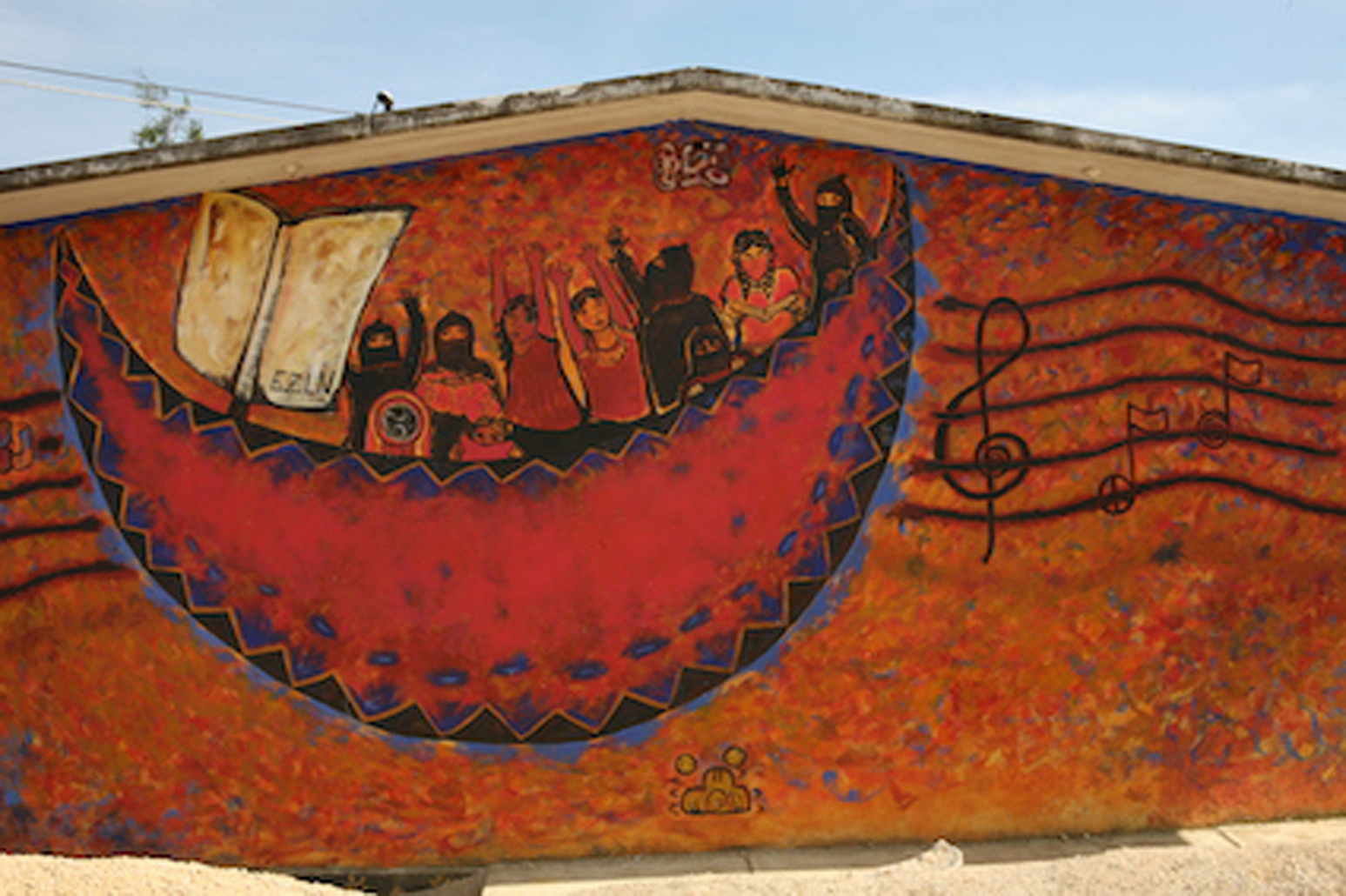
una visión fantasiosa de la lucha zapatista, en la que se integran insurgentes en mazorcas (Figura 11), o donde compas navegan en el cielo sobre una luna menguante (Figura 12).
Conexión con lo prehispánico.

Conexión con la Revolución Mexicana.

Conexión con mitos de la identidad nacional.
El sujeto colectivo insurgentes y compas.

Los insurgentes.

La mirada.
Episodios de la lucha zapatista.

La escuela: El derecho a educación.
Lo naíf: Insurgentes en una mazorca.

Lo naíf: Insurgentes y compas en la luna.
A raíz de lo expuesto, se puede corroborar la tesis de que el muralismo presente en los MARZ se constituye como una expresión crucial para el movimiento zapatista y para la política activista mexicana y transnacional posterior a 1994. Esta afirmación se sostiene en el trabajo de Morgan (Reference Morgan1999, 8) que señala que la cultura visual delimita las fronteras de las comunidades imaginadas al proporcionar un repertorio compartido de imágenes y objetos que dan forma a la memoria y la identidad. También Zubrzycki (Reference Zubrzycki2013) expone —citando a Mukeiji— que los símbolos visuales, los discursos pictóricos y la cultura material pueden usarse como medios de socialización o herramientas de propaganda y por ello convertirse en objeto de lucha entre grupos que promueven diferentes ideologías, identidades o agendas políticas.
Además el muralismo zapatista no solo tiene una iconografía singular y propia, sino que la forma estética y material de su universo icónico consiguió arrebatar la figura de Zapata y la bandera nacional a la imaginería revolucionaria mexicana oficial, resignificó la figura e identidad de lo indígena y su comunidad, y generó un nuevo imaginario revolucionario relacionado con la construcción de espacios de autonomía, a partir de las demandas del EZLN —“trabajo, techo, tierra, alimentación, educación, salud, independencia, libertad, democracia, justicia y paz”—, inspirando así un nuevo activismo nacional y transnacional (Olesen Reference Olesen2005; Rovira Reference Rovira2009).
Por todo ello este texto apela al concepto de revuelta estética acuñado por Zubrzycki (Reference Zubrzycki2013, 431) afirmando que a partir del levantamiento zapatista de 1994 los símbolos plasmados en los murales adquieren significaciones que impulsan nuevas identidades políticas. En este sentido compartimos con Zubrzycki (Reference Zubrzycki2013, 431) que la identidad se (re)modela no solo en y a través de ideologías y discursos, sino también a través de la estética. A la vez, hemos señalado que concurren las cinco dimensiones presentes en una revuelta estética que se exponen al inicio del texto. No nos corresponde analizar las dos primeras (el evento histórico y el reclamo político), pero sí señalar que las tres siguientes (una nueva forma visual y material específica; la elaboración de discursos sobre nuevos iconos y símbolos; y una singular representación en la esfera pública) se dan, pudiéndose afirmar que el zapatismo creó nuevos símbolos gráficos que sirvieron para enfocar, magnificar y exagerar características particulares de una nueva identidad, y con ello el EZLN y sus aliados impugnaron representaciones y narrativas, y rearticularon otras nuevas (Rovira Reference Rovira2012).
A la vez cabe exponer que el imaginario en el territorio zapatista no siempre coincide con el que abanderó la comunidad solidaria internacional, si bien está íntimamente imbricado. La iconografía de la solidaridad internacional zapatista (muy importante entre 1995–2006) fue mucho más limitada de lo que es la plástica mural del territorio zapatista. El movimiento de solidaridad se quedó en la imagen del pasamontañas y del Subcomandante Marcos, en los carteles de Beatriz Aurora, en las imágenes épicas (muy semejantes a las de Oventic que pinta el colectivo La Gárgola), o en algún mural específico por su singular historia de represión y reproducción posterior —como el de Taniperla.Footnote 13 En este sentido, la iconografía zapatista internacional no siempre tomó como imagen de referencia la pintura mural colectiva-comunitaria que es la que representa con más fidelidad el territorio zapatista y las comunidades en resistencia (Leyva Solano Reference Leyva Solano1999).
Para terminar este trabajo es preciso señalar que si bien el muralismo zapatista tiene rasgos comunes, fruto de una amalgama de concepciones no explicitadas de diversos sujetos que han ido abordando de diferentes maneras la vinculación entre arte y transformación social, en dicho muralismo también hay diferencias significativas. Por un lado, cabe distinguir entre los murales anónimos y los firmados. Son muchas las personas que han intervenido en el muralismo zapatista, la gran mayoría de forma anónima, como son los compas y los promotores culturales y educativos coordinados desde las Juntas de Buen Gobierno de cada uno de los Caracoles, con mucha autonomía entre ellos a la hora de impulsar esta expresión artística en su zona (Mora Reference Mora2018). Pero también ha habido algunos nombres propios con tradiciones pictóricas, itinerarios artístico-político y características muy diversas. Esta diferencia supone matices respecto a cómo se piensa el sujeto histórico, distinguiendo el muralismo “para” el zapatismo (Gustavo Chávez), “con” el zapatismo (colectivo “Pintar Obedeciendo”) o “desde” el zapatismo, impulsado por promotores de cultura que pertenecen a las comunidades (Martí i Puig Reference Martí i Puig2019, 50–54). A la vez también cabe hacer referencia a los murales pintados por brigadistas “espontáneos” que “dejan huella” y hacen constar la presencia de la solidaridad internacional en el territorio. Señalar las razones de ello, sin embargo, superan las pretensiones de este artículo.
Agradecimientos
Este texto es deudor del apoyo, compromiso y entusiasmo de muchas personas, gracias a las cuales tuve la posibilidad de realizar la investigación que se presenta. Muchas de ellas, que no puedo enumerar, viven en las comunidades donde transitamos y nos brindaron su hospitalidad. Entre los nombres propios debo señalar a Rafel S. Serrés por ofrecerme la oportunidad de realizar una ruta por los territorios zapatistas a la búsqueda de murales. También agradezco los debates realizados con Guiomar Rovira, así como de las aportaciones que hicieron al texto Magdalena López, Cristina Híjar, María Lourdes López y David Fuente.


 Open access

