











1. Introduction
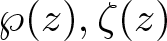
Let  $\Omega$ be a lattice in $\mathbb{C}$ with invariants $g_2,g_3,$ and let $\wp(z),\zeta(z)$ be the associated Weierstrass elliptic and zeta functions, respectively. For $\omega\in\Omega,$ let $\eta(\omega)$ denote the associated quasi-period of $\zeta(z).$ To each finitely generated subgroup $\Gamma$ of $\mathbb{C},$ we associate the following subfield of $\mathbb{C}$:
 \begin{equation*}K_\Gamma=\mathbb{Q}(\{g_2,g_3\}\cup\Gamma\cup\mathscr{Z}(\Gamma)),\end{equation*}
where  $\mathscr{Z}(\Gamma)=\Big\{\wp(u):~u\in\Gamma\setminus\Omega\Big\}\cup\Big\{\zeta(u):~u\in\Gamma\setminus\Omega\Big\}\cup\Big\{\eta(u):~u\in \Gamma\cap\Omega\Big\}.$ We let ${\mathrm{tr. deg}}_{{\mathbb{Q}}} K_\Gamma$ denote the transcendence degree of $K_\Gamma$ over ${\mathbb{Q}}$. From the Schneider theorem [Reference Chudnovsky8, Proposition 1.3, p. 299], one easily sees that ${\mathrm{tr. deg}}_{\mathbb{Q}} K_\Gamma\geq1.$ A central problem in transcendental number theory is to find conditions on $\Gamma$ such that ${\mathrm{tr. deg}}_{\mathbb{Q}} K_\Gamma\geq 2.$ This problem was first considered by Chudnovsky, who proved as a consequence of [Reference Chudnovsky8, Theorem 3.1, p. 309] that if $\Omega\subset \Gamma$ then ${\mathrm{tr. deg}}_{{\mathbb{Q}}} K_\Gamma\geq2.$ He also proved in [Reference Chudnovsky8, Theorem 5.3, p. 319] that if $g_2,g_3$ are algebraic and $\Gamma$ contains at least two ${\mathbb{Q}}$-linearly independent algebraic points of $\wp(z)$ then ${\mathrm{tr. deg}}_{{\mathbb{Q}}} K_\Gamma\geq2$. Also, from his result [Reference Chudnovsky7, Theorem 2.1], we see that if $g_2,g_3$ are algebraic and $\Gamma$ contains at least three ${\mathbb{Q}}$-linearly independent algebraic numbers, then ${\mathrm{tr. deg}}_{{\mathbb{Q}}} K_\Gamma\geq2.$ This latter result has been generalized by Philippon [Reference Philippon17, Corollary 0.3] and Wüstholz [Reference Wüstholz22, Corollary 2]. Remark that all the above results come from the well-known Grothendieck–André Conjecture about periods, see André’s letter attached to the article ‘Third kind elliptic integrals and $1$-motives’ by ${\mathbb{C}}$. Bertolin, J. Pure Appl. Algebra 224 (2020), no. 10, 106396, for a nice introduction to this subject.
The above problem also has a connection with algebraic groups. Indeed, if we let  $E$ denote the elliptic curve associated with $\Omega$ and $G_2$ the non-split algebraic group extension of $E$ by the additive group ${\mathbf{G}_a}$ (see [Reference Masser12, Ex. 20.102], and also the appendix by Tubbs at the end), then the above problem can be expressed in terms of the coordinates of the one-parameter subgroup $\phi(z)=\exp_G(z,z,0)$ of the algebraic group $G={\mathbf{G}_a}\times G_2.$ It is equivalent to finding conditions on $\Gamma$ such that for any subfield $K$ of ${\mathbb{C}}$ if $\varphi(\Gamma)\subset G(K)$ then ${\mathrm{tr. deg}}_{\mathbb{Q}} K\geq2.$ In [Reference Tubbs20, Reference Tubbs21], Tubbs proved several results on the algebraic independence of at least two numbers related to one-parameter subgroups of algebraic groups. The results of Tubbs are more general and are subject to the dimension of the algebraic group in question and $\ell={\mathrm{rank}}_{\mathbb{Z}} \Gamma.$ If we set $K=K_\Gamma(\wp'(u):~u\in\Gamma\setminus\Omega)$, then we have $\phi(\Gamma)\subset G(K).$ Further, $\phi(z)=(\exp_G\circ \textbf{L})(z)$ where $\textbf{L}:{\mathbb{C}}\to{\mathbb{C}}^3$ is given by $\textbf{L}(z)=(z,z,0).$ Note that $\textbf{L}({\mathbb{C}})={\mathbb{C}}(1,1,0).$ Thus, the ${\mathbb{C}}$-vector space of least dimension that is defined over $K$ and containing $\textbf{L}({\mathbb{C}})$ is ${\mathbb{C}}(1,1,0).$ Hence, with the notation of [Reference Tubbs20], we have $d=3,$ $d_0=1,d_1=0,$ $d_2=\dim G_2=2,$ and $n=1.$ Since $K$ is algebraic over $K_\Gamma$ (cf. (17)), we deduce from [Reference Tubbs20, Theorem 1] that if $\ell\geq5$ then ${\mathrm{tr. deg}}_{\mathbb{Q}} K_\Gamma\geq 2.$ As pointed out by Tubbs in [Reference Tubbs20, Remark, p. 295], Theorem 2 in that paper is not applicable to $G.$ Indeed, one checks that the results of [Reference Tubbs20, Reference Tubbs21] are not applicable for $G$ with $\ell\leq3.$ In this direction, we prove the following result in the present paper.
Theorem 1. Let  $\omega$ be a non-zero period of $\wp(z)$ and let $u_1,u_2$ be complex numbers such that $u_1,u_2,\omega$ are $\mathbb{Q}$-linearly independent with $({\mathbb{Z}} u_1+{\mathbb{Z}} u_2)\cap\Omega=(0).$ Then at least two of the numbers
 \begin{equation*}
g_2,g_3,\omega, \eta(\omega),u_1,u_2,\wp(u_i),\zeta(u_i)~~(1\leq i\leq 2)
\end{equation*}
\begin{equation*}
g_2,g_3,\omega, \eta(\omega),u_1,u_2,\wp(u_i),\zeta(u_i)~~(1\leq i\leq 2)
\end{equation*}are algebraically independent over  $\mathbb{Q}.$
In other words, if we set  $\Gamma={\mathbb{Z}} u_1+{\mathbb{Z}} u_2+{\mathbb{Z}} \omega$, then ${\mathrm{tr. deg}}_{{\mathbb{Q}}} K_\Gamma\geq2.$ Note that if $\wp(z)$ has complex multiplication, then Theorem 1 follows from the result of Chudnovsky [Reference Chudnovsky8, Theorem 3.1, p. 309] mentioned above. Otherwise, it is new in the literature.
The proof of Theorem 1 is given in § 5. The overall scheme of the proof is similar to Chudnovsky [Reference Chudnovsky8, Theorem 3.1, p. 309], but differs significantly in many places. For example, an elementary analytic zero estimate [Reference Chudnovsky8, Lemma 3.2, p. 310] was sufficient to complete his proof. However, in the setup of our problem, this zero estimate is not sufficient. For this purpose, we use a zero estimate of Robert Tubbs, given in the appendix at the end of this paper. (I thank him for agreeing to write this appendix.) Secondly, the Baker–Coates trick was not required to prove [Reference Chudnovsky8, Theorem 3.1, p. 309]; however, it is very essential for the present paper since we are interested in the case that none of  $u_1, u_2$ is a period of $\wp(z).$ In § 3 (see Lemma 4), we prove a variation of this trick for polynomials involving $\wp, \zeta$. As far as I know, this trick was not recorded anywhere earlier.
Another important step in the proof of Theorem 1 is eliminating the Weierstrass sigma function  $\sigma(z)$ associated with $\Omega.$ Namely, as in the proof of [Reference Chudnovsky8, Theorem 3.1, p. 309], our auxiliary function is also a polynomial in $z,\wp(z),\zeta(z).$ Therefore, in general, it is not an entire function. To apply the maximum modulus principle (the so-called Schwarz lemma), we multiply the auxiliary function by a suitable power of $\sigma(z)$ so that the product becomes entire. However, in the end, we are required to eliminate this power of $\sigma(z)$ from the auxiliary function to apply the transcendence criterion (Lemma 3). At the end of their paper [Reference Masser and Wüstholz15], Masser and Wüstholz explained how this elimination could be done. Since the non-zero value of the auxiliary function given by Proposition A.1 may correspond to a period of $\wp(z),$ according to the authors of [Reference Masser and Wüstholz15], we need to divide this elimination process into four cases: period or non-period; close to a lattice point or away from lattice points. Here, we use an alternate method to eliminate $\sigma(z)$, which does not require the distance from lattice points.
One may like to shrink the set  $\{u_1,u_2,\omega\}$ or to replace $\omega$ by a non-periodic point. However, the same scheme of proof does not work in these cases.
We conclude this section with some of the conventions used throughout this paper. By the height  $H(P)$ of a non-zero integer polynomial $P(X_1,X_2,\ldots,X_n)$, we mean the maximum absolute value of its coefficients; its type ${\sf t}(P)$ is defined by ${\sf t}(P)=\max(\log H(P),1+\deg_{X_1} P,\ldots,1+\deg_{X_n} P).$ We denote the integer part of a real number $x$ by $\lfloor x\rfloor,$ and the $r$th derivative of a meromorphic function $f$ either by $f^{(r)}$ or $\frac{d^r}{dz^r} f.$ If $f$ is meromorphic, then the symbol ${\rm Ord}_{z_0}f$ denotes the order of $f$ at $z_0.$ By definition, ${\rm Ord}_{z_0}f$ is positive if $z_0$ is a zero, negative if $z_0$ is a pole, and is $0$ if $z_0$ is neither a zero nor a pole of $f.$ The following equality holds for any two meromorphic functions $f$ and $g$ and any $z_0$ in ${\mathbb{C}}$:
 \begin{equation*}{\rm Ord}_{z_0}(fg)= {\rm Ord}_{z_0}f+{\rm Ord}_{z_0}g.\end{equation*}
 It follows that if both  $f$ and $g$ are analytic at $z_0$, then
 \begin{equation}
{\rm Ord}_{z_0}(fg)\geq \max\left({\rm Ord}_{z_0}f,{\rm Ord}_{z_0}g\right).
\end{equation}
\begin{equation}
{\rm Ord}_{z_0}(fg)\geq \max\left({\rm Ord}_{z_0}f,{\rm Ord}_{z_0}g\right).
\end{equation} We frequently use the following identity that holds for any function  $f$ meromorphic at $a+b$:
 \begin{equation}
{\rm Ord}_{z=a}f(z+b)={\rm Ord}_{a+b}f(z)={\rm Ord}_{z=b}f(z+a).
\end{equation}
\begin{equation}
{\rm Ord}_{z=a}f(z+b)={\rm Ord}_{a+b}f(z)={\rm Ord}_{z=b}f(z+a).
\end{equation}2. Applications
The lattice  $\Omega$ coincides with the set of periods of $\wp.$ If $g_2$ and $g_3$ are algebraic, then from the result of Schneider [Reference Chudnovsky8, p. 299] mentioned above, any non-zero element of $\Omega$ is transcendental. In particular, for any non-zero element $\omega$ of $\Omega,$ the numbers $1, \omega, \omega^2,\ldots$ are linearly independent over $\overline{{\mathbb{Q}}},$ the algebraic closure of ${\mathbb{Q}}$ in ${\mathbb{C}}.$ With this observation in mind, we have the following results.
Corollary 1. Assume  $g_2,g_3$ are algebraic. Let $\omega$ be any non-zero element of $\Omega$ such that $({\mathbb{Z}}\omega^2+{\mathbb{Z}}\omega^3)\cap\Omega=(0).$ Then, at least two among the numbers
 \begin{equation*}\omega,\eta(\omega),\wp(\omega^2),\wp(\omega^3),\zeta(\omega^2),\zeta(\omega^3)\end{equation*}
are defined and are algebraically independent over  ${\mathbb{Q}}.$
Proof. Take  $u_1=\omega^2$ and $u_2= \omega^3$ in Theorem 1.
It is expected that for any non-zero algebraic number  $\alpha$, the two numbers $\wp(\alpha)$ and $\zeta(\alpha)$ are algebraically independent over ${\mathbb{Q}},$ provided $g_2$ and $g_3$ are algebraic. This problem is still open. However, we have the following.
Corollary 2. Suppose the invariants  $g_2,g_3$ of $\Omega$ are algebraic and $\alpha,\beta$ are ${\mathbb{Q}}$-linearly independent algebraic numbers. Then, for any non-zero period $\omega$ of $\wp(z)$, at least two among the numbers
 \begin{equation*}\omega,\eta(\omega),\wp(\alpha),\wp(\beta),\zeta(\alpha),\zeta(\beta)\end{equation*}
are defined and are algebraically independent over  ${\mathbb{Q}}.$
Proof. From the result of Schneider mentioned above, we see that  $({\mathbb{Z}}\alpha+{\mathbb{Z}}\beta)\cap \Omega=(0).$ Hence, taking $u_1=\alpha$ and $u_2=\beta$ in Theorem 1, we obtain the result.
Corollary 3. Suppose the invariants  $g_2,g_3$ of $\Omega$ are algebraic and $\alpha,\beta$ are algebraic numbers with $1,\alpha,\beta$ ${\mathbb{Q}}$-linearly independent. Then, for any non-zero period $\omega$ of $\wp(z)$, at least two among the numbers
 \begin{equation*}\omega,\eta(\omega),\wp(\alpha\omega),\wp(\beta\omega),\zeta(\alpha\omega),\zeta(\beta\omega)\end{equation*}
are defined and are algebraically independent over  ${\mathbb{Q}}.$
Proof. By Chudnovsky [Reference Chudnovsky8, Theorem 3.1, p. 309], we can assume that  $\wp$ has no complex multiplication. Since $g_2,$ $g_3$ are algebraic numbers, from a result of Masser [Reference Masser10, Theorem II], we see that $({\mathbb{Z}}\alpha\omega+{\mathbb{Z}}\beta\omega) \cap \Omega=(0).$ Hence, taking $u_1=\alpha\omega$ and $u_2=\beta\omega$ in Theorem 1, we obtain the result.
3. Fields of transcendence degree one
Suppose  $K$ is a finitely generated subfield of ${\mathbb{C}}$ of transcendence degree one over ${\mathbb{Q}}.$ Then there exist elements $\theta,\nu$ of $K$ such that $K={\mathbb{Q}}(\theta, \nu)$ where $\theta$ is transcendental and $\nu$ is integral of degree say $d$ over ${\mathbb{Z}}[\theta].$ For each non-zero element $\xi$ of $K$, there exists a unique representation of the form
 \begin{equation*}
\xi=\frac{1}{p_0(\theta)}\sum_{j=1}^{d}p_j(\theta)\nu^{j-1}
\end{equation*}
\begin{equation*}
\xi=\frac{1}{p_0(\theta)}\sum_{j=1}^{d}p_j(\theta)\nu^{j-1}
\end{equation*}with  $p_0,\ldots, p_d$ co-prime polynomials in $\mathbb{Z}[X]$. If $\xi$ is written as above, then we define the degree $\deg \xi$ and type ${\sf t}(\xi)$ of $\xi$ as the maximum degree and type of the polynomials $p_0,\ldots,p_d$, respectively. Hence, we always have $\deg \xi\leq {\sf t}(\xi).$ The quantity $p_0(\theta)$ is sometimes called the denominator of $\xi$ for the reason that $p_0(\theta)\xi\in{\mathbb{Z}}[\theta,\nu].$ For example, if $\xi=\frac ab$ is a non-zero rational number with relatively prime integers $a,b,$ then $\deg \xi=0,$ ${\sf t}(\xi)=\log \max(|a|,|b|),$ and $b$ is its denominator.
An element  $\alpha$ of $K$ is said to be of degree at most $D$ and type at most $t$ if either $\alpha$ is zero or $\alpha$ is different from zero and has degree at most $D$ and type at most $t.$ Note that an element $\alpha$ of ${\mathbb{Z}}[\theta,\nu]$ has degree at most $D$ if and only if it has a representation of the form
 \begin{equation*}\alpha=\sum_{i=0}^D\sum_{j=0}^{d-1}a_{i,j}\theta^i\nu^j\end{equation*}
with integers  $a_{i,j}.$ Further, if $\alpha$ is non-zero, then ${\sf t}(\alpha)\leq \max(\log H, D+1),$ where $H$ is the maximum absolute value of the numbers $a_{i,j}.$ The following lemma provides upper bounds for the degree and type of sums and products of elements of ${\mathbb{Z}}[\theta,\nu]$.
Lemma 1. Let  $\alpha_1,\ldots,\alpha_n$ $(n\geq1)$ be non-zero elements of ${\mathbb{Z}}[\theta,\nu].$
(i) If  $\alpha_1+\cdots+\alpha_n\neq0,$ then ${\sf t}(\alpha_1+\cdots+\alpha_n)\leq \max_{1\leq i\leq n} {\sf t}(\alpha_i)+\log n$ and $\deg(\alpha_1+\cdots+\alpha_n)\leq \max_{1\leq i\leq n}\deg \alpha_i.$
(ii) There exists a constant  $c_1 \gt 1$ depending only on $\theta$ and $\nu,$ such that ${\sf t}(\alpha_1\alpha_2\cdots \alpha_n)\leq c_1\sum_{1\leq i\leq n} {\sf t}(\alpha_i)$ and $\deg(\alpha_1\alpha_2\cdots\alpha_n)\leq \sum_{1\leq i\leq n}\deg \alpha_i+c_1n(d-1).$
(iii) Let  $Q\in\mathbb{Z}[X_1,\ldots,X_n]$ be such that $\beta=Q(\alpha_1,\ldots,\alpha_n)\neq0.$ Then $\beta\in{\mathbb{Z}}[\theta,\nu]$ with
 \begin{equation*}\deg(\beta)\leq c_2\sum_{i=1}^n\deg_{X_i}Q,\quad {\sf t}(\beta)\leq c_3\left(\log H(Q)+\sum_{i=1}^n\deg_{X_i} Q\right)\end{equation*}
for some constants  $c_2,c_3$ depending only on $\theta,\nu,\alpha_1,\ldots,\alpha_n.$
Proof. The bounds for  ${\sf t}(\alpha_1+\cdots+\alpha_n)$ and ${\sf t}(\alpha_1\cdots\alpha_n)$ follow from [Reference Tubbs20, Lemma 2.1]. In particular, for integers $k\geq 0,$ ${\sf t}(\nu^k)\leq c_1k$ because ${\sf t}(\nu)=1$ and ${\sf t}(1)=0.$ Hence, one can write
 \begin{equation*}\nu^k=\sum_{i=0}^{c_1k}\sum_{j=0}^{d-1}a_{i,j,k}\theta^i\nu^{j}\quad (k\geq0)\end{equation*}
where  $a_{i,j,k}$ denotes an integer with absolute value at most $e^{c_1k}.$
Let  $D_i$ be the degree of $\alpha_i$ for $i=1,2,\ldots,n,$ and $D=\max\{D_1,\ldots, D_n\}.$ Then one can write
 \begin{equation*}\alpha_k=\sum_{i=0}^{D_k}\sum_{j=0}^{d-1}b_{i,j,k}\theta^i\nu^j=\sum_{i=0}^D\sum_{j=0}^{d-1}b_{i,j,k}\theta^i\nu^j \quad (1\leq k\leq n)\end{equation*}
for some integers  $b_{i,j,k}$ with $b_{i,j,k}$ equal to $0$ for $i \gt D_k.$ This implies
 \begin{equation*}\sum_{k=1}^n\alpha_k=\sum_{i=0}^D\sum_{j=0}^{d-1}\left(\sum_{k=1}^nb_{i,j,k}\right)\theta^i\nu^j,\end{equation*}
the asserted estimate for the degree of  $\alpha_1+\cdots+\alpha_n$ follows. Similarly,
 \begin{equation*}\prod_{k=1}^n\alpha_k=\sum_{i=0}^{D_1+\cdots+D_n}\sum_{j=0}^{n(d-1)}c_{i,j}\theta^i\nu^j\end{equation*}
for some integers  $c_{i,j}.$ (One can give an explicit representation of these integers $c_{i,j};$ however, it is not required to find the degrees.) Using the above representation for the integral powers of $\nu,$ we can re-write the above product in the following form:
 \begin{eqnarray*}
\prod_{k=1}^n\alpha_k&=&\sum_{i=0}^{D_1+\cdots+D_n}\sum_{j=0}^{n(d-1)}\sum_{\ell=0}^{c_1j}\sum_{m=0}^{d-1}c_{i,j}a_{\ell,m,j}\theta^{i+\ell}\nu^m.
\end{eqnarray*}
\begin{eqnarray*}
\prod_{k=1}^n\alpha_k&=&\sum_{i=0}^{D_1+\cdots+D_n}\sum_{j=0}^{n(d-1)}\sum_{\ell=0}^{c_1j}\sum_{m=0}^{d-1}c_{i,j}a_{\ell,m,j}\theta^{i+\ell}\nu^m.
\end{eqnarray*}Rearranging this, one obtains
 \begin{equation*}\prod_{k=1}^n\alpha_k=\sum_{i=0}^{D_1+\cdots+D_n+c_1n(d-1)}\sum_{j=0}^{d-1}d_{i,j}\theta^i\nu^j\end{equation*}
for some integers  $d_{i,j}$ depending only on $\theta,\nu,\alpha_1,\ldots,\alpha_n;$ the asserted estimate for the degree of $\alpha_1\cdots\alpha_n$ follows.
Next, let  $Q(X_1,\ldots,X_n)=\sum aX_1^{i_1}\ldots
X_n^{i_n}$ be any polynomial in
$Q(X_1,\ldots,X_n)=\sum aX_1^{i_1}\ldots
X_n^{i_n}$ be any polynomial in  $\mathbb{Z}[X_1,\ldots,X_n],$ where $a=a_{i_1,\ldots,i_n}$ is an integer, with $\beta=Q(\alpha_1,\ldots,\alpha_n)\neq0.$ Set $c_4=\max_{1\leq i\leq n}{\sf t}(\alpha_i).$ Since $Q$ has at most $M=\prod_{k=1}^n(1+\deg_{X_k} Q)$ terms, from the bounds for the types in (i) and (ii), we obtain
 \begin{equation*}{\sf t}(\beta)\leq \max_{i_1,\ldots,i_n} {\sf t}(a\alpha_1^{i_1}\ldots \alpha_n^{i_n})+\log M\leq c_1\Big(\log H(Q)+c_1c_4\sum_{k=1}^n\deg_{X_k} Q\Big)+\sum_{k=1}^n\deg_{X_k} Q,\end{equation*}
where the maximum in the middle of the inequalities is taken over all integers  $i_1,\ldots,i_n$ with $0\leq i_k\leq \deg_{X_k}Q$ for $k=1,2,\ldots,n.$ Letting $c_3=(c_1+1)(c_1c_4+1),$ the asserted estimate for ${\sf t}(\beta)$ follows. Similarly, from the bounds for the degrees in (i) and (ii), the required estimate for the $\deg \beta$ follows because
 \begin{equation*}\deg \beta\leq \max \deg (a\alpha_1^{i_1}\ldots \alpha_n^{i_n})=\max \deg (\alpha_1^{i_1}\ldots \alpha_n^{i_n})\leq (D+c_1(d-1))\left(\sum_{k=1}^n\deg_{X_k}Q\right),\end{equation*}
where the maximum in the middle of the inequalities is taken over all integers  $i_1,\ldots,i_n$ with $0\leq i_k\leq \deg_{X_k}Q$ for $k=1,2,\ldots,n.$ The lemma is proved.
The following result is an analogue of Siegel’s lemma on integer solutions of homogeneous linear equations over  ${\mathbb{Z}}.$
Lemma 2. Let  $D, N, M, H$ be positive integers such that $N \gt 8M.$ Suppose that $b_{i,j}$ $(1\leq i\leq M , 1\leq j\leq N)$ are elements of ${\mathbb{Z}}[\theta,\nu]$ with degrees at most $D$ and types at most $H.$ Then there exist elements $X_1,\ldots,X_N$ of ${\mathbb{Z}}[\theta,\nu],$ not all zero, with degrees at most $D$ and types at most $\log (Nd)+H+2D+1$ such that
 \begin{equation}
\sum_{j=1}^N b_{i,j}X_j=0
\end{equation}
\begin{equation}
\sum_{j=1}^N b_{i,j}X_j=0
\end{equation}for  $1\leq i\leq M.$
Proof. To see this, write
 \begin{equation*}b_{i,j}=\sum_{k_1=0}^{D}\sum_{\ell_1=0}^{d-1}A(k_1,\ell_1,i,j)\theta^{k_1}\nu^{\ell_1}\quad\quad (1\leq i\leq M, 1\leq j\leq N)\end{equation*}
and
 \begin{equation*}X_j=\sum_{k_2=0}^{D}\sum_{\ell_2=0}^{d-1} B(k_2,\ell_2,j)\theta^{k_2}\nu^{\ell_2}\quad\quad (1\leq j\leq N)\end{equation*}
where  $A(k_1,\ell_1,i,j)$ are integers with absolute values at most $e^H$ and ${B}(k_2,\ell_2,j)$ are unknowns. Then the set of conditions (3) becomes
 \begin{equation*}
\sum_{k_3=0}^{2D}\sum_{\ell_3=0}^{2d-2}{\mathbb{C}}(k_3,\ell_3,i)\theta^{k_3}\nu^{\ell_3}=0\quad \quad(i=1,2,\ldots,M)
\end{equation*}
\begin{equation*}
\sum_{k_3=0}^{2D}\sum_{\ell_3=0}^{2d-2}{\mathbb{C}}(k_3,\ell_3,i)\theta^{k_3}\nu^{\ell_3}=0\quad \quad(i=1,2,\ldots,M)
\end{equation*}where
 \begin{equation*}
{\mathbb{C}}(k_3,\ell_3,i)=\sum_{j=1}^N\sum_{k_2=0}^{k_3}\sum_{\ell_2=0}^{\ell_3}{A}(k_3-k_2,\ell_3-\ell_2,i,j){B}(k_2,\ell_2,j).
\end{equation*}
\begin{equation*}
{\mathbb{C}}(k_3,\ell_3,i)=\sum_{j=1}^N\sum_{k_2=0}^{k_3}\sum_{\ell_2=0}^{\ell_3}{A}(k_3-k_2,\ell_3-\ell_2,i,j){B}(k_2,\ell_2,j).
\end{equation*} If there are integers  ${B}(k_2,\ell_2,j)$ for $0\leq k_2\leq D, 0\leq \ell_2\leq d-1, 1\leq j\leq N$ for which
 \begin{equation}
{\mathbb{C}}(k_3,\ell_3,i)=0
\end{equation}
\begin{equation}
{\mathbb{C}}(k_3,\ell_3,i)=0
\end{equation}for  $0\leq k_3\leq 2D,~ 0\leq \ell_3\leq 2d-2,$ and $1\leq i\leq M,$ then clearly the associated tuple $(X_1,\ldots,X_N)$ is a solution of (3). Now (4) gives rise to a system of not more than $M(2D+1)(2d-1)$ equations in the $N(D+1)d$ unknowns ${B}(k_2,\ell_2,j).$ Further, since $N \gt 8M,$ we have
 \begin{equation*}N(D+1)d \gt 8M(D+1)d \gt 2M(2D+1)(2d-1).\end{equation*}
 Hence, by the usual Siegel’s lemma with integer coefficients (cf. [Reference Masser12, Proposition 8.3]), we can select  ${B}(k_2,\ell_2,j)$ from ${\mathbb{Z}},$ for $1\leq j\leq N,$ $0\leq k_2\leq D,$ and $0\leq \ell_2\leq d-1,$ not all zero, with absolute value at most
 \begin{equation*}N(D+1)de^H,\end{equation*}
such that (4) hold for  $0\leq k_3\leq 2D,~ 0\leq \ell_3\leq 2d-2,~1\leq i\leq M.$ Thus, we can find $X_1,\ldots,X_N$ of ${\mathbb{Z}}[\theta,\nu],$ not all zero, satisfying (3) with degrees at most $D$ and types at most $\log \left(Nd(D+1)\right)+H+D+1\leq \log (Nd)+H+2D+1,$ as required.
The following lemma is crucial for proving Theorem 1.
Lemma 3. Let  $K={\mathbb{Q}}(\theta,\nu)$ be as above and let $c_5 \gt 1$ be any real number. Further, let $(d_n)_{n\geq1} $ and $ (t_n)_{n\geq1} $ be two unbounded sequences of positive real numbers such that, for each $n$ in ${\mathbb{N}},$
 \begin{equation*}d_{n} \lt d_{n+1}\leq c_5d_n,\quad t_{n} \lt t_{n+1}\leq c_5t_{n}.\end{equation*}
 If there is a sequence  $(\theta_n)_{n\geq1}$ of non-zero elements of ${\mathbb{Z}}[\theta]$ such that $\deg \theta_n\leq d_n$ and ${\sf t}(\theta_n)\leq t_n$ for all $n$ in ${\mathbb{N}}$, then, for some infinite sequence of values of $n,$
$n,$
 \begin{equation*}\log |\theta_n| \gt -(2c_5+1)d_n(t_n+d_n).\end{equation*}
Proof. If this is not true, then there exists a positive integer  $N_0$ such that for each $n \gt N_0,$
 \begin{equation*}
\log |\theta_n|\leq -(2c_5+1)d_n(t_n+d_n).\end{equation*}
\begin{equation*}
\log |\theta_n|\leq -(2c_5+1)d_n(t_n+d_n).\end{equation*} If we write  $\theta_n=\mathcal{P}_n(\theta)$ with $\mathcal{P}_n(X)$ in ${\mathbb{Z}}[X]$, then $\mathcal{P}_n$ is non-zero having degree at most $d_n,$ height at most $e^{t_n},$ and $\log |\theta_n|=\log |\mathcal{P}_n(\theta)|\leq -(2c_5+1)d_n(t_n+d_n).$ Therefore, if we define for $m\geq1,$
 \begin{equation*}\delta_m=d_{N_0+m},\quad \gamma_m=t_{N_0+m},\quad \text{ and }\quad
P_m(X)=\mathcal{P}_{N_0+m}(X),\end{equation*}
\begin{equation*}\delta_m=d_{N_0+m},\quad \gamma_m=t_{N_0+m},\quad \text{ and }\quad
P_m(X)=\mathcal{P}_{N_0+m}(X),\end{equation*}then the sequences  $(\delta_m)_{m=1}^\infty$ and $(\gamma_m)_{m=1}^\infty$ are clearly unbounded sequences of positive real numbers with
 \begin{equation*}\delta_m \lt \delta_{m+1}\leq c_5 \delta_m,\quad \gamma_m \lt \gamma_{m+1}\leq c_5 \gamma_m, \quad\text{degree of }~P_m\leq \delta_m,\quad\text{height of } ~P_m\leq e^{\gamma_m},\end{equation*}
and  $\log |{P}_{m}(\theta)|=\log |\mathcal{P}_{N_0+m}(\theta)|\leq - (2c_5+1)\delta_m(\gamma_m+\delta_m).
$ Hence, either from Brownawell [Reference Brownawell4, Lemma 4] or from Waldschmidt [Reference Waldschmidt23, Theorem 8.2.1] we deduce that
$\log |{P}_{m}(\theta)|=\log |\mathcal{P}_{N_0+m}(\theta)|\leq - (2c_5+1)\delta_m(\gamma_m+\delta_m).
$ Hence, either from Brownawell [Reference Brownawell4, Lemma 4] or from Waldschmidt [Reference Waldschmidt23, Theorem 8.2.1] we deduce that  $\theta$ is algebraic. This contradicts the above assumption on $\theta$; therefore, the lemma must be true.
4. Lemmas on elliptic functions
In this section, we collect some of the properties of  $\wp$ and $\zeta$ needed for the proof of Theorem 1.
Lemma 4. Let  $\lambda_2\geq0,\lambda_3\geq0, L \gt 0$ be integers with $\max(\lambda_2,\lambda_3)\leq L$ and $v$ is a complex number not belonging to $\Omega.$ Then, for any non-negative integer $j,$ the $j$th derivative of
 \begin{equation*}
\Big(2\big(\wp(v)-\wp(z)\big)\Big)^{3L}\wp(z+v)^{\lambda_2}\zeta(z+v)^{\lambda_3}
\end{equation*}
\begin{equation*}
\Big(2\big(\wp(v)-\wp(z)\big)\Big)^{3L}\wp(z+v)^{\lambda_2}\zeta(z+v)^{\lambda_3}
\end{equation*}with respect to  $z$ can be expressed in the form
 \begin{equation*}
\textstyle\sum q \zeta(v)^{\mu}\wp(v)^{\mu'}\left(\wp'(v)\right)^{\mu^{\prime\prime}} \zeta(z)^{\tau}\wp(z)^{\tau'}\left(\wp'(z)\right)^{\tau^{\prime\prime}}\left(\wp^{\prime\prime}(z)\right)^{\tau^{\prime\prime\prime}}
\end{equation*}
\begin{equation*}
\textstyle\sum q \zeta(v)^{\mu}\wp(v)^{\mu'}\left(\wp'(v)\right)^{\mu^{\prime\prime}} \zeta(z)^{\tau}\wp(z)^{\tau'}\left(\wp'(z)\right)^{\tau^{\prime\prime}}\left(\wp^{\prime\prime}(z)\right)^{\tau^{\prime\prime\prime}}
\end{equation*}where  $ q=q(j,\mu,\mu',\mu^{\prime\prime},\tau,\tau',\tau^{\prime\prime},\tau^{\prime\prime\prime})$ denotes an integer with absolute value at most $j!c_{6}^{L+j}$ for some constant $c_{6} \gt 1$ depending only on $\Omega.$ Here, the summation extends over all non-negative integers $\mu,\mu',\mu^{\prime\prime},\tau,\tau',$ $\tau^{\prime\prime}, \tau^{\prime\prime\prime}$ with
 \begin{equation*}\mu+\mu'+\mu^{\prime\prime}\leq 5L,\quad\tau+\tau'+\tau^{\prime\prime}+\tau^{\prime\prime\prime}\leq 5L+j.\end{equation*}
Proof. For simplicity, let  $g(z)= \left(2(\wp(v)-\wp(z))\right)^{3L}\wp(z+v)^{\lambda_2}\zeta(z+v)^{\lambda_3}.$ The following addition formulas hold (see for example, [Reference Abramowitz and Stegun1, (18.4.1) and (18.4.3)]):
 \begin{equation}
2\big(\wp(v)-\wp(z)\big)\zeta(z+v)=2\big(\zeta(z)+\zeta(v)\big)\big(\wp(v)-\wp(z)\big)+\wp'(v)-\wp'(z),
\end{equation}
\begin{equation}
2\big(\wp(v)-\wp(z)\big)\zeta(z+v)=2\big(\zeta(z)+\zeta(v)\big)\big(\wp(v)-\wp(z)\big)+\wp'(v)-\wp'(z),
\end{equation}and
 \begin{equation}
4\big(\wp(v)-\wp(z)\big)^2\wp(z+v)=-4\big(\wp(z)+\wp(v)\big)\big(\wp(v)-\wp(z)\big)^2+\big(\wp'(v)-\wp'(z)\big)^2.
\end{equation}
\begin{equation}
4\big(\wp(v)-\wp(z)\big)^2\wp(z+v)=-4\big(\wp(z)+\wp(v)\big)\big(\wp(v)-\wp(z)\big)^2+\big(\wp'(v)-\wp'(z)\big)^2.
\end{equation} Using these formulas, one can express  $g(z)$ in the following way:
 \begin{eqnarray}
g(z)&=&\left(2(\wp(v)-\wp(z))\right)^{3L-2\lambda_2-\lambda_3}\Big[4(\wp(v)-\wp(z))^2\wp(z+v)\Big]^{\lambda_2} \nonumber\\
&&\Big[2(\wp(v)-\wp(z))\zeta(z+v)\Big]^{\lambda_3}\nonumber\\ &=&\textstyle\sum_1 q_1 \zeta(v)^{\mu_1}\wp(v)^{\mu_1'}\left(\wp'(v)\right)^{\mu_1^{\prime\prime}} \zeta(z)^{\rho_1}\wp(z)^{\rho_1'}\left(\wp'(z)\right)^{\rho_1^{\prime\prime}}\end{eqnarray}
\begin{eqnarray}
g(z)&=&\left(2(\wp(v)-\wp(z))\right)^{3L-2\lambda_2-\lambda_3}\Big[4(\wp(v)-\wp(z))^2\wp(z+v)\Big]^{\lambda_2} \nonumber\\
&&\Big[2(\wp(v)-\wp(z))\zeta(z+v)\Big]^{\lambda_3}\nonumber\\ &=&\textstyle\sum_1 q_1 \zeta(v)^{\mu_1}\wp(v)^{\mu_1'}\left(\wp'(v)\right)^{\mu_1^{\prime\prime}} \zeta(z)^{\rho_1}\wp(z)^{\rho_1'}\left(\wp'(z)\right)^{\rho_1^{\prime\prime}}\end{eqnarray}where  $ q_1=q_1(\mu_1,\mu_1',\mu_1^{\prime\prime},\rho_1,\rho_1',\rho_1^{\prime\prime})$ denotes an integer with absolute value at most $c_{7}^{L}$ for some absolute constant $c_{7}.$ Here, the summation $\sum_1$ is over all non-negative integers $\mu_1,\mu_1',\mu_1^{\prime\prime},\rho_1,\rho_1',\rho_1^{\prime\prime}$ with
 \begin{equation*}\max(\mu_1+\mu_1'+\mu_1^{\prime\prime},\rho_1+\rho_1'+\rho_1^{\prime\prime})\leq 5L.\end{equation*}
 Therefore, the lemma is valid for  $j=0.$ For $j\geq1,$ the $j$th derivative of $g(z)$ can be expressed in the form
 \begin{equation*}
g^{(j)}(z)=\textstyle\sum_1\sum_2 q_2\binom{j}{j_1,j_2,j_3} \left(\frac{d^{j_1}}{dz^{j_1}}\zeta(z)^{\rho_1}\right)\left(\frac{d^{j_2}}{dz^{j_2}}\wp(z)^{\rho_1'}\right)\left(\frac{d^{j_3}}{dz^{j_3}}\left(\wp'(z)\right)^{\rho_1^{\prime\prime}}\right)
\end{equation*}
\begin{equation*}
g^{(j)}(z)=\textstyle\sum_1\sum_2 q_2\binom{j}{j_1,j_2,j_3} \left(\frac{d^{j_1}}{dz^{j_1}}\zeta(z)^{\rho_1}\right)\left(\frac{d^{j_2}}{dz^{j_2}}\wp(z)^{\rho_1'}\right)\left(\frac{d^{j_3}}{dz^{j_3}}\left(\wp'(z)\right)^{\rho_1^{\prime\prime}}\right)
\end{equation*}where  $q_2= q_1 \zeta(v)^{\mu_1}\wp(v)^{\mu_1'}\left(\wp'(v)\right)^{\mu_1^{\prime\prime}}.$ Here, the summation $\sum_2$ is over all non-negative integers $j_1,j_2,j_3$ with $j_1+j_2+j_3=j$ and $\binom{j}{j_1,j_2,j_3}=\frac{j!}{j_1!j_2!j_3!}.$
From [Reference Baker2, Lemma 3] and [Reference Baker3, Lemma 3], we see that for integers  $\ell\geq1,\rho\geq0,$
 \begin{equation}
\left(\frac{d^\ell}{dz^\ell}\right)\wp(z)^\rho=Q_{\wp,\rho,\ell}\big(\wp(z),\wp'(z),\wp^{\prime\prime}(z)\big)
\end{equation}
\begin{equation}
\left(\frac{d^\ell}{dz^\ell}\right)\wp(z)^\rho=Q_{\wp,\rho,\ell}\big(\wp(z),\wp'(z),\wp^{\prime\prime}(z)\big)
\end{equation}and
 \begin{equation}
\left(\frac{d^\ell}{dz^\ell}\right)\zeta(z)^\rho=Q_{\zeta,\rho,\ell}\big(\zeta(z),\wp(z),\wp'(z),\wp^{\prime\prime}(z)\big)
\end{equation}
\begin{equation}
\left(\frac{d^\ell}{dz^\ell}\right)\zeta(z)^\rho=Q_{\zeta,\rho,\ell}\big(\zeta(z),\wp(z),\wp'(z),\wp^{\prime\prime}(z)\big)
\end{equation}for some polynomials  $Q_{\wp,\rho,\ell}\in{\mathbb{Z}}[X_1,X_2,X_3]$ and $Q_{\zeta,\rho,\ell}\in{\mathbb{Z}}[X_0,X_1,X_2,X_3]$ with total degrees at most $\ell+\rho$ and heights at most $\ell! c_{8}^{\ell+\rho}$ for some constant $c_{8}$ depending only on $\Omega.$ On the other hand, using the same strategy as in [Reference Baker2, Lemma 3], one sees that a similar expression exists for $\wp'$ too; that is, one can write
 \begin{equation}
\left(\frac{d^\ell}{dz^\ell}\right)(\wp'(z))^\rho=Q_{\wp',\rho,\ell}\big(\wp(z),\wp'(z),\wp^{\prime\prime}(z)\big)
\end{equation}
\begin{equation}
\left(\frac{d^\ell}{dz^\ell}\right)(\wp'(z))^\rho=Q_{\wp',\rho,\ell}\big(\wp(z),\wp'(z),\wp^{\prime\prime}(z)\big)
\end{equation}for some polynomial  $Q_{\wp',\rho,\ell}\in{\mathbb{Z}}[X_1,X_2,X_3]$ with total degree at most $\ell+\rho$ and height at most $\ell! c_{8}^{\ell+\rho}.$ These formulas give the required expression for $g^{(j)}(z)$ except for the estimate of the coefficients $q(j,\mu,\mu',\mu^{\prime\prime},\tau,\tau',\tau^{\prime\prime},\tau^{\prime\prime\prime}).$ But for $f$ belonging to $\{\wp,\wp',\zeta\}$ and $\ell\geq1,$ there are at most $(\ell+\rho+1)^4$ terms in the expression given by formulas (8), (9), and (10) for $(d^\ell/dz^\ell)\left((f(z))^\rho\right)$. Thus, $q(j,\mu,\mu',\mu^{\prime\prime},\tau,\tau',\tau^{\prime\prime},\tau^{\prime\prime\prime})$ has absolute value at most
 \begin{equation*}\textstyle\sum_1 \sum_{2}c_{7}^{L}c_{8}^{5L+j}\binom{j}{j_1,j_2,j_3}(j_1+\rho_1+1)^4(j_2+\rho_1'+1)^4(j_3+\rho_1^{\prime\prime}+1)^4j_1!.j_2!.j_3!.\end{equation*}
The asserted estimate follows, since
 \begin{equation*}\binom{j}{j_1,j_2,j_3}j_1!.j_2!.j_3!=j!,\quad (j_1+\rho_1+1)^4(j_2+\rho_1'+1)^4(j_3+\rho_1^{\prime\prime}+1)^4\leq (5L+j+1)^{12}\leq c_{9}^{L+j},\end{equation*}
for some absolute constant  $c_{9},$ the number of solutions of $j_1+j_2+j_3=j$ in non-negative integers $j_1,j_2,j_3$ is $\binom{j+2}{2}\leq 2^{j+3},$ and the summation $\sum_1$ has at most $(5L+1)^6$ terms.
Like  $\wp$ and $\zeta,$ the function $\wp'$ also satisfies the following addition formula (see, for example, [Reference Abramowitz and Stegun1, (18.4.2)]):
 \begin{equation}
(\wp(v)-\wp(z))\wp'(z+v)=\wp(z+v)\left(\wp'(z)-\wp'(v)\right)+\wp(z)\wp'(v)-\wp'(z)\wp(v).
\end{equation}
\begin{equation}
(\wp(v)-\wp(z))\wp'(z+v)=\wp(z+v)\left(\wp'(z)-\wp'(v)\right)+\wp(z)\wp'(v)-\wp'(z)\wp(v).
\end{equation} For  $n\geq0,$ let $\psi_n\in{\mathbb{Z}}[X,Y,A,B]$ be the $n$th division polynomial associated to $\wp(z),$ where $A=-g_2/4$ and $B=-g_3/4$ (cf. [Reference Lang9, Chapter II]). By definition, $\psi_0=0, \psi_1=1,$ and for $n\geq1,$ $\psi_{2n+1}$ is in ${\mathbb{Z}}[X,A,B]$ and $\psi_{2n}$ is in $ 2Y{\mathbb{Z}}[X,A,B].$ Moreover, for $n\geq1,$ $\psi_{2n+1}, \psi_{2n}$ have total degrees at most $2n(n+1), 2(n^2-1)$ respectively in $X,A,B.$ Further, $\psi_n^2$ has height at most $c_{10}^{n^2}$ for some constant $c_{10}$ depending only on $\Omega$. Hence, for $n\geq1,$ $\psi_n$ has height at most $c_{11}^{n^2}$ for some constant $c_{11}$ depending only on $\Omega.$ These estimates imply the second and third statements of the following lemma.
Lemma 5. For  $n\geq0,$ let
 \begin{equation*}
f_n(z)=\psi_n\left(\wp(z),\frac12\wp'(z),-g_2/4,-g_3/4\right).
\end{equation*}
\begin{equation*}
f_n(z)=\psi_n\left(\wp(z),\frac12\wp'(z),-g_2/4,-g_3/4\right).
\end{equation*} Then,  $f_n$ is an element of $\wp'{\mathbb{Z}}[\wp,\frac{g_2}{4},\frac{g_3}4]$ when $n$ is even, and is an element of ${\mathbb{Z}}[\wp,\frac{g_2}{4},\frac{g_3}4]$ when $n$ is odd, with coefficients having absolute values at most $c_{11}^{n^2}.$ With respect to $\wp(z),\frac{g_2}{4},\frac{g_3}4,$ it has total degree at most $(n^2-4)/2$ in the first case, and has total degree at most $(n^2-1)/2$ in the latter case. Further, if $u$ is a zero of $f_n$ with $n\geq1$, then $nu\in\Omega.$ Furthermore, for $n\geq1$, the following formulas hold.
 \begin{equation}
\wp(nz)=\wp(z)-\frac{f_{n-1}(z)f_{n+1}(z)}{f_{n}^2(z)},
\quad
\wp'(nz)=\frac{f_{2n}(z)}{f_n^4(z)},
\quad
\zeta(nz)=n\zeta(z)+\frac{f_n'(z)}{nf_n(z)}.
\end{equation}
\begin{equation}
\wp(nz)=\wp(z)-\frac{f_{n-1}(z)f_{n+1}(z)}{f_{n}^2(z)},
\quad
\wp'(nz)=\frac{f_{2n}(z)}{f_n^4(z)},
\quad
\zeta(nz)=n\zeta(z)+\frac{f_n'(z)}{nf_n(z)}.
\end{equation}Proof. We only remain to verify (12) and the statement regarding the zeros of the functions  $f_n.$ Let us first verify (12). The formulas for $\wp(nz),\wp'(nz)$ follow from [Reference Washington26, Lemma 9.28] and [Reference Washington26, Lemma 9.32] (see also [Reference Lang9, Theorem 1.1, p. 34]). For $\zeta(nz)$, we first note that
 \begin{equation}
\sigma(n z)=(-1)^{n-1}\sigma(z)^{n^2}f_n(z) \quad (n\geq 1).
\end{equation}
\begin{equation}
\sigma(n z)=(-1)^{n-1}\sigma(z)^{n^2}f_n(z) \quad (n\geq 1).
\end{equation} This can be easily verified by induction on  $n$. If $n=1$, then this is clear because $f_1(z)=1$. If $n= 2,$ then $\sigma(2z)=-\sigma(z)^4\wp'(z)$ (see [Reference Whittaker and Watson27, Exercise 20.24]) and $f_2(z)=\wp'(z).$ For $n\geq3,$ it follows from the first formula of (12) and the relation
 \begin{equation*}\wp((n-1)z)-\wp(z)=-\frac{\sigma((n-2)z)\sigma(nz)}{\sigma((n-1)z)^2\sigma(z)^2}\end{equation*}
 (see [Reference Whittaker and Watson27, Example 1, p. 451]). Now, taking the logarithmic derivative on both sides of (13), we obtain the required formula for  $\zeta(nz).$
Finally, if  $f_n(u)=0$ with $n\geq1,$ then $n\neq1$ and $nu$ is a pole of $\zeta(z)$ by the last formula of (12). This implies $nu\in\Omega,$ and the proof of the lemma is complete.
Let  $r, R$ be positive numbers with $2 \lt r \lt R.$ If $f$ is an entire function having at least $N$ zeros in the disk $|z| \lt r$, then from [Reference Waldschmidt23, Lemma 1.3.1],
 \begin{equation}
|f|_r\leq |f|_R\left(\frac{2r}{R}\right)^{N},
\end{equation}
\begin{equation}
|f|_r\leq |f|_R\left(\frac{2r}{R}\right)^{N},
\end{equation}because  $\frac{2rR}{R^2+r^2} \lt \frac{2r}{R}.$ If $w$ is any complex number with $|w| \lt r-2$ then the closure of $\{z:|w-z| \lt 1\}$ is contained in the open disc $\{z:|z| \lt r\}.$ Therefore, for $t\geq0,$ if we let $\mathbb{C}$ denote the circle with centre $w$ and radius $1,$ then, combining (14) with Cauchy’s inequality, one arrives at the following inequality:
 \begin{equation}
|f^{(t)}(w)|\leq t!|f|_{\mathcal{C}}\leq t!|f|_r\leq t! |f|_R\left(\frac{2r}{R}\right)^{N}.
\end{equation}
\begin{equation}
|f^{(t)}(w)|\leq t!|f|_{\mathcal{C}}\leq t!|f|_r\leq t! |f|_R\left(\frac{2r}{R}\right)^{N}.
\end{equation} This last inequality is the heart of the following result. Recall that the functions  $\sigma,\sigma\zeta,\sigma^2\wp,\sigma^3\wp'$ are all entire functions of order at most two. This implies there exists a positive number $R_0$ and a constant $c_{12}$ depending only on $\Omega$ such that for $R \gt R_0$ all these functions have absolute value at most $c_{12}^{R^2}$ for $|z| \lt R.$
Lemma 6. Let  $r,R,$ be positive numbers with $ 2 \lt r \lt R$ and $R \gt R_0.$ Further, let $u$ and $v$ be complex numbers with $\max(|u|,|v|) \lt R,$ and $L_1,L_2$ be positive integers. Suppose
 \begin{equation*}
P(X_1,X_2,X_3)=\sum_{\lambda_1=0}^{L_1}\sum_{\lambda_2=0}^{L_2}\sum_{\lambda_3=0}^{L_2}p_{\lambda_1,\lambda_2,\lambda_3}X_1^{\lambda_1}X_2^{\lambda_2}X_3^{\lambda_3}
\end{equation*}
\begin{equation*}
P(X_1,X_2,X_3)=\sum_{\lambda_1=0}^{L_1}\sum_{\lambda_2=0}^{L_2}\sum_{\lambda_3=0}^{L_2}p_{\lambda_1,\lambda_2,\lambda_3}X_1^{\lambda_1}X_2^{\lambda_2}X_3^{\lambda_3}
\end{equation*}is a polynomial with  $p_{\lambda_1,\lambda_2,\lambda_3}$ complex numbers having absolute value at most $M,$ for some positive number $M.$ Then the following statements hold.
(i) The function  $F(z)=\sigma(z+u)^{3L_2}P(z+u,\wp(z+u),\zeta(z+u))$ is entire. Moreover, if $F$ has at least $N$ zeros in the disk $|z| \lt r$ and $|v| \lt r-2$, then for $t\geq0,$
 \begin{equation*}|F^{(t)}(v)|\leq t!(L_1+1)(L_2+1)^2M(2R)^{L_1}c_{13}^{R^2L_2}\left(\frac{2r}R\right)^N\end{equation*}
for some constant  $c_{13}$ depending only on $\Omega.$
(ii) If  $v$ is not a period of $\wp(z),$ then
  $G(z)=
\sigma(z)^{15L_2}[2\left(\wp(v)-\wp(z)\right)]^{3L_2}P(z+v,\wp(z+v),\zeta(z+v))$ is an entire function. Moreover, if
$G(z)=
\sigma(z)^{15L_2}[2\left(\wp(v)-\wp(z)\right)]^{3L_2}P(z+v,\wp(z+v),\zeta(z+v))$ is an entire function. Moreover, if  $G$ has at least $N$ zeros in the disk $|z| \lt r$ and $|u| \lt r-2$, then for $t\geq0,$
 \begin{equation*} |G^{(t)}(u)|\leq t!(L_1+1)(L_2+1)^2(5L_2+1)^6M(2R)^{L_1}M_1c_{14}^{R^2L_2}\left(\frac{2r}R\right)^N\end{equation*}
for some constant  $c_{14}$ depending only on $\Omega,$ where $M_1=\max_{\mu,\mu',\mu^{\prime\prime}}\left(1+\left|\zeta(v)^{\mu}\wp(v)^{\mu'}\left(\wp'(v)\right)^{\mu^{\prime\prime}}\right|\right).$ Here, the maximum is taken over all non-negative integers $\mu,\mu',\mu^{\prime\prime}$ with $\mu+\mu'+\mu^{\prime\prime}\leq 5L_2.$
In the definition of  $G(z),$ instead of $[2\left(\wp(v)-\wp(z)\right)]^{3L_2}$, the factor $\left(\wp(v)-\wp(z)\right)^{3L_2}$ would be enough to make it entire. However, we introduce the factor $2^{3L_2}$ to clear denominators of some rational numbers.
Proof. (i) Clearly,  $F$ is entire, because $\max(\deg_{X_2}P,\deg_{X_3}P)$ $\leq L_2$. Since $P$ has at most $(L_1+1)(L_2+1)^2$ many terms and $R \gt R_0,$ we obtain
 \begin{equation*}|F|_R\leq
(L_1+1)(L_2+1)^2M(2R)^{L_1}c_{15}^{R^2L_2},\end{equation*}
\begin{equation*}|F|_R\leq
(L_1+1)(L_2+1)^2M(2R)^{L_1}c_{15}^{R^2L_2},\end{equation*}for some constant  $c_{15}$ depending only on $\Omega.$ Applying (15) with the pair $(f,w)$ replaced by $(F,v),$ we obtain the required estimate for $|F^{(t)}(v)|$.
(ii) To establish this, we first note that using the expression (7) with  $L$ replaced by $L_2$, one can express $[2\left(\wp(v)-\wp(z)\right)]^{3L_2}P(z+v,\wp(z+v),\zeta(z+v))$ in the following form:
 \begin{align}
&\textstyle\sum_{\lambda_1=0}^{L_1}\sum_{\lambda_2=0}^{L_2}\sum_{\lambda_3=0}^{L_2} p_{\lambda_1,\lambda_2,\lambda_3} (z+v)^{\lambda_1} \nonumber\\ &\quad \times \left(\sum_3q_1\zeta(v)^{\mu_1}\wp(v)^{\mu_1'}\left(\wp'(v)\right)^{\mu_1^{\prime\prime}} \zeta(z)^{\rho_1}\wp(z)^{\rho_1'}\left(\wp'(z)\right)^{\rho_1^{\prime\prime}}\right)
\end{align}
\begin{align}
&\textstyle\sum_{\lambda_1=0}^{L_1}\sum_{\lambda_2=0}^{L_2}\sum_{\lambda_3=0}^{L_2} p_{\lambda_1,\lambda_2,\lambda_3} (z+v)^{\lambda_1} \nonumber\\ &\quad \times \left(\sum_3q_1\zeta(v)^{\mu_1}\wp(v)^{\mu_1'}\left(\wp'(v)\right)^{\mu_1^{\prime\prime}} \zeta(z)^{\rho_1}\wp(z)^{\rho_1'}\left(\wp'(z)\right)^{\rho_1^{\prime\prime}}\right)
\end{align}where  $ q_1=q_1(\lambda_1,\lambda_2,\lambda_3,\mu_1,\mu_1',\mu_1^{\prime\prime},\rho_1,\rho_1',\rho_1^{\prime\prime})$ denotes an integer with absolute value at most $c_{7}^{L_2}.$ Here, the summation $\sum_3$ is over all non-negative integers $\mu_1,\mu_1',\mu_1^{\prime\prime},$ $ \rho_1,\rho_1',\rho_1^{\prime\prime}$ with
 \begin{equation*} \max(\mu_1+\mu_1'+\mu_1^{\prime\prime},\rho_1+\rho_1'+\rho_1^{\prime\prime})\leq 5L_2.\end{equation*}
 Hence,  $G$ is entire. Further, for $|z| \lt R$ we obtain
 \begin{align*}|\sigma(z)^{15L_2}p_{\lambda_1,\lambda_2,\lambda_3}q_1(z+v)^{\lambda_1} \zeta(v)^{\mu_1}\wp(v)^{\mu_1'}\left(\wp'(v)\right)^{\mu_1^{\prime\prime}}&\zeta(z)^{\rho_1}\wp(z)^{\rho_1'}\left(\wp'(z)\right)^{\rho_1^{\prime\prime}}| \\
& \lt Mc_7^{L_2}(2R)^{L_1}M_1c_{16}^{R^2L_2}\end{align*}
\begin{align*}|\sigma(z)^{15L_2}p_{\lambda_1,\lambda_2,\lambda_3}q_1(z+v)^{\lambda_1} \zeta(v)^{\mu_1}\wp(v)^{\mu_1'}\left(\wp'(v)\right)^{\mu_1^{\prime\prime}}&\zeta(z)^{\rho_1}\wp(z)^{\rho_1'}\left(\wp'(z)\right)^{\rho_1^{\prime\prime}}| \\
& \lt Mc_7^{L_2}(2R)^{L_1}M_1c_{16}^{R^2L_2}\end{align*}for some constant  $c_{16}$ depending only on $\Omega.$ Since the sum (16) has at most $(L_1+1)(L_2+1)^2(5L_2+1)^6$ many terms,
 \begin{equation*}|G|_R\leq (L_1+1)(L_2+1)^2(5L_2+1)^6Mc_7^{L_2}(2R)^{L_1}M_1c_{16}^{R^2L_2}.\end{equation*}
 Once again, applying (15) with the pair  $(f,w)$ replaced by $(G,u),$ we obtain the asserted estimate for $|G^{(t)}(u)|$.
5. Proof of Theorem 1
Recall that the function  $\wp$ satisfies the following differential equation
 \begin{equation}
[\wp'(z)]^2=4[\wp(z)]^3-g_2\wp(z)-g_3.
\end{equation}
\begin{equation}
[\wp'(z)]^2=4[\wp(z)]^3-g_2\wp(z)-g_3.
\end{equation} From this we obtain  $\wp^{\prime\prime}=6\wp^2-g_2/2.$ For the sake of contradiction, suppose that $u_1,u_2,\omega$, with $\omega$ belonging to $\Omega,$ are ${\mathbb{Q}}$-linearly independent complex numbers satisfying the hypothesis of Theorem 1 but not the conclusion. Then the numbers
 \begin{equation}
g_2/4,g_3/4,\omega, \eta,u_1/2,u_2,\zeta(u_1/2),\wp(u_1/2),\wp'(u_1/2),\wp^{\prime\prime}(u_1/2), \wp(u_i),\wp'(u_i),\wp^{\prime\prime}(u_i), \zeta(u_i)
\end{equation}
\begin{equation}
g_2/4,g_3/4,\omega, \eta,u_1/2,u_2,\zeta(u_1/2),\wp(u_1/2),\wp'(u_1/2),\wp^{\prime\prime}(u_1/2), \wp(u_i),\wp'(u_i),\wp^{\prime\prime}(u_i), \zeta(u_i)
\end{equation}for  $i=1,2$ are all defined, and, by the Schneider theorem [Reference Chudnovsky8, Proposition 1.3, p. 299] mentioned in the introduction, they generate over ${\mathbb{Q}}$ a subfield $K$ of ${\mathbb{C}}$ with
(i) $K={\mathbb{Q}}(\theta,\nu)$ where
$\theta$ is transcendental and
$\nu$ is integral of degree, say
$d$ over
${\mathbb{Z}}[\theta],$
$K={\mathbb{Q}}(\theta,\nu)$ where
$\theta$ is transcendental and
$\nu$ is integral of degree, say
$d$ over
${\mathbb{Z}}[\theta],$(ii)
$K/{\mathbb{Q}}(\theta)$ is Galois,


where  $\eta=\eta(\omega).$
To obtain a contradiction, we produce a sequence  $(\theta_n)_{n\geq 1}$ of elements of ${\mathbb{Z}}[\theta]$ violating Lemma 3. Indeed, we shall show that for each sufficiently large integer $N,$ there is a non-zero element $\theta_N$ in ${\mathbb{Z}}[\theta]$ with the degree at most $c_{17}\lfloor N/\log N\rfloor,$ type at most ${c_{18}N},$ and $\log |\theta_N|\leq -c_{19}N^2(\log N)$ for some positive constants $c_{17}, c_{18}, c_{19}$ independent of $N.$ This contradiction will then complete the proof of Theorem 1.
So, let  $N \gt c_{20}$ be any integer, where $c_{20}$ is a sufficiently large integer chosen for the validity of the subsequent arguments. For the rest of the proof, we fix the following values:
 \begin{align*}
&{L}_1=\lfloor N/(\log N)\rfloor,\quad L={L}_2=L_3=\lfloor \sqrt{N(\log N)}\rfloor, \nonumber\\
& \quad S={S}_1={S}_2=\lfloor N^{3/16}\rfloor,\quad
~ {S}_3=\lfloor c_{21}N^{5/8}\log N\rfloor
\end{align*}
\begin{align*}
&{L}_1=\lfloor N/(\log N)\rfloor,\quad L={L}_2=L_3=\lfloor \sqrt{N(\log N)}\rfloor, \nonumber\\
& \quad S={S}_1={S}_2=\lfloor N^{3/16}\rfloor,\quad
~ {S}_3=\lfloor c_{21}N^{5/8}\log N\rfloor
\end{align*}where  $c_{21}$ is a positive real number, depending at most on the quantities $\theta,\nu,\omega, \Omega$ and the numbers in (18), that will be chosen later.
Let  $\delta$ be the product of the denominators of the numbers in (18) with respect to $\theta,\nu$ over ${\mathbb{Z}}.$ For positive integers $A_1,A_2,A_3,$ $\Gamma(A_1,A_2,A_3)=\{a_1u_1+a_2u_2+a_3\omega:~0\leq a_i\leq A_i-1,~a_i\in{\mathbb{Z}}~ \text{for} \,1 \leq i \leq 3\}$. This is the same as the set defined in formula (A.10) of the appendix, which corresponds to the ${\mathbb{Z}}$-linearly independent set $\{u_1,u_2,\omega\}$ and the integers $A_1,A_2,A_3.$
The proof of the theorem now proceeds by several lemmas. We begin by computing upper bounds for the degrees and types of some of the elements of  $K$ related to the higher derivatives $z,\wp(z),\zeta(z)$ at the points of the form $v+u_1/2$ with $v$ belonging to $\Gamma(3S_1,3S_2,3S_3).$ In the following, $c_{22},c_{23},\ldots$ denote positive constants that depend at most on the quantities $\theta,\nu,$ $\omega,\Omega,$ and the numbers in (18).
Lemma 7. Let  $v=a_1u_1+a_2u_2+a_3\omega$ be an element of $\Gamma(3S_1,3S_2,3S_3)\setminus\Omega$ with integers $a_1, a_2,a_3$ so that $0\leq a_i \lt 3S_i$ for $i=1,2,3.$ Define
 \begin{equation*}
\mathscr{B}_{v}=
\left\{
\begin{array}{lll}
4a_1a_2\big(\wp(a_1u_1)-\wp(a_2u_2)\big)^3\big(f_{a_1}(u_1)f_{a_2}(u_2)\big)^{12} & \mbox{if } a_1a_2\neq0,\\
a_2f_{a_2}(u_2)^4 & \mbox{if } a_1=0, \\
a_1f_{a_1}(u_1)^4 & \mbox{if } a_2=0.
\end{array}
\right.
\end{equation*}
\begin{equation*}
\mathscr{B}_{v}=
\left\{
\begin{array}{lll}
4a_1a_2\big(\wp(a_1u_1)-\wp(a_2u_2)\big)^3\big(f_{a_1}(u_1)f_{a_2}(u_2)\big)^{12} & \mbox{if } a_1a_2\neq0,\\
a_2f_{a_2}(u_2)^4 & \mbox{if } a_1=0, \\
a_1f_{a_1}(u_1)^4 & \mbox{if } a_2=0.
\end{array}
\right.
\end{equation*}Then, the following statements hold.
(a)  $ \mathscr{B}_{v}$ is non-zero and each one of
  $
\mathscr{B}_{v}, \mathscr{B}_{v}\wp(v), \mathscr{B}_{v}\wp'(v), \mathscr{B}_{v}\zeta(v)
$ can be expressed as a polynomial over
$
\mathscr{B}_{v}, \mathscr{B}_{v}\wp(v), \mathscr{B}_{v}\wp'(v), \mathscr{B}_{v}\zeta(v)
$ can be expressed as a polynomial over  ${\mathbb{Z}}$ in
 \begin{equation}
\eta, g_2/4, g_3/4,\wp(u_1),\wp'(u_1),\zeta(u_1),\wp(u_2),\wp'(u_2),\zeta(u_2)
\end{equation}
\begin{equation}
\eta, g_2/4, g_3/4,\wp(u_1),\wp'(u_1),\zeta(u_1),\wp(u_2),\wp'(u_2),\zeta(u_2)
\end{equation}with the total degree at most  $c_{22}S^2$ and coefficients having absolute values at most $e^{c_{23}S^2}.$
(b) Let  $t,\lambda_1,\lambda_2,\lambda_3$ be non-negative integers such that $ \lambda_i\leq L_i$ for $i=1,2,3,$ and let $\mathscr{A}_1(\lambda_1,\lambda_2,\lambda_3,t,v)$ be equal to
 \begin{equation*}
\delta^{5L(c_{22}S^2+1)+t+L_1}\mathscr{B}_{v}^{5L}\frac{d^t}{dz^t}\left(\left(2(\wp(v)-\wp(z))\right)^{3L}(z+v)^{\lambda_1}\wp(z+v)^{\lambda_2}\zeta(z+v)^{\lambda_3}\right)\Big|_{z=u_1/2}
\end{equation*}
\begin{equation*}
\delta^{5L(c_{22}S^2+1)+t+L_1}\mathscr{B}_{v}^{5L}\frac{d^t}{dz^t}\left(\left(2(\wp(v)-\wp(z))\right)^{3L}(z+v)^{\lambda_1}\wp(z+v)^{\lambda_2}\zeta(z+v)^{\lambda_3}\right)\Big|_{z=u_1/2}
\end{equation*}where  $c_{22}$ is the constant from (a). Then $\mathscr{A}_1(\lambda_1,\lambda_2,\lambda_3,t,v)$ is an element of ${\mathbb{Z}}[\theta,\nu]$ with degree at most $c_{24}((N/\log N)+t)$ and type at most $c_{25}(N+\log(t!)+t \log L_1).$
Proof. (a) First, note that at least one of  $a_1$ or $a_2$ is non-zero, hence $ \mathscr{B}_{v}$ is well defined for all $v$ in $\Gamma(3S_1,3S_2,3S_3)\setminus\Omega.$ Since $({\mathbb{Z}} u_1+{\mathbb{Z}} u_2)\cap \Omega=\{0\}$ and the only zeros of $f_n$ are torsion points of $\wp(z)$ (by Lemma 5), we see that $\mathscr{B}_{v}$ is non-zero. Further, since $\omega$ is a period of $\wp(z),$ $\wp(v)=\wp(a_1u_1+a_2u_2),$ $\wp'(v)=\wp'(a_1u_1+a_2u_2),$ and $\zeta(v)=\zeta(a_1u_1+a_2u_2)+a_3\eta.$ Recall that $f_0=0$ and $f_1=1.$ Hence, setting $f_{-1}=0,$ we deduce from the formulas (5), (6), (11), and (12) that each one of
  $
\mathscr{B}_{v}, \mathscr{B}_{v}\wp(v), \mathscr{B}_{v}\wp'(v), \mathscr{B}_{v}\zeta(a_1u_1+a_2u_2)
$ can be expressed as a polynomial over
$
\mathscr{B}_{v}, \mathscr{B}_{v}\wp(v), \mathscr{B}_{v}\wp'(v), \mathscr{B}_{v}\zeta(a_1u_1+a_2u_2)
$ can be expressed as a polynomial over  ${\mathbb{Z}}$ with bounded coefficients and degrees (say, at most $c_{26}$) in
 \begin{equation*}a_i, f_{a_i}(u_i), f_{a_i-1}(u_i), f_{a_i+1}(u_i), f_{2a_i}(u_i),f'_{a_i}(u_i),\wp(u_i),\zeta(u_i)\quad (i=1,2).\end{equation*}
 Since  $\wp^{\prime\prime}=6\wp^2-g_2/2,$ the asserted estimate follows from Lemma 5, because the functions
 \begin{equation*} f_{a_i}, f_{a_i-1}, f_{a_i+1}, f_{2a_i},f'_{a_i}\quad (i=1,2)\end{equation*}
all belong to  ${\mathbb{Z}}[\wp,\wp',g_2/4,g_3/4]$ with total degrees at most $2a_i^2\leq 2S^2$ and coefficients having absolute values at most $c_{11}^{(2a_i)^2}\leq c_{11}^{4S^2},$ where $c_{11}$ is the constant from Lemma 5.
(b) Let  $c_{22}$ be the constant from (a). From Lemma 4, the number $\mathscr{A}_1(\lambda_1,\lambda_2,\lambda_3,t,v)$ is given by
 \begin{equation}
\textstyle\sum_{j=0}^{\min\{t,\lambda_1\}}\sum_4 q_5 q_6\binom{t}j\mathscr{U}_j\mathscr{V}_j \mathscr{W}_j
\end{equation}
\begin{equation}
\textstyle\sum_{j=0}^{\min\{t,\lambda_1\}}\sum_4 q_5 q_6\binom{t}j\mathscr{U}_j\mathscr{V}_j \mathscr{W}_j
\end{equation}where
 \begin{eqnarray*}
\mathscr{U}_j&=&\delta^{L_1}(v+u_1/2)^{\lambda_1-j},\quad q_5=q_5(j)=\lambda_1(\lambda_1-1)\cdots(\lambda_1-j+1),\\
\mathscr{V}_j= \mathscr{V}_j(\mu,\mu',\mu^{\prime\prime})&=&\delta^{5c_{22}LS^2}\mathscr{B}_{v}^{5L}\zeta(v))^{\mu}(\wp(v))^{\mu'}\left(\wp'(v)\right)^{\mu^{\prime\prime}}\\ \mathscr{W}_j=\mathscr{W}_j(\tau,\tau',\tau^{\prime\prime},\tau^{\prime\prime\prime})&=&\delta^{5L+t}\zeta\left(\frac{u_1}2\right)^{\tau}\wp\left(\frac{u_1}2\right)^{\tau'}\left(\wp'\left(\frac{u_1}2\right)\right)^{\tau^{\prime\prime}}\left(\wp^{\prime\prime}\left(\frac{u_1}2\right)\right)^{\tau^{\prime\prime\prime}},
\end{eqnarray*}
\begin{eqnarray*}
\mathscr{U}_j&=&\delta^{L_1}(v+u_1/2)^{\lambda_1-j},\quad q_5=q_5(j)=\lambda_1(\lambda_1-1)\cdots(\lambda_1-j+1),\\
\mathscr{V}_j= \mathscr{V}_j(\mu,\mu',\mu^{\prime\prime})&=&\delta^{5c_{22}LS^2}\mathscr{B}_{v}^{5L}\zeta(v))^{\mu}(\wp(v))^{\mu'}\left(\wp'(v)\right)^{\mu^{\prime\prime}}\\ \mathscr{W}_j=\mathscr{W}_j(\tau,\tau',\tau^{\prime\prime},\tau^{\prime\prime\prime})&=&\delta^{5L+t}\zeta\left(\frac{u_1}2\right)^{\tau}\wp\left(\frac{u_1}2\right)^{\tau'}\left(\wp'\left(\frac{u_1}2\right)\right)^{\tau^{\prime\prime}}\left(\wp^{\prime\prime}\left(\frac{u_1}2\right)\right)^{\tau^{\prime\prime\prime}},
\end{eqnarray*}and  $ q_6=q_6(t-j,\mu,\mu',\mu^{\prime\prime},\tau,\tau',\tau^{\prime\prime},\tau^{\prime\prime\prime})$ denotes an integer with absolute value at most
 \begin{equation*}(t-j)!c_6^{t-j+L}\leq t!c_6^{t+L}.\end{equation*}
 Here, the summation  $\sum_4$ extends over all non-negative integers $\mu,\mu',\mu^{\prime\prime},\tau,\tau',\tau^{\prime\prime},\tau^{\prime\prime\prime}$ with
 \begin{equation}
\mu+\mu'+\mu^{\prime\prime}\leq 5L,\quad\tau+\tau'+\tau^{\prime\prime}+\tau^{\prime\prime\prime}\leq 5L+t-j\leq 5L+t.
\end{equation}
\begin{equation}
\mu+\mu'+\mu^{\prime\prime}\leq 5L,\quad\tau+\tau'+\tau^{\prime\prime}+\tau^{\prime\prime\prime}\leq 5L+t-j\leq 5L+t.
\end{equation} It follows from the definition of  $\delta$ and part (a) that the numbers $\mathscr{U}_j, \mathscr{V}_j, \mathscr{W}_j$ in the sum (20) are all elements of ${\mathbb{Z}}[\theta,\nu].$ Hence $\mathscr{A}_1(\lambda_1,\lambda_2,\lambda_3,t,v)$ is an element of ${\mathbb{Z}}[\theta,\nu].$
Moreover, the sum (20) has at most  $(t+1)(5L+1)^4(5L+t+1)^4$ many terms, and $\left|q_5q_6\binom t j\right|\leq L_1^{t} (t!c_6^{t+L})2^t.$ So,
 \begin{equation*}\log ((t+1)(5L+1)^4(5L+t+1)^4)+\log \left|q_5q_6\binom t j\right|\leq c_{27}(\log t!+t\log L_1+L+t).\end{equation*}
Hence, from Lemma 1(i) and (ii), we obtain
 \begin{eqnarray}\deg \mathscr{A}_1(\lambda_1,\lambda_2,\lambda_3,t,v)&\leq&\max_{j,\mu,\mu',\mu^{\prime\prime},\tau,\tau',\tau^{\prime\prime},\tau^{\prime\prime\prime}} \left(\deg \mathscr{U}_j\mathscr{V}_j \mathscr{W}_j\right)\nonumber\\ & \leq& c_{28}\max_{j,\mu,\mu',\mu^{\prime\prime},\tau,\tau',\tau^{\prime\prime},\tau^{\prime\prime\prime}} \left(\deg \mathscr{U}_j+\deg \mathscr{V}_j +\deg \mathscr{W}_j\right)\end{eqnarray}
and
 \begin{eqnarray}{\sf t}\left(\mathscr{A}_1(\lambda_1,\lambda_2,\lambda_3,t,v)\right)&\leq&c_{27}(\log t!+t\log L_1+L+t)+\max_{j,\mu,\mu',\mu^{\prime\prime},\tau,\tau',\tau^{\prime\prime},\tau^{\prime\prime\prime}} {\sf t}\left(\mathscr{U}_j\mathscr{V}_j \mathscr{W}_j\right)\nonumber\\ & \leq&c_{27}(\log t!+t\log L_1+L+t)+c_{29}(*)\end{eqnarray}
where
 \begin{equation*}(*)=\max_{j,\mu,\mu',\mu^{\prime\prime},\tau,\tau',\tau^{\prime\prime},\tau^{\prime\prime\prime}} {\sf t}\left(\mathscr{U}_j\right)+{\sf t}\left(\mathscr{V}_j\right)+{\sf t}\left(\mathscr{W}_j\right).\end{equation*}
 Here, the maximum is taken over all non-negative integers  $\mu,\mu',\mu^{\prime\prime},\tau,\tau',\tau^{\prime\prime},\tau^{\prime\prime\prime}$ satisfying the conditions of (21), and non-negative integers $j$ with $0\leq j\leq \min\{t,\lambda_1\}.$
Fix an integer  $j$ with $0\leq j\leq \min\{t,\lambda_1\}$ and write
 \begin{align}
\mathscr{V}_j(\mu,\mu',\mu^{\prime\prime})= \left( \delta^{c_{22}S^2}\mathscr{B}_{v}\right)^{5L-\mu-\mu'-\mu^{\prime\prime}}\left( \delta^{c_{22}S^2}\mathscr{B}_{v}\zeta(v)\right)^{\mu}& \left( \delta^{c_{22}S^2}\mathscr{B}_{v}\wp(v)\right)^{\mu'} \nonumber\\
&\left( \delta^{c_{22}S^2}\mathscr{B}_{v}\wp'(v)\right)^{\mu^{\prime\prime}}.
\end{align}
\begin{align}
\mathscr{V}_j(\mu,\mu',\mu^{\prime\prime})= \left( \delta^{c_{22}S^2}\mathscr{B}_{v}\right)^{5L-\mu-\mu'-\mu^{\prime\prime}}\left( \delta^{c_{22}S^2}\mathscr{B}_{v}\zeta(v)\right)^{\mu}& \left( \delta^{c_{22}S^2}\mathscr{B}_{v}\wp(v)\right)^{\mu'} \nonumber\\
&\left( \delta^{c_{22}S^2}\mathscr{B}_{v}\wp'(v)\right)^{\mu^{\prime\prime}}.
\end{align} Then, first applying Lemma 1(ii), and then applying Lemma 1(iii) combined with the expression of  $\mathscr{B}_{v}, \mathscr{B}_{v}\wp(v), \mathscr{B}_{v}\wp'(v), \mathscr{B}_{v}\zeta(v)$ as a polynomial in the numbers in (19) over ${\mathbb{Z}}$ given by part (a), we obtain
 \begin{equation}
\max\left(\deg \mathscr{V}_j(\mu,\mu',\mu^{\prime\prime}), {\sf t}\left(\mathscr{V}_j(\mu,\mu',\mu^{\prime\prime})\right) \right)\leq c_{30}LS^2
\end{equation}
\begin{equation}
\max\left(\deg \mathscr{V}_j(\mu,\mu',\mu^{\prime\prime}), {\sf t}\left(\mathscr{V}_j(\mu,\mu',\mu^{\prime\prime})\right) \right)\leq c_{30}LS^2
\end{equation}for all integers  $\mu,\mu',\mu^{\prime\prime}$ satisfying the first inequality in (21). Similarly, viewing $\mathscr{W}_j(\tau,\tau',\tau^{\prime\prime},\tau^{\prime\prime\prime})$ as a polynomial in $\delta, \delta \zeta(u_1/2), \delta \wp(u_1/2), \delta \wp'(u_1/2), \delta \wp^{\prime\prime}(u_1/2)$ over ${\mathbb{Z}},$ from Lemma 1(iii) we obtain
 \begin{equation}
\max\left(\deg \mathscr{W}_j(\tau,\tau',\tau^{\prime\prime},\tau^{\prime\prime\prime}), {\sf t}(\mathscr{W}_j(\tau,\tau',\tau^{\prime\prime},\tau^{\prime\prime\prime})\right)\leq c_{31}(L+t)
\end{equation}
\begin{equation}
\max\left(\deg \mathscr{W}_j(\tau,\tau',\tau^{\prime\prime},\tau^{\prime\prime\prime}), {\sf t}(\mathscr{W}_j(\tau,\tau',\tau^{\prime\prime},\tau^{\prime\prime\prime})\right)\leq c_{31}(L+t)
\end{equation}for all integers  $\tau,\tau',\tau^{\prime\prime},\tau^{\prime\prime\prime}$ satisfying the second inequality in (21). In the same way, since $\mathscr{U}_j=\delta^{L_1-\lambda+j}(a_1\delta u_1+a_2\delta u_2+a_3\delta \omega+\delta u_1/2)^{\lambda_1-j}$ is a polynomial in $\delta, \delta u_1,\delta u_2,\delta \omega, \delta u_1/2$ over ${\mathbb{Z}},$ once again using Lemma 1(iii), we find that
 \begin{equation}
\deg \mathscr{U}_j\leq c_{32}L_1,\quad {\sf t}\left(\mathscr{U}_j\right)\leq c_{33}\left(L_1\log \max(S,S_3)+L_1\right)\leq 2c_{33} N.
\end{equation}
\begin{equation}
\deg \mathscr{U}_j\leq c_{32}L_1,\quad {\sf t}\left(\mathscr{U}_j\right)\leq c_{33}\left(L_1\log \max(S,S_3)+L_1\right)\leq 2c_{33} N.
\end{equation}Finally, combining (25), (26), and (27) with (22), (23), we obtain
 \begin{equation*} \deg \mathscr{A}_1(\lambda_1,\lambda_2,\lambda_3,t,v)\leq c_{28}\left(c_{32}L_1+c_{30}LS^2+c_{31}(L+t)\right)\leq c_{34}\left(N/(\log N)+t\right),\end{equation*}
and
 \begin{eqnarray*}
{\sf t}\left(\mathscr{A}_1(\lambda_1,\lambda_2,\lambda_3,t,v)\right)&\leq& c_{27}(\log t!+t\log L_1+L+t)+c_{29}\left(2c_{33}N+c_{30}LS^2+c_{31}(L+t)\right)\\ &\leq& c_{35}(N+\log(t!)+t \log L_1),
\end{eqnarray*}
\begin{eqnarray*}
{\sf t}\left(\mathscr{A}_1(\lambda_1,\lambda_2,\lambda_3,t,v)\right)&\leq& c_{27}(\log t!+t\log L_1+L+t)+c_{29}\left(2c_{33}N+c_{30}LS^2+c_{31}(L+t)\right)\\ &\leq& c_{35}(N+\log(t!)+t \log L_1),
\end{eqnarray*}as asserted.
We remark for later use that similar upper bounds exist for the degrees and types of the following elements of  $K$:
$K$:
 \begin{equation}
\mathscr{A}_2(\lambda_1,\lambda_2,\lambda_3,t,v)=\delta^{L_1+3L+t}\frac{d^{t}}{dz^{t}}\left((z+v)^{\lambda_1}\wp(z+v)^{\lambda_2}\zeta(z+v)^{\lambda_3})\right)|_{z=u_1/2}
\end{equation}
\begin{equation}
\mathscr{A}_2(\lambda_1,\lambda_2,\lambda_3,t,v)=\delta^{L_1+3L+t}\frac{d^{t}}{dz^{t}}\left((z+v)^{\lambda_1}\wp(z+v)^{\lambda_2}\zeta(z+v)^{\lambda_3})\right)|_{z=u_1/2}
\end{equation}where  $t,\lambda_1,\lambda_2,\lambda_3$ are non-negative integers such that $ \lambda_i\leq L_i$ for $i=1,2,3,$ and $v$ is an element of $\Gamma(3S_1,3S_2,3S_3)\cap\Omega.$ To see this, write $v=a\omega$ with an integer $a$ so that $0\leq a \lt 3S_3.$ Then, combining the formulas (8) and (9) with Leibniz’s differentiation rule, one can express the $t$-th derivative of
 \begin{equation*}
(z+v)^{\lambda_1}\wp(z+v)^{\lambda_2}\zeta(z+v)^{\lambda_3}=(z+a\omega)^{\lambda_1}\wp(z)^{\lambda_2}(\zeta(z)+a\eta)^{\lambda_3}
\end{equation*}
\begin{equation*}
(z+v)^{\lambda_1}\wp(z+v)^{\lambda_2}\zeta(z+v)^{\lambda_3}=(z+a\omega)^{\lambda_1}\wp(z)^{\lambda_2}(\zeta(z)+a\eta)^{\lambda_3}
\end{equation*}at  $z=u_1/2$ in the following way:
 \begin{equation*}\textstyle\sum_5q_7(u_1/2)^{\tau_1}\omega^{\tau_2}\eta^{\tau_3}\zeta(u_1/2)^{\mu}\wp(u_1/2)^{\mu'}\left(\wp'(u_1/2)\right)^{\mu^{\prime\prime}}\left(\wp^{\prime\prime}(u_1/2)\right)^{\mu^{\prime\prime\prime}}.\end{equation*}
 Here, the summation  $\sum_5$ extends over all non-negative integers $\tau_1,\tau_2,\tau_3,\mu,$ $\mu',\mu^{\prime\prime},\mu^{\prime\prime\prime}$ with
 \begin{equation*}\tau_1+\tau_2\leq L_1,\quad \tau_3\leq L_3=L,\quad \mu+\mu'+\mu^{\prime\prime}+\mu^{\prime\prime\prime}\leq t+2L,\end{equation*}
and  $q_7=q_7(\tau_1,\tau_2,\tau_3,\mu,\mu',\mu^{\prime\prime},\mu^{\prime\prime\prime})$ denotes an integer with absolute value at most
 \begin{equation*}t!(t+1)^3(2L+t+1)^4(\lambda_3+1)(\lambda_1+1)2^{L_1+L_3}L_1^{t}c_{8}^{2L+t}(3S_3)^{L_1+L_3}\leq e^{c_{36}(N+\log t!+t\log L_1)}\end{equation*}
by the choice of our parameters. Hence, from Lemma 1(iii), we easily see that  $\mathscr{A}_2(\lambda_1,\lambda_2,\lambda_3,t,v)$ is an element of ${\mathbb{Z}}[\theta,\nu]$ with degree at most $c_{37}(N/\log N+t)$ and type at most $c_{38}(N+\log t!+t\log L_1).$
The next lemma guarantees a suitable auxiliary function for constructing  $\theta_N$.
Lemma 8. There exists a non-zero polynomial  $P$ of the form
 \begin{equation*}
P(X_1,X_2,X_3)=\sum_{\lambda_1=0}^{L_1}\sum_{\lambda_2=0}^{L_2}\sum_{\lambda_3=0}^{L_3}p_{\lambda_1,\lambda_2,\lambda_3}X_1^{\lambda_1}X_2^{\lambda_2}X_3^{\lambda_3},
\end{equation*}
\begin{equation*}
P(X_1,X_2,X_3)=\sum_{\lambda_1=0}^{L_1}\sum_{\lambda_2=0}^{L_2}\sum_{\lambda_3=0}^{L_3}p_{\lambda_1,\lambda_2,\lambda_3}X_1^{\lambda_1}X_2^{\lambda_2}X_3^{\lambda_3},
\end{equation*}over  ${\mathbb{Z}}[\theta,\nu]$ for which the associated meromorphic function
  $
F(z)=P(z+u_1/2,\wp(z+u_1/2),\zeta(z+u_1/2))
$ satisfies
$
F(z)=P(z+u_1/2,\wp(z+u_1/2),\zeta(z+u_1/2))
$ satisfies
 \begin{equation}
F^{(t)}(v)=0
\end{equation}
\begin{equation}
F^{(t)}(v)=0
\end{equation}for all  $v$ in $\Gamma({S}_1,{S}_2,{S}_3)\setminus \Omega$ and all integers $t$ with $ 0\leq t\leq \lfloor N/\log N\rfloor.$ Moreover, we can choose the coefficients $p_{\lambda_1,\lambda_2,\lambda_3}$ having degrees at most $c_{39}\lfloor N/(\log N)\rfloor$ and types at most $c_{40}N.$
Proof. Let  $P$ be the unknown polynomial above, where the $p_{\lambda_1,\lambda_2,\lambda_3}$ are yet to be determined. For $v$ not in $ \Omega,$ put
 \begin{equation*}
F_1(z,v)=\left(2(\wp(v)-\wp(z))\right)^{3L}P(z+v,\wp(z+v),\zeta(z+v)).
\end{equation*}
\begin{equation*}
F_1(z,v)=\left(2(\wp(v)-\wp(z))\right)^{3L}P(z+v,\wp(z+v),\zeta(z+v)).
\end{equation*} For any integer  $t$ in the interval $[0,N/\log N]$ and each $v$ in $\Gamma({S}_1,{S}_2,{S}_3)\setminus \Omega,$ let
 \begin{align*}
A(v,t)=& \,\,\delta^{5L(c_{22}S^2+1)+t+L_1}\mathscr{B}_{v}^{5L}\frac{d^t}{dz^t}F_1(z,v)|_{z=u_1/2} \nonumber\\
& = \sum_{\lambda_1=0}^{L_1}\sum_{\lambda_2=0}^{L_2}\sum_{\lambda_3=0}^{L_3} p_{\lambda_1,\lambda_2,\lambda_3}\mathscr{A}_1(\lambda_1,\lambda_2,\lambda_3,t,v)
\end{align*}
\begin{align*}
A(v,t)=& \,\,\delta^{5L(c_{22}S^2+1)+t+L_1}\mathscr{B}_{v}^{5L}\frac{d^t}{dz^t}F_1(z,v)|_{z=u_1/2} \nonumber\\
& = \sum_{\lambda_1=0}^{L_1}\sum_{\lambda_2=0}^{L_2}\sum_{\lambda_3=0}^{L_3} p_{\lambda_1,\lambda_2,\lambda_3}\mathscr{A}_1(\lambda_1,\lambda_2,\lambda_3,t,v)
\end{align*}where  $\mathscr{A}_1(\lambda_1,\lambda_2,\lambda_3,t,v)$ and $\mathscr{B}_{v}$ are defined in Lemma 7. Since both $(\wp(v)-\wp(z))^{-1}$ and $F_1(z,v)$ are analytic at $z=u_1/2,$ by formulas (1) and (2), we obtain
 \begin{eqnarray*}
{\rm Ord}_{v}F={\rm Ord}_{z=\frac{u_1}2}P(z+v,\wp(z+v),\zeta(z+v))&=&{\rm Ord}_{z=\frac{u_1}2}\Big(F_1(z,v)\left(2(\wp(v)-\wp(z))\right)^{-3L}\!\!\Big)\\
&\geq& {\rm Ord}_{z=\frac{u_1}2} F_1(z,v).
\end{eqnarray*}
\begin{eqnarray*}
{\rm Ord}_{v}F={\rm Ord}_{z=\frac{u_1}2}P(z+v,\wp(z+v),\zeta(z+v))&=&{\rm Ord}_{z=\frac{u_1}2}\Big(F_1(z,v)\left(2(\wp(v)-\wp(z))\right)^{-3L}\!\!\Big)\\
&\geq& {\rm Ord}_{z=\frac{u_1}2} F_1(z,v).
\end{eqnarray*} In view of the above order relation and since  $\delta\mathscr{B}_{v}\neq0$ for all $v\in\Gamma({S}_1,{S}_2,{S}_3)\setminus\Omega,$ the set of equations (29) will be satisfied if the equations $A(v,t)=0$ hold for all $v$ in $\Gamma({S}_1,{S}_2,{S}_3)\setminus \Omega$ and all integers $t$ in the closed interval $[0, N/\log N].$ Now, these latter give rise to a system of not more than
 \begin{equation*}\mathcal{M}\leq |\Gamma({S}_1,{S}_2,{S}_3)\setminus \Omega|\left(\lfloor N/\log N\rfloor+1\right) \leq c_{21}c_{41} N^2\end{equation*}
linear equations in the
 \begin{equation*}\mathcal{N}=(L_1+1)(L+1)^2\geq c_{42}N^2\end{equation*}
unknowns  $p_{\lambda_1,\lambda_2,\lambda_3}$ over ${\mathbb{Z}}[\theta,\nu].$ Further, since $t\leq N/\log N,$ Lemma 7(b) implies the coefficient of $p_{\lambda_1,\lambda_2,\lambda_3}$ in the linear form $A(v,t),$ namely the number $\mathscr{A}(\lambda_1,\lambda_2,\lambda_3,t,v)$ has degree at most $2c_{24}\lfloor N/\log N\rfloor$ and type at most $3c_{25}N$. Moreover, if we choose $c_{21}=\frac{c_{42}}{9c_{41}}$, then we have $\mathcal{N} \gt 8\mathcal{M}.$ Hence by Lemma 2, the equations can be solved non-trivially and the numbers $p_{\lambda_1,\lambda_2,\lambda_3}$ can be chosen from ${\mathbb{Z}}[\theta,\nu]$ with degrees at most $3c_{23}\lfloor N/\log N\rfloor$ and types at most
 \begin{equation*}\log \mathcal{N}d+3c_{25}N+4c_{24}\lfloor N/\log N\rfloor+1\leq c_{43}N,\end{equation*}
for  $c_{20}$ sufficiently large, as required.
Let  $P$ be any polynomial from Lemma 8 and $F(z)$ the associated meromorphic function defined there. Note that $F$ is analytic at each point of $\Gamma(3S_1,3S_2,3S_3).$
Lemma 9. There exists a  $v_0$ belonging to $\Gamma(3S_1,3S_2,3S_3)$ with $t_0={\rm Ord}_{v_0}F\leq c_{44}\lfloor N/\log N\rfloor.$
Proof. We work with the function
 \begin{equation*}
F_1(z,u_1/2)=\left(2(\wp(u_1/2)-\wp(z))\right)^{3L}F(z).
\end{equation*}
\begin{equation*}
F_1(z,u_1/2)=\left(2(\wp(u_1/2)-\wp(z))\right)^{3L}F(z).
\end{equation*}From formula (7), one can write
 \begin{equation*}F_1(z,u_1/2)=Q(z,\wp(z),\wp'(z),\zeta(z))
\end{equation*}
\begin{equation*}F_1(z,u_1/2)=Q(z,\wp(z),\wp'(z),\zeta(z))
\end{equation*}for some non-zero polynomial  $Q$ in $K[Y_1,X_1, X_2, X_3]$ with
 \begin{equation*}
\mathrm{deg}_{Y_1}Q \leq L_1,\quad \mathrm{deg}_{X_1}Q +\mathrm{deg}_{X_2}Q+\mathrm{deg}_{X_3}Q \leq 5L.
\end{equation*}
\begin{equation*}
\mathrm{deg}_{Y_1}Q \leq L_1,\quad \mathrm{deg}_{X_1}Q +\mathrm{deg}_{X_2}Q+\mathrm{deg}_{X_3}Q \leq 5L.
\end{equation*} Therefore, the bi-homogenization  $Q^h$ of $Q$ defined as in § A.3 associated with $Q$, has bidegree $(D_0,D_2)$ in the set of variables $\textbf{Y}=(Y_0,Y_1), \textbf{X}=(X_0,X_1,X_2,X_3)$ with $D_0\leq L_1$ and $D_2\leq 5L.$ The algebraic independence of $z,\wp(z),\zeta(z)$ implies $F$ is not the zero function, hence the entire function
 \begin{eqnarray*}
G_{Q^h}(z)&=&Q^h(1, z; \sigma(z)^3, \sigma(z)^3 \wp(z), \sigma(z)^3 \wp'(z), \sigma(z)^3 \zeta(z))\\
&=& \sigma(z)^{3D_2}Q(z,\wp(z),\wp'(z),\zeta(z))=\sigma(z)^{3D_2}\left(2(\wp(u_1/2)-\wp(z))\right)^{3L}F(z)
\end{eqnarray*}
\begin{eqnarray*}
G_{Q^h}(z)&=&Q^h(1, z; \sigma(z)^3, \sigma(z)^3 \wp(z), \sigma(z)^3 \wp'(z), \sigma(z)^3 \zeta(z))\\
&=& \sigma(z)^{3D_2}Q(z,\wp(z),\wp'(z),\zeta(z))=\sigma(z)^{3D_2}\left(2(\wp(u_1/2)-\wp(z))\right)^{3L}F(z)
\end{eqnarray*}is also non-zero. In particular, the polynomial  $Q^h$ cannot vanish identically on the algebraic group $G$ in the introduction.
Next, let  $c_G$ be the constant from Theorem A.1. Clearly,
 \begin{equation*}\max\Big( D_0(3D_2)^2,
S_3(3D_2)^2\Big)\leq 225N^2\end{equation*}
\begin{equation*}\max\Big( D_0(3D_2)^2,
S_3(3D_2)^2\Big)\leq 225N^2\end{equation*}and  $S^2S_3\geq c_{45}N(\log N).$ Therefore, if we set $T=2\lfloor \frac{675 c_GN}{c_{45}\log N}\rfloor=c_{46}\lfloor N/(\log N)\rfloor,$ then $T\geq3$ and
 \begin{equation*}TS^2S_3=TS_1S_2S_{3} \gt 3c_G\max\Big(D_0(3D_2)^2,
S_3(3D_2)^2\Big)\end{equation*}
\begin{equation*}TS^2S_3=TS_1S_2S_{3} \gt 3c_G\max\Big(D_0(3D_2)^2,
S_3(3D_2)^2\Big)\end{equation*}for  $c_{20}$ sufficiently large. Since $\kappa = \mathrm{rank}_{\mathbb{Z}}(\Omega \cap (\mathbb{Z} u_1 + \mathbb{Z}u_{2}+\mathbb{Z}\omega)\big)=1$ and $\max(S_1, S_2, S_3)=S_3,$ by Proposition A.1, $G_{Q^h}^{(t')}(v_0)\neq0$ for some $v_0\in\Gamma(3S_1, 3S_2 ,3S_{3})$ and a $t'$ with $0\leq t'\leq c_{46} \lfloor N/(\log N)\rfloor.$
If  $v_0$ belongs to $\Omega$ then both $\sigma(z)^{3(D_2+2L)}\left(2(\wp(u_1/2)-\wp(z))\right)^{3L}$ and $F(z)$ are analytic at $v_0.$ Hence by (1),
 \begin{equation*}t_0={\rm Ord}_{v_0}F\leq {\rm Ord}_{v_0}\left(\sigma(z)^{6L}G_{Q^h}(z)\right)\leq 6L+t'\leq c_{47}\lfloor N/\log N\rfloor.\end{equation*}
 On the other hand, if  $v_0$ is not in $\Omega,$ then both $\sigma(z)^{3D_2}\left(2(\wp(u_1/2)-\wp(z))\right)^{3L}$ and $F(z)$ are analytic at $v_0$. Hence once again by (1), we obtain $t_0={\rm Ord}_{v_0}F\leq {\rm Ord}_{v_0}G_{Q^h}\leq t'\leq c_{46}\lfloor N/\log N\rfloor.$
Let  $v_0$ be from Lemma 9 and let $t_0={\rm Ord}_{v_0}F;$ so, $t_0\leq c_{44}\lfloor N/\log N\rfloor.$ From Lemma 8, for integers $\lambda_1,\lambda_2,\lambda_3$ with $0\leq \lambda_i\leq L_i$ $(1\leq i\leq 3),$ we have
 \begin{eqnarray*}
|p_{\lambda_1,\lambda_2,\lambda_3}|\leq (c_{39}(N/\log N)+1)d\max(1,|\theta|)^{c_{39}\lfloor N/(\log N)\rfloor)}\max(1,|\nu|)^{d}e^{c_{40}N}\leq e^{c_{48}N}.
\end{eqnarray*}
\begin{eqnarray*}
|p_{\lambda_1,\lambda_2,\lambda_3}|\leq (c_{39}(N/\log N)+1)d\max(1,|\theta|)^{c_{39}\lfloor N/(\log N)\rfloor)}\max(1,|\nu|)^{d}e^{c_{40}N}\leq e^{c_{48}N}.
\end{eqnarray*} Also,  $F$ has at least $ |\Gamma({S}_1,{S}_2,{S}_3)\setminus \Omega|\left(\lfloor N/\log N\rfloor+1\right)= c_{49}N^2$ zeros (counted with multiplicity) in the open disk $|z| \lt r= 4S_3(|u_1|+|u_2|+|\omega|).$ The same is true for the function $\sigma(z+u_1/2)^{3L}F(z).$ Further, $\max(|v_0|,|u_1/2|) \lt r-2$ for $c_{20}$ sufficiently large. If $ R=N^{\frac58+\frac1{18}}=N^{49/72}$, then the following inequalities can be easily verified:
 \begin{equation}
\frac {2r}R\leq 8c_{21}(|u_1|+|u_2|+|\omega|)N^{-1/18}(\log N),\quad \quad t_0!\leq e^{c_{50}N}, \quad\quad R^{L_1} \lt e^N
\end{equation}
\begin{equation}
\frac {2r}R\leq 8c_{21}(|u_1|+|u_2|+|\omega|)N^{-1/18}(\log N),\quad \quad t_0!\leq e^{c_{50}N}, \quad\quad R^{L_1} \lt e^N
\end{equation} \begin{align}
(L_1+1)(L+1)^2\leq (L_1+1)(L+1)^2(5L+1)^6 & \lt c_{51}L_1L^8 \lt c_{51}N^5(\log N)^3,\quad \nonumber\\
& LR^2\leq N^{\frac{67}{36}}(\log N)^{1/2}.
\end{align}
\begin{align}
(L_1+1)(L+1)^2\leq (L_1+1)(L+1)^2(5L+1)^6 & \lt c_{51}L_1L^8 \lt c_{51}N^5(\log N)^3,\quad \nonumber\\
& LR^2\leq N^{\frac{67}{36}}(\log N)^{1/2}.
\end{align}Taking into account these inequalities and applying Lemma 6(i) with the choices
 \begin{align}
u=u_1/2,\quad v=v_0,\quad t=t_0, \quad r=4S_3(|u_1|+|u_2|+|\omega|),\quad R=N^{49/72}
\end{align}
\begin{align}
u=u_1/2,\quad v=v_0,\quad t=t_0, \quad r=4S_3(|u_1|+|u_2|+|\omega|),\quad R=N^{49/72}
\end{align}we obtain
 \begin{equation}
\left|F^{(t_0)}(v_0)\right| \lt |\sigma(v_0+u_1/2)|^{-3L}N^{-c_{52}N^2},
\end{equation}
\begin{equation}
\left|F^{(t_0)}(v_0)\right| \lt |\sigma(v_0+u_1/2)|^{-3L}N^{-c_{52}N^2},
\end{equation}because  $\sigma(v_0+u_1/2)$ is non-zero.
On the other hand, if  $v_0$ is not in $\Omega$, then from formula (2), for any $t\geq0$ and for any $v$ in $\Gamma(3S_1,3S_2,3S_3),$ the following equality holds:
 \begin{equation*}F^{(t)}(v)=\frac{d^{t}}{dz^{t}}P(z+v_0,\wp(z+v_0),\zeta(z+v_0))|_{z=v-v_0+u_1/2}.\end{equation*}
 In particular, taking  $v=v_0$ we obtain
 \begin{equation}
F^{(t)}(v_0)=\frac{d^{t}}{dz^{t}}P(z+v_0,\wp(z+v_0),\zeta(z+v_0))|_{z=u_1/2}.
\end{equation}
\begin{equation}
F^{(t)}(v_0)=\frac{d^{t}}{dz^{t}}P(z+v_0,\wp(z+v_0),\zeta(z+v_0))|_{z=u_1/2}.
\end{equation} Moreover, for any  $v$ in $\Gamma(3S_1,3S_2,3S_3),$ $|v-v_0+u_1/2| \lt r= 4S_3(|u_1|+|u_2|+|\omega|)$ for $c_{20}$ sufficiently large. Hence, from Lemma 8, the entire function
 \begin{equation*}\sigma(z)^{15L}\Big(2\big(\wp(v_0)-\wp(z)\big)\Big)^{3L} P(z+v_0,\wp(z+v_0),\zeta(z+v_0))\end{equation*}
has at least  $c_{49}N^2$ zeros (counted with multiplicity) in $|z| \lt r= 4S_3(|u_1|+|u_2|+|\omega|).$ Consequently, applying Lemma 6(ii) with the same choices as in (32) and taking into account the inequalities (30), (31) together with the equation (34), we obtain
 \begin{equation}
\left|[2\left(\wp(v_0)-\wp(u_1/2)\right)]^{3L}F^{(t_0)}(v_0)\right|\leq \min(1,|\sigma(u_1/2)|)^{-15L}N^{-c_{53}N^2}M_1\leq N^{-c_{54}N^2}M_1
\end{equation}
\begin{equation}
\left|[2\left(\wp(v_0)-\wp(u_1/2)\right)]^{3L}F^{(t_0)}(v_0)\right|\leq \min(1,|\sigma(u_1/2)|)^{-15L}N^{-c_{53}N^2}M_1\leq N^{-c_{54}N^2}M_1
\end{equation}where  $M_1$ is the maximum of the numbers $1+\left|\zeta(v_0)^{\mu}\wp(v_0)^{\mu'}\left(\wp'(v_0)\right)^{\mu^{\prime\prime}}\right|$ for non-negative integers $\mu,\mu',\mu^{\prime\prime}$ with $\mu+\mu'+\mu^{\prime\prime}\leq 5L.$ Note here that $\sigma(u_1/2)\neq0.$
Lemma 10. There exists a non-zero element  $\xi_N$ of ${\mathbb{Z}}[\theta,\nu]$ with
 \begin{equation*}
\deg(\xi_N)\leq c_{55}\lfloor N/(\log N)\rfloor, \quad {\sf t}(\xi_N)\leq c_{56}N, \quad and \quad 0 \lt |\xi_N| \lt N^{-c_{57}N^2}.
\end{equation*}
\begin{equation*}
\deg(\xi_N)\leq c_{55}\lfloor N/(\log N)\rfloor, \quad {\sf t}(\xi_N)\leq c_{56}N, \quad and \quad 0 \lt |\xi_N| \lt N^{-c_{57}N^2}.
\end{equation*}Proof. We divide the proof into two cases. First, suppose that  $v_0$ is not in $\Omega.$ In this case, define
 \begin{eqnarray*}
\xi_N&=&\delta^{5L(c_{22}S^2+1)+t_0+L_1}\mathscr{B}_{v_0}^{5L}\Big(2\big(\wp(v_0)-\wp(u_1/2)\big)\Big)^{3L} F^{(t_0)}(v_0)\\
&=& \sum_{\lambda_1=0}^{L_1}\sum_{\lambda_2=0}^{L_2}\sum_{\lambda_3=0}^{L_3}p_{\lambda_1,\lambda_2,\lambda_3} \mathscr{A}_1(\lambda_1,\lambda_2,\lambda_3,t_0,v_0)
\end{eqnarray*}
\begin{eqnarray*}
\xi_N&=&\delta^{5L(c_{22}S^2+1)+t_0+L_1}\mathscr{B}_{v_0}^{5L}\Big(2\big(\wp(v_0)-\wp(u_1/2)\big)\Big)^{3L} F^{(t_0)}(v_0)\\
&=& \sum_{\lambda_1=0}^{L_1}\sum_{\lambda_2=0}^{L_2}\sum_{\lambda_3=0}^{L_3}p_{\lambda_1,\lambda_2,\lambda_3} \mathscr{A}_1(\lambda_1,\lambda_2,\lambda_3,t_0,v_0)
\end{eqnarray*}where  $\mathscr{A}_1(\lambda_1,\lambda_2,\lambda_3,t_0,v_0)$ and $\mathscr{B}_{v_0}$ are defined in Lemma 7 with $t=t_0$ and $v=v_0$. Clearly, $\xi_N\neq0,$ because $v_0\pm u_1/2\notin\Omega.$ Since $t_0\leq c_{44}N/\log N,$ from Lemma 7(b) and Lemma 8, the numbers $p_{\lambda_1,\lambda_2,\lambda_3}$ and $ \mathscr{A}_1(\lambda_1,\lambda_2,\lambda_3,t_0,v_0)$ are elements of ${\mathbb{Z}}[\theta,\nu]$ having degrees at most $c_{58}N/\log N$ and type at most $c_{59}N.$ Hence, from Lemma 1, we easily see that $\xi_N$ is an element of ${\mathbb{Z}}[\theta,\nu]$ with degree at most $2c_{58}N/\log N$ and type at most $c_{60}N.$
On the other hand, from Lemma 7(a), we see that
 \begin{align*}
& \max(|\mathscr{B}_{v_0}|, |\mathscr{B}_{v_0}\wp(v_0)|, |\mathscr{B}_{v_0}\wp'(v_0)|, |\mathscr{B}_{v_0}\zeta(v_0)|) \nonumber\\
& \leq (c_{22}S^2+1)^9\max(1,\mathscr{M})^{c_{22}S^2}e^{c_{23}S^2}\leq e^{c_{61}S^2},
\end{align*}
\begin{align*}
& \max(|\mathscr{B}_{v_0}|, |\mathscr{B}_{v_0}\wp(v_0)|, |\mathscr{B}_{v_0}\wp'(v_0)|, |\mathscr{B}_{v_0}\zeta(v_0)|) \nonumber\\
& \leq (c_{22}S^2+1)^9\max(1,\mathscr{M})^{c_{22}S^2}e^{c_{23}S^2}\leq e^{c_{61}S^2},
\end{align*}where  $\mathscr{M}$ is the maximum absolute value of the numbers in (19). This implies
 \begin{equation}
\left|\mathscr{B}_{v_0}^{5L}\left(1+\zeta(v_0))^{\mu}(\wp(v_0))^{\mu'}\left(\wp'(v_0)\right)^{\mu^{\prime\prime}}\right)\right|\leq 2e^{5c_{61}LS^2}\leq e^{c_{62}N^{7/8}(\log N)^{1/2}}
\end{equation}
\begin{equation}
\left|\mathscr{B}_{v_0}^{5L}\left(1+\zeta(v_0))^{\mu}(\wp(v_0))^{\mu'}\left(\wp'(v_0)\right)^{\mu^{\prime\prime}}\right)\right|\leq 2e^{5c_{61}LS^2}\leq e^{c_{62}N^{7/8}(\log N)^{1/2}}
\end{equation}for all non-negative integers  $\mu,\mu',\mu^{\prime\prime}$ with total sum at most $5L.$ Hence, from (35) and (36), we obtain
 \begin{eqnarray*}
0 \lt |\xi_N| & \lt &\max(1,|\delta|)^{5L(c_{22}S^2+1)+t_0+L_1}N^{-c_{54}N^2}M_1|\mathscr{B}_{v_0}|^{5L}\\ & \lt &\max(1,|\delta|)^{5L(c_{22}S^2+1)+t_0+L_1}N^{-c_{54}N^2}e^{c_{62}N^{7/8}(\log N)^{1/2}} \lt N^{-c_{63}N^2}
\end{eqnarray*}
\begin{eqnarray*}
0 \lt |\xi_N| & \lt &\max(1,|\delta|)^{5L(c_{22}S^2+1)+t_0+L_1}N^{-c_{54}N^2}M_1|\mathscr{B}_{v_0}|^{5L}\\ & \lt &\max(1,|\delta|)^{5L(c_{22}S^2+1)+t_0+L_1}N^{-c_{54}N^2}e^{c_{62}N^{7/8}(\log N)^{1/2}} \lt N^{-c_{63}N^2}
\end{eqnarray*}because  $5L(c_{22}S^2+1)+t_0+L_1\leq c_{64}N/\log N.$ Hence, in this case, we found a $\xi_N$ satisfying all the conditions of the lemma.
Next, suppose that  $v_0$ is in $\Omega.$ Then, consider the number
 \begin{equation*}\xi_N=\delta^{L_1+3L+t_0}F^{(t_0)}(v_0)=\sum_{\lambda_1=0}^{L_1}\sum_{\lambda_2=0}^{L_2}\sum_{\lambda_3=0}^{L_3}p_{\lambda_1,\lambda_2,\lambda_3}\mathscr{A}_2(\lambda_1,\lambda_2,\lambda_3,t_0,v_0)\end{equation*}
where  $\mathscr{A}_2(\lambda_1,\lambda_2,\lambda_3,t_0,v_0)$ defined in (28) corresponds to $t=t_0$ and $v=v_0.$ As remarked earlier, $\mathscr{A}_2(\lambda_1,\lambda_2,\lambda_3,t_0,v_0)$ has degree at most $c_{37}(N/\log N+t_0)\leq c_{65}N/\log N$ and type at most $c_{38}(N+\log (t_0!)+t_0\log L_1)\leq c_{66}N.$ Hence, as before, we see from Lemma 1 that $\xi_N$ is a non-zero element of ${\mathbb{Z}}[\theta,\nu]$ with degree at most $c_{67}N/\log N$ and type at most $c_{68}N.$
Further, from (33), we obtain
 \begin{equation*}0 \lt |\xi_N|\leq \max(1,|\delta|)^{L_1+3L+t_0}
|\sigma(v_0+u_1/2)|^{-3L}N^{-c_{52}N^2}\leq |\sigma(v_0+u_1/2)|^{-3L}N^{-c_{69}N^2},
\end{equation*}
\begin{equation*}0 \lt |\xi_N|\leq \max(1,|\delta|)^{L_1+3L+t_0}
|\sigma(v_0+u_1/2)|^{-3L}N^{-c_{52}N^2}\leq |\sigma(v_0+u_1/2)|^{-3L}N^{-c_{69}N^2},
\end{equation*}because  $L_1+3L+t_0 \lt c_{70}N/\log N.$ However, if we write $v_0=a\omega$ with an integer $a$ such that $0\leq a \lt 3S_3$, then from the functional equation of the sigma function (see, for example, [Reference Masser12, (20.21)]), we obtain
 \begin{equation*}\sigma(v_0+u_1/2)=\chi(v_0)\sigma(u_1/2)e^{a\eta(u_1/2+a\omega/2)}\end{equation*}
where  $\chi(v_0)=\pm1.$ Hence,
 \begin{equation*}|\sigma(v_0+u_1/2)|^{-3L}\leq \max\left(\big|\sigma(u_1/2)^{-1}\big|, \big|e^{-\eta u_1/2}\big|, \big|e^{-\omega/2}\big|\right)^{81LS_3^2}
\leq e^{c_{71}N^{7/4}(\log N)^{5/2}}.\end{equation*}
\begin{equation*}|\sigma(v_0+u_1/2)|^{-3L}\leq \max\left(\big|\sigma(u_1/2)^{-1}\big|, \big|e^{-\eta u_1/2}\big|, \big|e^{-\omega/2}\big|\right)^{81LS_3^2}
\leq e^{c_{71}N^{7/4}(\log N)^{5/2}}.\end{equation*} Consequently, we have  $0 \lt |\xi_N| \lt N^{-c_{72}N^2}.$ Thus, in this case also, we found a $\xi_N$ satisfying all the conditions of the lemma. The proof is therefore complete.
Let  $\xi_N$ be any element of $K$ from Lemma 10 and put $\theta_N=N_{K/{\mathbb{Q}}(\theta)}(\xi_N).$ So, $\theta_N$ is a non-zero element of ${\mathbb{Z}}[\theta].$ If $\rho_0={\rm id}, \rho_1,\ldots,\rho_{d-1}$ is the complete set of field automorphisms of $K$ over ${\mathbb{Q}}(\theta),$ then $\theta_N=\prod_{k=0}^{d-1} \rho_k(\xi_N).$ One can write
 \begin{equation*}
\xi_N=\sum_{i=0}^{c_{55}\lfloor N/(\log N)\rfloor}\sum_{j=1}^{d}a_{i,j,N}\theta^i\nu^{j-1}
\end{equation*}
\begin{equation*}
\xi_N=\sum_{i=0}^{c_{55}\lfloor N/(\log N)\rfloor}\sum_{j=1}^{d}a_{i,j,N}\theta^i\nu^{j-1}
\end{equation*}where  $a_{i,j,N}$ denotes an integer with absolute value at most $e^{c_{56}N}$ and $|\xi_N| \lt N^{-c_{57}N^2}.$ Since $\rho_k(\xi_N)=\sum_{i=0}^{c_{55}\lfloor N/(\log N)\rfloor}\sum_{j=1}^{d}a_{i,j,N}\theta^i\rho_k(\nu)^{j-1},$ we obtain
 \begin{align*}
|\rho_k(\xi_N)|\leq & \Big(c_{55}\lfloor N/(\log N)\rfloor+1\Big) d \max(1,|\theta|)^{c_{55}\lfloor N/(\log N)\rfloor} \nonumber\\
&\max(1,|\rho_k(\nu)|)^{d}e^{c_{56}N}\leq e^{c_{73}N}\quad (1\leq k\leq d-1).
\end{align*}
\begin{align*}
|\rho_k(\xi_N)|\leq & \Big(c_{55}\lfloor N/(\log N)\rfloor+1\Big) d \max(1,|\theta|)^{c_{55}\lfloor N/(\log N)\rfloor} \nonumber\\
&\max(1,|\rho_k(\nu)|)^{d}e^{c_{56}N}\leq e^{c_{73}N}\quad (1\leq k\leq d-1).
\end{align*}Therefore,
 \begin{equation*}
0 \lt |\theta_N|=|\xi_N|.\prod_{k=1}^{d-1}|\rho_k(\xi_N)|\leq N^{-c_{57}N^2}e^{(d-1)c_{73}N}\leq N^{-c_{74}N^2}.
\end{equation*}
\begin{equation*}
0 \lt |\theta_N|=|\xi_N|.\prod_{k=1}^{d-1}|\rho_k(\xi_N)|\leq N^{-c_{57}N^2}e^{(d-1)c_{73}N}\leq N^{-c_{74}N^2}.
\end{equation*}Moreover, from Lemma 1(ii), one can write
 \begin{equation*}\theta_N=\sum_{i=0}^{c_{75}d\lfloor N/\log N\rfloor}a(N,i)\theta^{i}\end{equation*}
where  $a(N,i)$ denotes an integer with $|a(N,i)|\leq e^{c_{76}N}.$ Hence, if we let $d_N=c_{75}d\lfloor N/\log N\rfloor$ and $t_N=c_{76}N$ then
 \begin{equation*}d_N \lt d_{N+1} \lt 2d_{N},\quad t_N \lt t_{N+1} \lt 2t_N,\end{equation*}
and
 \begin{equation*}\log |\theta_N| \lt -c_{74}N^2(\log N) \lt -c_{74}(\log N)^2d_N(t_N+d_N) \lt -5d_N(t_N+d_N)\end{equation*}
for all  $N \gt c_{20}$ and for $c_{20}$ sufficiently large. Thus, the sequences $\{(d_{n+c_{20}})_{n\geq 1},(t_{n+c_{20}})_{n\geq 1}, (\theta_{n+c_{20}})_{n\geq 1}\}$ contradict Lemma 3. This contradiction implies our theorem must be true. This completes the proof of Theorem 1.
Acknowledgements
I thank Professor Michel Waldschmidt for his constant encouragement, for reading previous versions of this paper, and for offering useful suggestions. Also, I thank him for bringing the two references [Reference Tubbs20] and [Reference Tubbs21] to my attention. I am extremely grateful to Professor Robert Tubbs for valuable discussions related to zero estimates, and I was saddened to learn that he passed away in April 2023. I would also like to thank the anonymous referee for his/her careful reading of our manuscript and some valuable comments.
Competing interests
The author declares none.
Appendix: A zeros estimate by Robert Tubbs
TechniquesFootnote 1 from commutative ring theory were introduced into transcendental number theory by Yu. V. Nesterenko in 1977 in his study of the zeros of a function of the form  $F(z) = P(z, f_1(z), f_2(z))$ where $P$ is a polynomial and $f_1$ and $f_2$ are analytic functions satisfying linear differential equations, see [Reference Nesterenko16]. Nesterenko’s ideas were then extended by W. D. Brownawell and D. W. Masser in their 1980 study of the zeros of polynomial functions in analytic functions $f_1, \ldots, f_n$ where the ring $\mathbb{C}[f_1, \ldots, f_n]$ is closed under differentiation [Reference Brownawell and Masser5, Reference Brownawell and Masser6]. D. W. Masser and G. Wüstholz further extended these ideas to study the vanishing of polynomials on finite subsets of commutative group varieties, in [Reference Masser and Wüstholz13] and [Reference Masser and Wüstholz14]. Then, in 1986, P. Philippon established a very general result concerning polynomial functions vanishing on discrete subsets of commutative algebraic groups, [Reference Philippon19].
The zeros estimate established here is a consequence of a slightly sharper corollary than one Philippon gave to the main theorem of [Reference Philippon19]. He established his corollary in [Reference Philippon18]; it had been conjectured by M. Waldschmidt in [Reference Waldschmidt24].
A.1. The general setting
Suppose  $G$ is a commutative algebraic group of dimension $d$ defined over $\mathbb{C}.$ We identify the tangent space of $G$ at its identity element with $\mathbb{C}^d.$ Let $\mathbf{G}_a,$ respectively $\mathbf{G}_m,$ denote the additive, respectively multiplicative, group of complex numbers, and write
 \begin{equation*}
G = \mathbf{G}_a^{d_0} \times \mathbf{G}_m^{d_1} \times G_2,
\end{equation*}
\begin{equation*}
G = \mathbf{G}_a^{d_0} \times \mathbf{G}_m^{d_1} \times G_2,
\end{equation*}where  $d_0$ and $d_1$ are maximal, and $d_2 = \mathrm{dim}(G_2),$ so $d = d_0 + d_1 + d_2.$ We view $G$ as being embedded into a product of projective spaces, $\mathbf{P}_{d_0} \times \mathbf{P}_{d_1} \times \mathbf{P}_N,$ and will consider the vanishing of a multihomogeneous polynomial from the ring $\mathbf C\lbrack Y_0,\dots,Y_{d_0};Z_0,\dots,Z_{d_1};X_0,\dots,X_N\rbrack$ on a finite subset of $G$.
$G$.
The points we study will lie on a one-parameter subgroup of  $G.$ Specifically, we let $\phi: \mathbb{C} \rightarrow G(\mathbb{C})$ be an analytic homomorphism and put $A = \phi(\mathbb{C}).$ For a finite subset $X$ of $G$ that contains the identity element and for $n \in \mathbb{N},$ let $ X(n) = \{x_1 + \cdots + x_n: x_i \in X\}$ with the additional notation that $X(0) =\{0\}.$ With this notation in mind, we have the following theorem due to Philippon [Reference Philippon18].
Theorem A.1. Let  $T \in \mathbb{N}$, and suppose $Z$ is a hypersurface defined by a polynomial $P$ of multidegree $(D_0, D_1, D_2),$ with $D_2 \leq \min\{D_0, D_1\},$ which vanishes to order $\geq dT+1 $ along $\phi$ at each point of $X(d).$ Then there exists a constant $c_G$ and a connected algebraic subgroup $H$ of $G$, contained in a translate of $Z \cap G$, such that
 \begin{equation}
\binom{T + \mathrm{codim}_{A}( A \cap H)}{\mathrm{codim}_{A} (A \cap H)} \mathrm{card}\big((X + H)/H\big)\leq c_GD_0^{r_0(H)}D_1^{r_1(H)}D_2^{r_2(H)},
\end{equation}
\begin{equation}
\binom{T + \mathrm{codim}_{A}( A \cap H)}{\mathrm{codim}_{A} (A \cap H)} \mathrm{card}\big((X + H)/H\big)\leq c_GD_0^{r_0(H)}D_1^{r_1(H)}D_2^{r_2(H)},
\end{equation}where  $\mathbf{G}_a^{r_0(H)}$ (resp. $\mathbf{G}_m^{r_1(H)}$) is the maximal unipotent (respectively, multiplicative) factor of $G/H$ and where $r_2(H) = \mathrm{dim}(G/H) - r_0(H) - r_1(H).$
Proof. This is a slightly simplified version of the main theorem of [Reference Philippon18], wherein it is allowed that  $\phi: \mathbb{C}^n \rightarrow G(\mathbb{C})$ can be a multi-variable analytic subgroup, and it is noted that the subgroup $H$ satisfying (A.1) is incompletely defined in $G$ by polynomials of multidegree at most $(D_0, D_1, D_2)$.
An examination of the proof of Theorem  $1$ in [Reference Philippon18] reveals that a slightly stronger result was established that does not require the hypothesis that $D_2 \leq \min\{D_0, D_1\}.$ To state this result we let $\pi_a, \pi_m, \text{and } \pi_2$ denote the projections of $G$ onto $\mathbf{G}_a^{d_0}, \mathbf{G}_m^{d_1}, \text{and } G_2$ (respectively).
Theorem A.2. Let  $T \in \mathbb{N}$ and let $c_G$ be the constant from Theorem A.1. Suppose $Z$ is a hypersurface defined by a polynomial $P$ of multidegree $(D_0, D_1, D_2)$ which vanishes to order $\geq dT+1 $ along $\phi$ at each point of $X(d).$ Then there exists a connected algebraic subgroup $H$ of $G$, contained in a translate of $Z \cap G$, such that
 \begin{equation}
\binom{T + \mathrm{codim}_{A}( A \cap H)}{\mathrm{codim}_{A} (A \cap H)}\mathrm{card}\big((X + H)/H\big) \leq c_GD_0^{r'_0(H)}D_1^{r'_1(H)}D_2^{r'_2(H)},
\end{equation}
\begin{equation}
\binom{T + \mathrm{codim}_{A}( A \cap H)}{\mathrm{codim}_{A} (A \cap H)}\mathrm{card}\big((X + H)/H\big) \leq c_GD_0^{r'_0(H)}D_1^{r'_1(H)}D_2^{r'_2(H)},
\end{equation}where  $r'_0(H) = \mathrm{dim}(\mathbf{G}_a^{d_0}/\pi_a(H)), r'_1(H) = \mathrm{dim}(\mathbf{G}_m^{d_1}/\pi_m(H)), \text{and } r'_2(H) = \mathrm{dim}(G/H) -r'_0(H) - r'_1(H).$
Proof. This is an intermediate step in the proof of the above Theorem A.1 from [Reference Philippon18]; it is a line (**) in that proof. Inequality (A.1) of Theorem A.1 cannot unconditionally be deduced from (A.2) because the relationship between  $r_i(H)$ and $r'_i(H)$ for $i = 0, 1, 2$ is more complicated than it might at first seem. As Philippon pointed out, for $i = 0, 1, \ r_i(H) \geq r'_i(H)$ because $H \subset \pi_a(H) \times \mathbf{G}_m^{d_1} \times G_2$ and $H \subset \mathbf{G}_a^{d_0} \times \pi_m(H) \times G_2$ and the projections from $G/H$ to $G/(\pi_a(H) \times \mathbf{G}_m^{d_1} \times G_2) \cong \mathbf{G}_a^{r_0'(H)}$ and from $G/H$ to $G/( \mathbf{G}_a^{d_0} \times \pi_m(H) \times G_2) \cong \mathbf{G}_m^{r_1'(H)}$ are surjective. The inequalities $ r_i(H) \geq r'_i(H)$ for $i = 0, 1$ imply that $r_2(H) \leq r'_2(H)$ so one cannot simply replace each $r'_i(H)$ by $r_i(H)$ in (A.2) to obtain (A.1).
However, inequality (A.1) of Theorem A.1 does follow from (A.2) if we assume  $D_2 \leq \min\{D_0, D_1\}$ and observe, as Philippon did, that:
  $\begin{array}{ccl}
D_0^{r'_0(H)}D_1^{r'_1(H)}D_2^{r'_2(H)} & = & D_0^{r_0(H)}D_1^{r_1(H)}D_2^{r_2(H)} \frac{D_2^{r'_2(H) - r_2(H)}}{D_0^{r_0(H)- r'_0(H)}D_1^{r_1(H) - r'_1(H)}} \\
& \leq & D_0^{r_0(H)}D_1^{r_1(H)}D_2^{r_2(H)}.
\end{array}$
$\begin{array}{ccl}
D_0^{r'_0(H)}D_1^{r'_1(H)}D_2^{r'_2(H)} & = & D_0^{r_0(H)}D_1^{r_1(H)}D_2^{r_2(H)} \frac{D_2^{r'_2(H) - r_2(H)}}{D_0^{r_0(H)- r'_0(H)}D_1^{r_1(H) - r'_1(H)}} \\
& \leq & D_0^{r_0(H)}D_1^{r_1(H)}D_2^{r_2(H)}.
\end{array}$
A.2. A special case
Let  $E$ be an elliptic curve defined over $\mathbb{C}$ and let $G_2$ be a non-split, $\mathbf{G}_a$-extension of $E$ given by:
 \begin{equation}
0 \rightarrow \mathbf{G}_a \xrightarrow{i} G_2 \xrightarrow{\pi} E \rightarrow 0.
\end{equation}
\begin{equation}
0 \rightarrow \mathbf{G}_a \xrightarrow{i} G_2 \xrightarrow{\pi} E \rightarrow 0.
\end{equation} The commutative algebraic group studied in this article is  $G = \mathbf{G}_a \times G_2,$ so $d_0 = 1, d_1 = 0,$ and $d_2 = 2.$
In this setting, all analytic subgroups can be given explicit descriptions using elliptic functions. In particular, we let  $\wp(z)$ be a Weierstrass elliptic function with lattice of periods $\Omega = \mathbb{Z} \omega_1 + \mathbb{Z} \omega_2$ and with associated sigma function, $\sigma(z),$ and zeta function, $\zeta(z).$ (Recall that $\zeta(z)$ is quasi-periodic, satisfying for any $\omega \in \Omega, \ \zeta(z + \omega) = \zeta(z) + \eta(\omega),$ where $\eta(\omega)$ is the quasi-period associated with $\omega.$) We identify the tangent space to $G$ at its identity element with $\mathbb{C}^3$ and view $G$ as embedded in $\mathbf{P}_1 \times \mathbf{P}_4,$ where the embedding of $G_2$ into $\mathbf{P}_4$ is as described in [Reference Masser11]. Then $G$’s exponential mapping $\displaystyle{\exp_G: \mathbb{C}^3 \rightarrow G(\mathbb{C})}$ is given by $\exp_G (t, z_1, z_2) = $ $\big(1, t; \sigma(z_1)^3, \sigma(z_1)^3\wp(z_1), \sigma(z_1)^3\wp'(z_1), \sigma(z_1)^3(z_2 + \zeta(z_1)), \sigma(z_1)^3[\wp'(z_1)(z_2+ \zeta(z_1)) + 2\wp(z_1)^2]\big),$
which can also be described as:
 \begin{align*}
&\exp_G(t, z_1, z_2) \nonumber\\
& = \begin{cases}
(1, t; 1, \wp(z_1), \wp'(z_1), z_2 + \zeta(z_1), \wp'(z_1)(z_2+ \zeta(z_1)) + 2\wp(z_1)^2)& \text{if } z_1 \notin \Omega \\
(1, t; 0, 0, 1, 0,z_2+ \eta(z_1))& \text{if } z_1 \in \Omega. \\
\end{cases}
\end{align*}
\begin{align*}
&\exp_G(t, z_1, z_2) \nonumber\\
& = \begin{cases}
(1, t; 1, \wp(z_1), \wp'(z_1), z_2 + \zeta(z_1), \wp'(z_1)(z_2+ \zeta(z_1)) + 2\wp(z_1)^2)& \text{if } z_1 \notin \Omega \\
(1, t; 0, 0, 1, 0,z_2+ \eta(z_1))& \text{if } z_1 \in \Omega. \\
\end{cases}
\end{align*} If  $V$ is a vector subspace of $\mathbb{C}^3$ then $\exp_G$ restricted to $V$ is an analytic subgroup of $G.$ In particular, when $V$ is the one-dimensional $\mathbb{C}$-vector space generated by $(1, 1, 0)$, we obtain the one-parameter subgroup of $G$:
$G$:
 \begin{equation*}
\phi(z) = \exp_G(z, z, 0) =
\begin{cases}
(1, z; 1, \wp(z), \wp'(z), \zeta(z), \wp'(z)\zeta(z) + 2\wp(z)^2)& \text{if } z \notin \Omega \\
(1, z; 0, 0, 1, 0, \eta(z))& \text{if } z \in \Omega. \\
\end{cases}
\end{equation*}
\begin{equation*}
\phi(z) = \exp_G(z, z, 0) =
\begin{cases}
(1, z; 1, \wp(z), \wp'(z), \zeta(z), \wp'(z)\zeta(z) + 2\wp(z)^2)& \text{if } z \notin \Omega \\
(1, z; 0, 0, 1, 0, \eta(z))& \text{if } z \in \Omega. \\
\end{cases}
\end{equation*} A description of all connected algebraic subgroups of  $G$ is given in Lemma A.1. One quickly sees from this lemma that for every proper connected algebraic subgroup $H$ of $G,$
$G,$  $A \cap H$ is finite (in fact, singleton), where $A=\phi({\mathbb{C}}).$ As remarked by Philippon [Reference Philippon19, p. 360], in such a situation,
 \begin{equation}
\binom{T + \mathrm{codim}_{A}( A \cap H)}{\mathrm{codim}_{A} (A \cap H)}=T+1
\end{equation}
\begin{equation}
\binom{T + \mathrm{codim}_{A}( A \cap H)}{\mathrm{codim}_{A} (A \cap H)}=T+1
\end{equation}for any  $T\geq1.$ In the following, for integers $T\geq1,$ let
 \begin{equation}
c_{G,T}=
\begin{cases}
3c_G & \text{if}\ T\neq 1,2;\\
4c_G & \text{if}\ T=1;\\
8c_G & \text{if}\ T=2,
\end{cases}
\end{equation}
\begin{equation}
c_{G,T}=
\begin{cases}
3c_G & \text{if}\ T\neq 1,2;\\
4c_G & \text{if}\ T=1;\\
8c_G & \text{if}\ T=2,
\end{cases}
\end{equation}where  $c_G$ is the constant from Theorem A.1. We then have the following corollary of Theorem A.2.
Theorem A.3. Let  $G$ and $ \phi(z)$ be as above, and let $T, D_0, D_2$ be positive integers. Suppose $X$ is a finite subset of $G$ that contains the identity element. For an algebraic subgroup $H$ of $G$ let $r'_0(H) = \mathrm{dim}(\mathbf{G}_a/\pi_a(H)))$ and $r'_2(H) = \mathrm{dim}(G/H) - r'_0(H).$ Suppose that for every proper connected algebraic subgroup $H$ of $G,$
$G,$
 \begin{equation}
T \mathrm{card}\big((X + H)/H\big) \gt c_{G,T} D_0^{r'_0(H)}D_2^{r'_2(H)}.
\end{equation}
\begin{equation}
T \mathrm{card}\big((X + H)/H\big) \gt c_{G,T} D_0^{r'_0(H)}D_2^{r'_2(H)}.
\end{equation} Then any bihomogeneous polynomial  $P(Y_0, Y_1; X_0, X_1, X_2, X_3, X_4)$ of bidegree $(D_0, D_2)$ that vanishes along $\phi$ to order $\geq T+1$ on $X(3)$ vanishes on all of $G$.
$G$.
Proof. Suppose that (A.6) holds for every proper, connected algebraic subgroup  $H$ of $G$ and that there exists a bihomogeneous polynomial $P$ of bidegree $(D_0, D_2)$ that vanishes along $\phi$ to order at least $T+1$ on $X(3).$ If $T=1$, then $P^2$ vanishes along $\phi$ to order at least $4$ on $X(3).$ Hence, by Theorem A.2, there exists a connected algebraic subgroup $H$ of $G,$ contained in a translate of $Z \cap G$, such that
 \begin{equation}
\binom{1 + \mathrm{codim}_{A}( A \cap H)}{\mathrm{codim}_{A} (A \cap H)}\mathrm{card}\big((X + H)/H\big) \leq c_G(2D_0)^{r'_0(H)}(2D_2)^{r'_2(H)}.
\end{equation}
\begin{equation}
\binom{1 + \mathrm{codim}_{A}( A \cap H)}{\mathrm{codim}_{A} (A \cap H)}\mathrm{card}\big((X + H)/H\big) \leq c_G(2D_0)^{r'_0(H)}(2D_2)^{r'_2(H)}.
\end{equation} If  $H\neq G,$ then from (A.4) and (A.6), we obtain $8 \lt 2^{r'_0(H)+r'_2(H)},$ which is false because $r'_0(H)+r'_2(H)\leq 3.$ Hence, $H$ must be equal to $G,$ so $G$ is contained in a translation of $Z \cap G$, implying that $P$ vanishes on all of $G$. This establishes the theorem in the case $T=1.$
If  $T=2$, then $P^2$ vanishes along $\phi$ to order at least $6\geq 3.1+1$ on $X(3).$ Hence, the inequality (A.7) holds for some connected algebraic subgroup $H$ of $G$ contained in a translate of $Z \cap G$. As before, if $H\neq G$ then combining the inequality of (A.6) corresponds to $T=2$ with (A.7), we obtain $8 \lt 2^{r'_0(H)+r'_2(H)},$ which is again false for the above reason that $r'_0(H)+r'_2(H)\leq 3.$ Hence $H$ must be equal to $G,$ so in this case also $P$ vanishes on all of $G$.
$G$.
Next, assume  $T\geq3.$ Write $T=3T_1+T_2$ with integers $T_1,T_2$ so that $T_2\in\{0,1,2\}$ and $T_1\geq1.$ Since $T+1\geq 3T_1+1,$ by Theorem A.2, there exists a connected algebraic subgroup $H$ of $G$ such that
 \begin{equation*}
\binom{T_1 + \mathrm{codim}_{A}( A \cap H)}{\mathrm{codim}_{A} (A \cap H)}\mathrm{card}\big((X + H)/H\big) \leq c_GD_0^{r'_0(H)}D_2^{r'_2(H)}.
\end{equation*}
\begin{equation*}
\binom{T_1 + \mathrm{codim}_{A}( A \cap H)}{\mathrm{codim}_{A} (A \cap H)}\mathrm{card}\big((X + H)/H\big) \leq c_GD_0^{r'_0(H)}D_2^{r'_2(H)}.
\end{equation*}However, by (A.4),
 \begin{equation*}
\binom{T_1 + \mathrm{codim}_{A}( A \cap H)}{\mathrm{codim}_{A} (A \cap H)}=T_1+1 \gt T/3,
\end{equation*}
\begin{equation*}
\binom{T_1 + \mathrm{codim}_{A}( A \cap H)}{\mathrm{codim}_{A} (A \cap H)}=T_1+1 \gt T/3,
\end{equation*}which implies that  $H$ does not satisfy (A.6), so $H$ is not a proper algebraic subgroup of $G$. Hence, $H = G$, so $G$ is contained in a translation of $Z \cap G$, implying that $P$ vanishes on all of $G$.
$G$.
We will use the above theorem to study the order of vanishing of a function of the form:  $F(z) = P(z, \wp(z), \wp'(z), \zeta(z)),$ where $P(Y_1, X_1, X_2, X_3) \in \mathbb{C}[Y_1, X_1, X_2, X_3]$ with $\mathrm{deg}_{Y_1}P \leq D_0,$ $\mathrm{deg}_{X_1}P \leq D_2, $ $\mathrm{deg}_{X_2}P \leq D_2, $ and $ \mathrm{deg}_{X_3}P \leq D_2$, on a subset of $\mathbb{C}.$ Since the subset we can consider needs to contain $0$, and could contain a non-zero period or periods, we work with the bihomogeneous polynomial:
 \begin{equation}
P^h(Y_0, Y_1; X_0, X_1,X_2, X_3) = X_0^{3D_2} Y_0^{D_0}P(Y_1/Y_0; X_1/X_0, X_2/X_0, X_3/X_0),
\end{equation}
\begin{equation}
P^h(Y_0, Y_1; X_0, X_1,X_2, X_3) = X_0^{3D_2} Y_0^{D_0}P(Y_1/Y_0; X_1/X_0, X_2/X_0, X_3/X_0),
\end{equation}which has bidegree  $(D_0, 3D_2)$ and the related function:
 \begin{equation}
G_{P^h}(z) = P^h(1, z; \sigma(z)^3, \sigma(z)^3 \wp(z), \sigma(z)^3 \wp'(z), \sigma(z)^3 \zeta(z)).
\end{equation}
\begin{equation}
G_{P^h}(z) = P^h(1, z; \sigma(z)^3, \sigma(z)^3 \wp(z), \sigma(z)^3 \wp'(z), \sigma(z)^3 \zeta(z)).
\end{equation} We will consider a subset of  $\mathbb{C}$ defined as follows: For $\mathbb{Q}$-linearly independent $u_1, \ldots, u_{\ell}$ in $\mathbb{C}$ and positive integers $S_1, \ldots, S_{\ell}$ let
 \begin{equation}
\Gamma(S_1, \ldots, S_{\ell}) = u_1\mathbb{N}(S_1) + u_2\mathbb{N}(S_2) + \cdots + u_{\ell}\mathbb{N}(S_{\ell}),
\text{where } \mathbb{N}(S) = \{0, 1, \ldots, S - 1 \}.
\end{equation}
\begin{equation}
\Gamma(S_1, \ldots, S_{\ell}) = u_1\mathbb{N}(S_1) + u_2\mathbb{N}(S_2) + \cdots + u_{\ell}\mathbb{N}(S_{\ell}),
\text{where } \mathbb{N}(S) = \{0, 1, \ldots, S - 1 \}.
\end{equation} To make our deduction clearer, we introduce a finite subset of  $G$ related to $\Gamma(S_1, \ldots, S_{\ell})$:
 \begin{equation}
X = \phi(u_1)\mathbb{N}(S_1) + \cdots + \phi(u_{\ell})\mathbb{N}(S_{\ell}).
\end{equation}
\begin{equation}
X = \phi(u_1)\mathbb{N}(S_1) + \cdots + \phi(u_{\ell})\mathbb{N}(S_{\ell}).
\end{equation} Since  $\phi: \mathbb{C} \rightarrow G(\mathbb{C})$ is a homomorphism, we have
 \begin{equation*}
\phi(\Gamma(S_1, \ldots, S_{\ell})) = X .
\end{equation*}
\begin{equation*}
\phi(\Gamma(S_1, \ldots, S_{\ell})) = X .
\end{equation*} To deduce from Theorem A.3 a result involving the order of vanishing along  $\phi$ of the bihomogeneous polynomial $P^h(Y_0, Y_1; X_0, X_1, X_2, X_3)$ on a finite subset such as $X$, we will need to understand the proper, connected algebraic subgroups of $G$. A description of all such subgroups is given by part (b) of the following lemma.
Lemma A.1. (a) The only connected algebraic subgroups of  $G_2$ are $\{0\}, i(\mathbf{G}_a)$ and $G_2.$
(b) Let  $H$ be a proper, connected algebraic subgroup of $G = \mathbf{G}_a \times G_2.$ Then $H$ is either $\{0\}, \{0\} \times G_2, \mathbf{G}_a \times i(\mathbf{G}_a), \text{or a connected one-dimensional algebraic subgroup of } \mathbf{G}_a \times i(\mathbf{G}_a).$
Proof. We first establish (a). Suppose  $G'$ is a connected, algebraic subgroup of $G_2.$ If $\mathrm{dim}(G') = 2$ then there is a two-dimensional vector space $V' \subset \mathbb{C}^2$ such that $\mathrm{exp}_{G_2}(V') = G'.$ But necessarily $V' = \mathbb{C}^2$ so $G' = G_2.$
Next suppose  $\mathrm{dim}(G') = 1.$ We consider two cases depending on the image $\pi(G')$ in $E.$ The only connected algebraic subgroups of $E$ are $\{0\}$ and $E$, so we consider these two cases. If $\pi(G') = \{0\}$ then $G' \subset \mathrm{ker}(\pi) = i(\mathbf{G}_a).$ Consider the one-dimensional vector spaces $V'$ and $V_a$ of $\mathbb{C}^2$ that $\mathrm{exp}_{G_2}$ maps to $G'$ and $i(\mathbf{G}_a),$ respectively. The inclusion $G'\subset i(\mathbf{G}_a)$ implies that $V'\subset V_a$ and therefore $V' = V_a$ so $G' = i(\mathbf{G}_a).$
We next consider the case where  $\pi(G') = E.$ Let $\pi'$ denote $\pi$ restricted to $G'.$ We then have an exact sequence:
 \begin{equation}0\rightarrow G'\cap i({\mathbf G}_a)\rightarrow G'\xrightarrow{\pi'}E\rightarrow0.\end{equation}
 If  $G' \cap i( \mathbf{G}_a) = i( \mathbf{G}_a)$ then $ i( \mathbf{G}_a) \subset G',$ so, as above, $G' = i( \mathbf{G}_a). $ If, on the other hand, $G' \cap i( \mathbf{G}_a) = \{0\}$, then $\pi': G' \rightarrow E$ is an isomorphism. This means that $G_2$ contains an isomorphic image of $E$, so the sequence (A.3) splits, contrary to our assumption. This establishes (a).
To establish (b) we first observe that each of  $\{0\}, \{0\} \times G_2, \mathbf{G}_a \times i(\mathbf{G}_a),$ and any connected one-dimensional, algebraic subgroup of $\mathbf{G}_a \times i(\mathbf{G}_a)$ is a connected, algebraic subgroup of $G.$ To see that there are no others, let $H$ be a proper, non-zero, connected algebraic subgroup of $G.$ Since $\pi_a(H)$ and $\pi_2(H)$ are connected we know $\pi_a(H)$ is either $\{0\}$ or $\mathbf{G}_a, $ and $\pi_2(H)$ is either $\{0\}$ or $i(\mathbf{G}_a)$ or $G_2.$ We note that $H \subset \pi_a(H) \times \pi_2(H).$
If  $\pi_a(H) \times \pi_2(H) \neq \mathbf{G}_a \times G_2$, then $H$ is one of the algebraic subgroups described in the statement of (b).
If
 \begin{equation}
\pi_a(H) \times \pi_2(H) = \mathbf{G}_a \times G_2
\end{equation}
\begin{equation}
\pi_a(H) \times \pi_2(H) = \mathbf{G}_a \times G_2
\end{equation}we extend the mapping  $\pi:G_2 \rightarrow E$ to $\pi_G: G \rightarrow \mathbf{G}_a\times E$ by $\pi_G(g_1, g_2) = (g_1, \pi(g_2)).$ Then $\pi_G(H) \subset \mathbf{G}_a \times E$. The algebraic groups $\mathbf{G}_a$ and $E$ are disjoint as defined in [Reference Masser and Wüstholz14] so, by Lemma 7 of that paper $ \pi_G(H) = H_a \times H_E$ where $H_a$ and $H_E$ are connected, algebraic subgroups of $\mathbf{G}_a$ and $E$, respectively. It follows from (A.13) that $H_a = \mathbf{G}_a$ and $H_E = E.$ Therefore, we have an exact sequence
 \begin{equation}
0 \rightarrow H \cap \mathrm{ker}{(\pi_G)} \rightarrow H \xrightarrow{\pi_G} \mathbf{G}_a \times E \rightarrow 0,
\end{equation}
\begin{equation}
0 \rightarrow H \cap \mathrm{ker}{(\pi_G)} \rightarrow H \xrightarrow{\pi_G} \mathbf{G}_a \times E \rightarrow 0,
\end{equation}where  $\mathrm{ker}(\pi_G) = \{0\} \times i(\mathbf{G}_a).$ By (A.13) we have $H \cap \mathrm{ker}{(\pi_G)} = \{0\} \times i(\mathbf{G}_a).$ Therefore, from (A.14) we see $\mathrm{dim}(H) = 3$, so $H = \mathbf{G}_a \times G_2$, contrary to our assumption that it is a proper algebraic subgroup of $G$. This establishes (b).
Waldschmidt, in private correspondence [Reference Waldschmidt25], stated a slight variant of the next proposition as his ‘Expected Result’; it is our zeros estimate.
Proposition A.1. Let  $\wp$ be a Weierstrass elliptic function with period lattice $\Omega = \mathbb{Z} \omega_1 + {Z} \omega_2$ and associated sigma function, $\sigma(z),$ and zeta function, $\zeta(z).$ Suppose $u_1, \ldots , u_{\ell}$ are $\mathbb{Q}$-linearly independent complex numbers and let $\kappa = \mathrm{rank}_{\mathbb{Z}}(\Omega \cap (\mathbb{Z} u_1 + \cdots + \mathbb{Z}u_{\ell})\big)$. Let $D_0, D_2, T, S_1, \ldots , S_{\ell}$ be positive integers and let $c_{G,T}$ be the constant defined in (A.5). Consider the following inequalities, which we label as Conditions 1, 2, and 3:
 \begin{equation*}
TS_1S_2\cdots S_{\ell} \gt \begin{cases}
c_{G,T} D_0(3D_2)^2 & \text{(Condition 1)} \\
c_{G,T} (3D_2)^2 \max_{1 \leq i \leq \ell}\{S_i\}& \text{(Condition 2)}\\
c_{G,T} (3D_2) \max_{1 \leq i \lt j \leq \ell}\{S_iS_j\} & \text{(Condition 3).}
\end{cases}
\end{equation*}
\begin{equation*}
TS_1S_2\cdots S_{\ell} \gt \begin{cases}
c_{G,T} D_0(3D_2)^2 & \text{(Condition 1)} \\
c_{G,T} (3D_2)^2 \max_{1 \leq i \leq \ell}\{S_i\}& \text{(Condition 2)}\\
c_{G,T} (3D_2) \max_{1 \leq i \lt j \leq \ell}\{S_iS_j\} & \text{(Condition 3).}
\end{cases}
\end{equation*} We assume that the positive integers  $D_0, D_2, T, S_1, \ldots , S_{\ell}$ satisfy Condition 1, and they additionally satisfy Condition 2 if $\kappa \geq 1$ as well as Condition 3 if $\kappa = 2.$
Suppose that  $P(Y_1, X_1, X_2, X_3) \in \mathbb{C}[Y_1, X_1, X_2, X_3]$ is a polynomial with $\mathrm{deg}_{Y_1}P \leq D_0,$ $ \mathrm{deg}_{X_1}P \leq D_2,$ $ \mathrm{deg}_{X_2}P \leq D_2,$ and $\mathrm{deg}_{X_3}P \leq D_2$ such that $P^h$ does not vanishes identically on $G.$ Then $G_{P^h}(z)$ cannot have a zero of multiplicity $\geq T+1$ at each point of the set $\Gamma(3S_1, \ldots ,3S_{\ell})$ associated with $u_1, \ldots, u_{\ell}$ as in (A.10).
Note: The degree of  $P$ in $X_1,X_2,$ and $X_3, D_2,$ has been replaced by $3D_2$ in Conditions 1, 2, and 3 since the bidegree of $P^h$ is $(D_0,3D_2).$
Proof. Let  $P(Y_1, X_1, X_2, X_3)$ be a polynomial in $\mathbb{C}[Y_1, X_1, X_2, X_3]$ with $\mathrm{deg}_{Y_1}P \leq D_0,$ $ \mathrm{deg}_{X_1}P \leq D_2,$ $ \mathrm{deg}_{X_2}P \leq D_2,$ and $\mathrm{deg}_{X_3}P \leq D_2.$ Let $T, S_1, \ldots, S_{\ell}$ be positive integers and for $\mathbb{Q}$-linearly independent complex numbers $u_1, \ldots, u_{\ell}$ let $X = \phi(u_1)\mathbb{N}(S_1) + \cdots + \phi(u_{\ell})\mathbb{N}(S_{\ell}).$
We will show that, assuming Condition 1 holds, along with Condition 2 if  $\kappa \geq 1$ as well as Condition 3 if $\kappa = 2$, that each proper, connected, algebraic subgroup $H$ of $G$ satisfies inequality (A.6) of Theorem A.3. This will allow us to deduce the proposition from Theorem A.3.
We will simply examine, separately, each of the possible algebraic subgroups  $H$ of $G$ as described in Lemma A.1: $\{0\}, \{0\} \times G_2, \mathbf{G}_a \times i(G_a),$ or a connected one-dimensional subgroup of $\mathbf{G}_a \times i(\mathbf{G}_a).$
(1) If  $H = \{0\}$ then $G/H = G$ so $r'_0(H) = 1$ and $r'_2(H) = 2$. We also have
 \begin{equation}
\mathrm{card}\Big(\big(X + H\big)/H\Big) = S_1 \cdots S_{\ell}.
\end{equation}
\begin{equation}
\mathrm{card}\Big(\big(X + H\big)/H\Big) = S_1 \cdots S_{\ell}.
\end{equation} Then Condition 1 implies that  $H$ satisfies (A.6):
 \begin{equation*} T \mathrm{card}\Big(\big(X + H\big)/H\Big) =T S_1 \cdots S_{\ell} \gt c_{G,T} D_0(3D_2)^2.\end{equation*}
 (2) If  $H = \{0\} \times G_2$ then $G/H$ is isomorphic to $\mathbf{G}_a$ so $r'_0(H) = 1$ and $r'_2(H) = 0.$ Since $\pi_a(H) = \{0\}$ we again see that (A.15) holds. Condition 1 then implies that $H$ satisfies (A.6):
 \begin{equation*}T \mathrm{card}\Big(\big(X + H\big)/H\Big) \gt c_{G,T}D_0.\end{equation*}
 (3) Suppose  $H = \mathbf{G}_a \times i(\mathbf{G}_a).$ Then $G/H$ is isomorphic to $E$, so $r'_0(H) = 0$ and $r'_2(H) = 1.$ In this case, the value of $\kappa$ plays a role.
If  $\kappa = 0$, then $\mathrm{card}\Big(\big(X + H\big)/H\Big) = \mathrm{card}(X)$ and by Condition 1, $H$ satisfies (A.6):
 \begin{equation*}
T \mathrm{card}\Big(\big(X + H\big)/H\Big) = T S_1\cdots S_{\ell} \gt c_{G,T}(3D_2).
\end{equation*}
\begin{equation*}
T \mathrm{card}\Big(\big(X + H\big)/H\Big) = T S_1\cdots S_{\ell} \gt c_{G,T}(3D_2).
\end{equation*} If  $\kappa = 1$, then there exists a period $u \in \mathbb{Z}u_1 + \cdots + \mathbb{Z}u_{\ell}$. It is possible that $u \in \Gamma(S_1, \ldots, S_{\ell}),$ indeed we could have $u = u_i,$ for some $i, 1 \leq i \leq \ell,$ so we only have
 \begin{equation*}
\displaystyle{\mathrm{card}\Big(\big(X + H\big)/H\Big) \geq \frac{S_1 \cdots S_{\ell}}{\max_{1 \leq i \leq \ell}\{S_i\}}}.
\end{equation*}
\begin{equation*}
\displaystyle{\mathrm{card}\Big(\big(X + H\big)/H\Big) \geq \frac{S_1 \cdots S_{\ell}}{\max_{1 \leq i \leq \ell}\{S_i\}}}.
\end{equation*} Then by Condition 2, we see that  $H$ satisfies (A.6):
 \begin{equation*}
\begin{split}
T \mathrm{card}\Big(\big(X + H\big)/H\Big) & \geq T \frac{S_1 \cdots S_{\ell}}{\max_{1 \leq i \leq \ell} \{S_i\}} \\
& \gt c_{G,T} (3D_2).
\end{split}
\end{equation*}
\begin{equation*}
\begin{split}
T \mathrm{card}\Big(\big(X + H\big)/H\Big) & \geq T \frac{S_1 \cdots S_{\ell}}{\max_{1 \leq i \leq \ell} \{S_i\}} \\
& \gt c_{G,T} (3D_2).
\end{split}
\end{equation*} If  $\kappa = 2$ it is possible that both periods are elements of $\Gamma(S_1, \ldots, S_{\ell})$ then we can only give the lower bound: $\displaystyle{\mathrm{card}\Big(\big(X + H\big)/H\Big) \geq \frac{S_1 \cdots S_{\ell}}{\max_{1 \leq i \lt j \leq \ell}\{S_iS_j\}}}.$ It follows from Condition 3 that $H$ satisfies (A.6):
 \begin{equation*}
\begin{split}
T \mathrm{card}\Big(\big(X + H\big)/H\Big) & \geq T \frac{S_1 \cdots S_{\ell}}{\max_{1 \leq i \lt j \leq \ell}\{S_iS_j\}} \\
& \gt c_{G,T} (3D_2).
\end{split}
\end{equation*}
\begin{equation*}
\begin{split}
T \mathrm{card}\Big(\big(X + H\big)/H\Big) & \geq T \frac{S_1 \cdots S_{\ell}}{\max_{1 \leq i \lt j \leq \ell}\{S_iS_j\}} \\
& \gt c_{G,T} (3D_2).
\end{split}
\end{equation*} (4) Finally, suppose  $H$ is a one-dimensional connected, algebraic subgroup of $\mathbf{G}_a \times i(\mathbf{G}_a).$
If  $H = \{0\} \times i(\mathbf{G}_a)$ then $G/H$ is isomorphic to $\mathbf{G}_a \times \Big(G_2/i(\mathbf{G}_a)\Big).$ Thus $r'_0(H) = r'_2(H) = 1.$ Then, because $\pi_a(H) = \{0\}$, (A.15) holds and, when combined with Condition 1, implies that $H$ satisfies (A.6):
 \begin{equation*}
T \mathrm{card}\Big(\big(X + H\big)/H\Big) \gt c_{G,T} D_0(3D_2)
\end{equation*}
\begin{equation*}
T \mathrm{card}\Big(\big(X + H\big)/H\Big) \gt c_{G,T} D_0(3D_2)
\end{equation*} If  $H$ is a one-dimensional connected algebraic subgroup of $\mathbf{G}_a \times i(\mathbf{G}_a)$ not equal to $\{0\} \times i(\mathbf{G}_a)$ then $\pi_a(H) \neq \{0\}.$ So $G/H$ is two-dimensional and $r'_0(H) = 0$ so $r'_2(H) = 2.$ To examine this case, we introduce some notations. For a connected, algebraic subgroup $H$ of $G$, let $q_H: G \rightarrow G/H$ denote the quotient map. We then define $\phi^*: \mathbb{C} \rightarrow G/H$ by $\phi^* = q_H \circ \phi.$ Hence $\phi^*$ is an analytic homomorphism whose image is Zariski dense in $G/H(\mathbb{C}).$
We claim that
 \begin{equation}
\mathrm{card}\Big(\big(X + H\big)/H\Big) \geq \frac{S_1 \cdots S_{\ell}}{\max_{1 \leq i \leq \ell}\{S_i\}}.
\end{equation}
\begin{equation}
\mathrm{card}\Big(\big(X + H\big)/H\Big) \geq \frac{S_1 \cdots S_{\ell}}{\max_{1 \leq i \leq \ell}\{S_i\}}.
\end{equation} If not, then there exist  $\mathbb{Q}$-linearly independent $u'$ and $u^{\prime\prime}$ in $\Gamma(S_1, \ldots, S_{\ell})$ both in the kernel of $\phi^*.$ This implies that $G/H$ is an elliptic curve, contrary to its having dimension 2.
If
 \begin{equation*}\mathrm{card}\Big(\big(X + H\big)/H\Big) = S_1 \cdots S_{\ell}\end{equation*}
then by Condition 1,  $H$ satisfies (A.6):
 \begin{equation*}T \mathrm{card}\Big(\big(X + H\big)/H\Big) = T S_1 \cdots S_{\ell} \gt c_{G,T}(3D_2)^2.\end{equation*}
If
 \begin{equation*} \frac{S_1 \cdots S_{\ell}}{\max_{1 \leq i \leq \ell}\{S_i\}} \leq \mathrm{card}\Big(\big(X + H\big)/H\Big) \lt S_1 \cdots S_{\ell}\end{equation*}
then there exists  $u' \in \Gamma(S_1, \ldots, S_{\ell})$ such that $\phi^*(u')$ equals the identity element in $G/H.$ This means that $(\pi \circ \phi)(u')$ is the identity element in $E$. Therefore, $u' \in \Omega$, so Condition 2 holds in the statement of the proposition. Then by (A.16) and Condition 2, we see again that $H$ satisfies (A.6):
 \begin{equation*}T \mathrm{card}\Big(\big(X + H\big)/H\Big) \geq T\frac{S_1 \cdots S_{\ell}}{\max_{1 \leq i \leq \ell}\{S_i\}} \gt c_{G,T}(3D_2)^2.\end{equation*}
 Thus, we have shown that assuming Conditions 1, 2, and 3 hold, as described above, when  $G$ is the product $\mathbf{G}_a \times G_2$ and $X = \phi(u_1) \mathbb{N}(S_1) + \cdots + \phi(u_{\ell})\mathbb{N}(S_\ell)$, inequality (A.6) of Theorem A.3 holds for every proper, connected algebraic subgroup $H.$
$H.$
We now apply Theorem A.3 to the polynomial  $P^h(Y_0, Y_1; X_0, X_1, X_2, X_3)$ on the set $X.$ Since we have shown that inequality (A.6) holds for every proper, connected algebraic subgroup $H$ of $G$, Theorem A.3 tells us if $P^h(Y_0, Y_1; X_0, X_1,X_2, X_3)$ vanishes to order $\geq T+1$ along $\phi$ at the points of $X(3)$, then it vanishes on all of $G$. However, our assumption implies that $P^h$ does not vanish on $G.$ Thus the function $G_{P^h}(z) = P^h(1, z; \sigma(z)^3, \sigma(z)^3 \wp(z), \sigma(z)^3 \wp'(z), \sigma(z)^3 \zeta(z))$ does not vanish to order $\geq T+1$ at all the points in the set $ \phi^{-1}(X(3)) .$ Since $X \subset X(3),$ we obtain
 \begin{equation*}
\Gamma(S_1, \ldots, S_{\ell}) \subset \phi^{-1}(X(3)) \subset \Gamma(3S_1, \ldots, 3S_{\ell}),
\end{equation*}
\begin{equation*}
\Gamma(S_1, \ldots, S_{\ell}) \subset \phi^{-1}(X(3)) \subset \Gamma(3S_1, \ldots, 3S_{\ell}),
\end{equation*}which establishes Proposition A.1.


 Open access

