


Global economic competition, and the resulting pressure on local labor markets, has fueled a backlash against globalization, a turn towards populist leaders, and the rise of right-wing parties (for reviews, see Owen and Walter Reference Owen and Walter2017; Walter Reference Walter2021; Scheiring et al. Reference Scheiring, Serrano-Alarcón, Moise, McNamara and Stuckler2024). The overall pattern relating economic globalization to broad political swings is well-established (Margalit et al. Reference Margalit, Raviv and Solodoch2025; Milner Reference Milner2021). Across countries, in regions hit by import pressures, voters turned away from incumbents (Jensen et al. Reference Jensen, Quinn and Weymouth2017), supported far-right parties (see, for example, Dippel et al. Reference Dippel, Gold, Heblich and Pinto2022), espoused authoritarian values (Ballard-Rosa et al. Reference Ballard-Rosa, Malik, Rickard and Scheve2021), and soured on international co-operation (Colantone and Stanig Reference Colantone and Stanig2018a).
We describe a distinct manifestation of the place-based economic effects of globalization: competition from global markets, by raising the salience of local identity, drives the election of representatives with local ties – specifically, of candidates whose place of birth allows them to credibly represent the local community. These effects are most pronounced in regions with strong pre-existing local identities, which become politically more salient in response to import pressures; and where import pressures hit key industries in local economic clusters, creating spillovers throughout the community that expose individuals to global markets indirectly and increase the sense of a shared local identity.
Despite the intuitive appeal of associating disenchantment with global markets with a turn towards local identity, the literature has not recognized these effects. Yet they constitute an important dimension of the political response to globalization. A premium on the place-based identities of representatives translates the place-based consequences of economic globalization into politics. Moreover, for many citizens, district representatives are their most immediate connection to the political system. While less dramatic compared to swings in party systems and towards populist leaders, local ties are a key aspect of descriptive representation (Crosson and Kaslovsky Reference Crosson and Kaslovsky2025; Schulte-Cloos and Bauer Reference Schulte-Cloos and Bauer2023; Tavits Reference Tavits2010). A shift towards representatives with local ties is both a reflection of citizen preferences and a precursor to governance in the context of economic globalization.
We assess our argument in the context of elections to the US House of Representatives, for the period from 2002 to 2016. Members of the US House of Representatives have a clear mandate to represent their districts. The elections tend to be candidate-centered, pushing candidate identity to the foreground and rendering this a plausible setting for our argument. We document that global economic pressures have a substantial impact on the identity of representatives: increasing import pressures by one standard deviation increases the odds of electing a representative born in the same state by over one third. The effects are larger where pre-existing levels of local identity are pronounced and where import pressures on key industries create spillovers that reinforce a shared identity. We also report evidence that import pressures lead to subsequently higher levels of local identity, and that import pressures are associated with candidate selection in the primary process, explaining part of the overall pattern.
We identify a novel effect of globalization on domestic politics. Additionally, we contribute to several bodies of literature. First, our paper dovetails with influential literatures on the politics of place, which exist largely separately in legislative politics (see, for example, Carella and Eggers Reference Carella and Eggers2024; Cramer Reference Cramer2016; Harfst et al. Reference Harfst, Bol, Blais, Golder, Laslier, Stephenson and Straeten2024) and in comparative and international political economy (see, for example, Rickard Reference Rickard2020; Broz et al. Reference Broz, Frieden and Weymouth2021; Kim and Pelc Reference Kim and Pelc2026). We unite these by emphasizing the increased salience of local identity as a consequence of the place-based consequences of globalization. Our focus on local identity also provides a counterpoint to the dominant narrative on the globalization backlash, which emphasizes a move towards economic nationalism (Steiner and Harms Reference Steiner and Harms2023). Rather than challenging this interpretation, we observe that a parallel trend heightens the appeal of local candidates, who offer descriptive representation to local constituents.
Second, we highlight the role of spillovers throughout domestic production networks, where key industries are co-located with suppliers in local economic clusters (Porter Reference Porter1998). Import pressures have distinct political effects if they hit such key industries by exposing firms and employees to global markets indirectly. Affecting more segments of the local economy, this indirect exposure facilitates building a shared identity and engendering a broader political response to economic globalization. This dimension is missing from prominent frameworks that focus on individual firms, not connections among firms in the domestic economy (Betz and Sun Reference Betz, Sun, Zeng and Liang2022). Advancing an emerging body of literature (Betz and Hummel Reference Betz and Hummel2025; Flaherty Reference Flaherty2026; Jones et al. Reference Jones, González and Owen2026), we point to the importance of such connections among firms and identify how they become politically relevant. Our results provide some of the first evidence of how indirect exposure to global markets plays an important part in understanding the political response to economic globalization, and why this response is stronger in some places than in others.
Finally, an evolving literature in legislative politics examines differences in the behavior of legislators with local ties (Crosson and Kaslovsky Reference Crosson and Kaslovsky2025; Schulte-Cloos and Bauer Reference Schulte-Cloos and Bauer2023; Tavits Reference Tavits2010). We highlight how global economic pressures drive the election of such legislators. That candidates with local ties disproportionately often come into office in response to the negative repercussions of globalization offers new explanations for why representatives with local ties behave differently once in office. This suggests a research agenda linking the global economic environment to candidate characteristics and, ultimately, legislative behavior.
From Global Markets to Local Representation
The economic gains from trade are unequally distributed, creating winners and losers from globalization (Baccini et al. Reference Baccini, Pinto and Weymouth2017; Jensen et al. Reference Jensen, Quinn and Weymouth2017). This is also true across regions within countries (Rickard Reference Rickard2020). Local labor markets vulnerable to import competition face declining wages, a loss of manufacturing jobs, and an increasing reliance on transfer payments (Acemoglu et al. Reference Acemoglu, Autor, Dorn, Hanson and Price2016; Autor et al. Reference Autor, Dorn and Hanson2013; Pierce and Schott Reference Pierce and Schott2016). These economic effects are well-documented. Similarly well-documented are some of the political consequences, such as the turn to right-wing parties and populist leaders (Colantone and Stanig Reference Colantone and Stanig2018a; Milner Reference Milner2021; Walter Reference Walter2021; Scheiring et al. Reference Scheiring, Serrano-Alarcón, Moise, McNamara and Stuckler2024).
An influential part of this literature documents how import pressures, beyond affecting trade attitudes, raise the political salience of identity-related dimensions (Baccini and Weymouth Reference Baccini and Weymouth2021; Rodrik Reference Rodrik2021). Individuals affected by import pressures display authoritarian values (Ballard-Rosa et al. Reference Ballard-Rosa, Malik, Rickard and Scheve2021, Reference Ballard-Rosa, Jensen and Scheve2022), nationalist sentiment (Steiner and Harms Reference Steiner and Harms2023), and negative attitudes about out-groups (Ferrara Reference Ferrara2023).
We shift attention to another dimension of social identity, local identity, highlighting how global market pressure results in the election of representatives with local ties. First, we argue that import pressures raise the salience of local identity. As a widely shared, place-based attribute, this effect extends to broad segments of the local community, even those not affected directly. Second, we discuss why global market pressure results in the election of representatives with local ties. Finally, corroborating the link from global market pressures to the local ties of representatives, we argue that these effects should be especially pronounced where pre-existing local identity is high, and where import pressures hit key industries in the local economy, creating spillovers throughout the community.
Import Pressure and Local Identity
Economic hardship can increase the salience of group identity (Pears and Sydnor Reference Pears and Sydnor2022). For global economic pressures and local identity, these effects are particularly pronounced. Import pressures affect specific industries, even within broader sectors, located in a specific place, creating different exposure to global markets even in geographically proximate areas. The regional economic disparities created by the place-based effects of globalization heighten the sense of being from a place that is distinct, increasing attachment to the local community (Inglis and Donnelly Reference Inglis and Donnelly2011; Kim and Pelc Reference Kim and Pelc2026; Le Galès Reference Le Galès2021). Indeed, in cross-country survey data, local attachment and anti-globalization attitudes go hand in hand (Mayda and Rodrik Reference Mayda and Rodrik2005; Roudometof Reference Roudometof2005).
This pattern is also evident from work on rural identity, a specific type of local identity (Cramer Reference Cramer2016; Munis Reference Munis2022). Because urban centers tend to fare better in global markets than rural areas (Potlogea Reference Potlogea2018), globalization pressures tend to induce resentment among rural residents (Margalit et al. Reference Margalit, Raviv and Solodoch2025) – including a stronger rural consciousness, based on the perceived distinctions to urban areas and national elites (Cramer Reference Cramer2016).
More broadly, the discourse around globalization tends to emphasize the distinct role of place as well. Globalization is frequently portrayed as disorienting and dislocating, causing a retreat to local awareness. In 2020 focus groups by Pew, for example, individuals reported feeling alternatively ‘swept up’ or ‘left behind’, and also reported how globalization thus negatively impacted local communities.Footnote 1 In a 2007 Pew survey, in forty-six out of forty-seven countries,Footnote 2 the majority of respondents said their ‘traditional way of life’ was being lost to globalization.Footnote 3
Global market pressures thus cause a sense of dislocation, feelings of being swept up and left behind, and a retreat to the local community. The contrast between outsiders, operating on global markets across borders, and insiders, staying put in the local economy, is also stark. These aspects differ from economic hardships more generally, such as those caused by automation and structural change, which do not create a similar contrast between global market forces and local conditions.
A distinct local identity in response to global market pressures is also regularly invoked by policy makers – especially in the context of industries considered traditional parts of the local community. In 2015, Senator Rob Portman, Ohio, in the context of complaints about unfair trade practices abroad, noted how ‘The tire and rubber industry has a proud history in Ohio from Akron to Findlay, and beyond. For over one hundred years, generations of Ohio workers have manufactured the tires that drive America. […] these businesses play a major role in our communities, with sons and daughters often following their parents and grandparents’.Footnote 4 Other remarks by Senator Portman similarly highlighted how ‘Tire manufacturing has been an iconic part of our state‘s heritage’,Footnote 5 evoking a shared community around this industry.
The effects of import pressure on the salience of local identity should extend broadly. Even individuals who are not affected directly by trade learn about the negative consequences through social networks and the impact on the local economy, thus affecting trade attitudes (Rickard Reference Rickard2020; Scheve and Slaughter Reference Scheve and Slaughter2001). For local identity, these effects should be even more pronounced than for trade attitudes. Being in the same place is one of the few widely shared characteristics among residents in the local community. Even those not directly impacted can sympathize with the consequences of import pressures on the local community, and might be receptive to statements – by political candidates, policy makers, or unions and industry representatives in the media – about the decline of industries perceived as vital to the local economy’s history and tradition.
Local Ties of Legislators
We argue that competition from global markets leads citizens to prefer representatives with local ties as an expression of this increased salience of local identity. Specifically, we focus on whether representatives are born in the same state as the district they seek to represent as an easily observable and communicated marker.
Both observational and experimental data suggest that citizens with a stronger local identity prefer candidates with local ties and are more sensitive to cues about candidates’ local ties (Hunt Reference Hunt2022; Hunt and Fontana Reference Hunt and Fontana2025; Jacobs and Munis Reference Jacobs and Munis2020; Munis Reference Munis2021; Schulte-Cloos and Bauer Reference Schulte-Cloos and Bauer2023; Ternullo Reference Ternullo2024).
In response to global market pressures, which reinforce a unique sense of place, the preference for candidates with local ties should be pronounced. Candidates with local ties satisfy multiple grievances created by global market pressure: they are an embodiment of voters’ increased sense of local identity, in a response to the dislocation brought about by largely anonymous global market forces; and they offer a contrast to national-level politicians, who are at least in part perceived to be responsible for, and blind to, the economic woes that global markets have caused for the local community.
The local ties of candidates serve two functions in this context. First, candidates with local ties can credibly claim to better understand the needs of the local community, because they are from there. They know how the local community differs from other places, and they are familiar with feelings of dislocation and being disregarded by national politicians (Hunt Reference Hunt2022; Schulte-Cloos and Bauer Reference Schulte-Cloos and Bauer2023). In a newsletter to constituents in 2011, Daniel Lipinski (IL-3) – who often, including in his official biography, touted being a ‘proud native of Illinois’ Third Congressional District’ – discussed the negative economic consequences of globalization, emphasizing that ‘Manufacturers in my district know this, workers in my district know this, only Congress and the President seem blind to it’.Footnote 6 The quote underscores the perceived difference between insiders and outsiders to the local community in their ability to understand the local impact of trade.
Second, candidates with local ties can credibly claim to continue to stand up for the local community once in office, because they have shared interests through personal and family ties (Campbell et al. Reference Campbell, Cowley, Vivyan and Wagner2019; Velimsky et al. Reference Velimsky, Block, Gross and Nyhuis2024). Local ties thus raise expectations of continued behavioral localism, beyond mere rhetoric on the campaign trail. This also appears to be recognized by constituents. In the context of the retirement announcement of Representative Pete Visclosky (IN-1), the American Manufacturing Association highlighted that, ‘Born in Gary, Indiana […] Pete is a northwest Indiana native son [who] stuck up for the Region’,Footnote 7 and followed up with individual testimonials touting how Representative Visclosky worked hard for people working in his district – in particular in the context of trade policy, where he ‘appeared often at U.S. International Trade Commission to fight for tougher trade enforcement’. A union representative also noted how Representative Visclosky had been ‘very supportive on issues such as trade, tariffs, trade laws, and pushing to use American steel. He’s done so much over his entire career for the working men and women in Indiana’. The comments reflect Visclosky’s own frequent reference to his local ties, and his support for the local community in response to global market pressure.
Candidates without local ties, in contrast, have more difficulties conveying their ability to understand the local community and their commitment to it. This also surfaces in campaigns. While ultimately unsuccessful in a run for Tennessee’s fourth Congressional District (a district considered safely Republican), the Democratic Party candidate Steven Reynolds highlighted in an interview with a local newspaper in 2016 how ‘I am the only candidate that was actually born in Tennessee (Manchester), and I’m truly connected to the people here. […] I feel like I will be a true representative of the people’.Footnote 8 Of the two substantive issues Reynolds raised in the interview, one was his opposition to the Trans Pacific Partnership, where he planned to engage the incumbent, Representative Scott DesJarlais, ‘in a battle of ideas of who can best represent all the people of this district’. The journalist further emphasized how ‘Reynolds touts having deeper roots than DesJarlais, who grew up in South Dakota’.
One implication is that candidates with local ties have strong incentives to politicize import pressures to appeal to local identity and to highlight their own local ties. Local identity is shared among broad sets of voters within districts (Crosson and Kaslovsky Reference Crosson and Kaslovsky2025), rather than being explicitly linked to specific subgroups of constituents, such as those based on race, gender, or class, which allows candidates with local ties to draw support from a broad coalition of voters (Hunt Reference Hunt2022; Hunt and Fontana Reference Hunt and Fontana2025).
Where import pressures draw together the local community, then, candidates with local ties benefit from highlighting their ability to address these grievances effectively and credibly, and from stressing the effects of trade on the broader local community. This differs from many other policy issues, which might get challenged as particularistic policy making, identity politics on behalf of subsets of voters, or overtly partisan politics.
Voters also plausibly know about the local ties of candidates as an important dimension of representation (Key Reference Key1949). Representatives with local ties make explicit efforts to convey their personal connection to constituents during campaigns (Fenno Reference Fenno1977). Even a cursory look at websites and the communications of representatives – as in the examples above – suggests that these local ties are regularly highlighted, and a lack of local ties by outsiders is pointed out by opponents. Non-profits that distribute candidate information, such as Vote Smart, also regularly include information on a candidate’s place of birth on their websites.Footnote 9
We therefore expect voters to favor candidates with local ties where import pressures are pronounced, resulting in the election of such representatives. Such a link between import pressures and representatives with local ties might come about not only through vote choices on election day, but also through candidate selection in the primary process. Candidates without local ties may refrain from running, and candidates with local ties feel drawn into such races, changing the composition of the pool of candidates towards those with local ties. Party leaders may similarly recognize the political handicap of candidates without local ties and gravitate towards candidates with local ties.
In districts with higher import competition, voters might thus be less likely to face candidates without local ties on the election day ballot. We offer some evidence to distinguish candidate selection in the primary process from voter choice on election day in the empirical section below. At the same time, these different mechanisms ultimately suggest the same overall pattern at the level of elected representatives, driven by the same underlying force: in districts that experience stronger import pressures, voters support candidates with local ties, resulting in the election of such representatives.
This discussion yields our first hypothesis.
Hypothesis 1 Import pressure on local labor markets increases the probability that a candidate with local ties represents a Congressional District in the US House of Representatives.
Our account does not contradict two other prominent themes: the nationalization of US politics and the role of race in the globalization backlash. By offering descriptive representation, local ties may afford candidates more flexibility on policy issues, thus facilitating a substantive nationalization of politics (Ternullo Reference Ternullo2024) – including in response to globalization shocks (Steiner and Harms Reference Steiner and Harms2023). Moreover, local identity might be wrapped up with other group identities, including racial identity (Jardina Reference Jardina2019), which plays an important role in understanding the globalization backlash (Baccini and Weymouth Reference Baccini and Weymouth2021; Ballard-Rosa et al. Reference Ballard-Rosa, Jensen and Scheve2022). Local identity potentially stretches across racial cleavages. Individuals might share a place-based attachment, even if their interpretations of what being local means differ. Local identity is at once specific, in that ‘place’ is delineated, and vague, in that the same ‘place’ can mean different things to different individuals. In the empirical section, we further differentiate our account from one based on racial cleavages.
We develop two additional implications to corroborate the link from global economic pressure to the local ties of representatives.
Pre-existing Local Identity
We expect that global economic pressure increases the salience of local identity, rather than creating local identity in the first place. The link from global economic pressures to local representation should therefore be shaped by pre-existing levels of local identity, which in turn are largely rooted in history and family ties. Global economic pressures should be more likely to lead to local representation where citizens already have a strong sense of local identity, which then becomes politically salient.
This expectation builds on prior work, which shows that a candidate’s local ties are most relevant for voters with a strong local identification and place-based identity (Collignon and Sajuria Reference Collignon and Sajuria2018; Harfst et al. Reference Harfst, Bol, Blais, Golder, Laslier, Stephenson and Straeten2024; Munis Reference Munis2021). To these voters, candidates’ local ties credibly communicate shared interests, and the election of such candidates provides an effective outlet for expressing local identity and counteracting the perceived dislocation and shattering of a sense of belonging caused by economic globalization. The increased salience of local identity also creates a parallel to existing work on globalization attitudes. Electoral responses to globalization appear not to be driven by substantive swings in public opinion, but by an increasing politicization and salience of pre-existing attitudes (Walter Reference Walter2021). We expect, similarly, that pre-existing levels of local identity become more salient politically when activated by global competition.
Hypothesis 2 The effect of import pressure on the election of candidates with local ties increases in pre-existing levels of local identification.
Spillovers from Key Industries
Import pressures should have larger effects if they hit key industries. We conceive of key industries not as those defined by geographic concentration (Kim and Pelc Reference Kim and Pelc2026) or history (Etzerodt Reference Etzerodt2026), but instead as defined by their embeddedness in local production networks. Import pressures not only have isolated effects on individual industries. The indirect effects, which propagate throughout production networks, can be economically substantial: if a key industry in the local economy comes under trade pressure, it also affects suppliers upstream, who face cost-cutting pressures or a decline in demand.Footnote 10
Such spillovers broaden the impact within local communities. Key industries tend to cluster geographically with their supply chain (Krugman Reference Krugman1991). This is evident in ‘innovation clusters’, such as Silicon Valley, but it is a broader pattern – including in traditional manufacturing, such as leather apparel or shoe-making in Northern Italy (Porter Reference Porter1998). Despite the growth of global supply chains, local production networks remain economically important (Carvalho et al. Reference Carvalho, Nirei, Saito and Tahbaz-Salehi2020; Crafts and Klein Reference Crafts and Klein2021).
We contend that import pressures on key industries in local production networks – industries co-located with suppliers upstream – have distinct political effects, because import pressures on these industries are more likely to evoke a shared local identity that ties together constituents.
We highlight two channels. First, import pressures on key industries expose a broader and more diverse set of citizens to import pressures, because suppliers to key industries are composed of different occupations with different socio-economic backgrounds, including education, gender, and unionization rates (Betz and Hummel Reference Betz and Hummel2025). Spillovers also expose individuals to global markets that otherwise would have remained sheltered from these pressures, creating more broadly felt material consequences.
Second, key industries create denser connections among individuals in the local economy. Professional and social networks, including job-to-job movements, correlate with local production networks (Cardoza et al. Reference Cardoza, Grigoli, Pierri and Ruane2020). Local economies with key industries also have closer social connections and shared identity (Kim and Pelc Reference Kim and Pelc2026). This broadens the set of individuals who learn about the consequences of import pressures on key industries.
Hence, import pressures on some industries remain largely that – import pressures on one industry – and do little to create a shared sense of exposure to global markets. Import pressures on other industries, in contrast, create a shared experience that can be traced back to a common denominator, a key industry in the local economy. This renders import pressures an issue that is salient for the entire local community, regardless of whether an individual is affected directly or indirectly. Similarly, a disenchantment with global markets becomes not just a protectionist response by an individual industry (in the mold of standard particularistic policy making), but instead an issue that pertains to the broader local community.
For an illustration, consider the difference between a car manufacturer, such as Audi, and a pencil manufacturer, such as Faber-Castell. Both are multinationals and global brands, with their headquarters in Germany located within sixty miles of each other. Aside from the difference in employment numbers, they differ in their domestic supply chains and the sourcing from firms upstream: car manufacturing draws on inputs from a broader variety of industries, sourcing more complex parts and penetrating deeper into the economy, than pencil manufacturing. Import pressure on a car manufacturer, therefore, should link together a broader constituency within the local economy, through these upstream spillovers.
Anecdotal evidence indicates citizens’ awareness of spillovers. In a Pew Focus Group on the political consequences of globalization, a respondent in Newcastle, UK, stated how ‘I used to work for a company [that bought rubber] manufactured locally […] it all went out to China [with a] knock-on effect of one of those plants shutting down and the guys that supply their raw materials and everything’.Footnote 11 The respondent clearly identified the repercussions on the local economy throughout local production networks.
We therefore expect that the political consequences of import pressures differ systematically for key industries in local production networks:
Hypothesis 3 The effect of import pressure on the election of candidates with local ties increases with an industry’s embeddedness in local production networks.
Empirical Evidence
We compile a data set across US Congressional Districts for 2002 to 2016, combining product-, industry-, and district-level attributes with data on legislator characteristics and election outcomes. The time frame is largely driven by data availability, and comprises a period of major changes to US trade flows, while excluding the well-studied protectionist turn after 2016.
Import Exposure
We begin with the observation that the import exposure of Congressional Districts varies with their economic structure (Autor et al. Reference Autor, Dorn and Hanson2013). We combine data on (1) imports across industries and (2) district-level employment across industries. We focus on manufacturing industries, where detailed trade and employment numbers are available.
Broadly following the literature (Acemoglu et al. Reference Acemoglu, Autor, Dorn, Hanson and Price2016; Autor et al. Reference Autor, Dorn, Hanson and Majlesi2020; Colantone and Stanig Reference Colantone and Stanig2018b; Feigenbaum and Hall Reference Feigenbaum and Hall2015), we calculate district-level import pressure per worker,
$IPW_{cd,t}$
 , by allocating US imports across Congressional Districts: $ IPW_{cd,t} = \sum _{i} \left ( {{L_{cd,i,t}}\over{L_{cd,t}}} \times {{M_{i,t}}\over{L_{i,t}}} \right ) $
where cd denotes the Congressional District, t represents an election year, i specifies the industry, L refers to employment, and M denotes US imports in 2010 USD. We log-transform the variable. We next describe how we calculate the components of IPW cd,t .
Trade Data
We start with product-level imports across trade partners. This differs from some of the literature, which has focused on the change in imports from China, because China’s entry into the World Trade Organization in 2001 led to a sudden, plausibly exogenous increase in imports (Pierce and Schott Reference Pierce and Schott2016). Our account does not require import shocks from a specific country. Rather, we expect import pressures to drive a turn towards local candidates, even if those pressures have been unfolding over time. Additionally, a focus on China ignores the bulk of US trade. Even at their peak, imports from China never exceeded a quarter of US imports. Some of the imports from China were also substituting for imports from other countries, not contributing to an increase in overall imports. In the appendix, we document how some industries that account for the highest import shares are barely represented in imports from China (and vice versa), and we present results based on a measure of changes in imports, rather than on overall import volumes.
We match product-level import data, sourced at the Harmonised System six-digit level from UN Comtrade, to six-digit NAICS industry codes, using concordances by Pierce and Schott (Reference Pierce and Schott2009). We thus arrive at the variable M i, t in the above equation, capturing imports in industry i and election-year t.
Labor Market Data
We draw on differences in the spatial allocation of industries to arrive at the remaining variables to calculate IPW cd, t . We obtain industry-level employment across US counties from the County Business Patterns, as provided by Eckert et al. (Reference Eckert, Fort, Schott and Yang2020). We aggregate employment to modified commuting zones, the relevant economic areas (Fowler et al. Reference Fowler, Rhubart and Jensen2016). We then map the data to Congressional Districts with population-weighted crosswalks provided by Ferrara et al. (Reference Ferrara, Testa and Zhou2024) to arrive at import exposure per worker across US Congressional Districts. Figure 1 displays the spatial distribution from 2012 to 2016.Footnote 12
Average import exposure per worker by congressional district, 2012–16. Darker shades indicate a higher degree of import pressure. Values in thousands of US dollars. Clusters of hexagons form Congressional Districts; thick lines delineate state borders. The hexagonal map reflects the number of counties and Congressional Districts in each state, rather than their land area.

Legislators’ Local Ties
Measuring the ‘localness’ of representatives has received substantial attention in recent work (see, for example, Crosson and Kaslovsky Reference Crosson and Kaslovsky2025; Hunt Reference Hunt2022). Our main measure of local ties is a dummy variable capturing whether a member of the House of Representatives represents a district in the same state in which they were born. We obtain the variable from Crosson and Kaslovsky (Reference Crosson and Kaslovsky2025), who draw on the biographical directory of the US Congress.
We prefer a state-based measurement of ‘localness’ as our main variable for several reasons. First, the boundaries of districts do not correspond neatly with the boundaries citizens typically encounter in their day-to-day life – such as city limits or neighborhoods within cities. This issue is compounded by redistricting efforts, which create district boundaries that might appear arbitrary from the perspective of citizens’ sense of place and what it means to be ‘local’. This also affects candidates directly. Erin Bilbray-Kohn, an eventually unsuccessful candidate in 2016 for Nevada’s third district, remarked how she ‘was districted out by a mile this last redistricting, but this is the community that I was born and raised in. […] I like to say I didn’t jump the border, the border jumped me’.Footnote 13
Second, the state is a common locus of place identity in the United States. The Constitution requires that Members of the House of Representatives reside in the state, but not necessarily the district, they represent.Footnote 14 This underscores the salience of the state as a main dimension of local identity and what it means to represent local interests in Congress. Pears and Sydnor (Reference Pears and Sydnor2022) note that a similar emphasis on state identity can be found in the Federalist Papers, and provide evidence that state identities continue to play an important role alongside national identity in contemporary U.S. politics.
Both observational and experimental data show that the state remains a salient political geography, despite broader trends towards the nationalization of politics (Munis Reference Munis2021). Many voters identify with ‘states as symbolic geographies’ as a key location of place-based identities (Munis Reference Munis2021, p. 4), and we follow Munis’s focus on whether representatives are born in the same state as expression of place-based identity. In the General Social Survey, the share of respondents who report feeling close to their state is similar to the share of respondents who report feeling close to their town or city (Davern et al. Reference Davern, Bautista, Freese, Herd and Morgan2025). Other survey research also highlights how the state is an important part of their identity for the majority of US respondents, and on par with other markers of identity, such as race, class, and party (Schildkraut Reference Schildkraut2024).
Additional data further support this emphasis on the state: US residents prefer their neighbors to come from the same state, reflecting that ‘many Americans hold deep and consequential attitudes about the states in which they live’ (Jacobs and Munis Reference Jacobs and Munis2020, p. 545). The attachment of US residents to their state is also underscored by economic behavior: migration patterns drop off sharply at state borders, even within integrated economic areas. Drawing on extensive micro-data, Wilson (Reference Wilson2022) shows that US residents ‘are three times as likely to move to a different county in the same state than to an equally distant county in a different state [and] about twice as likely to commute to a different county in the same state as to an equally distant county in a different state’ (p. 1), and provides suggestive evidence that this is driven by home-state biases and social networks.
Third, because we emphasize state-based identities, the alternative of distance from birthplace has some downsides. In large states, legislators might be born far from their birthplace, but can still claim localness based on their state. This is particularly the case for the largest state in the contiguous United States, Texas, which arguably has a pronounced identity. Conversely, in densely populated areas, even a short distance might place a legislator in a different state. We contend that state borders and boundaries create distinct identities, and distance obscures the discontinuity created by state borders.
To illustrate why we prefer a definition of localness based on being born in the same state as the district a legislator is representing, consider the tenth Congressional District in Texas, currently represented by Rep. Michael McCaul. The district ranges from Austin to the suburbs of Houston, including parts of Harris County, of which Houston is the county seat. It is difficult to imagine that a candidate born just inside the district boundaries in the Northern parts of Austin would be considered more ‘local’ by the majority of voters in the district than a candidate born in downtown Austin or Houston, or in a suburb just outside the district boundaries. Indeed, citizens likely recognize the gerrymandered and – political considerations aside – arbitrary delineation of many district boundaries, rendering an overly narrow definition of ‘local’ moot. Similarly, a representative born in Houston could credibly claim to be ‘local’ to half a dozen districts. However, a representative from Texas very clearly is local in a broader sense. Indeed, as the official website of Rep. McCaul notes prominently, ‘Born and raised in Texas, Congressman McCaul is proud to represent Texas’ 10th Congressional District, which stretches from Austin to Houston’.Footnote 15
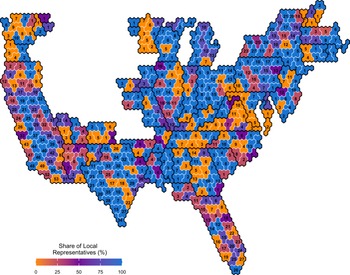
We therefore expect the match between a district and the state in which a politician was born to capture how voters perceive local ties. We code our main outcome variable accordingly. In our sample, 64 per cent of legislators have local ties. Figure 2 displays how often each district was represented by a representative with local ties for the period 2012–16.Footnote 16 We discuss several alternative measures below.
Percentage of years in which a Congressional District was represented by a representative born in the same state, 2012–16. Darker shades indicate a higher share of years with a representatives with local ties. Clusters of hexagons form Congressional Districts; thick lines delineate state borders. The hexagonal map reflects the number of counties and Congressional Districts in each state, rather than their land area.

Model Specification
To accommodate the dichotomous nature of our dependent variable, we estimate logit models. Our key variable, import pressure, is a function of the economic composition of districts, and therefore correlated over time. Districts also are situated in the context of county and commuting zones as economically relevant boundaries, which induces correlation in import pressure across districts. To account for arbitrary dependence over time and across districts within states, we cluster standard errors at the level of states, as the highest-level clearly defined geographic boundary, following Cameron and Miller (Reference Cameron and Miller2015) and MacKinnon et al. (Reference MacKinnon, Ørregaard Nielsen and Webb2023). We obtain similar (and typically more precisely estimated) results using standard errors clustered at the level of districts, and using two-way clustered standard errors that also account for arbitrary correlation across states or districts within each election year (Cameron et al. Reference Cameron, Gelbach and Miller2011), as reported in the appendix.
Our models seek to predict whether a representative has local ties, which guides our selection of control variables. This is different from the literature on the globalization backlash – we do not predict, for example, whether a representative is a Republican or Democrat. We instead account for variables that correlate both with import pressures and with support for local representatives.
First, education levels predict both trade flows and trade attitudes (Mayda and Rodrik Reference Mayda and Rodrik2005). Educated individuals also are less responsive to the local identity of representatives (Hunt and Fontana Reference Hunt and Fontana2025). We therefore control for education levels by including the logged share of the district population with a bachelor’s degree or above (from Foster-Molina Reference Foster-Molina2017).
Second, we seek to distinguish our proposed link from partisan differences and incumbency advantages, both of which might correlate with import pressures and support for local candidates. For example, Republican voters might favor candidates with local ties (Munis Reference Munis2021). They might reward those ties especially in Democratic candidates, leading them to cross party lines (Hunt and Fontana Reference Hunt and Fontana2025). We include the logged district-level vote share of the Democratic candidate in the most recent presidential election to account for a district’s overall partisanship (Bonica Reference Bonica2023); whether a representative is a Democrat or Republican (Volden and Wiseman Reference Volden and Wiseman2014); and whether a representative is an incumbent. In the appendix, we split the samples for Republican and Democratic representatives, to further address partisan differences.
Third, it is more likely that suitable candidates will be found from the same state in larger states, and land area tends to correlate with trade exposure. We include the logged land area of a state, from the US Census Bureau.
Fourth, to distinguish our account from one based on cleavages along racial lines (Baccini and Weymouth Reference Baccini and Weymouth2021; Ballard-Rosa et al. Reference Ballard-Rosa, Jensen and Scheve2022; Jardina Reference Jardina2019), we include the logged share of the population that identifies as white. This rules out that our associations reflect that districts with more white voters might favor local candidates from the (white) majority group. For example, Munis (Reference Munis2021) shows that racial resentment tends to correlate with support for candidates with local ties.
Finally, we include election fixed effects, which account for country-wide trends in local representation and import competition. This allows us to identify estimates based on differences in the economic structure across districts within the same election, leveraging deviations from national-level political and economic trends. We consider additional control variables below. Of note, we do not include median income levels among our baseline controls, because these are in part a response to import pressures. We consider them as a robustness check in the appendix.
Results
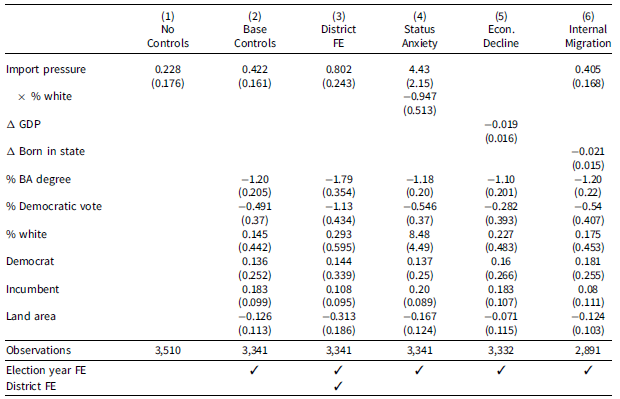
Our primary regression results are presented in Table 1. The unit of observation is the Congressional District election. Column 1 reports results from an unconditional model without control variables, and column 2 from our main specification, which incorporates the baseline controls and election fixed effects.
Import pressure and local representation

Note: Logit models. Intercepts and fixed effects omitted. Coefficient estimates with standard errors, clustered on states, in parentheses.
The effect of import pressures on electing representatives with local ties is positive, and statistically significant at the 5 per cent level once we include control variables. In substantive terms, increasing import competition by one standard deviation increases the odds of electing a representative born in the same state by over one third, or approximately 5.6 percentage points, based on the results in column 2. These effects are also politically relevant. The effect remains at least equally strong in competitive districts – those won by margins of five percentage points or less and those won by margins of ten percentage points or less (reported in the appendix). Where small shifts in voter preferences determine the electoral outcome, import competition thus shapes the composition of the US House of Representatives.
Identification
We have few reasons to suspect reverse causality. The most immediate concern would be that representatives with local ties are less effective at securing protectionist trade policy for their districts, creating trade exposure. This channel is unlikely to explain the results. Changes in US trade in the sample period are largely driven by international commitments, economic transformations abroad, and technological change (Acemoglu et al. Reference Acemoglu, Autor, Dorn, Hanson and Price2016; Handley and Limão Reference Handley and Limão2017; Pierce and Schott Reference Pierce and Schott2016). In the appendix, we also report that representatives with local ties are not associated with lower tariffs for their districts.
We addressed the most obvious potential confounders through control variables. We address a wide range of remaining confounders with district fixed effects. These capture any omitted variables specific to the district (and by implication the state in which a district is located). This includes urban and rural composition, geographic location, historical levels of partisanship and trade exposure, and economic fundamentals. In addition, they capture underlying district-specific preferences for candidates with local ties, as well as the average import exposure of a district throughout the sample period. Together with the year fixed effects, this specification thus identifies how changes in import exposure within districts, relative to overall trends across the US, shape the election of representatives with local ties.
We rely on penalized maximum likelihood fixed effects estimation (PMLFE) as proposed by Firth (Reference Firth1993) and discussed for binary outcomes with fixed effects in Cook et al. (Reference Cook, Hays and Franzese2020). The widely used conditional logit estimator drops districts without temporal variation in the outcome variable and does not allow for the estimation of marginal effects. The PMLFE estimator allows retaining these observations. The results, presented in column 3, remain robust, strengthening the plausibility of a causal interpretation. Substantively, the effect of import competition increases compared to our baseline model. We consider alternative estimators below.
We briefly discuss three remaining issues. First, prior work establishes a link between import competition and a turn towards economic nationalism, populism, and authoritarian values. A prominent thread in this literature suggests that the racial make-up of local economies moderates the effects of import pressures: white voters are more sensitive to the resulting threats to their economic status (Autor et al. Reference Autor, Dorn, Hanson and Majlesi2020; Ballard-Rosa et al. Reference Ballard-Rosa, Jensen and Scheve2022; Baccini and Weymouth Reference Baccini and Weymouth2021; Broz et al. Reference Broz, Frieden and Weymouth2021). To rule out that our results capture increased status anxiety and racial identity, we interact import pressures with the logged share of white residents. The results in column 4 indicate that the effects of import pressures decrease, rather than increase, in the share of white residents.Footnote 17 Our focus on local representation thus appears distinct from a focus on racial identity and the turn towards economic nationalism, populism, and authoritarian values identified in the literature.
Second, we highlight the distinct role of import pressures, which differ from more general economic decline. To assess this explicitly, we replace import pressures with the change in local gross domestic product in each Congressional District (data from the Bureau of Economic Analysis). The results in column 5 corroborate the distinct effects of global market pressures: the effects of changes in gross domestic product are substantively small and statistically not significant. This underscores that the explicit ‘foreignness’ of market pressure, not economic distress more generally, drives local representation.
Third, our associations might capture internal migration rates. In districts with high import exposure, a lack of in-migration from other US states may result in a local population, and therefore a pool of potential candidates, largely composed of those with local ties. The associations we report then would not reflect a preference for local ties, but rather the composition of the local population. Yet, if internal migration patterns were explaining our results, individuals would have to migrate not just out of their district, but out of their home state, in response to contemporaneous trade shocks. Internal migration in the US tends to be pro-cyclical (Molloy et al. Reference Molloy, Smith and Wozniak2011). Moreover, internal migration tends to drop off sharply at state borders (Wilson Reference Wilson2022). The local population thus tends to be relatively insensitive to negative economic shocks. In column 6, we also report that the effect remains positive and statistically significant when controlling for the change in the share of the population that was born in the state.
Mechanism: Local Identity
Prior work suggests a link between import pressure and local identity, though sometimes only indirectly (see, for example, Inglis and Donnelly Reference Inglis and Donnelly2011; Mayda and Rodrik Reference Mayda and Rodrik2005; Le Galès Reference Le Galès2021). Assessing this mechanism explicitly, we report in the appendix that import pressures are associated with subsequently higher levels of local identification,Footnote 18 drawing on the Nationscape Survey (Tausanovitch and Vavreck Reference Tausanovitch and Vavreck2021). Controlling for standard individual-level attributes, a one standard deviation increase in district-level import pressure accounts for roughly a quarter of the standard deviation across districts in the share of respondents describing the local community as being important or very important to their identity.
Mechanism: Candidate Selection
The association between import pressure and local representation combines multiple possible mechanisms. First, given the choice between a local and a non-local candidate on election day, voters gravitate towards the local candidate where import pressures are higher. Second, anticipating these choices, candidates with local ties are more likely to end up on the ballot, reflecting candidate and voter choices in the primary process. The associations above do not separate out these mechanisms, and instead emphasize that they have a common source: voter preferences for candidates with local ties.
To assess these mechanisms separately, we identify the birthplaces of all major-party candidates that lost Congressional races in the 2016 election. We are able to do so – from campaign statements, local news sources, and other publicly available information – for over 80 per cent of losing major-party candidates. In the appendix, we report that the overall association can at least in part be explained by strategic candidate entry by local candidates (and non-entry by non-local candidates) and voter choices in the primary process. Import pressures increase the probability that at least one major-party candidate on the election day ballot has local ties. This holds both in districts with multiple primary candidates and in those with uncontested primaries. Moreover, in districts where incumbents lack local ties, local candidates are more likely to run in response to import pressures. Yet, import pressures are not associated with an increase in the number of candidates running in primary elections.
At the same time, we show that these patterns only explain part of the overall association between import pressures and the success of local candidates. The overall association is stronger than what is explained by decisions in the primary process and holds when controlling for primary outcomes. It also holds in head-to-head races – both open races (with a p-value just over 0.05) and races with a margin of victory below 10 per cent (with a p-value below 0.05) – between local and non-local candidates.
Robustness
In the appendix, we present several robustness checks.
Estimators and fixed effects. As an alternative to the PMLFE estimator, we present results from a logit fixed effects estimator. While the results are robust to this choice, we prefer the PMLFE estimator, following the discussion in Cook et al. (Reference Cook, Hays and Franzese2020).
We also show that the results remain robust in a Mundlak–Chamberlain model, which models the fixed effects by including the district averages of each variable. For the linear case, Mundlak (Reference Mundlak1978) and Bell and Jones (Reference Bell and Jones2015) establish the equivalence to the standard fixed effects estimator. Wooldridge (Reference Wooldridge2019) extends the application to binary outcome models. The model has two advantages: it allows inclusion of the full sample, similar to the PMLFE model; and it allows for a decomposition of effects within Congressional Districts and across Congressional Districts. The results indicate that import pressures have effects in both dimensions, providing some justification for the pooled specifications. We further assess the cross-sectional nature of the effects by collapsing the data by district, estimating linear regression models with robust standard errors. In these models, the reported association remains as well.
When we return to our original specification and include state fixed effects, the coefficient on import pressure declines in size and loses statistical significance. A decomposition of the effects together with the other results reveals a nuanced pattern: the effects are based on differences within districts across time and on differences across districts across states, but not on differences across districts within states.
State size. In larger states, being born in-state might be less meaningful. We find tentative evidence for such a pattern: the effects of import pressures decrease in state size, though the interaction fails to reach statistical significance. Further analyses suggest considerable heterogeneity among large states. The negative interaction term is largely driven by California. In contrast, in Texas, the effects of import pressures are larger – plausibly reflecting the high salience of local identity in Texas. Once we remove California and Texas, we also find no evidence of systematic differences along state size. State borders, as boundaries, appear to be politically relevant largely independent of state size.
Measuring local ties. We consider several alternatives to capture local ties. We present results based on the distance between a representative’s place of birth and the district (from Crosson and Kaslovsky Reference Crosson and Kaslovsky2025); based on distance relative to the land area of a state, to incorporate that a larger distance is less meaningful in larger states, while in smaller states even a smaller distance might cross multiple state borders; based on distance coded with positive values only for representatives born outside the state, which blends distance with our main measure; and based on an index of ‘local roots’ developed by Hunt (Reference Hunt2022), which, among other factors, takes into account whether a representative was born, attended high school or college, or owned a business in the district they are representing.
For distance without normalization or modification, the results point in the same direction as our main results – import pressures are associated with the election of candidates born closer to the district they are representing – but fail to reach statistical significance at the 5 per cent level. For the remaining measures, with the exception of the Local Roots Index in combination with district fixed effects (possibly reflecting the shorter time span), the results retain statistical significance at the 5 per cent level.
Import pressure. We re-estimate our base model, excluding one at a time imports from the ten largest US trading partners in the computation of import pressure. The results affirm that the results are not driven by import from specific trade partners. We also construct a measure of changes in imports per worker, following the literature on import shocks (see, for example, Colantone and Stanig Reference Colantone and Stanig2018a). We calculate this change relative to 2002 as base year. The results are robust to this change, and – reflecting the considerably larger variance in this variable – generally increase in statistical significance.
Financial crisis. The elections in 2008 and 2010 coincide with the financial crisis, a major economic shock in many regions. The results are robust to excluding these elections.
Partisanship. Import pressures, as well as some of the control variables, might have different effects for Republican and Democratic representatives. In the appendix, we show that we obtain similar effects of import pressures when splitting the sample by partisanship. We also show that the results are robust to recoding control variables to align with the partisanship of the representative.
Pre-existing Local Identification
Hypothesis 2 contends that the effects of import pressures are larger in areas with stronger pre-existing local identification. To obtain a measure of pre-existing local identification, we rely on the World Values Survey (Inglehart et al. Reference Inglehart, Haerpfer, Moreno, Welzel, Kizilova, Diez-Medrano, Lagos, Norris, Ponarin and Bea2014), with a total of 3,373 US respondents in the years 2006 and 2011. As part of the surveys, participants were asked whether they see themselves as a part or a member of their local community, with response options ranging from ‘strongly agree’ to ‘strongly disagree’.Footnote 19
We match survey respondents to census regions, the most narrow geographic identifier in the survey, to calculate region-specific average levels of local identification. We thus capture pre-existing local identification for the three elections in our sample taking place after 2011. This avoids including characteristics in our models that are outcomes of import pressure and thus would induce post-treatment bias (Agnolin et al. Reference Agnolin, Colantone and Stanig2025). While census regions are large, we are not aware of more granular survey data asking similar questions during our sample period. Such coarse groupings are also not unusual. For example, the divide between East and West Germany helps identify differences in local identity (Harfst et al. Reference Harfst, Bol, Blais, Golder, Laslier, Stephenson and Straeten2024) or gender attitudes (De Vries and O’Brien Reference De Vries and O.’Brien2026).
Regional differences in this measure of local identification accord to some extent with intuition. For example, one of the states scoring highest on the measure is Texas, a state typically perceived to have pronounced local identity. At the same time, the measure displays few systematic correlations with other variables in our data (reported in the appendix). Districts in the lower and upper quartile of local identification do not differ on education levels, land area, or the share of white residents. We do find systematic differences on some economic attributes: districts with higher local identification tend to have lower median incomes. In the appendix, we show that our results are robust to adjusting for these differences.
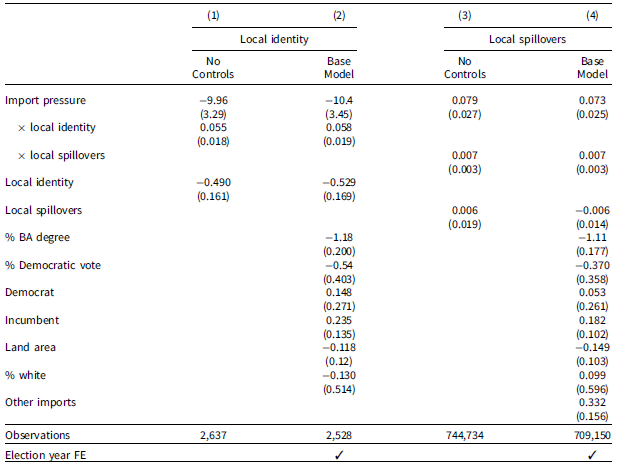
To assess Hypothesis 2, we interact local identification with import pressure. Otherwise, we retain the previous model specifications with standard errors clustered by states. We first present a model without control variables, then our baseline specification. The results are presented in columns 1 and 2 of Table 2. The interaction term is positive and statistically significant at the 5 per cent level, indicating that the effect of import pressure increases with pre-existing local identification.
Import pressure and local representation: conditional relationships

Note: Logit models. Intercepts and fixed effects omitted. Coefficient estimates with standard errors, clustered on states, in parentheses.
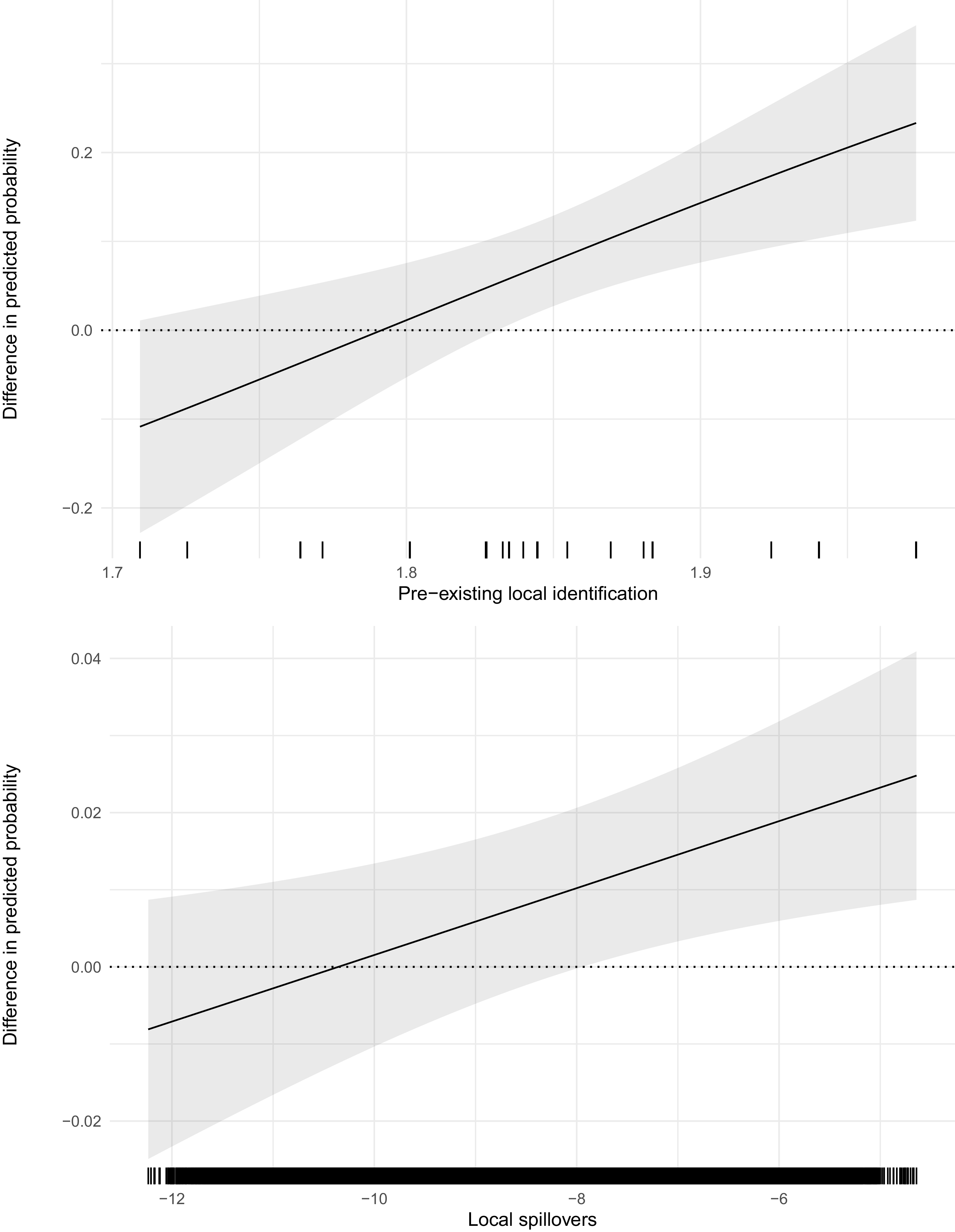
We illustrate the substantive size of these effects in the top panel of Figure 3.Footnote 20 The figure displays the marginal effect of increasing import pressures from the twenty-fifth to the seventy-fifth percentile along different values of local identification on the horizontal axis. The ticks at the bottom indicate the distribution of local identification in the sample. The effect of import pressure is negative in regions with the lowest levels of local identification. At about the sample median, the effect becomes positive and statistically significant at the 5 per cent level. At the highest levels of local identification, the probability of electing a representative with local ties increases by about 20 percentage points – around three times the overall unconditional effect.
Marginal effect of import competition on local ties of legislators, moderated by pre-existing local identification (top panel) and upstream spillovers (bottom panel). Based on models including controls and election fixed effects. Vertical axis: marginal effect of moving from the twenty-fifth to the seventy-fifth percentile of import pressure. Horizontal axis: local identity (top panel) and local spillovers (bottom panel). Rug plots indicate the distribution of the moderator variable in the estimation sample.

Local identity is measured at a higher level of aggregation than import pressure. Heisig and Schaeffer (Reference Heisig and Schaeffer2019) suggest that such a multilevel structure in interaction models may deflate standard errors and p-values. In the appendix, we follow their recommendation and estimate multilevel models with random slopes for import pressure.
As an alternative measure of local identity, the share of residents born in-state presents a close match to our outcome variable. In the appendix, we report that the effects of import pressure decline in the share of residents born in-state (though the interaction term misses significance at the 5 per cent level). We also briefly discuss two potential explanations of this association, based on the presence of foreign-born residents and based on the accumulation of past economic performance. Ultimately, however, these remain post-hoc explanations. We hope future work can further assess these patterns, and for now suggest a cautious interpretation.
Spillovers from Key Industries
Our final hypothesis contends that import pressures have the largest effects if they hit key industries in local production networks: then, import pressures spill over to local suppliers upstream, eliciting a shared local identity most forcefully. To assess this hypothesis, we require a disaggregated data set at the level of the district–industry–election year. Otherwise, we cannot assess whether the effects of import pressures are larger if they hit industries that create local spillovers.
To arrive at a measure of spillovers, we follow Betz and Hummel (Reference Betz and Hummel2025), who draw on detailed industry-level data from US input–output tables. For every industry i, we first identify all supplying industries j = 1…J. We then calculate the share of industry j’s output that is supplied to industry i, capturing to what extent import pressure on industry i affects upstream industry j. We obtain data on customer–supplier relationships across industries from the 2012 input–output tables from the US Bureau of Economic Analysis. We adjust for input sourcing of imports following guidance by the Bureau of Economic Analysis.
We combine these with data on district-level industry employment to identify local spillovers. Denoting the value of supplies from industry j to industry i at time t with m i,j,t , total output of industry j with q j,t , employment in industry j in district cd with L j,cd,t , and total district-level employment with L cd,t , we calculate $\eta _{i,cd} = \sum _{j} \left ({{m_{i,j,t}}\over{q_{j,t}}} \times {{L_{j,cd,t}}\over{L_{cd,t}}} \right ). $
As with import pressures, we use the log-transformed value. To accommodate this variable, which varies across districts and industries, we disaggregate our base data set to the district–industry–election year. To isolate spillovers from correlated import pressure across industries (driven by similarities in comparative advantage across industries in the same production network), we control for import pressures on other industries in the same district. Otherwise, we retain the same models as before, clustering standard errors at the level of states. This accounts for arbitrary correlation across Congressional Districts within states, including over time and across industries.
We present results in columns 3 and 4 in Table 2. We obtain a positive and statistically significant coefficient on the interaction of import pressure and local spillovers, supporting Hypothesis 3: the effect of import pressures increases with an industry’s embeddedness in local production networks. The bottom panel of Figure 3 illustrates the substantive size of the marginal effects. Import pressures have the largest effects when they occur for industries that create spillovers. Conversely, import pressures that are isolated to specific industries and create few spillovers throughout the local economy fail to elicit a similar political response – arguably because these, as industry-specific effects, fail to raise the salience of local identity.
We require the disaggregated data set to assess our hypothesis. In the appendix we return to the district–election year level and include the average indirect import pressure per worker in each district. While this model does not allow assessing to what extent import pressures result in larger effects if they hit key industries in the local economy, the results corroborate that indirect import pressure results in the election of candidates with local ties.
To address the potentially inflated number of observations in our district–industry–election year data set, in the appendix we show that the results are robust to alternative treatments of the standard errors, including standard errors clustered at the level of districts; at the level of states and industries simultaneously; and at the level of state–industry pairs. We also estimate weighted regression models to account for the varying number of observations within each district.
Conclusion
We present a link from global market pressures to local representation. While prior work has highlighted the place-based effects of trade, it has not recognized this link between economic globalization and local representation. We contend that this link is an important dimension of the political consequences of economic globalization: we shift attention away from changes in party systems and political leadership, and towards the descriptive attributes of representatives. We thus build on recent work, which pays attention to differences in descriptive representation across, for example, race (Steinberg and McDowell Reference Steinberg and McDowell2024) and gender (Betz et al. Reference Betz, Fortunato and O’Brien2021) as important dimensions in economic globalization.
Future work could consider extensions in multiple directions. We highlight three. First, our findings raise the question of how legislators compensate for a lack of local ties in response to global market pressures, and to what extent the election of legislators with local ties can substitute for a turn towards populism and economic nationalism. For example, future work could examine social media statements, legislator newsletters, or legislative behavior to assess whether global market pressures also increase the incentives of legislators to cultivate a personal vote (Carey and Shugart Reference Carey and Shugart1995) – and, in particular, a personal vote based on local identity and downstream policy outcomes with respect to globalization.
Second, we focused on the United States, a context where elections are candidate-centered and parties are weak. In other contexts, parties play a more important role in candidate selection and policy formulation. On the one hand, this suggests local ties might be less relevant elsewhere, consistent with arguments about differences in the importance of local, geographically concentrated interests across electoral systems (Rickard Reference Rickard2020). On the other hand, the identity of representatives provides one outlet to accommodate place-based identities. Where national-level parties are not accommodating these, citizens might feel increasingly alienated from the political system, suggesting a different channel through which discontent with globalization turns into discontent with politics more broadly.
Finally, our framework emphasizes the distinct political consequences of spillovers created by local production networks, which foster a shared local identity. Future work could consider how such spillovers shape trade preferences more specifically. Many firms and their employees are tied to global markets only indirectly, and this extends beyond the negative consequences that we considered. For example, while multinational corporations as beneficiaries of globalization dominate trade and trade politics, these firms also tend to have hundreds of suppliers in the domestic economy that stretch across industries, considerably broadening the benefits of access to global markets and the consequences of trade policy choices (Betz and Hummel Reference Betz and Hummel2025). To what extent such indirect exposure to globalization shapes trade preferences – creating coalitions in support of open markets that cut across traditional cleavages formed by occupations, industries, or classes – remains an important question for future research.
Supplementary material
The supplementary material for this article can be found at https://doi.org/10.1017/S0007123426101471.
Data availability statement
Replication data for this paper can be found at doi.org/10.7910/DVN/AXYSCF.
Acknowledgments
For many helpful comments, we are indebted to Vincent Arel-Bundock, Michael Becher, Sung Eun Kim, Irene Menéndez González, Erica Owen, Dennis Quinn, Paul Thurner, three anonymous reviewers, and the editor, as well as participants in the LMU Research Colloquium and audiences at the annual conferences of the American Political Science Association, the European Political Science Association, and the Southern Political Science Association. Monika Grzegorczyk and Tuna Taspinar provided excellent research assistance.
Financial support
This research was funded by the European Research Council (Grant Agreement No. 101041658, Project PINPOINT), funded by the European Union. Views and opinions expressed are, however, those of the authors only and do not necessarily reflect those of the European Union or the European Research Council Executive Agency. Neither the European Union nor the granting authority can be held responsible for them.
Competing interests
None to disclose.



 Open access

