


1 Introduction
Western societies place great value on the provision of extensive choice (Reference SchwartzSchwartz, 2004). Choice, it is argued, enhances the ability to match individual preferences to outcomes (Reference Botti and IyengarBotti & Iyengar, 2004), is associated with feelings of personal autonomy and well-being (Reference Ryan and DeciRyan & Deci, 2001), and people tend to react negatively when choice is restricted (Reference FitzsimonsFitzsimons, 2000). However, the benefits of extensive choice need to be considered alongside potential costs. Research suggests, for instance, that too much choice may encourage confusion and choice deferment (Reference Arunachalam, Henneberry, Lusk and NorwoodArunachalam, Henneberry, Lusk & Norwood, 2009; Reference Iyengar and LepperIyengar & Lepper, 2000; Reference Shah and WolfordShah & Wolford, 2007; Reference Tversky and ShafirTversky & Shafir, 1992) as well as a reduction in satisfaction with chosen options (Reference HaynesHaynes, 2009; Reference Iyengar and LepperIyengar & Lepper, 2000). Moreover, economic theory has long recognised that as options become more similar the opportunity costs of the next best alternative foregone also rise. This tension between wanting more options but finding them difficult to deal with has been referred to as the Paradox of Choice (Reference SchwartzSchwartz, 2004).
To date, however, much of this research has focused on consumer decision making for products such as jams, chocolates, pens, soft drinks, sweets, gift boxes and music (see Reference Scheibehenne, Greifeneder and ToddScheibehenne, Greifeneder & Todd, 2010, for a review) and we still know very little about whether the paradox of choice exists for more consequential decisions (although see Reference Iyengar, Huberman, Jiang, Mitchell and UtkusIyengar, Huberman & Jiang, 2004). The aim of the current research was to investigate whether extensive choice undermines decision making with respect to a potentially more meaningful decision context, namely choosing an organisation to volunteer for. Volunteering one’s time without concern for financial gain is a serious time commitment for many individuals, which has been linked to a range of volunteer benefits such as greater life satisfaction, improved health, skill development and better job prospects (Reference BorgonoviBorgonovi, 2008; Reference Meier and StutzerMeier & Stutzer, 2008), as well as obvious benefits for others. Consequently, the implications for the individual of deciding which organisation to volunteer for are potentially much larger than for many of the consumer contexts explored previously.
Like many of these consumer contexts, however, the charity and volunteer sector is one where excess choice abounds. For example 164,000 charities are registered in the UK alone (Reference CabinetCabinet Office, 2008). Moreover, the National Centre for Social Research and the Institute for Volunteering Research (NCSR, 2007) estimates that the economic benefit of UK volunteering is around £40 billion annually. The current UK government has placed increased volunteering at the heart of its Big Society agenda (Reference CabinetCabinet Office, 2010). If this plethora of organisations is indeed detrimental for volunteer recruitment this could have a major effect on service delivery and the success of the Big Society and other similar initiatives. Understanding how people make decisions about selecting volunteer organisations and how best to structure these choices to aid people’s decision making could therefore have considerable policy implications.
For research into volunteer recruitment, students are a very important population to investigate. This is an age and stage of life when many people begin volunteering for the first time. In the UK, for instance, around 15% of first year students (Reference HoldsworthHoldsworth, 2010) and more than 42,000 students in total volunteer each year through organised volunteering programmes at their Higher Education Institutions (Student Volunteering England [SVE], 2004). Key motivations include wanting to learn new skills (55.9%) and to gain experience for their future career (44.5%; SVE, 2004). The contribution to the economy is estimated to be around £34 million pounds (wage equivalent at 2003 values, SVE, 2004). Importantly students also tend to continue volunteering after leaving college. In the US, College graduates were more likely to volunteer (24.4%) than people without college experience (8.3%) and were also more likely to still be volunteering later in life (Marcelo, Reference Marcelo2007a, Reference Marcelo2007b).
The present studies focus on the potential of extensive choice to increase the likelihood that individuals will put off making an immediate decision and instead defer a decision to later. Given the general propensity not to revisit deferred decisions (Reference Ariely and WertenbrochAriely & Wertenbroch, 2002) this could have important implications for volunteer recruitment. Our primary hypothesis was that as the number of organisations considered by potential volunteers increases, the likelihood that they will state a preference to defer the decision will also increase. In Study 1, subjects were asked to explore one of the main UK volunteering websites and choose which organisation they would most like to volunteer with. The association between the number of options considered and deferment likelihood was then tested. Study 2 presented subjects with either a large or relatively small choice set of hypothetical organisations, and deferment preferences were again recorded. Our secondary hypothesis was that feelings of confusion, difficulty and lack of confidence during the decision process might mediate this effect (Reference ChernevChernev, 2003; Reference Scheibehenne, Greifeneder and ToddScheibehenne, Greifeneder, & Todd 2009).
2 Study 1: The association between number of options considered and decision deferment for real volunteer organisations
Study 1 asked students who were not currently volunteering to explore the Volunteering England website. The website is one of the leading sources of information about volunteering in the UK and at the time of the study presented detailed information on over 100 organisations. Subjects were asked to record the number of organisations they looked at and short listed and asked several questions about the decision process. Our key dependent variable was whether website viewers felt, by the end of their exploration, that they were ready to make a decision or would prefer to put it off until later. Our main hypothesis was that the more organisations people considered the less likely they would be willing to choose any specific organisation. The secondary hypothesis was that this process would be mediated by how difficult subjects reported the decision making process to be.
2.1 Method
2.1.1 Subjects
Fifty-two undergraduate Psychology students at the University of Plymouth (43 females, 9 males; M age = 20yrs) took part in the study. They were recruited via the University’s participation points system which encourages students to take part in studies in return for course credit. Students were eligible to take part in the study only if they were not currently volunteering (to eliminate the possibility that current volunteers would just pick the organisation they were already volunteering with).
2.1.2 Procedure and materials
Subjects entered a lab in the psychology department and were briefed. They were then sat in front of a PC screen showing the Volunteering England website (www.volunteering.org.uk), specifically the Volunteering in the UK section (to avoid them selecting exotic but unrealistic opportunities overseas). They were requested to stay in the Volunteering in the UK section and not follow links to the individual organisations websites. On the website there were one hundred and fifteen different volunteering opportunities arranged across nine different categories (e.g., environmental, social care etc.)Footnote 1. Within each category, volunteering organisations were listed alphabetically, the organisation name in bold followed by a description of the organisation and what volunteers could do. Subjects were given 5 minutes to explore the website, to consider as many options as they liked and pick the organisation they would most like to volunteer with. Choosing time was limited to 5 minutes as we believed this would be sufficient time for subjects to reach their decision. Reference Boyce, Dixon, Fasolo and ReutskajaBoyce, Dixon, Fasolo and Reutskaja (2010) found that even for an important decision such as choosing which hospital to get treated at for a serious non-urgent knee problem needing surgery, people only took 2.7 minutes to make their decision. They were then asked a series of questions.
First, subjects were asked “How many organisations did you consider” and “How many organisations did you shortlist”. The majority of people said they looked at between 10–15 options. Nevertheless there was considerable variance around this mean with 21% of subjects looking at fewer than 10 and 38% looking at more than 15 options. Thirty nine per cent shortlisted between 0–3 options, 45% shortlisted between 3–5 and 15.69% shortlisted between 5–8 options. Since the number of options considered and the number shortlisted were highly correlated (r = .57; α = .62Footnote 2) these two scores were collapsed to form a single “Personal Choice Amount” variable such that higher scores indicated more options in the person’s own choice set.
Our key dependent variable was deferment likelihood; how likely people were to say that they were not sure which organisation they would choose and would therefore put off making a decision about which organisation to volunteer with. We were also interested in how difficult people found the decision making process. Items for deferment likelihood and decision difficulty, their means and reliabilities are presented in Table 1.Footnote 3
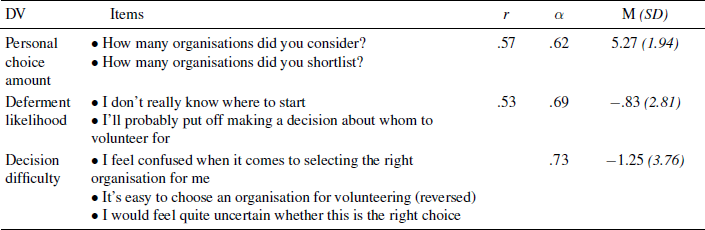
Note: All items (apart from personal choice amount) were presented on a scale ranging from -3 (totally disagree) to 3 (totally agree)
2.2 Results and discussion
In line with our main hypothesis, there was a significant positive correlation, r = .30, p = .03 between personal choice amount and deferment likelihood. The more options subjects considered and shortlisted the more likely they were to say they did not know where to start and to want to defer a decision. To test the potential mediating role of Decision Difficulty we carried out a three step regression model (Reference Arunachalam, Henneberry, Lusk and NorwoodBaron & Kenny, 1986). Personal Choice Amount predicted both deferment likelihood in Step 1 (β = .30, p = .03), replicating the correlational analysis, and also decision difficulty in Step 2 (β = .31, p = .03). When both variables were entered in Step 3, the effect of personal choice amount was reduced to non-significance while that of decision difficulty was highly significant (see Table 2 and Figure 1).

Regression models predicting Deferment Likelihood for volunteering in Study 1 (Solid Lines, top) and Study 2 (Dashed lines, bottom).
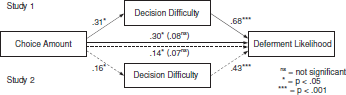
These findings support our contention that the more volunteering options that people consider, the more difficult they find the decision making process and the more likely they are to want to put off making any decision. This is further supported by comments made by a number of subjects after the main part of the study was over about how their decision could have been made easier, for instance; “Fewer options”, “The organisations could have been put in a more specific category”, “What made my decision difficult was the fact that many organisations were quite similar, so it was difficult to choose one out of the many ones you could choose from”, “By putting the organisations into more specific categories so there was less to look at and take in at one time” and “Simple step by step choices suiting your attributes to a volunteering option”.
Despite these early indications of the potential problem of too much choice when faced with the real volunteering sector, the study had a number of limitations in terms of testing our hypotheses. First, all subjects had the opportunity to view up to 115 organisations and while there was considerable variation in the number people said they considered we had no objective way of checking this. Second, the relationship between this self-reported number and deferment likelihood may be accounted for by a third variable such as perceived decision importance which might have influenced both search strategy and deferment. Third, individual differences may have caused subjects to view and deal with the amounts of organisations differently. For instance, according to Schwartz, Ward, Monteroso, Lyubomirsky, White and Lehman (Reference Schwartz, Ward, Monteroso, Lyubomirsky, White and Lehman2002) some people are maximisers and will strive to find the best possible option for them. They find choosing from large choice sets difficult and time-consuming. Other people are satisficers and make-do with the first option that meets their expectations. They do not find choosing from large choice sets as difficult as maximisers as once they have found an option that meets their criteria they stop searching. With regards to Study 1, maximisers would be more likely to consider a greater number of organisations than satisficers essentially confounding individual differences and choice set size in this cross-sectional approach. Finally, we took no account of people’s prior familiarities or preferences for different real world organisations (Reference Scheibehenne, Greifeneder and ToddScheibehenne et al., 2009; Reference Soyer and HogarthSoyer & Hogarth, 2011). For these reasons we conducted a second, more controlled, experimental study that presented subjects with either a relatively small (10) or large (30) number of different organisations (Reference Iyengar and LepperIyengar & Lepper, 2000). Moreover, the organisations presented were hypothetical rather than real to reduce the potential effect of prior preferences (e.g., Reference ChernevChernev, 2003).
3 Study 2: Deferment likelihood for few versus many hypothetical volunteer organisations
Study 2 experimentally manipulated the number of organisations seen by subjects so that they saw either a relatively small choice set (10 options) or a large choice set (30 options). We predicted that subjects who could choose from 30 hypothetical volunteer organisations would be more likely to want to defer any decision than those presented with 10 options and that again this process would be mediated by the self-reported decision difficulty.
3.1 Method
3.1.1 Subjects
Two hundred and six subjects, consisting of students and visitors on the University campus (70 male, 136 female; age was not recorded) took part in the study. Psychology students were recruited via the University’s participation points system and received course credit for taking part; others were approached on campus and offered £3 to take part in the study.
3.1.2 Procedure and materials
Following an introductory brief, subjects sat in front of a computer and were logged into the study. There they were asked to imagine that they had four hours spare a week that they had decided to use to volunteer for a local charity. It should be noted that different amounts of time allocated to volunteering as well as the number of volunteering organisations on offer may elicit differences in deferment likelihood. However, for the purposes of this first experimental study investigating the relationship between the amount of options and deferment likelihood we thought it best to standardise the expected amount of time spent volunteering per week for all subjects. The amount of four hours was based on the actual requirement for various volunteer organisations such as Samaritans (Reference Pahl, White and CarrollPahl, White & Carroll, 2010). Subjects were instructed that they would be presented with some volunteering organisations and should look through the different volunteering opportunities for as long as they wanted and should choose which organisation they would most like to volunteer with. On proceeding, the programme randomly allocated them to either the relatively low (10) or high (30) choice condition.
Though the organisations were hypothetical they aimed to replicate the diverse range of real world volunteering opportunities in Study 1. Specifically ten volunteering categories were created (Animal Welfare, Campaigning, Charity, Companionship, Disability, English Heritage, Environmental, Food, Support and Young People) with three organisations in each category. Subjects were not made aware of these underlying categories as this can affect choosing behaviour (Mogilner, Rudnick & Iyengar, Reference Mogliner, Rudnick and Iyengar2008).
In the high choice condition subjects saw the names of all 30 organisations on the screen and were invited to click as many as they liked to reveal information about the aims or the organisations and what roles/activities volunteers could expect to carry out. Each time a name was clicked it was recorded by the programme, to monitor how many organisations were considered in more depth. The location of the organisations on the screen was allocated randomly for each subject. A similar process occurred for subjects in the relatively low choice condition but only 10 organisations (one from each of the ten categories, to ensure variety within the choice set) were randomly selected and displayed on the screen.Footnote 4 There was no time limit on how long subjects could take to make their decision. These hypothetical organisations appeared to be a good representation of those in the real world since twenty-nine of the thirty were selected by at least one subject.
Subjects were asked to select their preferred organisation but were also asked several other questions (Table 3).

a Presented on a scale ranging from -3 (I felt that I had too few options to choose from) to +3 (I felt that I had too many options to choose from).
b Presented on a scale ranging from -3 (not at all) to +3 (extremely).
3.2 Results and discussion
A manipulation check confirmed that subjects in the relatively low choice condition viewed 10 options as “too few” compared to zero t(102) = −2.56, p < .01 and subjects in the high choice condition viewed 30 options as “too many”, compared to zero t(102) = 5.28, p < .001. Subjects in the high choice condition (M = 108.58s, SD = 46.06s) also took longer to make their choice than subjects in the relatively low choice condition (M = 82.18s, SD = 38.52), F(1, 194) = 19.07, p < .001, η p 2 = .09.Footnote 5 Further, subjects in the relatively low choice condition (M = 7.92, SD = 4.35) looked at fewer organisations (including re-looks) than subjects in the high choice condition (M = 13.71, SD = 12.26), F(1,204) = 20.38, p < .001, η p2 = .09.
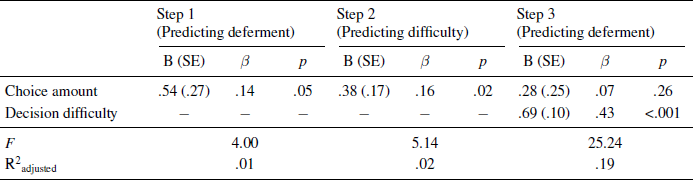
Supporting predictions subjects presented with 30 options were more likely to want to defer their decision than those shown 10 options, t(204) = 1.99, p = .05. Moreover, subjects reported greater decision difficulty when presented with 30 than 10 options, t(204) = −2.27, p = .02. As with Study 1, subjects’ responses as to how their choices could have been made easier indicated the problems of choosing from unstructured choice sets, similar options and large numbers of options. Intriguingly these issues were raised in both the relatively low and high choice conditions.
As with Study 1 a regression analysis was carried out to examine the extent to which decision difficulty mediated the effect of choice amount on deferment likelihood (Table 4). The first two steps are analogous to the two t-tests presented above. When both variables were entered in Step 3, the effect of choice amount was reduced to non-significance while that of decision difficulty was highly significant (see Table 4 and Figure 1).
4 General discussion
Most research into the excess choice effect has examined the impact of choice amount on people’s reactions to simple material products such as pens and chocolates and concluded that people tend to be more likely to put off making a decision or are less satisfied with their choice if faced with more options (Reference Arunachalam, Henneberry, Lusk and NorwoodArunachalam et al., 2009; Reference Iyengar and LepperIyengar & Lepper, 2000; Reference Shah and WolfordShah & Wolford, 2007). More recently, researchers have tried to understand why the effect has been hard to replicate and have begun to investigate potential moderators (Scheibehenne et al., Reference Scheibehenne, Greifeneder and Todd2009; Reference Scheibehenne, Greifeneder and Todd2010). The current research extends this literature by focusing not on a choice about material possessions but on a choice concerning how one spends one’s time, making it an “experiential” choice (Reference Van Boven and GilovichVan Boven & Gilovich, 2003). Specifically, we wondered whether being faced with the large number of charitable organisations seeking volunteers might adversely affect an individual’s decision process when considering volunteering options. Volunteering has a number of benefits both for society and the volunteer themselves (Reference BorgonoviBorgonovi, 2008; Reference Meier and StutzerMeier & Stutzer, 2008; NCSR, 2007). Understanding whether excess choice in this context interferes with volunteer recruitment may be important in the success of initiatives to encourage greater social participation.
Study 1 found that the more options subjects examined on the Volunteering England website, the more likely they were to want to defer making any concrete decision. This hesitation seemed to be related to increased levels of confusion and difficulty when considering and short-listing many vs. relatively few options. To reduce potential confounds and prior preferences associated with the real organisations used in Study 1, Study 2 presented either 10 (relatively few) or 30 (many) hypothetical organisations. Results replicated Study 1. Subjects presented with 30 options reported greater decision difficulty and a higher desire to defer making a decision than those presented with 10 options. As far as we are aware this is the first time that the excess choice effect has been clearly demonstrated for an experiential choice (Reference Van Boven and GilovichVan Boven & Gilovich, 2003; Reference Carter and GilovichCarter & Gilovich, 2010).
Our findings are, nonetheless, consistent with the few studies that have considered the effects of choice set size on decisions involving non material purchases. First, Iyengar and Lepper (2000, Study 2) demonstrated that students presented with many vs. few essay titles wrote objectively poorer essays. Further, Iyengar et al. (2004) reported that deferment of decisions about pension investment was more likely the higher the number of potential funds. Of particular relevance to the current studies, Scheibehenne et al. (2009) examined people’s willingness to donate to charity. In one study (Study 2c) they found that subjects were less likely to donate a Euro when they had seen 40 or 80 organisations than 5. In part this seemed to be because subjects found it harder to justify their selection from more options. Two further studies failed to replicate this effect.
Reference Soyer and HogarthSoyer and Hogarth (2011) extended Scheibehenne et al.’s (2009) research by considering how individuals might split a larger donation (50 Euros) among multiple organisations (or multiple campaigns of a single organisation). Replicating Scheibehenne et al. (2009) they found that organisation familiarity was correlated with donation amount: Better known organisations received larger donations. Of particular relevance to the current findings they also found that more people donated at least something, i.e., chose at least one organisation to give something to, as the number of organisations increased. This appears to contrast with our own finding that deferment may be more likely as the number of charities increases. There are a number of possible reasons for this discrepancy. First, in Soyer and Hogarth’s study people simply decided to donate any winnings or not, they were not asked whether they might want to defer a decision. Second, the number of options in their large choice sets (16/13) were closer to our small choice set (10) and it may be that decision paralysis would be more likely with 30 organisations to donate to (see Reference Scheibehenne, Greifeneder and ToddScheibehenne et al., 2009). Finally, although both studies concern choices regarding charitable organisations we still do not know how donations of time (volunteering) and money differ psychologically, a question which further research could address.
Our findings raise the more general question of whether there are simply too many volunteer organisations now. The answer is that it probably depends. Reference Diehl and PoynorDiehl and Poynor (2010) for instance argue that when people have strong prior preferences they are able to deal with a large choice set, precisely because they are more likely to be able to find a match for these preferences. None of the subjects in Study 1 were currently volunteering, which suggests that they did not have clear prior preferences and may have found the decision process more difficult than potential volunteers with clearer preferences. Secondly, volunteer organisations are often grouped into categories and it is possible that this process could aid decision making (Mogilner et al., Reference Mogliner, Rudnick and Iyengar2008). Nonetheless categories were present in Study 1 and the effect was still found. We are currently exploring how best to categorise and structure volunteer choices in order to aid the decision process and reduce deferment likelihood. Of course there are other additional factors that may affect both decisions to give time or money to charitable organisations. For example, Reference Dickert, Kleber, Peters and SlovicDickert, Kleber, Peters and Slovic (2011) found that monetary donation decisions depended on individuals’ numeracy levels as well as the mental imagery evoked by different presentation formats.
Despite the consistency of our findings across two studies, a number of limitations should be recognised. Firstly, all of our subjects in Study 1 and most in Study 2 were students and it remains to be seen whether other potential sectors of the volunteering community would show similar effects. As noted above however, students are an important part of the volunteer community so the use of students in this research seems justifiable. Second, we asked our subjects to consider volunteering for a specific amount of time (4 hrs per week), based on the actual requirements of a leading charity we had worked with (Reference Pahl, White and CarrollPahl et al., 2010). We are unsure at this stage what effect this level of specificity had on subjects’ responses and whether the pattern would generalise to different or unspecified, self-directed amounts of time.
Third, as noted above, we did not record differences in individual’s choice making strategies. Schwartz and colleagues (Schwartz et al., 2001) for instance argue that large choice sets might not affect “satisficers” as much as “optimisers” and it may be that our sample in Study 1 largely consisted of optimisers as the satisficers had already chosen an organisation to volunteer for. Although this would not account for the results in Study 2, consideration of this in future research would be useful. Fourth, we also recognise that it may not simply be the number of organisations, but the number of features relating to each organisation that may be important for decision difficulty and deferment (Reference Greifeneder, Scheibehenne and KleberGreifeneder, Scheibehenne & Kleber, 2010).
Finally, while we have focused on decision deferment, which has potential implications for volunteer recruitment, we recognise that choice set size may also affect subsequent satisfaction with any volunteering experience. This has potential implications for volunteer retention since dissatisfied volunteers may be less likely to continue. Previous research, again largely with consumer decisions, suggests that the more options there are the greater people’s expectations become (Reference Diehl and PoynorDiehl & Poynor, 2010) and the more they consider options foregone, which can decrease their satisfaction with the option chosen (Reference Hafner, White and HandleyHafner, White & Handley, in press; Reference Sagi and FriedlandSagi & Friedland, 2007). Perhaps most consistent with our own findings, Reference Iyengar, Wells and SchwartzIyengar, Wells and Schwartz (2006) found that satisfaction with one’s job was inversely related to the number of jobs considered. Longitudinal research is now needed to follow up volunteers exposed to different arrays of volunteer options to see whether it affects their long-term satisfaction and retention.
In sum, the findings from two studies suggest that the more volunteer organisations individuals consider, the less likely they may be to firmly commit to any of them. Since people often fail to revisit deferred decisions (Reference Ariely and WertenbrochAriely & Wertenbroch, 2002), this could have significant implications for volunteer recruitment. Given that increasing volunteer numbers is a crucial part of the policy for delivering public services, the current growth rate of the voluntary sector may actually be self defeating. Not only may it be splitting the volunteer community thinly across even more organisations but it may also discourage others from volunteering altogether. Future research is needed to see whether increasing options may also lead to growing dissatisfaction among current volunteers who may be more likely to think about other organisations they could switch to.


 Open access

