1 Introduction: Why Connected Language Learning?
Learning emerges in the interplay of individual human beings with multiple contexts and systems they are situated in across life experience (Barron, Reference Barron, Martin, Peppler, Halverson and Kafai2006; Jackson, Reference Jeong, Han, Lee, Sunalai and Yoon2023). It involves “the acquisition and expansion of a cultural toolkit based on involvement in a range of specific cultural communities” (Ito et al., Reference Ito, Gutiérrez and Livingstone2013, p. 47). These communities consist of both physical and virtual spaces that provide opportunities for learning, each space comprising “a unique configuration of activities, material resources, relationships and the interactions that emerge from them” that carry different affordances for learning (Barron, Reference Barron, Martin, Peppler, Halverson and Kafai2006, p. 195). These communities are inherently interconnected and interdependent, working together to shape an individual’s development (Barron, Reference Barron, Martin, Peppler, Halverson and Kafai2006; Jackson, Reference Jeong, Han, Lee, Sunalai and Yoon2023). Thus, learning is an ongoing journey across settings, and overlooking the connectedness of learning experiences “is fundamentally at odds with the ways in which individuals learning across various social settings” (National Research Council, Reference Nordqvist and Liang2009, p. 27).
The connectedness of experiences is particularly true for language learning. Language is integral to human doing, being, becoming, and belonging. Its acquisition is hence naturally distributed in and across activity spaces. According to van Lier (Reference van Lier2004), language learning takes place through learners’ interaction with linguistic sources (i.e., language inputs and forms of linguistic communication that learners interact with) and nonlinguistic sources (i.e., the broader physical surroundings, social practices, cultural artifacts, contextual cues, and symbolic sources that provide context and meaning for language use) in meaningful activities within specific activity spaces. Each activity space has unique configurations of linguistic and nonlinguistic resources. Similarly, Benson (Reference Benson and Hall2022) underscored a spatial view of language learning that draws attention to the unique affordances offered by each individual space, shaped by the resources available within that space, including “language-bearing” people, things, and information to which language is attached. Thus, different activity or learning spaces afford different language learning and use experiences, collectively shaping learners’ language development. Learners map out their individual language learning environments through selecting, creating, exploiting, and coordinating physical and virtual learning situations to meet the purpose of learning. Yet, this mapping has a temporal dimension, involving the negotiation of temporospatial resources in life situations at a given time. Even the purpose of learning might morph over time. Benson (Reference Benson and Hall2022) further pointed out that resources in specific spaces are not fixed but rather fluid, due to the global mobilities of “language-bearing assemblage” and learners’ growing capacities to perceive and act on the affordances in a space. Thus, language learning inevitably involves a dynamic configuration and reconfiguration of multiple interconnected, mutually influencing settings that interplay in a facilitative or contested manner. A connected view is hence indispensable and insightful when understanding, facilitating, and researching language learning.
The connected view of language learning has drawn increasing attention in recent academic discourses in education in general and language education in specific, as change has become a defining theme of the contemporary world due to fast technological development, necessitating a transformation in the landscape of learning. Scholars advocate greater attention to connected learning across the lifespan. For instance, Barnett (Reference Barnett, Boduszek and Willmott2004) argued that the current era is an “age of supercomplexity’ that is full of uncertainties. The uncertainties demand individuals to engage in lifelong learning and constantly update their knowledge and skills to remain adaptive to the changing world. Accordingly, scholars urge educational transformations that support individuals’ lifelong learning trajectories across lifewide contexts, where formal, nonformal, and informal learning spaces cross-pollinate over time (e.g., Barnett & Jackson, Reference Barron, Martin, Peppler, Halverson and Kafai2019; Peters & Romero, Reference Peters and Romero2019; Sangrá et al., Reference Sangrá, Raffaghelli and Guitert‐Catasús2019). In language education, scholars prioritize the role of language learning in empowering learners’ social participation in second language life worlds, online and offline (e.g., Eskildsen et al., Reference Fendler2019; Wagner, Reference Wang and Vásquez2019). Wagner (Reference Wang and Vásquez2019) argued that the ultimate goal of second language learning is to participate in new life worlds that use the target language, and it hence makes sense to connect learners’ in-class language learning experience with their language use needs in the life worlds that they are participating or aspire to participate in. Moreover, the increasing volume of research on language learners’ informal or extramural language learning has evidenced positive and unique benefits of learners’ out-of-class language experiences on language development (e.g., Cole & Verderplank, Reference Cole and Vanderplank2016; De Wilde et al., Reference De Wilde, Brysbaert and Eyckmans2020). This body of literature urges greater attention to language learning in diverse contexts and encourages efforts that synergize language learning across settings (Lai & Sundqvist, Reference Lai and Sundqvist2026).
The prevalence of technology in daily life further fuels and intensifies discourses in support of connected language learning. Technology transforms human doing, being, becoming, and belonging, shaping language learning and use. Digital and online technologies bring together the symbiotic interplay of living and nonliving entities in both physical and virtual worlds, where actions in one context extend those in others (Blaschke et al., Reference Blaschke, Bozkurt, Cormier, Hase and Blaschke2021). In this connected landscape, the nature of learning is transformed, where learning is “motivated by an interest to know, share, create and find support, and these activities lead to a range of learning outcomes” (Ala-Mutka et al., Reference Ala-Mutka, Punie and Ferrari2009, p. 350). The pervasive integration of technology in human life and the entanglement of physical and digital experiences make scholars forefront the concept of post-digital hybrid lifelong learning (Nørgård, Reference Oddone, Hughes and Lupton2021). These scholars highlight the transcendence of physical and digital divides, arguing that face-to-face interactions are organically blended with digital tools and platforms. The entanglement of technological, human, and social systems in learners’ experience “challenges binary distinctions between digital and nondigital realities” (p. 7), transforming learning into “interconnected spaces for continuous learning” (Code, Reference Cole and Vanderplank2025, p. 2).
As language is distributed in social participation and cultural artifacts, the emergence and normalization of technologies inevitably change the landscape of language learning and use. Technologies increase the mobility of “language-bearing” objects, expand the settings of language learning, and drive the constant evolution of the nature, scale, foci, and relation of language learning within and beyond the classroom (Benson, Reference Benson and Hall2022; Reinhardt, Reference Rezai, Goodarzi and Liu2022). Reinhardt (Reference Rezai, Goodarzi and Liu2022) drew on a few examples to illustrate how technologies have expanded and redefined language education: The emergence of printing machines expanded demands for general literacy and second language reading; The invention of telegraphs and engines shrank temporal and physical distances, expanding language learning needs to the speaking domain, and shifting language teaching method from Grammar-Translation to Direct Method that centered on naturalistic dialogs; Broadcast radio and audio cassettes popularized audiolingual programmed instructional methods, defining a strong cognitive focus on language education; and the Internet, Web 2.0 and mobile technologies enabled participatory learning and expanded temporospatial dimensions of language learning, incentivizing the shift from a predominant cognitive focus toward a focus on cultural discourses and social practices in language education. Thus, the emergence of new technologies brings along new possibilities of learning that challenge the conventional structures, locations, and attributes of language learning (Nordqvist & Liang, Reference Nordqvist and Liang2015).
Generative Artificial Intelligence (GenAI) is about to start another era of transformation in language education, expanding and connecting language learning across contexts. Generative artificial intelligence is capable of generating humanlike, multilingual textual and visual outputs, which have the potential to create new learning possibilities. These capacities enable customized learning pathways, provide immediate and individualized feedback, and proffer adaptive learning content and materials that fit individual needs and preferences, hence extending language instruction beyond the classroom and empowering personalized and self-directed language learning (Firat, Reference Forbush and Foucault-Welles2023; Grover, Reference Guan, Li and Gu2024). Generative artificial intelligence may also serve as teaching assistants, individual tutors, learning companions, collaborators, as well as conversation partners who strengthen the connection of in-class and out-of-class learning by facilitating class interaction, enabling one-on-one tutoring and language practice, providing real-time feedback and guidance, as well as partnering with learners to produce works, come up with solutions, and create new possibilities of learning (e.g., Kildė, Reference Knowles2024; Law, Reference Law2024; Lee et al., Reference Lim and Toh2025). At the same time, the potential of GenAI to carry out the communicative and transactional language tasks for learners urges the redefinition of key language education goals and competences (Kern, Reference Kern2024; Law, Reference Law2024). Language education in the GenAI era can no longer continue its primary focus on the transactional functions of language and on the development of learners’ linguistic knowledge and skills. Instead, language education needs to focus more on the social and cultural values of language learning. Richard Kern (Reference Kern2024) reimagined language education in the GenAI as follows: “What I believe we want to encourage is a genuine agency and autonomy that is born of an integration of language, culture, mind and body. An integration that allows connection with other people, creative expression of new identities in multiple modalities, and critical remove from monolingual and monocultural perspectives” (p. 522).
To highlight the functions of language for social connection and relationship building, for identity expression, and for the transmission and preservation of cultural identity and human values, connecting language learning with learner experience across life domains is unavoidable. Moreover, the affordances of GenAI for autonomy and personalization may potentially drive paradigm shifts in language education toward learner-driven and learner-centered approaches. Scholars underscore learner agency and autonomy as the essence of language education in the GenAI era, highlighting the importance of amplifying and supporting learner-driven language learning across time and space (Gao, Reference García Botero, Botero Restrepo, Zhu and Questier2024; Law, Reference Law2024). Conceptualizing the generative affordances of GenAI in transforming education, Ron Beghetto argued that it is essential to use GenAI to “give students an opportunity to be designers of their own futures and their own learning” and “to accelerate their interest and capabilities to do things in the world that they haven’t been able to do before, and to open up possibilities” (Mishra & Henriksen, Reference Mishra and Henriksen2024, p. 400). Thus, language educators need to seriously consider how to create a connected learning experience that situates language learning in learners’ desired and aspired social participation across life domains, acknowledging the expansive functions of language that go beyond mere transactional purposes.
In this backdrop, connected language learning is a defining theme and a direction of language education in the post-digital era. Connected learning aims to connect learning to individuals’ life spheres so as “to narrow the gap between how learners live and how and what they learn at school” (Kumpulainen & Sefton-Green, Reference Lai, Hu and Lyu2014, p. 9). Notwithstanding, current conceptualizations of education often treat students’ learning experiences across contexts as disconnected, and there is a paucity of educational practices that consciously scaffold connected learning (Lewin & Charania, Reference Lim and Toh2018; Livingstone & Sefton-Green, Reference Livingstone and Sefton-Green2016). This Element hence intends to contribute to a systemic effort toward supporting students’ connected language learning in the post-digital era.
This Element aims at the following objective: To develop a conceptual framework of connected language learning with technology, and map out pedagogical implementation and research around the framework. To achieve the objective, it intends to synthesize existing discussions on connected learning in both the broader field of education and scholarship within language education to generate a framework of connected language learning with technology and its constituent elements, devise ways of operationalizing this conceptual framework, analyzing potential implementation issues and support mechanisms, and discussing research needed to advance the theorization and practice of connected language learning with technology.
2 Theorize Connected Language Learning with Technology
Educational scholars have theorized connected learning from different theoretical stances. I will review a few major theories related to connected learning to synthesize a framework that theorizes connected language education with technology in the post-digital era.
Theoretical Frameworks in Support of Connected Learning
There have been quite a few theoretical frameworks that highlight the importance of connected learning, driven by the observations of the multiplicity of learning contexts and the fluidity of information, knowledge, resources, and experiences across time and space.
Rhizomatic Learning
Arguing that knowledge in the information age is fluid and constantly updating, which makes canon knowledge a moving target, Cormier (Reference Cormier2008) introduced the concept of rhizomatic learning. Cormier compared the constantly evolving knowledge in the information age to a rhizomatic plant. A rhizomatic plant has a root system that spreads horizontally in different directions with no fixed center and is only bounded by the limits of its habitat. Accordingly, Cormier (Reference Cormier2008) highlighted the nonlinear and interconnected nature of knowledge and argued that what is learned is not predefined or validated by experts, but rather emerges in the contributions and interests of the communities. Thus, learning is social engagement and a process of discovery, and is characterized by mobilities and deterritorialization (Fendler, Reference Fendler2013). Learners are “nomadic subjects” who create a dynamic, open, personal learning network based on perceived and real needs and desires (Lian & Pineda, 2014).
Scholars hence underscore the importance of constructing rhizomatic learning that is open, lacks prescription in curriculum and learning outcomes, and is responsive to students’ needs (Lian & Sangarun, Reference Littlejohn, Hood, Milligan and Mustain2023). To support learners to create unbounded personal learning networks that blend different communities, teachers are to create rhizomatic learning structures that are characterized by: (1) hyperconnectivity in learning resources and experiences and knowledge objects; (2) heterogeneity that creates multiplicity in learning possibilities; and (3) multiplicity in perspectives, ways of knowing, pedagogies, and learning media (Cronjé, Reference Cronjé and Khine2023). Thus, rhizomatic learning emphasizes:
(1) Moving away from a rigid and scripted curriculum toward a more fluid and dynamic learning process, and creating learning conditions that allow multiple, nonhierarchical entry and exit points with no predetermined beginning or end.
(2) Placing the responsibility of learning in the hands of the learners, where they act toward self-defined goals with the support of resources.
(3) Supporting learning mobilities across contexts, and allowing learners to freely navigate and build connections across activity or information points according to perceived need.
(4) Supporting learner autonomy and decision-making in the learning processes, and fostering learners’ awareness of their evolving agency and identity, as well as reflection in and on action.
Thus, rhizomatic learning highlights the fluidity and connectedness of knowledge and knowledge construction pathways.
Learning Ecology Framework
The learning ecology framework draws on the sociocultural and ecological theories of human development to capture self-sustained learning (Barron, Reference Barron, Martin, Peppler, Halverson and Kafai2006; Jackson, Reference Jeong, Han, Lee, Sunalai and Yoon2013). Inspired by biological ecosystems, this framework highlights that individuals are simultaneously involved in multiple settings, which constitute a learner’s environment. People, places, tools, and activities across settings are interdependent, making learners’ experiences across settings interconnected too (Jackson, Reference Jeong, Han, Lee, Sunalai and Yoon2013). This framework pre-assumes that learning ecologies span different times and places, connecting learning experiences across a person’s life course. Thus, learning occurs within a dynamic, interconnected system of contexts, relationships, and resources that a learner actively creates and navigates throughout his/her life.
This framework highlights the centrality of learners in learning. Learners actively create, sustain, and adapt personalized learning ecologies to meet their evolving needs and purposes (Jackson, Reference Jeong, Han, Lee, Sunalai and Yoon2013). They decide goals to achieve, people to interact with, activities to spend time on, and attention to allocate at different activity contexts. Interest triggers their self-directed learning across contexts. Interest-driven learning activities are boundary-crossing, with interests originating in one context being followed up in other contexts, and sparking off and sustaining “fertile bi-directional flows of knowledge between contexts” (Barron, Reference Barron, Martin, Peppler, Halverson and Kafai2006, p. 218).
Learning ecology scholars hence emphasize designing boundary-crossing and connected forms of learning that may sustain across the life course and creating integrated learning experiences that support lifewide learning (Peters et al., Reference Peters and Romero2022):
(1) Creating learning experiences that cross formal and informal, as well as individual and collaborative boundaries
(2) Featuring the connections of academic forms of knowledge and experience with practical ones, as well as with everyday interest-driven learning
(3) Enabling and supporting learner agency
Thus, the learning ecology framework features the temporospatial dimensions of connectedness in learning. In addition to these two frameworks that conceptualize the connectedness of knowledge and learning spaces, there are also three theoretical frameworks that underscore connectedness as a response to the prevalence of digital and online media.
Connectivism
Connectivism was coined by George Siemens to reconceptualize knowledge and learning in view of the online connectedness of people (Siemens, Reference Siemens2005). According to Siemens (Reference Siemens2005), “knowledge has changed from categorization and hierarchies to networks and ecologies” (p. v). This conceptual lens views knowledge as “networks of connections formed from experience and interactions between individuals, societies, organizations and the technologies that link them” (Goldie, Reference Goldie2016, p. 5). Accordingly, learning is conceptualized as a cyclical process of forming, participating in, and traversing networks of information, people, as well as resources, building connections across nodes or information sources, modifying beliefs, and sharing one’s realizations with the networks (Downes, Reference Downes2022). Hence, learning starts in connecting to and participating in learning communities, such as libraries, websites, databases, and organizations. A learning community is “the clustering of similar areas of interest that allows for interaction, sharing, dialoguing, and thinking together” (Siemens, Reference Siemens2005). Each community constitutes a node that is part of a larger network. Connectivism, hence, places learners at the center of the learning experience. Learners’ personal interests and preferences are the main drivers of learning (Kop & Hill, Reference Kolluri and Tichavakunda2008). Their idiosyncratic learning experience is shaped by their decision-making regarding what online and physical networks to connect to or to create, and the nature and levels of participation in these networks.
In connectivism, to teach is to facilitate learners’ construction and refinement of the networks of information, people, and resources. Connectivist pedagogies are to build expansive networks of connected people and resources that allow learners to “gather things together, remix them, adopt them to [their] own purpose, translate to [their] own language, and then share” (Downes, Reference Downes2022, p. 81). It emphasizes several key principles (Downes, Reference Downes2022; Kop & Hill, Reference Kolluri and Tichavakunda2008; Siemens, Reference Siemens2005):
(1) Creating learning environments based on learner self-direction and autonomy, facilitating the construction of personal learning networks.
(2) Building decentralized learning networks that support more equitable distribution of connections and facilitate the sharing of diverse perspectives and experiences.
(3) Supporting learners’ abilities to obtain and filter information, to perceive and make connections between fields, ideas, and concepts, as well as to interpret and synthesize information from multiple sources.
Siemens and Downes illustrated connectivism through designing one of the first massively open online courses (MOOC), titled “Connectivism and Connective Knowledge”, in 2008. This course had no required readings, but distributed daily newsletters that aggregated diverse content for participants to explore. Learners were encouraged to construct a personal learning pathway based on interests and needs. They were expected to build connections between various materials and perspectives, remixing and repurposing the information to generate new understandings and contributions, and form insights to be shared publicly. They were encouraged to create their own groups and online communities, and share their creations with the communities, thereby feeding forward and contributing to the learning networks. The roles of the instructors were to construct an open and decentralized learning environment, structure co-creation of knowledge and co-construction of learning communities, and facilitate students’ connection building through a global network. Thus, connectivism highlights the connectedness of information and expertise as well as the social connectedness in knowledge construction.
Networked Learning
Similarly, networked learning also emphasizes the social aspect of learning. The concept of networked learning emerged in the 1990s in view of the prevalence of e-learning, web-based learning, and online learning. Goodyear and colleagues provided a definition of networked learning as follows: “Networked learning involves processes of collaborative, co-operative and collective inquiry, knowledge-creation and knowledge action, underpinned by trusting relationships, motivated by a sense of shared challenge and enabled by convivial technologies” (Networked learning Editorial Collective, 2021).
Thus, networked learning emphasizes a social lens to education. It promotes creating learning environments that feature cooperative learning and community participation to strengthen and facilitate the connectedness “between people, between sites of learning and action, between ideas, resources and solutions, across time, space and media” (Networked Learning Editorial Collective, 2021, p. 319). Networked learning centralizes human interactions via and with technology: (1) technology-mediated interactions among geographically distributed peers to support learning and collaborative problem-solving, and associated sociopsychological issues such as trust, power, identity, belonging, and affection; (2) learners’ interactions with technology and how technology shapes and is shaped by human activities; and (3) collaborative engagement in valued activities, in the form of collaborative inquiry and joint actions, to enhance understanding and for effective problem-solving (Networked Learning Editorial Collective, 2021).
Networked learning design follows a few key principles (Hodgson & McConnell, Reference Hoi and Mu2019; Networked Learning Editorial Collective, 2021):
(1) Creating learning experiences toward collaborative, purposeful transformation of the world, and centering learning activities around solving a shared challenge.
(2) Creating opportunities for collaboration, cooperation, as well as collective learning and action, where responsibilities for learning are shared among all actors in the network. Building in social interactions that support the sharing of expertise, sustain learners’ dialogues with peers and/or experts, and facilitate the co-construction of knowledge and identity.
(3) Building democratic and open cultures that encourage self-determined learning, respect differences, create conditions of trust and peer support, and build relationships and reciprocity.
(4) Enabling learners to build the capabilities needed to generate new ways of seeing things and for social participation toward valued changes. Support learner agency, critical analysis, and reflexivity, as well as shared commitment to change.
In a nutshell, in addition to emphasizing social connectedness of knowledge construction, the networked learning framework further underscores collective purposes and responsibilities in learning.
Connected Learning Framework
The connected learning framework was introduced by Ito et al. (Reference Ito, Gutiérrez and Livingstone2013). Different from connectivism and networked learning, the connected learning framework is driven not only by the observation of the affordances in the interconnected world created by digital and online media but also by a conscious awareness of the constraints. Ito and colleagues argue that while expanding access to information, boosting social connection, and enabling interest-driven learning and social participation, digital and online media also exacerbate existing social problems and inequalities. Thus, it underscores creating a learning experience that not only capitalizes on the afforded possibilities of pursuing personal interests and expands supportive relationships across contexts, but also creates opportunities for career and civic participation that address existing social issues. The framework hence advocates the tripartite connection of academic learning, career advancement, and civic engagement. Ito et al. (Reference Jeong, Han, Lee, Sunalai and Yoon2020) define connected learning as: “learning that is socially embedded, interest-driven, and oriented toward expanding educational, economic, or political opportunity. It is realized when a young person is able to pursue a personal interest or passion with the support of friends and caring adults and is in turn able to link this learning and interest to academic achievement, career success, or civic engagement” (p. 26).
This framework values interest-driven learning across settings, emphasizing personal meaningfulness of learning by tying learning with interest areas and associated affinities. It recognizes the embeddedness of learning in social relationships and cultural contexts, valuing support from both near-peer and adult affinity-based mentorship. It also has an equity agenda in respecting learners’ cultural identities and connecting learning experience with career and civic life.
Connected learning framework highlights the following key elements in constructing learning environments and experience (Ito et al., Reference Jeong, Han, Lee, Sunalai and Yoon2020):
(1) Sponsoring and legitimizing diverse interests, both personal and social/political-oriented, and cultural identities among the learners, and building an expansive network beyond schools to incentivize and support relevant learning initiatives.
(2) Providing opportunities for learners to engage in shared practices (e.g., creative production around popular culture and entertainment, joint inquiry) toward a shared goal for positive personal growth (e.g., academic success and career development), and social change (e.g., contributions to communities, social change, or solving real problems)
(3) Connecting learning across settings to create “lines of practice” across time and space that support learners’ interest development, have their work recognized, and connect them with opportunities beyond school.
Thus, this framework places connectedness at the core of the meaningfulness of learning and emphasizes the connectedness of individual experiences across life domains.
Although connectivism, networked learning, and connected learning frameworks are transformative learning paradigms driven by the prevalence of online and digital media and conceptualized to harness the learning potentials of the interconnected world online, the central tenets of these frameworks are learner-driven, collaborative knowledge co-construction through information and expertise sharing and co-creation for meaningful purposes. These central tenets can be realized via both high-tech and low-tech solutions.
A Synthetic Framework of Connected Learning
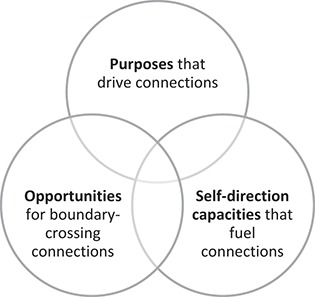
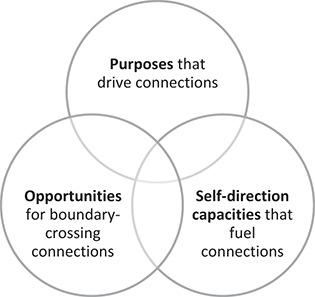
So far, I have reviewed five theoretical frameworks that advocate creating connected learning. These frameworks differ in theoretical lenses and highlight different aspects of learning that need to be connected. Learning ecology framework and connected learning framework have a longitudinal perspective, focusing on designing learning experiences across communities and across the lifespan to serve a long-term purpose, such as personal interest, personal passions, and civic and political engagement. Connectivism and rhizomatic learning emphasize the design of open, nonhierarchical, and networked learning environments that could support the creation of personal learning networks and pathways. Networked learning stresses the construction of collaborative communities and collective efforts to solve shared problems and challenges. Despite the different foci, these frameworks share the following commonalities:
(1) Purposes that drive connections – all the frameworks highlight purposes or goals that necessitate and drive connected learning, although the specific nature differs. While some frameworks (e.g., networked learning, connected learning framework) stress a social cause, such as social changes and civic participation, the rest frameworks underscore personal goals or personal interests.
(2) Opportunities for boundary-crossing connections – all the frameworks highlight designing learning environments that create opportunities for connections in resources, relationships, and interactions that enable and empower boundary-crossing learning experiences. They emphasize open and emergent learning environments that are not predetermined, and encourage and support learners to seek, contribute, and/or coordinate learning resources across learning settings and/or digital platforms. They value interactions and/or collective actions with peers or affinity-based groups within and/or beyond the learning contexts, such as the co-creation and contribution of learning materials and perspectives (e.g., connectivism), or collaborations around shared practices or challenges (e.g., networked learning, connected learning framework). These frameworks further emphasize the construction of a democratic and expansive learning culture, breaking down hierarchical structures and building relationships with varied entities within academic contexts and beyond (e.g., connectivism, connected learning framework), as well as developing reciprocity (e.g., networked learning) and emotional affiliations and support (e.g., connected learning framework).
(3) Self-direction capacities that fuel connections – all the frameworks place learners at the center, conceptualizing learning as a process of building personal networks and/or ecologies. The frameworks place responsibilities of learning in the hands of learners (e.g., networked learning), demand learner agency in constructing personal learning networks and pathways (e.g., rhizomatic learning; connectivism), or encourage self-directed pursuit of personal interests (e.g., connected learning framework, learning ecology framework). Thus, these frameworks emphasize self-direction capacities that support learner-driven connected learning. These frameworks highlight the development of learner capacities and attributes that support self-direction, such as learner agency and self-determination (e.g., networked learning, connectivism, learning ecology framework; connected learning framework), decision-making abilities (e.g., connectivism, rhizomatic learning), and interest development (learning ecology framework; connected learning framework)
Based on these commonalities, a conceptual framework is proposed to synthesize the key elements of connected learning (Figure 1).
Conceptual framework of connected learning.
This framework speaks to learning in general. Second language learning has its unique characteristics, demanding additional dimensions that need to be considered when constructing connected learning.
Conceptualize Connected Language Learning
Language learning and use are contextual in nature, situated and embedded in layers of ecosystems (Chong et al., Reference Chong, Isaacs and McKinley2023). Ecological perspectives of second language acquisition and use highlight that: “Learning is a nonlinear, relational human activity, co-constructed between humans and their environment, contingent upon their position in space and history, and a site of struggle for the control of social power and cultural memory” (Kramsch, Reference Kramsch2002, p. 5).
According to this perspective, language use has multiple layers of meaning: “It refers not only to the here and now, but also to the past and the future of the person or persons involved in the speech event, to the world around us, and to the identity that the speaker projects” (Kramsch, Reference Kramsch2008; Van Lier, Reference Van Lier2010, p. 3). Thus, language use and meaning making is shaped by the “layered simultaneity” of historicity, that is, the copresence of multiple social histories and shared communal memories that may influence how people perceive and act to varied degrees (Bloomaert, Reference Brandt2006 p. 130; Kramsch, Reference Kramsch2008). Learners bring their historical and cultural backgrounds into language use and understanding. Meaning-making is always connected to social histories that learners carry with them, and emerges from the interplay of past experiences, collective memories, and ongoing social practices within discourse communities. Language and culture use hence involves the negotiation of pluralistic cultural and ideological perspectives and subjective positions that interlocutors bring to a language use event (Kramsch, Reference Kramsch2008). Kramsch (Reference Kramsch2012) further elaborated that this temporal dimension of language use manifests in the negotiation of the present, past, and future: “Language learners acquire the ability to communicate not only with other human beings (native speakers, non-native speakers, students in the same classroom, teachers), but also with imagined and remembered interlocutors (imagined selves in their diaries, imagined and remembered others on line, on face-book, over the phone, constructed others in novels, plays and poems)” (p. 14).
It also manifests in the relatedness of learners’ multilingual learning journeys: “relearns the ways of the child and at the same time learns to become a multilingual adult” (Kramsch, Reference Kramsch2012, p. 14). Moreover, language learning is inseparable from the broader sociocultural and ideological environments that shape power relations and learners’ identities. It involves an active, ongoing, embodied interaction between the learner and the socially and culturally embedded environment, where learners perceive and act on the affordances, “relationships of possibility” (van Lier, Reference van Lier2004, p. 105), within power relations and social contexts for language use and action. Affordance perception depends essentially on learners’ perceiving, negotiating, and shaping the historicity and subjectivity of themselves and others for meaning, identities, and participation (Kramsch, Reference Kramsch2008; van Lier, Reference van Lier2004).
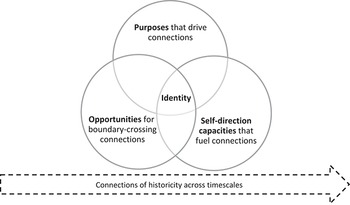
Thus, both language use and language learning emphasize a strong temporal and historical dimension that features learners’ negotiation of their own and others’ past, present, and future linguistic and cultural practices, namely the connection of historicity over timescales. This historicity dimension of connectedness, hence, needs to be featured in second language learning, and language learning experiences need to acknowledge, respect, and activate learners’ existing and envisioned linguistic and sociocultural repertoires. At the center of connected language learning is identity, as “language is not just a mode of communication but a symbolic statement of social and cultural identity, especially in the increasingly multilingual environments in which L2 learners found themselves” (Kramsch & Vork Steffensen, Reference Kramsch, Vork Steffensen and Hornberger2008, p. 20). Figure 2 situates connected learning in the second language education context.
Framework of connected language learning.
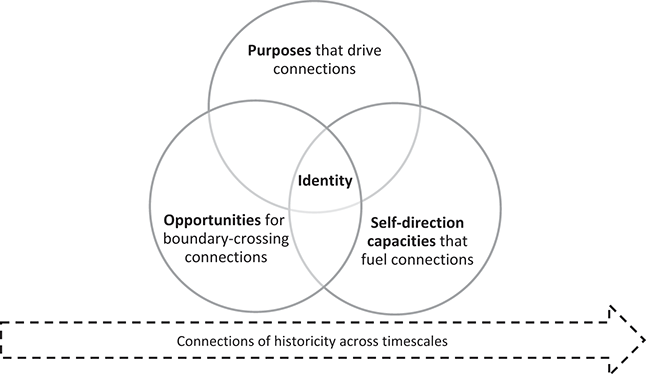
This framework conceptualizes four elements that incentivize and support connected language learning. Attaching personal and/or community purposes to language learning incentivizes connection of learning across learning domains (academic, physical, and online society, profession), driving learner investment in learning and providing a strong motive for connection. Proffering boundary-crossing learning opportunities immerses learners in experiential activities of connected learning across learning spaces, formal and informal, which expands material and social capital for learning and sustains connected learning. Providing experience that allows and supports the connection of learners’ historicity across timescales enables learners to draw on their past, present and envisioned sociocultural, linguistic, and historical resources for empowered sense making and to achieve connection across life histories. These three angles are teacher-initiated connected learning from spatial and temporal perspectives, which may, over time, transform into self-initiated connected learning if learners accumulate sufficient capabilities and internalize the experience as habits. Boosting self-direction capacities may directly spark off learners’ self-initiated connection across spatiotemporal experiences, but sustained engagement in such behaviors needs to be fueled by finding purposes and having opportunities for spatial and temporal connections.
Each of the four elements could potentially serve as a starting point for connected learning. Although being independent angles to connected learning, these four elements are mutually reinforcing and permeable. For instance, as learners engage more and more in connected language learning across context (the opportunity aspect), they may, over time, build the competence and confidence for social participation in the target language, eventually choosing to transform their online language activities into social or digital activism (the purpose aspect). Combinations of these angles form a continuum of connected learning, with strong connected learning (the integration of all four elements) on the one side and weak connected learning (the enactment of a single element) on the other side. Strong connected learning helps bridge learners’ formal and informal learning experiences to enable them “to pursue a personal interest and passion with the support of another (friends, caring adults, knowledgeable others) and empower them to link this learning and interest to academic achievement, career success, and/or civic engagement” (Prestridge et al., Reference Rashid, Howard, Cunningham and Watson2021, p. 2172). It is hence more likely to induce self-initiated self-sustaining connected language learning across life space and lifespan, and contribute to learners’ personal development beyond language per se. Weak forms of connected learning may still induce connected learning behaviors, which are more likely to be short-lived, due to a lack of either lasting motives or sustaining capacities, and contribute narrowly to language development.
Position Technology in Connected Language Learning
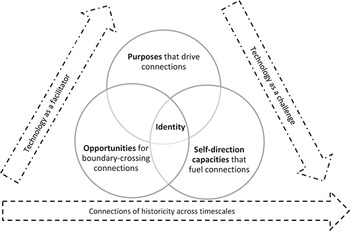
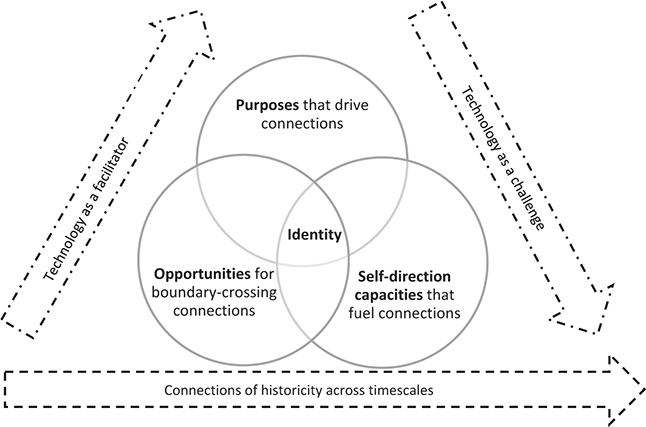
Technologies are essential to connected language learning, serving as both boundary objects and boundary crossing tools. Yet, as “digital technology is hardly the benign, neutral presence in education that we are often assured it to be” (Selwyn, Reference Silvia2015, p. 248), technologies may play both a facilitating and constraining role in connected language learning.
On the one hand, technologies bring new possibilities to connected language learning. Technologies proffer expansive language learning spaces that enable new learning experiences and allow new identity experimentation and performance, expanding nodes of connection in language learning. Technologies are constitutive elements of learning spaces, enabling boundary-crossing learning activities and interactions across communities (e.g., students can access the Internet for quick reference or elaboration via listening to class lectures). The pervasive presence of technologies in any learning space breaks the temporospatial boundaries of spaces, making learning spaces increasingly porous. Moreover, technologies provide digital means that facilitate the brokering of boundaries across academic, interest affinity spaces, professions, as well as social, economic, and political participations, potentially reinforcing learning experiences across communities and enhancing personal relevance and meaningfulness of learning. Technologies and associated social issues may also serve as boundary objects – personal interest pursuit (e.g., pursuing interest in programming via the target language) and social cause for purposeful actions (e.g., video series to help younger siblings develop critical digital literacy to counter potential negative effects of social media) – that incentivize connected learning. In addition, technologies empower self-direction by providing new possibilities. For instance, GenAI may empower personalized learning by enabling customized learning pathways, individualized feedback, as well as adaptive learning content and materials that fit personal interests, needs, and preferences, and even supporting the self-regulated learning process (Chiu, Reference Chong, Isaacs and McKinley2024; Hsu & Ching, Reference Hsu and Ching2023; Zhang & Tur, Reference Zhang and Tur2024).
On the other hand, negative consequences of technologies often go hand-in-hand with the positive effects, and unintended consequences are an inherent part of technologies (Burbules & Callister, Reference Burkitt1999). Moreover, “how a given technological artifact might manifest is largely dependent on how it is storied into existence” (Lynch, Reference Lynch, Bulfin, Johnson and Bigum2015, p. 145), and thus barriers in effective use of technologies might further constrain the role of technologies in connected learning. While acknowledging their essential roles in expanding the accessibility of information and connection, Jones (Reference Ju, Jia and Shoham2025) argued that the Internet and media are broken: “with these advances will come increasing inequality, social isolation, a loss of human agency, and a further loosening of our grip on reality” (p. 3). He warned educators that “bringing digital technologies into classrooms has inevitably entailed importing what is broken about them” (p. 6).
Take the role of social media in identity development as an example. Social media have been applauded as sites for identity development for two reasons: (1) affording community-based, identity-masking interpersonal interactions that allow low-risk language use and social practices and equal social interaction (Greenhow, Reference Guan, Li and Gu2011; Ju et al., Reference Ju, Jia and Shoham2016); and (2) providing comfortable and nonthreatening social interaction venues that constitute optimal contexts for transcultural and plurilingual identity construction and performance (Reinhardt, Reference Renninger and Hidi2019; Wang & Vásquez, Reference Wang and Vásquez2012). However, social media may also deter identity development for two potential reasons: (1) lacking the contextual cues necessary to aid the successful transmission and translation of complex cultural meanings, leading to intercultural misunderstanding (Veronis et al., Reference Veronis, Tabler and Ahmed2018); and (2) amplifying cultural differences (Forbush & Foucault-Welles, Reference Forbush and Foucault-Welles2016). Similarly, GenAI is argued to both benefit and constrain personalized language learning. On the one hand, GenAI is acclaimed for empowering personalized learning experiences and ameliorating resource and experience disparities. On the other hand, scholars argue that GenAI does not necessarily empower personalization by default, and its power depends on effective use of GenAI (Laak et al., Reference Lankiewicz2024). Inappropriate use of GenAI has also been associated with potential hazards, such as overreliance and passive dependence on the tool, diminished critical thinking, academic dishonesty, metacognitive laziness, and thoughtless consumption of misinformation and biased information (Lo et al., Reference Lo, Hew and Jong2024; Zhang & Tur, Reference Zhang and Tur2024). The level of expertise required for harnessing the capabilities of GenAI may contribute to an emerging digital divide, hence running the risk of exacerbating existing educational inequalities (Cooper & Tang, Reference Cooper and Tang2024). Thus, technologies bring mixed blessings to connected language learning.
In this backdrop, I position technology as both a potential enabler and a challenge to connected language learning (see Figure 3), and its mixed blessings need to be taken into consideration when discussing the operationalization and implementation of connected language learning with technology. In the next section, I will elaborate on how to operationalize the key elements in this framework to create connected language learning.
Connected language learning with technology.
3 Operationalize Connected Language Learning with Technology
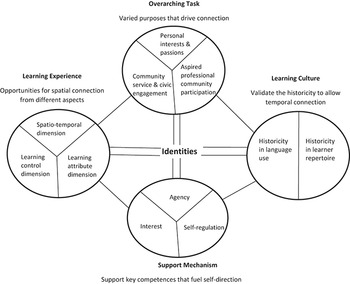
The conceptual framework devised in Section 2 guides the design of technology-mediated language learning that integrates learners’ lived experiences across time and space. The framework contains five key elements: purposes that drive connections, opportunities for connected learning, self-direction capacities that fuel connections, connection in historicity across timescales, and identity development. Purposes inform overarching task design, opportunities guide learning experience design, connections in historicity steer the design of learning culture, self-direction capacities advise the design of support mechanisms, and identity is at the core, constituting both the outcome and a shaping force of connected learning experience. In this section, I will elaborate on how to operationalize these key elements to create connected language learning with technology.
Overarching Task Design: Purposes for Connection
To incentivize connected language learning, the overarching task design needs to ensure that language learning is attached to and serves a strong purpose. This purpose connects learners’ language learning experience with their cultural or ethnic communities, aspired careers and related professional communities, personal interests and passions, and associated affinity spaces, or civic engagement with social issues and activist networks.
Language educators have explored the possibility of connecting language learning with learners’ cultural or ethnic communities and with civic participation, with the aim of creating a more ethical and inclusive society or repairing the broken internet world (Jones, Reference Ju, Jia and Shoham2025). For instance, Jiang (Reference Jiang and Hafner2026) engaged his Hong Kong university students in creating and sharing multimodal products for social equity-oriented actions. These ESL students assumed the agentive role of social issue investigators and exhibited a high level of investment in using English to create multimodal products that draw the public’s attention to local social issues. Lai et al. (Reference Lai, Pi, Xiong, Gu and Jiang2025) reported how the creation and publishing of digital multimodal cultural artifacts that featured ethnolinguistic and ethnocultural contents and issues helped strengthen the link of a group of Chinese intermediate-level university ethnic minority English as Foreign Language (EFL) learners with their ethnic communities. They found that connecting these learners’ English learning experience with their ethnic communities provided them opportunities to resist the exclusionary ideologies in their socio-educational contexts and validate subordinated cultural and digital resources, incentivized their in-depth explorations into marginalized ethnic cultures, bolstered inward gaze toward their beliefs about English learning and usage, and induced broadened identities and imagined new possibilities for social roles. But at the same time, they reported that ideological contestation in online spaces, such as the reproduced national chauvinism, created new modes of exclusion and discouraged some learners from leveraging the expanded possibilities of action this experience might have proffered. In the context of secondary school education, Cummins and colleagues (Reference De Wilde, Brysbaert and Eyckmans2015) revealed that engaging in identity-affirming creative writing production, such as migration stories and identity poems, enabled secondary school multilingual students from marginalized communities in Canada to amplify their sense of self, exhibiting stronger pride in themselves and their cultural and linguistic origins, and empowered them to project themselves as intellectually and academically capable despite their limited English proficiency. Similarly, Kendrick et al. (Reference Kendrick, Early, Michalovich and Mangat2022) found that creating video digital stories to inquire into their lived experiences empowered secondary school refugee students to exercise agency to represent and reposition their identities, critically reflecting on their ethnic cultures and social issues, and create “counter-narratives of empowerment and pride” (p. 981).
Language educators have also explored connecting language learning experience with one’s aspired careers and professional communities. For instance, Osa-Melero and colleagues (Reference Osa-Melero, Fernández and Quiñones2019) initiated a project that paired up university Spanish language learners with Hispanic children, aged five to eight, who newly immigrated to the US for an after-school program. During the after-school sessions, these university Spanish learners gave mini-lessons on Spanish plays they were studying in their literature course, and prepared these Hispanic children to act out the plays for the Hispanic and university communities, including friends and family members of the Hispanic children, as well as Spanish students and faculty members at the university. The researchers found that working with native Spanish-speaking children not only boosted the university Spanish learners’ conversational and listening competence as well as confidence in Spanish, but also geared them toward future career plans in relation to Spanish immigrant communities. Yeh and Mitric (Reference Yung, Lai, Tai and Cai2023) engaged their university English Language Learners (ELLs) who studied at an arts and media college to create Instagram accounts dedicated to an aspired creative industry in envisioned future careers. Students were instructed to connect to artists on Instagram, introduce artists’ work to online audiences, and curate and post relevant works in/about their own neighborhoods. They found that the connected learning experience not only enhanced these ELL learners’ critical awareness of in-school and out-of-school literacy practices and developed their cyber-pragmatics of internet-mediated text genres, but also boosted their intention to engage in similar digital practices in the future for professional purposes.
Moreover, language educators have explored connecting learners’ language learning experience with the pursuit of personal interests and passions. York (Reference York2023) reported an innovative project where university ELLs were guided to explore their personal interests and form groups of shared interests. Afterwards, students joined and followed sub-Reddit communities that aligned with their interests. In-class learning revolved around supporting their participation in these communities. The researcher found that structuring English learning experience around students’ personal interests not only strengthened their intrinsic motivation to learn but also boosted creative language use and enhanced interaction with authentic audiences. Researchers have also examined language learners’ pursuit of interest objects in affinity spaces, where individuals voluntarily aggregate around an intensive endeavor, goal, and practice, and engage in sharing and collaboration activities toward the development of the interest. A seminal work is Black’s (Reference Blaschke, Bozkurt, Cormier, Hase and Blaschke2005) account of adolescent ELL learners’ participation in online Fandom communities, that is, online communities where people gather to create or adapt literary works and media products of interest. Black argued that the linguistic and cultural hybridity in these spaces enables language learners to broaden their identities as successful writers and knowledgeable experts in the digital literary practice, develop an authorial voice, and construct hybridized identities that free them of the constraints of classroom learning. These Fandom spaces, such as fanfiction communities, dubbing communities, and translation communities, not only proffer immense opportunities of informal mentoring that supports learners’ development of writing skills (e.g., Aragon & Davis, Reference Aragon and Davis2019), but also foster a strong sense of belonging, identity construction, and a strong will of using the target language for community service and personal fulfillment (e.g., Vazquez et al., Reference Wang and Vásquez2019). Studies have further revealed that connecting learners’ language learning experience with artifact creation around literary works and popular culture products of personal interests helps boost learner voice and agency in language participation both in the digital wilds and in subsequent in-class writing practices (e.g., Naderpour, 2022).
Thus, designing tasks with a strong personal and community purpose may drive the connection of language learning experience with community service, civic participation, and professional engagement, and incentivize learners’ connection with peers, mentors, experts, and real audiences, online and offline, beyond the classroom. More importantly, linking language learning and use with concrete products (e.g., co-creation; civic action) around personal and community purposes that are visible and appreciated by people and communities of personal significance helps learners construct and perform identities associated with varied social participation domains, broadening their identities beyond a subordinate learner identity. The broadening of identities is critical to learner agency in sustained engagement with the language for social participation.
Learning Experience Design: Opportunities for Connected Learning
To design a learning experience that provides opportunities for connection, we need to conceptualize how key elements of learning situations can be connected. Every learning situation is defined by three essential elements: the spatiotemporal dimension, the learning control dimension, and the learning attribute dimension.
The spatiotemporal dimension refers to the “configurations of activities, material resources, relationships and interactions” (Barron, Reference Barron, Martin, Peppler, Halverson and Kafai2006, p. 195) and “conditions for language contact” (Benson, Reference Benson and Hall2022, p. 29) made possible by learners’ spatiotemporal routines in a learning situation. For instance, the spatiotemporal routines of learning on mobile devices are often characterized by spontaneity, fragmentation, and noisy and multitasking situations full of potential distractions. These routines determine that mobile learning experience is often casual by nature, and not cognitively demanding and time-intensive (e.g., Lai & Zheng, Reference Lai and Zheng2018). The spatiotemporal characteristics of a learning situation shape the possibilities of learning.
The learning control dimension refers to who has the control (learner or external control), what is being controlled (the negotiability and choice of learning purposes, learning outcomes, learning contents, learning process, and learning assessment), and the degree of control (the level of structuredness) in a learning situation (Colley et al., Reference Cooper and Tang2003; Rogers, Reference Rogers2014). The learning control dimension defines the scope of learner agency and autonomy in a learning situation.
The learning attribute dimension refers to the nature of learning (e.g., implicit or explicit, didactic or experiential, embodied or conceptual, and uniform or personalized), and the interrelationships during learning (e.g., individual or collaborative). These attributes collectively form the characteristics of learning experience in a learning situation (Colley et al., Reference Cooper and Tang2003; Rogers, Reference Rogers2014; Rogoff et al., Reference Saadatmand, Kumpulainen, Hodgson, Jones, de Laat, McConnell, Ryberg and Sloep2016). Coming back to the mobile learning example, attributes in this learning situation might be contextualized, situated in personal life, and individually based.
In the following section, I will discuss how to provide opportunities for connection in language learning experience along these three dimensions.
Connection from the Spatiotemporal Dimension
Along the spatiotemporal dimension, we may consider synergizing the affordances of in-class and out-of-class learning to create a seamless language learning experience across time and space. For instance, Wong et al. (Reference Wraae and Nybye2015) introduced a seamless learning framework to utilize and coordinate the affordances of in-class learning (systematic instruction and teacher support) and out-of-class learning (contextualized and networked learning) to optimize learning. Under this framework, formal instruction is to establish initial understanding of a language phenomenon at the beginning of the learning cycle and consolidate learners’ understanding at the end, and informal learning is to enable personalized, contextualized learning and allow extended co-learning with peers in between. They introduced MyCLOUD, a seamless vocabulary learning framework, as an example in K-12 contexts. The learning experience contains the following elements in a cycle: (1) in-class teacher-guided learning of new vocabularies and co-creation of photo blogging on some vocabularies; (2) out-of-class generation of personalized photo blogging using these vocabularies to describe one’s daily encounters; (3) peer review and discussions on learner-generated artifacts on a social networking space; and (4) teacher-facilitated and -scaffolded in-class discussion and consolidation of both teacher-supplied and learner-generated artifacts. Another example is the 4-D foreign language learning environment introduced by Waragai and colleagues (Reference Wraae and Nybye2017) to guide the design of digital learning applications that connect formal and informal learning as well as physical and cyber space in a secondary school EFL learning context. They advocated meta-level integrations that integrate in-class learning with experience-connected learning environments: (1) to detect the physical context (place and time) where a language use event is taking place, and deliver relevant learning materials and resources to support the experience; (2) to deliver class lecture materials that associate with and might support learners’ performance during a particular online communication activity; and (3) to support subsequent self e-learning by enabling autonomous follow-up study and review of learning materials.
Connection from the Learning Control Dimension
At the learning control dimension, different approaches with varying aspects and degrees of control can be adopted to reposition teacher-learner power relationships.
Peripheral approach – The approach that imposes minimal requirements on the instructional time and existing curriculum is the peripheral approach, where learners are invited to co-create supplementary digital learning materials that connect with in-class learning topics. For instance, Trinder (Reference Trinder2017) imagined a scenario where students may be asked to find and share digital resources, such as news articles, forum comments, videos, and social media posts, that are associated with school curriculum content and topics. Students then post these resources on an online community and comment on each other’s contributions as extracurricular learning tasks. This approach can be further strengthened by threading together the extracurricular learning tasks with a course project and allowing learner control over the learning purposes and outcomes of the project. For instance, students can team up with peers to work collaboratively on a semester- or year-long project of shared interests (e.g., creating a booklet on a healthy diet for peers, or developing a strategy manual for teenagers to counter the negative cognitive and emotional impact of social media). The project can be relevant to or independent of course topics, and supported by self-curated materials and a class resource pool (Idros et al., Reference Ito, Gutiérrez and Livingstone2010). This peripheral approach gives learners control over learning content and potentially learning purposes and goals in the extracurricular contexts, which supplements their in-class learning.
Embedded approach – The second approach is the embedded approach, where learners are invited to codesign the learning contents, tasks, and processes as a part of an in-class learning experience. For instance, Godwin-Jones (Reference Goldie2018) shared an example of having intermediate-level students curate, share, and evaluate authentic online materials in the target language (videos, music, websites, etc.) that they enjoy. Students are to process the materials shared by peers and rate the enjoyment level. The teacher and students then work together to transform highly rated materials into interactive learning materials to be shared as open educational resources for the class and beyond. This connection approach gives learners control over the content of in-class activities and peers’ learning activities and processes. It hence requires teachers to free up some instructional hours and curriculum content for learner contribution, allowing for greater learner control than the peripheral approach.
Centralized approach – The third approach is the centralized approach, where learners self-define the learning goals and pathways, identify learning resources, and structure their learning networks. In this approach, teachers’ roles are to facilitate students’ self-determined learning journeys. One example is provided by Little and Thorne (Reference Liu and Darvin2017), where individual and collaborative activities are arranged to guide students to explore their personal hobbies and interests at the beginning of the class, which are then followed up with independent or collaborative pursuit of hobbies and interests in the target language. With the affordances of GenAI for personalized learning, teachers may also position in-class learning experiences as serving and supporting learner-defined projects. Teachers may guide students to imagine how they can learn and use the target language for the purposes of personal growth or helping others in their school or living communities, brainstorming value-creation products they can create using the language acquired. Students may be entrusted with personalized learning with GenAI to curate the necessary knowledge and skills needed for their individual or collective projects. Teachers may dedicate in-class time to providing the support the whole class needs, such as helping students imagine and enact learning possibilities with GenAI to support individual learning pathways, coordinating GenAI with other human and nonhuman resources to seek learning support and build expansive learning networks, providing them with discursive resources and language learning and processing strategies, organizing collaborative sharing sessions to support each other with useful strategies, and providing consultation sessions for individual students or groups. This centralized approach, hence, gives learners full control of learning, with in-class learning mainly to facilitate the learner-defined learning process.
Connection from the Learning Attribute Dimension
At the learning attribute dimension, three approaches can be adopted to create a connected learning experience.
Integration approach – The first approach is the integration approach. This approach is to identify and integrate key attributes of informal language use into material, task, and assessment design. One informal language use attribute is multimodality. Multimodality is found to empower disadvantaged learners inside the classroom. Jiang et al. (Reference Jiang, Yang and Yu2020) documented how individual or collaborative video creation around curricular topics and/or themes of personal interests empowered the English learning journey of a university EFL learner of Tibetan background. They found that the teacher’s integration of multimodality into the university English class helped this Tibetan background student, who started the English class with very low self-efficacy, to grow into a confident user of English for self-expression. Another informal language use attribute is personal relevance. Liu and Chen (Reference Liu and Chen2015) found that engaging Taiwan university students in taking photos of the target English phrases from their daily life led to better performance in both immediate and delayed posttests than asking them to search relevant photos from websites. Thus, connecting language learning with personal life experience carries learning benefits. Another informal language use attribute is interest-driven. Studies have found that incorporating students’ personal interests in assignments boosted students’ interest in the language and enhanced their in-class participation (Holm, Reference Hsu and Ching2020). Moreover, students who read high-interest texts exhibited greater look-up behaviors on vocabularies while reading, and retained significantly more vocabulary compared to those who read teacher-assigned texts (Cancino, Reference Cervin-Ellqvist, Larsson, Adawi, Stöhr and Negretti2023). Moreover, informal language use is about social connection and participation. Yung et al. (Reference Yung, Lai, Tai and Cai2023) reported that converting one-third of the school curriculum into social media materials that aligned with curricular topics as study materials and assigning relevant social media participatory activities as unit assessments led to a significant increase in their secondary school Chinese language learners’ ideal L2 Chinese self. In addition, informal language use involves digital literacy practices. Hafner and Miller (Reference Hafner and Miller2011) found that creating learning tasks that allowed learners to draw on their daily life funds of knowledge, namely the digital tools and media that were familiar in daily life, played an essential role in boosting learner autonomy. The researchers concluded that “a structured learning environment can be designed to emulate the kind of informal learning opportunities found in learners’ unstructured learning environment” (p. 82). These studies suggest that integrating informal language use attributes, such as multimodality, personal relevance, interest-driven, social participation, and digital literacy practices, into in-class material and activity design brings positive effects on learning.
Compensatory approach – The second approach is the compensatory approach. One way to implement this approach is to coordinate and supplement the language use features in formal and informal contexts. For instance, Sockett and Toffoli (Reference Sundqvist2020) recommended in-class learning to focus on speaking and/or writing activities, considering that language learners’ informal learning experience is predominated by receptive activities, such as watching films and TV shows, and skimming social media posts. They suggest assigning listening and reading activities as independent pre-class learning components that support subsequent teacher-facilitated related speaking and writing activities inside the classroom. English language teachers in Schurz and Sundqvist’s (Reference Siemens2022) study reported focusing on accuracy-oriented activities inside the classroom to compensate for the fluency-focused language use in informal learning contexts. Another way to implement this approach is to coordinate types of language use experience in formal and informal contexts. For instance, Lai et al. (Reference Lai, Zhu and Gong2015) found that it was the total number of meaning-focused activities, not the total number of technological resources, that predicted Chinese junior high school students’ English grade and English learning confidence. They hence recommended that in the context where in-class learning is dominated by form-focused instruction, learners’ experience needs to be complemented with meaning-focused activities beyond the classroom. Language user role is another lens for this approach. Little and Thorne (Reference Liu and Darvin2017) emphasized connecting the consumer and receiver roles learners often play inside the classroom with the producer roles that language users could play in informal spaces, especially on social media spaces. They shared an example of a project where school-age kids in rural Alaska were sent to interview their tribal elders to collect and document traditional wisdom and practices, knowledge, and skills in fighting the epidemic. These learners subsequently created products to document the curated cultural funds of knowledge. Little and Throne argued that enabling learners to assume the identity of active knowledge producers complemented the imposed consumer roles in in-class learning. Thus, creating an in-class learning experience that broadens learners’ identities beyond language learners helps connect learners’ in-class and out-of-class learning experiences.
Ethnographic-metacognitive approach – The third approach is the ethnographic-metacognitive approach, which emphasizes creating pedagogical activities to facilitate the seamless flow between in-class and out-of-class learning. Hafner et al. (Reference Hafner, Li and Miller2015) argued that language use at school focuses heavily on standardized forms of the language and native-speaker norms, which is different from the creative translingual and trans-semiotic language use that dominates online spaces. This gap needs to be bridged in order to facilitate learners’ seamless navigation of language use across spaces. Thus, in the ethnographic-metacognitive approach, learners are entrusted with the role of curators of authentic language use in the digital wilds, and teachers assume the role of boundary brokers who help prepare students develop relevant metacognitive and metalinguistic knowledge and skills needed to participate in activities in the digital wilds (Godwin-Jones, Reference Goldie2019). Thorne and Reinhart (Reference Toffoli and Sockett2008) proposed a pedagogical framework of bridging activity cycle that consists of three components: (1) Observation and collection – this step involves either students collecting or teachers providing Internet texts and practices that are of interest to students. (2) Guided exploration and analysis. This step leads students to analyze the linguistic and cultural practices of collected texts to familiarize them with the metalinguistic and metacultural aspects of online interaction. (3) Creation and participation. This step arranges simulation activities that engage students in similar activities with peer support, as well as analyze and support each other’s products before immersing them in authentic internet communities for social participation. Their participation experience in the digital wilds would spark off another round of bridging activity cycle. This pedagogical cycle has been found effective in not only enhancing language learners’ cyberpragmatics and understanding of social practices in specific digital spaces, but also boosting learners’ willingness to participate in these online spaces to pursue personal interests and connect to affinity spaces and with professional communities (e.g., Yeh & Mitric, Reference Yung, Lai, Tai and Cai2023).
In summary, to provide opportunities for connected learning experience, language educators may start with any of these approaches to connect the spatiotemporal, the control, and/or the attribute dimensions of language learning experience. Depending on the socio-educational circumstances and curriculum characteristics of specific teaching contexts, teachers may either adopt a single approach or combine different dimensions and approaches.
Learning Culture: Connection at the Temporal Dimension – The Historicity
So far, I have discussed the creation of connected learning through overarching task design and learning experience design, both addressing connection from the spatial perspectives. In this section, I will move the discussion toward the temporal dimension – the historicity in learners’ language use. This aspect of connection depends on the construction of a learning culture that respects and utilizes learners’ historicity in language and culture to activate and connect learning with their historical repertoires.
Historicity: Connecting Language Use with Historical and Cultural Contexts
One dimension of historicity is the historicity in language use. Language use and meaning making involve the reterritorialization and negotiation of “cultural memories carried by words, gestures, body postures, scripts taken from a different timescale in a different place” (Kramsch, Reference Kramsch2008, p. 401). It is hence important to help learners build the temporal connection of language and culture with its historical contexts, as this connection is crucial for effective meaning-making and communication. To achieve this, fostering learners’ symbolic competence, that is, the ability to navigate and interpret the symbolic dimensions of language use, is essential. Learners need to develop an awareness of the temporality in language use, understanding, and appreciating the richness of language as a historically situated and symbolized social practice. Activities that guide students to situate and critically analyze language in the larger ecosystem are hence critical. To achieve this, relatedness and dynamicity are the two key considerations in designing relevant learning activities.
Teachers need to help students establish a relational view toward language use and develop a heightened awareness of the relatedness of their own and others’ embodied history and subjectivity in language use and comprehension. Teachers may engage learners in analytical activities, where learners are guided to observe and analyze varying interpretations of a language use artifact. Such activities help reveal how diverse meanings might be assigned to the same language artifact by different learners, given their respective historical and cultural experiences. Similar perspective-taking activities around cultural symbols are helpful too in establishing this relational view (Kramsch, Reference Kramsch2011; Laviosa, Reference Laviosa2015). Teachers may also raise students’ awareness of language use in relation to social dynamics and power relations. Wagner and Hoecherl-Alden (Reference Wraae and Nybye2024) suggested guiding learners to examine and contrast how language may vary in different use contexts – such as social media and government discourse – and in different forms – such as graffiti and signs –so that learners may develop an understanding of how social dynamics and power relations shape language use.
Teachers also need to incorporate learning activities that help students see the dynamicity of language use, that is, how language is a living entity that is shaped by historical events and cultural shifts. Engaging learners to trace the evolution of certain expressions across generations could help illuminate how shifts in cultural values and societal norms shape the evolution of language forms. Moreover, engaging learners in storytelling and guided reflections on their language learning experiences, and linking their personal narratives to the larger historical and cultural contexts, are also beneficial in enhancing their ability to understand and manipulate the social and political histories embedded in language.
Historicity: Connecting Linguistic and Cultural Repertoires
Another dimension of historicity is the historicity of the learner. Learners bring their own personal experiences to any language learning and use situations. Thus, it is important to acknowledge and sustain learners’ historical practices, including linguistic hybridity and cultural repertoires. Scholars advocate inclusive teaching practices that embrace learners’ linguistic repertoires – heritage languages, dialects, and the target language – and cultural repertoires – heritage cultures, host culture, professional cultures, and digital cultures – over time and place (Lankiewicz, Reference Lankiewicz2021; Paris, Reference Perez, Gregory and Baker2012).
Given learners’ rich linguistic repertoires, translanguaging approaches that allow learners to switch between linguistic resources to clarify thoughts and deepen discussions, and to leverage their full linguistic capabilities to creatively, confidently, and effectively communicate themselves are critical (García & Li, Reference Gay, Milner and Lomotey2014). Moreover, Lin (Reference Littlejohn, Hood, Milligan and Mustain2019) also encouraged trans-semiotic teaching, where various semiotic resources and practices – such as gestures, visuals, and spatial arrangements – are validated and utilized to empower meaning-making and communication. Consequently, scholars advocate embracing digital multimodal composing, where learners are allowed to utilize the full repertoire of resources at their disposal and their multiple identities in lived experiences for idea representation and communication (Jiang & Hafner, Reference Jiang and Hafner2025; Lim & Toh, Reference Lim and Toh2020). Thus, learning activity and assessment design need to enable this dimension of connection, giving learners the room to utilize their multilingual and multi-semiotic resources in creative and effective communication to circumvent limited proficiency in language learning and use. While fostering a learning culture that values learners’ multilingual and multi-semiotic resources, teachers also need to support learners’ ethical use of these resources. Class policies need to be established and agreed upon with the students to ensure translanguaging and trans-semiotic practices are not abused, utilized in ways that serve and support their development of target language competence only. Moreover, teachers may embed activity components that engage learners to critically analyze and reflect on whether and how they utilize their linguistic and semiotic repertoires responsibly and effectively to enhance communication without sacrificing learning opportunities.
Considering that learners also bring with them their rich cultural repertoires, pedagogical activities need to consider how to strengthen the connection of language learning and use with these cultural repertoires. Scholars refute the deficit ideology toward viewing linguistically and culturally diverse students’ communicative and sociocultural practices as detrimental to academic success, advocating validating and amplifying students’ cultural and linguistic repertoires as cultural capital in classroom practices (Gay, Reference Gay, Milner and Lomotey2014; Ladson-Billings, Reference Larsen–Freeman1995). Accordingly, asset-based pedagogical initiatives are advocated. These pedagogical initiatives activate and integrate students’ funds of knowledge, that is, “historically accumulated and culturally developed bodies of knowledge and skills” (Moll & Gonzalez, Reference Morris and Rohs1994, p. 133). Teachers are encouraged to activate learners’ cultural and ethnic identities as well as linguistic and experiential backgrounds, and adapt teaching practices to meet their linguistic and cultural needs (Gay, Reference Gay, Milner and Lomotey2014; Ladson-Billing, Reference Larsen–Freeman1995). To achieve this, teachers may incorporate activities that allow learners to identify and utilize their multiple cultural backgrounds, especially the suppressed ones. For instance, Turner and Griffin (Reference Turner and Griffin2020) reported that incorporating activities that invited selective orchestration of music genres allowed a group of Black adolescent girls to explore and express “the complex intersectionalities salient to their future-making, including religious identities (e.g., Black gospel/spirituality), Black youth culture (e.g., hip-hop), and racial identities (e.g., R&B, hip-hop, gospel)” (p. 126). Such activities were found to help these adolescents counter the stereotypical depictions of the professional identity as Black women. Similar activities include engaging students to discover and provide strength-based representations of their community experiences, or creating digital narratives of one’s lived experiences. Thus, designing learning activities that actively incorporate learners’ diverse cultural repertoires would help them build connections in their lived experiences across multiple cultural communities they reside in at different timescales.
In all, when creating a connected language learning experience, teachers may strengthen this temporal dimension of connection by building a learning culture that respects and harnesses the historicity both in language use and in learners’ linguistic and cultural repertoires, with the aim of creating an empowering language learning experience for learners.
Support Mechanisms: Self-Direction Capacities That Fuel Connected Learning
Self-direction in learning emphasizes that learners take initiative to self-determine their learning needs, formulate learning goals, as well as orchestrate, monitor, and adjust learning resources, learning strategies, and learning process to achieve personal growth and self-actualization (Knowles, Reference Knowles1975, p. 18; Morris, Reference Morris2023). Although self-direction is central to academic achievement and lifelong learning, learners are often found to lack the necessary capacities to engage in self-directed learning (Morris & Rohs, Reference Morris and Rohs2023). Thus, self-direction capacities are a key consideration in operationalizing connected language learning with technology.
Brandt (Reference Brandt2020) conceptualized self-direction as: (1) learners’ willingness to initiate and take responsibility for actions toward self-actualization goals that benefit oneself and one’s community; (2) learners’ agentic actions in making choices and managing the learning trajectory and process; (3) learners’ maintenance of a positive mindset on the malleability of intelligence, personality, and learning motivation that fuels proactivity in self-direction; and (4) learners’ capacity to self-regulate their emotions, thoughts and behaviors during the learning tasks. Morris (Reference Morris2023) further highlighted learners’ consciousness and abilities to work collaboratively with contextual factors and their adeptness in overcoming situational (constraints in the immediate learning environment), institutional (barriers created by institutional practices and policies), and sociocultural barriers in self-directed learning. These constituent dimensions are both generic and discipline-specific (Brandt, Reference Brandt2020).
Synthesizing the discussions on self-direction and connected learning, I highlight three key aspects of learner support in connected language learning with technology: (1) agency, the antecedent of self-direction; (2) interest, the fuel for sustained commitment to and motivation toward self-directed lifelong learning; and (3) self-regulation, the key to supporting individuals’ learning journey and overcoming contextual constraints.
Agency
Agency is the will and capacity to act to “make a difference to a pre-existing state of affairs or course of events” (Giddens, Reference Giddens1984, p. 14). Agency conveys a sense of deliberation and choice (Huang, Reference Huang2011), and is the “raw materials” and prerequisites for learners’ autonomous learning (Huang, Reference Huang2011, p. 242; Larsen-Freeman et al., Reference Laviosa2021).
The importance of agency in self-direction has been highlighted by both psychologists and sociologists. Psychologists view agency as the individual capacity for self-direction, shaped by self-efficacy as well as cognitive and affective processes such as reflexivity and emotions (Archer, Reference Archer2010; Bandura, Reference Barnett, Boduszek and Willmott2001; Burkitt, Reference Burkitt2012). Sociologists view agency as the “socioculturally mediated capacity to act” (Ahearn, Reference Ahearn2001, p. 112), highlighting the entanglement of agency with the structure – social roles, patterns of relationships, norms and rules, and resources that guide and enable social practices in an interaction context. These scholars highlight the interplay of agency and structure in shaping learners’ agentic participation or nonparticipation in certain learning tasks (Mercer, Reference Mercer2011), which in turn strengthens or constrains learners’ power to act. Scholars further underscore the dynamic and diachronic nature of the interplay (Emirbayer & Mische, Reference Fendler1998), emphasizing that iterational (personal history and habit), projective (anticipated future), and practical-evaluative (appraisal of present circumstances) elements interact to shape agency (Emirbayer & Mische, Reference Fendler1998). Both psychologists and sociologists view agency as human-centred, envisioning “an individual, autonomous person acting upon the world” (Jones, Reference Ju, Jia and Shoham2025, p. 28). Refuting this human-centered perspective toward agency, sociocultural and ecological perspectives highlight the distributed nature of agency, viewing it as mediated through cultural tools (van Lier, Reference van Lier2004). To these scholars, agency is shared with the tools we use and with the sociocultural contexts that provide the tools. Regardless of the theoretical camps, agency is deemed fundamental to self-directed actions.
With the pervasiveness of technology in daily life, scholars view agency as emerging in the entanglement of technological, human, and social systems, and urge an expanded view of agency in the post-digital era (Jandrić et al., Reference Jeong, Han, Lee, Sunalai and Yoon2018). In this expanded conceptualization of learner agency, agency is recognized as distributed across human and technological infrastructures. This conceptualization destabilizes the boundaries of technology and humans to address “the complexities of hybrid, algorithmically mediated educational environments” (Code, Reference Cole and Vanderplank2025, p. 11). The relational and emergent aspects of agency are hence highlighted in current understandings of agency.
Given that agentic actions emerge in the interplay of agency, social structures, and sociotechnological systems, when operationalizing connected language learning with technology, teachers need to make sure that the learning environments, learning culture, and learner support mechanisms are structured in ways that amplify learner agency. It is important to build agency-amplifying learning culture and structures, and support learners to navigate the sociocultural structures of the various communities where connected learning takes place, as well as the sociotechnological structures within and across these communities. But at the same time, we need to bear in mind that technology may both amplify and constrain agency. While empowering human agency by aiding decision-making and augmenting human abilities, technology is also questioned for “robbing us of agency, taking away our ability to act independently” (Jones, Reference Ju, Jia and Shoham2025, p. 26). Developing agentic yet critical users of technology is hence essential.
Interest
Barron (Reference Barron, Martin, Peppler, Halverson and Kafai2006) highlighted that interest fuels learners’ self-initiated efforts in choosing, developing, and creating learning opportunities for themselves, drives boundary-crossing initiatives that connect learners’ learning experience across contexts, and sustains their motivation and efforts in lifelong learning. Thus, interest is integral to discussions on the support mechanisms for connected learning.
Interest refers to individuals’ preferred engagement with a particular content or activity (Hidi & Renninger, Reference Hidi and Renninger2006). There are two types of interest: personal interest and situational interest. Personal interest (a.k.a. individual interest) refers to enduring preference or liking for a particular subject, topic, or activity that spans across time and settings; whereas situational interest (a.k.a. task interest) refers to a temporary, context-dependent state of heightened focus and curiosity triggered by features in the immediate environment or task (O’Keefe & Linnenbrink-Garcia, Reference Perez, Gregory and Baker2014; Renninger & Hidi, Reference Renninger and Hidi2015). The former is more stable, depends on internal preferences, and is a motivational disposition for (re)engagement. The latter is a psychological state of being engaged, depends on external factors, and is often short-lived unless transformed into personal interest.
Personal interest often activates exploratory behaviors, broadens learner experiences, and shapes repeated and frequent engagement with a particular object of interest (Renninger & Hidi, Reference Renninger and Hidi2015). It drives people to actively appropriate and create learning opportunities to engage in self-propelled, self-sustaining learning across temporal and spatial boundaries, which further fuels the knowledge and skills needed to sustain personal interest and repeated engagement with a particular content item or activity (Barron & Martin, Reference Barron, Martin, Peppler, Halverson and Kafai2016). Personal interest supports self-regulation by influencing the direction (i.e., goals to be pursued and activities to be chosen), vigour (i.e., intensity of effort), and persistence (i.e., duration of sustained effort) of actions, and interfering with goal-striving behaviors and strategy use (Su, Reference Su2020). Personal interest is an essential driver of self-directed learning across contexts (Jeong et al., Reference Jeong, Han, Lee, Sunalai and Yoon2018), and is found to directly predict language learners’ frequency of using technology for information-oriented and entertainment-oriented digital activities with the target language (Lai et al., Reference Lai, Hu and Lyu2024).
Situational interest can serve as a precursor and a catalyst for personal interest. Situational interest may ignite focused attention and engagement, induce deeper cognitive engagement, and enhance perseverance toward a learning task (Ainley et al., Reference Ainley, Hidi and Berndorff2002). Situational interest may lead to greater self-regulation, inducing goal setting and persistent efforts toward the goals. The aroused curiosity and engagement, as well as perseverance, may in turn lead to an increased investment in the activity and potentially foster sustained personal interest (Durik & Harackiewicz, Reference Fendler2007). Moreover, situational interest may also attach positive feelings to a specific learning content, and this initial motivator may develop into long-term interest in the object.
Thus, to support self-directed connected learning, we need to include considered measures of activating and sustaining interest. The support can be in the form of activity design, learning content selection, and reflective activities in relation to personal interests. It can also be in the form of interest development interventions.
Self-Regulation
Self-regulation is “the process by which learners personally activate and sustain cognitions, affects and behaviours that are systematically oriented toward the attainment of learning goals” (Zimmerman & Schunk, Reference Zimmerman and Schunk2011, p. vii). Self-regulation is essential to the navigation of the free yet challenging terrain of self-directed learning across contexts, technology-mediated contexts in particular (Beishuizen & Steffens, Reference Bell, Ellingson and Noe2011; Bell, Reference Bell, Ellingson and Noe2017). Being key to the procedural aspects of self-directed learning (Loyens et al., Reference Lynch, Bulfin, Johnson and Bigum2008), self-regulation is a significant determinant of autonomous language learning with technology. The lack of self-regulation hinders self-directed language learning (García Botero et al., Reference García Botero, Botero Restrepo, Zhu and Questier2021).
Self-regulation has been found to directly predict learners’ utilization of digital media, such as mobile devices, for language learning, especially for cognitively demanding language learning activities, such as instruction-oriented, information-oriented, and socialization-oriented digital activities (Lai et al., Reference Lai, Hu and Lyu2024). In addition, it serves both as a mediator and moderator of the relationships of other factors with self-directed technology use. For instance, Kormos and Csizer (Reference Kolluri and Tichavakunda2014) found that self-regulation strategies mediated the relationship between motivational factors and autonomous use of resources for language learning. They further found that different dimensions of self-regulation capacities associated differently with autonomous language learning: Opportunity control capacity (i.e., willingness and proactive attitudes to seek opportunities for English language learning and use), satiation capacity (the capacity to overcome boredom in English language learning), and time-management control capacity were all significant determinants of students’ self-directed use of traditional learning resources beyond the classroom. However, only the opportunity control capacity significantly predicted their self-directed use of technological resources for English learning. Lai, Y et al. (Reference Lai, Liu, Hu, Benson and Lyu2022) further found that self-regulation moderated the link between learners’ behavioral intention and their actual technology use behavior. Namely, the higher learners’ self-regulation skills are, the more likely their intention for technology use would turn into actual technology use. Moreover, Huang (Reference Huang2014) found that self-regulation helped buffer the negative influence of resistance to change on autonomous mobile learning: Learners’ resistance to change related negatively to mobile English learning satisfaction for learners with low learning management skills; whereas, the negative association was not significant for learners with high learning management skills. The link between satisfaction with mobile-assisted language learning and intention for continued use was also stronger for learners with higher learning management skills.
Moreover, self-regulation contributes to interest development. It supports activity engagement and may increase situational interest via perceived competence and interest-enhancing strategies, which may ultimately contribute to the development of personal interest over time (McLoughlin & Mynard, Reference McLoughlin and Mynard2018). Self-regulation further mediates the relationship between individual interest and learning outcomes (Schiefele, Reference Schoon1991).
Thus, in the context of connected language learning with technology, support for self-regulation is indispensable. The support can be provided through various forms of learner training, which I will discuss in detail in Section 4.
Identity Development: The Core of Connection
Identity is “our sense of who we are and our relationship to the world” (Kanno, Reference Kato and Mynard2003, p. 3). It is both a point of origin and the “direction of development” for autonomy (Chik, Reference Chong, Isaacs and McKinley2007, p. 41). Identity is both an outcome and an influencing factor of connected learning.
Identity is an outcome of connected learning because everyday living events are often accompanied by shifts in identity and the assumption of new roles. Literacy activities, such as reading and writing, are in essence the enactment of learners’ identities and social memberships (Heath, Reference Hidi and Renninger1983), indexing individuals’ “embodied, emotional and social ways of being in the world” (Jones, Reference Ju, Jia and Shoham2025, p. 9). Joining affinity spaces that align with one’s personal interests and passions, participating in community service and civic engagement, and getting connected with aspired professional communities are associated with the validation of suppressed identities, the discovery of new identities, and the emergence of aspired identities (e.g., Black, Reference Blaschke, Bozkurt, Cormier, Hase and Blaschke2005; Lai et al., Reference Lai, Pi, Xiong, Gu and Jiang2025; Yeh & Mitric, Reference Yung, Lai, Tai and Cai2023). The process of connecting to and collaborating with peers, experts, and mentors often involves the co-construction of identities and enables the performance of identities denied in language classrooms. Connecting with the historicity in language use and in one’s linguistic and cultural repertoires often goes hand in hand with a renewed understanding of one’s selves and identities. Thus, identity development arises naturally from connected language learning with technology. But at the same time, connected learning may also bring challenges to identity formation. For instance, Wraae and Nybye (Reference Ye2025) found that participating in extracurricular activities demanded the simultaneous performance of multiple identities, and that when cultivated identities did not resonate with one’s personal narratives, identity confusion arose. Moreover, enhanced interactions with peers may intensify social comparisons, inducing feelings of inadequacy, and discouraging the adoption of identities learners aspire (Ali Abadi et al., Reference Ali Abadi, Coetzer, Roxas and Pishdar2023). The pressure to fit in new communities may also lead to the suppression of true selves (Young, Reference Yung, Lai, Tai and Cai2012). Thus, identity formation via connected learning may not be a smooth process, and learners need support in negotiating the identity formation process.
At the same time, identity may shape connected language learning experience, being a factor that both initiates learners’ digital behaviors and mediates and/or moderates the intensity and direction of learners’ investment in digital activities across contexts. Scholars argue that identity is heart and soul to investment in language learning (e.g., Darvin & Norton, Reference De Wilde, Brysbaert and Eyckmans2015) and autonomy development in the digital wilds (e.g., Han & Reinhardt, Reference Rezai, Goodarzi and Liu2022), where the navigation of online spaces involves the negotiation of multiple identities and the creation of alternative identities (Thorne et al., Reference Thorne, Sauro and Smith2015). Identity shapes learners’ intensity of self-directed engagement in digital spaces for language learning. Liu et al. (Reference Liu and Chen2024) found that Chinese university English learners’ long-term investment in informal digital English learning is largely determined by the possible selves they envisaged, and their desired selves served as strong motivators for sustained engagement in online language learning. Both international posture and ideal L2 self directly predicted learners’ frequency of engaging in informal digital English learning. Liu and colleagues hence argued that helping learners imagine a global community linked by English and envision their roles in the community are critical to fostering agentic navigation of online spaces for language learning. Identity is also found to shape learners’ differential engagement with digital resources. For instance, Ye (Reference Ye2025) found that Chinese Uyghur university students’ self-positioning as disadvantaged students in their schooling context, due to limited proficiency in both Mandarin and English, induced intensive use of digital tools, which helped narrow their proficiency gap with Han counterparts and facilitated a transformation of identity as legitimate English speakers. Lai and colleagues (Reference Lai, Liu, Hu, Benson and Lyu2022) revealed that their ethnic minority secondary school students’ cultural identifications and aspired future selves in relation to the target language shaped the types of social media activities they engaged in.
Thus, identity plays dual roles in connected language learning with technology, both shaping the learning pathways and being shifted as a result of the experience. There is a dialectic relationship between identity and connected language learning (Lai et al., Reference Lai, Hu and Lyu2024).
The Operationalization Framework
Synthesizing the discussions on the key considerations in connected learning, I devise an operationalization framework for connected language learning with technology (Figure 4).
The operationalization framework.
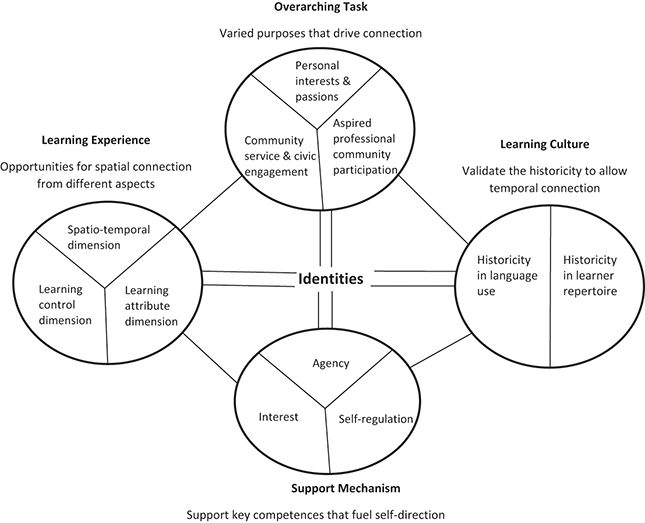
This framework lays out how a connected language learning experience with technology can be constructed and supported through the overarching task design, learning experience design, learning culture construction, and support mechanism provision. Identity interacts with these four design elements dialectically, shaping learner experience therein and shifting in response to the experience.
Each of the four design dimensions could serve as a point of departure in constructing connected language learning, supporting different aspects of connection and inducing different types of connected learning. The overarching task and learning experience design support the connection from the spatial perspective, learning culture construction supports the connection from the temporal perspective, and support mechanisms support the connection from the learner preparation perspective. The first three dimensions (overarching task design, learning experience design, and learning culture construction) enable teacher-initiated student-directed connected learning, and the last (support mechanism provision) may induce learner-initiated learner-directed connected learning. Each dimension has the potential to spark off connected learning, although from different angles.
Connected learning can be operationalized at varying levels – combinations of multiple dimensions or a single dimension. The four design dimensions impose differential demands on the instructional context: The support mechanism dimension imposes the lowest demands on the curriculum content and instructional arrangements, as it is at the learner preparation level. The overarching task design imposes the highest demands, as it is at the overall curriculum design level. The learning experience design imposes demands on learning material, in-class learning activities, and/or out-of-class learning assignments. And the learning culture design has implications on the language use policy concerning classroom discourse, material selection, as well as activity and assessment design and requirements.
Teachers may decide on specific angle(s) and forms of connection in response to the sociocultural circumstances, curriculum flexibility, and learner characteristics of their specific teaching contexts. For instance, if the teaching context has tight control over the curriculum content and instructional arrangements, teachers may facilitate connected language learning through the learner support perspective and the classroom discourse level of the temporal connection. If the teaching context has flexibility in material selection and activity design, teachers may facilitate connected language learning through the learning experience design dimension and the material and assessment task requirement level of the temporal connection. If the teaching context has total freedom in curriculum design, teachers may facilitate connected language learning through a comprehensive model that integrates all four dimensions.
Connected language learning rests essentially on learner autonomy. As learners’ autonomous actions with technology are at the intersection of student-level factors, material-level factors, institution-level factors, social/structural-level factors, and ideology-level factors (Lai, Reference Lai, Hu and Lyu2023), I will discuss the implementation of connected learning in view of the interplay of these multilayer factors in Section 4.
4 Implement Connected Language Learning with Technology
As connected language learning is learner-driven – whether learner-initiated or teacher-initiated – learners are the key to the implementation (Prestridge et al., Reference Rashid, Howard, Cunningham and Watson2021). The operationalization framework in Section 3 features four key learner factors: agency, interest, self-regulation, and identity. These learner factors are critical to learner-initiated connected learning and also determine the extent to which teacher-initiated connected learning design can be actualized. Thus, the discussion of the implementation issues in this section will center around these four learner factors. Considering that learner factors intertwine closely with social structure and technological structure in the post-digital era (Jandrić et al., Reference Jeong, Han, Lee, Sunalai and Yoon2018), I will discuss how to support the four learner factors in view of the intertwining material-level, institutional-level, social/structural-level, and ideology-level factors (Lai, Reference Lai, Hu and Lyu2023).
Agency
As discussed in Section 3, the entanglement of agency with social and technological structures calls for greater attention to the relational and emergent nature of agency.
Learner Agency in Relation to Technology
The pervasiveness of technology in daily life and the advancement of GenAI have drawn increasing attention to the issue of control in human actions. Take GenAI as an example, researchers found that a sense of control is an essential consideration in learners’ decision-making concerning agentic engagement with GenAI for self-directed learning (Lai et al., Reference Lai, Qin, Jiang and Lin2026; Nyaaba et al., Reference Nyaaba, Wright and Choi2024). Arguing that human actions have always been entangled with machines and the material worlds we inhabit, Jones (Reference Ju, Jia and Shoham2025) foregrounded the concept of agencing as key to this sense of control. Agencing is the process where human actions with technology arise in “entangled agencies of humans and machines,” which “‘crystallise’ into particular relationships with technologies and dispositions to act in certain ways with them” over time (p. 16). Thus, agency does not reside within learners or machines, but rather emerges in learners’ moment-by-moment “agential cuts” of the lines between humans and machines enacted through “material-discursive practices.” Using navigating a dark room with a stick as an example, Jones elaborated that “material-discursive practices” are the ways we hold the stick: loose hold indexes perceiving the stick as a tool separate from us; and tight hold indexes seeing the stick as part of us. As literacy is not about meanings learners make with digital devices but more essentially about actions learners take, agency in literary practices in digital spaces is “people’s ability to make choices about what to do and exercise some degree of control over what’s happening around them” (p. 26). Thus, to him, literacy teachers’ core mission is to develop learners’ agential literacies in the face of the mixed blessings of technology.
To develop agential literacies in digital spaces for learning, both Codes (Reference Cole and Vanderplank2025) and Jones (Reference Ju, Jia and Shoham2025) provide some insights. Codes (Reference Cole and Vanderplank2025) conceptualized aspects of agentic actions that the interplay of learner and technological systems could empower, and Jones (Reference Ju, Jia and Shoham2025) delineated key principles of pedagogical experiences that lend to the development of agential literacies. We referred to these two pieces of work to discuss the development of agential literacies in learning with technology.
Codes (Reference Cole and Vanderplank2025) conceptualized four interconnected modes of relational agency that “reflect different ways learners engage with their environments, emphasizing the adaptability, collaboration, and ethical interaction with human and algorithmic systems” (p. 12). The four modes of relational agency include proxy agency, collective agency, spatial agency, and shared agency. Proxy agency refers to leveraging human and digital systems to obtain personalized support. Spatial agency refers to navigating and optimizing interactions across digital and physical environments to personalize the learning experience. Collective agency refers to collaborating with human and nonhuman actors to collectively solve problems in the learning process. Shared agency refers to effective and critical interactions with human and algorithmic systems to co-construct knowledge and maximize learning. These four modes specify different aspects of the learning process that need to be considered when supporting and amplifying learner agency in the post-digital era.
Taking the use of GenAI for self-directed English language learning as an example. Examining a group of Chinese university EFL learners, Lai et al. (2026a) revealed how these four modes of relational agency manifested in their interaction with GenAI. Depending on whether they engaged in follow-up actions, such as review, analysis, deliberate study, or further exploration, with and around GenAI output, learners manifested either performance-oriented proxy agency (use GenAI to enhance language performance) or learning-oriented proxy agency (use GenAI to improve understanding and support learning). Spatial agency was reflected in their use of GenAI to support in-class learning experience as well as to expand or enhance out of-class learning experience. Shared agency manifested in learners’ conscious monitoring and refinement of AI output through cross-referencing, and their considered and coordinated use of GenAI in relation to respective strengths and weaknesses of themselves and other human and nonhuman resources. Collective agency was reflected in their use of GenAI to expand language learning and practice venues and to change their learning styles. These findings suggest the importance of helping learners imagine possibilities of actions and learning with GenAI: (1) guiding and supporting learners to use GenAI in ways that empower learning, minimizing irresponsible cognitive offloading; (2) guiding them to use GenAI to facilitate the effective navigation of in-class learning and out-of-class encounters with other digital resources and human actors; (3) facilitating their coordination of GenAI with other digital resources and human actors to enhance and augment GenAI output toward the optimization of learning and knowledge co-construction; and (4) supporting learners to collaborate with GenAI to collectively expand learning possibilities by creating new venues of learning and shifting learning styles within and beyond GenAI. Thus, Code’s (Reference Cole and Vanderplank2025) framework is useful in identifying areas of support that teachers can provide to facilitate learners’ interaction and collaboration with technological systems.
Jones (Reference Ju, Jia and Shoham2025) further argued that agential literacies are not just about taking actions with digital tools and resources, but more essentially about “develop[ing] more ethical, inclusive, and empowering forms of human-technology intra-action” (p. 55). To achieve the goal, teachers need to guide learners to position themselves as “fixers” of their “broken” relationships with digital worlds (p. 57), and “challenge their assumptions about the boundaries of human agency and to imagine new forms of social and political action ‘one click at a time’” (p. 55). Jones further proposed some characteristics of pedagogical activities that are facilitative of agential literacies. First, pedagogical activities need to raise learners’ awareness of agencing: providing opportunities for learners to explore how particular material-discursive practices shape the particular kinds of agents they become; how their moment-by-moment practices reconfigure the world and their relationships with technologies; and how the embodied relationships affect what they can do and what is happening.
Second, pedagogical activities need to engage students in exploring the use of technologies from different perspectives: mapping their embodied encounters with technologies; analyzing how particular digital devices enable and constrain different actions and how they negotiate agencing with the digital devices; and imagining the changes in agencing under different material-discursive practices and the respective impact on their relationships with digital devices and the material worlds.
Third, pedagogical activities need to develop an inward critical gaze toward one’s own digital actions and foster a metacognitive approach toward “algorithmic resistance” (Jones, Reference Ju, Jia and Shoham2025, p. 58). Jones took AI prompting as an example. He argued that the goal of prompting should not be to enhance the quality of machine output, but to “optimize students’ own uses of these systems” (p. 57). To achieve this goal, he proposed engaging students to work backwards from model outputs to discover how AI output echoes elements of the prompt, and how linguistic features of the prompt change the data that are used to train the model.
The importance of metacognitive awareness and the imagination of new ways of interaction is supported by Lai et al.’s (2026b) findings on a group of preservice language teachers’ use of GenAI for self-directed professional learning. They found that agency attribution was critical to safeguarding a sense of control over perceived GenAI limitations. The participants who attributed unsuccessful interaction experience to their prompt literacy, interaction strategies, or GenAI tool choices were more likely to circumvent GenAI limitations and persist in agentic interaction with GenAI and exhibit greater resilience against failed experiences. Moreover, participants who could perceive and utilize GenAI affordances to (re)imagine possibilities to co-team with GenAI in ways that maximize and coordinate respective strengths and achieve cognitive coupling were more likely to sustain engagement with GenAI for self-directed learning. Moreover, how learners positioned GenAI in the learning process also mattered. Those who positioned interaction with GenAI as a process of mutual empowerment tended to actively seek opportunities to learn from the experience, have more positive emotional responses to unsuccessful interaction, and exhibit more balanced and considered use of GenAI. In contrast, those who assigned GenAI a competing or determining role and who positioned GenAI interaction as a process of testing AI’s capacity to perform tended to exhibit a negative change trajectory. Based on the findings, Lai and colleagues hence underscored the importance of helping learners develop productive GenAI partnerships through fostering proactive agency attribution, positive positioning of AI interaction for mutual empowerment, learning mentalities toward the interaction with AI, and learners’ capacities to co-team with AI.
Learner Agency in Relation to Socio-educational and Socio-technological Structures
Learning does not take place in a vacuum. Learners’ agentic actions are mediated by the changing sociocultural and socio-educational contexts (Gao, Reference Gao2010; Larsen-Freeman et al., Reference Laviosa2021). Schoon (Reference Schoon2018) argued that “the sources of agency are shared by individuals and their contexts and cannot be reduced to one or the other” (p. 8). Complexity theory emphasizes the interactive relationships between agents and the messy contexts inside and outside the classrooms (van Dijk et al., Reference van Dijk, Lowie, Smit, Verspoor and van Geert2024) and highlights that changes in one component in this complex system may induce changes in others and the relationships among them. Larsen-Freeman (Reference Larsen–Freeman2019) argued that learner agency is spatiotemporal situated, that is, it is not only a coordinative response to immediate conditions and shifting thereof but also is influenced by learners’ history and future aspirations. Moreover, learner agency is dynamic in that it is constantly changing through iteration and coadaptation to achieve reciprocity between agency and the socio-educational and socio-technological structures.
Yung (Reference Yung2025) documented this situatedness and dynamism in his investigation of three senior secondary students’ evolving agency in learning English through private online tutoring over one academic year during the COVID-19 pandemic. He found that these students exercised agency in seeking English private tutoring courses venues when realizing the limitations of online teaching at school during the pandemic, and creating conducive learning conditions – such as hiding their phones – as ongoing strategic adaptation and self-organization to reach reciprocity with the changing learning environments. Their agency was empowered by the availability of English private tutoring courses, their emerging possible future L2 selves, and the flexibility of online learning. Their agency was also inhibited by their lack of self-discipline and motivation at different times, limited tutor–tutee interaction, and the examination-orientation of these tutoring courses. Yung highlighted the dynamic changes of agency in relation to internal and external contextual factors and stressed teachers’ roles in the process. To achieve this, Yung recommended that teachers help learners sustain agency over time through: (1) encouraging learners to exercise control over the learning process; (2) guideing goal-setting, time management, and self-monitoring; and (3) developing learners’ reflexivity and self-awareness of the learning process.
Mairitsch et al. (Reference McLoughlin and Mynard2023) followed a group of lower secondary school students’ learning during after-school study sessions and structured free time blocks over a year, and revealed that agency was socially constructed and distributed. They found that learner agency emerged in the interplay among: (1) perceived opportunities and support in the environment (e.g., the personalized, one-to-one support and guidance offered by teachers), (2) perceived expectations from teachers, and (3) self-assessed confidence, competence, and willingness to engage (e.g., lack of motivation, knowledge, and strategies). They further found evidence of collective agency where learners learned together as a group, motivating each other and reinforcing each other’s self-regulation processes by recognizing respective needs and wants. Stressing that agency is both socially constructed and socially distributed, Mairitsch and colleagues advocated utilizing the social nature of agency to enhance learners’ awareness of learning potentials in their communities and the environmental affordances, and engaging learners in collective reflection and collaborative discussion of learning.
Examining preservice language teachers’ informal professional learning with GenAI, Lai et al. (2026b) identified various “conditions of possibility” (Rose & Jones, Reference Sangrá, Raffaghelli and Guitert‐Catasús2005) that shaped the interplay of learner and GenAI agency. The study found that teacher support, peer influence, and societal discourses on GenAI played an essential role in incentivizing learners’ use of GenAI and in expanding their capacities to (re)imagine and utilize the possibilities of GenAI. The study further identified that learners’ personal circumstances interplayed with their perceptions of socio-educational situations and socio-technological circumstances to moderate the extent to which they would transform the perceived affordances and possibilities of GenAI into co-teaming behaviors. Personal circumstances factors included previous experience with GenAI, perceived relevance of AI to current learning and envisioned future professional practices, perception and attitudes toward AI, and emotional responses to AI interaction. Socio-educational situation factors included envisioned curriculum structure, professional discourse, and school policy on academic integrity. Socio-technological circumstance factors included expected colleagues’ attitudes toward GenAI, cultural norms on educational use of technology, school technological infrastructure, and access to online resources/communities on GenAI.
These studies remind us of the importance of adopting a relational and dynamic view when supporting learner agency, taking into consideration the various socio-educational and socio-technological factors and learners’ internal contextual factors that are at play in shaping learner agency. It is essential to guide learners to capitalize on collective agency in collected learning and position themselves as active participants in and contributors to social activities, encouraging them to engage in co-creation of knowledge (Prestridge et al., Reference Rashid, Howard, Cunningham and Watson2021). In addition, agency-amplifying activities need to be embedded to enhance agential literacies. Agency-amplifying activities can assume various forms, including teacher-guided discussion, modeling and training, guided analysis and reflection on experiences, and collaborative sharing of perceptions and strategies, with the ultimate goal of empowering learners to work together to imagine new possibilities and circumvent socio-educational and socio-technological constraints.
Interest
Personal/individual interest drives the agentic utilization of learning opportunities across settings to create personal ecologies of connected learning across formal and informal contexts (Barron, Reference Barron, Martin, Peppler, Halverson and Kafai2006; Ito et al., Reference Jeong, Han, Lee, Sunalai and Yoon2020). Interest in a particular content in the L2 (e.g., Japanese manga) may also drive learners’ self-directed interaction with the relevant L2 online resources (Kormos & Csizér, Reference Kolluri and Tichavakunda2014; Lai et al., Reference Lai, Hu and Lyu2018). Given that curiosity, interest, and the internal drive for self-improvement are essential motivational factors for self-directed learning (Trinder, Reference Turner and Griffin2016), Lai et al. (Reference Lai, Hu and Lyu2024) advocate utilizing personal interest as a boundary-crossing object. Thus, harnessing personal interest is an essential consideration in connected language learning with technology (Ito et al., Reference Jeong, Han, Lee, Sunalai and Yoon2020; Lai et al., Reference Lai, Hu and Lyu2024).
Interest has three constitutive components: (1) Affect (feelings) – which is boosted by novel and challenging but fulfilling experiences; (2) Value (perceived importance and personal connection) – which is strengthened through linking the activity to daily life and underscoring personal relevance of a particular activity or object; and (3) Knowledge (prior knowledge and perceived competence) – which concerns appraisal of available skills, knowledge, and resources for the activity (O’Keefe & Linnenbrink-Garcia, Reference Perez, Gregory and Baker2014; Renninger & Hidi, Reference Rezai, Goodarzi and Liu2019; Silvia, Reference Silvia2008). Thus, to capitalize on the boundary-crossing potentials of personal interest in language learning, several conditions need to be met:
First, to create opportunities for learners to pursue personal interests in the target language and establish a positive self-concept through the experience. As Prestridge et al. (Reference Rashid, Howard, Cunningham and Watson2021) pointed out, connected learning environments need to be both open and bounded – open for connections to diverse human and nonhuman resources, while “bounded by personal interest, needs or topic” (p. 2173). Thus, creating opportunities for and supporting learners to pursue objects of personal interest in the target language are essential to connected language learning. Ito et al. (Reference Jeong, Han, Lee, Sunalai and Yoon2020) highlighted the importance of “sponsor youth interests,” that is, attaching the overarching task to personal interests and/or integrating objects of personal interest into learning experience design. According to them, to foster connected learning, educators need to meet youth at where they are genuinely interested in. Personal interest may assume different forms: interest that pertains to one’s personal identity; interest in belonging to a certain social group; professional or academic interest; and interest in societal issues. Ito and colleagues suggested legitimizing youth interests and values, learning about learners’ diverse interests, incorporating learners’ interest objects (e.g., pop culture) into classrooms, and supporting learner-initiated interest-driven projects or assigning projects that connect to learner interests. Legitimizing personal interest in in-class learning helps motivate and activate funds of knowledge (e.g., ways of knowing, doing, and being, social identities, life expertise, etc.), and support learner autonomy so that learners can play a more active role in learning (Little & Throne, Reference Liu and Darvin2017; Reeve & Cheon, Reference Reeve and Cheon2021). Scholars like Benson (Reference Benson and Hall2016) and Kato and Mynard (Reference Kato and Mynard2016) advocated engaging learners to explore their motivations, dreams, and interests, as well as to set self-determined learning goals and plans that align with individual interests and purposes, and guiding learners to select resources and activities that can help them achieve personal learning goals. In addition, including materials and activities that align with their personal interests and directing them to venues and resource pools where they can locate materials of interest are equally important. For instance, Pan et al. (Reference Pan, Lai, Guo and Huang2026) found that incorporating a GenAI bot to provide reading materials that align with students’ personal interests not only enhanced university EFL learners’ use of self-regulation strategies during extensive reading but also boosted self-directed reading beyond the platform. Yet, only those interests that are seen and recognized by others could induce positive self-concept and self-identification in relation to the interest objects, which sustains investment in the interest. Thus, in addition to allowing and supporting learners to pursue objects of personal interest, it is equally important to anchor learners’ interest pursuit toward producing products of value for others. For instance, teachers can engage students to pursue their current personal interest objects (e.g., emotion regulation) and then create English products on their interest objects (e.g., an English booklet with tips on emotion regulation) that can be used by junior grade students as English learning materials at the school. Attaching learners’ pursuits of personal interests to concrete, visible achievements helps learners see what is possible with their personal interests, which is critical to sustained engagement.
Second, to support learners’ pursuit of personal interest in the target language. As perceived availability of institutional, social, and discursive support is critical to perceived competence (Kormos & Csizér, Reference Kolluri and Tichavakunda2014), one way to strengthen the support is to create collaboration opportunities to boost collective agency. Scholars have suggested placing collaboration at the center of self-determined learning experience: supporting co-inquiry based on common interests and convergent goals; guiding students to identify common interests and set communal goals on collaborative artifacts that align with common interests; embedding joint activities and affinity-based mentorships (e.g., creating online interest-based peer communities); giving access to stories of self-directed learning behaviors from peers; and building scaffolding mechanisms and buddy systems to provide needed support (Ito et al., Reference Jeong, Han, Lee, Sunalai and Yoon2020; Kizilcec et al., Reference Knowles2017; Saadatmand & Kumpulainen, Reference Saadatmand, Kumpulainen, Hodgson, Jones, de Laat, McConnell, Ryberg and Sloep2012). Learners benefit from opportunities to co-construct creative solutions to potential breakdowns or challenges induced by language or technological deficiencies. Another way to strengthen the support is to equip learners with the relevant strategies and provide cognitive and affective support. When pursuing personal interest in a target language, learners need both resource support – such as technological resource selection and use (Kormos & Csizér, Reference Kolluri and Tichavakunda2014; Lai et al., Reference Lai, Zhu and Gong2016), and language support – such as a list of high-frequency vocabularies in the interest area, relevant vocabulary learning materials, and associated language processing and use strategies. In addition, reflection probes, such as “I-CAN” probes (a series of “I can … ” statements), can be used to strengthen self-efficacy and personal connections with the interest object (Renninger & Hidi, Reference Renninger and Hidi2015).
Third, to boost and facilitate the transformation of situational interest to personal interest. A key principle of connected learning is “to encourage individuals […] to seek out subjects, topics, questions, problems which are of strong personal interest” (Prestridge et al., Reference Rashid, Howard, Cunningham and Watson2021, p. 2182). Yet, we may get into situations where learners, especially in the K-12 contexts, do not have or are not able to identify areas of personal interest. The good news is that personal interest is malleable and can be fostered. Individuals may transit from situational interest triggered by environmental features to well-developed personal interest that is self-sustaining (Hidi & Renninger, Reference Hidi and Renninger2006). Guo and Fryer (Reference Guo and Fryer2025) identified six triggers/sources of situational interests: (1) associating a learning experience with self-related information processing (e.g., one’s future goals, daily life, preferences, or prior interests) so that learners may perceive the value, relevance and meaningfulness of the experience; (2) providing intriguing learning experience through novelty (i.e., something new), suspense (i.e., uncertainty about what is going to happen), surprise (i.e., unexpected situation); or variety (i.e., tasks in changing forms); (3) enhancing cognitive activation and complexity through posing questions, introducing a problem, or answering questions learners previously struggled; (4) strengthening learners’ interaction with others; (5) providing hands-on experiential learning; and (6) providing learners with choices. Wong and colleagues (Reference Ye2020) underscored piquing learners’ epistemic curiosity, “thirst for knowledge,” to trigger situational interest (p. 5). Epistemic curiosity could be aroused through creating knowledge gaps, foregrounding students’ knowledge deficit, or violating an expectation that motivates the search for explanations. Thus, teachers may design learning tasks that contain some of these triggers to spark off situational interests. Yet, triggered situational interest may be short-lived and may only become maintained situational interest when conditions are created to help learners become fully immersed in tackling more novel challenges in the same domain. The maintained situational interest needs to be extended for prolonged periods and enable learners to perceive enjoyment or value in order to be transformed into individual interest, to which meaningfulness is the key (Wong et al., Reference Ye2020). Meaningfulness in learning can be achieved through instructional moves that stress knowledge integration from different perspectives and across disciplines, and connect learning to real-life situations (Wong et al., Reference Ye2020). Thus, in the early stage of interest development, the provision of novel content and associated experience and the development of personal connections with the content are crucial. Connection is established through strengthened valuing, enhanced knowledge, and a bolstered sense of competence to utilize the opportunities and resources available (Renninger & Hidi, Reference Renninger and Hidi2015; Su, Reference Su2020). At the later stage, learners need to be supported in self-exploration of knowledge about the interest object (Renninger & Hidi, Reference Rezai, Goodarzi and Liu2019). Wong and colleagues (Reference Ye2020) used the example of reading to illustrate how this process can be facilitated. To trigger students’ situational interest in reading a book, teachers may use the following strategies: (1) creating reading experiences that arouse students’ curiosity, such as allowing students to bring their books (e.g., reading a series they are interested in); (2) anchoring reading around fulfilling a personally meaningful purpose (e.g., to find solutions to personal struggles at school or in daily life); (3) creating an information gap to arouse reading to quench epistemic curiosity (e.g., reach a selected part of a book aloud in class but stop at a climax); and (4) modeling the enjoyment of reading for students to mimic (e.g., model reading on a routine basis). Teachers may follow up by creating an environment (time and space) that allows students to concentrate and enjoy total immersion and enjoyment in reading to reach a flow state so as to maintain situational interest. Afterwards, creation and challenges are essential to maintaining and extending situational interest and further developing learning interests into long-lasting passions. Teachers need to create opportunities for learners to extend their interest by seeking more books that are personally meaningful, and arrange face-to-face or online book-talk activities where students can share book reviews and recommend books to each other. The creation works could be product-oriented in terms of artifacts (e.g., to make videos or social media posts to share their readings) or process-oriented in terms of ideas (e.g., to invent new ways or new strategies to tackle a problem based on what they read). In addition, teachers need to challenge students to attempt more challenging books that bring enriching perspectives or broadened horizons, and to engage with progressively enlarged communities, progressing from sharing among inner circles (e.g., teammates, classmates) to wider circles (e.g., schoolmates, global public on the Internet). Such activities increase the likelihood that students may perceive the values of the reading activities. Such interest-driven creation needs to be built into daily learning routines in order to maximize and drive interest toward long-term undertakings.
Fourth, to create a porous and supportive learning culture. Through case studies of adolescents’ boundary-crossing learning experience, Barron (Reference Barron, Martin, Peppler, Halverson and Kafai2006) identified different pathways that personal interests may be developed: Interest could arise at school and be carried over to home and community contexts; Interest could originate in informal learning activities with friends, which leads to the pursuit of relevant courses at school; and interest could begin at home, and then lead to learning activities in out-of-school classes, in the community, and then at school. The different pathways indicate the learning culture needs to be porous, enabling and supporting the flow of interest across spaces. Both ideational resources (e.g., an assignment to create a website, accessing an online fanfiction site) and relational resources (e.g., connection with friends, parents, and teachers) are essential to initiating and supporting boundary-crossing self-exploration activities related to personal interest. Thus, learning culture needs to be open, validating, encouraging, and motivating diverse resources, activities, and pathways.
Self-Regulation Skills
Poor self-regulation and the lack of effective cognitive, metacognitive, and affective strategies often lead to limited self-directed engagement with technology beyond the classroom (e.g., Cervin-Ellqvist et al., Reference Cervin-Ellqvist, Larsson, Adawi, Stöhr and Negretti2021). Thus, enhancing self-regulation skills is important in connected language learning with technology.
Self-regulation consists of five dimensions: metacognitive regulation (goal commitment, planning, and follow-up), cognition regulation (the regulation of cognitive strategy use), motivation regulation (the control of motivation and emotion), behavioral regulation (the management of time and effort), and environmental regulation (the management of spaces and resources).
Metacognitive regulation could be enhanced through engaging students in the self-regulatory process. Self-regulation involves three constitutive processes: regulatory agent (i.e., goal setting), regulatory mechanism (i.e., planning, monitoring, metacognition and strategy use, and motivation control), and regulatory appraisal (i.e., self-evaluation and attribution) (Sitzmann & Ely, Reference Sitzmann and Ely2011). These processes can be grouped under three cyclical phases in Zimmerman’s (Reference Zimmerman, Boekaerts, Zeidner and Pintrich2000) model: a forethought phase (set goals, make plans, and evaluate planned tasks); a performance phase (monitor performance, and employ strategies); and a reflection phase (evaluate the learning process). To support these phases, teachers can utilize various scaffolding approaches, including goal lists, templates and prompts, examples of strategy utilization and monitoring, reflective assessments with metacognitive questions, and feedback (Bernacki et al., Reference Bernacki, Aguilar and Byrnes2011).
The support for cognition, motivation, behavioral, and environmental regulation needs to target both generic and language learning-specific self-regulation knowledge and skills. Generic knowledge and skills include the monitoring of behavioral factors (effort management and help-seeking), of affective factors (self-efficacy and anxiety management), and of environmental factors (time and environment management and peer learning) at different phases of learning (Littlejohn et al., Reference Littlejohn, Hood, Milligan and Mustain2016). Researchers have found that integrating training sessions on generic learning techniques – such as cognitive strategies to avoid procrastination and cramming, and affective self-regulation strategies – into regular language classes could bolster learners’ motivation for and engagement in self-directed language learning across settings (e.g., Luo, Reference MacMahon, Carroll and Gillies2020).
Language-specific knowledge and skills include knowledge about digital and online learning venues and how to use these venues effectively for language learning. Studies have shown that providing language-specific training – such as web-based dictionary skills, strategies around TED Talk videos, and Facebook use norms – could boost learners’ enjoyment of L2 learning, and enhance their effective interaction with individual technological resources (e.g., Rashid et al., Reference Rashid, Howard, Cunningham and Watson2021). Training on language-specific knowledge needs to pay attention to the following aspects:
First, help students develop a good understanding of the sociotechnical structures that support and/or constrain language learning. Any online or digital space or venues has its unique configuration of resources, including material resources (i.e., online tools and platforms), mental resources (i.e., technological and social skills and knowledge), social resources (i.e., social ties and relationships), cultural and discursive resources (i.e., beliefs and shared mentalities related to the behaviors), and temporal resources (i.e., time available for the behaviors) (Van Dijk, Reference Van Dijk2005). Accordingly, an introduction on any online or digital space needs to cover all these dimensions so that learners can have a comprehensive understanding of its affordances and constraints and be able to use it appropriately and effectively. Moreover, opportunities for learner collaboration and sharing of information on resources and ways to manage resources are essential for the curation of social and emotional support and the development of self-regulation (Hadwin & Oshige, Reference Hafner, Li and Miller2011).
Second, focus on the selection principles rather than recommending specific resources when enhancing students’ ability to construct learning ecologies. Recommending specific lists of resources may be counterproductive, as informal digital language learning is idiosyncratic in nature and there are no universal sets of resources that would work for all. Research has yielded contradictory findings on the efficacy of individual digital resources: The same digital activity might show up to be a significant predictor of a language skill in one study but a nonsignificant predictor of that skill in another study (Peters et al., Reference Peters, Noreillie, Heylen, Bulté and Desmet2019; Schmitt, Reference Siemens2019). Thus, it might be more meaningful to direct students’ attention to principles that guide them on digital resource selection and the construction of personalized learning ecologies. The principles involve raising students’ awareness of: (1) the linguistic and discourse characteristics of digital resources that are critical to language learning. Examples of these characteristics are the scale of social interaction afforded by different genres of digital games (Sundqvist, Reference Sundqvist2019) and the frequency of encounters of vocabulary afforded by related videos or TV show episodes (Webb, Reference Webb, Nunan and Richards2015); (2) the attributes of learner actions with digital resources that affect learning. For example, learners need to be aware that their purposes of interacting with informal digital resources may influence the type of resources they engage with and their cognitive attention during interaction (Lai et al., Reference Lai, Pi, Xiong, Gu and Jiang2025b). They need also to understand that their cognitive attention and levels of cognitive and linguistic engagement (e.g., simultaneous attention to multimodal information in digital resources, dual attention to both language form and meaning), and strategic engagement characteristics (e.g., subsequent sustained engagement with vocabularies encountered), affect the extent of incidental vocabulary learning from digital interactions (Arndt, Reference Asgari2023; Lai et al., Reference Lai, Saab and Admiraal2022b); (3) the types of learning ecologies that are beneficial. For instance, learners need to be alerted to the importance of constructing diverse language learning experiences, such as opting for meaning-focused activities in teaching contexts characterized by form-focused language instruction (Lai et al., Reference Lai, Zhu and Gong2015), and diversifying media use purposes in informal digital language experiences (Lai & Wang, Reference Lai, Zhu and Gong2025).
Third, enhance learners’ abilities to comprehend and acquire language from authentic language exposure and experience, equipping them with language processing and communication strategies that support authentic language (Hubbard, Reference Ito, Gutiérrez and Livingstone2013). In addition, students also need to be supported in effective skills in navigating the digital spaces for social participation and digital activism, especially in the context of connected learning across communities for social purposes. For instance, Lai et al. (Reference Lai, Pi, Xiong, Gu and Jiang2025) highlighted the importance of supporting “critical digital civic literacy,” the skills and knowledge necessary to effectively navigate, evaluate, and engage with digital information and platforms for civic participation in multimodal digital composing and publishing. Students need to be empowered to move fluidly across online and offline spaces, being able to tackle negative forces online and being resilient against potential negative experiences. Teachers also need to enhance learners’ reflexivity toward reimagining new identities and possibilities, and produce counternarratives against the ideological constraints online and offline. Speaking to the context of social media participation, Jones (Reference Ju, Jia and Shoham2025) highlighted the importance of: (1) developing learners’ critical awareness of the “conditions of sociality,” that is, the kinds of social interactions and relationships enabled and encouraged in different spaces; and (2) boosting their “ethical-political skills” that enable them to challenge the existing structures of online interaction that lead to conflict, incivility, and ideological polarization, and explore ways to develop new practices of affinity that forge more meaningful, open, embracive relationships and connections (p. 18).
These self-regulation support components and mechanisms need to be threaded throughout the learning experience to facilitate learners’ navigation of connected language learning with technology.
Identity
Identity interacts dialectically with connected learning, both resulting from and moderating learner experience in the process. On the one hand, identity shapes behaviors and leads to lasting behavior change (Barnett et al., Reference Barnett, Boduszek and Willmott2021). Fostering positive identities would help reinforce the effects of connected learning. On the other hand, identity is multifaceted, and multiple identities often co-exist. Helping learners resolve contested, incompatible, or conflicting identities in the learning process is essential. Thus, to safeguard connected learning, identity interventions might be necessary, as identity interventions have been found to strengthen connections and sense of belonging, induce a commitment to act, boost learners’ self-efficacy and agency, enhance self-awareness and readiness for change, and reinforce a sense of purpose and meaning (Barnett et al., Reference Barnett, Boduszek and Willmott2021). In connected learning, several issues need to be attended to when conceptualizing identity interventions.
First, connected learning involves expansive learning across communities, both familiar and strange, demanding a complex set of skills to navigate and participate in unfamiliar terrains, to tackle and persevere against difficult and challenging situations, and to be adaptive. How to strengthen learners’ perseverance and adaptivity in the process is a major consideration in identity interventions. Identity-focused prompts that promote the explicit connections between course contents and learners’ current and future selves are found to be effective in boosting task value and commitment (Perez et al., Reference Perez, Gregory and Baker2022). Oyserman’s (Reference Perez, Gregory and Baker2015) pathways-to-success motivation intervention is a good reference in boosting perseverance against difficulties. This intervention framework contains three aspects: (1) Psychological relevance: connecting aspired future selves with actual selves; (2) Readiness to act: cuing identity-congruent strategies to attain the aspired selves; and (3) Interpretation of experienced difficulty: providing a proactive mindset to reframe challenges and difficulties as a necessary and transformative step toward attaining aspired selves. Moreover, strength-based positioning and a growth mindset are important to enhance identity coherence and resilience against potential identity confusions during connected learning (Wraae & Nybye, Reference Ye2025). To enhance learners’ adaptivity toward unfamiliar situations, researchers may refer to Crocetti et al.’s (Reference Cronjé and Khine2008) three-factor model, which consists of three processes of dynamic identity formation: The first two processes are commitment (raise students’ awareness of the choices they have made and the self-confidence they derive from these choices) and in-depth exploration (engage students in cognitive and behavioral investigations of and reflections on present commitments). These two processes engage adolescents in active investigation of self and environment, maintaining a coherent sense of identity. The third process is reconsideration of commitment, where students are guided to question current commitments, search for alternative paths, and compare the unsatisfactory current commitments to these possible alternatives, with the goal of identifying new commitments that align better with changing personal desires and contextual demands. These processes work together to help support adaptivity to experience by promoting flexible identity processes that support resilience, exploration, and adjustment to new contexts.
Second, connected learning involves intense interactions and collaboration as well as social participation in different communities and affinity-based communities. Thus, broadening learners’ current selves and developing a sense of belonging are important to maintain their investment in connecting with others for learning. To broaden learners’ current selves, creative activities that enhance critical awareness (e.g., drawing an identity tree; multimodal self-expression, and storytelling in the form of journaling), and group activities that expose learners to new possibilities and enable the co-construction of identity (e.g., group experiential activities and collaborative community action) are frequently used to facilitate identity change. Piotrowski et al. (Reference Reeve and Cheon2025) further advocated integrating structured social interactions and community-based projects with guided self-regulation. A sense of belonging can be fostered through collective identity development that strengthens group identification and intergroup relationships.
Third, the temporal dimension of connected learning demands learners’ discovery and embracement of multilingual and multicultural identities. Multicultural identity-affirming creative works, such as creative writing production of migration stories and identity poems, and video digital stories to inquire into lived experiences, have been used as an identity intervention, and has been found to amplify marginalized multilingual adolescents’ sense of self and pride in themselves and their cultural and linguistic origins, encourage them to exercise agency to represent and reposition their identities, and empower them to create “counter-narratives of empowerment and pride” (Cummins et al., Reference De Wilde, Brysbaert and Eyckmans2015; Kendrick et al., Reference Kendrick, Early, Michalovich and Mangat2022, p. 981). Scholars have further experimented with pedagogical solutions to raise learners’ awareness of their own and others’ multilinguistic repertoires. For instance, Forbes et al. (Reference Forbush and Foucault-Welles2021) developed a multilingual identity-oriented pedagogy that consists of three components: (1) cultivating students’ knowledge about the cognitive and social benefits of multilingualism through sharing of relevant academic literature and personal experience; (2) raising their awareness of the potential of multilingualism through a series of identity-focused participative activities; and (3) encouraging reflexivity and personal reflection on their application of the understanding acquired in steps 1 and 2 to their own everyday life situations. They found this pedagogical approach enhanced learners’ valuation of and willingness to identify with their multilingual resources.
The above three considerations are to foster positive identities that would fuel and safeguard successful connected learning. Yet, connected learning, attaching learners to affinity-based communities and enabling the use of language to create value for others, also has the potential for and aims at expanding identities. To realize its identity construction potential, we need to strengthen the stickiness of connected learning so that the experience is intense enough to support identity transformation. Such a learning experience needs to build social synchrony and strengthen the sense of acceptance and sense of empowerment. Existing literature has suggested strengthening the following four dimensions in constructing a connected learning experience (MacMahon et al., Reference MacMahon, Carroll and Gillies2020; Prestridge et al., Reference Rashid, Howard, Cunningham and Watson2021): (1) relationship dimension. Relationship dimension helps build a sense of familiarity. The learning environment needs to foster mutual respect, encourage ongoing communication/friendship, provide opportunities for networking and collaboration, make learners feel safe and comfortable through clear communication of expectations and process, and provide diverse and inclusive digital and physical learning platforms; (2) competence dimension. This dimension helps build confidence in oneself and others to support one’s own and shared goals. The learning environment needs to provide relevant skill support (e.g., career skills or career development support; guidance on decision-making; support for personal problems), and provide opportunities for the integration of students’ existing knowledge and experience; (3) affect and motivation dimension. This dimension helps sustain learner investment and engagement. The learning environment needs to convey high expectations, inspire learners to try something new, provide positive and inspiring role models, and care about student well-being in the process; and (4) learner voice and choice dimension. The learning environment needs to cultivate learner voice by encouraging learners’ opinions/perspectives and providing opportunities for leadership, and make learners feel comfortable initiating on-task discussions and off-task conversations with peers and beyond.
Thus, both implementing identity interventions prior to connected learning and constructing an intense connected learning experience are essential to augmenting the reciprocity of identity and connected learning.
The implementation of these four learner factors is indispensable for teachers. Thus, to safeguard the successful implementation of connected language learning with technology, supporting teachers to acquire related mindsets and capacities is also essential.
Teacher Training
To foster teachers’ mindsets and capacities in support of connected learning, scholars have advocated providing teachers with connected professional learning experiences. For instance, Oddone et al. (Reference Oddone, Hughes and Lupton2019) proposed a personal learning network approach that engages teachers in connected learning. This framework emphasizes providing opportunities for and support teachers to: (1) construct personal learning networks via social technologies and diverse connections; (2) link to others to solve problems, stretch networks to form new connections to update knowledge, and amplify new knowledge through collaborative inquiry and research, across pedagogical, personal and public arenas; and (3) engage in professional learning as autonomous, participatory, and networked learners. Baker-Doyle and colleagues (Reference Bakhtin and Holquist2018) further highlighted three connected learning activities that may strengthen teachers’ courage in transformative practices: (1) connecting with others to seek inspiring models of possibility and examples of new approaches in shared teaching circumstances; (2) fostering mediated reintervention where teachers reconceptualize and reinvent ideologies and practices through creative use of technology; and (3) engaging in inquiry in action. Working with literacy teachers, Mirra (Reference Morris and Rohs2019) emphasized broadening teachers’ view of language instruction through guiding them to conceptualize literacy as situated practices, raising their awareness of youth digital literacy practices via interviewing and examining adolescents’ daily digital literacy practices, and helping them discover the implicit skills embedded in those daily life interest-driven practices. Mirra argued that such first-hand experience with connected learning is essential to foster the knowledge, skills, and dispositions for connected teaching.
At the same time, scholars also draw attention to the importance of helping teachers to circumvent the structural constraints in their teaching contexts, which Mirra (Reference Morris and Rohs2019) referred to as “pragmatic agency,” that is, the will and capacities to design transformative learning experiences within their teaching contexts that are often characterized by high-stakes accountability culture and neoliberal economic policies. Studies have shown that the implementation of connected learning is subject to various sociolinguistic, socioeducational, and sociotechnological constraints. For instance, Lai and Shi (Reference Lai and Sundqvist2025) examined Chinese K-12 English teachers’ engagement in bridging activities that connect their students’ in-class and out-of-class English learning experience. Teachers’ bridging foci and strategies were found to be shaped by their awareness and appraisals of students’ out-of-class digital behaviors. Teachers’ role positioning, access to contextually appropriate digital resource repertoires, and resourcefulness in circumventing sociocultural constraints in their teaching contexts (e.g., rigid school curriculum; examination-oriented societal discourse; parents’ ideology toward English learning, and parental digital surveillance) were also found to be critical to their decision-making around the nature of bridging activities. The researchers advocated strengthening teachers’ understanding of students’ digital behaviors and fostering a broadly defined educator identity to surmount sociocultural barriers. Moreover, Ito et al. (Reference Jeong, Han, Lee, Sunalai and Yoon2020) pointed out that the implementation of connected learning in full demands certain socioeducational and sociotechnological infrastructures that may not be available in some countries, and thus “connected learning is not equitably distributed among young people from all walks of life” (p. 11). Thus, it is necessary to engage teachers in collectively tackling equity issues in connected learning and pondering the roles they could play in countering the depriving and constraining sociocultural, socioeducational, and sociotechnical structures (Baker-Doyle et al., Reference Bakhtin and Holquist2018). Teachers in different educational contexts face different constraints at the ideological, policy, resource, relational, and learner levels. Accordingly, the supports they need may vary across contexts. For teachers in under-resourced areas, guidance on developing anti-deficit framing and generating creative solutions to counter structural oppressions and infrastructure deficiencies might be especially important (Kolluri & Tichavakunda, Reference Kolluri and Tichavakunda2023).
In addition, the extent to which teachers can provide a connected learning experience depends on the specific sociocultural circumstances. Schurz and Sundqvist’s (Reference Siemens2022) study on the bridging activities among secondary school English teachers from four European countries further revealed that teachers’ digital bridging practices varied across countries, with differential levels of appreciation of extramural English exposure in national English curricula and differential levels of extramural English exposure in daily life. Thus, it is important to foster a flexible mindset among teachers when implementing connected learning. Characteristics of sociocultural and teaching contexts need to be taken into consideration when conceptualizing the nature and degree of interest integration in connected learning tasks and learning experience design.
So far, I have conceptualized connected language learning with technology and discussed how it could be operationalized and implemented. Yet, the conceptualization and successful implementation need to be supported by empirical research. In the next section, I will examine the existing research literature and chart out areas of research in need.
5 Research Connected Language Learning with Technology
Research interests in connected language learning with technology across formal and informal learning contexts have started to emerge. This body of literature has focused primarily on discovering the nature and contribution of informal language learning. Researchers have also started to examine the interface of formal and informal language learning, focusing primarily on students’ and teacherx’ perception of and initiatives in bridging formal and informal learning (Schurz & Sundqvist, Reference Siemens2022; Toffoli & Sockett, Reference Toffoli and Sockett2015), as well as the learning effects of bridging pedagogies (e.g., Thorne & Reinhart, Reference Toffoli and Sockett2008; Yeh & Mitric, Reference Yung, Lai, Tai and Cai2023). Notwithstanding, the emerging academic interests are only scratching the surface. More systematic research efforts are needed to support the actualization of connected language learning with technology. Researching this phenomenon can focus on two major terrains: (1) student learning through connected language learning with technology; and (2) the design and implementation of connected language learning with technology.
Research on Student Learning
Research on student learning needs to shed light on both the learning process and the learning outcomes. Current research has focused primarily on documenting the learning outcomes.
Outcome-Oriented Research
As informal digital language learning is an emerging field, research has primarily focused on understanding the contribution of informal digital experience to language development. In the past decade, we have witnessed an increasing body of literature that examines the language learning potentials of learners’ self-initiated self-directed engagement with digital resources in informal learning contexts. This body of literature consists of an amalgamation of studies that follow different operationalizations of learners’ informal experience. Some highlight incidental and intentional learning beyond the classroom with or without technology, such as extramural language learning (Sundqvist & Sylvén, Reference Thorne, Sauro and Smith2016) and out-of-class English learning (Lai et al., Reference Lai, Zhu and Gong2015). Some underscore the use of digital resources independent of instructional arrangement for both intentional and incidental learning (informal digital learning of English: Lee, Reference Lee2019) or for incidental learning only (informal online English learning: Sockett, Reference Su2014). Some stress the social and unpredictable nature of the experience (language learning in the digital wilds: Sauro & Zourou, Reference Sauro and Zourou2019). And others spotlight learners’ self-direction in learning (self-directed language learning with technology beyond the classroom: Lai et al., Reference Lai, Hu and Lyu2024). Despite the variations, all emphasize learning experiences independent of formal instructional contexts.
Status Quo of the Research Strand
This body of literature has linked informal digital language experiences with various language learning outcomes, including vocabulary gains, reading, writing, speaking, and listening, as well as psychological and affective outcomes, including learner agency and digital literacy empowerment, self-efficacy and identity development, willingness to communicate, L2 motivational self and perception of the language, and acculturation (see Lai & Sundqvist, Reference Lai and Sundqvist2026 for an overview). This body of literature has used a combination of statistical modeling (e.g., regression analyses and structural equation modeling) and qualitative methods (e.g., case study, narrative inquiry, and interview) to provide the evidence. Researchers have further attempted to shed light on the differential contributions of different informal digital activities. But these attempts are not successful for two reasons: (1) each digital activity comprises a heterogeneous mix of genre and auxiliary features that have implications for learning (e.g., Reynolds et al., Reference Rogers2022); and (2) the same technology might be appropriated differently by learners due to different media use purposes and different levels of strategic engagement (e.g., Lai et al., Reference Lai, Pi, Xiong, Gu and Jiang2025b). Thus, some researchers have started to adopt a person-centered approach, using cluster analysis or profile analysis, to generate patterns of learners’ agentic idiosyncratic interaction with digital resources (e.g., Peng et al., Reference Peters and Romero2022; Lai & Wang, Reference Lai, Zhu and Gong2025). Others have tapped deeper into factors that shape differential effects of informal digital resources, including the characteristics of the digital resources (e.g., Sundqvist, Reference Sundqvist2019; Webb, Reference Webb, Nunan and Richards2015), learners’ strategic interactions with digital resources and cognitive attention allocation during interaction (e.g., Lai et al., Reference Lai, Saab and Admiraal2022, Reference Lai, Pi, Xiong, Gu and Jiang2025b), and the type of informal activities, such as extracurricular versus extramural activities (e.g., Rezai et al., Reference Rezai, Goodarzi and Liu2025). In addition, the emergence of GenAI may disrupt the landscape of informal language learning experience, as it serves not only as a powerful extracurricular tool that affords personalized language learning and an extramural tool that enables personalized language use, but also a tool that can expand, facilitate, and/or replace learners’ use of other informal digital resources. Researchers have started to explore how learners utilize GenAI for informal language learning and the influencing factors (e.g., Guan et al., Reference Guan, Li and Gu2024; Liu et al., Reference Liu and Chen2024; Liu & Zhao, Reference Livingstone and Sefton-Green2025).
Concerning connected language learning, studies on the temporal dimension of connected learning have examined digital multimodal composing (e.g., Jiang & Hafner, Reference Jiang and Hafner2025) and bicultural and multicultural interventions (e.g., Cummins et al., Reference De Wilde, Brysbaert and Eyckmans2015; Kendrick et al., Reference Kendrick, Early, Michalovich and Mangat2022). Studies on the spatial dimension of connected learning have also started to accumulate. These studies have examined the effects of interest-, community-, and civic-participation-based language learning (e.g., Asgari, Reference Asgari2023; Lai et al., Reference Lai, Hu and Lyu2024; Jiang, Reference Jiang and Hafner2026). They have also investigated the effects of different approaches to connected language learning, including the spatiotemporal approach of creating seamless in-class and out-of-class learning (e.g., Wong et al., Reference Wraae and Nybye2015), the learning attribute approach where attributes of informal spaces are integrated into in-class learning (e.g., Yeh & Mitric, Reference Yung, Lai, Tai and Cai2023; Yung et al., Reference Yung, Lai, Tai and Cai2023), and the learning control approach that releases class control to learners’ informal digital experiences (e.g., York, Reference York2023).
Research Gaps in This Research Strand
Despite being a fast-growing research strand, this strand has a few research gaps:
The scope of research needs to be expanded. First, current research has focused primarily on learners’ informal digital language learning experience per se, with little research into the interface of formal and informal learning and the effects of connected learning on student learning. Research is needed to examine the effects of connected language learning with technology, as well as the role of GenAI in the process (see Lai & Sundqvist, Reference Lai and Sundqvist2026, for an expanded discussion). Second, in terms of the learning outcomes, research has focused predominantly on the linguistic, cognitive, and emotional outcomes, with limited attention to its social outcomes as well as associated agency and identity transformation (e.g., see Liu & Darvin, Reference Liu and Darvin2024). The focus on linguistic and cognitive outcomes is shaped by the knowledge- and skill-centric view of literacy. Yet, literacy is a social practice (Jones, Reference Ju, Jia and Shoham2025), and connected language learning in full emphasizes the social and cultural functions of language experience. Thus, it makes sense to shift more attention to the social outcomes, especially in the context of connected language learning. Research into social outcomes might examine how connected language learning with technology might impact learners’ engagement in social actions, such as digital activism. Research into social outcomes might also examine the positive and negative impact of connected language learning for educational equity. Third, as each dimension of the conceptual framework (Figure 2) could be an entry point for connected language learning, each carries different implications for learning. It would be meaningful to compare the learning outcomes associated with different dimensions, and to examine how connected learning from a specific dimension might interplay with the other dimensions over time. Moreover, the learning outcomes of different forms of connected language learning along the continuum deserve research attention. Fourth, research has focused more on evidencing the facilitative role of technology in connected language learning. Given that technology brings mixed blessings for connected language learning (Figure 3), more research is needed to reveal potential negative and unintended consequences of technology for connected learning.
The research approach also needs to be expanded. First, current research is primarily cross-sectional with a paucity of longitudinal research (e.g., see Laufer and Vaisman, Reference Laviosa2023). More longitudinal research is needed to reveal not only the long-term effects but also the reciprocal relationships of these outcomes with changing engagement in connected learning. Second, existing research has primarily adopted a naturalistic approach to understand the effects of informal digital language learning, which could only suggest correlational relationships. Few studies have adopted (quasi-)experimental design to establish the causal relationships. Third, current research, especially that on informal digital language learning, has primarily relied on self-report data, questionnaires, and interviews in particular. Future research may adopt a more fine-tuned data collection method (e.g., experience sampling method via mobile apps: Arndt et al., Reference Asgari2023), the triangulation of multiple data sources such as language logs, observation, screencast video-based stimulated recall, and computer tracking data (see Lee, Reference Lim and Toh2022, for a detailed discussion). Fourth, current research findings are primarily based on learners from the resource-rich regions. The nature and effects of out-of-class digital language learning and the influencing factors thereof may vary across contexts (e.g., Lee & Sylvén, Reference Lee and Sylvén2021). Future research may pay more attention to underprivileged populations, such as rural and indigenous communities, and low socioeconomic status students, as well as under-resourced regions with poor digital infrastructure at school, to examine the positive and negative effects of connected learning.
Process-Oriented Research
Connected learning is distributed across communities, and relevant research is methodologically challenged in terms of finding ways to trace learning across boundaries and over time. As Kumpulainen and Sefton-Green (Reference Lai, Hu and Lyu2014) pointed out, “the key challenge for researching connected learning is how to capture the dynamic nature of the making of connections, which works at a number of levels” (p. 10). Kumpulainen and Sefton-Green (Reference Lai, Hu and Lyu2014) conceptualized three aspects of connected learning experience that need to be captured: (1) to track the transformation of discrete experiences and associated changes within and across space-time configurations; (2) to capture the complex process of reapplying and reframing learning from one context to another and its barriers and enablers; and (3) to analyze and assess learners’ “learning lives.”
Status Quo of the Research Strand
Given the limited longitudinal research in this field (Soyoof et al., Reference Su2023), insights into the learning process are quite limited. Nonetheless, a few studies have informed our understanding.
Studies have examined the changes in learners’ identity and investment in language learning as a result of self-initiated connected learning experiences. For instance, Liu and Darvin (Reference Liu and Darvin2024) revealed the longitudinal changes of identities and investment among a rural English language learner: Self-initiated activities in the informal digital spaces over one year enhanced his confidence in oral English and empowered his construction of competent identities for online and offline participation with English.
Studies have also examined how learning in one context might influence learning in other contexts, although these studies have adopted a cross-sectional design. For instance, Lee et al. (Reference Lee and Sylvén2024) found that both receptive and productive informal digital language learning contributed positively to students’ willingness to communicate inside the classroom.
Other studies have adopted an ecological perspective to trace language learners’ self-initiated experience across time and space. For instance, Gao (Reference Gao2010) documented how material, discursive, and social interactions in different contexts at different times shaped learners’ selective use of strategies for English learning. Liu, a case in his study, illustrated a dynamic strategy construction process: Liu opted to adopt a lot of social learning strategies to make good use of the abundance of English material and social resources upon moving to Hong Kong, but only to shift back to memorization strategies due to setbacks in integrating into the local community and the resulting greater affiliation with Putonghua-speaking mainland Chinese students and its dominant discourse of achieving high academic results and pursuing postgraduate degree at overseas universities. Similarly, the Korean English learner in Benson et al.’s (Reference Bernacki, Aguilar and Byrnes2003) study exhibited a dynamic process of creating and recreating “new ways of learning and new situations” (p. 35) in response to the cultural norms and resources in different sociocultural contexts.
Research Gaps in the Research Strand
Kumpulainen and Sefton-Green’s (Reference Lai, Hu and Lyu2014) conceptualization of the three aspects of the connected learning process guides the discussion of the research gaps and future research in this research strand.
Capture Changes Over Space-Time Configurations
Kumpulainen and Sefton-Green (Reference Lai, Hu and Lyu2014) proposed chronotopes as a possible conceptual tool to trace the changes. Chronotopes is a concept developed by Bakhtin (Reference Bakhtin and Holquist1981) to describe the fusion of time and space as represented in discourse, narrative, and social practices, and to capture the temporal and spatial situatedness of human actions. This research method involves collecting (1) observation data on learners’ organization and use of physical spaces and time during activities; (2) discourse data on learners’ recounts of their experiences through interviews or written texts; and (3) material artifacts – such as tools, technologies, schedules, or spatial arrangements – that shape time-space practices. It emphasizes collecting multiple voices and perspectives from different stakeholders and presents a longitudinal view. This conceptual lens has been adopted to understand learner agency, identity, and engagement in social activity within and across formal and informal settings.
To trace learner changes over space-time configurations in connected language learning with technology, research is needed in the following aspects: (1) to examine learners’ negotiation and construction of time and space for language learning, possibly adopting Benson’s (Reference Benson and Hall2022) spatial perspective; (2) to analyze both material (physical) and discursive (language, interaction) aspects of how language learning and use activities unfold in specific time-space configurations; (3) to investigate language learning process and identity formation across multiple locations and time periods; and (4) to reveal tensions and contradictions caused by different cultural and institutional chronotopes.
Capture Boundary-Crossing Movements
Kumpulainen and Sefton-Green (Reference Lai, Hu and Lyu2014) proposed intertextuality as a potential conceptual lens to understand boundary-crossing movements. Intertextuality emphasizes how texts (broadly defined as narratives, life stories, media, etc.) relate to and draw meaning from other texts, cultural references, and contexts. This conceptual lens allows us to examine learners’ sense-making across boundaries. Researchers who follow this paradigm usually collect: (1) textual and multimodal data through narratives, interviews, life stories, written documents, media content, and other communicative artifacts; (2) contextual data in terms of cultural, historical, or social contexts that inform the texts; and (3) participant perspectives that tap into individuals’ interpretations of intertextual references. To understand learning and development across boundaries, Akkerman and Bakker’s (Reference Akkerman and Bakker2011) four-component boundary crossing learning mechanisms (identification, coordination, reflection, and transformation) are a good reference to guide research inquiries and development efforts into the learning process across boundaries.
Thus, research may adopt the conceptual lens of intertextuality to shed light on language learners’ boundary-crossing movements in connected language learning with technology through revealing: (1) the emergence of intertextuality (how one text references, echoes, or dialogues with others texts) and the co-construction of meaning through textual connections; (2) the recognition and validation, or lack thereof, of intertextuality within and across contexts and situations; (3) the construction of social relationships across past, present and future contexts; and (4) the relationship between micro-level contexts (specific learning events and situations) and macro-level contexts (broad social and cultural structures).
Capture Learning Lives
Capturing learning lives relies on the exploration of the learning journey and experience. This research angle focuses on the development of selfhood and identity-making across time and space, learners’ relationship with social groups and communities, their space-making, and experience across contexts and time periods. Research methods into this process usually adopt longitudinal case studies, methods of portraiture, ethnographic narrative, life history and biography, and digital trace data (e.g., logs, online posts, artifacts).
Current research on learners’ “learning lives” has primarily adopted narrative inquiry and longitudinal case studies. Future research may consider integrating quantitative methods, such as the experience sampling method, to quantify the shift in learning lives over time, or social network analysis to visualize the evolution of patterns of connections and interactions among learners, peers, mentors, and resources within learning networks over time. Moreover, current studies have primarily examined learners’ self-initiated self-directed learning process over time. Future research may explore how learners bring their “learning lives” to form idiosyncratic responses to teacher-initiated connected learning interventions, and how teacher-initiated connected learning interventions might reshape their “learning lives” over time.
Research on Design and Implementation
Research on Design
Research on the design of connected language learning with technology needs to investigate the four design aspects highlighted in the operationalization framework (Figure 4): overarching task design, learning experience design, learning culture construction, and support mechanism.
Status Quo of the Research Strand
Research on the design of overarching tasks and learning experience design still rests at the conceptualization stage. Studies have primarily examined the effects of connected learning experience (e.g., seamless learning; bridging activities) over a semester or a course unit. Little attention has been paid to the design elements.
In contrast, research on learning culture and support mechanisms is in a better position. There has been a large volume of research relevant to learning culture design and support mechanisms. Literature on translanguaging and trans-semiotic pedagogical approach (e.g., Huang & Chalmers, Reference Huang and Chalmers2023; Prilutskaya, Reference Reeve and Cheon2021) and on digital multimodal composing (e.g., Jiang & Hafner, Reference Jiang and Hafner2025) could inform learning culture construction. Similarly, there are also quite a few research studies that examine the design of self-regulation intervention and its effects on informal digital language learning (e.g., García Botero et al., Reference García Botero, Botero Restrepo, Zhu and Questier2021; Lai et al., Reference Lai, Zhu and Gong2016).
Research Gaps in the Research Strand
Research in this strand may want to focus on the following aspects:
(1) Delve deeper into design issues in relation to task and learning experience design –research studies need to contrast the overarching task design with different purposes (community participation and civic engagement, personal interest and passion pursuit, and aspired profession engagement). It is important to examine how different purposes might influence students’ learning process, as well as reveal their differential short-term and long-term influence on language and personal development. A similar contrastive lens needs to be adopted to examine how different approaches to learning experience design and how different support mechanisms might lead to differential learning outcomes. A (quasi-)experimental research design would help shed light on the effects of the interventions.
In addition, researchers may examine how different ways of operationalizing the design principles (e.g., different ways of delivering self-regulation training; different ways of developing agential literacy) may affect learners’ connected learning experience differently. Design-based research sheds light on the effects of different design approaches and reveals characteristics of key design elements (Ito et al., Reference Jeong, Han, Lee, Sunalai and Yoon2020). Instruments like Maul et al.’s (Reference Mercer2017) questionnaire on experiences in connected learning can be used to measure and compare learners’ perceptions of the connected learning experience under different operationalizations. Research is also needed to conceptualize how GenAI can be positioned in the learning design, and empirically test how the design under different positionings might influence the learning experience. Moreover, this body of research may also uncover design elements of connected learning with technology that are unique to the language education context.
(2) Expand research on learning culture and support mechanisms – despite the large volume of research on learning culture and support mechanisms, they are limited in scope. In the learning culture domain, Zhang et al. (Reference Zimmerman, Boekaerts, Zeidner and Pintrich2025) pointed out that current translanguaging classroom research is limited in the language varieties studies (mostly about Spanish–English dual-language programs) and the learning outcomes. They advocated expanding the research to different language varieties with different power dynamics between the dominant language and the language varieties. They also suggest expanding insights into outcomes like learner agency and social responsibility for social justice. Similarly, research in support mechanisms also contains limited research on agency and interest in connected language learning. Thus, future research may expand the scale of research on these two dimensions to include more research in agency, interest, and identity development, examining how different learning environment designs or explicit learner interventions might influence these factors. Moreover, current research on self-regulation has focused primarily on metacognitive and cognitive dimensions. Emotional, social, and learning management dimensions of self-regulation might matter more in connected learning, as interactions and collaborations across communities form its core. Future research may pay more attention to how support for these dimensions of self-regulation could be provided effectively.
Research on Implementation
The implementation of connected language with technology relies essentially on the agentic actions of learners and teachers, which are subject to the influence of myriad internal and external influences (Lai, Reference Lai, Hu and Lyu2023). Research in this strand focuses on shedding light on students’ and teachers’ perceptions and practices, factors that shape their perceptions and practices, and possible interventions that enhance their participation in relevant teaching and learning behaviors.
Status Quo of the Research Strand
Studies have tapped into learners’ perceptions of and self-initiated practices in connecting in-class and out-of-class learning, primarily through interview studies. It has further identified factors that contribute to learner variations in perceptions and practices of connected language learning across formal and informal spaces, such as language learner beliefs (Lai, Reference Lai, Hu and Lyu2019). In addition, studies have revealed learners’ perceptions of the type of teacher behaviors that contribute to their engagement in informal digital language learning (e.g., Hoi & Mu, Reference Hoi and Mu2021; Lai, Reference Lai, Hu and Lyu2015).
With regard to teachers, studies have largely examined teachers’ perceptions of learners’ informal digital language learning and their roles in the process (e.g., Hannibal Jensen & Lauridsen, Reference Hidi and Renninger2023). There are only a few attempts at revealing teachers’ actual engagement in bridging in-class and out-of-class learning (e.g., Lai & Shi, Reference Lai and Sundqvist2025; Schurz & Sundqvist, Reference Siemens2022).
Research Gaps in the Research Strand
This research strand is quite limited in its research scope and research method. The following research gaps are identified:
First, existing research has primarily focused on documenting learners’ and teachers’ perceptions and practices. Moreover, the documentation is primarily based on anecdotal self-report data. Researchers are encouraged to take systematic approaches and adopt mixed-method approaches to profile learners’ and teachers’ connection initiatives in different teaching and learning contexts. Comparisons of learners’ and teachers’ connection initiatives across sociocultural, linguistic, and educational contexts are also critical in revealing the myriad factors that are at play in shaping their perceptions and behaviors (e.g., Schurz & Sundqvist, Reference Siemens2022). Given that both learners’ and teachers’ technological behaviors are subject to a wide range of factors at different levels (Lai, Reference Lai, Hu and Lyu2023), research is needed to reveal how various internal and external factors interplay to shape students’ and teachers’ perceptions of and engagement in connected learning and teaching.
Second, research is needed to examine the effects of learners’ connection initiatives on their language development and personal development. Research is also needed to understand the impact of teacher connection initiatives on student learning. Moreover, it is important to compare how student learning varies across different profiles of connection initiatives among learners and among teachers.
Third, intervention studies are needed to enhance both learners’ and teachers’ connection initiatives. The effects of learner-perceived teacher support (e.g., Hoi & Mu, Reference Hoi and Mu2021) need to be empirically tested through quasi-experimental studies. Research on learners’ connection initiative profiles and the influencing factors can inform the design of intervention programs, the efficacy of which needs to be empirically tested. In addition, learner factors that are critical to the implementation of connected language learning (Section 4) need attention. Researchers are encouraged to adopt relevant theoretical frameworks, such as Jones’ (Reference Ju, Jia and Shoham2025) theorization on agential literacy, Code’s (Reference Cole and Vanderplank2025) framework on relational agency with technology, and Hidi & Renninger’s (Reference Hidi and Renninger2006) framework on interest development, to examine how relevant interventions can be developed to boost these key factors. Similarly, professional development programs need to be developed based on the research on teacher connection initiative profiles and influencing factors, and empirically tested via teacher education programs. Both learner training and teacher professional development programs need to be compared across sociocultural and educational contexts to identify context-specific elements.
The novelty and the urgency of connected learning with technology in language education make it a fertile field for research. Intensive research efforts are needed to advance our understanding and practice in this field.
6 Concluding Remarks
Learning is inherently a social activity without boundaries. Any activity we do in daily life is a learning event, either acquiring new knowledge and/or skills, gaining a new insight, or having a new understanding of ourselves and our world. Thus, learning is in essence distributed across time and space, with the classroom being one space. As John Holt pinpointed, “Learning is the product of the activity of learners.” In the post-digital era, technology has become so embedded in our daily life that the boundaries between human and nonhuman actors, as well as formal and informal spaces, are getting blurred, and the distinctions between the physical and the virtual, as well as the digital and the analog, are becoming neither ecologically valid nor useful. “The hybridization of learning environments” (Code, Reference Cole and Vanderplank2025, p. 4) challenges educators to reimagine learning, decentering the role of classroom learning. In effect, Issac Asimov argued back in 1975 that “self-education is, I firmly believe, the only kind of education there is. The only function of a school is to make self-education easier.” The hybridization of learning environments in the post-digital era makes Asimov’s thesis even more relevant. It confronts us with the urgency of connected learning, urging us to break the artificial boundaries of formal and informal learning and narrow the gap between life and learning. The emergence of GenAI further challenges language education to amplify the purposes and meaningfulness of language learning and use, highlighting the importance of linking connected learning experiences with a meaningful purpose, be it personal development or community cause.
In this backdrop, I introduce the concept of connected language learning with technology, which advocates creating and supporting learning experiences that incentivize and enable learners to connect different spheres of learning and one’s historicity across timescales to forge empowering integration of one’s lived experiences across time and space. The ultimate goal is to enable learners to pursue their personal interests and passions in the target language, with the support of more knowledgeable others, in ways that expand academic, career, and/or civic opportunities. It aims to foster self-driven, self-sustaining connected language learning with technology across life domains and throughout the lifespan. I consider such an experience particularly relevant and empowering in language learning in the GenAI era, as it helps move language learning beyond its transactional functions to foreground and actualize its social and cultural functions.
This Element sets out to conceptualize the key elements of connected language learning with technology, contemplate how these elements can be operationalized and implemented pedagogically, and establish a research agenda to support this learning paradigm. I highlight four key elements of connected learning: purposes that drive connections, opportunities for boundary-crossing connections, self-direction capacities that fuel connections, and connections of historicity across timescales. These elements each could serve as an angle and an entry point to connected language learning. Varying combinations of the key elements form a continuum of connected language learning with different requirements on curriculum and instructional arrangements and with varied potentials for lasting and holistic impact on learning. Identity lies at the core of connected learning, being both an outcome and a shaping factor. Identity intertwines closely with these four elements. Technologies both fuel and pose challenges to connected learning, and a critical stance needs to be taken when positioning it in the process.
This conceptual framework guides the operationalization and implementation of connected learning in the language education context, which foregrounds four learner factors: agential literacy, interest development, self-regulation support, and identity intervention. A substantial body of research is needed to further our understanding and practice. I hope readers find this framework helpful in reimagining and reconceptualizing language education in the GenAI era.
Glenn Stockwell
The Education University of Hong Kong
Glenn Stockwell has published several books exploring the use of technology in second language teaching and learning. He is Editor-in-Chief of Computer Assisted Language Learning and the Australian Journal of Applied Linguistics. He is interested in how technology shapes the learning environment from both teacher and learner perspectives.
Yijen Wang
Waseda University
Yijen Wang has published numerous research articles and book chapters in the field of technology and language education, specifically looking at learner and teacher motivation and the development of autonomy. She is currently Editor-in-Chief of Technology in Language Teaching & Learning and regularly reviews for multiple journals in the field.
Editorial Board
David Barr, Ulster University
Jules Buendgens-Kosten, Goethe-Universität Frankfurt
Mónica S. Cárdenas-Claros, Pontificia Universidad Católica de Valparaíso
Pornapit Darasawang, King Mongkut’s University of Technology Thonburi
Gilbert Dizon, Himeji Dokkyo University
Pham Ho, Van Lang University
Chun Lai, University of Hong Kong
Yu-Ju Lan, National Taiwan Normal University
Sangmin-Michelle Lee, Kyunghee University
Lara Lomicka, University of South Carolina
Qing (Angel) Ma, Education University of Hong Kong
Susan Marandi, Alzahra University
Mathias Schulze, San Diego State University
Bryan Smith, Arizona State University
Dara Tafazoli, University of Newcastle
Nobue Tanaka-Ellis, Tokai University
Jinlan Tang, Beijing Foreign Studies University
Lawrence Zhang, University of Auckland
About the Series
The evolution of technology has opened up new avenues for teaching and learning second languages, and technology has become a part of the vast majority of educational environments. This series aims to showcase and foster innovation in second language education to both reflect on their own practices and take advantage of ongoing technological and pedagogical developments.