


1. Introduction
The experience that a user has with a product and, most importantly, the interaction with it, is the result of a series of actions, shaped by the action capabilities of the user, also in relation to the surrounding environment, and by the action possibilities offered by the product itself (Reference Pozzi, Pigni and VitariPozzi et al., 2014; Reference Ghajargar, De Marco and MontagnaGhajargar, 2017). These dynamics are captured by the concept of affordance. An affordance indeed does not exist per sè, but always according to the interaction between an actor, a system and the environment (Reference Pucillo, Becattini and CasciniPucillo et al., 2016; Reference Mesgari, Mohajeri and AzadMesgari et al., 2023).
Reflecting the theoretical nature of the concept, affordances assessment process is ambiguous and contributions in the literature that try to empirically identify them are, indeed, scarce.
This study proposes a solid and unambiguous evaluation of the user experience (UX) as the starting point for capturing affordances, since user activities are where affordances emerge from (Reference Kim and HongKim and Hong, 2012). Coherently, the paper presents a tool for coding the user experience, intended for describing UX with no ambiguity, subjectivity or vagueness, but avoiding too much complexity. The tool, called UX grammar and developed by Reference Dabouis, Boccara and YannouDabouis et al. (2024a, Reference Dabouis2024b), is based on explicit descriptive statements that can be linked together by, for example, causal and chronological relationships. Statements concern all elements that compose a user experience, meaning the subject, the artefact, their relation, and the environment, thus ensuring comprehensiveness.
The outcome of the coding is a clear visual representation of the user experience, from which affordances can be recognised and characterised. The richness and granularity of the UX grammar and, most of all, its ability to represent the dynamic links among all the elements involved in a user experience, make it an effective tool for capturing affordances.
Moreover, the study combines the UX grammar (Reference Dabouis, Boccara and YannouDabouis et al., 2024a, Reference Dabouis2024b) with the framework developed by Reference Ostern and RosemannOstern and Roseman (2021) for affordance characterisation, so to extend its applicability to the evolving context of digital affordances.
Finally, an example is presented to demonstrate the application of the proposed methodology. The example illustrates how, by simply observing users interacting with a product while adopting the think-aloud methodology, it is possible to use the UX grammar to code the complete user experience and capture the affordances (existing, perceived and actualise) within it.
2. Affordance within the user experience
The term affordance has been firstly introduced in Psychology as “what it [the environment] offers the animal, what it provides or furnishes, either for good or ill” (Reference GibsonGibson, 1979), but has been later adopted across various disciplines, and reinterpreted accordingly. The Design, Human-Computer Interaction and Information System literatures, as other fields of observation, have developed their own specific definition of the concept (Reference Colombo, Montagna, Cascini and PalazzoloColombo et al., 2022).
In general and simpler terms, affordances are action possibilities a system offers to an actor, though their existence does not imply the action will occur (Reference GaverGaver, 1991; Reference GreenoGreeno, 1994; Reference Pozzi, Pigni and VitariPozzi et al., 2014). In this view, through a purposely designed feature, the system communicates the possibility of performing a certain task and the actor responds accordingly to their interpretation of such a message. However, what the actor perceives might not be aligned with designer’s intentions. In some cases, affordances suggest actions that are different from the intended design of the object, resulting in ‘false affordances’; in other cases, potential actions may be inadequately informed and thus not perceived by the actor, resulting in ‘hidden affordance’ (Reference GaverGaver, 1991; Reference Ostern and RosemannOstern and Rosermann, 2021). Indeed, if affordances are action possibilities or invitations to action, they also describe how clear these invitations are, in terms of correct perception by the user (quality of affordances, Reference Maier and FadelMaier and Fadel, 2009; Reference Pucillo and CasciniPucillo and Cascini, 2014).
Anyway, an affordance should not be confused with the mere characteristic of the system, or with the behaviour or outcome of the activity the system enables, avoiding the improper use influenced by the colloquial meaning of the English verb “to afford” (Reference Evans, Pearce, Vitak and TreemEvans et al., 2017). Instead, affordances are defined in the relation to an actor, to the system with which the actor interacts, and to the context or environment in which such interaction takes place (Reference Mesgari, Mohajeri and AzadMesgari et al., 2023).
At the same time, user experience (UX) is defined as a “person’s perceptions and responses resulting from the use and/or anticipated use of a product, system or service” (ISO 9241-210:2019), including task performance, aesthetic and emotions, and all the aspects within interaction (Reference Norman, Miller and HendersonNorman et al., 1995).
It appears then evident that the relational nature of affordance is precisely what makes them central in the user experience and, consequently, highly relevant in the design process (Reference Maier and FadelMaier and Fadel, 2003, Reference Maier and Fadel2009; Reference Pucillo and CasciniPucillo and Cascini, 2014). Indeed, since perceiving affordances correctly is essential for ensuring usability and easiness of use (Reference Mcgrenere and HoMcGrenere and Ho, 2000), designing an artefact with high visible and perceptible affordances is essential to foster a positive experience.
3. Recognise and evaluate affordance
Understanding the relation between user, artefact and environment, which is at the base of the concept of affordance, is crucial, but not always straightforward, as it evolves as the nature of the artefact changes (Reference NormanNorman, 1988). This dynamism of human characteristics and abilities, of technologies and contexts of usage makes affordances difficult to assess and evaluate (Reference Mesgari, Mohajeri and AzadMesgari et al., 2023). That explains why affordance theories and applications are so numerous. Consequently, many contributions in the literature remain at a relatively high level of abstraction, with the development of frameworks based on in-depth literature reviews (e.g., Reference Pozzi, Pigni and VitariPozzi et al., 2014). For example, Reference ParchomaParchoma (2014) presents an overview on the different definitions of affordance, while Reference Evans, Pearce, Vitak and TreemEvans et al. (2017) analyse the uses of the term and highlight the inconsistencies, proposing criteria for evaluating and identifying affordances correctly. Others attempt to classify the different types of affordance according to different perspectives. For example, Reference HartsonHartson (2003) refers to the way affordances support the user in the execution of activities and differentiates between ‘cognitive’, ‘physical’, ‘sensory’ and ‘functional’ affordances. Conversely, Reference ScarantinoScarantino (2003) distinguishes between ‘goal’ and ‘happening’ affordances, contingent on whether they are activated by a specific intention.
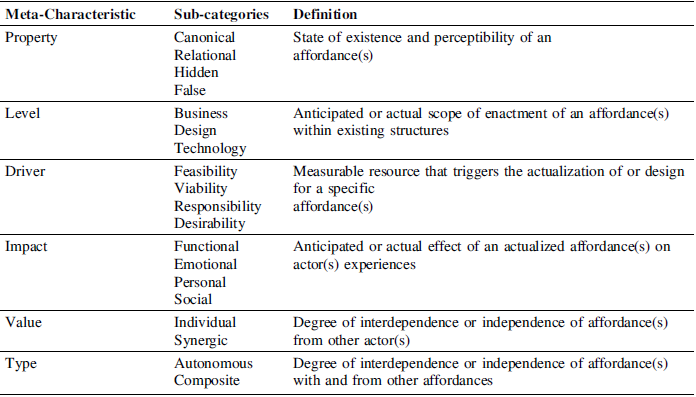
One significant theoretical contribution is represented by the framework developed by Reference Ostern and RosemannOstern and Roseman (2021), which identifies six affordances’ meta-characteristics, namely property, level, driver, impact, value and type. Table 1, taken from the stated contribution, presents the definitions.
The relevance of the framework lies in its capacity to account for the relational nature of affordance, as well as the interrelations and interactions among them. This approach makes the model able to capture even the fast-moving nature of today’s digital technologies and the generative mechanisms resulting from their complexity. Moreover, the integration of the numerous concepts in the literature and its abstraction from a specific context render the framework comprehensive and generalisable. Finally, it considers the dynamic process of affordances, distinguishing between the three states of affordance existence, perception and actualisation (Reference Bernhard, Recker and Burton-JonesBernhard et al., 2013), and acknowledges the presence of loops, viewing the relationship between perception of affordances and actions not as one-sided.
The meta-characteristics of affordances from Reference Ostern and RosemannOstern and Roseman (2021)

When present, empirical analysis employs qualitative methods based on case studies, collecting data through the observation of user-system interaction and critical realism (Reference Volkoff and StrongVolkoff e Strong, 2013), questionnaire (Reference Seet and GohSeet and Goh, 2012), interviews, and document analysis, often combining multiple methodologies (Reference Anderson and RobeyAnderson and Robey, 2017).
Regardless of the adopted data collection methodology or the nature of the study, whether it is theoretical or empirical, the starting point for evaluating affordances is (or should be) the user-artefact-environment interaction or, more broadly, the user experience. This is indeed the object of analysis of any framework development or observation, questionnaire and interview that may be conducted.
However, evaluating the user experience is other than trivial, due to the many elements and interactions involved. Various tools exist to describe a user experience, some focusing on tentative representations, as personas (e.g., Reference Vallet, Puchinger, Millonig, Lamé and NicolaïVallet et al., 2020), storytelling (e.g., Reference Michailidou, Von Saucken, Kremer and LindemannMichailidou et al., 2014), storyboards (e.g., Reference Ranscombe, Rodda and JohnsonRanscombe et al., 2019) and journey maps (e.g., Reference Oliveira, Birrell and CainOliveira et al., 2020), others oriented towards evaluation, as user tests (e.g., Reference Lallemand and GronierLallemand & Gronier, 2018), review mining (Reference Hou, Yannou, Leroy and PoirsonHou et al., 2019), UX scales and questionnaires (e.g., Reference Schrepp, Hinderks and ThomaschewskiSchrepp et al., 2017).
The present paper adopts the UX grammar model by Reference Dabouis, Boccara and YannouDabouis et al. (2024a, Reference Dabouis2024b) to encode the user interaction with a product in its environment, and to further detect the characteristics and categories of the affordances emerged within it. The ability of the grammar to represent UX multidimensionality in a comprehensive and unambiguous way in fact can support an effective affordance evaluation.
4. UX grammar
The UX grammar model, by Reference Dabouis, Boccara and YannouDabouis et al. (2024a, Reference Dabouis2024b), is a simple design tool that provides an exhaustive representation framework, without ambiguity in coding or interpretation. The tool has been developed combining the two graphical model languages DRED2.0-Design Rationale Editor (Reference Bracewell and WallaceBracewell and Wallace, 2003) and SysML-System Modelling Language (OMG, 2007) with the UX journey map (e.g., Reference Oliveira, Birrell and CainOliveira et al., 2020). On the one hand, DRED and SysML allow to overcome the ambiguity and lack of completeness of UX representation tools; on the other, the UX journey map covers all the necessary UX elements, from the involved stakeholders and systems to the surrounding environment (Reference Wang and KimWand and Kim, 2025).
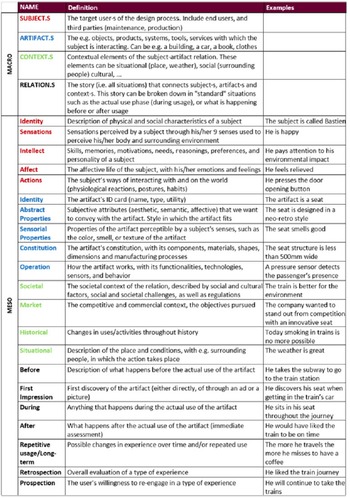
The UX grammar proposes to use sentences written in natural languages to describe user experience, by breaking it down into descriptive units called “statements”. For example, “the subject opens the door” or “the subject is happy” are possible statements. For clearness and to avoid ambiguity, the format to be used to formulate a statement is supposed to be either Subject + verb + attribute, to describe a variable’s state, or Subject + verb + receiver (+ attribute), to describe an action or judgment. The tool is intended as complementary to the UX lexicon (Reference DabouisDabouis, 2025), also developed by Reference Dabouis, Boccara and YannouDabouis et al. (2024a, Reference Dabouis2024b), which provides a common dictionary when talking about user experience (Table 2).
UX lexicon proposed by Reference Dabouis, Boccara and YannouDabouis et al. (2024a, Reference Dabouis2024b)

With reference to the UX lexicon, each statement can refer to the subject, the artefact, the relation between the subject and the artefact, or the context, and thus can be associated to the relative category of the lexicon. Moreover, the level of detail of the meso-categories of the lexicon makes them capable of representing the entire spectrum of dimensions involved in a user experience, enabling a complete coding.
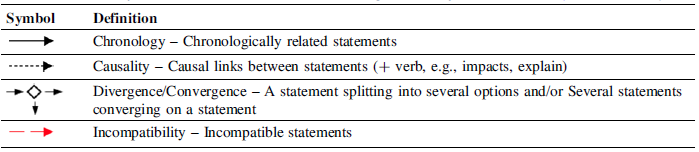
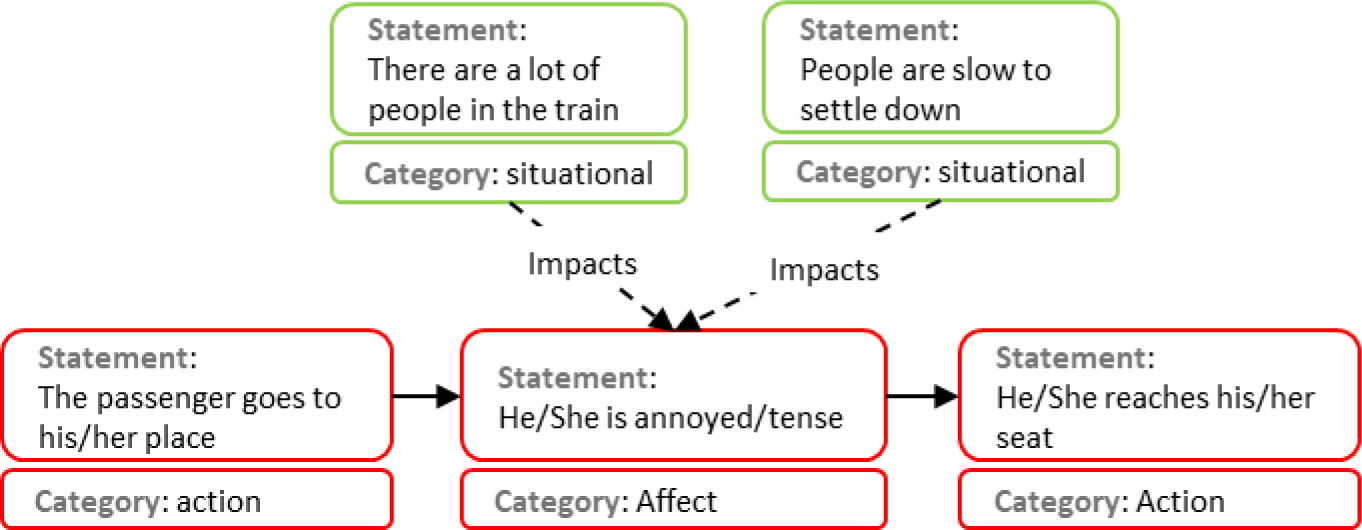
Recalling the diagrammatic representations of DRED and SysML, each statement is written in a rectangle “card”. These cards can then be linked together to describe the complete dynamics of the user experience and to capture the rationale behind it, whether it is chronology, causality, divergence/convergence or incompatibility. Table 3 presents the possible links, while Figure 1 illustrates an example of a set of UX grammar statements and their connections.
The possible association links of the UX grammar by Reference Dabouis, Boccara and YannouDabouis et al. (2024a, Reference Dabouis2024b)

Exemplary statements of the UX grammar by Reference Dabouis, Boccara and YannouDabouis et al. (2024a, Reference Dabouis2024b)

The use of natural language, both for its intuitiveness and its richness in description possibilities, enables to describe the user experience in a simple and complete manner, through explicit statements with no ambiguity, subjectivity or vagueness, unlike more interpretative representations such as sketches.
Accordingly, in the present paper, the UX grammar is used as a user experience coding framework from which to capture affordances. The level of granularity is indeed appropriate for affordance identification, since the grammar allows to codify elements pertaining to the subject, the artefacts, their relation and the environment (meso-categories of the UX lexicon; Table 2), separately and in their possible interconnections (association links; Table 3). The representation of these dynamics is the essence of the concept of affordance and its relational nature. Indeed, the statements related to the artefact’s constitution and properties enable the codification of the perceptual information associated with the design features that suggest affordances (affordance existence); statements describing the actions performed by the subject reflect affordance actualisation; finally, statements about subject’s intellectual reasoning or feeling, together with the links between artefact- and subject-related statements, clearly represent the process of how (and how clearly) information are interpreted and affordance perceived.
With reference to the framework developed by Reference Ostern and RosemannOstern and Roseman (2021), reminding its completeness and general applicability, including the digital context, the UX grammar coding enables to capture all the affordance characteristics (property, level, driver, impact, value and type).
First, the affordance characteristic of property can be inferred from the divergence association links, which code different behaviours of subjects and therefore suggest differences in affordance perception. Similarly, a link between Subject statements of action and sensations can indicate such action is conditioned to the perception of some artefact’s properties and is thus dependent on the actor-object relationship. Finally, the use of Relation meso-categories is also relevant, as it highlights the connection between the subject, artefact and context.
Second, the affordance characteristic driver can be deduced by the association links of causality (e.g., “because”) between Artefact statements and Subject statements describing actions, as they reveal the cues offered by the object to indicate the existence of an affordance. From the same causal links, it is also possible to infer the characteristics anticipated level and anticipated impact, since they reveal the information guiding the actor’s decision of whether to actualise an affordance or not. More specifically, these links show the reasons why the actor chooses to actualise an affordance and thus perform the action described in the related statement: they may depend on design features of the object that communicates the action possibility, or on the outcome expected from that action. Additionally, association links between action statements allow the identification of the affordance characteristic type by uncovering the interrelations between affordances, in terms of sequence or hierarchy.
Finally, the coding following the statement that concerns a subject’s action represents the real outcome of affordance actualisation, indicating the affordance characteristics of actual level and actual impact, but also the effect of such outcome, in terms of value.
A demonstrative application of the UX grammar coding for capturing affordances is now presented.
5. Validation
An experimental protocol has been developed to recognize and evaluate affordances and their characteristics from the coding of the user-product-environment interaction using the UX grammar.
The ultimate goal of the experiment is to identify the evolution of affordances when a product is rendered digital; indeed, the study observes the interaction of the user with both the non-digital and the digital version of the same product.
The selected case study is a vacuum cleaner, with its traditional cyclonic model compared to the floor cleaning robot. This represents an illustrative example of two products with the same main function (the desired output of a system, Reference UllmanUllman, 2002), but while the first is operated manually (non-digital version), the other autonomously navigates by processing data from sensors (digital version). Despite the goal of the experiment includes the comparison of the recognised affordances in the non-digital interaction with the digital one, this section focuses on the possibility to capture affordance from the UX grammar coding, as the methodology aims to be the main elements of novelty of this contribution. Accordingly, results from the comparison are considered out of scope and will therefore not be included.
The experimental protocol required the participants to perform ordinary activities using the two vacuum cleaners, namely assembling the device, completing a 10-minutes usage trial and cleaning the dust bin. More specifically, for the assembly, the participants had to unpack the components and put them together; during the usage trial, they were asked to clean a designated area; finally, for the dust bin cleaning, they had to detach the dust bin from the main body and empty it into a waste bin.
Activities were audio and video recorded and the ‘think-aloud’ methodology was adopted, meaning the participants had to say out loud everything that goes through their mind while interacting with the devices (Reference Van Someren, Barnard and SandbergVan Someren et al., 1994). Data about the participant’s demographics (gender, age, educational level and background) as well as information about the level of experience with the two types of vacuum cleaners (year of experience, usage frequency) were collected prior the beginning of the experiment.
Nine participants were involved in this preliminary experiment; they were volunteers, older than 18 years, and with no medical conditions or disabilities that significantly limit movement and physical interaction with the experimental environment. They were informed about audio and video recording, and data treatment consent paper was signed. The recorded user-artefact interactions were coded by one analyst using the UX grammar, distinguishing each activity for both the devices, ending with six complete codifications (three activities with two devices). The single-analyst coding and the limited number of participants align with the aim of simply validating the codification process.
The recordings allowed to observe the different actions of the user and understand the artefacts’ features that allow such actions, which reflect affordance actualisation and the design elements involved in the communication of the action possibilities. The think-aloud methodology revealed the participant’s thoughts and reflections, which were coded through Subject meso-categories of the UX grammar lexicon, such as Intellect, Affect, or Sensations. This explicated user’s interpretation and judgement of the design elements, and thus connects with affordance perception (Reference Kim and HongKim and Hong, 2012).
Overall, the UX grammar proved to be effective in capturing the affordances emerged within the selected user experiences. By simply using statements written in natural languages and linking them according to their association of chronology, causality, divergence/convergence or incompatibility, the interactions between the actor, the artefact and the environment stands out clearly, enabling to identify affordances and, most of all, to recognize their characteristics, as defined by Reference Ostern and RosemannOstern and Roseman (2021).
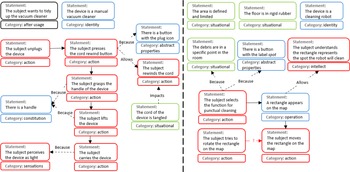
Within the vacuum cleaner case study, the characteristics of type and property have been found the most relevant from the codification. Figure 2 shows a small portion of the coding of the usage interaction with the traditional (on the left) and robotic (on the right) vacuum cleaner.
Exemplary statements from the codification of user-vacuum cleaner interaction

Figure 2 Long description
Panel A: A flowchart depicting the interaction with a manual cord vacuum cleaner. The subject unplugs the device, presses the cord rewind button, grasps the handle, lifts the device, and carries it. The flowchart includes statements about the subject's actions and perceptions, such as the device being perceived as light and the cord being tangled. Panel B: A flowchart depicting the interaction with a cleaning robot. The subject selects the function for punctual cleaning, a rectangle appears on the map, and the subject moves the rectangle on the map. The flowchart includes statements about the subject's understanding and actions, such as the floor being in rigid rubber and the area being defined and limited.
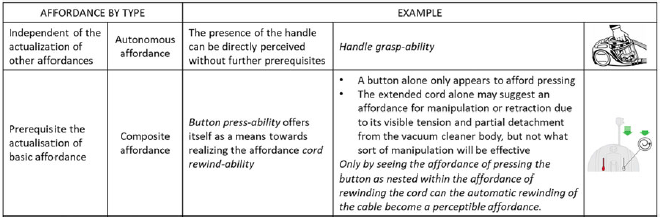
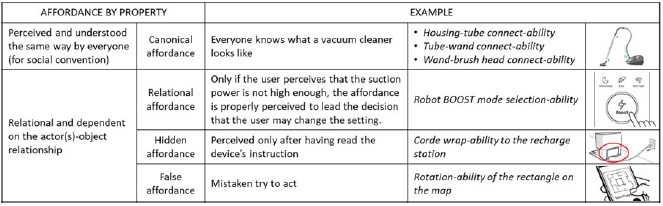
Tables 4 and 5 display some examples of the affordances identified from the UX grammar coding, with the related statements (only key statements are reported). In particular, the autonomous and composite affordances (characteristic type) are captured from the codified user experience with the traditional vacuum cleaner illustrated in the left-hand part of Figure 2; while the false affordance (characteristic property) arose from the interaction with the cleaning robot and it is reported on the right-hand part.
The figure proves how UX grammar is simple not only in coding but also in understanding.
In the first case, the codification shows clearly that the subject grasps the handle because the solely presence of such components acts as perceptible cue for guiding the placement of the hand; no other elements intervene in the action, meaning the handle effectively communicated by itself to the participant the possibility of grasping the vacuum cleaner. This classifies the grasp-ability as an autonomous affordance, which does not necessitate any prerequisites to be actualised. The other affordance, instead, is a nested affordance, since, to automatically rewind the cord (i.e., to actualise the affordance of cord rewind-ability), the button must first be correctly pressed (i.e., to actualise the affordance of button press-ability). Coherently, the codification illustrates that one action (statement: the subject rewinds the cord) is allowed by another action (statement: the subject presses the cord rewind button), highlighting the need of actualising one affordance before the other.
The other affordances presented in Table 5 were captured analogously. All participants assembled the traditional vacuum cleaner in the same, correct way. It is easy to imagine this occurs for social convention, as the device is a well-known technology, whose meaning has been shaped and consolidated over time by socio-cultural and organizational influences. While thinking aloud, participants tried to articulate their reasoning during the assembly process with sentences like “I’ve seen many vacuum cleaners in my life, so I know what it looks like” or “I just know the appearance of a vacuum cleaner, that’s it”. Consequently, the affordances related to the connection of the tube to the wand and then to the head brush can be classified as canonical, meaning they are perceived by everyone in the same way.
The observed relational affordance, instead, involves the cleaning robot and the possibility of modifying its cleaning settings of the device. During the usage trial, the correct perception and actualisation of boost mode selection-ability depended on how effective the participant considered the suction power to be. The perception of the operation characteristics of the device, which is specific to the subject, thus represents a particular form of relationship between the subject and the object’s properties.
Finally, hidden and false affordances represent, respectively, action possibilities that were not perceived by participants, although present, or actions that the participants believed to be possible but instead were not. This last case was evident in the usage experience with the smartphone application needed to control the robot. For spot cleaning in case of concentrated debris to remove, a dedicated function allows the user to define the area to be cleaned by positioning a rectangular shape on the map in the desired location. While interacting with this feature, the subject attempted to rotate the rectangle to better match the orientation of the area to be cleaned, performing gesture-based movements on the screen. However, the rectangle maintained the same orientation. The subject therefore misinterpreted the interaction possibilities offered by the system, perceiving the rotation-ability affordance that was, in fact, false (the incompatibility association link in the coding highlights the wrong perceived action possibility).
Affordances identified in the user-vacuum cleaner interaction (characteristic type)

Affordances identified in the user-vacuum cleaner interaction (characteristic property)

6. Discussion and conclusion
The relational nature of affordances requires their evaluation within the study of user-artefact-environment interaction and, more broadly, within the user experience (UX) framework.
In this context, the present paper presents the use of the UX grammar model developed by Reference Dabouis, Boccara and YannouDabouis et al. (2024a, Reference Dabouis2024b) for coding user interaction with a product and further capturing affordances, with no ambiguity or vagueness. Such UX grammar model uses explicit descriptive statements formulated in natural language to represent the user experience in a simple, complete and unique way, encompassing all the UX dimensions. Accordingly, the grammar enables to codify elements pertaining to the artefact, the subject, their mutual relation, and the surrounding environment, and to link these elements through specific association rules to outline the dynamics of their interconnection. Here lies the tool’s suitability for capturing affordances.
The use of the grammar model for coding the user-product-environment interactions is validated in the context of the post recognition of affordance characteristics. An experiment was conducted with participants interacting with traditional and robotic vacuum cleaners during ordinary operations activities, while thinking aloud to express their perception, judgement and action (Reference Kim and HongKim and Hong, 2012). Their user experiences were recorded and codified using the UX grammar. The result allowed affordances to be captured and their characteristics to be distinguished and classified according to the established framework by Reference Ostern and RosemannOstern and Roseman (2021). Examples of type and property affordance characteristics emerged as most relevant and are thus presented, together with the corresponding coded statements from which they were identified. The validation demonstrated the grammar’s richness and level of granularity, which is suitable to both recognise and characterised affordances.
The aim of the study is to validate the ability to code the user experience for further capturing affordances in a simple, complete and unambiguous way. The relevance of the proposed methodology specifically lies in these last three attributes. Codification of UX is crucial for designer to support dialogue among the different stakeholders coming from the multiple disciplines involved in design (Reference Cantamessa, Cascini and MontagnaCantamessa et al., 2012, Reference Cantamessa, Montagna and Cascini2016).
We now aim to study the unicity of coding by using and identifying affordance characteristics, whoever can be the coders and the decoders. Furthermore, given the time-intensive nature of manual coding, we are working on developing an AI-based tool to automate the process and improve the scalability of the method. Ideally, this tool will be able to automatically code the UX and extract related affordances, receiving images and video recordings from think-aloud experiments with the products as inputs.
The possibility of capturing affordances from the outcome of the coding, which was the particular focus of this contribution, adds another layer of utility to the methodology, enabling a more detailed evaluation of the user-product interaction and allows to designers to analyse, and even predict, the circumstances for the emergence and actualisation of affordances. Finally, the reference to the Reference Ostern and RosemannOstern and Roseman’s (2021) framework extends the application of this methodology to contexts of rapid technological progress, such as today’s, thus encompassing digital affordances generated by modern technologies.
Acknowledgement
This publication is part of the project PNRR-NGEU which has received funding from the MUR–DM 118/2023.

 Open access

