


Introduction
How does technological change affect social policy preferences? This question has attracted significant interest in recent years (for a review, see Gallego and Kurer Reference Gallego and Kurer2022). The overarching hypothesis guiding this body of research rests on the intuition that individuals employed in occupations exposed to greater risk of automation demand greater state intervention in the form of compensatory social policy (Kurer and Häusermann Reference Kurer, Häusermann, Busemeyer, Kemmerling, Marx and van Kersbergen2022; Thewissen and Rueda Reference Thewissen and Rueda2019). However, empirical evidence in support of this hypothesis has been susceptible to choice of variables and research designs (Ahrens Reference Ahrens2024; Compton and Philips Reference Compton and Philips2024; Gallego et al. Reference Gallego, Kuo, Manzano and Fernández-Albertos2022; Weisstanner Reference Weisstanner, Clegg and Durazzi2023), leading to mixed results. This calls for a reassessment of the relationship between technological change and social policy preferences.
This article argues that skill formation may be the missing link. Specifically, it highlights the role of dual vocational education and training (VET) in shaping social policy preferences in the age of automation, and in moderating the relationship between automation risk and the demand for compensatory social policy. Dual VET refers to training that takes place in both schools and firms (typically in the form of apprenticeships), resulting in certified and portable occupational skills. Firms and their intermediary associations participate in the provision, financing, and administration of training (Busemeyer and Trampusch Reference Busemeyer, Trampusch, Busemeyer and Trampusch2011, 14–15). In Europe, the share of upper secondary students who are enrolled in dual VET programs varies widely, ranging from zero in countries such as Italy to up to 58 per cent in Switzerland (Emmenegger and Haslberger Reference Emmenegger and Haslberger2025; see Table A2 for details).
Our focus on skill formation is motivated by a major theoretical puzzle: the absence of skills in current discussions about the relationship between technological change and social policy preferences.Footnote 1 This absence is surprising given that labor economics highlights the crucial role of educational levels in determining workers’ fortunes in the context of the automation revolution (see, for example, Autor et al. Reference Autor, Levy and Murnane2003; Goos et al. Reference Goos, Manning and Salomons2014). Moreover, the Varieties of Capitalism (VoC) literature emphasized the role of different types of upper-secondary education systems – and in particular whether they produce ‘specific’ skills – in shaping demand for compensatory social policy, albeit not in the context of technological change (see, for example, Estevez-Abe et al. Reference Estevez-Abe, Iversen, Soskice, Hall and Soskice2001; Iversen and Soskice Reference Iversen and Soskice2001). Yet, variation in skill formation systems has been absent from the debate on individual preferences for social policy in the context of increasing automation risks, as also pointed out by recent review articles (Gallego and Kurer Reference Gallego and Kurer2022; Özkiziltan and Hassel Reference Özkiziltan and Hassel2020).
This paper shows that skill formation constitutes a missing link in the relationship between automation risk and demand for compensatory social policy. In doing so, we propose a dialogue between three streams of literature that share obvious affinities but have mostly developed separately from one another thus far: the labor economics literature on the relationship between skills and technology; the political behavior literature on the connection between technological change and social policy preferences; and the VoC literature on skill specificity and its implications for social policy preferences. Taken together, these streams of literature put skills, technology, and social policy preferences under the spotlight – but they analyze them only in pairs. We suggest instead that skills, technology, and social policy preferences should be placed under a unified theoretical framework.
We argue that a dual VET background influences social policy preferences in the age of automation and moderates the relationship between automation risk and demand for compensatory social policy. Specifically, we develop a theoretical argument predicting that dual VET makes individuals less supportive of compensatory social policy. We outline three (non-mutually exclusive) mechanisms that underpin this relationship: (i) material self-interest, reflecting the above-average salaries of dual VET graduates, especially at the beginning of their careers; (ii) workplace socialization into workfarist attitudes that consider social policies harmful for the economy; and (iii) the authoritative system of skill certification that improves skill portability. We argue that these three mechanisms set dual VET apart from other forms of education and training and that they jointly explain why dual VET graduates are comparatively critical of compensatory social policy in the context of automation.
Empirically, we demonstrate that a dual VET background is associated with lower levels of support for compensatory social policy (compared to respondents with comparable levels of educational achievement). Subsequently, we assess the three mechanisms through which this is hypothesized to happen. Finally, we demonstrate that a dual VET background attenuates the positive association between automation risk and support for compensatory social policy. Mobilizing cross-national survey data and country-level information on education and training as well as zooming into cases with large dual VET systems to tap into more fine-grained information on individuals’ educational background, we find strong support for our argument across a range of statistical analyses and model specifications.
The paper is organized as follows. The literature review highlights how the absence of skill formation from the debate on technological change and social policy preferences is theoretically puzzling. Subsequently, we develop our theoretical argument, explaining in detail the three mechanisms through which we hypothesize dual VET weakens demand for compensatory social policy in the context of automation. After discussing the data and the statistical approach, we present the results of our empirical analysis. The concluding section discusses how this paper – by emphasizing the central role of skills – advances the flourishing literature on the relationship between technological change and social policy as well as broader political developments. Moreover, we argue that our framework also enriches the labor economics literature on skills and technology by showing that types of education and training matter, alongside skill levels.
Skills as the Missing Link between Automation Risk and Social Policy Preferences
Skills, technology-induced automation, and social policy preferences feature prominently in the debate on the transition to the knowledge economy (Hall Reference Hall2020; Hassel and Palier Reference Hassel and Palier2021; Thelen Reference Thelen2019). However, these three elements are largely analyzed in pairs. Labor economics is preoccupied with the relationship between skills and automation but has shown little interest in social policy. In contrast, recent political behavior literature focuses on the relationship between automation risk and social policy preferences but pays little attention to skills. Finally, the VoC literature has highlighted the relationship between skills and social policy preferences. Yet, technology-induced automation has not featured prominently in this literature. As a result, few scholars have explored the three-pronged relationship between skills, automation risk, and social policy preferences, which we argue is a crucial, yet overlooked, aspect of the transition to a knowledge economy.
In labor economics, theories of skill-biased and routine-biased technological change highlight the asymmetric effects of technology on labor markets. Crucial reasons behind such asymmetry lie in the different relationships between occupations at various skill and task levels, on the one hand, and technology on the other (Autor et al. Reference Autor, Levy and Murnane2003; Goos et al. Reference Goos, Manning and Salomons2014). Skill-biased technological change suggests that technology is complementary to jobs at high levels of skills, while it enables the automation of jobs lower down the skill distribution. Routine-biased technological change concurs on the complementary relationship between technology and high skill levels typically associated with non-routine cognitive tasks but expects substitution to occur in the middle of the skill distribution, where jobs tend to be characterized by routine tasks. However, it posits that occupations often found at the bottom of the skill distribution and characterized by interpersonal tasks are not easily replaceable by technology and may benefit from consumption spillovers (Mazzolari and Ragusa Reference Mazzolari and Ragusa2013).
Despite different expectations concerning the bottom of the skill distribution, both approaches point de facto in the same direction as far as the middle and top of the skill distribution are concerned. Knowledge economies are expected to thrive on high skill levels that fuel cognitively and analytically demanding occupations and that are complementary to technology. In contrast, they paint a rather bleak picture for jobs in the middle of the skill distribution.
The relationship between technological change and social policy preferences has been hotly debated. The political behavior literature theorizes how exposure to automation risk affects individual demand for social protection. Thus far, results have been mixed. Based on perceived automation risk, Kurer and Häusermann (Reference Kurer, Häusermann, Busemeyer, Kemmerling, Marx and van Kersbergen2022) find that at-risk individuals demand traditional passive insurance against the risk of job loss. Similarly, based on routine-task intensity (RTI) at the occupational level, Thewissen and Rueda (Reference Thewissen and Rueda2019) observe that individuals in routine occupations demand more redistribution to compensate for their greater risk of losing their jobs due to automation. Gallego et al. (Reference Gingrich, Kuo, Busemeyer, Kemmerling, Marx and van Kersbergen2022), on the other hand, do not find strong support for the compensation hypothesis in the case of Spain. Rather than demanding more public spending on unemployment benefits, workers at risk of automation prefer policies that slow down the pace of technological change. Similarly, Ahrens (Reference Ahrens2024) and Compton and Philips (Reference Compton and Philips2024) find no clear relationship between labor market risks and social policy preferences. Busemeyer and Tober (Reference Busemeyer and Tober2023) focus on the interactions between automation risk, demand for social protection, and welfare state institutions. They find that both the perception of technology-related employment risks and RTI increase demand for unemployment benefits, although the relationship is moderated by the generosity of existing compensation schemes (see also Compton and Lipsmeyer Reference Compton and Lipsmeyer2019). Importantly, they find that welfare state institutions make a difference in shaping social policy preferences only for individuals at low perceived risk of automation.
Taken together, the political behavior literature suggests a complex relationship between automation risk and demand for compensatory social policy. While the ‘risk-insurance framework’ is appealing for its parsimoniousness (Haslberger et al. Reference Haslberger, Gingrich and Bhatia2025), the extent to which it captures the determinants of preferences for compensatory social policy in the age of automation seems susceptible to data sources, specifications, and the exact policy manifestations that such preferences take.
Given the degree of ambiguity in findings, we must conclude that there are missing links in the theorization of the relationship between automation risk and social policy preferences. From our vantage point, the limited role assigned to education and training as potentially influencing the relationship between automation risk and demand for compensatory social policy stands out. Empirical studies typically treat education as a control variable (for example, years of education, thereby ignoring type of education) or they use occupation-based (rather than education-based) measures of skill specificity as an alternative specification. Thus, the role of education and skills is not systematically embedded in the theoretical apparatus underpinning this research. Reviewing the state-of-the-art on the impact of automation on the labor market, Özkiziltan and Hassel (Reference Özkiziltan and Hassel2020, 23) conclude that ‘a new research agenda should incorporate institutional factors, such as workers’ voice and the role of existing training regimes (VET)’. Similarly, Gallego and Kurer (Reference Gallego and Kurer2022, 479) urge that ‘[d]ifferences in education and, particularly, vocational education and training regimes should have a more prominent role in this research agenda’.
The lack of explicit theorization of education and skill formation is all the more surprising given that the microfoundations of the prominent VoC framework built precisely on the relationship between (types of) skills and demand for social protection (Estevez-Abe et al. Reference Estevez-Abe, Iversen, Soskice, Hall and Soskice2001; Hall and Soskice Reference Hall, Soskice, Hall and Soskice2001). Here, the central tenet was again formulated along the lines of a ‘risk increases demand for social protection’ relationship where the risk is not automation but rather skill specificity. The argument held that an investment in specific skills, typically obtained through dual VET, carries an inherent risk due to the lower probability for specific-skilled individuals relative to individuals holding general skills to find an equally remunerating job in case of unemployment (Iversen and Soskice Reference Iversen and Soskice2001). Therefore, individuals who invested in highly specific skills would also demand insurance against this risk, most notably generous unemployment benefits (Cusack et al. Reference Cusack, Iversen and Rehm2006; Lee Reference Lee2007).
Admittedly, in recent years, researchers in the VoC tradition have abandoned their focus on specific skills, calling into question the role this type of skill plays in generating economic growth in today’s knowledge economies (Iversen and Soskice Reference Iversen and Soskice2019). Nevertheless, this brief review of the literature presents us with a stark theoretical puzzle: (i) if type of skill (not just – or not even primarily – level of education) is an important predictor of individual social policy preferences; (ii) if automation risk is equally an important factor shaping such preferences; and (iii) if skill types affect automation risk, why do we lack systematic theorization and empirical scrutiny of the role that different skill types play in shaping preferences for social protection in the age of automation? One might plausibly answer that ‘we do not need one’. This is because dual VET might be hypothesized – if all that has been discussed thus far holds true – as simply pushing in the same direction as automation. We refer to this as the ‘dual VET as risk magnifier’ hypothesis, which would roughly run as follows: if technology-induced automation wipes out jobs in the middle of the skill distribution, and if these jobs were already underpinned by ‘risky’ investments in specific skills even before technologies were adopted at large, then we must conclude that automation risk and skill specificity reinforce each other and jointly contribute to increasing demand for insurance via increased social protection.
In the next section, we argue that there are reasons to advance an alternative argument centered around skill types – and in particular on the role of dual VET – in shaping the relationship between automation risk and preferences for compensatory social policy, which points in the opposite direction compared to the risk magnifier hypothesis that received wisdom would steer us towards. We submit that dual VET mitigates – rather than magnifies – support for compensatory social policy in the age of automation. However, to make this argument, we must focus on other important characteristics of dual VET besides skill specificity.
Reconceptualizing Skills in the Age of Automation
We identify three characteristics of dual VET that allow us to posit that such an educational background (i) is associated with lower demand for generous social policy and (ii) moderates the relationship between automation risk and social policy preferences by dampening – not magnifying – support for compensatory social policy, compared to individuals with similar levels of educational achievement (for example, a secondary degree but no educational background in dual VET). We refer to this as the ‘dual VET as risk mitigator’ hypothesis, which works through three non-mutually exclusive mechanisms. First, dual VET facilitates school-to-work transitions and allows individuals to command above-average salaries, especially at the beginning of their professional careers. Secondly, dual VET socializes young people mostly at the workplace rather than in schools, thus instilling comparatively workfarist attitudes. Thirdly, dual VET has a unique system that authoritatively certifies the skills acquired, which increases re-employment chances.
It is important to note at the outset that these three mechanisms are expected to be just as relevant in the context of technological change as they would be in the absence of it. That is, our core argument is that dual VET graduates are less supportive of compensatory social policy in general and that dual VET mitigates the demand for compensatory social policy in the face of automation risk. By implication, dual VET can be thought of as both a predictor of social policy preferences and a moderator in the relationship between automation risk and demand for compensatory social policy. With this double focus, we draw attention to the hitherto neglected triangular relationship between skills, technological change, and social policy preferences. Moreover, we focus on the moderating role of dual VET on research design grounds. Dual VET is typically associated with middle-skilled jobs (Culpepper and Thelen Reference Culpepper, Thelen, Mayer and Solga2008; Estevez-Abe et al. Reference Estevez-Abe, Iversen, Soskice, Hall and Soskice2001), which the labor economics literature identifies as most amenable to automation (Acemoglu and Autor Reference Acemoglu, Autor, Ashenfelter and Card2011). This suggests that dual VET should make its graduates respond to technological change by increasing demand for compensatory social policy. Given that our argument predicts that the opposite holds true, focusing on the moderating role of dual VET in the context of technological change allows us to stack the deck against our own argument and test it in a least-likely setting.
Material Self-Interest
Empirical research has repeatedly shown that dual VET is associated with low youth unemployment rates (Breen Reference Breen2005; Emmenegger and Haslberger Reference Emmenegger and Haslberger2025; Tomic Reference Tomic2018; Zimmermann et al. Reference Zimmermann, Biavaschi, Eichhorst, Giulietti, Kendzia, Muravyev, Pieters, Rodríguez-Planas and Schmidl2013). Furthermore, dual VET-trained individuals have higher relative incomes, especially at the beginning of their career (compared to individuals with similar levels of educational achievement), due to the greater proximity of their qualifications to labor market needs, even as this advantage gradually decreases over the life-course (Chuan and Ibsen Reference Chuan and Ibsen2022; Hanushek et al. Reference Hanushek, Schwerdt, Woessmann and Zhang2017; Korber and Oesch Reference Korber and Oesch2019; Schulz et al. Reference Schulz, Solga and Pollak2023).
We refer to this ability to promote smooth school-to-work transitions and comparatively high salaries as the material self-interest mechanism. It builds at a theoretical level on recent work which argues that education shapes social policy preferences via the wages that workers command at different educational levels (Bullock Reference Bullock2021; Gelepithis and Giani Reference Gelepithis and Giani2022; Marshall Reference Marshall2016). Here, the typical finding is that certain types of education attract higher wages, which in turn decrease demand for compensatory social policy, not least due to higher levels of economic security (Gelepithis and Giani Reference Gelepithis and Giani2022). Similar findings apply to studies analyzing reforms increasing the compulsory schooling age in Great Britain and the United States. Such reforms turned individuals who stayed longer in secondary school against generous compensatory social policy by virtue of the higher wages accrued to them as a result of additional years of schooling (Bullock Reference Bullock2021; Marshall Reference Marshall2016).
Following this line of reasoning, we hypothesize that dual VET dampens demand for compensatory social policy from individuals by granting them comparatively advantageous economic positions in the form of high employment rates and high relative incomes, especially at the beginning of their careers. Since they are likely to be net contributors to unemployment insurance, material self-interest dictates that they should be less supportive of generous policies. Put differently, we argue that the high income levels of dual VET graduates (compared to individuals with upper secondary general education, though not compared to university graduates) mediate the negative relationship between dual VET background and demand for compensatory social policy at similar levels of exposure to automation risk.
Moreover, recent research suggests that dual VET can maintain its comparative advantage also in the context of technological change, because employer involvement ensures that training content aligns with frontier labor market needs, such as problem-solving skills in technology-rich environments (Emmenegger and Haslberger Reference Emmenegger and Haslberger2025), while the shared governance between employers, unions, and governments contributes to the pursuit of occupational upgrading – rather than polarization – in the transition to the knowledge economy (Bonoli and Emmenegger Reference Bonoli, Emmenegger, Bonoli and Emmenegger2022). For instance, Durazzi and Tonelli (Reference Durazzi and Tonelli2025) find that dual VET is associated with higher levels of non-routine cognitive jobs among young upper-secondary-educated workers than non-dual VET systems and that this effect is larger at high levels of intensity of information and communications technology. Dual VET, in other words, is conducive to employment opportunities at the top end of the labor market also in mature knowledge economies (Adda and Dustmann Reference Adda and Dustmann2023; Schulz et al. Reference Schulz, Solga and Pollak2023). For this reason, we hypothesize that an educational background in dual VET also mitigates the effect of automation risk on support for compensatory social policy.
Workplace Socialization
The workplace socialization mechanism focuses on the role of education environments in shaping individuals’ worldviews. Adults spend much of their waking time at the workplace, which is likely to influence social policy preferences (Kitschelt and Rehm Reference Kitschelt and Rehm2014). The same applies to the period before people become economically active. In these years, individuals spend most of their time in education and training. Socialization theory argues that institutions such as education systems or workplaces serve as ‘inferential spaces’ that shape how individuals come to think about cause–effect relationships and the desirability of certain policies (Busemeyer and Guillaud Reference Busemeyer and Guillaud2023; Mijs Reference Mijs2018). Experiences in secondary school and during the first years of employment have been found to be particularly influential because beliefs developed at a relatively young age – the ‘impressionable years’ – have lasting effects on policy preferences (Emmenegger et al. Reference Emmenegger, Marx and Schraff2017; Grasso et al. Reference Grasso, Farrall, Gray, Hay and Jennings2019; Jennings and Niemi Reference Jennings and Niemi1974; Sears and Funk Reference Sears and Funk1999). The different experiences individuals have during their training years and the first years of employment are likely to shape their social policy preferences.
From a workplace socialization standpoint, dual VET is different from any other form of education and training. Notably, dual VET students conduct a significant proportion – often a majority – of their training within a company, not in a school. According to the OECD (2001) definition, which we also follow in our analysis, dual VET students spend between 25 and 90 per cent of their time in a company, and most firm-based training is offered by small- and medium-sized companies. Moreover, in dual VET, firms and employers’ associations are typically involved in the definition of training content (Busemeyer and Trampusch Reference Busemeyer, Trampusch, Busemeyer and Trampusch2011, 14–15). This provides important levers to influence the socialization of dual VET students. Thus, as put by Van Maanen and Schein (Reference Van Maanen, Schein and Staw1979, 209), ‘[w]ork organizations offer a person far more than merely a job’, because individuals are also exposed to the strategic communication of employers, managers, and supervisors, which influences perceptions of economic problems and possible policy solutions (Heinrich Reference Heinrich2025).
Automation and technological change can be connoted negatively – as job destruction – or positively – as opening up new employment opportunities. Similarly, compensatory social policy can be framed positively – as necessary insurance against automation – or negatively – as a burden on companies facing technological challenges. In both cases, we expect the latter to be the framing that young adults are more likely to encounter in dual VET systems relative to school-based education systems, because such framing is a correlate of managerial discourse, whereas schoolteachers tend to lean left on redistributive attitudes (Heinrich Reference Heinrich2025; Van DeWerfhorst Reference Van DeWerfhorst2020). We therefore expect dual VET graduates to hold more workfarist attitudes, where excessive government intervention in the face of technological change is considered harmful disruption to the ‘natural’ course of events and thus ultimately counterproductive.Footnote 2 In short, we expect dual VET graduates to have comparatively workfarist attitudes, which mediate the negative relationship between dual VET background and demand for compensatory social policy (at similar levels of risk exposure) and contribute to mitigating the relationship between automation risk and social policy preferences.
Skill Certification
Lastly, the skill certification mechanism builds on the uniqueness of dual VET’s authoritative certification of skills (Busemeyer Reference Busemeyer2009; Streeck Reference Streeck, Busemeyer and Trampusch2011). In the VoC literature, there is a tendency to conflate issues of portability of skills and the actual content of skills. However, similar types of skills can result in different levels of portability – as a function of their certification (Busemeyer Reference Busemeyer2009, 381). In dual VET systems, Streeck (Reference Streeck, Busemeyer and Trampusch2011, 5) argues, skills are authoritatively certified by governments, business, and unions consisting of a ‘system of occupations and occupational training profiles that, through publicly supervised examination and certification of acquired skills, allowed for, in principle, unlimited mobility of workers in nationwide sectoral labor markets’. As a result, employers recognize skills obtained through VET, which in turn increases VET graduates’ ability to find new employment in case of unemployment. Re-employment chances are further improved by the fact that the skills produced by dual VET are in fact rather broad, because dual VET systems feature a consolidated curriculum for ‘adjacent occupations’ as well as an ‘academic part of vocational training’ that ‘was upgraded to a point where a growing segment of youth were no longer able to meet the ever higher academic demands’ (Streeck Reference Streeck, Busemeyer and Trampusch2011, 23). For this reason, VET skills are typically recognized in a variety of occupations, and not just the one that VET graduates specifically trained for.
These features become particularly salient in the context of technological change and automation risk. Given employers’ centrality in training definition and delivery, dual VET is particularly responsive to labor market needs and constantly adapts to employers’ demands, which means incorporating in the curricula the skills needed to cope with technological change (Durazzi and Tonelli Reference Durazzi and Tonelli2025; Emmenegger et al. Reference Emmenegger, Bajka and Ivardi2023; Emmenegger and Haslberger Reference Emmenegger and Haslberger2025). For this reason, dual VET graduates possess portable (that is, authoritatively certified) skills that are perceived as being developed in close correspondence with labor market needs and with employers’ buy-in. Therefore, we hypothesize that dual VET graduates perceive their skills to cushion rather than amplify the threat of automation, which should lower demand for compensatory social policy (at similar levels of risk exposure) and contribute to mitigating the effect of automation risks on support for generous social policy (compared to individuals with similar levels of educational achievement).
Hypotheses
To summarize, we have the following theoretical expectations. As argued above, the existing literature suggests that a dual VET background should be associated with higher levels of support for compensatory social policy and should magnify the effect of automation risk on demand for compensatory social policy (risk magnifier hypothesis). In contrast, our risk mitigator hypothesis makes two contrary predictions. First, it holds that a dual VET background decreases support for compensatory social policy. It does so through three non-mutually exclusive mechanisms: material self-interest, workplace socialization, and skill certification. In the empirical analysis, we use mediation analysis to examine these three mechanisms. Secondly, it predicts that a dual VET background mitigates – not magnifies – the effect of automation risk on demand for compensatory social policy. In the empirical analysis, we use moderation analysis to examine this mitigation effect. However, first, we discuss the research design and data that we use to put these hypotheses to an empirical test.
Data
Our main data source is the 2016 wave of the European Social Survey (ESS). The ESS is a biennial survey of demographic and attitudinal characteristics of European populations, with changing special modules. The 2016 iteration includes a module on welfare attitudes and covers twenty-three countries.Footnote 3 Additionally, for the analysis of the skill certification mechanism, we rely on data from an original survey that we conducted in spring 2024 (hereafter ‘VET survey’). This survey covers seven countries and allows us to perform a mediation analysis, which was not possible with ESS data.Footnote 4 We restrict our sample to working-age individuals (15–65 years) who have at least completed secondary education. Our dependent variable reads as follows:
-
• Is it the government’s responsibility to ensure a reasonable standard of living for the unemployed? (0 = not government’s responsibility at all; 10 = entirely government’s responsibility)
We focus on unemployment support because an increase in demand for compensatory policy, and especially for unemployment support, has been the closest to a consistent finding in the literature on political responses to automation risk (Busemeyer et al. Reference Busemeyer, Gandenberger, Knotz and Tober2023; Gallego and Kurer Reference Gallego and Kurer2022; Haslberger et al. Reference Haslberger, Gingrich and Bhatia2025; Kurer and Häusermann Reference Kurer, Häusermann, Busemeyer, Kemmerling, Marx and van Kersbergen2022; Weisstanner Reference Weisstanner, Clegg and Durazzi2023). It is also conceptually most closely related to unemployment risk, as unemployment benefits are likely the most immediate concern of people who lose their job due to automation. Thus, we expect to find a negative association between dual VET and demand for unemployment support, and a moderating effect of dual VET on the association between automation risk and demand for unemployment support.
Our main explanatory variables are individual VET status and occupational RTI. We capture people’s educational background with a three-category variable distinguishing between vocational secondary education (‘VET secondary’),Footnote 5 general secondary education (‘GE secondary’), and a bachelor’s degree or higher at a university or university of applied science (‘university degree’). The coding procedure is described in detail in Appendix A. This approach yields two categories with comparable levels of education (VET secondary and GE secondary), and a third group of people with tertiary education.Footnote 6 In the empirical analysis, we are primarily interested in the comparison between VET secondary and GE secondary.
According to our theoretical argument, the risk-mitigating role should be visible mainly in the case of dual VET, not fully school-based VET. However, the ESS data do not allow us to distinguish between dual VET (combining school- and firm-based learning) and fully school-based VET in most countries. To alleviate this limitation and further strengthen our case, we conduct separate analyses on the so-called ‘DACH’ countries (Austria, Germany, Switzerland), where it is possible to construct an approximate mapping of the educational codes onto dual and school-based VET at the individual level (see Appendix A for details). Next to data availability, we examine these three countries because they all feature sizeable dual VET, school-based VET, and tertiary sectors, allowing us to examine differences in attitudes between graduates from these three educational sectors. With this approximate indicator of dual VET status at the individual level, we can show that dual VET is indeed distinct from school-based VET in its association with social policy preferences.
Our other independent variable is RTI as a measure of objective automation risk. This reflects the prominent argument that workers in more routine-task-intensive occupations are at greater risk of unemployment and hence should demand more generous unemployment benefits. To operationalize automation risk, we calculate RTI scores using two-digit ISCO-08 task content data from the European Working Conditions Survey (EWCS) following the procedure of Haslberger (Reference Haslberger2022). This measure is similar to the widely used RTI scores of Goos et al. (Reference Goos, Manning and Salomons2014) but contains important improvements such as a better matching of concepts and empirical measures and the use of up-to-date European task data. It is important to note at the outset that, as expected, RTI and VET status are significantly correlated (r = 0.19). Moreover, RTI is significantly correlated with subjective unemployment risk (r = 0.15). This pattern holds across education groups, indicating that objective automation risk is associated with, but not identical with, subjective unemployment risk in people with different educational backgrounds (see Ahrens Reference Ahrens2024).
As control variables, we include important individual-level characteristics (gender, age, years of education, household income decile, union membership, unemployment, private sector employment, left–right ideology). All these variables have been identified as important predictors of support for compensatory social policy in previous work (Gingrich and Kuo Reference Gingrich, Kuo, Busemeyer, Kemmerling, Marx and van Kersbergen2022; Kurer and Häusermann Reference Kurer, Häusermann, Busemeyer, Kemmerling, Marx and van Kersbergen2022; Weisstanner Reference Weisstanner, Clegg and Durazzi2023; Wlezien and Soroka Reference Wlezien and Soroka2021). Admittedly, some of these variables are ‘post-treatment’ with respect to VET status, but more importantly, they help us address some of the selection issues inherent to an observational study like ours. For example, by controlling for private sector employment, we account for potential heterogeneous effects of vocational training in the private and public sectors. Moreover, controlling for gender, left–right ideology, and union membership is important to account for selection based on risk aversion and ideology.Footnote 7 Summary statistics by education group for all individual-level variables are reported in Table B1 and Table B2.
At the country level, we control for the average unemployment rate from 2014 to 2016 to account for national labor market performance (data from ILOSTAT) and the dual VET enrollment share at the upper secondary level in 2016 to alleviate the lack of individual-level information on the type of VET background in most countries (see Table A2; data from Emmenegger and Haslberger Reference Emmenegger and Haslberger2025). Using cross-level interactions, we test whether the association between individual VET background and social policy preferences is stronger in countries with higher dual VET shares (in case of the models where we cannot differentiate between dual and school-based VET at the individual level).
As the VoC literature makes clear, dual VET systems co-evolved alongside a set of complementary institutions, notably in the realm of welfare policy, since the late nineteenth century (Iversen and Soskice Reference Iversen and Soskice2009; Thelen Reference Thelen2004; Trampusch Reference Trampusch2010).Footnote 8 In recent years, skill formation systems have undergone significant reform to cope with the new demands of the knowledge economy (Bonoli and Emmenegger Reference Bonoli, Emmenegger, Bonoli and Emmenegger2022; Diessner et al. Reference Diessner, Durazzi and Hope2022). A detailed discussion of the nuances of national contexts is beyond the scope of this article, and in the empirical analysis we focus on country-level variables that are directly tied to our research question, but we acknowledge that correlated institutional configurations may jointly shape enrollment decisions and social policy preferences. Moreover, we note at the outset that the observational nature of our data prevents us from interpreting the estimated effects as causal.
Results
VET is Associated with Lower Support for Compensatory Social Policy
We begin our analysis by establishing that having a VET background has a strong negative association with support for compensatory social policy.Footnote 9 Our baseline specification is a multilevel model with random country intercepts that combines individual and country-level data and takes the following form:Footnote 10 $y_{ic} = \alpha _{c} + \beta _{1}VET_{ic} + {\beta }_{2}X_{ic} + {\beta }_{3}X_{c} + e_{ic}, $
where $y_{ic}$
measures respondent
$y_{ic}$
measures respondent  $i$
’s support for compensatory social policy in country
$i$
’s support for compensatory social policy in country  $c$
, α
c
is a random country intercept and β
1
VET
ic
is the indicator of an individual’s VET status. β
2
X
ic
is a vector of individual-level control variables (including RTI) and β
3
X
c
a vector of country-level covariates, and finally e
ic
is the residual error term. Our risk mitigator hypothesis posits that β
1 should be negative. Throughout the paper, observations are weighted using the analytical survey weights provided by the ESS.
$c$
, α
c
is a random country intercept and β
1
VET
ic
is the indicator of an individual’s VET status. β
2
X
ic
is a vector of individual-level control variables (including RTI) and β
3
X
c
a vector of country-level covariates, and finally e
ic
is the residual error term. Our risk mitigator hypothesis posits that β
1 should be negative. Throughout the paper, observations are weighted using the analytical survey weights provided by the ESS.
Figure 1 shows that people with a vocational secondary education stand out as significantly less supportive of compensatory social policy than both higher educated respondents with a university degree and respondents who have a secondary education but with a general orientation. We build our models by successively adding controls. The base model includes only the VET status indicator, the second model adds basic socio-demographic controls (age, sex, income), the third model adds controls related mainly to education and employment (years of education, RTI, employment status, private sector employment, union membership, political orientation), and the full model additionally accounts for country-level factors (dual VET share, unemployment rate). The full model is our default specification throughout the remainder of the paper. Regardless of the set of controls, the coefficient on VET status remains statistically significant and negative. This confirms the first part of our risk mitigator hypothesis: VET is associated with lower support for compensatory social policy.
VET background is associated with lower support for compensatory social policy.
Note: Estimates from multilevel models with random country intercepts with 90 and 95 per cent confidence intervals (thick and thin lines). Base: no controls. + Demographics: age, sex, household income. + Emp/Edu: years of education, routine-task intensity (RTI), employment status, private sector employment, union membership, political orientation. + Country Controls: dual vocational education and training (VET) share, unemployment rate. N = 32,306/26,487/22,074/22,074. For full results, see Table B3.

Interestingly, Figure 1 shows that university-educated individuals are less supportive of compensatory social policy than people with general secondary education in the unconditional model, but once we add the individual-level controls, this association disappears. No such pattern can be observed for people with a VET background. The full output can be studied in Table B3. Notably, RTI is positively associated with support for unemployment benefits, which aligns with previous literature that has found positive or null effects of automation risk on support for passive labor market policies (Busemeyer and Tober Reference Busemeyer and Tober2023; Gallego et al. Reference Gallego, Kuo, Manzano and Fernández-Albertos2022; Kurer and Häusermann Reference Kurer, Häusermann, Busemeyer, Kemmerling, Marx and van Kersbergen2022; Weisstanner Reference Weisstanner, Clegg and Durazzi2023). Since individuals with a vocational education often (but not exclusively) work in routine-intensive occupations, the negative coefficient of the VET variable suggests that VET systems may moderate the relationship between technological risk and support for compensatory social policy. Moreover, since we control for additional years of secondary education, which have been shown to reduce support for redistribution (Bullock Reference Bullock2021; Gelepithis and Giani Reference Gelepithis and Giani2022; Marshall Reference Marshall2016), our findings indicate that even conditional on the level of education, the type of education is associated with support for unemployment benefits. In Appendix C, we present a number of additional robustness checks, which show that our main results throughout the paper are robust to controlling for subjective unemployment risk (Table C3), not controlling for years of education (Table C4), controlling for cohabitation status (Table C5), not controlling for income (Table C6), controlling for parental education (Table C7), and using the Goos et al. (Reference Goos, Manning and Salomons2014) RTI measures (Table C8).Footnote 11 These robust findings underscore our motivating observation that studies which ignore the role of types of education, and dual VET in particular, are in danger of missing an important link.
Potential Mechanisms
In a second step, we zoom in on the theoretical mechanisms we identified – material self-interest, workplace socialization, and skill certification – and investigate them using mediation analyses to substantiate the core of our argument, the association between dual VET and social policy preferences. We find strong evidence consistent with the self-interest and workplace socialization mechanisms but not with the skill certification mechanism. However, despite this evidence, we caution against a causal interpretation of these mechanisms due to the observational and cross-sectional nature of the data.
We use a product of coefficients approach for the mediation analyses (MacKinnon et al. Reference MacKinnon, Lockwood, Hoffman, West and Sheets2002; Sobel Reference Sobel1982), calculating the direct effect of VET and the indirect effect of the mediator, and their relative contribution to the total effect on support for compensatory social policy. The procedure requires the estimation of two models: the mediator model $ M = \alpha _0 + \alpha _1T + \beta C + u $
and the outcome model $ Y = \gamma _0 + \gamma _1T + \gamma _2M + \delta C + v, $
where M represents the mediator, T the treatment (VET), and Y the outcome (support for unemployment benefits). The direct effect is γ 1 and the indirect effect is α 1 × γ 2. We calculate the standard errors of the indirect effects using the delta method. The total effect is the sum of the direct and indirect effects. The portion of the effect that is mediated is the ratio of the indirect effect over the total effect. Table 1 provides an overview of the mediator variables used to test the three mechanisms. We include the same control variables as in the full models in Figure 1.
Mediation analysis of mechanisms

Material self-interest
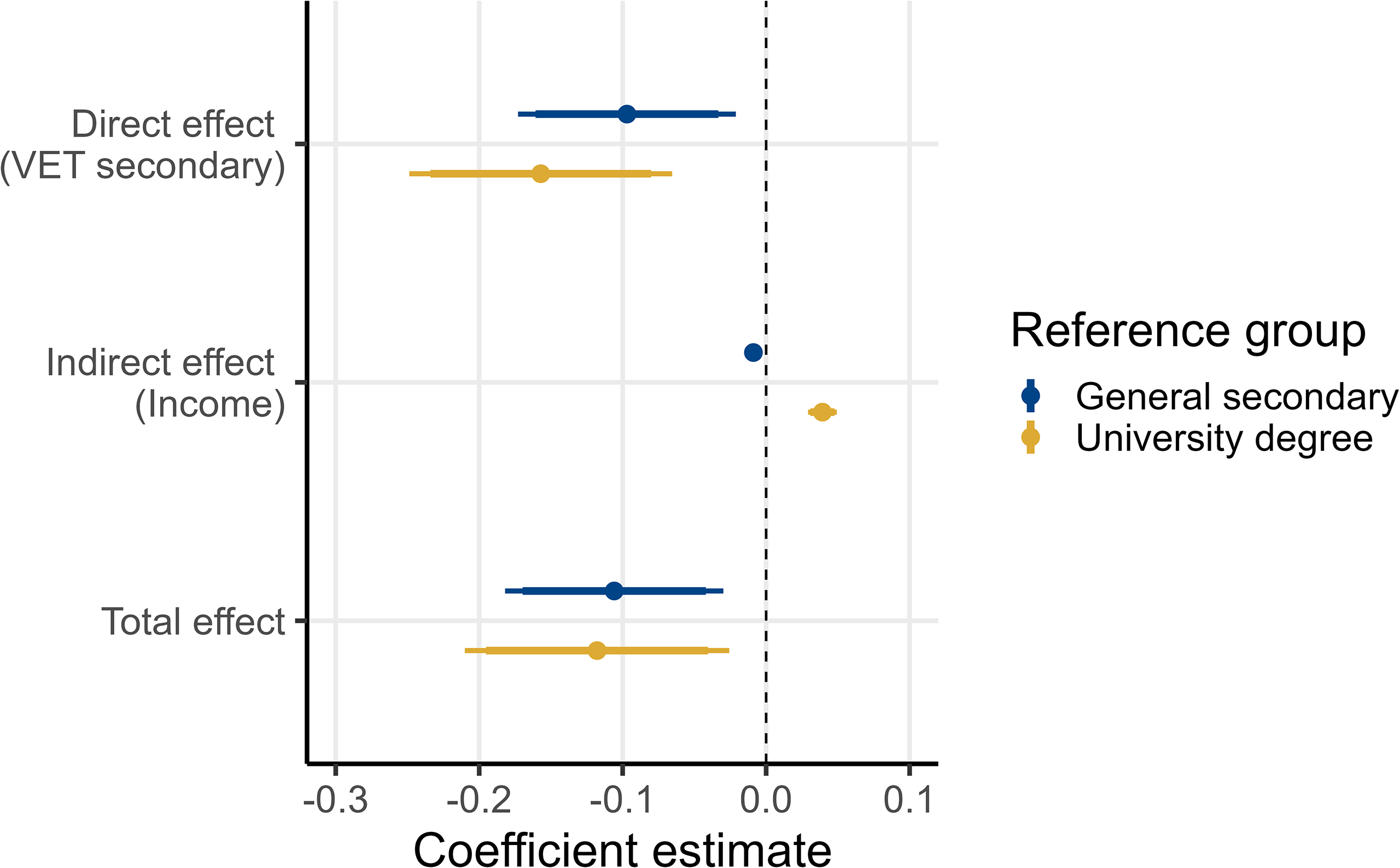
Drawing on the literature on the education–wage–social policy nexus, we argued that VET might reduce demand for compensatory social policy by enabling VET graduates to earn higher wages than individuals with a comparable level of education and fostering social policy preferences aligned with safeguarding their material self-interest. Our results support this argument: differences in income levels mediate the negative association between a dual VET background and demand for compensatory social policy. Specifically, Figure 2 shows that comparing VET to GE, the indirect effect accounts for approximately 8 per cent of the total effect, indicating that income differences contribute modestly to the reduced support for compensatory social policy among VET-educated individuals relative to GE-educated individuals. In contrast, using university degree holders as the reference group, income acts as a suppressor, opposing the total effect and reducing it by 33 per cent. The observed associations suggest that if VET graduates earned salaries comparable to university graduates, their opposition to compensatory social policy would be even stronger.
Material self-interest mechanism.
Note: Between −33 and 8 per cent of the estimated total effect of vocational education and training (VET) on support for unemployment benefits are mediated by income. N = 22,074. For full results, see Table B4.

Another corollary of our argument is that the difference in material self-interest should be most pronounced among younger workers. This is because VET graduates start out with higher salaries than their peers, who then catch up during their labor market careers (see, for example, Hanushek et al. Reference Hanushek, Schwerdt, Woessmann and Zhang2017; Schulz et al. Reference Schulz, Solga and Pollak2023). Borrowing from the literature on the scarring effects of unemployment (see, for example, Emmenegger et al. Reference Emmenegger, Marx and Schraff2017), we expect that the early experience of gainful employment and paying taxes, while many of their age cohort still rely on parental or state support, may induce opposition to compensatory social policy, which only recedes slowly over time. Figure C1 provides evidence in support of this conjecture. Among individuals under 35 years of age, having a vocational qualification nullifies the strongly positive and significant association between RTI and unemployment support among people with general secondary education. The interaction weakens slightly among workers aged 35–49 and largely disappears in the group of older workers (50–65 years). Overall, our analysis suggests that the material self-interest of dual VET-educated workers – especially younger ones – is one of the mechanisms by which VET is associated with lower support for compensatory social policy.
Workplace socialization
The workplace socialization hypothesis holds that workplace training during students’ ‘impressionable years’ (Schuman and Scott Reference Schuman and Scott1989) inculcates workfarist attitudes. Greater exposure to discourses framing government intervention as burdensome and dependency on the government as objectionable than in general schooling might shape the ideological outlook of individuals with a dual VET background and cause them to oppose generous unemployment benefits. Thus, we posit that the effect of dual VET is partially mediated by attitudes towards state intervention in general. Empirically, our mediator is agreement with the statement that ‘social benefits and services place too great a strain on the economy’. This question captures higher-order views of the role of the state in general, rather than on the specific policy problem of support for the unemployed, and can therefore serve as a proxy for workfarist attitudes.Footnote 12
In Figure 3, we find that having a VET background is positively associated with agreement that social benefits place too great a strain on the economy. Workfarism in turn is strongly negatively associated with support for unemployment benefits. When general secondary education serves as the reference category, we estimate that the indirect effect through workfarist attitudes accounts for 43 per cent of the total effect of VET. Relative to university-educated individuals, the indirect effect of workfarism accounts for a still substantial 21 per cent of the total effect. Clearly, these are substantively meaningful mediation effects. While we cannot rule out the possibility of selection effects despite a comprehensive set of control variables, this strongly suggests that workplace socialization into views critical of government intervention in the economy is a substantively important mechanism through which (dual) VET reduces support for compensatory social policy.
Workplace socialization mechanism.
Note: Between 21 and 43 per cent of the estimated total effect of vocational education and training (VET) on support for unemployment benefits are mediated by workfarist attitudes. N = 21,641. For full results, see Table B5.

Skill certification
The skill certification hypothesis holds that since dual VET skills are authoritatively certified, holders of a dual VET qualification are confident that their skills would be highly portable and in demand by other employers if they should become unemployed. Hence, they are less likely to personally benefit from and support generous unemployment benefits. To test this mechanism, we estimate whether answers to the question ‘Do you know of any other employers who would have good use for what you have learned in your present job?’ mediate the association between VET and support for unemployment benefits. Since this question was not asked in the 2016 wave of the ESS, we rely on data from a separate survey of seven European countries, which we ran in the spring of 2024. We estimate mediation models similar to the ones above, with the same reference groups.Footnote 13
Our analyses do not support the skill certification mechanism. Figure 4 shows that at most 7 per cent of the total effect on support for unemployment benefits operates through this mechanism when comparing people with a vocational secondary education to those with a general secondary education. Compared to people with a university degree, skill portability reduces the total effect by a minuscule 2 per cent. This shows that skill portability is no major factor behind the lower support of VET-educated individuals for compensatory social policy.
Skill certification mechanism.
Note: Between −2 and 7 per cent of the estimated total effect of vocational education and training (VET) on support for unemployment benefits are mediated by skill certification. N = 7,689. For full results, see Table B6.

VET Attenuates the Association between Automation Risk and Social Policy Preferences, Driven by Dual VET
We now move to test the second part of the risk mitigator hypothesis, which holds that dual VET attenuates the association between automation risk and support for unemployment benefits. To test this argument, we add an interaction term between VET status and RTI (β 3 VET ic × RTI ic ) to Equation 1, yielding the following equation: $ y_{ic} = \alpha _{c} + \beta _{1}VET_{ic} + \beta _{2}RTI_{ic} + \beta _{3}VET_{ic} \times RTI_{ic} + {\beta }_{4}X_{ic} + {\beta }_{5}X_{c} + e_{ic} $
The risk mitigator hypothesis implies that the interaction coefficient β 3 should be negative. The coefficient of VET status (β 1) should also be negative, while the coefficient of RTI (β 2) should be positive.
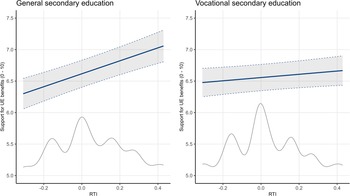
Figure 5 shows how the association between RTI and support for unemployment benefits differs between individuals with general secondary education (left panel) and those with a vocational secondary background (right panel).Footnote 14 At the bottom of the panels, we also include kernel density plots of RTI, which show that both groups tend to work in occupations with similar RTI.Footnote 15 In individuals with a GE background, support for unemployment benefits is positively associated with routine-intensity, in line with the predominant narrative. The size of this increase is substantively meaningful, amounting to 27 per cent of a standard deviation from the least to the most routine-intensive occupation. For VET-educated individuals, however, we find no significant association; support for unemployment benefits is essentially flat over the RTI distribution. Accordingly, the interaction coefficient is highly statistically significant (p < 0.001, see Table B7). This is also illustrated in Figure C3, which shows that at above-median levels of RTI, the marginal effect of VET status differs significantly between people with secondary general and vocational education. Especially in routine-intensive occupations, individuals with general secondary education therefore express on average significantly higher support for compensatory social policy than people with a VET background.
Vocational education nullifies the association between RTI and support for unemployment benefits.
Note: Predicted support for unemployment benefits across the distribution of routine-task intensity (RTI), by educational background, with 95 per cent confidence bands. Density of RTI at the bottom. N = 22,074. For full results, see Table B7.

Since we cannot observe dual VET status at the individual level in all ESS countries, we substantiate our claim that dual VET is driving the association by interacting RTI with the dual VET share of enrollment at the upper secondary level. In Figure 6, we plot the estimated marginal effect of RTI at different percentiles of the dual VET share of upper secondary enrollment. In line with our argument, we find that RTI is significantly positively associated with support for compensatory social policy only where enrollment in dual VET is low, but the relationship becomes statistically insignificant around the seventieth percentile and even turns negative at higher shares of dual VET enrollment. This finding strongly indicates that the individual-level attenuation pattern that we documented in Figure 5 is primarily due to individuals who have a dual VET background. Further evidence comes from the split-sample analyses in Table C11, which show that the level effect of VET and the interaction between VET and RTI are both driven by countries where dual VET accounts for a substantial share of overall VET enrollment.
Where the dual VET share is high, there is no (or even a negative) association between RTI and support for unemployment benefits.
Note: Estimated marginal effect of routine-task intensity (RTI) on support for compensatory social policy at percentiles of the dual vocational education and training (VET) share, with 90 and 95 per cent confidence intervals (thick and thin lines). N = 22,074. For full results, see Table B7.

In firm support of the risk mitigator hypothesis, we find evidence for the view that VET skills constitute a missing link between automation risk and individuals’ social policy preferences. Moreover, we find that this is driven by countries where dual VET predominates. However, individual-level information about the orientation of VET qualifications is needed to conclusively establish this relationship. We turn to this in the next section.
Dual VET Status in the DACH Countries
In the analyses so far, we have been limited by the fact that the harmonized education data in the ESS do not allow us to distinguish between school-based and dual VET at the individual level. However, some countries have national coding schemes that allow us to determine with reasonable accuracy whether individuals have a dual VET background. We therefore use the case of the DACH countries (Austria, Germany, Switzerland), where both school-based and dual VET are common, to further investigate whether the pattern we detected is really driven by dual VET.Footnote 16 Departing from our earlier approach, we now create a categorical indicator to capture whether individuals have obtained a dual (‘dual VET’) or a school-based (‘other VET’) VET qualification, or have no VET background at all (‘no VET’).
We see in Figure 7 that individuals with a dual VET background exhibit significantly lower support for compensatory social policy than those with school-based VET, who in turn are similar to individuals without any VET background. Substantively, the estimated difference is more than twice as large as the difference between vocational and general secondary education in Figure 1. These results clearly highlight that dual VET in the DACH countries is qualitatively different from school-based VET. Moreover, in contrast to the twenty-three-country sample, in the DACH models the coefficient on RTI is not significantly different from zero. This result reinforces our earlier finding that in countries with high dual VET enrollment, there is no association between automation risk and support for compensatory social policy (see Figure 6).
Dual vocational education and training (VET) and support for compensatory social policy in the DACH countries.
Note: Model estimates with 90 and 95 per cent confidence intervals (thick and thin lines). N = 3,735. For full results, see Table B8.

To test whether the second element of the risk mitigator hypothesis also holds in the DACH countries, we calculate predicted support for compensatory social policy among individuals with dual VET in the DACH countries and compare it to support among all individuals with VET in the full sample (right panel of Figure 5). As Figure 8 shows, there is both a level effect – support is lower among the dual VET-educated in the DACH sample across the entire RTI distribution – and a flatter gradient. Figure C4 furthermore shows that the association is positive, albeit imprecisely estimated due to the limited sample size, in people with a school-based VET qualification in the DACH countries. This provides crucial individual-level evidence that dual VET, but not school-based VET, mitigates the association between automation risk and demand for compensatory social policy. Thus, the results from the DACH analyses add to a very substantial body of evidence indicating that a dual VET background has a distinct negative association with support for compensatory social policy and attenuates the association between automation risk and social policy preferences.
Routine-task intensity (RTI), dual vocational education and training (VET), and support for compensatory social policy in the DACH countries.
Note: Predicted support for unemployment benefits across the distribution of RTI, with 95 per cent confidence bands. Density of RTI at the bottom. N = 3,735. For full results, see Table B8.

Conclusion
In this paper, we sought to advance the literature on the political consequences of technological change by analyzing the role of dual VET (i) in accounting for social policy preferences in the age of automation and (ii) in moderating the effect of technological change on demand for social protection. More specifically, we developed a theoretical argument centered on the impact of dual VET in three steps. First, we hypothesized that a dual VET background dampens demand for compensatory social policy. Secondly, we identified three theoretical mechanisms that mediate this relationship, namely (i) material self-interest, (ii) workplace socialization, and (iii) skill certification. Finally, we argued that a dual VET background mitigates the relationship between automation risk and demand for social protection.
Empirically, we mobilized cross-country data from the ESS with a detailed analysis of the Austrian, German, and Swiss ESS modules to ascertain the impact of dual VET on preferences for generous unemployment benefits and its moderating effect on the relationship between automation risks and support for compensatory social policy. In strong support of our risk mitigator hypothesis, we found that a VET background is associated with less support for compensatory social policy, that this association is mediated by the material self-interest and workplace socialization mechanisms (but not the skill certification mechanism), and that the association between risk of automation and demand for compensatory social policy is significantly weaker among workers with a VET background in high dual VET countries. Ancillary evidence from the DACH countries exploited more fine-grained information on individuals’ educational background to lend additional support to the expectation that dual VET is associated with lower demand for compensatory social policy. In short, our empirical analysis provides evidence supporting the argument that in the age of automation, dual VET reduces support for compensatory social policy (i) by turning dual VET graduates against public spending on social policy to protect their above-average salaries and (ii) by socializing them in a workfarist environment that comes with a negative view of government intervention. Our paper, therefore, provides theoretical and empirical insights to fully integrate the role of education and training in the study of the political consequences of technological change.
Our study highlighted skills as an important missing link which may be able to account for the hitherto inconclusive results in the literature on the effects of automation risk on social policy preferences. Moreover, with a view to the labor economics literature, which emphasizes skill levels to explain labor market outcomes, our study showed that the design of education and training systems – and thus the resulting type of skills – may be just as important as the level of skills that individuals attain. Depending on system design, individuals go through vastly different educational experiences and labor market transitions, with profound implications for their social policy preferences. Recent calls to better integrate the role of education and training systems in the literature on social policy preferences in the age of automation (see Gallego and Kurer Reference Gallego and Kurer2022; Özkiziltan and Hassel Reference Özkiziltan and Hassel2020) seem to us, therefore, to point towards a crucial issue. We think of our article as the first major attempt to respond to such calls.
As we seek to chart a new line of research that assigns a greater role to education and training systems, we suggest several avenues for future research to expand on our findings. First, our individual-level information drawn from cross-national ESS data does not distinguish between firm-based and school-based VET. We dealt with this issue by adducing national-level data on the size of the dual VET system and zooming in on the Austrian, German, and Swiss ESS modules, which do allow us to distinguish between school-based and dual VET at the individual level. However, it would be worthwhile exploring this relationship further via surveys that in the future will hopefully collect cross-national individual-level data on the type of VET background. Second, while we go beyond much existing research in our attempt to open up the black box and tease out the mechanisms that drive our main finding, the ESS data do not allow us to make causal claims. This paper should therefore serve as a starting point for further efforts to pinpoint exactly how dual VET (and other aspects of education and skill formation systems) shapes the relationship between technology and policy preferences, including other outcomes such as general redistributive attitudes. Detailed single-country studies as well as experimental research will help to conclusively establish causal mechanisms.
Alongside these specific extensions of the empirical analysis, the findings of this paper also set the stage for asking broader questions. The political and economic context within which the relationship between skills, technology, and social policy preferences unfolds is rapidly evolving. This points to two further avenues of future research through which the argument developed in this paper can be probed and expanded. The first concerns the pace and nature of technological change in the age of artificial intelligence (AI). While earlier changes have been convincingly interpreted through the lenses of skill-biased and routine-biased technological change, recent work conceptualizes AI as imposing a ‘seniority bias’ on the occupational structure, replacing entry-level jobs to a greater extent than more senior positions (Brynjolfsson et al. Reference Brynjolfsson, Chandar and Chen2025; Hosseini and Lichtinger Reference Hosseini and Lichtinger2025). Other work has documented sociotropic policy preferences among individuals exposed to generative AI (Haslberger et al. Reference Haslberger, Gingrich and Bhatia2025) and a perception of VET as a ‘safe haven’ in the face of technological risk (Haslberger and Bajka Reference Haslberger and Bajka2025). When considered alongside this paper’s empirical evidence, these findings raise intriguing questions. It is precisely in the earlier stages of their careers that dual VET graduates accrue most of the economic advantage that we have shown underpins their lower support for compensatory social policy. The extent to which AI’s seniority bias may alter the temporal structure of these preferences – and, more broadly, how it may reshape the relationship between technological change and different types of skills – appears to be an important issue for future analyses and data-collection efforts.
A second avenue of research stems from the profound transformation of the party-political landscape in recent years, with ‘anti-system’ parties – particularly those on the far right – capturing growing vote shares and, in several cases, gaining power in advanced democracies (Hopkin Reference Hopkin2020; Rathgeb Reference Rathgeb2024). Building on this paper’s finding regarding the social policy preferences of dual VET graduates, a pressing question for future research is how such preferences translate into patterns of political behavior. The aversion to compensatory social policy that we document would plausibly find programmatic expression in the policy agendas of right-wing parties. Yet an important question is whether dual VET graduates are more likely to support mainstream center-right parties or instead become a reservoir of support for far-right parties. Their aversion to compensatory social policy and continued economic success, even in the face of technological change, suggests affinity with center-right parties, which typically espouse more pro-market positions than their far-right peers. However, the social policy agenda of the latter appears increasingly designed to appeal to workers in the middle of the skill distribution: the ‘makers versus takers’ distinction embedded in far-right welfare proposals (Rathgeb Reference Rathgeb2021) promises a leaner welfare state by concentrating its efforts on ‘core workers’ – a category that includes many occupations commonly held by dual VET graduates. Moreover, the AI-driven transformations discussed above may intersect with these political dynamics, potentially pushing dual VET graduates towards the more ‘protective’ stance of far-right parties relative to center-right ones. As the technological and political landscape within which individuals make educational choices, confront economic risks, and form policy preferences continues to evolve, a rich research agenda situated at the intersection of skill formation, technological change, and political behavior clearly emerges.
Supplementary material
The supplementary material for this article can be found at https://doi.org/10.1017/S0007123426101446.
Data availability statement
Replication data and code can be found in Harvard Dataverse: https://doi.org/10.7910/DVN/QPU5ZH.
Acknowledgements
We thank Reto Bürgisser, David Hope, Julian Limberg, Tim Vlandas, and Mads Andreas Elkjær, as well as participants at EPSA 2023, ESPAnet 2023, the In_equality Conference 2024, DPSA 2025, and seminar participants at the University of Basel, for their helpful comments and feedback. We also gratefully acknowledge the helpful feedback and suggestions from three anonymous reviewers. All remaining errors are our own.
Financial support
This work was supported by the Swiss State Secretariat for Education, Research, and Innovation (SERI) in the framework of the GOVPET research project.
Competing interests
None.






 Open access

