

Introduction
¡Hola! Areet! Alright bab!
Archaeology is a discipline studied and practised around the world by archaeologists speaking a multitude of languages, adorned by even more numerous accents and dialects. Despite this, English operates as the ‘common language’ of archaeology as well as in a range of other things such as international infrastructure and global communications at large. English, therefore, is a ‘majoritarian’ language. By this we do not mean that it is spoken by most of humanity, but rather that it is held up as the ‘ideal’ that other languages get measured against (Stark Reference Stark2016, 27); a dominant and assumed normative voice to the detriment of other languages. This largely came about from British colonialism, from which our discipline, archaeology, also emerged. Despite English not being the most spoken language on the planet, its prevalence as the first language of over 60 countries is reflective of its inherent colonial history as a vehicle for control and dominance. Archaeology, as one of the subdisciplines of anthropology, is one of the areas that ultimately developed past antiquarian hobbyists to serve colonialist purposes. Essentially, the campaign to know the people and their past meant that colonists could ‘know’ how aggressive, submissive, how many goods does the Other possess, etc. In the centuries since colonialism, archaeology has become formalized as an academic discipline, but still holds a lot of these original characteristics of colonialism, such as an overriding authoritative language—English.
At the Theoretical Archaeology Group (TAG) conference at the University of East Anglia in December 2023, we organized a session to challenge ‘English’ as archaeology’s lingua franca and think about ways we could both disrupt and move beyond this, from outside and inside English. We do not see the session as an end in itself, but rather as the beginnings of dialogue within our discipline, mapping ways how we can deal with this issue that has affected archaeology for so long.
In the discussion below, speakers from our session have adapted their papers for the discussion format. We begin with a piece by Eriksen, Mol and Pétursdóttir who delve into the issues that arise from English’s linguistic privilege in archaeology, and explore some of the benefits and creative potential non-English languages and untranslatable words can bring to our discipline. Following them, Sequeira and Casimiro disrupt the dominant role Britain has assumed in founding and theorizing industrial archaeology, especially in Portugal. Instead, they highlight the difference of Portugal’s industrial history from that of Britain and untangle the close relationship these two countries have had in the context of industrial archaeology. Next, Accinelli Obando takes us to Peru to examine the effect equivocations in archaeology have on people and beings outside of the discipline. He maps ways we can control equivocation not only ask to new questions but to prevent the harm modernist thinking inflicts onto certain beings, and take seriously the ontologies of subaltern groups that had previously been wrongfully dispelled as just the ‘beliefs’ of ‘Others’. Johnson then considers the unintended and unexpected differences that emerged from the multiple translations of his book Archaeological Theory: An Introduction into a number of different languages. Furthermore, Johnson provides insights into the world of academic publishing, its Anglo-centrism, and ways translations can lead to the ‘death of the author’ (sensu Barthes). To round off our discussion, López Aceves asks in both Spanish and English: ‘Is archaeology translatable?’. Drawing on her own experiences in academia and beyond, López Aceves calls attention to the problems and inequalities present in archaeology with English as the lingua franca; an arrangement that unfairly affects those who do not speak it as a first language with the extra, painful labour of translating their work, and marks out subaltern people from around the world as ‘Other’.
With this discussion piece, we hope to bring this important conversation to a wider audience; to include the voices of colleagues for whom English is perhaps a second, third, fourth (and so on) language, so that we may be able to hear from them and how they have been affected.
Found in translation: towards a richer archaeological language
By Marianne Hem Eriksen, Eva Mol & Þóra Pétursdóttir
Introduction
English is the academic lingua franca. It allows us to share ideas across linguistic borders and enables transnational discourse and communication. For close to a century it has brought people together and facilitated new connections, communication and sharing of ideas, and by so doing, truly enriched our scholarship.
Despite these great advantages, however, this brings significant disadvantages to non-native English speakers: challenges which, we argue, are largely ignored or unacknowledged in our Anglophone-dominated field. What we want to address here is the existence of linguistic privilege (Politzer-Ahles et al. Reference Politzer-Ahles, Holliday, Girolamo, Spychalska and Harper Berkson2016) and to contemplate what it means in the context of archaeological scholarship and labour. Furthermore, English has been the language of colonizers and its use underpins and maintains a disbalance of the already unequal academic power structures between the Global North and Global South.
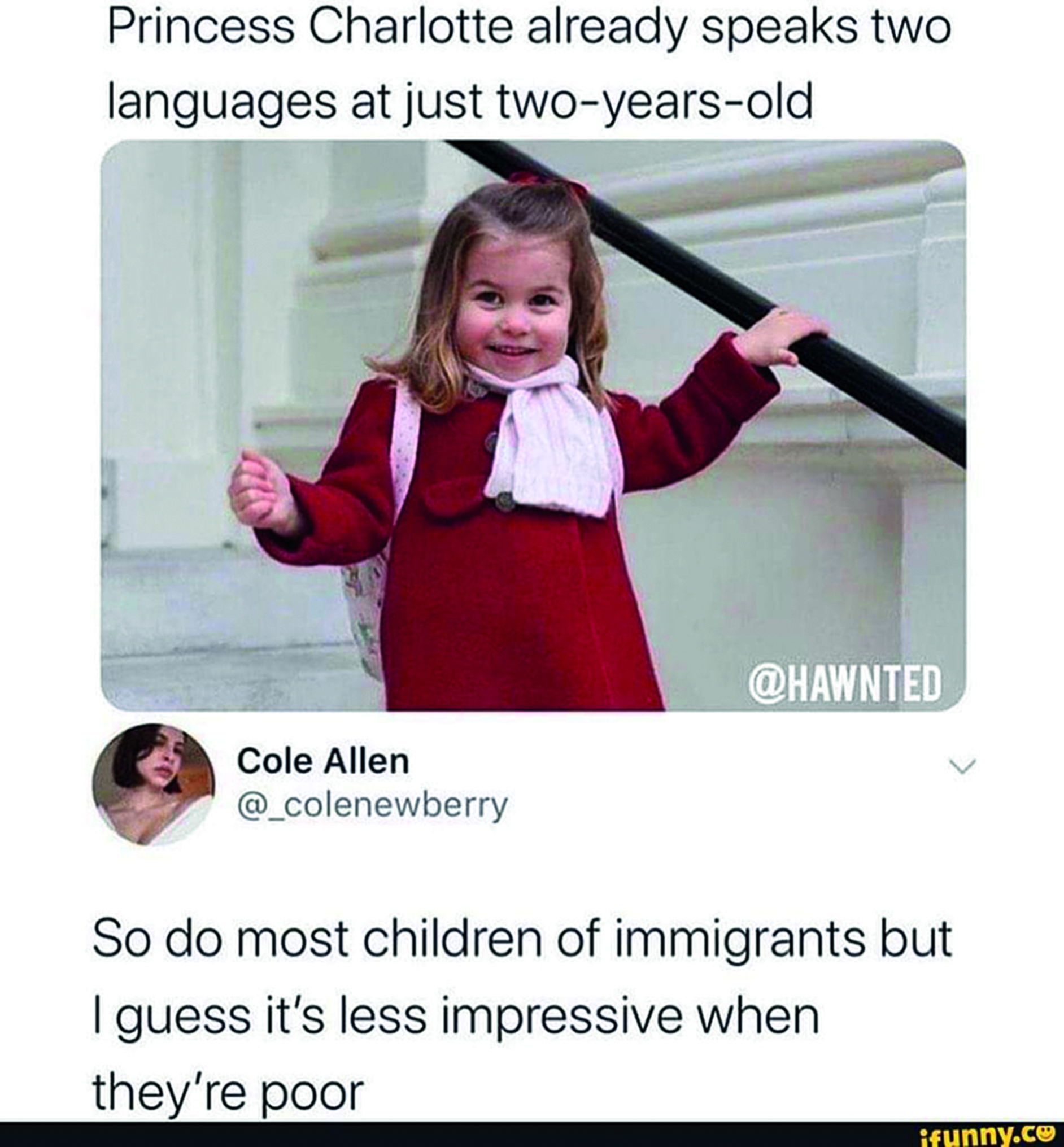
On an individual level, living our professional lives in English makes many of us feel like we can never express ourselves in full, never be as eloquent or nuanced or precise as in our own languages, or say quite what we want to say. And while non-native English speakers do the labour of teaching, publishing and disseminating to the public in a second, third or fourth language, we encounter people with English-language privilege who rarely acknowledge their a priori status (Fig. 1), and who may correct and otherwise enact language policing in different ways.
In the public domain.
How can we address this issue constructively? In this paper, we urge for more awareness of language matters and argue that, rather than policing the boundaries, archaeology can harvest creativity and richness by allowing expressions, idiosyncrasies and turns of phrase from non-English languages to seep into ‘accepted’ archaeological thinking, speaking and writing. To our minds, this can only serve to enrich scholarship further: not only would this lower the bar for non-native English speakers, but it would also nourish archaeology with concepts, tools and phrases that allow further diversity in analytic perspectives.
We acknowledge our own language backgrounds and other forms of privilege—all authors speak Germanic languages closely related to English, and we come from affluent areas of northern Europe where English is part of standard education. The points we raise here can thus be made much more strongly by scholars from different language groups and cultures, and are intended as a point of departure for a conversation of the role of English—and other languages—in archaeological work. This paper is thus an attempt to create a space to reflect, disrupt and, most importantly, enrich our archaeological language practice.
The labour of translation
Let us begin by briefly elaborating the often-overlooked labour of translation required in career building in academia.
Publish or perish
This mantra describes what is often seen as the key to academic success. What it does not say, however, is that publications in English are those that truly count. In Scandinavia, for example, journals in native languages give less credit than English ones and are by definition considered less impactful. What is rarely acknowledged is the hierarchy this creates. Some authors have referred to a ‘linguistic injustice’ and pointed out the serious disadvantage non-English speakers have in the current research landscape (Amano et al. Reference Amano, Ramírez-Castañeda and Berdejo-Espinola2023; Clavero Reference Clavero2010; Ramírez-Castañeda Reference Ramírez-Castañeda2020). Supporting such claims, studies have found that rejection rates in English-speaking journals are much higher for submissions from non-native English speakers than from speakers with English as first language (Okike et al. Reference Okike2008; Ross et al. Reference Ross, Gross and Desai2006). Interestingly, this preference was reduced by 34 per cent with a blinded review process (Ross et al. Reference Ross, Gross and Desai2006). While this is the case, few (if any) of the publishing houses currently dominating high-ranked academic publication offer any form of language support to authors. And, while there is much talk about the largely unpaid labour put down by editors, peer reviewers and authors, there are few mentions of the labour and direct costs that non-native speakers pay to get published.
Conferencing and networking
Conferences and networking are equally vital to succeed in academia. While challenging for anyone, this is often an enormous hurdle for non-native English speakers. While papers can be read from pre-written manuscripts, spontaneous Q&A sessions are more difficult to plan. The thought of not understanding a question or recalling the translation of a concept in a public setting causes anxiety. Moreover, formulating responses while translating them into English requires both effort and time: something which conference sessions have increasingly little of. As a ‘fast science’ mentality infiltrates academia with new formats of fast communication (e.g. PechaKucha), we should be aware of how this affects people differently. There is much prestige attached to a scholar’s ability to ‘perform’, and those considered good lecturers are often those who speak off script. Quite naturally, this, as well as pitching one’s work in a fast but sophisticated manner, is for many easier to accomplish in a mother tongue. The effects of this are obvious in conference settings where those at home in English receive an almost natural invitation to dominate the discussion.
Internationalization
A third pillar of academic success is ‘internationalization’, which is increasingly required in individual research profiles, team compositions and grant proposals. Generally, this is a positive development that encourages new collaborations and knowledge exchange across the world. Yet one may also question what is implied by ‘internationalization’? When English publications alone give credit, when international conferences operate in English regardless of their location, and when competitive research applications in most countries must be written in English, how can we in fact talk about internationalization? The inter-national, as it appears, is one-directional, and the accessibility emphasised no less so. We meet this one-directional internationalization on all levels of academic work. Peer-reviewers require inclusion of the latest English publications, while paying little attention to scholarship in other languages. Publishers, employees and funding bodies require abstract and title translations of non-English publications, while the opposite rarely occurs. And spellings of individual names are asked to be ‘anglophied’ to fit the limits of the English alphabet. Our question is, how is this in fact serving our quest for internationalization? Because, internationalization should surely enrich the academic language rather than limit it?
The magic of the untranslatable
In addition to simply raising the issue of being lost in translation and the inequity present between those possessing native access to English and those who do not, there is theoretical potential in thinking about language and translations. This relates to writing as the medium through which we make sense of the past and the world, the nature of translation, but also what would be gained by opening up our academic language to the untranslatable and the mistranslation. Instead of policing the borders, we can expand on the positive aspects of getting lost in translation and the wider ontological consequences this brings.
This idea was central to Viveiros de Castro’s work on Amerindian Perspectivism in which he stated that ‘to translate is always to betray’ (Viveiros de Castro Reference Viveiros de Castro2004; ironically a translation of an originally Italian expression: traduttore, traditore). His concern was directed toward translations between the language of anthropology and that of Amerindian indigenous people of Brazil, and the impossibility of extending the full ontological content of the latter into the former through language. The magic, it seemed, was often lost in the process and concepts lost value when translated into a different language system. Viewed in this way, translation is a betrayal—a work of distancing, reflected more broadly in the way that we have access to the past as an act of translation. To acknowledge that there are a few unbridgeable differences between (conceptual) language regimes is not something negative, however, even when we discuss this for academic communication. The incommensurability as a shared difference might open avenues for broader ontological understanding, as well as a more creative use of the artificial language of academic English. In short: we can embrace the untranslatable as a means of enrichment.
Moreover, what was important for Viveiros de Castro and this paper is that a good translation is one that betrays the destination language, not the source language. In our case, we should more actively enforce that nobody owns academic English, and it is quite exciting to think how a mutual incommensurability from native and non-native English speakers can make it richer. As Cassin refers to in the Dictionary of Untranslatables, we should gamble on the retention of many languages, making clear on every occasion the meaning and the interest of the differences (Cassin et al. Reference Cassin, Apter, Lezra and Wood2014). Acknowledging both the untranslatable and the artificiality as a part of our shared academic language, therefore, is the space where we might allow ourselves to ‘betray’ it.
This brings us from creating space, and accepting that some things should remain lost in order to keep the magic, to the gains we can find in translations and mistranslations themselves. This is expressed by Viveiros de Castro (drawing on the work of Walter Benjamin [1923] Reference Benjamin and Rendall2012, 42) and also by Jorge Luis Borges, who not only reflected on translation, but also practised it. Borges challenged the notion that translations are necessarily inferior to the original—originals are as much ‘drafts’ as translations are (Borges [1919] Reference Borges and Levine2010; Levine Reference Levine and Williamson2013). Even if one does not have native access to a certain language, the act of translating is useful in itself. We can learn more about Deleuze’s agencement by translating it as assemblage, and vice versa. This is important also from the perspective of balancing language privilege. It means, following Borges, that ‘mistranslation’, as far as it exists, can be a powerful site of innovation and resistance for the periphery (Waisman Reference Waisman2005, 91). When viewed in this way, translation, just like the untranslatable, is rendered more of a creative craft—a way of rethinking, of actualizing the original, rather than simply repeating or ‘re-presenting’ it. Seen from this perspective translation becomes less of a betrayal (at least a creative betrayal) but a means to offer new understandings.
Found in translation: archaeological writing enriched by non-English concepts
We now turn to two brief examples of concepts, phrases and words that are found beyond translation: cases where we argue that archaeological writing has been enriched by non-English language-worlds. Both examples come from our own linguistic background of Germanic languages. Crucially, we encourage readers to think of concepts they have come across from their own language-worlds that would augment or enhance archaeological thinking and writing.
Firstly, in the article ‘Half beast–half man: hybrid figures in animal art’, Siv Kristoffersen (Reference Kristoffersen2010) discusses the pan-Germanic animal styles of the early medieval period. Kristoffersen uses animal styles to ask questions of human-animal relationships, creativity in prehistoric ‘art’, and the relations between the creative expressions such as metal decoration and later poetry.
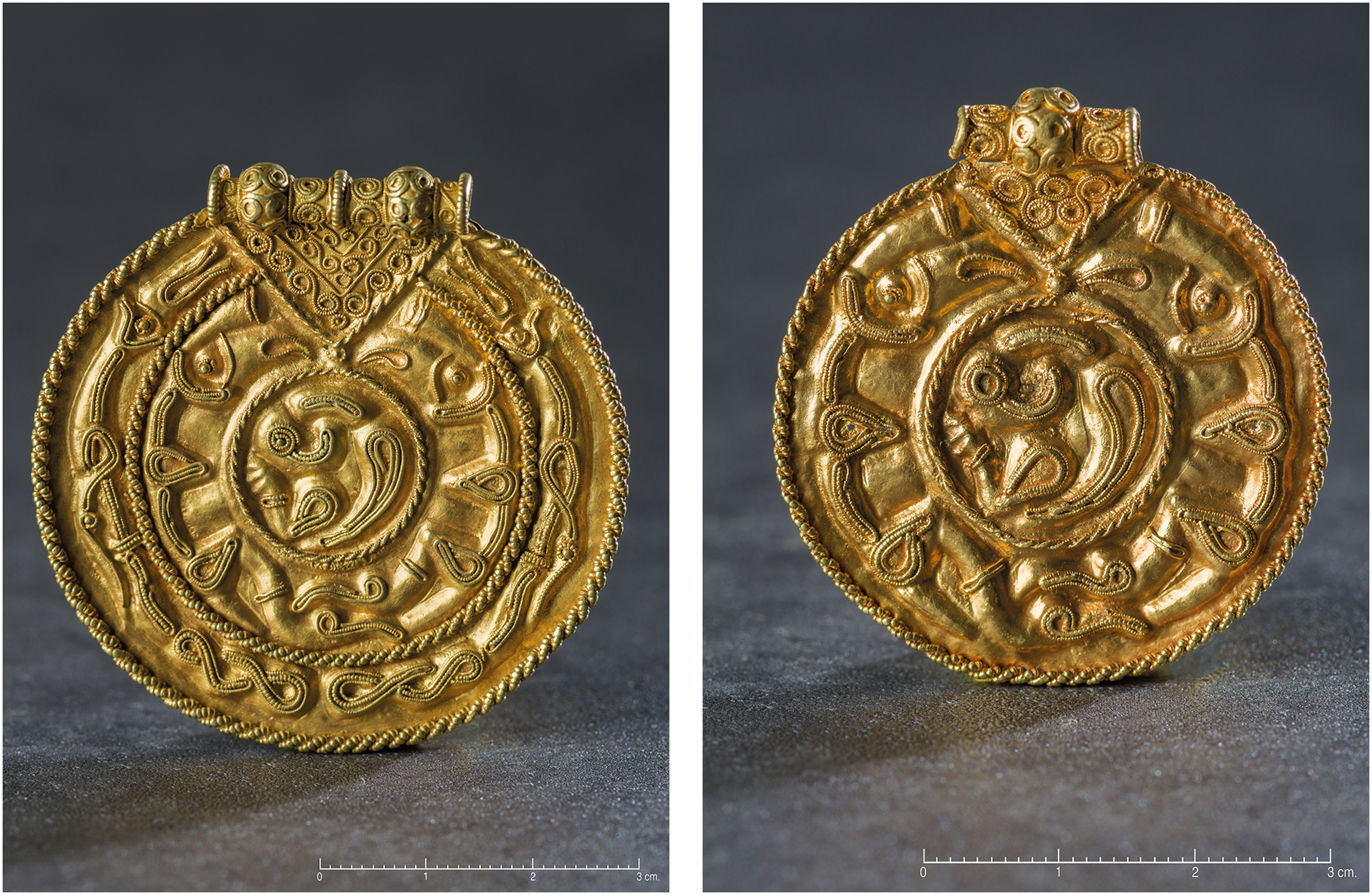
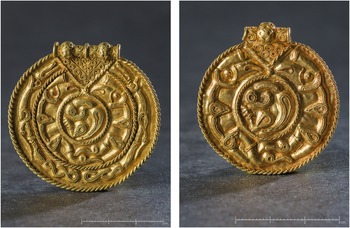
Kristoffersen discusses artefacts such as two near-identical gold bracteates from Rogaland, Norway (Fig. 2), with depictions of human–bird hybrid beings, as part of a transcendental reality where the boundaries between human and animal bodies were fluid; borrowing Lotte Hedeager’s argument (Reference Hedeager, Andrén, Jennbert and Raudvere2004, 234) that ‘animals were people and people were animals’.
Gold bracteates from Teig, Rogaland, Norway, displaying ‘finurlighet’ in their rendering of abstracted and fluid body-parts of birds-and-humans. (Photographs: Arkeologisk Museum, Universitetet i Stavanger/Annette Øvrelid. CC BY-NC-ND 3.0.)
Of interest in this context is Kristoffersen’s use of the Norwegian untranslatable word ‘finurlighet’. She writes:
These motifs are made by smiths who stand out as true masters of finurlighet: a Norwegian word that has connotations of subtlety, ingenuity, artfulness, cunning and intricacy, an ideal of the time which underlines the connection between art and poetry. (Kristoffersen Reference Kristoffersen2010, 268)
Kristoffersen cannot, nor can we, find any suitable direct translation to English—and why would we need to? Kristoffersen uses this Norwegian concept to capture technical know-how, detail and Fingerspitzengefühl (to use another loan word) as an intellectual tool that affords interpretations about the complexity in creative practices across domains in these societies, as encompassing ontologies, technical skills, intuition and intellect.
A second example comes from Susan Pollock’s work on ancient Mesopotamia. Pollock (Reference Pollock, Robb and Pauketat2013) explores how different types of Mesopotamian persons were produced—among intersections of class, gender, occupation, skill—allowing different contingencies of actions or potential futures. She asks rhetorically ‘how [did one become] a fisherman or beer brewer in third millennium Mesopotamia’? As an intellectual tool, she used the German Handlungsraum—‘space for action’.
Handlungsräume (pl.) open and limit possibilities for action: they ‘are a product of socialization, learning, traditions, and practices that reinforce limits on thought and action, but that also modify them, whether intentionally or unintentionally’ (Pollock Reference Pollock, Robb and Pauketat2013, 148). Through employing the term, Pollock unpacks different dimensions of Mesopotamian life, particularly ones that are caught up in conventional narratives of Mesopotamian state development: commensal eating and drinking, public spaces, feasts, and so on. She explores how these practices and materials opened and constrained different Handlungsräume, and moreover, that the ‘space for action’ was crucially different whether one was the lyre-playing musician or the shepherd required to deliver milk, wool and meat so that the herd could be sustained (Pollock Reference Pollock, Robb and Pauketat2013, 168). The Handlungsraum is thus used to break open some conventional ways of thinking about power and social complexity, to disrupt the familiar and bring other actions, persons and ideas to the fore.
These are just two brief examples of how the ‘untranslatable’ is not a challenge, but opens new horizons of exploration, resistance and possibility. To accept and incorporate idiosyncrasies, non-English concepts, quirkiness, the foreign and the other into archaeological thinking, speaking, and writing, is to invite the magic in. This is conceptual enrichment in practice, a tangible gain of working between language regimes.
Conclusions
The aims of this piece have been twofold. First, we demonstrated that more awareness of the challenges facing non-native English speakers is needed in archaeology. Responses to the conference session this text springs from clearly indicate that linguistic injustice in our discipline needs to be addressed more explicitly. Issues range from encountering attitudes of language policing and feelings of intellectual inferiority due to non-standard pronunciation to the direct translation costs personally paid by non-Anglophone academics; where the number of publications one can pursue depends on the financial resources of the individual researcher. Most of these issues are completely invisible to our English-speaking archaeological colleagues. Academic English, we argue, is an artificial language that should not and cannot be owned by native speakers of Standard English (as opposed to academic English), and its gatekeeping needs to stop.
Second, and more crucially, we want to advocate for empathy and solidarity rather than gatekeeping as core principles for our discipline. Archaeology, as an academic community, can impose and allow acts of ‘creative betrayal’. Rather than allowing the intellectual impoverishment of confining our discipline to one way of thinking and expressing ideas and concepts, we strongly encourage play with untranslatable terms, mistranslations, exploration, innovation and concepts ‘found’ in translation.
Not only is this a way of levelling the playing field: we argue that encouraging turns of phrase, metaphors and concepts from outside of English will broaden archaeology’s intellectual foundation. Non-translation, loan words, concepts rooted in different language-worlds are a creative craft and intellectual force for interpretation—and should be celebrated.
‘I thought British policy was to make the world England, Sir’. British industrial archaeology concepts in Portugal
By João Sequeira & Tânia Casimiro
The purpose of our contribution to this discussion is to debate how we are almost forced to subjugate our research, when dealing with industrial archaeology, to English language (or direct translations) and British concepts. We are both Portuguese archaeologists (we were born, studied and worked most of our professional lives—although not exclusively—in Portugal) who enjoy working in Portuguese industrial contexts. However, although we also publish a lot in Portuguese, we also want to publish and present our work abroad and discuss it with non-Portuguese colleagues. Being able to speak some languages among ourselves, we tend to use Portuguese, Spanish and French, but most of the time English, to present our work. However, as Portuguese native speakers, our mental structures are built in a language that is completely different from English. We do not feel, however, that the problem lies in the use of other languages to communicate, but in how specific ways of writing, concepts and ideas are imposed—and we will debate by whom and how—when we communicate.
We feel this particularly strongly when dealing with industrial archaeology. There is this idea in Portugal (very vocalised by researchers but less written) that British academia is among the best when we are working with eighteenth- to twentieth-century industrial sites, and that Portuguese archaeologists should reproduce the methods and analyses that were created by British scholars, researchers, or simply enthusiasts, since ‘industrial heritage is generally recognized as a key element of Britain’s contribution to world culture’ (Palmer Reference Palmer and Smith2014, 3858). However, these methods and analyses were created concerning British territories, and the people who created them had no consideration for anything other than British cultural, social, ideological and technical developments. To make things even more tricky, many scholars from non-English-speaking territories use these concepts almost as methodological concepts without questioning how these must be considered with the climate, environmental, social, political, economic, (de)colonial challenges, just to mention a few.
It is known that the first time that the concept of industrial archaeology (archéologie industrielle) was published was by Marie Pierre Le Pelletier, a French scholar, back in 1842. However, this very known fact is very unknown to the generality of researchers worldwide, since industrial archaeology is still methodologically and theoretically framed by British scholars, the so-called founders of industrial archaeology and sons of the Industrial Revolution. These scholars, who tend to set the pace, terms and concepts used around the globe when doing studies in industrial contexts are, more often than not, English native speakers. However British researchers were not the first to use the concept. French researchers seem to have been the pioneers, and in 1861 these two words were combined by Boyer de Sainte-Suzanne, in 1862 by Michel Chevalier and in 1865 by Félicien de Saulcy. In 1870, Brazilian scholar Luiz Henrique de Moraes Garcez also used it and in 1896 the Portuguese scholar Sousa Viterbo followed (Ramos Reference Ramos2015; Reference Ramos2019). Only in the twentieth century would Michael Rix use this concept in English (Rix Reference Rix1955). One of us recently asked an English colleague to proofread a text since the journal we were publishing required the paper read by a native speaker. She confessed that it was her idea that the first use of the term ‘industrial archaeology’ had taken place in England by Michael Rix. Thus, why is Britain considered to be the pioneer? Was this successfully advertised by British scholars or was it Portuguese authors who imported and imposed it? The argument we would like to construct is that this is not about some competition, or about who did it first. However, we guess that even today many British colleagues still think that the concept was born in Great Britain, as some of us back in Portugal truly believe that Sousa Viterbo was a pioneer. Curious how we are both wrong!
The title of our manifesto comes from a movie: The Last of the Mohicans (1992). Not going too much into the plot, the movie takes place in 1757 during the French and Indian War and, when facing negotiations the English army had to do with local settlers, one of the officers of the British army (Steven Waddington) does not understand why the colonel (Maurice Roëves) has to concede to certain things since England was the largest power in the world …Footnote 1 We are not trying to be nasty here, and we will not point a finger at any British scholar about the imperialism of British world ruling, but in the majority of Portuguese industrial archaeology, England is, in fact, the world. This in itself is a contradiction because industrial archaeology contexts in Portugal have little to do with industrial archaeology contexts in Great Britain; however, many researchers (both in history and archaeology) in our country try to impose the British model of analysis on sites and interpretations in general, using concepts such as Industrial Revolution and industrial societies, among others (Castro Reference Castro1978). A remark must be made that others have already contested this generalisation (Mendes Reference Mendes2017). This is not the fault of British scholars, but translates as an unbalanced power relationship in industrial archaeology because it seems that anything ‘made [or said] in Britain’ has more quality than if made anywhere else. This feeling goes back to the nineteenth century (Catroga & Carvalho Reference Catroga and Carvalho1994), and is especially strong in Portuguese academia. This led to the adoption of the British model of industrial archaeology without any critical thinking or debate of what industrialization was in Portugal. British academia has developed its terms, methodologies, or concepts adapted to a world in change since the eighteenth century, and Portugal was far away from that world until quite recently.
The most striking examples, among many others, are concepts such as the Industrial Revolution, the Industrial Period, industrial societies or industrial civilization in the Portuguese context, concepts that define moments when industrial production was so intense that everyone in a certain territory was influenced by it (Custódio Reference Custódio1998, 124). In Portugal, we are taught in schools and universities that the Industrial Revolution started in England and spread (although with different intensities) to the rest of the world, creating a modern, technological world. However, while in Britain there were indeed industrial areas where the majority of the population engaged somehow with industrial production, in Portugal things were a bit different. The perception of the industrial development of Portugal can be seen in the Inquéritos Industriais, documents that publish inquiries made to industries in the country every few years. Although analysis of these documents presents several problems related to what was considered an industry, the administrative division of the territory, the access to information, and the fact that only industries with 21 or more people working there were considered, they still reveal the evolution of the number of people working in industrial activities (Sequeira et al. Reference Sequeira, Casimiro and Figueiredo2017). The interesting thing is that it was only in the 1970s that for the first time, the Portuguese active population working in industries surpassed those working in agriculture, about 30 years after the Second World War ended and when the first discussion about de-industrialization appeared in Great Britain (Amaral Reference Amaral2019, 206). The reasons for this delay are various, but one relates necessarily to the political environment lived during the larger part of the twentieth century. The dictatorship promoted the rural way of life as the perfect model of virtue, and where profit was always seen as an immoral action (Remédio Reference Remédio2012).
This makes us contest another key concept used in Portuguese industrial archaeology directly imported from British textbooks: the so-called industrial period, which Portuguese scholars tend to locate between the eighteenth and the twentieth century (Custódio Reference Custódio2015; Guedes Reference Guedes1999). Also, some authors believe that the nineteenth century can only be studied from an industrial archaeology perspective and, more than a thematic archaeology, it is a period archaeology where the new industrial man is a sign of progress (Custódio Reference Custódio2015). We believe that Portuguese scholars took this concept from Marilyn Palmer in the early 1990s, and although the researcher has already considered a distinction between industrial, historical and post-medieval archaeology, Portuguese researchers continue to use the concept as a broad general time frame (Palmer Reference Palmer1990; Reference Palmer and Smith2014; Palmer & Neaverson Reference Palmer and Neaverson1998, 4) During the nineteenth century, Portugal was a non-industrialized country that started to import industrial material culture combined with traditional ways of doing, a dichotomy that would last at least until the 1960s, if not later (Reis Reference Reis2021).
So the question is, why? Why do we insist on importing a dialectic model of thinking and language, imported from an industrialized country into a not-so-industrial territory? There are several reasons we can consider and the four presented below are reflections based on our experience as industrial archaeologists: a) the Portuguese see the British as the people who, in the nineteenth century, due to their strategic warfare and industrial progress, saved us from the French; b) in the nineteenth century, some of the most successful industries in Portugal were either explored by British people, or had British capital involved; c) when industrial archaeology started to become a discipline in the 1990s, all the reference textbooks used in Portugal were written in English, so it was easy to import concepts without a critical analysis; d) on a more theoretical basis, we have to realize that archaeology in Portugal did not pass by a Post-Processual turn and cultural perspectives where technological evolution as a synonym for civilization was the main paradigm. Using the Industrial Revolution/period theoretical mainframe was thus a sign that a rural country such as Portugal was not behind in progress.
How to control equivocations in archaeology?
By Aldo Accinelli Obando
My main preoccupation when thinking about the use of a hegemonic language in archaeology is the consequences it has had and can have when people outside of academia conceptualize their past. This concern is about how the past is conceptualized globally based on who has the power to shape and impose certain terms. A very personal position, since I am from Peru, but most of the texts used to describe the ancient past are going to use a terminology developed in archaeological school of thoughts from the Global North (Harris & Cipolla Reference Harris and Cipolla2017). To challenge these prerogatives influencing the construction of what happened before cannot be done using the same language that gave birth to them. It is an ontological challenge, since it requires the critique to be able to restrain itself from starting on a modern perspective. This can be done using the method of controlled equivocation. The method itself is conceived to help salvage not only language barriers, but ontological misunderstandings created from the different positionality of the interlocutors at play (Viveiros de Castro Reference Viveiros de Castro and Skafish2014). The very simple fact that having a distinct way of perceiving the world changes the way you relate to it has profound implications into how you deal with what we have called, in a very cartesian way, ‘past time’ (Accinelli Reference Accinelli2023).
Equivocation, in this methodological context, refers to the notion that interlocutors may employ the same vocabulary, yet their concepts diverge, often without them knowing (Viveiros de Castro Reference Viveiros de Castro2015, 55–74). Exercising control over equivocation means refraining from transforming or translating a given concept into something dissimilar. This acknowledges that words are not mere concepts, but can constitute different worlds. Such worlds are constructed through the interplay of concepts, grammatical structures and practices, constituting the equivocation in which interlocutors are situated and through which they communicate. In this sense, it looks to raise the conceptual level of the interlocutor into that of conceptualizations of the worlds instead of mere beliefs. Therefore, by raising them as actual conceptualizations, it is a recognition of different worlds being inhabited at the same time. This also requires that the social scientist believes his or her interlocutor in the sense that the Other is not merely giving an opinion about something; this person is effectively teaching the social scientist a concept, what something is, from an intellectual and philosophical position. It is an exchange of metaphysical thinking.
This is the crucial aspect from an ontological perspective, because controlled equivocation means instead of describing ideas as a group of beliefs from a different Other, it is about making logical questions following these set of ideas. For example, if somebody in the Andes says that huacas Footnote 2 are beings, not mere locations, the questions should be: what does this idea do? What assemblages can it help constitute? What are its consequences? Consequences like what does it mean to excavate a huaca if a huaca is a sentient being? The point is that if for somebody else an entity is defined a certain way, then it must be understood and translated in those terms, which may sound kind of obvious, but the tendency in humanities and social sciences is to place somebody else’s world into our own conceptual threshold, to make it fit into our own way of understanding what is.
By doing this, it is possible to indicate the social scientist’s conceptual threshold. In other words, as Fúnez-Flores has put it, it is the intentional disfigurement of the analyst’s conceptual world, since the aim is to translate Other concepts as a way to transgress modern concepts while elevating the former to philosophical status (Fúnez-Flores Reference Fúnez-Flores2022, 35). Therefore, its potentiality to challenge modernity is what can be its biggest contribution for archaeology. This would be a call to say that archaeology can be and needs to be more anthropological, but not on an evolutionary perspective like in the 1960s. It is about our own language limitations when trying to explain possible worlds.
What I propose here centres on two relationships, one between archaeologists and other people, and the other between archaeologists themselves. Because before even thinking of applying the method to understand the ’past’, we must start by thinking about the relationship between us and the materiality we analyse. By how we have been trained into becoming archaeologists we have a way of conceptualizing these things we handle to get our data; even if we consider that the thing itself can influence us as much as we can influence it (Olsen Reference Olsen2010). This is a common equivocation, one in which we are usually expecting the other to understand our position. Sometimes we phrase this as the values that people should learn when dealing with heritage objects (Smith Reference Smith2006). But this is a hegemonic position that has been made law in many different places of the planet. To control this equivocation is not just to acknowledge our conceptual threshold; it is also to acknowledge our power position in relation to other people (Haber Reference Haber2012; Smith Reference Smith2004): which is the first of the two relations that I am going to focus on.
In Peru we use the term huaco to refer to any ancient vessel. For an archaeologist, a huaco is an object of study that should be in a lab, a museum or inside the deposits of the Ministry of Culture. But there are other people who are going to see a huaco as a living entity, a being that has agency (Soares Reference Soares2021). Traditionally this conceptual framing has been labelled as a superstition (Soares Reference Soares2021, 357). But the huaco can suffer a disruption and become an inert thing (Soares Reference Soares2021, 365–8). In that world, it is the labour of the archaeologist that makes the huaco lose its capacities, by making it into a thing just for contemplation or analysis. By putting forward this example I am saying that to acknowledge the equivocation is not just to understand that there is a missed translation, a missed comparison, but that an equivocation is going to have consequences beyond an academic discussion. If it is a philosophical approximation to a lived reality, then why would one of these two approaches prevail on a legal level? This is what occurs in the case of the huaco. When a person uses it for a religious purpose, they are doing an illegal act and can be penalized, even with jail time. So, controlled equivocation it is not only about the misunderstanding itself, but also about the consequences that misunderstanding has in society for always expecting to accommodate everything under a certain gaze. Because if we are going to acknowledge that a huaco is not just something that belongs in a museum for the archaeologist to analyse, then why should the people that see it that way be penalized for putting it into practice? (Chirinos Ogata Reference Chirinos Ogata2018; Smith Reference Smith2005).
Therefore, to control the equivocation in the example given means that the heritage laws and experts must cede power to this other ideology in a relationship where both ways of being in the world are on an equal footing. This would be a way to solve the irreducible disparities in how different cultures or communities understand material evidence. Rather than treating such gaps as obstacles to be resolved, archaeologists can engage them as generative spaces for methodological innovation. By reframing equivocation as an opportunity rather than a problem, archaeology can move beyond universalist claims and foster more pluralistic, reflexive narratives. This is also what makes Viveiros de Castro’s perspective horizontal. Because it is not a thought process to grasp the Other intellectual position, it is a method that can make scientific practice cede its hegemonic positionality and make it stand with non-scientific practices that govern other ontologies. By placing these other worldviews on the same level as the hegemonic one, a different political practice is expected (De la Cadena Reference De la Cadena2015). If a huaco is a being, it cannot be merely stored inside a box in a deposit or put behind glass; it needs to interact with other beings. To be stored exclusively for contemplation or study under the label of ‘pottery/vessel/pot’ means that one ontological position dominates the other.
There is also another distinction in the case of the huaco. An archaeologist is not going to use that word besides a colloquial situation; it will not appear in an academic paper or lecture. Part of being an archaeologist is using the language that other archaeologists have created to refer to archaeological material. There is a set standard which conforms our way of being an archaeologist. Furthermore, even though it might be tempting to label them as such, theoretical discussions among us are not equivocations. I consider that archaeologists in distant places in the world are not so ontologically separated that an equivocation could occur between them. Because of the training under scientific parameters born out of modernist thinking, archaeologists while doing archaeology share the same conceptual world, otherwise they would not be archaeologists, but something else, and that goes beyond the scope of this discussion. In this manner of acting in our archaeological world, what becomes crucial is not the possible misunderstanding of concepts, but to scrutinize the process by which we select the concepts we use to think other concepts. In this sense, we should be thinking about translation as an act that has the potential to go against dominant notions of reality, including past reality.
Because if in Andean archaeology we start thinking about how vessels can be beings, it takes us to a whole different approach for understanding the past. In the same way that thinking about what the consequences of killing a jaguar are in a world in which jaguars and humans are the same (Viveiros de Castro Reference Viveiros de Castro and Skafish2014, 57–66), then if vessels are beings, what does it mean to be buried with thousands of them like the Moche did? Clearly, this puts us into a situation where the traditional answers of prestige, power, social status, etc., are not enough because those are categories of our world that we are trying to translate into the past. Therefore, in this context, to make archaeology more anthropological is not to see how a human group of the past fits into an evolutionary scale that we have created based on colonial prejudices; it is more about how we can recreate the possible world that past populations lived in, knowing that currently there is not just our modernist approximation to reality, that those materials we recover from the ground were probably more to the people that used them than the technical moulds we are trying to make them fit in. An ontological pluralism is needed to map how different communities understand the same material record without reducing one to the other. Thus, the possible interpretations of archaeological records can be widened.
I have delineated a path to control equivocations in archaeology, but as I have stated previously, these equivocations are not between archaeologists, they exist between ourselves and other people, as well as between ourselves and past societies, which obliges us to rethink the way we conceptualize the concepts we use to talk about past populations. To put it in other words, in order to avoid equivocations with ancient societies, we need to feed from the philosophical postures of living populations. Because, as we have seen, not to do so has severe consequences over existing populations that may not share in part or entirely our modernist thinking, and it can also take us into a journey of concept exploration; which forces us to adapt the current existing dominant languages, English globally, Spanish in my country, by recognizing their insufficient capacity for recreating different worlds, which decentres them by allowing other conceptual thresholds to become a distinct frame of reference. Therefore, to control equivocations in archaeology requires that we rethink the capacity of the languages we use when doing archaeology.
Reflecting on archaeological theory in translation
By Matthew Johnson
This short forum piece reflects on my experiences as an author of having work translated from English into other languages. It engages mostly, though not exclusively, with the introductory textbook Archaeological Theory: An Introduction (ATAI). The first edition of ATAI was published in 1999, and I subsequently responded to feedback, rewrote, added and revised material for the second and third editions in 2011 and 2019.
My reflections are not intended to be particularly profound or intellectually heavyweight. My central point is this: the ‘death of the author’, as defined and discussed by Roland Barthes, should be understood in practical as well as theoretical terms. In the late 1990s, I sat down to write a particular kind of book, one that was quite lively and opinionated, as part of a conversation, addressed particularly to the students I had taught at Sheffield and at Durham Universities. It was informed by my experiences of teaching theory in the early 1990s, and in particular my experience of hostility to theory from both students and some fellow teachers. However, ATAI has, despite my best intentions, become a very different kind of book, and has been read and used in all sorts of different ways that I did not consciously intend.
The points I want to make about majoritarian English stem from this context. ATAI has been translated from English into Spanish, Chinese, Serbian, Polish, Estonian, Greek, Korean and Persian. With each of these translations, authorial intention and responsibility has shifted in different and often unexpected ways. My comments are also informed by the Korean translation of Ideas of Landscape (Johnson Reference Johnson2007); a theory paper Nicola Terrenato translated into Italian (Johnson Reference Johnson and Terrenato2000); and also by four months teaching German students in English at Heidelberg University. I will move from practice to theory, thinking first about publishing practices, before moving on to particular translation issues and more general themes.
Publishing practices
I suggest that majoritarian English is reinforced and buoyed by the way the publishing industry works. Anglophone academic publishers are primarily interested in the mass markets for ‘Archaeological Theory 101’ courses, and increasingly, purchases of e-copies by University libraries. Publishers do not have an agenda: they are simply less concerned about a non-Anglo audience because it is numerically small relative to these larger markets. I learnt this when publishers commissioned reviews of the first edition of ATAI to help me with revisions for the second, around 2005: when these reviews were sent to me, it was clear that the publishers had only asked North Americans plus one or two British institutions. This made perfect sense to them: that was where the book was selling.
This lack of attentiveness to non-Anglo audiences is compounded by the way that translation rights work in the publishing business. Once a translation agreement is signed, the US/UK publisher knows little more about it. So I while I have detailed publishing figures for c. 32,000 English-language copies of ATAI sold, I simply do not have anything other than anecdotal impressions of how many translated copies have been published, or who is reading them.
The author also has no editorial control over translations. A standard book contract specifies that the publisher is able to sell, or to deny, translation rights to whomever they like. I frequently receive emails from would-be translators asking for my permission for them to translate ATAI into a given language; those making this request often have difficulty understanding my response that I do not, in fact, have the right to give them or deny them such permission. Additionally, within a publishing house, the translation rights department does not always work closely with the commissioning editor, the person with whom the author has the closest relationship. This can lead to communication issues. In one case, when a non-Anglo friend asked about a particular translation, I responded that I had no knowledge that any such was pending, when in fact a contract had been signed some months before and the translation was already in progress.
The author also has no control over unauthorized translations. A Persian translation of ATAI appeared in 2023, published by the Iranian Ministry of Culture. I was asked to give my ‘approval’ of this unauthorized translation, but was instructed by my publisher that to do so would be a violation of my contract with them. Inevitably, unauthorized e-copies of the English text are also around. Most notably, there is a copy of the second revised edition circulating; I suspect that this has been the most influential edition of the three for this reason.
Translation issues
Some translators reached out to discuss or clarify particular passages, which I have always been happy to do. Some translation issues are interesting but of limited wider significance. I have always been intrigued by how the name of my fictional interlocutor, ‘Roger Beefy’, was going to be translated, ‘Beefy’ having connotations of a muscular rather than a thoughtful approach, and roast beef having a distinctively English identity. In fact most translations ducked the issue—he was rendered simply as ‘Roger’ in Spanish, and left untranslated as “’Roger Beefy’ in Polish. Other issues around phrases like ‘chilly-making activities’, ‘the trail of the human serpent lies over everything’, and ‘pools fillers’ were the subject of some correspondence with individual translators. At a deeper level, the translator for the Greek edition identified three areas of difficulty: Science/Wissenschaft, cognitive archaeology, and reciprocity. Reciprocity in particular, he suggested, was a concept so embedded in Greek culture that it was difficult to articulate. More broadly, he suggests that problematic translations end up reinforcing majoritarian use of English, because one has to refer back to the original text (Theodoros Giannopoulos pers. comm., November 2023).
I am interested at a deeper level in the translation of two terms in particular: ‘empiricism’ and ‘culture’. Empiricism has a set of meanings that relate directly to its use in English language and particularly the replacement of Latin by the vernacular in seventeenth-century texts. Empiricist philosophy in early modern English intellectual circles was set up in rhetorical opposition to France and to Catholicism. It drew on legal rhetoric and tradition in its stress on ‘plain English’ and visual metaphors for observation: ‘we see that …’ (discussed in Johnson Reference Johnson2011). Most fundamentally, empiricism rests on a separation between mind and matter not seen in many other languages and traditions. Its cultural legacy lives on in opposition to what it perceived as ‘jargon’ and the persistent mistranslation of Derrida’s ‘il n’y a pas d’hors-texte’. The term culture, is, famously, extraordinarily difficult and contested in English, in ways that are difficult to replicate in other languages (as I discuss in Johnson Reference Johnson2015).
Debates and tensions in archaeology
A strong critique of the first edition of ATAI was that it contributed to Anglophone dominance through ignoring or marginalizing theoretical traditions in other parts of the globe. This criticism came particularly from a number of scholars working in or originating from continental Europe, Scandinavia, and Latin America (for example Holtorf Reference Holtorf2000).
I welcome and have tried to respond positively to this feedback. The criticism is one that I have tried to address in successive editions: there is more discussion of Latin American social archaeology and of Continental European traditions in later revised editions. I have also revised to discuss at greater length the influence on theory of concepts and traditions such as Zeitgeist; German romanticism; French anthropology; Herder through to Boas; critical theory; and Continental traditions of phenomenology. I also wrote special Prefaces for the Polish and Greek translations, commenting on how I might modify themes in the book were I writing for those particular audiences.
A more profound response is to consider the proposition that ‘archaeological theory’ is arguably a specifically Anglophone construct and that, therefore, any book about it cannot avoid being Anglocentric to an extent. It is important in this context to ask where ATAI has not been translated: there are no French, German, or Italian translations. It is possible to argue that in central and eastern European archaeology there is theory, but at the level of general philosophical enquiry, not as a distinctly archaeological domain. This was the core of Leo Klejn’s response to ATAI, which he viewed negatively as ‘neither archaeology nor theory’ (Klejn Reference Klejn2005), objecting to the inclusion of social theory and political context.
However, I am not persuaded by this proposition. It needs at least to be heavily qualified if not rejected outright, particularly after developments in recent years (compare Eggert Reference Eggert1998 with Eggert Reference Eggert2013). However one chooses to define ‘theory’, there is, in the real world, a vibrant discourse in archaeological theory across Europe, as testified by the success of German and Nordic TAGs.
The basic structure of ATAI is still arguably an Anglophone one: it starts with processual versus postprocessual archaeology before moving on to more recent debates. This structure betrays the historical origins of the text, which is now 25 years old. The first, 1999 edition came very much out of the Anglophone ‘theory wars’ and was then a victim of its own success. I have always been uneasy about making generalizing statements about archaeological theory that claim to be global and all-encompassing, rather than being open about coming from a particular position. Genuine inclusivity should start from an acknowledgement that one is writing from a standpoint. A problem I always had with conceptions of “’world archaeology’ is that any survey of world archaeology runs the risk of being unwittingly imperialist: there was at the very least a paradox in asserting that the postprocesssual stress on diversity was always right in all times and in all places.
A further response is to suggest that theoretical debates have sometimes been hampered by an undue deference to Anglophone theory. The use of theory, and the perception that archaeological theory is a good/bad thing that is imported from abroad, gets tangled with generational debates within particular national traditions. The Korean translation of Ideas of Landscape has a note by the translator explaining its importance for a Korean audience. However, undue deference can become marginalization: in some non-Anglo contexts, theory is ‘theory’—seen as an Anglo product and in this way implicitly marginalized.
Conclusion
In conclusion, I offer some unresolved questions. First, there is a gender issue: all the translators of ATAI have been men, though the translator of Ideas of Landscape, Sae-yeon Oh, is a woman. I think about this observation a lot, and its relationship to the perceived gendering of theory, without having a settled view on what to make of it. Second, there is a comparative discussion to be had over tensions in archaeological theory, and theory generally, within other languages. I am aware, for example, of tensions over the use of Castilian versus New World Spanish that reflect Hispanophone arguments over decolonization. Third, I am thinking increasingly about theory in English-speaking areas outside Britain and North America. There are intriguing observations to be made about the language of theory in Ireland, Australia, New Zealand and India, and the intersection with the use of English and the issues of Indigenous archaeology and culture in these contexts, many of which can be characterized as colonial. One intriguing example is Te Mauri Tau’s response to J.G.A. Pocock’s use of Maori concepts in the understanding of New Zealand culture and history (Tau Reference Tau2008).
I am not currently planning a fourth edition, so in terms of control of the translation and interpretation of AITI, I am now effectively dead. I leave it to my readers and critics, and any future translators, to conduct the inquest.
Acknowledgements
I thank the translators of my work, especially Theodoros Giannopoulos (Greek), Zhang Meng (Chinese, 3rd edn), and Kamyar Abdi (Persian). Yasmin Yeon researched the Korean reception of ATAI and Ideas of Landscape. I also thank the German students who took my Theory class at Heidelberg in 2004; and many other non-Anglophone interlocutors over the years whose comments informed this paper.
Is archaeology translatable?
By Judith M. López Aceves
Archaeology is not a univocal discipline; we cannot fully say that certain words have a unique meaning. Words, people, materials have multiple meanings within themselves.
I kept wondering about the question ‘is archaeology translatable?’ when I came up to the conclusion I mentioned before. I was trying to figure out if I research something and write it in Spanish, would it have the same meaning when I then translate it into English? Would my words have the same intention, or would my arguments resonate as I wish them to be?
Certain concepts are fully understood in a particular context, or their meanings are acknowledged by a particular context; however, their meaning might escape people that are part of another context.
Here I would like to put myself as an example of this. I personally thought that I have a manageable English proficiency—that’s what my English proficiency tests have agreed on—but in practice, a lot of concepts are elusive to me. Memories, TV shows, music, slang are entangled in language, and not being able to decode them makes you evidently ‘the Other’, and thus, excluded. Interestingly, whenever I talk with someone that has English as their second or third language, that comes from the ‘Global South’, we can communicate far more easily than with people who have it as their first language or that are part of the ‘Global North’. Are we communicating through our commonalities or are we communicating using English? Are commonalities, and ‘the familiar’, ways to exclude the Other? How can we avoid that in archaeology? Can we translate these commonalities?
One important point to raise is, is it mandatory to write your research in English? Unfortunately, I would say yes. If you don’t write or research in English, you are not going to be read. English still works as academia’s lingua franca with an expectancy of near native proficiency. This makes translating a mandatory activity for people who do not primarily write or research in English.
Translating is a ‘painful’ activity; to sacrifice the way you normally communicate to artificially communicate with academia is not an enjoyable activity. However, people who don’t speak English have to endure this painful and laborious activity if they want to participate in the academic arena. Why do people that only write in English not need to endure this pain?
Lots has been said about inclusivity in archaeology: including communities, including people from other contexts [insert lots of references]. But this is something that is said and written, but not put in practice. This has something that always makes me sentir bien sabe como (feel weird), reading about inclusivity in a paper about an indigenous community (read as: using them as a stair to achieve academic success), but whatever has been found/discovered/researched is not shared with them. They were used … they were not included.
A lot of literature reviews I’ve seen on a large variety of topics [please insert as many references as possible] only include authors who write in English. Because translating the local language is ‘a pain in the ass’, translating and communicating with the people within the academic world from the area you’re researching is ‘hard’, and they ‘have other ways’, ‘they don’t know what to look for’ or ‘archaeological theory is only done in the UK anyway’. Are people proud of their own novelty? Are they afraid that what they have thought has been already discussed by local academics? Is local knowledge understood as being ‘less’, or is it overlooked entirely?
Does that mean that only local people can study topics of their own territory or context? No, archaeologists need to be accountable of the area they’re interested in: we need to find what has been done by local and external researchers (in English and in other languages), what are the theories employed, how communities participate actively or passively in the reconstruction of their pasts.
Even posthumanist archaeology has looked into giving a voice/agency to all of the things involved in the past: material, non-human, human, etc. [insert even more references]. But has failed in making people, belonging to the ‘Other’ category, active subjects in their past, instead of passive entities. Are people researching from subaltern academia understood as passive subjects?
Other languages and dialects are active agents in the reconstruction and creation of past, and the people using them are resisting the urge of native English proficiency as the only way of communicating knowledge.
¿Se puede traducir la arqueología?
por Judith M. López Aceves
La arqueología no es una disciplina unívoca; no podemos decir que todas las palabras tienen un significado único. Las palabras, las personas y los materiales tienen múltiples significados en sí mismos.
Me preguntaba si la arqueología es traducible cuando llegué a la conclusión que mencioné antes. Estaba tratando de pensar que, si investigo algo y lo escribo en español, ¿tendría el mismo significado cuando luego lo traduzca al inglés? ¿Tendrían mis palabras la misma intención, o resonarían mis argumentos como deseo que lo hagan?
Ciertos conceptos se comprenden plenamente en un contexto particular, o sus significados son reconocidos por los participantes de un contexto particular; sin embargo, su significado podría escapársele a personas que son parte de un contexto diferente.
Para continuar sobre esta línea de pensamiento, me pondré como ejemplo de esto. Personalmente, yo pensaba que mis habilidades para comunicarme en inglés eran buenas —eso es lo que han dicho los múltiples exámenes que han medido mis habilidades en inglés—, pero en la práctica, muchos conceptos se me escapan. Recuerdos, programas de televisión, música, la jerga local, entre otras cosas, están entrelazados en el lenguaje, y no ser capaz de descifrarlos te hace evidentemente ‘el Otro’ y, por lo tanto, excluido. Curiosamente, cada vez que hablo con alguien que tiene el inglés como segundo o tercer idioma y que proviene del llamado ‘Sur Global’, podemos comunicarnos mucho más fácil que con personas que tienen el inglés como lengua nativa o que son parte del llamado ‘Norte Global’. ¿Acaso nos estamos comunicando a través de nuestros puntos en común o estamos usando el inglés para ello? ¿Son estos puntos en común y ‘lo familiar’ formas de excluir al Otro? ¿Cómo podemos evitar eso en la arqueología? ¿Podemos traducir estos conceptos en común?
Un punto importante que preguntarnos es si ¿es obligatorio escribir nuestras investigaciones en inglés? Desafortunadamente, pienso que sí. Si no escribes o investigas en inglés, no vas a ser leído por otros. El inglés sigue funcionando como la lengua franca de la academia, con la expectativa de tener habilidades nativas. Esto hace que traducir sea una actividad obligatoria para las personas que no escriben o investigan principalmente en inglés.
Traducir es una actividad “dolorosa”; sacrificar la forma en que normalmente te comunicas para comunicarte artificialmente con la academia no es una actividad placentera. Sin embargo, las personas que no hablan inglés tienen que soportar esta actividad dolorosa y compleja si quieren participar en el ámbito académico. ¿Por qué las personas que solo escriben en inglés no necesitan soportar este dolor?
Se ha dicho mucho sobre la inclusividad en la arqueología: incluir a las comunidades locales, incluir a personas de otros contextos [inserte muchas referencias]. Pero esto es algo que se dice y de lo que se escribe, pero que no se pone en práctica. Esto es algo que siempre me hace sentir bien sabe como, leer sobre inclusividad en un artículo sobre una comunidad indígena (léase: usándolos como un escalón para lograr el éxito académico), pero lo que sea que se haya encontrado/descubierto/investigado no se comparte con ellos. Fueron utilizados … no fueron incluidos.
Muchos estados de la cuestión que he visto sobre una gran variedad de temas [por favor, inserte tantas referencias como le sea posible] solo incluyen a autores que escriben en inglés. Porque traducir la lengua local es ‘muy latoso’, traducir y comunicarse con las personas dentro del mundo académico del área que estás investigando es ‘difícil’, y es que ellos tienen ‘otras maneras’, ‘no saben qué investigar’ o ‘la teoría arqueológica solo se hace en el Reino Unido de todos modos’. ¿Las personas están orgullosas de la ilusión de novedad en su investigación? ¿Es que tienen miedo que lo que han pensado ya haya sido discutido por académicos locales? ¿Acaso se entiende el conocimiento local como ‘menos que’ o se pasa por alto por completo?
Entonces, ¿eso significa que solo las personas locales pueden estudiar temas de su propio territorio o contexto? No, los arqueólogos deben ser responsables de su área de interés: necesitamos encontrar lo que ya han hecho los investigadores locales y externos (ya sea en inglés o en otros idiomas), informarse de cuáles son las teorías empleadas, conocer cómo las comunidades participan activamente o pasivamente en la reconstrucción de su pasado.
Incluso la arqueología posthumanista ha tratado de dar voz/agencia a todo lo que está involucrado en el pasado: lo material, lo no humano, lo humano, etc. [inserte aún más referencias]. Pero ha fallado en hacer que las personas que son reconocidas como “los Otros” sean sujetos activos en su pasado, en lugar de entidades pasivas. ¿Acaso las personas que investigan desde la academia subalterna se les percibe como sujetos pasivos?
Otras lenguas y dialectos son agentes activos en la reconstrucción y creación del pasado, y las personas que los usan están resistiendo la imposición del inglés como la única forma de comunicar nuevos conocimientos.
What are our conclusions?
JMLA: We don’t want to provide an answer to the issue of archaeology being captured by the English language. We would like to highlight different aspects of how linguistic dominance—particularly the dominance of Standard English—affects the production, dissemination and interpretation of knowledge (If you want to read more on this, see Amano et al. Reference Amano, Ramírez-Castañeda and Berdejo-Espinola2023).
JMLA: The dominance of Standard English in academia creates significant barriers for non-native and native English speakers. Standard English dictates who and how people can get heard but also influences how knowledge is shaped and interpreted.
JG: This ongoing project and the discussion above have taught me many valuable lessons about the inequalities that exist for non-native speakers that might not be readily apparent to someone who can only speak English. Yet within English itself, there are a multitude of different dialects that are also negatively affected by Standard British English being held up as the most ‘proper’ way to speak the language.
BMIM: Despite being English, I’ve always had comments on the way I speak. When I first went to university I really noticed people sometimes found me unintelligible or just simply did not like the way I spoke. They used to say ‘you Brummies (a denonym for those coming from Birmingham, UK) speak another language’. We know that’s not true, it’s a dialect for one, and depending on what area you come from it’s several different dialects. Nonetheless, as I have worked my way up the metaphoric ranks of education I have noticed a dulling of this accent, in some cases to become more understandable but mostly, to ‘fit in’.
BMIM: Now accents and dialects were not the focal topic of what we wanted to address with our TAG session. Thinking about these experiences as a native English speaker could only act to amplify what non-native speakers deal with on a day-to-day basis in their careers and education journeys. Thus, as co-authors, the sharing of our varying experiences helped lay the groundworks to what we thought was ‘The Problem’. The problem being that English as the lingua franca imposes an assumed singular voice across all narratives throughout places and the past. From delivering the session, subsequent conversations, and now writing this piece it has become clear that I was looking at this all wrong. There isn’t ‘the problem’ but a series of entangled, diverging and completely separate problems that can all be understood as an inherently colonial, anglocentric and socially embedded practice of language and communication in archaeology, or academia more broadly: i.e. the problem still stands, but it is so much bigger than its singularity or the simplistic view of the mere operating of a lingua franca. The (lack of) place of language and practice of communication in academia has seldom been the topic of scrutiny which has left an image that archaeology at large is a monolingual field, and it is worse off because of it.
BMIM: Why? Because translating words between languages does not produce renderings of the same thing, but actually each language offers their own way to communicate, in turn opening up whole new worlds. The way we use a language, or essentially the way we formalize our words, is representative of the way we see, perceive and navigate the world. Language is part of our ontology, literally the way we express our being in the world. Federico Fellini was spot on in noting that ‘Un linguaggio diverso è una diversa visione della vita’ [a different language is a different vision of life].
JMLA: Translation plays a significant role, which is not only a linguistic exercise but also a cultural and intellectual one. Concepts and dialects deeply rooted in specific cultural or linguistic contexts may not translate easily or accurately into this standard, leading to potential misunderstandings, equivocations, oversimplifications and erasures. The act of translation itself, if done wrongly, can reinforce the power dynamics between dominant and marginalized cultures. A translator then becomes the new author of the research: if the translation is not done carefully, a paper can become two different things in different languages.
JMLA: Language inclusivity is still absent in archaeological academia. The exclusion of non-English scholarship in it, the marginalization of local knowledge and the challenges faced by scholars from the Global South reflect ongoing inequities in the academic world (see Marín-Aguilera Reference Marín-Aguilera2021). This inclusivity would require a more joint effort to engage with and value diverse linguistic and cultural perspectives.
BMIM: As a discipline that investigates the lives of humans and non-humans that rarely meet us on the other side of a conversation, we have a responsibility to interrogate the language used and subsequent stories that come from our formulation of words, or run the risk of inflicting further injustices to the past and our presents. The collection of papers we have shared here have only further illuminated this point and demonstrated the imperativeness to reconsider language practice, translation and equivocations in our work. Put simply, ‘It matters what stories make worlds, what worlds make stories’ (Haraway Reference Haraway2016, 12). By advocating for a decolonial and reflexive addressal to language expression within archaeology, as we have done with this paper, we can achieve a much more vibrant and appropriate understanding of stories from the past and present. We can continue to seek creative, different, or ‘unusual’ approaches to disrupt how language and ultimately archaeology presents itself … and this is exciting! So, going back to my own words, maybe the way I speak is a different ‘language’ in some respects? But I’ve learnt through all this that that’s not such a bad thing after all.
JG: As someone whose first (and only) language is English, I am part of the problem in bolstering the majoritarian position of English in archaeology, especially when so many of my friends and colleagues speak Spanish, Italian, Greek, and German (to name just some) as a first or second or third language. This doesn’t mean I am happy with English as a majoritarian standard for language in archaeology and beyond.
JG: I feel uncomfortable with the fact that my inability to speak other languages means those around me who can speak more languages have to speak English too. The onus, therefore, is on those of us who are monolingual to harness that discomfort productively and use it to not only learn to speak more languages but also to pay closer attention to what our friends and colleagues go through, as has been described so clearly above by Eriksen, Mol, Pétursdóttir, and López Aceves, and uncover new and creative ways we can overcome these inequalities and destabilize the dominant force of English. In my own case, I used my TAG paper for this session to try and destabilizfe the dominance of Standard British English as the voice of archaeology in my research context (Neolithic Britain) from within. Harnessing my Geordie dialect, I wrote a narrative about a site in South Shields to produce a different past to ones I was used to reading.
JMLA: In this paper we would like to show the need to resist the hegemony of Standard English in academia and the need to create spaces where diverse voices, dialects and languages can contribute to the conversation equally. This requires not only translating research into multiple languages, but also translating Standard English papers into other languages and dialects, promoting genuine dialogue.
Together
Together we want to maintain the momentum surrounding the topic of language operation in archaeology and we aim to keep up the conversation and dialogue around this. JMLA and BMIM have since delivered a second rendition of our TAG session but with the new aim of disruptive action! Here we workshopped with attendees some of the ways we can start to deviate from a monolingual discipline, sit with our discomforts, and pursue an inclusive multilingual field.
We also want to take this opportunity to invite readers to join our continuing conversation over on the discord we have established (https://discord.gg/zaRDF7gB), via other social media means, or hope to see you join us at future opportunities for conversations!
Further to this, please also take this as an invitation for you to do your own acts to disrupt! As we have tried to show in this discussion, no one (including us!) owns language and so we encourage you all to pursue decolonial practices in your own daily language engagements.
In the meantime, ¡Sigan hablando! Keep talking!

 Open access

