

A recent study in Antiquity (Reference ThackerayThackeray 2005a) discussed the role and context of men performing animal roles, both on rock paintings and recorded in photographs. One of the most important original paintings of such therianthropes, was recently revisited and found to be carrying additional symbolic features. The rock painting, which includes three therianthropes (part human, part antelope) was recorded by J.S. Orpen at the Melikane rock shelter in the Lesotho mountains in the nineteenth century.
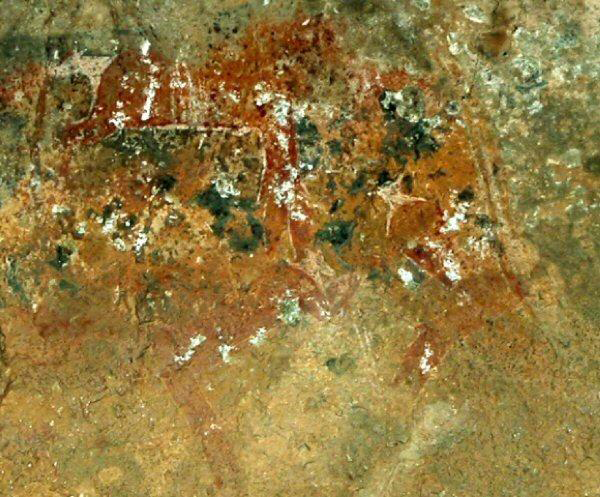
This is a particularly valuable scene as the original was interpreted by an indigenous inhabitant named Qing, whose comments were documented by Reference OrpenOrpen (1874). W.H.I. Bleek (1874) showed a copy of the painting to San informants in Cape Town . The Melikane painting has recently been photographed. After computer enhancement (Figure 1), it appears that one of the therianthropes has been marked in a way that potentially relates to symbolic wounds, corresponding to the concept of sympathetic control (Reference ThackerayThackeray 2005a). Ethnographic data associated with the Melikane therianthropes, published by Reference OrpenOrpen (1874) and Bleek (1874), provided part of the basis for the ‘trance hypothesis’, whereby it was suggested that therianthropes could be understood in relation to beliefs associated with ‘medicine-men’ who experienced trance in rituals during which they were believed to access controlling power over game, rain, or illness (Lewis-Williams 1980; 1981). However, concepts associated with sympathetic control may also be linked to the Melikane imagery (Reference ThackerayThackeray 2005a).
Enhanced photograph of the Melikane therianthropes, enhanced by Jean-Loïc Le Quellec. Photograph taken in November 2005.

The Melikane therianthropes appear to show forward-bending human individuals under the skins and heads of antelopes, probably eland. Two sticks appear to be held in the hands of each person who takes on a quadrupedal posture. The same features have been recognised in a photograph of a person described as a ‘buck-jumper’, witnessed by W.H.C. Taylor in 1934 at Logageng on the southern margin of the Kalahari (Reference ThackerayThackeray 1993). Remarkably, the skin of the antelope (probably roan) worn by the ‘buck-jumper’ has at least three vertical stripes (probably painted), and these have been interpreted as symbolic wounds (Reference ThackerayThackeray 2005a), possibly ‘inflicted’ in the belief that this would contribute to success in a forthcoming hunt, corresponding closely to rituals associated with a form of ‘sympathetic hunting magic’ recorded by Reference LichtensteinLichtenstein (1812) in South Africa.
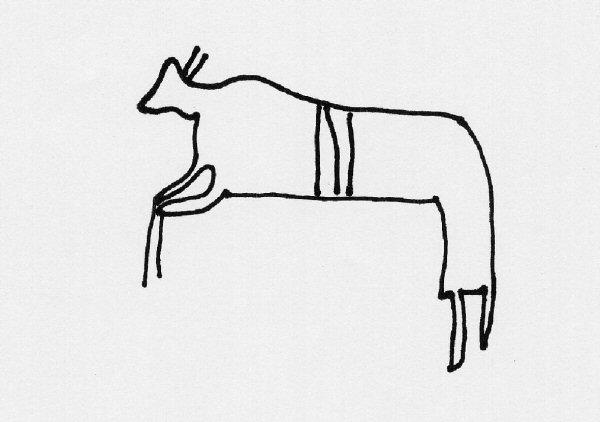
One of us visited the Melikane Shelter in November 2005, and photographed the three therianthropes in colour (Figure1). The painting has faded, but it can be recognised that a therianthrope has been marked by at least three vertical lines, possibly incisions on the body of the antelope (Figure 2). It is not known when these marks were placed on the painting. They differ from ones added recently on other paintings in the same shelter. The therianthropes interpreted by Qing are now very difficult to discern. They can be detected only by careful examination of the wall. It seems highly unlikely that a recent visitor would have intended to vandalise the three therianthropes, as was the case for other paintings in the same shelter.
A reconstructed image of a Melikane therianthrope, based on Figure 1, showing at least three vertical stripes (perhaps incised) on the representation of the skin of the antelope, probably eland. It is suggested that the three stripes were ‘inflicted’ over the painting, some time after the image had been originally painted, in the belief that the stripes represented symbolic wounds associated with the concept of sympathetic magic.

It would seem more probable that the three lines on one of the Melikane therianthropes were made deliberately some time after the painting was originally drawn on the rock, at some time in prehistory. The interpretation that we would like to offer is that the marks on the skin of the therianthrope were intended to reflect a concept of control that was related to ‘sympathetic hunting magic’, as suggested in the case of the Logageng ‘buck-jumper’ (Reference ThackerayThackeray 2005a), and in the case of a painting of a similar therianthrope at the nearby shelter of Libesoaneng, which has several lines painted on the skin of an antelope that appears to cover a forward-bending person (Reference ThackerayThackeray 2005b).
This interpretation can be related to Qing’s comment concerning the Melikane therianthropes as ‘men who had died at the same time as eland’ (Reference OrpenOrpen 1874). It would seem possible that, in this context, death was a metaphor that related in part to rituals and beliefs which included the principle of ‘sympathetic magic’, linked to the ‘death’ of an antelope and the ‘death’ of a medicine-man with controlling power over game.
It is remarkable that ‘symbolic wounds’ are represented not only on a Melikane therianthrope (Figure 2), but also on the Logageng ‘buckjumper’ (Reference ThackerayThackeray 2005), both of which are associated with bending-forward human figures who take on the form and appearance of an antelope, using sticks in their hands to adopt a quadrupedal posture. This combined evidence serves to emphasise the need to reconsider the long-discarded principle of ‘sympathetic magic’ in the context of southern African rock art studies.