



Introduction
Irritable bowel syndrome (IBS) is a chronic functional gastrointestinal (GI) disorder, with a relapsing and remitting natural history. The condition is commoner in women and younger individuals (Lovell and Ford, Reference Lovell and Ford2012a; Reference Lovell and Ford2012b), with a prevalence in the community of between 5% and 20% (Lovell and Ford, Reference Lovell and Ford2012a), depending on the criteria used to define its presence, but does not affect life expectancy (Ford et al., Reference Ford, Forman, Bailey, Axon and Moayyedi2012). There is no known structural explanation for the symptoms sufferers report, although visceral hypersensitivity (Trimble et al., Reference Trimble, Farouk, Pryde, Douglas and Heading1995), aberrant central pain processing (Tillisch et al., Reference Tillisch, Mayer and Labus2011), perturbations of intestinal flora (Kassinen et al., Reference Kassinen, Krogius-Kurikka, Makivuokko, Rinttila, Paulin, Corander, Malinen, Apajalahti and Palva2007), and abnormal GI motility have all been proposed (McKee and Quigley, Reference McKee and Quigley1993). The current gold standard for the diagnosis of IBS are the Rome III criteria (Longstreth et al., Reference Longstreth, Thompson, Chey, Houghton, Mearin and Spiller2006), which consist of the presence of abdominal pain or discomfort that is relieved by defaecation, or associated with either a change in stool form or stool frequency. Costs of IBS to the health service are substantial, estimated at almost $1 billion in direct costs and another $50 million in indirect costs in a recent burden of illness study in the United States (Everhart and Ruhl, Reference Everhart and Ruhl2009).
Up to 40% of people who report symptoms compatible with IBS will consult a physician as a result (Ford et al., Reference Ford, Forman, Bailey, Axon and Moayyedi2008a). Doctors are encouraged to make a positive diagnosis of IBS based on symptoms reported by the patient, and minimise the use of investigations, unless alarm symptoms such as weight loss or rectal bleeding are present, although these perform poorly in detecting lower GI cancer (Ford et al., Reference Ford, Veldhuyzen Van Zanten, Rodgers, Talley, Vakil and Moayyedi2008d). Despite the fact that most research into the pathophysiology and treatment of IBS is conducted by Gastroenterologists in secondary or tertiary care, the majority of patients are dealt within primary care, with only a minority being referred on to see a specialist (Thompson et al., Reference Thompson, Heaton, Smyth and Smyth2000).
Previous surveys demonstrate that few primary care physicians have heard of, or use, the diagnostic criteria for IBS that Gastroenterologists have developed (Thompson et al., Reference Thompson, Heaton, Smyth and Smyth1997), and many believe that IBS is a diagnosis of exclusion (Spiegel et al., Reference Spiegel, Farid, Esrailian, Talley and Chang2010). In the last five years, the available published evidence for the diagnosis and treatment of IBS has been synthesised in a series of systematic reviews and meta-analyses (Ford et al., Reference Ford, Talley, Spiegel, Foxx-Orenstein, Schiller, Quigley and Moayyedi2008b; Reference Ford, Talley, Veldhuyzen Van Zanten, Vakil, Simel and Moayyedi2008c; Reference Ford, Brandt, Young, Chey, Foxx-Orenstein and Moayyedi2009a; Reference Ford, Chey, Talley, Malhotra, Spiegel and Moayyedi2009b; Reference Ford, Talley, Schoenfeld, Quigley and Moayyedi2009c; Moayyedi et al., Reference Moayyedi, Ford, Brandt, Foxx-Orenstein, Cremonini, Talley and Quigley2010), and in the United Kingdom the National Institute for Health and Clinical Excellence (NICE) have published the first set of guidelines for the management of IBS in primary care (National Institute for Health and Clinical Excellence, 2008). In order to assess whether this information has been incorporated into clinical practice, we have conducted a cross-sectional survey to assess primary care physicians’ knowledge and beliefs about the management of IBS.
Methods
This was a simple cross-sectional survey conducted among primary care physicians in Leeds, a city in Northern England with a population of 800 000. A questionnaire was designed (Supplementary material), and uploaded to the SurveyMonkey website. The questionnaire consisted of 18 questions dealing with aspects of the management of IBS. The first question asked primary care physicians how they reached a diagnosis of IBS, the second question whether they felt IBS was a diagnosis of exclusion, and the third whether they performed serological screening for coeliac disease in individuals with symptoms suggestive of IBS. Questions 4 to 17 dealt with beliefs about the efficacy of individual therapies for IBS, and how often the individual primary care physician utilised these. Responses for these 14 questions were collected using five-point Likert scales. Questions 2 to 17 were based on specific recommendations from the NICE guidelines for the management of IBS in primary care (National Institute for Health and Clinical Excellence, 2008), which we presumed most primary care physicians would be familiar with. The final question asked primary care physicians where they obtained up-to-date information concerning recommendations for the management of IBS.
The questionnaire was sent to the email addresses of all 275 primary care physicians in Leeds in May 2013, via the three clinical commissioning groups in the city. Participants were given up to a month to respond, and a reminder email was sent to all individuals two weeks after the initial questionnaire had been sent out.
Results
Reaching a diagnosis of IBS
We received a response from 102 (37.1%) primary care physicians. Eighty-four (82.4%) of the respondents confirmed that they used clinical symptoms or signs elicited during the history and physical examination to diagnose IBS, with only 10 (9.8%) using the Rome criteria, and four (3.9%) the Manning criteria. A further four participants stated that they referred to a Gastroenterologist to confirm the diagnosis. Seventy (68.6%) primary care physicians agreed or strongly agreed that IBS was a diagnosis of exclusion, with only five (4.9%) strongly disagreeing with this statement.
Serological testing for coeliac disease in suspected IBS
One-hundred and one primary care physicians responded to this question, of whom 83 (82.2%) stated that they often or always checked coeliac serology in patients with symptoms suggestive of IBS. Seventeen (16.8%) respondents stated that they sometimes checked coeliac serology, and the remaining individual never performed this investigation in suspected IBS.
Efficacy and frequency of use of available therapies for IBS
The results of the questions concerning belief in the efficacy of available therapies for IBS were answered by 102 subjects and are detailed in Table 1. In summary, >70% agreed or strongly agreed that antispasmodics were effective therapies for IBS, >65% agreed or strongly agreed that peppermint oil was effective, almost 60% agreed or strongly agreed that psychological therapies were effective, and >50% of responders agreed or strongly agreed that soluble fibre, such as ispaghula, or tricyclic antidepressants (TCADs) were effective. Fewer respondents believed that selective serotonin re-uptake inhibitors (SSRIs) or probiotics were efficacious in IBS. One-third of participants agreed or strongly agreed that SSRIs were of benefit, whereas only 20% of responders agreed or strongly agreed that probiotics were effective, with 48% and 55%, respectively, remaining neutral concerning their efficacy.
Responses from 102 general practitioners concerning the efficacy of various therapies for IBS
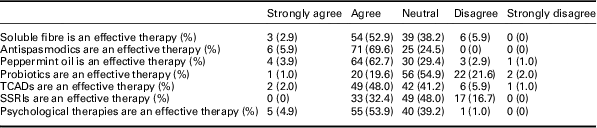
IBS=irritable bowel syndrome; TCADs=tricyclic antidepressants; SSRIS=selective serotonin re-uptake inhibitors.
In terms of frequency of use, almost 40% of primary care physicians used soluble fibre often or always in IBS, >50% used antispasmodics often or always, and >45% used peppermint oil at the same frequency (Table 2). With respect to TCADs, <10% of participants replied that they often or always used these drugs, with a further 36% stating that they sometimes used them, and the remainder using them rarely or never. Again, <10% of responders said that they used or recommended probiotics often or always, with 65% saying that they used them never or rarely. The use of SSRIs was reported often by only 1%, and sometimes by only 23.5% of physicians, with the rest using them never or rarely. As most primary care physicians do not administer psychological therapies themselves in the United Kingdom, the question was altered to address ease of access to these types of treatment. Only 7% of participants agreed that access was easy, with 80% disagreeing or strongly disagreeing.
Responses from 102 general practitioners concerning the use of various therapies for IBS

IBS=irritable bowel syndrome; TCADs=tricyclic antidepressants; SSRIS=selective serotonin re-uptake inhibitors.
Sources of information regarding recommendations for the treatment of IBS used by primary care physicians
Ninety-six primary care physicians answered this question. The most frequent source of information used by primary care physicians for the management of IBS was NICE guidelines, used by 80 (83.3%). This was followed by review articles published in journals, used by 54 (56.3%), BMJ Clinical Evidence, used by 34 (35.4%), and other international guidelines, which were utilised by only three people (3.1%). No one reported using Cochrane collaboration systematic reviews as an information source.
Discussion
IBS is common in the community, and represents a considerable burden to the health service, therefore appropriate management of the condition is important. This survey has revealed that most primary care physicians use a history and examination to diagnose IBS, rather than symptom-based diagnostic criteria. Almost 70% of respondents felt that IBS was a diagnosis of exclusion, and >80% stated that they checked coeliac serology often or always. In terms of their views on the efficacy of various therapies, soluble fibre, antispasmodics, peppermint oil, and psychological therapies were all viewed by primary care physicians as being potentially efficacious therapies. The respondents were less convinced with the merits of TCADs, SSRIs, or probiotics. These opinions concerning efficacy are reflected in the relatively high levels of use of soluble fibre, antispasmodics, and peppermint oil, and the lower rates observed for TCADs, SSRIs, and probiotics. Despite beliefs about the efficacy of psychological therapies, most primary care physicians felt that these were not easily available. Finally, most primary care physicians obtained up-to-date evidence about the management of IBS from NICE guidelines and review articles and, despite the fact that they are the gold standard for evidence synthesis from randomised controlled trials, no one used Cochrane collaboration systematic reviews to inform their clinical practice.
Strengths of this study include the fact that it was conducted among all primary care physicians registered with the three clinical commissioning groups in the city of Leeds, meaning that the results are likely to be generalisable to primary care physicians in other large cities in the United Kingdom. We allowed primary care physicians up to one month to complete the questionnaire, and sent all participants a reminder via email two weeks after the initial questionnaire was sent out, in order to maximise response rates.
Limitations include the fact that the questionnaire we used was not validated, although we are unaware of any validated questionnaire for use in a survey such as this. In addition, the response rate was 37.1% and therefore we cannot exclude the possibility that those primary care physicians who responded to the survey were motivated by a special interest in, or detailed knowledge of, IBS. This may have skewed our results, meaning the results are not generalisable to the average primary care physician. We were unable to examine whether there were differences between responders and non-responders, as the questionnaire was emailed via the administrators of the three clinical commissioning groups in Leeds. The fact that the study was conducted among a localised sample of primary care physicians also means that the results may not be generalisable to primary care physicians in other centres, due to variation in local educational initiatives, attitudes of local clinical commissioning groups, or attitudes of consultants in secondary care. Finally, our methodology is also a limitation, in that the use of a questionnaire may have limited the amount and type of information that we were able to collect. Other approaches to examining the approach of local primary care physicians to the diagnosis and management of IBS could have been to conduct detailed face-to-face interviews with the participants, although we feel this may have been logistically difficult due to other pressures on our primary care colleagues.
Previous studies that have applied a routine panel of blood tests in patients with suspected IBS demonstrate a yield for organic disease of ⩽1% (Tolliver et al., Reference Tolliver, Herrera and DiPalma1994; Sanders et al., Reference Sanders, Carter, Hurlstone, Pearce, Milford Ward, McAlindon and Lobo2001). Despite recommendations from NICE for the management of IBS in primary care (National Institute for Health and Clinical Excellence, 2008), many primary care physicians do not appear to be comfortable with making a positive diagnosis of the condition, without recourse to investigation or the opinion of a specialist, with almost 70% of respondents still believing that IBS was a diagnosis of exclusion. These findings are in keeping with a recent survey of primary care physicians in the United States (Spiegel et al., Reference Spiegel, Farid, Esrailian, Talley and Chang2010). However, recommendations for the routine exclusion of coeliac disease in patients with suspected IBS appear to have been incorporated, for the most part, into the usual practice of the primary care physicians we surveyed. This approach is supported by a meta-analysis demonstrating that the prevalence of biopsy-proven coeliac disease among patients with suspected IBS was 4% (Ford et al., Reference Ford, Chey, Talley, Malhotra, Spiegel and Moayyedi2009b), four-fold that of controls without symptoms suggestive of IBS.
As other investigators have demonstrated, most primary care physicians do not use symptom-based criteria, such as the Manning or Rome criteria, to reach a diagnosis of IBS, but instead rely on a combination of symptoms and signs elicited during the clinical history (Thompson et al., Reference Thompson, Heaton, Smyth and Smyth1997; Franke et al., Reference Franke, Singer and Dumitrascu2009). This approach is difficult to criticise, as there have been very few validation studies of these symptom-based criteria (Ford et al., Reference Ford, Talley, Veldhuyzen Van Zanten, Vakil, Simel and Moayyedi2008c), and most have been conducted among secondary or tertiary care populations. In addition, the current Rome III criteria have only been the subject of one validation study (Ford et al., Reference Ford, Bercik, Morgan, Bolino, Pintos-Sanchez and Moayyedi2013), have been developed to aid research in to the treatment and pathophysiology of IBS, and are probably too cumbersome for use in a busy primary care clinic. In fact, there is concern even among experts, some of whom helped to develop these criteria, that they do not adequately reflect the spectrum of IBS seen in their usual clinical practice (Pimentel et al., Reference Pimentel, Talley, Quigley, Hani, Sharara and Mahachai2013).
There have been few studies that have examined therapies used by primary care physicians in the management of IBS, but antispasmodics have been reported as the most popular choice in one survey conducted in Italy (Bellini et al., Reference Bellini, Tosetti, Costa, Biagi, Stasi, Del Punta, Monicelli, Mumolo, Richiutti, Bruzzi and Marchi2005). Our study suggests that many primary care physicians believe in the efficacy of, and use, soluble fibre, antispasmodics, and peppermint oil for the management of IBS. It also appears that psychological therapies are felt to be beneficial, but their use is hampered by a lack of easy access in primary care. Belief in any beneficial effect of TCADs, SSRIS, and probiotics was less consistent, and there appeared to be some reluctance on the part of primary care physicians to institute these therapies. This may relate to either a lack of apparent efficacy, or in the case of TCADs and SSRIs it could be due to the perceived risk–benefit profile of these agents, in what is essentially a benign non-life threatening disease, or a fear that the patient will ultimately believe that they have been labelled as having depression or an imagined illness, rather than genuine and troublesome GI symptoms.
The majority of randomised controlled trials of therapies for IBS have been conducted in secondary or tertiary care. This may explain why some interventions that Gastroenterologists consider to be effective appear to have a relatively low uptake in primary care. The potential difference in perception of what are effective therapies for the treatment of IBS in primary compared with secondary care highlights the need for the development of guidance that is integrated for use in both settings, and which also incorporates the role of diagnostic testing to rule out organic disease, such as coeliac serology and faecal calprotectin (Ford et al., Reference Ford, Chey, Talley, Malhotra, Spiegel and Moayyedi2009b; van Rheenen et al., Reference van Rheenen, Van de Vijver and Fidler2010), in addition to treatment algorithms as to which therapies to use first- and second line.
If primary care physicians are to be convinced of the benefit of low-dose antidepressants or probiotics, then large IBS treatment trials based in primary care, such as that conducted by Bijkerk and colleagues in the Netherlands using ispaghula and bran (Bijkerk et al., Reference Bijkerk, de Wit, Muris, Whorwell, Knottnerus and Hoes2009), are required. Further research is also required concerning the optimal approach to diagnosing IBS in primary care, in order to minimise referral to secondary care and inappropriate investigations, as well as to avoid a missed diagnosis of organic lower GI disease. Despite perceived efficacy of psychological therapies in the management of IBS, many primary care physicians cannot access them, and this needs to change. The NICE guidelines for the management of IBS appear to have been instrumental in guiding practice among the primary care physicians we studied, and these should probably be updated regularly, with short synopses of their recommendations circulated widely in primary care.
Most primary care physicians still believe IBS is a diagnosis of exclusion, and many are reluctant to use antidepressants or probiotics to treat IBS. More research studies addressing diagnosis and treatment of IBS based in primary are required.
Acknowledgements
The authors are grateful to the 102 primary care physicians in Leeds who took the time to answer our questionnaire. U.N.S. and A.C.F. conceived and drafted the study. U.N.S. collected all data. A.C.F. analysed and interpreted the data. A.C.F. drafted the manuscript. Both authors have approved the final draft of the manuscript.
Financial Support
None.
Conflicts of Interest
None.
Supplementary material
To view supplementary material for this article, please visit http://dx.doi.org/10.1017/S1463423614000383



