


A fundamental question in international relations (IR) is how states can signal their intentions. This topic is crucial because it underpins the most prominent mechanisms for international conflict: the security dilemma and bargaining failure. In the security dilemma, states with compatible goals end up in conflict due to misplaced distrust, whereas states bargaining over a disputed asset may be unable to reach a peaceful settlement due to an underestimation of each other’s resolve to fight. In both frameworks, inefficient conflict arises due to a lack of information about another state’s goals. But crucially, the information failures run in opposite directions. In the security dilemma, states forego cooperation in favor of competition because they believe another to have hostile intentions; that is, its goals are insufficiently compatible with their own.Footnote 1 Thus, states attempt to alleviate security dilemmas through reassurance by signaling that their goals are compatible. Conversely, bargaining breaks down when one or both sides believe the other to be insufficiently resolved. Thus, in coercive bargaining, states signal high resolve; that is, that their goals over the disputed asset are incompatible with the receiver’s.Footnote 2
Despite a large literature on both reassurance and coercive bargaining, the conditions that give rise to each distinct interaction remain ill-defined. Moreover, although many signaling mechanisms have been identified for each, the efficacy of reassurance has proven far more controversial than that of signaling high resolve in bargaining. Whereas it is now almost axiomatic that states can meaningfully (though not always perfectly) increase an adversary’s beliefs about their willingness to fight,Footnote 3 a prominent strand of IR theory holds that reassurance is effectively impossible, rendering the security dilemma pervasive and intractable.Footnote 4 This is puzzling: why would the mechanisms for signaling incompatible goals not work the same way in reverse for signaling high compatibility? What are the conditions that give rise to reassurance versus coercive bargaining incentives, and is there reason to think credible signaling is more difficult in one than the other?
This article addresses these questions, unpacking the fundamental distinction between reassurance and coercive bargaining and the different incentive structures and signaling mechanisms that characterize them. Identifying these conceptual differences is instrumental for developing theoretical mechanisms to overcome the challenges inherent to credible signaling, as well as for understanding how reassurance and bargaining dynamics interact.
The article first juxtaposes reassurance and coercive bargaining based on their opposing directional incentives to misrepresent. It then identifies the conditions for each signaling interaction, broadly arguing that reassurance incentives arise when states believe it possible that their goals are largely compatible, and when at least one side can reduce its vulnerability through costly actions against the other. The remainder of the article argues that there are systematic differences in how credible signaling works in reassurance versus coercive bargaining. Existing reassurance models have made several assumptions that inflate the feasibility of sending credible cooperative signals. Relaxing those assumptions reveals three broad distinctions between the two signaling interactions that imply previously unidentified barriers to reassurance.
First, power shifts impede credible cooperative signals. Senders whose goals are incompatible with the receiver’s (hereafter termed ‘incompatible’ senders) are often induced to behave cooperatively by the constraints they face from others. However, as rising states gain power these constraints will be reduced. A rising state’s cooperative signals under high constraints in the present may therefore not be indicative of its intentions under low constraints in the future.Footnote 5 Conversely, in coercive bargaining power shifts tend to augment the credibility of a rising state’s signals of high resolve, since it will become more willing to fight in the future as it gains power.
Second, in reassurance even compatible senders may be reluctant to send cooperative signals because often the only ones available exacerbate security vulnerability. This reluctance makes it easier for incompatible senders to misrepresent their goals by mimicking the behavior of compatible ones, hindering credible reassurance. By contrast, in coercive bargaining there is wider availability of signals that are costly only to weakly resolved states, not to highly resolved ones. This inhibits weak senders from mimicking strong ones, which facilitates credible signals of high resolve.
Third, ambiguity about the issue area motivating the sender’s signals hinders reassurance because the receiver does not know whether the signal pertains to an issue of high or low importance to itself, and thus what the signal says about the sender’s overall compatibility. In reassurance, states with incompatible goals typically have incentives to misrepresent any noncooperative behaviors as being motivated by their goals on issues of low value to the receiver, and vice versa for cooperative behaviors. By contrast, in bargaining the opposite obtains: states have incentives to honestly reveal the relative importance of the issues at stake in order to get greater concessions on the issues they care most about. This mitigates the problem of issue ambiguity in bargaining.
Overall, the analysis suggests that credible signaling is systematically more difficult in reassurance than in coercive bargaining. Importantly, however, the argument here is not that reassurance is impossible or that no barriers to credible signaling exist in coercive bargaining. Instead, the claim is that barriers to credible signaling exist in reassurance that do not in bargaining, which future research should focus on overcoming.
Reassurance versus coercive bargaining
Conceptual distinctions
Reassurance and coercive bargaining are overlapping but distinct signaling interactions. The discussion first treats the two as separate ideal types, then relaxes that simplification to examine how they relate to each other.
The definitional distinction between reassurance and coercive bargaining (hereafter ‘bargaining’) involves the direction of the actors’ incentives to misrepresent.Footnote 6 In reassurance, one state (the sender) sends cooperative signals to convince another (the receiver) that their goals are compatible, insofar as the realization of one’s goals advances (or at least does not impede) the other’s.Footnote 7 If successful, this allows the sender to avoid incurring costly opposition from distrustful receivers, which may take preventive actions to reduce their vulnerability to senders whose goals they believe are incompatible with their own (‘incompatible’ senders). Thus, although only truly compatible senders inherently benefit from cooperation, incompatible senders often have strong incentives to misrepresent their goals to avoid opposition and augment their capacity to exploit the receiver in the future.
Coercive bargaining, in contrast, is a zero-sum interaction in which states attempt to signal low compatibility – often characterized as high resolve.Footnote 8 The sender’s objective in bargaining is to signal its willingness to fight over a disputed asset unless the receiver makes additional concessions. This means senders must convince the receiver that they value the asset highly – in other words, that the disparity in the actors’ goals is severe enough that the sender is willing to fight to achieve its goals on that issue instead of acquiescing to the receiver’s.
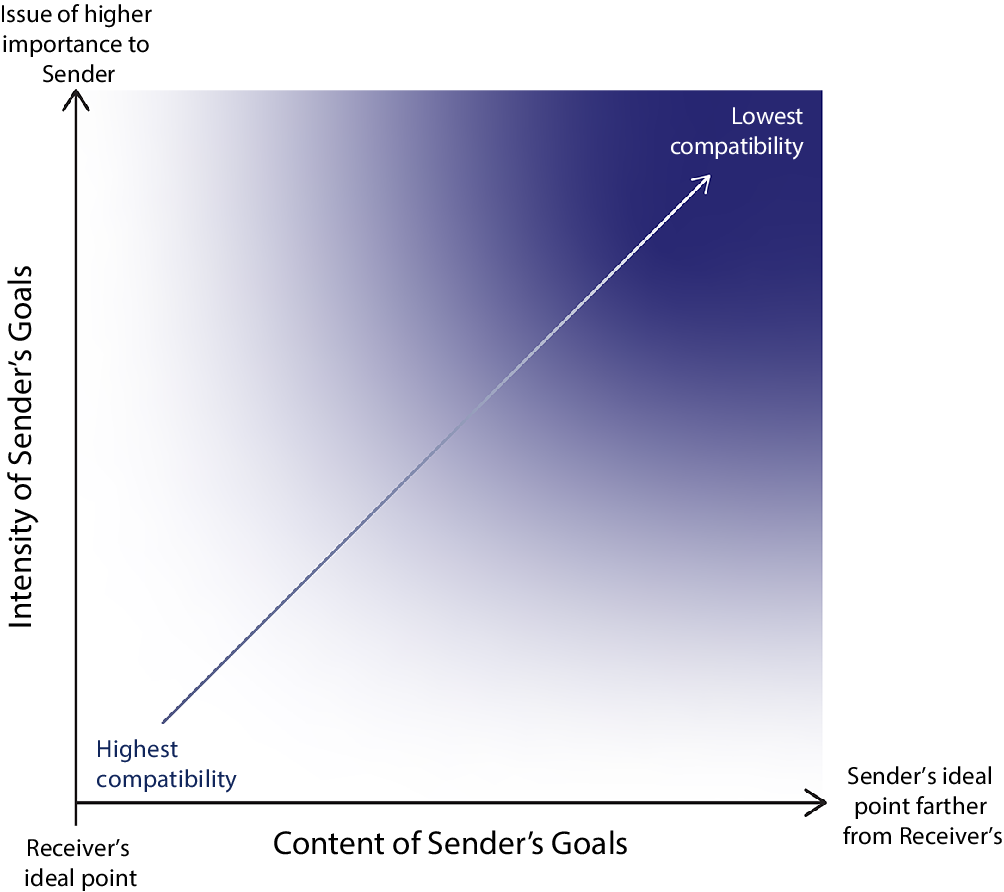
To clarify this distinction, we must disaggregate the compatibility of actors’ goals into two separate dimensions, captured in Figure 1: content and intensity. The content of a sender’s goals on a particular issue is defined by the distance between its ideal point and the receiver’s regarding the outcome on that issue. At the extreme, if the two actors’ ideal points are identical, then their goals are inherently positive-sum – any action that advances one’s goals automatically advances the other’s.Footnote 9 On the other hand, intensity is defined as the value a state assigns to a marginal increase in its share of a disputed asset. This dimension of compatibility is often referred to in the bargaining literature as a state’s ‘resolve.’Footnote 10 Thus, content defines the scope of the disputed asset in the bargaining model – how much the sender wants from the receiver in a particular issue area – whereas intensity refers to the importance the sender assigns to that issue area, or how badly it wants any given portion of a disputed asset.
As Figure 1 illustrates, these two dimensions of goals interact to determine an actor’s overall compatibility. With either low intensity of preferences or low content at stake, overall compatibility is high, since the sender will make only small demands that the receiver is willing to concede. But given some distance between the actors’ ideal points, more intensely held goals (higher resolve) imply less compatibility, all else equal. The greater the intensity of a sender’s goals, the more willing it is to fight over whatever content is disputed, and thus the larger its demands on the receiver. Likewise, holding preference intensity constant, a greater distance between ideal points increases the value of the total asset at stake, making the sender more willing to fight and thus increasing its demands. This implies that states in bargaining settings may have incentives to inflate not only the intensity of their aims, but also the content – pretending to want more than they actually do – in order to dupe their counterpart into conceding more of the portion of the asset they truly desire.Footnote 11 Thus, increasing either the distance between actors’ ideal points or the intensity of their goals reduces their compatibility (increases their resolve, in bargaining terminology).
Sender’s compatibility determined by the interaction of content and intensity of its goals.

In sum, reassurance and bargaining are characterized by countervailing incentives for actors to misrepresent their goals. In reassurance, senders attempt to signal high compatibility, whereas in bargaining they attempt to signal high incompatibility.
A second fundamental distinction between these two types of signaling interaction is that in reassurance the receiver believes there is some possibility that the actors’ goals might be highly compatible across the issues it values most, whereas in bargaining both actors have already determined that the content of their goals on a particular issue has some minimum degree of incompatibility. Beyond that threshold, they simply do not know how incompatible, and thus how willing the other is to fight over that specific asset. As defined by Andrew Kydd, bargaining ‘focuses on conflict resolution – how conflicts of interest are resolved’ short of war given that they are known to exist, whereas reassurance focuses ‘on conflict avoidance – how states [signal] their motivations and thereby avoid conflicts of interest in the first place.’Footnote 12 In other words, actors in bargaining must believe the content of their goals is relatively incompatible; otherwise, there would be no meaningful asset to bargain over, and no reason for either actor to exaggerate their incompatibility.
Finally, it is worth noting that uncertainty over the content versus the intensity of others’ preferences is not a fundamental distinction between reassurance and coercive bargaining. Typically, coercive bargaining is modeled so that actors are aware of the extent to which their ideal outcomes diverge – the scope of the asset at stake is known to both actors and normalized to 1 – with uncertainty instead pertaining to the intensity of the actors’ preferences over this known asset.Footnote 13 Yet coercive bargaining can also be modeled with uncertainty over the content of the actors’ preferences.Footnote 14 Conversely, uncertainty in reassurance is typically represented in terms of the content of the actors’ goals; that is, the scope of the asset at stake.Footnote 15 But less commonly, reassurance has also been modeled with uncertainty over the intensity of the actors’ preferences given some fixed scope.Footnote 16
Conditions for reassurance
Under what conditions does each set of countervailing signaling incentives obtain? There are three necessary conditions for reassurance to occur: 1) uncertainty over the sender’s goals; 2) a limited degree of actual incompatibility; and 3) dynamic capabilities.
First, as already discussed, reassurance necessarily occurs only when a receiver is uncertain whether the sender holds compatible goals. If the actors already know their goals are sufficiently divergent, reassurance is impossible, and their incentives become to instead inflate their incompatibility to obtain a better bargaining settlement. But in addition, the actors cannot already be completely informed that their goals are sufficiently compatible, which would make reassurance superfluous.
Secondly, the sender’s actual goals cannot be excessively incompatible with the receiver’s. If they are, the asset at stake becomes sufficiently valuable that the sender prefers to pursue its aims immediately rather than reassuring the receiver and avoiding opposition. This has been a consistent finding in models of reassurance: the most highly resolved or ‘greediest’ states will reveal (or inflate) the extent of their goals to try to get a more favorable settlement, even if doing so results in costly opposition or precludes power gains in the future.Footnote 17
Finally, reassurance interactions arise when the receiver can reduce its vulnerability to exploitation in ways that are costly to the sender. To see this, note that the sender only has incentives to reassure if the receiver would impose costs on it otherwise. Furthermore, a distrustful receiver will impose such costs if doing so will reduce its vulnerability to exploitation by a hostile sender. The way to avert this punishment from the receiver is for the sender to alleviate its distrust, and hence its need to reduce its vulnerability – in other words, the sender must reassure the receiver that their goals are compatible.
This reassurance dynamic is most commonly modeled as a security dilemma, in which one or both actors are uncertain whether the other holds ‘prisoners’ dilemma’ preferences, such that it prefers unilateral defection to mutual cooperation, or ‘stag hunt’ preferences, such that it prefers mutual cooperation to unilateral defection.Footnote 18 In any particular round, unilateral cooperation yields the worst outcome, which implies that cooperation increases a receiver’s vulnerability to the sender’s defection. Yet by defecting, even if only to protect itself, the receiver necessarily lowers the sender’s payoff.
Reassurance in the security dilemma is generally interpreted in terms of dynamic capabilities; that is, that the receiver’s defection decreases the sender’s power relative to what it would be had the receiver cooperated. This can be modeled as a first-mover advantage, either in war-fightingFootnote 19 or arms racing,Footnote 20 or as a power shift in which the receiver can impose costs on the sender to reduce its relative capabilities. With an exogenous power shift, the declining receiver can either acquiesce or implement mutually costly ‘containment’ measures against the rising sender,Footnote 21 whereas under an endogenous power shift the receiver invests in its own capabilities or acquires strategically valuable territory if it anticipates excessive demands by the sender.Footnote 22
In sum, reassurance occurs only if the receiver can mitigate its vulnerability by imposing costs on the sender – otherwise, the sender’s incentive is to inflate its incompatibility rather than to downplay it. If the receiver cannot reduce its vulnerability, or if doing so does not impose costs on the sender, the latter has no incentive to reassure and should instead signal high resolve to maximize the concessions it can obtain from the receiver.
Overlap between reassurance and coercive bargaining
Importantly, reassurance and bargaining can occur simultaneously, in at least two ways. First, assurances can serve as a complement to threats in achieving successful coercion under certain conditions. Second, coercive bargaining and reassurance can occur simultaneously within a particular dyad across different issue areas.
On the latter point, a sender might attempt to convince a receiver of its incompatibility (high resolve) on one issue even as it attempts to reassure the receiver of their compatible goals on others. For example, the United States has had bargaining interactions with China over several specific disputes, such as the status of Taiwan, but remains significantly uncertain about others, such as whether China will use its growing economic and institutional power to uphold or challenge the existing rules and norms of the liberal economic order.Footnote 23 The implications of simultaneous interactions across multiple issues for credible signaling are discussed below.
Secondly, as Schelling first noted, coercive diplomacy often requires assurances, as any threat (‘stop or I’ll shoot’) must be coupled with an implicit assurance (‘and if you do I won’t’).Footnote 24 If that assurance is non-credible the threat becomes unconditional, and the receiver’s rational response is to withhold concessions and fight rather than make costly concessions only to incur punishment anyway.Footnote 25 In this context, the sender’s task is to signal intermediate compatibility so that the threat is credible enough to garner concessions but not deemed unconditional.Footnote 26 Thus, states may have incentives to send simultaneous signals of low and high resolve when bargaining, which Knopf calls ‘deterrence-related assurance.’Footnote 27
Other work has formally identified conditions under which senders combine threats with assurances in bargaining, which mirror the overall criteria for reassurance presented above.Footnote 28 Briefly, assurances are warranted when their absence would result in a preventive or preemptive attack by the receiver in anticipation of unacceptable future demands. This requires power to shift as a function of the distribution of the asset at stake, such that the receiver has incentives to reduce its vulnerability by initiating costly conflict. In addition, the receiver must ‘wonder how far [the sender’s] ambitions extend’ and the sender must not be exceedingly incompatible, such that it ‘prefers to lower its own bottom line through an assurance rather than fight.’Footnote 29 In short, reassurance can coincide with bargaining to signal intermediate compatibility, but the fundamental incentives driving assurances as part of the bargaining process are the same as those driving stand-alone reassurance more generally.
Having established the conceptual distinction between reassurance and coercive bargaining and the conditions under which the former obtains, the paper now turns to when and how credible signaling occurs in each interaction. Much of the literature on reassurance is quite categorical that credible reassurance signals are widely available and that states with compatible goals can readily identify each other.Footnote 30 Yet this literature contains several assumptions that obscure significant barriers to credible cooperative signals. The next three sections relax these assumptions to identify conditions under which credible reassurance is likely to be difficult, while drawing contrasts with coercive bargaining.
Power shifts as barriers to credibility
In order to credibly signal its goals, a sender must take actions that distinguish itself from other ‘types’ that hold different goals. To signal high compatibility in reassurance, an honest sender must take actions that a dishonest, incompatible sender would be unlikely to take. Similarly, in bargaining honest, highly resolved senders must take actions that dishonest, low-resolved senders would not mimic.
This means that credible signals must be costly – not necessarily to an honest sender itself, but to a hypothetical dishonest sender whose goals differ from the actual sender’s.Footnote 31 Such signals are more likely to be sent by honest types than by misrepresenting, dishonest types, thereby allowing receivers to distinguish between the two, at least probabilistically. Thus, the greater the net cost of a signal to a dishonest type, the more credible it is.
This section argues that although power shifts engender incentives to reassure, they simultaneously undermine the credibility of cooperative signals. These challenges for credible signaling are overlooked by reassurance models without power shifts.Footnote 32 The section first establishes that rising states have strong incentives to misrepresent their incompatible goals, which makes it difficult for declining receivers to distinguish compatible risers from incompatible ones, and then proceeds to show that power shifts have the opposite effect on rising states’ incentives to misrepresent in coercive bargaining.
Shifting power and incentives to misrepresent in reassurance
Shifting power gives rise to reassurance incentives, but it also makes reassurance particularly challenging. During power shifts, receivers are primarily interested in the intentions of rising senders. A declining state’s future intentions are less salient, since others will become less – not more – vulnerable to it over time, and since its preferences likely have already been revealed through its behavior at the peak of its power, when constraints are lowest.Footnote 33 In contrast, receivers will become increasingly vulnerable to exploitation by rising senders over time. Furthermore, it is particularly important for a receiver to learn a rising state’s intentions as soon as possible, while the receiver still holds a relatively favorable power position. Its beliefs about the riser’s goals then determine the receiver’s strategy in the present: it will accommodate senders it believes are compatible, while attempting to forestall the rise of those it believes are incompatible.
Fundamentally, power shifts hinder reassurance because a rising sender’s behavior is likely to change over time with the external constraints it faces.Footnote 34 At the outset of a power shift, when the sender is relatively weak, it is constrained to behave cooperatively toward powerful receivers even if its goals are incompatible with theirs. However, these constraints will be reduced as the sender gains power. Highly constrained incompatible risers are therefore likely to send dishonest cooperative signals in the present, but become less cooperative in the future as their freedom of action increases.
Even more perniciously, power shifts give incompatible rising states powerful incentives to actively misrepresent their goals. By attempting revision in the present, the rising state risks revealing its incompatible goals and incurring preventive opposition from the declining receiver, which would jeopardize the riser’s future power gains.Footnote 35 Thus, incompatible risers often prefer to bide their time and behave cooperatively in the present to elicit accommodation, which allows them to accrue power and attempt revision under more favorable conditions in the future.
The power gains from cooperation, combined with the cost of incurring opposition while weak, often make cooperative signals net-beneficial even for incompatible rising states. This incentive for incompatible types to misrepresent, in turn, reduces the credibility of rising states’ cooperative signals: because such signals are likely to be sent by both benign and hostile types alike, they do not allow the receiver to distinguish rising states’ true goals for the international order and thus their future intentions.Footnote 36 Shifting power, therefore, impedes the feasibility of reassurance.Footnote 37
These incentives to misrepresent under shifting power help explain why American observers faced such difficulty discerning China’s intentions in the post-Cold War era. In the early 2000s, China had yet to exhibit any significant revisionism.Footnote 38 Yet some observers noted that even a hypothetically incompatible China had strong incentives to exhibit such cooperative behavior, because China’s cooperation with US-led norms and institutions allowed it to avoid incurring containment and sustain its rapid economic rise.Footnote 39 This made it exceedingly difficult for China to successfully reassure the United States of its benign intentions, because American observers knew China could behave quite differently as its rising power lessened its constraints.Footnote 40 While the resulting US uncertainty did not precipitate preventive war, it did prompt a competitive hedging response short of war, as models of reassurance under shifting power predict.Footnote 41
In sum, power shifts hinder credible reassurance in two ways. First, rising states are highly constrained by more powerful states to behave cooperatively while relatively weak. Yet they will no longer face such constraints as they gain power in the future. Thus, cooperation under high constraints in the present may be a poor predictor of a rising state’s future intentions. Second, incompatible rising states have strong incentives to misrepresent their goals by behaving cooperatively in order to avoid opposition from a declining state that could jeopardize their future power gains. This dishonest cooperation makes it difficult for the decliner to distinguish compatible risers from incompatible ones, thereby undermining reassurance.
Signaling high resolve under shifting power
The effect of power shifts on credible signaling is reversed in coercive bargaining, because incentives to misrepresent run in the opposite direction that they do in reassurance. Thus, whereas in reassurance incompatible rising senders have strong incentives to send dishonest cooperative signals that reduce credibility, in bargaining rising power enhances the credibility of a sender’s coercive signals.
To see this, first note that rising states that signal high resolve in the present will only become more willing to fight as the distribution of power becomes more favorable. Furthermore, as discussed above, rising states have strong incentives to avoid conflict in the present, while relatively weak.Footnote 42 In reassurance, incompatible types do this by sending dishonest cooperative signals that belie their future intentions. However, in bargaining, senders avoid conflict by backing down from disputes. This incentive to back down makes weakly resolved risers more likely to send honest signals in the present, all else equal, rather than dishonest signals of high resolve such as hand-tying or brinkmanship that raise the likelihood of conflict. Thus, by reducing incentives for weakly resolved risers to misrepresent, shifting power makes signals of high resolve more credible in bargaining.
On the other hand, a declining sender’s signals of high resolve may not reflect its future intentions, as its willingness to fight will decrease with its power. But crucially, a declining sender’s willingness to fight in the future is generally irrelevant to the receiver’s current strategy. As long as the sender signals a high willingness to fight in the present, the rising receiver’s best strategy is to bide its time, making concessions to avoid conflict while relatively weak. Indeed, a declining state’s signals of high resolve in the present are particularly credible, since it has extra incentive to obtain the asset while conditions are most favorable. But even if the declining sender is bluffing, time is on the receiver’s side: it can elicit greater concessions under a more favorable distribution of power in the future. Thus, in bargaining settings, shifting power makes declining senders’ signals less informative of their future intentions, but this is strategically inconsequential to rising receivers.
This section has argued that dynamic power affects signaling differently in reassurance versus bargaining settings. Power shifts remove constraints on a rising sender’s behavior over time, giving it incentives to avoid conflict in the present while relatively weak. In reassurance, this can induce incompatible risers to misrepresent their goals by behaving cooperatively, thereby reducing the credibility of such behavior as a signal of compatible goals. But the dynamic is reversed in bargaining: incentives to avoid conflict make weakly resolved rising states more inclined to issue concessions rather than misrepresent themselves as strong and risk escalation. This suggests that shifting power constitutes a greater barrier to credible signaling in reassurance than in bargaining.
Disincentives to send honest signals
Another barrier to credible signaling is that honest senders may be unwilling to signal their true goals. As discussed above, the credibility of a signal is undermined if it is net-beneficial to dishonest senders as well as to honest ones. Conversely, if a signal is net-costly to both honest and dishonest senders, it is unlikely to be sent by either type. This makes it easier for dishonest types to misrepresent their goals, because honest senders will only be willing to send weak signals that dishonest ones can mimic without taking prohibitively costly actions themselves. Therefore, to the extent that the available actions that are highly costly to dishonest types are also costly to honest types, credible signaling is impeded.
This section argues that key signaling mechanisms in bargaining that are low-cost to honest, high-resolution senders are sometimes unavailable in a reassurance context. Thus, there are realistic conditions under which the only available cooperative signals entail high costs for honest, compatible senders, not just for incompatible ones. This characterizes the most prominent signaling mechanisms in the reassurance literature. In contrast, there appear to be fewer restrictions on the availability of coercive signals that are costly only to dishonest, low-resolve senders, but costless or even beneficial to high-resolve types.
Credible signaling mechanisms are typically categorized as ‘tying hands’ or ‘sinking costs.’Footnote 43 Tied-hands signals commit the sender to a particular action by raising the costs of alternative actions – for example, committing to stand firm in a crisis by raising the costs of backing down. Tying hands is potentially costly to a dishonest (bluffing) sender that does not intend to carry out its commitment. But for an honest sender, pure tied-hands signals are costless. The sender will never incur the self-imposed costs of reneging because it actually intends to fulfill its commitment. Pure tied-hands signals are therefore costly only to dishonest senders.
Conversely, sinking costs means that the sender imposes costs on itself in the present in order to facilitate a particular course of action in the future – for example, investing resources in fortifications to protect a disputed asset.Footnote 44 Sunk-cost signals are credible because dishonest senders are less willing to pay to facilitate an action they will not actually take than are honest senders that will. But unlike tying hands, sunk-cost signals are costly to honest senders as well as dishonest ones, because costs are incurred unconditionally ex ante. Footnote 45 Thus, for honest senders, costless tied-hands signals are generally preferable to sunk-cost signals, as long as the former are available.Footnote 46
The problem is that pure tied-hands signals are not always available: often, tying hands also entails some degree of sunk costs. The remainder of this section argues that this is generally true for reassurance, but not for bargaining. The main signaling mechanisms identified in the reassurance literature involve significant sunk costs, which reduce the willingness of compatible states to employ them. Conversely, pure tied-hands signals that are costless to honest senders are broadly available in bargaining, removing barriers for genuinely resolved states to signal credibly.
Costly honest signals in reassurance
The frequency with which signaling in reassurance and bargaining, respectively, occurs through tying hands versus sinking costs is ultimately an empirical question.Footnote 47 However, to gain insight into the types of signals that are most prevalent in each interaction, this section examines the signaling mechanisms identified in the respective literatures on reassurance and bargaining.
Few pure tied-hands reassurance signals have been identified. Fearon has suggested that tied-hands signals are less effective in long-term strategic interactions than in short-term crises: ‘Because leaders and circumstances change over time, [long-term tied-hands signals] do not attach as directly to the person of the leader generating them as do efforts to tie hands in crisis bargaining.’ This engenders ‘difficulties for a leader of projecting tied hands into an uncertain and distant future against unknown adversaries,’ leaving sunk-cost signals ‘the only feasible options.’Footnote 48 Reassurance tends to be precisely this kind of long-term, ‘grand strategic’ interaction, especially in the dynamic power context in which it is particularly salient.Footnote 49 Rising states seek to avoid opposition over an extended period of time as they gain power, and therefore must reassure receivers across contexts and individual leaders. This distinction is, of course, not universal – assurances do occur over specific assets and general deterrence entails establishing a broad, dispositional reputation for resolve – but to the extent that it holds, it suggests pure tied-hands signals may be less prevalent in reassurance than in bargaining.
This intuition is corroborated by the main signaling mechanisms suggested in the reassurance literature, each of which entails sunk costs that disincentivize cooperative signals even from compatible states. Realist scholars have identified four categories of military cooperation that reduce the sender’s ability to attack or coerce others: 1) unilateral military reductions, 2) refraining from low-cost expansion, 3) arms control agreements, and 4) eschewing offensive military technology even when it is most efficient.Footnote 50 Additionally, liberal scholars have suggested that states can signal compatible goals through economic and institutional cooperation.Footnote 51
Some of these signaling mechanisms do entail a tied-hands component, insofar as they reduce the sender’s capacity for exploitation. As others have noted, however, military restraint and economic interdependence also sink costs by increasing the sender’s vulnerability to security threats from third parties or the receiver itself.Footnote 52 This is driven by classic security dilemma dynamics.Footnote 53 First, by reducing military forces or refraining from low-cost expansion, even compatible states often forgo power gains that could enhance their security. Of course, foregoing expansion carries no inherent cost to compatible senders, who by definition place low value on exploiting the receiver. However, to the extent that power is endogenous to the asset at stake and the sender faces external security threats – conditions that are exceedingly common in international politics – foregoing an opportunity to expand or invest in military power incurs security costs even for states with no hostile underlying goals.
Secondly, arms control agreements and economic interdependence must asymmetrically favor the receiver to be credible signals of compatibility. Otherwise, an incompatible sender would also take such actions to accrue relative gains that enhance its ability to exploit the receiver.Footnote 54 Yet asymmetric interdependence increases the sender’s vulnerability to exploitation by the receiver, which reduces incentives for even compatible types to undertake it.
Likewise, investment exclusively in defensive weapons is costly to compatible senders under certain conditions, which are also those under which it is most credible. To the extent that offensive technology is more efficient, investing in less-efficient defensive technology is costly for compatible senders seeking only security.Footnote 55 These costs constitute barriers to reassurance, as Kydd and Glaser acknowledge.Footnote 56 Furthermore, offensive and defensive technologies must be distinguishable from each other, which is frequently not the case for the leading weapons systems of any particular era.Footnote 57 Of course, when defensive technology is both more efficient and distinguishable, exclusive investment in it constitutes a costless reassurance signal for honest, compatible senders. Yet even under this specific set of conditions, the credibility of this signal is relatively weak, because a subset of incompatible senders would also be inclined to invest in the more efficient defensive technology – only the most extremely incompatible types would separate.Footnote 58 Thus, investment in defensive technology is only costless to compatible senders under circumscribed conditions, and yields limited information even when those conditions apply.
The final class of signals suggested in the reassurance literature is for senders to support the receiver’s preferred international order by building and contributing to international institutions.Footnote 59 This is more credible than merely joining institutions, which may be rational even for incompatible types that seek to revise the existing institutional structure.Footnote 60 Yet these signals also entail sunk costs for compatible types. Even if the sender and receiver have identical goals for the international order, the order itself constitutes a public good to which it is costly to contribute. In the presence of one or a few powerful states that have the capacity and incentive to supply public goods on their own, less-powerful compatible states have strong incentives to free-ride, rather than bearing the costs of contributing to public goods themselves.Footnote 61 For example, even a sender that inherently prefers an open international economy might still prefer to keep its own tariffs high in the presence of a compatible hegemon that provides international market access unilaterally.
Again, this ‘free-rider’ problem is particularly detrimental to credibility in the context of shifting power. As a compatible rising sender becomes more capable of contributing to the international order and declining receivers can no longer sustain it on their own, the sender will take greater responsibility for providing the necessary public goods.Footnote 62 Yet this means that even compatible risers that intend to maintain the receiver’s preferred order once they become more powerful might refrain from cooperating to do so in the present, when the decliner still has the capacity and incentive to provide public goods unilaterally. It can therefore be very difficult for declining states to distinguish compatible free-riders from incompatible risers that will revise the status quo order as they gain power. Such was the case for a declining Britain assessing whether a rising, protectionist United States shared its preferences for a liberal international economic order in the late-19th century.Footnote 63 More recently, the United States has faced similar problems of inferring whether China’s relatively illiberal economic policies and reluctance to contribute to global public goods signal goals of revising the US-led status quo order or merely transient incentives to free-ride.Footnote 64
In sum, there are broad conditions under which the signaling mechanisms suggested in the reassurance literature carry costs for both compatible and incompatible senders alike. When these conditions obtain, compatible types may become less willing to send cooperative signals, all else equal, increasing the capacity for incompatible types to misrepresent their goals.
Low-cost honest signals in bargaining
In contrast to reassurance, one of the key signaling mechanisms identified in the bargaining literature is a pure tied-hands signal – audience costs – that is costless to honest, highly resolved senders. This subsection argues that there is good reason to think this mechanism is less available for reassurance. Furthermore, even sunk-cost signals in bargaining often yield positive externalities to honest senders that make signaling high resolve net-beneficial for those types independent of its informational value. This suggests that states are more often willing to send credible signals in bargaining than they are in reassurance.
Availability of pure tied-hands signals in bargaining
Pure tied-hands signals that are costless to honest senders are common in bargaining settings. The primary hand-tying mechanism is public commitments that either domestic or international audiences will punish the sender for breaking (audience costs).Footnote 65 A leader who fails to carry out a public commitment appears weak or incompetent to domestic constituents who determine whether the leader remains in power. Yet tying its hands through large audience costs is costless to a highly resolved state, which actually intends to carry out its commitments and thus will never incur these self-imposed costs of backing down.Footnote 66 The same is true of commitments to international audiences that stake the sender’s reputation on fulfilling its threats.Footnote 67
The low cost of sending tied-hands signals of high resolve in bargaining enhances their credibility. Honest, highly resolved senders have every incentive to send the largest signals they can, maximizing their own costs of backing down.Footnote 68 This, in turn, makes it exceedingly difficult for bluffing, weakly resolved senders to misrepresent. As Fearon argues, when signals of high resolve are costless to honest senders, limited signals of resolve actually convey weakness, since resolved senders would send the largest signals possible.Footnote 69 Misrepresentation is therefore a particularly onerous all-or-nothing proposition for weakly resolved states, which are unlikely to risk incurring such high costs in order to pool with highly resolved types.
By contrast, analogous signals in reassurance involve some sort of sunk costs for honest, compatible senders themselves. Kydd has suggested that leaders can use audience costs to commit to non-aggression by publicly supporting a pacifistic ideology, thereby tying the sender’s hands to behave cooperatively.Footnote 70 Yet such domestic constraints would also impede the sender from adopting aggressive or competitive policies toward third parties. This could prove quite costly even to a benign sender, by compromising its security from hostile third parties or otherwise hindering its ability to pursue its goals at their expense.
Furthermore, more targeted audience costs may not be available for reassurance.Footnote 71 If the domestic audience holds hawkish preferences, it is unlikely to impose costs on a leader who reneges on a promised concession to the adversary. Leaders would then face little reputational cost for abandoning cooperative commitments, making it difficult for them to credibly tie their hands.Footnote 72 Moreover, hawkish domestic audiences are common, as publics generally value national reputations for resolve and are more likely to punish leaders for making concessions than for exhibiting strength.Footnote 73 This theoretical logic is borne out in experimental studies showing that audience costs for assurances are either weaker than for threats,Footnote 74 or that they do not obtain at all.Footnote 75
If domestic audience costs are weaker and more circumscribed in reassurance than in bargaining, what about international audiences? Allies, in particular, might punish a state that verbally commits to cooperation with a third party and then reneges.Footnote 76 Doing so would call into question the sender’s commitment to cooperation, incentivizing security partners to exit or otherwise take undesirable actions (e.g., nuclear proliferation) to substitute for the security benefits they cannot count on from the unreliable sender.Footnote 77 But, again, such reassurance audience costs would only obtain under constrained conditions. The sender must have allies, those allies must be important enough that their punishment would be consequential, and they must have a credible threat of exit. If an ally is so dependent on the sender for security that alternatives are nonviable, its threat of punishment is nullified. Furthermore, similarly to the domestic audience, third-party allies would have to disapprove of the sender’s shift away from cooperation, weakening the mechanism’s applicability for reassuring common rivals. Overall, then, there are many realistic conditions under which pure tied-hands reassurance signals are unavailable at either the international or domestic level.
Positive externalities of sinking costs in bargaining
In bargaining, not only are costless tied-hands signals widely available, but even sunk-cost signals of resolve tend to yield benefits for honest, highly resolved senders, which offset the costs of sending such signals.Footnote 78 These are what Quek refers to as reducible costs,Footnote 79 which Altman and Quek show are far more common than pure sunk-cost signals in IR.Footnote 80 As discussed above, the primary cooperative signaling mechanism in reassurance – military restraint – entails sunk costs for honest, compatible senders in the form of increased vulnerability. In contrast, honest senders in bargaining signal high resolve by investing more heavily in military capabilities. These investments produce positive externalities regarding both the sender’s overall security and the specific asset in dispute. Costly deployments of military resources sink costs, but also bolster the sender’s chances of prevailing should conflict occur. For a highly resolved state that would stand firm if challenged, these benefits of increased capabilities offset, and may even outweigh, the costs being sunk in military investments.
Conversely, sunk-cost signals in bargaining do not yield positive externalities for a weakly resolved sender that would back down if challenged. Such senders do not intend to make use of the military resources they have invested in, and therefore absorb only the costs of that signal, not the benefits. As such, sunk-cost signals in bargaining are costly to dishonest, weakly resolved senders, but often beneficial, on balance, to highly resolved senders.
This section has argued that pure tied-hands signals are widely available in bargaining but more circumscribed in reassurance, in which the only available signals often carry costs even for honest, compatible senders. Furthermore, whereas sunk-cost reassurance signals entail a reduction in security, bargaining is more conducive to reducible-cost signals that enhance military capabilities and make them net-beneficial to genuinely resolved senders. As such, honest signals of high resolve are likely to be sent under broader conditions than honest reassurance signals.
Ambiguity regarding the issue(s) motivating signals
A final barrier to reassurance concerns the difficulty of determining the issue area to which signals pertain. The security dilemma literature typically conceives of states’ goals in general terms, as dispositional traits that are uniformly compatible or incompatible across issue areas.Footnote 81 For example, in characterizing reassurance over time, Kydd writes, ‘the first round could be a trade treaty and the second round a security treaty. Cooperation over trade reassures the two players and allows them to cooperate over a more important security matter’ in the future.Footnote 82 But such characterizations omit the possibility that compatibility might vary across issue areas.
This is clearly inaccurate. A sender and receiver may have compatible goals on some issues and incompatible goals on others. Moreover, not all issues are equally important: a receiver cares more about others’ goals on issues it values highly – its ‘primary issues’ – than those it values little.Footnote 83 Yet, as discussed in the opening section, receivers simultaneously face uncertainty about a sender’s goals on two dimensions, which existing reassurance models have overlooked. Not only are receivers uncertain about the content of the sender’s goals in any particular issue area, but they are also uncertain about the relative intensity of the sender’s goals – the degree to which it values an issue relative to others.
The remainder of this section argues that such two-dimensional uncertainty is particularly acute in a reassurance context. Many behaviors could plausibly be intended to fulfill the sender’s goals regarding several different issue areas. This can make it difficult to determine whether the sender’s signals are motivated by its goals on issues of high or low importance to the receiver, and therefore whether the sender is compatible on the issues that matter. This two-dimensional uncertainty is analogous to multiple undefined variables in an algebraic expression. The receiver cannot solve for X – the sender’s compatibility on its primary issue – because it does not know the value of Y – the priority the sender places on that issue relative to others.Footnote 84
This section first establishes how simultaneous interaction over multiple issues disrupts states’ capacities to infer each other’s underlying goals. It then argues that in reassurance contexts, states have incentives to misrepresent which issues are most important to them, attributing non-cooperative behaviors to their goals on issues of low importance to the receiver rather than on their primary issues. Analogous incentives to misrepresent are absent in coercive bargaining: states want a known adversary to be informed of their primary issues, to elicit concessions on the issues they care about rather than on those they do not. Thus, issue ambiguity is a more severe barrier to signaling in reassurance, where incompatible senders have incentives to misrepresent the issues driving their behavior, than it is in bargaining, where states have incentives to honestly reveal the relative importance of different issues.
Issue ambiguity in reassurance
In reassurance, receivers seek to determine whether the sender’s goals are compatible or incompatible with their own in the issue areas the receiver considers most important (its ‘primary issues’). However, it is often difficult to determine if senders’ signals reflect their goals regarding a receiver’s primary issues, or regarding secondary issues the receiver considers less important. As Robert Jervis writes, a sender might take non-cooperative actions to ‘seek a goal that conflicted with the [decliner]’s interest,’ yet ‘not generally seek to harm the [receiver],’ particularly in the case of ‘an issue-specific conflict [that] yields disproportionate benefits’ for the sender.Footnote 85
Ambiguity about which issue is motivating a sender’s behavior can obscure whether its goals are compatible or incompatible with the receiver’s. For example, China’s ongoing push to acquire maritime jurisdiction in the South China Sea could be motivated by its goals in at least four distinct issue areas: (1) it likely contains natural resources; (2) it increases China’s regional military power; (3) it allows China to control maritime commerce; and (4) it is essential to China’s national identity.Footnote 86 Yet for the United States, the importance of these issue areas varies greatly. Because the islands themselves are of little value to the United States, if China is motivated to possess them for their intrinsic value (e.g., in terms of resource endowments or national identity), China’s ‘assertiveness’ means little for its overall compatibility with the United States. Alternatively, if China wants these territories as a means of (for instance) shifting the regional military balance or gaining control of maritime trade routes, its signals concern issues vital to the United States, and reflect how China is likely to behave on these issues in the future as it gains power. In short, a sender (here China) can plausibly frame its behavior as narrow and local rather than system-revisionist, thereby impeding the receiver (the United States) from inferring the sender’s broader goals.Footnote 87
This ambiguity is exacerbated by receivers’ lack of information about the relative intensity of a sender’s goals, which prevents them from simply inferring that signals are motivated by the issue the sender values most.Footnote 88 In reassurance, incompatible senders (those with incompatible goals on the receiver’s primary issues) have strong incentives to perpetuate the receiver’s uncertainty by misrepresenting which issues are most important to them. This, in turn, helps them misrepresent the content of their goals regarding the receiver’s primary issues: incompatible senders can plausibly claim that their non-cooperative behaviors are motivated by issues of low importance to the receiver, and thus that their goals on the receiver’s primary issues remain compatible. Returning to the example above, China has an incentive to claim that its assertiveness in the South China Sea is driven by an issue of low salience to the United States – for example, China’s national identity – even if it is actually driven by incompatible goals regarding an issue vital to the United States; for example, freedom of navigation. This is what Nazi Germany did in reassuring the Allies of its limited aims in the 1930s by claiming that its aggression was motivated by ethnic reunification, not broader expansionism.Footnote 89 Thus, in reassurance, uncertainty about the relative intensity of senders’ goals across issue areas constitutes a barrier to inferring the content of their goals on the receiver’s primary issues.
This barrier is particularly severe in a dynamic international system, where reassurance incentives most commonly obtain. First, when a rising sender is relatively weak, it has limited resources to pursue its goals across various issue areas. If the sender and receiver have different primary issues, the sender is thus likely to subordinate its goals to the receiver’s primary issues and others that the sender considers more important.Footnote 90 As the sender rises, however, it will be capable of pursuing its goals on a greater number of issues simultaneously. Incompatible rising senders may therefore behave cooperatively regarding a receiver’s primary issues in the present, but become non-cooperative as their capacity to pursue goals across multiple issues increases.
The combination of multiple issues and shifting power can also make a rising sender’s non-cooperative behavior less informative. Issues of high salience to the sender will likely be resolved in its favor as it gains power, allowing it to prioritize secondary issues that were previously deemphasized. Thus, a sender with compatible goals on the receiver’s primary issues may temporarily behave non-cooperatively early in its rise, due to competing goals on other issues the sender considers more vital. These often pertain to the rising sender’s local region, making them both asymmetrically important to the sender and among the first it revises as it gains power. For instance, in the late-19th century, the United States and Great Britain had several disputes in the Western Hemisphere on issues far more important to the United States than to Britain.Footnote 91 As US power increased through the turn of the 20th century, however, these issues were resolved in its favor. This left the two countries to interact only on broader issues of high salience to both, on which their goals were largely compatible. Thus, competitive US behavior toward Britain in the 19th century was not a credible indicator of overall US compatibility on Britain’s primary issues.
Similar dynamics apply to a rising China. As it gains power and resolves important issues in its home region – the South China Sea disputes, the status of Taiwan, the vulnerability of its commerce – China will no longer need to compete with the United States over these issues. The two countries may then be able to cooperate on issues of primary importance to the United States, such as maintaining the international economic order – if their goals on such issues are indeed compatible. Yet it is difficult to distinguish whether China’s competitive policies in East Asia are limited to local issues that the United States considers relatively minor, or reflect incompatible goals regarding the broader international order that the United States considers vital. As Alastair Iain Johnston writes of the South China Sea, ‘one should be cautious about generalizing from these maritime disputes to Chinese foreign policy writ large…it is possible for a state to be newly assertive on some limited range of issues while leaving other major policies unchanged.’Footnote 92
Issue-specific signals in bargaining
The problem of multiple issue areas described above is less severe in bargaining. This is because the incentives to misrepresent which issues are important in reassurance are reversed in a bargaining context, where states do best by honestly revealing the issues that are most valuable to them. Thus, in coercive bargaining, ambiguity about the relative importance the sender assigns to various issues can be straightforwardly resolved through credible cheap-talk statements. Signals of high resolve, even those that could plausibly be motivated by the sender’s goals on multiple issues (such as a general arms buildup), can therefore be readily specified to an issue.
Formal models of bargaining across multiple issues have demonstrated this point.Footnote 93 Trager presents a model in which two states bargain simultaneously over two issues, the value of each of which is private information.Footnote 94 In this context, simple cheap-talk statements convey significant information, allowing the receiver to update its beliefs about which issue(s) the sender is willing to fight over. The key mechanism is that by signaling honestly that one issue is more valuable than the other, the sender foregoes the opportunity to get what it wants on the lesser issue. This indirect cost lends credibility to the sender’s claim that it is willing to fight for the high-value issue, which must be worth enough to outweigh foregoing any chance of concessions on the secondary issue. In contrast, dishonestly claiming willingness to fight for both issues would decrease the sender’s chances of getting its way on the one it truly prioritizes. In short, ‘countries often admit that their resolve in one area is not high relative to their resolve in some other area’ that they value more.Footnote 95
What accounts for this distinction between bargaining and reassurance? Recall that reassurance incentives arise when the sender stands to lose substantial power in the future from incurring opposition, whereas coercive bargaining incentives apply under static power conditions. In the latter case, states want others to know which issues their resolve is highest on in order to receive the most valuable compensation. Conversely, where punishment would lead to an unfavorable power shift, the sender wants to obfuscate any hostile goals it may hold on the receiver’s primary issues. Instead, it should attribute any plausibly non-cooperative behaviors to its goals on issues of lower importance to the receiver, or refrain from non-cooperative behavior on those issues altogether. Thus, whereas senders in bargaining want the receiver to be completely informed of the issues motivating them, senders in reassurance have strong incentives to misrepresent.
This contrast can be seen in practice. During the US-Soviet Cold War, the principals’ goals on most issues were known to conflict. Bargaining incentives were therefore obtained. Both sides sought to signal high resolve on the issues they valued most, honestly revealing which issues they prioritized and which they were willing to concede. In the 1960s, for example, the United States acknowledged a willingness to back down over Czechoslovakia to lend credibility to its commitment to stand firm over Berlin.Footnote 96 This contrasts with the pre-Cold War era immediately following WWII, when Allied negotiations over the post-war settlement were ongoing and Soviet goals were still unknown. At that time, reassurance incentives applied: the Soviets, seeking to avoid US containment, routinely misrepresented the issue areas driving their behavior, attributing non-cooperative actions in Eastern Europe to insecurity and temporary military expediency rather than disagreements over principles of democracy and self-determination.Footnote 97 A similar shift from reassurance to bargaining dynamics has taken place in contemporary US–China relations. As China’s rise has slowed and perceptions of incompatible US and Chinese goals have emerged, China has shifted from a policy of downplaying the urgency of reunification with Taiwan and the importance of its territorial claims in the South China Sea (‘hide capabilities and bide time’ [韬光养晦]) to openly amplifying its willingness to fight over these issues in an effort to compel greater concessions from the United States and other contesting parties (‘striving for achievement’ [奋发有为]).Footnote 98
This section has argued that ambiguity about the issue(s) driving a sender’s behavior hinders credible signaling. But whereas in reassurance this ambiguity is often pronounced, in coercive bargaining the issue at stake is generally clear. In a reassurance context, senders with incompatible goals on the receiver’s primary issues have strong incentives to misrepresent which issues motivate their behavior, claiming that non-cooperative actions are driven by goals on issues secondary to the receiver. Conversely, in a bargaining context states have incentives to honestly reveal which issues they value most. Issue ambiguity therefore poses a greater barrier to reassurance than to signals of resolve in bargaining.
Conclusion
How states communicate their intentions is of central importance in IR. Beliefs about others’ intentions underpin bargaining outcomes and wars of incomplete information, as well as the severity of the security dilemma and the feasibility of mutually beneficial cooperation. But what states signal about their intentions differs fundamentally depending on the strategic context. In some settings, states attempt to reassure each other of the compatibility of their preferences to reduce others’ threat perceptions and promote cooperation. But states also frequently do the opposite, inflating the incompatibility of their preferences with their receiver’s to signal high resolve and increase their coercive bargaining leverage.
The conditions under which reassurance and bargaining incentives obtain have not previously been identified, and potential differences in the credibility mechanisms that characterize each signaling interaction have thus far been unexplored. This paper has sought to fill that gap by conceptually delineating reassurance and coercive bargaining, and showing that the two signaling interactions occur under overlapping but distinct conditions. Most notably, reassurance incentives arise only when the receiver believes the sender’s goals may be highly compatible and when it can reduce its vulnerability to exploitation by imposing costs on the sender. Furthermore, there are several differences in the mechanisms and conditions under which credible signals can be sent in reassurance versus bargaining that have heretofore been left implicit. Although none of these distinctions are absolute, in combination they imply that reassurance is more difficult, on balance.
First, power shifts reduce the constraints on rising senders’ behavior over time and create strong incentives for them to avoid conflict in the present. In reassurance, this means that incompatible rising states have strong incentives to misrepresent their goals and are likely to shift to non-cooperative behavior as their power increases. This, in turn, reduces the credibility of a rising sender’s cooperative behavior as a signal of its future intentions. This dynamic is reversed in bargaining: the incentive to avoid conflict makes weakly resolved rising states reluctant to misrepresent themselves as strong, all else equal. Thus, shifting power appears to pose a greater barrier to credible signaling in reassurance than in bargaining.
Second, cooperative signals in reassurance generally carry costs for compatible senders as well as for incompatible ones. These costs disincentivize compatible types from sending strong reassurance signals, enabling incompatible senders to misrepresent their goals. In contrast, the coercive bargaining literature implies broad availability of signals of high resolve that are costly only to weakly resolved senders, but costless or even beneficial to highly resolved types. This suggests that reassurance failure often arises because cooperative signals are prohibitively costly to genuinely compatible senders, whereas the analogue in bargaining appears rare.
Finally, reassurance is hindered by the existence of multiple issue areas that might be driving a sender’s behavior. The receiver cares about the sender’s goals on issues of vital interest to itself, but in a reassurance context senders have incentives to misrepresent which issues are driving their cooperative and non-cooperative behaviors. This reduces the receiver’s ability to infer the overall compatibility of senders’ goals. The opposite incentive obtains in a bargaining context: senders honestly reveal which issues they value most, in order to extract the largest concessions from the receiver on those issues instead of on lesser ones. Thus, whereas in bargaining the issue to which the sender’s signals of resolve pertain is generally clear, in reassurance it is often ambiguous.
Although this article identifies barriers to reassurance, it departs from critiques of interstate signaling that argue that reassurance is effectively impossible.Footnote 99 Rather, the claim here is that while credible signaling in reassurance tends to be more difficult than in bargaining, it remains possible under certain conditions. Recognizing conditions under which signals are non-credible is essential for determining the conditions under which they are credible, and for devising strategies to engender such conditions. For example, as discussed above, there is already formal analysis showing that although reassurance is far more difficult under shifting power, partially credible signals often remain possible and are facilitated by screening actions that declining states may sometimes be willing to take. One possibility is an unconditional hedging strategy of limited containment that disincentivizes misrepresentation by hostile senders because they will incur at least some opposition no matter what they do. Alternatively, a decliner can retrench from a particular region, removing constraints on the rising state to reduce incentives for hostile types to misrepresent.Footnote 100 Other models show how alliance formation,Footnote 101 transparency,Footnote 102 and institutionalizationFootnote 103 can facilitate reassurance, but again under limited conditions.Footnote 104
In sum, although some progress has already been made in developing mechanisms to overcome the fundamental barriers to reassurance identified in this paper, there is clearly a need for further formal analysis to specify how reassurance can be achieved under unfavorable conditions of shifting power, high external threat, and overlapping issues at stake. Credible signaling mechanisms for these contexts, where reassurance is most difficult, have the greatest potential to help policymakers overcome security dilemmas and avoid conflict.
Acknowledgments
Thanks to Dale Copeland, Kurt Taylor Gaubatz, Kyle Haynes, Andy Kydd, Kyle Lascurettes, John Owen, Kate Sanger, Todd Sechser, Alex Weisiger, Reinhard Wolf, Steve Yetiv, and International Theory’s editors and anonymous reviewers for helpful comments. Thanks also to Blake Berger for research assistance.

 Open access

