


Impact statement
The IYRP emerged through the collaboration of two related but distinct professional communities. An International Year was initially promoted by the range science community that focused exclusively on rangelands, while an International Year of Pastoralists was independently promoted by the pastoralist development community. These two professional communities agreed to collaboratively promote an International Year that emphasized both the science and management of rangelands, and the socioeconomic rationale and human rights of pastoralists. The convergence of these two communities highlighted differences and similarities in conservation and pastoralist development goals and in scientific and cultural perspectives. Continued collaboration among these broad communities may generate both interdisciplinary and transdisciplinary knowledge that can more effectively address the challenges confronting sustainable rangelands and pastoralism, and the well-being of pastoralists. The Global Alliance seeks to transform the deeply held narratives that inappropriately emphasize marginalization, degradation and backwardness with those that more appropriately identify the benefits that rangelands and pastoralists provide to humanity and the creation of strategies and legislation to sustain these benefits for future generations.
Introduction
The United Nations General Assembly (UNGA) has declared 2026 the International Year of Rangelands and Pastoralists (IYRP). The Global Alliance, which independently organized in support of the IYRP, provides a unique and timely platform to address the global challenges confronting rangelands and pastoralists (IYRP Global Alliance, 2016). This perspective introduces the IYRP and associated Global Alliance by describing their origins, goals and activities.
Rangelands are lands dominated by grasses, grass-like plants, forbs, shrubs, and sometimes trees that are grazed or have the potential to be grazed by livestock and wildlife. Pastoralists are people whose livelihoods mainly rely on domesticated and semi-domesticated animals that graze and browse predominantly on rangelands with varying degrees of mobility. A majority of global pastoralists inhabit rangelands, and pastoralism is practiced in many different forms (World Map of Pastoralists, 2023). These definitions have been adopted by the Food and Agriculture Organization (FAO), which will oversee formal implementation of the IYRP 2026; the rangeland definition is similar to that of Allen et al. (Reference Allen, Batello, Berretta, Hodgson, Kothmann, Li, McIvor, Milne, Morris, Peeters and Sanderson2011).
Motivation for the IYRP
Rangelands represent the largest global land-cover type, which exceeds that of forests and arable lands, and they provide diverse ecosystem services to society (UNCCD, 2024). A sustainable system of food security supporting pastoralist livelihoods receives the greatest attention, but climate regulation, biodiversity conservation and cultural heritage are also critical but often overlooked benefits (Briske & Coppock, Reference Briske and Coppock2023). Despite their importance to planetary sustainability, rangelands are frequently portrayed as having minimal value because of high resource scarcity and variability (Sayre et al., Reference Sayre, McAllister, Bestelmeyer, Moritz and Turner2013; Hoover et al., Reference Hoover, Bestelmeyer, Grimm, Huxman, Reed, Sala, Seastedt, Wilmer and Ferrenberg2020). In addition, pastoralism is inappropriately seen as a backward and inefficient system of livestock production that often contributes to land degradation (Nori & Scoones, Reference Nori and Scoones2023). These narratives of marginalization, degradation and backwardness are deeply held, and transformational change is required to develop and promote narratives that more accurately represent the value of rangelands and pastoralists to society.
The IYRP occurs at a time of rapid change for both rangelands and pastoralists. Threats to rangelands include land conversion and fragmentation, shifting land tenure, climate change and variability, and ineffective governance (UNCCD, 2024). Pastoralists’ challenges include land access and mobility, the impact of development investments on social and cultural dynamics, gender issues, the perceived trade-off between the preservation of pastoralist cultures and the human right of pastoralists to development, and their insufficient representation in governance and decision making (Johnsen et al., Reference Johnsen, Niamir-Fuller, Bensada and Waters-Bayer2019).
The IYRP Global Alliance (2016) provides a unique and timely platform to address these challenges because of its global network, which brought about the UN declaration of the IYRP. A growing global pastoralist movement has emerged over the past two decades that has led to a number of calls for increased international recognition of pastoralist cultures, ways of life and benefits to society. Since 2010, at least 10 such declarations and statements have emanated from gatherings of pastoralists around the world (IYRP Global Alliance, 2016). The IYRP Global Alliance (2016) has advocated that greater attention be focused on these challenges and opportunities at numerous global and national events, resulting in a growing awareness, greater knowledge generation and significant policy changes at national and international levels.
IYRP origin
Supported by the Global Alliance, the Government of Mongolia formally submitted a resolution in August 2019 to the UN. In March 2022, UNGA – with the endorsement of 102 supporting and co-sponsoring Member States representing all regions of the world – declared 2026 the IYRP and requested the UN Food and Agriculture Organization (FAO) to officially implement the Year (UNGA, n.d.). UNGA designates International Years to focus attention on critical global issues beginning with World Refugees in 1959/60. Subsequent International Years that are relevant to rangelands and pastoralists include: 1993 – World’s Indigenous Peoples, 2006 – Deserts and Desertification, 2010 – Biodiversity, 2019 – Indigenous Languages, and 2024 – Camelids – plus the International Year of the Woman Farmer in 2026, concurrent with the IYRP (UN International Years, n.d.).
The IYRP is unique in that it originated from the interests of two major professional communities, consisting of diverse stakeholder groups, in pursuit of a common set of goals. An International Year of Rangelands was initially discussed at the VIIIth International Rangeland Congress (IRC) in Hohhot, China (2008), by the rangeland science and management community, whose membership includes scientists, managers, ranchers, conservationists and others. However, it was not until early 2015 that the initiative for an International Year of Rangelands was again considered, this time by members of the Rangelands Partnership and the Society for Range Management in the United States.
At the same time, an International Year of Pastoralists was independently being promoted by a network of civil society and international organizations, pastoralist development practitioners and scientists through the World Initiative on Sustainable Pastoralism hosted by the International Union for Conservation of Nature (IUCN), and the Pastoralist Knowledge Hub (established by FAO in 2015) and several other organizations. These two professional communities eventually merged perspectives to jointly advocate for an International Year that emphasized both the ecology and management of rangelands, and the socioeconomic rationale and human rights of pastoralists. This led directly to the resolution for an IYRP that was adopted by delegates of the Xth IRC in Saskatoon, Canada (2016). Congress delegates subsequently formulated a resolution, in collaboration with the Government of Mongolia, requesting the UN to designate an IYRP. The IYRP International Support Group (now known as the Global Alliance) was also formed at this time.
Throughout this effort, the range science and pastoralist development communities were responding to calls for action from pastoralist representatives at a number of global events, including the World Pastoralists’ Gathering in 2008 and the Mera Women Pastoralists Gathering in 2009. Sustainable pastoralism and rangelands were also featured at the second United Nations Environment Assembly (UNEA) in 2016, where – for the first time in UN decision-making – the Member States adopted a resolution recognizing the importance of pastoralism and rangelands.
The convergence of these two professional communities, borne out of the shared desire to promote strategies for sustainable rangelands and pastoralists globally, has highlighted differences and similarities in pastoralist development and conservation goals and in scientific and cultural perspectives. This unprecedented convergence has contributed to a developing consensus regarding terminology, priority challenges and strategic goals among anthropologists, conservationists, ecologists, economists, rangeland scientists and managers, and sociologists. Continued collaboration among these professional communities – together with pastoralist organizations – may generate both interdisciplinary and transdisciplinary knowledge that can more effectively address the challenges confronting sustainable rangelands and pastoralism, and the well-being of pastoralists (Reynolds et al., Reference Reynolds2007).
IYRP Global Alliance
The IYRP Global Alliance is an all-volunteer network that has grown to comprise more than 1,000 individuals and more than 400 organizations with varied backgrounds and interests (IYRP Global Alliance, 2016). More than half of the members are affiliated with civil society organizations, including pastoralist organizations, and the other members with research/academic institutions, and modest representation by the business community and local governments. The network is further organized into 11 Regional IYRP Support Groups (RISGs) that provide global representation of rangelands and pastoralists and whose purpose is to raise awareness of the IYRP in their specific regions (Figure 1). A 54-member Global Coordinating Group provides overall planning and organization under the direction of a (virtual) Global Secretariat. This large and diverse membership ensures a broad representation of rangelands and pastoralist perspectives.
Eleven IYRP regional support groups span the entirety of global rangelands. Areas within the dashed lines represent the Arctic IYRP Support Group.

Since 2016, the Global Alliance⎯initially called the IYRP International Support Group and including FAO and other UN representatives from the outset⎯has been active in promoting adoption of the IYRP resolution and preparing for the IYRP. Members of the network voluntarily assume responsibility for various activities, which provide the capacity to implement numerous events that amplify pastoralist voices, to advocate for new knowledge generation, and to engage with global and national policy platforms such as the UN Food Security Summits and the Conference of Parties (COPs) of several Multilateral Environmental Conventions (Figure 2).
Conceptual development and key chronological events of the IYRP and Global Alliance. Increasing circle size indicates increasing priority placement on simultaneously occurring conceptual activities.

Actions of the Alliance are founded on evidence-based assessments that emerged from the UN Environmental Programme (UNEP) Gap Analysis (Johnsen et al., Reference Johnsen, Niamir-Fuller, Bensada and Waters-Bayer2019) and were further developed by multiple thematic IYRP Working Groups that have identified and are assessing challenges critical to rangelands and pastoralists, as well as opportunities (Box 1). The impact of this advocacy is exemplified by adoption of the UN Convention to Combat Desertification (UNCCD) Decision COP16/L15 on Rangelands and Pastoralists in December 2024, which contributed to the development of a formal Rangeland Flagship Program that will be launched in 2026.
List of current Global Alliance Working Groups
-
• Afforestation in Rangelands
-
• Pastoralism & Gender
-
• Pastoralists & Water
-
• Rangelands & Land Degradation Neutrality
-
• Rangelands & Biodiversity
-
• Pastoralist Economy
-
• Pastoralist Youth
-
• Pastoralism & Land Rights
-
• Rangelands, Pastoralists & Climate Change
-
• Pastoralist & Animal Fibres
-
• Pastoralists & Carbon Markets
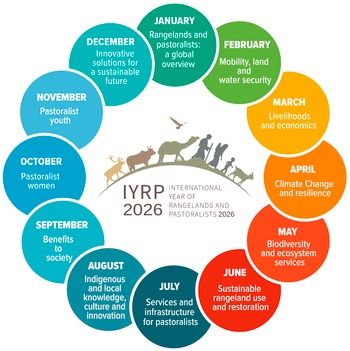
The Global Alliance created a framework of 12 monthly themes for the IYRP to highlight the critical challenges confronting pastoralists and rangelands and to illustrate the commonality of these challenges throughout the globe (Figure 3). The themes also highlight the important contribution of rangelands and pastoralists to the environment and society. The themes originated from multiple sources including declarations from pastoralist assemblies and FAO and UNEP documents. The monthly themes will showcase the diversity of pastoralists and pastoral systems prevalent in each region.
Twelve monthly themes of the IYRP highlighting unique contributions and challenges of rangelands and pastoralists.

Global alliance mission and vision statement and goals
Mission statement
Promote sustainable rangeland stewardship and pastoralism through the creation and dissemination of knowledge, construction of coalitions, and support for effective legislation and governance.
Vision statement
Societal recognition of rangelands and pastoralists that is commensurate with their contribution to humanity, and equitable and just representation of pastoralists in local, national and global governance.
Goal 1. Increase public awareness of the societal value derived from rangelands and pastoralism
Communicate and promote the vital contribution of rangelands and pastoralists to sustainable food systems, biodiversity conservation, land degradation neutrality and climate change mitigation. Key messages will be communicated to diverse audiences through multiple venues, including social media, websites, film festivals and national and global conferences.
Goal 2. Promote pastoralist knowledge, innovation and coalition building to meet contemporary needs
Effective stewardship of rangelands and pastoralism requires knowledge of the complex, adaptive linkages among ecological, socioeconomic and political dynamics supporting the resilience of these systems, rather than narrowly focused technofixes. Relevant and durable partnerships consisting of a coalition of nations, civil society organizations and other diverse stakeholders are required to create and share knowledge of existing challenges and potential solutions.
Goal 3. Advocate for evidence-based policy and legislation that supports sustainable rangelands and pastoralism
Advocate for policies and governance mechanisms vital to pastoralist livelihoods and rangeland stewardship, including ethical and just treatment of pastoralists and the animals on which they depend, and physical infrastructure facilitating extensive, mobile pastoralism. Equally important is replacement or redesign of failed policies, including resource privatization and land conversion and fragmentation, that have contributed to adverse outcomes for pastoralists and their environments in the past.
Goal 4. Foster strategic and ethical investments to address challenges confronting rangelands and pastoralism in the 21st century
Marginal returns from past investments necessitate that the rangeland science and pastoralist development professions advocate for more strategic and ethical public and private investment strategies in the future. This may be accomplished by greater representation of local communities and local/Indigenous knowledge, innovation and values, and increased awareness of the contribution of governance to program outcomes.
IYRP 2026
When UNGA invited FAO to serve as the lead agency in implementing the IYRP in 2026, it requested that FAO develop a formal report in 2027 documenting activities and achievements of the IYRP. In mid-2025, FAO formed an IYRP Steering Committee, which includes four non-FAO members of the Global Alliance; this is anticipated to provide an opportunity to incorporate critical insights and recommendations developed by the Alliance. The UN Resolution on the IYRP provides opportunities to integrate these recommendations into existing and emerging programs of several multilateral organizations, specifically FAO, UNCCD, the Convention on Biological Diversity and the UN Framework Convention on Climate Change. Recommendations will focus on the transformation of narratives to more appropriately identify the benefits provided by rangelands and pastoralists and the creation of strategies and policies to sustain these benefits for future generations.
The IYRP Global Alliance (2016) will seek to accomplish its goals through numerous activities and venues. Key messages will be disseminated through social media, films, webinars and exhibitions presented at multiple global, regional, national and local events. Each of the 11 RISGs will focus on key issues that resonate with diverse stakeholders and the public in their respective regions (Figure 1). Pastoralist groups will organize events to enhance awareness of their cultures and ways of life to strengthen pastoralist civil society and increase leverage with national and global policymakers. Policy recommendations will be presented to international and national governing bodies and at major global conferences, including relevant UN COP events.
IYRP beyond 2026
The Global Alliance is exploring options to continue its momentum beyond the IYRP 2026 to complete ongoing activities and to develop new initiatives in support of sustainable rangelands and pastoralist futures (Figure 2). Potential future initiatives include the following:
-
• International Day of Rangelands and Pastoralists
-
• Programmatic designation specific to rangelands and pastoralists in a relevant multilateral organization
-
• Global rangelands certification standard and monitoring system
-
• Data-based module that will enable local communities to support land degradation neutrality in coordination with the UNCCD.
The multiple challenges confronting rangelands and pastoralists require a concerted multistakeholder effort to strategically guide investments that balance positive pastoralist developmental outcomes with effective rangeland stewardship as well as just and sustainable livelihoods of pastoralists (Reid et al., Reference Reid2021). Continued interdisciplinary and transdisciplinary dialogue, perhaps the greatest contribution of the IYRP, is required to sustain momentum for global action. Collaboration among the rangeland science and pastoralist development communities to achieve intimately related goals is vital to a future in which sustainable rangelands and pastoralism play a critical role in supporting environmental quality and maintaining food and economic security.
Open peer review
For open peer review materials, please visit http://doi.org/10.1017/dry.2025.10016.
Data availability statement
No data files were referenced.
Acknowledgements
We wish to commemorate the spirited contributions of the late Jim O’Rourke, who was a founding leader of the campaign for the successful UN Resolution. He was instrumental in securing support for the IYRP within the IRC, North America and the Society for Range Management. We acknowledge the constructive reviews of Layne Coppock, Andrew Feldman and Jurgen Hoth and the ongoing contributions of the members of the IYRP Global Alliance.
Author contribution
Organization and writing of initial draft: DDB; original IYRP content development and editing: MN-F; pastoralist development content and editing: JD; chronological IYRP development and editing: AW-B and BSH; graphics coordination and editing: IS.
Financial support
No financial resources supported this work.
Competing interests
The authors declare none.



 Open access


Comments
11 October 2025
Dear Editor Osvaldo Sala:
The manuscript entitled, “United Nations Declares 2026 International Year of Rangelands and Pastoralists” is being submitted for consideration as a perspectives in Drylands. You had requested that a piece along these lines be developed following your return from IRC in Australia.
I will gladly provide additional information upon request.
David Briske
Regents Professor Emeritus