





In the UK, over 100 000 children live in the care of local authorities, most commonly due to abuse or neglect (66% of cases), family dysfunction (12%), or absent parenting (9%). 1,2 Children who are currently or have previously been placed in care, either voluntarily or under a care order, face an increased risk of a range of negative outcomes including behavioural problems, neurodevelopmental disorders, and poor mental health. Reference Bronsard, Alessandrini, Fond, Loundou, Auquier and Tordjman3–Reference McKenna, O’Reilly and Maguire5 Understanding the factors that influence the mental health and overall adjustment among such ‘care-experienced’ children and young people is essential for providing effective support and promoting their overall well-being.
The stability of a child’s living arrangement within the care system, also known as ‘placement stability’, can play a key role in their adjustment, and is particularly important given the adverse experiences many children face prior to entering care. 6 Internationally, child welfare agencies emphasise the importance of stable placements for promoting better outcomes for care-experienced individuals. 7–10 Despite these efforts, placement instability remains a significant issue in the UK care system, with approximately 30% of children in care experiencing at least one placement change each year, and 10% facing two or more. 1 While some placement moves may be necessary to meet a child’s needs or ensure their safety, these transitions are often unexpected and uncontrollable for the child, with many expressing feelings of shock, fear and sadness from losing not only their home, but sometimes also their friendships and school. Reference Rostill-Brookes, Larkin, Toms and Churchman11 Furthermore, placement breakdowns are typically underpinned by complex factors related to the needs of the child, the carer, the placement dynamics and systemic factors. Child-related factors are likely to depend, at least in part, on their experiences both prior to and during the placement, which may, in turn, influence how they make sense of and respond to the breakdown event following its occurrence. Reference Bombach, Gabriel and Stohler12
The negative impact of placement instability on the mental health and well-being of care-experienced children and young people has been widely documented, particularly in relation to externalising behaviours. Reference Clark, Palmer, Akin, Dunkerley and Brook13–Reference Newton, Litrownik and Landsverk16 There is also additional evidence highlighting mental health difficulties as a risk factor for placement instability, Reference Clark, Palmer, Akin, Dunkerley and Brook13–Reference Newton, Litrownik and Landsverk16 leading to growing recognition of a bidirectional relationship. Reference Newton, Litrownik and Landsverk16–Reference Jones, Everson-Hock, Papaioannou, Guillaume, Goyder and Chilcott18 However, much of the existing evidence on this relationship is limited in its relevance to the UK care system due to an underrepresentation of UK-based research. Previous reviews have rarely identified quantitative evidence from UK studies, and no systematic examination of UK-specific evidence has been conducted until now. Reference Maguire, May, McCormack and Fosker19,Reference Riemersma, Harder, Zijlstra, Post and Kalverboer20 This gap is problematic given substantial variations in care systems globally Reference Berrick, Dickens, Poso and Skivenes21–Reference Munro and Manful23 and the presence of distinct challenges within the UK care system, including significant financial pressures on social care services, Reference Holmes24,Reference Oakley, Miscampbell and Gregorian25 a focus on permanent out-of-home placements, Reference Forrester, Goodman, Cocker, Binnie and Jensch26 and the societal-level exacerbation of financial and mental health challenges due to the recent cost-of-living crisis. Reference Bennett, Schlüter, Melis, Bywaters, Alexiou and Barr27,Reference Smith28 These factors underscore the critical need for UK-specific evidence to inform national policies and guidelines that address the unique needs of children looked after within the UK care system.
To address the gap between research and practice, we conducted a systematic review and meta-analysis that synthesised existing evidence on the potential bidirectional relationship between placement instability and mental health among care-experienced children and young people in the UK. In doing so, we consolidated findings from studies that assessed mental health as either an outcome or a predictor of placement instability, and evaluated the methodologies used in existing research. As the first meta-analysis globally to explore this relationship, our findings highlight critical areas for future research and provide key insights to inform service-level recommendations, with a particular focus on enhancing practice within the UK care system.
Method
This systematic review and meta-analysis adheres to the Preferred Reporting Items for Systematic Reviews and Meta-Analyses (PRISMA) guidelines Reference Page, McKenzie, Bossuyt, Boutron, Hoffmann and Mulrow29 (see Supplementary Material 1.0 for the PRISMA checklist, available at https://doi.org/10.1192/bjp.2025.10375). The review was prospectively registered on the International Prospective Register of Systematic Reviews (PROSPERO; CRD42024493617) on 3 January 2024 and any deviations from this protocol are detailed in Supplementary Material 2.0.
Search strategy and study selection
We performed a systematic search across five electronic databases (PsycNet, PubMed, International Bibliography of the Social Sciences, Child Development and Adolescent Studies, and Scopus) on 9 February 2024, with an update on 28 August 2024. The search strategy comprised terms relating to children and young people (e.g. child* OR adolescen*), the care system (e.g. looked after OR foster care), placement (in)stability (e.g. stability OR breakdown*), and mental health (e.g. psycholog* OR mental), including relevant MeSH terms. Search terms were selected based on established terminology in the literature and those employed in previous reviews exploring similar topics. Reference Konijn, Admiraal, Baart, van Rooij, Stams and Colonnesi30–Reference Pixley32 The full search strategy is provided in Supplementary Material 3.0.
Original research articles were included if they: were published in English; were peer-reviewed; were conducted in the UK; included a sample who were currently or previously living in local authority care (regardless of placement type); included a measure of placement (in)stability; included at least one measure of mental health (e.g. self-report, other-report, the presence/absence of a mental disorder, or records of self-harm or suicide attempts); and quantitatively analysed the association between placement instability and mental health. We excluded dissertations, previous review articles, unpublished studies, and articles reporting only qualitative findings (see Supplementary Material 4.0 for detailed inclusion/exclusion criteria).
After removing duplicates, we uploaded articles into Covidence (2022; Veritas Health Innovation, Melbourne, Australia; www.covidence.org) for screening. Two reviewers (C.V. and either S.T.L. or a research assistant) independently assessed the titles and abstracts against the inclusion/exclusion criteria. Full text screening was then conducted in duplicate by the same reviewers to determine final eligibility, with discrepancies resolved through consensus discussions. We conducted backward and forward citation searches on all studies selected for inclusion and reviewed the reference lists of previous relevant reviews Reference Maguire, May, McCormack and Fosker19,Reference Riemersma, Harder, Zijlstra, Post and Kalverboer20,Reference Konijn, Admiraal, Baart, van Rooij, Stams and Colonnesi30,Reference McKenna, Donnelly, Onyeka, O’Reilly and Maguire33–Reference Rock, Michelson, Thomson and Day35 to identify any additional articles, but none were found (see Supplementary Material 5.0).
Data extraction
Two reviewers (C.V. and either S.T.L. or A.R.P.) independently extracted data from each study using a standardised, pre-piloted data extraction form, with regular meetings to resolve any disagreements. The extracted data included study location, design, sample size, participant demographics and the measures used to assess placement instability and mental health (see Supplementary Material 6.0 for full details). We also extracted odds ratios with 95% confidence intervals for the relationship between placement changes and mental health. These were either directly extracted or calculated from the number of participants with and without placement instability, categorised by the presence or absence of a mental health difficulty. In cases where such data were unavailable, we contacted study authors to request the relevant data before extracting other summary statistics that could be used to approximate an odds ratio (see Supplementary Material 7.0). For studies with multiple mental health measures, we prioritised the Strengths and Difficulties Questionnaire (SDQ) scores, as these are routinely used in the UK for assessing mental health among care-experienced children. 36 If available, we used the total problem score; otherwise, we extracted scores from the emotional problems subscale. In the absence of SDQ data, we prioritised other validated mental health measures, or clinical diagnoses. When the necessary data to calculate or approximate an odds ratio were not available, studies were excluded from the meta-analysis but remained included in the narrative synthesis.
Data analysis
Following the three-step approach outlined by the Economic and Social Research Council (ESRC), Reference Popay, Roberts, Sowden, Petticrew, Arai and Rodgers37 we conducted a narrative synthesis of the included studies to explore sample type, study location, study quality and the measures used to assess placement instability and mental health.
For studies with available data, we performed a meta-analysis of the unadjusted odds ratios and corresponding 95% confidence intervals to assess the pooled association between placement instability and mental health difficulties. In cases where odds ratios were not already calculated, or the necessary raw data were unavailable, we applied transformations according to standard recommendations Reference Lenhard and Lenhard38 (see Supplementary Material 7.0). To assess heterogeneity, we used the I 2 statistic, where values of 0, 25, 50 and 75% corresponded to no, low, moderate, and high heterogeneity, respectively. Reference Higgins, Thompson, Deeks and Altman39 To investigate potential sources of heterogeneity in the pooled association, we performed subgroup analyses based on the type of mental health outcome (broad psychological measures versus clinical measures; see Supplementary Material 10.1), study quality and year of publication. We used random-effects models throughout as a high level of heterogeneity was anticipated.
Publication bias was assessed by visually inspecting funnel plots and performing Egger’s test. Reference Egger, Davey Smith, Schneider and Minder40 Where publication bias was identified, we employed the trim-and-fill method Reference Duval and Tweedie41 to calculate corrected effect sizes. To evaluate the robustness of our pooled results, we conducted sensitivity analyses (see Supplementary Material 11.0) examining the influence of specific decisions made during data extraction and the effect of approximating odds ratios via transformations. We also performed a leave-one-out analysis, systematically excluding one study at a time to determine if any single study disproportionately influenced the overall pooled odds ratio. All statistical analyses were completed in R (version 4.3.0 for Windows 11; R Core Team, Vienna, Austria; https://www.r-project.org).
Quality assessment
We assessed the methodological quality of the included studies using adapted versions of the Newcastle–Ottawa Scale (NOS; Reference Wells, Shea, O’Connell, Peterson, Welch and Losos42 see Supplementary Material 13.0). Two independent reviewers (C.V. and A.R.P.) completed the quality assessments, with any disagreements resolved through consensus discussion. Studies were assessed based on four key domains: sample selection, comparability of participants, assessment of placement instability and mental health, and statistical rigour. Each study was categorised as having good, fair, or poor quality according to the scores assigned for each domain.
Results
Our systematic search identified 7120 articles. After removing 3294 duplicates in EndNote (version 20.6 for Windows 11; Clarivate, Philadelphia, USA; =https://support.clarivate.com/Endnote/s/article/Download-EndNote?language=en_US), 3826 unique records were imported into Covidence for title and abstract screening. Full-text screening was performed on 179 articles, yielding 15 articles with a total care-experienced sample of N = 6905. Figure 1 shows the PRISMA flow diagram for the included studies. For a full list of excluded studies with reasons, see Supplementary Material 8.0.
PRISMA flow diagram.

Study characteristics
The study characteristics of the 15 included studies are summarised in Table 1. Studies spanned the period 2001 to 2023, with ten (67%) conducted in England, Reference Hiller, Fraser, Denne, Bauer and Halligan17,Reference Ward and Skuse43–Reference Beck46,Reference Lutman and Farmer49,Reference Hillen and Gafson51–Reference Neil, Morciano, Young and Hartley53,Reference Smith, Bartlett and Hales55 one (7%) in Wales, Reference Paine, Fahey, Anthony and Shelton54 two (13%) in Northern Ireland, Reference McKenna, O’Reilly and Maguire5,Reference Hamilton, Taylor, Killick and Bickerstaff50 and two (13%) employing a combined sample across England, Wales and Scotland. Reference Ford, Vostanis, Meltzer and Goodman47,Reference Dregan and Gulliford48 Care-experienced sample sizes ranged from N = 41 Reference Richards, Wood and Ruiz-Calzada45 to N = 1543, Reference Ford, Vostanis, Meltzer and Goodman47 with a mean of 525 participants. Participants’ ages ranged from infancy to 30 years old. Of the 15 studies, 9 (60%) focused exclusively on children or young people in local authority care at the time of data collection. Reference McKenna, O’Reilly and Maguire5,Reference Ward and Skuse43–Reference Ford, Vostanis, Meltzer and Goodman47,Reference Hillen and Gafson51,Reference Hiller and St Clair52,Reference Smith, Bartlett and Hales55 A further four (27%) studies examined mental health in individuals who had previously been in care but had since left the care system, Reference Dregan and Gulliford48 been reunified with parents, Reference Lutman and Farmer49 or been adopted, Reference Neil, Morciano, Young and Hartley53,Reference Paine, Fahey, Anthony and Shelton54 while two (13%) studies included both current and former care recipients. Reference Hiller, Fraser, Denne, Bauer and Halligan17,Reference Hamilton, Taylor, Killick and Bickerstaff50 Most samples comprised children placed in foster care (n = 8, 62%), residential care (n = 8, 62%) or kinship care (n = 7, 54%), though other care settings were also reported (see Supplementary Material 9.0).
Characteristics of studies included in review (n = 15) and meta-analysis (n = 12)

E, England; W, Wales; NI, Northern Ireland; S, Scotland; CAMHS, Child and Adolescent Mental Health Services; AMHS, Adult Mental Health Services; ED, Emergency Department; SDQ, Strengths and Difficulties Questionnaire; ICD-10, International Classification of Diseases-Tenth Revision; DAWBA, Development and Well-Being Assessment; ASQ:SE, Ages & Stages Questionnaires: Social-Emotional (Second Edition); PAPA, Preschool Age Psychiatric Assessment; PIR-GAS, Parent–Infant Relationship Global Assessment; PSRS, Perceived Stress Reactivity Scale.
Mental health outcome in bold shows the outcome used in the subsequent meta-analysis.
a n refers to care-experienced sample only.
b Total number of children/young people data were collected for: 109 young people, 162 carers/key workers, 8 teachers (completing questionnaires for 25 children).
c Age at the start of study/return/data extraction.
d +, poor quality; ++, fair quality; +++, good quality, as assessed by adapted versions of the Newcastle–Ottawa Scale Reference Wells, Shea, O’Connell, Peterson, Welch and Losos42 (see Supplementary Material 13.0).
e Studies included in narrative synthesis only.
The majority of studies (n = 10, 67%) used cross-sectional designs, Reference McKenna, O’Reilly and Maguire5,Reference Ward and Skuse43–Reference Ford, Vostanis, Meltzer and Goodman47,Reference Hamilton, Taylor, Killick and Bickerstaff50,Reference Hillen and Gafson51,Reference Neil, Morciano, Young and Hartley53,Reference Smith, Bartlett and Hales55 while five (33%) employed longitudinal designs. Reference Hiller, Fraser, Denne, Bauer and Halligan17,Reference Dregan and Gulliford48,Reference Lutman and Farmer49,Reference Hiller and St Clair52,Reference Paine, Fahey, Anthony and Shelton54 The measurement of placement (in)stability varied widely across the reviewed studies. Most calculated the total number of placements or changes a child experienced from the time they entered care until data collection, irrespective of time spent in care. Reference McKenna, O’Reilly and Maguire5,Reference Stanley, Riordan and Alaszewski44,Reference Dregan and Gulliford48,Reference Hamilton, Taylor, Killick and Bickerstaff50,Reference Neil, Morciano, Young and Hartley53–Reference Smith, Bartlett and Hales55 However, several studies standardised this approach by focusing on placement changes within defined time frames, such as the previous 12 months, Reference Beck46,Reference Ford, Vostanis, Meltzer and Goodman47 the first 3 years in care, Reference Hiller, Fraser, Denne, Bauer and Halligan17 or the first 5 years in care. Reference Hiller and St Clair52 Definitions of what constituted a placement change also varied. Some studies excluded shorter placements such as hospital admissions or initial overnight emergency placements, Reference Ward and Skuse43,Reference Hillen and Gafson51 while others included them. Reference Hiller and St Clair52 Notably, Hiller et al Reference Hiller, Fraser, Denne, Bauer and Halligan17 and Hiller and St Clair Reference Hiller and St Clair52 counted a placement provider only once, even if they had provided care for the child multiple times.
Studies also differed in how they measured mental health. The SDQ Reference Goodman56,Reference Goodman57 was used in six (40%) studies to assess emotional and behavioural difficulties, Reference Hiller, Fraser, Denne, Bauer and Halligan17,Reference Richards, Wood and Ruiz-Calzada45–Reference Ford, Vostanis, Meltzer and Goodman47,Reference Hiller and St Clair52,Reference Paine, Fahey, Anthony and Shelton54 of which, three relied on reports from caregivers, Reference Hiller, Fraser, Denne, Bauer and Halligan17,Reference Hiller and St Clair52,Reference Paine, Fahey, Anthony and Shelton54 while three combined this with information from teachers and self-report data. Reference Richards, Wood and Ruiz-Calzada45–Reference Ford, Vostanis, Meltzer and Goodman47 Three (20%) studies developed novel measures of mental wellbeing: Lutman and Farmer Reference Lutman and Farmer49 created a well-being scale utilising data from children’s case files; Stanley et al Reference Stanley, Riordan and Alaszewski44 classified mental health need based on participants’ clinical symptoms, emotions and social behaviours; and Neil et al Reference Neil, Morciano, Young and Hartley53 determined a scale of adverse outcomes based on caregiver-reports. Additionally, six (40%) studies used clinical indicators of mental health, including psychiatric diagnoses, Reference Ford, Vostanis, Meltzer and Goodman47,Reference Hillen and Gafson51,Reference Smith, Bartlett and Hales55 instances of self-harm or suicidal ideation, Reference McKenna, O’Reilly and Maguire5,Reference Beck46,Reference Hamilton, Taylor, Killick and Bickerstaff50 access to mental health services, Reference McKenna, O’Reilly and Maguire5,Reference Beck46,Reference Hamilton, Taylor, Killick and Bickerstaff50 and psychotropic medication prescriptions. Reference McKenna, O’Reilly and Maguire5 Similarly, Dregan and Gulliford Reference Dregan and Gulliford48 used the Malaise Inventory Reference Rutter, Tizard and Whitmore58 to assess symptoms of depression.
Despite identifying several longitudinal studies, none could establish directionality between placement changes and mental health difficulties, predominantly due to placement stability being measured at a single time point. Nevertheless, the longitudinal studies offer valuable insights into the evolving relationship between placement changes and mental health. For example, Hiller and St Clair Reference Hiller and St Clair52 found that the association between placement instability and emotional problems peaked during a child’s fourth year of care and stabilised by year five. Similarly, Hiller et al Reference Hiller, Fraser, Denne, Bauer and Halligan17 observed that experiencing more placement changes in the first 3 years of care was associated with greater internalising and externalising problems, particularly in years two and three. Finally, Lutman and Farmer Reference Lutman and Farmer49 reported that children’s emotional problems prior to returning to the care of a parent were predictive of placement instability 5 years post-return.
Quality of evidence
Regarding the quality of the included studies, seven (47%) were of poor quality, four (27%) were of fair quality, and four (27%) were rated as good quality (see Table 1). Studies typically scored lower due to inadequate handling of covariates but performed better in terms of the measures and statistical methods used to assess outcomes. The full results of the quality assessment are reported in the Supplementary Material 13.4.
Association between placement instability and mental health
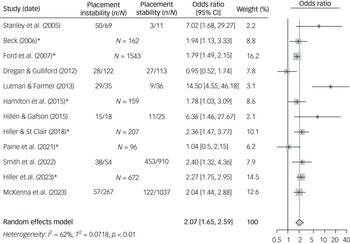
A random-effects meta-analysis of 12 studies (n = 5536 care-experienced participants) showed that individuals with unstable placements were over two times more likely to experience mental health difficulties compared to those in stable placements (pooled odds ratio 2.07, 95% CI 1.65–2.59; see Fig. 2). Moderate heterogeneity was observed across studies (I 2 = 61.8%, p < 0.01), indicating some variation in the strength of this association. Therefore, potential sources of heterogeneity were explored. A subgroup meta-analysis, stratified by type of mental health measure, did not find robust evidence of differences between studies using broader psychological measures of mental health (such as the SDQ) and those using clinical measures (such as formal psychiatric diagnoses and instances of self-harm; χ 2 = 1.55, d.f. = 1, p = 0.21; see Supplementary Material 10.2 for full results). We also found no evidence of differential associations across studies in which quality was assessed as poor, fair, or high (χ 2 = 4.56, d.f. = 2, p = 0.10; see Supplementary Material 10.3 for full results), or between studies published before or after 2015 (χ 2 = 0.34, d.f. = 1, p = 0.56; see Supplementary Material 10.4 for full results).
Odds ratio of poor mental health among care-experienced individuals with and without placement instability. n, cases of poor mental health; N, total group size. Where a separate n is not available for each group (i.e., where odds ratios are transformed from other statistics), total N is reported. *Odds ratio has been approximated by transforming from another effect size rather than calculated from a 2 × 2 contingency table.

Egger’s test (p > 0.05) indicated minimal evidence of publication bias (Supplementary Material 12.0). While the trim-and-fill method identified three potentially missing studies, incorporating these only slightly reduced the pooled odds ratio from 2.07 to 1.81 (95% CI 1.21–2.71; see Supplementary Material 12.0), maintaining the positive association. Sensitivity analyses conducted to assess the impact of decisions made during data extraction – such as selecting the primary mental health outcome measure and categorising placement changes as stable versus unstable – showed the pooled effect size to remain relatively stable (odds ratio range: 1.93 and 2.13; Supplementary Material 11.1). Similarly, no evidence of differential associations was found across studies where the odds ratio was approximated via transformation (odds ratio 1.81, 95% CI 1.55–2.12) and those calculated using raw data (odds ratio 3.29, 95% CI 1.48–7.30; χ 2 = 2.05, d.f. = 1, p = 0.15; Supplementary Material 11.2). The three largest studies, all with effect sizes around two, further support the robustness of the overall effect, as do the results of the leave-one-out analysis (Supplementary Material 11.3).
Discussion
This systematic review and meta-analysis offers important, novel insights into the association between placement instability and mental health among care-experienced children and young people, with a particular focus on the UK. We provide robust evidence that individuals with unstable care placements are more than twice as likely to experience mental health difficulties compared to those in stable placements. With approximately 45% of care-experienced children and young people affected by mental health disorders, 9 we identify placement instability as a potential contributing factor to this high level of need, emphasising how aspects of the care experience may exacerbate emotional distress. These findings are particularly relevant for certain groups of children, including those from ethnic minority backgrounds and those with a disability, who are less likely to achieve permanency. 59
While this is the first systematic review to evidence this association within the unique context of the UK care system, it is also the first meta-analysis globally to examine the relationship between placement changes and mental health. Placement instability remains a widespread issue internationally, with recent global estimates indicating that one in four foster placements break down, rising to one in three among adolescents. Reference Eltink, Waaijenberg, Broers, van Anrooij, van Rooij and Stams60 While our findings align with international research which has consistently linked instability to various aspects of mental health, Reference Maguire, May, McCormack and Fosker19,Reference Konijn, Admiraal, Baart, van Rooij, Stams and Colonnesi30,Reference Rock, Michelson, Thomson and Day35,Reference Dubois-Comtois, Bernier, Tarabulsy, Cyr, St-Laurent and Lanctot61 they add unique meta-analytical evidence that has not been presented before. In contrast to previous reviews, we identify a more consistent association between placement changes and a range of mental health outcomes, including emotional and behavioural difficulties, self-harm and psychiatric diagnoses. Our findings are also consistent with qualitative studies that highlight the importance of stability in promoting children’s sense of belonging, control and secure relationships. Reference Chambers, Crutchfield, Willis, Cuza, Otero and Harper62,Reference Woodall, Browne, Green and Majumder63 Taken together, these results support the assumption that placement changes contribute significantly to mental health difficulties among care-experienced children. However, a bidirectional relationship is also likely, as young people with severe mental health issues may find it more difficult to settle into placements, and caregivers face more challenges in supporting them. Reference Clark, Palmer, Akin, Dunkerley and Brook13,Reference Vreeland, Ebert, Kuhn, Gracey, Shaffer and Watson15,Reference Hiller, Fraser, Denne, Bauer and Halligan17 This dynamic likely increases the risk of premature placement terminations, Reference Newton, Litrownik and Landsverk16,Reference Hiller, Fraser, Denne, Bauer and Halligan17 creating a cycle of instability and worsening mental health and leaving young people at risk of severe negative outcomes. Reference Clark, Palmer, Akin, Dunkerley and Brook13,Reference Vreeland, Ebert, Kuhn, Gracey, Shaffer and Watson15,Reference Okpych and Courtney64
A key objective of our meta-analysis was to capture these bidirectional effects. However, the lack of causal evidence identified in our review prevented us from assessing the temporal direction of this association. Similarly, a previous international systematic review exploring placement instability identified 40 quantitative studies, none of which used longitudinal designs. Reference Rock, Michelson, Thomson and Day35 These observations highlight a critical gap in the evidence that limits our understanding of the reciprocal dynamics at play in the association between placement instability and mental health, and consequently the potential to inform UK policy and practice. Furthermore, with an estimated shortage of 8500 foster carers in the UK, children are increasingly placed in unregulated settings such as hostels and shared housing, exacerbating both instability and mental health problems. Reference MacAlister65 Addressing this gap could have implications for the recruitment, training and support for foster carers, leading to more stable placements and better outcomes for care-experienced children.
The majority of studies identified in our review assessed mental health using the SDQ, consistent with the wide use of this measure in the UK social care system. 36 Other measures included psychiatric diagnoses, symptoms of depression and instances of self-harm or suicide. Despite the variety in measures, studies yielded relatively consistent evidence in terms of the association between mental health and placement instability. Unfortunately, there was insufficient data to determine whether specific mental health issues, such as depression, self-harm, or anxiety, were more strongly associated with placement instability and this remains a critical question. For instance, previous work has identified a stronger association between placement instability and externalising symptoms, such as disruptive or aggressive behaviours, Reference Maguire, May, McCormack and Fosker19,Reference Dubois-Comtois, Bernier, Tarabulsy, Cyr, St-Laurent and Lanctot61,Reference Okpych and Courtney64 potentially due to these behaviours placing greater strain on carers. Similarly, previous reviews have demonstrated a stronger link to post-traumatic symptoms. Reference Maguire, May, McCormack and Fosker19,Reference Konijn, Admiraal, Baart, van Rooij, Stams and Colonnesi30 Future research should prioritise exploring these distinctions further to better understand how placement instability impacts different dimensions of mental health. Exploring these nuances would offer valuable insights that could help tailor more targeted interventions for care-experienced children and young people, both in the UK and internationally.
When interpreting our findings, several limitations of the evidence base must be considered. First, though random-effects models were used, high heterogeneity was observed, which was not explained by our subgroup and sensitivity analyses. This variability likely arises from inconsistencies in participant demographics, sampling methods and measurement approaches. Notably, definitions of ‘placement instability’ varied widely. For example, studies differed in how they defined a placement change and how many times the same placement could be counted, meaning that the relationship effect in our meta-analysis should be understood within the specific context of each individual study. A more fine-grained analysis of the nature and extent of placement changes could provide further insights into the children and young people most at risk of mental health difficulties. Second, several studies included in the meta-analysis were rated as poor quality, primarily due to limitations around comparability. Key confounding factors known to correlate with both placement instability and poor mental health – such as gender, age, ethnicity, trauma history and other placement-related factors Reference Clark, Palmer, Akin, Dunkerley and Brook13,Reference Rock, Michelson, Thomson and Day35,Reference Sattler, Font and Gershoff66–Reference Tarren-Sweeney68 – were often inadequately controlled and there were inconsistencies around the reporting of these variables. Nevertheless, sensitivity analyses showed the overall effect size to remain consistent across studies of varying quality. Finally, as previously noted, the lack of robust longitudinal evidence limited our ability to explore the reciprocal relationship between placement changes and mental health. This is a critical evidence gap to address in future work.
Our methodology also has limitations. In instances where raw data were unavailable, we estimated the odds ratio using other available statistics, which relies on assumptions and statistical transformations that can introduce inaccuracies. As a result, these estimates should be interpreted with caution, though sensitivity analyses showed no difference in the pooled effect size of these studies when compared to those with odds ratios calculated from raw data. Due to inadequate data availability, we also relied on unadjusted odds ratios, neglecting previously mentioned variables that may influence the relationship between placement instability and mental health. The exclusion of grey literature is also a potential limitation, although we found no evidence of publication bias. Finally, small numbers of studies in subgroup meta-analyses reduced the precision of our results, potentially leading to imprecise confidence interval ranges and inaccurate estimates of between-study heterogeneity.
Clinically, our findings highlight the importance of prioritising care stability and exploring ways to reduce the potential impact of poor mental health on placement experiences. A doubling of the odds for mental health difficulties in this high-risk group places additional strain on already stretched social care and mental health services. Policymakers must prioritise and provide funding for early collaborative interventions between mental health service providers and local authorities that simultaneously focus on both placement stability and mental health support. This approach may help prevent the cycle of instability and mental health deterioration, reducing the immediate psychological harm and long-term socioeconomic consequences of untreated mental health difficulties in this group. Currently, services may delay therapeutic support until children are in stable placements, Reference Wilson, Coughlan, Duschinsky and Foster69 but our findings indicate that this may result in children who are most at risk missing out on necessary support. Advocating for timely and accessible mental health services tailored to the specific needs of care-experienced individuals is therefore essential. Training caregivers and social workers on the psychological impact of placement instability could also enhance transitional support, ultimately reducing mental health challenges and decreasing the likelihood of further placement breakdowns.
In light of our findings, it is also important to consider that placement in local authority care should be avoided wherever safely possible. While the care system aims to protect children and promote their wellbeing, our review suggests that care experiences can themselves be associated with increased mental health need, highlighting systemic limitations in providing children with safety, stability and emotional security. UK-based research shows that children looked after by local authorities experience greater levels of psychosocial adversity and psychiatric disorder than even the most socioeconomically disadvantaged children living in private households, Reference Ford, Vostanis, Meltzer and Goodman47 and further meta-analytic evidence suggests that residential care does not consistently lead to better outcomes than remaining at home. Reference Gutterswijk, Kuiper, Lautan, Kunst, van der Horst and Stams70 Therefore, while entry into care is sometimes necessary to ensure a child’s safety, it is important to first explore and prioritise family preservation. Intensive family preservation services represent one example of a potentially safe and effective alternative to out-of-home placement. Reference Bezeczky, El-Banna, Petrou, Kemp, Scourfield and Forrester71,Reference Lippens, De Clercq, Vandevelde, De Pauw and Stams72
In sum, our findings highlight the critical relationship between placement stability and better mental health for children and young people in UK care, with implications for care systems worldwide. We demonstrate that individuals with unstable placements are over twice as likely to experience mental health difficulties compared to those in stable placements, further exacerbating the already heightened mental health vulnerability within this population. Reference Villodas, Cromer, Moses, Litrownik, Newton and Davis73 While UK social services prioritise stable care placements, acting on the assumption that instability is a cause of poor mental health, current research falls short of adequately assessing the direction of this relationship. This underscores the urgent need for robust longitudinal studies that track both placement instability and mental health over time. Such studies should account for additional variables such as trauma history, age, ethnicity, disability and care-related variables to better capture the complexity of this association and consider how aspects of study methodology may influence this relationship. Reference Maguire, May, McCormack and Fosker19 A unified framework for defining and measuring placement instability could further enhance clarity around this relationship, by reducing heterogeneity and improving the comparability of findings across care systems globally. Expanding this research will enhance our understanding of the interplay between mental health symptoms and placement changes and inform more effective mechanisms of intervention aimed at improving the overall well-being of care-experienced children and young people.
Supplementary material
The supplementary material is available online at https://doi.org/10.1192/bjp.2025.10375
Data availability
All data related to this systematic review and meta-analysis will be made publicly available on the Open Science Framework (OSF; https://osf.io/29kbv/) on publication.
Acknowledgements
The authors would like to thank Annalisa Been, research assistant at the University of Bath, for her valuable assistance with the article screening process for this review. They also extend their gratitude to Justin Hodds from the University of Bath for his expertise and guidance in refining search terms and navigating electronic databases.
Author contributions
C.V.: conceptualisation, data curation, formal analysis, funding acquisition, investigation, methodology, project administration, software, visualisation, writing – original draft, writing – review and editing. A.R.P.: investigation, validation, writing – review and editing. S.T.L.: investigation, validation, writing – review and editing. N.M.: writing – review and editing. S.L.H.: conceptualisation, funding acquisition, methodology, project administration, supervision, writing – review and editing. K.S.B.: conceptualisation, methodology, project administration, supervision, writing – review and editing.
Funding
C.V. is funded through an Economic and Social Sciences Research Council South West Doctoral Training Partnership PhD studentship at the University of Bath. The funder of the study had no role in the study design, data collection, data analysis, data interpretation or writing of this report.
Declaration of interest
None.
Transparency declaration
C.V. affirms that the manuscript is an honest, accurate and transparent account of the study being reported; that no important aspects of the study have been omitted; and that any discrepancies from the study as planned and registered have been explained.
Analytic code availability
The analytic code that supports the meta-analyses in this review will be made publicly available on OSF (https://osf.io/29kbv/) on publication.
Research material availability
All supporting materials associated with this review will be made publicly available on OSF (https://osf.io/29kbv/) on publication.




 Open access


eLetters
No eLetters have been published for this article.