

The Fukushima Daiichi Nuclear Power Station accident occurred following the Great East Japan Earthquake on March 11, 2011. Fukushima Medical University, commissioned by Fukushima Prefecture, conducted the Fukushima Health Management SurveyReference Yasumura, Hosoya and Yamashita1 to clarify the adverse effects of radiation on health following the accident. The Mental Health and Lifestyle Survey (MHLS)Reference Yabe, Suzuki and Mashiko2 is a detailed survey which was included in the project. The aim of the MHLS was to identify individuals at risk of developing of psychiatric disorders (e.g., depression, post-traumatic stress disorder) and lifestyle-related issues (e.g., lack of exercise, drinking and smoking habits, obesity), and to provide interventions. The target population comprised approximately 210000 people in 13 municipalities within the Fukushima evacuation area. The results of the first MHLS survey year (2012) demonstrated that the prevalence of probable depression among adult evacuees was as high as 14.6%,Reference Yabe, Suzuki and Mashiko2 based on scores of 13 or more on the Japanese version of the 6-item Kessler Psychological Distress Scale (K6).Reference Furukawa, Kawakami and Saitoh3,Reference Kessler, Andrews and Colpe4 This prevalence of probable depression had been decreasing yearly from 2011-2015.5-8 A 3-year MHLS trajectory analysis revealed that a negative perception of the genetic risks and effects associated with exposure to radiation was strongly associated with depressive symptoms.Reference Oe, Maeda and Nagai9 As a result, in recent years, relevant literatureReference Goldmann and Galea10-Reference Hong and Efferth12 has indicated that mental health problems, including major depression and post-traumatic stress disorder (PTSD), have increased in prevalence, more greatly affecting public health after disasters.
One year after the Fukushima Daiichi Nuclear Power Station accident, 65.7% of evacuees had moved residence more than three times.Reference Yabe, Suzuki and Mashiko2 It is necessary to investigate methods of supporting evacuees who are relocated multiple times, since frequent relocations are related to psychological distress.Reference Horikoshi, Iwasa and Kawakami13 Various methods of supporting evacuees already exist, including: home visits,Reference Teramoto, Nagata and Okamoto14 telephonic support,Reference Sobowale and Torous15 web-based support,Reference Ruggiero, Davidson and McCauley16,Reference Ruggiero, Price and Adams17 and distributing relevant materials via mail. Supposedly, face-to-face support such as personal visits have been most frequently performed in natural disasters, as recommended in psychological first aid (PFA) literature.18 However, as the Fukushima disaster produced over 100000 evacuees dispersed widely through the whole of Japan, the ability to provide visitation to all evacuees was quite limited. We furthermore faced a lack of human resource capacity, because of evacuation of local health professionals as well as affected residents. In these situations, we needed to develop scalable counter measures, which were also applicable to various types of psychological distress that evacuees might have had. TI was considered one of the limited, but feasible, ways of allowing bidirectional contact with numerous evacuees regardless of their location, including elderly people who might hesitate to use the internet. Rather than wait for phone calls from people needing support as is frequently done in natural disasters, we made calls to those at risk, based on results of questionnaires that had been sent in advance. Such bidirectional telecommunication could be a scalable transdiagnostic intervention, while minimizing economical and logistical burdens upon support providers and evacuees. Outreaches utilizing TI have been recognized as useful provided that efficacy requirements indicated by studiesReference Stead, Hartmann-Boyce and Perera19,Reference Simon, Ludman and Tutty20 are adhered to.
In this study, we examined the usefulness of the TI annually conducted for numerous evacuees who had some mental health problems identified by MHLS. However, few global reports indicate TI being employed for this number of evacuees. According to the study describing the features of the TI,Reference Kashiwazaki, Maeda and Yagi21 despite lack of advantage of face-to-face intervention, TI is able to provide support by reducing the influence of distance which many affected people may have faced. This is because it has great feasibility and accessibility, especially in major disasters that produce numerous evacuees over broad areas, such as the Fukushima disaster. In addition, these studies have not considered the effectiveness of these interventions. In particular, there are few reports on the effects of interventions for evacuees using telephonic methods. In order to verify the usefulness of TI following the Fukushima disaster, we focused on interventions for evacuees at risk of mental health problems. The aim of this study was to clarify the usefulness of TI for evacuees by examining their levels of satisfaction with them through individual follow-up interviews.
METHODS
The Mental Health and Lifestyle Survey (MHLS)
The Mental Health and Lifestyle Survey (MHLS) has several purposes. The first is to clarify, using several questionnaires, current mental health problems, and lifestyle-related issues among the people who lived in the evacuation area at the time of the disaster. The second is to provide brief interventions to persons at risk for depression, PTSD, and other behavioral problems identified in the MHLS. The third is to share adequate information regarding available resources inside and outside the Fukushima prefecture, including psychiatric clinics and local health centers.Reference Yabe, Suzuki and Mashiko2,Reference Kunii, Suzuki and Shiga22,Reference Itagaki, Harigane and Maeda23 The target population of the MHLS is individuals registered as residents of municipalities designated as evacuation order areas after the disaster; namely: Hirono, Naraha, Tomioka, Kawauchi, Okuma, Futaba, Namie, Katsurao, Iitate, Minami-soma, Tamura, Kawamata, and portions of Date. Participants are divided into five groups for the MHLS, according to age: 0-3 years, 4-6 years, 7-12 years, 13-15 years, and 16 years and above. The response rates obtained every year have been approximately 20-40%.
Annual Brief Telephonic Interventions
Based on the results of MHLS, we have been providing TI every year for evacuees at risk of mental health or lifestyle-related problems, using a telephonic method, since the 2011 fiscal year. The features of this brief intervention are not ‘on call,’ but rather ‘call service.’ In the context of a more positive, intensive address to evacuees, we called this ‘phone support based on an outreach approach.’ The Mental Health Support Team consisted of 15 counselors, including clinical psychologists, social workers, and public health nurses with more than 10 years of hands-on practical experience. Considering a large number of evacuees, TI had two different aims; one was to provide intervention for as many affected people as possible, and another was to meet their psychological needs as much as possible. These interventions for high risk individuals include active listening, psychoeducation, and advice by telephone or mail. The high risk population identified in our survey had been estimated to number up to 3000-5000. Each TI usually lasted 10-30 minutes according to the conditions or demands of target individuals, and was mostly conducted between 9 AM and 5 PM on weekdays. Completing the intervention for all respondents took about 8 months per year. Thus, the respondents who received TI were about 3000-4000 people yearly.24-26 The respondents were informed that they might receive a telephone call from the counselor if they were identified to be at risk based on the survey, and that TI might be offered. This information was disclosed in a document that was part of the MHLS questionnaire.
Examination of the Usefulness of TI in the 2015 Fiscal Year
For this study, the participants who had undergone the TI were individually interviewed for about 30 minutes to examine the usefulness of the TI at their preferred location (often their home). All the interviewers visited the participants’ homes between August 2016 and November 2016, after providing information regarding this study via mail and confirming acceptance of participation in the interview.
Participants
The target population of the MHLS in the 2015 fiscal year (comprising adult 16 years-old, or older) was 184758 people, and the survey respondents comprised 44010 people. People at high risk for mental health disorders were identified mainly based on the results of the K6. Generally, a cut-off total K6 score of 13 or more is applied in Japan based on the results of standardized procedures from previous studies in Japan.Reference Sakurai, Nishi and Kondo27,Reference Sakuma, Takahashi and Ueda28 However, considering the team’s capability to provide TI for respondents at risk, we used higher cut-off point (15 or more) for TI in the 2015 fiscal year. Of these, 2807 had a K6 of 15 or higher. We thus randomly selected 1553 people who had been evacuated from 13 municipalities in Fukushima Prefecture to 8 safer regions in and outside Fukushima (4 regions each). Consequently, a total of 484 participants (31.2%) gave consent to be interviewed. Of the 484 participants, 438 people received TI (intervention group), and 46 people did not receive TI because they were not on the phone due to working, attending schools or other reasons including refusal despite their high risk (non-intervention group) (Figure 1).
Flow chart of the study participants. The target population of the MHLS in FY2015 (adult group) was 184758 people, and the survey respondents comprised 44010 people. Out of 2807 target persons for telephonic intervention with K6 score of 15 or more, 1553 were randomly selected for face-to-face interviews, and 484 people agreed. Of the 484 participants, 438 people received TI (intervention group) and 46 did not (non-intervention group).

Data Collection and Measures
We gathered data regarding age, sex, subjective health (Good: very good, good, and normal; Poor: poor and very poor), history of mental illness, residential location (inside Fukushima prefecture and outside Fukushima prefecture), number of family members (1-2 and 3+), employment status (employed and unemployed), financial circumstances (good and bad), and K6 data from MHLS questionnaires. The K6 is a self-administered questionnaire consisting of six questions that evaluate depressive mood and anxiety over the preceding four weeks on a 5-point response scale from 0 (none of the time) to 4 (all of the time). A score range of 0-24 is possible. Data were collected through the interviews and comprised the following: advance knowledge of TI availability; desire to receive TI; expectations related to TI; and the Lubben Social Network Scale-6 (LSNS-6).Reference Lubben, Blozik and Gillmann29,Reference Kurimoto, Awata and Ohkubo30 If a participant scored less than 12 on the LSNS-6, they were defined as being socially isolated. Additionally, the individuals belonging to the intervention group had received TI were asked about their subjective thoughts and impressions of the TI, including satisfaction with intervention, conformance to expectations, understanding of the participant’s feelings, protection of privacy, duration of the intervention, and timing of the intervention. We regarded the level of general satisfaction to be the main outcome of this study. Questions regarding subjective thoughts and impressions of the TI were asked by the interviewers, and the participants responded on a 4-point Likert scale from ‘very satisfied’ to ‘very dissatisfied.’
Statistical Analysis
Student t-tests and chi-square tests were performed to compare the intervention and non-intervention groups. The scores on the measures were expressed as means (M) and standard deviations (SD). Multivariate logistic regression analysis was used for the factors associated with satisfaction with the TI. A probability value of P < 0.05 was set to indicate statistical significance. IBM SPSS Statistics for Windows (version 21; IBM Corp, Armonk, NY) was used for all analyses.
Ethical Considerations
This study was approved by the Ethics Review Committee of Fukushima Medical University (No. 2795, 2148). All participants were informed of the purpose of the study, and all were advised that: (1) their participation would be entirely voluntary; (2) they could withdraw from the study at any time; and (3) they would not be disadvantaged if they chose not to participate or to withdraw from the study. Detailed informed consent was acquired from participants at the time of the visit.
RESULTS
Characteristics of Participants
The characteristics of participants in the intervention and non-intervention groups are shown in Table 1. We carried out chi-square tests and t-tests to clarify the differences in characteristics between the two groups. The intervention group was older (P < 0.001), had significantly higher proportion of mental illness (P = 0.012), were more likely to live inside the Fukushima prefecture (P = 0.005), had fewer family members (P = 0.046), had higher levels of unemployment (P = 0.002), and had better financial circumstances (P = 0.042).
Characteristics of the Participants

Note. n (%); mean (SD); *The K6 value was measured by MHLS before the brief telephonic intervention; chi-square test and t-test were used.
Social isolation was measured using LSNS-6 scale; a participant with a LSNS-6 score of <12 was defined as socially isolated.
Table 2 shows the differences between the measured characteristics of intervention group and the non-intervention group. Individuals in the intervention group were more likely to have advance knowledge of TI availability (P < 0.001) and had higher expectation related to TI (P = 0.019). Participants in the intervention group had a particular expectation that they would be able to receive the TI for sufficient time, and be provided with information regarding the available social resources. On the other hand, both the intervention and non-intervention groups had strong expectations that during the TI, they could be advised regarding coping strategies for stress (37.7%), availability of social resources (30.6%), and health-related practices (28.0%).
Differences in the measured characteristics between the intervention group and the non-intervention group
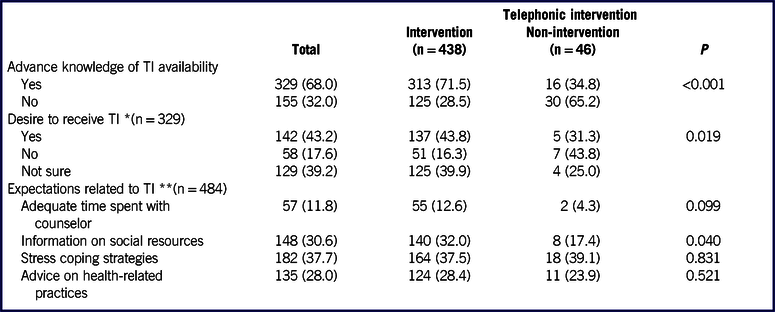
Note. n (%); chi-square test was used; * included only those who answered “Yes” to “Advance knowledge of TI availability”; **asked all the participants regardless of their answer to “Advance knowledge of TI availability”; Advance knowledge of TI availability: Did you know in advance that the TI is available Desire to receive TI: Did you want to receive the TI? Expectations related to TI: What do you expect (hope) for the TI?
Subjective Thoughts and Impressions of the Telephonic Intervention (TI) by the Intervention Group
Figure 2 shows the responses to questions about subjective impressions of the TI received: satisfaction with intervention, conformance to expectations, understanding of the participant’s feelings, protection of privacy, duration of the intervention, and timing of the intervention. The satisfaction level of those in the intervention group was 74.6%. The characteristics of the intervention group, by differences in satisfaction with the intervention, are shown in Table 3. Those who were highly satisfied with intervention hada higher proportion of advance knowledge of TI availability (P < 0.001). Among those who had high expectations related to TI, the participant who expected information on social resources (P = 0.021) and advice on health-related practices (P = 0.002) showed higher satisfaction. Table 4 shows the results of the multivariate logistic regression analysis of factors associated with satisfaction with the intervention. Satisfaction with the intervention was significantly associated with awareness of intervention availability (OR = 3.00, 95% CI: 1.59-5.64) and advice regarding health-related practices (OR = 2.15, 95% CI: 1.12-4.13).
Subjective thoughts and impressions of brief telephonic intervention by the intervention group. It shows a 4-point Likert scale ‘very satisfied,’ ‘satisfied,’ ‘dissatisfied,’ and ‘very dissatisfied.’

Characteristics of the intervention group based on differences in satisfaction with the intervention

Note. n (%); mean (SD); chi-square test and t-test were used.
The results of the multivariate logistic regression analysis of factors associated with satisfaction with the intervention

Note. Multivariate logistic regression was used to calculate ORs and 95% confidence intervals (95% CI) after controlling simultaneously for independent variables; N = 418
DISCUSSION
In this study, we evaluated the TI conducted for those evacuees of the Fukushima nuclear disaster identified to be at risk of mental health problems. In the 5 years after the disaster, the number of people receiving TI exceeded 26000. Our findings revealed that, compared with the non-intervention group, people receiving TI were more likely to be older, unemployed, and have a history of mental illness.
A significant number of people who received the TI expressed a positive impression of it. More than 70% of those who received the TI were satisfied with the process. Whereas the average time spent per session was relatively brief (approximately 15 minutes), the conduct of each intervention was allowed to great flexibility according to the conditions and demands of target individuals. Such flexibility could be key to satisfaction impressions of them, and even a brief intervention can be useful for meeting the affected person’s needs.Reference Birur, Moore and Davis31 Factors related to high satisfaction with the intervention were: ‘advance knowledge of TI availability’ and ‘an expectation to receive advice on health-related practices.’ Participants who remembered the intervention would occur were considered to have psychological readiness, and to express an expectation that TI would persist for a sufficient period of time, during which they might receive useful advice regarding their health problems. Unfortunately, many respondents did not anticipate the TI, despite previous notice. We should consider the fact that the telephone call was unexpected for those without expectation of the intervention, leading to potentially unpleasant feelings. Therefore, advance notice, which should be provided to all target populations, is a very important factor for enhancing the benefits of TI. Widespread advertising strategies, developed in cooperation with municipalities, and promoting the usefulness of TI, could achieve this.
Regarding the mental health of this survey’s target population, a K6 of 15 points or more was required, and these participants were more likely to be unhealthy and to have a history of mental illness.Reference Iwasa, Takebayashi and Suzuki32-Reference Fukasawa, Kawakami and Umeda34 It is conceivable that, because of higher psychological distress, these persons were likely to have already considered seeking some help from experts. These participants were also older and tended to be unemployed. Unemployment may have indicated greater availability to participate in the intervention, even during daytime on weekdays. On the other hand, individuals in the non-intervention group were more likely to be employed,Reference Horikoshi, Iwasa and Yasumura35 and therefore unable to make time to receive the intervention although they may have hoped to do so. Since employed evacuees were also at high risk of psychological distress,Reference Kunii, Suzuki and Shiga22 and future studies should focus on providing interventions on weekends or at other times convenient for employed persons.
In addition, this study revealed high proportion of social isolation in both intervention and non-intervention groups (56.0 %, 54.5 %, respectively). Compared to previous data obtained from national and similarly-structured communities in Japan,Reference Kurimoto, Awata and Ohkubo30,Reference Sone, Nakaya, Sugawara, Tomata, Watanabe and Tsuji36 the proportion in the present study was considerably high. The high social isolation may be due to the unique situation in Fukushima. Because of concerns about radiation effects, evacuees tended to relocate to more remote areas across the country. Long-term evacuation to those areas could damage existing community structures. They also tended to hide their evacuees because of the common stereotypes and prejudices about the genetic effects of radiation exposure, and compensation from Tokyo Electric Power Company. Secondly, social isolation is associated with a higher risk of poor mental health.Reference Sone, Nakaya, Sugawara, Tomata, Watanabe and Tsuji36,Reference Taylor, Taylor, Nguyen and Chatters37 Therefore, we assume that the proportion of social isolation was high because the TI subjects were high-risk population.
Although outreach services are essential for many people affected by disasters as recommended in PFA,18 it is very difficult to provide for the entire population if the affected area is too extensive. Even if we can successfully focus on people at risk of mental health problems through useful screening, the number of people requiring mental health support may become too large to usefully service. However, as shown in this study, TI based on adequate screening can be feasible and useful in major disasters impacting broad areas such as the Fukushima disaster. On the other hand, because of a technical limitation in this approach—namely, an inability to directly confirm the mental health status of affected people through face-to-face interviews—cooperation and sharing of necessary information with pre-existing care resources (e.g., local health care centers, hospitals, and schools) is essential, especially for those at high risk.Reference Maeda and Oe38
There are several other limitations of this study. First, the assessment tools for the usefulness of the TI were all subjective measures based on participants’ opinions and responses. Second, the study design was retrospective, and not a well-controlled design with a comparison group. Specifically, ‘satisfaction’ used to examine the usefulness of TI was measured only in the intervention group, and not in the non-intervention group. Therefore, we did not make a direct comparison between the two groups. In the future, we believe that it is desirable to verify the effectiveness of TI using a design with a clear comparison group. Third, this study may have given representation to a disproportionate number of evacuees, potentially limiting the external validity of the findings. Finally, because the response rate was not high (31.2%), there is the possibility of a lack of representativeness in the evacuee sample. Despite these limitations, this study lends strength to the notion that the use of a continuous TI, broadly conducted for a large number of affected people, can be useful when a major disaster occurs.
CONCLUSIONS
In this study, we clarified the usefulness of the TI for evacuees following the Fukushima Daiichi Nuclear Power Station accident. Many people who received the TI reported a positive impression of the service. The feasibility of this type of intervention should be further examined, since there are few large-scale studies examining TI for this purpose.
Acknowledgments
The authors would like to thank all the members of the Fukushima Health Management Survey, especially the mental health group members, for data collection and suggestions. This study was supported by the National Health Fund for Children and Adults Affected by the Nuclear Incident.
Conflict of Interest Statement
The authors declare no conflicts of interest.


 Open access

