

The Filipino musicians are very capable, and almost invariably far superior to the Chinese in playing our instruments and music, in fact, they almost inundate the East.Footnote 1
The Chinese grew with the country from its earliest days, and helped in its development. They are modest, law-abiding, and hard-working … . The Chinese are possessed of a peculiar knack for cordial conviviality with Filipinos. Many of our best citizens are of Chinese extraction.Footnote 2
Introduction
On a chilly December morning in 1934, Captain Honorio C. Evangelista (Figure 0.1) of the Shanghai Volunteer Corps received orders from Corps HQ to mobilize the Philippine Company in response to “disquieting reports” of enemy activity.Footnote 3 Though a veterinarian by training, the Manila-born Evangelista had demonstrated his martial prowess by rising through the ranks of the Volunteer Corps in Shanghai to become captain of the newly organized Filipino company. His recent promotion and the dire nature of the orders likely provided ample incentive for him and his colleagues to go above and beyond, especially with the other companies of the international volunteer militia – including the British, American, and Japanese companies, who represented the political elite of the city – also participating.
According to reports from headquarters, Taiping rebels, who were “excellent individual fighters, but badly led,” were gathering at the city’s edge with “a certain amount of Machine Guns and modern rifles.”Footnote 4 Shanghai yet again braced itself for an invasion. But how could this be? Although long-haired Taiping rebels had threatened Shanghai after the Battle of Muddy Flats, and Filipino mercenaries in the city had played a role in crushing that rebellion by serving in the so-called Ever-Victorious Army, those events had taken place over eighty years before.Footnote 5 Could this be a restoration of the dreaded Taiping Heavenly Kingdom?
Captain Honorio C. Evangelista, Shanghai Volunteer Corps

Following protocol, Captain Evangelista notified lieutenants Julio Templo, Agapito Celis, and Guillermo Luchangco to assemble the company. Marching through the art deco streets of the International Settlement in Shanghai, the lieutenants led the Filipino volunteers to the Polytechnic Public School for Chinese on Pakhoi Road a little after sunrise at 0800 hours for a rendezvous with other Corps companies. From there, the troops advanced to Sector “B” by Suzhou Creek to watch and secure “all roads leading into the Settlement from the West.”Footnote 6 For the no doubt anxious soldiers, what remained was a waiting game.
Americans, Japanese, Europeans, Filipinos, Middle Easterners, and other foreigners as well as Subei, Jiangnanese, Fujianese, Cantonese, and other Chinese who called Shanghai home lived in a perpetual state of vigilance. Considering the near century of intermittent conflict, refugee migrations, and food shortages many had experienced, this preparedness came naturally. The same qualities that made Shanghai a cosmopolitan economic and cultural hub – proximity to the sea and the Yangtze river, top-tier universities, national and international financial institutions, manufacturing infrastructure, and a stable government under international protection – also made it a prime target for invasion.
However, in the end, after much ado, the Philippine Company’s mobilization came to an end. The Filipinos deployed admirably, but the invasion never came, at least not in the form of Taipings in 1934. The Taipings had indeed been defeated eighty years earlier, and they were merely boogeymen for a Corps mobilization exercise designed to insure the combat preparedness of its international members. Yet Shanghai sat poised for an actual invasion, and the 1934 exercise in which the Philippine Company took part came as the rising sun loomed on the horizon and war drums, or perhaps merely echoes of the bombs that had shattered the Zhabei district two years earlier, rumbled in the distance.
For those of you familiar with twentieth-century Chinese history, the image of Filipino soldiers defending Shanghai against Taiping rebels likely strikes a strange scene, and it puzzled me too when I first came across the mobilization plan in the archives. It did not take me too long to gather that the Taipings were not real, but the more interesting discovery was that the Filipinos, who left many heretofore untold stories in the archives, were.Footnote 7 Sewing together these stories, one discovers a vibrant yet insecure community of predominantly white-collar workers and entertainers – a community that, curiously enough, resembles another in Asia: the Chinese in the Philippines. Chapter 1 explores this mirrored diaspora and the cities and empires that reflected and connected them.
Cities, Diasporas, and Empires
The Filipino community in Shanghai and the Chinese community in the Philippines shared some striking similarities. First, they were dominated by young to middle-aged sojourning men. This sometimes resulted in long-distance relationships but more often led to local marriage, which in turn led to a rising caste of mestizos, or mixed-people, as well as the identity-related issues they navigated. Regarding vocation, some Filipinos in Shanghai and Chinese in Manila, in contrast with other Filipino and Chinese migrants around the world, occupied comparatively well-paid professions. Many Filipinos, for instance, worked as clerks and musicians, while Chinese served in a variety of occupations but were often associated, for better or worse, with a small elite who engaged in business. Hence the trumpets (musicians) and ledgers (businessmen) in Chapter 2’s title.
Chinese and Filipino sojourners in their mirrored diasporas occupied a third space in the imperial-racial hierarchy as unaligned foreign Asians without strong state or imperial protection.Footnote 8 Filipinos and Chinese were not the French, British, Japanese, or Americans, who colonized territory and peoples with armaments, bureaucracies, and selective discourses of enlightenment. Nor were they agents or proxies of empire, like Sikhs or Vietnamese, who, as members of so-called martial races, policed portions of the British and French empires respectively.Footnote 9
At the same time, Chinese in Manila and Filipinos in Shanghai did not resemble Asian settler colonists, like the Japanese, Filipinos, and Chinese who established roots in Hawai’i. In Hawai’i, with greater numbers, Asian settler colonists shared some privilege in imperial and urban hierarchies.Footnote 10 Furthermore, Shanghai’s Filipinos and Manila’s Chinese could not unequivocally claim membership to new national entities championed by “native” leaders. In other words, they could not claim white or Japanese colonial superiority, proxy imperial protection, or indigenous belonging. They filled an ill-defined and precarious middle ground – a space unintentionally cultivated by cities and empires.
Urban spaces around the world sowed vitality, diversity, cross-fertilization, and curious juxtapositions, and in Asia, the immense size of cities only amplified these features. Historians have undertaken meticulous research to highlight the crucial roles of Asian cities, such as Hong Kong, Singapore, Shanghai, Batavia, Yokohama, and to a lesser extent, Manila, in linking together the region and the world.Footnote 11 These and other historians have stressed how, in these Asian metropolises, “new venues were emerging where Asians from all over the region met each other in professional associations and learned societies.”Footnote 12 To put it another way, Manila and Shanghai acted as the trellis that supported migratory vines from China, the Philippines, and places far beyond.
Spreading from city to city, these Asian “mobile societies,” as Engseng Ho calls them, linked the continent, both circumventing and amplifying imperial networks.Footnote 13 In an attempt to follow these mobile societies and piece together a history of the “many Asias” they bridged, scholars have weaved together histories of diaspora, migration, and mobility.Footnote 14 The chapters in this part build on this research by centering the mirrored diasporas of Chinese in Manila and Filipinos in Shanghai. It replaces the nation or nation’s diaspora, which has largely dominated the field of migration studies, with the lattice of inter-Asian migration and urban-imperial connections.
In this era of connectivity, empires spread over water and land, leading scholars to describe them as unbounded and amorphous “formations” or “spheres.”Footnote 15 These overlapping empires, which competed with, copied, and cooperated with one another, also supported many unexpected links, like the ones between China and the Philippines.Footnote 16 To better explore these accidental connections of empire, historians have compiled “new” imperial histories and imperial biographies that followed individuals as they navigated overlapping imperial spheres.Footnote 17 Other scholars have approached imperial histories “from below,” stressing the agency of non-imperials within imperial networks.Footnote 18 Much as cities sowed the businesses, bureaucracies, and dance halls that employed Chinese and Filipinos, empires tilled and fertilized the diasporic fields. And historians of empire have developed sophisticated, if not entirely agreed upon, methods to measure crop yields.
It is time we took a page from an early twentieth-century Shanghai journalist who – borrowing from the term Huaqiao (華僑), which itself had recently been appropriated from an archaic term to describe Chinese living outside the borders of the new Chinese nation-state – referred to Filipinos in China as Feiqiao (菲僑).Footnote 19 In creating this term, this unnamed author recognized what most scholars in the past fifty years have not – that these migrations represent a shared impulse and dynamic, and they warrant comparison.
Incorporating and building on the rich contributions of migration studies, urban history, and new imperial history, the chapters that follow uncover the entangled histories of the Chinese community in Manila and the Filipino community in Shanghai. Chapter 1 locates the two communities in their respective cities, while Chapter 2 follows Filipinos through the wilderness of the music industry and Chinese through legal brambles. Part I argues that agents of these mirrored diasporas shared much in common and are best understood when studied together. And, finally, this part contends that by centering inter-Asian interactions in world history, one gains clarity on somewhat overgrown topics, such as statutory exclusion, imperial and state power, and Shanghai’s and Manila’s foreign communities. Now, let us use these interventions to unlock the next key to the story.
In 1885, two unnamed “Manilamen” were assaulted by “lekin runners,” or Qing-government-sanctioned opium tax collectors, in the International Settlement in Shanghai. In response, a Scottish and a British member of the Shanghai Municipal Council exchanged letters with the German Senior Consul discussing whether this intrusion of the runners into the International Settlement breached the Treaty of Tianjin, one of the unequal treaties signed nearly thirty years beforehand. The Scot, who chaired the Council, noted that the presence of Chinese opium tax collectors and “a number of rowdies” created “serious ill-feeling and resentment.”Footnote 1
The tone of the letters is telling. Two Filipinos, one of whom had his arm broken, were at the center of the assault, yet the letter carried a sense of bureaucratic apathy. The Filipinos were there, yet for the Council members, diplomats, and tax collectors alike, they appeared more like rhetorical devices to test the limits of the law than actual humans. Perhaps the lekin runners felt they had more leeway to enforce their sovereignty over fellow Asians, while the Municipal Council members felt conflicted on where to draw the line on “foreign” privilege in the international city.Footnote 2 Council members eventually decided to ban lekin runners in the International Settlement altogether, but by the time they came to that decision, the Filipinos had faded from the conversation and the historical record.
The ethereal presence of Filipinos in these letters resembles the depiction of Filipinos in later histories of Shanghai. Filipinos sometimes appear in history monographs or research articles, but always in the background, never the center, and often voiceless. In some ways, this is understandable because many records of Filipino lives are difficult to trace, but the elision of the community by historians has largely moved from the realm of accidental oversight to subconscious erasure. Before addressing the erasure of Filipinos from Shanghai history, however, we will first restore that history.
City residents created the Shanghai Volunteer Corps (Figure 1.1), whose mobilization exercise began this chapter, in 1853 in response to the threat of the Taiping Civil War spilling over into the city.Footnote 3 Although Filipinos had served in mercenary armies around Shanghai during that time, the official Philippine Platoon of the Shanghai Volunteer Corps was not founded until 1927. The platoon transformed into a full company of 100 soldiers five years later.Footnote 4 The creators of the Volunteer Corps envisioned an international organization that would mobilize during times of duress, coordinate with the Shanghai Municipal Police, and defend the city until foreign powers had time to send in their regular navies and armies.Footnote 5 At its maximum strength, the Corps boasted twenty-seven companies consisting of English, American, Russian, Japanese, Jewish, Chinese, Portuguese, and Filipino soldiers.Footnote 6
Members of the Philippine Company, Shanghai Volunteer Corps
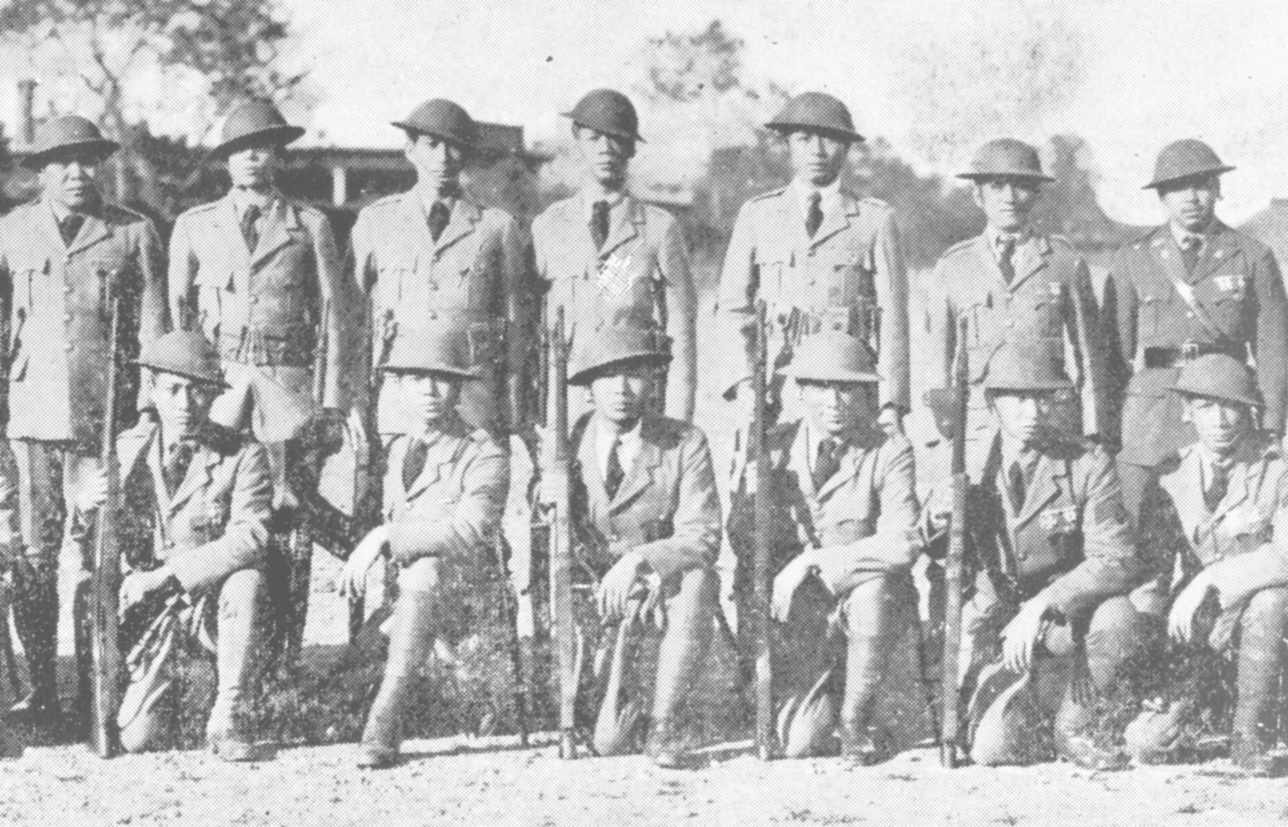
The Shanghai Municipal Council activated the Shanghai Volunteer Corps on twenty-five occasions, but two mobilizations loom large over the others.Footnote 7 The first occurred during the Taiping Civil War and the second in response to the 1932 Japanese invasion of the Zhabei district of the city, also known as the January 28 Incident. This brief preview of World War II in Zhabei served as a catalyst for the conversion of the Philippine Platoon into a full company. Though the company suffered from similar recruitment issues as other companies during the Great Depression, it retained enough members to stay intact until the dissolution of the Corps in 1942.Footnote 8
While Filipinos made up only one of the twenty-seven companies, their eager participation in mobilization exercises, Corps parades, and annual rifle competitions made them a visible presence in the cosmopolitan city. Historian of the Corps I. I. Kounin relates how Filipino “keenness is not confined to parades,” noting, “Filipino volunteers have won many honors on the rifle range.”Footnote 9 Newspapers corroborated this success, reporting on Filipino victories in individual and group competitions of the Municipal Challenge Cup, Trueman Cup, and Durban Cup.Footnote 10 Their precision on the rifle range likely gained them some measure of respect. In an era when military power reflected well on the general prosperity of a country and its people, the Filipino volunteers earned social capital through their martial displays on the firing range.
If we take a brief detour to the Philippines to preview the next section in this chapter, we find that many Chinese living there, like their Filipino counterparts in Shanghai, volunteered for military service, fighting in the Philippine wars against Spain, the United States, and Japan.Footnote 11 Jose Ignacio Paua, who was perhaps the most famous Chinese volunteer, reportedly recruited 3,000 Chinese fighters to fight in the 1896 revolution against Spain.Footnote 12 According to historian Richard T. Chu, however, most Chinese “seem to have taken a wait-and-see attitude” during the revolution.Footnote 13 Chinese in the Philippines took a more proactive role during World War II. Japan, which invaded the Philippines in 1942 in the middle of their eight-year war with China, targeted Chinese political activists in the archipelago, causing many to go underground, where they split into left- and right-leaning guerilla movements.Footnote 14
The Filipino volunteers in China and the Chinese volunteers in the Philippines demonstrated a willingness to join in the collective protection of their new ecosystems. While the skeptic would be correct to point out that the fighter-volunteers also defended their own interests when taking up arms, this observation does not detract from the overarching contributions of the volunteer fighters.Footnote 15 Ultimately, they made the choice to fight. As a result, unlike the “sub-imperial” Sikh soldiers and officers, who became “a surrogate target for Chinese resentment of Euro-American imperialism,” Chinese in Manila and Filipinos in Shanghai, as volunteers, largely avoided direct association with white and Japanese imperial power.Footnote 16
In some ways, however, the participation of Filipinos in the defense of China and the participation of Chinese in defense of the Philippines is obscured in historiography and popular memory.Footnote 17 In his groundbreaking article on the Chinese Company of the Shanghai Volunteer Corps, for example, Xu Tao does not mention the Philippine Company despite their sharing many commonalities with the Chinese Company. Members of the Chinese and Philippine companies had to overcome racial discrimination and prove their worth through physical displays of aptitude.Footnote 18 Yung Li Yuk-wai, in her work on Chinese mobilizations against Japan in the Philippines during the Second World War, noted how she had to work against stereotypes that depicted Chinese “not just as grasping and disloyal, but as essentially cowardly.”Footnote 19
“Huaqiao warriors” in the Philippines and Filipino Corpsmen in Shanghai did not belong to an overarching imperial mission, and, as a result, did not appear consistently in any specific archive. In the gardens of historical records, they are visible for all to see, but without labels, historians have trouble identifying them.Footnote 20 By contrast, historians have traced in some detail the contributions of Indians in the “British world.”Footnote 21 Even if Filipinos and Chinese acted in their own interest when volunteering to defend their host countries, they were clearly not furthering the goals of Chinese or Philippine empires, which sets them apart from Sikh, Vietnamese, Javanese, and other Asian imperial migrants.
If Filipinos were not traveling to Shanghai as sub-imperial agents or colonizers, why did they uproot themselves and move to the city? There is no simple answer. Their participation in the Volunteer Corps hints at their visibility in and relationship with the city, but it does not divulge their reasons for coming. It turns out that some Filipinos, like the Russian and Jewish refugees who began to crowd the city by the 1930s, came as political refugees from the wars for independence at the turn of the twentieth century.Footnote 22 Others just traveled to the city on vacation, like Mrs. Marcos Roces, Isabel Roces, and Ontonia Roces of the famous media mogul family.Footnote 23 Dr. Riego de Dios, a registered physician, came to Shanghai to practice.Footnote 24 Another Filipino operated a casino that served the Filipino community in the city.Footnote 25
The brothers Jose, Vicente, and Julian Cobarrubias worked for an American import–export firm. At least one of the brothers also volunteered for the Shanghai Volunteer Corps. Vicente Alobog owned a hat store on Nanjing Road near what would become the Philippine Consulate in 1947.Footnote 26 Captain Honorio Evangelista, the leader of the Philippine Company of the Shanghai Volunteer Corps, served as the city’s sole Filipino veterinarian.Footnote 27 Other “Manilamen” worked on vessels that prowled the Yangtze.Footnote 28 In other words, as historian Gregorio F. Zaide observes, “Filipinos went to China in search of commercial profits, new homes, and adventure.”Footnote 29
In many ways, Honorio Evangelista, Riego de Dios, Vicente Alobog, and other Filipinos lived uniquely Shanghai stories. Shanghai – the “demon capital,” “paradise of adventurers,” “pleasure capital,” and “Paris of the Orient” – was a vibrant metropolis and open port known for cultural innovation, leading universities, student and worker activism, industrial production, and capital flows.Footnote 30 It was no accident that Filipinos decided to establish roots in the city. Like many cities at the time, Shanghai contained sharp contrasts, with countless residents living in dire poverty while others commuted in gold-plated sedans.Footnote 31 The city’s diverse industries, including construction and entertainment, attracted all types of people.Footnote 32 Filipinos, like the city’s Russians, Sikhs, Jews, Americans, Portuguese, and Japanese, leveraged their talents to carve out a community, becoming one of the largest foreign contingents in the megacity.Footnote 33
Determining the overall population of Filipinos in Shanghai in the early twentieth century is a daunting task because they had no consulate until 1947 and no Philippine imperial archive to accumulate their records afterward. According to the official census of the International Settlement, 382 Filipinos lived in the city in 1930.Footnote 34 But censuses are capricious creatures. Recent debates about the categorization of people of Southwest Asian or North African descent in the United States hint at the uncertainty involved in categorizing and counting people.Footnote 35 Uncertainty grows during periods of greater racial and political malleability like in the early twentieth century when competing and overlapping ethno-nationalist movements cropped up across the world.
Moving beyond the census only muddies the waters. Although a period guidebook, All about Shanghai, registered zero Filipino residents in the French Concession, the Concession hosted a “Manila Road,” and Philippine Consul General Mariano Ezpeleta reported numerous Filipino residents in the former Concession in 1947.Footnote 36 Estimating the aggregate population of Filipinos in Shanghai in 1947, Ezpeleta wrote, “The Filipinos number over one thousand.”Footnote 37 In fact, his first major task as Consul General was to do what the British, Japanese, French, and Americans leaders in the city had felt little incentive to do when they ran the city – track down and properly document Filipinos.
Tallying the Filipino population no doubt proved difficult for Ezpeleta considering that many Filipinos in the city had not registered marriages or births, while those who had registered often did so with the incorrect consulate.Footnote 38 If Ezpeleta’s number of 1,000 is accurate, though, then the number of Filipinos in the city approached the French and German communities, both of which totaled around 1,400 residents in 1935.Footnote 39 Considering the Philippine Company of the Shanghai Volunteer Corps had nearly 100 members, pinning the overall population at above or around 1,000 does not seem far-fetched.
While censuses are problematic, they can still reveal some telling information. According to the 1935 census, for instance, reflecting the general pattern in Shanghai, males accounted for 63 percent of the adult Filipino population in the International Settlement, with 169 men and 99 women.Footnote 40 Curiously, the census revealed a similar imbalance with Filipino children, with seventy-one boys and forty-eight girls, which might suggest that families sent daughters back to the Philippines or removed them through some other means. The gender skew of the adult population mirrored global patterns during this era of “proletarian mass migrations.”Footnote 41 Anecdotal evidence suggests that some Filipinos found local partners.Footnote 42 Captain Honorio Evangelista of the Shanghai Volunteer Corps, for example, married Shanghai native Nancy Ting Evangelista, who unfortunately left a sparse paper trail.Footnote 43
Though likely an exaggeration, according to Consul General Ezpeleta, “most Filipinos married Chinese girls.”Footnote 44 This situation no doubt created the same types of legal uncertainties that confronted Chinese–Filipino couples in the Philippines, where Filipino women could lose their citizenship or American national status by marrying a Chinese national. In Shanghai, where the Municipal Mixed Court and separate national courts and consulates complicated jurisdiction and jurisprudence, as we saw with the case of the Filipinos and lekin runners at the start of this chapter, cases regarding disappearance, divorce, and domestic violence with mixed families must have been complicated and contentious.Footnote 45
Legal ambiguities aside, children of mixed families appear to have faced issues of identity and belonging. One mixed Filipino-Chinese lad in Shanghai, for instance, felt obligated to prove he was truly a Filipino when acting as a trilingual translator for visiting Filipinos. Consul General Ezpeleta assured Filipino readers of his memoir that the young man participated in Filipino social gatherings and was “one of us.”Footnote 46
To move beyond the surface and dig out topics like wages, community, and family, we will utilize the records of the Shanghai Municipal Orchestra, but before we continue with the Filipino experience, let us hop aboard a steamer and take a closer look at the lives of Chinese in the Philippines.
Chinese in Manila
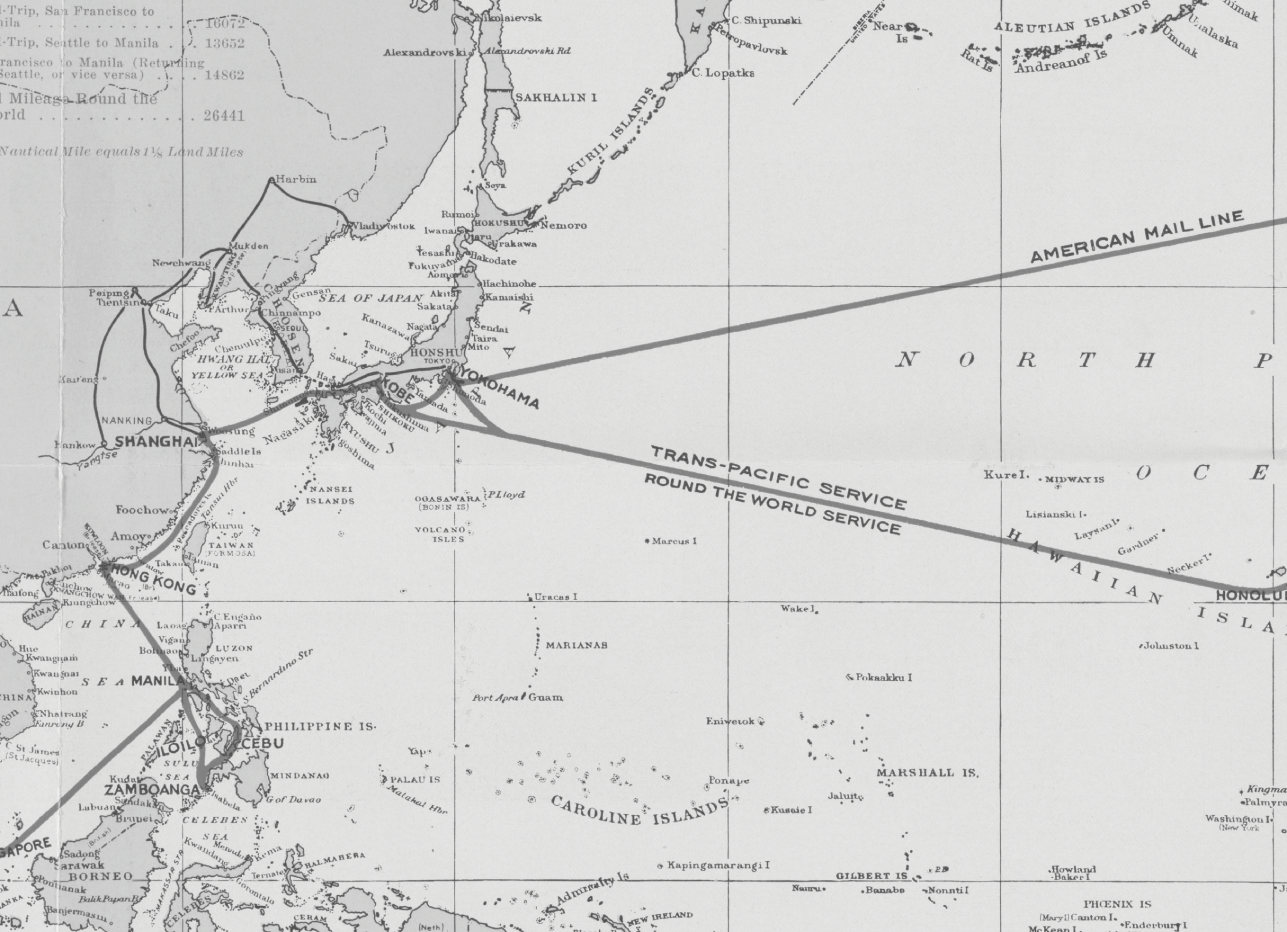
What is currently a two-and-a-half-hour flight from Shanghai-Pudong Airport to Ninoy Aquino International Airport in Manila was a three- to four-day voyage in the 1930s. Though it might seem like an endless journey by today’s impatient standards, back then it was a breeze. By contrast, it required at least three weeks to travel to Europe or the United States from either city. Xiamen to Luzon is even closer, measuring only seven hundred miles as the bird flies, or about the same distance as New York to Chicago. As historian Andrew Wilson observes, “steaming from Xiamen to Manila was perhaps as mundane as my morning commute and probably carried about as much political consequence.”Footnote 47 More important than distance, however, is connectedness, and multiple lines from several steamship companies linked Shanghai, Xiamen, and Manila (Figure 1.2).
Entrepreneurs catered to passenger, post, and commercial transportation needs in Asian waters. The Dollar Steamship Company, founded by American businessman Robert Dollar, ran several passenger liners from Shanghai and Hong Kong to Manila.Footnote 48 Five main Dollar Steamship routes served American imperial and business interests, and two of them, the Round the World and Trans-Pacific lines, connected Shanghai and Manila.Footnote 49 Competitors from Russia, Japan, and Canada also plied the Shanghai–Manila route. In other words, China and the Philippines were bound by the “helix of imperial and global power,” as historian Antoinette Burton theorizes in a different context, and this helix brought Chinese to Manila just as it brought Filipinos to Shanghai.Footnote 50
Route of the world-famous president liners
Like Shanghai, “Manila was one of the world’s most spectacular emporia with cosmopolitan sensibilities and a genuinely global outlook.”Footnote 51 A thrice-colonized city as opposed to a co-colonized city like Shanghai, it also absorbed foreign populations and new ideas. Through the early Maynila sultanate, Spanish colonial period, First Republic, and American colonial period, one factor remained constant in the city: a sizable and aspiring Chinese community. Yet while the Chinese community has received deserved if uneven scholarly attention, the city itself “is a place remarkably deficient of comprehensive urban historical analysis.”Footnote 52 Whereas Shanghai flourishes in a well-fertilized field of scholarship, Manila has weltered in the dusty margins of obscurity.Footnote 53
When Manila appears in historical scholarship, it often fills the role of a trade waystation or an axis of conflict. Many scholars, for instance, have tracked the famed Manila galleons along their route between Acapulco and Manila.Footnote 54 This highly profitable and surprisingly durable luxury route budded when what Spanish officials called “the China Enterprise” – a euphoric dream of Spanish conquest and Christianization of China – came to a rapid and inglorious end, and Spanish officials in Manila instead became increasingly reliant on the growing Chinese community in the city to supply luxury goods for new and old Spain.Footnote 55 Chinese traders engaging in the lucrative “triangular trade” between China, Japan, and Manila, meanwhile, viewed the archipelago as a reliable port, if not a promised land.Footnote 56
The stable profits of the Manila trade ensured that Chinese would continue to sojourn there throughout the Spanish colonial period despite numerous obstacles placed by Chinese and Spanish authorities. The Spaniards implemented a long-standing tripartite policy of taxation, control, and conversion.Footnote 57 In 1581, only ten years after Miguel López de Legazpi first set foot in the already-thriving port, the fourth governor general, following a new global pattern of segregation, established the segregated Parián neighborhood in Manila, requiring non-Christian Chinese to reside within its borders. For many centuries afterward, Chinese lived in segregated communities in the Parián and Binondo neighborhoods of Manila.Footnote 58 Together, these neighborhoods served as the fulcrum for trade and specialized industries in Manila and beyond.Footnote 59
Throughout the Spanish colonial period, the Chinese maintained a tenuous relationship with Spanish authorities. With the China dream dead and decayed for Spaniards, the Philippine dream of Chinese people dominated the relationship. However, Spaniards feared the influential, connected, and sizable Chinese community, which had quickly grown to outnumber theirs. Periodic pogroms and expulsion orders that threatened the foundations of the Chinese community defined the seventeenth and eighteenth centuries.Footnote 60 The Chinese feared the arbitrary justice and reactionary blindsides of Spanish authorities, but they consistently reestablished themselves after pogroms despite staggering casualty figures, such as the estimated 23,000 who perished in 1603.Footnote 61
To compensate for their insecurity and uncertainty as non-colonizing and non-native members of the Manila community, Chinese turned to numerous strategies, including organizing the community through the Chamber of Commerce and cabecilla, or community leader; establishing and invoking hometown or qiaoxiang (僑鄉) ties; maintaining lines of credit with powerful Spaniards; and fostering extra-consanguine family ties such as compadrazgo, or co-parenthood and padrinazgo, or godparenthood.Footnote 62 Like their Filipino counterparts in Shanghai, to whom we will return in the next chapter, in times of duress, Chinese people came together as a community to help one another.
Much of the community cohesion stemmed from shared linguistic and hometown ties, with most residents hailing from a few towns in southern Fujian, or Minnan. Scholars have noted how these Hokkien speakers became “undisputed leaders in seafaring enterprises.”Footnote 63 In this regard, one could argue that they shared more in common with seafaring “Manilamen” than their Chinese peers.Footnote 64 Yet for all of its advantages as a seafaring region, southern Fujian faced the dual dilemma of severe shortage of arable land and a bumper population.Footnote 65 Fortunately for them, the Philippines, like much of Southeast Asia before the twentieth century, remained comparatively underpopulated. This led many Fujianese to try their luck in Manila, which Richard T. Chu describes as a “magnet to many Minnanese.”Footnote 66
Just like today, Manila served as the economic, cultural, and political center of the Philippines. Local Chinese opened a branch of the Protect the Emperor Society, a famous Qing loyalist organization, in Manila in 1899.Footnote 67 Likewise, nationalist-minded activists established the first Philippine branch of the Tongmenghui, Sun Yatsen’s (Sun Zhongshan 孫中山) anti-Manchu revolutionary organization, in Manila right before the revolution.Footnote 68 As we will explore in more detail in Chapter 6, leading community members also established the Philippine Chinese Chamber of Commerce, the China Banking Corporation, and other prominent Chinese business ventures in Manila. As historian Edgar Wickberg notes in his work, “Unlike other parts of the archipelago, Manila had a Chinese population that was constantly being replenished.”Footnote 69
Like Filipinos in Shanghai, Chinese in Manila mingled and interacted widely with the city’s diverse denizens, forming business partnerships, lasting friendships, and intimate relationships.Footnote 70 According to censuses, the gender ratio skewed even further out of proportion for the Chinese community in the Philippines than it did for the Filipino community in Shanghai, with only 194 women out of a total of 66,000 in 1886 and 3,098 women out of 43,802 in 1918.Footnote 71 While this data, as mentioned earlier in the Filipino case, was almost certainly incomplete, the official tally is quite shocking for its implications on family life.
With fewer than 100,000 Chinese residents for most of the American colonial period, and only half of them residing in Manila, the Chinese community remained more compact than comparable Chinese or Indian communities in Southeast Asia.Footnote 72 So, while the Chinese population in the Philippines, and in Manila in particular, was significantly larger than the Filipino population in Shanghai, which we pinned at approximately 1,000, perhaps Chinese in Manila had more in common with Shanghai’s Filipinos than appears at first glance. If we consider the overall population of China, which was approaching 500 million, and the overall population of the Philippines, which had just passed 10 million, the emigration numbers, or outward flow of migrants, were similar percentage-wise but clearly on a different scale.Footnote 73
With a gender ratio of 92.9 percent male to 7.1 percent female in 1918, there must have been many cases of underreporting, sojourning, or informal relationships. As Richard T. Chu notes, the 7.1 percent tally in the census also included Filipino women who married male Chinese nationals because citizenship became linked with the husband after the extension of exclusionary policies to the Philippines.Footnote 74 On the flip side, this meant that if a Chinese woman were to marry a Filipino man, which was no doubt quite rare given the demographics, she would face legal limbo. A commentator in a Singaporean newspaper observed that in such cases, the Chinese woman would lose her Chinese citizenship and but could not acquire Philippine citizenship due to exclusionist laws.Footnote 75 Lawmakers heaped these legal obstacles on Chinese people to disincentivize migration and complicate their lives, and we will explore this topic in more detail in the next chapter.
The census, which recorded a sizable mestizo or “half-breed” population, as the census labeled them, also shows a glimpse at the long history of intimate relations between Chinese and Filipinos.Footnote 76 Furthermore, many Filipinos with Chinese heritage did not even report their Chinese background to census takers. The well-known author José Rizal, whose family famously rejected their Chinese heritage, supposedly for tax purposes, is a case in point.Footnote 77 Church records and anecdotal evidence generally corroborate the long history of intermarriage.Footnote 78 In other words, Chinese in the Philippines, like their Filipino peers in Shanghai, despite the many societal pressures and legal barriers designed to hinder such unions, adjusted to the new soil in these cosmopolitan cities by forming intimate partnerships.
Unlike the Filipino community in Shanghai, the Chinese community had clear and traceable leadership and organizational structures. Of course, these organizations sometimes masked underlying divisions within the community, and we will return to those divisions in Part III. By the twentieth century, the Philippine Chinese Chamber of Commerce, which theoretically only dealt with financial affairs, had replaced earlier Spanish-era institutions as the de facto community governing body.Footnote 79 Coupled with a vibrant Chinese press, which shapes Part IV, and a semi-independent school system, which we touch upon in Part II, the Chinese community was well defined and comparably unified. This unity allowed for a quick resolution of issues, such as a 1922 incident that entangled the Chinese community in Manila and Filipino one in Shanghai.
The incident began when “news flashed from Shanghai, stating that Filipino colonists, mostly musicians and their families, who were living in that city were being maltreated by the Chinese there.”Footnote 80 According to historian Eufronio M. Alip, Filipinos in Manila responded to this news by harassing local Chinese residents until Philippine Senator Manuel Roxas intervened to quell the riots.Footnote 81 Just as American transplants in China suffered in the anti-American exclusion-inspired riots of 1905, Chinese residents in the Philippines suffered when rumors spread regarding ill treatment toward Filipinos in China.Footnote 82 In other words, the Chinese and Filipino diasporas were not just similar; they were also intertwined.
Trumpets: The Shanghai Municipal Orchestra and Filipino Jazz
In an unnamed Shanghai dance hall, “an American was holding a German. A Spaniard was holding a Russian. Portuguese bumped into people of mixed blood; inebriated people from Siam, France, Italy, Bulgaria” danced to their hearts’ content. Yokomitsu Riichi painted this exhilarating and romanticized picture in his 1925 novel, Shanghai. On the stage of this dance hall, “trombones and coronets swung about. Teeth were exposed from the dark skin of a band from Manila.”Footnote 1 Though blurred by the constructed reality of fiction, the Filipinos on stage in Yokomitsu’s novel reflected a historical reality during Shanghai’s jazz age.Footnote 2 If you entered a jazz club in Shanghai in the 1930s, chances are you would be doing the foxtrot to the beat of a Filipino band.
While some Shanghai residents might have associated Filipinos with the Shanghai Volunteer Corps and mercenary armies, many more associated them with classical music and jazz, and some historians have followed suit. Historian Chen Chen goes so far as to write, “Filipino musicians had become synonymous with jazz in old Shanghai.”Footnote 3 Another scholar, with similar pomp, notes that the “Filipino bands dominate[d]” the jazz scene in Shanghai.Footnote 4 Journalist Chang Hsiangyi, meanwhile, writes that, among the five or six hundred active musicians in Shanghai, “Filipino bands are the most famous.”Footnote 5 Popular Filipino bands sprouted up across the city in the 1920s and 1930s, becoming an important part of the cultural ecosystem of Shanghai. Before Filipinos became connected with jazz, however, they had made a name for themselves in the Shanghai Municipal Orchestra.
This section pieces together a social history of Filipinos in the city using archival documents of the Shanghai Municipal Orchestra from the 1880s to the 1920s and published memoirs and newspaper accounts of the jazz club night scene from the 1920s to the 1940s. Together, these documents show a vibrant and visible community that crossed paths with both the city’s elite and the city’s underclass. Challenging received assumptions about Western cultural influence on China, this section argues that Filipinos, who became closely connected with classical music and jazz in Shanghai, acted as one of the primary translators of these mediums to China.
Filipinos first gained fame as musicians in the city through the Shanghai Municipal Orchestra.Footnote 6 The first conductor, Spanish musician Melchior Vela, led a trip to “Manila where he recruited 19 men” for the band three years after its founding in 1878.Footnote 7 Spanish imperial linkages created opportunities for Filipinos in Shanghai just as they had created opportunities for Filipino seafarers and musicians in the Americas, and Filipinos took full advantage of those opportunities by uprooting their lives and starting over in a new land.Footnote 8 From Vela’s first recruiting trip up to the mid-1920s, Filipinos accounted for the majority of the Shanghai Municipal Orchestra’s members.
Leaders of the Shanghai Municipal Council, which sponsored the ensemble, had many reasons to direct administrators to recruit Filipino band members. Historian Robert Bickers notes that “the most likely reason for the recruitment of Filipinos was that Spanish rule had fostered the development of a tradition of Filipino involvement in the colonial administration’s military and civil bands and musical life.”Footnote 9 While this certainly factored in, practical concerns like the physical proximity of the recruits also shaped the decision. The Philippines was considerably closer than other talent pools.Footnote 10 Why send a recruiter to Italy, Mexico, or France when the Philippines was a four-day steamship ride away?
Shanghai ratepayers also viewed the hiring of Filipinos as an affordability issue because Filipinos received less compensation on average than European players.Footnote 11 As with the unnamed “Manilamen” who were assaulted by lekin runners, the Filipino band members were both visible and invisible, central yet overlooked, at least from white eyes. They shared some aspects of foreign privilege, which helped them land jobs in the first place, but they could not hide their physiognomy, which shaped the fates of many humans during this era of pseudo-science–infused racism. The governing class expressed no moral qualms when prying wages out of their dark complexion.
The advantages of hiring Filipinos ensured that the Orchestra remained a Filipino band for the first four decades of its existence. However, when Mario Paci, the institution’s most famous and longest tenured conductor, took charge in 1919, Filipinos gradually yielded their positions to Russians and Italians.Footnote 12 After the Great War and its accompanying budget shortfalls, the Orchestra employed only seven European musicians and nineteen Filipinos.Footnote 13 In 1920, a year after Mario Paci’s ascension, the number shifted dramatically to seventeen Europeans and twenty-two Filipinos.Footnote 14 From that point on, the numbers began to favor players of European descent. In 1927 the band consisted of thirty Europeans and fourteen Filipinos, and in 1940 it had forty-three Europeans, three Filipinos, and four Chinese people.Footnote 15
Why did Paci, with the support of Shanghai Municipal Council members and ratepayers, weed out Filipino musicians? Most institutions evolve if they survive over half a century, and the Shanghai Municipal Orchestra was no exception. What was a limited music scene with few standout performers and a small listening audience in the 1880s had blossomed into a field of abundant talent and fierce competition by the 1930s, especially after the Depression set in and more people searched for work.Footnote 16 By 1929, 13,000 Russians lived in the city, and many of them needed a job and possessed musical ability.Footnote 17 In other words, the availability of Russian and other musicians in Shanghai made recruitment abroad unnecessary, or as Paci himself put it, “Manila offers no more advantages from a musical standpoint than those already obtainable in Shanghai.”Footnote 18
Logistics of recruitment and the growth of local talent aside, transforming into a more European-looking band had become a selling point for Mario Paci and other government officials. Authors of the Annual Report of the Shanghai Municipal Council, for example, delightedly informed Shanghai ratepayers that “the Orchestra never rendered better music than at the concerts towards the end of 1925,” noting that “this is due, particularly to the increase in the number of good European musicians, to compensate for the decrease in Filipino musicians of less skill.”Footnote 19
Though Mario Paci and his backers ostensibly replaced Filipinos with Europeans to increase the “skill” of the Orchestra, it does not take a trained historian to read between the lines. I contend that British, American, and other privileged white members of the Shanghai community intentionally whitewashed the public band to claim control and ownership of the medium of classical music, which had, up to that time, been stewarded by Filipinos. To put it another way, adhering to the circular supremacist logic of imperialism, they wanted to “restore” Europeans to their “proper” place as progenitors of music and civilization. In this regard, the leaders of the Shanghai Municipal Council were partially successful in the short term, but tremendously successful in the long term, as we will explore in this chapter’s conclusion on erasure and distortion.
Though largely lost in the wildfires of popular memory and controlled burns of historiography, the lives of Filipino and other band members endured in flame-resistant seeds found deep in the recesses of the archives.Footnote 20 The records of the Shanghai Municipal Orchestra, for instance, give us unique insights into their lives. They show how Claro Legaspi, who carried the name of the Spanish conquistador Miguel López de Legazpi, cultivated a new career by moving to Shanghai and landing a white-collar job in the Orchestra in 1905.Footnote 21 Like any white-collar job, work at the Orchestra had its perks, but it also demanded mental and physical devotion.
During his long career in Shanghai, Legaspi only managed two trips back to the Philippines. It was simply too difficult to find time for the trip. He applied for a leave of absence in May of 1920, for instance. However, due to the Orchestra’s packed summer schedule, the conductor asked him to put his plans on hold until September, knowing full well that it had been ten years since he had last stepped foot in his homeland.Footnote 22 After some foot-dragging by the Band Committee, Legaspi and his wife and children finally received permission to take the Empress of Asia steamship back home later that year. Legaspi and his family traveled second class, of course, but at least the Municipal Council footed the bill.Footnote 23
Claro Legaspi received several raises over the years.Footnote 24 A June 30, 1923, notification from the band’s conductor recommended the continuation of his employment and an increase in pay to $160 per month.Footnote 25 However, three years later, in the midst of the Orchestra’s transformation, Conductor Paci wrote to the Band Committee, “Mr. Legaspi, after 21 years service [sic] and being aged at 52 years, has not any longer that grade of efficiency required to fill the place of third Trombone-Player in the Orchestra.”Footnote 26 Although Legaspi received a year and a half of severance pay, he did not enjoy the same retirement pension as white employees. This disparity in compensation would become a major point of contention between the band’s Filipino and European players.Footnote 27
In response to his sudden change in fortune, Legaspi sent a plea to Assistant Conductor A. de Kryger, who appears to have been closer to the band’s Filipino players than Conductor Paci. It read,
As Conductor and my constant companion on the Band I believe you are in a position to say whether or not I have humbly and faithfully performed my duties as musician for the Municipal Band during the time that I was connected with it. Therefore I am approaching you today as I know of no other man who might have a little interest on my behalf and sincerely thanking you if you will be kind enough to help me, for the last time, to request the Shanghai Municipal Council that my compensation be made adequately or a little more than has been previously made – in order that I and my family may be able to get along with it for a while, or until at least I shall be able to find a new profession in my new field, in life.Footnote 28
At age 52, distant from both the vigor of youth and the land of his ancestors, Claro Legaspi found himself unemployed. The nimble hands that had so adroitly navigated the curves of his trombone to create and sustain a career and livelihood in Shanghai had abandoned him as they took up the pen to write a heartfelt plea. The tone of his words suggests that he knew the appeal would land on deaf ears. All he had left were his wits and a small stipend to support his family.
Legaspi could have turned to jazz like some of his colleagues, but instead, relying on the same entrepreneurial spirit that had brought him to Shanghai in the first place, he pioneered a different path. He found a new job as conductor. Jinan University, a Shanghai-based school that catered to overseas Chinese students, hired him as the “Conductor of the University Orchestra.”Footnote 29 In an interesting twist, at Jinan, he taught “returned” overseas Chinese students, including some from the Philippines. After holding the position for several years, Legaspi returned to the Shanghai Municipal Orchestra on a temporary basis. Perhaps things were turning around for him, but it was hard to say with the state of the global economy during the Great Depression. He could only play music; the rest was up to God.
The Shanghai Municipal Orchestra files reveal much that the International Settlement census could not. Personal stories of family, misfortune, prejudice, and community come to life in the private letters of the conductor and assistant conductor. The death of an employee always impacts an institution, and when well-regarded violinist Benito C. Sado died suddenly in 1932 while still an active member of the Orchestra, the assistant conductor wrote, “Sado has been a member of the Orchestra and Band for nearly 20 years and has always given his best, he was a very good musician and also a very honest and reliable man, whose death means a great loss to the Municipal Orchestra and Band.”Footnote 30 After what was no doubt a frustrating back-and-forth with the Shanghai Municipal Council, Benito Sado’s wife Mary Kou Sado eventually received her husband’s full superannuation.Footnote 31
Other band members and their families were less fortunate. P. Natividad, a talented player fluent in two instruments, became sick in 1933 with a growth in his throat. Unable to perform due to the nature of the illness, he lost his source of income and had trouble making hospital payments. In a highly contested business decision, the Band Committee declined to support Natividad financially because he no longer worked for the band. He died in November, a few months after becoming ill. To help their colleague and his family, Filipino members of the Orchestra financed his funeral, and the Municipal Council eventually granted six months’ pay to his widow.Footnote 32
Though the snapshots into the lives of Natividad and Sado are brief and incomplete, they provide valuable information. Judging from Mary Kou Sado’s name, she was likely ethnic Chinese, which hints at the romantic relationships formed in Shanghai. The way the Filipino band members rallied around their ailing mate suggests a vibrant support network much like the more formalized Chinese network in the Philippines. As far as I could tell during my research, apart from one World War II-era musicians’ union, there was no community newspaper or organization uniting Filipinos, but this anecdotal evidence hints at a type of unity.Footnote 33 On a different note, one chronicler alluded to a different type of communal cohesion when he described the “Manila cock-pit in bamboo town” that was “in full swing every Sunday afternoon.”Footnote 34 The disputes over pensions, severance, and health insurance show how Filipinos faced an uphill battle fighting for basic rights with the Euro-American–Japanese-dominated Municipal Council.
Let us turn finally to Filipino achievement and Chinese viewership. C. de Castro and F. M. Calibo, two long-tenured and particularly well-regarded Filipino band members, set the bar for achievement. During his twenty-seven-year career, to the chagrin of some of his European peers, de Castro became the assistant conductor, occasionally conducting the half band on his own when both halves were requested for concurrent performances.Footnote 35 In 1908, before the rise of Conductor Paci, the Band Committee even entrusted Mr. de Castro to travel to Manila to recruit additional band members, but de Castro declined due to poor health.Footnote 36 F. M. Calibo played the piano and clarinet. He served on the Orchestra for thirty-seven years from 1905 to 1942. Unlike other Filipino players who retired due to old age, whitewashing policies, or underperformance in the 1930s, Calibo remained in the Band until its disbandment in World War II.Footnote 37
The Orchestra initially served only foreigners and the city’s super wealthy, but after the success of the Northern Expedition of 1927, the Municipal Council expanded access to the Orchestra, allowing ordinary Chinese residents to attend. However, even before this expansion, the half orchestra or individual band members would play at private gatherings, which led to considerable exposure of the Filipino band members to Shanghai locals. The Chin Woo Athletic Association, for example, requested the services of a “Manila pianist” on April 9, 1921.Footnote 38 The Orchestra sent F. M. Calibo. Apparently satisfied with his services, the Chin Woo Athletic Association requested Calibo’s services twice more over the ensuing years, the second time also requesting Claro Legaspi.Footnote 39 Although restrictions prevented Chinese individuals in Shanghai from viewing Orchestra performances before 1928, private shows opened spaces for personal interactions.Footnote 40
During the summer season, weather permitting, the band performed outside in Jessfield Park, and in the winter, they played in the regal Lyceum Theater. However, during downtimes, with the Band Committee’s sanction, Filipino band members performed for the city’s Chinese elite at weddings, dance parties, and other gatherings. In 1923, for instance, Claro Legaspi, a rather popular private performer, served as bandmaster for a Chinese band at a meeting of the Shanghai Charitable Societies.Footnote 41 This no doubt served him well when he later applied to be the conductor at Jinan University. Two years earlier, Lord Robert Lee, the grandson of Li Hongzhang (李鴻章), requested the “Municipal Filipino Band” to perform at his mother’s funeral.Footnote 42
In this interesting but telling slip of tongue, Lee hinted at a general association between the Orchestra and Filipinos among Shanghai’s residents. And these examples represent only a fraction of the requests received by the Orchestra over the years. The number of private performances ensured that the Orchestra and its Filipino band members gained visibility and renown. The Orchestra also frequently played for the Shanghai Volunteer Corps, which exposed the Filipino bandmembers to even wider audiences. As a result, for many of the city’s residents, Filipinos came to epitomize classical music. The omnipresence of Filipinos in the cabarets and nightclubs further expanded the link between Filipinos and cultural innovation.
Consul General Mariano Ezpeleta stated upon his arrival in Shanghai in 1947 that “more than half of the Filipino residents in Shanghai dabble in music in the evenings.”Footnote 43 Most Filipino jazz musicians did not play at Shanghai’s most prestigious facilities, which hosted the city’s wealthiest and most famous patrons or, as famous jazz pioneer and former Shanghai resident Whitey Smith called them, the “International 400.”Footnote 44 Instead, Filipino jazz musicians worked in places that “catered less to foreigners and the native elite than to the Chinese urban petit bourgeoisie (xiao shimin),” like the city’s other famous jazz musicians, African Americans.Footnote 45 Many onlookers and fellow jazz musicians, like Yokomitsu Riichi, Buck Clayton, and Whitey Smith, attested to the ubiquity of Filipinos in nightlife.
In a city where “movie actors and actresses were national celebrities and popular idols,” many Filipino musicians gained the trappings of fame.Footnote 46 Pomping Villa headed “a good Filipino band of 12 people” at the Mandarin Club, a prestigious Shanghai nightclub.Footnote 47 A big fish, he was “acknowledged as the foremost xylophone player in Shanghai.”Footnote 48 Similarly, Apolo Dila, whom many considered “the best jazz trumpet player in the late 1930’s,” led a band called the Shanghai Swing Masters.Footnote 49 However, the most famous Filipino musician, and “acknowledge[d] musical leader” of the community, was Don Jose Alindada.Footnote 50 In an interview, Don Jose’s son recalled how his father leveraged his wealth and fame to cruise through Japanese checkpoints during World War II without showing his identification.Footnote 51
When Filipinos did not headline, they, along with the city’s Russian and Japanese musicians, filled out the cast of aspiring bands. Some Japanese bands, for instance, “employed Filipino bands with a few token Japanese members until the number of Japanese musicians in Shanghai made all-Japanese bands feasible,” again hinting at the ubiquity of Filipinos in the night scene.Footnote 52 Whitey Smith also formed an “International Band” that contained American, Filipino, Russian, and German players.Footnote 53 The presence of Filipinos in the prestigious Shanghai Municipal Orchestra and Band only enhanced the status of Filipinos who played jazz. In this international city, Filipinos became jazz, and jazz became Filipino. However, this did not always carry a positive connotation, with some Chinese referring to Filipinos as “foreign piano devils.”Footnote 54
Archival letters provide snapshots into the lives of Filipino orchestra players and their families, and memoirs and newspapers tell us colorful anecdotes about Filipino jazz musicians, but these sources remain fragmented and incomplete. Women’s voices are absent or derivative, and Filipinos who did not fit the middle-class mold outlined above have fallen through the cracks. Nevertheless, it is safe to say that Filipinos had a vibrant and visible community that served a valuable function in the ecosystem of one of Asia’s most unique cities. Historical records also demonstrate how Filipinos overseas, or Feiqiao, lived different lives from both the seafaring mariners or “Manilamen” and the sojourning medical workers who have dominated research on Filipino mobile societies more recently.Footnote 55 Restoring and situating the Shanghai Filipino community helps grow our understanding of the cosmopolitan city and Filipino migrations, and a similar approach toward the Chinese community in the Philippines helps us better understand migration and the new art of gatekeeping.
Ledgers: Banking, Import–Export, and the Bookkeeping Law
Chinese exclusion has long influenced conversations in Chinese-American and Asian-American studies in the United States, and recently, the topic has sprouted fresh interpretations and insights.Footnote 56 Scholars have recast the earliest rendition of the 1882 nationwide act as an experimental “restriction” act that probed the limits of sovereignty, reserving the term “exclusion” for the revamped and better funded 1888 law.Footnote 57 They have noted that businesspeople and educators in the United States vehemently opposed the legislation, lobbying for exemptions for students through the so-called side door and for merchants through the VIP door.Footnote 58 Other scholars have linked American exclusionary measures with a global tide of anti-Asian sentiment and innovative gatekeeping techniques.Footnote 59 The infamous but short-lived Philippine Bookkeeping Act, which banned Chinese business owners from maintaining their ledgers in Chinese, pioneered the next step in this xenophobic global movement, but it has fallen under the radar of researchers.
For their part, historians of the Philippines have recently begun to examine the consequences and logics of American exclusion in the archipelago. General Elwell S. Otis provisionally extended exclusion to the Philippines in 1898, and legislators cemented the policy in 1902.Footnote 60 In banning the migration of Chinese laborers to the archipelago, architects of America’s empire deliberately distinguished themselves from their British and French peers, who turned to Chinese, Vietnamese, and Indian labor in their colonies after the end of the global slave trade.Footnote 61 When one American businessman attempted to recruit coolie laborers from China for a new rickshaw business in Manila in 1902, American administrators and Filipino union leaders lambasted him and shut down the project.Footnote 62 One by-product of this exclusionary policy, as mentioned before, was the formation of a comparatively small and wealthy Chinese community in the Philippines.
The population of Chinese in the Philippines hovered around 100,000 during the American colonial period, but, as mentioned before, that figure paled in comparison to communities in other colonies and polities in Southeast Asia where independent Chinese and global companies activated business, native-place, and kinship networks to recruit Chinese laborers. Historian Adam McKeown calculates that while 4 million Chinese people traveled to Thailand, 2 to 3 million crossed into Indochina, 4 million made it to the Dutch East Indies, and a staggering 11 million went to the Straits colonies, fewer than 1 million embarked for the Philippines.Footnote 63 Colonial policy largely caused this discrepancy as both the Spanish and American colonial regimes took measures to reduce Chinese migration.
Filipino legislators during the American colonial period, following in the footsteps of Spanish and American colonial officials, took the next logical step in legal gatekeeping wizardry with the passage of the Bookkeeping Act of 1921. This act built on the foundation of the Exclusion Act in the United States and the Head Tax and White Australia Policy in Canada and Australia, but Filipino legislators acted as its main stewards. The law, Act No. 2972 of the Philippine legislature, required that all businesses maintain their financial transaction records in Spanish, English, or a native language of the Philippines – or in other words, any language other than Chinese.Footnote 64 Legislators ostensibly passed this law to prevent tax evasion by Chinese and other foreign merchants who could have theoretically obscured their records by maintaining them in their native languages, but, as one economist sardonically retorted, “Dishonesty can be committed in any language.”Footnote 65
What, then, was the actual intention of the legislation? It is hard to see the Bookkeeping Act as anything other than an attempt to disadvantage the remaining Chinese people in the Philippines. As with other forms of legislative gatekeeping, its designers hid their objectives behind the veil of sovereignty. Jaime C. de Veyra, a Filipino legislator who championed the School of Forestry in Los Baños, which we will return to in Chapter 4, described the Bookkeeping Act as an innocent attempt to correct for “irregularities of books of Chinese firms.”Footnote 66 By making this argument, he, like the drafters of the Chinese Exclusion Act in the United States and the Chinese Head Tax in Canada, described the passage of the law as an act of sovereignty, writing, “it is a sovereign right for a country to enact laws to protect the well-being of its citizens.”Footnote 67
The Bookkeeping Act differed from exclusionist legislation in white settler states, however, because it targeted wealthy Chinese merchants instead of laborers. This represented a radical shift from legislation that built on the prejudices of white working-class settlers but preserved a hushed alliance among the world’s most wealthy. By targeting capital flows instead of the movement of people, the Bookkeeping Act more directly threatened the bottom lines of wealthy Chinese businesspeople in the archipelago and, therefore, potentially wealthy Filipino and Americans elsewhere. The class-sensitive nature of the law threatened to destabilize the unspoken class alliance that allowed a wealthy global elite, like those of the “International 400” in Shanghai, to grow their profits while avoiding some of the distastefulness of global xenophobia.Footnote 68
Proponents of the Act defended it in one of two ways. The few American colonizers who supported the law viewed it as an opportunity for the United States to distinguish itself from imperial peers, like Japan, France, and England, by demonstrating a commitment to Filipinos first even if it entailed financial costs. Filipino legislators and businesspeople who designed and defended the Act viewed it as a form of affirmative action, using the same types of arguments that proponents of the New Economic Policy in Malaysia and the Filipino First Policy in the Philippines would use after independence. Instead of receiving preference, however, Filipino businesspeople gained a distinct legal advantage over their Chinese business competitors under the Bookkeeping Act.
Historian John E. Murray has meticulously pieced together economic reports to estimate Chinese wages in the Philippines during the early American colonial period, and his research helps shed light on what appears to have been a common Filipino perspective. According to Murray, Chinese wages in Manila exceeded those in Xiamen by “a factor of two or more,” making it an obvious draw for those who could make it to the archipelago. Once in Manila, “Chinese workers except the semiskilled were paid significantly more than Filipinos in the same occupation.”Footnote 69 This discrepancy, mixed with the visibility of Chinese storefronts around the capital, likely led to native Filipino animosity toward the successful migrants, which begins to explain the willingness of legislators to experiment with the law. Just as some Chinese in Shanghai viewed Filipino jazz musicians as “foreign piano devils,” some Filipinos in Manila viewed Chinese businesspeople as foreign bookkeeping devils.
The American-appointed Philippine Commission proposed early versions of the Bookkeeping Act in 1912 and 1913 without success.Footnote 70 Filipino legislators updated and rewrote the Bookkeeping Act in 1921 and passed it into law with the approval of the Governor General. After undergoing several court-ordered delays, the law went into effect on January 1, 1923. Failure to comply with the bookkeeping translation requirement resulted in imprisonment, or a fine of up to ₱10,000, which was a considerable sum at the time, especially for mom-and-pop store owners. As the Chinese Chamber of Commerce of the Philippines noted in a letter to the Governor General, Chinese small businesses, which made up 90 percent of Chinese businesses in the archipelago, would suffer the most because they could not afford translators.Footnote 71
Although it could have undermined the community, the passage of the Bookkeeping Act appeared to unify Chinese in the Philippines. It helped them transform from a marginalized in-between community into a self-sufficient and activist one, just as wage discrimination in the Shanghai Municipal Orchestra and in Shanghai’s cabarets had for Filipinos in that city. In Manila, coordinated by the Philippine Chinese Chamber of Commerce, community members tapped into their diverse acquaintance and business networks to challenge the law. The resistance campaign began with a high-stakes meeting of local leaders to discuss strategy.
At the meeting in 1921, Chinese leaders began to lay out a multilayered campaign to combat the Act in the Philippines, the United States, and around the world.Footnote 72 In the first phase of the plan, they drafted and submitted a protest memorial to the high-stakes Wood–Forbes Mission, which was at that time touring the Philippines to ascertain whether the Philippines was “ready” for independence.Footnote 73 They also sent Albino Sycip (Xue Minlao 薛敏老), Dee C. Chuan (Li Qingquan 李清泉), and six other prominent members of the Chinese community to testify against the bill before the Philippine Senate Committee on Justice.Footnote 74 Finally, they engaged native-place associations, business networks, and personal acquaintances to grow awareness of the new law.
As the Bookkeeping Act approached implementation, community leaders enacted phase two of their campaign, dispatching the young lawyer Albino Sycip and the veteran stalwart Rafael Machuca Go Tauco (Wu Kecheng 吳克誠) overseas to lobby for international support. Their ultimate destination was the United States Supreme Court, but they made many stops along the way, including one in China where they coauthored a stinging critique of the Bookkeeping Act in the Banking Journal. In the article, stressing the global ramifications of the law, they mused about what would happen if Chinese leaders passed a parallel law requiring American and Filipino merchants in China to keep their ledgers in Chinese.Footnote 75
Careful to avoid making any unnecessary enemies, veiled threats against American businesses in China aside, Sycip and Go Tauco stressed camaraderie between Chinese and Filipinos in the article, reminding readers of the support mainland Chinese had offered to Philippine anti-imperial movements in the past.Footnote 76 They informed Chinese readers that Filipino opinion toward the law was divided, noting that the editors of the Philippine Spanish dailies El Comercio, La Nation, and El Mercantile all opposed the law.Footnote 77 Seeking to light a fire under the feet of their Chinese compatriots, they argued that should China wait for the law to pass before taking countermeasures, it would be too late.Footnote 78
A well-organized cable and letter campaign accompanied the lobbying of Sycip and Go Tauco. Dee C. Chuan, a leading figure in this campaign, penned a personal letter to the Tianjin Chamber of Commerce where he outlined the details of the law and introduced Sycip and Go Tauco.Footnote 79 Others took the campaign to the popular press in the Philippines, China, and the United States, securing the support of many American newspapers.Footnote 80 In newspaper op-eds, Chinese in the Philippines systematically refuted the premise that Chinese cheated on their taxes. In a detailed analysis of import and export volume by Chinese merchants in the Philippines in the Shenbao, Gan Bun Cho (Yan Wenchu 顏文初) argued that the accusations that Chinese cheated on their tax reports were categorically false.Footnote 81
The concerted efforts of Chinese leaders in the Philippines and allies around the world secured the support of the Shanghai Chinese Chamber of Commerce, the Shanghai Bankers’ Union, the Shanghai Education Group, the Jiangsu Ministry of Education, the Nanjing Chamber of Commerce, the American Chamber of Commerce in China, and many other associations and organizations.Footnote 82 The American Chamber of Commerce in China communicated:
RESOLVED That we, the American Chamber of Commerce of China, give our support to the attached protest of the Chinese General Chamber of Commerce of Shanghai, in the belief that the omission of the Chinese language from the above mentioned law is an unfortunate oversight and that either this omission should be promptly remedied by amendment or the law repealed.Footnote 83
The American Chamber of Commerce might have been motivated to support their Chinese counterparts in the Philippines by the prospect of Chinese reprisals against American business interests in China, but, motivation aside, they became an ally in the campaign.Footnote 84 Because of these initial lobbying efforts, colonial officials postponed the promulgation of the law to January 1, 1923. After going into effect, the campaign against the law shifted to the courts.
The Philippine government levied its first bookkeeping charge on the Chinese merchant Yu Cong Eng (Yang Kongying 楊孔鶯). With the assistance of Albino Sycip and Rafael Go Tauco, Yu Cong Eng sued. After two years in insular courts, the Philippine Supreme Court upheld the constitutionality of the law. This led to a final appeal to the United States Supreme Court that culminated in the June 7, 1926, ruling. Supreme Court Justice William Howard Taft, who had previously served as Governor General of the Philippines and the president of the United States, wrote the majority opinion. Taft struck down the law, writing,
In view of the history of the Islands, the large and important mercantile interests of Chinese residing there, who are unacquainted with other languages than their own, the above Act of the legislature, in prohibiting them from maintaining a set of account books in Chinese, and thus preventing them from keeping advised of their business and directing its conduct, is not within the police power, but is arbitrary and discriminatory, and deprives them of liberty and property without due process of law and denies them the equal protection of the laws, in violation of the Philippine Bill of Rights.Footnote 85
This hard-fought victory for Chinese in the Philippines would not have been possible without the unity of the community and the support of allies across the globe.
Yet chirps of criticism about the anti-Bookkeeping campaign could be heard in the archipelago, and those critiques help historians better understand the complex position of Chinese in the Philippines. Lim Boon Keng (Lin Wenqing 林文慶), a prominent educator from Singapore who served as president of Xiamen University from 1921 to 1937, argued that Chinese in the Philippines should not have taken the dispute to the United States but instead resolved it locally by working with Filipino legislators.Footnote 86 Lim felt that by bypassing the Philippine Senate, local Chinese leaders undercut the authority of Filipino elected representatives, creating a rift between the Chinese and Filipino communities in the archipelago.
Sycip and Dee, key architects of the resistance campaign, defended themselves by declaring that they did not intend to undermine the authority of Filipino legislatures, and that they had only turned to the courts and the United States as a last resort.Footnote 87 Chinese in the Philippines had to address and negotiate through multiple layers of sovereignty. By internationalizing the campaign, engaging the popular press, and utilizing the court system, Chinese in the Philippines risked alienating potential allies in the postindependence world. It was a tough decision to make, but community leaders likely felt they had no other choice.
In the same way that Filipinos became linked with jazz and music in China, Chinese became intertwined with business and capital in the Philippines. Labor and financial disputes rocked both communities. The precarious position Chinese and Filipinos found themselves in left them with few options for formal redress.Footnote 88 Under pressure, Filipinos in Shanghai turned to union action and flight to other industries such as jazz. Chinese in Manila, on the other hand, reached beyond imperial networks, tapping into business relationships, kinship networks, personal acquaintances, and the courts to challenge the Bookkeeping Act. In both circumstances, despite grave challenges, the communities remained intact if a little unsettled. World War II and the Cold War proved to be gamechangers, however.
Exodus and Entrenchment
Alfonso Z. Sycip (Xue Fenshi 薛芬士) stayed in the Philippines, while Honorio Evangelista packed his bags and left Shanghai after World War II. The conflict turned life on its head for many in Asia. Life savings dissolved, multi-generation homes succumbed to incendiaries, and necessities such as food and water evaporated. Many people, meanwhile, faced execution or imprisonment without pretext or recourse. The Cold War, instead of resolving the conflict in Asia, divided the region into camps, further complicating matters for families and individuals who had to either uproot themselves or weather the storms. The postwar choices of Sycip and Evangelista reflect some of the larger trends of the two communities. For the most part, Filipinos in Shanghai fled the reds, while Chinese in Manila feared the reds.
Alfonso Sycip, a community stalwart and prominent businessperson, was approaching retirement age when the war came, but that did not stop him from rallying the Chinese community in the Philippines to support the fight against Japan. As head of the Chamber of Commerce at the outbreak of the Sino–Japanese war, he organized the “Philippine Resist-the-Enemy Committee” to raise funds to send medicine, munitions, and aid to Chinese soldiers in occupied China.Footnote 89 His anti-Japanese activity put him, along with many other prominent Chinese merchants and leaders in Manila, in a position of great peril when the war expanded to the archipelago on December 8, 1941.Footnote 90
Japanese officials had already known about the Sycips before the invasion. Alfonso’s driver was a Japanese man who ended up serving as a Captain in the Imperial Army, and both Alfonso and his brother Albino were outspoken community leaders.Footnote 91 So, after the Japanese army occupied Manila, they promptly captured and imprisoned Alfonso and Albino. Some of Alfonso’s colleagues, like Gan Bun Cho, a reporter and educator who will appear again later in this book, were executed by Japanese soldiers.Footnote 92 Other Chinese in the Philippines took up arms against the Japanese invaders, joining both left- and right-leaning guerilla movements in the Luzon countryside.Footnote 93
Alfonso Sycip, due to his advanced age, received a pardon from his Japanese captors, and, before they could change their minds, fled with many other members of the Sycip family to a remote island in the northern Philippines.Footnote 94 In exile, Alfonso and his family lost touch with his brother, Albino, who had elected to go into hiding in Manila. After the liberation of the Philippines, but before the end of the war itself, Albino Sycip used his personal connections with General Douglas MacArthur to dispatch a rescue boat to Fuga Island where Alfonso and his family had isolated themselves.Footnote 95 Fortunately, everyone was alive and well. Despite experiencing many hardships, the Sycips had more or less made it to the other end of the war unscathed, which was a boast few of their Chinese colleagues could make.
Filipinos in Shanghai had largely avoided critiquing Japan, theoretically decreasing the probability of Japanese reprisals against them, yet they likely felt insecure during the war nonetheless. Agapito Celis, a former Shanghai Volunteer Corps lieutenant, founded the Filipino Musicians Union of Shanghai in 1942 to “promote the welfare of Filipino musicians and to help destitute musicians.”Footnote 96 As citizens in Shanghai turned their attention to the necessities of daily life during the war, the music industry withered, leaving Filipino musicians to fend for themselves. While it is difficult to gauge the reach of the Musicians Union, one document listed at least twenty-four members, including the Filipino celebrity, Don Jose Alindada.Footnote 97
A brief cabaret revival spread across Shanghai after the war, and many Filipino musicians returned to their old grazing grounds. The Consul General of the Philippines in Shanghai, Mariano Ezpeleta, noted sardonically, “The smutty nightclubs and dancing parlours which suffered physical paralysis during the war had a biblically mystical resurrection when peace came.”Footnote 98 Former Shanghai Volunteer Corps corporal and Caltex employee Guillermo Luchangco was elected president of a new community organization.Footnote 99 After years of uncertainty and living in the margins, Filipinos finally had a government-like body representing them in Shanghai. However, even as the community regenerated after the drought, new storm clouds rumbled on the horizon that threatened to wash out the community entirely.
When “red shadows” descended upon Shanghai in 1949, many Filipinos, following Consulate directives, fled the city. Veterinarian Captain Honorio C. Evangelista of the Shanghai Volunteer Corps and his wife Nancy Ting Evangelista, with special permission from the US Congress, attained permanent residence in the United States for making “an extremely valuable contribution to the cause of the United States during and since hostilities ended in the Pacific.”Footnote 100 Unfortunately for us, the American lawmakers did not elaborate on what the “valuable contribution” was, but it no doubt had something to do with the budding Cold War.
Leaving Shanghai was a tough decision, especially for those “raising a family of third generation Filipinos in this city of irresistible allurement.”Footnote 101 For many Filipinos, Shanghai had become home. And besides, the airlines were fully booked for a year and passenger ships like the Presidential Liners were booked for six months at that point, making departure difficult even after Filipinos accepted that necessity.Footnote 102 On the other end of the journey, when and if they finally did make it “home” to the Philippines, “many of these Filipinos brought with them their families of different nationalities and for the first time, they saw the land of their husband.”Footnote 103
Instead of going to the Philippines, some Filipinos, like their privileged Kuomintang and rightest Chinese counterparts, left for Hong Kong and Taiwan. Victoria and Vicente Padilla, on the other hand, remained in the People’s Republic of China through the Cultural Revolution before finally deciding to move to Hong Kong.Footnote 104 The Padillas shared diplomatic pedigrees – Victoria having spent a few years in Manila with her father, who served as the Chinese Consul General, and Vicente having served as a Filipino diplomat in China. Many years later, after Reform and Opening, the Padillas came full circle, making their way back “home” to Shanghai to retire.Footnote 105
The “reds” were also on people’s minds in the Philippines in the late 1940s and early 1950s. For Chinese people living there, the success of the Chinese Communist Party proved problematic. During the war, many Chinese people in the Philippines had taken up arms to fight against the Japanese invaders, but for many of them, especially those who had joined left-leaning militias, that asset quickly morphed into a liability as people began to suspect them of harboring communist sympathies.
Squadron Number 48 of the Hukbalahaps, or “Huks,” a group of communist guerilla fighters from central Luzon who fought during and after World War II, consisted of Chinese fighters, many of whom had seen action in China before coming to the Philippines.Footnote 106 Soon after World War II, when the Cold War began to heat up, Chinese in the Philippines became convenient targets for nativist nationalists due to their perceived connections with “red” China and the Huks. Legislation such as the 1958 Filipino First Policy, which displaced many Chinese people from the retail industry, left more Chinese on the defensive. Costly naturalization barriers that priced people out of citizenship, meanwhile, left some Chinese men and their wives in legal limbo.Footnote 107
It was not until the dictator Ferdinand Marcos restored relations with China and instituted his mass naturalization policy in 1975 that Chinese in the Philippines finally felt some measure of security.Footnote 108 After Marcos’ policy shift, some Chinese chose to move to the Republic of China in Taiwan, where their previous citizenship was tied, while some ventured to their ancestral homes in the People’s Republic of China. The majority, whose roots had long since matured, however, chose to stay in the Philippines despite the remaining legal and cultural obstacles.
Part I Conclusion: The Agenda of Memory
In his oft-cited 1934 guidebook to Shanghai, All About Shanghai, Henry J. Lethbridge provides a comprehensive overview of the city, covering topics such as the government structure, demographics, neighborhoods, newspapers, transportation, and nightlife. Curiously, in the sections where he discusses cabarets, nightlife, and the Shanghai Municipal Orchestra, despite Filipinos having become “synonymous with jazz,” as we established earlier, Lethbridge does not mention them.Footnote 109 In this regard, his guidebook set a trend for later histories and memoirs of the city, which uprooted Filipinos from the field of historical memory.
In his much more recent history of dance in Shanghai, Andrew Field mentions Filipinos in passing on several occasions, but he largely marginalizes them in a story for which they were so critical.Footnote 110 Prominent historians of Shanghai Hanchao Lu and Joshua Fogel similarly omit Filipinos entirely in blanket statements about Shanghai’s foreign residents.Footnote 111 But while English-language scholarship has sometimes downplayed the role of Filipinos in the city, Chinese-language scholarship denigrates or removes them. For example, in her account of the Shanghai Municipal Orchestra, echoing the uncritical sentiments of Conductor Mario Paci, Wang Yanli writes, “Paci advanced the conversion to European musicians, while gradually eliminating unqualified musically deficient (逐渐削弱演奏水平欠佳) Filipino players, and in the 1930s added talented (优秀) Chinese musicians.”Footnote 112 Others, like Zhao Xiaohong, Hu Nan, and Wang Zhicheng, opt for erasure by either ignoring the ethnicities of the players or privileging the history of the European and Chinese players.Footnote 113
Filipinos presented these scholars with a paradox. If, as Wang Yanli argues, “The Shanghai Municipal Orchestra, through a variety of methods, gradually completed Chinese acceptance of Western symphonic music,” then how did Filipinos fit into the story?Footnote 114 How could Chinese people learn and adopt “Western” music if it was played by the hands of Filipinos? Was it still “Western” music? The solution to the paradox that these scholars adopted was simple – they wrote the Filipinos out of history.
It was much harder for historians and scholars of Chinese in the Philippines to erase Chinese people from history, even though many historical individuals like José Rizal attempted to exorcise Chineseness from their personal histories. Many Chinese people still live in the Philippines, and their historical numbers made them impossible to expunge discursively. The memory and history of Chinese in the Philippines, therefore, is less a battle for existence and more a struggle over meaning. Alfonso Felix’s 1966 work represents a pattern of early scholarship that was largely descriptive and prescriptive. He argues that the history of Chinese in the Philippines was defined by struggle, and that, to escape from that cycle, Chinese should assimilate into Philippine society.Footnote 115
Later, historians began to grapple with nationalism and identity, writing histories of gradual awakenings and competing allegiances. More recently, scholarship has taken on an activist-like engagement with the concepts of “loyalty” and belonging. Given the long history of discrimination that we glimpsed through our discussion of the Bookkeeping Act, crafting a longue-durée narrative of loyalty seems like a logical mechanism to bolster a vibrant but still contingent community. In the conclusion of her work on hybridity in the Chinese community in the Philippines, Juliet Lee Uytanlett felt it necessary to write, “They are Chinese in ethnicity and Filipino in nationality. They are Chinese whose loyalty resides in the country [the Philippines] and not China or Taiwan.”Footnote 116
Perhaps no scholar has done more to use her academic platform to ameliorate the condition of Chinese in the Philippines than Teresita Ang See, a respected scholar-activist who founded Kaisa Para Sa Kaunlaran – a heritage center, library, and museum dedicated to Chinese in the Philippines. The Kaisa Para Sa Kaunlaran credo states, “Our blood may be Chinese, but our roots grow deep in Filipino soil; our bonds are with the Filipino people.”Footnote 117 See popularized the term, “Tsinoy,” which comes from “Tsino,” or Chinese, and “Pinoy,” or Filipino.Footnote 118 For Tsinoys in the Philippines or any sympathetic to their condition, history has become a tool with which to offset or balance the discrimination and prejudice that are still endemic in Philippine society. Perhaps historians of Filipinos in Shanghai should take note.
The past offers important lessons and can sometimes act as a salve for the present. Despite their facing overt discrimination, legal uncertainties, questions about loyalty, and citizenship limbo, and despite their lacking imperial protection, Filipinos in Shanghai and Chinese in Manila built stable, visible, and flourishing communities in the early twentieth century. Manila and Shanghai, unique and diverse urban centers, lured sojourners and settlers with jobs and opportunities. Imperial networks and the steamships that linked them served as the trellis connecting the cities and their peoples. These unique circumstances created a mirrored diaspora of nonaligned foreign Asian communities that challenge our notion of what imperial networks, diasporas, and cities looked like. By restoring this complex and muddled history, we can approach the politics and prejudices of the present with more levity and patience. Recognizing what we do not know is always a humbling experience.

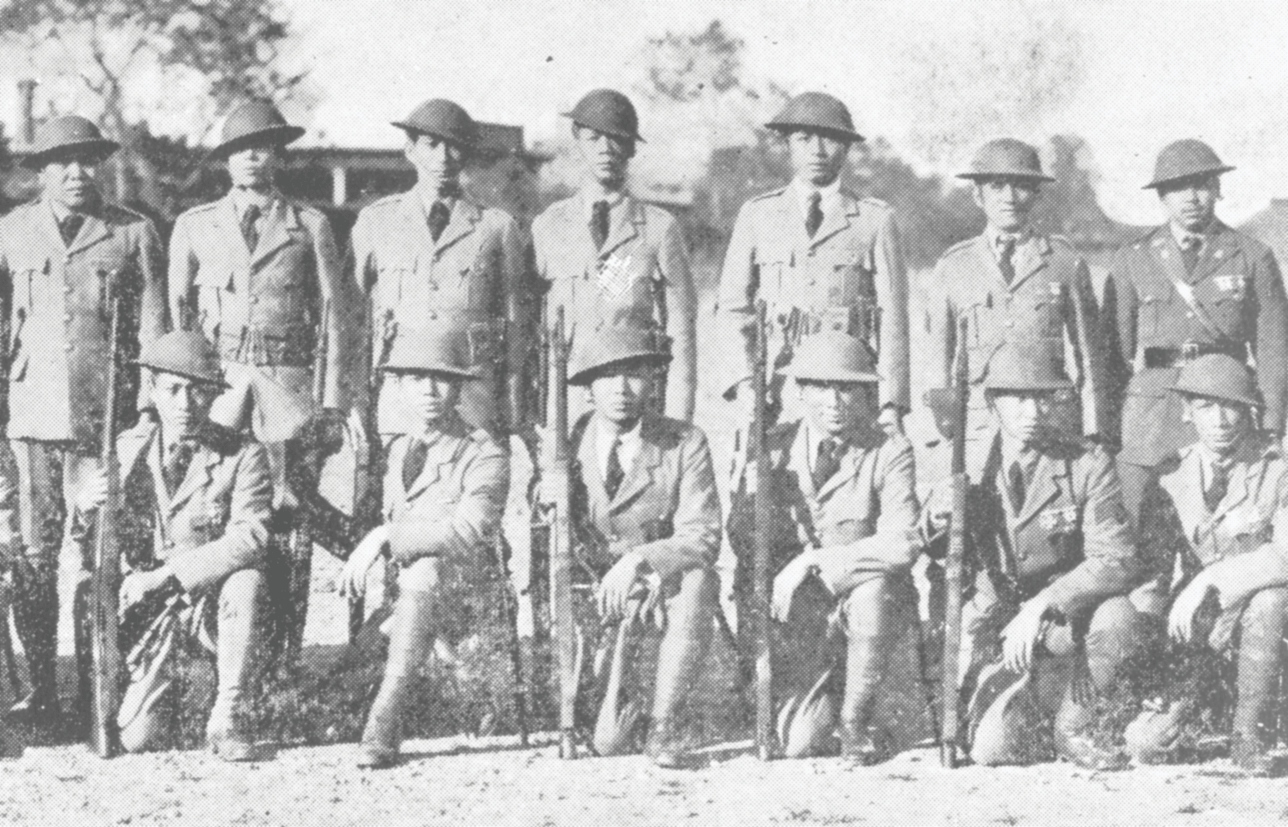
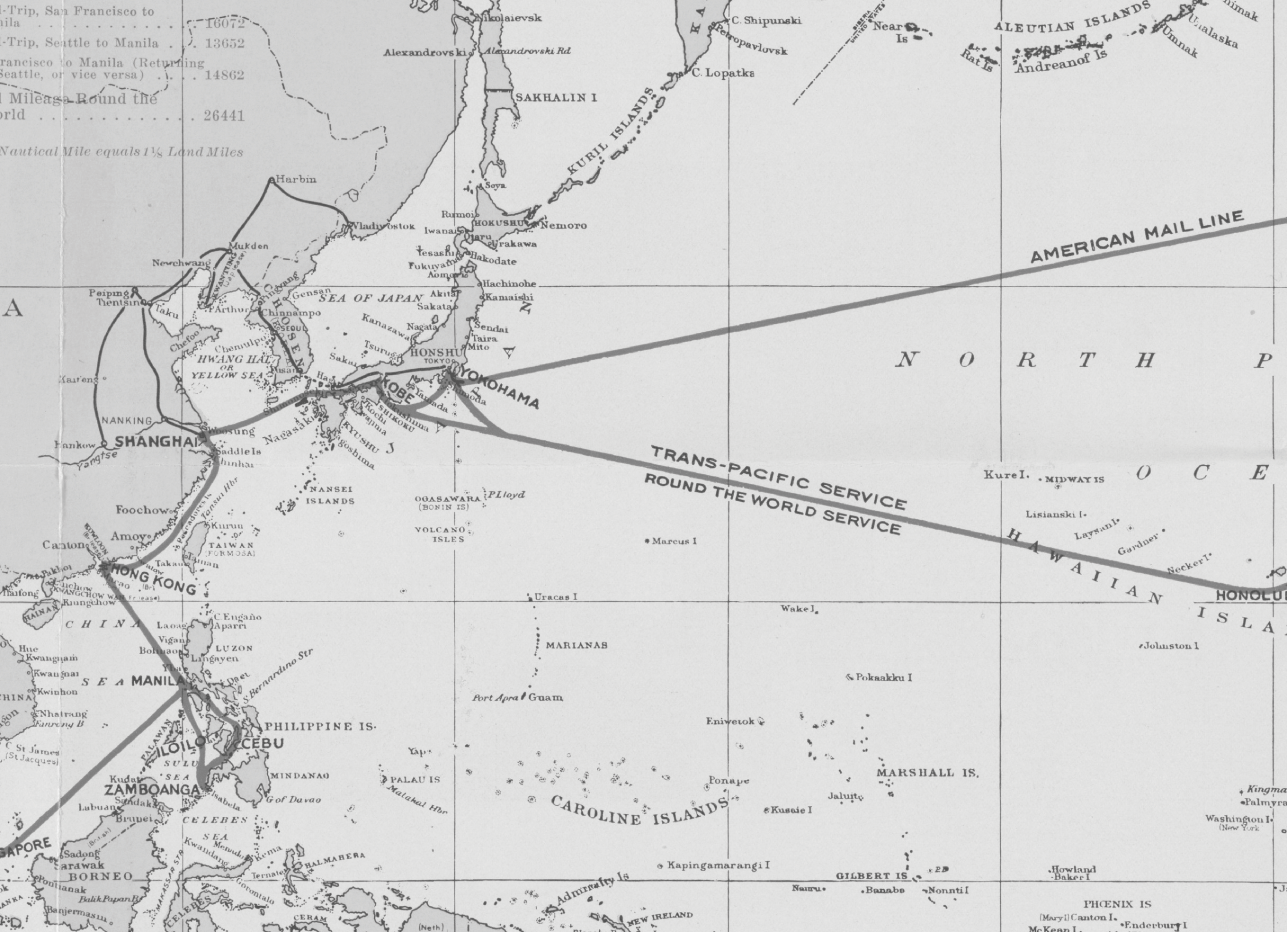

 Open access