


1. Introduction
Progressive parties frequently champion pro-immigration policies, yet they do not receive uniform support from immigrant communities. Why is this the case? As immigrants tend to hold more progressive views on immigration than the general public (Just and Anderson, Reference Just and Anderson2015; Šedovič and Dražanová, Reference Šedovič and Dražanová2025), one could expect that immigrants support more pro-immigration platforms. However, progressive parties do not necessarily garner broad support from all immigrant voters, and recent elections have shown that immigrants can also strongly support parties with anti-immigration platforms (e.g., Medina et al., Reference Medina, Igielnik and Ulloa2024; Sommer and Franco, Reference Sommer and Franco2024).
We study this puzzle by focusing on pre-migration socialization in different regimes. While some immigrants grow up in established democracies with extensive political rights, others emigrate to escape persecution or seek better economic opportunities in more stable political systems. As early political experiences play an important role in shaping long-term preferences (Sears, Reference Sears, Greenstein and Polsby1975; Niemi and Hepburn, Reference Niemi and Hepburn1995), they can help to understand how progressive platforms can be more or less successful in appealing to different immigrant groups.
Progressive parties, such as the greens, often push for multiculturalist policies, which have been shown to be important for immigrants’ voting behavior (Moriconi et al., Reference Moriconi, Peri and Turati2023). We show that those with an immigration background from established democracies are more likely to support green parties than those from (post-)authoritarian regimes. To explain this pattern, we draw on work on political socialization and cultural transmission (Niemi and Hepburn, Reference Niemi and Hepburn1995; Bisin and Verdier, Reference Bisin and Verdier2001; Reference Bisin and Verdier2011): immigrants build on experiences from their origin country when participating in politics in their host country (see also Harles, Reference Harles1997). We argue that immigrants from established democracies are more likely to support green parties than those from (post-)authoritarian regimes for two reasons: differences in salience and post-materialist values—green parties rarely represent a strong political alternative in new democracies and, as we document, (post-)authoritarian regimes do not prioritize environmental issues as much.
Empirically, we combine data from the European Social Survey (ESS) and V-DEM and employ entropy balancing before estimating regression models to document this green support gap. Using data from global surveys and from UN speeches, we show that democracies focus significantly more on environmental issues. Building on the assumption that post-materialistic values are more likely to increase support for post-materialistic issues (e.g., Inglehart, Reference Inglehart1977; Reference Inglehart1990), we also show that immigrants from established democracies are more concerned about climate change and more progressive on other post-materialist issues than those from (post-)authoritarian regimes.
This paper makes three contributions. First, we contribute to work on how socialization influences immigrant political behavior (e.g., Bilodeau, Reference Bilodeau2014; Couttenier et al., Reference Couttenier, Petrencu, Rohner and Thoenig2019; Just, Reference Just2019; Superti and Gidron, Reference Superti and Gidron2022; Lindemann, Reference Lindemann2023). We show that socialization influences the issues immigrants find most important, which in turn influences their party preferences. Second, we contribute to the study of political parties. While some studies show that immigrants in Europe tend to be more supportive of left-leaning parties (Dancygier and Saunders, Reference Dancygier and Saunders2006; Bergh and Bjørklund, Reference Bergh and Bjørklund2011), we show that progressive platforms can struggle to gather support from these groups, and provide insights on why this might happen. Finally, we contribute to the study of environmental politics and green parties. Previous work suggests that green party success is often driven by economic conditions (Inglehart, Reference Inglehart1990; Abou-Chadi and Kayser, Reference Abou-Chadi and Kayser2017; Grant and Tilley, Reference Grant and Tilley2019), the salience of environmental issues (Grant and Tilley, Reference Grant and Tilley2019), or specific events (Valentim, Reference Valentim2023). Our study extends that view by showing that the institutional context voters are socialized in influences their likelihood of supporting green parties in the long term.
2. Immigrants, party support and green issues
What explains immigrants’ political behavior? Early work on this question focuses mainly on the United States and differences between immigrant groups, showing that if and which parties are supported varies by group and age of immigration (e.g., Cain et al., Reference Cain, Kiewiet and Uhlaner1991; Hill and Moreno, Reference Hill and Moreno1996; Wong, Reference Wong2000). For example, many Latinx people are more likely to support Democrats than Republicans (Leal et al., Reference Leal, Barreto, Lee and de la Garza2005), a tendency that increases over time (Cain et al., Reference Cain, Kiewiet and Uhlaner1991). Nevertheless, these are not homogeneous groups, and explicit calls for considering differences between immigrants and ethnic minorities were raised early (e.g., Tam, Reference Tam1995). For example, immigrants from China, Korea, and Southeast Asia are more likely to become Republicans as time passes (Cain et al., Reference Cain, Kiewiet and Uhlaner1991). Moreover, first-generation Cuban immigrants have historically supported the Republican Party, which is often attributed to anti-communist sentiments resulting from their pre-migration experiences with communism (Hill and Moreno, Reference Hill and Moreno1996; Bishin and Klofstad, Reference Bishin and Klofstad2012). Media reports covering the 2024 US election pointed to similar effects: Not only did they frequently mention the growing support for Trump in Latino communities, but also that Trump linking Kamala Harris, his opponent, to socialism and communism could have been especially effective among Venezuelan and Cuban Americans (Luscombe, Reference Luscombe2024; Noe-Bustamante et al., Reference Noe-Bustamante, Krogstad and Lopez2024; Cadava, Reference Cadava2024a; Reference Cadava2024b).
Research on Europe shows that immigrants tend to support left-wing parties more strongly than non-immigrants (Dancygier and Saunders, Reference Dancygier and Saunders2006; Bergh and Bjørklund, Reference Bergh and Bjørklund2011), suggesting that these differences are driven more by group voting or the salience of immigration, than purely ideological reasons or preferences on redistribution (Dancygier and Saunders, Reference Dancygier and Saunders2006; Bergh and Bjørklund, Reference Bergh and Bjørklund2011). However, immigrants are not a static group, nor are their political behavior and attitudes (e.g., Wüst, Reference Wüst2004; Maxwell, Reference Maxwell2010; André et al., Reference André, Dronkers and Need2014; Vermeulen et al., Reference Vermeulen, Kranendonk and Michon2020; Goerres et al., Reference Goerres, Mayer and Spies2022; Debus et al., Reference Debus, Himmelrath and Stecker2024). Focusing on naturalized citizens in Germany, Wüst (Reference Wüst2004) shows that those with a Turkish background are more likely to support the center-left, while those from the former Soviet Union are more likely to support the center-right, highlighting how parties’ positions, religious and ethnic factors underlie these patterns. Debus et al. (Reference Debus, Himmelrath and Stecker2024) suggest that these differences are also driven by issue preferences, and whether one is first- or second-generation. This implies that there is substantial variation among those with an immigration background.
Another key element explaining differences between migrant groups is their origin country. Prior political experiences affect political trust and support for democracy (e.g., Bilodeau et al., Reference Bilodeau, McAllister and Kanji2010; Bilodeau, Reference Bilodeau2014; Superti and Gidron, Reference Superti and Gidron2022). However, it is less clear how the institutions of the origin country shape migrants’ party preferences. Although there is increasing consensus that immigrants from (former) left-wing authoritarian regimes are more likely to support center-right parties compared to other immigrants (see Strijbis, Reference Strijbis2014; Just, Reference Just2019; Lindemann, Reference Lindemann2023), it is unclear whether and how progressive parties can (or cannot) attract migrants’ support.
2.1. Green parties and immigrant party support
Having highlighted significant differences across immigrant groups, we now provide an overview of the party family we study: green parties. In the aftermath of World War II, Western European democracies witnessed peaceful economic growth, increased levels of education and urbanization. These allowed for economic prosperity and physical safety that created the basis for the development of post-materialist values (Inglehart, Reference Inglehart1970; Reference Inglehart1971; Reference Inglehart1977; Reference Inglehart1990) as Western Europeans now gave more importance to autonomy and self-expression over economic growth. As a consequence, voters in these contexts started giving more importance to non-economic issues such as gay rights, environmental issues, or gender equality (Inglehart, Reference Inglehart1971; Reference Inglehart1977; Reference Inglehart1990). A political consequence of these changes is a pivot to new political issues: Social movements on cultural and social issues such as environmental protection, women’s rights, and pacifism emerged in the 1960s and 1970s (Touraine, Reference Touraine1985; Burchell, Reference Burchell2002; De Vries and Hobolt, Reference De Vries and Hobolt2020).
Green parties emerged in this context. They focused on New Left issues, but also drew heavily on these social movements in terms of how they were organized (Kitschelt, Reference Kitschelt1988; Dalton, Reference Dalton1990; Burchell, Reference Burchell2002; De Vries and Hobolt, Reference De Vries and Hobolt2020). During the 1980s and 1990s, green parties put ecology and the environment at the center of their agenda, together with anti-war stances, gender equality, and new ways of organizing as parties (Frankland, Reference Frankland1989; Burchell, Reference Burchell2002), which often brought about a conservative backlash (Arend et al., Reference Arend, Ellger and Valentim2025). After their initial electoral success, challenger parties often face the dilemma of wanting to attract new voters by moderating and embracing other issues, while also not wanting to lose their core base (Spoon, Reference Spoon2011). As a consequence, green parties across Europe have increasingly taken positions on issues well outside of the environment, particularly when motivated by political competition (Spoon and Williams, Reference Spoon and Williams2021).
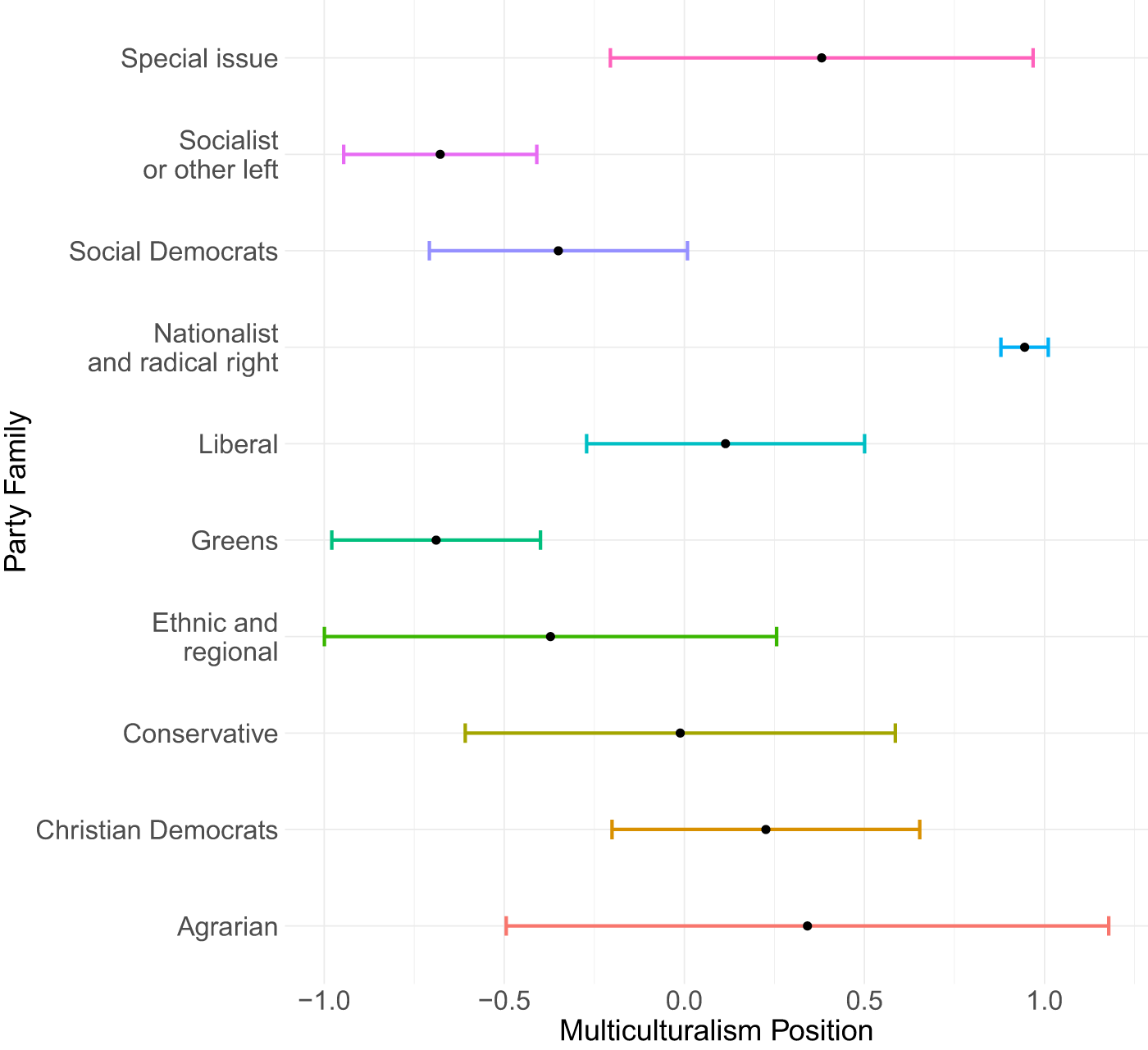
Green parties could be an attractive option for immigrants for several reasons. First, green parties in Europe generally hold liberal stances on immigration and citizenship rights, as Figure 1 shows (see also Odmalm and Super, Reference Odmalm and Super2014; Harteveld et al., Reference Harteveld, Kokkonen and Dahlberg2017). Previous work shows that immigrants are more supportive of pro-immigration policies than non-immigrants (this is, however, more pronounced prior to citizenship) (Just and Anderson, Reference Just and Anderson2015) and that the clarity of parties’ positions on immigration increases the likelihood of immigrants having clearer political identities (Just, Reference Just2021). As we mentioned, multiple studies show that immigrants tend to support left-wing parties more than non-immigrants (Dancygier and Saunders, Reference Dancygier and Saunders2006; Bergh and Bjørklund, Reference Bergh and Bjørklund2011) and that, particularly for second-generation immigrants, this left-bias is strongly associated with support for internationalism and multiculturalism (Moriconi et al., Reference Moriconi, Peri and Turati2023). We would like to emphasize that the measures we present in Figure 1 are for both immigration and citizenship rights. This is relevant as the groups we compare—immigrants from established democracies and (post-)authoritarian regimes—might differ in their access to and interest in citizenship and immigration policy. Figure 1 shows that green parties are one of the most progressive party families on both issues.
The plot displays average position on multiculturalism issues by party family. We use data from the Manifesto Project (Lehmann et al., Reference Lehmann, Franzmann, Al-Gaddooa, Burst, Ivanusch, Regel, Riethmüller, Volkens, Weßels and Zehnter2024), and follow Abou-Chadi (Reference Abou-Chadi2016)’s measure of positions on multiculturalism, where “higher levels represent restrictive policies toward citizenship acquisition and immigration in an election” (p. 425). Countries (and elections) are Austria (2019), Belgium (2019), Denmark (2019), Finland (2019), France (2017), Germany (2021), Iceland (2021), Ireland (2020), Netherlands (2021), Norway (2017), Sweden (2022), Switzerland (2019), and United Kingdom (2019). The group of green parties is what the Manifesto Project refers to as ecological parties.

2.2. How socialization influences green support
Following our discussion, one could expect that i. immigrants are more likely to support left-leaning parties in Europe (e.g., Bergh and Bjørklund, Reference Bergh and Bjørklund2011), and ii. clarity on immigration policy positions is important for immigrants’ party identification (e.g., Just and Anderson, Reference Just and Anderson2015). Given this and the patterns shown in Figure 1, we could expect voters of immigration backgrounds to be keen supporters of green parties.
However, this does not seem to be the case for all immigrants. Figure 2 uses data from ten European countries to show that, with some exceptions, in established democracies, immigrants from established democracies are more likely to support green parties than those from (post)authoritarian regimes. In addition, Lindemann (Reference Lindemann2023) also shows that in Germany this pattern seems to emerge regardless of the ideology of the authoritarian regime in which immigrants were socialized. This points to the puzzle highlighted in the introduction: parties with progressive immigration policies can sometimes struggle to gather support from those with immigration backgrounds.
Differences in proportion of green party identification when comparing first-generation immigrants regardless of immigration age from established democracies and immigrants from (post-)authoritarian regimes across Western and Northern European countries based on ESS round 5-11 (European Social Survey European Research Infrastructure (ESS ERIC), 2017; 2018a; 2018b; 2020; 2021; 2023a; 2023c; 2024). Red depicts the share of immigrants from (post-)authoritarian regimes identifying with the greens, and blue depicts immigrants from established democracies identifying with the greens in the corresponding country (born after 1945). Host country differences between immigrant groups are depicted if there are at least 30 observations in each group.

What drives these patterns? We argue that socialization in an established democracy has long-term consequences on political behavior, even after migration. We expect that these experiences will be particularly clear when compared to those who were socialized in (post-)authoritarian regimes. Building on theories of socialization and cultural transmission (e.g., Niemi and Hepburn, Reference Niemi and Hepburn1995; Bisin and Verdier, Reference Bisin and Verdier2001; Reference Bisin and Verdier2011), we expect that immigrants partly transfer political preferences acquired in the origin country to the politics of the host country. This expectation builds on previous findings: Luttmer and Singhal (Reference Luttmer and Singhal2011) show that redistribution preferences in the origin country are positively associated with those of migrants in the host country. Similarly, Harles (Reference Harles1997) shows that how people perceive politics is partly shaped by experiences in the origin country, while Superti and Gidron (Reference Superti and Gidron2022) show that if immigrants are “too old to forget” at the time of migration, the institutions in the origin country serve as a reference point in the host country. Research on authoritarian legacies also supports the idea that political context affects political attitudes and preferences in the long run, as multiple studies document a backlash against the ideology or party associated with the authoritarian regime after democratization (e.g., Dinas, Reference Dinas2017; Dinas and Northmore-Ball, Reference Dinas and Northmore-Ball2020; Frantzeskakis and Sato, Reference Frantzeskakis and Sato2020; but see Pop-Eleches and Tucker, Reference Pop-Eleches and Tucker2014). Different institutional contexts can, therefore, lead to different political preferences.
Our argumentation builds on two observations: First, green parties are among the most progressive parties on immigration issues (see Figure 1), and second, they are seen as the issue owners on climate and environmental issues. While the former explains why immigrants could be attracted to green parties in general, our central claim focuses on the latter: that immigrants from established democracies are especially likely to support green parties because they have been socialized in contexts where environmental politics and post-materialist values are more salient. In short, we argue that the variation in immigrant support for green parties is primarily driven by differences in exposure to environmental norms and priorities, not by differences in attitudes toward immigration per se.
We posit that socialization in established democracies makes migrants more likely to support green parties in the host country for two reasons: First, post-materialism is often used to explain support for environmental issues and green parties (Inglehart, Reference Inglehart1970). Building on work from Maslow (Reference Maslow1943), this approach argues that humans have a hierarchy of needs, where physical and economic security precedes concerns about self-expression or quality of life. Thus, the argument goes, as post-WWII Western European cohorts grew up in secure, affluent societies, this allowed them to shift their focus from material concerns toward values such as self-expression, and quality of life. In this framework, security acts as a foundation for the emergence of post-materialistic values and the focus on non-economic issues such as environmental protection or LGBTQ+ rights (Inglehart, Reference Inglehart1970). We posit that, at the individual level, the security and economic prosperity of established democracies should promote post-materialist values. This is particularly true when compared to migrants from (post-)authoritarian regimes, who are more likely to migrate for economic and security reasons, key drivers of migration into Europe (see, e.g., European Parliament, Reference European Parliament2020). In authoritarian regimes, repression is a clear threat to the safety of citizens. Those who emigrate from authoritarian regimes might be particularly likely to be critical of the regime (e.g., Michel et al., Reference Michel, Miller and Peters2023; Larratt-Smith and Leon, Reference Larratt-Smith and Leon2025; Lueders, Reference Lueders2025) and thus more likely to have their physical safety at risk. As both economic and physical safety can be more secured for those from established democracies, they are more likely to support post-materialist values, and as a consequence, issues including pro-climate policy preferences. More specifically, green parties’ origins are often traced back to these value changes, and greens tend to focus on these issues as well (Grant and Tilley, Reference Grant and Tilley2019). Thus, we should expect that voters for whom the pre-conditions for post-materialist values are met (e.g., those from established democracies) are more likely to support these parties. In line with this prediction, Goldenberg and Saxe (Reference Goldenberg and Saxe1996) compare attitudes of USSR immigrants to US nationals in the 1990s, and find that this group is much less likely to support post-materialist values. Hence, since post-materialist values are lower for immigrants from (post-)authoritarian regimes, green parties are likely a more viable option for immigrants from established democracies.
Second, at the macro level, green issues are prioritized more in public debates in established democracies. Autocratic leaders face an important dilemma when dealing with public opinion and citizens’ demands: Although they are not constrained by electoral uncertainty as democratic leaders are, some level of attention to public demands is important for regime survival (e.g., Malesky and Schuler, Reference Malesky and Schuler2010; Manion, Reference Manion2015; Chen et al., Reference Chen, Pan and Yiqing2016; Truex, Reference Truex2016; Lueders, Reference Lueders2022). This information gathering is important for multiple reasons: it can diminish the risk of political elites’ challenge, as well as the mobilization and collective action of regime opponents (e.g., Chen et al., Reference Chen, Pan and Yiqing2016; Lueders, Reference Lueders2022). Work on this dilemma suggests that the issues that concern citizens the most, and the issues that autocracies are more likely to be responsive on tend not to be environmental issues, but those more concerned with economic issues, safety, and public good provision. For example, Lueders (Reference Lueders2022) shows that in East Germany, less than 2% of petitions submitted by GDR citizens to both the Council of Minister and the People’s Chamber were on topics related to nature, the environment or water. Instead, these were much more focused on quality of life and procedural issues such as housing, justice, labor, wages, or social insurance (Lueders, Reference Lueders2022).
In Western European democracies, environmental issues have been much more salient, from the emergence of social movements that pushed the issue and green parties since the 1960s (see, e.g., Kitschelt, Reference Kitschelt1989), to newer forms of protest and increased polarization in recent decades (Valentim, Reference Valentim2023; Borbáth and Hutter, Reference Borbáth and Hutter2025; Dickson and Hobolt, Reference Dickson and Hobolt2025). Thus, the higher salience of environmental issues in established democracies can bolster green party support among immigrants from these regimes.
Overall, we expect that immigrants from established democracies are more likely to support the greens, and to be concerned about climate change—relative to those from (post-)authoritarian regimes. To be clear, we are not making an argument about which regime type is more effective in addressing climate change (see, e.g., Bättig and Bernauer, Reference Bättig and Bernauer2009; Bernauer, Reference Bernauer2013; Mittiga, Reference Mittiga2022; Lindvall and Karlsson, Reference Lindvall and Karlsson2024 for discussions on this). Nor are we arguing that environmental outcomes are irrelevant in (post-)authoritarian regimes or for their citizens (see, e.g., Alkon and Wang, Reference Alkon and Wang2018, on how environmental public goods influence support for authoritarian regimes). Instead, we are making a claim about the extent to which environmental issues are debated and the extent to which voters see this issue as an important political issue.
3. Empirical strategy
To test our expectations, we use the ESS Rounds 5-11 (European Social Survey European Research Infrastructure (ESS ERIC), 2017; 2018a; 2018b; 2020; 2021; 2023a; 2023c; 2024).Footnote 1 The ESS is a series of repeated cross-sectional surveys on representative samples of European countries, conducted every two years since 2001. As a respondent’s exact year of migration is only sampled since round 5, we exclude earlier rounds.
We focus on host countries that are considered a stable electoral or liberal democracy since 1946 according to the Regimes of the World indicator (Lührmann et al., Reference Lührmann, Tannenberg and Lindberg2018; Coppedge et al., Reference Coppedge, Gerring, Knutsen, Lindberg, Teorell, Altman, Angiolillo, Bernhard, Borella, Cornell, Fish, Fox, Gastaldi, Gjerløw, Glynn, Good God, Grahn, Hicken, Kinzelbach, Marquardt, McMann, Mechkova, Neundorf, Paxton, Pemstein, Rydén, von Römer, Seim, Sigman, Skaaning, Staton, Sundström, Tzelgov, Uberti, Wang, Wig and Ziblatt2024a) from V-Dem (Coppedge et al., Reference Coppedge, Gerring, Knutsen, Lindberg, Teorell, Altman, Angiolillo, Bernhard, Borella, Cornell, Fish, Fox, Gastaldi, Gjerløw, Glynn, Good God, Grahn, Hicken, Kinzelbach, Krusell, Marquardt, McMann, Mechkova, Medzihorsky, Natsika, Neundorf, Paxton, Pemstein, Pernes, Rydén, von Römer, Seim, Sigmann, Skaaning, Staton, Sundström, Tzelgov, Wang, Wig, Wilson and Ziblatt2024b; Pemstein et al., Reference Pemstein, Marquardt, Tzelgov, Wang, Medzihorsky, Krusell, Miri and von Römer2024).Footnote 2 To identify green parties, we rely on the Comparative Manifesto Project’s (CMP) (Lehmann et al., Reference Lehmann, Franzmann, Al-Gaddooa, Burst, Ivanusch, Regel, Riethmüller, Volkens, Weßels and Zehnter2024) party family indicator. We define host countries as Northern and Western European countries that (1) are classified as established democracies by V-Dem and (2) are included in the ESS with green parties listed as a party-preference option (as classified by the CMP; see Appendix A.1–A.2).Footnote 3 To classify origin countries as (post-)authoritarian or established democracies, we also use the Regimes of the World indicator (Lührmann et al., Reference Lührmann, Tannenberg and Lindberg2018; Coppedge et al., Reference Coppedge, Gerring, Knutsen, Lindberg, Teorell, Altman, Angiolillo, Bernhard, Borella, Cornell, Fish, Fox, Gastaldi, Gjerløw, Glynn, Good God, Grahn, Hicken, Kinzelbach, Marquardt, McMann, Mechkova, Neundorf, Paxton, Pemstein, Rydén, von Römer, Seim, Sigman, Skaaning, Staton, Sundström, Tzelgov, Uberti, Wang, Wig and Ziblatt2024a). Immigrants whose origin country has not been an electoral democracy consistently since 1946 are considered as coming from a (post-)authoritarian regime, otherwise they are coded as coming from an established democracy (see Appendix A.3).Footnote 4 We include respondents in our sample who were born after 1945 and were least 18 years old when they immigrated ensuring they spent a substantial part of their socialization period in the origin country.Footnote 5 Respondents who do not meet these criteria are excluded (see Appendix A.4 for details on analytical sample for green party support).Footnote 6 We exclude emigrants from Germany, since we do not have information on whether they were born in East or West Germany.Footnote 7 As Figure A.3 in the Appendix shows, a majority of the respondents from established democracies and (post-)authoritarian regimes immigrated after the fall of the USSR.
We compare immigrants from established democracies to immigrants from (post-)authoritarian regimes. We believe that comparing two immigrant groups is a suitable strategy given that unobserved factors driving migration are at least partly accounted for. For example, Auer and Schaub (Reference Auer and Schaub2024) show that migrants themselves tend to have more liberal values than those who do not emigrate, while Turcu and Urbatsch (Reference Turcu and Urbatsch2020) find that diaspora voters are more likely to vote green in domestic elections than non-emigrants. Hence, migrants tend to be more progressive overall than those who do not emigrate.Footnote 8
Studying potential transmission effects by focusing on immigrants is no trivial endeavor. Immigrants from established democratic regimes and immigrants from (post-)authoritarian regimes might differ substantially in their composition. To avoid capturing purely compositional effects, we use entropy balancing (Hainmueller, Reference Hainmueller2012) to reweigh observations before estimating linear probability models and OLS regressions. We use the package WeightIt (Greifer, Reference Greifer2024) in R and balance, if convergence is possible, on the first, second, and third moment. If these constraints are too high for convergence or result in a small effective sample size, we reduce this to the first moment (and second if possible) being balanced. While still having the risk of biased estimates because of unobserved confounders, this allows to rule out bias on observed covariates by achieving perfect balance on them.
We define the treatment group as immigrants from established democracies, which we compare to those from (post-)authoritarian regimes. To balance the data and avoid post-treatment bias, we include the following time-invariant covariates in the balancing process: Year of birth, gender, father’s education (as a proxy of the respondent’s education)Footnote 9 and the father’s occupation (as a proxy to social class). Additionally, we include the ESS round and host country in the balancing procedure to ensure that comparisons are made within similar contexts. To avoid having a very small effective sample, we include GDP pc (logged) and urbanization rate before year of birth of the origin country as a control instead of a weighting variable (both provided by V-Dem, Fariss et al., Reference Fariss, Anders, Markowitz and Barnum2021; Coppedge et al., Reference Coppedge, Gerring, Knutsen, Lindberg, Teorell, Altman, Angiolillo, Bernhard, Borella, Cornell, Fish, Fox, Gastaldi, Gjerløw, Glynn, Good God, Grahn, Hicken, Kinzelbach, Marquardt, McMann, Mechkova, Neundorf, Paxton, Pemstein, Rydén, von Römer, Seim, Sigman, Skaaning, Staton, Sundström, Tzelgov, Uberti, Wang, Wig and Ziblatt2024a).Footnote 10 We control for GDP pc and urbanization rate as these can affect the level of democracy in a country, the possibility to migrate, and finally also what kind of topics are on the political agenda: hence, affecting political preferences.
In theory, factors such as citizenship status, timing of immigration, and socio-economic conditions in the host country could bias our results. However, these are post-treatment variables (i.e., they happen after people have been socialized into their native country), which bias the socialization effect. For transparency, we include them in separate models. These models control for (but are not weighted on) citizenship, immigration year, subjective household income (current), and education years of the respondent. We report both weighted and unweighted estimates. If our findings were driven by these mechanisms, controlling for them would make the effects vanish. However, we find no substantive differences when accounting for these post-treatment factors (see Tables A.3 and A.4 in Appendix A.4 for summary statistics on covariates prior to weighting).
3.1. Main outcome
Our main outcome is green party support. We create dichotomous variable based on the ESS question Which political party do you feel closest to?. Following the CMP’s variable on party family, we coded ecological parties as green parties (1) and the remaining parties in the ESS as not green (0). Respondents who did not report feeling closer to any party were coded as missing and excluded.
3.2. Climate change salience
Our argument is based on the assumption that climate change salience is higher in established democracies than (post-)authoritarian regimes. We test this by looking at media salience, a common measure of salience (e.g., Helbling and Tresch, Reference Helbling and Tresch2011). We use data from Leiserowitz et al. (Reference Leiserowitz, Carman, Buttermore, Rosenthal, Jennifer Marlon and Mulcahy2022), who surveyed over 100 countries on climate change issues in 2022. We use an item asking respondents to rate how frequently they hear about climate change (About how often do you hear about climate change in your daily life (for example, from TV, newspapers, social media, or conversations with friends and family)?). We restrict the sample to countries that appear both in Leiserowitz et al. (Reference Leiserowitz, Carman, Buttermore, Rosenthal, Jennifer Marlon and Mulcahy2022)’s survey and as origin countries in our full ESS sample (see Section A.5 for the countries). In an additional analysis, we also use data from Jankin et al. (Reference Jankin, Baturo and Dasandi2017) to look at the salience of environmental and climate issues by regime type on UN speeches (see also Baturo et al., Reference Baturo, Dasandi and Mikhaylov2017; Jankin et al., Reference Jankin, Baturo and Dasandi2025).
3.3. Climate change attitudes
We argued that socialization in a democracy could make people more post-materialistic, which is associated with support for green parties. Therefore, we analyze differences in attitudes toward climate change. While we also test for differences on multiple post-materialistic issues (see below), we assess climate change attitudes separately them being more closely linked to green parties and their perceived issue ownership. First, we use attitudes toward climate change from the ESS (rounds 8, 10 and 11) to investigate differences between immigrant groups, using the following items: 1) Personal responsibility to reduce climate change (To what extent do you feel a personal responsibility to try to reduce climate change? on a scale from 0 (not at all) to 10 (a great deal)) and 2) Worry about climate change (How worried are you about climate change? on a scale from 1 (not at all worried) to 5 (extremely worried)).Footnote 11 For comparability, we recode the measures for them to have the same minimum and maximum values, before creating a mean index, which we standardize for our analysis. We calculate the mean index if respondents answer either one or both items.
3.4. Other issue attitudes
Our argument builds on the assumption that post-materialistic values would make voters more progressive on post-materialistic issues (e.g., Inglehart, Reference Inglehart1977). We assess how the two immigrant groups differ on other post-materialist issues, using survey items on attitudes toward homosexuality, gender equality, and immigration (specifically cultural aspects of migration) from the ESS. To measure attitudes toward homosexuality, we include the items 1) Gay men and lesbians should be free to live their own life as they wish, 2) Gay male and lesbian couples should have the same rights to adopt children as straight couples and 3) If a close family member was a gay man or a lesbian, I would feel ashamed, and recode them so that higher values depict more progressive stances. We use a scale from 1 (disagree strongly) to 5 (agree strongly). We create a mean index, where the mean score is calculated if one of the three measures is observed to not lose statistical power. We include rounds 8 to 11, when all items are measured. To measure attitudes on gender equality, we reverse and include the item When jobs are scarce, men should have more right to a job than women, so the scale ranges from 1 (agree strongly) to 5 (disagree strongly) (rounds 5 and 8). To measure attitudes toward immigration, we include 1) Would you say that [country]’s cultural life is generally undermined or enriched by people coming to live here from other countries? from 0 (cultural life undermined) to 10 (cultural life enriched) and 2) Is [country] made a worse or a better place to live by people coming to live here from other countries? from 0 (worse place to live) to 10 (better place to live) (rounds 5 to 11). We also combine them into a mean index, which is calculated if respondents answer any of the items.
To understand whether potential differences in these two groups are only restricted to conventional post-materialistic issues or not, we also analyse their differences on two other items, on diffuse support toward the EU and redistribution preferences for reasons of comparability. For diffuse support, we use the item Now thinking about the European Union, some say European unification should go further. Others say it has already gone too far. Using this card, what number on the scale best describes your position? from 0 (unification has already gone too far) to 10 (unification should go further). For redistribution preferences, we use the reversed measure The government should take measures to reduce differences in income levels for the scale to range from 1 (disagree strongly) to 5 (agree strongly). We standardize both post-materialist and other issues to make them more comparable.
4. Results
Do immigrant groups differ in their green party support? Panel A of Figure 3 shows unweighted and weighted differences, using entropy balancing. Across all specifications, immigrants from established democracies are more likely to identify with green parties than immigrants from (post-)authoritarian regimes. These are statistically significant and range from 7% to 10%, showing that coming from an established democracy as compared to a (post-)authoritarian regime is associated with higher green party support (see Appendix B for (weighted) frequencies of origin countries, covariate balance pre- and post-weighting, and regression tables). These differences hold when including post-treatment covariates (citizenship, education, subjective household income, and immigration year). If green party support differences were entirely driven by group differences in the conditions in the host country, these estimates would substantively diminish or disappear when controlling for them. We find no evidence of that. Footnote 12
Panel A: Effect of coming from an established democratic vs. (post-)authoritarian country on green party identification. Panel B: Effect of coming from an established or (post-)authoritarian regime compared to non-immigrants (i.e., born in the host country) on green party identification (full models only). Standard errors clustered at country of origin level, for analysis of established democratic immigrants vs. non-immigrants robust standard errors (too few clusters). Unweighted and weighted estimates shown. 95% (thin bars) and 90% (thick bars) confidence intervals depicted.

While we believe that comparing immigrants groups is the most suitable strategy, we also present the comparison of the two migrant groups to host country natives. This allows us to assess whether immigrants from established democracies are those who are more green or whether immigrants from (post-)authoritarian regimes are less green compared to the native-born population. Footnote 13 Panel B of Figure 3 presents the results. Immigrants from established democracies are the ones who are more likely to be green: they are around 8% (full, weighted estimate) more likely to identify with green parties than their native-born counterparts, while there is no statistically significant difference between immigrants coming from (post-)authoritarian contexts and natives (see Tables B.8 and B.9). This supports the argument that there is no penalty from immigrants from (post-)authoritarian regimes for green parties, but that immigrants from established democracies are particularly green.Footnote 14
4.1. Length of stay in origin and host country
If socialization in the origin country influences green party support in the host country, the length of stay in the origin country should matter. If socialization is approached from a life-long openness model (see Sears, Reference Sears, Wheeler and Shaver1983, p.81), we could expect that the longer someone is socialized in an established democracy, the stronger their green party support. If, however, this pattern is not linear this may suggest that it is enough to have spent the formative years in an established democracy for this pattern to show—especially if moving to another democracy. Moreover, given that immigrants from both regime groups are exposed to new ideas and political discussions, one could expect further assimilation, which would counter origin country socialization effects.
Panel A of Figure 4 shows there is no effect of the established democratic socialization on green party support when immigrants immigrated prior to the age of 15. Once they spent the entirety of their formative years in the origin country, the positive effect of socialization starts to become statistically significant. However, those who spent more than 25 years in their origin country are only marginally more supportive of the greens than those who have spent (part of) their formative years in the origin country. Although the interaction effect in the weighted analysis is not statistically significant when comparing 15–25 years to fewer than 15 years in the origin country, the analysis still suggests a non-linear rather than a linear effect (see Tables B.10 and for the linear model B.11 in Appendix B.6), supporting the formative years argument.Footnote 15
Panel A: Effect of green party identification by length in origin country. Panel B: Effect of green party identification by length in host country. Standard errors clustered at country of origin level (full models). 95% (thin bars) and 90% (thick bars) confidence intervals depicted.

Panel B shows that the effect of being socialized in an established democracy does not appear to decrease the longer someone spent in the host country. This is true when measuring the length of stay in the host country as a categorical variableFootnote 16 and as a linear variable (see Tables B.12 and B.13 in Appendix B.6).Footnote 17 This suggests that the green party support gap between immigrants from established democracies and (post-)authoritarian regimes is driven by socialization, which remains after migration.
4.2. Exposure to authoritarianism
So far, we have implicitly assumed our reference group, immigrants from (post-)authoritarian regimes, to be homogeneous in their green party support. Nevertheless, this means we combine immigrants who have always lived under authoritarianism with those who have only lived in new democracies. In Appendix B.7, we test whether comparing immigrants from established democracies to immigrants who experienced a longer exposure to authoritarianism versus those from non-established democracies leads to heterogeneous treatments effects. To do so, we first replicate our main analysis with having those immigrants from (post-)authoritarian regimes in the reference group who had at least 15 years of direct exposure of authoritarianism, but less than 15 years of direct exposure to democracy prior to migrating. We then replicate our main analysis with those who had at least 15 years of direct exposure to a new democracy, but less than 15 years of direct exposure to authoritarianism before immigrating into the host country as our reference. The treatment group remains immigrants from established democracies in both analyses. As discussed in Appendix B.7, the gap in green party identification is more stable for those who were exposed longer to authoritarianism prior to migration.
4.3. Exposure to different ideologies
In addition, we also split the reference group of the sample in regards to regime ideology (see Appendix B.8), to examine whether the difference between immigrants from established democracies and immigrants from (post-)authoritarian regimes depends on the predominant ideology before migration of the reference group. We divide our samples into one group whose reference group was exposed the longest to a nationalist/conservative regime and the other, where the reference was exposed the longest to a socialist regime than any other ideology or democracy according to V-Dem (Tannenberg et al., Reference Tannenberg, Bernhard, Gerschewski, Lührmann and von Soest2021; Coppedge et al., Reference Coppedge, Gerring, Knutsen, Lindberg, Teorell, Altman, Angiolillo, Bernhard, Borella, Cornell, Fish, Fox, Gastaldi, Gjerløw, Glynn, Good God, Grahn, Hicken, Kinzelbach, Marquardt, McMann, Mechkova, Neundorf, Paxton, Pemstein, Rydén, von Römer, Seim, Sigman, Skaaning, Staton, Sundström, Tzelgov, Uberti, Wang, Wig and Ziblatt2024a) prior to migration and replicate our main analysis. As discussed in Appendix B.8, while the unweighted estimations suggest that the identified gap does not depend on the experienced ideology of the control group, the results appear more stable and pronounced when including only those in the reference group that have experienced a nationalist/conservative ideology. This could, however, be a consequence of weaker statistical power of the other group.
4.4 Drivers of the green support gap
Having shown that there is a clear gain for green parties for those who were socialized in established democracies, we now explore the reasons why. We argued that one of the reasons driving this green support gap is the fact that green issues are more salient in established democracies. This would make immigrants from established democracies more likely to support green parties. Although we cannot fully test the mechanisms with observational data, we can assess their observable implications.
We follow the assumption that voting is a manifestation of underlying preferences and issue priorities (e.g., Downs, Reference Downs1957; Nordin, Reference Nordin2014), and test the drivers of green party support by focusing on i. the salience of environmental issues, on which green parties are issue owners in the host countries of our respondents (e.g., Abou-Chadi, Reference Abou-Chadi2016) and ii. support for post-materialistic issues, on which green parties traditionally focus and have more progressive stances on (e.g., Kitschelt, Reference Kitschelt1988; Inglehart, Reference Inglehart1990).
In Figure 5, we use data from Leiserowitz et al. (Reference Leiserowitz, Carman, Buttermore, Rosenthal, Jennifer Marlon and Mulcahy2022) to explore if climate issues are more salient in established democratic than (post-)authoritarian regimes. We use an item that asks respondents how often they hear about climate change, and plot these answers by regime type. Figure 5 shows that climate change is much more salient in established democracies than under (post-)authoritarianism. The highest share of respondents living in established democracies hears about climate change on a weekly basis, whereas the highest share of respondents living in (post-)authoritarian regimes reports doing so only several times per year.Footnote 18
The plot displays country average percentage of people who choose each of the response options in Leiserowitz et al. (Reference Leiserowitz, Carman, Buttermore, Rosenthal, Jennifer Marlon and Mulcahy2022), as well as the confidence intervals. We restrict the sample to countries that appear both in Leiserowitz et al. (Reference Leiserowitz, Carman, Buttermore, Rosenthal, Jennifer Marlon and Mulcahy2022)’s survey and as origin countries in our full ESS sample. Countries are classified using the Regimes of the World indicator (Lührmann et al., Reference Lührmann, Tannenberg and Lindberg2018; Coppedge et al., Reference Coppedge, Gerring, Knutsen, Lindberg, Teorell, Altman, Angiolillo, Bernhard, Borella, Cornell, Fish, Fox, Gastaldi, Gjerløw, Glynn, Good God, Grahn, Hicken, Kinzelbach, Marquardt, McMann, Mechkova, Neundorf, Paxton, Pemstein, Rydén, von Römer, Seim, Sigman, Skaaning, Staton, Sundström, Tzelgov, Uberti, Wang, Wig and Ziblatt2024a). Complete list of countries can be found in Appendix A.5.

For an additional test of whether (post-)authoritarian regimes are less likely to discuss climate and environmental issues, we use data from Jankin et al. (Reference Jankin, Baturo and Dasandi2017) on UN General Assembly General Debate speeches from 1946-2022. Using the origin countries from our ESS sample, whose regimes we classify based on V-Dem into either (post-)authoritarian or an established democracy, we use a dictionary approach to identify the frequency words associated with climate change and the environment are used. This is a setting where (post-)authoritarian regimes are likely to be more pressured to address these issues: On the international stage, they may be more targeted in shaming campaigns to enforce environmental policy (Murdie and Urpelainen, Reference Murdie and Urpelainen2015). Figure 6 shows the average count of words per year per regime type. While both regimes follow the same general trend, the frequencies among democracies are clearly higher. In Appendix C, we show similar patterns by classifying the regimes in a time-varying way for these two analyses on saliency: In both Figure C.5 and C.6, we demonstrate that the patterns in Figures 5 and 6 are robust to using an alternative regime classification.
Salience of climate change and environment by regime type (UN speeches, Jankin et al. (Reference Jankin, Baturo and Dasandi2017)). Terms are: “climate,” “global warming,” “pollution,” “solar,” “wind power,” “environment,” “wind energy,” “wind power,” “wind installation,” “renewable,” “electricity,” “eco,” “re powering,” “emission,” “photovoltaic,” “heat,” “fuel,” “shore,” “coal,” “warming,” “hydropower,” “hydroelectric,” “geothermal,” “power plant,” “turbine,” “nuclear power,” “nuclear energy”.

Although the salience of climate change and environmental issues might be higher in established democracies, it would only help explain our results if immigrants from established democracies are more concerned about climate change than those from (post-)authoritarian regimes. In Figure 7, we use the ESS and find that immigrants from established democracies score on average 0.21 standard deviation units higher on our mean index (full, weighted model), which depicts concerns about and perceived personal responsibility to reduce climate change than their counterparts from (post-)authoritarian regimes (see Table C.20 in Appendix C.3). The results are robust to different specifications and statistically significant at the conventional levels.Footnote 19 Thus, we find evidence according to the expectation that immigrants from established democracies are more concerned about environmental issues.
Effect of coming from an established democratic vs. (post-)authoritarian country on attitudes toward climate change in standard deviation units. Standard errors clustered at country of origin level. Unweighted and weighted estimates shown. 95% (thin bars) and 90% (thick bars) confidence intervals depicted.

4.4.1. Post-materialist and economic issue attitudes
We argued that the gap in green party support between immigrant groups is driven by the higher salience of green issues in established democracies. As argued, immigrants from established democracies are, however, also likely more post-materialist in general (see also Goldenberg and Saxe, Reference Goldenberg and Saxe1996). Hence, the effects reported in Figure 7 could be part of a broader pattern of lower values of post-materialism rather than more specifically attitudes toward the environment in connection to green party support.
To explore this concern, we first replicate our main analysis on a series of policy preferences items. Figure 8 supports that immigrants from established democratic contexts are more progressive than their (post-)authoritarian counterparts in two of the three cultural issues. Coming from an established democratic is associated with an increase in support for homosexuality and gender equality of 0.58 and 0.41 standard deviation units, respectively. We find no significant differences on the immigration index, which proxies cultural aspects of immigration, and neither on issues such as redistribution and diffuse EU support (see also Tables C.21 and C.22 in Appendix C.4). Overall, we find some support for the idea that the established democratic group is more likely to support some, but not all, post-materialist policy issues.
Effect of coming from an established democratic vs. (post-)authoritarian country on attitudes different policy issues in standard deviation units. Standard errors clustered at country of origin level. Unweighted and weighted estimates shown. 95% (thin bars) and 90% (thick bars) confidence intervals depicted.

Secondly, we explore whether climate change concern predicts green party support, once we account for attitudes on these other issues. We split the sample of migrants into those coming from (post-)authoritarian and established democratic regimes and predict green party identification with the different policy issues.Footnote 20 This should help determine whether attitudes toward climate change or other issues are driving green party support. Table 1 shows that green party identification among both immigrants from (post-)authoritarian and established democratic regimes does not seem to be driven exclusively by attitudes on issues other than environmental ones. In the full model, a one standard deviation unit increase in the attitudes toward climate change index is predicted to increase green party identification by four and seven percentage points among immigrants from (post-)authoritarian regimes and immigrants from established democracies, respectively, everything else constant (full model). Hence, even when controlling for attitudes on different policy issues, attitudes toward climate change still seem to be predicting green party support. This provides further, albeit suggestive, evidence for our proposed mechanism. Nonetheless, the sample sizes are limited for these analyses because not all items were surveyed in the same ESS rounds. The sample size for the full model including immigrants from established democracies only (fourth column) is very small, and has weaker statistical power. These results should be interpreted with care.
Predictors of green party identification. Robust standard errors instead of country of birth clustered standard errors for models including immigrants from democratic regimes only due to too few clusters present. Full model controls include also subjective household income, education years, citizenship, and immigration year in this analysis
 $^{***}p \lt 0.001$; $^{**}p \lt 0.01$; $^{*}p \lt 0.05$; $^{\ddagger}p \lt 0.1$
Overall, at the macro-level, we provide evidence that established democracies give more attention to environmental and climate issues. At the individual level, we show that attitudes toward green issues are an important predictor of green party support for both immigrant groups. This supports our theory that the salience of green issues in the origin country and post-materialist values are drivers of the green support gap we presented.
4.5. Alternative explanations
4.5.1. Small parties
In most contexts, green parties cannot be categorized as mainstream parties. Hence, the found patterns could emerge because immigrants from established democracies are more likely to support smaller parties, while those from (post-)authoritarian contexts benefit mainstream parties more strongly. We explore this concern by replicating the main analysis for each party family other than green parties.Footnote 21 As we show in Figure D.7 and discuss in Appendix D.1, there are no statistically significant differences between the two immigrant groups in support for other small party families except for nationalist and radical right parties.
4.5.2. Conditions in host country
Another possible explanation for the green gap we report is that immigrants from established democracies and from (post-)authoritarian regimes differ significantly in their conditions in the host country—in terms of timing of immigration, their citizenship, or socio-economic status—which could influence their support for the greens. As discussed earlier, if these were the main mechanisms of the reported differences, our main results should become much smaller or vanish once we account for them. Therefore, we control for these post-treatment factors in Figure 3, which does not substantively change our results. This suggests that our findings are not driven by timing of immigration, nor respondents’ citizenship or socio-economic status post-migration.
5. Discussion and conclusion
While it is often assumed that immigrants would support parties with progressive immigration stances, these parties often struggle to get support from all immigrant groups. We contribute to understanding this puzzle by studying how socialization in different regimes influences the preferences of immigrants in Europe. We focus on a particularly interesting puzzle: Those with an immigration background from established democracies are substantively more likely to support green parties than those from (post-)authoritarian regimes. This is particularly puzzling given that green parties hold progressive stances on immigration, often seen as an important factor in immigrants’ voting behavior.
Building on theories of political socialization and cultural transmission, we argued that socialization in an established democracy is associated with more exposure to environmental issues as a salient political issue, and that this migrant group has also developed more post-materialist values than those from (post-)authoritarian regimes. As a consequence, they are more likely to support green parties and be more concerned about post-materialistic issues than immigrants from (post-)authoritarian regimes.
We use European cross-national survey data to show that immigrants from established democracies are significantly more likely to support green parties than those socialized in (post-)authoritarian regimes. Using data from different sources, we explore the reasons underlying this pattern. We find that there is a significant difference in the information environment, where established democracies are far more likely to expose citizens to environmental issues on a high frequency than (post-)authoritarian regimes. Post-emigration, we find that immigrants from established democracies are more concerned about climate change and more progressive on other post-materialist issues than immigrants from (post-)authoritarian regimes.
This research has some limitations. First, while we include as many variables as possible in the weighting process, this only lets us account for imbalances on observed (and included) covariates. Additional unobserved confounders might bias our estimations. Nevertheless, our models’ robustness across the different model specifications gives us confidence in the results. Moreover, especially in the additional analyses, we have to rely on smaller samples with weaker statistical power, limiting our conclusions. Future research should develop better data to better understand the political behavior of immigrants, as they constitute an increasing part to society and the electorate.
Overall, this study contributes to our understanding of the comparative politics of institutions, political behavior, and party politics. We contribute to scholarship of how political institutions influence political behavior, by showing that the regime migrants were socialized in influences not only their ideological preferences in the host country (e.g. Lindemann, Reference Lindemann2023), but also the issues they find important and worthy of making political decisions on. We contribute to research of party politics by suggesting how progressive political parties and political candidates might struggle to gain votes from immigrants, even when hosting very progressive stances on immigration policy. Additionally, our study highlights how important it is to understand the variation between different groups of immigrants, and future research should focus on these differences further. Corroborating previous work on socialization, our findings suggest that the context voters are socialized in has lasting effects for their preferences, and might make certain groups more or less likely to support post-materialistic platforms. An interesting question for future work would be if and when immigrants from (post-)authoritarian regimes are willing to de-prioritize economic issues in their voting and party identification, as well as to investigate further how institutions influence information environments.
Supplementary material
The supplementary material for this article can be found at https://doi.org/10.1017/psrm.2026.10093. To obtain replication material for this article, https://doi.org/10.7910/DVN/HWMO56.
Acknowledgements
We thank Ala Alrababah, Eva Krejcova, Matthew Rhodes-Purdy, and the audiences of APSA 2024, EPSA 2024, SVPW 2025, the Pre-EPSA Workshop in Münster 2024, and the PBC at the EUI in 2024 for helpful feedback and comments on previous versions. We are also grateful to Thales Carvalho for help with the UN dataset. Finally, we thank our two anonymous reviewers for their helpful comments.
Funding declaration
This research was partially developed within the Research Training Group DYNAMICS, funded by the Deutsche Forschungsgemeinschaft (DFG, German Research Foundation) – 390285477/GRK 2458. António acknowledges and thanks for the support from the MacMillan Center.
Conflicts of interest
The authors have no conflicts of interest to disclose.
Data availability statement
Replication materials are available at the Political Science Research and Methods Dataverse: https://doi.org/10.7910/DVN/HWMO56.


 Open access

