

Introduction
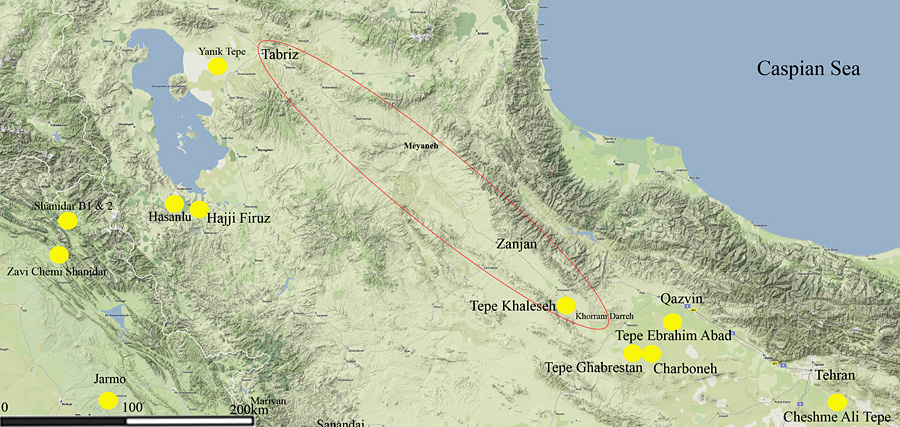
Archaeological information regarding the Neolithic period on the Iranian central plateau does not yet appear to have received adequate scrutiny. In the corridor leading from Mianeh to Zanjan to Korram Darreh/Abhar, a natural access route from the central plateau to the north-west of Iran (Figure 1), an archaeological investigation at the site of Tepe Khaleseh contributes to understanding the cultural changes this area underwent. The site was discovered during archaeological surveys in the Abhar-Rood basin and identified as belonging to the Neolithic and Chalcolithic periods (Reference AaliAali 2004, 2006). Surface finds, including stone tools thought to be of Lower Palaeolithic origin, have also been published recently (Alibaigi & Khosravi 2009; Alibaigi et al. 2010).
Location map showing the Zanjan province as a corridor between the central plateau and north-western Iran and location of Pottery Neolithic sites.

Excavation at Tepe Khaleseh
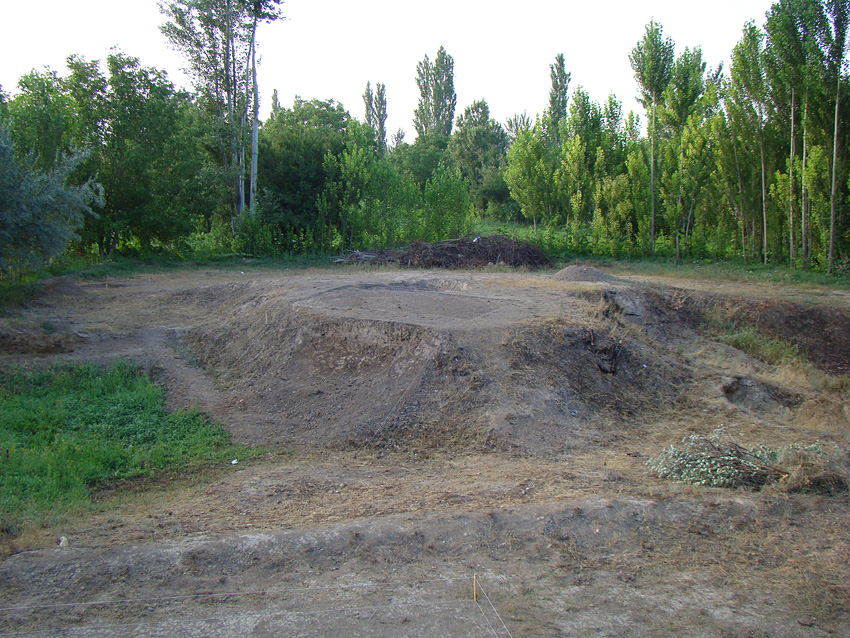
Tepe Khaleseh, a small tell site near the river Khoshkeh-Rud (a branch of the river Abhar-Rood), is located about 300m south-west of Khorramdarreh city, at a height of 1600m asl, rising 2m above the surrounding landscape. It covers an area of 2116m² and has a diameter of 46m (Figure 2). The site is surrounded by farms and has been disturbed by farmers, as shown by shallow holes from illegal excavation visible on the surface of the site (Figure 2), but nevertheless archaeological excavations, the first to be undertaken on this site, were conducted by Hamid Reza Valipour in summer and autumn 2009 (Reference ValipourValipour 2011).
Tepe Khaleseh, general view.

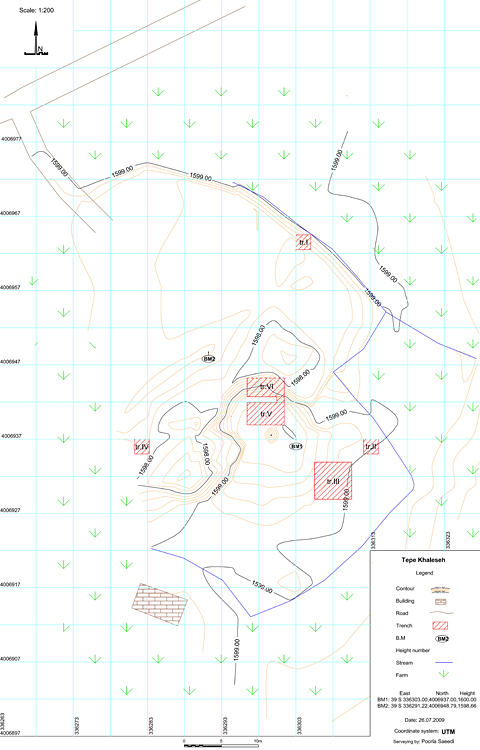
A series of trenches were excavated in order to comprehend the nature of site. Trenches I, II and IV, aimed at understanding the site's stratigraphy, were 2x2m in size. Trench III was 5x5m and located on the eastern side of the site, while Trench V, 3x5m, was in the centre, at its highest point (Figure 3).
Topographic map with locations of the trenches.

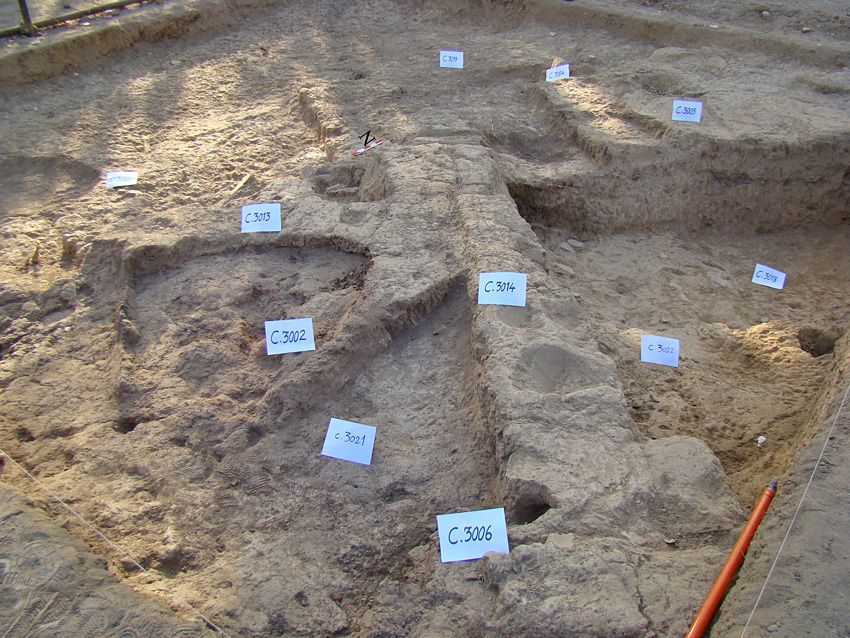
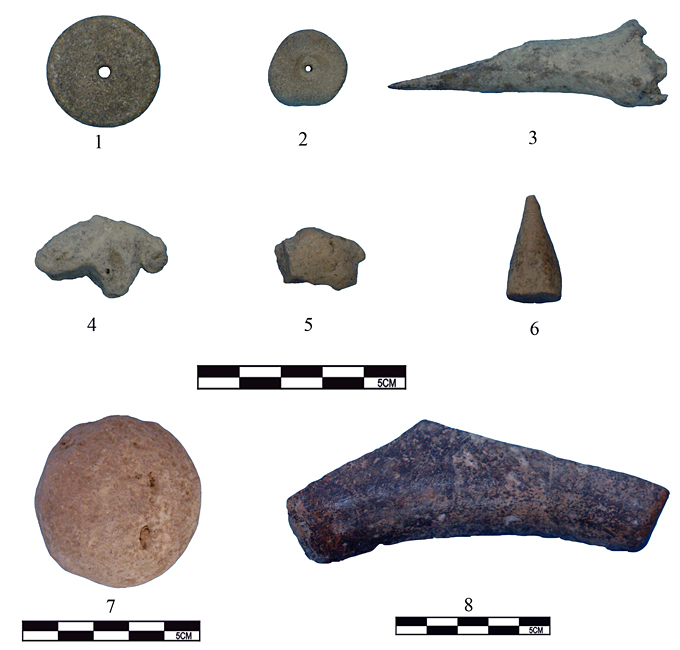
Results obtained from this first season of excavation appear to show that the site was occupied in a single period, the Neolithic (6000–5500 BC), but contains structures of several different phases stratified over 3m of archaeological deposits. Structural features including buildings, pottery kilns, burials and pits containing domestic waste all suggest the existence of a permanent settlement (Figure 4). The presence of closed and semi-permanent kilns seems to indicate that ceramic was produced at household level. The Tepe Khaleseh households also produced finds such as bone tools, stone and clay beads, a clay figurine, tokens, clay sling stones, grinding and pounding stones, parts of stone vessels, a mortar pestle, and stones bearing metal (Figure 5).
Archaeological features in Trench III.

Non-pottery finds including stone beads, bone tool, clay figurines, conical clay token, pounding stone and bone object.

The pottery
The pottery of Tepe Khaleseh was divided into groups of red and buff wares and subdivided into groups based on their type of decoration, resulting in 4 groups: (1) plain red; (2) painted red; (3) plain buff and (4) painted buff. There is no significant difference in manufacture between these groups. All the pottery is handmade, soft, organic-tempered, and in some very fine fabrics the temper may have been grit or limestone. The vessels were shaped in a variety of ways, including freehand forming from a solid lump, building with slabs and a combination of moulding and forming. A slip on both the exterior and interior surface is smooth and sometimes burnished. Judging by the thinness of the oxidised layer of clay on the surface, this pottery must have been fired at low temperature but the pottery in general was well fired.
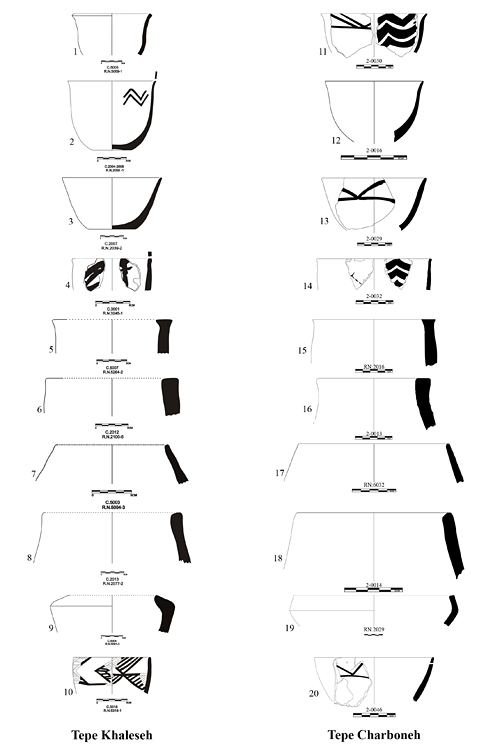
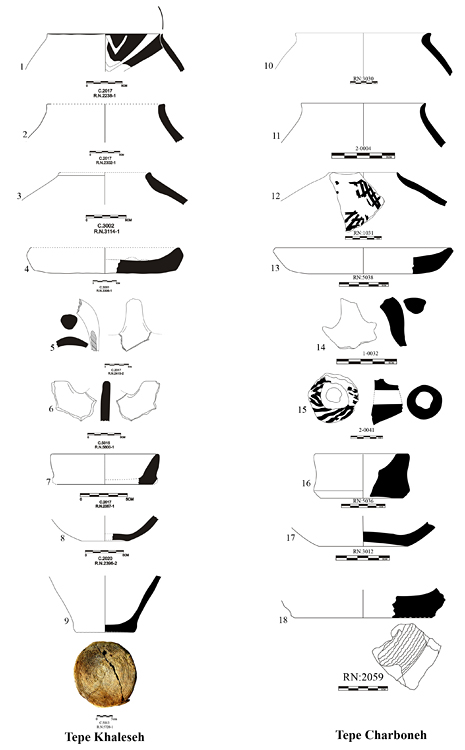
The ceramic forms have been classified into bowls, cups, pots, jars, vessels with inner lip, plates and trays (Figure 6 & 7). Among the forms, square vessels are noticeable; they include shallow and deep, open-rimmed bowls with a blunt curve (Figure 8, no. 10) which have also been found at Tepe Hajji Firuz (Reference VoigtVoigt 1976: fig. 71k & l) and Tepe Charboneh. The 'basket handles' joined to the rims of these vessels are also comparable to those of Hajji Firuz (Reference VoigtVoigt 1976: fig. 73i, j & k), Tepe Charboneh (Fazeli et al. 2007a: fig. 12) and Tepe Ebrahim Abad (Fazeli et al. 2007b: fig. 20) (Figure 7, nos. 5 & 14).
Selected forms of pottery: bowls and jars from Tepe Khaleseh and Tepe Charboneh.

Selected forms of pottery: pots, trays, handles and bases from Tepe Khaleseh and Tepe Charboneh.

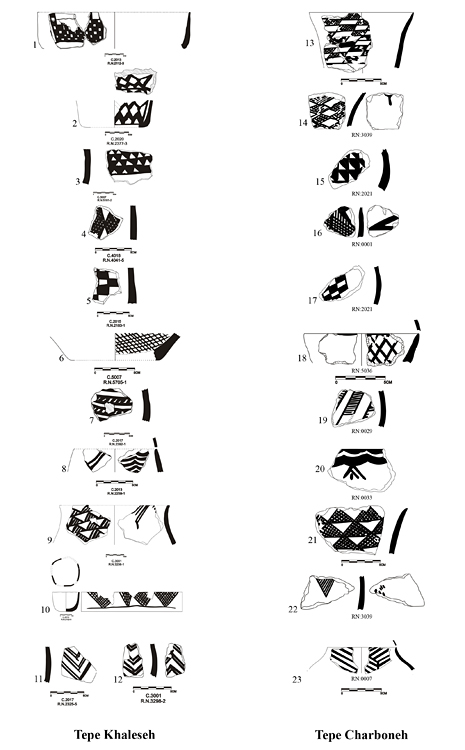
Selected decorative motifs on pottery from Tepe Khaleseh and Tepe Charboneh.

The decorative motifs on the pottery are simple, geometric or plant-like. The most common geometric motifs are simple horizontal and vertical lines, triangles and diamonds, more rarely squares within wide lines. Other motifs include vertical and horizontal zigzags in two or three rows, spiral lines, wavy motifs, chequered motifs, parallel herringbone decors, crosshatches, basketry motifs and triangles joined in one or more rows. The plant motifs are stylised, evoking pine trees, wheat clusters or other shapes of trees and plants. Nearly all the motifs, except the plant motifs, are comparable to those found at Tepe Charboneh (Fazeli et al. 2009: fig. 15) (Figure 8). Some zigzag and herringbone motifs are similar to those found at Ebrahim Abad (Fazeli et al. 2007b: fig. 5; 2009, fig. 17) (Figure 8, nos. 11 & 12) and the common herringbone and triangles motifs are similar in structure and shape to those of Hajji Firuz (Voigt: 1976: figs. 89j, n & s; 397, fig. 90e, fig. 94; 1983: figs. 92 & 93).
Our preliminary examination suggest that the pottery is mostly indigenous, with regional and local characteristics, but that some features of form and decoration are comparable to the pottery from neighbouring Neolithic sites such as Tepe Charboneh on the Qazvin plain and Hajji Firuz in north-western Iran.
Conclusion
In the absence of aceramic Neolithic sites in the Qazvin plain and given the similarity between Tepe Khaleseh and Tepe Charboneh in terms of assemblages, it is reasonable to propose that some relationships existed between these two sites in the Neolithic. Excavations at Tepe Khaleseh have revealed a Late Neolithic (Pottery Neolithic) site belonging to an agricultural and pastoral community (Grezak et al. 2010). The pottery indicates cultural similarities between this area and the Neolithic sites of the Qazvin Plain, Zanjan province and north-western Iran. If, as had been assumed, local Neolithic communities were not involved in cross-regional exchange in this period, what can be deduced from these cultural similarities? There may be two possibilities, either expansion or similar cultural trajectories. In the first scenario similarities could be due to exchanges which involve small areas within a larger network, of which the Miane–Zanjan–Abhar/Khorram Darreh–Qazvin corridor forms part. In the second, largely similar Neolithic communities developed along similar patterns.