





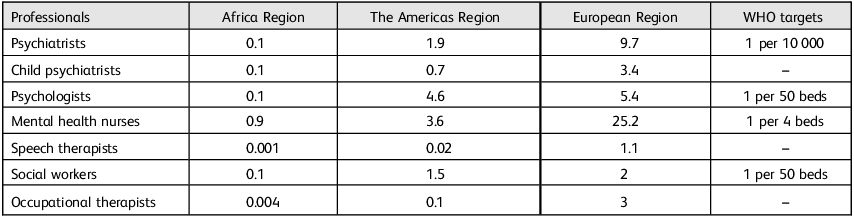
The burden of mental disorders is increasing in Africa owing to longer life expectancy, population growth and the limited number of mental health professionals (Table 1). Reference Sankoh, Sevalie and Weston1 The World Health Organization (WHO) 2014 Mental Health Atlas showed that there were just 1.4 mental health professionals per 100 000 inhabitants, compared with a global world average of 9 per 100 000. Reference Sankoh, Sevalie and Weston1 Mental disorders represent a huge load of morbidity and disability, while typically less than 1% of already modest healthcare budgets are devoted to them. Reference Sankoh, Sevalie and Weston1
Mental health professionals (median number per 100 000 population) by World Health Organization (WHO) region 2
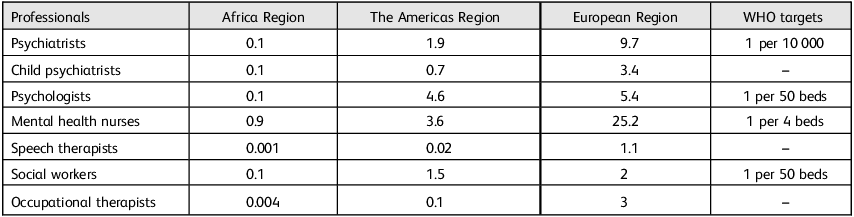
The WHO Mental Health Atlas of 2020 published information and data from 88% (171/194) of WHO Member States regarding the progress made towards achieving mental health targets for 2020 set by the global health community and included in WHO’s Comprehensive Mental Health Action Plan. 2 It included data on newly added indicators on service coverage, mental health integration into primary healthcare, preparedness for the provision of mental health and psychosocial support in emergencies, and research on mental health. It also included new targets for 2030.
This paper synthesises the views of experts shared during the first African School of Psychiatry, an international conference held in Agadir, Morocco, from 3 to 5 October 2024. The aim was to identify the main challenges facing mental health in Africa and possible perspectives. Participants included experts in psychiatry, neuroscience, biology and genetics and mental health leaders from four African countries: Senegal, Niger, Mauritania and Morocco.
Arguments
Individuals from different cultures have distinct conceptions of the person that underpin self-understanding and self-representation. These concepts influence many aspects of mental health within the biopsychosocial model, which is universally recognised and considered valid. The biological component, including genetic variations, is universal, influenced by race and environment. On the other hand, the social and/or sociopsychological component is subject to significant variations that should be taken into account in any intervention or strategy for implementing mental health initiatives in Africa.
Kpanake examined cultural concepts observed in many African cultural contexts. He found that African cultures encourage a relationship-oriented personality, shaped by three types of factor: spiritual factors, including God, ancestors and spirits influencing the person; social factors, including family, clan and community; and autonomy, which is responsible for the person’s inner experience. Reference Kpanake3 The Western foundations of mental health knowledge are not universal, and their assumptions about psychosocial factors are not necessarily applicable worldwide. Reference Saade, Parent-Lamarche, Khalaf, Makke and Legg4 Hence, questions arise regarding the concepts of mental health and the ideal form of personality, the concept of mental illness, and what the needs and expectations of patients are. Reference Wondimagegn, Pain, Seifu, Cartmill, Alemu and Whitehead5
Challenges
A work of reflection and collaboration by academic institutions, non-governmental organisations (NGOs) and the WHO reported various health system challenges in Africa (Table 1). Reference Trudell, Burnet, Ziegler and Luginaah6 These included poor coordination between national and local authorities, inadequate drug supply, weak information systems, heavy workloads on health professionals, human resource shortages, inflexible bureaucracy, lack of follow-through among agencies in implementing programmes, constraints related to demand for care, including limited community awareness, high levels of stigma and discrimination against people with mental illness, and the various metaphysical explanatory models of illness. Reference Saade, Parent-Lamarche, Khalaf, Makke and Legg4
Another group of experts meeting in 2007 and 2008 identified other gaps, focusing on the lack of understanding of the contribution of mental disorders to morbidity and mortality, the lack of inclusion of mental health in the core health indicators, the lack of evidence from economic research, the absence of a strategic approach to human resource planning, the lack of partnerships with the social development sector, and the need for mental health professionals to have public health skills to effectively lead national advocacy. Reference Hassan and Sharif7
A review of studies on barriers to care conducted in six African countries (Ethiopia, Mali, Egypt, South Africa, Nigeria and Tunisia) found three most frequently encountered obstacles: a preference for traditional/alternative and complementary treatments (33.33%), stigmatisation of mental illness (25%) and a lack of knowledge about and/or misunderstanding of mental disorders (25%). Reference Hassan and Sharif7 Other constraints highlighted in the scientific literature included extreme weather events, Reference McEwen, El Khatib, Hadfield, Pluess, Chehade and Bosqui8 political instability and food insecurity. Reference McEwen, El Khatib, Hadfield, Pluess, Chehade and Bosqui8
Outlook
Real change in mental health in African countries requires innovation; therefore, explanatory models of suffering within particular populations (elderly people, children, working women, immigrants, etc.) are needed to guide the development of training programmes, research and healthcare services. Reference de Oliveira, Dal Sasso Mendes, de Almeida, de Almeida, Souza Gonçalves and Strobbe9 In 2022, the WHO’s World Mental Health Report: Transforming Mental Health for All concluded that the mental health status quo will not change without significant funding. Indeed, little change has occurred over the past 20 years. Reference Liu, Jack, Piette, Mangezi, Machando and Rwafa10 Changes in Africa will have to respect the continent’s resources, both human and financial. It will be necessary to define a minimum care package, such as low-threshold psychiatry (minimal mental healthcare). It will be important to specify the list of priority care activities and to define the optimal in-patient and out-patient circuits, aligning with international recommendations.
In each country, mental health managers need to establish care priorities according to the human and financial possibilities of each nation. Hence, specific mental disorders should be prioritised, such as suicidal behaviour, mood disorders, psychotic disorders and addictions. Basic primary care must be provided for in-patients (for example, sufficient psychiatric beds) and accessibility to out-patient care within the community should be ensured.
Similarly, the distribution of human resources throughout African countries should be a major objective of any mental health promotion strategy. Among the potential solutions to address the unequal distribution of mental health professionals, telepsychiatry offers a means of overcoming barriers that prevent certain demographic groups from accessing mental health services, including at least some form of psychotherapeutic treatment. Reference Hassan and Sharif7 Indeed, psychotherapy delivered via videoconference has been shown to be as effective as face-to-face therapy, although it may be less suitable in certain contexts. Reference Nobre, Oliveira, Monteiro, Sequeira and Ferré-Grau11 In a study conducted by McEwen et al among children and adolescents in humanitarian settings, phone-delivered psychological therapy, implemented using simplified technology, demonstrated promising evidence of feasibility and acceptability. It also showed potential to enhance access to mental health services for hard-to-reach populations. Reference Sodi, Quarshie, Oppong Asante, Radzilani-Makatu, Makgahlela and Nkoana12
Caregiver training
Studies have shown that integrating the mental health approach into primary care structures is gaining a high level of evidence. However, academic, cultural and language barriers still need to be overcome to enable sharing of results and protocols of such interventions. Reference Trudell, Burnet, Ziegler and Luginaah6,Reference Abbo, Odokonyero and Ovuga13
Similarly, training healthcare professionals working in primary care settings is a high priority. Yet, there is less consensus on training strategies for these professionals. The development of innovative educational strategies, competency-based learning objectives and post-training outcome measures is crucial to having a significant impact. Reference Sankoh, Sevalie and Weston1–Reference Sodi, Quarshie, Oppong Asante, Radzilani-Makatu, Makgahlela and Nkoana12
Mental health literacy
Recently, the scientific literature has been enriched by research on development programmes to promote mental health literacy. A review devoted to adolescent literacy identified 29 articles published between 2013 and 2020, including knowledge about adolescent mental health, components of stigma reduction and face-to-face interventions in the school environment, which showed statistically significant improvements in adolescent mental health. Reference Sankoh, Sevalie and Weston1–Reference Sodi, Quarshie, Oppong Asante, Radzilani-Makatu, Makgahlela and Nkoana12 In addition, adolescents have been identified as a particularly important target group for initiating and improving mental health knowledge. Reference Sankoh, Sevalie and Weston1–Reference Sodi, Quarshie, Oppong Asante, Radzilani-Makatu, Makgahlela and Nkoana12 Further development of this literacy concept in schools would be an interesting pillar for promoting early detection and undertaking early interventions.
Traditional medicine and religious beliefs
Traditional practices based on indigenous knowledge and experience in the local cultural and environmental contexts are very common in Africa. Reference Sankoh, Sevalie and Weston1–Reference Sodi, Quarshie, Oppong Asante, Radzilani-Makatu, Makgahlela and Nkoana12 Recognising and highlighting religious coping as a process within the dimensions and framework of the biopsychosocial model, and as a mechanism of resilience against psychological suffering, would be an attractive way to increase the African population’s adherence to psychiatric care. Several literature reviews have demonstrated the interest in the spiritual and/or religious components of affective disorders, anxiety disorders and addictions. Reference Sankoh, Sevalie and Weston1–Reference Sodi, Quarshie, Oppong Asante, Radzilani-Makatu, Makgahlela and Nkoana12
Furthermore, the religious sector could be sensitised and oriented towards raising awareness among the general population. People working in religious organisations could receive basic training in recognising and screening for psychological symptoms so that they can make referrals to mental healthcare services. Similarly, it is essential for mental health professionals to take into account patients’ religious and spiritual beliefs. Establishing partnerships with religious leaders can play a key role in raising awareness about mental health issues and fostering greater understanding and acceptance of psychiatric care within religious discourse and community outreach. Sociocultural issues cannot be dissociated from neuroscience, genetics and psychiatric phenotypes. There is a need to recognise and strengthen the links at educational, clinical and policy levels, and to conduct research into how these links might be improved. Reference Sankoh, Sevalie and Weston1–Reference Sodi, Quarshie, Oppong Asante, Radzilani-Makatu, Makgahlela and Nkoana12
For this reason, it is essential not to offend the cultural or religious beliefs of patients with psychological problems, nor to upset them in a way that causes them to abandon their religious practices or traditional care. Doing so could lead to feelings of guilt and foster a negative attitude towards mental healthcare.
Scientific research
Possible prospects also include investment in scientific research into health economics and public health to enable better diagnosis and identification of the links between mental health and social development, as well as intensive mobilisation of resources. Many areas of scientific research in mental health remain unexplored or underexplored, while the scientific community worldwide is wondering what is happening in Africa and what impact culture and the environment have on psychopathology and psychiatric phenotypes in Africa.
Mental health was the subject of only 3% of clinical trials conducted in low- and middle-income countries. Reference Sankoh, Sevalie and Weston1–Reference Sodi, Quarshie, Oppong Asante, Radzilani-Makatu, Makgahlela and Nkoana12 There are a number of research areas that are particularly relevant to mental health in Africa, especially epidemiological and clinical studies. The prevalence of certain psychiatric disorders differs from global data. Likewise, genetic research is still an underdeveloped field, and all data are coming from Western countries. Reference Sankoh, Sevalie and Weston1–Reference Sodi, Quarshie, Oppong Asante, Radzilani-Makatu, Makgahlela and Nkoana12 Therefore, it is strongly recommended that international collaborations are multiplied to strengthen genetic and epidemiological research specific to Africa and secure sustainable funding for mental health research programmes.
Conclusions
The aim of this brief article is to highlight specificities of the psychosocial and cultural environment in Africa and their links to mental health promotion strategies. It is a call for confidence in ourselves as mental health professionals, as well as a spur for reflection and the reinvention of innovative methods, not necessarily Western-style, for developing psychiatry and mental health in Africa.
Data availability
The data that support the findings of this study are available from the corresponding author, S.B., on reasonable request.
Author contributions
I.R. and S.B.: conceptualisation and design, acquisition, analysis and data interpretation, writing the paper. I.R. and S.B.: drafting the article. M.M., M.N., J.D., A.S., C.M.F., H.G., M.B., D.D.M. and H.R.: reviewing of data analysis and interpretation. I.R.: drafting the article. The final version of the article was approved by all authors.
Funding
This research received no specific grant from any funding agency, commercial or not-for-profit sectors.
Declaration of interest
None.


 Open access


eLetters
No eLetters have been published for this article.