

Witnessed in iconic examples of high-prestige art such as the Parthenon Frieze, the Gemma Augustea, or the Arch of Constantine, ancient relief cut across all kinds of contexts, media, techniques, and scales. It could appear in private households, on public architecture, or within funerary spaces, executed in terra-cotta, bronze, or stone, made by incision, modeling, or repoussé, from the miniature to the monumental. As the chapters in this volume attest, images in relief pervaded practically every aspect of ancient visual culture from the rise of the Greek city-state through to the Christian era.
Yet, in today’s everyday language, when we use the word “relief,” we are much less likely to be referring to an artistic phenomenon than to a fiscal or bodily one: Medicines offer relief from headache or indigestion, and state-run programs offer relief from student debt. Both uses depend on a fundamental sense of lifting a burden up and away; in the case of the body, the act of lifting is a powerful and deep-seated metaphor. A sense of alleviation from distress is already built into the Latin term relevare,Footnote 1 with the same idea attested in English by the late fourteenth century.Footnote 2 This sense of relief has both physical and psychological connotations: It can indicate the cessation of not only corporeal pain but anxiety or other pent-up emotions. In the various versions of the so-called relief theories of humor espoused by figures as varied as Herbert Spencer, John Dewey, and Sigmund Freud, what causes laughter is the release of nervous energy that has built up in the body through anger, anxiety, expectation, or the unconscious repression of other emotions.Footnote 3 The physiological bases of these theories have long been discredited, but in their metaphorical application of the idea of relief, they correspond to ways of thinking and talking about the body that many people today might still recognize.
This is all to say, although “relief” is an extremely familiar term, one that frequently appears in everyday conversation, even its most common uses are slippery, inevitably sliding among discourses and carrying both literal and metaphorical meanings. The situation is no different in the more specialized arena of the visual arts. Both a literal and metaphorical sense of lifting up and away from a flat surface is already present in the earliest uses of the term “relief” in Italian artistic treatises of the late fourteenth and fifteenth centuries.Footnote 4 In Cenino Cenini’s handbook of art, written around 1400, the term rilievo serves a dual function. It means firstly the application of gesso to a surface in order to create a physical protrusion, what we would now call a genuine relief sculpture, and secondly an optical effect in painting, the use of light and shadows to create virtual volumes that seem as though they were raised from a surface but that are in fact two-dimensional.Footnote 5
Relief in early modern Italy, at least the kind discussed in contemporary art writing, is thus both sculptural and pictorial. Lorenzo Ghiberti referred to his own Gates of Paradise panels, which he was commissioned to design in 1425, as narratives (istorie) in low relief (pochissimo rilievo); these same objects offer remarkable variation in the physical and pictorial depth of relief, with figures set within persuasive and all-encompassing environments and particularly complex early experiments in perspectival construction.Footnote 6 In his treatise on painting, Leon Batista Alberti would especially emphasize the metaphorical sense of rilievo as a virtual lifting up from a surface.Footnote 7 The idea of rilievo plays a fundamentally intermedial and intermediary role in paragone debates throughout the early modern period, oscillating between the real presence of sculpture and the as-if worlds of painting.Footnote 8 Within this critical art discourse, relief is an inherently unfixed and unstable concept, vacillating on the one hand between painting and sculpture in the round, and on the other between the brute facts of physical reality and the virtuality of fiction. In other words, one may say that relief offered the Renaissance artist and art theorist the opportunity to have his cake and eat it too. Arguably, what distinguishes relief in this sense is as much a matter of phenomenological effect as it is one of technique, material, facture, or style.Footnote 9
We raise these points here both to highlight the difficulty in pinning down any one sense of the term “relief” and to acknowledge that it is a historically contingent concept. We wish to acknowledge, moreover, that the current idea of rilievo/relief is rooted in specific historical circumstances and is concerned with specific types of art making; it privileges the kinds of relief sculpture most highly esteemed in Italian Renaissance art-theoretical discourse – namely carved marble and cast metal – especially relief engaged in architecture that featured figures standing out against an essentially flat, planar ground that is at once pictorial and physical. By contrast, the same relief techniques applied to objects that offer less of a figure–ground relationship, and that are often more engaged with the living human body, such as tableware or jewelry, tend to fall out of the discourse of the high arts of the early modern period. Yet it seems hard to deny that the raised figures on a metal vessel such as the Derveni krater, discussed at further length later in this introduction, are executed as much in relief as those on Ghiberti’s Gates of Paradise.
Here ancient concepts may help us fill in the gaps left by modern ones. No comprehensive idea of relief – whether understood as mode(s) of artistic production or as effect of surface elaboration – existed in Greco-Roman antiquity. And no single term could cover the creation of carved marble or precious stones, cast bronze or silver, hand modeled or mold-made terra-cotta, or coins struck in dies. Instead, as Verity Platt’s contribution to this volume (Chapter 1) highlights, what we find are complementary and interlocking ideas, including the typology of making in molds or taking impressions, the craft of chasing in metal or working in terra-cotta, and the optics of virtual space and surface texture, both metaphorical and real. Antiquity provides us with a constellation of concepts that circle around and highlight the diversity of techniques, media, and optics that relief adumbrates.
When we now think of ancient relief, however, we are likely to gravitate toward monumental, architecturally engaged stone sculpture. There are clear historiographic reasons for this affinity.Footnote 10 As art history developed as a formal academic discipline in modern institutional and university settings, the idea of relief became a particularly important one in the study of ancient art, in no small part because both Greek temples and Roman state monuments yielded high-quality reliefs, giving scholars a corpus of undoubted “originals” to evaluate and compare. The arrival in London of the sculptures from the Temple of Apollo at Bassai and, most famously, the Parthenon sculptures in the early nineteenth century had a well-known effect on both contemporary tastes and art theory.Footnote 11 Similarly, the first appearance in Berlin in 1879 of the monumental architecture and vast frieze of the Great Altar at Pergamon coincided with, and indeed partially sparked, a moment of remarkable fertility in art-historical canonization and theorization.Footnote 12 Particularly striking about this moment is the fact that an ancient monument would wield such influence far outside the group of scholars specializing in the art of antiquity. For not only classical archaeologists like Alexander Conze and Heinrich Brunn but also artists like Adolf Hildebrand and historians of later periods of art such as Heinrich Wölfflin, the Pergamon reliefs provided a jumping-off point for substantial disciplinary reevaluations. Such reevaluations were permissible, as Alina Payne points out, because the Pergamon sculptures were so obviously different from the established canon of Greek art, while being indisputably masterpieces of ancient carving.Footnote 13
For Conze and Brunn, the emotive, expressive themes and the optically adept, “painterly” style of the Altar’s gigantomachy frieze prompted them to rethink both the restrictions on content and the insistence on medium specificity that had been inherited from eighteenth-century figures like Johann Joachim Winckelmann and Gotthold Ephraim Lessing.Footnote 14 Beyond the field of ancient archaeology, Hildebrand would argue that a relief-like visual effect (which, as Nikolaus Dietrich demonstrates in Chapter 5 of this volume, is also implicitly photographic) could be a model for sculpture more generally.Footnote 15 Wölfflin would carry the idea of the “painterliness” of reliefs like those from Pergamon into the early modern period as a defining feature of the Baroque, one as applicable, ultimately, to architecture as to any other artistic form.Footnote 16 The Pergamon marbles not only allowed scholars to expand upon the purpose of relief sculpture in architectural settings and to debate the variously “painterly,” “sculptural,” and “architectonic” functions of relief; they provoked a rethinking of period styles, such as Classical/Hellenistic or Renaissance/Baroque, and of the critical judgments typically associated with those styles.Footnote 17
Around the same time, relief was also playing a key role in attempts to define and redeem Roman and late antique art, especially prominently in the work of Franz Wickhoff and Alois Riegl, but also in the work of scholars who are less well known among Anglophone archaeologists and ancient art historians, such as Adolph Philippi and Edmond Courbaud.Footnote 18 For Wickhoff and Riegl, the attempt to determine what constituted Roman art, and what it had contributed to the history of European art writ large, hinged especially on what was unique about monumental Roman relief sculpture. For Wickhoff, both the impressionistic illusionism of Roman relief and its habit of driving narrative time forward by repeating figures within a single composition provided the historical matrix out of which Christian art would develop. For Riegl, reliefs such as those on the Arch of Constantine in Rome offered the opportunity to think through broad, epochal shifts in what he called Kunstwollen, or artistic volition, from a primarily tactile, or haptic, mode to a primarily optical one.Footnote 19 The story of Roman art, for Riegl, both performs a kind of Hegelian process of dematerialization and sets the stage for the optical experiments of Renaissance and modern art. We should note here that despite the prominence of monumental relief, intermediality was key to both projects. Wickhoff’s reliefs are compared not only to manuscript illumination but to Baroque painting, while Riegl’s theory of Kunstwollen expressly adumbrated not only the other figurative arts but architecture and decorative art as well.Footnote 20 In this sense, the status of relief as an intermediary medium seems to have been a key aspect of its importance to both authors.Footnote 21 This is all to say, for scholars of both Greek and Roman art around the turn of the twentieth century, while relief was at the core of the art-historical systems they were building, it seems to have played almost as important a role for its connections to what it was not – whether sculpture, painting, architecture, or the body – as for what it was.
Yet for all the undoubted significance of relief sculpture in this formative phase of the disciplines of classical archaeology and art history, many broader questions of relief as such have remained surprisingly under-theorized. For instance, how was relief conceptualized within antiquity itself? What are the consequences of the choice of materials and techniques in the creation of imagery in relief? How do various types of relief compare with respect to their visual impact? Ancient texts and artifacts speak to the pertinence of these issues in our current conceptualization of relief.
*
Take for instance the brilliantly provocative apology for painting, written at some point in the early third century CE, in which the Athenian sophist and historian Philostratus justifies the versatility of the medium he extols by contrasting it with a range of kinds of plastic art:
Now, there are many forms of plastike: molding itself, mimesis in bronze, those who carve white or Parian stone, ivory, and by Zeus sculptural engraving. Painting, however, is composed from colours, yet it does not accomplish only this, but it also displays more ingenuity from this singular quality than the other kind of craftsmanship does from many.Footnote 22
Like all such rhetorical justifications, this can be turned on its head. While painting – almost always tied to the flat surface, even in wall and ceiling decorations as well as in panels – needs all the ingenuity of trompe l’oeil and other spatial trickery in its use of colors, plastike offers an extraordinary range of media that themselves elicit multiplicities of techniques and methods to render visual images effective. By molding, Philostratus means fashioning objects from a mass of stucco or clay; by mimesis in bronze (and he might have named many other metals), he means both the hammering of metal and its casting (very different ways of proceeding with radically different effects); by the carving of stone and ivory (he might have added wood), he implies forms of sculpture that remove elements from the starting material block to bring a work of art to life – very different in the fine miniature of ivory from the grand scale of marble; and by engraving, he means all kinds of incision work, including the extraordinarily fine cutting of gems and tablets on a minuscule scale, perhaps with a magnifying glass. The fact that Philostratus chooses his examples with care to indicate different types and ways of creating relief signals a clear awareness and conceptualization within the Greco-Roman world of the diversity of options for the facture of three-dimensional rather than flat art. It is that range that gives life, variety, and immense “ingenuity” when we speak of imagery in relief more specifically.
In a passage from his Life of Apollonius, the same Philostratus extols a series of bronze panels showing the deeds of Alexander and Porus that are nailed into the walls of a temple in Taxila on the edge of ancient India:
On them, in brass, silver, gold and dark bronze, there are depicted elephants, horses, soldiers, helmets and shields, with spears, javelins and swords all in iron. Just as they say of a famous painting, for example one by Zeuxis, Polygnotus or Euphranor that artists like shadow, verisimilitude and perspective, the same effects, so they say, are visible here, and the materials blended like colours.Footnote 23
Here, in virtuoso contradiction of the argument in the Imagines, the multiplicity of metallic materials, each with its own hue, is compared with and indeed made to rival the coloristic and imitative effects of the best painting by a clutch of the most famous painters of the fifth and fourth centuries BCE. While both the paintings of the Imagines and the metal tablets of the Life of Apollonius are almost certainly fictions, the point is that the plastic workings of relief are both immensely diverse and – depending on the position you choose to adopt – as effective as the finest naturalistic paintings in their workings and impact.
The breadth and vivacity of imagery in relief is witnessed in a trio of large vessels that deploy relief in very diverse media and temporal moments within antiquity, but across a three-dimensional curving surface rather than the more typically flat plane. These containers, whose presence in their viewer’s space is voluminous and effectively sculptural, highlight the place of relief between the two-dimensional ground of flatness and the volumetric force of three dimensions. Our objects come from different periods in the art history of the Greek and Roman worlds – one from the dawn of Archaic art in the early seventh century BCE, one from the last moments of Classical art in the fourth century BCE, and one from the early Roman Empire in the first century CE. In each case, the technical methods required and chosen to produce the object’s final form in part determines the ways relief is used to create its visual argument and definition. One of the effects of looking at vessels – objects designed to be containers and to respond directly (whether in actuality or through imagination) to the embodied handling of viewers – is that there is potential play between the voluminous form of the object, containing space as well as consisting in space, and the relief decoration on its body.Footnote 24
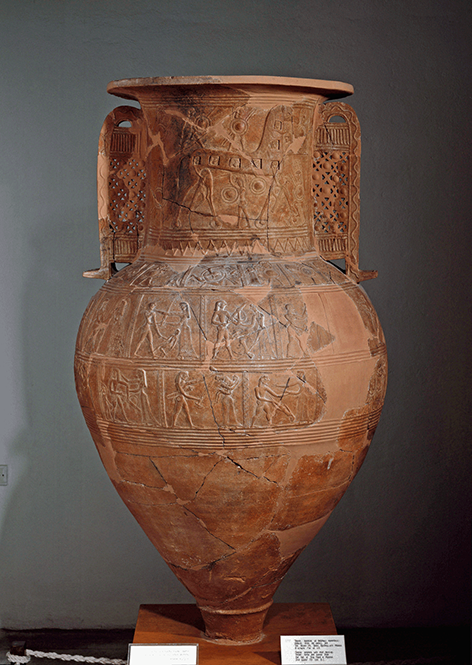
In 1961, a large pithos of gritty clay with a fine slip covering, measuring 1.339 m in height and 0.733 m in maximum diameter, was excavated in Mykonos (Fig. I.1).Footnote 25 Decorated in low-relief figures on the front but not on the back or the lower third, this amphora was probably intended for display against a wall, and when it was found, it had certainly acquired a funerary function in that it contained bones.Footnote 26 The reliefs were freely modeled (not made from molds) in rather finer clay than that of the core and applied to the surface of the vessel while it was leather-hard. Much of the modeling appears to have been done after the clay for the reliefs was applied onto the pot, with the use of blades, points, stamps, punches, and other tools. Some figures were outlined by incision into the vessel’s surface, and others were not.Footnote 27 The object belongs to a rich Archaic tradition of such pithoi, and particularly a class known as the Tenian-Boeotian group since many examples have been found in Tenos (near Mykonos) and Boeotia, though they were clearly made across the Cyclades and on the mainland.Footnote 28 It is one of the largest and finest of these vessels, dating probably to the second quarter of the seventh century BCE.Footnote 29
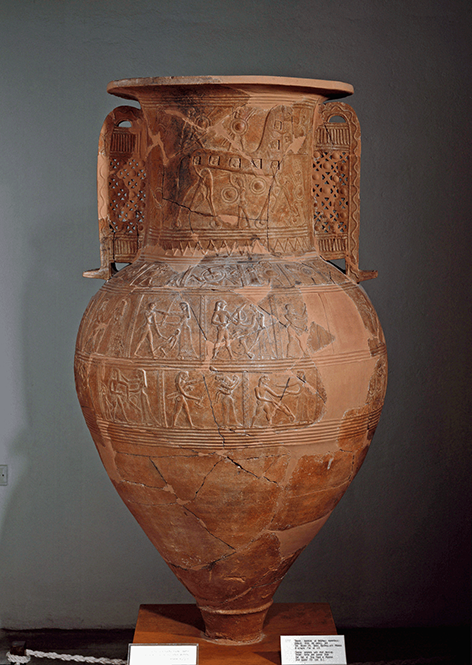
Fig. I.1 Relief pithos from Mykonos, second quarter of the seventh century BCE. Archaeological Museum of Mykonos, 2240
The pot has been of galvanizing interest because its imagery shows one of the earliest representations of the Trojan Horse, in pride of place at the neck of the pithos at the front and larger than any other of its images, and then a series of war scenes presumably depicting episodes from the sack of Troy in a range of smaller pictorial panels (often described as “metopes”) arranged in three tiers separated by bands of three incised lines. Our interest here is not in issues of narrativity or the relation of visual to literary narratives, as most frequently addressed in the scholarship, except insofar as they relate to relief.Footnote 30 But it is worth noting that the “metope” model of discrete scenes adopts an episodic strategy of storytelling that eschews both continuous narrative and any expansive single conflation of the depicted themes. Likewise, despite the voluminous nature of the relief jar, as a kind of shaped egg tapered at the bottom and cut off at the top, the images insist on a horizontal groundline, responding to the needs of an embodied viewer whose feet are on the ground observing the pithos’ surface.
The pot’s most striking scene is the wonderful depiction on the neck of the Trojan Horse on wheels. On the horse’s body, there are seven windows, cut out of the thickness of the clay used to make the body and so emphasizing its nature as applied relief. Within each of these a warrior’s head faces forward in profile, while four – at the top of the horse’s neck, at its foreleg, and its fore-belly, as well as at its rear – are handing down weapons (respectively, a plumed helmet, a sword, a shield, and a sword). Seven warriors are depicted outside the horse – whether the same seven at a later moment, having descended from their hiding place, or different ones, we cannot tell – but scholars largely agree that they are likely to be Greeks who are part of the attacking party rather than Trojans in resistance.Footnote 31 The emphasis on a container of men, the horse, is a brilliantly self-reflective commentary on the vessel’s own function as a container – whether of the remains of a dead person by intent or of other materials and then later reused for a burial. Moreover, the hollow horse whose entire purpose was concealment fails to hide its occupants; its relief layering with cut-out windows over heads, as well as arms that reach out through the windows over its body, applies a further layer or relief to the relief and figures the jar’s three-dimensional complexity of containment and concealment in the two dimensions of its narrative imagery. If the intended purpose of the object was funerary, that imagery is itself a story about the bringing of disaster and death.
The magnificent clay handles that sit alongside the Trojan Horse panel at the vessel’s top are just under 10 cm thick and nearly 120 cm across their width. While their nonfigural ornament of relief lines, circles, and a wavy patterning at the outer curving edge resonates against much of the relief decoration of both figures and frames in the rest of the pot, the choice to make pierced windows through their thick clay – semicircles at the top, right-angled triangles at the base, and a range of small triangles in the form of Maltese crosses within the handles’ main body – plays directly against the windows in the body of the Trojan Horse. The three-dimensional curving form of the vase’s neck juts out as a kind of columnar relief in its own right against the handles’ flatness, which sets out the plane of the pot’s diameter line. The windows in the horse open onto the images of men contained within, by contrast with the windows of the handles that offer only empty space. This comparison emphasizes the fullness of three-dimensionality and what it can contain against the emptiness behind the flat plane constituted by the handles.
While much more extensive discussion is possible – notably of the “metopes” with their scenes of the slaughter of warriors, women, and children, of the places where depicted figures transgress the elaborate ornamental articulation of the framing borders of their scenes, or of the varieties of sizes (or miniaturizations) in play in the three tiers of narrative decoration – suffice it here to dwell only on one further feature. The “metope” model of framed windows showing traumatic scenes in the main body of the jar is itself a kind of elaboration of the cut-out window strategy of depiction developed for the horse on the neck. Most strikingly the horse has seven windows, of which five make a horizontal line along its body. The horizontal line of “metope” panels in the upper tier on the curve of the pithos as it approaches the neck has five surviving windows out of what were probably originally seven, while each of the two lower tiers has seven windows, effectively replicating in each band the windowing of the horse.Footnote 32 Each panel on the body of the vessel acts out the slaughter that lies in potential in the warrior figures whose heads glare forward in windows of the Trojan Horse, and the seven fully armed standing fighters outside it. The windowing of the horse is itself fundamentally dependent on the vessel’s commitment to relief decoration – allowing the use of levels and layers of overlapping relief to evoke insiderness and a hollow interiority that serves as a container. The “metopes” of the amphora’s belly extend the decorative conceit of windows over what is in reality a container whose interior did in fact hold bones, evoking a figural play with the actions depicted on the belly and their theme of violent death. Relief is fundamental to the artistry and aesthetics of the Mykonos pithos, and specifically relief in relation to the voluminous three-dimensional structure on which the decoration is placed, to the invocation of a flat plane by the vessel’s handles, and to the empty piercing of the handles’ cut-through ornamentation.
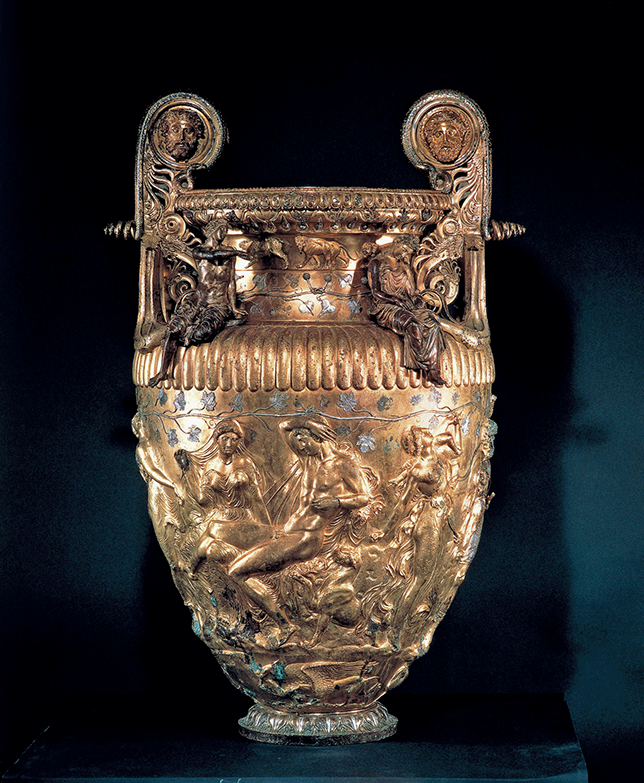
In 1962, in the late fourth- and early third-century BCE burial ground of Derveni near Thessaloniki in ancient Macedonia, a great metal krater was excavated from an undisturbed grave known as Cist Tomb B (Fig. I.2).Footnote 33 Made of gold-colored bronze, the krater is 90.5 cm high (including the handles, which rise above the rim) and 51.5 cm at its greatest diameter.Footnote 34 It was discovered fallen on its side from a specially fashioned base (a block with a ring cut into it where the krater’s foot sat) that stood 36 cm high. Tomb B is dated, on the basis of the range of other grave goods within it, to between 320 and 300 BCE,Footnote 35 while the date of the krater’s manufacture is likely around 370 BCE.Footnote 36 It was inscribed in silver inlay in the egg-frieze around the lip to read ΑΣΤΙΟΥΝΕΙΟΣ ΑΝΑΞΑΓΟΡΑΙΟΙ ΕΣ ΛΑΡΙΣΑΣ, which means “of Astioun, son of Anaxagoras from Larissa.”Footnote 37 There is discussion as to whether this man was the person intended to have his cremated remains interred in the krater, or whether the vessel had an original function other than funerary;Footnote 38 but in any case, when it was found, the Derveni krater contained nearly 2 kg of well-burnt bones belonging to a man of between thirty-five and fifty years of age and a probably younger woman.Footnote 39 Thus the question of function in the case of the Derveni krater is exactly the same as with the Mykonos pithos, with a likely funerary intent as at least a secondary if not primary purpose and the certainty that it was indeed used, ultimately, for burial.
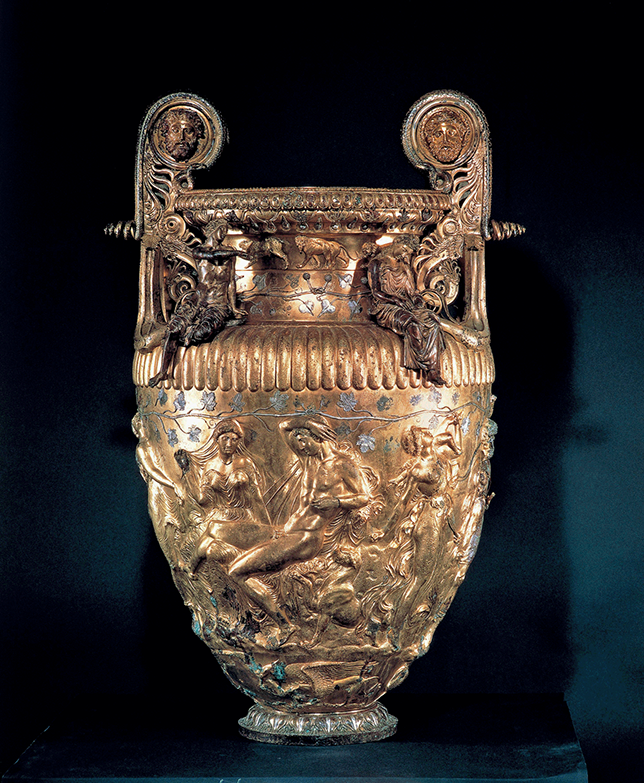
Fig. I.2 Bronze krater from Derveni, fourth century BCE. Archaeological Museum of Thessaloniki, B1
Like the Mykonos pithos, the mouth, neck, and body of the Derveni krater were not cast but raised from the raw material (metal in this case rather than clay and by hammering) in some places to a thickness of less than 1 mm.Footnote 40 The reliefs which then extensively decorated this core were created in a variety of ways. The great Dionysiac friezes of the main body as well as the animal figures at the very bottom were created by hammering with a variety of tools, both on the interior and exterior walls of the vessel in the repoussé technique, some of these figures raised to a depth of almost 2 cm. These were then elaborated with various overlays of bronze, silver, and gold (for instance, in the fine silver vines running below the neck frieze and above the Dionysiac scenes of the belly) and with specific soldered additions (such as the cast bronze hands of Dionysus or the sheet of copper added to the cape of Silenus),Footnote 41 as well as numerous surface treatments, such as the stippling of landscape features. The animal frieze of the neck, also rendered in repoussé, was not hammered from the object, but its elements were fashioned independently and fastened to the krater with solder in appliqué.Footnote 42 Major cast elements were then added to the object – notably the handles, which are complex combinations of separately made elements, including discretely made repoussé disks depicting the frontal masks of deities, with embossed surfaces, in the volutes.Footnote 43 Most striking of all are the four solid cast bronze statuettes of semi-reclining Bacchic figures, including Dionysus himself, a sleeping Maenad, an ecstatic Maenad, and Silenus lounging in the pose of the Barberini Faun but leaning on a sack of wine to his left.Footnote 44
Although still adhering to a horizontal ground aligned to the embodied viewer’s own posture, the spectacular Classical naturalism of this lavish object, potentially but not certainly made in Athens, strains to make a single thematic scene out of its Dionysiac imagery.Footnote 45 The flowing movement of its repoussé figures, whose very low-relief draperies billow about them as their own bodies undulate in and out of the curving surface of the krater’s belly, demonstrates an extraordinary plasticity and fluidity of medium in relation to iconography. That plasticity is in part the result of the technique of hammering a bronze block into the thin walls of a vessel and then of hammering so many of its images as bulges out of those walls in the repoussé technique. But the cast elements – especially the entirely three-dimensional bronze figurines, who acquire relief status only by virtue of being soldered onto the curving ground between the lip, neck, and shoulder of the vessel – effectively thrust it toward three dimensions. Not only are they fully worked on all sides, but they eschew the hollowness of the imagery around the belly of the krater for a fully substantial and heavy materiality. Likewise, the rims of the handles turn into serpents – their tails spiraling outward at the base, their heads rising just below the volutes at the top, perhaps threatening to strike at anyone who tried to get into the krater’s interior. Whereas the pithos’ neck and handles proclaimed its narrative and decorative propositions (Trojan Horse and windows, whether entirely pierced or penetrative of an interior), the krater’s two-dimensional repoussé base in Bacchic myth builds to a mounting three-dimensional neck and lip as the Dionysiac characters burst fully formed onto the great urn’s exterior.
While the Mykonos pithos affirmed a relief space between the flat and the three-dimensional, using its handles to determine the nonvoluminous ground of the plane against which its form (including its form as relief sculpture) emerges, the Derveni krater plays between low and high relief, between repoussé, appliqué, and cast three-dimensionality to entirely different aesthetic ends. While the iconography of the Mykonos vase is effectively a lament for the kinds of heroism that result in death, the imagery of the Derveni krater looks to the Dionysiac afterlife, a world of bliss beyond the earthly, and makes little of death.Footnote 46 There is no evidence of colored glaze on the pithos, although it may still have been colored with temporary pigment, but effectively neither of these objects seeks to make it effects through the “ingenuity” of multiple colors, as Philostratus puts it. Rather, they use the ways relief plays against particular kinds of material surface – with some careful uses of silver, copper, and gold in specific contexts in the krater, often as part of a given technical foray, such as the engraved and then infilled letter forms of the inscription.
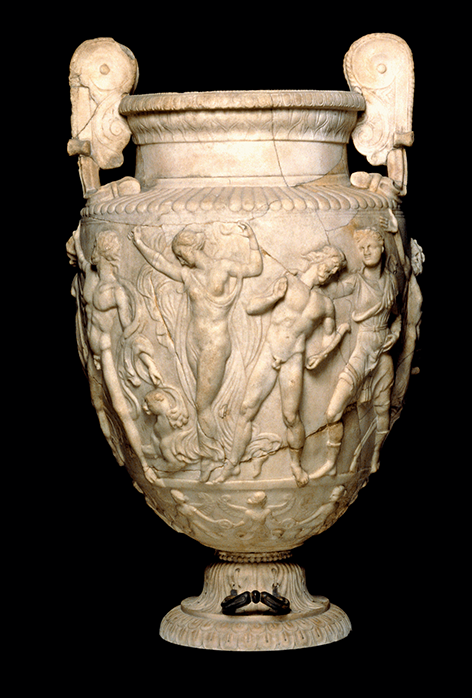
Our third example is a much more venerable discovery, excavated in the remains of the villa of the emperor Antoninus Pius at Monte Cagnolo in Lanuvium, just southeast of Rome, by the British artist, dealer, and archaeologist Gavin Hamilton in the year 1773 and sold after substantial restoration to the collector Charles Townley in 1774 (Fig. I.3).Footnote 47 This vast marble vase, 1.06 m in height, was carved out of a single block of stone with separate foot attached at the bottom. By contrast with the appliqué model of molded manufacture of reliefs in clay, as well as the hammering and casting of bronze, in this case sculptors had to realize the shape, its interior space, and its fine embellishments, such as the handles, by excavating stone from the block before realizing the fine relief of its sculpture from the ornament on the neck, lip, and handles to the figural decoration on its belly. The figures, a Bacchic procession encircling the main body and moving from right to left, include Dionysus and Ariadne, as well as a number of Maenads and Satyrs and a fine image of Pan carrying a vase of different shape to the Townley krater but nonetheless riffing on its form. These figures are carved in a diagonal plane so that their lower bodies are in low relief as the vase tapers in toward the foot but emerge from the background into high relief with heads and arms extending from the background just below the shoulder of the vessel. Draperies in very low relief play on the background against the much higher-set figures, as on the Derveni krater. A magnificent Roman work of the late first or early second century CE, the Townley vase (like the other major marble vases in its high elite class) borrows its imagery and iconography from a rich repertoire of Attic and Hellenistic precedents, confecting the fantasy of Dionysiac bliss on the body of an object whose form evokes the storage and drinking of wine.Footnote 48
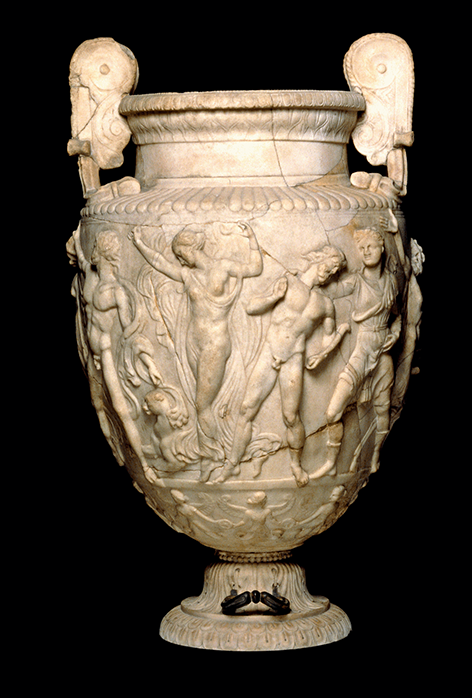
Fig. I.3 Townley vase from Monte Cagnolo, late first or early second century CE. London, British Museum, 1805,0703.218
This object was probably not funerary but rather part of a parade of sculpture displayed in the lavish context of a top-end imperial villa. On the other hand, its imagery and execution are hardly unrelated to the extensive culture of relief sarcophagi of both Attic and Roman origin that depict Dionysiac processions and were used for the burial of many in the Roman elite from the early second century.Footnote 49 Indeed, the urn form of the vase, as much as it calls to mind a krater for holding wine, also evokes a typical kind of repository for ashes in the Roman world, of a sort made in the same material but at much smaller scale.Footnote 50 In part, the game here is that the iconography of figural Dionysiac processions is reserved for sarcophagi destined for the inhumation of bodies, rather than for cinerary urns, but is transferred at monumental scale to a kind of object that – if used for burial, as this was not – would have contained cremated bones. Quite apart from its free play with earlier styles and iconographic forms, this piece plays on the kinds of functions of earlier works that looked something like it. Moreover, it imitates in marble the cast forms of bronze in its handles,Footnote 51 while evoking (in a spectacularly realized but entirely different technique) both the appliqué and repoussé artistry of vases in other media. The uses of relief in the Townley vase are part of the learned but playful knowingness of this kind of high elite object – fashioning in different media and scales (that is, in monumental marble) the kind of form and iconography typically created in metal or clay. They speak of imperial appropriations, ownership of all media to the extent of substituting one with the other, of eclecticism and excess.
The Townley vase’s knowingness and elite appropriation of aspects of other media indicate the ways that relief both was a way of making kinds of visual statements in the ancient world and had become by the Roman imperial period a means of appropriating and commenting on those statements. The three pieces we have examined here offer a clear view of how objects could exploit relief imagery in the context of a given regime of representation to make claims or comments on their functions, their aspirations, and the visual tradition in which they stand. The Mykonos pithos uses its windowing facture to comment on their own function as container, as well as an iconography of slaughter to reflect on the human remains therein. The Derveni krater, in a regime of rampant naturalism at a golden age of large-scale bronze manufacture, uses the move from repoussé relief to three-dimensional figurines rendered as super high reliefs via appliqué to evoke Bacchic bliss in the afterlife within the regime of increasing lifelikeness in representation.Footnote 52 The Townley vase riffs across these kinds of precursors with rampant abandon, some substantial art-historical understanding, and sculptural command, while using a radically different medium with changed functions.
*
Objects like these three vessels expand our sense of the technical, thematic, and visual possibilities of relief offered by the monumental, architecturally engaged examples with which we began. As the chapters that follow demonstrate, many further aspects of ancient relief production offer themselves for exploration. What the chapters also show – whether discussing the interplay of surface decoration and bodily substitution of Archaic Greek grave stelai or the chain of replication in the striking of late antique coins and medallions from officially sanctioned imperial dies and subsequent imitation of those objects by nonofficial means – is relief’s fundamental in-betweenness, its ability to act in the place of some other impetus and to fulfill such a wide range of functions. This is to say, in investigating the intricacies of ancient relief, in often quite detailed technical and lexical terms, the chapters also investigate how it functions as: as body, as medium, as process, as light effect, as movement, as replication, as fiction, as attestation of familial relation, or as point of connection to the numinous or the divine, to name just a few. Relief, in this sense, is both object of study in its own right and conduit to something else. It is the in-betweenness of relief, as much as its diversity of forms and functions, which makes a generalized theory of relief such a daunting and intellectually stimulating prospect. But it is also that same in-betweenness, we would suggest, that offers a through-line both for the chapters presented here and the phenomenon more broadly.
The chapters in this volume do not (and cannot) address the full breadth of issues raised by ancient relief as either theoretical subject or empirical phenomenon. But they point to both the complexity of the topic and to its transcultural and transhistorical ramifications, which reach practically every domain of visual culture. Of persistent interest precisely because it is never fully one thing or another, relief is an act of negotiation as much as it is an artistic technique or an optical effect. It negotiates among the integrity and smoothness of the notional surface out of which it seems to “emerge” (a surface which, we must emphasize, need not be a flat one), the visual and tactile texture of the elaboration of that surface and the actual material extension of the surface in space. Relief likewise negotiates among not just the two-dimensionality associated with painting and the three-dimensionality of sculpture but the singular dimension of the line. And it negotiates among monumental, figurative architectural sculpture, the humbler domains of pottery and other forms of terra-cotta production, and the luxury arts of gem-cutting and chasing and molding in precious metals.
Verity Platt (Chapter 1) opens the volume by approaching the topic of classical relief through an examination of ancient terminology, concepts, and mentalities. It proceeds from the premise that there was no single word, in Greek or Latin usage, which could function in the way that “relief” does in both everyday English and scholarly literature. Instead, a constellation of related concepts helped antiquity articulate relief across media and artistic technique, and further lent it a peculiarly indeterminate ontological status. Platt opens with the observation that the most common word in Greek for relief, typos, was also employed for an impression or stamp, what today we would still call a type. Platt further observes that the typology of molding and casting is especially connected to the act of carving through engraved gems used as seal-stones for the creation of reliefs. The chapter discusses a wide selection of evidence for ancient thinking about relief, ranging from Homer to Pliny and beyond. It emphasizes that what we might think of as phenomenological effect is as critical to ancient relief terminology as material support and process; hence, the relief effect of painting overlaps considerably with discussions of the figure–ground relationship in sculptural relief. Ultimately, Platt proposes, the constellation of thinking about relief diagrams an ontology of relationality, with as much to teach us about models of perception and cognition as about artistic creation.
For Caspar Meyer and Chris Pellettieri (Chapter 2), relief offers the opportunity to rethink the relationship between vision and meaning in ancient art-historical analysis. When viewed in a certain proximity, at a certain level of detail, autoptic analysis has typically threatened to rob art history of its ability to extract meaning from the visual arts. A single chisel mark, much less a more microscopic trace, may be enormously informative from the perspective of a history of technology or the construction of a chronological stemma, but it has typically seemed to lie outside the arena in which most European and American art history is able to locate interpretive meaning. This chapter works against that tendency by seeking to connect a technical, procedural understanding of the carving of Greek stelai with a deeper exploration of the frames of their creation and perception. Meyer and Pellettieri focus with particular acuity on the production of lines and planes that permitted a stele to act as a surface in the first place, both for figural relief and inscribed text, and thus as a literal and metaphorical ground for the production of meaning. The “immanent plane” of representation, they articulate, has become a basic given in modern representational acts, but in Archaic Greece it was an object of creation in its own right, one that could not be taken for granted and that required remarkable skill and creativity to produce. Ultimately, by attempting to think about monuments through the combination of stone, tool, and gesture, they argue, we both rescue the creative act from mere material determinism or historical teleology and open up new points of access to the connections between making and meaning.
Seth Estrin (Chapter 3) likewise takes on the topic of Archaic funerary sculpture, investigating in particular the question of the body. He reexamines the similarities and differences between the two primary forms of Archaic funerary sculpture, the freestanding statues known as kouroi, and the stelai decorated with relief, showing that rather than discrete, independent categories of artistic production, each blurs into the other. Rather than bodies fully in the round, Estrin shows, kouroi can in some senses be understood as quadrifacial high reliefs. And rather than mere surface elaborations, in turn, relief stelai often emphasize their bodily imposition in space. This blurring of boundaries is particularly important because recent scholarship has tended to see in the distinction between kouros and stele not just a question of artistic genre but one of representation itself and has frequently contrasted the copresence of kouroi in real space with the planar virtuality of the stelai. Yet despite the undeniable differences between them, Estrin argues, kouroi and relief stelai evince related forms of visualization, and – engaged as both inevitably were in complex, multipart monuments – they bespeak a common set of affective purposes that highlight not only the representational challenges but also the ethical implications of funerary commemoration.
In Chapter 4, Guy Hedreen examines relief in connection to Athenian vase painting. Already an intermediary form, where the pictoriality of painting and drawing stretch across and deliberately play with the three-dimensional shapes of the vessels themselves, Attic vase painting also features substantial experimentation with relief. As Hedreen explores, the phenomena of added clay relief and the raised relief-line are prominent in Archaic and Classical Attic painting, the latter especially in the red-figure technique, where it plays a complementary role to the incised line of black-figure painting by demarcating contours and adding physical and visual texture. These relief techniques are, on the one hand, sculptural, genuine physical protrusions from the surface of the vase. But they are also deeply pictorial, a way to influence the reflection of light off the vase by modulating the angle of incidence so as to create shining highlights and other optical effects. This play between the sculptural and the pictorial is also evident in the case of relief-mask kantharoi, which Hedreen argues develop not from sculpture, nor from genuine ritual masks, but from painted precursors. The dually sculptural and pictorial aspect of relief on Attic vases, Hedreen shows, has typically been suppressed in their photographic publication, which tends to employ certain lighting conditions and points of view that emphasize above all the graphic aspects of both the vase and its decorations, but when taken seriously, it helps us better understand not only important technical aspects of artistic production but even conceptions of pictoriality itself.
Nikolaus Dietrich (Chapter 5) also explores the borders between statuary in the round and relief sculpture, but does so by different means: through the lens of photography. Beginning with the observation that the role of photography in everyday scholarly practice is typically downplayed by students of ancient sculpture, Dietrich examines how the photograph converts the three-dimensional sculpture into a kind of relief, and how that conversion can either subvert or reinforce the compositional principles of the sculpture itself. Beginning already in the nineteenth century, the photographic reproductions employed in the scholarly study of Greek sculpture, he highlights, tend to exhibit a relief bias by choosing just a few angles onto a given statue and isolating it as much as possible from any surrounding context. Such acts of framing, on the one hand, are a legacy of neoclassical approaches to sculpture that sought for the best view of a given statue; they also accord closely with the late nineteenth-century prescriptions of the sculptor Adolf Hildebrand, who thought all statues should be essentially relief-like in their compositions. But they are not entirely modern fictions, however, and Dietrich also demonstrates that many Greek statues from the late Classical period onward were deliberately designed to encourage specific, privileged points of view.
Carolyn Laferrière (Chapter 6) takes us to Rome in the first centuries BCE and CE, where she examines the rhythmic and spatial compositions of so-called Neo-Attic reliefs. Sculpted marble objects of relatively modest size, seemingly designed for domestic display, these reliefs were designated as Neo-Attic insofar as they evoke the style and subject matter of Classical Athenian sculpture. But as Laferrière shows, they are much more than exercises in art-historical reference. Instead, such reliefs ally a multiplicity of temporal orientations – achieved through both the historical reference of figural style and the ambiguity of their narrative settings – with a deliberately uncanny spacelessness enacted in low relief. Although these objects often feature landscape elements, such as stones and trees, and their intricate patterns of overlapping indicate complex arrangements of pictorial depth, they rarely resolve into clear depth intervals from a plane, and the figures themselves – human, divine, and otherwise – only barely emerge from the background. The result, Laferrière argues, is that the reliefs evoke a sense of the past for their Roman audience that is at once historically specific (and specifically Greek) and at the same time lays outside the sequence of chronological time entirely.
Nathaniel B. Jones (Chapter 7) once again takes up the question of the intermediality of relief, this time through the examination of the remediation between ancient relief and painting, particularly in late Republican and early Imperial Rome. A concept developed in late twentieth-century media studies, remediation helps elucidate the degree to which one medium can contain, represent, and reflect on another medium through a dialectical process of acknowledging and denying its presence. Thus, as relief strives to be more like painting and vice versa, we find a series of reflections on the tensions between two and three dimensions, real and pictorial space, the haptic and the optic, form and color, and illusion and fiction. The chapter focuses in particular on the representation of relief sculpture within Roman murals, which, like other experiments in metapictoriality, permitted Roman painters to explore the boundaries of their capabilities by offering both a material limit of pictorialization and providing a host of ways in which the pictorial could seek to outflank the material. It concludes by reflecting on how the in-betweenness of relief, its ability to traffic in both real presence and virtuality, is in some ways analogous to the structure of fiction itself.
Jennifer Trimble (Chapter 8) takes us back to the production of carved marble reliefs, especially in early Imperial Rome. She examines the background of such reliefs, ostensibly a neutral, even negative zone, but in fact one of the final areas of the object to be carved. Rather than a stable plane of projection from which figures emerge, Trimble argues, from the perspective of a stone carver the background of a relief is in fact anchored by those figures, who typically come into existence first. This shift in focus turns the typical negation of the background on its head, revealing it to be a site of creative and dynamic fluidity. Trimble first takes us through the steps of the carving process before turning our attention to the specific example of a marble calyx krater used as a garden fountain in Villa A at Oplontis. A freestanding, volumetrically composed object carved from Pentelic marble, the krater features a host of relief decoration, including six nude, armed males dancing across its body. The background against which those figures dance, moreover, is not a flat surface but a precisely curved one that both imitates an emergent pictorial plane and follows the contour of the carefully considered geometric proportions of the body of a vessel. Achieving the appropriate symmetry and rhythm of that background, Trimble shows, would have been one of the prime challenges for the sculptural workshop. The fact that the final object playfully evokes a number of other media, including vessels in clay and metal, which would have been made according to very different protocols, and that similar marble kraters were depicted in the wall paintings at Oplontis, only serves to further foreground the significance of relief’s background.
Nicola Barham (Chapter 9) examines the varieties of relief evident in Palmyrene funerary portraiture. Widely known but often not well archaeologically documented, Palmyrene funerary sculpture embodies relief’s intermediateness, moving between shallow incision and sculpture in the round, between individualized portraiture and group identity. It likewise mediates between local, Parthian, and Mediterranean points of reference, both in style of execution and cultural signifiers like clothing, jewelry, and inscription. Indeed, Barham suggests that the primary purpose of Palmyrene tombs was to communicate the significance of the families they housed and commemorated to the surrounding empires. The fact that the portrait sculptures were used as loculus slabs, and were thus literally placed in between the represented dead and the living who mourned them, only further emphasizes their inherent mediateness. Beginning with a single relief portrait now in the Kelsey Museum of Archaeology in Ann Arbor, and then moving to a consideration of an ensemble of portraits in a corporate tomb, Barham shows how Palmyrene funerary sculpture in its original settings was capable of exploiting and subverting the norms of multiple artistic traditions, genres of portraiture, and affordances of relief in order to produce specific visual and commemorative effects.
Ashley Elizabeth Jones (Chapter 10) closes the volume by bringing us forward into late antiquity, to a relief phenomenon unique to the period between the third and seventh centuries CE: numismatic and nummiform gold jewelry. Her chapter examines coins and coin-like objects embellished with relief decoration and set into frameworks designed to be worn on the body. The objects she discusses elucidate not only the power of relief as personal adornment but also its role in a complex web of amuletic thinking in which aid, or indeed relief, was sought for the body of the wearer from a divine power, as attested by numerous inscriptions throughout the corpus she examines. Particularly important to this phenomenon, Jones elucidates, was a chain of typological associations. Literal typologies regulated the production of coins and struck medallions, which were produced from officially sanctioned dies in the imperial mint, but unofficial versions could be made from molds taken from the struck objects or through the direct impression of gold leaf. Metaphorical typologies have an important role to play, as well, as the relief imagery, along with the source of authority to which the jewelry appeals, moves between imperial and Christian. Ultimately, Jones demonstrates, the use of gold, the images themselves, and the invocations for aid connect these objects to a broad network of protective amulets and talismans throughout the ancient and late antique Mediterranean.
*
The chapters in this volume are marked by the diversity not only of their subject matter but of their approach as well. They cross chronological and geographic borders, from early Archaic Greece to late antique Rome, from Syria to Spain. They also range from the philological analysis of the lexicography of relief, to the formal analysis of its visual effect, to the technical analysis of its creation. In bringing these targeted contributions together, our aim as authors and editors has been to open up further space for deeper thinking about the multifaceted ontology of relief, its intermediate nature, multiple manifestations, varied processes of facture, impact on the eye, and complex construction of meanings, both in antiquity and in its later inheritances. So much of the long history of Greco-Roman art has been enabled and shaped by the artifactual interventions of the very production of relief that still invite further analysis and theorization. The place of incising or molding the surface is so obvious and so central in the histories of ancient artistic practice as to have been too long ignored as a key determinant for how visual culture articulated its themes. And in the sculptural arts, relief is the essence of so much image making and pictorial storytelling – across a tradition reaching continuously to modernity and well beyond the Greco-Roman world through Eurasia and Africa. A close consideration of relief brings to the fore how techniques of artistic making act with and against the given materials in aid of the purpose and content of the work being produced. Deepening our understanding of Greek, Roman, and late antique relief has much to teach us about the very nature of the art of antiquity and beyond.