


One of the most noteworthy qualities of asylum periodicals, in addition to and because of their authorship, is the dearth of sensationalism. Asylum periodicals surprised contemporary reviewers with their ‘sane and sensible lucubrations’, as the Chambers’s Journal put it.1 An article in the Leisure Hour claimed that the Morningside Mirror’s contributors ‘are wanting neither in logic nor in fancy’.2 Humble poetry, discussions of current political and social issues, and essays on philosophical and scientific questions, including madness, dominate the pages. Reflections on insanity and the general state of asylums and moral treatment tend to be wrapped up in distanced, medical language.3 Internal news about the institutions that issued the periodicals are frequently delivered in a light-hearted, even humorous tone. Special attention is paid to the entertainments available to the patients and events such as picnics, excursions, and celebrations. For instance, the issue of the Morningside Mirror for 15 July 1847 contains a reflection on ‘artistical taste’, a biography of Caliph Haroun al-Rashid, an article about amusements in the Royal Edinburgh Asylum, and a poem. In its more densely covered three-column pages, the Asylum Gazette offered readers of its number for 20 February 1846: a few editorial notices about the newspaper, its reception, and the publications received in exchange for it; four longer articles, about human nature, national character, women, and the state of American literature; seven short poems; several briefer pieces and anecdotes; and reprints from Socrates, the New York Sunday Times, the Geauga Republican, and the Providence Gazette. Some titles occasionally admitted open expressions of delusions or less coherent writing. According to Reiss, the Opal did so to maintain its authenticity, but as Chapter 7 shows, such pieces could also serve as specimens of madness presented to the medical community.4 For the most part, however, asylum periodicals disappointed readers’ expectations of facing raw, raving madness on their pages.
Who speaks from the pages of asylum periodicals? This question is central to the history of these publications and their future use as historical sources. To address it, this section of the book delves into the internal workings of asylums and the complex relationships that publishing involved. My exploration of the voices in asylum periodicals begins with a reflection on the function of the editor. I will suggest that periodical production in asylums was not incomparable with arrangements in other printing offices. The main difference was that the performance of editorial duties for asylum periodicals was embedded in additional, institutional hierarchies and pressures that inevitably affected the publications. To explore the role of conflict and collaboration in leading these publishing ventures, I will briefly discuss the unpublished Moon of the New York City Asylum on Wards Island and then trace the history of the Gartnavel Gazette (1853–1854; 1855) of the Glasgow Royal Asylum. The archival records associated with these titles offer a closer inspection of the interactions that periodical publishing involved: the Moon is an example of a failed collaboration between doctor and patient, while the Gartnavel Gazette persevered despite tensions, which are palpable in the remarkably well-preserved institutional archive.5 Though the Gazette was circulated only internally, the stories of its printers and editors are illustrative of the emergence of asylum periodicals out of conflict, negotiation, and collaboration – not unlike other similar publications at the time. This case study reveals that forces other than institutional staff’s supervision were at work. The editors’ class-based aesthetics and individual preferences in selecting material for publication, as well as conflicts among patients impacted asylum periodicals. In the case of the Gartnavel Gazette, the outcome was the discontinuation of the publication. This title also challenges previous representations of asylum periodicals as polished accounts characterised by docile reiteration of institutional discourses or, at most, by barely discernible protest under strict institutional control. It shows that interpersonal tensions and patients’ grievances found their way into the pages of asylum periodicals.
Doctors, Patients, and Editorial Control
Defining publishing and editing is key for understanding how asylum periodicals operated. Publishing of any kind involves a degree of supervision. As Pierre Bourdieu puts it, each expression is a ‘product of a compromise between an expressive interest and a censorship constituted by the very structure of the field in which the discourse is produced and circulates [emphases in original]’.6 Without considering the restraints on nineteenth-century publishing in general, commentators on the history of asylum periodicals have naturally focused on the inequality between staff and patients. This approach, with its over-reliance on the explanatory power of the term ‘censorship’, exaggerates the imbalance, willingly or not, and oversimplifies the mechanisms and pressures that governed expression in asylum periodicals. The claim that asylum periodicals were defined by infringement on patients’ freedom of speech also implies that outside asylums the press lived up to the ideal of liberty. This was hardly the case.7 Individuals striving for expression through publishing had to please those whose positions in the book trade gave them the power to monitor, judge, and select what got released to readers. Themselves dependent on readerships’ tastes and expectations, editors and publishers often occupied their positions of power because they had internalised or agreed to pay lip service to existing dominant discourses about respectability, morality, and aesthetic taste. Their positions were therefore as provisional as that of authors, depending on their ability to fit in the professional and market structures they inhabited. Nineteenth-century publishing was thus governed by a complex feedback loop, as producers and recipients of print influenced each other, negotiated the boundaries of what could be published and where, and shaped the discourses that governed these exchanges.8 In this context, editing is a position that is especially difficult to define since, as Robert L. Patten and David Finkelstein put it, ‘by “editing” one could mean almost anything’.9 Analysing the nature and degree of editing in any periodical is challenging, as the main piece of evidence are the finished products themselves.
Asylum periodicals are in some ways exceptional, as they and their institutions’ records occasionally lift the veil obscuring the mysterious editor figure. For instance, the collection of papers related to the Moon of the New York City Asylum on Wards Island, held at the archives of the University of California, Los Angeles, offers a unique insight into the editorial dynamics of the publication. Likely collected by the physician-superintendent, Dr Alexander E. MacDonald, the bundle reveals the complex relationship between the doctor and a patient with whom he planned to launch the newspaper.10 The collection features letters from subscribers keen to receive the first issue, clippings from the press, manuscript contributions, incomplete proofs of the publication with editorial notes and comments, and, most importantly, two letters from a patient, Thomas D. Maitland, to Dr MacDonald, which discuss the way the publication should be run. Maitland is known to have been a stenographer, reporter, and editor based in New York. His correspondence suggests that he was willing, if not keen, to apply his skills and experience to support the project.
The first letter, dated 12 April 1882, represents the patient less as an editor and more as a secretary. He proposed to take dictation from the physician or otherwise relinquish all control over the final contents:
If you don’t wish to dictate the article verbatim, I can work your ideas out from the leading or pivotal points which you can furnish in a few minutes. In writing out, I would leave ample space for interlining so that you could easily correct, add, amend, strike out, recast, or make suggestions for doing so if you did.11
The method of dictation was offered ‘so that the journal should not encroach upon the time of your [Dr MacDonald’s] professional demands’.12 The letter hints at Maitland’s excitement for the project. The aim of his subjection to the physician’s will was to persuade MacDonald to turn the newspaper idea into reality. The patient’s submission to the physician’s control was not complete, however. The rest of the letter exposed Maitland’s own ideas for the publication and its contents and reinstated him as a collaborator: ‘we should select subjects for editorials, and aim at making the paper newsy, interesting and thoroughly up to the times, journalistically and scientifically’.13 The ‘we’ in this sentence put the doctor and the patient on an equal footing, as each would contribute their relevant expertise to the project.
Apparently, Dr MacDonald did not respond to Maitland’s suggestions. Seventeen days later, Maitland wrote again, demanding a response to his propositions and asking the doctor for ‘an intelligent idea of what you wish me to do in relation to the selection of the matter, and the method of treating the subjects’.14 There are no more mentions of dictation, as the patient now assumed the role of an assistant editor and direct contributor, reassuring MacDonald that:
you will naturally occupy the position of Editor-in-Chief and general manager, the more accurately your views are anticipated and expressed, the less onerous will be your duties; and I shall have no feelings or prejudices to air that will clash with your notions. If you should wish to have in print that the moon is made of green cheese, I should write it down with as little compunction as I would the latest astronomical discovery of Proctor, with this reservation that I should prefer to write it over a nom de plume [underlining in original]. An editor when dealing with his chief must have no conscientious scruples. It’s non-professional.15
While negotiating editorial responsibilities and line of command, Maitland subtly reasserted his sanity and agency. By imposing regular publishing trade hierarchies onto the project and referring to a code of professionalism, he sought to adopt the rules of the outside world where he, a journalist and a reporter, had authority and expertise. His submission to the physician’s will also involved subtle subversion and mockery. Under the proposed arrangement, the only possible madman would be the physician. As a true professional, the patient-editor would replicate the doctor’s words but only after hiding behind a pseudonym – as a sane person recognising irrationality and wishing to distance himself from it.
Yet, Maitland thought it would be a good idea to present the project as entirely produced by insane people, to pursue a subversive agenda. In his first letter, where he offered his quick pen to the physician’s service, he wrote:
In consonance with an idea which you are represented as having expressed to some of the reporters of the large dailies it will be a good feature of the paper to keep up the notion of editorial insanity. This will afford an immense leverage on our side when criticizing the outside world through lunatic glasses, and under this cover of the editorial sanctum very sharp double-entendres [underlining in original] can be perpetuated with impunity and laughed at, which if uttered from a sane and solemn standpoint would be offensive, and for which you could not afford to be responsible, surrounded as you are by sensitive people; and seeing that the Commissioners themselves live in glass houses, you will be obliged as their representative to remember the maxim addressed to the inhabitants of these fragile structures.16
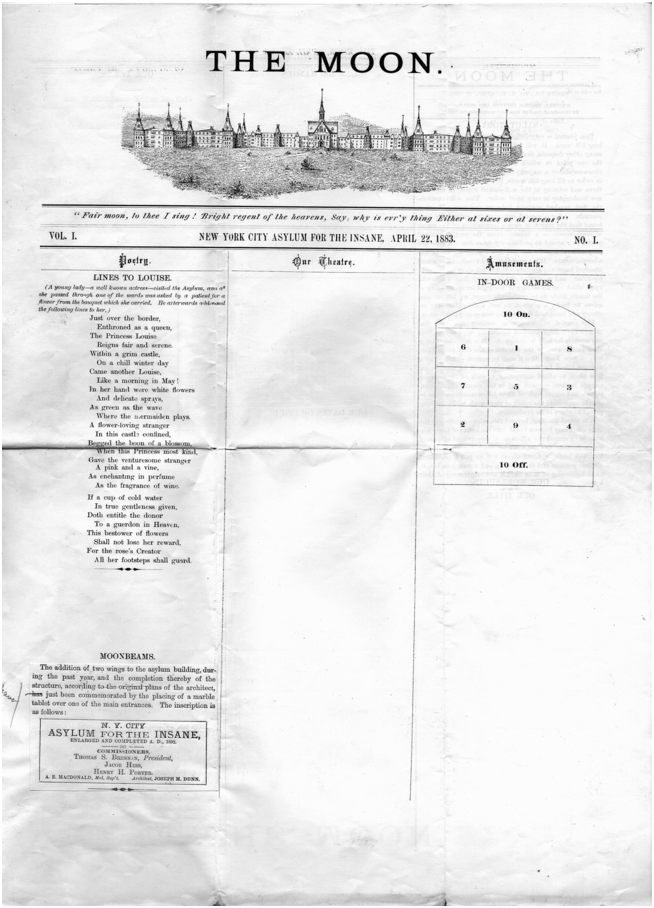
In advertising the new project, Dr MacDonald had falsely claimed that the publication would be produced entirely by lunatics. Maitland used the physician’s lie to his advantage, recognising the freedom of speech that the cover of insanity would offer. He was also aware of the physicians’ position in larger administrative bodies, such as the Commissioners of Public Charities and Correction, which monitored his work and limited his own freedom of expression and action. By recasting the physician’s lie to the public as a secret weapon and representing the physician in a position of submission, not unlike his own, the patient reframed their relationship as truly collaborative. Together they, sane and clear-sighted about the flaws of the world, would be able to reveal its true colours using the guise of insanity. MacDonald’s response to these proposals has not been found, but the preserved incomplete proofs (Figure 4.1) and annotated contributions featuring both Maitland’s and MacDonald’s hands suggest that, for a while, doctor and patient worked together on preparing the newspaper for publication.17 In August, Maitland earned his physical freedom and launched a campaign in the press against the asylum. He claimed that he had been wrongfully confined after a bromide overdose and kept in isolation from the outside world in the ‘chronic ward’ after submitting a few articles for publication in the New York Star, written prior to his admission.18 In December and early January, several notices in the press announced the upcoming publication of the Moon, suggesting that after all the investigations and court hearings, Dr MacDonald made another effort to launch the periodical.19 The silence that followed and the absence of discoverable copies of the newspaper indicate that the Moon was never published – yet another sign of the importance of patients with free time and expertise in these projects.
Proofs of the front page of the first issue of the Moon, dated 22 April 1883 and never published.
Portraying asylum periodicals as dependent on collaboration that was often ridden with tensions, the case of the Moon invites further reflection on the logistics of publishing within and beyond asylums. Maitland’s letters allow the asylum to be reimagined as a kind of publishing firm, in which the managers (or Commissioners) and the superintending physician often acted as what Robert Patten and David Finkelstein have termed ‘publishers-proprietors’. They had to be convinced of the benefits of the endeavour to spend their usually limited funding on a press, type, and, at the very least, paper and to dedicate space in the asylum for the printing office. They were invested in the publishing projects they managed and employed the wider resources at their disposal to maintain them. They occasionally sought to attract new contributors or, in cases like the Morningside Mirror and the Opal, initiated the periodicals by encouraging patients to write and edit them.20
An objection might be raised that these situations were too different from Patten and Finkelstein’s examples of the type, William Blackwood III and George Murray Smith, who produced a wider array of publications in addition to their magazines. However, asylum publishing was versatile too. The presses were regularly employed in producing administrative documentation, annual reports, and medical publications, and they sometimes printed other types of patients’ writing. Alexander Smart’s Scenes from the Life of a Sufferer, at first serialised in Hogg’s Instructor, was issued as a whole volume from the Royal Edinburgh Asylum in 1855. The same press published John Reid Adam’s Poetical Log-book; or, Journal of a Voyage from Malta to Liverpool (1855) and the two editions of his poetry collection All Sorts (1856; 1859). Though there is no information about the circulation of these complementary publications, they were likely to attract more attention to the institution and its Morningside Mirror. Asylums thus operated in a very similar way to regular publishing houses.
The editorial function was naturally complex. Though the editorial signature, if present, was usually of a single individual, most asylum periodicals had at least two editors – a patient and a physician.21 The two confirmed exceptions are Excelsior of the Murray Royal Asylum in Perth and the York Star of the York Lunatic Asylum.22 These are the only identified cases of single individuals editing an asylum periodical, a circumstance made possible only by their positions as physician superintendents: Dr William Lauder Lindsay and Dr Frederick Needham, respectively. At least a minimal degree of physicians’ involvement should be assumed for all other publications, since even an internally circulated publication like Chronicles of the Monastery was monitored by staff. However, Maitland’s letters reveal that editorial control was fundamentally tied with another factor – time. The physician’s availability to engage and monitor these projects was limited by the demands of his primary duties, which were not only medical but also administrative. With authority to establish the general direction of the periodical but limited capacity to produce fresh copy, the physician-editor was indeed an ‘Editor-in-Chief’, as Maitland refers to Dr MacDonald. The patient-editor, on the other hand, could afford to be more ‘hands-on’, to refer to Patten and Finkelstein’s terminology again. They had the advantage of plentiful time to spend on the publication, producing copy, corresponding with contributors, selecting and arranging content, and supervising or executing the printing process. Even as an assistant editor working under another’s guidance, they had greater opportunity to stir the publication and shape it from issue to issue.
A crucial difference between asylum and other periodicals was the fact that patients were on a metaphorical trial prior to the point of submission. Their writing could be used as evidence of their sanity or insanity.23 Patients’ behaviour and obedience to staff could be major considerations in whether they would be given access to expression in the first place.24 While the risks of detainment and silencing were not exclusive to the asylum setting, the impropriety or irrationality of patients’ writing could have consequences for their lives beyond dealing with the editor’s rejection. Patients were often aware that their writing could result in prolonged confinement or withdrawal of their privileges in the institution, including that of writing for the periodical.
Under these circumstances, one would expect asylum periodicals to be perfectly uniform celebrations of the achievements of psychiatry. That is not the case. It is tempting to argue that expressions of criticism or negative sentiments towards the institutions and their staff were simply failures of censorship. Insisting that patients used codespeak to refer to less pleasant aspects of their experience, Emily Clark has thus argued that ‘the institutional censors would overlook these harmless phrases, which would have been recognized as subversive by other patients’.25 Identifying instances of criticism in the Opal, she suggests that ‘perhaps the sarcastic tone was missed by the censors’.26 Failure to detect censorable content is a valid explanation, especially since monitoring the periodical was far from physicians’ primary duties. However, it is highly doubtful that physicians would have missed the ironic tone that permeates a significant portion of the contributions or the critical references to cold showers, anti-masturbation mittens, and other unpleasant asylum treatments. These references could just as well be interpreted as signs of permissiveness – of the physicians’ perception of them as non-threatening, general laxness about such subversive utterances, or even lack of interest in the publications.
The overemphasis on censorship also obscures the consequences of unfiltered speech, as well as patients’ own desire to protect themselves from overexposure. While editing could be driven by institutions’ reputational interests, selectiveness served patients’ interests too. The consequences of publishing indiscriminately could be devastating for large public institutions that relied on benefactors’ donations. This was likely the source of concern for the editors of the Asylum Journal when they delayed the publication of a satirical piece by ‘X. Y. Z.’, which proposed the candidacy of a madman for the presidential elections of 1844:
The following communication was (last week) presented for admission into the Journal, but the editor declined publishing it. An appeal was then made to the ‘board of Censors,’ who decided that it might be admitted on condition that the writer would present no more political pieces [emphasis in original].27
The ‘board of censors’ mentioned here was ‘chosen by the inmates of the Asylum’.28 While references to ‘The Crazy Man’s Ticket’ continued to appear in the Journal, this example shows that patients themselves regulated the contents of the periodicals guided by concerns that were not necessarily related to their institutionalised status. In this case, patient-editors were hesitant to admit a political article that could risk alienating some of their readers.29
Imagining asylum periodicals without censorship, McMillan has raised a reasonable question: ‘would [patient-readers] truly benefit in reading about a fellow inmate’s ongoing struggle with delusions?’30 One of the issues of the Morningside Mirror shows unambiguously that the contents of asylum periodicals were shaped by concerns for patients’ well-being. Containing a description of a violent murder that the author allegedly witnessed, the issue appeared in two different editions. Only one of them seems to have survived and has been preserved at the Lothian Health Services Archives. An editorial note in it reads: ‘This article has been considerably altered in the copies circulated within the Asylum, in order to suit it to the state of mind of the inmates; but it is thought proper to present so spirited a sketch entire to the extra-mural subscribers.’31
Though the author might not have been pleased that his fellow inmates were not given direct access to his writing in full, the editorial decision seems to have been driven by concerns about upsetting other patients. Finally, the Meteor, discussed in detail in Chapter 5, suggested that the public exposure of the secrets of deranged minds in periodicals would not necessarily be a step towards liberty.32 It could aggravate the ostracisation of the insane, just like former patients’ exposés, which in condemning the institutions, also denounced everyone else in them to highlight the authors’ own sanity.33
In addition to concerns connected to the peculiarities of asylum periodicals’ origins and their producers’ status, individual patients’ aesthetic ideas also governed the editing process. The therapeutic aims of asylum periodicals did not make the literary worth of contributions irrelevant. In his autobiographical account, Alexander Smart remarks that, apart from him:
Other writers there were, chiefly of the poetical class; but their tuneful effusions not being sufficiently touched with ‘the vision and faculty divine,’ to warrant their insertion in the ‘Mirror,’ they were ‘born to blush unseen,’ and never reached the dignity of print.34
This statement suggests that the quality of writing was important to patient-editors, especially when they were members of the publishing trade, which was often the case. For any editor, the periodical demonstrated the editor’s skills to attract, select, and curate content according to their own ideas of what was aesthetically pleasing to them and their readerships.35 Given the chance to impress their fellow patients, institutional staff, and the general public, patient-editors were equally driven to showcase the best writing that came within their reach, even if their subjective ideas about acceptable literature meant limiting the number of contributors.
Editing asylum periodicals thus involved collaborative work and constant negotiation between contributors and patient- and physician-editors. That a physician (usually the superintendent) had the final say does not mean that his control over the periodicals was total, neither that he wanted it to be so. Patients’ own aspirations and views shaped their editorial approaches which had an equally important role. Despite the complex position in which they found themselves, patients made asylum periodicals work for them, navigating institutional hierarchies and rules and using the resources they were offered, however limited they were.
The Gentlemanly Beginnings of the Gartnavel Gazette (1853–1854)
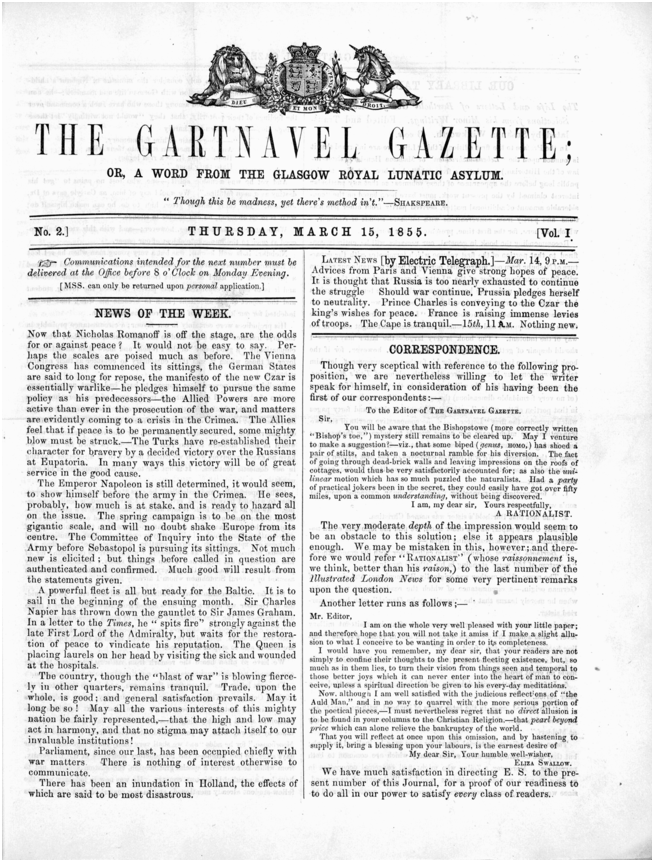
The patchy history of the Gartnavel Gazette, or the Monthly Journal of the Glasgow Royal Lunatic Asylum offers further insight into the publishing arrangements within institutions and the relationships between different representatives of the asylum populations. Its first series ran monthly from 1 June 1853 to 1 March 1854. After a year of hiatus, it was renewed as a weekly on 8 March 1855, under a new subtitle, A Word from the Glasgow Royal Lunatic Asylum. It also acquired an engraving of the royal coat of arms on its front page and a Shakespearean quote as its motto: ‘Though this be madness, yet there’s method in‘t.’ The date of the last surviving number is 28 June 1855.36 Both series appeared in four-page quarto double-column format.37 A sixteen-page Christmas Number was also published in 1882, before the Gazette was restored in 1903 as a quarterly.38 Here, I will focus on the first two series, which had different editors and tone but were both published under the superintendency of Dr Alexander Mackintosh, who headed the institution in 1849 and like his predecessor (Dr William Hutcheson) advocated the curative potential of work and recreation.39
At the time of the newspaper’s launch, the Glasgow Royal Asylum housed over 420 patients, with the two sexes equally represented and accordingly separated. In 1843, the asylum had changed location to a site in Gartnavel and consisted of two main buildings. The West House contained individual bedrooms or suites for private patients that were comfortably furnished. The physician resided there too. The East House housed the pauper patients and was less accommodating. The asylum had a garden, a farm, a pigsty, and workshops, where patients engaged with work suitable to their abilities and social background. Dr Mackintosh argued that ‘employment, both mental and physical, is of the greatest advantage’ and recognised ‘the importance of devising every means of occupation calculated to amuse and instruct’.40 Due to the gender and class divisions of labour, finding suitable employment for the paying patients, especially the men, was a challenge: the women could at least be occupied with sewing, knitting, and embroidery.41 Excursions, walks, amusements, and recreations such as sports and games were offered to address this gap and keep all patients busy. The asylum had a library too.
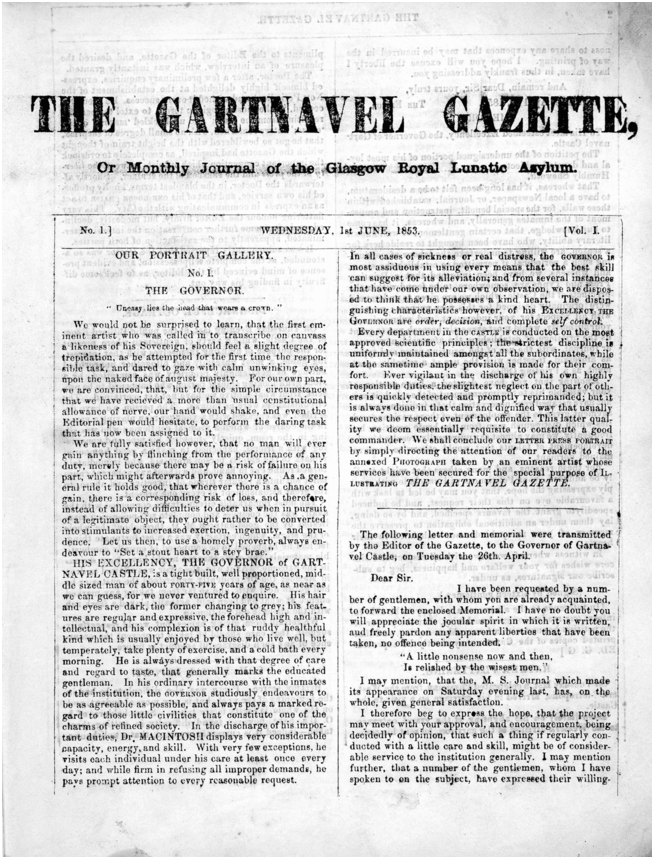
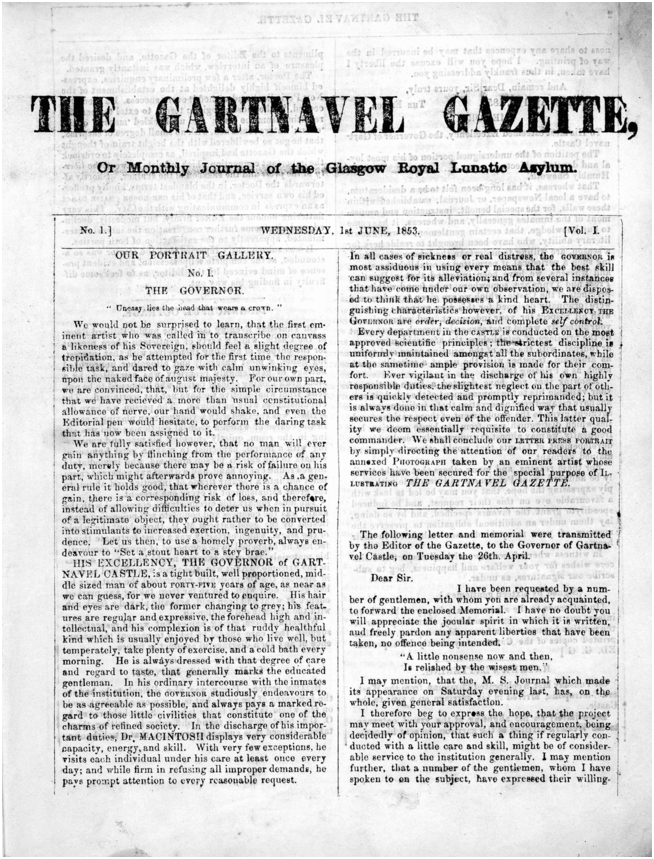
Initiated by patients, the Gartnavel Gazette was seen as a suitable addition to the recreational activities in the asylum. The first issue is quick to highlight the institutional support it received and outlines the negotiations behind the inception of the journal. The opening piece is a description of the superintendent himself (Figure 4.2). Titled ‘The Governor’, it evokes the image of a marshal ceremoniously introducing a nobleman, in this case: ‘His Excellency, the Governor of Gartnavel Castle [all caps in original]’.42 While serving the same purpose as a dedication to a patron, it is humorous, playful, almost tongue-in-cheek, though remaining respectful. It starts off with a description of the physician’s physical appearance, portraying him as a healthy, active, and intelligent man of science. The author then comments on the physician’s professional qualities. All in all, Dr Mackintosh is judged to be ‘a good commander’ who is strict but sensible and inspires respect in his subjects:
In the discharge of his important duties, [he] displays very considerable capacity, energy, and skill. With very few exceptions, he visits each individual under his care at least once every day; and while firm in refusing all improper demands, he pays prompt attention to every reasonable request.43
The next piece in the issue reveals that the Gartnavel Gazette was a result of one such reasonable request. It contains a letter from the editor that was originally sent to the superintendent with an enclosed memorial, ‘signed by sixteen gentlemen’ and dated 26 April 1853. The memorial states that:
whereas, we have been informed that a Printing Press and Types are, somewhere, to be found within the precincts of the Castle, which we are given to understand were originally designed for this very purpose; we now, with all respect for your judgement, and submission to your authority, would most earnestly beseech you to grant us the privilege of establishing the aforesaid newspaper or journal, with the use of the printing-press and types, as aforesaid, together with the use of a suitable apartment, as a Printing Office.44
The press in question was the same press that John Reid Adam had operated more than ten years earlier to produce the Chronicles of the Monastery. The first issue also indicates that a manuscript version of the Gazette was circulated a few days earlier with success and that the patients were willing ‘to share any expenses that may be incurred in the way of printing’.45 The memorial assures that the publication was ‘for the special benefit, instruction and amusement of the inmates’.46 The petitioners go as far as to suggest that their project would aid the physician in his mission of ‘improvement of the mind’ and might lead to ‘the development of talents that would otherwise have remained dormant’.47 The superintendent agreed that the periodical was ‘of sufficient importance to be put in print’.48 Highlighting the benefits of the project, the availability of resources for its implementation, and the absence of expenses it would generate, the petitioners persuaded Dr Mackintosh of the usefulness of their project.
Front page of the first issue of the Gartnavel Gazette, Or Monthly Journal of the Glasgow Royal Lunatic Asylum, dated 1 June 1853.
Patients’ employment in the printing office was recorded in the annual reports, indicating that the press served patients’ literary pursuits beyond the weekly periodical, as well as the institution. The Gartnavel Gazette, Dr Mackintosh observes, had ‘no pretensions to anything but the benefit of the Patients’.49 In the first year of setting up the publishing operations, he states that patients ‘also printed a Catalogue of the Library of the Asylum, a large and amended edition of the Rules, other papers, and the forms necessary in the admission of Patients’.50 The next report reveals that beyond the production of the newspaper, ‘a great many schedules, &c. have been printed, also part of Shakspere [sic], with original introductory notes’.51 As the building of residence and the type of work in the asylum were determined by patients’ social class, publishing at the Glasgow Royal Asylum also stimulated social mingling that would not have occurred naturally otherwise. Describing patients’ labour in 1854, the report states that: ‘The Male Pauper Patients have been employed as Printers, Joiners, Blacksmiths, Tailors, Shoemakers, Gardeners, Oakum-pickers, Farm Servants, and Servants of all work. Some of the Gentlemen … have composed articles, put them into type, and completed the whole by also working at the press.’52 The gentlemanly founders of the newspaper living in the West House of the asylum thus worked alongside the working-class inmates.
Like the earlier periodical of the Glasgow Royal Asylum, the Gartnavel Gazette was circulated only internally. When an unknown physician visited the institution and, impressed with the project, offered his own chaise to transport copies to the city, the editor ‘firmly, but modestly, declined’.53 The reasons are not stated, but it is possible to think of several. The Gazette’s gentlemanly founders claimed to have ‘a total want of professional experience’, representing the publication as an amateur stunt – more of a hobby to fill the time of patients unsuitable for other work in the asylum than a commercial venture.54 This stance had practical implications. As the periodical was distributed for free and only internally, it had a limited circulation that was enough to satisfy the small readership of literate patients who probably shared copies. External circulation would have also meant that the editor would have had to please both the readers in the Gartnavel and those outside, while potentially being more cautious of the information shared about the institution, the contributors, and himself. If the printing costs were indeed covered by the gentlemanly patients who founded the periodical and treated it as a leisurely activity, then it is not surprising that they refused to take on the responsibility of running a public periodical with a larger circulation.
At the head of the founding collective was the editor, who also printed the publication, received the correspondence, and wrote many of the contents.55 Hiding behind the pseudonym ‘Jacobus Amicus veritatis’ (‘James a Friend of Truth’) was James Buchanan (b. 1822).56 By trade, Buchanan was a provision merchant in Glasgow, working for his father’s company, Joshua Buchanan and Sons. He was brought to the asylum by his brother, having become
considerably changed in character and disposition since the death of his wife before which he is reported to have led a quiet and temperate life. Since that time he is said to have been much addicted to the use of strong drinks and illicit intercourse with the other sex. It is only within a month however that he has manifested maniacal symptoms accompanied with delusions.57
After an adventurous trip to northern England in the company of dubious characters, Buchanan was left alone, penniless, and delirious. Convinced that he was ‘placed under the influence of powerful galvanic batteries and exciting gases and made to speak and sing for the purpose of amusing the onlookers’, he was apprehended by the police in York ‘with a knife in his hand’ and jailed until his father came to take him back to Glasgow.58 He was admitted to the asylum soon after, on 5 April 1853.59
At first, Buchanan felt ‘quite at home with his fellow patients’ and enjoyed playing billiards with them.60 However, he spent his time writing, in addition to content for the first issue of the Gartnavel Gazette, a narrative of the events leading up to his institutionalisation and letters to medical and legal advisors urging them to investigate his case.61 About a week following the publication of the first issue, he ‘stated to Dr Mackintosh that he had the belief that his delusions were real, but that he wished to be convinced that they were not real, if they were not so. But the delusions he says have less hold upon his mind now than they had before.’62 Three days later, his legal advisor sent a petition to the Sheriff, demanding that Buchanan’s case be investigated and insisting that Buchanan was not insane and had never been. Over the month following the failure of the document to earn him back his freedom, Buchanan was ‘forward and overbearing in the highest degree’ and ‘disposed to indulge in scurrilous writing and insolence towards others’.63 By the end of July, however, he had ‘completely changed his tone’. He discontinued his claims to sanity and retrieved all his papers from his legal advisers.64 On 1 September, he was discharged relieved, as the surgeon observed that his delusions were ‘latent’ and his excitement had subsided.65
None of these developments were discussed on the pages of the Gartnavel Gazette, which Buchanan conducted while fighting to establish his sanity and regain his freedom. The tension between him and the institution is nevertheless palpable. Even the first issue, produced at a time when Buchanan was enjoying his time in the institution according to the notes, contains remarks that range from teasing to biting. The same piece that describes the unidentified physician’s visit, reports the following exchange:
[The physician] then proceeded, in the most eulogistic terms, to extol the benefits resulting from the ‘free’ and unshackled ‘liberty’ of the ‘press;’ but we remarked, with no small degree of surprise, that he got so bewildered with the bright train of thought which the Gazette had inspired, as completely to overlook the important connection which subsists between the liberty of the press and the freedom of the subject [emphases in original; underlined phrases are in all caps in the original].66
The daring publication of such commentary demonstrates that asylum periodicals were not always obedient, nor subtle in their criticism. The conversation depicts the physician as overly idealistic and impressionable, to the point of naiveté, while the editor emerges as superior in his awareness of the true limits of liberty. The concluding sentence of the account reinforces this idea: ‘the Doctor was so astounded, at the complete selfpossession [sic], and evident presence of mind evinced by the Editor, as to feel some difficulty in finding his way out’.67 The roles here are reversed: the patient embodies composure and rational thought, while the stupefied physician literally cannot leave the institution.
Several other complaints were audibly voiced. A ‘Commercial Report’ noted the scarcity of bullion, tobacco, and paper in the asylum.68 A humorous advertisement hinted at the building’s rat infestation: it sought a ‘rat terrier of genuine Scotch breed, and a good one to kill. Also a few Cats, who thoroughly understand their business’.69 The second number contained a notice that ‘certain letters and documents of importance have … been wickedly, and feloniously intercepted either before or after they have been lodged in the post office here’.70 Finally, the editorial piece of the third issue bemoans the monotony of life in the institution and the lack of events to discuss. Resigned to the fact, the editor imagines he could go out for a long walk beyond the walls of the institution. The daydream ends abruptly:
Tis vain – the familiar sound of the Castle bell reminds us that our season for romantic walks among woods and streams and highland glens has not yet arrived – that, in short, we are still in the editorial sanctum, and must in some way or another finish the leader for the ‘Gartnavel Gazette’.71
These rants ran in parallel with Buchanan’s campaign to be freed. While the expressions of criticism were delivered with humour and irony, they were nonetheless vocal, challenging the idea of asylum periodicals as ‘sanitised’. Furthermore, they undermine the totality of institutional control. It is impossible that Dr Mackintosh and the staff of the Gartnavel did not pick them up, but they did not intervene.
Buchanan’s writings reveal that the quality of writing was a major factor in filling the Gazette. In the first issue, he reflected on his editorial power:
as the Editor is always held responsible for the general character of his paper, he, of necessity, must possess the power of rejecting any article, or expunging any sentence or expression, he may think objectionable …. We would, however, earnestly hope that the usual rules of propriety, good taste and charity, will be so well observed by all who may favour us with their contributions, as to render the exercise of this privilege quite unnecessary. Let our contributors write frequently, plainly, and always to the point, and there need not be the slightest fear entertained for the success, or utility of the Gartnavel Gazette.72
The ‘usual rules of propriety, good taste and charity’ emerge as the leading principles of the editorial process. These terms are heavily loaded. While they embody the medical and institutional ideal of moral behaviour, they also and even more explicitly represent upper- and middle-class ideals. With this statement, Buchanan embraced the standards of respectability that ruled society at large and urged contributors to do the same. Madness could not be an excuse and would not be allowed. To be published in the Gazette, sounding sane was hardly sufficient. Demonstrating ‘good taste’, a capacity determined by class, was crucial.
These rules were not readily accepted by the Gartnavel Gazette’s audience. A notice in the third number addresses ‘several complaints’ accusing the editor of being ‘not sufficiently liberal in giving a place in our [his] columns to the various contributions’.73 To pacify the frustrated contributors, Buchanan offered further guidance:
1st, No stale ‘news’, or articles having no conceivable connection with passing events, can be inserted on any terms.
2nd, All Poetry which is utterly destitute of rhyme and reason, or one or other of these important requisites, is equally inadmissible.
3rd, Every contribution which is in any way calculated to afford either instruction or amusement to the general reader, will be received with gratitude.74
Apart from the mention of ‘reason’ in the poetic submissions, these requirements hardly differ from those governing the selection process for other periodicals. They show Buchanan’s determination to run a publication of quality and value, regardless of the unusual setting in which he operated.
After a farewell celebration thrown at the request of his fellow patients, Buchanan was discharged on 1 September 1853, though he appears as the editor of the Gazette’s issue for 7 September too.75 It is unclear who took over his position, under the pseudonym ‘Phoenix Redivivus’.76 The major change that the new editor introduced was the introduction of correspondence with readers. Correspondents’ initials can be matched with actual patients residing in the institution. However, the authenticity of the correspondence is hard to ascertain, because it was a common practice for editors to fill their own columns. Whether genuine or not, the new column made the Gazette seem more conversational and transparent of its collaborative and communal character. It allowed the editor to manage the expectations of contributors and at the same time opened possibilities for voicing the opinions of patients as a community. A published letter from ‘Viator’ praises the amusements offered in the asylum but raises concerns about the availability of indoor exercise. Billiards, he argues, does not require sufficient exertion, so the correspondent ‘suggest[s] to the Physician Superintendent and Directors the expediency of forming a covered racket-ground, ball-alley, or similar place of amusement’.77 Even if the column was full of made-up letters, it enabled communication with the institution’s administration that was not possible without the Gazette. Though the signature of ‘Phoenix Redivivus’ is not present in later issues, the Gazette’s first series ran smoothly, likely under his editorship, until 1 March 1854.
George Black’s Reinstalment of the Gartnavel Gazette (1855)
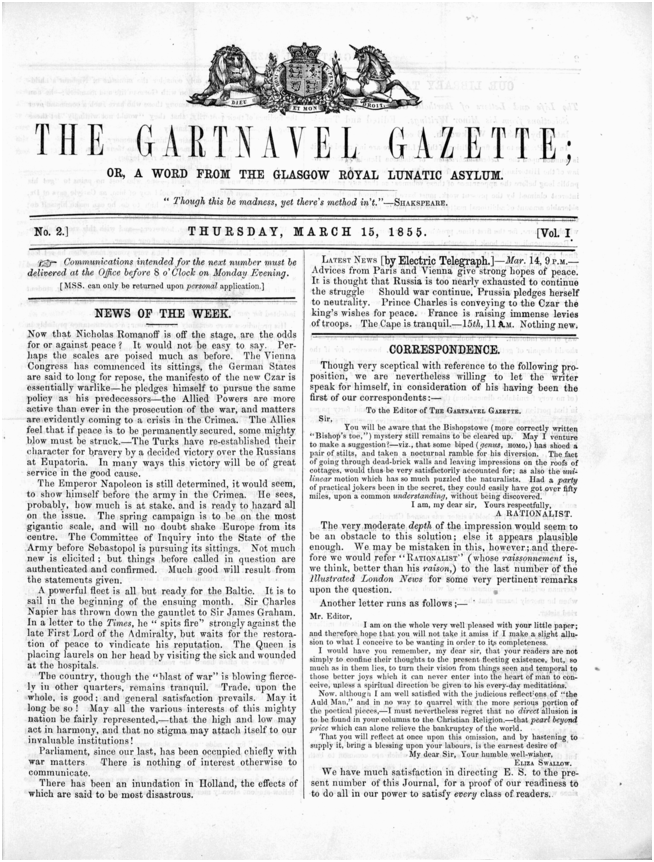
The newspaper was revived under new editorship a year later, on 8 March 1855, though the first issue has not survived (Figure 4.3). The new series was led by George Black, a Dundee-born printer who had previously been associated with the local press there and had spent three months in the Murray Royal Asylum in Perth.78 Under Black, the Gazette had a significantly shorter and more unstable existence, reflecting its editor’s turbulent residence in the institution. Like Buchanan, Black was frustrated with his confinement and used the Gazette to vocalise his discontent. However, his different social status as a printer and a working-class man affected not only his experience as a patient but also as an editor, causing unsustainable strain on the publication.
Second issue of the new series of the Gartnavel Gazette, or a Word from the Glasgow Royal Lunatic Asylum, dated 15 March 1855.
Black had likely been involved in the publication from its early days: within a month of his admission on 24 June 1853, he was busy composing type in the printing office, and his initials appear under poetic contributions from September onwards, occasionally dominating the poetry column.79 The surgeon’s notes from the Gartnavel describe him as: ‘restless and sleepless – talks and sings – good natured – he broke some glass – not suicidal – naturally of a religious turn, sober and well-doing’.80 He was ‘troubled with life usually’ and soon after admission, he was ‘restless[,] confused and incoherent’.81 He repeatedly expressed the wish to leave. Two more notes, from the end of August and the end of September that year, indicate that he remained stable and healthy, ‘rational in conversation’.82 A blank half page follows, interrupted by a note dated 1 February 1854: ‘By order to the Inspector of [the] poor … was this day handed over to his brother in law. Relieved.’83 What occurred during these four months is unclear, but the involvement of the Inspector of the Poor in his release suggests that it took place under external pressure from Black’s family and potentially against the physicians’ complete approval. The silence of the case notes corresponds to the disappearance of Black’s initials from the Gartnavel Gazette.
Black returned to the Gartnavel on 28 March 1854.84 He entered in a similar state of agitation and incoherence but in a few weeks restored his clarity of mind. With that came the realisation that he was confined once again. Wishing to leave, he expressed suspicions that he was ‘kept here so to work in the Printing Office’.85 Black’s fears might not have been unfounded, given the absence of other qualified printers in the institution at the time and a concern of Dr Mackintosh’s that the institution’s ‘great want is compositors and pressmen’.86 Either way, he had all the reasons to feel anxious about getting out. A father of seven children, the youngest of whom was a few months old, he was deprived of opportunities to provide for his family.87 Working in the asylum’s printing office, he spared the institution from outsourcing the task and training other patients to do the job. Throughout this stay of over two years, Black repeatedly expressed the wish to go home and wrote letters to his wife weekly, asking her to take him out, as he was ‘able enough to work for his family’.88 It is unclear whether she received them.
Soon after his readmission, he started working in the printing office once again, and after a year, on 8 March 1855, he and another patient reinstated the Gartnavel Gazette as a weekly.89 It is likely that his work earned him a privileged position in the asylum: from April 1855, his case notes repeatedly refer to his removals to the East House as punishment, indicating that he lived in the West House, despite being a pauper patient. His behaviour fluctuated: from quiet, content, and busy printing medical certificates and forms, he became rebellious, disruptive, and verbally abusive not only to staff but also to his fellow patients. The spells of anger and agitation resulted in him getting repeatedly placed in seclusion. Eventually, he was transferred to the East House permanently, marking the end of his printing career in the Gartnavel and of the second series of the Gartnavel Gazette.90 Between July and November, his medical notes convey a deterioration in his mental health, growing unrest, and tensions with his fellow inmates. The last seven months of his residence are unaccounted for, but the Patients Index indicates that he was discharged ‘relieved’ on 24 June 1856.91 Half a year later, he was in the Dundee Royal Asylum.92 He remained there for about four more years, continuing to write poetry and letters to his wife. Some of that correspondence has survived, suggesting that Black’s home life was ridden with tensions too.93
Black’s circumstance motivated the revival of the Gartnavel Gazette: his medical notes reveal that the first impression of the journal featured the following statement at the end: ‘Price two pence. For the benefit of George Blacks [sic] wife and family’.94 This notice is absent from the surviving copies of the Gazette. There is no evidence that the Gazette was reinstated as a paid publication, or that it reached readers outside the asylum. As the first number is missing, however, it is possible that it alone was sold either internally or externally to support Black’s family.
Apart from this lost call to charity, Black’s situation is not directly discussed in the Gazette, but it inevitably affected the fate of the periodical. While Black is explicitly acknowledged as the printer at the end of each issue, the identity and responsibilities of the other patient co-founder of the periodical remain unknown. It is likely that he was an invisible editor or co-editor, but the 17 May issue of the Gazette contains a statement that denies him any credit:
Having been informed that sundry reports are now current, to the effect that one of the mere contributors to the Gartnavel Gazette has caused it to be made known in public that he – and not other – is the Editor thereof, – thus appropriating to himself all the credit of my office, without a share of its responsibility, – this is to give notice, that I, George Black, Printer of the said Journal, presently residing at Gartnavel, believe such reports to be contrary to truth. Be it known, moreover, that I, George Black, as aforesaid, now am, and from the 8th day of March last have been, both Printer and Editor of the said Gartnavel Gazette [emphases in original].95
Even if the impostor in question was not the collaborator mentioned in the medical notes, Black’s statement is a refusal to acknowledge anyone else’s involvement in running the newspaper. But there must have been another party involved, as the publication carried on even while Black was in seclusion in the East House and when he was not allowed access to the printing office between 22 April and 4 May 1855.96 After the publication of Black’s hostile statement on 17 May, it is reasonable to think that Black took complete charge over the publication.
Evidence of backstage conflicts can also be found in the correspondence columns. Insistence on literary value intensified in the new series, and the editor(s) did not hesitate to express their opinion about both the successful and the unsuccessful submissions, as the following examples show:
T. Miller. – We should like to have gone hand in hand with you over your own ground, enlarging upon its beauties, and at the same time pointing out its defects.
J. J. B.: The ‘Lay’ lacks variety. It is certainly not up to your work.
‘Kilmarnock’. – Should you ever be a prisoner ‘in a strange land,’ you may comfort yourself with the assurance that your enemies will never seek songs from you.
‘Junius Secundus’. – We are not at a loss for selections in the poetical line. Your Prose sketch is quite a morsel to our liking, and will probably appear in our next.97
In addition to demonstrating the role of aesthetics in the selection process that governed periodical publication in asylums, these examples highlight the aspirational nature of asylum periodicals. While the editor had the final say about what would be admitted, he could also offer guidance to contributors to make their writing publishable – not unlike other editors that left room for correspondents’ poetry in their papers. Such feedback was becoming more common in the general press at the time, especially in newspapers and periodicals that targeted the working classes. As Kirstie Blair observes, ‘editors recognized that many of their correspondents had had limited access to education and consequently offered basic suggestions for self-help when they discovered genuine talent in need of cultivation’.98
The correspondents from the asylum, however, were not necessarily working-class readers. In fact, the story of the Gazette’s origins suggests that a significant portion of those who submitted were paying patients, residing in the West House alongside George Black. In fact, a piece of correspondence in the issue for 14 June 1855 voiced a complaint on behalf of the readers from the East House:
Now if you would hae pity upon us east house chaps, and try and transmografy awe they lang nebed wourds into engliesh, or a mixture o english and scotch, the thing would tak a great deal better here, and we would a be better satisfied with it. It does very well for you gentlemen in the west house to read and discuss, and may be you understand it among your cells; but us pare sort a simple sort a pauper sould cana understand it at aw [sic].99
The letter’s self-derogatory tone raises doubts about its authenticity: towards the end, the author calls himself ‘a daft man’.100 It still suggests that the periodical was not accessible to the residents of the East House, and that its primary audience were the more affluent and better educated inhabitants of Gartnavel. This peculiarity of the publication setting invested Black with the power to disrupt social hierarchies, by criticising higher-class patients’ writing. Consequently, the editor often became the target of correspondents’ complaints of extreme selectivity and unfair judgement and was forced to publicly answer angry letters.101 ‘A Little Bit of Secret History’ takes up most of the issue for 12 April, narrating a dispute between the editor and an author about the inclusion of a poem. The article ends with the original poem in full, published ‘“without so much pruning” as we should consider essential to the writer’s reputation.’102 This example illustrates the backstage tensions, arising from the renegotiation of class division in the asylum, and the limits of editorial power, as the editor could be pressured by contributors to publish previously rejected pieces.
The last surviving number, dated 28 June 1855, contains an article in which the editor is haunted by all the rejected pieces, or ‘the Spectres of the Rag-basket [emphasis in original]’.103 Only seemingly making amends, he tries to justify his judgements and consolidate his editorial authority. He quotes and comments on several of the unsuccessful contributions, including ‘[t]hree foolscap pages upon “Love”, – sexual, sensual, and other – [which] are, the state of the thermometer considered, “something too much of this”’.104 Another commentary is about a poem whose author seems to have refused the corrections that the editor suggested: ‘A “Serenade” from the pen of J. J. B. would seems light enough to defy criticism. It contains two faulty stanzas, however, – and we dare not mend them, for J. J. B. is as jealous in these matters as “a Barbary cock-pigeon over his hen.”’105 Adopting the mockingly exasperated editorial tone typical of contemporary correspondence columns, Black tried to settle his disputes with authors unwilling to accept his criticism. He also sought to draw his readers on his side by appealing to their sensibility and literary taste and exposing the lowly character and poor quality of the rejected submissions.106
While a regular newspaper would usually have a larger pool of readers who did not know the editor personally, Black inhabited the same space as his readers and was acquainted with at least some of the rejected contributors. It is possible that some of the criticisms were taken to heart or caused tensions within the asylum community, further fuelled by the class differences between the editor and the aspiring contributors of the West House. As the weeks went by, less and less original writing appeared in the Gartnavel Gazette, and it contained mostly the editor’s own writing (book reviews, news, and responses to correspondents) and reprinted poetry.107 It is likely that Black struggled to fill the pages of the Gazette because the ‘rag basket’ kept filling with what he considered talentless submissions. Considering his deteriorating relations with the rest of the patients, it is also possible that over time the number of contributors decreased.108 While Black’s harsh editorial voice was not unusual by the standards of general periodical culture, it can be seen as an extension of his verbal abuse and bullying of other patients. For instance, his removal to the East House ‘on account of his anoyance [sic] to the gentlemen in the West House’ took place within ten days of the publication of the last surviving issue.109 His intention to turn the criticism of rejected submission into a regular column titled ‘Our Failures’ never materialised.110
Black’s editorial experience was therefore significantly different from that of James Buchanan and ‘Phoenix Redivivus’, distinguishing the two series of the Gartnavel Gazette from each other. While Buchanan treated running and printing the newspaper as a recreational activity to fill his days in the asylum, Black’s lower social status required him to work. His medical notes clearly show that he was anxious to keep providing for his family, including by reviving the Gazette. These class differences could be responsible for the different outcomes for the two patients and the newspaper. Buchanan had access to legal advice, even if its usefulness was questionable in earning him freedom. In Black’s case, the additional financial pressure to get out of the asylum might have aggravated his condition, leading him to further frustration, anger, and violence over time. Finally, Black’s editorial authority was more easily contested by the contributors from the West House of the Gartnavel. Buchanan’s editorial decisions and aesthetic preferences, on the other hand, were reinforced by his gentlemanly status. Although similar to their ‘sane’ counterparts, asylum periodicals were hence shaped by unique tensions, arising from patients’ plea to liberty as well as interpersonal conflicts among inmates. Social class was one of the major factors that defined patients’ experience in nineteenth-century asylums. While subject to renegotiation, depending on the needs of the asylum, editors’ social status could play an important role in the launching and development of the publications and the selection of their contents.

 Open access