


1 Introduction
Various writers have suggested that biases in judgments and decisions may be reduced by concrete and visual presentation of data (e.g., Reference Gigerenzer, Gaissmaier, Kurz-Milcke, Schwartz and WoloshinGigerenzer et al., 2007). In this paper we focus on the attribute-framing bias and examine whether it is moderated by displaying the critical attribute visually in a graph alongside the verbal description. While previous studies have already showed attenuation of the framing bias using visual aids (e.g., Reference Garcia-Retamero and CokelyGarcia-Retamero & Cokely, 2011; Reference Garcia-Retamero and GalesicGarcia-Retamero & Galesic, 2010) the aim of the current research was to explore the factors underlying this attenuation. Based on the literature, we propose that two factors are involved in visual attenuation. The first is the display mode—whether the problem is presented verbally or visually. The second factor is the representation of the critical attribute—whether both the positive and the negative outcomes or only one outcome are represented. Systematic examination of the interaction of these two factors may shed light on the cognitive processes underlying attribute-framing bias. Moreover, it may have practical implications, given that attribute framings influence important judgments and decisions in health, financial decisions, consumer behavior, and many other domains (see review in Reference Levin, Schneider and GaethLevin et al., 1998).
1.1 Framing effects
Research on framing effects took off after Reference Tversky and KahnemanTversky and Kahneman (1981) introduced the systematic reversals of preferences that people exhibit in alternate framings of problems, contingencies or outcomes. Following Reference Tversky and KahnemanTversky and Kahneman (1981), many studies examined the valence framing effect in various contexts, demonstrating that the mere presentation of the same glass as half full or half empty affects judgment and decision making (Reference FrischFrisch, 1993; Reference Keren and KerenKeren, 2010).
Reviewing the abundant research on framing effects, Reference Levin, Schneider and GaethLevin et al. (1998) discerned three types of framing: risky choice framing, goal framing, and attribute framing. Reference Tversky and KahnemanTversky and Kahneman’s (1981) famous “Asian disease” is the most well-known typical example of the first type, risky choice framing. They demonstrated that people show reversed preferences between two options when these were presented in either a positive (“lives saved”) or negative (“lives lost”) frame. The second type, goal framing, relates to the persuasive power of presenting the same message in either gain terms when performing an action or loss terms when not performing it. A typical context of goal framing is health related behavior, in which both society and each individual would benefit if a particular health promoting or disease preventing behavior is adopted. Reference Rothman and SaloveyRothman and Salovey (1997) proposed that the perceived risk of the health behavior moderates the effectiveness of the message frame: for relatively safe behaviors (e.g., prevention behavior) positive framing is more effective, while for risky behaviors (e.g., detection of an illness) negative framing is more effective. Although this moderating effect was reported upon in the literature, recent meta-analysis has raised some doubt about its empirical veracity (Reference Gallagher and UpdegraffGallagher & Updergraff, 2012).
In this paper we focus on the third type, attribute framing. Specifically, we examine the situation in which one can refer to an object or event by presenting either the positive aspect of a central attribute (e.g., the success rate in an academic course) or the complementary negative aspect of the same attribute (e.g., the failure rate in the same course). Such framing was shown to result in a bias in evaluation. For example, Reference Levin and GaethLevin and Gaeth (1988) showed that people evaluated the quality of ground beef as better when it was labeled as “75% lean” (positive framing) relative to “25% fat” (negative framing). Attribute framing typically shows a robust effect with an advantage for the positive versus negative framing when evaluating events or objects. Reference Levin, Schneider and GaethLevin et al. (1998) reviewed dozens of studies and concluded that, in most of them, positive framing resulted in more favorable evaluations of objects or events relative to negative framing. In a meta-analysis of 30 studies, Reference Piñon and GambaraPinon and Gambara (2005) reported an average attribute framing effect size of 0.26, but they suspected that this relatively small effect size reflected an underestimate due to the statistical methods used for the meta-analysis.
Reference Levin, Schneider and GaethLevin et al. (1998) proposed a theoretical explanation for the cognitive mechanism through which attribute framing affects people’s judgments and evaluations. They suggested that presenting an object or an event in positive or negative framing affects information processing in a way similar to priming. Positive or negative framing activates corresponding favorable or unfavorable associations that bias people’s judgments and evaluations (Reference Levin, Schneider and GaethLevin et al., 1998). This theoretical explanation attributed the framing bias to information encoding and processing and was not restricted to verbal presentation. Although most studies examined verbal attribute framing, we argue that examining the effect of visual display mode on attribute-framing bias might help understand the cognitive processes underlying framing bias.
1.2 Visual framing versus verbal framing
In discussing people’s errors in the evaluation of quantitative data, Reference Gigerenzer, Gaissmaier, Kurz-Milcke, Schwartz and WoloshinGigerenzer et al. (2007) argued that one reason for errors and biased evaluations may be that the presentation of numerical data is too difficult and that presenting data visually might offer a more concrete representation that would be easier to process and thereby attenuate biases relative to verbal presentation of numerical data.
Several studies examined the possible effect of visual and graphical presentation on framing bias. For example, Reference Sun, Li, Bonini and SuSun et al. (2012) altered the spatial characteristics of a graphical display presenting two attributes of MP3 products, namely reliability and capability: Product A had superior reliability while product B had superior capability. The products were presented visually in a figure where the X axis represented capability and the Y axis represented reliability. The relative length of the axes was manipulated such that in one figure the axis representing capability was longer than that representing reliability, and in the other this was reversed. Participants gave higher evaluations to the product (either A or B) when its superior aspect was represented by the longer axis. Thus, the authors concluded that the aspect that presents the differences in a more salient fashion had a stronger effect on participants’ evaluations (Reference Sun, Li, Bonini and SuSun et al., 2012) and suggested that evaluations are affected by the spatial characteristic of the visual display. Sun et al. examined framing problems in the broader or loose definition of framing. They did not examine the effect of visual display on valence framing.
More relevant to the current paper are papers that showed that visual aids facilitated the processing of statistical information (e.g., Reference Kurz-Milcke, Gigerenzer and MartignonKurz-Milcke et al., 2008) in the context of applied psychology. For example, recent studies examined the efficacy of visual aids in preventing framing biases related to goal framing (Reference Garcia-Retamero and CokelyGarcia-Retamero & Cokely, 2011) and attribute framing (Reference Garcia-Retamero and GalesicGarcia-Retamero & Galesic, 2010) in the context of health information. In these studies participants were presented with a verbal message framed either in a positive or negative manner accompanied by an identical visual display. These findings clearly indicate that visual presentation of the statistical information can reduce the framing bias. These studies, however, did not explore what factors in the visual display contribute to the attenuation of the framing bias. Possibly, the visual attenuation may be due to the fact that an identical graph was presented in both positive and negative framing conditions. Thus, while the Reference Garcia-Retamero and GalesicGarcia-Retamero and Galesic (2010) study manipulated framing by presenting either the positive or the negative outcome in the verbal description, it did not manipulate framing in the visual display because both positive and negative outcomes were equally represented in the graphs. The current research aims to extend the investigation about the factors affecting the attenuation of framing bias by systematically manipulating two factors: display mode—whether the problem is presented verbally or visually—and the representation of the critical attribute—whether both the positive and the negative outcomes or only one outcome are represented.
1.3 Review of the experiments
In a series of three experiments, we systematically manipulated two factors, namely display mode and representation of the critical attribute, in order to examine their interactive contribution to the attenuation of the attribute framing bias. In Experiment 1 we represented only one outcome of the critical attribute, either the positive or the negative, and examined whether and to what extent adding a visual display of a particular outcome attenuates framing bias compared to verbal description without visual aids. Experiments 2 and 3 examined to what extent the representation of the critical attribute—whether both the positive and the negative outcomes or only one outcome are represented—affects attenuation of the framing bias. Experiment 2 focused on verbal descriptions and examined to what extent the mixed representation of both the positive and the negative outcomes attenuates framing bias compared to a single-outcome representation. Experiment 3 focused on visual display to similarly examine to what extent visual display of mixed versus single representation of the outcomes attenuate framing bias compared to a single outcome visual display.
2 Experiment 1
The aim of Experiment 1 was to examine whether and to what extent visual display attenuates framing bias when different visual displays are used to represent the positive and negative outcomes. Whereas Reference Garcia-Retamero and GalesicGarcia-Retamero and Galesic (2010) presented the same graphs for the negative and positive framing conditions, in this experiment we used different graphs to present the positive and negative numerical information (see Table 1). If visual aids generally attenuate the verbal framing bias, we would expect to replicate the attenuating effect found by Reference Garcia-Retamero and GalesicGarcia-Retamero and Galesic (2010). If, however, the attenuation of the framing bias actually results from the presentation of identical graphs for both the positive and negative framing conditions, we would expect only marginal attenuation of the framing bias, if any.

2.1 Method
2.1.1 Participants
Participants were 141 undergraduate students in an undergraduate program in an Israeli higher education institution (85% female; mean age 23.5 with a standard deviation of 1.8) who participated in the study in partial fulfillment of their course requirement.
2.1.2 Design and Procedure
Experiment 1 comprised a between-participants 2×2 factorial design that manipulated the display mode (verbal versus visual) and the framing (positive versus negative). There were 35–36 participants in each experimental condition.
Participants were informed that the study examined people’s behavior in various situations, and that the results of the questionnaire were anonymous and would be used for research purposes only. Thereafter, they were presented with several questions. The first question related to the present study, and the others related to a different study. In the target question all participants were asked to imagine that a young acquaintance of theirs is asking them about a driving instructor. Participants were provided with information about the success rate (in the positive framing condition) or failure rate (in the negative framing condition) of this driving instructor’s previous students. The success or failure rates were presented differently in the verbal and visual display modes (see Table 1). In the Verbal Display mode, the positive framing related to the driving instructor’s students’ 85% success rate while the negative framing related to his students’ 15% failure rate (see Table 1). In the Visual Display mode, the text related to the instructor’s success rate (in the positive framing condition) or failure rate (in the negative framing condition), and participants were referred to the pie-chart (see Table 1). In the charts the red areas created the visual framing such that in the positive framing the more salient red area represented the 85% passing rate of the students of this instructor and in the negative framing the more salient red area represented the 15% failing rate. The complementary failure or success rates were outlined by faded contours, giving them a transparent look. The salient colored area in each condition was placed at the top right side of the figure to comply with visual scanning patterns of Hebrew readers (e.g., Reference AbedAbed, 1991; Reference Nachshon, Shefler and SamochaNachshon et al., 1977). Finally, all participants were asked the same question regarding their recommendation intentions: Would you recommend this driving instructor to your acquaintance? The answers were given on a 7-point scale, ranging from 1 (I definitely won’t), to 2 (I won’t), 3 (I probably won’t), 4 (maybe I will and maybe I won’t), 5 (I probably will), 6 (I will), and 7 (I definitely will).
2.2 Results and discussion
Figure 1 presents the means of participants’ ratings of their intentions to recommend the driving instructor (recommendation intentions) as a function of the display mode and framing. In both the verbal and visual display modes, participants exhibit higher recommendation intentions in the positive (vs. negative) framing conditions. The size of the attribute framing effect was relatively large and statistically significant for both the verbal display mode (Cohen’s d = 1.08; t(69) = 4.57, p = .00), and the visual display mode (d =0.94; t(68) = 3.93, p = .00).
The means of recommendation intentions as a function of the display mode and framing (error bars represent 1 standard error).
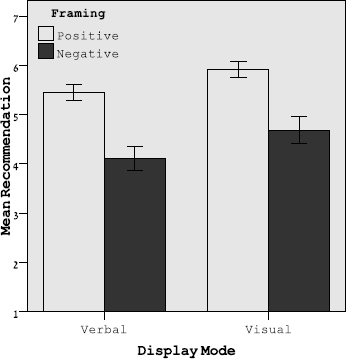
A two-way ANOVA predicting the recommendation intentions from the display mode and the framing revealed an insignificant interaction (F(1, 137) = 0.08, p = .79); the attribute framing effect was significant (F(1, 137) = 36.0, p = .00), indicating that the recommendation intentions were higher in the positive relative to the negative framing, for both verbal and visual conditions. Finally, the effect of the display mode was also significant (F(1, 137) = 5.78, p = .02), indicating that the recommendation intentions were higher in the visual relative to the verbal display mode (d = 0.37).
The main result of Experiment 1 was that visual presentation of the numerical information about success and failure rates in a pie-chart did not attenuate attribute framing bias. While Reference Garcia-Retamero and GalesicGarcia-Retamero and Galesic (2010) found attenuation of the framing effect using identical visual display for the positive and negative framing, our finding shows that, when different visual displays are used, the framing bias is barely attenuated. This result suggests that visual presentation of the numerical information cannot by itself attenuate the framing bias. In fact, it might be possible to create a visual presentation that would highlight only one of the two outcomes and elicit a framing bias similar to the conventional verbal framing bias.
3 Experiment 2
In order to disentangle the effects of the display mode and the attribute representation, in Experiment 2 we focused on verbal presentation. Most previous studies of framing bias represented only a single-outcome of the critical attribute, while very few studies used a mixed representation (Reference Bigman, Cappella and HornikBigman et al., 2010; and see Reference O’Connor, Boyd, Tritchler, Kriukov, Sutherland and TillO’Connor et al., 1985, and Reference O’ConnorO’Connor, 1989 for mixed effects in risky choice framing). Of particular interest for the current research is Reference Bigman, Cappella and HornikBigman et al.’s (2010) study examining attribute framing. In this study participants were asked to evaluate an HPV vaccine and rate their intentions to recommend it to their acquaintances. The vaccine was described as effective against HPV strains that cause 70% of cervical cancers (positive framing) or as ineffective against HPV strains that cause 30% of cervical cancers (negative framing). The experiment included four framing conditions: positive, negative or mixed representation with either the positive preceding the negative or vice versa. For the perceived effectiveness, the results revealed a framing bias, but this bias was significant only between the positive and negative conditions and not in the mixed conditions. For the recommendation intentions only small and insignificant framing bias was revealed between the positive and negative conditions. Thus, this study did not resolve the question of whether the mixed representation of the critical attribute attenuates the framing bias.
3.1 Method
3.1.1 Participants and procedure
There were 155 participants in this study, with mean age of 29.2 (SD = 12.1); 40% were males. Participants were sampled in a train station in the Sharon area of Israel, and were given a small candy bar after filling in the short questionnaire. Participants were approached individually and asked to fill in the short self-administrated pen-and-paper questionnaire. The experimenters reported a high rate of cooperation among the passengers.
3.1.2 Design and materials
The vignette presented to the participants was similar to the one used in Experiment 1. The design was 2 framing conditions (positive versus negative) X 2 critical attribute representation (single-outcome versus mixed-outcome). The single-outcome condition replicated the conventional verbal presentation of either positive or negative information in a manner that was identical to the verbal display mode of Experiment 1. In the mixed condition, both positive and negative verbal information was presented and framing manipulated their order of appearance—in the positive framing condition the positive outcome was presented first and the negative second, and in the negative framing condition the order was reversed. Table 2 presents the text for each of the four experimental groups, in which there were between 37 and 42 participants. The recommendation question was identical to one described in Experiment 1. We hypothesized that in the mixed condition attribute framing bias would be attenuated relative to the conventional single-outcome condition.

3.2 Results and discussion
Figure 2 presents the means of participants’ recommendation intentions as a function of attribute representation and framing. In the single-outcome and mixed conditions participants exhibit higher recommendation intentions in the positive versus negative framing conditions. The attribute framing effect sizes were medium and statistically significant for both the single-outcome (Cohen’s d = 0.62; t(77) = 2.76, p = .01), and the mixed (d =0.52; t(74) = 2.25, p = .03) conditions.
The means of recommendation intentions as a function of the framing and the verbal attribute representation (error bars represent 1 standard error).

A two-way ANOVA predicting the recommendation intentions from attribute representation and framing revealed a non-significant interaction (F(1, 151) = 0.59, p = .44); the attribute framing effect was significant (F(1, 151) = 12.5, p = .00), indicating that the recommendation intentions were higher in the positive relative to the negative framing, for both the single-outcome and the mixed conditions. Finally, the effect of attribute representation was not significant (F(1, 151) = 0.84, p = .36), indicating that the recommendation intentions were similar in the single-outcome relative to the mixed conditions (d = 0.12).
The main finding of Experiment 2 was that verbal presentation of both the success and failure rates did not substantially attenuate attribute framing bias. The results show comparable framing effect sizes for the single-outcome condition and for the mixed condition. Consequently, it seems that, when both positive and negative outcomes are represented, a framing bias can be generated merely by reversing the order of their appearance.
4 Experiment 3
Experiment 3 used the same experimental design as in Experiment 2, but this time we manipulated visual presentation using two factors: framing (positive versus negative) and attribute representation (single-outcome versus mixed; see Table 3). In the single-outcome condition, we used the same visual display as in Experiment 1, highlighting either the positive or negative outcome. In the mixed condition, we presented both negative and positive outcomes using different colors with similar saliency. Note, however, that in all four conditions the verbal description accompanying the visual representation included both positive and negative framing outcomes, ordered in a manner reflecting the framing manipulation (as in the mixed condition of Experiment 2).
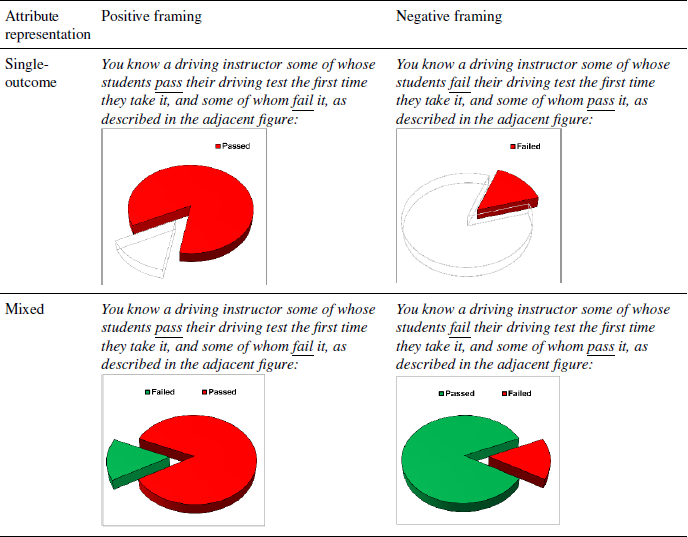
Experiments 1 and 2 found minor attenuation of the framing bias caused by a visual display (Experiment 1) and by using mixed attribute representation (Experiment 2). Hence, we predicted small attenuation of the framing bias in the single-outcome visual presentation that combines visual representation of a single outcome with verbal mixed attribute representation (see top panels in Table 3). In contrast, in view of the attenuation shown in the findings of Reference Garcia-Retamero and GalesicGarcia-Retamero and Galesic (2010), we predicted that, in the mixed visual presentation, where both outcomes are graphically balanced, framing bias would be attenuated (bottom panels in Table 3). Moreover, given that in Reference Garcia-Retamero and GalesicGarcia-Retamero and Galesic (2010) the verbal description represented only one outcome, whereas here the verbal description in the mixed visual presentation included both outcomes, we may expect a larger attenuation or even total elimination of framing bias.
4.1 Method
4.1.1 Participants and procedure
There were 149 participants in this study, with mean age of 28.9 (SD = 11.5); 39% were males. The sampling and the procedure were similar to the ones reported for Experiment 2.
4.1.2 Design and materials
The vignette presented to the participants was similar to the one used in Experiment 2. The design was similar to that of Experiment 2 but here we substituted the numerical presentation of the information by figural presentation: 2 framing conditions (positive versus negative) X 2 attribute representation conditions (single-outcome versus mixed). Table 3 presents the stimuli used in the four conditions that had between 36 and 38 participants. In both attribute representation conditions, the text introduced both positive and negative framing of success and failure, while manipulating their order of presentation according to the framing condition—in the positive framing condition the positive outcome was presented first and the negative second, and in the negative framing condition the order was reversed. The visual figure used in the different conditions distinguished between the single-outcome and mixed-outcome representations: For the single-outcome condition, either the positive (the teacher’s 85% passing rate) or negative (the teacher’s 15% failing rate) outcome of the critical attribute was presented in red while the complementary failure or success rates were outlined by faded contours, giving them a transparent look (replicating the visual manipulation of framing in Experiment 1). In the mixed condition, the pie-charts presented either the positive or negative outcome of the critical attribute in red on the right side while the complementary outcome was presented in green on the left side of the figure. As Table 3 demonstrates, the use of such different visual displays allowed us to create visual representations that corresponded to the four conditions of single-outcome versus mixed representation, and positive versus negative framing. The recommendation question was identical to the one described in Experiments 1 and 2.
4.2 Results and discussion
Figure 3 presents the means of participants’ recommendation intentions as a function of the attribute representation and framing. The attribute framing effect sizes were small and not statistically significant for both the single-outcome (Cohen’s d = 0.36; t(73) = 1.56, p = .12), and the mixed (d =-0.25; t(72) = −1.07, p = .29) conditions. The means show that positive framing slightly enhanced participants’ recommendation intentions relative to negative framing in the single-outcome condition, while the mixed condition showed the opposite effect.
The means of recommendation intentions as a function of framing and the visual attribute representation (errors bar represent 1 standard error).
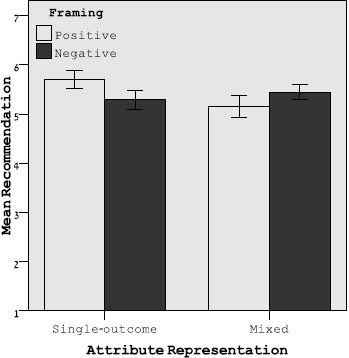
A two-way ANOVA predicting the recommendation intentions from attribute representation and framing revealed an interaction effect that approached significance (F(1, 145) = 3.45, p = .065). Neither the attribute framing effect (F(1, 145) = 0.11, p = .74) nor the effect of attribute representation (F(1, 145) = 1.07, p = .30) was significant. These results suggest that, when mixed verbal representation was accompanied by visual presentation, the framing bias was too small to be statistically significant.
5 General discussion
Is a picture worth a thousand words? The findings of this research join previous findings in suggesting the answer is—not always; rather it depends on the words and the picture used. Whereas some visual aids may attenuate or even eliminate the framing bias, some may elicit a bias similar to the conventional verbal framing bias.
In this series of experiments we manipulated both the verbal and visual presentation of the critical attribute in order to examine their relative contribution to the attenuation of the attribute framing bias. Only negligible attenuation was observed when verbal description of a single outcome was accompanied by a corresponding single outcome graphical presentation (Experiment 1). Similarly, negligible attenuation was obtained when no visual aids were used and the verbal description included both the positive and negative outcomes of the critical attribute (Experiment 2). Attenuation was obtained when mixed presentation in the verbal description was accompanied by single outcome graphical presentation, and attribute framing was totally eliminated when mixed presentation was used both in the verbal description and in the graphical display. These results demonstrate that two factors affect framing bias: Supplementing the verbal description with a visual aid, and representing the critical attribute by one or two outcomes.
With respect to the first factor, previous studies indicated that visual aids presenting the numerical information attenuated framing bias (Reference Garcia-Retamero and CokelyGarcia-Retamero & Cokely, 2011; Reference Garcia-Retamero and GalesicGarcia-Retamero & Galesic, 2010; Reference Sun, Li, Bonini and SuSun et al., 2012). A possible theoretical explanation for this attenuation was that visual display of numerical information may reduce biases in judgment and decision making because visual presentations are more concrete, and therefore, easier to understand (Reference Gigerenzer, Gaissmaier, Kurz-Milcke, Schwartz and WoloshinGigerenzer et al., 2007). Indeed, Reference Garcia-Retamero and GalesicGarcia-Retamero and Galesic (2010) showed that visual aids are more effective in attenuating framing bias for people with low numeracy. It seems, however, that visual aids do not always attenuate the framing bias to the same extent. Reference Garcia-Retamero and GalesicGarcia-Retamero and Galesic (2010) used different types of graphical presentation such as icon array, horizontal bar graphs, vertical bar graphs and pie charts (see Figure 1 in Reference Garcia-Retamero and GalesicGarcia-Retamero & Galesic, 2010) and found that the different graphical presentations attenuated attribute framing bias to varying degrees. The current findings further suggest that the visual representation of one versus two outcomes affects the attenuation of framing bias. Using conventional single-outcome verbal framing, we found in Experiment 1 only marginal attenuation whereas Reference Garcia-Retamero and GalesicGarcia-Retamero and Galesic (2010) found significant attenuation. These different results can be attributed to the differences in the visual aids used. Whereas we used a single-outcome graphical presentation that represented either the positive or negative outcome of the critical attribute, Reference Garcia-Retamero and GalesicGarcia-Retamero and Galesic (2010) used an identical graphical presentation for the positive and negative framing conditions.
An additional factor that could attenuate framing bias is attribute representation: does the verbal description represent the positive, the negative or both outcomes? Previous studies of framing bias typically represented only a single outcome of the critical attribute. The few studies that used a mixed representation did not find conclusive results. One of the few studies that examined mixed representations in the context of attribute framing was the study of Reference Bigman, Cappella and HornikBigman et al. (2010). Since they did not find the conventional framing bias with regard to recommendation intentions, it is not possible to draw conclusions about the effect of mixed representation on the attenuation of the framing bias and to compare these findings to ours. Further research is needed to clarify whether mixed presentation of the positive and negative outcomes attenuates framing bias and to what extent. Our results suggest that merely presenting one frame before the other is sufficient to cause considerable framing bias, consistent with a theoretical explanation of the primacy effect. If future research replicates our results, the use of a mixed representation in verbal description in order to prevent framing bias might be questionable.
Previous studies examined either the effect of visual aids or the effect of verbal mixed representation on framing bias. Critically, our research manipulated both factors and the results indicate that the effect of visual aids interacts with attribute representation (single-outcome versus mixed). We succeeded in eliminating attribute framing bias only when both verbal and visual presentations represented both outcomes of the critical attribute. This interaction could be explained by Reference Levin, Schneider and GaethLevin et al.’s (1998) Association Theory. According to Reference Levin, Schneider and GaethLevin et al. (1998), the positive and negative framing would evoke positive and negative associations respectively. Representing only one outcome of the critical attribute either verbally or visually evokes highly polarized associations in the different framing conditions. In contrast, representing both the positive and negative outcomes evokes less polarized associations. Our results suggest that when both the verbal and the visual presentations include a mixed representation of the critical attribute, the polarization is eliminated.
The findings of this research have important practical implications. Unlike previous studies, we demonstrated that visual aids might not always attenuate framing bias, but rather the attenuation depends on whether a single or mixed attribute representation is used. There are contexts in which one would wish to refrain from affecting people’s judgment and decision making for ethical or other considerations. For example, medical authorities need to supply patients and their families with information about the success and failure rates of medical intervention in order to enable them reach an informed decision. The framing literature repeatedly demonstrated the possible effect of presenting either the success or failure rates on people’s judgment and decision making. This research showed that using verbal descriptions of both success and failure in either order, accompanied by graphical display of the two possible results, can prevent attribute framing bias. It is interesting to note that previous studies that used various types of identical graphical presentation for the positive and negative framing succeeded in reducing attribute framing bias, but did not eliminate it altogether (Reference Garcia-Retamero and GalesicGarcia-Retamero & Galesic, 2010), possibly because they used verbal description of a single outcome. Our findings suggest that total elimination of attribute framing bias requires verbal mixed representation of both positive and negative outcomes along with graphical display representing the two complementary outcomes.
Future studies could further explore the possible attenuating effects of single-outcome versus mixed presentation of both verbal and visual display modes using different graphical display of the data. In this research we used pie-charts, which to some extent imply the complementary outcome of the critical attribute even when it is outlined by faded contours. Future research could examine whether the use of other graphical displays that convey the complementary outcome to a lesser extent (e.g., bar charts) or to a higher extent (e.g., pie charts presenting the complementary outcome in a manner that is in-between the two modes used in this research—faded and green contours) would influence framing effect size. We predict that the former presentation would increase framing effect sizes while the latter would attenuate them relative to the display used in this research (e.g., in Experiment 1).
Additional future studies are needed in order to examine possible moderation of visual display on other types of framing effects such as goal framing and message framing. On a broader scale, the knowledge that would be gained from the attenuating effect of visual aids on framing bias could be further generalized to other contexts of biases in judgment and decision making.


 Open access

