


How is populism related to party organization? Populism is a central topic in the media as well as academic and policy communities (e.g., Akkerman et al., Reference Akkerman, Zaslove and Spruyt2017; Hawkins & Kaltwasser, Reference Hawkins, Kaltwasser, Hawkins, Carlin, Littvay and Kaltwasser2018; Mudde, Reference Mudde2004; Mudde & Kaltwasser, Reference Mudde, Kaltwasser, Mudde and Kaltwasser2012; Rooduijn, Reference Rooduijn2019; Wuttke et al., Reference Wuttke, Schimpf and Schoen2020). Whether it is the Dutch Party for Freedom, the French National Rally, or the Freedom Party of Austria, populist parties gain a disproportionate amount of media coverage (Bos et al., Reference Bos, Van der Brug and De Vreese2010) and they significantly influence political discourse at home and abroad (Jagers & Walgrave, Reference Jagers and Walgrave2007; Koopmans & Muis, Reference Koopmans and Muis2009; Meret & Siim, Reference Meret, Siim, Siim and Mokre2013; Rydgren, Reference Rydgren2005). The scholarly literature has considered multiple definitions of populism (see Mudde, Reference Mudde2004; Rueda, Reference Rueda2021; Weyland, Reference Weyland2021). Some studies focus on the role of ideology (an ideational perspective), which often highlights people‐centric and anti‐elite aspects of populism. Others emphasize organizational form (leadership perspective), and populism as a strategy for opportunistic leaders to consolidate their power (e.g., Weyland, Reference Weyland2021). Hence, theorists have proposed various understandings of populism, which can lead to a range of expectations regarding the internal structure of populist parties. Specifically, depending on the perspective on populism, as an ideology or as an organization (Rueda, Reference Rueda2021; Weyland, Reference Weyland2021; see also Kenny, Reference Kenny2019), expectations will vary about whether party structures will be democratic. Our results suggest that populist party organizations are relatively undemocratic.
Internally democratic parties feature large ‘selectorates’ in leadership elections (e.g., Bischof & Wagner, Reference Bischof and Wagner2017; Ignazi, Reference Ignazi2020; Lehrer, Reference Lehrer2012; Schumacher et al., Reference Schumacher, De Vries and Vis2013; for overviews, see Borz & Janda, Reference Borz and Janda2020; Poguntke et al., Reference Poguntke, Scarrow, Webb, Allern, Aylott, Biezen, Calossi, Lobo, Cross, Deschouwer, Enyedi, Fabre, Farrell, Gauja, Pizzimenti, Kopecký, Koole, Müller, Kosiara‐Pedersen and Verge2016) and broad participation of members in policy decisions (Schumacher & Giger, Reference Schumacher and Giger2017; also von dem Berge et al., Reference Von dem Berge, Poguntke, Obert and Tipei2013). For example, parties may grant their members the right to elect the party leader, to choose candidates for general elections, or to hold referenda on coalition agreements. Defining features of intra‐party democracy are decentralized and inclusive decision making (Ware, Reference Ware1996), which enable the rank‐and‐file membership to hold the leadership accountable because they can block their way to office. As defined in Poguntke et al. (Reference Poguntke, Scarrow, Webb, Allern, Aylott, Biezen, Calossi, Lobo, Cross, Deschouwer, Enyedi, Fabre, Farrell, Gauja, Pizzimenti, Kopecký, Koole, Müller, Kosiara‐Pedersen and Verge2016, p. 670; see also Scarrow, Reference Scarrow2015), intra‐party democracy ‘maximizes the involvement of party members in the decisions that are central to a party's political life, including program writing, and personnel selection and other intraorganizational decision‐making’. Intra‐democratic parties thus ‘are founded on principles of participation, competition, representation, responsiveness and transparency’ (Rahat & Shapira, Reference Rahat and Shapira2017, p. 88). What matters primarily is whether party members can influence decision making, internal debate is possible (and the party leadership does not rule this out) and procedures are inclusive of various factions and organizational layers within a party (Meijers & Zaslove, Reference Meijers and Zaslove2021; Rahat & Shapira, Reference Rahat and Shapira2017; Scarrow, Reference Scarrow2015). This implies that personalized leadership is less strongly pronounced in more internally democratic parties.
According to the ideational perspective, populism is defined as ‘a thin‐centered ideology that considers society to be ultimately separated into two homogeneous and antagonistic groups, the people and the corrupt elite, and which argues that politics should be an expression of the volonté générale (general will) of the people’ (Mudde, Reference Mudde2004, p. 543). In this context, populists see the general will as homogeneous and singular, and the people should make significant political decisions – not elites (Hawkins & Kaltwasser, Reference Hawkins, Kaltwasser, Hawkins, Carlin, Littvay and Kaltwasser2018; see also Huber & Schimpf, Reference Huber and Schimpf2016). Populists often argue, however, that representative democracy does not meet their ideological expectations of expressing the will of the people (Mény & Surel, Reference Mény, Surel, Mény and Surel2002), which leads them to demand that the people ‘be given their voices back and that people should therefore have more influence on the political decision‐making process’ (Rooduijn, Reference Rooduijn2014, p. 576; see also Rooduijn & Akkerman, Reference Rooduijn and Akkerman2017, p. 194). In the ideational perspective, populism is characterized by anti‐elitism, people‐centrism, and a discourse emphasizing a moral struggle between ‘good people’ and ‘the elite’. Watts and Bale (Reference Watts and Bale2019) demonstrate what the concept of ideational populism means for party organization: rank‐and‐file party members are ‘the people’ and party leaders are ‘the elite’. Applying populism as an ideational approach may thus lead to the expectation that populist parties should be internally more democratic.
The leadership perspective distinguishes more strongly between populism as an ideology and how it might apply to party organization (see Hawkins & Kaltwasser, Reference Hawkins and Kaltwasser2017). Weyland (Reference Weyland2021) or Kenny (Reference Kenny2019) contend that populism is more a form of organization or strategy, and is defined in part by personalist leadership that hardly proposes that party organizations will be democratic. According to Weyland (Reference Weyland2001, p. 14), ‘populism is best defined as a political strategy through which a personalistic leader seeks or exercises government power based on direct, unmediated, uninstitutionalized support from large numbers of mostly unorganized followers’. When populism as an organizational form is seen from this lens, it is explicitly not democratic (e.g., Finchelstein & Urbinati, Reference Finchelstein and Urbinati2018; Mueller, Reference Mueller2019; Pappas, Reference Pappas2016; Urbinati, Reference Urbinati, Kaltwasser, Taggart, Espejo and Ostiguy2017, Reference Urbinati2019a, Reference Urbinati2019b). To this end, Pappas (Reference Pappas2016), for example, calls populism ‘illiberal democracy’. This latter set of arguments emphasize that populist parties should not be internally democratic, even if it is defined according to its ideational features.
In sum, the literature on how to define populism can lead to different expectations about whether the characteristics of it as an ideational concept translate directly into populism as a form of organization. When populist ideology is applied to party organization, populism should be internally democratic with rank‐and‐file members involved in major party decisions. Put differently, ideational populism implies intra‐party democracy. This view is consistent with previous studies by Roberts (Reference Roberts1995; Reference Roberts2006) and Jansen (Reference Jansen2011) who suggest that populism is jointly defined by ideology and organization in that the characteristics across both forms are similar. That said, the leadership perspective stresses that populist organizations are unlikely to be ‘democratic’ in the liberal sense, even if they might be plebiscitary.
We leverage these persistent disagreements by empirically testing how populism and party organization are related to each other. We expand the scope of several qualitative studies of party organization and populism (e.g., Heinisch & Mazzoleni, Reference Heinisch and Mazzoleni2016; Kenny, Reference Kenny2019; Weyland, Reference Weyland2001) as we analyze more than 200 parties across 26 countries. The empirical findings provide strong evidence that populist parties are generally undemocratic. This mirrors the perspective in the literature positing that crucial differences exist between populism as an ideational form and populism as a form of organization. We conclude this article by arguing that the pull of personalized leadership outweighs the role of ideology in explaining the intra‐party organization of populist parties.
Design
The main data source for our empirical evaluation of the relationship between populism and intra‐party democracy is the Populism and Political Parties Expert Survey (POPPA; Meijers & Zaslove, Reference Meijers and Zaslove2021). This dataset has information on more than 200 political parties in 28 European countries that were represented in parliament in 2017/2018, and thus a wide geographical coverage is one of the data's advantages. However, datasets like the POPPA project that rely on expert codings, where country specialists provide summary assessments, raise a few considerations. For example, it may be challenging to capture a rather abstract concept such as populism or intra‐party democracy with accuracy using expert judgements. Also, such coding approaches often lead to little within country variation over time (see Clinton & Lewis, Reference Clinton and Lewis2008).
The POPPA data are cross‐sectional and observations do not vary over time. While this may seem initially a concern, since longitudinal data would inform us how parties’ populism scores change over time, note that the intra‐party democracy variable (the dependent variable) hardly varies over time (see Schumacher & Giger, Reference Schumacher and Giger2017; but see Scarrow et al., Reference Scarrow, Webb and Poguntke2017). Consequently, cross‐sectional data are sufficient for our purposes. As we rely on the POPPA dataset, the unit of observation in our analysis is the political party in 2017/2018. The data are hierarchical with some parties nested in the same country. To account for dependencies stemming from this multilevel structure of the data, we employ random‐intercept models with country‐level and party‐family intercepts to control for unobserved heterogeneity at these respective levels.
Our dependent variable pertains to parties’ organizations – and, precisely, their degree of intra‐party democracy. The POPPA data comprise a relevant item here, which is framed as: ‘some political parties practice more intra‐party democracy than others, i.e., party members play a role in decision‐making, there is room for internal debate, decision‐making is inclusive of various factions and organizational layers within the party’ (Meijers & Zaslove, Reference Meijers and Zaslove2021, p. 384). Experts could rate parties on a scale from 0 to 10, with 10 standing for a very high level of intra‐party democracy (0 stands for no intra‐party democracy at all). This operationalization of intra‐party democracy mirrors the studies cited above that we rely on for its conceptual definition (e.g., Poguntke et al., Reference Poguntke, Scarrow, Webb, Allern, Aylott, Biezen, Calossi, Lobo, Cross, Deschouwer, Enyedi, Fabre, Farrell, Gauja, Pizzimenti, Kopecký, Koole, Müller, Kosiara‐Pedersen and Verge2016; Rahat & Shapira, Reference Rahat and Shapira2017; Scarrow, Reference Scarrow2015). To the extent that there is error in the measurement of our dependent variable, the estimated standard errors tend to be increased, thus lowering the chances to find statistically significant results (although this would not lead to bias in the coefficients). After accounting for missing values of our dependent variable, 229 parties are included in the dataset and the intra‐party democracy variable has a mean value of 4.83 (standard deviation of 1.93).Footnote 1
The main explanatory variable, Populism Score, captures the degree of populism for each political party in the data as taken from POPPA. It is based on factor regression scores of five dimensions of populism and ranges between 0 (a party is not at all populist) and 10 (a party is very populist). This populism variable of Meijers and Zaslove (Reference Meijers and Zaslove2021, p. 383) is a weighted arithmetic mean of its five subcomponents, with weights assigned to each subdimension based on its loading in the factor analysis. These five dimensions that POPPA employs in its conceptual definition of populism and which comprise our Populism Score are: Manichean discourse (parties might see politics as a moral struggle between good and bad), the indivisibility of people (parties consider the ordinary people to be indivisible, i.e., homogeneous), the general will of the people (parties consider the ordinary people's interests to be singular), people centrism (parties believe that sovereignty should lie exclusively with the ordinary people) and anti‐elitism.Footnote 2
After accounting for missing values, Populism Score provides data for 236 parties in 26 states and has a mean value of 4.39 (standard deviation of 2.65). Aggregating this information to the country level, some nations score quite high, for example, Greece or Italy, while others are generally not characterized by strong populist parties (e.g., Germany) although outliers within the system may exist (e.g., the German AfD has a value of 9.437 on Populism Score). Note that the operationalization of Populism Score can lead to high values even if a party does not score highly on one subdimension. By contrast, Wuttke et al. (Reference Wuttke, Schimpf and Schoen2020) argue for a non‐compensatory understanding of populism, which means that all dimensions of populism must be strongly pronounced if a party is to be classified as populist. On this point, they state unequivocally that ‘higher values on one component cannot offset lower values on another’ (Wuttke et al., Reference Wuttke, Schimpf and Schoen2020, p. 356). As a robustness check, we thus re‐estimate the main model when operationalizing populism along the lines of Wuttke et al. (Reference Wuttke, Schimpf and Schoen2020). The corresponding findings are discussed in the Supporting Information Appendix, and these estimates continue to support the results we report below.
The random intercepts in our models address several potential sources of bias. In addition, we include the median voter position as a control variable. Lehrer (Reference Lehrer2012; see also Bischof & Wagner, Reference Bischof and Wagner2017; Schumacher et al., Reference Schumacher, De Vries and Vis2013) reports that this variable might condition the impact of intra‐party democracy on party behaviour. Hence, it is plausible that parties organize themselves differently when they face a rather left or a more right‐wing electorate (see Poguntke et al., Reference Poguntke, Scarrow, Webb, Allern, Aylott, Biezen, Calossi, Lobo, Cross, Deschouwer, Enyedi, Fabre, Farrell, Gauja, Pizzimenti, Kopecký, Koole, Müller, Kosiara‐Pedersen and Verge2016). The left‐right political ideology variable can control for such an effect. We thus incorporate a country‐level variable on the median voter into our estimations and use Eurobarometer data to this end.Footnote 3 We rely on the 2018 surveys or, if data were not available for a county that year, the most recent survey since 2018. The Eurobarometer's item asks respondents to place themselves on a left‐right scale from 1 (left) to 10 (right). The final variable is aggregated to the country level and has a mean value of 5.84 with a standard deviation of 0.89.
Results
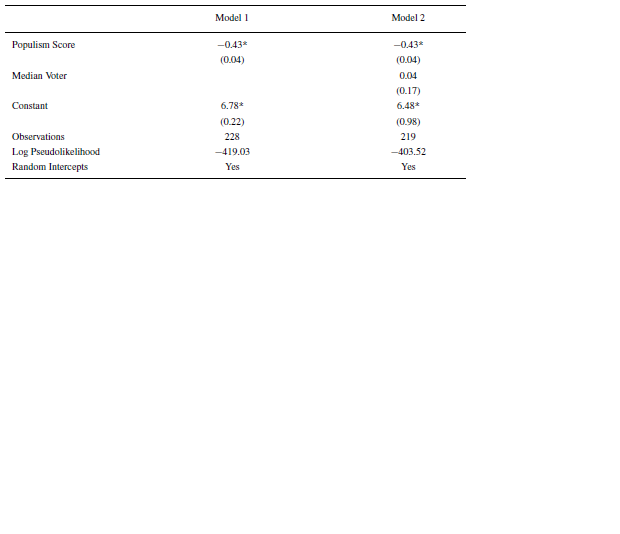
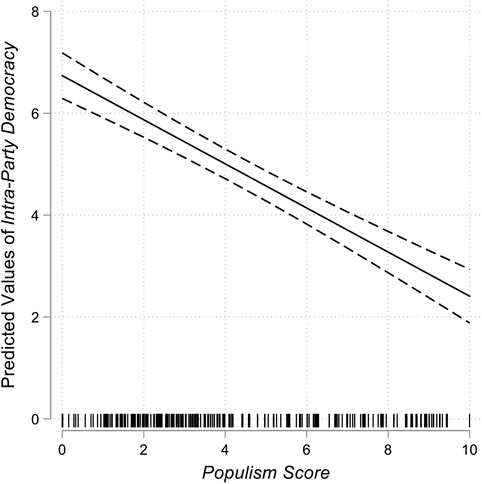
The first model in Table 1 is a hierarchical linear model that only comprises Populism Score as an explanatory variable, and we include random intercepts for countries and party families. The second model also includes the median voter item. First, Populism Score is negatively signed and statistically significant in both estimations. The inclusion or exclusion of Median Voter does not affect this finding – in any case, the median voter variable is statistically insignificant in Model 2.Footnote 4 The negative sign of Populism Score implies that, all else equal, more populist parties tend to be less democratic internally. In Model 1, for example, the effect size suggests that Intra‐Party Democracy decreases by about 0.43 units for each unit increase of Populism Score. The substantive effect based on Model 2 is summarized in Figure 1, which shows that for low levels of populism, the predicted value of Intra‐Party Democracy is approximately 7. However, toward the maximum of Populism Score, the predicted values of our dependent variable approach a value of 2. Hence, there is a negative and significant relationship between populism and intra‐party democracy that is substantively meaningful in size.
Populism and intra‐party democracy

Note: Table entries are coefficients; standard errors in parentheses; the dependent variable is Intra‐Party Democracy; * p < 0.05.
Substantive effects of Populism Score.
Notes. The dashed lines are 95 per cent confidence intervals; rug plot along horizontal axis depicts distribution of Populism Score.

Linking these findings back to the theoretical discussion above, the negative relationship that we estimate emphasizes that the characteristics of populism as an ideology do not translate into similar features when treated as an organizational form. Recall that in the ideational perspective, populism is essentially anti‐politics, claiming to pursue a new morale that opposes the establishment and ‘corrupt elites’ (Mudde & Kaltwasser, Reference Mudde, Kaltwasser, Mudde and Kaltwasser2012, p. 8) at the centre of political decision‐making and power (Hay & Stoker, Reference Hay and Stoker2009; Huber, Reference Huber2020). Given the defining characteristics of intra‐party democracy, it would only be consistent – from an ideational point of view – that more populist parties are internally more democratic: a general, broad, and influential participation of the party members seems in line with the volonté générale (Mudde, Reference Mudde2004). Instead, our evidence highlights that the relationship is in the opposite direction: populist parties are less democratic internally. This result corroborates the leadership perspective as researched by Weyland (Reference Weyland2001, Reference Weyland2021), Kenny (Reference Kenny2019), Pappas (Reference Pappas2016), or Urbinati (Reference Urbinati, Kaltwasser, Taggart, Espejo and Ostiguy2017, Reference Urbinati2019a, Reference Urbinati2019b). It stresses personalist leadership and anti‐democratic tendencies of populism as a form of organization (see also Finchelstein & Urbinati, Reference Finchelstein and Urbinati2018; Mueller, Reference Mueller2019).
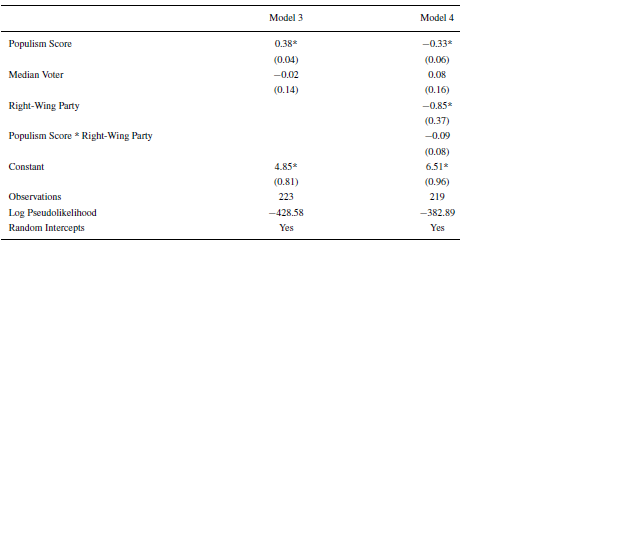
Against this background, we also replaced the dependent variable with an item on personalized styles of party leadership (Model 3, Table 2). This new dependent variable is also reported in the POPPA data (Meijers & Zaslove, Reference Meijers and Zaslove2021), which asks experts: ‘parties can be characterized by more or less personal leadership. Please tick the box that best describes each party's degree of personalized leadership’. The variable ranges between 0 and 10, with higher values capturing more personalized leadership styles. The results of Model 3 provide evidence for a positive relationship between parties’ levels of populism and their personalized leadership score.
Populism and intra‐party democracy: Additional analyses

Note: Table entries are coefficients; standard errors in parentheses; the dependent variable is Personalized Leadership (Model 3) or Intra‐Party Democracy (Model 4); * p < 0.05.
Under personalized leadership, a leader's political weight significantly exceeds that of their party (Pedersen & Rahat, Reference Pedersen and Rahat2020). Although there certainly are populist parties without a strong leader and some non‐populist platforms have strong leaders, we would expect, all else equal, that more personalized leadership is less strongly pronounced in more intra‐democratic and less populist parties (e.g., Poguntke et al., Reference Poguntke, Scarrow, Webb, Allern, Aylott, Biezen, Calossi, Lobo, Cross, Deschouwer, Enyedi, Fabre, Farrell, Gauja, Pizzimenti, Kopecký, Koole, Müller, Kosiara‐Pedersen and Verge2016; Scarrow, Reference Scarrow2015; Rahat & Shapira, Reference Rahat and Shapira2017). Model 3 demonstrates that populist parties apparently have – albeit not consistent with their own core ideological characteristics, but in line with the leadership perspective – an affinity for personalist and charismatic leaders (Weyland, Reference Weyland2001; see also Kenny, Reference Kenny2019).
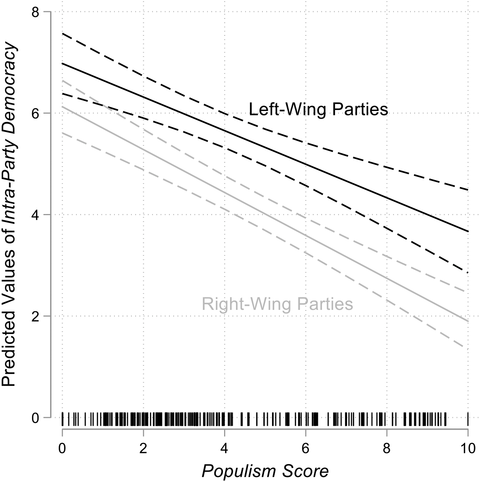
Finally, we evaluate the relationship between populism and party organization for left‐wing and right‐wing movements. Indeed, populism exists across the entire left‐right spectrum (Mudde, Reference Mudde2004) and the level of intra‐party democracy could differ depending on a party's general left‐right position (see Akkerman et al., Reference Akkerman, Zaslove and Spruyt2017; Huber & Schimpf, Reference Huber and Schimpf2017; Rahat & Shapira, Reference Rahat and Shapira2017; Rooduijn & Akkerman, Reference Rooduijn and Akkerman2017). Model 4 and Figure 2 distinguish between right‐wing and left‐wing parties, based on the POPPA data on parties’ overall ideology on a scale ranging from 0 (left) to 10 (right). Using this item, we constructed a binary variable distinguishing between left‐ (0–5) and right‐wing (6–10) parties, which we interact with Populism Score. The negative association between populism and intra‐party democracy prevails, although the relationship is slightly sharper for right‐wing platforms.
Interaction of Populism Score and right‐wing party.
Notes. The dashed lines are 95 per cent confidence intervals; rug plot along horizontal axis depicts distribution of Populism Score.

That is, the effect of Populism Score for non‐right‐wing parties is estimated at −0.33 (Model 4), that is, the relationship between populism and less democratic intra‐party structures does not only apply to right‐wing populists. Deriving the actual effect for right‐wing parties from Model 4 is not without difficulty; hence, Figure 2 presents the linear prediction of our outcome variable given Populism Score, distinguishing between right‐wing and left‐wing parties. The graph shows that the negative influence of populism on intra‐party democracy is robust – regardless of the general left‐right position of a party. However, left‐wing (0–5 on the POPPA left‐right scale) parties are, for most values of Populism Score, significantly more democratic internally than right‐wing parties. The fact that right‐wing populists define and see core aspects of populism somewhat differently than left‐wing populists can explain this pattern: ‘left‐wing populist parties differ from right‐wing populist parties in that they embrace an inclusive as opposed to an exclusive view of society’ (Huber & Schimpf, Reference Huber and Schimpf2017. p. 148). Therefore, left‐wing platforms are more ‘inclusive’ than rightist populists with regard to the society at large and political participation. This difference in understanding populism and (liberal) democracy leads to the slightly stronger effect for right‐wing parties we identify in Figure 2.
In the Supporting Information Appendix, we discuss several additional analyses – all of which corroborate our substantive findings. First, we control for parties’ positions on EU integration, migration, nationalism and law‐and‐order. Second, in the section ‘Populism as a Non‐Compensatory Concept’, we operationalize populism according to the understanding in Wuttke et al. (Reference Wuttke, Schimpf and Schoen2020). Third, we examine the populist variable's subcomponents’ reliability scores, conduct a principal component analysis, and we present the results from a one‐parameter item‐response theory logistic model (see section ‘Subcomponents’ Reliability Scores, Principal Component Analysis, and Item‐Response Theory’). We also estimate the main model for each subcomponent of the aggregated populist variable separately. Both jack‐knifed and country‐clustered standard errors are considered, and we control for party age (section ‘Controlling for Party Age’). Finally, we consider alternative data sources for both our dependent variable and the main explanatory variable (section ‘Alternative Data Sources’).
Conclusion
By making use of the newly released POPPA data of Meijers and Zaslove (Reference Meijers and Zaslove2021), this study provides the widest scope to date of the analysis of populism and party organization. Our central finding that – despite holding an ideology that promotes the general will and ‘anti‐elitism’ – populist parties are not internally democratic has direct implications for our understanding of populism and party organizations. Our core result means that populism as an ideational form does not directly translate into a form of party organization (Rueda, Reference Rueda2021; Weyland, Reference Weyland2021). Instead, the findings highlight that the implications of the leadership perspective can be applied to the understanding of populist parties’ organizations as these parties have adopted highly undemocratic and leader‐centric structures (e.g., Finchelstein & Urbinati, Reference Finchelstein and Urbinati2018; Kenny, Reference Kenny2019; Mueller, Reference Mueller2019; Pappas, Reference Pappas2016; Urbinati, Reference Urbinati, Kaltwasser, Taggart, Espejo and Ostiguy2017, Reference Urbinati2019a, Reference Urbinati2019b; Weyland, Reference Weyland2001, Reference Weyland2021).
Our research supports the qualitative scholarship on party organizations and populism (see Heinisch & Mazzoleni, Reference Heinisch and Mazzoleni2016). What is more, to gain a more complete understanding of the relationship between populism and intra‐party democracy, we expect future work will examine these findings from a more qualitative and in‐depth perspective. Our results also suggest that populist parties may exhibit vote‐seeking motivations if they are aware that voters tend to punish internally divided parties (Greene & Haber, Reference Greene and Haber2015), as having personalist leaders and undemocratic organizations will help them appear more unified to the public in elections.
Based on the relationship between populism and party organization that we report, there are several opportunities for future research. Research on parties’ organizations has analyzed various aspects of party behaviour, including coalition formation (e.g., Pedersen, Reference Pedersen2010), cabinet portfolio allocation (e.g., Bäck et al., Reference Bäck, Debus and Müller2016; Greene & Jensen, Reference Greene and Jensen2016), and how parties respond to voters’ and supporters’ policy movements (Lehrer, Reference Lehrer2012; Schumacher et al., Reference Schumacher, De Vries and Vis2013). In combination with these studies above, our result that populism is associated with less democratic party organizations highlights possible extensions to understanding how these parties influence government formation and termination, and for considering how they respond to public opinion. Future work may also evaluate party survival (e.g., Laroze, Reference Laroze2019) because it may be that internally undemocratic parties (with personalized leadership) are more prone to collapse than other types of parties.
Moreover, in light of populism and personalized leadership being strongly linked to each other, there is the aspect that personalized leadership is characterized by the ‘grassroots’ connection of the leader to the party. Although intra‐party democracy is missing, populist leaders may nevertheless have enormous support among the rank‐and‐file members and, thus, their legitimacy. The leadership concentrates power and deprives the membership base of ‘its say’ in decision making, yet it still has broad backing at the grassroots level. Our data focus on the organizational aspects of parties and does not capture support among the grassroots supporters and the legitimacy of the leadership in the eyes of the rank‐and‐file, but this leader‐grassroots dynamic remains an interesting topic to explore in the future: although populist parties violate principles of intra‐party democracy, their personalized leadership may still enjoy a great level of support among the membership base. This relates to Mudde (Reference Mudde2004, p. 558) who states that ‘citizens do not put much value on actually participating themselves in political life. True, they want to be heard in the case of fundamental decisions, but first and foremost they want leadership. They want politicians who know (rather than “listen to”) the people, and who make their wishes come true’. The above notwithstanding, our empirical findings represent an important step forward in understanding the relationship between populism and party organization.
Online Appendix
Additional supporting information may be found in the Online Appendix section at the end of the article:
Supplementary material


 Open access

