


Bullying and cyberbullying have been established as global phenomena, occurring at different educational stages (Kowalski, Giumetti, Schroeder, & Lattanner, Reference Kowalski, Giumetti, Schroeder and Lattanner2014). Most studies have focused their analysis on secondary school students and adolescents (Kowalski, Limber, & McCord, Reference Kowalski, Limber and McCord2018) and, subsequently, the vast majority of prevention and intervention programs also focus on this age group (Della Cioppa, O’Neil, & Craig, 2015; Ttofi & Farrington, Reference Ttofi and Farrington2011). The main reason that these studies on cyberbullying have focused on adolescents relies on the assumption that children started to use ICT and smartphones at a later stage. However, data from the Instituto Nacional de Estadística indicate that in 2016, 90.6% and 93.1% of children aged 10 and 11 respectively were already Internet users.
These data show that children of this age group are already Internet users with all the advantages and risks this entails. According to Kowalksi, Giumetti, Schroeder, and Lattaner (Reference Kowalski, Giumetti, Schroeder and Lattanner2014) meta-analysis and review, one of the most worrying consequences of bullying and cyberbullying victimization is that it affects several mental health outcomes. This path has been supported by other meta-analyses showing a relationship between bullying and cyberbullying victimization and externalizing (i.e., conduct problems, substance use, self-harm) and internalizing disorders (i.e.: depression, anxiety, physical symptoms) (Fisher, Gardella, & Teurbe-Tolon, Reference Fisher, Gardella and Teurbe-Tolon2016; Gini, Card, & Pozzoli, Reference Gini, Card and Pozzoli2018), and by longitudinal research, that has shown that victimization can generate harmful long-term consequences (Bannink, Broeren, van De Looij-Jansen, de Waart, & Raat, Reference Bannink, Broeren, van de Looij-Jansen, de Waart and Raat2014; Gámez-Guadix, Orue, Smith, & Calvete, Reference Gámez-Guadix, Orue, Smith and Calvete2013), and even lead to suicidal ideation (Holt et al., Reference Holt, Vivolo-Kantor, Polanin, Holland, DeGue, Matjasko and Reid2015). Furthermore, chronic victimization from early adolescence can be particularly worrying as recent research has showed that victimization can lead adolescents to develop maladaptive schemas that put them at a higher risk for new episodes of victimization and psychological problems (Calvete, Fernández-González, González-Cabrera, & Gámez-Guadix, Reference Calvete, Fernández-González, González-Cabrera and Gámez-Guadix2018).
The worrying consequences of bullying and cyberbullying together with the data of Internet use at this age reveal the need to analyze the prevalence of cyberbullying in this age range, as a step toward creating prevention and intervention programs adapted to this developmental period.
For this study, we reviewed the literature on bullying and cyberbullying of children in or near their last stage of primary education (9–13 years old) from the last 5 years. The results of the main prevalences are presented in Table 1.
Review of Prevalence Studies in Children of Equivalent Age or Close to those in Lower Primary Education
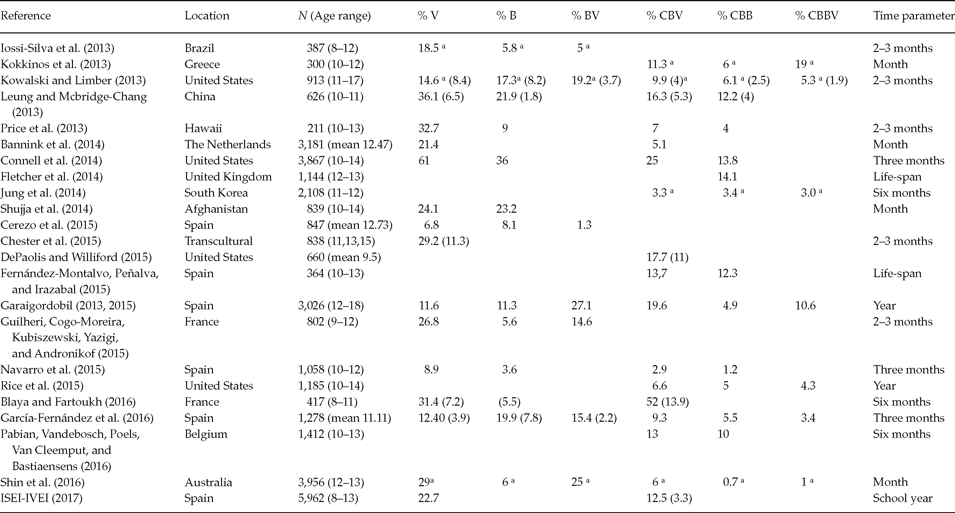
Note: %V = victims; %B = bullies; %BV = bully-victims; % CBV = cybervictims; %CBB = cyberbullies; %CBBV = cyberbully-victims.
a =denotes that the victim, bully and bully-victim categories are mutually exclusive; parenthesis indicates severe implication.
As can be seen in Table 1, with respect to face-to-face bullying, the percentage of victims ranges from 7% (Cerezo, Sánchez, Ruiz, & Arense, Reference Cerezo, Sánchez, Ruiz and Arense2015; Navarro, Yubero, & Larrañaga, Reference Navarro, Yubero and Larrañaga2015) to approximately 33% (Blaya & Fartoukh, Reference Blaya and Fartoukh2016; Leung & Mcbridge-Chang, Reference Leung and McBride-Chang2013; Price, Chin, Higa-McMillan, Kim, & Frueh, Reference Price, Chin, Higa-McMillan, Kim and Frueh2013). In the case of bullies, the proportion ranges from 4% (Iossi-Silva, Pereira, Mendonça, Nunes, & de Oliveira, Reference Iossi-Silva, Pereira, Mendonça, Nunes and de Oliveira2013; Navarro et al., Reference Navarro, Yubero and Larrañaga2015), to approximately 20% (García-Fernández, Romera-Félix, & Ortega-Ruiz, Reference García-Fernández, Romera-Félix and Ortega-Ruiz2016; Leung & Mcbridge-Chang, 2013; Shujja, Att, & Shujjat, 2013). It should be noted that Connell, Schell-Busey, Pearce, and Negro (Reference Connell, Schell-Busey, Pearce and Negro2014) places prevalence at significantly higher percentages, 61% and 36% for victims and bullies, respectively. For bully-victims, the range varies from 1.3% (Cerezo et al., Reference Cerezo, Sánchez, Ruiz and Arense2015) to 25% (Shin, Braithwaite, & Ahmed, Reference Shin, Braithwaite and Ahmed2016). Regarding the studies analyzing severe victimization (i.e., students who suffered bullying behaviors very frequently or always), it ranges from 3.9% (García-Fernández et al., Reference García-Fernández, Romera-Félix and Ortega-Ruiz2016) to 11.3% (Chester et al., Reference Chester, Callaghan, Cosma, Donnelly, Craig, Walsh and Molcho2015), while the number of severe bullies’ ranges from 1.8% (Leung & Mcbridge-Chang, 2013) to 8% (García-Fernández et al., 2016; Kowalski & Limber, 2013). Fewer studies report the number of bystanders; however, García-Fernández et al. (2016) report that 28% of children were bystanders of face-to-face bullying. In a study involving adolescents, Garaigordobil (Reference Garaigordobil2015) reports a slightly higher percentage of 33.7% of adolescents who observed bullying without being involved either as victims or bullies.
When considering cyberbullying, the prevalence of cybervictims ranges from 3% (Jung et al., Reference Jung, Leventhal, Kim, Park, Lee, Lee and Park2014; Navarro et al., Reference Navarro, Yubero and Larrañaga2015) to 52% (Blaya & Fartoukh, Reference Blaya and Fartoukh2016), and the number of cyberbullies ranges from 1% (Navarro et al., Reference Navarro, Yubero and Larrañaga2015; Shin et al., Reference Shin, Braithwaite and Ahmed2016) to 14% (Connell et al., Reference Connell, Schell-Busey, Pearce and Negro2014; Fletcher, Fitzgerald-Yau, Jones, Allen, Viner, & Bonell, Reference Fletcher, Fitzgerald-Yau, Jones, Allen, Viner and Bonell2014). Regarding cyberbully-victims, the prevalence ranges from 1% (Shin et al., Reference Shin, Braithwaite and Ahmed2016) to 5% (Kowalski & Limber, Reference Kowalski and Limber2013; Rice et al., Reference Rice, Petering, Rhoades, Winetrobe, Goldbach, Plant and Kordic2015), although the study by Kokkinos, Antoniadou, Dalara, Koufogazou, and Papatziki (Reference Kokkinos, Antoniadou, Dalara, Koufogazou and Papatziki2013) reports a rate of 19% of cyberbully-victims. Those studies that analyze severe cyber-victimization and severe cyber-aggression place the percentage of severe cybervictims between 4% (Irakas-Sistema Ebaluatu eta Ikertzeko Erakundea-Instituto Vasco de Evaluación e Investigación Educativa, ISEI-IVEI, 2017) (Kowalski & Limber, Reference Kowalski and Limber2013) and 13.9% (Blaya & Fartoukh, Reference Blaya and Fartoukh2016), and that of severe cyberbullies around 3% (Kowalski & Limber, Reference Kowalski and Limber2013; Leung & Mcbridge-Chang, Reference Leung and McBride-Chang2013). As for cyberbystanders, the range is between 13% of bystanders (García-Fernández et al., Reference García-Fernández, Romera-Félix and Ortega-Ruiz2016) and 28.8% (Pabian et al., Reference Pabian, Vandebosch, Poels, van Cleemput and Bastiaensens2016).
In regard to the most frequent behaviors, several studies confirm that physical aggressions begin to decrease around the age of 10–11, while verbal and relational aggressions become more frequent (Garaigordobil, Reference Garaigordobil2017). In addition, several studies have found that verbal offenses are the most frequent behaviors in the last stage of primary school, followed by social aggressions (Connell et al., Reference Connell, Schell-Busey, Pearce and Negro2014; ISEI-IVEI, 2017) or physical assaults (Price et al., Reference Price, Chin, Higa-McMillan, Kim and Frueh2013). Given the distinct nature of the behaviors analyzed in the different studies, determining the most frequent cyber-aggression is hard. However, a review of the studies conducted points to offensive and insulting messages, insulting calls, anonymous calls, and the spread of rumors as the most frequent forms of attack (Blaya & Fartoukh, Reference Blaya and Fartoukh2016; Garaigordobil, Reference Garaigordobil2013, Reference Garaigordobil2015).
Of note is the inclusion of the study of Garaigordobil’s (Reference Garaigordobil2013, Reference Garaigordobil2015) with an older sample (aged 12 to 18), as it uses the same structure, instrument and setting as this study and will allow for a comparison between our sample of last stage primary education and her study, with secondary and baccalaureate students.
As shown in Table 1, few studies focus only on primary school students, generally using older participants as part of the sample. In addition, there are large differences in prevalence rates, due to the different instruments used and the different time ranges analyzed. Finally, it can also be observed that hardly any studies provide data on the 4 roles (victim, bully, bully-victim, and bystander) of bullying and cyberbullying.
Objectives and Hypotheses
The main aim of the study is to analyze the global and severe prevalence of bullying and cyberbullying in the last stage of primary education. With this objective, and based on the review of previous studies and their prevalence rates presented in Table 1 and the study of Garaigordobil (Reference Garaigordobil2013, Reference Garaigordobil2015) with secondary education students, the following 5 hypotheses are proposed:
a. In terms of global bullying, we expect to find that around 20%–25% of students will be pure victims, 5%–10% will be pure bullies, 10%–15% will be bully-victims, and 35% will be pure bystanders.
b. Regarding severe bullying or actual bullying (defined as occurring “often” and “always,” respectively), the expected percentages are that 10% of students will be severe pure victims, 3% will be severe pure bullies and severe bully-victims, and 20% will be severe pure bystanders who will have frequently observed aggressive behaviors among peers over the past year.
c. With regard to cyberbullying, we expect that 10%–15% of students will be pure victims, 3%–5% will be pure cyberbullies, 5%–7% will be cyberbully-victims, and 30%–40% of the participants will have been pure bystanders of cyberbullying behaviors over the last year.
d. For severe cyberbullying, it is proposed that approximately 3% of the student sample will be severe cyber victims, 1% will be severe pure cyberbullies or severe cyberbully-victims, and around 10% will be severe bystanders of cyberbullying behaviors among equals.
e. The most frequently reported aggressive face-to-face bullying behaviors are expected to be verbal and physical aggression, while for cyberbullying, the most frequent behaviors are expected to be offensive and insulting messages, offensive and insulting calls, and anonymous calls made to provoke fear.
Method
Participants
The study sample included 1,993 students in 5th and 6th grades. The randomly selected children make up a representative sample of pupils in the last stage of primary school in the Basque Country. Participants were aged between 9 and 13 years old (M = 10.68, SD = 0.71), 50.2% boys and 48.8% girls. 51.5 % (n = 1,027) were in the 5th grade and 48.5 % were in the 6th grade (n = 966). 51% of the sample attended public network schools (13 schools) and the remaining 49% attended private or concerted schools (12 schools). For the selection, the population level of the provinces of the Basque Country (Gipuzkoa, Bizkaia and Araba) was taken into account. Of the 1,993 participants, 16.3% attended schools in the province of Araba, 46.9% attended schools in the province of Bizkaia, and the remaining 36.9% attended schools in Gipuzkoa.
Instruments
To evaluate the variables under study, the “Cyberbullying: Screening of Peer-Harassment” (Garaigordobil, Reference Garaigordobil2013) test was applied. This standardized instrument, with psychometric guarantees of reliability and validity, evaluates both face-to-face bullying and cyberbullying. It provides 4 indicators: Level of victimization, aggression, aggressive-victimization, and observation. The Bullying Scale through a four item scale, assesses four types of bullying: Physical aggression (aggressive actions aimed at a person’s body, e.g. hit, push, slap...; or indirect actions, aimed at their property, e.g. steal or damage the books, backpack); verbal aggression (negative verbal behaviors towards someone, e.g. insults, calling him or her hurtful names...); social aggression (behaviors that isolate a person from the group, e.g. ignoring the victim and excluding him or her from normal social interactions); and psychological aggression (bullying behaviors to undermine a person’s self-esteem and provoke insecurity and fear, e.g. humiliating the victim or creating insecurity for him or her). The Cyberbullying Scale explores the roles of cybervictim, cyberbully and cyberbystander 15 behaviors related to technological bullying such as: Making offensive calls, making anonymous to calls to frighten, sending offensive and insulting messages, recording a beating and uploading it to YouTube, stealing and uploading private or compromising photos, blackmailing or threatening someone, spreading rumors, secrets, and lies, faking photos or videos and uploading them to YouTube, isolating others in social networks, blackmailing with disclosing intimate details about someone, slandering, impersonation, death threats, sexual harassment.
The 4 items of the bullying scale and the 15 items are phrased in the victim role (e.g. “Have you been blackmailed or threatened with calls or messages during the last year?”), and then in the bully role (e.g. “Have you blackmailed or threatened another student with calls or messages during the last year?”), and finally, in the bystander role (e.g. “Have you witnessed another student being threatened with calls or messages during the last year?”). In both scales participants report the frequency with which they have suffered, performed and observed those behaviors (Likert scale of 0 = never, 1 = sometimes, 2 = often, 3 = always) during the last year.
The psychometric analyses in this sample confirm adequate internal consistency on both the bullying scale (global scale α =. 84; victimization α =. 80; aggression α =. 69; and observation α =. 84) and on the cyberbullying scale (global scale α =. 91; cyber-victimization α =. 83; cyber-aggression α =. 91; cyberobservation α = .89). Exploratory factor analysis confirmed a three-factor structure (victims, aggressors, bystanders) on both scales that explains 61.61% and 43.72% of the variance for bullying and cyberbullying, respectively. The assessment tool also showed convergent validity yielding positive correlations between aggression and aggressive conflict resolution, antisocial behavior, psychopathological disorders, school problems, neuroticism, and negative correlations with empathy, emotional regulation, responsibility as well as social adaptation in the original sample (Garaigordobil, Reference Garaigordobil2013).
Design and procedure
This research used a descriptive and comparative cross-sectional design. With regard to the procedure, firstly an e-mail was sent to the randomly selected schools to explain the research, afterwards a telephone or personal interview was set to further the information and clarify the queries of the school staff. Once the school agreed to participate consent forms were sent to parents and students via school administration and a date was set for completing the cyberbullying test. After informed consent of school administration, the parents, and the students were obtained, the test was administered in a 45-minute session by members of the research team, who presented the standardized instructions and gave the questionnaire to the participants. They completed the test in a classroom, in a group setting. Even though most of the students in the classrooms participated, under the Organic Law on the Protection of Personal Data (LOPD), several institutions did not provide the number of students who did not agree to participate in the research.
The study complied with the with the ethical values required in research involving human beings, respecting the fundamental principles included in the Helsinki Declaration (informed consent and right to information, protection of personal data and guarantees of confidentiality, non-discrimination, gratuity and the right to withdraw from the study in any of its stages), receiving a favorable report from the ethics committee of the University of the Basque Country (CEISH/229/2013). After collecting the data, an individual report was sent to each school providing information on the prevalence of the school and of the autonomous community.
Data analysis
First, the frequencies and percentages of students who were victims, perpetrators and bystanders of face-to-face bullying were calculated according to 4 mutually exclusive categories: “Pure victims”, “pure bullies”, “bully-victims”, (those who had been victims and also aggressors) and “pure bystanders” (had not performed or suffered aggressions but had observed them between their peers). Taking these categories into account, the global prevalence (i.e. suffered/perpetrated/witnessed one or more behaviors sometimes, often and always during the past year) and the severe prevalence (i.e. suffered/perpetrated/witnessed one or more behaviors often and always during the past year) of both bullying and cyberbullying is identified. Lastly, the frequency and percentage of victims, bullies and bystanders of the different types of aggressive behavior analyzed is reported.
Results
Global and severe bullying and cyberbullying prevalence
The descriptive analyses (frequencies and percentages) (see Table 2) revealed that with respect to face-to-face bullying: 20.3% of the sample were pure victims; 6.1% were pure bullies; 23.9% were bully-victims; and 28.9% had observed bullying behaviors in the last year, without having suffered or performed them. In terms of severe prevalence: 13.2% of the sample were severe pure victims of face-to-face bullying; 1.6% were severe pure bullies; 2% were severe bully-victims; and 23.2% of the sample observed fairly often or always aggressive behaviors among partners in the last year, without having been either a victim or a perpetrator.
Global and Severe Prevalence in Bullying and Cyberbullying
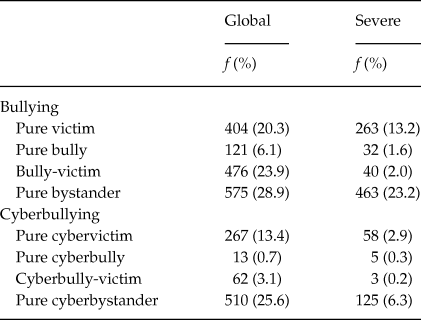
Note: f = frequency; % = percentage.
When analyzing cyberbullying, we found that 13.4% of the sample were pure cybervictims, 0.7% were pure cyberbullies, 3.1% were cyberbully-victims, and 25.6% had observed or had knowledge of one or more aggressive cyberbullying behaviors among peers. In terms of cyberbullying at a severe level, the results show that 2.9% were severe pure cybervictims, 0.3% were severe pure cyberbullies, 0.2% were severe cyberbully-victims, and that 6.3% of the sample had observed cyberbullying behaviors quite often or always among peers in the past year.
Percentages and frequencies of victims, aggressors and bystanders in bullying and cyberbullying behaviors
With respect to the percentage of those involved in each of the face-to-face bullying behaviors, the results in Table 3 show that the most prevalent aggressions are verbal aggressions, both in global and severe form. In addition, victims, aggressors and bystanders agree and report that physical aggressions are the second most frequent behavior, followed by social aggressions and finally psychological aggressions.
Frequencies and Percentages of Victims, Perpetrators and Bystanders of Aggressive Face-to-Face Behavior

Note: f = frequency, % = percentage.
Regarding cyberbullying, as can be seen in Table 4, the comparison of the information from the 3 roles indicates that the 5 most prevalent behaviors are the following: offensive and insulting messages and calls to scare and frighten; blackmail or threats through calls or the Internet; defamation by telling lies over the Internet about a person in order to disregard the rights of others.
Frequencies and Percentages of Cybervictims, Cyberbullies and Cyberbystanders of the 15 Cyberbullying Behaviors
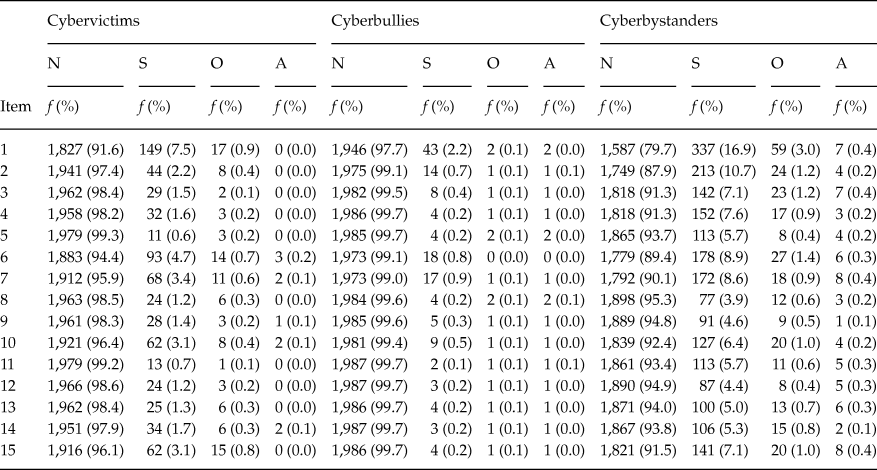
Note: 15 cyberbullying behaviors. 1 = Offensive/insulting messages; 2 = Offensive/insulting calls; 3 = Attacking, recording and hanging on Internet; 4 = Broadcasting private photos/videos; 5 = Taking photos in dressing rooms, beach...to broadcast; 6 = Anonymous frightening calls; 7 = Threatening by calls or messages; 8 = Sexual harassment by cellphone/Internet; 9 = Identity theft; 10 = Theft of password; 11 = Touching up photos/videos and broadcasting them; 12 = Isolating on social networks; 13 = Blackmailing by threatening to broadcast intimacy; 14 = Death threats; 15 = Slandering and spreading rumors to discredit someone. N = Never; S = Sometimes; O = Often; A= Always; f = frequency, % = percentage.
Discussion
This study aimed to analyze the prevalence of bullying and cyberbullying among students in the last stage of primary education.
The results showed that 20.3% of the students were pure victims, 6% pure bullies, 23.9% bully-victims, and 28.9% bystanders. In this way, hypothesis 1 was supported almost entirely, and the results confirmed the review carried out in international studies. Specifically, similar percentages of victims were found in Bannink et al. (Reference Bannink, Broeren, van de Looij-Jansen, de Waart and Raat2014) and ISEI-IVEI (2017), and several studies found similar percentages of bullies involved in face-to-face bullying (Cerezo et al., Reference Cerezo, Sánchez, Ruiz and Arense2015; Shin et al., Reference Shin, Braithwaite and Ahmed2016). The percentage of bully-victims found in this study is similar to that of Shin et al. (Reference Shin, Braithwaite and Ahmed2016), who found 25%, but higher than those reported by most studies, which overall reported figures below 15% (García-Fernández et al., Reference García-Fernández, Romera-Félix and Ortega-Ruiz2016; Guilheri et al., Reference Guilheri, Cogo-Moreira, Kubiszewski, Yazigi and Andronikof2015), as well as studies that found percentages below 5% (Cerezo et al., Reference Cerezo, Sánchez, Ruiz and Arense2015). Finally, the percentage of bystanders is similar to that reported by García-Fernández et al. (Reference García-Fernández, Romera-Félix and Ortega-Ruiz2016), who found 28.45% of bystanders.
Regarding Hypothesis 2 on the severe prevalence of bullying, the results reveal the existence of 13.2% severe pure victims, 1.6% severe pure bullies, 2% severe bully-victims, and 23.2% pure bystanders who have observed these aggressive face-to-face behaviors very frequently. Therefore, Hypothesis 2 is confirmed and consistent with the results of other studies that have analyzed the percentage of severe victims of bullying, such as Chester et al. (Reference Chester, Callaghan, Cosma, Donnelly, Craig, Walsh and Molcho2015), who found 11.3% were severe victims, Leung and McBridge-Chan (Reference Leung and McBride-Chang2013), who found 1.8% were severe aggressors, and Kowalski and Limber (Reference Kowalski and Limber2013), who found 3.7% were severe bully-victims.
Regarding the prevalence of cyberbullying, Hypothesis 3 is partially confirmed as the numbers of pure cybervictims (13.4%) and pure cyberbystanders (25.6%) are similar to those expected; however, the numbers of pure cyberbullies and cyberbully-victims are lower, at 0.7% and 3.1%, respectively. This percentage of cybervictims coincides with the results of other studies (Fernández-Montalvo et al., Reference Fernández-Montalvo, Peñalva Vélez and Irazabal2015; ISEI-IVEI, 2017; Kokkinos et al., Reference Kokkinos, Antoniadou, Dalara, Koufogazou and Papatziki2013). The prevalence of cyberbullies in this study is lower than that found by most studies, which have reported a prevalence of around 3% (Jung et al., Reference Jung, Leventhal, Kim, Park, Lee, Lee and Park2014; Price et al., Reference Price, Chin, Higa-McMillan, Kim and Frueh2013; Rice et al., Reference Rice, Petering, Rhoades, Winetrobe, Goldbach, Plant and Kordic2015). Even so, the percentage of cyberbullies found in this study is similar to that found in several other studies such as Navarro et al. (Reference Navarro, Yubero and Larrañaga2015), which found 1.2% of cyber-aggressors, and Shin et al. (Reference Shin, Braithwaite and Ahmed2016), which found 0.7% of cyberbullies in Australia. On the other hand, the percentage of cyberbully-victims found in our study is similar to that found by other studies such as that of García-Fernández et al. (Reference García-Fernández, Romera-Félix and Ortega-Ruiz2016) or Jung et al. (Reference Jung, Leventhal, Kim, Park, Lee, Lee and Park2014), which found 3.4%, and 3%, respectively. However, these results were also lower than in several other studies. Regarding the number of bystanders identified, Pabian et al. (Reference Pabian, Vandebosch, Poels, van Cleemput and Bastiaensens2016) found a 28.8% of cyberbystanders in their studies, matching the present study. Similarly, Garaigordobil (Reference Garaigordobil2013, Reference Garaigordobil2015) found 34.7% were cyberbystanders in a study with adolescents.
Concerning the prevalence of severe cyberbullying, the results reveal that 2.9% of the sample were severe pure cybervictims, 0.3% were severe pure cyberbullies, 0.2% were severe cyberbully-victims, and 6.3% were cyberbystanders who have observed cyberbullying behavior very frequently. Hypothesis 4 was confirmed, as we found similar percentages to those predicted in the 4 roles. These figures are slightly lower than those of other reviewed studies with adolescents that found about 5% were severe cybervictims (Kowalski & Limber, Reference Kowalski and Limber2013; Leung & McBridge-Chang, Reference Leung and McBride-Chang2013; Garaigordobil, Reference Garaigordobil2013, Reference Garaigordobil2015), but are similar to those found by ISEI-IVEI (2017), which found 3.3% were severe cybervictims in the last stage of primary education. Regarding the number of severe cyberbullies and severe cyberbully-victims, the figures are also lower than in studies that analyzed these involvement categories (Kowalski & Limber, Reference Kowalski and Limber2013; Leung & McBridge-Chang, Reference Leung and McBride-Chang2013), which found between 2.5% and 4% were severe cyberbullies, or Kowalski and Limber (Reference Kowalski and Limber2013), which found 1.9% were severe cyberbully-victims.
Finally, as regards the most frequent behaviors, victims, aggressors, and bystanders agreed that in face-to-face bullying the most prevalent forms of aggression are verbal, whereas the second most frequent are physical. Regarding the most prevalent cyberbullying attacks, cybervictims, cyberbullies, and cyberbystanders agreed that offensive and insulting messages and calls to scare and frighten are the 2 most frequent behaviors. Therefore, Hypothesis 5 was completely confirmed.
These results agree with several studies pointing to verbal aggression as being the most common form of aggression (Price et al., Reference Price, Chin, Higa-McMillan, Kim and Frueh2013), but contrast with Williams and Guerra (Reference Williams and Guerra2007), who indicated that physical aggression was more prevalent than verbal aggression. This difference may be due to the mean age of the samples under study, which were slightly lower than the mean age of this study, as the literature confirms the predominance of physical bullying at younger ages (Garaigordobil, Reference Garaigordobil2017). As for cyberbullying, the behaviors analyzed in other research (e.g., e-mail, SMS text messages, specific social media, etc.) differ from those studied here, thus making it difficult to compare results; however, they point in the same direction as Garaigordobil’s (Reference Garaigordobil2013, Reference Garaigordobil2015) studies, which also found these behaviors were the most prevalent among adolescents and young people in the Basque Country, and other international studies (e.g. Blaya & Fartoukh, Reference Blaya and Fartoukh2016).
These results imply that, although the prevalence of cyberbullying is less frequent than that of face-to-face bullying, it is a real problem in this educational stage, even at a severe level. For this reason, and because of the effects of victimization on children’s and adolescents’ mental and physical health outcomes such as higher levels of depression, anxiety, loneliness, psychosomatic complaints and lower self-esteem and academic performance among others (Garaigordobil, Reference Garaigordobil2017; Kowalski et al., Reference Kowalski, Limber and McCord2018), it is important to create and implement programs for the prevention and intervention of bullying and cyberbullying in order to teach children the risks and implications of using communication technologies, as well as teaching them strategies to deal with situations of cyberattacks, either as a cybervictim or as a bystander.
It should be noted that, although there are empirically validated bullying and cyberbullying prevention programs, they have usually been oriented toward secondary school students. For this reason, it is necessary to create new content or adapt existing programs for these ages and this developmental stage. This will also result in greater prevention, since, as the meta-analyzes of Yeager, Fong, Lee, and Espelage (Reference Yeager, Fong, Lee and Espelage2015) show, the effect of the programs is greater when conducted with those aged younger than 12–13 than with those older than 12–13 years of age.
Finally, this study is not exempt from limitations, in particular the use of self-reporting with the social desirability bias that entails. In addition, although the sample is representative of the Basque Country, it would be useful to carry out prevalence studies in other geographical settings. Furthermore, another limitation comes from not gathering data on the use of ICT from the participants, doing that would have permitted to run comparisons between the data on use of ICT form the Instituto Nacional de Estadística and our sample, and between users and non-users of Internet and the different roles of cyberbullying. In spite of these limitations, this study makes a significant contribution by providing prevalence data on the different roles involved in bullying and cyberbullying in an educational stage that has been understudied until now but that, according to the studies analyzed here, is as likely to be cybervictimized as secondary school students. For this reason, the main objective of any future research work must be to create prevention and intervention plans with appropriate content adapted to this educational stage.
In this sense, in addition to the already mentioned bullying and cyberbullying interventions, programs that promote improvement in the social climate of the classroom, respect for difference, enhanced empathy and emotional expression, increased self-esteem, more prosocial behavior, cooperative conflict resolution skills, and anger control (Garaigordobil, Reference Garaigordobil2013) should be implemented in schools. In addition, given the vital role that parents and teachers play in the lives of children of this age, it is imperative that future programs involve both the family and the school in tackling these problems.



