

5.1 Introduction
Sufficient evidence has been accumulated in the past few decades to show that the global temperature is rising, and the climate is changing rapidly to an alarming degree (Hoegh-Guldberg Reference Hoegh-Guldberg, Jacob, Taylor, Masson-Delmotte, Zhai and Pörtner2018; Thuiller Reference Thuiller2007). The practice of federalism has stood out, but with ambivalent effects, in climate governance (Karapin Reference Karapin2020). Despite being an authoritarian state, China has adopted a quasi-federal system to combat climate change, comprising five mechanisms: a target-responsibility system; the inclusion of environmental performance in local officials’ promotion assessment; fiscal incentives; the central inspection system for ecological and environmental protection; and public participation. These are explained in detail in the case analysis of China’s low-carbon pilot policy.
China’s quasi-federalist system in climate governance features centralized decision-making, evaluation, and supervision, together with decentralized implementation. This has shown evidence of environmental federalism in experimenting with innovative solutions to climate crisis and promoting policy diffusion, but it has also experienced some challenges as demonstrated in fragmented patchwork of policies at the local level of government.
Overall, China’s environmental quasi-federalism of devolved implementation under centralized policymaking has generally been effective in climate governance even though it has some drawbacks.
5.2 Climate Change in China
China has achieved phenomenal economic growth in the past few decades, rising from being an impoverished country to becoming the second-largest economy in the world (Ross Reference Ross2019). However, China’s economic achievement was accomplished at the cost of damaging the environment to an alarming degree (Chow Reference Chow2015).
In 2006, China replaced the United States as the largest emitter of annual carbon dioxide, and it has remained at the top since then. According to the latest available data compiled by the International Energy Agency (IEA 2019) and CAIT Climate Data Explorer,1 China’s annual CO2 emissions have been on the rise during the period of 1990 to 2017, starting from 1.9 gigatons (GT) annually which accounted for approximately 8 per cent of world’s total in 1990 to 9.3 GT annually which contributed to 28 per cent of global emissions in 2017 (see Figure 5.1). Emissions growth continues, but at a slower rate.
Annual CO2 emissions of China and the world.

There are three main GHG sources: energy, industry, and agriculture. In general, energy-related fossil fuel combustion is the primary driver of anthropogenic CO2 emissions in most countries (IPCC Reference Stocker, Qin and Plattner2014). In China, this is especially the case. China’s energy-related CO2 emissions (emissions from coal, oil, and natural gas) have long been the dominant portion of its total CO2 emissions and have remained at over 90 per cent level from 1990 to 2016 (see Figure 5.2).
China’s total CO2 and energy-related CO2 emissions.

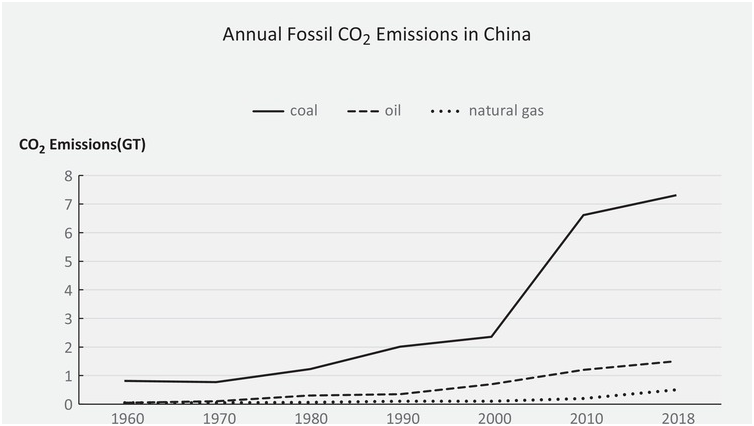
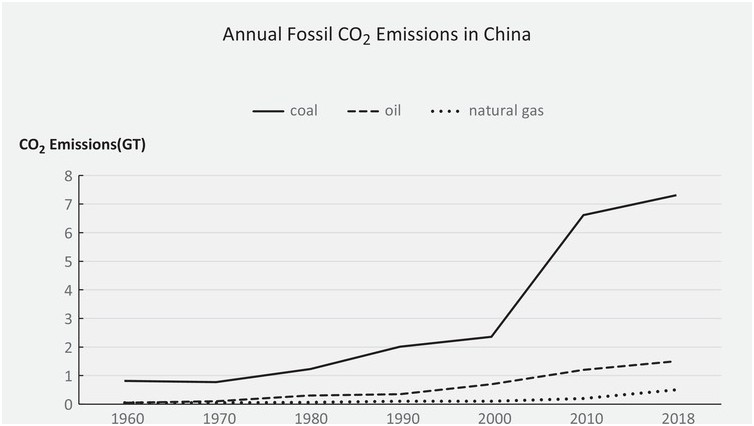
This high percentage is inextricably linked to China’s energy structure, where coal has long occupied over 60 per cent of all energy consumption compared to the global average of 27.8 per cent, and contributed even more to energy-related CO2 emissions (Korsbakken, Andrew, and Peters Reference Korsbakken, Andrew and Peters2019) As Figure 5.3 shows, coal-induced CO2 has long been contributing close to or even more than 70 per cent of total fossil-fuel CO2 emissions in China.
Annual fossil CO2 emissions in China.
Constantly growing GHG emissions will continue to exacerbate global climate change, the effects of which are far-reaching in China. Annual mean air temperature over the past thirty years has risen by over 1.0°C, which is higher than the synchronous global average (Fang et al. Reference Fang, Guirui, Liu, Shuijin and Stuart Chapin2018). To be more specific, northern China is warming faster than southern China (Ding et al. Reference Ding, Ren and Zhao2007). The most evident effect of global warming is melting glaciers. The glacier volume in the Qilian Mountains of north-western China decreased by 30 per cent ± 8 per cent from 1956 to 2010 (Tian et al. Reference Tian, Yang and Liu2014). The glacier retreat has led to rising sea levels, which is alarming because China has a heavily populated 18,000-kilometre eastern coastline where many of the most economically prosperous cities are located. The occurrence of climate-related extreme weather events, such as droughts and floods, has increased unevenly in the north and south of China, resulting in severe damage to the stability and quality of food production, undermining China’s ability to feed its people2 (Piao et al. Reference Piao, Ciais and Huang2010). Socio-economic conditions including public health and sustainable economic development have also been affected by adverse climate change (Watts et al. Reference Watts, Neil Adger and Agnolucci2015).
China has long been confronted with a series of stubborn climate adaptation challenges, among which a varied climate, scarce natural resources, an extensive economic growth model , and a large population are the main stumbling blocks (Nan and Jingyang Reference Nan and Jingyang2014). With a vast territory, China has complex climate patterns and interactions, making climate adaptation more difficult. Insufficient natural resources coupled with a large population are discouraging adaptation action. The coal-dominant energy structure and low energy efficiency stand in the way as roadblocks to sustainable economic development (Dai and Finkelman Reference Dai and Finkelman2020).
Despite the aforementioned challenges, China has been cooperating with the international community to combat climate change. In the COP26 summit in Glasgow in 2021, China promised to achieve carbon peak before 2030 and carbon neutrality before 2060. Under the Paris Agreement reached in 2015, China committed to peak its CO2 emissions around 2030 and lift non-fossil energy to 20 per cent by 2030. According to a study, China is likely to achieve this goal if all current policies are effectively implemented (Gallagher et al. Reference Gallagher, Zhang, Orvis, Rissman and Liu2019). China’s most recent pledge was to ‘endeavour to reach carbon neutrality by 2060‘, which was considered a shockingly ambitious goal especially when the Covid-19 is still wreaking havoc on people’s lives and economy in China and worldwide.3
5.3 Climate Change and Quasi-Federalism in China
The impact of federalism on climate governance has been widely studied (e.g., Austin et al. Reference Austin, Ford, Berrang-Ford, Biesbroek, Tosun and Ross2018; Balthasar, Schreurs, and Varone 2020; Jordaan et al. Reference Jordaan, Davidson, Nazari and Herremans2019). Despite being an authoritarian state, China adopted a quasi-federal system to mitigate and adapt to climate change with mixed measures and mechanisms. What underpins the quasi-federalist system is a multi-level structure with vertical and horizontal power dynamics. Five mechanisms embedded in this system are identified, which we will discuss further below.
5.3.1 China’s Quasi-Federalism: Structures and Division of Powers
Federalism has three essential features, though it has various definitions. First, it requires a division of powers between the central (or federal) governments and regional (or constituent) governments. Second, the two levels of government are of equal status (Wheare Reference Wheare1946). Third, the division of powers and equal status are guaranteed by a written constitution (Elazar Reference Elazar1987).
China is a unitary state where the central government has supreme authority over local governments. China thus does not satisfy the ‘equal status’ rule of federalism. However, there is a constitutionally prescribed division of powers between the central government and local governments. Its governance structure is usually explained by the analytical framework of tiao-kuai (Lieberthal and Oksenberg Reference Lieberthal and Oksenberg1988; Schurmann Reference Schurmann1968). Tiao refers to the vertical–functional relationship between the central and local governments, while kuai refers to the horizontal–territorial relationship at different levels of government (Lieberthal Reference Lieberthal1997). Although the central government maps out strategies and issues directives to local governments, local governments largely control the resources, staff, and information needed to implement the directives. In environmental governance, tiao and kuai usually underlie the mechanisms for power sharing and bargaining (Alkon and Wong Reference Alkon and Wong2018). Therefore, albeit a de jure unitary state, China operates under a de facto federal-like system (Zheng Reference Thuiller2007).
Different from analysing the environmental federalism in federal states, China is a party-state where the Chinese Communist Party (CCP) controls virtually all the other political organizations and institutions mainly through dominating the selection of cadre leaders.
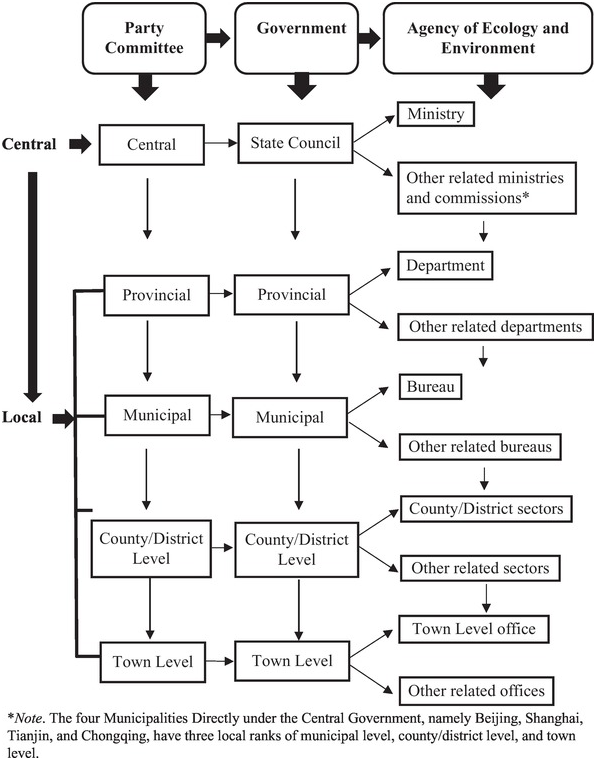
The structures and division of powers can be illustrated by tiao (vertical) and kuai (horizontal) lines as shown in Figure 5.4. Vertically, there are five orders of organizations. The highest rank of the party committee, government, and environmental and ecological agencys have constitutional authority over the lower ranks of corresponding agencies separately. In other words, the local organizations are the ‘branches’ of the central organizations and therefore should be responsible to them. It should be noted that this is different from the federal structure of the United States where the federal government and state governments do not follow a superior–subordinate relationship. Horizontally, the party leads the government which in turn leads its subordinate agencies. For instance, at the highest rank, the Central Party Committee headed by the general secretary leads the State Council steered by the prime minister, which in turn governs the Ministry of Ecology and Environment. It should be noted that the prime minister and the minister of ecology and environment and other ministers are also members of the Central Party Committee. At the nexus of tiao and kuai exists overlapping authority. For example, the provincial environmental agency is subordinate to the central environmental agency and meanwhile affiliated to the provincial government. Besides, a power shift from the National Development and Reform Commission (NDRC) to the Ministry of Ecology and Environment (MEE) in steering climate governance has strengthened the latter’s authority in taking tougher measures to curb climate change. NDRC is an affiliated commission of the State Council. It is often called the ‘small State Council’ due to its high status as a comprehensive agency for national strategic planning and economic management. It had overseen GHG emissions reduction until MEE took over in 2018. This power shift, decided by the CCP Central Committee and State Council out of consideration for balancing economic growth and climate governance, authorized more power to MEE to implement climate change policies. Over time, the power shift at the highest level has also been transmitted to lower levels, strongly empowering local environmental agencies to tackle urgent environmental problems.
The central government has constitutional authority over, and is responsible for negotiating international commitments and designing national policies, for climate mitigation and adaptation (local governments are not allowed to conduct para-diplomacy), while local governments are mainly responsible for implementing these policies although they enjoy a certain degree of flexibility in formulating locally suited policies.
5.3.2 How the Quasi-Federalist System Works
As is shown in Figure 5.4, what underpins the quasi-federalist system is a multi-level administrative structure that functions through hierarchical central–local governments, party–government power structure, and dual leadership that local-level environmental agencies receive.
In the quasi-federalist system, the central government and local government (including four levels, namely province, municipality, county, and town) do not have equal status. The former has supreme authority and power to formulate national strategies and goals while the latter has little power in national-level decision-making although they have much discretion in the implementation of national policies. This system creates a top-down policy process where the central government defines problems, sets the agenda, formulates national policies, and evaluates and supervises policy implementation while local governments mainly implement national policies. For climate policies, the central government sets targets and assign them to provinces which then break their quotas assigned down to lower levels of local governments. Meanwhile, local governments at each level have significant discretionary power during policy implementation, though the degree of discretion varies in response to different socio-economic conditions of local governments, the urgency of environmental issues, and social norms (Chŏng and Chung Reference Chŏng and Chung2000; Shin Reference Shin2017).
Another distinctive feature of the multi-level governance structure is the party–government power structure. At each level, party institutions co-work with government institutions, and the party leader is the most powerful figure, superior to the government leader who is the second most powerful figure. In general, the party committee, at each level, is mainly responsible for making major decisions and the government is mainly in charge of implementation. However, the boundary between party and government is blurred in reality because the party committee has the power to promote or demote officials working in both same-level party institutions and government institutions, and the government leader also serves as the deputy party leader. To understand the climate policies in China, it is necessary to take the party–government power dynamics into consideration.
Local environmental agencies receive dual guidance and supervision. They are not only horizontally responsible for the same-level local governments but also vertically responsible for their immediate higher level environmental agencies (Ma Reference Ma2017). However, the dual leadership is often at odds with each other in implementing environmental policies because environmental protection and economic development are often at odds with each other (Zhang Reference Zhang2021). The vertical leadership tends to impose strict directives on, and strengthen oversight over, lower levels of environmental agencies while the horizontal leadership is likely to loosen supervision over same-level environmental agencies for the sake of local economic growth. To take tougher measures against climate change, the central party committee and central government proposed strengthening the vertical leadership to counterbalance local interests in 2015.
5.3.3 Mechanisms of China’s Quasi-Federalism
How does China’s quasi-federalism work? We introduce five main mechanisms here briefly, which will be detailed in the case study section.
5.3.3.1 Target-Responsibility System
The target-responsibility system, which was imported into the Chinese bureaucracy in the 1980s to boost economic development and introduced to environmental management soon afterward, is an adapted, Chinese version of Management by Objectives (Lan and Hu Reference Lan and Shuigen2008).
As its name implies, the central organization sets targets and assign the sub-targets to corresponding local organizations whose leaders will be rewarded if the targets are achieved, and punished otherwise. In China, the central government is responsible for making a comprehensive work plan for energy conservation and emission reduction, where targets are set and allocated to provincial governments, which will further divide the targets and allocate them to lower levels of government.4
5.3.3.2 Inclusion of Environmental Performance in Local Officials’ Promotion
Since the reform and opening-up in 1978, economic performance has been an overwhelming factor in local officials’ career advancement until the second half of the 2000s when China realized the severity of environmental degradation. Since 2007, environmental performance has been incorporated in the evaluation of local officials’ political achievements.
5.3.3.3 Fiscal Incentives
Roughly speaking, China’s tax system since 1949 has gone through three phases. The first phase was the period of the planned economy from 1949 to 1978 when taxation was highly centralized. After that much of the power of levying taxes was devolved from the central government to local governments to boost the economy from 1978 to 1994, eventually leading to central government’s financial deficiency. Therefore, in 1994, taxation was centralized again, and this system has remained in place to the present day.
To create an incentive for local governments to combat climate change, the Environmental Protection Tax Law was enacted 2016, requiring all environmental taxes to be allocated to local governments starting from 2018. In general, this has increased local governments’ investment for environmental protection and reduced CO2 emissions, even though environmental taxes have traditionally played a limited role in environmental regulation (Li et al. Reference Li, Lin, Du, Feng and Zuo2021).
5.3.3.4 Central Inspection System for Ecological and Environmental Protection
To ensure that the national strategy to combat ecological and environmental deterioration was implemented as required by local governments, the State Council of China created the Central Inspection System for Ecological and Environmental Protection (CISEEP) in 2016 and the Ministry of Ecology and Environment is responsible for the nationwide inspection.
CISEEP prescribes that an inspection task force should be approved by the central party committee and government to supervise and scrutinize what provincial governments have done in environmental and ecological governance.
5.3.3.5 Public Participation
The issues of climate change are so complex that the central government needs to resort to public participation to improve the effectiveness in climate governance.
Measures for Public Participation in Environmental Protection was approved by the then-called Ministry of Environmental Protection.5 This document stipulates that citizens can report environmental issues by way of writing letters or emails to environmental agencies or calling the environmental hotline. Local environmental agencies are also encouraged to engage social organizations in environmental protection (climate change included) through project grants or purchasing services.
In summary, although these five mechanisms mentioned above were not exclusively created for addressing climate change, they have been playing an essential role in China’s quasi-federalist system for climate governance.
5.4 Case Study
In this section, we analyse a case of climate mitigation in China: the pilot low-carbon city initiative.
5.4.1 An Analytical Framework
One distinctive feature of China’s environmental quasi-federalism is its selective centralization or decentralization in the policy process between the central government and local governments. It is also worth noting that it is the central government that determines when and where to centralize or decentralize – which to a certain degree demonstrates the ‘strategic pragmatism’ in China’s policy process (Gallagher and Xuan Reference Gallagher and Xuan2019). Centralization here means that the central government has dominant power in making major decisions while decentralization means that the central government devolves much of its power to local governments in the implementation of climate and environmental policies. The five mechanisms are fitted into the different stages of the policy process. The central government has absolute authority over agenda setting. It also has a dominant power in formulating and adopting policies where the target-responsibility system is brought in to establish specific targets that local governments must achieve. However, the implementation is decentralized mainly because local governments are far more familiar with local conditions and are more capable of deploying resources available to accomplish climate mitigation/adaptation tasks. Fiscal incentives and local officials’ promotion pressure come in to ease off the GDP-oriented development pattern. Public participation is also promoted. But in the last step, centralization is back again. A central inspection brigade heads for provinces to supervise and evaluate local environmental performance which will serve as the decisive criterion to judge whether the assigned targets are met (see Table 5.1). In general, major decision-making and evaluation are centralized and implementation is decentralized.
| Policy Process | Selective Centralization or Decentralization | Mechanisms |
|---|---|---|
| Agenda Setting | Highly Centralized | |
| Formulation and Adoption | Centralized | target-responsibility system (mainly the ‘target’ part) |
| Implementation | Decentralized | 1) fiscal incentives 2) incorporation of environmental performance in local officials’ promotion 3) public participation |
| Supervision and Evaluation | Centralized | 1) central inspection system for ecological and environmental protection 2) target-responsibility system (mainly the ‘responsibility’ part) |
It should be clarified that each mechanism that is fitted to each step of the policy process is not exclusively functioning in that step. Instead, it might straddle two or more stages. For example, although the target-responsibility system is introduced in formulating and adopting the low-carbon policy, it also imposes pressure on local governments’ implementation and serves as criteria for policy evaluation.
We will employ this analytical framework to analyse the implementation, evolution, and conflicts/cooperation between the central government and local governments in the following two cases.
5.4.2 Case of Climate Mitigation: Pilot Low-Carbon City Initiative
To curb adverse climate change and promote green development, China launched an incremental and massive pilot low-carbon city policy in 2010.
Up to now, a total number of eighty-seven local governments at different levels throughout China have joined the pilot low-carbon policy experimentation since three rounds of pilot policy were implemented respectively in 2010, 2012, and 20176 (see Table 5.2). In the past ten years an increasing number of jurisdictions have adopted low-carbon policy from east to west, scattered to nationwide, and provincial-level governments down to county/district-level governments.
Note. As early as in 2008, Shanghai and Baoding joined a World Wildlife Fund initiative to explore low-carbon urban development.
5.4.2.1 Agenda Setting
The agenda setting of the pilot low-carbon initiative is highly centralized. Although local governments have the right to make suggestions, the central government has the final say on what issues should be prioritized.
In November 2009, the State Council proposed the general target for cutting GHG emissions. Then, NDRC rolled out the pilot low-carbon policy. In the second and third rounds, it was also the NDRC that steered this policy. However, in 2018, MEE was authorized more power and began to dominate the climate change policy. Facing the next five years, MEE is finalizing the guidelines on reaching carbon emissions peak by 2030 in the fourteenth Five-Year Plan, realizing carbon neutrality by 2060, making specialized plans for combating climate change, and accelerating the national carbon trading market.7
This kind of centralized agenda setting is reasonable for the urgent battle against climate change in that it can expedite the formulation, adoption, and implementation of climate policies without consuming too much time to negotiate a consensus.
5.4.2.2 Formulation and Adoption of Low-Carbon Policy
The formulation and adoption of the low-carbon policy are also centralized, although there exist much bargaining and negotiation between central and local governments in this process.
Based on suggestions from local governments, the NDRC formulated and adopted the pilot low-carbon city initiative through internal discussion and research, and then issued official written policy documents to local governments.
The central government’s centralized power in formulating and adopting the low-carbon policy is mainly reflected in the following four aspects.
First, the NDRC has the final say over which provinces or cities should join the pilot low-carbon initiative although local socio-economic conditions will be considered. Second, the NDRC sets the general target and requires that local governments incorporate tackling climate change into their Five-Year-Plan, set their targets and formulate specific measures for reducing GHG emissions, by considering local natural conditions, resources endowments, and economic foundation. Third, the pilot local governments are required to apply information technology (e.g., establish an integrated system for GHG emissions statistics, monitoring and accounting) to track the pace of curbing CO2 emissions and to accumulate evidence for local energy conservation and emission reduction policy design. The last aspect lies in NDRC’s power to evaluate policy implementation and choose and promote successful cases. All of these are written into government documents.8
Supervision of local government has also been reinforced over time. In 2010, when the first batch of local governments was selected to implement the low-carbon policy, the NDRC took a mild and open attitude and did not force local officials to be held accountable if the local GHG emission reduction targets were not met. Yet in 2012, when the second batch of pilot local governments was chosen, the NDRC introduced the target-responsibility system to the national low-carbon pilot policy, which was reformed and intensified in 2017.
The target-responsibility system is generally effective in allocating GHG emission reduction targets to local governments and imposing a certain degree of pressure on local officials to take action to promote low-carbon experimentation. These mandatory targets are all-important because they provide relatively clear goals that local governments are pressured to achieve. Yet they are not always effective due to unreasonable target allocation, the intricate nature of the targets, distraction from parallel programmes, and unreasonable choice of indicators.
Initially, the national target for reducing GHG emissions was broken down and allocated almost equally to each province regardless of the significant differences between them in energy consumption, industrial structure, resource endowments, and technological level. This inevitably twisted the target distribution system. This problem has been gradually alleviated with the constant promotion of a national carbon emission trading system. These targets are also intricate in that some target indicators are unquantifiable, with most of the quantifiable indicators allocated to related sectors by local governments (e.g., industry, energy, building, and transportation) in a clear-cut way. Another issue is that pilot provinces and cities are faced with parallel programmes at the same time and thus confused with and distracted by the overlapping goals of these programmes9 (Lo Reference Lo2014). In such situations, the target-responsibility system would fall short of expectations. Indicators of target matter too. Initially, energy intensity was taken as the key indicator. However, energy consumption could still grow even if the energy intensity declined when the economy grew at a faster rate (Lo Reference Lo2020). To remedy this situation, the indicator of energy consumption was introduced in 2016 at the outset of China’s thirteenth Five-Year-Plan.
5.4.2.3 Implementation
The implementation of the low-carbon pilot city policy is decentralized. The NDRC does not provide specific guidance or methods for low-carbon development. Local governments are granted a relatively high degree of discretion over experimenting with locally suited policies to reduce GHG emissions. In policy implementation, local governments are so diverse in population, industrial structure, and energy structure, that they take on different patterns of climate governance (Yi and Liu Reference Yi and Liu2015). The strength of local governments’ climate actions is determined by a mix of factors such as governance costs, local leaders’ career advancement, collaboration among horizontal sectors, and public opinion. There are pioneers as well as laggards in climate governance innovation. To provide incentives for local governments to address climate change, the central government has established several mechanisms.
Climate governance is undoubtedly a high-cost project. Since the tax-sharing reform in 1994, China’s taxation has remained centralized. The central government has more tax revenue and less expenditure responsibility while local governments have less tax revenue and more expenditure responsibility. Additionally, local governments largely control the personnel and finance of their environmental protection agencies. Therefore, local governments tend to budget tightly for climate mitigation and adaptation, and local environmental protection agencies are often constrained by limited finance even though they might have ambitious plans. To ease off this financial predicament, the Environmental Protection Tax Law was enacted in 2016 and all the environmental taxes have been distributed to local tax revenue since 1 January 2018, a major decision made by the State Council.
GDP-dominant political achievement for local officials’ promotion is another obstacle against pushing climate governance forward. Since 1978, China’s provincial leaders’ promotion has been highly linked with local economic performance (Li and Zhou Reference Li and Zhou2005). Economic growth has long taken priority over environmental protection. To reverse this path dependence, the central government stipulated that local environmental performance – especially energy conservation and GHG emissions – would be incorporated into the assessment of the political achievements of local officials.
The collaboration among different sectors in local governments has long been a Gordian knot. The building of low-carbon cities is so complex that it entails horizontal cross-sector collaboration, ranging from the economic sector to the environmental sector, from the transportation sector to the energy sector, and from the natural resources sector to the agricultural sector. Horizontal cross-sector collaboration is often difficult because local governments have the same administrative rank, each with different or even conflicting policy objectives. To lubricate and facilitate collaboration, the central government devolved much power to local government leaders, local development and reform commissions, and local environmental agencies.
A low-carbon lifestyle is also an important policy goal. As mentioned above, the complexity of climate governance necessitates strengthening public participation (Liu and Zhang Reference Liu, Zhang and Bi2012). In official documents, the central government reiterates that local governments should publicize low-carbon development, increase data transparency, and engage citizens in climate governance by establishing diverse channels. Although the overall influence of public participation in combating climate change remains to be seen, empirical research shows that public participation has a positive effect on pushing enterprises to comply with green development policies (Fu and Geng Reference Fu and Geng2019).
These mechanisms have spawned many policy pioneers. Up to now, at least thirty-three pilot provinces and cities have formulated specialized plans for low-carbon development. More than thirteen pilot local governments have formulated specialized plans to address climate change. A total of thirty-seven pilot provinces and cities have announced preliminary targets to peak GHG emissions.10 The pioneering provinces and cities have taken diverse and innovative approaches to driving low-carbon development, ranging from institutional innovation to the establishment of an information management platform and to market-based measures (see Table 5.3). Their pioneering work captured the attention of the central government, which in turn set up exemplary provinces or cities to promote their experience, a move not only to share and promote successful experience but also to exert pressure on those provinces or cities that did not produce satisfactory climate governance performance.
| Pilot Low-Carbon Provinces/ Cities | Innovative Measures |
|---|---|
| Zhenjiang City | Created dual leadership and accountability (party leader and government leader); established a low-carbon management platform |
| Guangyuan City | Set up a Bureau of Low-Carbon Development |
| Yunnan Province | Incorporated low-carbon development into local medium- and long-term socio-economic plan |
| Shenzhen City | Explored the establishment of a carbon trading market |
| Shanghai | Promoted low-carbon transportation and designed eco-friendly streets |
| Beijing | Established cross-district carbon trading system |
| Chengdu City | Promoted low-carbon transportation |
| Wuhan City | The first city to have announced the action plan to peak GHG emissions; sought international cooperation |
| Guiyang City | Promoted circular economy |
| Suzhou City | Created carbon inventory for local enterprises |
| Hangzhou City | Established a carbon emission platform for supervision and decision-making |
| Jinchen City | Reduced CO2 emissions by gradually replacing boiler combustion with coalbed methane combustion |
| Guangdong Province | Launched certification of low-carbon products |
| Chongqing | Launched certification of low-carbon products |
Yet these mechanisms are not always effective. Policy implementation has also been plagued with laggards. The implementation gap has long been present. The gap is embodied in many forms and can be explained under different aspects, but the root lies in the conflict between local economic interests and national goals for climate governance – a classical intergovernmental dilemma.
Fiscal incentives are not working well in some local governments implementing the low-carbon pilot policy. The belief that economic growth is the top priority has been ingrained in the mental models of some local leaders who do not give due weight to ecological and environmental protection. Besides, fiscal incentives are not strong enough to push energy-intensive provinces and cities, (which are predisposed to consume more coal), to decisively cut their CO2 emissions.
Climate governance performance does not have a substantive effect on local leaders’ promotion or demotion, which is mainly determined by local economic growth, the contribution of revenue to the central government, and political considerations (Bo [Reference Bo2002] 2019). Few local leaders have been demoted or prevented from being promoted simply because they did not perform well in achieving climate governance goals. Therefore, local leaders have a relatively large degree of discretion over how many resources will be distributed to reduce CO2 emissions.
Functional collaboration among different local government departments has remained complex and intricate although local development and reform commissions and environmental departments have been delegated more power (Westman and Broto Reference Westman and Broto2018). For example, some local finance departments were often delayed in appropriating money for inspecting local enterprises’ measures to reduce GHG emissions. The openness and sharing of climate governance-related information have not fared well either because some departments have tried to keep their core information to themselves for political or economic interests.
5.4.2.4 Supervision and Evaluation
The fundamental challenge in supervision and evaluation of climate governance is information asymmetry.
Although local governments are required to report work progress to the central government regularly, they usually present achievements but cover up problems. Local governments are also inclined to falsify data to circumvent punishment from the central government (Kostka and Nahm Reference Kostka and Nahm2017). Therefore, the central government adopts a centralized top-down mechanism of supervision and evaluation.
The Ministry of Ecology and Environment has been supervising and evaluating local low-carbon experiments. ‘Soft’ and ‘hard’ measures have both been taken. The former includes creating model low-carbon provinces or cities, and encouraging media, social organizations, and the public to report ecological and environmental issues. The latter is exemplified by the Central Inspection System for Ecological and Environmental Protection (CISEEP) which was inaugurated by the Central Committee and the State Council in January 2016.
CISEEP is an iron-handed top-down inspection system for a comprehensive list of ecological and environmental issues, energy conservation and GHG emissions reduction included. A central inspection workforce would be formed and march into different provinces and state-owned enterprises, and stationed there for a length of time to supervise and evaluate the implementation of national ecological and environmental policies. Up to now, two rounds of inspection have been carried out, respectively in 2016 and 2019. The main task of the central inspection workforce is to find out the problems, penalize the organizations or people involved, and keep track of their remedy measures until the problems are resolved. For example, in the second round of central inspection, serious problems of China Minmetals Group were exposed. One of them was that although the China Minmetals Group included its targets for saving energy and reducing GHG emissions in its development plan for 2019 to 2021, it did not take specific action to achieve the goals. The central inspection team confirmed these problems and urged the China Minmetals Group to make improvement plans which were required to be open to the public for supervision, and whose implementation would receive a follow-up central inspection.
Some empirical research shows that CISEEP is generally effective in pushing local governments to achieve ecological and environmental targets (Jia and Chen Reference Jia and Chen2019; Li et al. Reference Li, Zhou, Bi, Liu and Li2020). Inequity also occurs due to ‘insufficient differentiation based on economic and capacity criteria’ (Kostka and Goron Reference Kostka and Goron2021).
The low-carbon policy experiments are still ongoing in China. It is arbitrary to take a stand on whether they are successful or not. China’s quasi-environmental federalism works out in some respects but fails in others (Cheng et al. Reference Cheng, Yi, Dai and Xiong2019; Khan Reference Khan2013; Lo Reference Lo2014; Lo, Li, and Chen Reference Lo2020; Wang et al. Reference Wang, Song, He and Qi2015). In general, the low-carbon pilot policy has improved the overall GHG emission efficiency of pilot cities though it might take a longer time to achieve the goal, and it might widen the divide between eastern and western regions because the policy has been more effective in eastern pilot cities (Fu, He, and Luo Reference Fu, He and Luo2021). It seems that its strengths outweigh its weaknesses, but more empirical research should be conducted to reach a more rigorous conclusion.
5.5 Conclusion
China’s practice in climate governance partly echoes the ‘laboratory of federalism’. In general, a preliminary conclusion can be reached that China’s environmental federalism, which features centralized decision-making, evaluation, and supervision, and decentralized implementation, is effective in climate governance even though it falls short in some respects. Since China’s practices in climate governance are still ongoing, more empirical research should be done to reach a more rigorous and fine-grained conclusion.
China’s quasi-federalist system in climate governance is to a large degree successful in facilitating major decision-making without consuming too much time to reach a consensus, incentivizing local officials to promote low-carbon policies, and exerting centralized and uniform supervision and evaluation of local policies for addressing climate change. Devolved implementation is conducive to experimenting with innovative solutions to climate change.
However, it is also fraught with disadvantages. Inappropriate choice of indicators in the target-responsibility system is likely to skew incentives. Decentralized implementation might also strengthen local governments’ tendency to prioritize local economic development over environmental protection. Public participation is generally weak. Local governments are inclined to conceal, manipulate, and falsify data related to environmental quality. Decentralized implementation might fare better when it is combined with centralized policymaking, evaluation, and supervision.
Institutions, ideas, and interests have played a significant role in shaping the relationship between federalism and climate governance in China. The institutional capacity of central and local governments, along with the five mechanisms, constitutes the federal structure in climate governance. The central government’s knowledge of science and strategic planning, local governments’ expertise, and citizens’ awareness of environmental protection help build a growing consensus on fighting against climate change. However, the conflict in policy goals between the national target and local economic growth often hinders the smooth implementation of climate change policies.
Key implications for policymakers can be summarized under four aspects.
First, the specific indicators of the target-responsibility system should be comprehensive, reasonable, and clear. Experts and specialists rather than administrative officers should have the right to determine the whole list of indicators for policy evaluation.
Second, more financial incentives should be given to local governments to cope with climate change. This might include allocating more financial power to local governments and environmental agencies, outsourcing environmental protection projects to a larger degree, and fostering the environmental protection industry.
Third, the public should be included in the policy process to help define problems and supervise implementation. This might, to some degree, reduce the tensions between the central government and local governments.
The last aspect is that the central government should develop and apply more technologies to alleviate the falsification of environment-related data. Examples of this might include setting up real-time monitoring stations and establishing a unified data platform.




 Open access