





1 Introduction
Let R be a commutative ring and M be a flat R-module. For ideals $I, J$
of R, the exact sequence
$I, J$
of R, the exact sequence
 $$\begin{align*}0 \to R/I\cap J \to R/I \oplus R/J \end{align*}$$
gives rise to an exact sequence $0 \to M/(I \cap J)M \to M/IM \oplus M/JM$
. Taking the kernel, we get
$0 \to M/(I \cap J)M \to M/IM \oplus M/JM$
. Taking the kernel, we get $(I \cap J)M = IM \cap JM$
. In other words, expansions of ideals to a module commute with finite intersections for flat modules. Replacing a finite collection of ideals by a collection
$(I \cap J)M = IM \cap JM$
. In other words, expansions of ideals to a module commute with finite intersections for flat modules. Replacing a finite collection of ideals by a collection $\{I_\alpha \colon \alpha \in A\}$
indexed by an arbitrary set A, one can naturally ask when
$\{I_\alpha \colon \alpha \in A\}$
indexed by an arbitrary set A, one can naturally ask when
 $$ \begin{align} \bigcap_{\alpha \in A} I_\alpha M = \left(\bigcap_{\alpha \in A} I_\alpha\right)M? \end{align} $$
This question was first studied systematically by Ohm and Rush [Reference Ohm and Rush20]. They observed that for any R-module M, one can always define a function
 $$\begin{align*}c_M \colon M \to \{\textrm{ideals of } R\}, \end{align*}$$
called the content of M, where for $x \in M$
,
$x \in M$
, $c_M(x)$
is the intersection of all ideals I of R such that
$c_M(x)$
is the intersection of all ideals I of R such that $x \in IM$
. The reason for using the term “content” for this function is that when
$x \in IM$
. The reason for using the term “content” for this function is that when $M = R[x]$
is the polynomial ring, then for
$M = R[x]$
is the polynomial ring, then for $f \in R[x]$
,
$f \in R[x]$
, $c_{R[x]}(f)$
is the usual content of f, namely the ideal generated by the nonzero coefficients of f. Ohm and Rush observed that (1.0.0.1) always holds precisely when for all
$c_{R[x]}(f)$
is the usual content of f, namely the ideal generated by the nonzero coefficients of f. Ohm and Rush observed that (1.0.0.1) always holds precisely when for all $x \in M$
,
$x \in M$
, $x \in c_M(x)M$
. That is, (1.0.0.1) holds if and only if for any element
$x \in c_M(x)M$
. That is, (1.0.0.1) holds if and only if for any element $x \in M$
, there is a unique smallest ideal I of R such that
$x \in M$
, there is a unique smallest ideal I of R such that $x \in IM$
. In honor of Ohm and Rush, and following [Reference Epstein and Shapiro5, Reference Epstein and Shapiro6, Reference Epstein and Shapiro7], we will call modules that satisfy (1.0.0.1) Ohm-Rush in this paper (Definition 3.4.2), although they were called content modules in [Reference Ohm and Rush20].
$x \in IM$
. In honor of Ohm and Rush, and following [Reference Epstein and Shapiro5, Reference Epstein and Shapiro6, Reference Epstein and Shapiro7], we will call modules that satisfy (1.0.0.1) Ohm-Rush in this paper (Definition 3.4.2), although they were called content modules in [Reference Ohm and Rush20].
There is also a natural generalization of (1.0.0.1) to submodules of modules. For an R-module L and a submodule U of L, let $UM$
denote the image of the canonical map
$UM$
denote the image of the canonical map $U \otimes _R M \to L \otimes _R M$
. Note that when
$U \otimes _R M \to L \otimes _R M$
. Note that when $L = R$
and U is an ideal of R, then
$L = R$
and U is an ideal of R, then $UM$
is naturally identified with the expansion of U to M. If L is finitely generated and
$UM$
is naturally identified with the expansion of U to M. If L is finitely generated and $\{U_\alpha \colon \alpha \in A\}$
is a family of submodules of L, one can study the equality
$\{U_\alpha \colon \alpha \in A\}$
is a family of submodules of L, one can study the equality
 $$ \begin{align} \bigcap_{\alpha \in A} U_\alpha M = \left(\bigcap_{\alpha \in A} U_\alpha\right)M \end{align} $$
in the module $L \otimes _R M$
. We call M intersection flat (Definition 4.2.2) following [Reference Hochster and Huneke11, Reference Hochster and Jeffries12] if (1.0.0.2) holds for all families of submodules
$L \otimes _R M$
. We call M intersection flat (Definition 4.2.2) following [Reference Hochster and Huneke11, Reference Hochster and Jeffries12] if (1.0.0.2) holds for all families of submodules $\{U_\alpha \colon \alpha \in A\}$
of all finitely generated R-modules L. It is clear that modules that are intersection flat are Ohm-Rush, but the converse fails in general (see Example 4.3.11).
$\{U_\alpha \colon \alpha \in A\}$
of all finitely generated R-modules L. It is clear that modules that are intersection flat are Ohm-Rush, but the converse fails in general (see Example 4.3.11).
Our interest in the intersection flatness and Ohm-Rush properties originated from the study of singularities via the Frobenius map. Recall Kunz’s celebrated theorem [Reference Kunz16] which states that a Noetherian ring R of prime characteristic $p> 0$
is regular precisely when the Frobenius
$p> 0$
is regular precisely when the Frobenius $F \colon R \to R$
or p-th power map
$F \colon R \to R$
or p-th power map $r \mapsto r^p$
is flat. Denoting the target copy of R with module structure induced by restriction of scalars along Frobenius as
$r \mapsto r^p$
is flat. Denoting the target copy of R with module structure induced by restriction of scalars along Frobenius as $F_*R$
, Hochster and Huneke studied when
$F_*R$
, Hochster and Huneke studied when $F_*R$
is an intersection flat R-module in [Reference Hochster and Huneke11]. They encountered this condition in their quest to show the existence of certain uniform multipliers in tight closure known as test elements. The test ideal generated by the test elements has found many applications and is mysteriously related to multiplier ideals from complex algebraic geometry [Reference Smith26, Reference Hara8]. Nevertheless, it remains a long-standing open conjecture that prime characteristic excellent reduced rings admit test elements.
$F_*R$
is an intersection flat R-module in [Reference Hochster and Huneke11]. They encountered this condition in their quest to show the existence of certain uniform multipliers in tight closure known as test elements. The test ideal generated by the test elements has found many applications and is mysteriously related to multiplier ideals from complex algebraic geometry [Reference Smith26, Reference Hara8]. Nevertheless, it remains a long-standing open conjecture that prime characteristic excellent reduced rings admit test elements.
Let S be a regular ring of prime characteristic $p> 0$
. It was observed by Sharp [Reference Sharp25] that the intersection flatness of
$p> 0$
. It was observed by Sharp [Reference Sharp25] that the intersection flatness of $F_*S$
implies the existence of test elements for reduced homomorphic images of S. The following are the known results about intersection flatness and Ohm-Rush properties of
$F_*S$
implies the existence of test elements for reduced homomorphic images of S. The following are the known results about intersection flatness and Ohm-Rush properties of $F_*S$
.
$F_*S$
.
-
(1) $F_*S$
was shown to be an intersection flat S-module when S is complete regular local in [Reference Katzman14];
$F_*S$
was shown to be an intersection flat S-module when S is complete regular local in [Reference Katzman14]; -
(2)
$F_*S$
was shown to be an Ohm-Rush S-module when S is an excellent regular local ring in [Reference Katzman, Lyubeznik and Zhang15]; -
(3)
$F_*S$
is an intersection flat S-module when S is F-finite [Reference Blickle, Mustaţǎ and Smith1, Reference Katzman14, Reference Sharp25];


Our main goal in this paper is to systematically study intersection flatness, Ohm-Rush and related properties. In [Reference Datta, Epstein, Schwede and Tucker2] with Karl Schwede, we use the techniques of this article to then exhibit new cases of the existence of test elements.
One property that is related to Ohm-Rush and intersection flatness relies on trace ideals, which have been studied in numerous algebraic contexts. Let M be an R-module and suppose $\varphi \in M^* {:=}q \operatorname {\mathrm {Hom}}_R(M,R)$
. Then for any
$\varphi \in M^* {:=}q \operatorname {\mathrm {Hom}}_R(M,R)$
. Then for any $x \in M$
and for any ideal I of R such that
$x \in M$
and for any ideal I of R such that $x \in IM$
, the linearity of
$x \in IM$
, the linearity of $\varphi $
implies that
$\varphi $
implies that $\varphi (x) \in I$
. Thus, the ideal
$\varphi (x) \in I$
. Thus, the ideal $ \operatorname {\mathrm {Tr}}_M(x) {:=}q \operatorname {\mathrm {im}}(M^* \xrightarrow {\operatorname {\mathrm {eval}} @ x} R), $
called the trace of x, is contained in
$ \operatorname {\mathrm {Tr}}_M(x) {:=}q \operatorname {\mathrm {im}}(M^* \xrightarrow {\operatorname {\mathrm {eval}} @ x} R), $
called the trace of x, is contained in $c_M(x)$
. Consequently, if
$c_M(x)$
. Consequently, if $x \in \operatorname {\mathrm {Tr}}_M(x)M$
, we get
$x \in \operatorname {\mathrm {Tr}}_M(x)M$
, we get $\operatorname {\mathrm {Tr}}_M(x) = c_M(x)$
because
$\operatorname {\mathrm {Tr}}_M(x) = c_M(x)$
because $c_M(x)$
is the intersection of all ideals I of R such that
$c_M(x)$
is the intersection of all ideals I of R such that $x \in IM$
. We will call an R-module M Ohm-Rush trace (Definition 4.1.1) if for all
$x \in IM$
. We will call an R-module M Ohm-Rush trace (Definition 4.1.1) if for all $x \in M$
, one has
$x \in M$
, one has
 $$ \begin{align} x \in \operatorname{\mathrm{Tr}}_M(x)M. \end{align} $$
We will say a ring map $R \to S$
is Ohm-Rush trace if S is an Ohm-Rush trace R-module. We note that an Ohm-Rush trace R-module M is automatically flat (see Remark 4.1.2(g)).
$R \to S$
is Ohm-Rush trace if S is an Ohm-Rush trace R-module. We note that an Ohm-Rush trace R-module M is automatically flat (see Remark 4.1.2(g)).
The Ohm-Rush trace condition was also studied in [Reference Ohm and Rush20], where modules satisfying (1.0.0.3) were called trace modules. However, we feel it is less confusing to use our more verbose terminology because the term “trace” is used abundantly in mathematics. Projective modules are prototypes of Ohm-Rush trace modules (see Lemma 4.1.5), and more examples of Ohm-Rush trace modules can be constructed from them because this notion satisfies a number of stability properties; see Lemma 4.1.7 and Proposition 4.1.9. One can think of the Ohm-Rush trace property as codifying not just that $M^*$
is nontrivial, but that there are “sufficiently many” functionals on M. For instance, for an Ohm-Rush trace module M, the canonical map
$M^*$
is nontrivial, but that there are “sufficiently many” functionals on M. For instance, for an Ohm-Rush trace module M, the canonical map $M \to M^{**}$
is not just injective but also cyclically pure (Lemma 4.1.3). Recall that a map of R-modules
$M \to M^{**}$
is not just injective but also cyclically pure (Lemma 4.1.3). Recall that a map of R-modules $M \to N$
is (cyclically) pure if for all (cyclic) modules P, the induced map
$M \to N$
is (cyclically) pure if for all (cyclic) modules P, the induced map $M \otimes _R P \to N \otimes _R P$
is injective. Pure maps are also called universally injective in the literature [Reference Authors27, Tag 058H].
$M \otimes _R P \to N \otimes _R P$
is injective. Pure maps are also called universally injective in the literature [Reference Authors27, Tag 058H].
The three properties of modules we have introduced so far are related as follows:

We would like to add more implications in the diagram. The way forward is via the theory of Mittag-Leffler and strictly Mittag-Leffler modules developed by Raynaud and Gruson in [Reference Raynaud and Gruson23]. They utilized these latter notions in their proof of the faithfully flat descent of projectivity. A module M over a commutative ring R is Mittag-Leffler if for all R-linear maps $g \colon P \to M$
from a finitely presented R-module P, there exists an R-linear map
$g \colon P \to M$
from a finitely presented R-module P, there exists an R-linear map $f \colon P \to Q$
such that Q is finitely presented
$f \colon P \to Q$
such that Q is finitely presented

and such that for all R-modules N, $\mathrm{ker} (f \otimes _R \operatorname {\mathrm {id}}_N) = \mathrm{ker} (g \otimes _R \operatorname {\mathrm {id}}_N)$
(see Definition 3.2.1). Such an f is called a stabilizer of g. One should think of the condition on kernels as saying that g, which maps to a possibly highly nonfinitely presented module M, behaves as if it were a map between finitely presented modules.
$\mathrm{ker} (f \otimes _R \operatorname {\mathrm {id}}_N) = \mathrm{ker} (g \otimes _R \operatorname {\mathrm {id}}_N)$
(see Definition 3.2.1). Such an f is called a stabilizer of g. One should think of the condition on kernels as saying that g, which maps to a possibly highly nonfinitely presented module M, behaves as if it were a map between finitely presented modules.
The Mittag-Leffler property generalizes the notion of a finitely presented module, and the condition on equality of kernels is intimately related to the notion of purity. Indeed, one can show (Lemma 3.1.2 (3)) that $\mathrm{ker} (f \otimes _R \operatorname {\mathrm {id}}_N) = \mathrm{ker} (g \otimes _R \operatorname {\mathrm {id}}_N)$
holds for all R-modules N precisely when
$\mathrm{ker} (f \otimes _R \operatorname {\mathrm {id}}_N) = \mathrm{ker} (g \otimes _R \operatorname {\mathrm {id}}_N)$
holds for all R-modules N precisely when $f'$
and
$f'$
and $g'$
are pure maps of modules in the pushout
$g'$
are pure maps of modules in the pushout

Note that for any commutative diagram of linear maps

one always has $ \mathrm{ker} (f \otimes _R \operatorname {\mathrm {id}}_N) \subseteq \mathrm{ker} ((\varphi \circ f) \otimes _R \operatorname {\mathrm {id}}_N) = \mathrm{ker} (g \otimes _R \operatorname {\mathrm {id}}_N). $
Thus, if you have two maps
$ \mathrm{ker} (f \otimes _R \operatorname {\mathrm {id}}_N) \subseteq \mathrm{ker} ((\varphi \circ f) \otimes _R \operatorname {\mathrm {id}}_N) = \mathrm{ker} (g \otimes _R \operatorname {\mathrm {id}}_N). $
Thus, if you have two maps $f \colon P \to Q$
and
$f \colon P \to Q$
and $g \colon P \to M$
that both factor through each other, then
$g \colon P \to M$
that both factor through each other, then $\mathrm{ker} (f \otimes _R \operatorname {\mathrm {id}}_N) = \mathrm{ker} (g \otimes _R \operatorname {\mathrm {id}}_N)$
for all R-modules N. This observation leads to a strengthening of the notion of a Mittag-Leffler module. We say an R-module M is strictly Mittag-Leffler if for all linear maps
$\mathrm{ker} (f \otimes _R \operatorname {\mathrm {id}}_N) = \mathrm{ker} (g \otimes _R \operatorname {\mathrm {id}}_N)$
for all R-modules N. This observation leads to a strengthening of the notion of a Mittag-Leffler module. We say an R-module M is strictly Mittag-Leffler if for all linear maps $g \colon P \to M$
where P is finitely presented, there exists a linear map
$g \colon P \to M$
where P is finitely presented, there exists a linear map $f \colon P \to Q$
such that Q is finitely presented, and
$f \colon P \to Q$
such that Q is finitely presented, and $f, g$
factor through each other (Definition 3.2.3). The above discussion shows that a strictly Mittag-Leffler module is always Mittag-Leffler. Moreover, projective modules are strictly Mittag-Leffler (Remark 3.2.4 (h)) and over Noetherian complete local rings, Matlis duality (Lemma 2.2.3) can be used to show that the Mittag-Leffler and strict Mittag-Leffler properties coincide (Proposition 3.2.7).
$f, g$
factor through each other (Definition 3.2.3). The above discussion shows that a strictly Mittag-Leffler module is always Mittag-Leffler. Moreover, projective modules are strictly Mittag-Leffler (Remark 3.2.4 (h)) and over Noetherian complete local rings, Matlis duality (Lemma 2.2.3) can be used to show that the Mittag-Leffler and strict Mittag-Leffler properties coincide (Proposition 3.2.7).
In general, the strict Mittag-Leffler property is significantly stronger than the Mittag-Leffler property. For instance, if M is strictly Mittag-Leffler, then any pure map $P \to M$
from a finitely presented module P is automatically split (Remark 3.2.4 (g)). Using this observation one can show that over a local ring
$P \to M$
from a finitely presented module P is automatically split (Remark 3.2.4 (g)). Using this observation one can show that over a local ring $(R,{\mathfrak {m}})$
, a flat strictly Mittag-Leffler module M can be expressed as a filtered union of finite free submodules that are direct summands of M, whereas for a flat Mittag-Leffler module M these finite free submodules need only be pure in M in general; see [Reference Raynaud and Gruson23] or Proposition 3.2.6. In fact, we will show that further removing the restriction that the union must be filtered characterizes flat Ohm-Rush modules (Proposition 3.4.29). This explains key differences between flat strictly Mittag-Leffler, flat Mittag-Leffler, and flat Ohm-Rush modules in the local setting.
$(R,{\mathfrak {m}})$
, a flat strictly Mittag-Leffler module M can be expressed as a filtered union of finite free submodules that are direct summands of M, whereas for a flat Mittag-Leffler module M these finite free submodules need only be pure in M in general; see [Reference Raynaud and Gruson23] or Proposition 3.2.6. In fact, we will show that further removing the restriction that the union must be filtered characterizes flat Ohm-Rush modules (Proposition 3.4.29). This explains key differences between flat strictly Mittag-Leffler, flat Mittag-Leffler, and flat Ohm-Rush modules in the local setting.
From the structure of a strictly Mittag-Leffler module M over a local ring R described above, it follows that M typically has many nontrivial linear functionals. This is reminiscent of the Ohm-Rush trace property, and indeed, Raynaud and Gruson showed:
Theorem [Reference Raynaud and Gruson23, Part II, Prop. 2.3.4]
Let R be a commutative ring and M be an R-module. Then M is Ohm-Rush trace if and only if M is a flat strictly Mittag-Leffler R-module.
A feature result of this article is an analog of the above result for the Mittag-Leffler and intersection flatness properties.
Theorem (Theorem 4.3.1)
Let M be a flat module over a commutative ring R. Then the following are equivalent:
-
(1) M is Mittag-Leffler.
-
(2) M is intersection flat.
-
(3)
$M \otimes _R S$
is an intersection flat S-module for all R-algebras S.

This theorem reveals that the intersection flatness property is substantially more restrictive than the Ohm-Rush property because while intersection flatness is preserved under arbitrary base change, the Ohm-Rush property is not. In fact, the Ohm-Rush property fails to be preserved even under smooth base change (see Example 4.3.11). The above two theorems allow us to use the substantial arsenal developed in [Reference Raynaud and Gruson23] for (strictly) Mittag-Leffler modules to study the Ohm-Rush trace property and intersection flatness.
In summary, we have the following implications for flat modules over an arbitrary commutative ring (the implications that hold without flatness assumptions are also indicated):
Diagram of implications for flat modules.

The implications in the above diagram that are not equivalences are all strict. In [Reference Datta, Epstein, Schwede and Tucker2] with Karl Schwede, we show that the Frobenius maps of appropriately chosen prime characteristic DVRs can be used to illustrate this. Surprisingly, our analysis together with results from [Reference Raynaud and Gruson23] and [Reference Hochster and Jeffries12] show that all five notions of modules from Figure 1 are equivalent in the complete local case. We obtain several new characterizations as well.
Theorem (Theorem 4.3.12)
Let $(R,{\mathfrak {m}},\kappa )$
be a Noetherian local ring that is
$(R,{\mathfrak {m}},\kappa )$
be a Noetherian local ring that is ${\mathfrak {m}}$
-adically complete. Let M be a flat R-module and let
${\mathfrak {m}}$
-adically complete. Let M be a flat R-module and let $\widehat {M}$
denote its
$\widehat {M}$
denote its ${\mathfrak {m}}$
-adic completion. Then the following are equivalent:
${\mathfrak {m}}$
-adic completion. Then the following are equivalent:
-
(1) M is intersection flat.
-
(2) M is Mittag-Leffler.
-
(3) M is strictly Mittag-Leffler.
-
(4) M is an Ohm-Rush trace R-module.
-
(5) M is an Ohm-Rush R-module.
-
(6) The canonical map
$M \to \widehat {M}$
is a pure map of R-modules. -
(7) The canonical map
$M \to \operatorname {\mathrm {Hom}}_R(\operatorname {\mathrm {Hom}}_R(M,R),R)$
is a pure map of R-modules. -
(8) The canonical map
$M \to \operatorname {\mathrm {Hom}}_R(\operatorname {\mathrm {Hom}}_R(M,R),R)$
is cyclically pure as a map of R-modules. -
(9) For all finitely generated R-modules L,
$L \otimes _R M$
is
${\mathfrak {m}}$
-adically separated. -
(10) For all cyclic R-modules L,
$L \otimes _R M$
is
${\mathfrak {m}}$
-adically separated. -
(11) For any finitely generated submodule P of M, there exists a finitely generated submodule L of M containing P such that L is free and is a direct summand of M.
-
(12) For any cyclic submodule P of M, there exists a finitely generated submodule L of M containing P such that L is free and is a direct summand of M.





Thus, if M is flat and ${\mathfrak {m}}$
-adically complete, then M satisfies the equivalent conditions
${\mathfrak {m}}$
-adically complete, then M satisfies the equivalent conditions $(1)-(12)$
.
$(1)-(12)$
.
For flat modules over an arbitrary commutative ring, the Ohm-Rush property is the most general. Improving upon Sharp’s result [Reference Sharp25] referenced earlier, in forthcoming work [Reference Datta, Epstein, Schwede and Tucker3] we will show the existence of test elements and exhibit a robust test ideal theory for reduced quotients of an excellent regular ring S for which $F_*S$
has the Ohm-Rush property. Thus, it is natural to desire a better understanding of the structure of flat Ohm-Rush modules, along the lines of the structure theory of (strictly) Mittag-Leffler modules developed in [Reference Raynaud and Gruson23]. We develop this theory in Section 3.
$F_*S$
has the Ohm-Rush property. Thus, it is natural to desire a better understanding of the structure of flat Ohm-Rush modules, along the lines of the structure theory of (strictly) Mittag-Leffler modules developed in [Reference Raynaud and Gruson23]. We develop this theory in Section 3.
Our first observation is that while the Mittag-Leffler property captures purity, the Ohm-Rush condition captures cyclic purity. Let M be a module over a commutative ring R and let $g \colon P \to M$
be a linear map from a finitely presented R-module P. We will say that a linear map
$g \colon P \to M$
be a linear map from a finitely presented R-module P. We will say that a linear map $f \colon P \to Q$
is a cyclic stabilizer of g if Q is finitely presented and for all cyclic R-modules N we have
$f \colon P \to Q$
is a cyclic stabilizer of g if Q is finitely presented and for all cyclic R-modules N we have $\mathrm{ker} (f \otimes _R \operatorname {\mathrm {id}}_N) = \mathrm{ker} (g \otimes _R \operatorname {\mathrm {id}}_N)$
. Thus, the notion of a cyclic stabilizer is a weakening of the notion of a stabilizer because for the latter one requires the equality of kernels to hold for all R-modules and not just cyclic ones.
$\mathrm{ker} (f \otimes _R \operatorname {\mathrm {id}}_N) = \mathrm{ker} (g \otimes _R \operatorname {\mathrm {id}}_N)$
. Thus, the notion of a cyclic stabilizer is a weakening of the notion of a stabilizer because for the latter one requires the equality of kernels to hold for all R-modules and not just cyclic ones.
Just as stabilizers are intimately related to purity, cyclic stabilizers are related to cyclic purity (see Lemma 3.3.3). We first show that cyclic stabilizers capture the notion of a flat Ohm-Rush module. Note that flatness is a mild assumption for Ohm-Rush modules. For instance, if R is a domain, then an Ohm-Rush R-module is flat if and only if it is torsion-free (Proposition 3.4.21).
Theorem (Theorem 3.4.18)
Let R be a commutative ring and M be a flat R-module. Then the following are equivalent:
-
(1) M is an Ohm-Rush R-module.
-
(2) Every linear map
$v\colon R \to M$
admits a cyclic stabilizer
$u \colon R \to F$
where F is free of finite rank and such that u factors v. -
(3) Every linear map
$v \colon R \to M$
admits a cyclic stabilizer that factors v. -
(4) Every linear map
$v\colon R \to M$
admits a cyclic stabilizer
$u \colon R \to P$
such that
$u(1) \in c_P(u(1))P$
.



Surprisingly, we also show the notion of a flat Ohm-Rush module is characterized by the existence of stabilizers (and not just cyclic stabilizers) for maps $R \to M$
. This result is summarized below along with an analogous result for Mittag-Leffler modules established in [Reference Raynaud and Gruson23].
$R \to M$
. This result is summarized below along with an analogous result for Mittag-Leffler modules established in [Reference Raynaud and Gruson23].
Theorem. Let R be a commutative ring and M be a flat R-module. Then we have the following:
-
(1) [Reference Raynaud and Gruson23] M is Mittag-Leffler if and only if for all positive integers n, every R-linear map
$R^{\oplus n} \to M$
admits a stabilizer. -
(2) (Corollary 3.4.28) M is Ohm-Rush if and only if every R-linear map
$R \to M$
admits a stabilizer.


Another application of (cyclic) stabilizers is to deduce descent statements for Ohm-Rush and intersection flatness. Descent for stabilizers was established in [Reference Raynaud and Gruson23], while we prove descent for cyclic stabilizers in Corollary 3.5.3. As a consequence, one then has the following result.
Theorem (Theorem 3.5.4, Corollary 4.3.2)
Let $R \to S$
be a homomorphism of commutative rings and M an R-module. Then we have the following:
$R \to S$
be a homomorphism of commutative rings and M an R-module. Then we have the following:
-
(1) If
$R \to S$
is pure and
$S \otimes _R M$
is an intersection flat S-module, then M is an intersection flat R-module. -
(2) If
$R \to S$
is cyclically pure, M is flat and
$S \otimes _R M$
is an Ohm-Rush S-module, then M is an Ohm-Rush R-module.


Note that we do not know if the Ohm-Rush property descends along cyclically pure ring maps without the assumption that M is flat over the base ring R. One application (Corollary 4.3.16) of descent of intersection flatness and Theorem 4.3.12 is that over a Noetherian local ring, the intersection flat modules are precisely those flat Ohm-Rush modules such that the Ohm-Rush property is preserved under arbitrary base change.
Yet another application of (cyclic) stabilizers is to deduce openness of certain pure loci. Suppose M is a module over a commutative ring R and $g \colon P \to M$
is a linear map from a finitely presented R-module P that admits a stabilizer
$g \colon P \to M$
is a linear map from a finitely presented R-module P that admits a stabilizer $f \colon P \to Q$
. Then for all prime ideals
$f \colon P \to Q$
. Then for all prime ideals ${\mathfrak {p}}$
of R,
${\mathfrak {p}}$
of R, $f_{\mathfrak {p}}$
is also a stabilizer of
$f_{\mathfrak {p}}$
is also a stabilizer of $g_{\mathfrak {p}}$
as maps of
$g_{\mathfrak {p}}$
as maps of $R_{\mathfrak {p}}$
-modules, and as
$R_{\mathfrak {p}}$
-modules, and as $\operatorname {\mathrm {coker}}(f)$
is a finitely presented R-module we have
$\operatorname {\mathrm {coker}}(f)$
is a finitely presented R-module we have
 $$\begin{align*}\{{\mathfrak{p}} \in \operatorname{\mathrm{Spec}}(R) \colon g_{\mathfrak{p}} \text{ is } R_{\mathfrak{p}}\text{-pure}\} = \{{\mathfrak{p}} \in \operatorname{\mathrm{Spec}}(R) \colon f_{\mathfrak{p}} \text{ splits in } \operatorname{\mathrm{Mod}}_{R_{\mathfrak{p}}}\}. \end{align*}$$
by [Reference Lazard17, Cor. 2.4]. The latter locus is open because splittings of maps of finitely presented modules spread. Thus, if $g \colon P \to M$
admits a stabilizer, then the pure locus of g is open in
$g \colon P \to M$
admits a stabilizer, then the pure locus of g is open in $\operatorname {\mathrm {Spec}}(R)$
. As a consequence, we have:
$\operatorname {\mathrm {Spec}}(R)$
. As a consequence, we have:
Proposition (Corollary 3.6.3, Lemma 3.6.4)
Let R be a commutative ring, M a flat R-module, P a finitely presented R-module and $g \colon P \to M$
a linear map. Let
$g \colon P \to M$
a linear map. Let $\operatorname {\mathrm {Pure}}(g)$
(resp.
$\operatorname {\mathrm {Pure}}(g)$
(resp. $\operatorname {\mathrm {CPure}}(g)$
) be the locus of primes
$\operatorname {\mathrm {CPure}}(g)$
) be the locus of primes ${\mathfrak {p}} \in \operatorname {\mathrm {Spec}}(R)$
such that
${\mathfrak {p}} \in \operatorname {\mathrm {Spec}}(R)$
such that $g_{\mathfrak {p}}$
is
$g_{\mathfrak {p}}$
is $R_{\mathfrak {p}}$
-pure (resp.
$R_{\mathfrak {p}}$
-pure (resp. $R_{\mathfrak {p}}$
-cyclically pure). Then
$R_{\mathfrak {p}}$
-cyclically pure). Then
 $$\begin{align*}\operatorname{\mathrm{Pure}}(g) = \operatorname{\mathrm{CPure}}(g).\end{align*}$$
Furthermore,
-
(1) If M is intersection flat, then
$\operatorname {\mathrm {Pure}}(g)$
is open in
$\operatorname {\mathrm {Spec}}(R)$
. -
(2) If M is Ohm-Rush and
$P = R$
, then
$\operatorname {\mathrm {Pure}}(g) = \operatorname {\mathrm {Spec}}(R) \setminus \mathbf {V}(c_M(g(1)))$
.



Openness of pure loci is not only implied by the intersection flat and Ohm-Rush properties, but also implies these properties when the modules are known to be locally intersection flat and Ohm-Rush. The main local-to-global result in this direction, relying also on the descent results above, is the following:
Theorem (Theorem 3.7.1, Proposition 3.7.2)
Let R be a commutative ring and M a flat R-module.
-
(1) Suppose
$M_{\mathfrak {p}}$
is an intersection flat
$R_{\mathfrak {p}}$
-module for all
${\mathfrak {p}} \in \operatorname {\mathrm {Spec}}(R)$
. Then M is intersection flat if and only if for all integers
$n \geq 0$
and linear maps
$g \colon R^{\oplus n} \to M$
, the cyclically pure locus of g is open in
$\operatorname {\mathrm {Spec}}(R)$
. -
(2) Suppose
$M_{\mathfrak {p}}$
is an Ohm-Rush
$R_{\mathfrak {p}}$
-module for all prime ideals
${\mathfrak {p}}$
of R.-
(a) M is Ohm-Rush if for all integers
$n \geq 0$
and linear maps
$g \colon R^{\oplus n} \to M$
, the cyclically pure locus of g is open in
$\operatorname {\mathrm {Spec}}(R)$
. -
(b) If R is a Prüfer domain (e.g., a Dedekind domain), then M is Ohm-Rush if and only if for all linear maps
$g \colon R \to M$
, the cyclically pure locus of g is open in
$\operatorname {\mathrm {Spec}}(R)$
.
-










Note that the case $n = 1$
above is already quite interesting. For instance, if M is locally Ohm-Rush and one has the openness of pure loci for maps
$n = 1$
above is already quite interesting. For instance, if M is locally Ohm-Rush and one has the openness of pure loci for maps $R \to M$
, then one can recover the content function of M up to radical (Proposition 3.7.3); that is, for all
$R \to M$
, then one can recover the content function of M up to radical (Proposition 3.7.3); that is, for all $x \in M$
, there exists a smallest ideal
$x \in M$
, there exists a smallest ideal $I = \sqrt {I}$
such that
$I = \sqrt {I}$
such that $x \in IM$
.
$x \in IM$
.
2 Preliminaries
2.1 Conventions and abbreviations
All rings in this paper are commutative. We will frequently work over non-Noetherian rings because [Reference Raynaud and Gruson23, Reference Hochster and Jeffries12] develop the theories of Mittag-Leffler modules and intersection flat modules over arbitrary commutative rings, and one of our goals in this paper is to link Raynaud and Gruson’s classic work with notions that commutative algebraists have studied in relation to Hochster and Huneke’s theory of tight closure [Reference Hochster and Huneke10, Reference Hochster and Huneke11]. In addition, even in the study of singularities of Noetherian rings, which is the main application we have in mind, one has to frequently study non-Noetherian rings such as perfections, absolute integral closures and big Cohen-Macaulay algebras. We will specify whenever Noetherian hypotheses are needed in the statements of results. When we use the term “regular ring” it is implicit that such rings are Noetherian. Additionally, for us a “local ring” is not necessarily Noetherian. However, when we say a local ring is “complete,” we mean it is Noetherian and complete with respect to the ideal adic topology induced by the maximal ideal.
The following abbreviations are used freely in the text.
2.2 Pure maps
Recall that given a ring R, a map of R-modules $M \to N$
is pure if for all R-modules P, the induced map
$M \to N$
is pure if for all R-modules P, the induced map $M \otimes _R P \to N \otimes _R P$
is injective. Similarly, a map of R-modules
$M \otimes _R P \to N \otimes _R P$
is injective. Similarly, a map of R-modules $M \to N$
is cyclically pure provided
$M \to N$
is cyclically pure provided $M \otimes _R P \to N \otimes _R P$
is injective for all cyclic R-modules P. A ring homomorphism
$M \otimes _R P \to N \otimes _R P$
is injective for all cyclic R-modules P. A ring homomorphism $R \to S$
is pure (or cyclically pure) if it is pure (respectively cyclically pure) as a map of R-modules. If M is a submodule of an R-module N such that the inclusion
$R \to S$
is pure (or cyclically pure) if it is pure (respectively cyclically pure) as a map of R-modules. If M is a submodule of an R-module N such that the inclusion $M \hookrightarrow N$
is pure, then we will often say that M is pure in N.
$M \hookrightarrow N$
is pure, then we will often say that M is pure in N.
Pure maps of modules are also called universally injective maps of modules in the literature. While the latter terminology is more descriptive, we will primarily use the former terminology for its brevity.
The following fact about pure maps is presumably well-known, but for lack of a good reference we include a proof here. Recall that an R-algebra S is a first order nilpotent thickening of R if $S \cong R/I$
, where I is an ideal of R such that
$S \cong R/I$
, where I is an ideal of R such that ${I}^2 = 0$
[Reference Authors27, Tag 04EX].
${I}^2 = 0$
[Reference Authors27, Tag 04EX].
Lemma 2.2.1. Let R be a ring and $\varphi \colon M \to N$
a map of R-modules. Then
$\varphi \colon M \to N$
a map of R-modules. Then $\varphi $
is pure if and only if for any R-algebra S that is also a first order nilpotent thickening of R,
$\varphi $
is pure if and only if for any R-algebra S that is also a first order nilpotent thickening of R, $\varphi \otimes _R \operatorname {\mathrm {id}}_S$
is an injective S-linear map.
$\varphi \otimes _R \operatorname {\mathrm {id}}_S$
is an injective S-linear map.
Proof. The nontrivial implication is to show that if $\varphi \otimes _R \operatorname {\mathrm {id}}_S$
is an injective S-linear map for all R-algebras S that are a first order nilpotent thickening of R, then
$\varphi \otimes _R \operatorname {\mathrm {id}}_S$
is an injective S-linear map for all R-algebras S that are a first order nilpotent thickening of R, then $\varphi $
is a pure R-linear map. Let P be an R-module and let
$\varphi $
is a pure R-linear map. Let P be an R-module and let $R \ltimes P$
be the R-algebra obtained by Nagata’s principle of idealization [Reference Nagata19]. That is, the underlying additive group of
$R \ltimes P$
be the R-algebra obtained by Nagata’s principle of idealization [Reference Nagata19]. That is, the underlying additive group of $R \ltimes P$
is
$R \ltimes P$
is $R \oplus P$
with multiplication given by
$R \oplus P$
with multiplication given by $(r_1,p_1)\cdot (r_2,p_2) = (r_1r_2, r_1p_2 + r_2p_1)$
. The R-algebra structure is induced by the ring homomorphism
$(r_1,p_1)\cdot (r_2,p_2) = (r_1r_2, r_1p_2 + r_2p_1)$
. The R-algebra structure is induced by the ring homomorphism
 $$ \begin{align*} R &\to R \ltimes P.\\ r & \mapsto (r,0) \end{align*} $$
and coincides with the R-module structure on $R \oplus P$
. Note that
$R \oplus P$
. Note that $R \ltimes P$
is a first order nilpotent thickening of R because the ideal
$R \ltimes P$
is a first order nilpotent thickening of R because the ideal $I = \{(0,p) \colon p \in P\}$
satisfies
$I = \{(0,p) \colon p \in P\}$
satisfies $I^2 = 0$
and we have
$I^2 = 0$
and we have $(R \ltimes P)/I \cong R$
. The canonical injection
$(R \ltimes P)/I \cong R$
. The canonical injection $P \hookrightarrow R \ltimes P$
given by mapping
$P \hookrightarrow R \ltimes P$
given by mapping $p \to (0,p)$
is a split R-linear map (the usual projection
$p \to (0,p)$
is a split R-linear map (the usual projection $R \ltimes P \twoheadrightarrow P$
is a left-inverse), and hence, it is R-pure. Therefore, in the commutative diagram
$R \ltimes P \twoheadrightarrow P$
is a left-inverse), and hence, it is R-pure. Therefore, in the commutative diagram

the vertical maps are injective. Since the bottom horizontal map is injective by assumption so is the top horizontal map.
There is a related deformation-theoretic criterion for purity.
Lemma 2.2.2. Let R be a ring and I be a nilpotent ideal of R (that is, $I^n = 0$
for some integer
$I^n = 0$
for some integer $n> 0$
). Let
$n> 0$
). Let $\varphi \colon M \to N$
be an R-linear map where N is R-flat. If
$\varphi \colon M \to N$
be an R-linear map where N is R-flat. If $\varphi \otimes _R \operatorname {\mathrm {id}}_{R/I} \colon M/IM \to N/IN$
is
$\varphi \otimes _R \operatorname {\mathrm {id}}_{R/I} \colon M/IM \to N/IN$
is $R/I$
-pure, then
$R/I$
-pure, then $\varphi $
is R-pure.
$\varphi $
is R-pure.
Proof. Since purity is preserved under restriction of scalars, the $R/I$
-purity of
$R/I$
-purity of $\varphi \otimes _R \operatorname {\mathrm {id}}_{R/I}$
implies the R-purity of
$\varphi \otimes _R \operatorname {\mathrm {id}}_{R/I}$
implies the R-purity of $\varphi \otimes _R \operatorname {\mathrm {id}}_{R/I}$
. The result now follows by [Reference Raynaud and Gruson23, Part I, Lem. 4.2.1].
$\varphi \otimes _R \operatorname {\mathrm {id}}_{R/I}$
. The result now follows by [Reference Raynaud and Gruson23, Part I, Lem. 4.2.1].
Lemma 2.2.3 (cf. [Reference Warfield29, Thm. 3])
Let $(R, {\mathfrak {m}})$
be a Noetherian local ring. Let
$(R, {\mathfrak {m}})$
be a Noetherian local ring. Let $\varphi \colon M \to N$
be a map of R-modules, where M is finitely generated and N is an arbitrary R-module. Let
$\varphi \colon M \to N$
be a map of R-modules, where M is finitely generated and N is an arbitrary R-module. Let $\widehat {M}$
denote the
$\widehat {M}$
denote the ${\mathfrak {m}}$
-adic completion of M. Then the following are equivalent:
${\mathfrak {m}}$
-adic completion of M. Then the following are equivalent:
-
(a)
$\varphi $
is a pure map of R-modules. -
(b) The canonical map
$\operatorname {\mathrm {Hom}}_R(N, \widehat {M}) \xrightarrow {- \circ \varphi } \operatorname {\mathrm {Hom}}_R(M, \widehat {M})$
is surjective.


Thus, if $(R, {\mathfrak {m}})$
is additionally
$(R, {\mathfrak {m}})$
is additionally ${\mathfrak {m}}$
-adically complete, then
${\mathfrak {m}}$
-adically complete, then $\varphi $
is pure if and only if
$\varphi $
is pure if and only if $\varphi $
admits an R-linear left-inverse.
$\varphi $
admits an R-linear left-inverse.
Proof. First suppose the canonical map is surjective. Let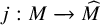 $j: M \to \widehat M$
be the completion map. Then there is some
$j: M \to \widehat M$
be the completion map. Then there is some $h\in \operatorname {\mathrm {Hom}}_R(N, \widehat {M})$
such that
$h\in \operatorname {\mathrm {Hom}}_R(N, \widehat {M})$
such that $h \circ \varphi = j$
. But since j is faithfully flat, it is pure, and hence
$h \circ \varphi = j$
. But since j is faithfully flat, it is pure, and hence $\varphi $
is pure.
$\varphi $
is pure.
Conversely, suppose $\varphi $
is pure. Then
$\varphi $
is pure. Then $\varphi \otimes 1_{M^\vee } :M \otimes _R M^\vee \to N \otimes _R M^\vee $
is injective, where
$\varphi \otimes 1_{M^\vee } :M \otimes _R M^\vee \to N \otimes _R M^\vee $
is injective, where $(-)^\vee = \operatorname {\mathrm {Hom}}_R(-, E_R(R/{\mathfrak {m}}))$
is the Matlis duality functor. Applying said functor to the resulting map, we get a surjective map
$(-)^\vee = \operatorname {\mathrm {Hom}}_R(-, E_R(R/{\mathfrak {m}}))$
is the Matlis duality functor. Applying said functor to the resulting map, we get a surjective map $(N \otimes _R M^\vee )^\vee {\xrightarrow {\ \ }\hspace {-0.8em}\rightarrow }(M \otimes _R M^\vee )^\vee $
. But then by Hom-tensor adjointness, along with the fact that the double Matlis dual of a finite module is its completion, we get
$(N \otimes _R M^\vee )^\vee {\xrightarrow {\ \ }\hspace {-0.8em}\rightarrow }(M \otimes _R M^\vee )^\vee $
. But then by Hom-tensor adjointness, along with the fact that the double Matlis dual of a finite module is its completion, we get $\operatorname {\mathrm {Hom}}_R(N,\widehat M) \cong \operatorname {\mathrm {Hom}}_R(N, M^{\vee \vee }) \cong (N \otimes _R M^\vee )^\vee {\xrightarrow {\ \ }\hspace {-0.8em}\rightarrow }(M \otimes _R M^\vee )^\vee \cong \operatorname {\mathrm {Hom}}_R(M, M^{\vee \vee }) = \operatorname {\mathrm {Hom}}_R(M, \widehat {M})$
. Moreover, since everything is natural, the map in question is the canonical map given in (b).
$\operatorname {\mathrm {Hom}}_R(N,\widehat M) \cong \operatorname {\mathrm {Hom}}_R(N, M^{\vee \vee }) \cong (N \otimes _R M^\vee )^\vee {\xrightarrow {\ \ }\hspace {-0.8em}\rightarrow }(M \otimes _R M^\vee )^\vee \cong \operatorname {\mathrm {Hom}}_R(M, M^{\vee \vee }) = \operatorname {\mathrm {Hom}}_R(M, \widehat {M})$
. Moreover, since everything is natural, the map in question is the canonical map given in (b).
For the final statement, in this case we have $M = \widehat {M}$
, so if
$M = \widehat {M}$
, so if $\varphi $
is pure, then by what we have proved, the canonical map
$\varphi $
is pure, then by what we have proved, the canonical map $\operatorname {\mathrm {Hom}}_R(N,M) \to \operatorname {\mathrm {Hom}}_R(M,M)$
is surjective. In particular, there exists
$\operatorname {\mathrm {Hom}}_R(N,M) \to \operatorname {\mathrm {Hom}}_R(M,M)$
is surjective. In particular, there exists $h \in \operatorname {\mathrm {Hom}}_R(N,M)$
with
$h \in \operatorname {\mathrm {Hom}}_R(N,M)$
with $1_M = h \circ \varphi $
. The converse is trivial.
$1_M = h \circ \varphi $
. The converse is trivial.
The next lemma gives a criterion for when the completion of a pure map of modules over a Noetherian local ring is pure over the completion. The result, however, is stated more generally. Note that no finiteness restrictions are imposed on the modules.
Lemma 2.2.4. Let R be a ring and I a finitely generated ideal of R such that $R/I$
is Noetherian. Let M be a flat R-module. Then we have the following:
$R/I$
is Noetherian. Let M be a flat R-module. Then we have the following:
-
(1)
$\widehat {M}^I$
is a flat module over the Noetherian ring
$\widehat {R}^I$
. -
(2) If
$\varphi \colon N \to M$
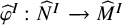
is a pure map of R-modules, then the induced map on I-adic completions
$ \widehat {\varphi }^I \colon \widehat {N}^I \to \widehat {M}^I $
is a pure map of
$\widehat {R}^I$
-modules.



Proof. (1) follows by [Reference Authors27, Tag 0AGW].
(2) Consider the short exact sequence
 $$\begin{align*}0 \to N \xrightarrow{\varphi} M \to \operatorname{\mathrm{coker}}(\varphi) \to 0. \end{align*}$$
Since $\varphi $
is R-pure and M is R-flat, both N and
$\varphi $
is R-pure and M is R-flat, both N and $\operatorname {\mathrm {coker}}(\varphi )$
are flat R-modules. This follows easily by the long exact sequence on
$\operatorname {\mathrm {coker}}(\varphi )$
are flat R-modules. This follows easily by the long exact sequence on $\operatorname {\mathrm {Tor}}$
and purity, but see for instance, [Reference Authors27, Tag 058P] for a more elementary diagram-chase proof. We then get a short exact sequence of flat
$\operatorname {\mathrm {Tor}}$
and purity, but see for instance, [Reference Authors27, Tag 058P] for a more elementary diagram-chase proof. We then get a short exact sequence of flat $\widehat {R}^I$
-modules
$\widehat {R}^I$
-modules
 $$\begin{align*}0 \to \widehat{N}^I \xrightarrow{\widehat{\varphi}^I} \widehat{M}^I \to \widehat{\operatorname{\mathrm{coker}}{\varphi}}^I \to 0 \end{align*}$$
by (1) and [Reference Authors27, Tag 0315 (3)]. Then $\widehat {\varphi }^I$
is a pure map of
$\widehat {\varphi }^I$
is a pure map of $\widehat {R}^I$
-modules by looking at the long-exact sequence on Tor because
$\widehat {R}^I$
-modules by looking at the long-exact sequence on Tor because $\widehat {\operatorname {\mathrm {coker}}(\varphi )}^I$
is
$\widehat {\operatorname {\mathrm {coker}}(\varphi )}^I$
is $\widehat {R}^I$
-flat, or alternatively, by using [Reference Authors27, Tag 058M].
$\widehat {R}^I$
-flat, or alternatively, by using [Reference Authors27, Tag 058M].
We also recall the following helpful result about pure maps.
Lemma 2.2.5 [Reference Lazard17, Cor. 2.4]
Let $\varphi \colon M \to N$
be a pure map of R-modules such that
$\varphi \colon M \to N$
be a pure map of R-modules such that $\operatorname {\mathrm {coker}}(\varphi )$
is a finitely presented R-module. Then
$\operatorname {\mathrm {coker}}(\varphi )$
is a finitely presented R-module. Then $\varphi $
splits, that is,
$\varphi $
splits, that is, $\varphi $
has a left-inverse in
$\varphi $
has a left-inverse in $\operatorname {\mathrm {Mod}}_R$
.
$\operatorname {\mathrm {Mod}}_R$
.
The next result is well-known, but for lack of an appropriate reference, we include a proof here.
Lemma 2.2.6. Let R be a ring and M be a flat R-module. Let N be a pure submodule of M (that is, the inclusion $\iota \colon N \hookrightarrow M$
is pure). Then N is also a flat R-module.
$\iota \colon N \hookrightarrow M$
is pure). Then N is also a flat R-module.
Proof. Let $f \colon P \to Q$
be an injective R-linear map. We get a commutative diagram
$f \colon P \to Q$
be an injective R-linear map. We get a commutative diagram

The map $\operatorname {\mathrm {id}}_P \otimes _R \iota $
is injective by purity of
$\operatorname {\mathrm {id}}_P \otimes _R \iota $
is injective by purity of $\iota $
and
$\iota $
and $f \otimes _R \operatorname {\mathrm {id}}_M$
is injective by flatness of M. Thus, by the commutativity of the above diagram,
$f \otimes _R \operatorname {\mathrm {id}}_M$
is injective by flatness of M. Thus, by the commutativity of the above diagram, $f \otimes _R \operatorname {\mathrm {id}}_N$
is also injective, that is, N is R-flat.
$f \otimes _R \operatorname {\mathrm {id}}_N$
is also injective, that is, N is R-flat.
2.3 Expansions of radical ideals
We will need the following result on the preservation of radical ideals under expansion along the completion map.
Lemma 2.3.1. Let A be a Noetherian ring such that for all prime ideals ${\mathfrak {p}}$
of A, the fibers of
${\mathfrak {p}}$
of A, the fibers of $A_{\mathfrak {p}} \to \widehat {A_{\mathfrak {p}}}$
are reduced. Then for any radical ideal I of A,
$A_{\mathfrak {p}} \to \widehat {A_{\mathfrak {p}}}$
are reduced. Then for any radical ideal I of A, $I\widehat {A_{\mathfrak {p}}}$
is a radical ideal of
$I\widehat {A_{\mathfrak {p}}}$
is a radical ideal of $\widehat {A_{\mathfrak {p}}}$
. Thus, for all ideals J of A,
$\widehat {A_{\mathfrak {p}}}$
. Thus, for all ideals J of A,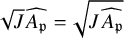 $\sqrt {J}\widehat {A_{\mathfrak {p}}} = \sqrt {J\widehat {A_{\mathfrak {p}}}}$
.
$\sqrt {J}\widehat {A_{\mathfrak {p}}} = \sqrt {J\widehat {A_{\mathfrak {p}}}}$
.
Proof. Since the property of being a radical ideal is preserved under arbitrary localization, we may assume A is local and ${\mathfrak {p}}$
is the maximal ideal
${\mathfrak {p}}$
is the maximal ideal ${\mathfrak {m}}$
of A. We let
${\mathfrak {m}}$
of A. We let $\widehat {A}$
denote the
$\widehat {A}$
denote the ${\mathfrak {m}}$
-adic completion of A. By hypothesis, the fibers of
${\mathfrak {m}}$
-adic completion of A. By hypothesis, the fibers of $A \to \widehat {A}$
are reduced. Let I be a radical ideal of A. Then
$A \to \widehat {A}$
are reduced. Let I be a radical ideal of A. Then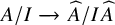 $ A/I \to \widehat {A}/I\widehat {A} $
is also a flat map of Noetherian rings with reduced fibers. Since
$ A/I \to \widehat {A}/I\widehat {A} $
is also a flat map of Noetherian rings with reduced fibers. Since $A/I$
is reduced by assumption,
$A/I$
is reduced by assumption, $\widehat {A}/I\widehat {A}$
is reduced by [Reference Authors27, Tag 0C21]. Thus,
$\widehat {A}/I\widehat {A}$
is reduced by [Reference Authors27, Tag 0C21]. Thus, $I\widehat {A}$
is a radical ideal of
$I\widehat {A}$
is a radical ideal of $\widehat A$
.
$\widehat A$
.
The second statement follows easily from the first and its proof is omitted.
3 Stabilizers and cyclic stabilizers
In this section, we will discuss in some detail the notions of domination and stabilizers developed in [Reference Raynaud and Gruson23, Part II]. The motivation for doing so is to create a natural framework for introducing the notion of a Mittag-Leffler module (Definition 3.2.1) that makes the relation of the notion to the well-studied concept of a pure map of modules most transparent. For completeness and the convenience of the reader, we shall give detailed proofs of the most important results needed from [Reference Raynaud and Gruson23, Part II]. We will also define a natural weakening of the notion of stabilizers, called cyclic stabilizers, and develop some of their basic properties. While the notion of a stabilizer captures the Mittag-Leffler condition, we will see that cyclic stabilizers will be related to a notion that we call Ohm-Rush (Definition 3.4.2). Ohm-Rush modules were first introduced by Ohm and Rush [Reference Ohm and Rush20] in relation with the content function for modules. The Ohm-Rush condition has been studied for the Frobenius homomorphism in prime characteristic commutative algebra in connection with test ideals [Reference Blickle, Mustaţǎ and Smith1, Reference Sharp25, Reference Sharp24].
3.1 Domination and stabilizers
In this subsection R denotes an arbitrary commutative ring that is not necessarily Noetherian. Also, a local ring for us is just a ring with a unique maximal ideal, that is, local rings are not necessarily Noetherian unless otherwise specified.
Definition 3.1.1. Let R be a ring and $f \colon P \to Q$
and
$f \colon P \to Q$
and $g \colon P \to M$
be two maps of R-modules with common domain P. We say g dominates f if for all R-modules N,
$g \colon P \to M$
be two maps of R-modules with common domain P. We say g dominates f if for all R-modules N, $ \mathrm{ker} (f \otimes _R \operatorname {\mathrm {id}}_N) \subseteq \mathrm{ker} (g \otimes _R \operatorname {\mathrm {id}}_N). $
The notion of domination satisfies the following properties:
Lemma 3.1.2. Let R be a ring and $f \colon P \to Q$
and
$f \colon P \to Q$
and $g \colon P \to M$
be R-linear maps. Then we have the following:
$g \colon P \to M$
be R-linear maps. Then we have the following:
-
(1) g dominates
$f \Longleftrightarrow $
for all finitely presented R-modules N,
$\mathrm{ker} (f \otimes _R \operatorname {\mathrm {id}}_N) \subseteq \mathrm{ker} (g \otimes _R \operatorname {\mathrm {id}}_N)$
. -
(2) If g factors through f, that is, if there exists a map
$\varphi \colon Q \to M$
such that
$g = \varphi \circ f$
, then g dominates f. The converse holds if
$\operatorname {\mathrm {coker}}(f)$
is finitely presented as an R-module. -
(3) Consider the pushout of f and g
Then g dominates
$f \Longleftrightarrow f'$
is a pure map of R-modules.
-
(4) Suppose there is a pure R-linear map
$\varphi \colon Q \to M$
such that
$g = \varphi \circ f$
. Then g and f dominate each other. -
(5) Consider a commutative diagram of R modules
where f and h dominate each other. Then
$f, g, h$
dominate each other in pairs.
-
(6) Consider a commutative diagram of R-modules
If f and g dominate each other, then
$h \circ f$
and g dominate each other.
-
(7) Suppose P is a finitely presented R-module and M is a flat R-module. Then any R-linear map
$g \colon P \to M$
dominates an R-linear map
$f \colon P \to Q$
, where Q is a free R-module of finite rank. -
(8) Suppose we have a surjective R-linear map
$\varphi \colon P' \twoheadrightarrow P$
. Then
$g \circ \varphi $
dominates
$f \circ \varphi $
if and only if g dominates f.




Proof. $(1)$
is [Reference Authors27, Tag 059C].
$(1)$
is [Reference Authors27, Tag 059C].
For $(2)$
, if g factors through f via
$(2)$
, if g factors through f via $\varphi $
, then it follows that for any R-module N,
$\varphi $
, then it follows that for any R-module N,
 $$\begin{align*}\mathrm{ker}(g \otimes_R \operatorname{\mathrm{id}}_N) = \mathrm{ker}((\varphi \otimes_R \operatorname{\mathrm{id}}_N) \circ (f \otimes_R \operatorname{\mathrm{id}}_N)) \supseteq \mathrm{ker}(f \otimes_R \operatorname{\mathrm{id}}_N). \end{align*}$$
Hence g dominates f. The converse follows by [Reference Authors27, Tag 059D]. $(3)$
follows by [Reference Authors27, Tag 0AUM].
$(3)$
follows by [Reference Authors27, Tag 0AUM]. $(4)$
Since
$(4)$
Since $\varphi $
is pure, for all R-modules N,
$\varphi $
is pure, for all R-modules N, $\mathrm{ker} (\varphi \otimes _R \operatorname {\mathrm {id}}_N) = 0$
. Thus,
$\mathrm{ker} (\varphi \otimes _R \operatorname {\mathrm {id}}_N) = 0$
. Thus,
 $$\begin{align*}\mathrm{ker}(g \otimes_R \operatorname{\mathrm{id}}_N) = \mathrm{ker}((\varphi \otimes_R \operatorname{\mathrm{id}}_N) \circ (f \otimes_R \operatorname{\mathrm{id}}_N)) = \mathrm{ker}(f \otimes_R \operatorname{\mathrm{id}}_N), \end{align*}$$
that is, g and f dominate each other. $(5)$
Since h factors through g and g factors through f, for all R-modules N, we have
$(5)$
Since h factors through g and g factors through f, for all R-modules N, we have
 $$\begin{align*}\mathrm{ker}(h \otimes_R \operatorname{\mathrm{id}}_N) = \mathrm{ker}(f \otimes_R \operatorname{\mathrm{id}}_N) \subseteq \mathrm{ker}(g \otimes_R \operatorname{\mathrm{id}}_N) \subseteq \mathrm{ker}(h \otimes_R \operatorname{\mathrm{id}}_N) = \mathrm{ker}(f \otimes_R \operatorname{\mathrm{id}}_N). \end{align*}$$
Thus, g and h dominate each other and g and f dominate each other. $(6)$
Note g dominates
$(6)$
Note g dominates $h \circ f$
by (2). On the other hand, for all R-modules N
$h \circ f$
by (2). On the other hand, for all R-modules N
 $$\begin{align*}\mathrm{ker}((h \circ f) \otimes_R \operatorname{\mathrm{id}}_N) = \mathrm{ker}((h \otimes_R \operatorname{\mathrm{id}}_N) \circ (f \otimes_R \operatorname{\mathrm{id}}_N)) \supseteq \mathrm{ker}(f \otimes_R \operatorname{\mathrm{id}}_N) = \mathrm{ker}(g \otimes_R \operatorname{\mathrm{id}}_N), \end{align*}$$
where the last equality follows because f and g dominate each other. This shows that $h \circ f$
dominates g.
$h \circ f$
dominates g. $(7)$
is [Reference Lazard17, Lem. 1.1]. It is the key lemma that leads to a proof of Lazard’s Theorem on flat modules being precisely the ones that are filtered colimits of free modules of finite rank [Reference Lazard17, Thm. 1.2].
$(7)$
is [Reference Lazard17, Lem. 1.1]. It is the key lemma that leads to a proof of Lazard’s Theorem on flat modules being precisely the ones that are filtered colimits of free modules of finite rank [Reference Lazard17, Thm. 1.2]. $(8)$
Since tensor product is right exact, for every R-module N, the induced map
$(8)$
Since tensor product is right exact, for every R-module N, the induced map $ \varphi \otimes _R \operatorname {\mathrm {id}}_N \colon P' \otimes _R N \to P \otimes _R N $
is also surjective. Now note that
$ \varphi \otimes _R \operatorname {\mathrm {id}}_N \colon P' \otimes _R N \to P \otimes _R N $
is also surjective. Now note that $\mathrm{ker} \left ((g \circ \varphi ) \otimes _R \operatorname {\mathrm {id}}_N\right )$
(resp.
$\mathrm{ker} \left ((g \circ \varphi ) \otimes _R \operatorname {\mathrm {id}}_N\right )$
(resp. $\mathrm{ker} \left ((f \circ \varphi ) \otimes _R \operatorname {\mathrm {id}}_N\right )$
) is the pre-image of
$\mathrm{ker} \left ((f \circ \varphi ) \otimes _R \operatorname {\mathrm {id}}_N\right )$
) is the pre-image of $\mathrm{ker} (g \otimes _R \operatorname {\mathrm {id}}_N)$
(resp.
$\mathrm{ker} (g \otimes _R \operatorname {\mathrm {id}}_N)$
(resp. $\mathrm{ker} (f \otimes _R \operatorname {\mathrm {id}}_N)$
) along the surjective map
$\mathrm{ker} (f \otimes _R \operatorname {\mathrm {id}}_N)$
) along the surjective map $\varphi \otimes _R \operatorname {\mathrm {id}}_N$
. Thus, we must have
$\varphi \otimes _R \operatorname {\mathrm {id}}_N$
. Thus, we must have
 $$\begin{align*}\mathrm{ker}(g \otimes_R \operatorname{\mathrm{id}}_N) \supseteq \mathrm{ker}(f \otimes_R \operatorname{\mathrm{id}}_N) \Longleftrightarrow \mathrm{ker}\left((g \circ \varphi) \otimes_R \operatorname{\mathrm{id}}_N\right) \supseteq \mathrm{ker}\left((f \circ \varphi) \otimes_R \operatorname{\mathrm{id}}_N\right). \end{align*}$$
Hence, g dominates f if and only if $g \circ \varphi $
dominates
$g \circ \varphi $
dominates $f \circ \varphi $
.
$f \circ \varphi $
.
Corollary 3.1.3. Let R be a ring and $f \colon P \to Q$
and
$f \colon P \to Q$
and $g \colon P \to M$
be R-linear maps. If g dominates f, then
$g \colon P \to M$
be R-linear maps. If g dominates f, then $\{{\mathfrak {p}} \in \operatorname {\mathrm {Spec}}(R) \colon g_{\mathfrak {p}} \text { is } R_{\mathfrak {p}}\text {-pure}\} \subseteq \{{\mathfrak {p}} \in \operatorname {\mathrm {Spec}}(R) \colon f_{\mathfrak {p}} \text { is } R_{\mathfrak {p}}\text {-pure}\}$
.
$\{{\mathfrak {p}} \in \operatorname {\mathrm {Spec}}(R) \colon g_{\mathfrak {p}} \text { is } R_{\mathfrak {p}}\text {-pure}\} \subseteq \{{\mathfrak {p}} \in \operatorname {\mathrm {Spec}}(R) \colon f_{\mathfrak {p}} \text { is } R_{\mathfrak {p}}\text {-pure}\}$
.
Proof. By Lemma 3.1.2 (3) the map $f'$
in the pushout square
$f'$
in the pushout square

is R-pure. Hence for all ${\mathfrak {p}} \in \operatorname {\mathrm {Spec}}(R)$
,
${\mathfrak {p}} \in \operatorname {\mathrm {Spec}}(R)$
, $f^{\prime }_{\mathfrak {p}}$
is a pure map of
$f^{\prime }_{\mathfrak {p}}$
is a pure map of $R_{\mathfrak {p}}$
-modules. Thus, if
$R_{\mathfrak {p}}$
-modules. Thus, if $g_{\mathfrak {p}}$
is
$g_{\mathfrak {p}}$
is $R_{\mathfrak {p}}$
-pure, then
$R_{\mathfrak {p}}$
-pure, then $ g^{\prime }_{\mathfrak {p}} \circ f_{\mathfrak {p}} = f^{\prime }_{\mathfrak {p}} \circ g_{\mathfrak {p}} $
is
$ g^{\prime }_{\mathfrak {p}} \circ f_{\mathfrak {p}} = f^{\prime }_{\mathfrak {p}} \circ g_{\mathfrak {p}} $
is $R_{\mathfrak {p}}$
-pure as well, and consequently,
$R_{\mathfrak {p}}$
-pure as well, and consequently, $f_{\mathfrak {p}}$
is a pure map of
$f_{\mathfrak {p}}$
is a pure map of $R_{\mathfrak {p}}$
-modules.
$R_{\mathfrak {p}}$
-modules.
Definition 3.1.4 [Reference Raynaud and Gruson23, Part II, Déf. 2.1.3]
Let R be a ring and $f \colon P \to Q$
and
$f \colon P \to Q$
and $g \colon P \to M$
be R-linear maps. Assume that both P and Q are finitely presented R-modules. We say f stabilizes g (or f is a stabilizer of g) if f and g dominate one another. We will say that g admits a stabilizer if there exists an f (with the same domain as g and a finitely presented codomain) that stabilizes g.
$g \colon P \to M$
be R-linear maps. Assume that both P and Q are finitely presented R-modules. We say f stabilizes g (or f is a stabilizer of g) if f and g dominate one another. We will say that g admits a stabilizer if there exists an f (with the same domain as g and a finitely presented codomain) that stabilizes g.
We have the following:
Lemma 3.1.5. Let R be a ring and $g \colon P \to M$
be a map of R-modules such that P is a finitely presented R-module. Then we have the following:
$g \colon P \to M$
be a map of R-modules such that P is a finitely presented R-module. Then we have the following:
-
(1) If
$f \colon P \to Q$
is a stabilizer of g, then g factors through f. -
(2) Let
$\{(L_i, u_{ij}) \colon i \in I\}$
be a direct system of finitely presented R-modules indexed by a filtered poset
$(I, \leq )$
such that
$ M = \operatorname {\mathrm {colim}}_i L_i. $
Let
$u_i \colon L_i \to M$
be the associated map for each
$i \in I$
. If g admits a stabilizer (resp. admits a stabilizer that factors through g), then there exists an index
$i \in I$
such that for all
$j \geq i$
, we have a map
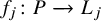
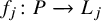
$f_j \colon P \to L_j$
that satisfies
$ g = u_j \circ f_j, \hspace {2mm} f_j = u_{ij} \circ f_i. $
Furthermore,
$f_j$
stabilizes g (resp.
$f_j$
stabilizes g and factors through g). -
(3) In the situation of
$(2)$
, suppose the index
$i \in I$
and the maps
$f_j \colon P \to L_j$
for
$j \geq i$
are chosen to satisfy the conclusion of
$(2)$
. Then for any R-module N and for all
$j \geq i$
,
$$\begin{align*}\operatorname{\mathrm{im}}\left(\operatorname{\mathrm{Hom}}_R(L_j, N) \xrightarrow{- \circ f_j} \operatorname{\mathrm{Hom}}_R(P, N)\right) = \operatorname{\mathrm{im}}\left(\operatorname{\mathrm{Hom}}_R(L_i, N) \xrightarrow{- \circ f_i} \operatorname{\mathrm{Hom}}_R(P, N)\right) \end{align*}$$












Proof. $(1)$
If f stabilizes g then by definition Q is a finitely presented R-module. Then g dominates f and
$(1)$
If f stabilizes g then by definition Q is a finitely presented R-module. Then g dominates f and $\operatorname {\mathrm {coker}}(f)$
is finitely presented because this cokernel is the quotient of a finitely presented module by a finitely generated submodule; see [Reference Authors27, Tag 0519 (4)]. Thus, g factors through f by Lemma 3.1.2
$\operatorname {\mathrm {coker}}(f)$
is finitely presented because this cokernel is the quotient of a finitely presented module by a finitely generated submodule; see [Reference Authors27, Tag 0519 (4)]. Thus, g factors through f by Lemma 3.1.2 $(2)$
.
$(2)$
. $(2)$
Let
$(2)$
Let $f \colon P \to Q$
be a stabilizer of g. Then g factors through f by
$f \colon P \to Q$
be a stabilizer of g. Then g factors through f by $(1)$
. Hence choose a map
$(1)$
. Hence choose a map $\varphi \colon Q \to M$
such that
$\varphi \colon Q \to M$
such that $ g = \varphi \circ f. $
Since P and Q are finitely presented and M is the filtered colimit of finitely presented modules
$ g = \varphi \circ f. $
Since P and Q are finitely presented and M is the filtered colimit of finitely presented modules $L_i$
, there exists an index
$L_i$
, there exists an index $i \in I$
such that
$i \in I$
such that $\varphi \colon Q \to M$
admits a lift to a map
$\varphi \colon Q \to M$
admits a lift to a map $\varphi _i \colon Q \to L_i$
along
$\varphi _i \colon Q \to L_i$
along $u_i$
, that is,
$u_i$
, that is,

For all $j \geq i$
, define
$j \geq i$
, define

Then
 $$\begin{align*}u_j \circ f_j = ((u_j \circ u_{ij}) \circ \varphi_i ) \circ f = (u_i \circ \varphi_i) \circ f = \varphi \circ f = g \end{align*}$$
by the choice of the index i. Moreover, since $u_{ii} = \operatorname {\mathrm {id}}_{L_i}$
, it follows that
$u_{ii} = \operatorname {\mathrm {id}}_{L_i}$
, it follows that $f_i = \varphi _i \circ f$
, and so,
$f_i = \varphi _i \circ f$
, and so,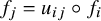 $ f_j = u_{ij} \circ f_i $
by definition of
$ f_j = u_{ij} \circ f_i $
by definition of $f_j$
for all
$f_j$
for all $j \geq i$
. It remains to show that
$j \geq i$
. It remains to show that $f_j$
stabilizes g.
$f_j$
stabilizes g.
Since g factors through $f_j$
, it follows that g dominates
$f_j$
, it follows that g dominates $f_j$
by Lemma 3.1.2
$f_j$
by Lemma 3.1.2 $(2)$
. On the other hand, for any R-module N
$(2)$
. On the other hand, for any R-module N
 $$\begin{align*}\mathrm{ker}(f_j \otimes_R \operatorname{\mathrm{id}}_N) = \mathrm{ker}((u_{ij} \circ \varphi_i \circ f) \otimes_R \operatorname{\mathrm{id}}_N) \supseteq \mathrm{ker}(f \otimes_R \operatorname{\mathrm{id}}_N) = \mathrm{ker}(g \otimes_R \operatorname{\mathrm{id}}_N), \end{align*}$$
where the last equality follows because f stabilizes g. This shows that $f_j$
dominates g, and so, g and
$f_j$
dominates g, and so, g and $f_j$
dominate each other, that is,
$f_j$
dominate each other, that is, $f_j$
stabilizes g, as desired.
$f_j$
stabilizes g, as desired.
Now suppose the stabilizer f also factors through g, that is, there exists $\phi \colon M \to Q$
such that
$\phi \colon M \to Q$
such that $ f = \phi \circ g. $
For the index
$ f = \phi \circ g. $
For the index $i \in I$
and the maps
$i \in I$
and the maps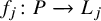 $f_j \colon P \to L_j$
for
$f_j \colon P \to L_j$
for $j \geq i$
chosen as above, if we define
$j \geq i$
chosen as above, if we define
 $$\begin{align*}\phi_j {:=}q M \xrightarrow{\phi} Q \xrightarrow{\varphi_i} L_i \xrightarrow{u_{ij}} L_j, \end{align*}$$
then $ \phi _j \circ g = (u_{ij} \circ \varphi _i \circ \phi ) \circ g = u_{ij} \circ \varphi _i \circ f = f_j, $
where the last equality follows by the definition of
$ \phi _j \circ g = (u_{ij} \circ \varphi _i \circ \phi ) \circ g = u_{ij} \circ \varphi _i \circ f = f_j, $
where the last equality follows by the definition of $f_j$
. Thus
$f_j$
. Thus $f_j$
stabilizes g and factors through g for all
$f_j$
stabilizes g and factors through g for all $j \geq i$
.
$j \geq i$
. $(3)$
For brevity, we will write the map
$(3)$
For brevity, we will write the map $\operatorname {\mathrm {Hom}}_R(L_j, N) \xrightarrow {- \circ f_j} \operatorname {\mathrm {Hom}}_R(P, N)$
as
$\operatorname {\mathrm {Hom}}_R(L_j, N) \xrightarrow {- \circ f_j} \operatorname {\mathrm {Hom}}_R(P, N)$
as $\operatorname {\mathrm {Hom}}_R(f_j, N)$
. In this new notation, we have to show that for all
$\operatorname {\mathrm {Hom}}_R(f_j, N)$
. In this new notation, we have to show that for all $j \geq i$
,
$j \geq i$
,
 $$\begin{align*}\operatorname{\mathrm{im}}\left(\operatorname{\mathrm{Hom}}_R(f_j, N)\right) = \operatorname{\mathrm{im}}\left(\operatorname{\mathrm{Hom}}_R(f_i, N)\right). \end{align*}$$
Since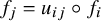 $f_j = u_{ij} \circ f_i$
for all
$f_j = u_{ij} \circ f_i$
for all $j \geq i$
, it follows that
$j \geq i$
, it follows that
 $$\begin{align*}\operatorname{\mathrm{im}}\left(\operatorname{\mathrm{Hom}}_R(f_j,N)\right) = \operatorname{\mathrm{im}}\left(\operatorname{\mathrm{Hom}}_R(f_i,N) \circ \operatorname{\mathrm{Hom}}_R(u_{ij},N)\right) \subseteq \operatorname{\mathrm{im}}\left(\operatorname{\mathrm{Hom}}_R(f_i,N)\right). \end{align*}$$
For all $j \geq i$
, we have a commutative diagram
$j \geq i$
, we have a commutative diagram

Since $f_i$
and g dominate each other, by Lemma 3.1.5 (5), for all
$f_i$
and g dominate each other, by Lemma 3.1.5 (5), for all $j \geq i$
,
$j \geq i$
, $f_i$
and
$f_i$
and $f_j$
also dominate each other. Since
$f_j$
also dominate each other. Since $\operatorname {\mathrm {coker}}(f_j)$
is finitely presented, it follows that
$\operatorname {\mathrm {coker}}(f_j)$
is finitely presented, it follows that $f_i$
factors through
$f_i$
factors through $f_j$
, that is, there exists
$f_j$
, that is, there exists $v_{ji} \colon L_j \to L_i$
such that
$v_{ji} \colon L_j \to L_i$
such that

Then $ \operatorname {\mathrm {im}}\left (\operatorname {\mathrm {Hom}}_R(f_i,N)\right ) = \operatorname {\mathrm {im}}\left (\operatorname {\mathrm {Hom}}_R(f_j,N) \circ \operatorname {\mathrm {Hom}}_R(v_{ji},N)\right ) \subseteq \operatorname {\mathrm {im}}\left (\operatorname {\mathrm {Hom}}_R(f_j,N)\right ). $
Using the previous lemmas, one can draw the following interesting consequence for stabilizers of maps to a flat module over a local ring. The result is [Reference Raynaud and Gruson23, Part II, Lem. 2.1.9], and its proof is provided for the convenience of the reader.
Proposition 3.1.6 [Reference Raynaud and Gruson23, Part II, Lem. 2.1.9] (c.f. Lemma 3.1.2 (7))
Let $(R, \mathfrak {m}, \kappa )$
be a local ring (not necessarily Noetherian). Let M be a flat R-module and
$(R, \mathfrak {m}, \kappa )$
be a local ring (not necessarily Noetherian). Let M be a flat R-module and $g \colon P \to M$
be an R-linear map, where P is a finitely presented R-module. If g admits a stabilizer, then there exists a submodule L of M such that all the following conditions are satisfied:
$g \colon P \to M$
be an R-linear map, where P is a finitely presented R-module. If g admits a stabilizer, then there exists a submodule L of M such that all the following conditions are satisfied:
-
(1) L is free of finite rank.
-
(2)
$L \subseteq M$
is a pure extension. -
(3)
$\operatorname {\mathrm {im}}(g) \subseteq L$
.


If L satisfies $(1)-(3)$
, then the map
$(1)-(3)$
, then the map $f \colon P \twoheadrightarrow \operatorname {\mathrm {im}}(g) \hookrightarrow L$
stabilizes g.
$f \colon P \twoheadrightarrow \operatorname {\mathrm {im}}(g) \hookrightarrow L$
stabilizes g.
Proof. If L satisfies $(1)-(3)$
then the map f stabilizes g by Lemma 3.1.2 (4). So now we show the existence of such an L.
$(1)-(3)$
then the map f stabilizes g by Lemma 3.1.2 (4). So now we show the existence of such an L.
By Lazard’s Theorem [Reference Lazard17, Thm. 1.2], M is a colimit of a system $\{(L_{i}, u_{ij}) \colon i, j \in I, i\leq j\}$
of free R-modules of finite rank indexed by a filtered poset
$\{(L_{i}, u_{ij}) \colon i, j \in I, i\leq j\}$
of free R-modules of finite rank indexed by a filtered poset $(I,\leq )$
. Here
$(I,\leq )$
. Here $u_{ij}$
denotes the transition map
$u_{ij}$
denotes the transition map $L_i \to L_j$
for
$L_i \to L_j$
for $i \leq j$
. We also let
$i \leq j$
. We also let $u_i \colon L_i \to M$
denote the associated maps for all i. Since g admits a stabilizer, by Lemma 3.1.5 parts (2) and (3), there exists an index
$u_i \colon L_i \to M$
denote the associated maps for all i. Since g admits a stabilizer, by Lemma 3.1.5 parts (2) and (3), there exists an index $i \in I$
such that for all
$i \in I$
such that for all $j \geq i$
, we have a map
$j \geq i$
, we have a map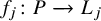 $ f_j \colon P \to L_j $
such that
$ f_j \colon P \to L_j $
such that $g = u_j \circ f_j, f_j = u_{ij} \circ f_i$
,
$g = u_j \circ f_j, f_j = u_{ij} \circ f_i$
, $f_j$
stabilizes g and
$f_j$
stabilizes g and $ \operatorname {\mathrm {im}}(\operatorname {\mathrm {Hom}}_R(f_j,R)) = \operatorname {\mathrm {im}}(\operatorname {\mathrm {Hom}}_R(f_i,R)). $
Let us call this stable image as S. Note that S is a finitely generated R-module, since it is a quotient of the free module
$ \operatorname {\mathrm {im}}(\operatorname {\mathrm {Hom}}_R(f_j,R)) = \operatorname {\mathrm {im}}(\operatorname {\mathrm {Hom}}_R(f_i,R)). $
Let us call this stable image as S. Note that S is a finitely generated R-module, since it is a quotient of the free module $\operatorname {\mathrm {Hom}}_R(L_i,R)$
. Let n be the minimal number of generators of S, that is,
$\operatorname {\mathrm {Hom}}_R(L_i,R)$
. Let n be the minimal number of generators of S, that is, $ n = \dim _k(S/\mathfrak {m} S). $
We then have a surjective R-linear map
$ n = \dim _k(S/\mathfrak {m} S). $
We then have a surjective R-linear map $ p \colon R^{\oplus n} \twoheadrightarrow S. $
By the choice of n, the induced map
$ p \colon R^{\oplus n} \twoheadrightarrow S. $
By the choice of n, the induced map $ p \otimes _R \operatorname {\mathrm {id}}_\kappa \colon \kappa ^{\oplus n} \to S/\mathfrak {m} S $
is an isomorphism. Consider the diagram
$ p \otimes _R \operatorname {\mathrm {id}}_\kappa \colon \kappa ^{\oplus n} \to S/\mathfrak {m} S $
is an isomorphism. Consider the diagram

The vertical map is the one obtained by restricting the codomain of $\operatorname {\mathrm {Hom}}_R(f_i,R)$
to
$\operatorname {\mathrm {Hom}}_R(f_i,R)$
to $S = \operatorname {\mathrm {im}}(\operatorname {\mathrm {Hom}}_R(f_i,R))$
. Since
$S = \operatorname {\mathrm {im}}(\operatorname {\mathrm {Hom}}_R(f_i,R))$
. Since $\operatorname {\mathrm {Hom}}_R(L_i,R)$
is a free, hence projective R-module, there exists an R-linear map
$\operatorname {\mathrm {Hom}}_R(L_i,R)$
is a free, hence projective R-module, there exists an R-linear map $q \colon \operatorname {\mathrm {Hom}}_R(L_i,R) \to R^{\oplus n}$
such that
$q \colon \operatorname {\mathrm {Hom}}_R(L_i,R) \to R^{\oplus n}$
such that
 $$ \begin{align} \operatorname{\mathrm{Hom}}_R(L_i,R) \twoheadrightarrow S = p \circ q. \end{align} $$
After tensoring by $\kappa $
and using that
$\kappa $
and using that $p \otimes _R \operatorname {\mathrm {id}}_\kappa $
is an isomorphism, it follows that
$p \otimes _R \operatorname {\mathrm {id}}_\kappa $
is an isomorphism, it follows that $q \otimes _R \operatorname {\mathrm {id}}_\kappa $
is also surjective. Then by Nakayama’s lemma, we see that q is surjective. Since the composition
$q \otimes _R \operatorname {\mathrm {id}}_\kappa $
is also surjective. Then by Nakayama’s lemma, we see that q is surjective. Since the composition
 $$\begin{align*}\operatorname{\mathrm{Hom}}_R(L_j,R) \xrightarrow{\operatorname{\mathrm{Hom}}_R(u_{ij}, R)} \operatorname{\mathrm{Hom}}_R(L_i,R) \twoheadrightarrow S \end{align*}$$
is surjective for all $j \geq i$
(S is the stable image
$j \geq i$
(S is the stable image $\operatorname {\mathrm {im}}(\operatorname {\mathrm {Hom}}_R(f_j,R))$
for all
$\operatorname {\mathrm {im}}(\operatorname {\mathrm {Hom}}_R(f_j,R))$
for all $j \geq i$
), it follows by the exact same reasoning as above that for all
$j \geq i$
), it follows by the exact same reasoning as above that for all $j \geq i$
,
$j \geq i$
,
 $$ \begin{align} q \circ \operatorname{\mathrm{Hom}}_R(u_{ij}, R) \colon \operatorname{\mathrm{Hom}}_R(L_j,R) \to R^{\oplus n} \end{align} $$
is also surjective. Applying $\operatorname {\mathrm {Hom}}_R(\hspace {2mm}, R)$
to the maps
$\operatorname {\mathrm {Hom}}_R(\hspace {2mm}, R)$
to the maps  and
and $ \operatorname {\mathrm {Hom}}_R(L_i,R) \xrightarrow {q} R^{\oplus n}, $
we get maps
$ \operatorname {\mathrm {Hom}}_R(L_i,R) \xrightarrow {q} R^{\oplus n}, $
we get maps

and

Here $P \to \operatorname {\mathrm {Hom}}_R(\operatorname {\mathrm {Hom}}_R(P,R),R)$
is the canonical map to the double dual, and we can make the identification
$P \to \operatorname {\mathrm {Hom}}_R(\operatorname {\mathrm {Hom}}_R(P,R),R)$
is the canonical map to the double dual, and we can make the identification $\operatorname {\mathrm {Hom}}_R(\operatorname {\mathrm {Hom}}_R(L_i,R),R) \cong L_i$
since
$\operatorname {\mathrm {Hom}}_R(\operatorname {\mathrm {Hom}}_R(L_i,R),R) \cong L_i$
since $L_i$
is free of finite rank. By (3.1.6.1),
$L_i$
is free of finite rank. By (3.1.6.1), $ t\circ s = f_i. $
Then
$ t\circ s = f_i. $
Then $u_i \circ (t \circ s) = u_i \circ f_i = g$
, and so,
$u_i \circ (t \circ s) = u_i \circ f_i = g$
, and so,
 $$ \begin{align} \operatorname{\mathrm{im}}(g) \subseteq \operatorname{\mathrm{im}}(u_i \circ t). \end{align} $$
We also have $ u_i \circ t = \operatorname {\mathrm {colim}}_{j \geq i} u_{ij} \circ t, $
where each
$ u_i \circ t = \operatorname {\mathrm {colim}}_{j \geq i} u_{ij} \circ t, $
where each $u_{ij} \circ t$
admits a left-inverse because it can be identified with the map obtained by applying
$u_{ij} \circ t$
admits a left-inverse because it can be identified with the map obtained by applying $\operatorname {\mathrm {Hom}}_R(\bullet , R)$
to the surjective map of free modules (3.1.6.2)
$\operatorname {\mathrm {Hom}}_R(\bullet , R)$
to the surjective map of free modules (3.1.6.2) $ q \circ \operatorname {\mathrm {Hom}}_R(u_{ij},R) $
which always has a right-inverse. Since a filtered colimit of split maps is pure, it follows that
$ q \circ \operatorname {\mathrm {Hom}}_R(u_{ij},R) $
which always has a right-inverse. Since a filtered colimit of split maps is pure, it follows that $u_i \circ t \colon \operatorname {\mathrm {Hom}}_R(R^{\oplus n},R) \to M$
is a pure map. Taking
$u_i \circ t \colon \operatorname {\mathrm {Hom}}_R(R^{\oplus n},R) \to M$
is a pure map. Taking $L {:=}q \operatorname {\mathrm {im}}(u_i \circ t) \cong R^{\oplus n}$
, (3.1.6.3) shows that L satisfies properties
$L {:=}q \operatorname {\mathrm {im}}(u_i \circ t) \cong R^{\oplus n}$
, (3.1.6.3) shows that L satisfies properties $(1)-(3)$
.
$(1)-(3)$
.
3.2 Mittag-Leffler and strictly Mittag-Leffler modules
The notion of a Mittag-Leffler module was introduced by Raynaud and Gruson to study faithfully flat descent of projectivity [Reference Raynaud and Gruson23, Part II]. Mittag-Leffler modules have a long history, and there are many equivalent definitions/characterizations for this notion. We choose Raynaud and Gruson’s original definition, in part because this perspective makes the connection between the Mittag-Leffler property and pure (aka universally injective) maps of modules clearest.
Definition 3.2.1 [Reference Raynaud and Gruson23, Part II, Déf. 2.1.3]
Let R be a ring. An R-module M is Mittag-Leffler, abbreviated ML, if any finitely presented R-module P and R-linear map $g: P \to M$
admits a stabilizer. That is, there exists a finitely presented module Q and an R-linear map
$g: P \to M$
admits a stabilizer. That is, there exists a finitely presented module Q and an R-linear map $f: P \to Q$
such that f and g dominate each other.
$f: P \to Q$
such that f and g dominate each other.
Example 3.2.2. Any finitely presented R-module is automatically ML.
In Definition 3.2.1, since $f \colon P \to Q$
is a map of finitely presented R-modules,
$f \colon P \to Q$
is a map of finitely presented R-modules, $\operatorname {\mathrm {coker}}(f)$
is also a finitely presented R-module by [Reference Authors27, Tag 0519 (4)] because
$\operatorname {\mathrm {coker}}(f)$
is also a finitely presented R-module by [Reference Authors27, Tag 0519 (4)] because $\operatorname {\mathrm {im}}(f)$
is a finitely generated R-module and one has a short exact sequence
$\operatorname {\mathrm {im}}(f)$
is a finitely generated R-module and one has a short exact sequence
 $$\begin{align*}0 \to \operatorname{\mathrm{im}}(f) \to Q \to \operatorname{\mathrm{coker}}(f) \to 0. \end{align*}$$
Hence by Lemma 3.1.2 $(2)$
, the map
$(2)$
, the map $g \colon P \to M$
factors through f. However,
$g \colon P \to M$
factors through f. However, $f \colon P \to Q$
does not necessarily factor through g because
$f \colon P \to Q$
does not necessarily factor through g because $\operatorname {\mathrm {coker}}(g)$
is not necessarily finitely presented – in fact,
$\operatorname {\mathrm {coker}}(g)$
is not necessarily finitely presented – in fact, $\operatorname {\mathrm {coker}}(g)$
may not even be finitely generated if M is not finitely generated. This observation leads to the strengthening of the notion of a Mittag-Leffler module.
$\operatorname {\mathrm {coker}}(g)$
may not even be finitely generated if M is not finitely generated. This observation leads to the strengthening of the notion of a Mittag-Leffler module.
Definition 3.2.3 [Reference Raynaud and Gruson23, Part II, Déf. 2.3.1]
An R-module M is strictly Mittag-Leffler, abbreviated SML, if for any finitely presented R-module P and any R-linear map $g \colon P \to M$
, there exists a finitely presented R-module Q and an R-linear map
$g \colon P \to M$
, there exists a finitely presented R-module Q and an R-linear map $f \colon P \to Q$
such that g factors through f and f factors through g.
$f \colon P \to Q$
such that g factors through f and f factors through g.
Remark 3.2.4. Let R be a ring and M be an R-module.
-
(a) (SML implies ML) If M is a SML R-module then M is a ML R-module by Lemma 3.1.2
$(2)$
. The converse holds for modules over a Noetherian complete local ring; see Proposition 3.2.7. -
(b) (ML and tensor product with arbitrary products) One can show that an R-module M is ML if and only if for any family of R-modules
$\{Q_i\}_{i \in \Lambda }$
, the canonical map
$ \left ( \prod _{i \in \Lambda } Q_{i} \right ) \otimes _R M \to \prod _{i \in \Lambda } (Q_{i} \otimes _R M) $
is injective [Reference Raynaud and Gruson23, Part II, Prop. 2.1.5] (alternate reference [Reference Authors27, Tag 059M]). This alternate characterization implies that the property of being Mittag-Leffler is preserved under arbitrary base change. That is, if M is a ML R-module and
$R \to S$
is a ring map, then
$S \otimes _R M$
is a ML S-module. Indeed, if
$\{Q_i\}_{i \in \Lambda }$
is a collection of S-modules, then the natural map can be identified with
$$\begin{align*}\left(\prod_{i \in \Lambda} Q_i\right) \otimes_S (S \otimes_R M) \to \prod_{i \in \Lambda} (Q_i \otimes_S (S \otimes_R M)) \end{align*}$$
The latter map is injective because M is a ML R-module.
$$\begin{align*}\left(\prod_{i \in \Lambda} Q_i\right) \otimes_R M \to \prod_{i \in \Lambda} (Q_i \otimes_R M). \end{align*}$$
-
(c) (Pure submodule of ML/SML is ML/SML) If M is a ML (resp. SML) R-module and N is a pure submodule of M, then N is a ML (resp. SML) R-module. Indeed, if
$g \colon P \to N$
is an R-linear map such that P is finitely presented, then the composition
$g' {:=}q P \xrightarrow {g} N \subseteq M$
admits a stabilizer
$f \colon P \to Q$
(resp. admits a stabilizer that
$g'$
factors) because M is ML (resp. is SML). Purity of the inclusion
$N \subseteq M$
implies that for all R-modules T,
$\mathrm{ker} (g \otimes _R \operatorname {\mathrm {id}}_T) = \mathrm{ker} (g' \otimes _R \operatorname {\mathrm {id}}_T) = \mathrm{ker} (f \otimes _R \operatorname {\mathrm {id}}_T)$
. Thus, f and g dominate each other, and so, f factors g by Lemma 3.1.2 (2) because
$\operatorname {\mathrm {coker}}(f)$
is finitely presented. If
$g'$
factors f, then g also factors f because g factors
$g'$
by definition
$g'$
. Thus, N is ML (resp. is SML). -
(d) (Testing ML with maps from finite free modules) As a consequence of Lemma 3.1.2 (8), we have that an R-module M is ML if and only if for every free module F of finite rank, every R-linear map
$g \colon F \to M$
admits a stabilizer. In other words, in Definition 3.2.1 it suffices to assume that P is a free module of finite rank. The key point here is that if
$g' \colon P \to M$
is an R-linear map from a finitely presented R-module P that is not necessarily free, then choosing an R-linear surjection
$\varphi \colon F \twoheadrightarrow P$
from a free module F of finite rank, one sees that if
$f \colon F \to Q$
is a map of finitely presented R-modules such that f and
$g' \circ \varphi $
dominate one another, then f factors through P along the surjective map
$\varphi $
. That is, there exists an R-linear map
$f' \colon P \to Q$
such that
$f = f' \circ \varphi $
. This is because the hypothesis of mutual domination between f and
$g' \circ \varphi $
ensures that
$\mathrm{ker} (f) = \mathrm{ker} (g' \circ \varphi ) \supseteq \mathrm{ker} (\varphi )$
. Since
$f = f' \circ \varphi $
and
$g' \circ \varphi $
dominate each other and
$\varphi $
is surjective,
$f'$
and
$g'$
also dominate one another by Lemma 3.1.2 (8). -
(e) (ML and filtered colimits of modules) Let
$\{(L_{i}, \varphi _{ij}) \colon i, j \in I, i \leq j\}$
be a system of R-modules indexed by a filtered poset
$(I, \leq )$
such that each
$L_i$
is a ML R-module and the transition maps
$\varphi _{ij}$
are pure. Then
$M {:=}q \operatorname {\mathrm {colim}}_{i \in I} L_i$
is also a ML R-module. Indeed, the associated maps
$\varphi _i \colon L_i \to M$
are R-pure (being a filtered colimit of pure maps). If P is a finitely presented R-module and
$g \colon P \to M$
is an R-linear map, then there exists
$i \in I$
and
$g_i \colon P \to L_i$
such that
$ g = \varphi _i \circ g_i. $
Then
$g_i$
and g dominate each other by Lemma 3.1.2 (4). Since
$L_i$
is ML,
$g_i$
admits a stabilizer
$f \colon P \to Q$
, that is, Q is finitely presented and
$g_i$
and f dominate each other. Hence g and f also dominate each other, that is, f stabilizes g. -
(f) (ML and restriction of scalars) As an application of (b) one can show the following fact about the behavior of ML modules under restriction of scalars. Let
$R \to S$
be a ML ring map and let M be a flat and ML S-module. Then M is a ML R-module. The interested reader can see [Reference Authors27, Tag 05CT] for a proof. -
(g) (Pure maps to SML split) Let
$\varphi \colon P \to M$
be a pure R-linear map, where P is finitely presented and M is SML. Then
$\varphi $
splits. Indeed, let Q be a finitely presented R-module and
$\phi \colon P \to Q$
be a linear map such that
$\varphi $
factors through
$\phi $
and
$\phi $
factors through
$\varphi $
. Since
$\varphi $
is R-pure and factors through
$\phi $
, it follows that
$\phi $
is also R-pure. Since the cokernel of a map of finitely presented modules is also finitely presented, it follows that
$\phi $
splits (Lemma 2.2.5), that is, there exists
$u \colon Q \to P$
such that
$u \circ \phi = \operatorname {\mathrm {id}}_P$
. Let
$f \colon M \to Q$
be a linear map such that
$ \phi = f \circ \varphi. $
Then
$\operatorname {\mathrm {id}}_P = u \circ \phi = (u \circ f) \circ \varphi $
, that is,
$\varphi $
splits. -
(h) (Free modules are SML) A free R-module F is SML and hence is also Mittag-Leffler. Indeed, let P be a finitely presented R-module and
$g \colon P \to F$
be a linear map. Since
$\operatorname {\mathrm {im}}(g)$
is finitely generated, let Q be a finitely generated free summand of F that contains
$\operatorname {\mathrm {im}}(g)$
and let
$f \colon P \to Q$
be the composition
$P \xrightarrow {g} \operatorname {\mathrm {im}}(g) \hookrightarrow Q$
. By construction, g factors through f via the inclusion
$Q \hookrightarrow F$
. Also, since Q is a summand of F, choosing a left-inverse
$u \colon F \to Q$
of
$Q \hookrightarrow F$
, we get
$u \circ g = f$
. Thus, f factors through g. -
(i) (Projective modules are SML) A consequence of (h) and (c) is that any projective R-module is SML and hence is also ML. Furthermore, if M admits a countable generating set as an R-module, then M is projective if and only if M is a flat SML R-module [Reference Raynaud and Gruson23, Part II, Cor. 2.2.2].



























Let $\{(L_i, \varphi _{ij}) \colon i, j \in I, i \leq j\}$
be a direct system of R-modules indexed by a filtered poset
$\{(L_i, \varphi _{ij}) \colon i, j \in I, i \leq j\}$
be a direct system of R-modules indexed by a filtered poset $(I, \leq )$
, and let
$(I, \leq )$
, and let $ M {:=}q \operatorname {\mathrm {colim}}_{i \in I} L_i. $
For all
$ M {:=}q \operatorname {\mathrm {colim}}_{i \in I} L_i. $
For all $i \in I$
, let
$i \in I$
, let $\varphi _i \colon L_i \to M$
be the canonical maps. Then for any R-module N, we get a filtered inverse system of R-modules
$\varphi _i \colon L_i \to M$
be the canonical maps. Then for any R-module N, we get a filtered inverse system of R-modules $\{(\operatorname {\mathrm {Hom}}_R(L_i, N), \operatorname {\mathrm {Hom}}_R(\varphi _{ij}, N)) \colon i, j \in I, i \leq j\}$
. Note that for all
$\{(\operatorname {\mathrm {Hom}}_R(L_i, N), \operatorname {\mathrm {Hom}}_R(\varphi _{ij}, N)) \colon i, j \in I, i \leq j\}$
. Note that for all $j \geq j$
,
$j \geq j$
, $ \operatorname {\mathrm {Hom}}_R(\varphi _i, N) = \operatorname {\mathrm {Hom}}_R(\varphi _{ij}, N) \circ \operatorname {\mathrm {Hom}}_R(\varphi _j, N), $
and so,
$ \operatorname {\mathrm {Hom}}_R(\varphi _i, N) = \operatorname {\mathrm {Hom}}_R(\varphi _{ij}, N) \circ \operatorname {\mathrm {Hom}}_R(\varphi _j, N), $
and so, $ \operatorname {\mathrm {im}}(\operatorname {\mathrm {Hom}}_R(\varphi _i, N)) \subseteq \bigcap _{j \geq i} \operatorname {\mathrm {im}}(\operatorname {\mathrm {Hom}}_R(\varphi _{ij}, N)). $
There are two natural questions one can ask about the above inverse system (that depends on N):
-
(⋆) For each
$i \in I$
, does
$\bigcap _{j \geq i} \operatorname {\mathrm {im}}(\operatorname {\mathrm {Hom}}_R(\varphi _{ij}, N))$
stabilize? That is, is there some
$j_0 \in I$
(depending on i) such that
$j_0 \geq i$
and
$ \bigcap _{j \geq i} \operatorname {\mathrm {im}}(\operatorname {\mathrm {Hom}}_R(\varphi _{ij}, N)) = \operatorname {\mathrm {im}}(\operatorname {\mathrm {Hom}}_R(\varphi _{ij_0}, N))? $
Such a
$j_0$
exists if and only if there exists a
$j_0$
such that
$j_0 \geq i$
and for all
$k \geq j_0$
,
$ \operatorname {\mathrm {im}}(\operatorname {\mathrm {Hom}}_R(\varphi _{ij_0}, N)) = \operatorname {\mathrm {im}}(\operatorname {\mathrm {Hom}}_R(\varphi _{ik}, N)). $
-
(⋆⋆) A stronger question one can ask is: does
$\bigcap _{j\geq i} \operatorname {\mathrm {im}}(\operatorname {\mathrm {Hom}}_R(\varphi _{ij}, N))$
stabilize for each
$i \in I$
and, moreover, does this stable set coincide with
$\operatorname {\mathrm {im}}(\operatorname {\mathrm {Hom}}_R(\varphi _i, N))$
? Equivalently, for each
$i \in I$
is there a
$j_0 \in I$
(depending on i) such that
$j_0 \geq i$
and
$ \operatorname {\mathrm {im}}(\operatorname {\mathrm {Hom}}_R(\varphi _i, N)) = \operatorname {\mathrm {im}}(\operatorname {\mathrm {Hom}}_R(\varphi _{ij_0}, N))? $
Such a
$j_0$
exists if and only if there exists a
$j_0$
such that
$j_0 \geq i$
and for all
$k \geq j_0$
,
$ \operatorname {\mathrm {im}}(\operatorname {\mathrm {Hom}}_R(\varphi _i, N)) = \operatorname {\mathrm {im}}(\operatorname {\mathrm {Hom}}_R(\varphi _{ik}, N)). $

















The difference between ( $\bigstar $
) and (
$\bigstar $
) and ( $\bigstar \bigstar $
) is the difference between a ML R-module and a SML R-module.
$\bigstar \bigstar $
) is the difference between a ML R-module and a SML R-module.
Theorem 3.2.5. Let $\{(L_i, \varphi _{ij}) \colon i, j \in I, i \leq j\}$
be a system of finitely presented R-modules indexed by a filtered poset
$\{(L_i, \varphi _{ij}) \colon i, j \in I, i \leq j\}$
be a system of finitely presented R-modules indexed by a filtered poset $(I, \leq )$
, and let
$(I, \leq )$
, and let $ M {:=}q \operatorname {\mathrm {colim}}_{i \in I} L_i. $
For all
$ M {:=}q \operatorname {\mathrm {colim}}_{i \in I} L_i. $
For all $i \in I$
, let
$i \in I$
, let $\varphi _i \colon L_i \to M$
be the canonical maps. Then we have the following:
$\varphi _i \colon L_i \to M$
be the canonical maps. Then we have the following:
-
(1) M is ML if and only if for all R-modules N and for all
$i \in I$
,
$\bigcap _{j \geq i} \operatorname {\mathrm {im}}(\operatorname {\mathrm {Hom}}_R(\varphi _{ij}, N))$
stabilizes in the sense of (
$\bigstar $
). -
(2) M is SML if and only if for all R-modules N and for all
$i \in I$
,
$\bigcap _{j \geq i} \operatorname {\mathrm {im}}(\operatorname {\mathrm {Hom}}_R(\varphi _{ij}, N))$
stabilizes to
$\operatorname {\mathrm {im}}(\operatorname {\mathrm {Hom}}_R(\varphi _i, N))$
in the sense of (
$\bigstar \bigstar $
).







Proof. (1) follows from [Reference Raynaud and Gruson23, Part II, Prop. 2.1.4 $(i)\iff (iii)$
] (alternate reference [Reference Authors27, Tag 059E]). Note that the implication
$(i)\iff (iii)$
] (alternate reference [Reference Authors27, Tag 059E]). Note that the implication $\implies $
in (1) follows from Lemma 3.1.5. The assertion in (2) follows from [Reference Raynaud and Gruson23, Part II, Prop. 2.3.2
$\implies $
in (1) follows from Lemma 3.1.5. The assertion in (2) follows from [Reference Raynaud and Gruson23, Part II, Prop. 2.3.2 $(i)\iff (iii)$
].
$(i)\iff (iii)$
].
Recall that Lazard’s Theorem characterizes flat R-modules as precisely those that can be written as a filtered colimit of free modules of finite rank. In general, one cannot guarantee the maps from these free modules to the flat module to be well-behaved in any way (for example, one cannot guarantee that a flat R-module is a filtered union of free submodules of finite rank). However, Proposition 3.1.6 has the following straightforward consequence for flat ML modules and flat SML modules over local rings.
Proposition 3.2.6. Let $(R, {\mathfrak {m}}, \kappa )$
be a local ring (not necessarily Noetherian) and let M be an R-module. We have the following:
$(R, {\mathfrak {m}}, \kappa )$
be a local ring (not necessarily Noetherian) and let M be an R-module. We have the following:
-
(1) M is flat and ML if and only if M is a filtered union of finitely generated free submodules that are pure in M.
-
(2) M is flat and SML if and only if M is a filtered union of finitely generated free submodules that are direct summands of M.
Proof. (1) A filtered colimit of free modules is flat. Thus, the “if” implication follows by Remark 3.2.4 (e) because free modules of finite rank are finitely presented, and hence, ML. Now suppose M is a flat ML R-module. We know that M is a filtered union of its finitely generated submodules. Thus, it suffices to show that if N is a finitely generated submodule of M, then there exists a submodule L of M such that $N \subseteq L$
, L is free of finite rank and
$N \subseteq L$
, L is free of finite rank and $L \hookrightarrow M$
is pure. But this follows upon choosing a map
$L \hookrightarrow M$
is pure. But this follows upon choosing a map $g \colon F \to M$
from a free module F of finite rank that surjects onto N and observing that since g admits a stabilizer (M is ML), it must admit one
$g \colon F \to M$
from a free module F of finite rank that surjects onto N and observing that since g admits a stabilizer (M is ML), it must admit one $f \colon F \to L$
where L has the desired properties by Proposition 3.1.6.
$f \colon F \to L$
where L has the desired properties by Proposition 3.1.6.
(2) Since a SML module is ML, it follows by (a) that a flat and SML R-module is a filtered union of finitely generated free submodules that are pure in M. But such a submodule must also be direct summand of M by Remark 3.2.4 (g). This proves the forward implication. Conversely, suppose M is a filtered union of finitely generated free submodules that are direct summands of M. Then M is flat since it is a filtered colimit of free modules. Moreover, free modules are SML by Remark 3.2.4 (h).
Thus, it suffices to show that if M is a filtered union of SML submodules that are direct summands of M, then M is also SML. Let P be a finitely presented R-module and $g \colon P \to M$
be R-linear. Then there exists a SML direct summand
$g \colon P \to M$
be R-linear. Then there exists a SML direct summand $M'$
of M such that
$M'$
of M such that $\operatorname {\mathrm {im}}(g) \subseteq M'$
. Let
$\operatorname {\mathrm {im}}(g) \subseteq M'$
. Let $u \colon M \to M'$
be a left-inverse of the inclusion
$u \colon M \to M'$
be a left-inverse of the inclusion $M' \hookrightarrow M$
. Let
$M' \hookrightarrow M$
. Let $g' \colon P \to M'$
be the composition
$g' \colon P \to M'$
be the composition $P \xrightarrow {g} \operatorname {\mathrm {im}}(g) \hookrightarrow M'$
. Since
$P \xrightarrow {g} \operatorname {\mathrm {im}}(g) \hookrightarrow M'$
. Since $M'$
is SML, there exists a finitely presented R-module Q and a map
$M'$
is SML, there exists a finitely presented R-module Q and a map $f \colon P \to Q$
such that
$f \colon P \to Q$
such that $g'$
factors through f and f factors through
$g'$
factors through f and f factors through $g'$
. Since g factors through
$g'$
. Since g factors through $g'$
, it follows that g factors through f. Furthermore, since
$g'$
, it follows that g factors through f. Furthermore, since $g'$
factors through g via u, it follows that f also factors through g. Thus, M is SML.
$g'$
factors through g via u, it follows that f also factors through g. Thus, M is SML.
The next result shows that the ML and SML properties coincide for modules over a Noetherian complete local ring.
Proposition 3.2.7. Let $(R, {\mathfrak {m}})$
be a Noetherian local ring that is
$(R, {\mathfrak {m}})$
be a Noetherian local ring that is ${\mathfrak {m}}$
-adically complete. Let M be an R-module. Then the following are equivalent:
${\mathfrak {m}}$
-adically complete. Let M be an R-module. Then the following are equivalent:
-
(1) M is a ML R-module.
-
(2) M is a SML R-module.
Proof. Since we are working over a Noetherian ring, finitely generated is the same as being finitely presented for modules.
Given Remark 3.2.4 (a), for the equivalence of $(1)$
and
$(1)$
and $(2)$
it suffices to show that if M is ML then M is SML. Let P be a finitely generated R-module and let
$(2)$
it suffices to show that if M is ML then M is SML. Let P be a finitely generated R-module and let $g \colon P \to M$
be an R-linear map. Since M is ML, there exists a finitely generated R-module Q and an R-linear map
$g \colon P \to M$
be an R-linear map. Since M is ML, there exists a finitely generated R-module Q and an R-linear map $f \colon P \to Q$
such that g and f dominate one another. Thus, if one forms the pushout square
$f \colon P \to Q$
such that g and f dominate one another. Thus, if one forms the pushout square

then both $f'$
and
$f'$
and $g'$
are pure maps of R-modules by Lemma 3.1.2 (3). Since
$g'$
are pure maps of R-modules by Lemma 3.1.2 (3). Since $\operatorname {\mathrm {coker}}(f)$
is finitely presented, it follows by Lemma 3.1.2
$\operatorname {\mathrm {coker}}(f)$
is finitely presented, it follows by Lemma 3.1.2 $(2)$
that g factors through f. Thus, it remains to show by Definition 3.2.3 that f factors through g.
$(2)$
that g factors through f. Thus, it remains to show by Definition 3.2.3 that f factors through g.
The map $g' \colon Q \to N$
is a pure map of modules over a Noetherian complete local ring such that Q is a finitely generated R-module. Thus, by Lemma 2.2.3,
$g' \colon Q \to N$
is a pure map of modules over a Noetherian complete local ring such that Q is a finitely generated R-module. Thus, by Lemma 2.2.3, $g'$
admits an R-linear left-inverse
$g'$
admits an R-linear left-inverse $\varphi \colon N \to Q,$
that is,
$\varphi \colon N \to Q,$
that is,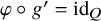 $\varphi \circ g' = \operatorname {\mathrm {id}}_Q$
. Then by the commutativity of the above diagram,
$\varphi \circ g' = \operatorname {\mathrm {id}}_Q$
. Then by the commutativity of the above diagram, $ (\varphi \circ f') \circ g = \varphi \circ (f' \circ g) = \varphi \circ (g' \circ f) = (\varphi \circ g') \circ f = f. $
That is, f factors through g as desired.
$ (\varphi \circ f') \circ g = \varphi \circ (f' \circ g) = \varphi \circ (g' \circ f) = (\varphi \circ g') \circ f = f. $
That is, f factors through g as desired.
3.3 Cyclic domination and cyclic stabilizers
Recall that we say that a map of R-modules $M \to N$
is cyclically pure if for all cyclic R-modules P, the induced map
$M \to N$
is cyclically pure if for all cyclic R-modules P, the induced map $M \otimes _R P \to N \otimes _R P$
is injective.
$M \otimes _R P \to N \otimes _R P$
is injective.
It is clear that pure maps are always cyclically pure. We have the following general situation where the converse holds; see also [Reference Hochster9] for other nontrivial instances where cyclic purity implies purity.
Lemma 3.3.1. Let R be a ring and $\varphi \colon M \to N$
be an R-linear map such that N is a flat R-module. Then
$\varphi \colon M \to N$
be an R-linear map such that N is a flat R-module. Then $\varphi $
is cyclically pure if and only if
$\varphi $
is cyclically pure if and only if $\varphi $
is pure.
$\varphi $
is pure.
Proof. This is [Reference Authors27, Tag 0AS5].
Given that the notion of domination is intimately tied to the notion of purity (see Lemma 3.1.2 (3)), it natural to develop a cyclic version of domination that will relate to cyclic purity.
Definition 3.3.2. Let R be a ring and $f \colon P \to Q$
and
$f \colon P \to Q$
and $g \colon P \to M$
be two maps of R-modules. Then g cyclically dominates f if for all cyclic R-modules N,
$g \colon P \to M$
be two maps of R-modules. Then g cyclically dominates f if for all cyclic R-modules N, $\mathrm{ker} (f \otimes _R \operatorname {\mathrm {id}}_N) \subseteq \mathrm{ker} (g \otimes _R \operatorname {\mathrm {id}}_N)$
.
$\mathrm{ker} (f \otimes _R \operatorname {\mathrm {id}}_N) \subseteq \mathrm{ker} (g \otimes _R \operatorname {\mathrm {id}}_N)$
.
Lemma 3.3.3. Let R be a ring and $f \colon P \to Q$
and
$f \colon P \to Q$
and $g \colon P \to M$
be R-linear maps. Consider the pushout of f and g
$g \colon P \to M$
be R-linear maps. Consider the pushout of f and g

Then g cyclically dominates f if and only if $f'$
is a cyclically pure map of R-modules.
$f'$
is a cyclically pure map of R-modules.
Proof. The proof of [Reference Authors27, Tag 0AUM] readily adapts to yield the assertion. We omit the details.
Lemma 3.3.4. Suppose we have a commutative diagram of R-modules

where $\varphi $
is cyclically pure. Then f and g cyclically dominate each other.
$\varphi $
is cyclically pure. Then f and g cyclically dominate each other.
Proof. Proof is similar to the proof of Lemma 3.1.2 (4) and is omitted.
Lemma 3.3.5. Let R be a ring and consider a commutative diagram of R-modules

where f and h cyclically dominate each other. Then $f, g, h$
cyclically dominate each other in pairs.
$f, g, h$
cyclically dominate each other in pairs.
Proof. One can readily adapt the proof of the analogous result for mutual domination instead of mutual cyclic domination given in Lemma 3.1.2 (5).
Definition 3.3.6. Let R be a ring and $f \colon P \to Q$
and
$f \colon P \to Q$
and $g \colon P \to M$
be R-linear maps, where P and Q are finitely presented R-modules. We say f cyclically stabilizes g (or f is a cyclic stabilizer of g) if f and g cyclically dominate each other. We will say g admits a cyclic stabilizer if there exists a finitely presented R-module Q and an R-linear map
$g \colon P \to M$
be R-linear maps, where P and Q are finitely presented R-modules. We say f cyclically stabilizes g (or f is a cyclic stabilizer of g) if f and g cyclically dominate each other. We will say g admits a cyclic stabilizer if there exists a finitely presented R-module Q and an R-linear map $f \colon P \to Q$
such that f cyclically stabilizes g.
$f \colon P \to Q$
such that f cyclically stabilizes g.
Proposition 3.3.7. Let R be a ring and let $\{(L_i,u_{ij}) \colon i, j \in I, i\leq j\}$
be a system of finitely presented R-modules indexed by a filtered poset
$\{(L_i,u_{ij}) \colon i, j \in I, i\leq j\}$
be a system of finitely presented R-modules indexed by a filtered poset $(I, \leq )$
. Let
$(I, \leq )$
. Let $ M {:=}q \operatorname {\mathrm {colim}}_i L_i $
and let
$ M {:=}q \operatorname {\mathrm {colim}}_i L_i $
and let $u_i \colon L_i \to M$
denote the associated map for all
$u_i \colon L_i \to M$
denote the associated map for all $i \in I$
. Suppose
$i \in I$
. Suppose $g \colon P \to M$
is a map of R-modules where P is finitely presented. If g admits a cyclic stabilizer that g dominates, then there exists an index
$g \colon P \to M$
is a map of R-modules where P is finitely presented. If g admits a cyclic stabilizer that g dominates, then there exists an index $i \in I$
along with a map
$i \in I$
along with a map $ g_i \colon P \to L_i $
such that
$ g_i \colon P \to L_i $
such that $u_i \circ g_i = g$
and for all
$u_i \circ g_i = g$
and for all $j \geq i$
,
$j \geq i$
, $ g_j {:=}q (P \xrightarrow {g_i} L_i \xrightarrow {u_{ij}} L_j) $
is a cyclic stabilizer of g that g dominates.
$ g_j {:=}q (P \xrightarrow {g_i} L_i \xrightarrow {u_{ij}} L_j) $
is a cyclic stabilizer of g that g dominates.
Proof. Suppose $f \colon P \to Q$
is a cyclic stabilizer of g that
$f \colon P \to Q$
is a cyclic stabilizer of g that $vg$
dominates. Since Q is a finitely presented R-module, g factors through f (Lemma 3.1.2 (2)), that is, there exists an R-linear map
$vg$
dominates. Since Q is a finitely presented R-module, g factors through f (Lemma 3.1.2 (2)), that is, there exists an R-linear map $ \varphi \colon Q \to M $
such that the following diagram commutes
$ \varphi \colon Q \to M $
such that the following diagram commutes

Since Q is a finitely presented R-module and $M = \operatorname {\mathrm {colim}}_i L_i$
is a filtered colimit of finitely presented modules
$M = \operatorname {\mathrm {colim}}_i L_i$
is a filtered colimit of finitely presented modules $L_i$
, there exists
$L_i$
, there exists $i \in I$
such that
$i \in I$
such that $\varphi $
admits a lift
$\varphi $
admits a lift $\varphi _i \colon Q \to L_i$
along
$\varphi _i \colon Q \to L_i$
along $u_i \colon L_i \to M$
, that is, the following diagram commutes
$u_i \colon L_i \to M$
, that is, the following diagram commutes

Now for all $j \geq i$
, define
$j \geq i$
, define $ g_j {:=}q (P \xrightarrow {f} Q \xrightarrow {\varphi _i} L_i \xrightarrow {u_{ij}} L_j). $
Then by the commutativity of the above diagrams,
$ g_j {:=}q (P \xrightarrow {f} Q \xrightarrow {\varphi _i} L_i \xrightarrow {u_{ij}} L_j). $
Then by the commutativity of the above diagrams, $ u_j \circ g_j = ((u_j \circ u_{ij}) \circ \varphi _i) \circ f = (u_i \circ \varphi _i) \circ f = \varphi \circ f = g. $
Thus, for all
$ u_j \circ g_j = ((u_j \circ u_{ij}) \circ \varphi _i) \circ f = (u_i \circ \varphi _i) \circ f = \varphi \circ f = g. $
Thus, for all $j \geq i$
, g dominates
$j \geq i$
, g dominates $g_j$
(Lemma 3.1.2 (2)). Moreover, for all
$g_j$
(Lemma 3.1.2 (2)). Moreover, for all $j \geq i$
, we have a commutative diagram
$j \geq i$
, we have a commutative diagram

Since f and g cyclically dominate each other, by Lemma 3.3.5 we have that $g_j$
and g cyclically dominate each other for all
$g_j$
and g cyclically dominate each other for all $j \geq i$
.
$j \geq i$
.
One now has the following analog of Lemma 3.1.2 (7) for cyclic stabilizers.
Corollary 3.3.8. Let M be a flat R-module. Let $g \colon P \to M$
be an R-linear map such that P is a finitely presented R-module. If g admits a cyclic stabilizer that g dominates, then g admits a cyclic stabilizer of the form
$g \colon P \to M$
be an R-linear map such that P is a finitely presented R-module. If g admits a cyclic stabilizer that g dominates, then g admits a cyclic stabilizer of the form $f \colon P \to F$
such that g dominates f and F is free of finite rank.
$f \colon P \to F$
such that g dominates f and F is free of finite rank.
Proof. By Lazard’s theorem we can express M as a filtered colimit of free modules of finite rank. The Corollary now follows by Proposition 3.3.7.
Remark 3.3.9. In Proposition 3.3.7 and Corollary 3.3.8, we not only need to assume that $g \colon P \to M$
admits a cyclic stabilizer, but that g admits a cyclic stabilizer that it dominates. In certain situations, domination will come for free from cyclic domination; see, for instance, Lemma 3.4.13.
$g \colon P \to M$
admits a cyclic stabilizer, but that g admits a cyclic stabilizer that it dominates. In certain situations, domination will come for free from cyclic domination; see, for instance, Lemma 3.4.13.
3.4 Content function and Ohm-Rush modules
We will now see that cyclic domination and cyclic stabilizers are related to the content function for modules. Recall that for any R-module M, there is a function $ c_M \colon M \to \{\text {ideals of } R\} $
given by
$ c_M \colon M \to \{\text {ideals of } R\} $
given by $ c_M(x) {:=}q \bigcap _{x \in IM} I. $
Here I denotes an ideal of R. The function
$ c_M(x) {:=}q \bigcap _{x \in IM} I. $
Here I denotes an ideal of R. The function $c_M$
is called the content function on M and the ideal
$c_M$
is called the content function on M and the ideal $c_M(x)$
is called the content of the element x. For a subset
$c_M(x)$
is called the content of the element x. For a subset $N \subseteq M$
one can similarly define the content of N, denoted
$N \subseteq M$
one can similarly define the content of N, denoted $c_M(N)$
, to be the intersection of all ideals I of R such that
$c_M(N)$
, to be the intersection of all ideals I of R such that $N \subseteq IM$
. It is clear that if
$N \subseteq IM$
. It is clear that if $\langle N \rangle $
is the submodule of M generated by N, then
$\langle N \rangle $
is the submodule of M generated by N, then $c_M(N) = c_M(\langle N \rangle )$
.
$c_M(N) = c_M(\langle N \rangle )$
.
Remark 3.4.1. Let $R \to S$
be a ring map and consider S as an R-module by restriction of scalars. Let J be an R-submodule of S and let
$R \to S$
be a ring map and consider S as an R-module by restriction of scalars. Let J be an R-submodule of S and let $JS$
denote the ideal of S that is generated by J. Since for any ideal I of R,
$JS$
denote the ideal of S that is generated by J. Since for any ideal I of R, $IS$
is an ideal of S, it follows that
$IS$
is an ideal of S, it follows that $J \subseteq IS \Longleftrightarrow JS \subseteq IS$
. Thus,
$J \subseteq IS \Longleftrightarrow JS \subseteq IS$
. Thus, $c_S(J) = c_S(JS)$
. This shows that instead of considering the content of R-submodules of S, one can look at the content of ideals of S. The latter is more natural to consider.
$c_S(J) = c_S(JS)$
. This shows that instead of considering the content of R-submodules of S, one can look at the content of ideals of S. The latter is more natural to consider.
Definition 3.4.2. An R-module M is Ohm-Rush if for all $x \in M$
,
$x \in M$
, $x \in c_M(x)M$
. A ring homomorphism
$x \in c_M(x)M$
. A ring homomorphism $R \to S$
is Ohm-Rush if S is an Ohm-Rush R-module by restriction of scalars.
$R \to S$
is Ohm-Rush if S is an Ohm-Rush R-module by restriction of scalars.
In other words, M is Ohm-Rush if for all $x \in M$
, the collection of ideals I of R such that
$x \in M$
, the collection of ideals I of R such that $x \in IM$
has a unique smallest element under inclusion.
$x \in IM$
has a unique smallest element under inclusion.
What we are calling an Ohm-Rush module is called a content module in [Reference Ohm and Rush20, Def. 1.1], which is where this notion was introduced. Our alternate terminology, first used in [Reference Epstein and Shapiro5, Reference Epstein and Shapiro6], honors the contributions of Ohm and Rush.
Remark 3.4.3. If $x \in c_M(x)M$
, then
$x \in c_M(x)M$
, then $c_M(x)$
has to be a finitely generated ideal (we are not assuming R is Noetherian). See [Reference Ohm and Rush20, p. 51].
$c_M(x)$
has to be a finitely generated ideal (we are not assuming R is Noetherian). See [Reference Ohm and Rush20, p. 51].
Lemma 3.4.4. Let M be an Ohm-Rush R-module. For any $N \subseteq M$
,
$N \subseteq M$
, $c_M(N) = \sum _{x \in N} c_M(x)$
and
$c_M(N) = \sum _{x \in N} c_M(x)$
and $N \subseteq c_M(N)M$
. In other words,
$N \subseteq c_M(N)M$
. In other words, $c_M(N)$
is the smallest ideal I of R such that
$c_M(N)$
is the smallest ideal I of R such that $N \subseteq IM$
.
$N \subseteq IM$
.
Proof. Let $I {:=}q \sum _{x \in N} c_M(x)$
. Since M is Ohm-Rush, for all
$I {:=}q \sum _{x \in N} c_M(x)$
. Since M is Ohm-Rush, for all $x \in N$
,
$x \in N$
, $x \in c_M(x)M \subseteq IM$
. Thus,
$x \in c_M(x)M \subseteq IM$
. Thus, $N \subseteq IM$
, and so,
$N \subseteq IM$
, and so, $c_M(N) \subseteq I = \sum _{x \in N} c_M(x)$
. For the other inclusion, let J be an ideal of R such that
$c_M(N) \subseteq I = \sum _{x \in N} c_M(x)$
. For the other inclusion, let J be an ideal of R such that $N \subseteq JM$
. Then for all
$N \subseteq JM$
. Then for all $x \in N$
,
$x \in N$
, $x \in JM$
, which implies
$x \in JM$
, which implies $c_M(x) \subseteq J$
. Thus
$c_M(x) \subseteq J$
. Thus $\sum _{x \in N} c_M(x) \subseteq J$
, for all ideals J such that
$\sum _{x \in N} c_M(x) \subseteq J$
, for all ideals J such that $N \subseteq JM$
, that is,
$N \subseteq JM$
, that is, $\sum _{x \in N} c_M(x) \subseteq c_M(N)$
.
$\sum _{x \in N} c_M(x) \subseteq c_M(N)$
.
The fact that $N \subseteq c_M(N)M$
follows because for all
$N \subseteq c_M(N)M$
follows because for all $x \in N$
,
$x \in N$
, $x \in c_M(x)M \subseteq c_M(N)M$
. Then by definition of
$x \in c_M(x)M \subseteq c_M(N)M$
. Then by definition of $c_M(N)$
, the latter is the smallest ideal I of R such that
$c_M(N)$
, the latter is the smallest ideal I of R such that $N \subseteq IM$
.
$N \subseteq IM$
.
As a consequence of the previous lemma, one can deduce the following:
Corollary 3.4.5. Let M be an Ohm-Rush R-module. Let $\{N_\alpha \colon \alpha \in A\}$
be a family of subsets of M. Then
$\{N_\alpha \colon \alpha \in A\}$
be a family of subsets of M. Then
-
(1)
$c_M(\bigcup _{\alpha \in A} N_\alpha ) = \sum _{\alpha \in A} c_M(N_\alpha )$
. -
(2) If each
$N_\alpha $
is a submodule of M, then
$c_M(\sum _{\alpha \in A}N_\alpha ) = \sum _{\alpha \in A} c_M(N_\alpha )$
.



Proof. (2) follows from (1) because $\sum _{\alpha \in A} N_\alpha $
is the submodule of M generated by
$\sum _{\alpha \in A} N_\alpha $
is the submodule of M generated by $\bigcup _{\alpha \in A} N_\alpha $
. For (1), by a double application of Lemma 3.4.4, we get
$\bigcup _{\alpha \in A} N_\alpha $
. For (1), by a double application of Lemma 3.4.4, we get
 $$\begin{align*}c_M(\bigcup_{\alpha \in A} N_\alpha) = \sum_{x \in \bigcup_{\alpha \in A}N_\alpha} c_M(x) = \sum_{\alpha \in A} \sum_{x \in N_\alpha} c_M(x) = \sum_{\alpha \in A} c_M(N_\alpha).\\[-47pt] \end{align*}$$
Remark 3.4.6. Even though the content function of Ohm-Rush modules is additive for submodules as Corollary 3.4.5 (2) shows, we warn the reader that the function is not additive for elements. Namely, while it is always true for an Ohm-Rush module M that $ c_M(x_1+ \dots + x_n) \subseteq \sum _{i=1}^n c_M(x_i), $
equality does not hold in general. An easy example can be obtained by taking
$ c_M(x_1+ \dots + x_n) \subseteq \sum _{i=1}^n c_M(x_i), $
equality does not hold in general. An easy example can be obtained by taking $M = R$
. Note that for all
$M = R$
. Note that for all $x \in R$
,
$x \in R$
, $c_R(x) = xR$
, but in general the ideal
$c_R(x) = xR$
, but in general the ideal $(x+y)R$
does not equal
$(x+y)R$
does not equal $xR + yR$
(for instance if
$xR + yR$
(for instance if $R = k[x,y]$
and we choose the indeterminates as our two elements).
$R = k[x,y]$
and we choose the indeterminates as our two elements).
Example 3.4.7. A free R-module F is Ohm-Rush. Indeed, if $\{e_i \colon I \in I\}$
is a basis of F, then for all
$\{e_i \colon I \in I\}$
is a basis of F, then for all $x \in F$
, if we write
$x \in F$
, if we write $ x = r_1e_{i_1} + \dots + r_ne_{i_n}, $
where
$ x = r_1e_{i_1} + \dots + r_ne_{i_n}, $
where $r_1,\dots ,r_n \in R \setminus \{0\}$
, then using linear independence it follows that
$r_1,\dots ,r_n \in R \setminus \{0\}$
, then using linear independence it follows that $ c_F(x) = (r_1,\dots ,r_n). $
A straightforward reinterpretation of the Ohm-Rush condition is the following:
Lemma 3.4.8 [Reference Ohm and Rush20, (1.2)]
Let M be a module over a ring R. Then M is Ohm-Rush if and only if for any collection of ideals $\{I_\alpha \}_\alpha $
, we have
$\{I_\alpha \}_\alpha $
, we have $\left (\bigcap _\alpha I_\alpha \right )M = \bigcap _\alpha I_\alpha M$
.
$\left (\bigcap _\alpha I_\alpha \right )M = \bigcap _\alpha I_\alpha M$
.
Corollary 3.4.9. Let $R \to S$
be an Ohm-Rush ring map and M an Ohm-Rush S-module. Then M is an Ohm-Rush R-module.
$R \to S$
be an Ohm-Rush ring map and M an Ohm-Rush S-module. Then M is an Ohm-Rush R-module.
Proof. Let $\{I_\alpha \colon \alpha \in A\}$
be a collection of ideals of R. Then
$\{I_\alpha \colon \alpha \in A\}$
be a collection of ideals of R. Then
 $$\begin{align*}\bigcap_{\alpha \in A} I_\alpha M = \bigcap_{\alpha \in A} (I_\alpha S)M = \left(\bigcap_{\alpha \in A} I_\alpha S\right)M = \left(\left(\bigcap_{\alpha \in A} I_\alpha \right)S\right)M = \left(\bigcap_{\alpha \in A} I_\alpha \right)M. \end{align*}$$
The first and fourth equalities follow because M is an S-module, the second equality follows because M is an Ohm-Rush S-module and the third equality follows because S is an Ohm-Rush R-module. Thus, M is an Ohm-Rush R-module by Lemma 3.4.8.
The next result highlights how the content function behaves with respect to scaling.
Lemma 3.4.10. Let R be a ring and let M be an R-module. Let $r\in R$
and
$r\in R$
and $x\in M$
. Then
$x\in M$
. Then $c_M(rx) \subseteq rc_M(x)$
in the following situations:
$c_M(rx) \subseteq rc_M(x)$
in the following situations:
-
(1)
$r=0$
or r is a nonzerodivisor on R (e.g., if R is a domain), -
(2)
$x \in c_M(x)M$
(e.g., if M is Ohm-Rush, or if
$c_M(x)=R$
).


If M is flat, then $rc_M(x) \subseteq c_M(rx)$
.
$rc_M(x) \subseteq c_M(rx)$
.
Proof. Suppose $r=0$
. Then
$r=0$
. Then $rx=0$
, so
$rx=0$
, so $c_M(rx) = 0 = rc_M(x)$
.
$c_M(rx) = 0 = rc_M(x)$
.
Suppose r is nonzerodivisor on R. Let I be an ideal with $x\in IM$
. Then
$x\in IM$
. Then $rx \in rIM$
, so
$rx \in rIM$
, so $c_M(rx) \subseteq rI$
. Hence,
$c_M(rx) \subseteq rI$
. Hence, $c_M(rx)$
is contained in the intersection of all such ideals
$c_M(rx)$
is contained in the intersection of all such ideals $rI$
, which, since r is a nonzerodivisor, coincides with r times the intersection of the ideals I. That is,
$rI$
, which, since r is a nonzerodivisor, coincides with r times the intersection of the ideals I. That is, $c(rx) \subseteq rc(x)$
.
$c(rx) \subseteq rc(x)$
.
If $x \in c_M(x)M$
, then
$x \in c_M(x)M$
, then $rx \in rc_M(x)M$
, whence
$rx \in rc_M(x)M$
, whence $c_M(rx) \subseteq rc_M(x)$
.
$c_M(rx) \subseteq rc_M(x)$
.
On the other hand, suppose M is flat. Let I be an ideal with $rx \in IM$
. Then
$rx \in IM$
. Then $x \in (IM :_M r) = (I:_R r)M$
(since M is flat), so that
$x \in (IM :_M r) = (I:_R r)M$
(since M is flat), so that $c_M(x) \subseteq (I : r),$
whence
$c_M(x) \subseteq (I : r),$
whence $rc_M(x) \subseteq I$
. Thus,
$rc_M(x) \subseteq I$
. Thus, $rc_M(x)$
is contained in the intersection of all such ideals I, which is to say
$rc_M(x)$
is contained in the intersection of all such ideals I, which is to say $rc_M(x) \subseteq c_M(rx)$
.
$rc_M(x) \subseteq c_M(rx)$
.
The first connection between cyclic domination and the content function is given by the following lemma.
Lemma 3.4.11. Let R be a ring and $f \colon M \to P$
and
$f \colon M \to P$
and $g \colon M \to Q$
be R-linear maps. Suppose g cyclically dominates f. Then for all
$g \colon M \to Q$
be R-linear maps. Suppose g cyclically dominates f. Then for all $x \in M$
and for all ideals I of R
$x \in M$
and for all ideals I of R
-
(1)
$f(x) \in IP \implies g(x) \in IQ$
. -
(2)
$c_Q(g(x)) \subseteq c_P(f(x))$
.


Proof. For all $x \in M$
and for all ideals I of R
$x \in M$
and for all ideals I of R
 $$\begin{align*}f(x) \in IP \Longleftrightarrow x + I \in \mathrm{ker}(f \otimes_R \operatorname{\mathrm{id}}_{R/I}) \subseteq \mathrm{ker}(g \otimes_R \operatorname{\mathrm{id}}_{R/I}) \implies g(x) \in IQ. \end{align*}$$
This immediately implies that $c_Q(g(x)) \subseteq c_P(f(x))$
.
$c_Q(g(x)) \subseteq c_P(f(x))$
.
Lemma 3.4.12. If $\varphi \colon N \to M$
is a cyclically pure map of R-modules, then
$\varphi \colon N \to M$
is a cyclically pure map of R-modules, then $c_M \circ \varphi = c_N$
.
$c_M \circ \varphi = c_N$
.
Proof. For all $x \in N$
and ideals I of R, the injectivity of the induced map
$x \in N$
and ideals I of R, the injectivity of the induced map $\varphi \otimes \operatorname {\mathrm {id}}_{R/I} \colon N/IN \to M/IM$
shows that
$\varphi \otimes \operatorname {\mathrm {id}}_{R/I} \colon N/IN \to M/IM$
shows that $x \in IN$
if and only if
$x \in IN$
if and only if $\varphi (x)$
is in
$\varphi (x)$
is in $IM$
. Thus,
$IM$
. Thus, $c_N(x) = c_M(\varphi (x)) = c_M \circ \varphi (x)$
, that is,
$c_N(x) = c_M(\varphi (x)) = c_M \circ \varphi (x)$
, that is, $c_N = c_M \circ \varphi $
.
$c_N = c_M \circ \varphi $
.
In the next Lemma, we describe a situation where domination comes to us for free from cyclic domination.
Lemma 3.4.13. Let R be a ring and $v \colon R \to M$
and
$v \colon R \to M$
and $u \colon R \to F$
be R-linear maps, where F is a free module. Then we have the following:
$u \colon R \to F$
be R-linear maps, where F is a free module. Then we have the following:
-
(1) There exists
$\varphi \colon F \to M$
such that
$v = \varphi \circ u$
if and only if
$v(1) \in c_F(u(1))M$
. -
(2) If v cyclically dominates u, then v factors through u. Consequently, v dominates u.



Proof. (2) follows from (1). Indeed, if v cyclically dominates u, then since $u(1) \in c_F(u(1))F$
(free modules are Ohm-Rush), by Lemma 3.4.11 (1) we have
$u(1) \in c_F(u(1))F$
(free modules are Ohm-Rush), by Lemma 3.4.11 (1) we have $ v(1) \in c_F(u(1))M. $
Then v factors through u by (1).
$ v(1) \in c_F(u(1))M. $
Then v factors through u by (1).
We first prove the backward implication of (1). Let $\{e_i \colon i \in I\}$
be a free basis of F and let
$\{e_i \colon i \in I\}$
be a free basis of F and let $u(1) = r_1e_{i_1} + \dots + r_ne_{i_n},$
where
$u(1) = r_1e_{i_1} + \dots + r_ne_{i_n},$
where $r_1,\dots ,r_n \in R \setminus \{0\}$
. By Example 3.4.7,
$r_1,\dots ,r_n \in R \setminus \{0\}$
. By Example 3.4.7, $c_F(u(1)) = (r_1,\dots ,r_n).$
Since
$c_F(u(1)) = (r_1,\dots ,r_n).$
Since $v(1) \in c_F(u(1))M$
, there exist
$v(1) \in c_F(u(1))M$
, there exist $m_1,\dots ,m_n \in M$
such that
$m_1,\dots ,m_n \in M$
such that $ v(1) = r_1m_1 + \dots + r_nm_n. $
Now consider any R-linear map
$ v(1) = r_1m_1 + \dots + r_nm_n. $
Now consider any R-linear map
 $$ \begin{align*} \varphi \colon F &\to M\\e_{i_j} &\mapsto m_j, \end{align*} $$
for $j = 1, \dots , n$
. By construction,
$j = 1, \dots , n$
. By construction, $ \varphi \circ u (1) = \varphi \left (\sum _{j=1}^nr_je_{i_j}\right ) = \sum _{j=1}^n r_jm_j = v(1). $
Thus,
$ \varphi \circ u (1) = \varphi \left (\sum _{j=1}^nr_je_{i_j}\right ) = \sum _{j=1}^n r_jm_j = v(1). $
Thus, $ \varphi \circ u = v. $
Conversely, suppose there exists
$ \varphi \circ u = v. $
Conversely, suppose there exists $\varphi \colon F \to M$
such that
$\varphi \colon F \to M$
such that $v = \varphi \circ u$
. Since F is Ohm-Rush,
$v = \varphi \circ u$
. Since F is Ohm-Rush, $u(1) \in c_F(u(1))F$
. Thus,
$u(1) \in c_F(u(1))F$
. Thus, $ v(1) = \varphi (u(1)) \in c_F(u(1))M $
by linearity of
$ v(1) = \varphi (u(1)) \in c_F(u(1))M $
by linearity of $\varphi $
. This completes the proof of (1).
$\varphi $
. This completes the proof of (1).
Proposition 3.4.14. Let M be an R-module and $\varphi \colon N \to M$
be an R-linear map. Then for all
$\varphi \colon N \to M$
be an R-linear map. Then for all $x \in N$
,
$x \in N$
, $c_M(\varphi (x)) \subseteq c_N(x)$
. Furthermore, if M is Ohm-Rush, then we have the following:
$c_M(\varphi (x)) \subseteq c_N(x)$
. Furthermore, if M is Ohm-Rush, then we have the following:
-
(1)
$\varphi $
is injective if and only if for all
$x \in N\setminus \{0\}$
,
$c_M(\varphi (x)) \neq (0)$
. -
(2)
$\varphi $
is cyclically pure if and only if N is Ohm-Rush and
$c_M \circ \varphi = c_N$
. -
(3) M is flat if and only if for all
$r \in R$
and
$x \in M$
,
$c_M(rx) = rc_M(x)$
. -
(4) If M is flat and S is a multiplicative set, then for all
$x \in M$
and
$s \in S$
,
$c_M(x)(S^{-1}R) = c_{S^{-1}M}(x/s)$
. Thus, for all submodules N of M,
$c_M(N)(S^{-1}R) = c_{S^{-1}M}(S^{-1}N)$
.












Proof. Let I be an ideal of R such that $x \in IN$
. Then by linearity,
$x \in IN$
. Then by linearity, $\varphi (x) \in IM$
. Thus,
$\varphi (x) \in IM$
. Thus, $c_M(\varphi (x)) \subset I$
for all such ideals I, and so,
$c_M(\varphi (x)) \subset I$
for all such ideals I, and so, $c_M(\varphi (x)) \subseteq c_N(x)$
.
$c_M(\varphi (x)) \subseteq c_N(x)$
.
We now assume M is Ohm-Rush, that is, for all $y \in M$
,
$y \in M$
, $y \in c_M(y)M$
. Then it is clear that
$y \in c_M(y)M$
. Then it is clear that $y \neq 0$
if and only if
$y \neq 0$
if and only if $c_M(y) \neq (0)$
. Part (1) readily follows by this observation. Part (2) essentially follows by the argument in [Reference Ohm and Rush20, Thm. 1.3] and we omit the details. Note that
$c_M(y) \neq (0)$
. Part (1) readily follows by this observation. Part (2) essentially follows by the argument in [Reference Ohm and Rush20, Thm. 1.3] and we omit the details. Note that $\varphi $
is cyclically pure
$\varphi $
is cyclically pure $\implies c_M \circ \varphi = c_N$
by Lemma 3.4.12. Part (3) is part of [Reference Ohm and Rush20, Cor. 1.6]. Note that the forward implication of
$\implies c_M \circ \varphi = c_N$
by Lemma 3.4.12. Part (3) is part of [Reference Ohm and Rush20, Cor. 1.6]. Note that the forward implication of $(3)$
is shown in Lemma 3.4.10.
$(3)$
is shown in Lemma 3.4.10.
The first part of (4) follows by [Reference Ohm and Rush20, Thm. 3.1] and (3). If N is a submodule of M, then
 $$ \begin{align*} c_M(N)(S^{-1}R) &= \left(\sum_{x \in N}c_M(x)\right)S^{-1}R = \sum_{x \in N} c_M(x)(S^{-1}R)\\ &= \sum_{s \in S}\sum_{x \in N}c_{S^{-1}M}(x/s) = c_{S^{-1}M}(S^{-1}N). \end{align*} $$
The first equality follows by Lemma 3.4.4 because M is Ohm-Rush, the second equality follows because expansions of ideals commute with arbitrary sums of ideals, the third equality follows by the first assertion in this statement, and the fourth equality follows because $S^{-1}M$
is an Ohm-Rush
$S^{-1}M$
is an Ohm-Rush $S^{-1}R$
-module by the equality
$S^{-1}R$
-module by the equality $c_M(x)(S^{-1}R) = c_{S^{-1}M}(x/s)$
.
$c_M(x)(S^{-1}R) = c_{S^{-1}M}(x/s)$
.
Remark 3.4.15. Proposition 3.4.14 (2) shows that the Ohm-Rush property descends under cyclically pure maps.
We now examine the behavior of the content function under base change. The main result is:
Proposition 3.4.16. Let $\varphi \colon R \to S$
be a ring map. Let
$\varphi \colon R \to S$
be a ring map. Let $f \colon N \to M$
be an R-linear map such that N is a flat R-module and M is an S-module. Assume that the induced S-linear map
$f \colon N \to M$
be an R-linear map such that N is a flat R-module and M is an S-module. Assume that the induced S-linear map $\tilde {f} \colon N \otimes _R S \to M$
is S-cyclically pure. Let
$\tilde {f} \colon N \otimes _R S \to M$
is S-cyclically pure. Let $x \in N$
and
$x \in N$
and $y {:=}q f(x)$
. If
$y {:=}q f(x)$
. If $x \in c_N(x)N$
, then
$x \in c_N(x)N$
, then $y \in c_M(y)M$
and
$y \in c_M(y)M$
and $c_M(y) = c_N(x)S$
.
$c_M(y) = c_N(x)S$
.
Proof. By Lemma 3.4.12, we have $c_{M} \circ \tilde {f} = c_{N \otimes _R S}$
since
$c_{M} \circ \tilde {f} = c_{N \otimes _R S}$
since $\tilde {f}$
is S-cyclically pure. Thus,
$\tilde {f}$
is S-cyclically pure. Thus, $c_M(y) = c_M(\tilde {f}(x \otimes 1)) = c_{N \otimes _R S}(x \otimes 1)$
, and we reduce to the case where
$c_M(y) = c_M(\tilde {f}(x \otimes 1)) = c_{N \otimes _R S}(x \otimes 1)$
, and we reduce to the case where $M = N \otimes _R S$
,
$M = N \otimes _R S$
, $f \colon N \to N \otimes _R S$
is the canonical map that sends
$f \colon N \to N \otimes _R S$
is the canonical map that sends $z \mapsto z \otimes 1$
and
$z \mapsto z \otimes 1$
and $y = x \otimes 1$
.
$y = x \otimes 1$
.
Since $x \in c_N(x)N$
, by linearity of f we get
$x \in c_N(x)N$
, by linearity of f we get $x \otimes 1 = f(x) \in (c_N(x)S)(N\otimes _R S)$
. Thus,
$x \otimes 1 = f(x) \in (c_N(x)S)(N\otimes _R S)$
. Thus, $c_{N \otimes _R S}(x \otimes 1) \subseteq c_N(x)S$
. To finish the proof it remains to show
$c_{N \otimes _R S}(x \otimes 1) \subseteq c_N(x)S$
. To finish the proof it remains to show $c_N(x)S \subseteq c_{N \otimes _R S}(x \otimes 1)$
. Let J be an ideal of S such that
$c_N(x)S \subseteq c_{N \otimes _R S}(x \otimes 1)$
. Let J be an ideal of S such that $x \otimes 1 \in J(N \otimes _R S)$
. Let
$x \otimes 1 \in J(N \otimes _R S)$
. Let $J^{\mathfrak c}$
denote the contraction of J to R. Since the induced map
$J^{\mathfrak c}$
denote the contraction of J to R. Since the induced map $R/J^{\mathfrak c} \to S/J$
is injective, the flatness of N implies that
$R/J^{\mathfrak c} \to S/J$
is injective, the flatness of N implies that $N/J^{\mathfrak c}N \to (S/J) \otimes _R N$
is injective as well. This induced map sends
$N/J^{\mathfrak c}N \to (S/J) \otimes _R N$
is injective as well. This induced map sends $x + J^{\mathfrak c}N \mapsto 0$
since
$x + J^{\mathfrak c}N \mapsto 0$
since $x \otimes 1 \in J(S \otimes _R N)$
. Thus, we have shown that if J is an ideal of R such that
$x \otimes 1 \in J(S \otimes _R N)$
. Thus, we have shown that if J is an ideal of R such that $x \otimes 1 \in J(N \otimes _R S)$
, then
$x \otimes 1 \in J(N \otimes _R S)$
, then $x \in J^{\mathfrak c}N$
. In other words,
$x \in J^{\mathfrak c}N$
. In other words, $c_N(x) \subseteq J^{\mathfrak c}$
for all such ideals J. Since taking ideal contraction commutes with arbitrary intersections of ideals, and since the intersection of all the ideals J of S such that
$c_N(x) \subseteq J^{\mathfrak c}$
for all such ideals J. Since taking ideal contraction commutes with arbitrary intersections of ideals, and since the intersection of all the ideals J of S such that $x \otimes 1 \in J(N \otimes _R S)$
is precisely
$x \otimes 1 \in J(N \otimes _R S)$
is precisely $c_{N \otimes _R S}(x \otimes 1)$
, we get
$c_{N \otimes _R S}(x \otimes 1)$
, we get $c_N(x) \subseteq (c_{N \otimes _R S}(x \otimes 1))^{\mathfrak c}$
, and so,
$c_N(x) \subseteq (c_{N \otimes _R S}(x \otimes 1))^{\mathfrak c}$
, and so, $c_{N}(x)S \subseteq c_{N \otimes _R S}(x \otimes 1)$
.
$c_{N}(x)S \subseteq c_{N \otimes _R S}(x \otimes 1)$
.
Theorem 3.4.17. Let R be a ring and M be an R-module. Let $v \colon R \to M$
be a linear map. Consider the following statements:
$v \colon R \to M$
be a linear map. Consider the following statements:
-
(1)
$v(1) \in c_M(v(1))M$
. -
(2) v admits a cyclic stabilizer
$u \colon R \to F$
where F is free of finite rank and such that v dominates u. -
(3) v admits a cyclic stabilizer that v dominates.
-
(4) v admits a cyclic stabilizer
$u \colon R \to P$
where P is Ohm-Rush. -
(5) v admits a cyclic stabilizer
$u \colon R \to P$
such that
$u(1) \in c_P(u(1))P$
.




One always has $(2) \implies (3)$
and
$(2) \implies (3)$
and $(4) \implies (5)\implies (1)$
. Moreover, if M is a flat R-module, then
$(4) \implies (5)\implies (1)$
. Moreover, if M is a flat R-module, then $(1) \implies (2)$
and
$(1) \implies (2)$
and $(3) \implies (4)$
. Hence all five statements are equivalent for flat modules.
$(3) \implies (4)$
. Hence all five statements are equivalent for flat modules.
Proof. The implications $(2) \implies (3)$
and
$(2) \implies (3)$
and $(4) \implies (5)$
are clear. For
$(4) \implies (5)$
are clear. For $(5) \implies (1)$
, suppose
$(5) \implies (1)$
, suppose $u \colon R \to P$
is a cyclic stabilizer of v such that
$u \colon R \to P$
is a cyclic stabilizer of v such that $ u(1) \in c_P(u(1))P. $
Since u and v cyclically dominate each other, by Lemma 3.4.11 (2) we have
$ u(1) \in c_P(u(1))P. $
Since u and v cyclically dominate each other, by Lemma 3.4.11 (2) we have $ c_P(u(1)) = c_M(v(1)). $
Then
$ c_P(u(1)) = c_M(v(1)). $
Then $v(1) \in c_P(u(1))M = c_M(v(1))M$
by Lemma 3.4.11 (1).
$v(1) \in c_P(u(1))M = c_M(v(1))M$
by Lemma 3.4.11 (1).
Now assume that M is a flat R-module. $(1) \implies (2):$
Since
$(1) \implies (2):$
Since $v(1) \in c_M(v(1))M$
,
$v(1) \in c_M(v(1))M$
, $c_M(v(1))$
is a finitely generated ideal of R (Remark 3.4.3). Suppose
$c_M(v(1))$
is a finitely generated ideal of R (Remark 3.4.3). Suppose $ c_M(v(1)) = (r_1,\dots ,r_n). $
Now consider the map
$ c_M(v(1)) = (r_1,\dots ,r_n). $
Now consider the map $u \colon R \to R^{\oplus n}$
such that
$u \colon R \to R^{\oplus n}$
such that $u(1) = (r_1,\dots ,r_n)$
. We claim that u is a cyclic stabilizer of v. Then the fact that v dominates u will follow from Lemma 3.4.13 (2). For an ideal I of R, we have
$u(1) = (r_1,\dots ,r_n)$
. We claim that u is a cyclic stabilizer of v. Then the fact that v dominates u will follow from Lemma 3.4.13 (2). For an ideal I of R, we have
 $$ \begin{align} \mathrm{ker}(u \otimes_R \operatorname{\mathrm{id}}_{R/I}) = (I \colon (r_1,\dots,r_n))/I = \left(I \colon c_M(v(1))\right)/I. \end{align} $$
Now suppose $r \in R$
such that
$r \in R$
such that $r + I \in \mathrm{ker} (v \otimes _R \operatorname {\mathrm {id}}_{R/I})$
. This is equivalent to saying that
$r + I \in \mathrm{ker} (v \otimes _R \operatorname {\mathrm {id}}_{R/I})$
. This is equivalent to saying that $rv(1) \in IM$
, and so,
$rv(1) \in IM$
, and so, $c_M(rv(1)) \subseteq I$
. Since M is flat, Lemma 3.4.10 shows that
$c_M(rv(1)) \subseteq I$
. Since M is flat, Lemma 3.4.10 shows that $rc_M(v(1)) \subseteq c_M(rv(1)) \subseteq I$
, and so,
$rc_M(v(1)) \subseteq c_M(rv(1)) \subseteq I$
, and so, $r \in (I \colon c_M(v(1)))$
. Thus,
$r \in (I \colon c_M(v(1)))$
. Thus, $ \mathrm{ker} (v \otimes _R \operatorname {\mathrm {id}}_{R/I}) \subseteq (I \colon c_M(v(1)))/I. $
Conversely, suppose $r \in (I \colon c_M(v(1)))$
. Then
$r \in (I \colon c_M(v(1)))$
. Then $rc_M(v(1)) \subseteq I$
, and so,
$rc_M(v(1)) \subseteq I$
, and so, $rc_M(v(1))M \subseteq IM$
. Since
$rc_M(v(1))M \subseteq IM$
. Since $v(1) \in c_M(v(1))M$
, we then get
$v(1) \in c_M(v(1))M$
, we then get $ v(r) = rv(1) \in rc_M(v(1))M \subseteq IM. $
Hence
$ v(r) = rv(1) \in rc_M(v(1))M \subseteq IM. $
Hence $r + I \in \mathrm{ker} (v \otimes _R \operatorname {\mathrm {id}}_{R/I})$
, which establishes the other inclusion
$r + I \in \mathrm{ker} (v \otimes _R \operatorname {\mathrm {id}}_{R/I})$
, which establishes the other inclusion $ (I \colon c_M(v(1)))/I \subseteq \mathrm{ker} (v \otimes _R \operatorname {\mathrm {id}}_{R/I}). $
Then for all ideals I of R
$ (I \colon c_M(v(1)))/I \subseteq \mathrm{ker} (v \otimes _R \operatorname {\mathrm {id}}_{R/I}). $
Then for all ideals I of R

Hence v and u cyclically dominate each other.
Finally, if M is flat then the implication $(3) \implies (4)$
follows by Corollary 3.3.8 because free modules are Ohm-Rush by Example 3.4.7.
$(3) \implies (4)$
follows by Corollary 3.3.8 because free modules are Ohm-Rush by Example 3.4.7.
We now obtain the following characterizations of the Ohm-Rush property. The proof is omitted as the result follows readily from the definition of an Ohm-Rush module and Theorem 3.4.17.
Theorem 3.4.18. Let R be a ring and M be an R-module. Consider the following statements:
-
(1) M is an Ohm-Rush R-module.
-
(2) Every R-linear map
$v\colon R \to M$
admits a cyclic stabilizer
$u \colon R \to F$
where F is free of finite rank and such that v dominates u. -
(3) Every R-linear map
$v \colon R \to M$
admits a cyclic stabilizer that v dominates. -
(4) Every R-linear map
$v \colon R \to M$
admits a cyclic stabilizer
$u \colon R \to P$
where P is Ohm-Rush. -
(5) Every R-linear map
$v\colon R \to M$
admits a cyclic stabilizer
$u \colon R \to P$
such that
$u(1) \in c_P(u(1))P$
.



One always has $(2) \implies (3)$
,
$(2) \implies (3)$
, $(4) \implies (5)$
and
$(4) \implies (5)$
and $(5) \implies (1)$
. Moreover, if M is flat, then all five assertions are equivalent.
$(5) \implies (1)$
. Moreover, if M is flat, then all five assertions are equivalent.
We isolate some important consequences of Theorem 3.4.18.
Corollary 3.4.19. Let R be a ring and M an R-module. Suppose that every R-linear map $v: R \to M$
admits a cyclic stabilizer
$v: R \to M$
admits a cyclic stabilizer $u: R \to P$
, such that P is Ohm-Rush. Then M is Ohm-Rush.
$u: R \to P$
, such that P is Ohm-Rush. Then M is Ohm-Rush.
Proof. This follows from the implications (4) $\implies $
(5)
$\implies $
(5) $\implies $
(1) of Theorem 3.4.18.
$\implies $
(1) of Theorem 3.4.18.
We also obtain a connection between the ML and Ohm-Rush properties for flat modules.
Corollary 3.4.20. Let R be a ring and M be a flat R-module. If M is ML then M is Ohm-Rush.
Proof. Let $v \colon R \to M$
be a linear map. Since M is ML, v admits a stabilizer
$v \colon R \to M$
be a linear map. Since M is ML, v admits a stabilizer $u \colon R \to P$
. That is, P is finitely presented and v and u dominate each other, and so, also cyclically dominate each other. Thus v admits a cyclic stabilizer that v dominates. This shows M is Ohm-Rush by Theorem 3.4.18 (3)
$u \colon R \to P$
. That is, P is finitely presented and v and u dominate each other, and so, also cyclically dominate each other. Thus v admits a cyclic stabilizer that v dominates. This shows M is Ohm-Rush by Theorem 3.4.18 (3) $\implies $
(1).
$\implies $
(1).
One may naturally wonder if there is any relationship between ML modules and Ohm-Rush modules outside the flat setting. The next result shows that no general relationship is possible because the Ohm-Rush condition often implies flatness.
Proposition 3.4.21 [Reference Ohm and Rush20, p. 53, last paragraph of Section 1]
Let R be a domain. Suppose M is an Ohm-Rush R-module. Then M is flat if and only if M is torsion-free.
Example 3.4.22. We can now construct many examples of nonflat ML-modules that are not Ohm-Rush. Namely, if R is a domain, then any finitely presented torsion-free R-module will be ML because finitely presented modules are always ML. However, such a module will be Ohm-Rush precisely when it is projective by Proposition 3.4.21.
Remark 3.4.23. It is more difficult to give examples of Ohm-Rush modules over a ring that are not ML. For instance, no such examples exist within the class of finitely presented modules (see also the remarks in Section 5).
Corollary 3.4.24. Suppose $\varphi \colon R \to S$
is an extension of domains. If
$\varphi \colon R \to S$
is an extension of domains. If $\varphi $
is Ohm-Rush, then
$\varphi $
is Ohm-Rush, then $\varphi $
is flat.
$\varphi $
is flat.
Proof. In our setup, S is a torsion-free R-module. Thus, S is flat by Proposition 3.4.21.
We next discuss how the content function behaves under filtered systems. One can view the stabilization property proved below as an analog of the stabilization properties proved for ML and SML modules in Theorem 3.2.5.
Proposition 3.4.25. Let R be a ring and let $\{(L_i, u_{ij}) \colon i, j \in I, i \leq j\}$
be a system of finitely presented R-modules indexed by a filtered poset
$\{(L_i, u_{ij}) \colon i, j \in I, i \leq j\}$
be a system of finitely presented R-modules indexed by a filtered poset $(I ,\leq )$
. Let
$(I ,\leq )$
. Let $ M {:=}q \operatorname {\mathrm {colim}}_i L_i. $
For all
$ M {:=}q \operatorname {\mathrm {colim}}_i L_i. $
For all $i \in I$
, let
$i \in I$
, let $u_i \colon L_i \to M$
be the associated map. Fix
$u_i \colon L_i \to M$
be the associated map. Fix $m \in M$
and choose an index
$m \in M$
and choose an index $i_0 \in I$
along with a lift
$i_0 \in I$
along with a lift $x_{i_0}$
of m to
$x_{i_0}$
of m to $L_{i_0}$
, that is,
$L_{i_0}$
, that is,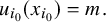 $ u_{i_0}(x_{i_0}) = m. $
For all
$ u_{i_0}(x_{i_0}) = m. $
For all $j \geq i_0$
, let
$j \geq i_0$
, let $x_j {:=}q u_{i_0 j}(x_{i_0})$
. Then we have the following:
$x_j {:=}q u_{i_0 j}(x_{i_0})$
. Then we have the following:
-
(1) For all
$k \geq j \geq i_0$
,
$ c_{L_k}(x_k) \subseteq c_{L_j}(x_j) \subseteq c_{L_{i_0}}(x_{i_0}). $
-
(2)
$c_M(m) = \bigcap _{j \geq i_0} c_{L_j}(x_j)$
. -
(3) Suppose that
$L_i$
is an Ohm-Rush R-module for all
$i \in I$
(for instance, if each
$L_i$
is free). Then
$m \in c_M(m)M$
if and only if the inverse system of ideals
$\{c_{L_j}(x_j) \colon j \geq i_0\}$
stabilizes under inclusion, that is, there exists
$j_0 \geq i_0$
such that for all
$k \geq j_0$
,
$c_{L_{j_0}}(x_{j_0}) = c_{L_k}(x_k)$
. -
(4) Suppose that
$L_i$
is a free R-module for all i. Let
$v \colon R \to M$
be the unique R-linear map that sends
$1 \mapsto m$
. For all
$j \geq i_0$
, let
$v_j \colon R \to L_j$
be the unique R-linear map that sends
$1 \mapsto x_j$
. Consider the following statements:-
(a)
$m \in c_M(m)M$
. -
(b) There exists
$j_0 \geq i_0$
such that for all
$k \geq j_0$
,
$v_k$
stabilizes v. -
(c) There exists
$j_0 \geq i_0$
such that for all R-modules N and for all
$k \geq j_0$
,
$ \operatorname {\mathrm {im}}(\operatorname {\mathrm {Hom}}_R(v_{j_0}, N)) = \operatorname {\mathrm {im}}(\operatorname {\mathrm {Hom}}_R(v_k,N)). $
Then
$(a)\Longleftrightarrow (b)\Longrightarrow (c)$
. -












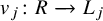






Proof. (1) By definition, $ u_{jk}(x_j) = u_{jk}(u_{i_0j}(x_{i_0})) = u_{i_0k}(x_{i_0}) = x_k. $
Thus, (1) follows by applying Proposition 3.4.14 to the map
$ u_{jk}(x_j) = u_{jk}(u_{i_0j}(x_{i_0})) = u_{i_0k}(x_{i_0}) = x_k. $
Thus, (1) follows by applying Proposition 3.4.14 to the map $u_{i_0j}$
(resp.
$u_{i_0j}$
(resp. $u_{jk}$
) and the element
$u_{jk}$
) and the element $x_{i_0} \in L_{i_0}$
(resp.
$x_{i_0} \in L_{i_0}$
(resp. $x_j \in L_j$
).
$x_j \in L_j$
).
(2) Since $u_{i_0}$
maps
$u_{i_0}$
maps $x_{i_0} \mapsto m$
, we see that for all
$x_{i_0} \mapsto m$
, we see that for all $j \geq i_0$
,
$j \geq i_0$
, $ u_j(x_j) = u_j(u_{i_0j}(x_{i_0})) = u_{i_0}(x_{i_0}) = m. $
Thus, by Proposition 3.4.14 applied to the maps
$ u_j(x_j) = u_j(u_{i_0j}(x_{i_0})) = u_{i_0}(x_{i_0}) = m. $
Thus, by Proposition 3.4.14 applied to the maps
 $$ \begin{align*} u_{j} \colon L_{j} &\to M\\ x_{j} &\mapsto m, \end{align*} $$
we get
 $$ \begin{align} c_M(m) \subseteq \bigcap_{j \geq i_0} c_{L_j}(x_j). \end{align} $$
Now suppose that I is an ideal of R such that $m \in IM$
. Choose
$m \in IM$
. Choose $a_1,\dots ,a_n \in I$
and
$a_1,\dots ,a_n \in I$
and $m_1,\dots ,m_n \in M$
such that
$m_1,\dots ,m_n \in M$
such that $ m = a_1m_1 + \dots + a_nm_n. $
Consider the maps
$ m = a_1m_1 + \dots + a_nm_n. $
Consider the maps
 $$ \begin{align*} f \colon R &\to M\\ 1 &\mapsto m, \end{align*} $$
and
 $$ \begin{align*} g \colon R &\longrightarrow R^{\oplus n}\\ 1 &\mapsto (a_1,\dots,a_n). \end{align*} $$
Then f factors through g via the map $ h \colon R^{\oplus n} \to M $
that sends the standard basis element
$ h \colon R^{\oplus n} \to M $
that sends the standard basis element $e_\ell \mapsto m_\ell $
, for
$e_\ell \mapsto m_\ell $
, for $1 \leq \ell \leq n$
. One can choose an index
$1 \leq \ell \leq n$
. One can choose an index $i \in I$
such that h lifts to a map
$i \in I$
such that h lifts to a map $ h_i \colon R^{\oplus n} \to L_i $
along
$ h_i \colon R^{\oplus n} \to L_i $
along $u_i \colon L_i \to M$
, that is,
$u_i \colon L_i \to M$
, that is, $ u_i \circ h_i = h. $
Then
$ u_i \circ h_i = h. $
Then $ u_i(h_i(a_1,\dots ,a_n)) = h(a_1,\dots ,a_n) = h(g(1)) = f(1) = m. $
Since
$ u_i(h_i(a_1,\dots ,a_n)) = h(a_1,\dots ,a_n) = h(g(1)) = f(1) = m. $
Since $x_{i_0}$
and
$x_{i_0}$
and $h_i(a_1,\dots ,a_n)$
are both lifts of m, by construction of a filtered colimit, there exists
$h_i(a_1,\dots ,a_n)$
are both lifts of m, by construction of a filtered colimit, there exists $j \in I$
such that
$j \in I$
such that $j \geq i_0, i$
and
$j \geq i_0, i$
and $ u_{ij}(h_i(a_1,\dots ,a_n)) = u_{i_0j}(x_{i_0}) = x_j. $
Then by Proposition 3.4.14 applied to the map
$ u_{ij}(h_i(a_1,\dots ,a_n)) = u_{i_0j}(x_{i_0}) = x_j. $
Then by Proposition 3.4.14 applied to the map $u_{ij} \circ h_i \colon R^{\oplus n} \to L_j$
, we have
$u_{ij} \circ h_i \colon R^{\oplus n} \to L_j$
, we have $ c_{L_j}(x_j) \subseteq c_{R^{\oplus n}}(a_1,\dots ,a_n) = (a_1,\dots ,a_n) \subseteq I. $
Thus, we have shown that for any ideal I of R such that
$ c_{L_j}(x_j) \subseteq c_{R^{\oplus n}}(a_1,\dots ,a_n) = (a_1,\dots ,a_n) \subseteq I. $
Thus, we have shown that for any ideal I of R such that $m \in IM$
, there exists
$m \in IM$
, there exists $j \geq i_0$
and
$j \geq i_0$
and $c_{L_j}(x_j) \subseteq I$
. Consequently,
$c_{L_j}(x_j) \subseteq I$
. Consequently, $ \bigcap _{j \geq i_0} c_{L_j}(x_j) \subseteq I $
for all ideals I of R such that
$ \bigcap _{j \geq i_0} c_{L_j}(x_j) \subseteq I $
for all ideals I of R such that $m \in IM$
, and so,
$m \in IM$
, and so, $\bigcap _{j \geq i_0} c_{L_j}(x_j) \subseteq c_M(m)$
. This, along with (3.4.25.1), completes the proof of (2).
$\bigcap _{j \geq i_0} c_{L_j}(x_j) \subseteq c_M(m)$
. This, along with (3.4.25.1), completes the proof of (2).
(3) Suppose $m \in c_M(m)M$
. In order to show that
$m \in c_M(m)M$
. In order to show that $\{c_{L_j}(x_j) \colon j \geq i_0\}$
stabilizes under inclusion, by (1) and (2) it suffices to show that there exists
$\{c_{L_j}(x_j) \colon j \geq i_0\}$
stabilizes under inclusion, by (1) and (2) it suffices to show that there exists $j_0 \geq i_0$
such that
$j_0 \geq i_0$
such that $ c_{L_{j_0}}(x_{j_0}) \subseteq c_M(m). $
Let
$ c_{L_{j_0}}(x_{j_0}) \subseteq c_M(m). $
Let $c_M(m) = (a_1,\dots ,a_n)$
(Remark 3.4.3). Then by repeating the argument in (2) above, we see that there exists
$c_M(m) = (a_1,\dots ,a_n)$
(Remark 3.4.3). Then by repeating the argument in (2) above, we see that there exists $j_0 \geq i_0$
such that
$j_0 \geq i_0$
such that $ c_{L_{j_0}}(x_{j_0}) \subseteq (a_1,\dots ,a_n) = c_M(m). $
Conversely, suppose $\{c_{L_j}(x_j) \colon j \geq i_0\}$
stabilizes under inclusion, say with stable ideal
$\{c_{L_j}(x_j) \colon j \geq i_0\}$
stabilizes under inclusion, say with stable ideal $c_{L_{j_0}}(x_{j_0})$
. Since I is a directed set, by (1) and (2) we have
$c_{L_{j_0}}(x_{j_0})$
. Since I is a directed set, by (1) and (2) we have $ c_M(m) = \bigcap _{j\geq i_0} c_{L_j}(x_j) = \bigcap _{k \geq j_0} c_{L_k}(x_k) = c_{L_{j_0}}(x_{j_0}). $
Since
$ c_M(m) = \bigcap _{j\geq i_0} c_{L_j}(x_j) = \bigcap _{k \geq j_0} c_{L_k}(x_k) = c_{L_{j_0}}(x_{j_0}). $
Since $L_{j_0}$
is an Ohm-Rush R-module, it follows that
$L_{j_0}$
is an Ohm-Rush R-module, it follows that $x_{j_0} \in c_{L_{j_0}}(x_{j_0})L_{j_0}$
. Using the homomorphism
$x_{j_0} \in c_{L_{j_0}}(x_{j_0})L_{j_0}$
. Using the homomorphism $ u_{j_0} \colon L_{j_0} \to M, $
we get
$ u_{j_0} \colon L_{j_0} \to M, $
we get $m = u_{j_0}(x_{j_0}) \in c_{L_{j_0}}(x_{j_0})M = c_M(m)M$
, as desired.
$m = u_{j_0}(x_{j_0}) \in c_{L_{j_0}}(x_{j_0})M = c_M(m)M$
, as desired.
(4) We first show $(b) \implies (a)$
. If there exists
$(b) \implies (a)$
. If there exists $k \geq i_0$
such that
$k \geq i_0$
such that $v_k$
stabilizes v, then since
$v_k$
stabilizes v, then since $L_k$
is Ohm-Rush, by Theorem 3.4.17
$L_k$
is Ohm-Rush, by Theorem 3.4.17 $(4) \implies (1)$
we have that
$(4) \implies (1)$
we have that $m = v(1) \in c_M(v(1))M = c_M(m)M$
.
$m = v(1) \in c_M(v(1))M = c_M(m)M$
.
We next prove $(a) \implies (b)$
. So assume that
$(a) \implies (b)$
. So assume that $m \in c_M(m)M$
. By (3) and (2), there exists
$m \in c_M(m)M$
. By (3) and (2), there exists $j_0 \geq i_0$
such that for all
$j_0 \geq i_0$
such that for all $k \geq j_0$
,
$k \geq j_0$
, $ c_{L_k}(x_k) = c_{L_{j_0}}(x_{j_0}) = c_M(m). $
By assumption,
$ c_{L_k}(x_k) = c_{L_{j_0}}(x_{j_0}) = c_M(m). $
By assumption, $L_{j_0}$
and
$L_{j_0}$
and $L_k$
are free R-modules, and hence Ohm-Rush. Thus, we have
$L_k$
are free R-modules, and hence Ohm-Rush. Thus, we have $ v_{j_0}(1) = x_{j_0} \in c_{L_{j_0}}(x_{j_0})L_{j_0} = c_{L_k}(x_k)L_{j_0} = c_{L_k}(v_k(1))L_{j_0}, $
and
$ v_{j_0}(1) = x_{j_0} \in c_{L_{j_0}}(x_{j_0})L_{j_0} = c_{L_k}(x_k)L_{j_0} = c_{L_k}(v_k(1))L_{j_0}, $
and $ v_{k}(1) = x_k \in c_{L_k}(x_k)L_k = c_{L_{j_0}}(x_{j_0})L_{k} = c_{L_{j_0}}(v_{j_0}(1))L_k. $
By Lemma 3.4.13 (1) we then conclude that
$ v_{k}(1) = x_k \in c_{L_k}(x_k)L_k = c_{L_{j_0}}(x_{j_0})L_{k} = c_{L_{j_0}}(v_{j_0}(1))L_k. $
By Lemma 3.4.13 (1) we then conclude that $v_{j_0} \colon R \to L_{j_0}$
factors through
$v_{j_0} \colon R \to L_{j_0}$
factors through $v_k \colon R \to L_k$
and vice-versa (here we are using that
$v_k \colon R \to L_k$
and vice-versa (here we are using that $L_{j_0}$
and
$L_{j_0}$
and $L_k$
are both free and not just Ohm-Rush). Thus, for all
$L_k$
are both free and not just Ohm-Rush). Thus, for all $k \geq j_0$
,
$k \geq j_0$
, $v_{j_0}$
and
$v_{j_0}$
and $v_k$
dominate each other. Since
$v_k$
dominate each other. Since $ v = \operatorname {\mathrm {colim}}_{k \geq j_0} v_j, $
it follows that v and
$ v = \operatorname {\mathrm {colim}}_{k \geq j_0} v_j, $
it follows that v and $v_{j_0}$
dominate each other because for all R-modules N,
$v_{j_0}$
dominate each other because for all R-modules N,
 $$ \begin{align*} \mathrm{ker}(v \otimes_R \mathrm{id}_N) &= \mathrm{ker}((\mathrm{colim}_{k \geq j_0} v_k)\otimes_R \mathrm{id}_N) = \mathrm{ker}(\mathrm{colim}_{k \geq j_0}(v_k \otimes_R \mathrm{id}_N))\\ &= \mathrm{colim}_{k \geq j_0} \mathrm{ker}(v_k \otimes_R \mathrm{id}_N) = \mathrm{colim}_{k \geq j_0} \mathrm{ker}(v_{j_0} \otimes_R \mathrm{id}_N) = \mathrm{ker}(v_{j_0} \otimes_R \mathrm{id}_N). \end{align*} $$
Here the second equality follows because tensor products commute with filtered colimits, the third equality follows because filtered colimits are exact in $\operatorname {\mathrm {Mod}}_R$
[Reference Authors27, Tag 00DB] and the fourth equality follows because
$\operatorname {\mathrm {Mod}}_R$
[Reference Authors27, Tag 00DB] and the fourth equality follows because $v_{j_0}$
and
$v_{j_0}$
and $v_k$
dominate each other. In fact, since
$v_k$
dominate each other. In fact, since $\mathrm{ker} (v_{j_0} \otimes _R \operatorname {\mathrm {id}}_N) = \mathrm{ker} (v_k \otimes _R \operatorname {\mathrm {id}}_N)$
, the above chain of equalities also shows that
$\mathrm{ker} (v_{j_0} \otimes _R \operatorname {\mathrm {id}}_N) = \mathrm{ker} (v_k \otimes _R \operatorname {\mathrm {id}}_N)$
, the above chain of equalities also shows that $\mathrm{ker} (v \otimes _R \operatorname {\mathrm {id}}_N) = \mathrm{ker} (v_k \otimes _R \operatorname {\mathrm {id}}_N)$
for all
$\mathrm{ker} (v \otimes _R \operatorname {\mathrm {id}}_N) = \mathrm{ker} (v_k \otimes _R \operatorname {\mathrm {id}}_N)$
for all $k \geq j_0$
. Since
$k \geq j_0$
. Since $L_k$
is a finitely presented R-module by hypothesis, we get that
$L_k$
is a finitely presented R-module by hypothesis, we get that $v_k$
stabilizes v for all
$v_k$
stabilizes v for all $k \geq j_0$
. This completes the proof of
$k \geq j_0$
. This completes the proof of $(a) \implies (b)$
.
$(a) \implies (b)$
.
It remains to show that (b) $\implies $
(c). Suppose there exists
$\implies $
(c). Suppose there exists $j_0 \geq i_0$
such that for all
$j_0 \geq i_0$
such that for all $k \geq j_0$
,
$k \geq j_0$
, $v_k$
stabilizes v. We have
$v_k$
stabilizes v. We have $ v_k(1) = x_k = u_{i_0k}(x_0) = u_{j_0k}(u_{i_0j_0}(x_0)) = u_{j_0k}(x_{j_0}) = u_{j_0k}(v_{j_0}(1)), $
and so,
$ v_k(1) = x_k = u_{i_0k}(x_0) = u_{j_0k}(u_{i_0j_0}(x_0)) = u_{j_0k}(x_{j_0}) = u_{j_0k}(v_{j_0}(1)), $
and so, $v_k = u_{j_0k} \circ v_{j_0}$
. Furthermore,
$v_k = u_{j_0k} \circ v_{j_0}$
. Furthermore, $ u_k \circ v_k(1) = u_k(x_k) = u_k(u_{i_0k}(x_{i_0})) = u_{i_0}(x_{i_0}) = m = v(1). $
Thus, for all
$ u_k \circ v_k(1) = u_k(x_k) = u_k(u_{i_0k}(x_{i_0})) = u_{i_0}(x_{i_0}) = m = v(1). $
Thus, for all $k \geq j_0$
,
$k \geq j_0$
, $u_k \circ v_k = v$
. Since
$u_k \circ v_k = v$
. Since $v_k$
stabilizes v, one can now apply Lemma 3.1.5 (3) (with
$v_k$
stabilizes v, one can now apply Lemma 3.1.5 (3) (with $f_k = v_k$
,
$f_k = v_k$
, $g = v$
and
$g = v$
and $i = j_0$
in the notation of the Lemma) to conclude that for all
$i = j_0$
in the notation of the Lemma) to conclude that for all $k \geq j_0$
and for all R-modules N,
$k \geq j_0$
and for all R-modules N, $\operatorname {\mathrm {im}}(\operatorname {\mathrm {Hom}}_R(v_{j_0},N)) = \operatorname {\mathrm {im}}(\operatorname {\mathrm {Hom}}_R(v_k,N))$
.
$\operatorname {\mathrm {im}}(\operatorname {\mathrm {Hom}}_R(v_{j_0},N)) = \operatorname {\mathrm {im}}(\operatorname {\mathrm {Hom}}_R(v_k,N))$
.
Remark 3.4.26. For the equivalence of assertions $(a), (b), (c)$
in Proposition 3.4.25 (4), the freeness of the
$(a), (b), (c)$
in Proposition 3.4.25 (4), the freeness of the $L_i$
is only used for
$L_i$
is only used for $(a) \implies (b)$
.
$(a) \implies (b)$
.
Proposition 3.4.25 allows us to add an additional statement in the list of equivalent statements for flat modules in Theorem 3.4.17.
Corollary 3.4.27. Let R be a ring and M be a flat R-module. Let $v \colon R \to M$
be an R-linear map. Then the following are equivalent:
$v \colon R \to M$
be an R-linear map. Then the following are equivalent:
-
(1)
$v(1) \in c_M(v(1))M$
. -
(2) v admits a stabilizer
$u \colon R \to L$
where L is free of finite rank. -
(3) v admits a stabilizer.


Proof. Note that any stabilizer of v is a cyclic stabilizer of v that v dominates. Thus, $(3) \implies (1)$
follows by Theorem 3.4.17 (3)
$(3) \implies (1)$
follows by Theorem 3.4.17 (3) $\implies $
(1) since M is a flat R-module. The implication
$\implies $
(1) since M is a flat R-module. The implication $(2) \implies (3)$
is clear.
$(2) \implies (3)$
is clear.
It suffices to show $(1) \implies (2)$
. Since M is flat we can express it as a colimit of a filtered system of free R-modules of finite rank
$(1) \implies (2)$
. Since M is flat we can express it as a colimit of a filtered system of free R-modules of finite rank $\{(L_i, u_{ij})\colon i,j \in I, i \leq j\}$
. Then one can choose
$\{(L_i, u_{ij})\colon i,j \in I, i \leq j\}$
. Then one can choose $i \in I$
and a lift
$i \in I$
and a lift $x_i$
of
$x_i$
of $v(1)$
to
$v(1)$
to $L_i$
such that the unique map
$L_i$
such that the unique map $u \colon R \to L_i$
that sends
$u \colon R \to L_i$
that sends $1 \mapsto x_i$
stabilizes v by Proposition 3.4.25 (4).
$1 \mapsto x_i$
stabilizes v by Proposition 3.4.25 (4).
We also have the following addition to the list of equivalent assertions for flat modules in Theorem 3.4.18. The proof is clear and is omitted.
Corollary 3.4.28. Let R be a ring and M be a flat R-module. Then the following are equivalent:
-
(1) M is Ohm-Rush.
-
(2) Every linear map
$v \colon R \to M$
admits a stabilizer
$u \colon R \to L$
where L is free of finite rank. -
(3) Every linear map
$v \colon R \to M$
admits a stabilizer.


The next result is as an analog of Proposition 3.1.6 for cyclic stabilizers.
Proposition 3.4.29. Let $(R,{\mathfrak {m}},\kappa )$
be a local ring (not necessarily Noetherian). Let M be a flat R-module and
$(R,{\mathfrak {m}},\kappa )$
be a local ring (not necessarily Noetherian). Let M be a flat R-module and $f\in M$
. Let
$f\in M$
. Let $v: R \to M$
be the unique R-linear map that sends
$v: R \to M$
be the unique R-linear map that sends $1\mapsto f$
. Then the following are equivalent:
$1\mapsto f$
. Then the following are equivalent:
-
(1) There is a finitely generated free submodule L of M that contains f, such that the inclusion map of L into M is pure.
-
(2) There is a finitely generated free submodule L of M that contains f, such that the inclusion map of L into M is cyclically pure.
-
(3) v admits a cyclic stabilizer
$u \colon R \to P$
such that P is Ohm-Rush. -
(4) v admits a cyclic stabilizer that v dominates.
-
(5)
$f \in c_M(f)M$
.


Proof. The equivalences of (3), (4) and (5) follow from Theorem 3.4.17 and hold even when R is not local. The implication $(1) \implies (2)$
is clear while
$(1) \implies (2)$
is clear while $(2) \implies (3)$
follows from Lemma 3.3.4 and the fact that free modules are Ohm-Rush (Example 3.4.7).
$(2) \implies (3)$
follows from Lemma 3.3.4 and the fact that free modules are Ohm-Rush (Example 3.4.7).
It remains to show $(5) \implies (1)$
. Since M is flat and
$(5) \implies (1)$
. Since M is flat and $f \in c_M(f)M$
, v admits a stabilizer by Corollary 3.4.27. Then (1) follows by Proposition 3.1.6 applied to
$f \in c_M(f)M$
, v admits a stabilizer by Corollary 3.4.27. Then (1) follows by Proposition 3.1.6 applied to $g = v$
.
$g = v$
.
One can use Proposition 3.4.29 to now deduce that flat and nontrivial Ohm-Rush modules over local rings are faithfully flat.
Corollary 3.4.30. Let $(R, {\mathfrak {m}}, \kappa )$
be a nontrivial local ring (not necessarily Noetherian). Let M be a flat and Ohm-Rush R-module. We have the following:
$(R, {\mathfrak {m}}, \kappa )$
be a nontrivial local ring (not necessarily Noetherian). Let M be a flat and Ohm-Rush R-module. We have the following:
-
(1) If
$M = {\mathfrak {m}} M$
, then
$M = 0$
. -
(2) If
$M \neq 0$
then M is faithfully flat. -
(3) If
$M \neq 0$
and
$I \neq J$
are ideals of R, then
$IM \neq JM$
. -
(4) If
$M \neq 0$
, then for any ideal I of R,
$c_M(IM) = I$
.



Proof. (1) Assume for contradiction that $M = {\mathfrak {m}} M$
and that
$M = {\mathfrak {m}} M$
and that $M \neq 0$
. Let
$M \neq 0$
. Let $f \in M$
be a nonzero element. By Proposition 3.4.29, there exists a finitely generated free submodule L of M that contains f and such that the inclusion
$f \in M$
be a nonzero element. By Proposition 3.4.29, there exists a finitely generated free submodule L of M that contains f and such that the inclusion $\iota \colon L \hookrightarrow M$
is pure. In particular,
$\iota \colon L \hookrightarrow M$
is pure. In particular, $L \neq 0$
. Let
$L \neq 0$
. Let $e \in L$
be a basis element. By Example 3.4.7,
$e \in L$
be a basis element. By Example 3.4.7, $c_L(e) = R$
. Since
$c_L(e) = R$
. Since $c_M \circ \iota = c_L$
by Proposition 3.4.14 (2), it follows that
$c_M \circ \iota = c_L$
by Proposition 3.4.14 (2), it follows that $ c_M(e) = c_M(\iota (e)) = c_L(e) = R. $
But this is a contradiction because
$ c_M(e) = c_M(\iota (e)) = c_L(e) = R. $
But this is a contradiction because $e \in M = {\mathfrak {m}} M$
, and so,
$e \in M = {\mathfrak {m}} M$
, and so, $c_M(e) \subseteq {\mathfrak {m}}$
.
$c_M(e) \subseteq {\mathfrak {m}}$
.
(2) follows from (1) by taking the contrapositive.
(3) As we saw in (1), the hypothesis that $M \neq 0$
implies that there exists
$M \neq 0$
implies that there exists $e \in M$
such
$e \in M$
such $c_M(e) = R$
. Assume for contradiction that
$c_M(e) = R$
. Assume for contradiction that $IM = JM$
. Let
$IM = JM$
. Let $i \in I$
. Then
$i \in I$
. Then $ie \in IM = JM$
, and so,
$ie \in IM = JM$
, and so, $iR = ic_M(e) = c_M(ie) \subseteq J$
, where we use Proposition 3.4.14 (3) for the equality
$iR = ic_M(e) = c_M(ie) \subseteq J$
, where we use Proposition 3.4.14 (3) for the equality $ic_M(e) = c_M(ie)$
. Since
$ic_M(e) = c_M(ie)$
. Since $i \in I$
was arbitrary, this shows
$i \in I$
was arbitrary, this shows $I \subseteq J$
. One similarly obtains
$I \subseteq J$
. One similarly obtains $J \subseteq I$
, contradicting that
$J \subseteq I$
, contradicting that $I \neq J$
.
$I \neq J$
.
(4) By definition of the content of a subset of M, $c_M(IM) \subseteq I$
. Moreover, since M is Ohm-Rush, by Lemma 3.4.4,
$c_M(IM) \subseteq I$
. Moreover, since M is Ohm-Rush, by Lemma 3.4.4, $IM \subseteq c_M(IM)M$
. Thus,
$IM \subseteq c_M(IM)M$
. Thus, $IM \subseteq c_M(IM)M \subseteq IM$
, and so, by (3) we must have
$IM \subseteq c_M(IM)M \subseteq IM$
, and so, by (3) we must have $I = c_M(IM)$
.
$I = c_M(IM)$
.
We also obtain the following comparison result between the content function of a flat Ohm-Rush module over a Noetherian local ring and the content function of the completion of the module.
Corollary 3.4.31. Let $(R,{\mathfrak {m}},\kappa )$
be a Noetherian local ring. Let M be a flat Ohm-Rush R-module. Let
$(R,{\mathfrak {m}},\kappa )$
be a Noetherian local ring. Let M be a flat Ohm-Rush R-module. Let $\widehat {M}$
be the
$\widehat {M}$
be the ${\mathfrak {m}}$
-adic completion of M. Let
${\mathfrak {m}}$
-adic completion of M. Let $c_M$
(resp.
$c_M$
(resp. $c_{\widehat {M}}$
) denote the content of M (resp. of
$c_{\widehat {M}}$
) denote the content of M (resp. of $\widehat {M}$
) as an R-module (resp.
$\widehat {M}$
) as an R-module (resp. $\widehat {R}$
-module). Let
$\widehat {R}$
-module). Let $ \varphi \colon M \to \widehat {M} $
denote the canonical map. Then we have the following:
$ \varphi \colon M \to \widehat {M} $
denote the canonical map. Then we have the following:
-
(1) For all
$x \in M$
,
$\varphi (x) \in c_{\widehat {M}}(\varphi (x))\widehat {M}$
and
$c_M(x)\widehat {R} = c_{\widehat {M}}(\varphi (x))$
. -
(2) If
$N \subseteq M$
, then
$\varphi (N) \subseteq c_{\widehat M}(\varphi (N))\widehat {M}$
and
$c_M(N)\widehat {R} = c_{\widehat {M}}(\varphi (N))$
. -
(3) If N is a submodule of M and if
$\widehat {R}N$
is the
$\widehat {R}$
-submodule of
$\widehat {M}$
generated by
$\varphi (N)$
, then
$c_M(N)\widehat {R} = c_{\widehat {M}}(\widehat {R}N)$
. -
(4)
$\varphi $
is a pure map of R-modules. -
(5) Let
$\phi \colon P \to N$
be a map of
$\widehat {R}$
-modules such that P is a flat Ohm-Rush
$\widehat {R}$
-module and N is a flat R-module. Considering
$\phi $
as a map of R-modules by restriction of scalars, we have that
$\phi $
is R-pure if and only if
$\phi $
is
$\widehat {R}$
-pure. -
(6) Let S be a flat Ohm-Rush R-algebra. Let I be an ideal of S and let
$\widehat {S}$
denote the
${\mathfrak {m}}$
-adic completion of S (that is,
$\widehat {S} = \widehat {S}^{{\mathfrak {m}} S}$
). Then
$c_S(I) \widehat {R} = c_{\widehat {S}}(I\widehat {S})$
, where by
$c_{\widehat {S}}$
we mean the content of
$\widehat {S}$
as a
$\widehat {R}$
-module.










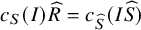


Proof. By Lemma 2.2.4, $\widehat {M}$
is a flat
$\widehat {M}$
is a flat $\widehat {R}$
-module. Also note that by definition (see Section 3.4), the content of a subset of a module coincides with the content of the submodule generated by the subset. With these preliminary observations, we begin proving the assertions.
$\widehat {R}$
-module. Also note that by definition (see Section 3.4), the content of a subset of a module coincides with the content of the submodule generated by the subset. With these preliminary observations, we begin proving the assertions.
(1) By Proposition 3.4.29, there exists a finitely generated free submodule L of M that contains x such that the inclusion $\iota \colon L \hookrightarrow M$
is a pure map of R-modules. Then by Lemma 2.2.4 and flatness of M, the induced map on
$\iota \colon L \hookrightarrow M$
is a pure map of R-modules. Then by Lemma 2.2.4 and flatness of M, the induced map on ${\mathfrak {m}}$
-adic completions
${\mathfrak {m}}$
-adic completions $ \widehat {\iota } \colon \widehat {L} \to \widehat {M} $
is a pure map of
$ \widehat {\iota } \colon \widehat {L} \to \widehat {M} $
is a pure map of $\widehat {R}$
-modules. Note that
$\widehat {R}$
-modules. Note that $\widehat {L}$
is a free
$\widehat {L}$
is a free $\widehat {R}$
-module and the canonical map
$\widehat {R}$
-module and the canonical map $\varphi ' \colon L \to \widehat {L}$
maps an R-basis of L to a
$\varphi ' \colon L \to \widehat {L}$
maps an R-basis of L to a $\widehat {R}$
-basis of
$\widehat {R}$
-basis of $\widehat {L}$
. We also have a commutative diagram
$\widehat {L}$
. We also have a commutative diagram

Thus, $ \varphi (x) = \varphi (\iota (x)) = \widehat {\iota }(\varphi '(x)) \in \operatorname {\mathrm {im}}(\widehat {\iota }). $
Furthermore,
$ \varphi (x) = \varphi (\iota (x)) = \widehat {\iota }(\varphi '(x)) \in \operatorname {\mathrm {im}}(\widehat {\iota }). $
Furthermore, $\operatorname {\mathrm {im}}(\widehat {\iota })$
is a free submodule of
$\operatorname {\mathrm {im}}(\widehat {\iota })$
is a free submodule of $\widehat {M}$
of finite rank such that
$\widehat {M}$
of finite rank such that $\operatorname {\mathrm {im}}(\widehat {\iota }) \hookrightarrow \widehat {M}$
is
$\operatorname {\mathrm {im}}(\widehat {\iota }) \hookrightarrow \widehat {M}$
is $\widehat {R}$
-pure. Since
$\widehat {R}$
-pure. Since $\widehat {M}$
is a flat module over the local ring
$\widehat {M}$
is a flat module over the local ring $\widehat {R}$
, one can apply Proposition 3.4.29 (1)
$\widehat {R}$
, one can apply Proposition 3.4.29 (1) $\implies $
(5) to conclude that
$\implies $
(5) to conclude that $ \varphi (x) \in c_{\widehat {M}}(\varphi (x))\widehat {M}. $
It remains to show that $c_M(x)\widehat {R} = c_{\widehat {M}}(\varphi (x))$
. By the R-purity of
$c_M(x)\widehat {R} = c_{\widehat {M}}(\varphi (x))$
. By the R-purity of $\iota $
, the
$\iota $
, the $\widehat {R}$
-purity of
$\widehat {R}$
-purity of $\widehat {\iota }$
and Lemma 3.4.12, we get
$\widehat {\iota }$
and Lemma 3.4.12, we get $ c_M \circ \iota = c_L \textrm { and } c_{\widehat {M}} \circ \widehat {\iota } = c_{\widehat {L}}. $
Thus,
$ c_M \circ \iota = c_L \textrm { and } c_{\widehat {M}} \circ \widehat {\iota } = c_{\widehat {L}}. $
Thus, $ c_M(x) = c_M(\iota (x)) = c_L(x) $
and
$ c_M(x) = c_M(\iota (x)) = c_L(x) $
and $ c_{\widehat {M}}(\varphi (x)) = c_{\widehat {M}}(\varphi \circ \iota (x)) = c_{\widehat {M}}(\widehat {\iota } \circ \varphi '(x)) = c_{\widehat L} (\varphi '(x)). $
Therefore, to prove
$ c_{\widehat {M}}(\varphi (x)) = c_{\widehat {M}}(\varphi \circ \iota (x)) = c_{\widehat {M}}(\widehat {\iota } \circ \varphi '(x)) = c_{\widehat L} (\varphi '(x)). $
Therefore, to prove $c_M(x)\widehat {R} = c_{\widehat {M}}(\varphi (x))$
, it suffices to show that
$c_M(x)\widehat {R} = c_{\widehat {M}}(\varphi (x))$
, it suffices to show that $c_L(x)\widehat {R} = c_{\widehat {L}}(\varphi '(x))$
. If
$c_L(x)\widehat {R} = c_{\widehat {L}}(\varphi '(x))$
. If $\{e_1,\dots ,e_n\}$
is a basis of L and
$\{e_1,\dots ,e_n\}$
is a basis of L and $ x = r_1e_1 + \dots + r_ne_n, $
for
$ x = r_1e_1 + \dots + r_ne_n, $
for $r_i \in R$
, then we have seen in Example 3.4.7 that
$r_i \in R$
, then we have seen in Example 3.4.7 that $ c_L(x) = (r_1,\dots ,r_n). $
Moreover, if $\widehat {r_i}$
denotes the image of
$\widehat {r_i}$
denotes the image of $r_i$
in
$r_i$
in $\widehat {R}$
, then in terms of the basis
$\widehat {R}$
, then in terms of the basis $\{\varphi '(e_1),\dots ,\varphi '(e_n)\}$
of
$\{\varphi '(e_1),\dots ,\varphi '(e_n)\}$
of $\widehat {L}$
over
$\widehat {L}$
over $\widehat {R}$
, we have
$\widehat {R}$
, we have $ \varphi '(x) = \widehat {r_1}\varphi '(e_1) + \dots + \widehat {r_n}\varphi '(e_n). $
Thus, by Example 3.4.7 again,
$ \varphi '(x) = \widehat {r_1}\varphi '(e_1) + \dots + \widehat {r_n}\varphi '(e_n). $
Thus, by Example 3.4.7 again, $ c_{\widehat {L}}(\varphi '(x)) = (\widehat {r_1},\dots ,\widehat {r_n}) = (r_1,\dots ,r_n)\widehat {R} = c_L(x)\widehat {R}, $
as desired.
$ c_{\widehat {L}}(\varphi '(x)) = (\widehat {r_1},\dots ,\widehat {r_n}) = (r_1,\dots ,r_n)\widehat {R} = c_L(x)\widehat {R}, $
as desired.
(2) We have $ c_M(N)\widehat {R} = \left (\sum _{x \in N}c_M(x)\right )\widehat {R} = \sum _{x \in N} c_M(x)\widehat {R} = \sum _{x \in N} c_{\widehat {M}}(\varphi (x)). $
The first equality follows by Lemma 3.4.4 because M is Ohm-Rush, the second equality follows because expansions of ideals commute with taking arbitrary sums of ideals and the third equality follows by (1). For all $x \in N$
, we have again by (1) that
$x \in N$
, we have again by (1) that $ \varphi (x) \in c_{\widehat M}(\varphi (x))\widehat {M}. $
Thus,
$ \varphi (x) \in c_{\widehat M}(\varphi (x))\widehat {M}. $
Thus,
 $$ \begin{align} \varphi(N) \subseteq \left(\sum_{x \in N} c_{\widehat{M}}(\varphi(x))\right)\widehat{M}, \end{align} $$
and hence, $c_{\widehat M}(\varphi (N)) \subseteq \sum _{x \in N} c_{\widehat {M}}(\varphi (x))$
, since by definition,
$c_{\widehat M}(\varphi (N)) \subseteq \sum _{x \in N} c_{\widehat {M}}(\varphi (x))$
, since by definition, $c_{\widehat M}(\varphi (N))$
is the intersection of all ideals J of
$c_{\widehat M}(\varphi (N))$
is the intersection of all ideals J of $\widehat {R}$
such that
$\widehat {R}$
such that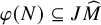 $\varphi (N) \subseteq J\widehat {M}$
. For any such ideal J and for all
$\varphi (N) \subseteq J\widehat {M}$
. For any such ideal J and for all $x \in N$
,
$x \in N$
, $ \varphi (x) \in \varphi (N) \subseteq J\widehat {M}, $
which implies that for all
$ \varphi (x) \in \varphi (N) \subseteq J\widehat {M}, $
which implies that for all $x \in N$
,
$x \in N$
, $c_{\widehat M}(\varphi (x)) \subseteq J$
, that is,
$c_{\widehat M}(\varphi (x)) \subseteq J$
, that is, $\sum _{x \in N} c_{\widehat {M}}(\varphi (x)) \subseteq J$
. Since this inclusion of sets holds for all such J, we then get
$\sum _{x \in N} c_{\widehat {M}}(\varphi (x)) \subseteq J$
. Since this inclusion of sets holds for all such J, we then get $\sum _{x \in N} c_{\widehat {M}}(\varphi (x)) \subseteq c_{\widehat M}(\varphi (N))$
, and so,
$\sum _{x \in N} c_{\widehat {M}}(\varphi (x)) \subseteq c_{\widehat M}(\varphi (N))$
, and so, $ c_{\widehat M}(\varphi (N)) = c_{\widehat {M}}(\varphi (x)). $
Then by (3.4.31.1) we get
$ c_{\widehat M}(\varphi (N)) = c_{\widehat {M}}(\varphi (x)). $
Then by (3.4.31.1) we get $\varphi (N) \subseteq c_{\widehat {M}}(\varphi (N))\widehat {M}$
. This completes the proof of (2).
$\varphi (N) \subseteq c_{\widehat {M}}(\varphi (N))\widehat {M}$
. This completes the proof of (2).
(3) By (2) we have $c_M(N)\widehat {R} = c_{\widehat {M}}(\varphi (N))$
and we have
$c_M(N)\widehat {R} = c_{\widehat {M}}(\varphi (N))$
and we have $c_{\widehat {M}}(\varphi (N)) = c_{\widehat {M}}(\widehat {R}N)$
because the content of a subset of a module equals the content of the submodule generated by the subset pretty much by definition.
$c_{\widehat {M}}(\varphi (N)) = c_{\widehat {M}}(\widehat {R}N)$
because the content of a subset of a module equals the content of the submodule generated by the subset pretty much by definition.
(4) Since $\widehat {M}$
is a flat
$\widehat {M}$
is a flat $\widehat {R}$
-module and hence is also a flat R-module (R is Noetherian so
$\widehat {R}$
-module and hence is also a flat R-module (R is Noetherian so $R \to \widehat {R}$
is flat), it suffices to show by Lemma 3.3.1 that
$R \to \widehat {R}$
is flat), it suffices to show by Lemma 3.3.1 that $\varphi $
is a cyclically pure map of R-modules. That is, we have to show that if I is an ideal of R, then
$\varphi $
is a cyclically pure map of R-modules. That is, we have to show that if I is an ideal of R, then
 $$ \begin{align*} \varphi \otimes_R \mathrm{id}_{R/I} \colon &M/IM \to \widehat{M}/(I\widehat{R})\widehat{M}\\ &x + IM \mapsto \varphi(x) + (I\widehat{R})\widehat{M} \end{align*} $$
is injective. So suppose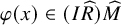 $\varphi (x) \in (I\widehat {R})\widehat {M}$
. Then by (1),
$\varphi (x) \in (I\widehat {R})\widehat {M}$
. Then by (1), $c_M(x)\widehat {R} = c_{\widehat {M}}(\varphi (x)) \subseteq I\widehat {R}$
. Contracting to R and using purity of
$c_M(x)\widehat {R} = c_{\widehat {M}}(\varphi (x)) \subseteq I\widehat {R}$
. Contracting to R and using purity of $R \to \widehat {R}$
gives us
$R \to \widehat {R}$
gives us $c_M(x) \subseteq I$
. Since M is an Ohm-Rush R-module, we have
$c_M(x) \subseteq I$
. Since M is an Ohm-Rush R-module, we have $x \in c_M(x)M \subseteq IM$
, which is precisely the assertion that
$x \in c_M(x)M \subseteq IM$
, which is precisely the assertion that $\varphi \otimes _R \operatorname {\mathrm {id}}_{R/I}$
is injective.
$\varphi \otimes _R \operatorname {\mathrm {id}}_{R/I}$
is injective.
(5) If $\phi $
is a pure map of
$\phi $
is a pure map of $\widehat R$
-modules then
$\widehat R$
-modules then $\phi $
is also a pure map of R-modules because purity is preserved by restriction of scalars. We now show the converse. So suppose
$\phi $
is also a pure map of R-modules because purity is preserved by restriction of scalars. We now show the converse. So suppose $\phi \colon P \to N$
is pure as a map of R-modules. Since N is a flat R-module, by Lemma 2.2.4, the induced map on
$\phi \colon P \to N$
is pure as a map of R-modules. Since N is a flat R-module, by Lemma 2.2.4, the induced map on ${\mathfrak {m}}$
-adic completion
${\mathfrak {m}}$
-adic completion $ \widehat {\phi } \colon \widehat {P} \to \widehat {N} $
is a pure map of
$ \widehat {\phi } \colon \widehat {P} \to \widehat {N} $
is a pure map of $\widehat {R}$
-modules. Consider the commutative diagram
$\widehat {R}$
-modules. Consider the commutative diagram

where the vertical maps are the canonical ones. Note that since P and N are $\widehat {R}$
-modules, all the maps in this diagram are
$\widehat {R}$
-modules, all the maps in this diagram are $\widehat {R}$
-linear. Since P is a flat Ohm-Rush
$\widehat {R}$
-linear. Since P is a flat Ohm-Rush $\widehat R$
-module, by (4) applied to the ring
$\widehat R$
-module, by (4) applied to the ring $\widehat R$
and the module P, we see that the left-vertical map
$\widehat R$
and the module P, we see that the left-vertical map $P \to \widehat {P}$
is a pure map of
$P \to \widehat {P}$
is a pure map of $\widehat {R}$
-modules. Thus, by the commutativity of the above diagram,
$\widehat {R}$
-modules. Thus, by the commutativity of the above diagram, $\phi \colon P \to N$
must be a pure map of
$\phi \colon P \to N$
must be a pure map of $\widehat {R}$
-modules.
$\widehat {R}$
-modules.
(6) In the notation of part (3), $\widehat {R}I$
is the
$\widehat {R}I$
is the $\widehat {R}$
-submodule of
$\widehat {R}$
-submodule of $\widehat {S}$
that is generated by the image of I under the canonical map
$\widehat {S}$
that is generated by the image of I under the canonical map $S \to \widehat {S}$
. Said differently,
$S \to \widehat {S}$
. Said differently, $\widehat {R}I$
is the image of the ideal
$\widehat {R}I$
is the image of the ideal $\widehat {R} \otimes _R I$
of
$\widehat {R} \otimes _R I$
of $\widehat {R} \otimes _R S$
under the canonical ring map
$\widehat {R} \otimes _R S$
under the canonical ring map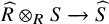 $\widehat {R} \otimes _R S \to \widehat {S}$
. So by (3) we get
$\widehat {R} \otimes _R S \to \widehat {S}$
. So by (3) we get $ c_S(I)\widehat {R} = c_{\widehat {S}}(\widehat {R}I). $
But
$ c_S(I)\widehat {R} = c_{\widehat {S}}(\widehat {R}I). $
But $\widehat {S}$
is a
$\widehat {S}$
is a $\widehat {R}$
-algebra, and so, by Remark 3.4.1,
$\widehat {R}$
-algebra, and so, by Remark 3.4.1, $c_{\widehat {S}}(\widehat {R}I)$
coincides with the content of the ideal of
$c_{\widehat {S}}(\widehat {R}I)$
coincides with the content of the ideal of $\widehat {S}$
that is generated by
$\widehat {S}$
that is generated by $\widehat {R}I$
. This ideal is clearly
$\widehat {R}I$
. This ideal is clearly $I\widehat {S}$
. Thus,
$I\widehat {S}$
. Thus, $c_S(I)\widehat {R} = c_{\widehat {S}}(\widehat {R}I) = c_{\widehat {S}}(I\widehat {S})$
.
$c_S(I)\widehat {R} = c_{\widehat {S}}(\widehat {R}I) = c_{\widehat {S}}(I\widehat {S})$
.
Remark 3.4.32. Corollary 3.4.31 shows that if M is a flat Ohm-Rush module over a Noetherian local ring $(R,{\mathfrak {m}})$
, then for all
$(R,{\mathfrak {m}})$
, then for all $x \in \widehat {M}$
that are in the image of the canonical map
$x \in \widehat {M}$
that are in the image of the canonical map $M \to \widehat {M}$
, we have
$M \to \widehat {M}$
, we have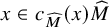 $x \in c_{\widehat {M}}(x)\widehat {M}$
. This raises the obvious question of whether
$x \in c_{\widehat {M}}(x)\widehat {M}$
. This raises the obvious question of whether $\widehat {M}$
is an Ohm-Rush
$\widehat {M}$
is an Ohm-Rush $\widehat {R}$
-module, that is, if
$\widehat {R}$
-module, that is, if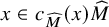 $x \in c_{\widehat {M}}(x)\widehat {M}$
for the elements
$x \in c_{\widehat {M}}(x)\widehat {M}$
for the elements $x \in \widehat {M}$
that are not in
$x \in \widehat {M}$
that are not in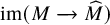 $\operatorname {\mathrm {im}}(M \to \widehat {M})$
. It will turn out that the answer to this question is yes, and does not have anything to do with M being Ohm-Rush. In other words, we will see in Corollary 4.3.14 that if M is a flat module over a Noetherian local ring
$\operatorname {\mathrm {im}}(M \to \widehat {M})$
. It will turn out that the answer to this question is yes, and does not have anything to do with M being Ohm-Rush. In other words, we will see in Corollary 4.3.14 that if M is a flat module over a Noetherian local ring $(R,{\mathfrak {m}})$
, then
$(R,{\mathfrak {m}})$
, then $\widehat {M}$
is always a flat and OR
$\widehat {M}$
is always a flat and OR $\widehat {R}$
-module because
$\widehat {R}$
-module because $\widehat {M}$
is
$\widehat {M}$
is ${\mathfrak {m}}$
-adically complete by [Reference Authors27, Tag 05GG]. Note the flatness of
${\mathfrak {m}}$
-adically complete by [Reference Authors27, Tag 05GG]. Note the flatness of $\widehat {M}$
follows by Lemma 2.2.4.
$\widehat {M}$
follows by Lemma 2.2.4.
We can summarize the key difference between the ML property and the Ohm-Rush property, at least for flat modules over local rings.
Corollary 3.4.33. Let $(R,{\mathfrak {m}})$
be a local ring (not necessarily Noetherian) and M be a flat R-module. Then we have the following:
$(R,{\mathfrak {m}})$
be a local ring (not necessarily Noetherian) and M be a flat R-module. Then we have the following:
-
(1) M is ML if and only if for any finitely generated submodule N of M, there exists a submodule L of M such that
$N \subseteq L$
, L is free of finite rank and
$L \hookrightarrow M$
is pure. -
(2) M is Ohm-Rush if and only if for any cyclic submodule N of M, there exists a submodule L of M such that
$N \subseteq L$
, L is free of finite rank and
$L \hookrightarrow M$
is pure.


Proof. (1) follows from Proposition 3.2.6 (1).
For (2), suppose M is Ohm-Rush and N is a cyclic submodule of M. Let f be a generator of N and consider the unique R-linear map $v \colon R \to M$
with image N that sends
$v \colon R \to M$
with image N that sends $1 \mapsto f$
. Since
$1 \mapsto f$
. Since $f \in c_M(f)M$
, by Proposition 3.4.29
$f \in c_M(f)M$
, by Proposition 3.4.29 $(5)\implies (1)$
we have that f (hence N) is contained in a submodule L of M such that L is free of finite rank and
$(5)\implies (1)$
we have that f (hence N) is contained in a submodule L of M such that L is free of finite rank and $L \hookrightarrow M$
is pure.
$L \hookrightarrow M$
is pure.
Conversely, suppose $f \in M$
and let
$f \in M$
and let $N = Rf$
. Choose a submodule L of M containing N such that L is free of finite rank and
$N = Rf$
. Choose a submodule L of M containing N such that L is free of finite rank and $L\hookrightarrow M$
is pure. Let
$L\hookrightarrow M$
is pure. Let $v\colon R \to M$
be the unique R-linear map that sends
$v\colon R \to M$
be the unique R-linear map that sends $1 \mapsto f$
and let
$1 \mapsto f$
and let $u \colon R \to L$
be the unique R-linear map that sends
$u \colon R \to L$
be the unique R-linear map that sends $1 \mapsto f$
. If
$1 \mapsto f$
. If $i \colon L \hookrightarrow M$
is the inclusion, then
$i \colon L \hookrightarrow M$
is the inclusion, then $v = i \circ u$
. Since i is pure and hence cyclically pure, u is a cyclic stabilizer for v by Lemma 3.3.4. Thus,
$v = i \circ u$
. Since i is pure and hence cyclically pure, u is a cyclic stabilizer for v by Lemma 3.3.4. Thus, $f \in c_M(f)M$
by Theorem 3.4.17
$f \in c_M(f)M$
by Theorem 3.4.17 $(4) \implies (1)$
.
$(4) \implies (1)$
.
Remark 3.4.34. Let M be a flat module over a local ring $(R,{\mathfrak {m}})$
. If
$(R,{\mathfrak {m}})$
. If $\Sigma $
is the collection of R-submodules of M that are pure in M and are free of finite rank, then
$\Sigma $
is the collection of R-submodules of M that are pure in M and are free of finite rank, then $\Sigma $
is filtered by inclusion when M is ML. In this case M is a filtered union of elements of
$\Sigma $
is filtered by inclusion when M is ML. In this case M is a filtered union of elements of $\Sigma $
. On the other hand, when M is Ohm-Rush (and not necessarily ML) then
$\Sigma $
. On the other hand, when M is Ohm-Rush (and not necessarily ML) then $\Sigma $
may not be filtered by inclusion and M is just a union (not a filtered union) of elements of
$\Sigma $
may not be filtered by inclusion and M is just a union (not a filtered union) of elements of $\Sigma $
.
$\Sigma $
.
Corollary 3.4.33 shows that for a flat Ohm-Rush module M over a local ring $(R,{\mathfrak {m}})$
and any
$(R,{\mathfrak {m}})$
and any $f \in M$
, one can always find a free submodule L of M of finite rank containing f such that L is pure in M. However, the proof of the existence of L is not very explicit, since it relies on the stabilization results of Proposition 3.4.29 and the equally less explicit Proposition 3.1.6. The next result provides criteria using the content function that can be used to construct L more explicitly; see Remark 3.4.36 for the construction.
$f \in M$
, one can always find a free submodule L of M of finite rank containing f such that L is pure in M. However, the proof of the existence of L is not very explicit, since it relies on the stabilization results of Proposition 3.4.29 and the equally less explicit Proposition 3.1.6. The next result provides criteria using the content function that can be used to construct L more explicitly; see Remark 3.4.36 for the construction.
Proposition 3.4.35. Let $(R,\mathfrak {m},\kappa )$
be a local ring (not necessarily Noetherian) and M a flat R-module. Let L be a finitely generated submodule and
$(R,\mathfrak {m},\kappa )$
be a local ring (not necessarily Noetherian) and M a flat R-module. Let L be a finitely generated submodule and $x_1, \ldots , x_n$
a minimal generating set. Let
$x_1, \ldots , x_n$
a minimal generating set. Let $\iota : L \hookrightarrow M$
be the inclusion map. The following are equivalent:
$\iota : L \hookrightarrow M$
be the inclusion map. The following are equivalent:
-
(1) For any
$y\in L \setminus \mathfrak {m} L$
,
$c_M(y)=R$
. -
(2)
$L \cap \mathfrak {m} M = \mathfrak {m} L$
, that is,
$\iota \otimes _R \kappa $
is injective. -
(3) For any ideal I of R, any minimal generating set
$y_1, \ldots , y_n$
of L, and any n-tuple
$a_1, \ldots , a_n \in R$
, if
$\sum _{i=1}^n a_i y_i \in IM$
, then
$(a_1, \ldots , a_n) \subseteq I$
. -
(4) L is free and
$\iota $
is pure. -
(5) L is free and
$\iota $
is cyclically pure. -
(6) For any n-tuple
$a_1, \ldots , a_n \in R$
, we have
$c_M(\sum _{i=1}^n a_i x_i) = (a_1, \ldots , a_n)$
.












Consider also the following statement:
-
(7) There is some
$a_1, \ldots , a_n \in R$
that form a minimal generating set for the ideal they generate, such that
$c_M(\sum _{i=1}^n a_i x_i) = (a_1, \ldots , a_n)$
.


If M is Ohm-Rush, then (7) implies the equivalent assertions (1)-(6).
Proof. We will make frequent use of Lemma 3.4.10, which guarantees because M is flat that $rc_M(f) \subseteq c_M(rf)$
for any
$rc_M(f) \subseteq c_M(rf)$
for any $r\in R$
,
$r\in R$
, $f \in M$
, with equality whenever
$f \in M$
, with equality whenever $c_M(f)=R$
.
$c_M(f)=R$
.
(1) $\Longleftrightarrow $
(2): Both statements amount to the assertion that
$\Longleftrightarrow $
(2): Both statements amount to the assertion that $L \setminus \mathfrak {m} L = L \setminus \mathfrak {m} M$
.
$L \setminus \mathfrak {m} L = L \setminus \mathfrak {m} M$
.
(1) $\implies $
(3): Suppose I is an ideal that violates the statement. Let k be minimal with
$\implies $
(3): Suppose I is an ideal that violates the statement. Let k be minimal with $1\leq k \leq n$
such that there exist some minimal generating set
$1\leq k \leq n$
such that there exist some minimal generating set $y_1, \ldots , y_n$
of L and elements
$y_1, \ldots , y_n$
of L and elements $a_1, \ldots , a_k \in R$
such that
$a_1, \ldots , a_k \in R$
such that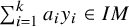 $\sum _{i=1}^k a_i y_i \in IM$
, but
$\sum _{i=1}^k a_i y_i \in IM$
, but $a_k \notin I$
. Note that
$a_k \notin I$
. Note that $k> 1$
because if
$k> 1$
because if $a_1y_1 \in IM$
, then
$a_1y_1 \in IM$
, then $a_1$
has to be in I because
$a_1$
has to be in I because $c_M(y_1) = R$
by (1) and we have
$c_M(y_1) = R$
by (1) and we have $a_1 \in a_1R = a_1c_M(y_1) \subseteq c_M(a_1y_1) \subseteq I$
.
$a_1 \in a_1R = a_1c_M(y_1) \subseteq c_M(a_1y_1) \subseteq I$
.
For our choice of k, we have $ a_k y_k \in (a_1, \ldots , a_{k-1})L + IM \subseteq ((a_1, \ldots , a_{k-1}) + I)M, $
so that since
$ a_k y_k \in (a_1, \ldots , a_{k-1})L + IM \subseteq ((a_1, \ldots , a_{k-1}) + I)M, $
so that since $c_M(y_k)=R$
(again using (1)), we have
$c_M(y_k)=R$
(again using (1)), we have $a_k \in a_k R = a_kc_M(y_k) \subseteq c_M(a_k y_k) \subseteq (a_1, \ldots , a_{k-1}) + I.$
Say
$a_k \in a_k R = a_kc_M(y_k) \subseteq c_M(a_k y_k) \subseteq (a_1, \ldots , a_{k-1}) + I.$
Say $a_k = u + \sum _{i=1}^{k-1} d_i a_i$
, with
$a_k = u + \sum _{i=1}^{k-1} d_i a_i$
, with $d_i \in R$
and
$d_i \in R$
and $u \in I$
. Then
$u \in I$
. Then
 $$\begin{align*}\sum_{i=1}^{k-1} a_i (y_i + d_i y_k) = \left(\sum_{i=1}^{k-1} a_i y_i\right) + a_k y_k - uy_k = \left(\sum_{i=1}^{k} a_i y_i\right) - uy_k \in IM. \end{align*}$$
But $ \{y_1 + d_1 y_k, y_2 + d_2y_k, \ldots , y_{k-1} + d_{k-1} y_k, y_k, \ldots , y_n\} $
is also a minimal generating set for L. Hence by minimality of k, we have
$ \{y_1 + d_1 y_k, y_2 + d_2y_k, \ldots , y_{k-1} + d_{k-1} y_k, y_k, \ldots , y_n\} $
is also a minimal generating set for L. Hence by minimality of k, we have $a_1, \ldots , a_{k-1} \in I$
. Thus,
$a_1, \ldots , a_{k-1} \in I$
. Thus, $a_k \in (a_1, \ldots , a_{k-1}) + I = I$
, which contradicts the fact that
$a_k \in (a_1, \ldots , a_{k-1}) + I = I$
, which contradicts the fact that $a_k \notin I$
. Hence, there is no ideal I that violates the assertion of (3).
$a_k \notin I$
. Hence, there is no ideal I that violates the assertion of (3).
(3) $\implies $
(5): For freeness, let
$\implies $
(5): For freeness, let $I=0$
in the statement of (3). For cyclic purity, let I be an ideal and
$I=0$
in the statement of (3). For cyclic purity, let I be an ideal and $f\in IM \cap L$
. Then there exist
$f\in IM \cap L$
. Then there exist $a_1, \ldots , a_n \in R$
with
$a_1, \ldots , a_n \in R$
with $f = \sum _{i=1}^n a_i x_i \in IM$
, so that by (3),
$f = \sum _{i=1}^n a_i x_i \in IM$
, so that by (3), $(a_1, \ldots , a_n) \subseteq I$
, whence
$(a_1, \ldots , a_n) \subseteq I$
, whence $f = \sum _{i=1}^n a_i x_i \in (a_1, \ldots , a_n)L \subseteq IL$
.
$f = \sum _{i=1}^n a_i x_i \in (a_1, \ldots , a_n)L \subseteq IL$
.
(4) $\Longleftrightarrow $
(5): This follows from Lemma 3.3.1 because M is flat.
$\Longleftrightarrow $
(5): This follows from Lemma 3.3.1 because M is flat.
(5) $\implies $
(6): Note
$\implies $
(6): Note $\{x_1,\dots ,x_n\}$
is a free basis of L. Since
$\{x_1,\dots ,x_n\}$
is a free basis of L. Since $\sum _{i=1}^n a_i x_i \in (a_1, \ldots , a_n)M$
, we have
$\sum _{i=1}^n a_i x_i \in (a_1, \ldots , a_n)M$
, we have $c_M(\sum _{i=1}^n a_i x_i) \subseteq (a_1, \ldots , a_n)$
. For the reverse containment, let I be an ideal such that
$c_M(\sum _{i=1}^n a_i x_i) \subseteq (a_1, \ldots , a_n)$
. For the reverse containment, let I be an ideal such that $\sum _{i=1}^n a_i x_i \in IM$
. Then
$\sum _{i=1}^n a_i x_i \in IM$
. Then $\sum _{i=1}^n a_i x_i \in IM \cap L = IL$
by cyclic purity, so by linear independence of the
$\sum _{i=1}^n a_i x_i \in IM \cap L = IL$
by cyclic purity, so by linear independence of the $x_i$
we have
$x_i$
we have $a_i \in I$
for all i. Hence
$a_i \in I$
for all i. Hence $(a_1, \ldots , a_n) \subseteq I$
, and since I was arbitrary with
$(a_1, \ldots , a_n) \subseteq I$
, and since I was arbitrary with $\sum _i a_i x_i \in IM$
, we have
$\sum _i a_i x_i \in IM$
, we have $(a_1, \ldots , a_n) \subseteq c_M(\sum _i a_i x_i)$
.
$(a_1, \ldots , a_n) \subseteq c_M(\sum _i a_i x_i)$
.
(6) $\implies $
(5): To see that L is free, let
$\implies $
(5): To see that L is free, let $a_1, \ldots , a_n \in R$
with
$a_1, \ldots , a_n \in R$
with $\sum _i a_i x_i =0$
. Then
$\sum _i a_i x_i =0$
. Then $(0)=c_M(0) = c_M\left (\sum _i a_i x_i\right ) = (a_1, \ldots , a_n),$
so that
$(0)=c_M(0) = c_M\left (\sum _i a_i x_i\right ) = (a_1, \ldots , a_n),$
so that $a_1 = \cdots = a_n = 0$
.
$a_1 = \cdots = a_n = 0$
.
To see that $\iota $
is cyclically pure, let
$\iota $
is cyclically pure, let $f\in IM \cap L$
. Since
$f\in IM \cap L$
. Since $f\in L$
, there exist
$f\in L$
, there exist $a_1, \ldots , a_n \in R$
with
$a_1, \ldots , a_n \in R$
with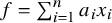 $f=\sum _{i=1}^n a_i x_i$
. Then since
$f=\sum _{i=1}^n a_i x_i$
. Then since $f\in IM$
, we have
$f\in IM$
, we have $(a_1, \ldots , a_n) = c_M(\sum _i a_i x_i) = c_M(f) \subseteq I$
, whence
$(a_1, \ldots , a_n) = c_M(\sum _i a_i x_i) = c_M(f) \subseteq I$
, whence $a_i \in I$
for all i. Thus,
$a_i \in I$
for all i. Thus, $f = \sum _{i=1}^n a_i x_i \in IL$
. This shows that for all ideals I,
$f = \sum _{i=1}^n a_i x_i \in IL$
. This shows that for all ideals I, $IM \cap L = IL$
, or equivalently, that
$IM \cap L = IL$
, or equivalently, that $\iota \otimes _R \operatorname {\mathrm {id}}_{R/I}$
is injective.
$\iota \otimes _R \operatorname {\mathrm {id}}_{R/I}$
is injective.
(5) $\implies $
(2): This follows because by cyclic purity because
$\implies $
(2): This follows because by cyclic purity because $\iota \otimes _R \kappa $
is injective.
$\iota \otimes _R \kappa $
is injective.
This completes the proof of the equivalence of conditions (1) through (6).
Now assume that M is Ohm-Rush. It suffices to show that (7) $\implies $
(1) under these hypotheses. By hypothesis,
$\implies $
(1) under these hypotheses. By hypothesis, $\{a_1,\dots ,a_n\}$
is a minimal generating set of the ideal
$\{a_1,\dots ,a_n\}$
is a minimal generating set of the ideal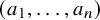 $(a_1,\dots ,a_n)$
. Let
$(a_1,\dots ,a_n)$
. Let $y \in L \setminus \mathfrak {m} L$
and expand y to form a minimal generating set
$y \in L \setminus \mathfrak {m} L$
and expand y to form a minimal generating set $y=y_1, y_2, \ldots , y_n$
for L. Then there is some invertible matrix
$y=y_1, y_2, \ldots , y_n$
for L. Then there is some invertible matrix $(\lambda _{ij})$
with entries in R such that for all
$(\lambda _{ij})$
with entries in R such that for all $1\leq j \leq n$
, we have
$1\leq j \leq n$
, we have $x_j = \sum _{i=1}^n \lambda _{ij} y_i$
. Set
$x_j = \sum _{i=1}^n \lambda _{ij} y_i$
. Set $b_i := \sum _{j=1}^n \lambda _{ij} a_j$
. Then
$b_i := \sum _{j=1}^n \lambda _{ij} a_j$
. Then $\{b_1,\dots ,b_n\}$
is also a minimal generating set for the ideal
$\{b_1,\dots ,b_n\}$
is also a minimal generating set for the ideal $(b_1,\dots ,b_n) = (a_1, \ldots , a_n)$
. Moreover,
$(b_1,\dots ,b_n) = (a_1, \ldots , a_n)$
. Moreover, $\sum _i b_i y_i=\sum _i \left (\sum _j \lambda _{ij} a_j\right ) y_i = \sum _j a_j \left (\sum _i \lambda _{ij} y_i\right ) = \sum _j a_j x_j.$
Now, suppose for contradiction $c_M(y) = c_M(y_1) \subseteq \mathfrak {m}$
. Then we have
$c_M(y) = c_M(y_1) \subseteq \mathfrak {m}$
. Then we have
 $$ \begin{align*} (b_1, \ldots, b_n) &= (a_1, \ldots, a_n) = c_M(\sum_j a_j x_j) = c_M(\sum_i b_i y_i)\\ &\subseteq \sum_i c_M(b_iy_i) \subseteq b_1 c(y_1) + (b_2, \ldots, b_n) \subseteq \mathfrak{m} b_1 + (b_2, \ldots, b_n). \end{align*} $$
Here for the inclusion $c_M(\sum _i b_i y_i) \subseteq \sum _i c_M(b_iy_i)$
we are crucially using that M is Ohm-Rush. By Nakayama’s lemma, we then have
$c_M(\sum _i b_i y_i) \subseteq \sum _i c_M(b_iy_i)$
we are crucially using that M is Ohm-Rush. By Nakayama’s lemma, we then have $b_1 \in (b_2, \ldots , b_n)$
, contradicting the fact that the
$b_1 \in (b_2, \ldots , b_n)$
, contradicting the fact that the $b_i$
form a minimal generating set of
$b_i$
form a minimal generating set of $(b_1,\dots ,b_n)$
. Thus,
$(b_1,\dots ,b_n)$
. Thus, $c_M(y) = R$
.
$c_M(y) = R$
.
Remark 3.4.36. Let M be a flat Ohm-Rush module over a local ring $(R,{\mathfrak {m}})$
and let
$(R,{\mathfrak {m}})$
and let $f \in M$
. Proposition 3.4.35 provides the following, more explicit, method of constructing a submodule L of M containing f such that L is free of finite rank and
$f \in M$
. Proposition 3.4.35 provides the following, more explicit, method of constructing a submodule L of M containing f such that L is free of finite rank and $L \hookrightarrow M$
is pure. Namely, since
$L \hookrightarrow M$
is pure. Namely, since $f \in c_M(f)M, c_M(f)$
is finitely generated. Let
$f \in c_M(f)M, c_M(f)$
is finitely generated. Let $a_1,\dots ,a_n$
be a minimal set of generators of the ideal
$a_1,\dots ,a_n$
be a minimal set of generators of the ideal $c_M(f)$
. Then there exists
$c_M(f)$
. Then there exists $x_1,\dots ,x_n \in M$
such that
$x_1,\dots ,x_n \in M$
such that $ f = a_1x_1 + \dots + a_nx_n. $
Let L be the submodule of M generated by
$ f = a_1x_1 + \dots + a_nx_n. $
Let L be the submodule of M generated by $x_1,\dots ,x_n$
. By construction,
$x_1,\dots ,x_n$
. By construction, $f \in L$
and
$f \in L$
and $ c_M(\sum _{i=1}^na_ix_i) = c_M(f) = (a_1,\dots ,a_n). $
Thus, by Proposition 3.4.35
$ c_M(\sum _{i=1}^na_ix_i) = c_M(f) = (a_1,\dots ,a_n). $
Thus, by Proposition 3.4.35 $(7)\implies (4)$
, L is free and
$(7)\implies (4)$
, L is free and $L \hookrightarrow M$
is pure provided that we can show that
$L \hookrightarrow M$
is pure provided that we can show that $x_1,\dots ,x_n$
is a minimal generating set for L. If not, then without loss of generality
$x_1,\dots ,x_n$
is a minimal generating set for L. If not, then without loss of generality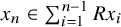 $x_n \in \sum _{i=1}^{n-1} Rx_i$
. Say
$x_n \in \sum _{i=1}^{n-1} Rx_i$
. Say $x_n = \sum _{i<n} b_i x_i$
. Then
$x_n = \sum _{i<n} b_i x_i$
. Then $f = \sum _{i=1}^n a_i x_i = \sum _{i=1}^{n-1} (a_i + a_n b_i)x_i.$
Let J be the ideal generated by the
$f = \sum _{i=1}^n a_i x_i = \sum _{i=1}^{n-1} (a_i + a_n b_i)x_i.$
Let J be the ideal generated by the $n-1$
elements
$n-1$
elements $a_i + a_n b_i$
,
$a_i + a_n b_i$
, $1 \leq i < n$
. Clearly
$1 \leq i < n$
. Clearly $J \subseteq (a_1,\ldots , a_n) = c_M(f)$
. On the other hand,
$J \subseteq (a_1,\ldots , a_n) = c_M(f)$
. On the other hand, $f \in JM$
, so
$f \in JM$
, so $c_M(f) \subseteq J$
. Thus
$c_M(f) \subseteq J$
. Thus $J=c_M(f)$
, so
$J=c_M(f)$
, so $c_M(f)$
can be generated by fewer than n elements, a contradiction.
$c_M(f)$
can be generated by fewer than n elements, a contradiction.
Perhaps a surprising aspect of Proposition 3.4.35 is that if M is a flat module over a local ring $(R,{\mathfrak {m}},\kappa )$
and L is a finitely generated submodule of M, then injectivity of the induced map
$(R,{\mathfrak {m}},\kappa )$
and L is a finitely generated submodule of M, then injectivity of the induced map $L/{\mathfrak {m}} L \to M/{\mathfrak {m}} M$
is enough to ensure that L is pure in M. Note that the freeness of L is really a consequence of the purity of
$L/{\mathfrak {m}} L \to M/{\mathfrak {m}} M$
is enough to ensure that L is pure in M. Note that the freeness of L is really a consequence of the purity of $L \hookrightarrow M$
. Indeed, since M is a flat R-module, it follows from the purity of
$L \hookrightarrow M$
. Indeed, since M is a flat R-module, it follows from the purity of $L \hookrightarrow M$
that L is also a flat R-module by Lemma 2.2.6. Then L is free because a finitely generated flat module over a local ring (not necessarily Noetherian) is free using the equational criterion of flatness [Reference Matsumura18, Thm. 7.10].
$L \hookrightarrow M$
that L is also a flat R-module by Lemma 2.2.6. Then L is free because a finitely generated flat module over a local ring (not necessarily Noetherian) is free using the equational criterion of flatness [Reference Matsumura18, Thm. 7.10].
The assumption that L is a finitely generated submodule of a flat module M can be relaxed to deduce purity of a map $L \to M$
from injectivity of the induced map
$L \to M$
from injectivity of the induced map $L/{\mathfrak {m}} L \to M/{\mathfrak {m}} M$
if we assume L is finitely presented.
$L/{\mathfrak {m}} L \to M/{\mathfrak {m}} M$
if we assume L is finitely presented.
Proposition 3.4.37. Let $(R,{\mathfrak {m}},\kappa )$
be a local ring (not necessarily Noetherian). Let
$(R,{\mathfrak {m}},\kappa )$
be a local ring (not necessarily Noetherian). Let $ \varphi \colon L \to M $
be a linear map where L is a finitely presented R-module and M is a flat R-module. Suppose that the induced map
$ \varphi \colon L \to M $
be a linear map where L is a finitely presented R-module and M is a flat R-module. Suppose that the induced map $\varphi \otimes _R \operatorname {\mathrm {id}}_{\kappa }$
is injective. Then
$\varphi \otimes _R \operatorname {\mathrm {id}}_{\kappa }$
is injective. Then $\varphi $
is a pure map.
$\varphi $
is a pure map.
Proof. By Lazard’s theorem [Reference Lazard17], we can express M as a colimit of a filtered system $\{(F_i, u_{ij}) \colon i, j \in (I, \leq ), i \leq j\}$
of finite free modules
$\{(F_i, u_{ij}) \colon i, j \in (I, \leq ), i \leq j\}$
of finite free modules $F_i$
. Since L is finitely presented, there exists
$F_i$
. Since L is finitely presented, there exists $i_0 \in I$
and a lift
$i_0 \in I$
and a lift $\varphi _{i_0} \colon L \to F_{i_0}$
of
$\varphi _{i_0} \colon L \to F_{i_0}$
of $\varphi $
along
$\varphi $
along $F_{i_0} \to M$
. Then
$F_{i_0} \to M$
. Then $ \varphi = \operatorname {\mathrm {colim}}_{j \geq i_0} u_{i_0j} \circ \varphi _{i_0}. $
Since a filtered colimit of universally injective maps of modules is universally injective, it suffices to show that for all
$ \varphi = \operatorname {\mathrm {colim}}_{j \geq i_0} u_{i_0j} \circ \varphi _{i_0}. $
Since a filtered colimit of universally injective maps of modules is universally injective, it suffices to show that for all $j \geq i_0$
,
$j \geq i_0$
, $u_{i_0 j} \circ \varphi _{i_0}$
is a pure map. Moreover, since
$u_{i_0 j} \circ \varphi _{i_0}$
is a pure map. Moreover, since $u_{i_0 j} \circ \varphi _{i_0}$
factors
$u_{i_0 j} \circ \varphi _{i_0}$
factors $\varphi $
, it follows by the injectivity of
$\varphi $
, it follows by the injectivity of $\varphi \otimes _R \operatorname {\mathrm {id}}_{\kappa }$
that for all
$\varphi \otimes _R \operatorname {\mathrm {id}}_{\kappa }$
that for all $j \geq i_0$
,
$j \geq i_0$
, $ (u_{i_0 j}\circ \varphi _{i_0}) \otimes _R \operatorname {\mathrm {id}}_{\kappa } \colon L/{\mathfrak {m}} L \to F_j/{\mathfrak {m}} F_j $
is also injective. The upshot is that replacing M by
$ (u_{i_0 j}\circ \varphi _{i_0}) \otimes _R \operatorname {\mathrm {id}}_{\kappa } \colon L/{\mathfrak {m}} L \to F_j/{\mathfrak {m}} F_j $
is also injective. The upshot is that replacing M by $F_j$
we may assume that M is finitely presented. Then
$F_j$
we may assume that M is finitely presented. Then $\varphi $
is injective and
$\varphi $
is injective and $\operatorname {\mathrm {coker}}(\varphi )$
is a flat R-module by [Reference Authors27, Tag 046Y]. But any injective map with flat cokernel is pure [Reference Authors27, Tag 058M].
$\operatorname {\mathrm {coker}}(\varphi )$
is a flat R-module by [Reference Authors27, Tag 046Y]. But any injective map with flat cokernel is pure [Reference Authors27, Tag 058M].
Proposition 3.4.35 and Proposition 3.4.37 have the following global consequences.
Corollary 3.4.38. Let R be a ring and $v \colon P \to M$
be a linear map where M is flat. Suppose that either of the following conditions hold:
$v \colon P \to M$
be a linear map where M is flat. Suppose that either of the following conditions hold:
-
(a) P is finitely generated and v is injective.
-
(b) P is finitely presented.
Then we have the following:
-
(1)
$\{{\mathfrak {p}} \in \operatorname {\mathrm {Spec}}(R) \colon v \otimes _R \operatorname {\mathrm {id}}_{R/{\mathfrak {p}}} \text { is injective}\} \subseteq \{{\mathfrak {p}} \in \operatorname {\mathrm {Spec}}(R) \colon v_{\mathfrak {p}} \text { is pure in } \operatorname {\mathrm {Mod}}_{R_{\mathfrak {p}}}\}$
. Moreover, if P is R-flat, then the two sets are equal. -
(2) Suppose that for all maximal ideals
${\mathfrak {m}}$
of R, the induced map
$v \otimes _R \operatorname {\mathrm {id}}_{R/{\mathfrak {m}}} \colon P/{\mathfrak {m}} P \to M/{\mathfrak {m}} M$
is injective. Then v is a pure map.



Proof. Assume $(a)$
. Identifying P with its isomorphic image
$(a)$
. Identifying P with its isomorphic image $\operatorname {\mathrm {im}}(v)$
, we will further assume that P is a finitely generated submodule of M and v is the inclusion map
$\operatorname {\mathrm {im}}(v)$
, we will further assume that P is a finitely generated submodule of M and v is the inclusion map $\iota $
of P into M.
$\iota $
of P into M.
(1) Suppose $\iota \otimes _R \operatorname {\mathrm {id}}_{R/{\mathfrak {p}}} \colon P/{\mathfrak {p}} P \to M/ {\mathfrak {p}} M$
is injective. Localizing at
$\iota \otimes _R \operatorname {\mathrm {id}}_{R/{\mathfrak {p}}} \colon P/{\mathfrak {p}} P \to M/ {\mathfrak {p}} M$
is injective. Localizing at ${\mathfrak {p}}$
we then get
${\mathfrak {p}}$
we then get $ \iota _{\mathfrak {p}} \otimes _{R_{\mathfrak {p}}} \kappa ({\mathfrak {p}}) \colon P_{\mathfrak {p}}/{\mathfrak {p}} P_{\mathfrak {p}} \to M_{\mathfrak {p}}/{\mathfrak {p}} M_{\mathfrak {p}} $
is injective. Since
$ \iota _{\mathfrak {p}} \otimes _{R_{\mathfrak {p}}} \kappa ({\mathfrak {p}}) \colon P_{\mathfrak {p}}/{\mathfrak {p}} P_{\mathfrak {p}} \to M_{\mathfrak {p}}/{\mathfrak {p}} M_{\mathfrak {p}} $
is injective. Since $\iota _{\mathfrak {p}}$
is also injective, Proposition 3.4.35 (2)
$\iota _{\mathfrak {p}}$
is also injective, Proposition 3.4.35 (2) $\implies $
(4) shows that
$\implies $
(4) shows that $\iota _{\mathfrak {p}}$
is pure in
$\iota _{\mathfrak {p}}$
is pure in $\operatorname {\mathrm {Mod}}_{R_{\mathfrak {p}}}$
. Thus,
$\operatorname {\mathrm {Mod}}_{R_{\mathfrak {p}}}$
. Thus, $ \{{\mathfrak {p}} \in \operatorname {\mathrm {Spec}}(R) \colon \iota \otimes _R \operatorname {\mathrm {id}}_{R/{\mathfrak {p}}} \text { is injective}\} \subseteq \{{\mathfrak {p}} \in \operatorname {\mathrm {Spec}}(R) \colon \iota _{\mathfrak {p}} \text { is pure in } \operatorname {\mathrm {Mod}}_{R_{\mathfrak {p}}}\}. $
Suppose P is a flat R-module. We want to show then that the other inclusion also holds. Let ${\mathfrak {p}} \in \operatorname {\mathrm {Spec}}(R)$
such that
${\mathfrak {p}} \in \operatorname {\mathrm {Spec}}(R)$
such that $\iota _{\mathfrak {p}}$
is pure. Consider the commutative diagram
$\iota _{\mathfrak {p}}$
is pure. Consider the commutative diagram

The bottom horizontal map is injective by purity of $\iota _{\mathfrak {p}}$
. Since P is R-flat, the left vertical map is also injective because it can be identified with the map obtained by applying
$\iota _{\mathfrak {p}}$
. Since P is R-flat, the left vertical map is also injective because it can be identified with the map obtained by applying $\otimes _R \operatorname {\mathrm {id}}_{P}$
to the injection
$\otimes _R \operatorname {\mathrm {id}}_{P}$
to the injection $R/{\mathfrak {p}} \hookrightarrow R_{\mathfrak {p}}/{\mathfrak {p}} R_{\mathfrak {p}} = \kappa (\mathfrak {p})$
. By commutativity, it follows that the top horizontal map is injective, that is,
$R/{\mathfrak {p}} \hookrightarrow R_{\mathfrak {p}}/{\mathfrak {p}} R_{\mathfrak {p}} = \kappa (\mathfrak {p})$
. By commutativity, it follows that the top horizontal map is injective, that is,
 $$\begin{align*}\{{\mathfrak{p}} \in \operatorname{\mathrm{Spec}}(R) \colon \iota_{\mathfrak{p}} \text{ is pure in } \operatorname{\mathrm{Mod}}_{R_{\mathfrak{p}}}\} \subseteq \{{\mathfrak{p}} \in \operatorname{\mathrm{Spec}}(R) \colon \iota \otimes_R \operatorname{\mathrm{id}}_{R/{\mathfrak{p}}} \text{ is injective}\}. \end{align*}$$
(2) Since purity of a map of R-modules can be checked locally at maximal ideals, it follows that if $\iota _{\mathfrak {m}}$
is
$\iota _{\mathfrak {m}}$
is $R_{\mathfrak {m}}$
-pure for all maximal ideals
$R_{\mathfrak {m}}$
-pure for all maximal ideals ${\mathfrak {m}}$
of R, then
${\mathfrak {m}}$
of R, then $\iota $
is R-pure. By hypothesis, the induced map
$\iota $
is R-pure. By hypothesis, the induced map $ \iota \otimes _R \operatorname {\mathrm {id}}_{R/{\mathfrak {m}}} \colon P/{\mathfrak {m}} P \to M/{\mathfrak {m}} M $
is injective. Thus by (1),
$ \iota \otimes _R \operatorname {\mathrm {id}}_{R/{\mathfrak {m}}} \colon P/{\mathfrak {m}} P \to M/{\mathfrak {m}} M $
is injective. Thus by (1), $\iota _{\mathfrak {m}}$
is
$\iota _{\mathfrak {m}}$
is $R_{\mathfrak {m}}$
-pure.
$R_{\mathfrak {m}}$
-pure.
The proof of $(1)$
and
$(1)$
and $(2)$
assuming
$(2)$
assuming $(b)$
is similar once we have Proposition 3.4.37. We omit the details.
$(b)$
is similar once we have Proposition 3.4.37. We omit the details.
3.5 Descent of (cyclic) stabilizers
We want to show that the Ohm-Rush property satisfies pure descent for flat modules (Theorem 3.5.4). But first, we will prove some preliminary results about descending (cyclic) purity and (cyclic) stabilizers. We begin with the following well-known result.
Lemma 3.5.1. Let $R \to S$
and
$R \to S$
and $M \to N$
be an R-linear map.
$M \to N$
be an R-linear map.
-
(1) If
$R \to S$
is pure and
$S \otimes _R M \to S \otimes _R N$
is pure as a map of S-modules, then
$M \to N$
is pure as a map of R-modules. -
(2) If
$R \to S$
is cyclically pure, M is flat and
$S \otimes _R M \to S \otimes _R N$
is cyclically pure as a map of S-modules, then
$M \to N$
is cyclically pure as a map of R-modules.






Proof. Consider the commutative diagram

(1) If $R \to S$
is pure, the left (resp. right) vertical map is obtained by tensoring the pure ring map
$R \to S$
is pure, the left (resp. right) vertical map is obtained by tensoring the pure ring map $R \to S$
with
$R \to S$
with $P \otimes _R M$
(resp.
$P \otimes _R M$
(resp. $P \otimes _R N$
). Thus, both the left and right vertical maps are injective.
$P \otimes _R N$
). Thus, both the left and right vertical maps are injective.
The bottom map $S \otimes _R (P \otimes _R M) \to S \otimes _R (P \otimes _R N)$
is injective because it can be identified with
$S \otimes _R (P \otimes _R M) \to S \otimes _R (P \otimes _R N)$
is injective because it can be identified with $ (S \otimes _R P) \otimes _S (S \otimes _R M) \to (S \otimes _R P) \otimes _S (S \otimes _R N), $
which is injective because by the assumption
$ (S \otimes _R P) \otimes _S (S \otimes _R M) \to (S \otimes _R P) \otimes _S (S \otimes _R N), $
which is injective because by the assumption $S \otimes _R M \to S \otimes _R N$
is pure as a map of S-modules. Then by the commutativity of the above diagram,
$S \otimes _R M \to S \otimes _R N$
is pure as a map of S-modules. Then by the commutativity of the above diagram, $P \otimes _R M \to P \otimes _R N$
must be injective as well.
$P \otimes _R M \to P \otimes _R N$
must be injective as well.
Since the base change of a cyclic R-module along S is a cyclic S-module, the proof of (2) follows using an argument similar to (1).
Our next result is about descending (cyclic) stabilizers along pure maps.
Proposition 3.5.2. Let $R \to S$
be a ring homomorphism. Let
$R \to S$
be a ring homomorphism. Let $\{(L_{i}, u_{ij}) \colon i, j \in I, i \leq j\}$
be a system of finitely presented R-modules indexed by a filtered poset
$\{(L_{i}, u_{ij}) \colon i, j \in I, i \leq j\}$
be a system of finitely presented R-modules indexed by a filtered poset $(I, \leq )$
. Set
$(I, \leq )$
. Set $ M {:=}q \operatorname {\mathrm {colim}}_i L_i. $
For all
$ M {:=}q \operatorname {\mathrm {colim}}_i L_i. $
For all $i \in I$
, let
$i \in I$
, let $u_i \colon L_i \to M$
be the associated map. Let F be a finitely presented R-module and
$u_i \colon L_i \to M$
be the associated map. Let F be a finitely presented R-module and $v \colon F \to M$
be an R-linear map.
$v \colon F \to M$
be an R-linear map.
-
(1) If
$R \to S$
is pure and
$\operatorname {\mathrm {id}}_S \otimes _R v$
admits a stabilizer in
$\operatorname {\mathrm {Mod}}_S$
, then there exists an index
$i \in I$
and a map
$v_i \colon F \to L_i$
such that
$ v = u_i \circ v_i $
and
$v_i$
is a stabilizer of v. -
(2) If
$R \to S$
is pure and
$\operatorname {\mathrm {id}}_S \otimes _R v$
admits a cyclic stabilizer in
$\operatorname {\mathrm {Mod}}_S$
that
$\operatorname {\mathrm {id}}_S \otimes _R v$
dominates, then there exists an index
$i \in I$
and a map
$v_i \colon F \to L_i$
such that
$ v = u_i \circ v_i $
and
$v_i$
is a cyclic stabilizer of v that v dominates. -
(3) If
$R \to S$
is cyclically pure,
$L_i$
is flat (equivalently, projective) for all i and
$\operatorname {\mathrm {id}}_S \otimes _R v$
admits a cyclic stabilizer in
$\operatorname {\mathrm {Mod}}_S$
that
$\operatorname {\mathrm {id}}_S \otimes _R v$
dominates, then there exists an index
$i \in I$
and a map
$v_i \colon F \to L_i$
such that
$ v = u_i \circ v_i $
and
$v_i$
is a cyclic stabilizer of v that v dominates.


Proof. We will prove (1) and (2) simultaneously. Note that $S \otimes _R M = \operatorname {\mathrm {colim}}_i S \otimes _R L_{i}$
since tensor products commute with filtered colimits. Since F is a finitely presented R-module, there exists
$S \otimes _R M = \operatorname {\mathrm {colim}}_i S \otimes _R L_{i}$
since tensor products commute with filtered colimits. Since F is a finitely presented R-module, there exists $i \in I$
and a map
$i \in I$
and a map $v_i \colon F \to L_i$
such that the following diagram commutes
$v_i \colon F \to L_i$
such that the following diagram commutes

Then $ v = u_i \circ v_i = (\operatorname {\mathrm {colim}}_{j \geq i} u_{ij}) \circ v_i = \operatorname {\mathrm {colim}}_{j \geq i} (u_{ij} \circ v_i). $
For all
$ v = u_i \circ v_i = (\operatorname {\mathrm {colim}}_{j \geq i} u_{ij}) \circ v_i = \operatorname {\mathrm {colim}}_{j \geq i} (u_{ij} \circ v_i). $
For all $j \geq i$
, define
$j \geq i$
, define $v_j {:=}q u_{ij} \circ v_i.$
We have
$v_j {:=}q u_{ij} \circ v_i.$
We have $ S \otimes _R M = \operatorname {\mathrm {colim}}_{j \geq i} S \otimes _R L_j, $
and
$ S \otimes _R M = \operatorname {\mathrm {colim}}_{j \geq i} S \otimes _R L_j, $
and $ \operatorname {\mathrm {id}}_S \otimes _R v = \operatorname {\mathrm {colim}}_{j \geq i} \operatorname {\mathrm {id}}_S \otimes _R v_j. $
Let
$ \operatorname {\mathrm {id}}_S \otimes _R v = \operatorname {\mathrm {colim}}_{j \geq i} \operatorname {\mathrm {id}}_S \otimes _R v_j. $
Let $f \colon S \otimes _R F \to P$
be a stabilizer of
$f \colon S \otimes _R F \to P$
be a stabilizer of $\operatorname {\mathrm {id}}_S \otimes _R v$
(resp. a cyclic stabilizer of
$\operatorname {\mathrm {id}}_S \otimes _R v$
(resp. a cyclic stabilizer of $\operatorname {\mathrm {id}}_S \otimes _R v$
that v dominates). By Lemma 3.1.2 (2),
$\operatorname {\mathrm {id}}_S \otimes _R v$
that v dominates). By Lemma 3.1.2 (2), $\operatorname {\mathrm {id}}_S \otimes _R v$
factors through f, that is, there exists
$\operatorname {\mathrm {id}}_S \otimes _R v$
factors through f, that is, there exists $\varphi \colon P \to S \otimes _R M$
such that
$\varphi \colon P \to S \otimes _R M$
such that

commutes. Since P is a finitely presented S-module, replacing i by a larger index, we may assume that there exists a lift $ \varphi _i \colon P \to S \otimes _R L_i $
of
$ \varphi _i \colon P \to S \otimes _R L_i $
of $\varphi $
along
$\varphi $
along $\operatorname {\mathrm {id}}_S \otimes _R u_i$
, that is,
$\operatorname {\mathrm {id}}_S \otimes _R u_i$
, that is,

commutes. Then we have two maps

such that $ (\operatorname {\mathrm {id}}_S \otimes _R u_i) \circ (\operatorname {\mathrm {id}}_S \otimes _R v_i) = \operatorname {\mathrm {id}}_S \otimes _R (u_i \circ v_i) = \operatorname {\mathrm {id}}_S \otimes _R v = \varphi \circ f = (\operatorname {\mathrm {id}}_S \otimes _R u_i) \circ (\varphi _i \circ f). $
Let
$ (\operatorname {\mathrm {id}}_S \otimes _R u_i) \circ (\operatorname {\mathrm {id}}_S \otimes _R v_i) = \operatorname {\mathrm {id}}_S \otimes _R (u_i \circ v_i) = \operatorname {\mathrm {id}}_S \otimes _R v = \varphi \circ f = (\operatorname {\mathrm {id}}_S \otimes _R u_i) \circ (\varphi _i \circ f). $
Let $f_1, \dots , f_n$
be generators of the S-module
$f_1, \dots , f_n$
be generators of the S-module $S \otimes _R F$
. Since
$S \otimes _R F$
. Since $M = \operatorname {\mathrm {colim}}_{j \geq i} S \otimes _R L_j$
, there exists
$M = \operatorname {\mathrm {colim}}_{j \geq i} S \otimes _R L_j$
, there exists $j \geq i$
such that for all
$j \geq i$
such that for all $\ell = 1, \dots , n$
,
$\ell = 1, \dots , n$
, $f_\ell $
has the same image in
$f_\ell $
has the same image in $S \otimes _R L_j$
under the two maps
$S \otimes _R L_j$
under the two maps

Since an S-linear map whose domain is $S \otimes _R F$
is completely determined by the images of the generators
$S \otimes _R F$
is completely determined by the images of the generators $f_1,\dots ,f_n$
, this implies
$f_1,\dots ,f_n$
, this implies $ \operatorname {\mathrm {id}}_S \otimes _R v_j = (\operatorname {\mathrm {id}}_S \otimes _R u_{ij}) \circ (\operatorname {\mathrm {id}}_S \otimes _R v_i) = (\operatorname {\mathrm {id}}_S \otimes _R u_{ij}) \circ (\varphi _i \circ f). $
Let
$ \operatorname {\mathrm {id}}_S \otimes _R v_j = (\operatorname {\mathrm {id}}_S \otimes _R u_{ij}) \circ (\operatorname {\mathrm {id}}_S \otimes _R v_i) = (\operatorname {\mathrm {id}}_S \otimes _R u_{ij}) \circ (\varphi _i \circ f). $
Let $\varphi _j {:=}q (\operatorname {\mathrm {id}}_S \otimes _R u_{ij}) \circ \varphi _i$
. We then see that the following diagram commutes
$\varphi _j {:=}q (\operatorname {\mathrm {id}}_S \otimes _R u_{ij}) \circ \varphi _i$
. We then see that the following diagram commutes

Since f is a stabilizer (resp. a cyclic stabilizer) of $\operatorname {\mathrm {id}}_S \otimes _R v$
, by Lemma 3.1.2 (5) (resp. by Lemma 3.3.5), we see that
$\operatorname {\mathrm {id}}_S \otimes _R v$
, by Lemma 3.1.2 (5) (resp. by Lemma 3.3.5), we see that $\operatorname {\mathrm {id}}_S \otimes _R v_j$
is a stabilizer (resp. a cyclic stabilizer) of
$\operatorname {\mathrm {id}}_S \otimes _R v_j$
is a stabilizer (resp. a cyclic stabilizer) of $\operatorname {\mathrm {id}}_S \otimes _R v$
. Now consider the pushout
$\operatorname {\mathrm {id}}_S \otimes _R v$
. Now consider the pushout

Since pushouts are preserved by base change,

is also a pushout diagram. The fact that $\operatorname {\mathrm {id}}_S \otimes _R v_j$
is a stabilizer (resp. a cyclic stabilizer) for
$\operatorname {\mathrm {id}}_S \otimes _R v_j$
is a stabilizer (resp. a cyclic stabilizer) for $\operatorname {\mathrm {id}}_S \otimes _R v$
is equivalent to the assertion that the maps
$\operatorname {\mathrm {id}}_S \otimes _R v$
is equivalent to the assertion that the maps $\operatorname {\mathrm {id}}_S \otimes _R v'$
and
$\operatorname {\mathrm {id}}_S \otimes _R v'$
and $\operatorname {\mathrm {id}}_S \otimes _R v_j'$
are both pure (resp. both cyclically pure) in
$\operatorname {\mathrm {id}}_S \otimes _R v_j'$
are both pure (resp. both cyclically pure) in $\operatorname {\mathrm {Mod}}_S$
by Lemma 3.1.2 (3) (resp. by Lemma 3.3.3). Since
$\operatorname {\mathrm {Mod}}_S$
by Lemma 3.1.2 (3) (resp. by Lemma 3.3.3). Since $R \to S$
is a pure ring map, Lemma 3.5.1 (1) then implies that
$R \to S$
is a pure ring map, Lemma 3.5.1 (1) then implies that $v'$
and
$v'$
and $v_j'$
are pure (resp. cyclically pure) in
$v_j'$
are pure (resp. cyclically pure) in $\operatorname {\mathrm {Mod}}_R$
. Thus
$\operatorname {\mathrm {Mod}}_R$
. Thus $v_j$
is a stabilizer (resp. a cyclic stabilizer) for v. Note that v dominates
$v_j$
is a stabilizer (resp. a cyclic stabilizer) for v. Note that v dominates $v_j$
since
$v_j$
since $v = u_j \circ v_j$
factors through
$v = u_j \circ v_j$
factors through $v_j$
.
$v_j$
.
(3) If the $L_i$
are all flat, then
$L_i$
are all flat, then $M = \operatorname {\mathrm {colim}}_i L_i$
is also flat. The proof of descent of cyclic stabilizers is now identical to (1) and (2), except in the step where we analyze the pushout Figure 3.5.2.1. Since M and
$M = \operatorname {\mathrm {colim}}_i L_i$
is also flat. The proof of descent of cyclic stabilizers is now identical to (1) and (2), except in the step where we analyze the pushout Figure 3.5.2.1. Since M and $L_j$
are both flat, the cyclic purity of
$L_j$
are both flat, the cyclic purity of $\operatorname {\mathrm {id}}_S \otimes _R v^{\prime }_j \colon S \otimes _R M \to S \otimes _R T$
and
$\operatorname {\mathrm {id}}_S \otimes _R v^{\prime }_j \colon S \otimes _R M \to S \otimes _R T$
and $\operatorname {\mathrm {id}}_S \otimes _R v' \colon S \otimes _R L_j \to S \otimes _R T$
as maps of S-modules implies that
$\operatorname {\mathrm {id}}_S \otimes _R v' \colon S \otimes _R L_j \to S \otimes _R T$
as maps of S-modules implies that $v^{\prime }_j$
and
$v^{\prime }_j$
and $v'$
are cyclically pure maps of R-modules by Lemma 3.5.1 (2) since we are assuming that
$v'$
are cyclically pure maps of R-modules by Lemma 3.5.1 (2) since we are assuming that $R \to S$
is cyclically pure.
$R \to S$
is cyclically pure.
Since any module can be expressed as a filtered colimit of finitely presented modules and since flat modules can be expressed as a filtered colimit of finite free modules, we then obtain the following:
Corollary 3.5.3. Let $R \to S$
be a ring map. Let
$R \to S$
be a ring map. Let $v \colon F \to M$
be an R-linear map where F is a finitely presented R-module. Then we have the following:
$v \colon F \to M$
be an R-linear map where F is a finitely presented R-module. Then we have the following:
-
(1) If
$R \to S$
is pure and
$\operatorname {\mathrm {id}}_S \otimes _R v$
admits a stabilizer in
$\operatorname {\mathrm {Mod}}_S$
, then v admits a stabilizer in
$\operatorname {\mathrm {Mod}}_R$
. -
(2) If
$R \to S$
is pure and
$\operatorname {\mathrm {id}}_S \otimes _R v$
admits a cyclic stabilizer that
$\operatorname {\mathrm {id}}_S \otimes _R v$
dominates in
$\operatorname {\mathrm {Mod}}_S$
, then v admits a cyclic stabilizer in
$\operatorname {\mathrm {Mod}}_R$
that v dominates. -
(3) If
$R \to S$
is cyclically pure, M is flat and
$\operatorname {\mathrm {id}}_S \otimes _R v$
admits a cyclic stabilizer that
$\operatorname {\mathrm {id}}_S \otimes _R v$
dominates in
$\operatorname {\mathrm {Mod}}_S$
, then v admits a cyclic stabilizer in
$\operatorname {\mathrm {Mod}}_R$
that v dominates.


Descent of cyclic stabilizers gives descent of the Ohm-Rush property. We note that our contribution is part (2) of the next result because descent of the ML property along pure maps was shown in [Reference Raynaud and Gruson23, Part II, Prop. 2.5.1]. We believe the proof of descent in [Reference Raynaud and Gruson23] is correct even though there is some confusion about its veracity. In any case, we reprove their result here since the proof follows easily by the theory already developed.
Theorem 3.5.4. Let $R \to S$
be a ring map and M be an R-module.
$R \to S$
be a ring map and M be an R-module.
-
(1) If
$R \to S$
is pure and
$S \otimes _R M$
is a ML S-module, then M is a ML R-module. -
(2) If
$R \to S$
is cyclically pure, M is flat and
$S \otimes _R M$
is an Ohm-Rush S-module, then M is an Ohm-Rush R-module.


Proof. $(1)$
If F is a finitely presented R-module and
$(1)$
If F is a finitely presented R-module and $v \colon F \to M$
is an R-linear map, we have to show that v admits a stabilizer. Upon expressing M as a directed colimit of finitely presented R-modules, this follows by Proposition 3.5.2 (1) because
$v \colon F \to M$
is an R-linear map, we have to show that v admits a stabilizer. Upon expressing M as a directed colimit of finitely presented R-modules, this follows by Proposition 3.5.2 (1) because $\operatorname {\mathrm {id}}_S \otimes _R v$
admits a stabilizer as a map of S-modules.
$\operatorname {\mathrm {id}}_S \otimes _R v$
admits a stabilizer as a map of S-modules. $(2)$
By Theorem 3.4.18, we have to show that every map
$(2)$
By Theorem 3.4.18, we have to show that every map $v \colon R \to M$
admits a cyclic stabilizer that v dominates. Since
$v \colon R \to M$
admits a cyclic stabilizer that v dominates. Since $S \otimes _R M$
is a flat Ohm-Rush S-module,
$S \otimes _R M$
is a flat Ohm-Rush S-module, $\operatorname {\mathrm {id}}_S \otimes _R v$
admits a cyclic stabilizer in
$\operatorname {\mathrm {id}}_S \otimes _R v$
admits a cyclic stabilizer in $\operatorname {\mathrm {Mod}}_S$
that
$\operatorname {\mathrm {Mod}}_S$
that $\operatorname {\mathrm {id}}_S \otimes _R v$
dominates by Theorem 3.4.18. Since M is flat, v admits a cyclic stabilizer in
$\operatorname {\mathrm {id}}_S \otimes _R v$
dominates by Theorem 3.4.18. Since M is flat, v admits a cyclic stabilizer in $\operatorname {\mathrm {Mod}}_R$
that v dominates by Corollary 3.5.3 (3).
$\operatorname {\mathrm {Mod}}_R$
that v dominates by Corollary 3.5.3 (3).
Remark 3.5.5.
-
(a) We do not know if one can drop the flatness assumption on M in Theorem 3.5.4 (2).
-
(b) Cyclically pure descent of the Ohm-Rush property for flat modules follows from the more general assertion about descent of cyclic stabilizers. However, one can also give a more direct argument of descent of the Ohm-Rush property that we include for the reader’s convenience. Let
$\{I_\alpha \colon \alpha \in A\}$
be a collection of ideals of R. Assuming that
$R \to S$
is cyclically pure and
$S \otimes _R M$
is an Ohm-Rush S-module for a flat R-module M, we need to show that
$ \bigcap _{\alpha \in A} I_\alpha M = \left (\bigcap _{\alpha \in A}I_\alpha \right ) M. $
Since taking inverse images commutes with arbitrary intersection, cyclic purity of
$R \to S$
implies that the induced map
$ \frac {R}{\bigcap _{\alpha \in A} I_\alpha } \to \frac {S}{\bigcap _{\alpha \in A} I_\alpha S} $
is injective. Since M is a flat R-module, this implies that (3.5.5.1)is injective as well. Since
$$ \begin{align} \frac{M}{\left(\bigcap_{\alpha \in A}I_\alpha\right) M} \to \frac{S \otimes_R M}{\left(\bigcap_{\alpha \in A}I_\alpha S\right)(S\otimes_R M)} \end{align} $$
$S \otimes _R M$
is an Ohm-Rush S-module, we then get (3.5.5.2)Then (3.5.5.1) and (3.5.5.2) imply that the composition
$$ \begin{align} \left(\bigcap_{\alpha \in A}I_\alpha S\right)(S\otimes_R M) = \bigcap_{\alpha \in A}I_\alpha S (S \otimes_R M). \end{align} $$
(3.5.5.3)
$$ \begin{align} \frac{M}{\left(\bigcap_{\alpha \in A}I_\alpha\right) M} \to \frac{S \otimes_R M}{\left(\bigcap_{\alpha \in A}I_\alpha S\right)(S\otimes_R M)} \to \prod_{\alpha \in A} \frac{S \otimes_R M}{(I_\alpha S)(S \otimes_R M)} \end{align} $$
is injective. But (3.5.5.3) has a factorization
So the first map
$ {\frac {M}{\left (\bigcap _{\alpha \in A}I_\alpha \right ) M}} \to {\prod _{\alpha \in A} \frac {M}{I_\alpha M}} $
is injective as well. But this precisely means that
$\bigcap _{\alpha \in A} I_\alpha M = \left (\bigcap _{\alpha \in A}I_\alpha \right ) M.$







Remark 3.5.6. It turns out that the SML property does not satisfy pure/faithfully flat descent. That is, if $R \to S$
is a faithfully flat ring map and M is an R-module (even a flat one) such that
$R \to S$
is a faithfully flat ring map and M is an R-module (even a flat one) such that $S \otimes _R M$
is a SML S-module, then it is not true in general that M is a SML R-module. Our example [Reference Datta, Epstein, Schwede and Tucker2, Remark 3.1.5 (b)] relies on the Frobenius endomorphism of an excellent local ring of prime characteristic and the connection of the SML property for flat modules with the Ohm-Rush trace property (Theorem 4.3.6).
$S \otimes _R M$
is a SML S-module, then it is not true in general that M is a SML R-module. Our example [Reference Datta, Epstein, Schwede and Tucker2, Remark 3.1.5 (b)] relies on the Frobenius endomorphism of an excellent local ring of prime characteristic and the connection of the SML property for flat modules with the Ohm-Rush trace property (Theorem 4.3.6).
3.6 Openness of pure loci
Let $v \colon M \to N$
be an R-linear map such that both M and N are finitely presented R-modules. Suppose
$v \colon M \to N$
be an R-linear map such that both M and N are finitely presented R-modules. Suppose ${\mathfrak {p}} \in \operatorname {\mathrm {Spec}}(R)$
such that the induced map
${\mathfrak {p}} \in \operatorname {\mathrm {Spec}}(R)$
such that the induced map $v_{\mathfrak {p}} \colon M_{\mathfrak {p}} \to N_{\mathfrak {p}}$
splits. Since
$v_{\mathfrak {p}} \colon M_{\mathfrak {p}} \to N_{\mathfrak {p}}$
splits. Since $\operatorname {\mathrm {Hom}}_R(N,M)_{\mathfrak {p}} = \operatorname {\mathrm {Hom}}_{R_{\mathfrak {p}}}(N_{\mathfrak {p}},M_{\mathfrak {p}})$
, a left-inverse of
$\operatorname {\mathrm {Hom}}_R(N,M)_{\mathfrak {p}} = \operatorname {\mathrm {Hom}}_{R_{\mathfrak {p}}}(N_{\mathfrak {p}},M_{\mathfrak {p}})$
, a left-inverse of $v_{\mathfrak {p}}$
spreads to a distinguished open neighborhood of
$v_{\mathfrak {p}}$
spreads to a distinguished open neighborhood of ${\mathfrak {p}}$
, that is, there exists
${\mathfrak {p}}$
, that is, there exists $f \in R \setminus {\mathfrak {p}}$
such that
$f \in R \setminus {\mathfrak {p}}$
such that $v_f \colon M_f \to N_f$
also splits. Thus,
$v_f \colon M_f \to N_f$
also splits. Thus, $ \{{\mathfrak {p}} \in \operatorname {\mathrm {Spec}}(R) \colon v_{\mathfrak {p}} \text { splits in } \operatorname {\mathrm {Mod}}_{R_{\mathfrak {p}}}\} $
is open in
$ \{{\mathfrak {p}} \in \operatorname {\mathrm {Spec}}(R) \colon v_{\mathfrak {p}} \text { splits in } \operatorname {\mathrm {Mod}}_{R_{\mathfrak {p}}}\} $
is open in $\operatorname {\mathrm {Spec}}(R)$
. Note that in this setup,
$\operatorname {\mathrm {Spec}}(R)$
. Note that in this setup, $\operatorname {\mathrm {coker}}(v)$
is a finitely presented R-module as well by [Reference Authors27, Tag 0519 (4)]. Thus,
$\operatorname {\mathrm {coker}}(v)$
is a finitely presented R-module as well by [Reference Authors27, Tag 0519 (4)]. Thus, $ \{{\mathfrak {p}} \in \operatorname {\mathrm {Spec}}(R) \colon v_{\mathfrak {p}} \text { is pure in } \operatorname {\mathrm {Mod}}_{R_{\mathfrak {p}}}\} = \{{\mathfrak {p}} \in \operatorname {\mathrm {Spec}}(R) \colon v_{\mathfrak {p}} \text { splits in } \operatorname {\mathrm {Mod}}_{R_{\mathfrak {p}}}\}$
by Lemma 2.2.5.
$ \{{\mathfrak {p}} \in \operatorname {\mathrm {Spec}}(R) \colon v_{\mathfrak {p}} \text { is pure in } \operatorname {\mathrm {Mod}}_{R_{\mathfrak {p}}}\} = \{{\mathfrak {p}} \in \operatorname {\mathrm {Spec}}(R) \colon v_{\mathfrak {p}} \text { splits in } \operatorname {\mathrm {Mod}}_{R_{\mathfrak {p}}}\}$
by Lemma 2.2.5.
Notation 3.6.1. For a map of R-modules $v \colon M \to N$
, let
$v \colon M \to N$
, let $\operatorname {\mathrm {Pure}}(v)$
denote the locus of primes
$\operatorname {\mathrm {Pure}}(v)$
denote the locus of primes ${\mathfrak {p}} \in \operatorname {\mathrm {Spec}}(R)$
where
${\mathfrak {p}} \in \operatorname {\mathrm {Spec}}(R)$
where $v_{\mathfrak {p}}$
is pure and we let
$v_{\mathfrak {p}}$
is pure and we let $\operatorname {\mathrm {CPure}}(v)$
denote the locus of primes
$\operatorname {\mathrm {CPure}}(v)$
denote the locus of primes ${\mathfrak {p}} \in \operatorname {\mathrm {Spec}}(R)$
where
${\mathfrak {p}} \in \operatorname {\mathrm {Spec}}(R)$
where $v_{\mathfrak {p}}$
is cyclically pure.
$v_{\mathfrak {p}}$
is cyclically pure.
We have the following:
Lemma 3.6.2. Let R be a ring and $v \colon M \to N$
be a map of R-modules where M is finitely presented. If v admits a stabilizer, then
$v \colon M \to N$
be a map of R-modules where M is finitely presented. If v admits a stabilizer, then $\operatorname {\mathrm {Pure}}(v)$
is open in
$\operatorname {\mathrm {Pure}}(v)$
is open in $\operatorname {\mathrm {Spec}}(R)$
.
$\operatorname {\mathrm {Spec}}(R)$
.
Proof. By hypothesis, there exists a finitely presented R-module P and a map $u \colon M \to P$
such that u and v dominate each other. Then
$u \colon M \to P$
such that u and v dominate each other. Then $\operatorname {\mathrm {Pure}}(v) = \operatorname {\mathrm {Pure}}(u)$
by Corollary 3.1.3. Since
$\operatorname {\mathrm {Pure}}(v) = \operatorname {\mathrm {Pure}}(u)$
by Corollary 3.1.3. Since $\operatorname {\mathrm {Pure}}(u)$
is open by the argument above, we have the desired result.
$\operatorname {\mathrm {Pure}}(u)$
is open by the argument above, we have the desired result.
Corollary 3.6.3. Let R be a ring and M be a ML R-module. Let P be a finitely presented R-module and $v \colon P \to M$
be a linear map. Then
$v \colon P \to M$
be a linear map. Then $\operatorname {\mathrm {Pure}}(v)$
is open.
$\operatorname {\mathrm {Pure}}(v)$
is open.
Proof. Since M is ML, v admits a stabilizer. So we are done by Lemma 3.6.2.
If M is a flat Ohm-Rush R-module, then any linear map $v \colon R \to M$
admits a stabilizer by Corollary 3.4.28. Thus
$v \colon R \to M$
admits a stabilizer by Corollary 3.4.28. Thus $\operatorname {\mathrm {Pure}}(v)$
is open for such maps v. However, we can say more about the pure locus in terms of the content function.
$\operatorname {\mathrm {Pure}}(v)$
is open for such maps v. However, we can say more about the pure locus in terms of the content function.
Lemma 3.6.4. Let R be a ring and M be a flat R-module. Let $v \colon R \to M$
be a linear map. Then we have the following:
$v \colon R \to M$
be a linear map. Then we have the following:
-
(1) v is pure if and only if
$c_M(v(1)) = R$
. -
(2) If M is Ohm-Rush, then
$\operatorname {\mathrm {Pure}}(v) = \operatorname {\mathrm {CPure}}(v) = \operatorname {\mathrm {Spec}}(R) \setminus \mathbf {V}(c_M(v(1)))$
.


Proof. (1) Suppose v is pure. Then for all ideals I of R, $v \otimes _R R/I$
is injective. Since the image of
$v \otimes _R R/I$
is injective. Since the image of $1$
in
$1$
in $R/I$
is a nonzero element if
$R/I$
is a nonzero element if $I \subsetneq R$
, this mean that for all proper ideals I of R,
$I \subsetneq R$
, this mean that for all proper ideals I of R, $v(1) + IM \neq 0$
in
$v(1) + IM \neq 0$
in $M/IM$
. But that is equivalent to saying that for all proper ideals I of R,
$M/IM$
. But that is equivalent to saying that for all proper ideals I of R, $v(1) \notin IM$
. Then
$v(1) \notin IM$
. Then $c_M(v(1)) = R$
by definition of content. Note this implication does not need M to be flat.
$c_M(v(1)) = R$
by definition of content. Note this implication does not need M to be flat.
Conversely, suppose $c_M(v(1)) = R$
. In order to show that v is pure, it suffices to show by Lemma 3.3.1 that v is cyclically pure because M is a flat R-module. Let I be an ideal of R and suppose
$c_M(v(1)) = R$
. In order to show that v is pure, it suffices to show by Lemma 3.3.1 that v is cyclically pure because M is a flat R-module. Let I be an ideal of R and suppose $r \in R$
such that
$r \in R$
such that $r + I \in \mathrm{ker} (v \otimes _R R/I)$
. Then
$r + I \in \mathrm{ker} (v \otimes _R R/I)$
. Then $v(r) \in IM$
, and so,
$v(r) \in IM$
, and so, $rv(1) \in IM$
. This means that
$rv(1) \in IM$
. This means that $ c_M(rv(1)) \subseteq I. $
Since M is R-flat, by Lemma 3.4.10, $ rc_M(v(1)) \subseteq c_M(rv(1)) \subseteq I. $
Hence
$ rc_M(v(1)) \subseteq c_M(rv(1)) \subseteq I. $
Hence $c_M(v(1)) \subseteq (I \colon r)$
. As
$c_M(v(1)) \subseteq (I \colon r)$
. As $c_M(v(1)) = R$
, we get
$c_M(v(1)) = R$
, we get $r \in I$
, which shows that
$r \in I$
, which shows that $v \otimes _R R/I$
is injective.
$v \otimes _R R/I$
is injective.
(2) Since M is flat we have $\operatorname {\mathrm {Pure}}(v) = \operatorname {\mathrm {CPure}}(v)$
by Lemma 3.3.1. Since M is also Ohm-Rush, by Proposition 3.4.14 (4) we have that for all
$\operatorname {\mathrm {Pure}}(v) = \operatorname {\mathrm {CPure}}(v)$
by Lemma 3.3.1. Since M is also Ohm-Rush, by Proposition 3.4.14 (4) we have that for all $x \in M$
and for all
$x \in M$
and for all ${\mathfrak {p}} \in \operatorname {\mathrm {Spec}}(R)$
,
${\mathfrak {p}} \in \operatorname {\mathrm {Spec}}(R)$
, $ c_M(x)R_{\mathfrak {p}} = c_{M_{\mathfrak {p}}}(x/1), $
where
$ c_M(x)R_{\mathfrak {p}} = c_{M_{\mathfrak {p}}}(x/1), $
where $c_{M_{\mathfrak {p}}}$
is the content of
$c_{M_{\mathfrak {p}}}$
is the content of $M_{\mathfrak {p}}$
as an
$M_{\mathfrak {p}}$
as an $R_{\mathfrak {p}}$
-module. By (1),
$R_{\mathfrak {p}}$
-module. By (1), $v_{\mathfrak {p}}$
is
$v_{\mathfrak {p}}$
is $R_{\mathfrak {p}}$
-pure if and only if
$R_{\mathfrak {p}}$
-pure if and only if $ c_M(v(1))R_{\mathfrak {p}} = c_{M_{\mathfrak {p}}}(v_{\mathfrak {p}}(1/1)) = R_{\mathfrak {p}}. $
This precisely means that
$ c_M(v(1))R_{\mathfrak {p}} = c_{M_{\mathfrak {p}}}(v_{\mathfrak {p}}(1/1)) = R_{\mathfrak {p}}. $
This precisely means that $ \operatorname {\mathrm {Pure}}(v) = \{{\mathfrak {p}} \in \operatorname {\mathrm {Spec}}(R) \colon c_M(v(1)) \nsubseteq {\mathfrak {p}}\},$
as desired.
$ \operatorname {\mathrm {Pure}}(v) = \{{\mathfrak {p}} \in \operatorname {\mathrm {Spec}}(R) \colon c_M(v(1)) \nsubseteq {\mathfrak {p}}\},$
as desired.
3.7 Local-to-global criteria
We have seen that a lot more can be said about the ML and Ohm-Rush properties when working over a local ring; see for instance Proposition 3.1.6, Proposition 3.2.7, Proposition 3.4.29, Proposition 3.4.35, Corollary 3.4.33 and Remark 3.4.36. This makes it desirable to have some local-to-global results that allow us to deduce that a module is ML or Ohm-Rush if all its localizations at primes are. This is the content of the main result of this subsection.
Theorem 3.7.1. Let R be a ring and let M be a flat R-module. Consider the conditions:
-
(† ′ ) For all finite free R-modules F and injective linear maps
$\varphi \colon F \hookrightarrow M$
, the set
$\{{\mathfrak {p}} \in \operatorname {\mathrm {Spec}}(R) \colon \varphi \otimes _R \operatorname {\mathrm {id}}_{R/{\mathfrak {p}}} \hspace {1mm} \text {is injective}\}$
is open in
$\operatorname {\mathrm {Spec}}(R)$
. -
(†) For all finite free R-modules F and linear maps
$\varphi \colon F \to M$
, the set
$\{{\mathfrak {p}} \in \operatorname {\mathrm {Spec}}(R) \colon \varphi \otimes _R \operatorname {\mathrm {id}}_{R/{\mathfrak {p}}} \hspace {1mm} \text {is injective}\}$
is open in
$\operatorname {\mathrm {Spec}}(R)$
. -
(† †) For all finite free R-modules F and linear maps
$\varphi \colon F \to M$
, the cyclically pure locus of
$\varphi $
is open in
$\operatorname {\mathrm {Spec}}(R)$
. -
(† † †) For all finitely presented R-modules P and linear maps
$\varphi \colon P \to M$
, the pure locus of
$\varphi $
is open in
$\operatorname {\mathrm {Spec}}(R)$
.




We have $(\dagger \dagger \dagger ) \implies (\dagger \dagger ) \Longleftrightarrow (\dagger ) \implies (\dagger ')$
. In addition, the following assertions hold:
$(\dagger \dagger \dagger ) \implies (\dagger \dagger ) \Longleftrightarrow (\dagger ) \implies (\dagger ')$
. In addition, the following assertions hold:
-
(1) Assume that for all
${\mathfrak {p}} \in \operatorname {\mathrm {Spec}}(R)$
,
$M_{\mathfrak {p}}$
is a ML
$R_{\mathfrak {p}}$
-module. Then the following are equivalent:-
(1a) M is ML.
-
(1b)
$(\dagger \dagger )$
holds. -
(1c)
$(\dagger \dagger \dagger )$
holds. -
(1d)
$(\dagger )$
holds.
Moreover, if R is a domain then
$(1a)-(1d)$
is equivalent to:-
(1d’)
$(\dagger ')$
holds.
-
-
(2) Assume that for all
${\mathfrak {p}} \in \operatorname {\mathrm {Spec}}(R)$
,
$M_{\mathfrak {p}}$
is an Ohm-Rush
$R_{\mathfrak {p}}$
-module.-
2(i) If
$(\dagger \dagger )$
(equivalently
$(\dagger )$
) holds, then M is Ohm-Rush. -
2(ii) If R is a domain and
$(\dagger ')$
holds, then M is Ohm-Rush.
-



Part (1) of Theorem 3.7.1 strengthens [Reference Raynaud and Gruson23, Part II, Lem. 2.5.6]. Furthermore, Theorem 3.7.1 (2) is new.
Proof. Since M is flat, $\operatorname {\mathrm {CPure}}(\varphi ) = \operatorname {\mathrm {Pure}}(\varphi )$
by Lemma 3.3.1. Moreover, if F is finite free (hence finitely presented and flat), then
$\operatorname {\mathrm {CPure}}(\varphi ) = \operatorname {\mathrm {Pure}}(\varphi )$
by Lemma 3.3.1. Moreover, if F is finite free (hence finitely presented and flat), then $\{{\mathfrak {p}} \in \operatorname {\mathrm {Spec}}(R) \colon \varphi \otimes _R \operatorname {\mathrm {id}}_{R/{\mathfrak {p}}} \hspace {1mm} \text {is injective}\} = \operatorname {\mathrm {Pure}}(\varphi )$
by Corollary 3.4.38. Hence
$\{{\mathfrak {p}} \in \operatorname {\mathrm {Spec}}(R) \colon \varphi \otimes _R \operatorname {\mathrm {id}}_{R/{\mathfrak {p}}} \hspace {1mm} \text {is injective}\} = \operatorname {\mathrm {Pure}}(\varphi )$
by Corollary 3.4.38. Hence $(\dagger ) \Longleftrightarrow (\dagger \dagger )$
. Moreover,
$(\dagger ) \Longleftrightarrow (\dagger \dagger )$
. Moreover, $(\dagger \dagger \dagger ) \implies (\dagger \dagger )$
and
$(\dagger \dagger \dagger ) \implies (\dagger \dagger )$
and $(\dagger ) \implies (\dagger ')$
are clear.
$(\dagger ) \implies (\dagger ')$
are clear. $(1a) \implies (1c)$
follows by Corollary 3.6.3, and we already saw that
$(1a) \implies (1c)$
follows by Corollary 3.6.3, and we already saw that $(1c) \implies (1b) \Longleftrightarrow (1d)$
regardless of whether M is locally ML.
$(1c) \implies (1b) \Longleftrightarrow (1d)$
regardless of whether M is locally ML.
We will finish the proof by demonstrating $(1b) \implies (1a)$
and
$(1b) \implies (1a)$
and $2(i)$
simultaneously because the proofs are similar.
$2(i)$
simultaneously because the proofs are similar.
So suppose for all ${\mathfrak {p}} \in \operatorname {\mathrm {Spec}}(R)$
,
${\mathfrak {p}} \in \operatorname {\mathrm {Spec}}(R)$
, $M_{\mathfrak {p}}$
is ML (resp. Ohm-Rush) in
$M_{\mathfrak {p}}$
is ML (resp. Ohm-Rush) in $\operatorname {\mathrm {Mod}}_{R_{\mathfrak {p}}}$
. Let P be a finitely presented R-module (resp. let
$\operatorname {\mathrm {Mod}}_{R_{\mathfrak {p}}}$
. Let P be a finitely presented R-module (resp. let $P = R$
) and let
$P = R$
) and let $v \colon P \to M$
be a linear map. It suffices to show that v admits a stabilizer (M will be Ohm-Rush in
$v \colon P \to M$
be a linear map. It suffices to show that v admits a stabilizer (M will be Ohm-Rush in $(2)$
when
$(2)$
when $P = R$
by Corollary 3.4.28).
$P = R$
by Corollary 3.4.28).
By Corollary 3.4.33, in either case there exists a submodule $N({\mathfrak {p}})$
of
$N({\mathfrak {p}})$
of $M_{\mathfrak {p}}$
such that
$M_{\mathfrak {p}}$
such that $ \operatorname {\mathrm {im}}(v)_{\mathfrak {p}} = \operatorname {\mathrm {im}}(v_{\mathfrak {p}}) \subseteq N({\mathfrak {p}}) \subseteq M_{\mathfrak {p}}, N({\mathfrak {p}})$
is free of finite rank and
$ \operatorname {\mathrm {im}}(v)_{\mathfrak {p}} = \operatorname {\mathrm {im}}(v_{\mathfrak {p}}) \subseteq N({\mathfrak {p}}) \subseteq M_{\mathfrak {p}}, N({\mathfrak {p}})$
is free of finite rank and $N({\mathfrak {p}}) \hookrightarrow M_{\mathfrak {p}}$
is pure in
$N({\mathfrak {p}}) \hookrightarrow M_{\mathfrak {p}}$
is pure in $\operatorname {\mathrm {Mod}}_{R_{\mathfrak {p}}}$
. Clearing denominators, if necessary, there exist
$\operatorname {\mathrm {Mod}}_{R_{\mathfrak {p}}}$
. Clearing denominators, if necessary, there exist $m_1,\dots ,m_n \in M$
such that
$m_1,\dots ,m_n \in M$
such that $m_1/1,\dots ,m_n/1$
form a free basis of
$m_1/1,\dots ,m_n/1$
form a free basis of $N({\mathfrak {p}})$
in
$N({\mathfrak {p}})$
in $\operatorname {\mathrm {Mod}}_{R_{\mathfrak {p}}}$
. Consider the R-linear map
$\operatorname {\mathrm {Mod}}_{R_{\mathfrak {p}}}$
. Consider the R-linear map
 $$ \begin{align} \varphi({\mathfrak{p}}) \colon R^{\oplus n} \to M \end{align} $$
that sends the standard basis vector $e_i$
of
$e_i$
of $R^{\oplus n}$
to
$R^{\oplus n}$
to $m_i$
for all
$m_i$
for all $i = 1, \dots , n$
. By construction,
$i = 1, \dots , n$
. By construction, $\varphi ({\mathfrak {p}})_{\mathfrak {p}}$
is an isomorphism onto its image
$\varphi ({\mathfrak {p}})_{\mathfrak {p}}$
is an isomorphism onto its image $N({\mathfrak {p}})$
, and hence,
$N({\mathfrak {p}})$
, and hence, $\varphi ({\mathfrak {p}})_{\mathfrak {p}}$
is
$\varphi ({\mathfrak {p}})_{\mathfrak {p}}$
is $R_{\mathfrak {p}}$
-pure. Note that by
$R_{\mathfrak {p}}$
-pure. Note that by $(\dagger \dagger )$
,
$(\dagger \dagger )$
, $ \operatorname {\mathrm {Pure}}(\varphi ({\mathfrak {p}})) = \operatorname {\mathrm {CPure}}(\varphi ({\mathfrak {p}})) $
is open. Since
$ \operatorname {\mathrm {Pure}}(\varphi ({\mathfrak {p}})) = \operatorname {\mathrm {CPure}}(\varphi ({\mathfrak {p}})) $
is open. Since ${\mathfrak {p}} \in \operatorname {\mathrm {Pure}}(\varphi ({\mathfrak {p}}))$
, one can choose
${\mathfrak {p}} \in \operatorname {\mathrm {Pure}}(\varphi ({\mathfrak {p}}))$
, one can choose $f \in R \setminus {\mathfrak {p}}$
such that
$f \in R \setminus {\mathfrak {p}}$
such that $\varphi ({\mathfrak {p}})_f$
is pure in
$\varphi ({\mathfrak {p}})_f$
is pure in $\operatorname {\mathrm {Mod}}_{R_f}$
. Furthermore, since
$\operatorname {\mathrm {Mod}}_{R_f}$
. Furthermore, since $\operatorname {\mathrm {im}}(v)$
is finitely generated (it is the image of the finitely presented module P) and
$\operatorname {\mathrm {im}}(v)$
is finitely generated (it is the image of the finitely presented module P) and $ \operatorname {\mathrm {im}}(v)_{\mathfrak {p}} = \operatorname {\mathrm {im}}(v_{\mathfrak {p}}) \subseteq N({\mathfrak {p}}) = \operatorname {\mathrm {im}}(\varphi ({\mathfrak {p}}))_{\mathfrak {p}}. $
Replacing f by a multiple in
$ \operatorname {\mathrm {im}}(v)_{\mathfrak {p}} = \operatorname {\mathrm {im}}(v_{\mathfrak {p}}) \subseteq N({\mathfrak {p}}) = \operatorname {\mathrm {im}}(\varphi ({\mathfrak {p}}))_{\mathfrak {p}}. $
Replacing f by a multiple in $R \setminus {\mathfrak {p}}$
, one may further assume that
$R \setminus {\mathfrak {p}}$
, one may further assume that $ \operatorname {\mathrm {im}}(v_f) = \operatorname {\mathrm {im}}(v)_f \subseteq \operatorname {\mathrm {im}}(\varphi ({\mathfrak {p}}))_f = \operatorname {\mathrm {im}}(\varphi ({\mathfrak {p}})_f). $
By purity,
$ \operatorname {\mathrm {im}}(v_f) = \operatorname {\mathrm {im}}(v)_f \subseteq \operatorname {\mathrm {im}}(\varphi ({\mathfrak {p}}))_f = \operatorname {\mathrm {im}}(\varphi ({\mathfrak {p}})_f). $
By purity, $\varphi ({\mathfrak {p}})_f \colon R_f^{\oplus n} \to M_f$
is an isomorphism onto its image. Let
$\varphi ({\mathfrak {p}})_f \colon R_f^{\oplus n} \to M_f$
is an isomorphism onto its image. Let $\phi \colon \operatorname {\mathrm {im}}(\varphi ({\mathfrak {p}})_f) \to R^{\oplus n}_f$
be the inverse map. Then we have
$\phi \colon \operatorname {\mathrm {im}}(\varphi ({\mathfrak {p}})_f) \to R^{\oplus n}_f$
be the inverse map. Then we have

Taking  , the purity of $\varphi ({\mathfrak {p}})_f$
implies that
$\varphi ({\mathfrak {p}})_f$
implies that $u_f$
is a stabilizer of
$u_f$
is a stabilizer of $v_f$
in
$v_f$
in $\operatorname {\mathrm {Mod}}_{R_f}$
by Lemma 3.1.2 (4).
$\operatorname {\mathrm {Mod}}_{R_f}$
by Lemma 3.1.2 (4).
Thus, for all ${\mathfrak {p}} \in \operatorname {\mathrm {Spec}}(R)$
, there exists
${\mathfrak {p}} \in \operatorname {\mathrm {Spec}}(R)$
, there exists $f \in R \setminus {\mathfrak {p}}$
such that
$f \in R \setminus {\mathfrak {p}}$
such that $v_f$
admits a stabilizer in
$v_f$
admits a stabilizer in $\operatorname {\mathrm {Mod}}_{R_f}$
. By quasicompactness, choose
$\operatorname {\mathrm {Mod}}_{R_f}$
. By quasicompactness, choose $f_1,\dots ,f_k$
such that
$f_1,\dots ,f_k$
such that $(f_1,\dots ,f_k) = R$
and
$(f_1,\dots ,f_k) = R$
and $v_{f_i}$
admits a stabilizer for all i. Then the canonical ring map
$v_{f_i}$
admits a stabilizer for all i. Then the canonical ring map $ \pi \colon R \to \prod _{i=1}^k R_{f_i} $
is faithfully flat, and by construction,
$ \pi \colon R \to \prod _{i=1}^k R_{f_i} $
is faithfully flat, and by construction, $ \operatorname {\mathrm {id}}_{\pi } \otimes _R v = \prod _{i=1}^k v_{f_i} $
admits a stabilizer as a map of
$ \operatorname {\mathrm {id}}_{\pi } \otimes _R v = \prod _{i=1}^k v_{f_i} $
admits a stabilizer as a map of $\prod _{i=1}^k R_{f_i}$
-modules. Then v admits a stabilizer by descent (Corollary 3.5.3). This finishes the proof of
$\prod _{i=1}^k R_{f_i}$
-modules. Then v admits a stabilizer by descent (Corollary 3.5.3). This finishes the proof of $(1b) \implies (1a)$
and
$(1b) \implies (1a)$
and $2(i)$
. Since we have already seen that the implications
$2(i)$
. Since we have already seen that the implications $(1a) \implies (1c) \implies (1b)$
hold, we then obtain the equivalence of
$(1a) \implies (1c) \implies (1b)$
hold, we then obtain the equivalence of $(1a)-(1d)$
when M is locally ML.
$(1a)-(1d)$
when M is locally ML.
It remains to show that if R is a domain, then $(1d')$
is equivalent to
$(1d')$
is equivalent to $(1a)-(1d)$
and
$(1a)-(1d)$
and $2(ii)$
holds. If R is a domain and M is locally ML (resp. is locally Ohm-Rush), then for v as above and a prime ideal
$2(ii)$
holds. If R is a domain and M is locally ML (resp. is locally Ohm-Rush), then for v as above and a prime ideal ${\mathfrak {p}}$
, the map
${\mathfrak {p}}$
, the map $\varphi ({\mathfrak {p}}) \colon R^n \to M$
in (3.7.1.1) is injective. This follows by the commutativity of the diagram
$\varphi ({\mathfrak {p}}) \colon R^n \to M$
in (3.7.1.1) is injective. This follows by the commutativity of the diagram

because the bottom horizontal map $\varphi ({\mathfrak {p}})_{\mathfrak {p}}$
is injective by purity and the left horizontal map
$\varphi ({\mathfrak {p}})_{\mathfrak {p}}$
is injective by purity and the left horizontal map $R^{\oplus n} \to (R^{\oplus n})_{\mathfrak {p}} = R_{\mathfrak {p}}^{\oplus n}$
is injective because it is a direct sum of the canonical injection
$R^{\oplus n} \to (R^{\oplus n})_{\mathfrak {p}} = R_{\mathfrak {p}}^{\oplus n}$
is injective because it is a direct sum of the canonical injection $R \hookrightarrow R_{\mathfrak {p}}$
. Again, note that the condition
$R \hookrightarrow R_{\mathfrak {p}}$
. Again, note that the condition $(\dagger ')$
for the injective map
$(\dagger ')$
for the injective map $\varphi ({\mathfrak {p}})$
is equivalent to
$\varphi ({\mathfrak {p}})$
is equivalent to $\operatorname {\mathrm {Pure}}(\varphi ({\mathfrak {p}}))$
being open in
$\operatorname {\mathrm {Pure}}(\varphi ({\mathfrak {p}}))$
being open in $\operatorname {\mathrm {Spec}}(R)$
by Corollary 3.4.38 (1). Then one just repeats the argument above to see v admits a stabilizer, thereby establishing
$\operatorname {\mathrm {Spec}}(R)$
by Corollary 3.4.38 (1). Then one just repeats the argument above to see v admits a stabilizer, thereby establishing $(1d') \implies (1a)$
and
$(1d') \implies (1a)$
and $2(ii)$
.
$2(ii)$
.
Recall that a domain R is called a Prüfer domain if for all maximal ideals ${\mathfrak {m}}$
of R,
${\mathfrak {m}}$
of R, $R_{\mathfrak {m}}$
is a valuation ring. For example, Dedekind domains are precisely the Noetherian Prüfer domains. For Prüfer domains, one has the following necessary and sufficient local-to-global statement for the Ohm-Rush property.
$R_{\mathfrak {m}}$
is a valuation ring. For example, Dedekind domains are precisely the Noetherian Prüfer domains. For Prüfer domains, one has the following necessary and sufficient local-to-global statement for the Ohm-Rush property.
Proposition 3.7.2. Let R be a Prüfer domain and M be a torsion-free R-module. Suppose that for all prime ideals ${\mathfrak {p}}$
of R,
${\mathfrak {p}}$
of R, $M_{\mathfrak {p}}$
is an Ohm-Rush
$M_{\mathfrak {p}}$
is an Ohm-Rush $R_{\mathfrak {p}}$
-module. Then M is Ohm-Rush if and only if every injective R-linear map
$R_{\mathfrak {p}}$
-module. Then M is Ohm-Rush if and only if every injective R-linear map $\varphi \colon R \to M$
has open cyclically pure locus.
$\varphi \colon R \to M$
has open cyclically pure locus.
Proof. Over a Prüfer domain, being torsion-free is equivalent to being flat. This follows after reducing to the local case by [Reference Authors27, Tag 0539] since torsion-freeness is equivalent to flatness for modules over valuation rings. Thus, M is a flat R-module. The “only if” implication then follows by Lemma 3.6.4.
Now assume that for any injective R-linear map $\varphi \colon R \to M$
,
$\varphi \colon R \to M$
, $\operatorname {\mathrm {CPure}}(\varphi )$
is open. Again, by flatness of M,
$\operatorname {\mathrm {CPure}}(\varphi )$
is open. Again, by flatness of M, $\operatorname {\mathrm {CPure}}(\varphi ) = \operatorname {\mathrm {Pure}}(\varphi )$
, so the pure locus of
$\operatorname {\mathrm {CPure}}(\varphi ) = \operatorname {\mathrm {Pure}}(\varphi )$
, so the pure locus of $\varphi $
is open as well.
$\varphi $
is open as well.
Let $v \colon R \to M$
be a linear map. It suffices to show by Corollary 3.4.28 that v admits a stabilizer. Since M is torsion-free over the domain R, v is either the zero map or v is injective. If v is the zero map, then
$v \colon R \to M$
be a linear map. It suffices to show by Corollary 3.4.28 that v admits a stabilizer. Since M is torsion-free over the domain R, v is either the zero map or v is injective. If v is the zero map, then $R \to 0$
is a stabilizer of v.
$R \to 0$
is a stabilizer of v.
So suppose v is injective. Let $f {:=}q v(1)$
. Then
$f {:=}q v(1)$
. Then $f \neq 0$
because v is an injection. Thus for all prime ideals
$f \neq 0$
because v is an injection. Thus for all prime ideals ${\mathfrak {p}}$
,
${\mathfrak {p}}$
, $f \neq 0$
in
$f \neq 0$
in $M_{\mathfrak {p}}$
because M is torsion-free. Hence,
$M_{\mathfrak {p}}$
because M is torsion-free. Hence, $c_{M_{\mathfrak {p}}}(f) \neq 0$
because
$c_{M_{\mathfrak {p}}}(f) \neq 0$
because $f \in c_{M_{\mathfrak {p}}}(f)M_{\mathfrak {p}}$
. Furthermore, since
$f \in c_{M_{\mathfrak {p}}}(f)M_{\mathfrak {p}}$
. Furthermore, since $c_{M_{\mathfrak {p}}}(f)$
is a finitely generated ideal of the valuation ring
$c_{M_{\mathfrak {p}}}(f)$
is a finitely generated ideal of the valuation ring $R_{\mathfrak {p}}$
by Remark 3.4.3, the minimal number of generators of
$R_{\mathfrak {p}}$
by Remark 3.4.3, the minimal number of generators of $c_{M_{\mathfrak {p}}}(f)$
equals
$c_{M_{\mathfrak {p}}}(f)$
equals $1$
. Then f, and hence
$1$
. Then f, and hence $\operatorname {\mathrm {im}}(v_{\mathfrak {p}})$
, is contained in a rank
$\operatorname {\mathrm {im}}(v_{\mathfrak {p}})$
, is contained in a rank $1$
free
$1$
free $R_{\mathfrak {p}}$
-submodule
$R_{\mathfrak {p}}$
-submodule $N({\mathfrak {p}})$
of
$N({\mathfrak {p}})$
of $M_{\mathfrak {p}}$
such that
$M_{\mathfrak {p}}$
such that $N({\mathfrak {p}}) \hookrightarrow M_{\mathfrak {p}}$
is pure by Remark 3.4.36. We can then construct an R-linear map
$N({\mathfrak {p}}) \hookrightarrow M_{\mathfrak {p}}$
is pure by Remark 3.4.36. We can then construct an R-linear map $\varphi ({\mathfrak {p}}) \colon R \to M$
as in the proof of Theorem 3.7.1 part 2
$\varphi ({\mathfrak {p}}) \colon R \to M$
as in the proof of Theorem 3.7.1 part 2 $(i)$
such that the image of the localization
$(i)$
such that the image of the localization $\varphi ({\mathfrak {p}})_{\mathfrak {p}}$
equals
$\varphi ({\mathfrak {p}})_{\mathfrak {p}}$
equals $N({\mathfrak {p}})$
, that is,
$N({\mathfrak {p}})$
, that is, $\varphi ({\mathfrak {p}})_{\mathfrak {p}}$
is
$\varphi ({\mathfrak {p}})_{\mathfrak {p}}$
is $R_{\mathfrak {p}}$
-pure. Moreover,
$R_{\mathfrak {p}}$
-pure. Moreover, $\varphi ({\mathfrak {p}})$
will be injective following the reasoning in the proof of Theorem 3.7.1 part 2
$\varphi ({\mathfrak {p}})$
will be injective following the reasoning in the proof of Theorem 3.7.1 part 2 $(ii)$
. Using the openness of the pure locus of
$(ii)$
. Using the openness of the pure locus of $\varphi ({\mathfrak {p}})$
, one then obtains a stabilizer for
$\varphi ({\mathfrak {p}})$
, one then obtains a stabilizer for $v_f$
for some
$v_f$
for some $f \notin {\mathfrak {p}}$
. By quasicompactness and descent, we again get a stabilizer for v. The interested reader can fill in the details following the proof of Theorem 3.7.1 part 2
$f \notin {\mathfrak {p}}$
. By quasicompactness and descent, we again get a stabilizer for v. The interested reader can fill in the details following the proof of Theorem 3.7.1 part 2 $(i)$
.
$(i)$
.
The next result shows that if M is a flat and locally Ohm-Rush R-module, then M globally satisfies the defining condition of the Ohm-Rush property for radical ideals assuming only the openness of pure loci of maps $R \to M$
. In other words, the characterization of Proposition 3.7.2 almost holds for flat modules over an arbitrary ring.
$R \to M$
. In other words, the characterization of Proposition 3.7.2 almost holds for flat modules over an arbitrary ring.
Proposition 3.7.3. Let R be a ring and M be a flat R-module. Consider the following statements:
-
(1) For all R-linear maps
$v \colon R \to M$
,
$\operatorname {\mathrm {Pure}}(v)$
is open in
$\operatorname {\mathrm {Spec}}(R)$
. -
(2) For all
$x \in M$
, the collection of ideals
$\{I \colon I = \sqrt {I}$
and
$x \in IM\}$
has a smallest element under inclusion. Equivalently, for any collection of radical ideals
$\{I_\alpha \}_\alpha $
of R,
$ \bigcap _\alpha I_\alpha M = \left (\bigcap _\alpha I_\alpha \right )M. $



Then $(2) \implies (1)$
. Moreover, if
$(2) \implies (1)$
. Moreover, if $M_{\mathfrak {p}}$
is an Ohm-Rush
$M_{\mathfrak {p}}$
is an Ohm-Rush $R_{\mathfrak {p}}$
-module for all
$R_{\mathfrak {p}}$
-module for all ${\mathfrak {p}} \in \operatorname {\mathrm {Spec}}(R)$
, then
${\mathfrak {p}} \in \operatorname {\mathrm {Spec}}(R)$
, then $(1) \implies (2)$
.
$(1) \implies (2)$
.
Proof. $(2) \implies (1)$
: Let
$(2) \implies (1)$
: Let $v \colon R \to M$
be a linear map. Let
$v \colon R \to M$
be a linear map. Let $x {:=}q v(1)$
, and let
$x {:=}q v(1)$
, and let $\scr {I}$
be the intersection of all radical ideals I of R such that
$\scr {I}$
be the intersection of all radical ideals I of R such that $x \in IM$
. By the hypothesis of (2),
$x \in IM$
. By the hypothesis of (2), $x \in \scr {I}M$
. We will show that
$x \in \scr {I}M$
. We will show that $ \operatorname {\mathrm {Pure}}(\varphi ) = \operatorname {\mathrm {Spec}}(R) \setminus \mathbf {V}(\scr {I}). $
Suppose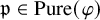 ${\mathfrak {p}} \in \operatorname {\mathrm {Pure}}(\varphi )$
. Since
${\mathfrak {p}} \in \operatorname {\mathrm {Pure}}(\varphi )$
. Since $v_{\mathfrak {p}}$
is pure, the map
$v_{\mathfrak {p}}$
is pure, the map $v \otimes _R \operatorname {\mathrm {id}}_{R/{\mathfrak {p}}} \colon R/{\mathfrak {p}} \to M/{\mathfrak {p}} M$
is injective by the assertion of equality of sets in Corollary 3.4.38 (1) because the domain of v, namely R, is flat and finitely presented. This shows that
$v \otimes _R \operatorname {\mathrm {id}}_{R/{\mathfrak {p}}} \colon R/{\mathfrak {p}} \to M/{\mathfrak {p}} M$
is injective by the assertion of equality of sets in Corollary 3.4.38 (1) because the domain of v, namely R, is flat and finitely presented. This shows that $x \notin {\mathfrak {p}} M$
. Since
$x \notin {\mathfrak {p}} M$
. Since $x \in \scr {I}M$
, it follows that
$x \in \scr {I}M$
, it follows that ${\mathfrak {p}} \in \operatorname {\mathrm {Spec}}(R) \setminus \mathbf {V}(\scr {I})$
. Thus,
${\mathfrak {p}} \in \operatorname {\mathrm {Spec}}(R) \setminus \mathbf {V}(\scr {I})$
. Thus, $\operatorname {\mathrm {Pure}}(\varphi ) \subseteq \operatorname {\mathrm {Spec}}(R) \setminus \mathbf {V}(\scr {I})$
.
$\operatorname {\mathrm {Pure}}(\varphi ) \subseteq \operatorname {\mathrm {Spec}}(R) \setminus \mathbf {V}(\scr {I})$
.
Suppose ${\mathfrak {p}} \in \operatorname {\mathrm {Spec}}(R) \setminus \mathbf {V}(\scr {I})$
. Then
${\mathfrak {p}} \in \operatorname {\mathrm {Spec}}(R) \setminus \mathbf {V}(\scr {I})$
. Then $x \notin {\mathfrak {p}} M$
by definition of
$x \notin {\mathfrak {p}} M$
by definition of $\scr {I}$
. Since
$\scr {I}$
. Since $M/{\mathfrak {p}} M$
is a flat module over the domain
$M/{\mathfrak {p}} M$
is a flat module over the domain $R/{\mathfrak {p}}$
by base change, we see that
$R/{\mathfrak {p}}$
by base change, we see that $M/{\mathfrak {p}} M$
is a torsion-free
$M/{\mathfrak {p}} M$
is a torsion-free $R/{\mathfrak {p}}$
-module. Thus, the induced
$R/{\mathfrak {p}}$
-module. Thus, the induced $R/{\mathfrak {p}}$
-linear map
$R/{\mathfrak {p}}$
-linear map $v \otimes _R \operatorname {\mathrm {id}}_{R/{\mathfrak {p}}} \colon R/{\mathfrak {p}} \to M/{\mathfrak {p}} M$
is injective because it maps
$v \otimes _R \operatorname {\mathrm {id}}_{R/{\mathfrak {p}}} \colon R/{\mathfrak {p}} \to M/{\mathfrak {p}} M$
is injective because it maps $1 + {\mathfrak {p}}$
to the nonzero (and hence torsion-free) element
$1 + {\mathfrak {p}}$
to the nonzero (and hence torsion-free) element $x + {\mathfrak {p}} M$
. Then
$x + {\mathfrak {p}} M$
. Then $v_{\mathfrak {p}}$
is
$v_{\mathfrak {p}}$
is $R_{\mathfrak {p}}$
-pure by the inclusion of sets in Corollary 3.4.38 (1). So,
$R_{\mathfrak {p}}$
-pure by the inclusion of sets in Corollary 3.4.38 (1). So, $\operatorname {\mathrm {Spec}}(R) \setminus \mathbf {V}(\scr {I}) \subseteq \operatorname {\mathrm {Pure}}(\varphi )$
, establishing the other inclusion.
$\operatorname {\mathrm {Spec}}(R) \setminus \mathbf {V}(\scr {I}) \subseteq \operatorname {\mathrm {Pure}}(\varphi )$
, establishing the other inclusion. $(1) \implies (2)$
: We will now assume M is locally Ohm-Rush, that is, for all
$(1) \implies (2)$
: We will now assume M is locally Ohm-Rush, that is, for all ${\mathfrak {p}} \in \operatorname {\mathrm {Spec}}(R)$
,
${\mathfrak {p}} \in \operatorname {\mathrm {Spec}}(R)$
, $M_{\mathfrak {p}}$
is an Ohm-Rush
$M_{\mathfrak {p}}$
is an Ohm-Rush $R_{\mathfrak {p}}$
-module. Consider the map
$R_{\mathfrak {p}}$
-module. Consider the map $v \colon R \to M$
that sends
$v \colon R \to M$
that sends $1 \mapsto x$
. Let
$1 \mapsto x$
. Let $\mathfrak {I}_x$
denote the unique radical ideal of R such that
$\mathfrak {I}_x$
denote the unique radical ideal of R such that $\operatorname {\mathrm {Spec}}(R) \setminus \mathbf {V}(\mathfrak {I}_x)$
defines the pure locus of v. We claim that
$\operatorname {\mathrm {Spec}}(R) \setminus \mathbf {V}(\mathfrak {I}_x)$
defines the pure locus of v. We claim that $\mathfrak {I}_x$
is the smallest radical ideal I of R with the property that
$\mathfrak {I}_x$
is the smallest radical ideal I of R with the property that $x \in IM$
.
$x \in IM$
.
Let $\mathfrak {p} \in \operatorname {\mathrm {Spec}}(R)$
. We claim that
$\mathfrak {p} \in \operatorname {\mathrm {Spec}}(R)$
. We claim that $ \sqrt {c_{M_{\mathfrak {p}}}(x/1)} = \mathfrak {I}_x R_{\mathfrak {p}}. $
Since
$ \sqrt {c_{M_{\mathfrak {p}}}(x/1)} = \mathfrak {I}_x R_{\mathfrak {p}}. $
Since $\mathfrak {I}_x R_{\mathfrak {p}}$
is also a radical ideal, in order to establish the above equality, it suffices to show that
$\mathfrak {I}_x R_{\mathfrak {p}}$
is also a radical ideal, in order to establish the above equality, it suffices to show that
 $$ \begin{align} \{Q \in \operatorname{\mathrm{Spec}}(R_{\mathfrak{p}}) \colon (v_{\mathfrak{p}})_Q \text{ is } (R_{\mathfrak{p}})_Q \text{ pure }\} = \operatorname{\mathrm{Spec}}(R_{\mathfrak{p}}) \setminus \mathbf{V}(\mathfrak{I}_x R_{\mathfrak{p}}). \end{align} $$
This is because $M_{\mathfrak {p}}$
is a flat Ohm-Rush
$M_{\mathfrak {p}}$
is a flat Ohm-Rush $R_{\mathfrak {p}}$
-module and Lemma 3.6.4 shows that
$R_{\mathfrak {p}}$
-module and Lemma 3.6.4 shows that
 $$\begin{align*}\{Q \in \operatorname{\mathrm{Spec}}(R_{\mathfrak{p}}) \colon (v_{\mathfrak{p}})_Q \text{ is } (R_{\mathfrak{p}})_Q \text{ pure}\} = \operatorname{\mathrm{Spec}}(R_{\mathfrak{p}}) \setminus \mathbf{V}\left(\sqrt{c_{M_{\mathfrak{p}}}(x/1)}\right). \end{align*}$$
Any $Q \in \operatorname {\mathrm {Spec}}(R_{\mathfrak {p}})$
is the expansion of a unique
$Q \in \operatorname {\mathrm {Spec}}(R_{\mathfrak {p}})$
is the expansion of a unique $\mathfrak {q} \in \operatorname {\mathrm {Spec}}(R)$
such that
$\mathfrak {q} \in \operatorname {\mathrm {Spec}}(R)$
such that $\mathfrak {q}\subseteq \mathfrak {p}$
. Moreover,
$\mathfrak {q}\subseteq \mathfrak {p}$
. Moreover, $(R_{\mathfrak {p}})_Q$
can then be identified with
$(R_{\mathfrak {p}})_Q$
can then be identified with $R_{\mathfrak {q}}$
and
$R_{\mathfrak {q}}$
and $(v_{\mathfrak {p}})_Q$
can be identified with the
$(v_{\mathfrak {p}})_Q$
can be identified with the $R_{\mathfrak {q}}$
-linear map
$R_{\mathfrak {q}}$
-linear map $v_{\mathfrak {q}}$
. Thus,
$v_{\mathfrak {q}}$
. Thus,
 $$\begin{align*}(v_{\mathfrak{p}})_Q \text{ is } (R_{\mathfrak{p}})_Q\text{-pure } \Longleftrightarrow v_{\mathfrak{q}} \text{ is } R_{\mathfrak{q}}\text{-pure } \Longleftrightarrow \mathfrak{I}_x \nsubseteq \mathfrak{q} \Longleftrightarrow \mathfrak{I}_x R_{\mathfrak{p}} \nsubseteq \mathfrak{q} R_{\mathfrak{p}} = Q, \end{align*}$$
which establishes (3.7.3.1). Here the second equivalence follows by the definition of $\mathfrak {I}_x$
. In the third equivalence, the nontrivial implication is
$\mathfrak {I}_x$
. In the third equivalence, the nontrivial implication is $\mathfrak {I}_x \nsubseteq \mathfrak {q} \implies \mathfrak {I}_xR_{\mathfrak {p}} \nsubseteq \mathfrak {q} R_{\mathfrak {p}} = Q$
. But this follows because otherwise, for all
$\mathfrak {I}_x \nsubseteq \mathfrak {q} \implies \mathfrak {I}_xR_{\mathfrak {p}} \nsubseteq \mathfrak {q} R_{\mathfrak {p}} = Q$
. But this follows because otherwise, for all $i \in \mathfrak {I}_x$
, there would exist
$i \in \mathfrak {I}_x$
, there would exist $s \in R \setminus {\mathfrak {p}} \subseteq R \setminus \mathfrak {q}$
such that
$s \in R \setminus {\mathfrak {p}} \subseteq R \setminus \mathfrak {q}$
such that $si \in \mathfrak {q}$
. Since
$si \in \mathfrak {q}$
. Since $\mathfrak {q}$
is prime, we would get
$\mathfrak {q}$
is prime, we would get $i \in \mathfrak {q}$
, whence,
$i \in \mathfrak {q}$
, whence, $\mathfrak {I}_x \subseteq \mathfrak {q}$
, which is a contradiction.
$\mathfrak {I}_x \subseteq \mathfrak {q}$
, which is a contradiction.
Thus for all prime ideals $\mathfrak {p}$
of R because
$\mathfrak {p}$
of R because $M_{\mathfrak {p}}$
is an Ohm-Rush
$M_{\mathfrak {p}}$
is an Ohm-Rush $R_{\mathfrak {p}}$
-module, we have
$R_{\mathfrak {p}}$
-module, we have $ x/1 \in c_{M_{\mathfrak {p}}}(x/1)M_{\mathfrak {p}} \subseteq \sqrt {c_{M_{\mathfrak {p}}}(x/1)}M_{\mathfrak {p}} = (\mathfrak {I}_x R_{\mathfrak {p}}) M_{\mathfrak {p}} = (\mathfrak {I}_x M)_{\mathfrak {p}}, $
and so,
$ x/1 \in c_{M_{\mathfrak {p}}}(x/1)M_{\mathfrak {p}} \subseteq \sqrt {c_{M_{\mathfrak {p}}}(x/1)}M_{\mathfrak {p}} = (\mathfrak {I}_x R_{\mathfrak {p}}) M_{\mathfrak {p}} = (\mathfrak {I}_x M)_{\mathfrak {p}}, $
and so, $x \in \mathfrak {I}_xM$
. Moreover, if I is a radical ideal of R such that
$x \in \mathfrak {I}_xM$
. Moreover, if I is a radical ideal of R such that $x \in IM$
, then for all prime ideals
$x \in IM$
, then for all prime ideals $\mathfrak {p}$
of R,
$\mathfrak {p}$
of R, $c_{M_{\mathfrak {p}}}(x/1) \subseteq IR_{\mathfrak {p}}$
, and so,
$c_{M_{\mathfrak {p}}}(x/1) \subseteq IR_{\mathfrak {p}}$
, and so, $\mathfrak {I}_x R_{\mathfrak {p}} = \sqrt {c_{M_{\mathfrak {p}}}(x/1)}$
is contained in the radical ideal
$\mathfrak {I}_x R_{\mathfrak {p}} = \sqrt {c_{M_{\mathfrak {p}}}(x/1)}$
is contained in the radical ideal $IR_{\mathfrak {p}}$
. Then
$IR_{\mathfrak {p}}$
. Then $\mathfrak {I}_x \subseteq I$
because the inclusion
$\mathfrak {I}_x \subseteq I$
because the inclusion $\mathfrak {I}_x \subset I$
can be checked locally. Hence
$\mathfrak {I}_x \subset I$
can be checked locally. Hence $\mathfrak {I}_x$
is indeed the smallest radical ideal I of R with the property that
$\mathfrak {I}_x$
is indeed the smallest radical ideal I of R with the property that $x \in IM$
.
$x \in IM$
.
3.8 Radical content
Let R be a ring, M be an R-module and $x \in M$
. Let us call
$x \in M$
. Let us call $c_{\operatorname {\mathrm {rad}},M}(x)$
the intersection of all radical ideals I of R such that
$c_{\operatorname {\mathrm {rad}},M}(x)$
the intersection of all radical ideals I of R such that $x \in IM$
. More generally, for
$x \in IM$
. More generally, for $N \subseteq M$
, let
$N \subseteq M$
, let $c_{\operatorname {\mathrm {rad}},M}(N)$
be the intersection of all radical ideals I of R such that
$c_{\operatorname {\mathrm {rad}},M}(N)$
be the intersection of all radical ideals I of R such that $N \subseteq IM$
. Clearly, if
$N \subseteq IM$
. Clearly, if $\langle N \rangle $
is the R-submodule of M generated by N, then
$\langle N \rangle $
is the R-submodule of M generated by N, then $c_{\operatorname {\mathrm {rad}},M}(N) = c_{\operatorname {\mathrm {rad}}, M}(\langle N \rangle )$
. We call the function
$c_{\operatorname {\mathrm {rad}},M}(N) = c_{\operatorname {\mathrm {rad}}, M}(\langle N \rangle )$
. We call the function $ c_{\operatorname {\mathrm {rad}},M} \colon M \to \{\text {radical ideals of } R\}$
the radical content of M. Clearly,
$ c_{\operatorname {\mathrm {rad}},M} \colon M \to \{\text {radical ideals of } R\}$
the radical content of M. Clearly, $\sqrt {c_M(N)} \subseteq c_{\operatorname {\mathrm {rad}},M}(N)$
.
$\sqrt {c_M(N)} \subseteq c_{\operatorname {\mathrm {rad}},M}(N)$
.
Suppose M is a flat R-module such that for any collection $\{I_\alpha \colon \alpha \in A\}$
of radical ideals of R,
$\{I_\alpha \colon \alpha \in A\}$
of radical ideals of R,
 $$ \begin{align} (\bigcap_{\alpha} I_\alpha)M = \bigcap_{\alpha \in A} I_\alpha M. \end{align} $$
This is equivalent to the assertion that for any $N \subseteq M$
,
$N \subseteq M$
, $N \subseteq c_{\operatorname {\mathrm {rad}},M}(N)M$
. Equivalently, the collection of radical ideals I of R such that
$N \subseteq c_{\operatorname {\mathrm {rad}},M}(N)M$
. Equivalently, the collection of radical ideals I of R such that $N \subseteq IM$
has a smallest element under inclusion. The following shows that
$N \subseteq IM$
has a smallest element under inclusion. The following shows that $c_{\operatorname {\mathrm {rad}}, M}$
behaves like the content function
$c_{\operatorname {\mathrm {rad}}, M}$
behaves like the content function $c_M$
when (3.8.0.1) is satisfied.
$c_M$
when (3.8.0.1) is satisfied.
Proposition 3.8.1. Let R be a ring and M be a flat R-module that satisfies condition (3.8.0.1). Let $N \subseteq M$
be a submodule.
$N \subseteq M$
be a submodule.
-
(1) Let P be any R-module and Q be a submodule such that
$Q \subseteq c_P(Q)P$
. Then
$c_{\operatorname {\mathrm {rad}},P}(Q) = \sqrt {c_P(Q)}$
. -
(2) If
$S \subset R$
is multiplicative, then for all
$x \in M, s \in S$
,
$x/s \in c_{\operatorname {\mathrm {rad}}, S^{-1}M}(x/s)(S^{-1}M)$
and
$c_{\operatorname {\mathrm {rad}},M}(x)(S^{-1}R) = c_{\operatorname {\mathrm {rad}}, S^{-1}M}(x/s)$
. -
(3) If
$S \subset R$
is multiplicative, then
$c_{\operatorname {\mathrm {rad}},M}(N)(S^{-1}R) = c_{\operatorname {\mathrm {rad}}, S^{-1}M}(S^{-1}N)$
. -
(4) If M is locally Ohm-Rush, then for all
${\mathfrak {p}} \in \operatorname {\mathrm {Spec}}(R)$
,
$c_{\operatorname {\mathrm {rad}}, M}(N)R_{\mathfrak {p}} = \sqrt {c_{M_{\mathfrak {p}}}(N_{\mathfrak {p}})}$
. -
(5) Suppose R is Noetherian and satisfies the property that for all
${\mathfrak {p}} \in \operatorname {\mathrm {Spec}}(R)$
the fibers of
$R_{\mathfrak {p}} \to \widehat {R_{\mathfrak {p}}}$
are reduced. If M is locally Ohm-Rush,
$\widehat {M_{\mathfrak {p}}}$
is the
${\mathfrak {p}} R_{\mathfrak {p}}$
-adic completion of M and
$\widehat {R_{\mathfrak {p}}}N$
denotes the
$\widehat {R_{\mathfrak {p}}}$
-submodule of
$\widehat {M_{\mathfrak {p}}}$
generated by the image of N under the canonical R-linear map
$M \to M_{\mathfrak {p}} \to \widehat {M_{\mathfrak {p}}}$
, then
$\widehat {R_{\mathfrak {p}}}N \subseteq c_{\operatorname {\mathrm {rad}}, \widehat {M_{\mathfrak {p}}}}(\widehat {R_{\mathfrak {p}}}N)\widehat {M_{\mathfrak {p}}}$
and
$c_{\operatorname {\mathrm {rad}}, M}(N)\widehat {R_{\mathfrak {p}}} = c_{\operatorname {\mathrm {rad}}, \widehat {M_{\mathfrak {p}}}}(\widehat {R_{\mathfrak {p}}}N)$
.
















Proof. (1) is clear. For (2) let $\pi \colon R \to S^{-1}R$
be the canonical map. Recall that if J is a radical ideal of
$\pi \colon R \to S^{-1}R$
be the canonical map. Recall that if J is a radical ideal of $S^{-1}R$
, then
$S^{-1}R$
, then $\pi ^{-1}(J)$
is a radical ideal of R such that
$\pi ^{-1}(J)$
is a radical ideal of R such that $\pi ^{-1}(J)S^{-1}R = J$
. Let
$\pi ^{-1}(J)S^{-1}R = J$
. Let $\{J_\alpha \colon \alpha \in A\}$
be a collection of radical ideals of
$\{J_\alpha \colon \alpha \in A\}$
be a collection of radical ideals of $S^{-1}R$
. We want to show that
$S^{-1}R$
. We want to show that $\bigcap _{\alpha \in A} J_\alpha (S^{-1}M) = (\bigcap _{\alpha \in A} J_\alpha )S^{-1}M$
. It is enough to show that if
$\bigcap _{\alpha \in A} J_\alpha (S^{-1}M) = (\bigcap _{\alpha \in A} J_\alpha )S^{-1}M$
. It is enough to show that if $p \colon M \to S^{-1}M$
is the canonical map, then
$p \colon M \to S^{-1}M$
is the canonical map, then $p^{-1}(\bigcap _\alpha J_\alpha (S^{-1}M)) = p^{-1}((\bigcap _{\alpha } J_\alpha )S^{-1}M)$
. Let
$p^{-1}(\bigcap _\alpha J_\alpha (S^{-1}M)) = p^{-1}((\bigcap _{\alpha } J_\alpha )S^{-1}M)$
. Let $I_\alpha {:=}q \pi ^{-1}(J_\alpha )$
. By the flatness of M, we get an injective map
$I_\alpha {:=}q \pi ^{-1}(J_\alpha )$
. By the flatness of M, we get an injective map $M/I_\alpha M \hookrightarrow S^{-1}M/J_\alpha (S^{-1}M)$
, that is, for all
$M/I_\alpha M \hookrightarrow S^{-1}M/J_\alpha (S^{-1}M)$
, that is, for all $\alpha \in A$
,
$\alpha \in A$
, $p^{-1}(J_\alpha (S^{-1}M)) = I_\alpha M$
. Similarly,
$p^{-1}(J_\alpha (S^{-1}M)) = I_\alpha M$
. Similarly, $p^{-1}((\bigcap _{\alpha } J_\alpha )S^{-1}M) = (\bigcap _{\alpha }I_\alpha )M$
. Thus,
$p^{-1}((\bigcap _{\alpha } J_\alpha )S^{-1}M) = (\bigcap _{\alpha }I_\alpha )M$
. Thus,
 $$\begin{align*}p^{-1}\left(\bigcap_{\alpha \in A} J_\alpha (S^{-1}M)\right) = \bigcap_{\alpha \in A} I_\alpha M = (\bigcap_{\alpha \in A}I_\alpha)M = p^{-1}((\bigcap_{\alpha \in A}J_\alpha)S^{-1}M), \end{align*}$$
that is, the $S^{-1}R$
-module
$S^{-1}R$
-module $S^{-1}M$
satisfies the property that for any collection of radical ideals
$S^{-1}M$
satisfies the property that for any collection of radical ideals $\{J_\alpha \colon \alpha \in A\}$
of
$\{J_\alpha \colon \alpha \in A\}$
of $S^{-1}R$
,
$S^{-1}R$
, $ \bigcap _{\alpha \in A} J_\alpha (S^{-1}M) = (\bigcap _{\alpha \in A}J_\alpha )S^{-1}M. $
Let
$ \bigcap _{\alpha \in A} J_\alpha (S^{-1}M) = (\bigcap _{\alpha \in A}J_\alpha )S^{-1}M. $
Let $x \in M, s \in S$
. Since
$x \in M, s \in S$
. Since $x \in c_{\operatorname {\mathrm {rad}},M}(x)M$
and since radical ideals of R expand to radical ideals of
$x \in c_{\operatorname {\mathrm {rad}},M}(x)M$
and since radical ideals of R expand to radical ideals of $S^{-1}R$
, we get
$S^{-1}R$
, we get $c_{\operatorname {\mathrm {rad}}, S^{-1}M}(x/s) \subseteq c_{\operatorname {\mathrm {rad}}, M}(x)S^{-1}R$
. Also, since
$c_{\operatorname {\mathrm {rad}}, S^{-1}M}(x/s) \subseteq c_{\operatorname {\mathrm {rad}}, M}(x)S^{-1}R$
. Also, since $\mathfrak {a} {:=}q \pi ^{-1}(c_{\operatorname {\mathrm {rad}},S^{-1}M}(x/s))$
is a radical ideal of R and since
$\mathfrak {a} {:=}q \pi ^{-1}(c_{\operatorname {\mathrm {rad}},S^{-1}M}(x/s))$
is a radical ideal of R and since $x/s \in c_{\operatorname {\mathrm {rad}}, S^{-1}M}(x/s)(S^{-1}M)$
, we get
$x/s \in c_{\operatorname {\mathrm {rad}}, S^{-1}M}(x/s)(S^{-1}M)$
, we get $x \in \mathfrak {a} M$
by flatness of M. So,
$x \in \mathfrak {a} M$
by flatness of M. So, $c_{\operatorname {\mathrm {rad}},M}(x) \subseteq \mathfrak {a}$
, and consequently,
$c_{\operatorname {\mathrm {rad}},M}(x) \subseteq \mathfrak {a}$
, and consequently, $c_{\operatorname {\mathrm {rad}},M}(x)(S^{-1}R) \subseteq \mathfrak {a}(S^{-1}R) = c_{\operatorname {\mathrm {rad}},S^{-1}M}(x/s)$
. This shows that for all
$c_{\operatorname {\mathrm {rad}},M}(x)(S^{-1}R) \subseteq \mathfrak {a}(S^{-1}R) = c_{\operatorname {\mathrm {rad}},S^{-1}M}(x/s)$
. This shows that for all $x \in M$
,
$x \in M$
, $s \in S$
,
$s \in S$
, $ c_{\operatorname {\mathrm {rad}},M}(x)(S^{-1}R) = c_{\operatorname {\mathrm {rad}}, S^{-1}M}(x/s). $
In other words,
$ c_{\operatorname {\mathrm {rad}},M}(x)(S^{-1}R) = c_{\operatorname {\mathrm {rad}}, S^{-1}M}(x/s). $
In other words, $c_{\operatorname {\mathrm {rad}},M}$
commutes with localization.
$c_{\operatorname {\mathrm {rad}},M}$
commutes with localization.
(3) One can check that for a submodule N of M, $c_{\operatorname {\mathrm {rad}}, M}(N) = \sqrt {\sum _{x \in N} c_{\operatorname {\mathrm {rad}}, M}(x)}$
. Moreover, since for any ideal I of R,
$c_{\operatorname {\mathrm {rad}}, M}(N) = \sqrt {\sum _{x \in N} c_{\operatorname {\mathrm {rad}}, M}(x)}$
. Moreover, since for any ideal I of R, $\sqrt {I}(S^{-1}R) = \sqrt {I(S^{-1}R)}$
, we get
$\sqrt {I}(S^{-1}R) = \sqrt {I(S^{-1}R)}$
, we get
 $$ \begin{align*} c_{\text{rad}, M}(N)(S^{-1}R) &= \left(\sqrt{\sum_{x \in N} c_{\text{rad},M}(x)}\right) (S^{-1}R) = \sqrt{\sum_{x \in N} c_{\text{rad}, M}(x)(S^{-1}R)}\\ &\stackrel{(2)}{=} \sqrt{\sum_{x \in N,s\in S}c_{\text{rad}, S^{-1}M}(x/s)} =c_{\text{rad}, S^{-1}M}(S^{-1}N). \end{align*} $$
The second equality follows because localization commutes with arbitrary sums of ideals.
(4) If M is locally Ohm-Rush, then for all submodules N of M and prime ideals ${\mathfrak {p}}$
of R,
${\mathfrak {p}}$
of R,
 $$\begin{align*}c_{\operatorname{\mathrm{rad}}, M}(N)R_{\mathfrak{p}} \stackrel{(3)}{=} c_{\operatorname{\mathrm{rad}}, M_{\mathfrak{p}}}(N_{\mathfrak{p}}) \stackrel{(1)}{=} \sqrt{c_{M_{\mathfrak{p}}}(N_{\mathfrak{p}})}. \end{align*}$$
(5) Note that $\widehat {R_{\mathfrak {p}}}N$
is also the
$\widehat {R_{\mathfrak {p}}}N$
is also the $\widehat {R_{\mathfrak {p}}}$
-submodule of
$\widehat {R_{\mathfrak {p}}}$
-submodule of $\widehat {M_{\mathfrak {p}}}$
that is generated by the image of
$\widehat {M_{\mathfrak {p}}}$
that is generated by the image of $N_{\mathfrak {p}}$
under the canonical map
$N_{\mathfrak {p}}$
under the canonical map $M_{\mathfrak {p}} \to \widehat {M_{\mathfrak {p}}}$
. Hence, since
$M_{\mathfrak {p}} \to \widehat {M_{\mathfrak {p}}}$
. Hence, since $M_{\mathfrak {p}}$
is an Ohm-Rush
$M_{\mathfrak {p}}$
is an Ohm-Rush $R_{\mathfrak {p}}$
-module, Corollary 3.4.31 shows that
$R_{\mathfrak {p}}$
-module, Corollary 3.4.31 shows that $c_{M_{\mathfrak {p}}}(N_{\mathfrak {p}}) \widehat {R_{\mathfrak {p}}} = c_{\widehat {M_{\mathfrak {p}}}}(\widehat {R_{\mathfrak {p}}}N)$
and
$c_{M_{\mathfrak {p}}}(N_{\mathfrak {p}}) \widehat {R_{\mathfrak {p}}} = c_{\widehat {M_{\mathfrak {p}}}}(\widehat {R_{\mathfrak {p}}}N)$
and $\widehat {R_{\mathfrak {p}}}N \subseteq c_{\widehat {M_{\mathfrak {p}}}}(\widehat {R_{\mathfrak {p}}}N)\widehat {M_{\mathfrak {p}}}$
.
$\widehat {R_{\mathfrak {p}}}N \subseteq c_{\widehat {M_{\mathfrak {p}}}}(\widehat {R_{\mathfrak {p}}}N)\widehat {M_{\mathfrak {p}}}$
.
Since $c_{\widehat {M_{\mathfrak {p}}}}(\widehat {R_{\mathfrak {p}}}N) \subseteq c_{\operatorname {\mathrm {rad}}, \widehat {M_{\mathfrak {p}}}}(\widehat {R_{\mathfrak {p}}}N)$
, we get
$c_{\widehat {M_{\mathfrak {p}}}}(\widehat {R_{\mathfrak {p}}}N) \subseteq c_{\operatorname {\mathrm {rad}}, \widehat {M_{\mathfrak {p}}}}(\widehat {R_{\mathfrak {p}}}N)$
, we get $\widehat {R_{\mathfrak {p}}}N \subseteq c_{\operatorname {\mathrm {rad}}, \widehat {M_{\mathfrak {p}}}}(\widehat {R_{\mathfrak {p}}}N)\widehat {M_{\mathfrak {p}}}$
. Moreover, since the formal fibers of
$\widehat {R_{\mathfrak {p}}}N \subseteq c_{\operatorname {\mathrm {rad}}, \widehat {M_{\mathfrak {p}}}}(\widehat {R_{\mathfrak {p}}}N)\widehat {M_{\mathfrak {p}}}$
. Moreover, since the formal fibers of $R_{\mathfrak {p}} \to \widehat {R_{\mathfrak {p}}}$
are reduced, by Lemma 2.3.1,
$R_{\mathfrak {p}} \to \widehat {R_{\mathfrak {p}}}$
are reduced, by Lemma 2.3.1, $\sqrt {c_{M_{\mathfrak {p}}}(N_{\mathfrak {p}})}\widehat {R_{\mathfrak {p}}} = \sqrt {c_{M_{\mathfrak {p}}}(N_{\mathfrak {p}})\widehat {R_{\mathfrak {p}}}} = \sqrt {c_{\widehat {M_{\mathfrak {p}}}}(\widehat {R_{\mathfrak {p}}}N)}$
. Also, by (4) we get
$\sqrt {c_{M_{\mathfrak {p}}}(N_{\mathfrak {p}})}\widehat {R_{\mathfrak {p}}} = \sqrt {c_{M_{\mathfrak {p}}}(N_{\mathfrak {p}})\widehat {R_{\mathfrak {p}}}} = \sqrt {c_{\widehat {M_{\mathfrak {p}}}}(\widehat {R_{\mathfrak {p}}}N)}$
. Also, by (4) we get $c_{\operatorname {\mathrm {rad}}, M}(N)R_{\mathfrak {p}} = \sqrt {c_{M_{\mathfrak {p}}}(N_{\mathfrak {p}})}$
. Thus,
$c_{\operatorname {\mathrm {rad}}, M}(N)R_{\mathfrak {p}} = \sqrt {c_{M_{\mathfrak {p}}}(N_{\mathfrak {p}})}$
. Thus, $ c_{\operatorname {\mathrm {rad}}, M}(N)\widehat {R_{\mathfrak {p}}} = (c_{\operatorname {\mathrm {rad}}, M}(N)R_{\mathfrak {p}})\widehat {R_{\mathfrak {p}}} = \sqrt {c_{M_{\mathfrak {p}}}(N_{\mathfrak {p}})}\widehat {R_{\mathfrak {p}}} = \sqrt {c_{\widehat {M_{\mathfrak {p}}}}(\widehat {R_{\mathfrak {p}}}N)}. $
Finally,
$ c_{\operatorname {\mathrm {rad}}, M}(N)\widehat {R_{\mathfrak {p}}} = (c_{\operatorname {\mathrm {rad}}, M}(N)R_{\mathfrak {p}})\widehat {R_{\mathfrak {p}}} = \sqrt {c_{M_{\mathfrak {p}}}(N_{\mathfrak {p}})}\widehat {R_{\mathfrak {p}}} = \sqrt {c_{\widehat {M_{\mathfrak {p}}}}(\widehat {R_{\mathfrak {p}}}N)}. $
Finally, $\sqrt {c_{\widehat {M_{\mathfrak {p}}}}(\widehat {R_{\mathfrak {p}}}N)} = c_{\operatorname {\mathrm {rad}}, \widehat {M_{\mathfrak {p}}}}(\widehat {R_{\mathfrak {p}}}N)$
by (1) because
$\sqrt {c_{\widehat {M_{\mathfrak {p}}}}(\widehat {R_{\mathfrak {p}}}N)} = c_{\operatorname {\mathrm {rad}}, \widehat {M_{\mathfrak {p}}}}(\widehat {R_{\mathfrak {p}}}N)$
by (1) because $\widehat {R_{\mathfrak {p}}}N \subseteq c_{\widehat {M_{\mathfrak {p}}}}(\widehat {R_{\mathfrak {p}}}N)\widehat {M_{\mathfrak {p}}}$
.
$\widehat {R_{\mathfrak {p}}}N \subseteq c_{\widehat {M_{\mathfrak {p}}}}(\widehat {R_{\mathfrak {p}}}N)\widehat {M_{\mathfrak {p}}}$
.
4 Ohm-Rush trace, intersection flatness and Mittag-Leffler modules
In this section we introduce the notions of Ohm-Rush trace modules and intersection flatness. We will then build connections between these new notions, Mittag-Leffler modules, strictly Mittag-Leffler modules and Ohm-Rush modules.
4.1 Ohm-Rush trace modules
Suppose that R is a ring. For an R-module M and $x \in M$
, let
$x \in M$
, let $ \operatorname {\mathrm {Tr}}_M(x) {:=}q \{f(x) \colon f \in \operatorname {\mathrm {Hom}}_R(M,R)\}, $
that is,
$ \operatorname {\mathrm {Tr}}_M(x) {:=}q \{f(x) \colon f \in \operatorname {\mathrm {Hom}}_R(M,R)\}, $
that is, $\operatorname {\mathrm {Tr}}_M(x)$
is the image of the evaluation at x map
$\operatorname {\mathrm {Tr}}_M(x)$
is the image of the evaluation at x map $\operatorname {\mathrm {Hom}}_R(M,R) \to R$
. Thus,
$\operatorname {\mathrm {Hom}}_R(M,R) \to R$
. Thus, $\operatorname {\mathrm {Tr}}_M(x)$
is an ideal of R, often called the trace of x. Similarly, if
$\operatorname {\mathrm {Tr}}_M(x)$
is an ideal of R, often called the trace of x. Similarly, if $N \subseteq M$
, we define
$N \subseteq M$
, we define $\operatorname {\mathrm {Tr}}_M(N) {:=}q \sum _{x \in N} \operatorname {\mathrm {Tr}}_M(x)$
. If N is an R-submodule of M, then it follows that
$\operatorname {\mathrm {Tr}}_M(N) {:=}q \sum _{x \in N} \operatorname {\mathrm {Tr}}_M(x)$
. If N is an R-submodule of M, then it follows that
 $$ \begin{align} \operatorname{\mathrm{Tr}}_M(N) = \sum_{f \in \operatorname{\mathrm{Hom}}_R(M,R)} f(N). \end{align} $$
The following notion codifies the idea that the R-dual of a module M has “sufficiently many” maps.
Definition 4.1.1. For a ring R and an R-module M, we say M is an Ohm-Rush trace (abbrv. ORT) R-module if for all $x \in M$
,
$x \in M$
, $x \in \operatorname {\mathrm {Tr}}_M(x)M$
. A ring homomorphism
$x \in \operatorname {\mathrm {Tr}}_M(x)M$
. A ring homomorphism $R \to S$
is Ohm-Rush trace if S is an ORT R-module.
$R \to S$
is Ohm-Rush trace if S is an ORT R-module.
What we call an Ohm-Rush trace module is called a trace module in [Reference Ohm and Rush20, Section 7, Pg. 66]. Again, our alternate terminology honors the contributions of Ohm and Rush.
Remark 4.1.2. Suppose M is an ORT R-module.
-
(a) Let
$x \in M$
and I be an ideal of R such that
$x \in IM$
. By R-linearity, for any
$f \in \operatorname {\mathrm {Hom}}_R(M,R)$
,
$f(x) \in f(IM) \subseteq If(M) \subseteq I$
. Thus
$\operatorname {\mathrm {Tr}}_M(x)$
is the smallest ideal I of R such that
$x \in IM$
, that is,
$\operatorname {\mathrm {Tr}}_M(x) = c_M(x).$
This shows that an Ohm-Rush trace (ORT) R-module is an Ohm-Rush R-module. We will continue using the notation
$\operatorname {\mathrm {Tr}}_M(x)$
even though this ideal coincides with
$c_M(x)$
. This is to emphasize the origin of
$c_M(x)$
via maps
$M \to R$
when M is ORT. Note also that since M is an Ohm-Rush module, for any
$N \subseteq M$
,
$ \operatorname {\mathrm {Tr}}_M(N) {:=}q \sum _{x \in N} \operatorname {\mathrm {Tr}}_M(x) = \sum _{x \in N} c_M(x) = c_M(N), $
where
$c_M(N)$
is the intersection of all ideals I of R such that
$N \subseteq IM$
. Here the last equality follows by Lemma 3.4.4. By the same lemma,
$N \subseteq c_M(N)M = \operatorname {\mathrm {Tr}}_M(N)M$
, that is,
$\operatorname {\mathrm {Tr}}_M(N)$
is the smallest ideal I of R such that
$N \subseteq IM$
. Moreover, if
$\langle N \rangle $
is the submodule of M generated by N, then
$\operatorname {\mathrm {Tr}}_M(\langle N \rangle ) = c_M(\langle N \rangle ) = c_M(N) = \operatorname {\mathrm {Tr}}_M(N)$
, where the second equality is clear by the definition of content of a subset of M. Thus, for any subset N of M,
$\operatorname {\mathrm {Tr}}_M(N) = \sum _{f \in \operatorname {\mathrm {Hom}}_R(M,R)} f(\langle N \rangle )$
by (4.1.0.1). -
(b) For any
$x \in M$
,
$\operatorname {\mathrm {Tr}}_M(x)$
is always a finitely generated ideal of R. This follows by (a) because
$c_M(x)$
is always a finitely generated ideal of R by Remark 3.4.3. -
(c) If
$x \in M$
is a nonzero element, then
$\operatorname {\mathrm {Tr}}_M(x) \neq 0$
because
$x \in \operatorname {\mathrm {Tr}}_M(x)M$
. Said differently, there exists
$f \in \operatorname {\mathrm {Hom}}_R(M,R)$
such that
$f(x) \neq 0$
, that is, the canonical map
$ M \to \operatorname {\mathrm {Hom}}_R(\operatorname {\mathrm {Hom}}_R(M,R), R) $
is injective (i.e., M is torsionless). In Lemma 4.1.3 we will have more to say about this map. -
(d) M is torsion-free. Indeed, if
$x \in M -\{0\}$
, then upon choosing
$f \in \operatorname {\mathrm {Hom}}_R(M,R)$
such that
$f(x) \neq 0$
, one sees that if
$r \in R$
is a nonzerodivisor such that
$rx = 0$
, then
$rf(x) = f(rx) = 0$
, which contradicts r being a nonzerodivisor on R. -
(e) If R is a domain and
$R \to S$
is an ORT ring map, then
$R \to S$
is injective. Otherwise,
$1 \in S$
is an R-torsion element, contradicting (d). -
(f) An ORT ring map
$R \to S$
splits provided that for every maximal ideal
${\mathfrak {m}}$
of R,
${\mathfrak {m}} S \neq S$
(for instance, if
$\operatorname {\mathrm {Spec}}(S) \to \operatorname {\mathrm {Spec}}(R)$
is surjective). Indeed, since
$1 \in \operatorname {\mathrm {Tr}}_S(1)S$
, this means that
$\operatorname {\mathrm {Tr}}_S(1)$
cannot be contained in any maximal ideal of R. Consequently
$\operatorname {\mathrm {Tr}}_S(1) = R$
, or equivalently, that there is a splitting of
$R \to S$
. -
(g) [Reference Ohm and Rush20, Sec. 7, Pg. 66] Let
$x \in M$
and
$r \in R$
. Since for all
$f \in \operatorname {\mathrm {Hom}}_R(M,R)$
we have
$f(rx) = rf(x)$
by linearity, it follows by (a) that
$c_M(rx) = \operatorname {\mathrm {Tr}}_M(rx) = r\operatorname {\mathrm {Tr}}_M(x) = rc_M(x)$
. Thus, M is a flat R-module by Proposition 3.4.14 (3). -
(h) Let
$f \colon M \to N$
be an R-linear map. Then for
$x \in M$
, the composition equals
$$\begin{align*}\operatorname{\mathrm{Hom}}_R(N,R) \xrightarrow{\operatorname{\mathrm{Hom}}_R(f,R)} \operatorname{\mathrm{Hom}}_R(M,R) \xrightarrow{\operatorname{\mathrm{eval}} @ x} R \end{align*}$$
$\operatorname {\mathrm {eval}} @ f(x) \colon \operatorname {\mathrm {Hom}}_R(N,R) \to R$
. Thus, for all
$x \in M$
, we have
$\operatorname {\mathrm {Tr}}_N(f(x)) \subseteq \operatorname {\mathrm {Tr}}_M(x)$
.
-
(i) Let
$R \to S$
be a ring homomorphism. Then
$\operatorname {\mathrm {Tr}}_S(1_S) = \sum _{x \in S} \operatorname {\mathrm {Tr}}_S(x)$
. Clearly, we have
$\operatorname {\mathrm {Tr}}_S(1_S) \subseteq \sum _{x \in S} \operatorname {\mathrm {Tr}}_S(x)$
. For the other inclusion, for any
$x \in S$
, if
$\ell _x \colon S \to S$
denotes left-multiplication by x, then and so,
$$\begin{align*}\operatorname{\mathrm{Hom}}_R(S,R) \xrightarrow{\operatorname{\mathrm{eval}} @ x} R = \operatorname{\mathrm{Hom}}_R(S,R) \xrightarrow{\operatorname{\mathrm{Hom}}_R(\ell_x,R)} \operatorname{\mathrm{Hom}}_R(S,R) \xrightarrow{\operatorname{\mathrm{eval}} @ 1_S} R, \end{align*}$$
$\operatorname {\mathrm {Tr}}_S(x) = \operatorname {\mathrm {im}}(\operatorname {\mathrm {eval}} @ x) \subseteq \operatorname {\mathrm {im}}(\operatorname {\mathrm {eval}} @ 1_S) = \operatorname {\mathrm {Tr}}_S(1_S)$
.




























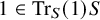
















Lemma 4.1.3. Let R be a ring and M be an ORT R-module. Set $M^{**} := \operatorname {\mathrm {Hom}}_R(\operatorname {\mathrm {Hom}}_R(M,R),R)$
. Then the canonical map
$M^{**} := \operatorname {\mathrm {Hom}}_R(\operatorname {\mathrm {Hom}}_R(M,R),R)$
. Then the canonical map $ M \to M^{**}$
is cyclically pure as a map of R-modules. Moreover, if
$ M \to M^{**}$
is cyclically pure as a map of R-modules. Moreover, if $(R, {\mathfrak {m}})$
is a Noetherian local ring that is
$(R, {\mathfrak {m}})$
is a Noetherian local ring that is ${\mathfrak {m}}$
-adically complete, then the canonical map is a pure map of R-modules.
${\mathfrak {m}}$
-adically complete, then the canonical map is a pure map of R-modules.
Proof. Suppose M is an ORT R-module and I is an ideal of R. We need to show that for all ideals I of R, the induced map $M/IM \to M^{**}/IM^{**}$
is injective. Let
$M/IM \to M^{**}/IM^{**}$
is injective. Let $x \in M$
. Under the canonical map
$x \in M$
. Under the canonical map $M \to M^{**}$
, the image of x is
$M \to M^{**}$
, the image of x is $\operatorname {\mathrm {eval}} @ x \colon \operatorname {\mathrm {Hom}}_R(M,R) \to R$
. Suppose
$\operatorname {\mathrm {eval}} @ x \colon \operatorname {\mathrm {Hom}}_R(M,R) \to R$
. Suppose $\operatorname {\mathrm {eval}} @ x \in IM^{**}$
. Then there exist
$\operatorname {\mathrm {eval}} @ x \in IM^{**}$
. Then there exist $\varphi _1, \dots , \varphi _n \in M^{**}$
and
$\varphi _1, \dots , \varphi _n \in M^{**}$
and $i_1, \dots , i_n \in I$
such that
$i_1, \dots , i_n \in I$
such that $ \operatorname {\mathrm {eval}} @ x = i_1\varphi _1 + \dots + i_n\varphi _n. $
This means that for all
$ \operatorname {\mathrm {eval}} @ x = i_1\varphi _1 + \dots + i_n\varphi _n. $
This means that for all $f \in \operatorname {\mathrm {Hom}}_R(M,R)$
,
$f \in \operatorname {\mathrm {Hom}}_R(M,R)$
, $f(x) = i_1\varphi _1(f) + \dots + i_n\varphi _n(f) \in I$
. Thus,
$f(x) = i_1\varphi _1(f) + \dots + i_n\varphi _n(f) \in I$
. Thus, $\operatorname {\mathrm {Tr}}_M(x) \subseteq I$
, and since
$\operatorname {\mathrm {Tr}}_M(x) \subseteq I$
, and since $x \in \operatorname {\mathrm {Tr}}_M(x)M$
, it follows that
$x \in \operatorname {\mathrm {Tr}}_M(x)M$
, it follows that $x \in IM$
. This is precisely the injectivity of
$x \in IM$
. This is precisely the injectivity of $M/IM \to M^{**}/IM^{**}$
.
$M/IM \to M^{**}/IM^{**}$
.
For the second assertion, purity of $M \to M^{**}$
is guaranteed by cyclic purity and Lemma 3.3.1 if
$M \to M^{**}$
is guaranteed by cyclic purity and Lemma 3.3.1 if $M^{**}$
is a flat R-module. Note that an ORT R-module is always R-flat by Remark 4.1.2 (g). It is shown in [Reference Raynaud and Gruson23, Part II, (2.4.3)] that if
$M^{**}$
is a flat R-module. Note that an ORT R-module is always R-flat by Remark 4.1.2 (g). It is shown in [Reference Raynaud and Gruson23, Part II, (2.4.3)] that if $(R, {\mathfrak {m}})$
is a Noetherian local ring that is
$(R, {\mathfrak {m}})$
is a Noetherian local ring that is ${\mathfrak {m}}$
-adically complete, then the R-dual
${\mathfrak {m}}$
-adically complete, then the R-dual $N^*$
is always a flat R-module for any flat R-module N using an
$N^*$
is always a flat R-module for any flat R-module N using an $\operatorname {\mathrm {Ext}}$
-rigidity theorem due to Jensen [Reference Jensen13, Thm. 1]. Thus, over a Noetherian complete local ring R, if M is an ORT R-module, then
$\operatorname {\mathrm {Ext}}$
-rigidity theorem due to Jensen [Reference Jensen13, Thm. 1]. Thus, over a Noetherian complete local ring R, if M is an ORT R-module, then $M^*$
and hence also
$M^*$
and hence also $M^{**}$
are R-flat, completing the proof of purity of
$M^{**}$
are R-flat, completing the proof of purity of $M \to M^{**}$
using its cyclic purity.
$M \to M^{**}$
using its cyclic purity.
Remark 4.1.4. Lemma 4.1.3 will be important for Theorem 4.3.12. In fact, Theorem 4.3.12 shows that a partial converse of Lemma 4.1.3 holds. Namely, if $(R, {\mathfrak {m}})$
is a Noetherian local ring that is
$(R, {\mathfrak {m}})$
is a Noetherian local ring that is ${\mathfrak {m}}$
-adically complete and if M is a flat R-module, then the cyclic purity of the canonical map
${\mathfrak {m}}$
-adically complete and if M is a flat R-module, then the cyclic purity of the canonical map ${M \to \operatorname {\mathrm {Hom}}_R(\operatorname {\mathrm {Hom}}_R(M, R), R)}$
implies that M is an ORT R-module.
${M \to \operatorname {\mathrm {Hom}}_R(\operatorname {\mathrm {Hom}}_R(M, R), R)}$
implies that M is an ORT R-module.
Lemma 4.1.5. Let R be a ring, M be an R-module and N be a submodule of M.
-
(1) Suppose M is an ORT R-module. If N is cyclically pure in M, then for all
$x \in N$
,
$\operatorname {\mathrm {Tr}}_N(x) = \operatorname {\mathrm {Tr}}_M(x)$
. Hence, N is ORT. -
(2) Any projective R-module is ORT.
-
(3) Suppose that any linear map
$v \colon R \to M$
admits a stabilizer
$u \colon R \to P$
such that u factors through v and P is ORT (equivalently, P is projective). Then M is ORT.




Proof. (1) Let $\iota \colon N \hookrightarrow M$
denote the inclusion. Then the composition
$\iota \colon N \hookrightarrow M$
denote the inclusion. Then the composition
 $$\begin{align*}\operatorname{\mathrm{Hom}}_R(M,R) \xrightarrow{\operatorname{\mathrm{Hom}}_{R}(\iota,R)} \operatorname{\mathrm{Hom}}_R(N,R) \xrightarrow {\operatorname{\mathrm{eval}} @ x} R \end{align*}$$
is also $\operatorname {\mathrm {eval}} @ x$
. Thus,
$\operatorname {\mathrm {eval}} @ x$
. Thus, $\operatorname {\mathrm {Tr}}_M(x) \subseteq \operatorname {\mathrm {Tr}}_N(x)$
. Since N is cyclically pure in M, the map
$\operatorname {\mathrm {Tr}}_M(x) \subseteq \operatorname {\mathrm {Tr}}_N(x)$
. Since N is cyclically pure in M, the map $N/\operatorname {\mathrm {Tr}}_M(x)N \to M/\operatorname {\mathrm {Tr}}_M(x)M$
is injective. But
$N/\operatorname {\mathrm {Tr}}_M(x)N \to M/\operatorname {\mathrm {Tr}}_M(x)M$
is injective. But $x \in \operatorname {\mathrm {Tr}}_M(x)M$
because M is an ORT R-module. By injectivity, it follows that
$x \in \operatorname {\mathrm {Tr}}_M(x)M$
because M is an ORT R-module. By injectivity, it follows that $x \in \operatorname {\mathrm {Tr}}_M(x)N$
. Then by Remark 4.1.2 (a), we get
$x \in \operatorname {\mathrm {Tr}}_M(x)N$
. Then by Remark 4.1.2 (a), we get $\operatorname {\mathrm {Tr}}_N(x) = c_N(x) \subseteq \operatorname {\mathrm {Tr}}_M(x)$
, and so,
$\operatorname {\mathrm {Tr}}_N(x) = c_N(x) \subseteq \operatorname {\mathrm {Tr}}_M(x)$
, and so, $\operatorname {\mathrm {Tr}}_M(x) = \operatorname {\mathrm {Tr}}_N(x)$
. Moreover, we then also have
$\operatorname {\mathrm {Tr}}_M(x) = \operatorname {\mathrm {Tr}}_N(x)$
. Moreover, we then also have $x \in \operatorname {\mathrm {Tr}}_N(x)N$
. Thus, N is ORT.
$x \in \operatorname {\mathrm {Tr}}_N(x)N$
. Thus, N is ORT.
(2) Since a projective module is a direct summand of a free module, by (1) it suffices to show that a free R-module F is ORT. Let $\{e_\alpha \}_{\alpha \in \scr {A}}$
be a basis of F. For all
$\{e_\alpha \}_{\alpha \in \scr {A}}$
be a basis of F. For all $\alpha \in \scr {A}$
, let
$\alpha \in \scr {A}$
, let $\phi _\alpha \colon F \to R$
be the projection onto the
$\phi _\alpha \colon F \to R$
be the projection onto the $\alpha $
-th factor. Take
$\alpha $
-th factor. Take $x \in F$
and write
$x \in F$
and write $x = \sum _\alpha r_\alpha \cdot e_\alpha $
uniquely in terms of the basis. Then
$x = \sum _\alpha r_\alpha \cdot e_\alpha $
uniquely in terms of the basis. Then $ x = \sum _\alpha r_\alpha \cdot e_\alpha = \sum _\alpha \phi _\alpha (x) \cdot e_\alpha \in \operatorname {\mathrm {Tr}}_F(x)F. $
That is, F is ORT. Note also that
$ x = \sum _\alpha r_\alpha \cdot e_\alpha = \sum _\alpha \phi _\alpha (x) \cdot e_\alpha \in \operatorname {\mathrm {Tr}}_F(x)F. $
That is, F is ORT. Note also that $\operatorname {\mathrm {Tr}}_F(x) = c_F(x) = (r_\alpha \colon \alpha \in \scr {A})$
by Example 3.4.7.
$\operatorname {\mathrm {Tr}}_F(x) = c_F(x) = (r_\alpha \colon \alpha \in \scr {A})$
by Example 3.4.7.
(3) Since $u \colon R \to P$
is a stabilizer for v, by definition P is a finitely presented R-module. Since ORT modules are flat (Remark 4.1.2 (g)), it follows that P is ORT if and only if P is projective.
$u \colon R \to P$
is a stabilizer for v, by definition P is a finitely presented R-module. Since ORT modules are flat (Remark 4.1.2 (g)), it follows that P is ORT if and only if P is projective.
Since u stabilizes v, we know v factors through u (Lemma 3.1.5 (1)), say $v = \varphi \circ u$
for some
$v = \varphi \circ u$
for some $\varphi \colon P \to M$
. By assumption, u factors through v; that is, there exists
$\varphi \colon P \to M$
. By assumption, u factors through v; that is, there exists $\phi \colon M \to P$
such that
$\phi \colon M \to P$
such that $u = \phi \circ v$
. Let
$u = \phi \circ v$
. Let $x {:=}q v(1)$
and
$x {:=}q v(1)$
and $y {:=}q u(1)$
. Then
$y {:=}q u(1)$
. Then $\varphi (y) = x$
and
$\varphi (y) = x$
and $\phi (x) = y$
. Thus, by Remark 4.1.2
$\phi (x) = y$
. Thus, by Remark 4.1.2 $(h)$
,
$(h)$
, $\operatorname {\mathrm {Tr}}_M(x) = \operatorname {\mathrm {Tr}}_M(\varphi (y)) \subseteq \operatorname {\mathrm {Tr}}_P(y)$
and
$\operatorname {\mathrm {Tr}}_M(x) = \operatorname {\mathrm {Tr}}_M(\varphi (y)) \subseteq \operatorname {\mathrm {Tr}}_P(y)$
and $\operatorname {\mathrm {Tr}}_P(y) = \operatorname {\mathrm {Tr}}_P(\phi (x)) \subseteq \operatorname {\mathrm {Tr}}_M(x)$
. That is,
$\operatorname {\mathrm {Tr}}_P(y) = \operatorname {\mathrm {Tr}}_P(\phi (x)) \subseteq \operatorname {\mathrm {Tr}}_M(x)$
. That is, $\operatorname {\mathrm {Tr}}_M(x) = \operatorname {\mathrm {Tr}}_P(y)$
. Since P is ORT,
$\operatorname {\mathrm {Tr}}_M(x) = \operatorname {\mathrm {Tr}}_P(y)$
. Since P is ORT, $y \in \operatorname {\mathrm {Tr}}_P(y)P$
, and so,
$y \in \operatorname {\mathrm {Tr}}_P(y)P$
, and so, $x = \varphi (y) \in \operatorname {\mathrm {Tr}}_P(y)M = \operatorname {\mathrm {Tr}}_M(x)M$
. Since every
$x = \varphi (y) \in \operatorname {\mathrm {Tr}}_P(y)M = \operatorname {\mathrm {Tr}}_M(x)M$
. Since every $x \in M$
is the image of
$x \in M$
is the image of $1 \in R$
under some linear
$1 \in R$
under some linear $v \colon R \to M$
, it follows that M is ORT.
$v \colon R \to M$
, it follows that M is ORT.
Remark 4.1.6. The proof of Lemma 4.1.5 shows that if M is a direct summand of a free R-module F with basis $\{e_\alpha \}_\alpha $
, then for any
$\{e_\alpha \}_\alpha $
, then for any $x \in M$
, if we express
$x \in M$
, if we express $x = \sum _\alpha r_\alpha \cdot e_\alpha $
, for
$x = \sum _\alpha r_\alpha \cdot e_\alpha $
, for $r_\alpha \in R$
, then
$r_\alpha \in R$
, then $\operatorname {\mathrm {Tr}}_M(x)$
is the ideal generated by the
$\operatorname {\mathrm {Tr}}_M(x)$
is the ideal generated by the $r_\alpha $
.
$r_\alpha $
.
The next result discusses the behavior of the ORT property under restriction of scalars.
Lemma 4.1.7. Let $R \to S$
be a homomorphism of rings and N be a S-module. If S is an ORT R-module and N is an ORT S-module, then N is an ORT R-module.
$R \to S$
be a homomorphism of rings and N be a S-module. If S is an ORT R-module and N is an ORT S-module, then N is an ORT R-module.
Proof. Let $x \in N$
. Since N is an ORT S-module, one can choose
$x \in N$
. Since N is an ORT S-module, one can choose $f_1, \dots , f_n \in \operatorname {\mathrm {Hom}}_S(N,S)$
and
$f_1, \dots , f_n \in \operatorname {\mathrm {Hom}}_S(N,S)$
and $y_1, \dots , y_n \in N$
such that
$y_1, \dots , y_n \in N$
such that $x = f_1(x)\cdot y_1 + \dots + f_n(x) \cdot y_n$
. Moreover, since S is an ORT R-module, for each
$x = f_1(x)\cdot y_1 + \dots + f_n(x) \cdot y_n$
. Moreover, since S is an ORT R-module, for each $i = 1, \dots , n$
, one can choose
$i = 1, \dots , n$
, one can choose $g_{i1}, \dots , g_{im_i} \in \operatorname {\mathrm {Hom}}_R(S,R)$
and
$g_{i1}, \dots , g_{im_i} \in \operatorname {\mathrm {Hom}}_R(S,R)$
and $s_{i1}, \cdots , s_{im_i} \in S$
such that
$s_{i1}, \cdots , s_{im_i} \in S$
such that $ f_i(x) = g_{i1}(f_i(x))s_{i1} + \dots + g_{im_i}(f_i(x))s_{im_i}. $
Then
$ f_i(x) = g_{i1}(f_i(x))s_{i1} + \dots + g_{im_i}(f_i(x))s_{im_i}. $
Then $x = \sum _{i = 1}^n \sum _{j = 1}^{m_i} (g_{ij} \circ f_i) (x) \cdot (s_{ij} \cdot y_i)$
. Since
$x = \sum _{i = 1}^n \sum _{j = 1}^{m_i} (g_{ij} \circ f_i) (x) \cdot (s_{ij} \cdot y_i)$
. Since $g_{ij} \circ f_i \in \operatorname {\mathrm {Hom}}_R(N, R)$
, N is an ORT R-module.
$g_{ij} \circ f_i \in \operatorname {\mathrm {Hom}}_R(N, R)$
, N is an ORT R-module.
The following is now immediate.
Corollary 4.1.8. If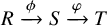 $R \xrightarrow {\phi } S \xrightarrow {\varphi } T$
are ring homomorphisms such that
$R \xrightarrow {\phi } S \xrightarrow {\varphi } T$
are ring homomorphisms such that $\phi ,\varphi $
are ORT, then
$\phi ,\varphi $
are ORT, then $\varphi \circ \phi $
is ORT.
$\varphi \circ \phi $
is ORT.
We next show that the ORT condition satisfies pleasing permanence properties.
Proposition 4.1.9. Let $R \to S$
,
$R \to S$
, $R \to T$
be ring maps and P be an R-module. Assume that S, P are ORT R-modules. Let x be an indeterminate. Then we have the following:
$R \to T$
be ring maps and P be an R-module. Assume that S, P are ORT R-modules. Let x be an indeterminate. Then we have the following:
-
(1)
$P \otimes _R T$
is an ORT T-module. In particular,
$S \otimes _R T$
is an ORT T-module. -
(2)
$P[x] {:=}q P \otimes _R R[x]$
is an ORT R-module. In particular,
$S[x]$
is an ORT
$R[x]$
-module. -
(3) If
$R, S$
are Noetherian, then
$S[[x]]$
is an ORT
$R[[x]]$
-module. -
(4) If
$R, S$
are Noetherian and I is an ideal of R, then the map of I-adic completions
$\widehat {R}^I \to \widehat {S}^{IS}$
is ORT.





Proof. (1) Every element $f \in P \otimes _R T$
can be expressed as a finite sum of elementary tensors
$f \in P \otimes _R T$
can be expressed as a finite sum of elementary tensors ${f = \sum _{i = 1}^n p_i \otimes t_i}$
, where
${f = \sum _{i = 1}^n p_i \otimes t_i}$
, where $p_i \in P$
and
$p_i \in P$
and $t_i \in T$
. We will use induction on n, the number of elementary tensors. If
$t_i \in T$
. We will use induction on n, the number of elementary tensors. If $n = 1$
, then
$n = 1$
, then $f = p \otimes t$
. Since P is ORT, there exist
$f = p \otimes t$
. Since P is ORT, there exist $\phi _1, \dots , \phi _m \in \operatorname {\mathrm {Hom}}_R(P,R)$
and
$\phi _1, \dots , \phi _m \in \operatorname {\mathrm {Hom}}_R(P,R)$
and $a_1,\dots ,a_m \in P$
such that
$a_1,\dots ,a_m \in P$
such that $ p = \phi _1(p)\cdot a_1 + \dots + \phi _m(p)\cdot a_m. $
Then
$ p = \phi _1(p)\cdot a_1 + \dots + \phi _m(p)\cdot a_m. $
Then $f = p \otimes t = \phi _1 \otimes _R \operatorname {\mathrm {id}}_T(p \otimes t)\cdot (a_1 \otimes 1) + \dots + \phi _m \otimes _R \operatorname {\mathrm {id}}_T(p \otimes t)\cdot (a_m \otimes 1)$
. Technically,
$f = p \otimes t = \phi _1 \otimes _R \operatorname {\mathrm {id}}_T(p \otimes t)\cdot (a_1 \otimes 1) + \dots + \phi _m \otimes _R \operatorname {\mathrm {id}}_T(p \otimes t)\cdot (a_m \otimes 1)$
. Technically, $\phi _i \otimes _R \operatorname {\mathrm {id}}_T$
is a T-linear map from
$\phi _i \otimes _R \operatorname {\mathrm {id}}_T$
is a T-linear map from $P \otimes _R T \to R \otimes _R T$
. But we can identify
$P \otimes _R T \to R \otimes _R T$
. But we can identify $R \otimes _R T$
canonically with T and hence consider
$R \otimes _R T$
canonically with T and hence consider $\phi _i \otimes \operatorname {\mathrm {id}}_T$
as a T-linear map
$\phi _i \otimes \operatorname {\mathrm {id}}_T$
as a T-linear map $P \otimes _R T \to T$
. With this identification, the base case
$P \otimes _R T \to T$
. With this identification, the base case $n=1$
follows.
$n=1$
follows.
Now suppose $f = \sum _{i = 1}^n p_i \otimes t_i$
. Choose
$f = \sum _{i = 1}^n p_i \otimes t_i$
. Choose $\phi _1, \dots , \phi _m \in \operatorname {\mathrm {Hom}}_R(P,R)$
and
$\phi _1, \dots , \phi _m \in \operatorname {\mathrm {Hom}}_R(P,R)$
and $a_1, \dots , a_m \in P$
such that
$a_1, \dots , a_m \in P$
such that $ p_n = \phi _1(p_n)\cdot a_1 + \dots + \phi _m(p_n)\cdot a_m. $
Then
$ p_n = \phi _1(p_n)\cdot a_1 + \dots + \phi _m(p_n)\cdot a_m. $
Then
 $$ \begin{align*} f - \sum_{i = 1}^m \phi_i \otimes_R \mathrm{id}_T(f) \cdot (a_i \otimes 1) &=f - \sum_{i = 1}^m\bigg{[}\phi_i \otimes_R \mathrm{id}_T\bigg{(}\sum_{j=1}^n p_j \otimes t_j\bigg{)} \cdot (a_i \otimes 1)\bigg{]}\\&= f - \sum_{i=1}^m\bigg{(}\sum_{j=1}^n \phi_i(p_j) \otimes t_j\bigg{)}\cdot (a_i \otimes 1)\\&= \bigg{(}\sum_{j=1}^n p_j \otimes t_j\bigg{)} - \sum_{j=1}^n\bigg{(}\sum_{i=1}^m \phi_i(p_j)\cdot a_i\bigg{)} \otimes t_j\\&= \sum_{j=1}^{n-1} \bigg{(}p_j - \sum_{i=1}^m \phi_i(p_j) \cdot a_i\bigg{)} \otimes t_j \end{align*} $$
is an element of $P \otimes _R T$
that can be expressed as a sum of at most
$P \otimes _R T$
that can be expressed as a sum of at most $n-1$
elementary tensors. By induction, there exist
$n-1$
elementary tensors. By induction, there exist $\psi _1, \dots , \psi _k \in \operatorname {\mathrm {Hom}}_T(P \otimes _R T, T)$
and
$\psi _1, \dots , \psi _k \in \operatorname {\mathrm {Hom}}_T(P \otimes _R T, T)$
and $g_1, \dots , g_k \in P \otimes _R T$
such that
$g_1, \dots , g_k \in P \otimes _R T$
such that $f' {:=}q f - \sum _{i = 1}^m \phi _i \otimes \operatorname {\mathrm {id}}_T(f) \cdot (a_i \otimes 1)$
satisfies
$f' {:=}q f - \sum _{i = 1}^m \phi _i \otimes \operatorname {\mathrm {id}}_T(f) \cdot (a_i \otimes 1)$
satisfies $ f' = \sum _{j = 1}^k \psi _j(f') \cdot g_j. $
Substituting the expression for
$ f' = \sum _{j = 1}^k \psi _j(f') \cdot g_j. $
Substituting the expression for $f'$
we then get
$f'$
we then get
 $$ \begin{align*} f - \sum_{i = 1}^m \phi_i \otimes \mathrm{id}_T(f) \cdot (a_i \otimes 1) &=\sum_{j=1}^k \psi_j\bigg{(}f - \sum_{i = 1}^m \phi_i \otimes \mathrm{id}_T(f) \cdot (a_i \otimes 1)\bigg{)}\cdot g_j\\&=\sum_{j=1}^k\psi_j(f) \cdot g_j - \sum_{j=1}^k\sum_{i=1}^m\psi_j\big{(}\phi_i \otimes \mathrm{id}_T(f) \cdot (a_i\otimes 1)\big{)} \cdot g_j. \end{align*} $$
Thus,
 $$ \begin{align} f = \sum_{i = 1}^m \phi_i \otimes_R \operatorname{\mathrm{id}}_T(f)\cdot (a_i \otimes 1) + \sum_{j=1}^k\psi_j(f) \cdot g_j - \sum_{j=1}^k\sum_{i=1}^m\psi_j\big{(}\phi_i \otimes \operatorname{\mathrm{id}}_T(f) \cdot (a_i\otimes 1)\big{)} \cdot g_j. \end{align} $$
The point now is that for all $i = 1, \dots , m$
and all
$i = 1, \dots , m$
and all $j = 1, \dots , k$
, the element
$j = 1, \dots , k$
, the element $\psi _j\big {(}\phi _i \otimes \operatorname {\mathrm {id}}_T(f) \cdot (a_i\otimes 1)\big {)} = \psi _j\big {(}a_i \otimes (\phi _i \otimes \operatorname {\mathrm {id}}_T(f))\big {)}$
(here we are identifying the codomain,
$\psi _j\big {(}\phi _i \otimes \operatorname {\mathrm {id}}_T(f) \cdot (a_i\otimes 1)\big {)} = \psi _j\big {(}a_i \otimes (\phi _i \otimes \operatorname {\mathrm {id}}_T(f))\big {)}$
(here we are identifying the codomain, $R \otimes _R T$
, of
$R \otimes _R T$
, of $\phi _i \otimes \operatorname {\mathrm {id}}_T$
with T) is evaluation at f of the T-linear map
$\phi _i \otimes \operatorname {\mathrm {id}}_T$
with T) is evaluation at f of the T-linear map
 $$\begin{align*}P \otimes_R T \xrightarrow{\phi_i \otimes \operatorname{\mathrm{id}}_T} T \longrightarrow P \otimes_R T \xrightarrow{\psi_j} T, \end{align*}$$
where the middle map is given by
 $$ \begin{align*} T &\to P \otimes_R T\\ t &\mapsto a_i \otimes t. \end{align*} $$
This shows that $f \in \operatorname {\mathrm {Tr}}_{P \otimes _R T}(f)(P \otimes _R T)$
by (4.1.9.1). Consequently,
$f \in \operatorname {\mathrm {Tr}}_{P \otimes _R T}(f)(P \otimes _R T)$
by (4.1.9.1). Consequently, $P \otimes _R T$
is an ORT T-module by induction.
$P \otimes _R T$
is an ORT T-module by induction.
(2) This statement follows from (1) by base change along $R \to R[x]$
, that is, take
$R \to R[x]$
, that is, take $T = R[x]$
in part (1).
$T = R[x]$
in part (1).
(3) Given $\phi \in \operatorname {\mathrm {Hom}}_R(S,R)$
, we will let
$\phi \in \operatorname {\mathrm {Hom}}_R(S,R)$
, we will let $\phi [[x]] \colon S[[x]] \to R[[x]]$
be the
$\phi [[x]] \colon S[[x]] \to R[[x]]$
be the $R[[x]]$
-linear map given by
$R[[x]]$
-linear map given by $ \phi [[x]](\sum _i a_ix^i) = \sum _i \phi (a_i)x^i. $
One can also think of
$ \phi [[x]](\sum _i a_ix^i) = \sum _i \phi (a_i)x^i. $
One can also think of $\phi [[x]]$
as the
$\phi [[x]]$
as the $xR[x]$
-adic completion of the
$xR[x]$
-adic completion of the $R[x]$
-linear map
$R[x]$
-linear map $\phi [x] \colon S[x] \to R[x]$
.
$\phi [x] \colon S[x] \to R[x]$
.
Let $f \in S[[x]]$
. We first claim that
$f \in S[[x]]$
. We first claim that $ \operatorname {\mathrm {Tr}}_{S[[x]]}(f)S[[x]] = \bigcap _{n \geq 0} (\operatorname {\mathrm {Tr}}_{S[[x]]}(f)S[[x]] + x^nS[[x]]). $
Here
$ \operatorname {\mathrm {Tr}}_{S[[x]]}(f)S[[x]] = \bigcap _{n \geq 0} (\operatorname {\mathrm {Tr}}_{S[[x]]}(f)S[[x]] + x^nS[[x]]). $
Here $\operatorname {\mathrm {Tr}}_{S[[x]]}$
is computed via the
$\operatorname {\mathrm {Tr}}_{S[[x]]}$
is computed via the $R[[x]]$
-module structure on
$R[[x]]$
-module structure on $S[[x]]$
. Since
$S[[x]]$
. Since $xS[x]$
is a finitely generated ideal and
$xS[x]$
is a finitely generated ideal and $S[[x]]$
is the completion of
$S[[x]]$
is the completion of $S[x]$
with respect to
$S[x]$
with respect to $xS[x]$
, it follows by [Reference Authors27, Tag 05GG] that
$xS[x]$
, it follows by [Reference Authors27, Tag 05GG] that $S[[x]]$
is
$S[[x]]$
is $xS[[x]]$
-adically complete. Consequently,
$xS[[x]]$
-adically complete. Consequently, $xS[[x]]$
is contained in the Jacobson radical of
$xS[[x]]$
is contained in the Jacobson radical of $S[[x]]$
[Reference Matsumura18, Thm. 8.2], and now, because
$S[[x]]$
[Reference Matsumura18, Thm. 8.2], and now, because $S[[x]]$
is Noetherian,
$S[[x]]$
is Noetherian, $\operatorname {\mathrm {Tr}}_{S[[x]]}(f)S[[x]]$
is closed in
$\operatorname {\mathrm {Tr}}_{S[[x]]}(f)S[[x]]$
is closed in $S[[x]]$
in the
$S[[x]]$
in the $xS[[x]]$
-adic topology by Krull’s intersection theorem [Reference Matsumura18, Thm. 8.10(i)]. But the closure of
$xS[[x]]$
-adic topology by Krull’s intersection theorem [Reference Matsumura18, Thm. 8.10(i)]. But the closure of $\operatorname {\mathrm {Tr}}_{S[[x]]}(f)S[[x]]$
in the
$\operatorname {\mathrm {Tr}}_{S[[x]]}(f)S[[x]]$
in the $xS[[x]]$
-adic topology is precisely
$xS[[x]]$
-adic topology is precisely $\bigcap _{n \geq 0} (\operatorname {\mathrm {Tr}}_{S[[x]]}(f)S[[x]] + x^nS[[x]])$
, proving our claim.
$\bigcap _{n \geq 0} (\operatorname {\mathrm {Tr}}_{S[[x]]}(f)S[[x]] + x^nS[[x]])$
, proving our claim.
Thus, in order to show that $f \in \operatorname {\mathrm {Tr}}_{S[[x]]}(f)S[[x]]$
, it suffices to show that for all integers
$f \in \operatorname {\mathrm {Tr}}_{S[[x]]}(f)S[[x]]$
, it suffices to show that for all integers $n \geq 0$
,
$n \geq 0$
, $ f \in \operatorname {\mathrm {Tr}}_{S[[x]]}(f)S[[x]] + x^nS[[x]]. $
We proceed by induction on n with the case $n = 0$
being clear because
$n = 0$
being clear because $\operatorname {\mathrm {Tr}}_{S[[x]]}(f)S[[x]] + x^0S[[x]] = S[[x]]$
. Suppose the statement holds for
$\operatorname {\mathrm {Tr}}_{S[[x]]}(f)S[[x]] + x^0S[[x]] = S[[x]]$
. Suppose the statement holds for $n \geq 0$
. Then choose maps
$n \geq 0$
. Then choose maps $\psi _1, \dots , \psi _m \in \operatorname {\mathrm {Hom}}_{R[[x]]}(S[[x]], R[[x]])$
and
$\psi _1, \dots , \psi _m \in \operatorname {\mathrm {Hom}}_{R[[x]]}(S[[x]], R[[x]])$
and $g_1,\dots ,g_m \in S[[x]]$
such that
$g_1,\dots ,g_m \in S[[x]]$
such that $ f - \sum _{i=1}^m g_i\psi _i(f) \in x^nS[[x]]. $
Let a be the coefficient of
$ f - \sum _{i=1}^m g_i\psi _i(f) \in x^nS[[x]]. $
Let a be the coefficient of $x^n$
in
$x^n$
in $f - \sum _{i=1}^m g_i\psi _i(f)$
. Since S is an ORT R-module, there exist
$f - \sum _{i=1}^m g_i\psi _i(f)$
. Since S is an ORT R-module, there exist $\phi _1, \dots , \phi _k \in \operatorname {\mathrm {Hom}}_R(S,R)$
and
$\phi _1, \dots , \phi _k \in \operatorname {\mathrm {Hom}}_R(S,R)$
and $s_1,\dots , s_k \in S$
such that
$s_1,\dots , s_k \in S$
such that $a = s_1 \phi _1(a) + \dots + s_k \phi _k(a)$
. Then
$a = s_1 \phi _1(a) + \dots + s_k \phi _k(a)$
. Then
 $$\begin{align*}\big{(}f - \sum_{i=1}^m g_i\psi_i(f)\big{)} - \sum_{j=1}^ks_j\phi_j[[x]](f - \sum_{i=1}^m g_i\psi_i(f)) \in x^{n+1}S[[x]] \end{align*}$$
because now we have killed the $ax^n$
term. Now
$ax^n$
term. Now
 $$ \begin{align*} &\big{(}f - \sum_{i=1}^m g_i\psi_i(f)\big{)} - \sum_{j=1}^ks_j\phi_j[[x]](f - \sum_{i=1}^m g_i\psi_i(f)) =\\ & f - \bigg{(}\sum_{i=1}^m g_i\psi_i(f) + \sum_{j=1}^ks_j\phi_j[[x]](f) - \sum_{j=1}^k\sum_{i=1}^ms_j\phi_j[[x]](g_i\psi_i(f))\bigg{)}. \end{align*} $$
As in (1), $\phi _j[[x]](g_i\psi _i(f))$
is the
$\phi _j[[x]](g_i\psi _i(f))$
is the $R[[x]]$
-linear map
$R[[x]]$
-linear map $S[[x]] \xrightarrow {\psi _i} R[[x]] \to S[[x]] \xrightarrow {g_i\cdot } S[[x]] \xrightarrow {\phi _j[[x]]} R[[x]]$
evaluated at f. Thus
$S[[x]] \xrightarrow {\psi _i} R[[x]] \to S[[x]] \xrightarrow {g_i\cdot } S[[x]] \xrightarrow {\phi _j[[x]]} R[[x]]$
evaluated at f. Thus $f \in \operatorname {\mathrm {Tr}}_{S[[x]]}(f)S[[x]] + x^{n+1}S[[x]]$
, finishing the proof of the inductive step.
$f \in \operatorname {\mathrm {Tr}}_{S[[x]]}(f)S[[x]] + x^{n+1}S[[x]]$
, finishing the proof of the inductive step.
(4) Suppose $I = (i_1,\dots ,i_n)$
. Then
$I = (i_1,\dots ,i_n)$
. Then $IS$
is generated by the images of
$IS$
is generated by the images of $i_j$
in S. By [Reference Matsumura18, Thm. 8.12], the ring map
$i_j$
in S. By [Reference Matsumura18, Thm. 8.12], the ring map $ \varphi : R[[x_1,\dots ,x_n]] \to \widehat {R}^I $
that sends
$ \varphi : R[[x_1,\dots ,x_n]] \to \widehat {R}^I $
that sends $x_j \mapsto i_j$
is surjective with kernel
$x_j \mapsto i_j$
is surjective with kernel ${(x_1 - i_1, \dots , x_n - i_n)}$
. Then
${(x_1 - i_1, \dots , x_n - i_n)}$
. Then $ S[[x_1,\dots ,x_n]] \otimes _{R[[x_1,\dots ,x_n]]}\widehat {R}^I \cong \frac {S[[x_1,\dots ,x_n]]}{(x_1-i_1,\dots ,x_n-i_n)S[[x_1,\dots ,x_n]]} \cong \widehat {S}^{IS}, $
where the second isomorphism again follows by [Reference Matsumura18, Thm. 8.12]. The upshot is that
$ S[[x_1,\dots ,x_n]] \otimes _{R[[x_1,\dots ,x_n]]}\widehat {R}^I \cong \frac {S[[x_1,\dots ,x_n]]}{(x_1-i_1,\dots ,x_n-i_n)S[[x_1,\dots ,x_n]]} \cong \widehat {S}^{IS}, $
where the second isomorphism again follows by [Reference Matsumura18, Thm. 8.12]. The upshot is that $\widehat {R}^I \to \widehat {S}^{IS}$
can be identified with the base change of the canonical map
$\widehat {R}^I \to \widehat {S}^{IS}$
can be identified with the base change of the canonical map $R[[x_1,\dots ,x_n]] \to S[[x_1,\dots ,x_n]]$
(that sends
$R[[x_1,\dots ,x_n]] \to S[[x_1,\dots ,x_n]]$
(that sends $x_j \mapsto x_j$
) along
$x_j \mapsto x_j$
) along $\varphi \colon R[[x_1,\dots ,x_n]] \twoheadrightarrow \widehat {R}^I$
. By a repeated application of (3),
$\varphi \colon R[[x_1,\dots ,x_n]] \twoheadrightarrow \widehat {R}^I$
. By a repeated application of (3), $R[[x_1,\dots ,x_n]] \to S[[x_1,\dots ,x_n]]$
is ORT, and by (1), the ORT property is preserved under base change. Thus,
$R[[x_1,\dots ,x_n]] \to S[[x_1,\dots ,x_n]]$
is ORT, and by (1), the ORT property is preserved under base change. Thus, $\widehat {R}^I \to \widehat {S}^{IS}$
is ORT as well.
$\widehat {R}^I \to \widehat {S}^{IS}$
is ORT as well.
Corollary 4.1.10. Let $\varphi \colon (R, {\mathfrak {m}}) \to (S, \mathfrak n)$
be a local homomorphism of Noetherian local rings such that
$\varphi \colon (R, {\mathfrak {m}}) \to (S, \mathfrak n)$
be a local homomorphism of Noetherian local rings such that $\sqrt {{\mathfrak {m}} S} = \mathfrak n$
. If
$\sqrt {{\mathfrak {m}} S} = \mathfrak n$
. If $\varphi $
is ORT, then
$\varphi $
is ORT, then $\widehat {R}^{{\mathfrak {m}}} \to \widehat {S}^{\mathfrak n}$
is also ORT.
$\widehat {R}^{{\mathfrak {m}}} \to \widehat {S}^{\mathfrak n}$
is also ORT.
Proof. By Proposition 4.1.9 (4), $\widehat {R}^{{\mathfrak {m}}} \to \widehat {S}^{{\mathfrak {m}} S}$
is ORT. But
$\widehat {R}^{{\mathfrak {m}}} \to \widehat {S}^{{\mathfrak {m}} S}$
is ORT. But $\widehat {S}^{{\mathfrak {m}} S} \cong \widehat {S}^{\mathfrak n}$
because
$\widehat {S}^{{\mathfrak {m}} S} \cong \widehat {S}^{\mathfrak n}$
because $\sqrt {{\mathfrak {m}} S} = \mathfrak n$
.
$\sqrt {{\mathfrak {m}} S} = \mathfrak n$
.
We also obtain that the ORT property is preserved under localization. Note that this was already observed in [Reference Ohm and Rush20, 7.1(b)].
Corollary 4.1.11. Let R be a ring and M be an ORT R-module. Then for a multiplicative set S of R, $S^{-1}M$
is an ORT
$S^{-1}M$
is an ORT $S^{-1}R$
-module. Moreover, for all
$S^{-1}R$
-module. Moreover, for all $x \in M$
and
$x \in M$
and $s \in S$
,
$s \in S$
, $ \operatorname {\mathrm {Tr}}_{S^{-1}M}(x/s) = \operatorname {\mathrm {Tr}}_{M}(x)(S^{-1}R). $
Proof. Base change along $R \to S^{-1}R$
gives us that
$R \to S^{-1}R$
gives us that $S^{-1}M$
is an ORT R-module by Proposition 4.1.9 (1). Since ORT modules are flat (Remark 4.1.2 (g)) and Ohm-Rush (Remark 4.1.2 (a)), it follows by Proposition 3.4.14 (4) and Remark 4.1.2 (a) that for all
$S^{-1}M$
is an ORT R-module by Proposition 4.1.9 (1). Since ORT modules are flat (Remark 4.1.2 (g)) and Ohm-Rush (Remark 4.1.2 (a)), it follows by Proposition 3.4.14 (4) and Remark 4.1.2 (a) that for all $x \in M$
and
$x \in M$
and $s \in S$
,
$s \in S$
,
 $$\begin{align*}\operatorname{\mathrm{Tr}}_M(x)(S^{-1}R) = c_M(x)(S^{-1}R) = c_{S^{-1}M}(x/s) = \operatorname{\mathrm{Tr}}_{S^{-1}M}(x/s).\\[-37pt] \end{align*}$$
4.2 Intersection flatness
The notion of intersection flatness seems to have been first studied in the special case of the Frobenius map in [Reference Hochster and Huneke11]. The general theory of intersection flatness was developed recently in [Reference Hochster and Jeffries12].
Notation 4.2.1. If $L,M$
are R-modules and U is a submodule of L, the notation
$L,M$
are R-modules and U is a submodule of L, the notation $UM$
refers to the image of
$UM$
refers to the image of $U \otimes _R M \to L \otimes _R M$
induced by
$U \otimes _R M \to L \otimes _R M$
induced by $U \hookrightarrow L$
.
$U \hookrightarrow L$
.
Definition 4.2.2 [Reference Hochster and Jeffries12, Sec. 5]
Let R be a ring and M an R-module. We say that M is intersection flat if for any finitely generated R-module L and any collection $\{U_i\}_{i \in \Lambda }$
of R-submodules of L,
$\{U_i\}_{i \in \Lambda }$
of R-submodules of L,
 $$ \begin{align} \left(\bigcap_{i \in \Lambda} U_i\right)M = \bigcap_{i \in \Lambda} (U_i M). \end{align} $$
A ring map $R \to S$
is intersection flat if S is an intersection flat R-module.
$R \to S$
is intersection flat if S is an intersection flat R-module.
Remark 4.2.3. Suppose M is an intersection flat R-module.
-
(a) Taking
$L = R$
in Definition 4.2.2, we see that if
$\{I_j\}_{j \in \Lambda }$
is a collection of ideals of R, then
$\left (\bigcap _{j \in \Lambda } I_j\right )M = \bigcap _{j \in \Lambda } I_jM$
. Consequently, an intersection flat module is Ohm-Rush (Lemma 3.4.8). -
(b) M is a flat R-module by [Reference Hochster and Jeffries12, Prop. 5.5]. In fact, by loc. cit. flatness follows provided (4.2.2.1) holds whenever
$\Lambda $
(the index set) is finite. -
(c) In Definition 4.2.2, it suffices to assume that L is a free module of finite rank by [Reference Hochster and Jeffries12, Prop. 5.6].
-
(d) If
$R \to S$
is an intersection flat ring map and M is an intersection flat S-module, then M is an intersection flat R-module. This follows by [Reference Hochster and Jeffries12, Prop. 5.7(a)].





4.3 Connections between various notions
We have introduced five different notions for modules, namely Mittag-Leffler (ML), strictly Mittag-Leffler (SML), Ohm-Rush, Ohm-Rush trace (ORT) and intersection flat. We have observed some relationships between these notions in the previous subsections (for example, see Remark 3.2.4 (a), Proposition 3.2.7, Corollary 3.4.20, Remark 4.1.2 (a)). Our goal in this subsection is to develop further connections between these notions. Many of these connections can only be made under an underlying flatness assumption.
Recall that if (P) is a property of modules, we say that an R-module M is universally (P) if for any R-algebra $R \to S$
, we have that
$R \to S$
, we have that $S \otimes _R M$
has (P) as an S-module.
$S \otimes _R M$
has (P) as an S-module.
The first connection is between the notions of ML and intersection flat modules.
Theorem 4.3.1. Let R be a ring and M a flat R-module. The following are equivalent:
-
(1) M is ML.
-
(2) M is universally intersection flat.
-
(3) M is intersection flat.
If R is local (not necessarily Noetherian) then $(1)-(3)$
is equivalent to the following condition:
$(1)-(3)$
is equivalent to the following condition:
-
(4) For any finitely generated submodule P of M, there exists a finitely generated submodule Q of M containing P such that Q is free and
$Q \subseteq M$
is a pure extension of R-modules.

Proof. We first prove the equivalence of $(1)-(3)$
. Clearly
$(1)-(3)$
. Clearly $(2) \implies (3)$
.
$(2) \implies (3)$
.
To prove that $(1) \implies (2)$
, suppose M is a ML module. Since the ML property is “universal” (see Remark 3.2.4 (b)), it will suffice to show that M is intersection flat. So let L be a finitely generated R-module and
$(1) \implies (2)$
, suppose M is a ML module. Since the ML property is “universal” (see Remark 3.2.4 (b)), it will suffice to show that M is intersection flat. So let L be a finitely generated R-module and $\{U_i\}_{i \in \Lambda }$
a collection of R-submodules of L. Consider the following exact sequence:
$\{U_i\}_{i \in \Lambda }$
a collection of R-submodules of L. Consider the following exact sequence:
 $$\begin{align*}0 \to \bigcap_{i \in \Lambda} U_i \to L \to \prod_{i \in \Lambda} (L / U_i), \end{align*}$$
where the first map is inclusion and the second map is $x \mapsto (x + U_i)_{i \in \Lambda }$
. Now tensor with M and use the fact (from Remark 3.2.4 (b)) that the natural map
$x \mapsto (x + U_i)_{i \in \Lambda }$
. Now tensor with M and use the fact (from Remark 3.2.4 (b)) that the natural map $(\prod _{i \in \Lambda } (L / U_i)) \otimes _R M \to \prod _{i \in \Lambda } ((L / U_i) \otimes _R M)$
is injective, along with the flatness of M over R, to get the following exact sequence
$(\prod _{i \in \Lambda } (L / U_i)) \otimes _R M \to \prod _{i \in \Lambda } ((L / U_i) \otimes _R M)$
is injective, along with the flatness of M over R, to get the following exact sequence
 $$\begin{align*}0 \to \left(\bigcap_{i \in \Lambda} U_i\right) \otimes_R M \overset{\alpha}{\to} L \otimes_R M \overset{\beta}{\to} \prod_{i \in \Lambda} ((L / U_i) \otimes_R M), \end{align*}$$
where $\beta $
is given by
$\beta $
is given by $x \otimes m \mapsto ((x + U_i) \otimes m)_{i \in \Lambda }$
. Thus, the image
$x \otimes m \mapsto ((x + U_i) \otimes m)_{i \in \Lambda }$
. Thus, the image $(\bigcap _i U_i) M$
of
$(\bigcap _i U_i) M$
of $\alpha $
is the kernel of
$\alpha $
is the kernel of $\beta $
. On the other hand, let
$\beta $
. On the other hand, let $z = \sum _{j=1}^n x_j \otimes y_j \in L \otimes _R M$
. Then
$z = \sum _{j=1}^n x_j \otimes y_j \in L \otimes _R M$
. Then $z\in \mathrm{ker} \beta $
if and only if for all
$z\in \mathrm{ker} \beta $
if and only if for all $i \in \Lambda $
,
$i \in \Lambda $
, $\sum _{j=1}^n (x_j + U_i) \otimes y_j = 0$
in
$\sum _{j=1}^n (x_j + U_i) \otimes y_j = 0$
in $(L / U_i) \otimes _R M$
. But the exactness of the sequences
$(L / U_i) \otimes _R M$
. But the exactness of the sequences $0 \to U_i \otimes _R M \to L \otimes _R M \to (L/U_i) \otimes _R M$
show that this vanishing is equivalent to
$0 \to U_i \otimes _R M \to L \otimes _R M \to (L/U_i) \otimes _R M$
show that this vanishing is equivalent to $z \in $
im
$z \in $
im $(U_i \otimes _R M \to L \otimes _R M) = U_i M$
for all
$(U_i \otimes _R M \to L \otimes _R M) = U_i M$
for all $i \in \Lambda $
. We have thus shown that
$i \in \Lambda $
. We have thus shown that $(\bigcap _i U_i)M = \mathrm{ker} (\beta ) = \bigcap _i (U_i M)$
. Since L and the
$(\bigcap _i U_i)M = \mathrm{ker} (\beta ) = \bigcap _i (U_i M)$
. Since L and the $U_i$
were arbitrary, it follows that M is intersection flat.
$U_i$
were arbitrary, it follows that M is intersection flat.
The last thing to prove for the equivalence of $(1)-(3)$
is
$(1)-(3)$
is $(3) \implies (1)$
. Accordingly, let M be an intersection flat R-module. Now, let G be a finitely generated free R-module and
$(3) \implies (1)$
. Accordingly, let M be an intersection flat R-module. Now, let G be a finitely generated free R-module and $x \in G \otimes _R M$
. Let
$x \in G \otimes _R M$
. Let $S {:=}q \{U \colon U$
is a submodule of G and
$S {:=}q \{U \colon U$
is a submodule of G and $x \in UM\}$
. Then
$x \in UM\}$
. Then $\bigcap _{U \in S} U \in S$
as well because
$\bigcap _{U \in S} U \in S$
as well because $x \in \bigcap _{U \in S} UM = (\bigcap _{U \in S} U)M$
. That is, for a finite free R-module G and
$x \in \bigcap _{U \in S} UM = (\bigcap _{U \in S} U)M$
. That is, for a finite free R-module G and $x \in G \otimes _R M$
, there exists a unique smallest R submodule C of G such that
$x \in G \otimes _R M$
, there exists a unique smallest R submodule C of G such that $x \in C \otimes _R M$
(we can identify
$x \in C \otimes _R M$
(we can identify $C \otimes _R M$
with
$C \otimes _R M$
with $CM$
by flatness of M). By [Reference Raynaud and Gruson23, Part II, Proposition 2.1.8] (alternate reference [Reference Authors27, Tag 059S]), since M is flat, it follows that M is ML. If R is a local ring then (1) is equivalent to (4) by Corollary 3.4.33 (1).
$CM$
by flatness of M). By [Reference Raynaud and Gruson23, Part II, Proposition 2.1.8] (alternate reference [Reference Authors27, Tag 059S]), since M is flat, it follows that M is ML. If R is a local ring then (1) is equivalent to (4) by Corollary 3.4.33 (1).
Theorem 4.3.1 implies the following behavior of intersection flatness with respect to pure maps.
Corollary 4.3.2. Let $R \to S$
be a ring map and M be an R-module. We have the following:
$R \to S$
be a ring map and M be an R-module. We have the following:
-
(1) If
$R \to S$
is pure and
$M \otimes _R S$
is an intersection flat S-module, then M is an intersection flat R-module. -
(2) If N is a pure submodule of M and M is an intersection flat R-module, then N is an intersection flat R-module.
-
(3) Let
$\{(M_i,\varphi _{ij}) \colon i, j \in I, i \leq j\}$
be a direct system of R-modules indexed by a filtered poset
$(I,\leq )$
. If each
$M_i$
is intersection flat and the transition maps
$\varphi _{ij}$
are R-pure, then
$\operatorname {\mathrm {colim}}_{i \in I} M_i$
is an intersection flat R-module.





Proof. (1) Since $M \otimes _R S$
is S-intersection flat,
$M \otimes _R S$
is S-intersection flat, $M \otimes _R S$
is a flat S-module by Remark 4.2.3. By pure descent, M is a flat R-module [Reference Authors27, Tag 08XD]. In light of Theorem 4.3.1, it suffices to show that M is a ML R-module. But the ML property satisfies descent along a pure ring map by Theorem 3.5.4 (1) and
$M \otimes _R S$
is a flat S-module by Remark 4.2.3. By pure descent, M is a flat R-module [Reference Authors27, Tag 08XD]. In light of Theorem 4.3.1, it suffices to show that M is a ML R-module. But the ML property satisfies descent along a pure ring map by Theorem 3.5.4 (1) and $M \otimes _R S$
is a ML S-module by Theorem 4.3.1 since it is intersection flat.
$M \otimes _R S$
is a ML S-module by Theorem 4.3.1 since it is intersection flat.
(2) N is flat by Lemma 2.2.6 and ML by Remark 3.2.4 (c). Thus N is intersection flat by Theorem 4.3.1.
(3) Since each $M_i$
is flat and ML, so is
$M_i$
is flat and ML, so is $\operatorname {\mathrm {colim}}_{i \in I} M_i$
by Remark 3.2.4 (e).
$\operatorname {\mathrm {colim}}_{i \in I} M_i$
by Remark 3.2.4 (e).
Remark 4.3.3. One can give a direct proof of pure descent of the intersection flatness property along the lines of the proof of cyclically pure descent of the flat Ohm-Rush property given in Remark 3.5.5. We omit the details.
One can also use known properties about intersection flat modules to deduce consequences for ML modules. For instance, we can characterize the ML and Ohm-Rush properties in terms of ideal adic separatedness.
Corollary 4.3.4. Let $(R, {\mathfrak {m}})$
be a Noetherian local ring and M be a flat R-module.
$(R, {\mathfrak {m}})$
be a Noetherian local ring and M be a flat R-module.
-
(1) If M is a ML R-module, then for all finitely generated R-modules L,
$L \otimes _R M$
is
${\mathfrak {m}}$
-adically separated. The converse holds if R is
${\mathfrak {m}}$
-adically complete. -
(2) If M is an Ohm-Rush R-module, then for all cyclic R-modules L,
$L \otimes _R M$
is
${\mathfrak {m}}$
-adically separated. The converse holds if R is
${\mathfrak {m}}$
-adically complete.


Proof. $(1)$
Since L is a finitely generated R-module, by Krull’s intersection theorem we have that L is
$(1)$
Since L is a finitely generated R-module, by Krull’s intersection theorem we have that L is ${\mathfrak {m}}$
-adically separated. Since flat ML modules are intersection flat (Theorem 4.3.1), one then has
${\mathfrak {m}}$
-adically separated. Since flat ML modules are intersection flat (Theorem 4.3.1), one then has
 $$\begin{align*}\bigcap_{n \in \mathbf{Z}_{> 0}} {\mathfrak{m}}^n(L \otimes_R M) = \bigcap_{n \in \mathbf{Z}_{> 0}} ({\mathfrak{m}}^nL)M = \left(\bigcap_{n \in \mathbf{Z}_{> 0}}{\mathfrak{m}}^n L\right)\,M = 0, \end{align*}$$
where the second equality follows by intersection flatness. This shows that $L \otimes _R M$
is
$L \otimes _R M$
is ${\mathfrak {m}}$
-adically separated, that is, we have the forward implication of
${\mathfrak {m}}$
-adically separated, that is, we have the forward implication of $(1)$
.
$(1)$
.
If $(R, {\mathfrak {m}})$
is
$(R, {\mathfrak {m}})$
is ${\mathfrak {m}}$
-adically complete, then an application of Chevalley’s Lemma shows that M must be an intersection flat R-module by the proof of [Reference Hochster and Jeffries12, Prop. 5.7(e)] (loc. cit. is stated for flat R-algebras but the proof readily applies to modules). Again, by Theorem 4.3.1 M is a ML R-module. This proves
${\mathfrak {m}}$
-adically complete, then an application of Chevalley’s Lemma shows that M must be an intersection flat R-module by the proof of [Reference Hochster and Jeffries12, Prop. 5.7(e)] (loc. cit. is stated for flat R-algebras but the proof readily applies to modules). Again, by Theorem 4.3.1 M is a ML R-module. This proves $(1)$
.
$(1)$
.
The proof of $(2)$
is similar. When R is
$(2)$
is similar. When R is ${\mathfrak {m}}$
-adically complete, the backward implication again follows by the proof of [Reference Hochster and Jeffries12, Prop. 5.7(e)] (as before, Hochster-Jeffries state the result for flat algebras, but their proof works for modules). A minor point is that a module that is intersection flat for ideals in [Reference Hochster and Jeffries12] is in our terminology a flat Ohm-Rush module (the equivalence of the two notions follows by Lemma 3.4.8).
${\mathfrak {m}}$
-adically complete, the backward implication again follows by the proof of [Reference Hochster and Jeffries12, Prop. 5.7(e)] (as before, Hochster-Jeffries state the result for flat algebras, but their proof works for modules). A minor point is that a module that is intersection flat for ideals in [Reference Hochster and Jeffries12] is in our terminology a flat Ohm-Rush module (the equivalence of the two notions follows by Lemma 3.4.8).
Now suppose $(R, {\mathfrak {m}})$
is an arbitrary Noetherian local ring, M is an Ohm-Rush R-module and L is a cyclic R-module. We may assume without loss of generality that
$(R, {\mathfrak {m}})$
is an arbitrary Noetherian local ring, M is an Ohm-Rush R-module and L is a cyclic R-module. We may assume without loss of generality that $L = R/I$
, where I is a proper ideal of R. Then
$L = R/I$
, where I is a proper ideal of R. Then
 $$ \begin{align*} \bigcap_{n \in \mathbf{Z}_{> 0}} {\mathfrak{m}}^n(R/I \otimes_R M) &\cong \bigcap_{n \in \mathbf{Z}_{> 0}} {\mathfrak{m}}^n(M/IM) = \frac{\bigcap_{n \in \mathbf{Z}_{> 0}} ({\mathfrak{m}}^n + I)M}{IM} = \frac{\left(\bigcap_{n \in \mathbf{Z}_{>0}} {\mathfrak{m}}^n + I\right)M}{IM}, \end{align*} $$
where the last equality follows because M is an Ohm-Rush R-module (Lemma 3.4.8). By Krull’s intersection theorem, $\bigcap _{n \in \mathbf {Z}_{>0}} {\mathfrak {m}}^n + I = I$
, and so,
$\bigcap _{n \in \mathbf {Z}_{>0}} {\mathfrak {m}}^n + I = I$
, and so, $R /I \otimes _R M$
is
$R /I \otimes _R M$
is ${\mathfrak {m}}$
-adically separated.
${\mathfrak {m}}$
-adically separated.
Remark 4.3.5. In Theorem 4.3.12 we will significantly improve Corollary 4.3.4 and show that over a complete Noetherian local ring, the notions of being Ohm-Rush and ML are equivalent for flat modules.
Gruson and Raynaud showed that a flat SML R-module is equivalent to an ORT R-module.
Theorem 4.3.6 [Reference Raynaud and Gruson23, Part II, Prop. 2.3.4, equivalence of (i) and (iii)]
Let R be a ring and let M be an R-module. The following are equivalent:
-
(1) M is a flat SML R-module.
-
(2) M is an ORT R-module.
Remark 4.3.7. In Theorem 4.3.6, the implication $(1) \implies (2)$
follows readily from the theory we have already developed. Suppose M is a flat and SML R-module. Let
$(1) \implies (2)$
follows readily from the theory we have already developed. Suppose M is a flat and SML R-module. Let $x \in M$
. We wish to show that
$x \in M$
. We wish to show that $x \in \operatorname {\mathrm {Tr}}_M(x)M$
. Let
$x \in \operatorname {\mathrm {Tr}}_M(x)M$
. Let $g \colon R \to M$
be the unique R-linear map that sends
$g \colon R \to M$
be the unique R-linear map that sends $1 \mapsto x$
. Since M is a SML R-module, g admits a stabilizer that factors through g. Expressing M as a filtered colimit of free modules of finite rank, Lemma 3.1.5 (2) implies that g admits a stabilizer
$1 \mapsto x$
. Since M is a SML R-module, g admits a stabilizer that factors through g. Expressing M as a filtered colimit of free modules of finite rank, Lemma 3.1.5 (2) implies that g admits a stabilizer $f \colon R \to L$
where L is a free module of finite rank and such that f factors through g (note that g factors through f by Lemma 3.1.5 (1)). Let
$f \colon R \to L$
where L is a free module of finite rank and such that f factors through g (note that g factors through f by Lemma 3.1.5 (1)). Let $y {:=}q f(1)$
. Since f factors through g, there exists a linear map
$y {:=}q f(1)$
. Since f factors through g, there exists a linear map $\varphi \colon M \to L$
such that
$\varphi \colon M \to L$
such that $f = \varphi \circ g$
. Thus,
$f = \varphi \circ g$
. Thus, $y = f(1) = \varphi \circ g (1) = \varphi (x)$
. Hence,
$y = f(1) = \varphi \circ g (1) = \varphi (x)$
. Hence, $\operatorname {\mathrm {Tr}}_L(y) = \operatorname {\mathrm {Tr}}_L(\varphi (x)) \subseteq \operatorname {\mathrm {Tr}}_M(x)$
by Remark 4.1.2 (h). Similarly, since
$\operatorname {\mathrm {Tr}}_L(y) = \operatorname {\mathrm {Tr}}_L(\varphi (x)) \subseteq \operatorname {\mathrm {Tr}}_M(x)$
by Remark 4.1.2 (h). Similarly, since $g = \phi \circ f$
for some linear
$g = \phi \circ f$
for some linear $\phi \colon P \to M$
, we get
$\phi \colon P \to M$
, we get $\operatorname {\mathrm {Tr}}_M(x) \subseteq \operatorname {\mathrm {Tr}}_L(y)$
. Thus,
$\operatorname {\mathrm {Tr}}_M(x) \subseteq \operatorname {\mathrm {Tr}}_L(y)$
. Thus, $\operatorname {\mathrm {Tr}}_M(x) = \operatorname {\mathrm {Tr}}_L(y)$
, and since
$\operatorname {\mathrm {Tr}}_M(x) = \operatorname {\mathrm {Tr}}_L(y)$
, and since $y \in \operatorname {\mathrm {Tr}}_L(y)L$
as free modules are ORT (Lemma 4.1.5), we get
$y \in \operatorname {\mathrm {Tr}}_L(y)L$
as free modules are ORT (Lemma 4.1.5), we get $x = g(1) = \phi \circ f(1) = \phi (y) \in \operatorname {\mathrm {Tr}}_L(y)M = \operatorname {\mathrm {Tr}}_M(x)M$
.
$x = g(1) = \phi \circ f(1) = \phi (y) \in \operatorname {\mathrm {Tr}}_L(y)M = \operatorname {\mathrm {Tr}}_M(x)M$
.
As a consequence, we then have
Proposition 4.3.8. Let R be a ring and M be an ORT R-module. Then M is intersection flat as an R-module.
Proof. By Theorem 4.3.6, M is a flat SML R-module. Thus, by Remark 3.2.4 (a), M is a flat ML R-module, and hence is intersection flat by Theorem 4.3.1.
Additionally, pure maps to ORT-modules are often split.
Corollary 4.3.9. Let R be a ring and M be an ORT R-module. Then for any finitely presented R-module P, if $\varphi \colon P \to M$
is a pure R-linear map, then
$\varphi \colon P \to M$
is a pure R-linear map, then $\varphi $
splits.
$\varphi $
splits.
Proof. Since M is SML, the result follows by Remark 3.2.4 (g).
Remark 4.3.10. Suppose $(R, {\mathfrak {m}})$
is a Noetherian local ring that is not
$(R, {\mathfrak {m}})$
is a Noetherian local ring that is not ${\mathfrak {m}}$
-adically complete. Then the notions of ML and SML modules may not coincide for the class of modules that are faithfully flat R-algebras. For an example that is relevant to the theory of F-singularities, consider an excellent, Henselian DVR
${\mathfrak {m}}$
-adically complete. Then the notions of ML and SML modules may not coincide for the class of modules that are faithfully flat R-algebras. For an example that is relevant to the theory of F-singularities, consider an excellent, Henselian DVR $(R, {\mathfrak {m}})$
of prime characteristic
$(R, {\mathfrak {m}})$
of prime characteristic $p> 0$
such that
$p> 0$
such that $\operatorname {\mathrm {Hom}}_R(F_*R, R) = 0$
(such examples exist by [Reference Datta and Murayama4]). Consider the R-algebra
$\operatorname {\mathrm {Hom}}_R(F_*R, R) = 0$
(such examples exist by [Reference Datta and Murayama4]). Consider the R-algebra $F_*R$
. Then
$F_*R$
. Then $F_*R$
is a faithfully flat R-algebra by [Reference Kunz16]. Moreover, since R is excellent,
$F_*R$
is a faithfully flat R-algebra by [Reference Kunz16]. Moreover, since R is excellent, $F_*R$
is an ML R-module [Reference Datta, Epstein, Schwede and Tucker2]. However,
$F_*R$
is an ML R-module [Reference Datta, Epstein, Schwede and Tucker2]. However, $F_*R$
is not a SML R-module by Theorem 4.3.6. Otherwise
$F_*R$
is not a SML R-module by Theorem 4.3.6. Otherwise $F_*R$
would be an ORT R-module, which would imply that the canonical map
$F_*R$
would be an ORT R-module, which would imply that the canonical map ${R \to \operatorname {\mathrm {Hom}}_R(\operatorname {\mathrm {Hom}}_R(F_*R,R),R)}$
is injective by Lemma 4.1.3. This is impossible because
${R \to \operatorname {\mathrm {Hom}}_R(\operatorname {\mathrm {Hom}}_R(F_*R,R),R)}$
is injective by Lemma 4.1.3. This is impossible because $\operatorname {\mathrm {Hom}}_R(F_*R, R) = 0$
by the choice of R.
$\operatorname {\mathrm {Hom}}_R(F_*R, R) = 0$
by the choice of R.
We have seen so far that the following properties are preserved under arbitrary base change: ML (Remark 3.2.4 (b)), ORT (Proposition 4.1.9 (1)), intersection flat (Theorem 4.3.1), flat and SML (Theorem 4.3.6 and Proposition 4.1.9 (1)). Thus, it is natural to ask if the property of being Ohm-Rush or, more restrictively, of being flat Ohm-Rush is preserved under arbitrary base change. We will now show that this is false.
Example 4.3.11. Let $R = k[x]_{(x)}$
,
$R = k[x]_{(x)}$
, $S = k[\![x]\!]$
, where x is an indeterminate and k is an arbitrary field, and let
$S = k[\![x]\!]$
, where x is an indeterminate and k is an arbitrary field, and let $R \to S$
be the
$R \to S$
be the $(x)$
-adic completion map. By [Reference Ohm and Rush20, Proposition 2.1], S is an Ohm-Rush R-algebra. However, if y is another indeterminate, then
$(x)$
-adic completion map. By [Reference Ohm and Rush20, Proposition 2.1], S is an Ohm-Rush R-algebra. However, if y is another indeterminate, then $S[y]$
is not an Ohm-Rush
$S[y]$
is not an Ohm-Rush $R[y]$
-module. To see this, we imitate the method of [Reference Hochster and Jeffries12, Example 5.3]. Accordingly, let
$R[y]$
-module. To see this, we imitate the method of [Reference Hochster and Jeffries12, Example 5.3]. Accordingly, let $f\in S$
be a power series that is transcendental over R. For each
$f\in S$
be a power series that is transcendental over R. For each $n \in \mathbb {N}$
, let
$n \in \mathbb {N}$
, let $f_n$
be the unique polynomial of degree
$f_n$
be the unique polynomial of degree $\leq n$
that agrees with f modulo
$\leq n$
that agrees with f modulo $x^{n+1}S$
. Set
$x^{n+1}S$
. Set $I_n := (y-f_n, x^{n+1})R[y] \subseteq R[y]$
. Then
$I_n := (y-f_n, x^{n+1})R[y] \subseteq R[y]$
. Then $I_n S = (y-f,x^{n+1})S[y] = (y-f)S[y] + (x)^{n+1}S[y]$
. Since
$I_n S = (y-f,x^{n+1})S[y] = (y-f)S[y] + (x)^{n+1}S[y]$
. Since $S[y] / (y-f) \cong S$
is an integral domain, it follows from the Krull intersection theorem for Noetherian domains that
$S[y] / (y-f) \cong S$
is an integral domain, it follows from the Krull intersection theorem for Noetherian domains that $ \bigcap _{n \in \mathbb {N}} (I_n S[y]) = (y-f)S[y]. $
Set
$ \bigcap _{n \in \mathbb {N}} (I_n S[y]) = (y-f)S[y]. $
Set $R' := k[x,y]_{(x,y)}$
and
$R' := k[x,y]_{(x,y)}$
and $S' := k[\![x,y]\!]$
. Note that
$S' := k[\![x,y]\!]$
. Note that $(y-f)S' \cap R' = 0$
by the transcendence assumption, as in the argument from [Reference Hochster and Jeffries12, Example 5.3]. But then
$(y-f)S' \cap R' = 0$
by the transcendence assumption, as in the argument from [Reference Hochster and Jeffries12, Example 5.3]. But then
 $$ \begin{align*} \bigcap_{n \in \mathbb{N}} I_n &= \left( \left(\bigcap_{n \in \mathbb{N}} I_n\right) S[y]\right)S' \cap R' \cap R[y] \subseteq \left( \left(\bigcap_{n \in \mathbb{N}} I_n\right) S[y]\right)S' \cap R' \\&\subseteq \left( \bigcap_{n \in \mathbb{N}} (I_n S[y])\right)S' \cap R' = (y-f)S' \cap R' = 0. \end{align*} $$
Since $\bigcap _n I_n = 0$
but
$\bigcap _n I_n = 0$
but $\bigcap _n (I_n S[y]) \neq 0$
, it follows that
$\bigcap _n (I_n S[y]) \neq 0$
, it follows that $S[y]$
is not an Ohm-Rush
$S[y]$
is not an Ohm-Rush $R[y]$
-algebra.
$R[y]$
-algebra.
The ML property coincides with the SML property for modules over a Noetherian complete local ring by Proposition 3.2.7. If we assume flatness, then all the notions introduced so far are equivalent.
Theorem 4.3.12. Let $(R, {\mathfrak {m}})$
be a Noetherian local ring that is complete with respect to the
$(R, {\mathfrak {m}})$
be a Noetherian local ring that is complete with respect to the ${\mathfrak {m}}$
-adic topology. Let M be a flat R-module. Then the R-dual
${\mathfrak {m}}$
-adic topology. Let M be a flat R-module. Then the R-dual $\operatorname {\mathrm {Hom}}_R(M,R)$
is an ORT R-module (equivalently, a flat and SML R-module). Furthermore, the following are equivalent:
$\operatorname {\mathrm {Hom}}_R(M,R)$
is an ORT R-module (equivalently, a flat and SML R-module). Furthermore, the following are equivalent:
-
(1) M is intersection flat.
-
(2) M is ML.
-
(3) M is SML.
-
(4) M is an ORT R-module.
-
(5) M is an Ohm-Rush R-module.
-
(6) If
$\widehat {M}$
denotes the
${\mathfrak {m}}$
-adic completion of M, then the canonical map
$M \to \widehat {M}$
is a (cyclically) pure map of R-modules. -
(7) The canonical map
$M \to \operatorname {\mathrm {Hom}}_R(\operatorname {\mathrm {Hom}}_R(M,R),R)$
is a pure map of R-modules. -
(8) The canonical map
$M \to \operatorname {\mathrm {Hom}}_R(\operatorname {\mathrm {Hom}}_R(M,R),R)$
is cyclically pure as a map of R-modules. -
(9) For all finitely generated R-modules L,
$L \otimes _R M$
is
${\mathfrak {m}}$
-adically separated. -
(10) For all cyclic R-modules L,
$L \otimes _R M$
is
${\mathfrak {m}}$
-adically separated. -
(11) For any finitely generated submodule P of M, there exists a finitely generated submodule L of M containing P such that L is free and is a direct summand of M.
-
(12) For any cyclic submodule P of M, there exists a finitely generated submodule L of M containing P such that L is free and is a direct summand of M.
-
(13) M is a filtered union of its finitely generated submodules that are free and direct summands of M.





Proof. An ORT R-module is equivalently a flat and SML R-module by Theorem 4.3.6. The fact that $\operatorname {\mathrm {Hom}}_R(M,R)$
is an ORT R-module is shown in [Reference Raynaud and Gruson23, Part II]. More explicitly, in [Reference Raynaud and Gruson23, Part II, (2.4.1)], Raynaud and Gruson show that if M is a module over any Noetherian ring R (not necessarily local) such that the functor
$\operatorname {\mathrm {Hom}}_R(M,R)$
is an ORT R-module is shown in [Reference Raynaud and Gruson23, Part II]. More explicitly, in [Reference Raynaud and Gruson23, Part II, (2.4.1)], Raynaud and Gruson show that if M is a module over any Noetherian ring R (not necessarily local) such that the functor $ \operatorname {\mathrm {Hom}}_R(M,\cdot ) \colon \text {Mod}^{fg}_R \to \mathfrak {A}\mathfrak {b} $
is exact on the category of finitely generated R-modules, then
$ \operatorname {\mathrm {Hom}}_R(M,\cdot ) \colon \text {Mod}^{fg}_R \to \mathfrak {A}\mathfrak {b} $
is exact on the category of finitely generated R-modules, then $\operatorname {\mathrm {Hom}}_R(M,R)$
must be an ORT R-module. For this, they use the natural transformation of functors
$\operatorname {\mathrm {Hom}}_R(M,R)$
must be an ORT R-module. For this, they use the natural transformation of functors $ \operatorname {\mathrm {Hom}}_R(M, R) \otimes _R \cdot \Longrightarrow \operatorname {\mathrm {Hom}}_R(M,\cdot ) $
and observe that this natural transformation is a natural isomorphism on
$ \operatorname {\mathrm {Hom}}_R(M, R) \otimes _R \cdot \Longrightarrow \operatorname {\mathrm {Hom}}_R(M,\cdot ) $
and observe that this natural transformation is a natural isomorphism on $\text {Mod}^{fg}_R$
. Now, if M is a flat module over a Noetherian local ring
$\text {Mod}^{fg}_R$
. Now, if M is a flat module over a Noetherian local ring $(R, {\mathfrak {m}})$
that is
$(R, {\mathfrak {m}})$
that is ${\mathfrak {m}}$
-adically complete, then
${\mathfrak {m}}$
-adically complete, then $\operatorname {\mathrm {Hom}}_R(M, \cdot )$
is exact on
$\operatorname {\mathrm {Hom}}_R(M, \cdot )$
is exact on $\text {Mod}^{fg}_R$
using a surprising vanishing theorem of Jensen’s [Reference Jensen13, Thm. 1]: for a flat module M over a Noetherian complete local ring R,
$\text {Mod}^{fg}_R$
using a surprising vanishing theorem of Jensen’s [Reference Jensen13, Thm. 1]: for a flat module M over a Noetherian complete local ring R, $\operatorname {\mathrm {Ext}}^i_R(M,N) = 0$
for all finitely generated R-modules N and all
$\operatorname {\mathrm {Ext}}^i_R(M,N) = 0$
for all finitely generated R-modules N and all $i> 0$
. This, in particular, implies
$i> 0$
. This, in particular, implies $\operatorname {\mathrm {Hom}}_R(M,R)$
is R-flat. Now let
$\operatorname {\mathrm {Hom}}_R(M,R)$
is R-flat. Now let $\varphi \in \operatorname {\mathrm {Hom}}_R(M,R)$
and consider the short exact sequence of finitely generated R-modules
$\varphi \in \operatorname {\mathrm {Hom}}_R(M,R)$
and consider the short exact sequence of finitely generated R-modules $ 0 \to \operatorname {\mathrm {im}}(\varphi ) \to R \to \operatorname {\mathrm {coker}}(\varphi ) \to 0. $
A diagram chase using
$ 0 \to \operatorname {\mathrm {im}}(\varphi ) \to R \to \operatorname {\mathrm {coker}}(\varphi ) \to 0. $
A diagram chase using

reveals that $\varphi \in \operatorname {\mathrm {im}}(\varphi ) \cdot \operatorname {\mathrm {Hom}}_R(M,R) = \operatorname {\mathrm {im}}(\operatorname {\mathrm {Hom}}_R(M,R) \otimes _R \operatorname {\mathrm {im}}(\varphi ) \to \operatorname {\mathrm {Hom}}_R(M,R))$
. If we look at the map
$\varphi \in \operatorname {\mathrm {im}}(\varphi ) \cdot \operatorname {\mathrm {Hom}}_R(M,R) = \operatorname {\mathrm {im}}(\operatorname {\mathrm {Hom}}_R(M,R) \otimes _R \operatorname {\mathrm {im}}(\varphi ) \to \operatorname {\mathrm {Hom}}_R(M,R))$
. If we look at the map $ \operatorname {\mathrm {eval}} @ \varphi \colon \operatorname {\mathrm {Hom}}_R(\operatorname {\mathrm {Hom}}_R(M,R),R) \to R, $
then clearly for all
$ \operatorname {\mathrm {eval}} @ \varphi \colon \operatorname {\mathrm {Hom}}_R(\operatorname {\mathrm {Hom}}_R(M,R),R) \to R, $
then clearly for all $x \in M$
,
$x \in M$
, $ \operatorname {\mathrm {eval}} @ \varphi (\operatorname {\mathrm {eval}} @ x) = \varphi (x), $
that is,
$ \operatorname {\mathrm {eval}} @ \varphi (\operatorname {\mathrm {eval}} @ x) = \varphi (x), $
that is, $\operatorname {\mathrm {im}}(\varphi ) \subseteq \operatorname {\mathrm {im}}(\operatorname {\mathrm {eval}} @ \varphi ) = \operatorname {\mathrm {Tr}}_{\operatorname {\mathrm {Hom}}_R(M,R)}(\varphi )$
. Thus,
$\operatorname {\mathrm {im}}(\varphi ) \subseteq \operatorname {\mathrm {im}}(\operatorname {\mathrm {eval}} @ \varphi ) = \operatorname {\mathrm {Tr}}_{\operatorname {\mathrm {Hom}}_R(M,R)}(\varphi )$
. Thus, $ \varphi \in \operatorname {\mathrm {im}}(\varphi ) \cdot \operatorname {\mathrm {Hom}}_R(M,R) \subseteq \operatorname {\mathrm {Tr}}_{\operatorname {\mathrm {Hom}}_R(M,R)}(\varphi ) \cdot \operatorname {\mathrm {Hom}}_R(M,R), $
that is,
$ \varphi \in \operatorname {\mathrm {im}}(\varphi ) \cdot \operatorname {\mathrm {Hom}}_R(M,R) \subseteq \operatorname {\mathrm {Tr}}_{\operatorname {\mathrm {Hom}}_R(M,R)}(\varphi ) \cdot \operatorname {\mathrm {Hom}}_R(M,R), $
that is, $\operatorname {\mathrm {Hom}}_R(M,R)$
is ORT.
$\operatorname {\mathrm {Hom}}_R(M,R)$
is ORT.
We now tackle the equivalence of the assertions.
The equivalence of $(1)$
and
$(1)$
and $(2)$
follows by Theorem 4.3.1. The equivalence of
$(2)$
follows by Theorem 4.3.1. The equivalence of $(2)$
and
$(2)$
and $(3)$
follows by Proposition 3.2.7. The equivalence of
$(3)$
follows by Proposition 3.2.7. The equivalence of $(3)$
and
$(3)$
and $(4)$
follows by Theorem 4.3.6.
$(4)$
follows by Theorem 4.3.6.
Note that in the statement of $(6)$
the R-cyclic purity of
$(6)$
the R-cyclic purity of $M \to \widehat {M}$
is equivalent to its R-purity by Lemma 3.3.1. This is because the flatness of M implies that
$M \to \widehat {M}$
is equivalent to its R-purity by Lemma 3.3.1. This is because the flatness of M implies that $\widehat {M}$
is a flat R-module by Lemma 2.2.4.
$\widehat {M}$
is a flat R-module by Lemma 2.2.4.
The equivalence of $(3)$
,
$(3)$
, $(6)$
and
$(6)$
and $(7)$
follows by [Reference Raynaud and Gruson23, Part II, Prop. (2.4.3.1)].
$(7)$
follows by [Reference Raynaud and Gruson23, Part II, Prop. (2.4.3.1)].
For the equivalence of $(7)$
and
$(7)$
and $(8)$
, note that
$(8)$
, note that $(7) \implies (8)$
is clear because pure maps of modules are cyclically pure. The implication
$(7) \implies (8)$
is clear because pure maps of modules are cyclically pure. The implication $(8) \implies (7)$
follows by Lemma 3.3.1 because
$(8) \implies (7)$
follows by Lemma 3.3.1 because $\operatorname {\mathrm {Hom}}_R(\operatorname {\mathrm {Hom}}_R(M,R),R)$
is a flat R-module since
$\operatorname {\mathrm {Hom}}_R(\operatorname {\mathrm {Hom}}_R(M,R),R)$
is a flat R-module since $\operatorname {\mathrm {Hom}}_R(M,R)$
is R-flat and so taking its R-dual preserves flatness by the first part of this Theorem.
$\operatorname {\mathrm {Hom}}_R(M,R)$
is R-flat and so taking its R-dual preserves flatness by the first part of this Theorem.
For the equivalence of $(5)$
and
$(5)$
and $(6)$
, note that
$(6)$
, note that $(5) \implies (6)$
follows by Corollary 3.4.31 (4) because
$(5) \implies (6)$
follows by Corollary 3.4.31 (4) because $R = \widehat {R}$
by assumption, while we have
$R = \widehat {R}$
by assumption, while we have $(6) \implies (3) \implies (4)$
and ORT modules are Ohm-Rush by Remark 4.1.2 (a), that is,
$(6) \implies (3) \implies (4)$
and ORT modules are Ohm-Rush by Remark 4.1.2 (a), that is, $(6) \implies (5)$
.
$(6) \implies (5)$
.
By Corollary 4.3.4, we have the equivalence of $(2)$
and
$(2)$
and $(9)$
as well as the equivalence of
$(9)$
as well as the equivalence of $(5)$
and
$(5)$
and $(10)$
.
$(10)$
.
Thus, assertions $(1)$
–
$(1)$
– $(10)$
are all equivalent.
$(10)$
are all equivalent.
The equivalence of $(11)$
and
$(11)$
and $(13)$
is straightforward and we omit its proof.
$(13)$
is straightforward and we omit its proof.
Since M is flat, the equivalence of $(2)$
and
$(2)$
and $(11)$
follows by Corollary 3.4.33 (1) and the fact that purity of a map
$(11)$
follows by Corollary 3.4.33 (1) and the fact that purity of a map $L \to M$
, when L is finitely generated, is equivalent to its splitting since we are working over a Noetherian complete local ring (see Lemma 2.2.3).
$L \to M$
, when L is finitely generated, is equivalent to its splitting since we are working over a Noetherian complete local ring (see Lemma 2.2.3).
To finish the proof, it remains to show the equivalence of $(5)$
and
$(5)$
and $(12)$
. The proof is similar to that of
$(12)$
. The proof is similar to that of $(2)\Longleftrightarrow (11)$
. The desired equivalence follows by Corollary 3.4.33 (2) and again the fact that purity of
$(2)\Longleftrightarrow (11)$
. The desired equivalence follows by Corollary 3.4.33 (2) and again the fact that purity of $L \to M$
is equivalent to its splitting when L is finitely generated.
$L \to M$
is equivalent to its splitting when L is finitely generated.
Remark 4.3.13.
-
(a) In [Reference Raynaud and Gruson23, Part II, Prop. (2.4.3.1)], Raynaud and Gruson prove the equivalence of statements
$(3), (6)$
and
$(7)$
of Theorem 4.3.12 by showing
$(3) \implies (7) \implies (6) \implies (3)$
. Their proof of
$(3) \implies (7)$
is terse, so we include a justification here for the reader’s convenience. If M is an ORT R-module, then
$M \to \operatorname {\mathrm {Hom}}_R(\operatorname {\mathrm {Hom}}_R(M,R),R)$
is R-pure because
$M \to \operatorname {\mathrm {Hom}}_R(\operatorname {\mathrm {Hom}}_R(M,R),R)$
is R-cyclically pure by Lemma 4.1.3 and one has that the cyclic purity of this canonical map is equivalent to its purity by the equivalence of
$(7)$
and
$(8)$
in Theorem 4.3.12 (whose justification we have provided in the proof above). -
(b) Let
$(R,{\mathfrak {m}})$
be a Noetherian local ring (not necessarily
${\mathfrak {m}}$
-adically complete) and let M be a flat R-module. In Corollary 3.4.31, we saw that if M is Ohm-Rush, then the canonical map
$M \to \widehat {M}$
is pure as a map of R-modules. In Theorem 4.3.12 we saw that the converse holds if R is complete. However, we caution the reader that purity of
$M \to \widehat {M}$
in the noncomplete local case does not imply that M is Ohm-Rush. Indeed, if
$M = \widehat {R}$
, then
$M \to \widehat {M}$
is an isomorphism. However,
$\widehat {R}$
is rarely an Ohm-Rush R-module; see [Reference Epstein and Shapiro7].






We now have the following consequences of the previous Theorem. The first one is that flat and complete modules over a complete Noetherian local ring satisfy all the notions that have been introduced so far.
Corollary 4.3.14. Let $(R,{\mathfrak {m}})$
be a Noetherian local ring that is complete with respect to the
$(R,{\mathfrak {m}})$
be a Noetherian local ring that is complete with respect to the ${\mathfrak {m}}$
-adic topology. Suppose M is a flat
${\mathfrak {m}}$
-adic topology. Suppose M is a flat ${\mathfrak {m}}$
-adically complete R-module. Then M is ML, SML, Ohm-Rush, ORT and intersection flat.
${\mathfrak {m}}$
-adically complete R-module. Then M is ML, SML, Ohm-Rush, ORT and intersection flat.
Proof. By assumption, the canonical map $M \to \widehat {M}$
is an isomorphism of R-modules, and hence, it is pure. Then we get all the desired properties of M by the equivalent statements
$M \to \widehat {M}$
is an isomorphism of R-modules, and hence, it is pure. Then we get all the desired properties of M by the equivalent statements $(1)-(6)$
in Theorem 4.3.12.
$(1)-(6)$
in Theorem 4.3.12.
Corollary 4.3.15. Let $(R, {\mathfrak {m}})$
be a Noetherian local ring that is complete with respect to the
$(R, {\mathfrak {m}})$
be a Noetherian local ring that is complete with respect to the ${\mathfrak {m}}$
-adic topology. Suppose
${\mathfrak {m}}$
-adic topology. Suppose $R \to S$
is a flat ring homomorphism and let
$R \to S$
is a flat ring homomorphism and let $\widehat {S}$
denote the
$\widehat {S}$
denote the ${\mathfrak {m}}$
-adic completion of S. Then we have the following:
${\mathfrak {m}}$
-adic completion of S. Then we have the following:
-
(1)
$R \to \widehat {S}$
is ORT. -
(2) If S is Noetherian and
${\mathfrak {m}} S$
is contained in the Jacobson radical of S, then
$R \to S$
is ORT.


Proof. (1) $\widehat {S}$
is R-flat (Lemma 2.2.4) and
$\widehat {S}$
is R-flat (Lemma 2.2.4) and ${\mathfrak {m}}$
-adically complete since
${\mathfrak {m}}$
-adically complete since ${\mathfrak {m}}$
is a finitely generated ideal [Reference Authors27, Tag 05GG]. Thus,
${\mathfrak {m}}$
is a finitely generated ideal [Reference Authors27, Tag 05GG]. Thus, $R \to \widehat {S}$
is ORT by Corollary 4.3.14.
$R \to \widehat {S}$
is ORT by Corollary 4.3.14.
(2) Since ${\mathfrak {m}} S$
is contained in the Jacobson radical of S,
${\mathfrak {m}} S$
is contained in the Jacobson radical of S, $S \to \widehat {S}$
is faithfully flat because S is Noetherian. Thus, by restriction of scalars,
$S \to \widehat {S}$
is faithfully flat because S is Noetherian. Thus, by restriction of scalars, $S \to \widehat {S}$
is R-pure, so
$S \to \widehat {S}$
is R-pure, so $R \to S$
is ORT by Theorem 4.3.12.
$R \to S$
is ORT by Theorem 4.3.12.
Another consequence of Theorem 4.3.12 is that over a Noetherian local ring, the intersection flat modules are precisely the flat Ohm-Rush modules such that the Ohm-Rush property is preserved under arbitrary base change. That is, intersection flat modules over a Noetherian local ring are precisely flat modules that are universally Ohm-Rush. This was once believed to always be the case [Reference Picavet21, Proposition 6], although the author of that paper no longer believes his proof [Reference Picavet22].
Corollary 4.3.16 (cf. [Reference Picavet21, Proposition 6])
Let $(R,{\mathfrak {m}})$
be a Noetherian local ring and M be an R-module. Then the following are equivalent:
$(R,{\mathfrak {m}})$
be a Noetherian local ring and M be an R-module. Then the following are equivalent:
-
(1) M is intersection flat.
-
(2) M is flat and Mittag-Leffler.
-
(3) M is flat and universally Ohm-Rush, that is, for all R-algebras S,
$M \otimes _R S$
is a flat and Ohm-Rush S-module. -
(4)
$M \otimes _R \widehat {R}$
is a flat and Ohm-Rush
$\widehat {R}$
-module, where
$\widehat {R}$
is the
${\mathfrak {m}}$
-adic completion of R.


Proof. The equivalence of $(1)$
and
$(1)$
and $(2)$
follows by Theorem 4.3.1. Thus, it suffices to show that
$(2)$
follows by Theorem 4.3.1. Thus, it suffices to show that $(1) \implies (3) \implies (4) \implies (1)$
. Since the intersection flatness property is preserved under base change (Theorem 4.3.1), we get
$(1) \implies (3) \implies (4) \implies (1)$
. Since the intersection flatness property is preserved under base change (Theorem 4.3.1), we get $(1) \implies (3)$
. Moreover,
$(1) \implies (3)$
. Moreover, $(3) \implies (4)$
is clear. For
$(3) \implies (4)$
is clear. For $(4) \implies (1)$
, since
$(4) \implies (1)$
, since $M \otimes _R \widehat {R}$
is a flat and Ohm-Rush
$M \otimes _R \widehat {R}$
is a flat and Ohm-Rush $\widehat {R}$
-module, it is an intersection flat
$\widehat {R}$
-module, it is an intersection flat $\widehat {R}$
-module by Theorem 4.3.12. Then by descent of intersection flatness (Corollary 4.3.2) along the faithfully flat map
$\widehat {R}$
-module by Theorem 4.3.12. Then by descent of intersection flatness (Corollary 4.3.2) along the faithfully flat map $R \to \widehat {R}$
, M is an intersection flat R-module.
$R \to \widehat {R}$
, M is an intersection flat R-module.
Remark 4.3.17. We do not know if the intersection flatness property is equivalent to the properties of being flat and universally Ohm-Rush over a Noetherian ring that is not local, and, more generally, over an arbitrary commutative ring.
5 Further work and Acknowledgments
Further work
Let R be a Noetherian ring of prime characteristic $p> 0$
. Kunz showed [Reference Kunz16] that R is regular if and only if the Frobenius map
$p> 0$
. Kunz showed [Reference Kunz16] that R is regular if and only if the Frobenius map $F \colon R \to R$
is flat. Viewing the target copy of R as an R-module by restriction of scalars along F and denoting the subsequent R-algebra by
$F \colon R \to R$
is flat. Viewing the target copy of R as an R-module by restriction of scalars along F and denoting the subsequent R-algebra by $F_*R$
, Hochster and Huneke first studied when
$F_*R$
, Hochster and Huneke first studied when $F_*R$
is an Ohm-Rush R-module in the local case [Reference Hochster and Huneke11]. This question was later examined in detail by Sharp [Reference Sharp25] (see also [Reference Katzman, Lyubeznik and Zhang15, Reference Blickle, Mustaţǎ and Smith1, Reference Epstein and Shapiro5, Reference Epstein and Shapiro6, Reference Epstein and Shapiro7]). Along with Karl Schwede, we apply the techniques developed in this paper to study the Ohm-Rush, ORT, and intersection flatness properties for the R-algebra
$F_*R$
is an Ohm-Rush R-module in the local case [Reference Hochster and Huneke11]. This question was later examined in detail by Sharp [Reference Sharp25] (see also [Reference Katzman, Lyubeznik and Zhang15, Reference Blickle, Mustaţǎ and Smith1, Reference Epstein and Shapiro5, Reference Epstein and Shapiro6, Reference Epstein and Shapiro7]). Along with Karl Schwede, we apply the techniques developed in this paper to study the Ohm-Rush, ORT, and intersection flatness properties for the R-algebra $F_*R$
in [Reference Datta, Epstein, Schwede and Tucker2]. There we prove new cases of intersection flatness of
$F_*R$
in [Reference Datta, Epstein, Schwede and Tucker2]. There we prove new cases of intersection flatness of $F_*R$
, give a characterization of when
$F_*R$
, give a characterization of when $F_*R$
is an intersection flat R-module in the local case in terms of a purity property of the relative Frobenius
$F_*R$
is an intersection flat R-module in the local case in terms of a purity property of the relative Frobenius $F_*R \otimes _R \widehat {R} \to F_*\widehat {R}$
, prove openness of pure loci statements for quotients of excellent regular rings of prime characteristic, and we show that excellent regular rings arising in Tate’s approach to rigid analytic geometry [Reference Tate28] have intersection flat Frobenius. The last result is particularly interesting because these rigid analytic regular rings are not essentially of finite type over an excellent local ring, and so, the current techniques of prime characteristic commutative algebra do not readily apply to the homomorphic images of these rings.
$F_*R \otimes _R \widehat {R} \to F_*\widehat {R}$
, prove openness of pure loci statements for quotients of excellent regular rings of prime characteristic, and we show that excellent regular rings arising in Tate’s approach to rigid analytic geometry [Reference Tate28] have intersection flat Frobenius. The last result is particularly interesting because these rigid analytic regular rings are not essentially of finite type over an excellent local ring, and so, the current techniques of prime characteristic commutative algebra do not readily apply to the homomorphic images of these rings.
Acknowledgments
This project branched off from a project that the authors began with Takumi Murayama and Karl Schwede, and was facilitated by a SQuaRE at the American Institute of Mathematics (AIM). The authors thank AIM for providing a supportive and mathematically rich environment.
We are grateful to Takumi and Karl for allowing us to write this standalone paper and have greatly benefited from our conversations with them. We have also benefited from conversations with Karen Smith, Mel Hochster, Yongwei Yao, Gabriel Picavet, Jay Shapiro, Johan de Jong, Alex Perry, Remy van Dobben de Bruyn and Bhargav Bhatt. Finally, we thank the referee for their suggestions and corrections that have improved the paper.
Competing interests
The authors have no competing interests to declare.
Financial support
Rankeya Datta was partially supported by an AMS-Simons travel grant, a grant from the Simons Foundation MP-TSM-00002400, and NSF grant DMS-2502333. Kevin Tucker was supported in part by NSF Grants #2200716, 2501904 and Simons Foundation Travel Support for Mathematicians SFI-MPS-TSM-00014083.


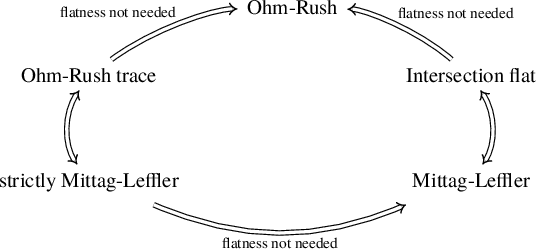

 Open access

