




Vicci Wong remembers the excitement of attending an Asian American activist meeting in Berkeley, California. That meeting, called by Yuji Ichioka and Emma Gee in May 1968, was unparalleled in unifying Japanese and Chinese Americans, and soon Filipino Americans and others as well, for the purpose of organizing as pan-Asians against racism. The concept of “Asian America” had not yet formed and Chinese, Japanese, Filipino, and Korean Americans worked primarily in separate community spaces. Wong and her best friend, Lillian Fabros, received cold calls from Gee, obtained from antiwar petitions. Gee also approached Richard Aoki, whose militancy would have been on display with flak jacket, beret, and sunglasses, and other Asian American students at the University of California, Berkeley. Her husband, Ichioka, called membership lists of the Chinese and Japanese American student organizations, including Floyd Huen, president of the Chinese Student Club. Though only six people showed up that evening, Wong relayed the excitement that something significant was taking place. They met in the Ichioka–Gee living room in a brown triplex at 2005 Hearst Avenue in north Berkeley. Those in attendance were already politicized and most were drawn to radical politics. Almost all had protested the Vietnam War, supported the Black Panther Party, and drawn inspiration from global Third World liberation struggles. While Ichioka and Gee had planned for an Asian American caucus of the Peace and Freedom Party, the original members instead created an independent organization.Footnote 1
The Asian American Political Alliance (AAPA, pronounced “aah-pah”) is an organization of historic significance. Scholars, and more recently journalists as well, uniformly cite AAPA as a leading organizing of the early Asian American movement (AAM).Footnote 2 AAPA is best known for introducing the term “Asian American” and for launching the AAM as a new pan-Asian political movement. And yet the treatment of AAPA is often cursory. This article presents one of the two most extensively researched works on AAPA, utilizing AAPA’s papers at UC Berkeley, the FBI files on AAPA, archival documents on AAPA collected by the author over two decades, and more than three dozen interviews.Footnote 3 It offers an analytic framework to theorize AAPA’s approach to educating, organizing, and building a political movement, or what I conceptualize as a “rhizomatic” mode that built horizontal nodes across people and places to foster the decentralized, self-initiating, interconnected participation of many people. In three parts, I examine AAPA’s (a) rhizomatic approach to political organizing, (b) model of collective leadership, and (c) community-centered pedagogy.
AAPA’S RHIZOMATIC APPROACH TO ORGANIZING
This article explores the method of organizing that AAPA embraced and tested out as they developed their organizational structure, politics, and activities. In A Thousand Plateaus, Gilles Deleuze and Félix Guattari contrast the model of the tree and the rhizome as different modes of reading and thinking. The tree model has an immobile root structure, grounded through a primary taproot (or, alternatively, several main roots extending from a central trunk). By contrast, rhizomes in nature, like crabgrass or Bermuda grass, have a nodal root system that spreads horizontally from many points, in many directions. The rhizome grows through subterranean flows of prolific rootstalks and numerous auxiliary buds. It operates through the principle of multiplicity and connection. Deleuze and Guatarri write, “The rhizome has no beginning or end; it is always in the middle, between things … The tree is filiation, but the rhizome is alliance, uniquely alliance. The tree imposes the verb ‘to be,’ but the fabric of the rhizome is the conjunction, ‘and … and … and …’”Footnote 4 The mode of the rhizome represents boundlessness and fosters imagination, creating spaces where “something unexpected can occur, where change and transition are not only possible but necessary.”Footnote 5 In addition, rhizomes defy easy rupture or erasure. If one breaks a rhizome while trying to remove it, it propagates new runners, turning breakage into a shattering that can spread and strengthen itself. In this, it has the potential to create something new through growth and rupture, to be transformational. The rhizomatic approach, as conceptualized by Deleuze and Guattari, is thus characterized by disjuncture, multiplicity, connection, creativity, change, horizontalism, and deterritoriality. Fay Yokomizo Akindes, through her study of Hawaiian music, tourism, and postcolonialism, came to view the rhizomatic model as a “counter-hegemonic approach,” where “ideas of non-linear, non-hierarchical, decentralized, unstable, unfixed, multi-directional relationships function to dislodge deep-rooted paradigms of stability and control.”Footnote 6
These ideas of the rhizome capture AAPA’s approach to organizing and leadership. AAPA developed a process that emphasized egalitarian, deterritorial, and entangled connections. They were transforming old paradigms of politics and establishing more participatory and decentralized ways of working. The AAPA groups that formed in several cities across the US were connected through a horizontal system that fostered independent, self-governing nodes over an arboreal approach with more fixed organizational structures. Still, while primarily horizontal, their approach did not exclude verticality. Even as the various AAPA groups functioned with a great degree of autonomy, Berkeley’s AAPA remained the nucleus of the broader organization.
Based on substantial archival research, thirty-nine interviews with twenty-three different former AAPA members, and FBI files on AAPA, this article analyzes AAPA’s rhizomatic approach in three parts.Footnote 7 First, I examined AAPA’s written documents and interviews with former members and found strong support for a horizontal, deterritorial approach to their organizational structures and processes. AAPA prioritized developing democratic and participatory ways of working, that in turn created space for women and other marginalized groups to be heard and have influence. Second, I observed that AAPA’s activities and campaigns show an approach to community-based organizing that affirmed the knowledge produced by ordinary people gained through their lived experiences. A central feature of AAPA’s approach to political organizing involved learning by listening such that members spent time in communities and accompanied people in their everyday activities (e.g. escorting seniors to medical appointments, providing Vietnam War draft counseling for youth). Third, I explored the importance of relationship building and rhizomatic networks in AAPA growth across the nation. Each AAPA chapter worked through autonomous, decentralized structures, while also being interconnected, notably through the Berkeley chapter which was the largest, most organized, and most active of the AAPA groups. Moreover, this study shows the significance of small organizations with short lives as places where knowledge and leadership are cultivated and can have large influences outside their own time and space.
One further note on the rhizomatic approach: this study of AAPA makes visible analyses and perspectives beyond what can be gained from the conventional writings of history that rely on the archives of institutions and prominent people. That method falls into the trap of viewing establishment organizations and politics, and the concessions they secure, such as higher wages and new laws, as the primary measure of social-movement success.Footnote 8 If we turn away from a history of institutions towards a history of people, mechanisms of other kinds become manifest. This does not diminish the importance of institutional activism, but instead elevates the organizing of ordinary people. It explores the ways grassroots movements shape institutions and are also constrained by them.Footnote 9 With an eye to the grass roots, we see the thinking, strategies, and cultures of struggle embodied in the everyday work of activists working in small, overlooked organizations. They become the unruly and rhizomatic nature of people’s struggles that spread transformative ideas, narratives, opportunities, and networks of resistance to fashion nothing short of new politicized identities and modes of activism for Asian America.
AN INTERLUDE: AAPA’S BEGINNINGS
Those attending that first AAPA meeting were a diverse group. Yuji Ichioka, a Japanese American from Berkeley, and his wife Emma Gee, a Chinese American activist with Martin Luther King’s Poor People’s Campaign, were both active with the left-wing independent political party the Peace and Freedom Party. Richard Aoki, from Berkeley and West Oakland, was a rare non-Black member in the Black Panther Party and a leftist thinker who had recently left the Socialist Workers Party. Ichioka and Aoki were both UC Berkeley graduate students and both had been incarcerated as children in the Topaz, Utah concentration camp during World War II. Born two years apart, in 1936 and 1938 respectively, Ichioka was a young nisei (the child of immigrants) and Aoki an older sansei (the grandchild of immigrants).Footnote 10 Vicci Wong, a Chinese American UC Berkeley undergraduate student, began her activism at age twelve in Salinas, a hundred miles south of Berkeley. She worked in the fields and cofounded a chapter of the National Farm Workers Association, established a junior chapter of Student Nonviolent Coordinating Committee (SNCC) in Monterey County, and organized antidraft actions at the nearby Fort Ord army base. Floyd Huen, a Chinese American from Oakland, was a newly elected Associated Students senator and president of the Chinese Student Club at UC Berkeley. Unlike the other AAPA founders, Huen had not participated in antiwar protests or Black Panther Party demonstrations, but, like the others, he already had notable organizing experience and, through his connections with student government, provided valuable resources for their new organization. Many others would also join AAPA Berkeley, including Filipina/o Americans Emil de Guzman, Liz Del Sol, Lillian Fabros, and Bruce Occena; Hawaiian/Filipino Bob Rita; Japanese Americans Patty Hirota, Keith Kojimoto, and Ronald Miyamura; and Chinese Americans Alvin Ja, Harvey Dong, Alan Fong, Jeff Leong, and Steve Wong. Bryant Fong would become the third and last chair of AAPA, after Ichioka and Aoki.Footnote 11
Soon after their first meeting, AAPA vigorously pursued their broad political agenda. They created an AAPA logo (the Chinese character for “east”), AAPA buttons, and a program delineating their beliefs to be announced at a public program on 30 June 1968 (Figure 1).Footnote 12 They voted to become a “yellow caucus in the black and brown caucus” of the Peace and Freedom Party and later endorsed Eldridge Cleaver’s PFP ticket run for the US presidency. They simultaneously worked on Asian American issues and on cross-racial issues that strengthened a US-based Third Worldist movement. They were forming a way of thinking and organizing that was at once ethnically specific, pan-Asian, and cross-racial. In addition, they worked locally while supporting international movements and brought a global analysis to local and national campaigns. AAPA worked through the dialectical tensions of specificity and solidarity and of nationalism and internationalism. They put an emphasis on action and “effective leadership.”Footnote 13 They seemingly spread out, in all directions, all at once. But these expansive activities were held together in a rhizomatic fashion by a collective organizational structure and by a radical and coalitional analysis that guided their practice.Footnote 14
AAPA developed a document called “AAPA Perspectives” that functioned as its guiding principles. The Chinese character for “east” became AAPA’s logo. UC Berkeley’s Ethnic Studies Library, AAPA Papers, Box 1, Folder 29.

ON COLLECTIVE LEADERSHIP: DEMOCRATIC PROCESS AND POLITICAL PRAXIS
It was important to AAPA that their organizational structure facilitate democratic participation by working in small groups, each with a particular purpose that could function both with autonomy from and in coordination with the larger organization. A rhizomatic orientation is embedded in AAPA’s primary approach to collective and horizontal leadership. But AAPA also worked through vertical structures, including proposals for a central committee. We see here that the rhizome and tree models are not oppositional. Instead, there is mutuality in these two modes of organizing; the wind helps to scatter the seeds of trees in free-floating, multidirectional ways, while some rhizomes have a central hub. Berkeley’s AAPA remained the core of the nationwide network, providing the ideology, programs, and principles for guiding the work of AAPA chapters in various locations.
AAPA began with its founders, Yuji Ichioka and Emma Gee, providing the primary leadership for initiating the group and reaching out to people. Ichioka was viewed as AAPA’s chairperson and facilitated meetings. But AAPA had an open structure, where any AAPA member could initiate different areas of work and participants could attend a single meeting. But within weeks of forming, AAPA members were experiencing problems with this loose, open structure. A particular problem revealed the need for a more defined organizational structure. AAPA had organized an event set for Sunday, 30 June 1968, to present their four-point program.Footnote 15 But two nights earlier, a police “riot” or protest mayhem, depending on one’s view, broke out on the streets of Berkeley. Approximately 1,500 people marched down Telegraph Avenue and Bancroft Way in an unpermitted march in solidarity with French students and workers. Suddenly, some two hundred police “routed the crowd with nightsticks and a massive bombardment of tear gas.” The situation escalated as “rocks battered against the squad cars,” with “500 police seal[ing] off entrances to the city,” and the city declaring a “state of emergency” with a 7 p.m. to 6 a.m. curfew.Footnote 16
For AAPA, besides being upset that “the police went wild,” the disturbances revealed structural problems within the nascent group. Despite holding several emergency meetings during the four-day pandemonium, “communications were poor” and they couldn’t gather a quorum to endorse the demonstrations. “We couldn’t get together as a group and act together,” they lamented.Footnote 17 If AAPA had operated through centralized leadership or top-down structures, or a more clearly articulated mix of vertical and horizontal approaches, its leaders could have moved quickly to make decisions for this group. But the problem emerged precisely because AAPA worked through a consensus-based model that required input from its members before decisions could be made. They came to realize that an overreliance on horizontalism could create delays to the point of inaction. They were learning that collaborative work could embrace vertical structures, even as egalitarianism was among its core values.Footnote 18 They also recognized the need for greater clarity and transparency in their leadership model, and turned to its development in earnest.
At a meeting on 7 July, AAPA engaged in a self-critical discussion about the need for better communication (by starting a newsletter) and for better organizing by forming “a steering committee that would make decisions for the group whenever time prevented majority approval.”Footnote 19 In weekly meetings, the leadership core hammered out an organizational structure. Most important to AAPA was that the structure promote democratic participation, aligned with their principle that “democracy be used as often as possible” and based on AAPA member Takashi Suzuki’s idea to use small “us” groups that were flexible and mobile, and made people feel that they had a role to play.Footnote 20
They followed this with another document on leadership, “An Understanding of AAPA,” co-authored by Bryant Fong and Floyd Huen. Before joining AAPA, the two had worked together in the Chinese Student Club and Fong had served as campaign manager for Huen’s run for Associated Student legislature. They wrote,
Leadership, as we understand it, is effective action; it is not making good speeches, rallying people, or having charisma, per se. It is leadership when those qualities lead to effective action. We are tired of rallies which result in frustration, tirades of rhetoric which lead to confusion, and general lack of understanding of the problems. Thus, we define leadership as effective action whether that action is work, writing, speaking, talking to friends, or plain secretarial labor. What is important is getting things done.Footnote 21
AAPA now included both horizontal and hierarchical structures, even as the organization did not offer a nuanced analysis of when different approaches would be most effective. It appears that horizontal methods work especially well for discussions or consciousness-raising groups, fostering organic relationship building, and creating space for people to initiate ideas and activities. Vertical structures were especially helpful when implementing strategies for campaigns, holding people accountable, developing strategies for growth or communication within or across chapters, and quicker decision making. There is another important reason for developing clear structures, one not articulated in the AAPA documents I saw, but by Jo Freeman in an influential article. Freeman observed that, in the women’s movement, “structurelessness becomes a way of masking power.” When organizational structures are opaque and unaccountable, there comes a defaulting to “elite” factions within the group that reproduce hierarchies of class, race, and gender, often along lines of friendships and relationships. By contrast, establishing processes for decision making, whether formal or informal, can make room for the greater participation of many and of those not necessarily aligned, personally or politically, with the core group.Footnote 22
Even as AAPA turned to more vertical structures to “organize effectively,” rhizomatic structures were most pronounced. Their working committees enabled multiple nodes of people and activities to develop particular areas of struggle and to have the autonomy to carry them out. They studied Mao’s essay “On Practice,” which posited that knowledge arose from social practice, especially “class struggle, political life, [and] scientific and artistic pursuits.”Footnote 23 While Mao promoted the unity of theory and practice, of study and action, he also insisted on the primacy of practice in the development of new knowledge, including ideas for creating change in the world. AAPA was also influenced by Maoist ideas that flatten hierarchies of intellectual and manual labor and respect a multiplicity of labor, where different kinds of work are necessary and valued. While many AAPA members were college students, they had also toiled in the fields or had parents who were garment, domestic, agricultural, cannery, or restaurant workers, and many AAPA members would go on to scrub, paint, and renovate the International Hotel. As in their statement above, AAPA rejected hierarchial models where a few people did the so-called “important” work of speaking and running meetings, with the majority serving as their helpers. They further disavowed the charismatic-leadership paradigm featuring a captivating speaker or singularly confident leader, usually embodied in the male figure who too often spoke with heavy doses of rhetoric and bombast.Footnote 24
Theirs was a leadership model of participation and facilitation rather than of centralized power. While having authority over its own areas, each node was not fully independent, but rather interdependent, connected with other work groups through communication and coordination of AAPA’s Central Committee. Like rhizomatic networks in nature, their interconnectedness strengthened their effectiveness and their resiliency. AAPA members were rooted in collective struggle, relationship building, and political study in ways that created space for themselves and others to develop their own ideas and activist pedagogies. Their beliefs and methods aligned with Karen Sacks’s study showing how social relationships, networking, and attending to the personal are crucial to organizing. Sacks named this “centerwomen” leadership to note its importance and its gendered dynamics, as compared to the more conventional modes of “spokesman” leadership.Footnote 25 AAPA activists seemed to recognize this when they raised the significance of relationship building – not just for social reasons among young people, but specifically to foster the trust that was essential to good organizing. At one meeting that summer, AAPA had the thirty-six people in attendance form into six groups with no particular political agenda, but rather to know one another. As AAPA put it, “Before any effective action could be taken politically, the individuals in the Alliance would need to know and trust each other.”Footnote 26 Their ideas prefigure what, many years later, Adrienne Maree Brown would write about as the need for activists to “move at the speed of trust” and no faster, regardless of the correctness of their ideas or even the urgency of the issues.Footnote 27 AAPA was developing a model of collective organizing based on three major principles: (a) that small, proactive work groups foster a sense of participation and belonging that (b) created mutuality and interconnectedness through a web of rhizomatic linkages (c) based on the belief that relational leadership is indispensable to grassroots activism.
AAPA’s approach to leadership could be called feminist in terms of being collaborative, participatory, and egalitarian. Indeed, a rhizomatic approach, like AAPA’s, provided the organizational structure to open spaces for women and others marginalized by power to increase their participation and decision making within the organization and broader movements for justice. By one estimate, women comprised about 40 percent of AAPA’s membership, and women like Emma Gee, Vicci Wong, and Penny Nakatsu were in leadership positions from the start.Footnote 28 Before offering a more nuanced discussion of women’s involvement in AAPA, I take note of the ways AAPA advanced women’s liberation in their writings and documents. Most visibly, in summer 1969, AAPA devoted two full pages in its newspaper to an article titled “Notes on Women’s Liberation,” authored by “G.L.” The essay juxtaposed the revolutionary figure of the Vietnamese woman freedom fighter with the conventional femininity of “Miss Chinatown USA.” It indicted American conceptualizations of freedom and democracy: “The woman in these United States is supposed to be among the ‘freest’ on earth. She can wear mini-skirts, go topless and obtain divorces.” The author reevaluated the meaning of “progress” made in women’s legal rights and access to professional fields, observing that women were often relegated into “clerical jobs with poverty-level pay or a skilled job with 60% of man’s pay,” a woman faced pressures to “become more ‘masculine’ in her behavior and occupation,” and “the percentage of women in college in proportion to men is about 10% lower than in the 1920s.” Instead, the author urged political activism: “If Asians really care about freedom, we must concern ourselves with the women’s liberation struggle,” with specific demands for “dignity” and “self-determination.”Footnote 29 AAPA revealed an emergent critique of US and Asian patriarchy and of liberal feminism’s focus on individual freedoms. They used the vocabulary of “liberation” rather than “rights” and located the problem of women’s subordination in systems of capitalism, colonialism, and patriarchy.Footnote 30 In addition, rooted in AAPA’s vital organizing to establish Asian American studies, students in Emma Gee’s proseminar on Asian women at UC Berkeley would later produce Asian Women (1971), a 144-page compilation of essays examining the “herstory” and politics of Asian and Third World women.Footnote 31
Despite efforts to promote women’s leadership and liberation, AAPA, like all organizations, reflected contradictions in society. Like most organizations at that time, AAPA Berkeley, and most AAPA chapters, had a predominance of male leadership (e.g. all three chairs of AAPA Berkeley were male). A notable exception was San Francisco State, where Japanese American women founded the group and provided its primary leadership. I also noticed that, in my interviews, former AAPA members repeatedly used the term “strong women” to describe AAPA women leaders. Penny Nakatsu relayed how she developed an “assertive” speaking style to be heard. Vicci Wong described how men in the movement were intimidated by strong women like herself. Male members viewed Emma Gee, Nikki Arai, and Lillian Fabros as “strong women” and Vicci Wong in particular as “a fiery leader” and “a firebrand.”Footnote 32 While intended as compliment, it was as if women had to be formidable to have a notable influence in AAPA, whereas men did not.Footnote 33
Vicci Wong offers a comment that reminds us of the need to address the particularities of racialized gender when analyzing Asian American gendered practices. She stated, “We never really had the thing of ‘Oh there’s too much male chauvinism,’ which I know was happening in other groups, especially in the Third World groups in terms of machismo.” She expressed a concern, “How do we make our males seem stronger to match with those other guys [in the TWLF]?”Footnote 34 The representation of model-minority masculinity impacted how AAPA was perceived by both fellow TWLF activists and university administrators. In one instance, TWLF strikers questioned whether Asians could hold their weight on the picket line and fight back physically if needed. One AAPA activist proudly relayed how an AAPA brother, though small in stature like himself, defended himself with ease.Footnote 35 In addition, Bryant Fong recalled that during a meeting with Black, Chicano, and Asian studies representatives, a top UC Berkeley administrator asked the Asian studies staff, “Why are you here? You’re successful. You’re part of the country. You don’t need to be with them.”Footnote 36 Despite the seemingly positive stereotyping at play, AAPA rejected this narrative. Asian American studies has since developed a large literature explaining the harm caused by the model-minority trope.Footnote 37
AAPA’s struggle against racialized gendered stereotyping anticipated what Patricia Hill Collins later called “controlling images” for these images’ hegemonic power and discursive legitimization of subordination through interlocking systems of race, class, and gender. AAPA’s focus on exposing controlling images of both American women and men and on resisting the subjugation of Asian Americans helps to explain their position that “the realization of women’s liberation will require the efforts of both men and women,” as G.L. wrote in “Notes on Women’s Liberation.” This wasn’t an argument for gender equivalency. The author wrote, “The work will be difficult … But it must be done. The woman will then be able to gain her human dignity. The man will lose his vanity and arrogance.”Footnote 38 Like other US Third World feminists in the late 1960s, many Asian American women engaged antisexist activism in race-based organizations, while distancing themselves from the white liberal feminist movement for focussing on “equality” with white men, while failing to oppose racism, sexism, and capitalism. In her research on Los Angeles-based Third World activism, Laura Pulido found that, compared to Black and Chicano/a activists in her study, the Asian American group, East Wind, was the “most effective organization at challenging sexism and traditional gender relations,” and also displayed the greatest gender flexibility and lesser impositions of patriarchy within their organizations. She attributed this to the East Wind’s collective leadership, including its communal living situation and nonhierarchical structure, and to its ideology that viewed sexism not as a byproduct of capitalism, but rather as “a relation partly constituted by capitalism that had to be fought on its own terms.”Footnote 39 While East Wind, founded four years after AAPA, established its own independent beliefs and practices, I also contend that AAPA’s approach to collective leadership had an influence on the larger AAM, including East Wind.
AAPA demonstrated, if never fully attained, the importance of articulating and working to implement collaborative processes and structure. They not only emphasized democratic participation through small, autonomous work groups, but also fostered opportunities for women’s involvement and leadership. Moreover, collective leadership became a hallmark of the Asian American movement itself and, in this, AAPA set the tone.
“SERVE THE PEOPLE WITH THE PEOPLE”: A COMMUNITY-CENTERED PEDAGOGY
AAPA deployed a decentralized, multidirectional approach to their community activism. Different members could develop small work groups to organize around issues of importance to them. This wasn’t a free-for-all; members proposed and discussed ideas in meetings. But there was an openness that allowed for self-initiating, nonhierarchical, mobile, and collaborative decision making – in other words, a rhizomatic method. This further matched their pedagogy, or beliefs about knowledge production and learning. Theirs was a relational model, where building social relationships with each other and with people in communities was crucial to how one learns and imparts political ideas. They took the time not only to participate in political meetings and rallies, but also to sit, talk, or share a meal with the everyday people in Chinatown, Manilatown, Japantown, Delano, and elsewhere. AAPA endorsed the belief that knowledge arose not from academic learning alone, but also from everyday experiences at the workplace, in activist struggles, in daily living. Their ideas were influenced by Mao’s “On Practice” and Paulo Freire’s Pedagogy of the Oppressed that united experiential knowledge with political education, working to weld theory to practice, whether on the streets or at the university.Footnote 40
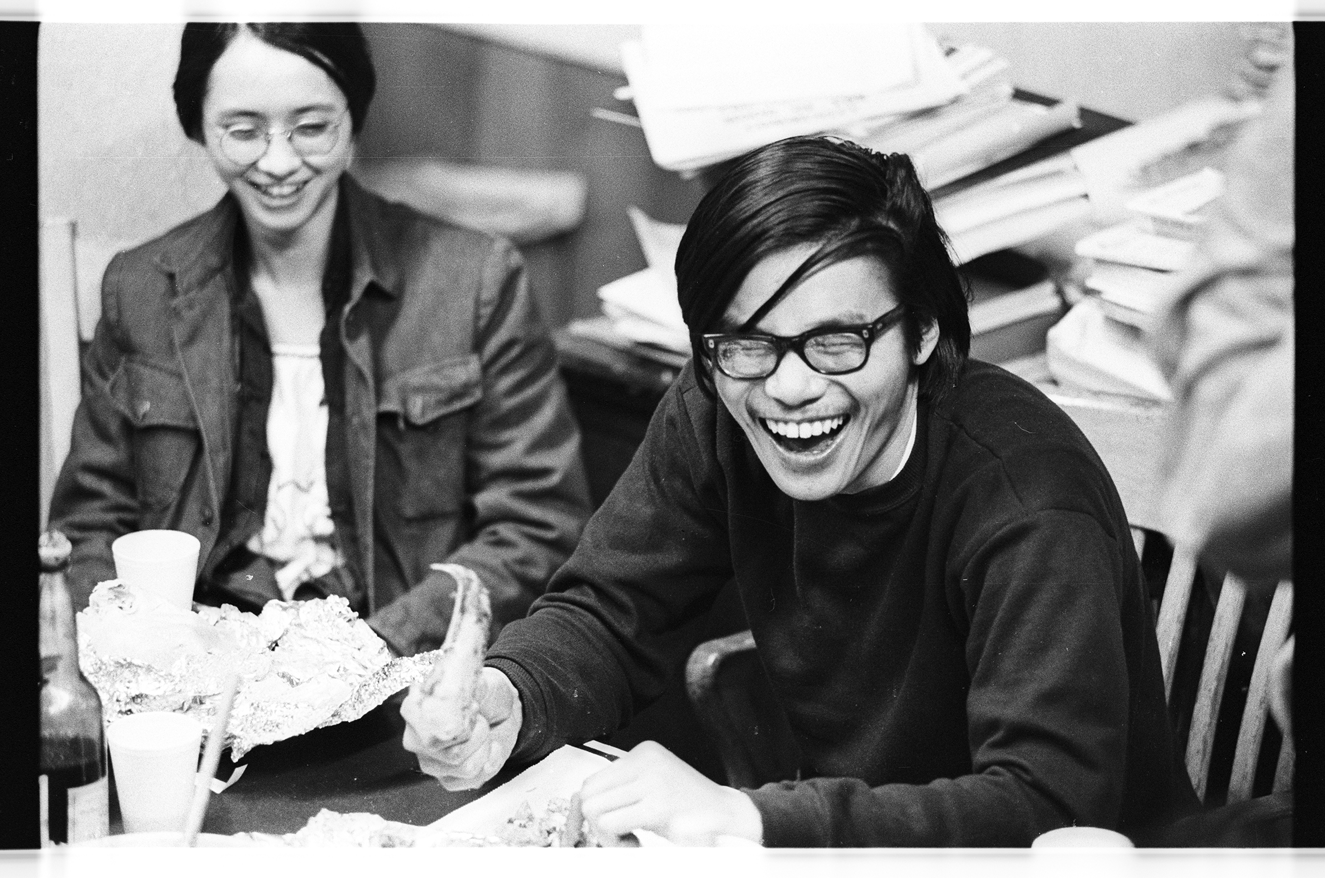
For Harvey Dong, AAPA provided an early training ground to experiment with activism and develop organizing lessons that stayed with him throughout his life (Figure 2). He grew up in Sacramento, eighty miles inland from Berkeley, the child of immigrants from China. In a city filled with anti-Asian racism, he found a sense of belonging among mostly Asian American friends. In fall 1966, his first year at UC Berkeley, he joined the ROTC. By fall 1967, he was opposing the Vietnam War and had participated in the Stop the Draft Week protests. In fall 1968, he joined AAPA. When reflecting on his activist experiences, Dong offered two interconnected insights. First, in addressing how to create change he stressed the need to “listen, unite with, and learn from the masses.”Footnote 41 Influenced by Mao, Dong believed that one’s conceptualization of the world should not emerge from abstract learning alone, but crucially from getting to know people in communities, workplaces, and political struggles and by listening to their concerns, joys, perspectives, and experiences. His is a relational approach that emphasizes the knowledge arising from people’s lived experiences and places value on building personal and political relationships over time. Second, Dong advocated an approach of “problem posing” to “rais[e] political consciousness” and sharpen analysis of oppressive systems. Freire promoted the method of “problem posing” that moves away from conventional leadership where bosses, administrators, or parents “fix” problems for other people, and instead saw ordinary people as cocreators of solutions to structural problems. These ideas informed the pedagogy that shaped AAPA’s work in Chinese, Filipino, and Japanese American communities.Footnote 42
AAPA’s Harvey Dong (right) and Dolly Lumsdaine (left) wearing a denim Mao jacket produced by the Chinatown Cooperative Garment Factory, located in the rear of the Asian Community Center basement. Photograph by Steve Louie, Wei Min She, and Asian Community Center photographs, AAS ARC 2015/3, Ethnic Studies Library, University of California, Berkeley.
AAPA was advancing an approach that contrasted with the Leninist vanguard models that dominated the Old Left. Black Panther Party cofounder Huey Newton observed that the Panthers’ approach of picking up the gun and wearing uniforms was an important method of community self-defense against police violence. But it also fostered a spectacle that turned supporters into observers rather than participants in their own resistance.Footnote 43 George Lipsitz similarly cautions against falling into “the vanguardist trap” where the focus is on cultivating the consciousness and capacities of the most advanced who then guide the struggle for the many. Lipsitz writes, “Radical social movements do require discipline, organization, and ideological clarity, as the vanguard tradition has always argued, but discipline, organization, and ideological clarity need to be tools forged by the people for their own purposes, not disciplinary apparatuses constructed for the people by their leaders.”Footnote 44 AAPA members represented a political pedagogy that grounds knowledge in the lives of people and views the work of activists as cultivating the long-term capacity of ordinary people to formulate their own solutions. Years later, after working in New Communist organizations that overrelied on vanguardist approaches, some former AAPA activists reflected on how change works and on the importance of learning from those they were sent to organize.Footnote 45 It might be said that they returned to their roots, starting with AAPA’s rhizomatic approach, moving away from more centralized and top-down approaches, and returning to prioritize people’s own capacity to create change. Yet this was not simply a return to the past, but rather an upward spiraling of knowledge based on a lifetime of organizing. It also reflected changes in political movements from the intensity of Marxist–Leninist organizing in the 1970s, to the expansion of neoliberalism that required different kinds of organizing and experimentation.
We turn next to AAPA’s organizing in Chinese and Filipino American communities. Note that elsewhere I write about AAPA’s work on Japanese American issues, including opposing Title II of the 1950 Internal Security Act and protesting “Japan Week” festivities welcoming Japan’s Prime Minister Eisaku Sato to San Francisco.Footnote 46
Chinatown Work Group. AAPA’s first foray into San Francisco’s Chinatown was to co-sponsor a “Chinatown Workshop” with the intention that “non-Chinatown people could learn more about the ‘ghetto’ so that effective action might be taken with the aim of ameliorating and changing conditions in San Francisco.”Footnote 47 The Intercollegiate Chinese for Social Action (ICSA), formed at San Francisco State College in 1967, was the main sponsor of the Chinatown Workshop, held on Saturday 17 August 1968, at the Cumberland Presbyterian Church. Later that day, about 250 people participated in the march to protest the conditions in Chinatown, organized by George Woo and the Wah Chings. AAPA’s pan-Asian focus would suggest that the “non-Chinatown people” they were targeting were not only white people, but also Japanese, Filipino, and Korean Americans, as well as Chinese raised outside Chinatown.Footnote 48
Other AAPA members such as Bryant Fong had experienced firsthand the poverty and constricted opportunities in Chinatowns in San Francisco and Oakland. San Francisco’s Chinatown (after Manhattan’s) was the second most densely populated area in the country, 77 percent of its dwellings were deemed substandard or seriously substandard, and it was characterized by restricted job options, low wages, and high rates of tuberculosis exacerbated by severe overcrowding.Footnote 49 Barlow and Shapiro wrote, “Of all the minority groups in San Francisco, the Chinese community is relatively the worst off – a fact insidiously concealed behind the Chinatown public façade.”Footnote 50 Fong’s father’s was a naturalized citizen through US military service and had hopes for a better future. But he instead discovered that housing deeds barred the selling of homes to Chinese people and that anti-Chinese racism constricted job opportunities and shattered dreams. Fong’s mother and grandmother worked as Chinatown garment workers and Bryant himself spoke primarily Chinese until well into elementary school, struggling without any bilingual education programs.Footnote 51 This was the experiential knowledge arising from daily life that informed AAPA’s politics and community focus, understandings they augmented with activism and political education study.
The Chinatown Workshop energized AAPA to establish a Chinatown Work Group as its third working committee. Two organizing issues stand out. First, like other AAPA committees, the Chinatown Work Group functioned with decision-making autonomy and a nimbleness that enabled them to engage in numerous activities. Second, this work required that AAPA not remain in university classrooms, but be people who grounded themselves in community and learned to work collaboratively, and sometimes in struggle, with activists and organizations, not only youth activist groups, but also the Chinatown elite who had differing politics and methods of organizing. AAPA’s Chinatown Work Group created a “Chinatown Library” and supported ICSA’s tutorial program for “immigrants and disadvantaged youth,” with classes offered five evenings a week at Commodore Stockton and Jean Parker elementary schools. AAPA and ICSA further proposed establishing a twenty-four-hour helpline as a juvenile defense service, providing interpretation and legal contacts for those in the carceral system.Footnote 52 With Leeways and others, AAPA established the first draft counseling center in San Francisco’s Chinatown in January 1969. The Chinatown Draft Counseling Center, located in the Chinatown Legal Aid Society, was open every Saturday from 12 to 8 p.m., filling a major absence by providing Chinese-language materials in order to “put an end to the Draft’s racism.” By late 1969, they renamed themselves the Chinatown–Manilatown Draft Help Center to recognize the adjacent Filipino community embattled at the International Hotel and relocated to 854 Kearney Street on the International Hotel block.Footnote 53 It is striking how much AAPA was able to accomplish, including working with established groups to acquire the use of space and other resources to enable their community programming.Footnote 54
Through intergenerational community-based relationships, AAPA learned another aspect of their history; that is, a history of radical activism in Chinese, Filipino, and Japanese American communities. This history had been largely erased from their knowing through the state’s Cold War repression of the Chinese immigrant left, ruptures caused by incarceration and the postwar rise of assimilationism in Japanese American communities, and success story strivings by the Filipino immigrant generation.Footnote 55 Yet this history was never completely erased. There were former Chinese Marxists still around, including the fathers of AAPA’s Alvin Ja and Steve Yip, who became knowledge keepers of earlier radicalism. Groups like the Red Guard, supported by AAPA, disrupted a community tightly controlled by the pro-Kuomingtang (KMT) Six Companies by daring to marching with Maoist banners on the streets of Chinatown and to show the film The East Is Red to enthusiastic crowds.Footnote 56 Student activists heard stories of Filipino labor organizing from the Manong at the I-Hotel or in Delano. In the Title II repeal campaign or protests against S. I. Hayakawa, AAPA activists formed alliances with progressive Japanese Americans in their parent’s generation. At a time when assimilationism and model-minority tropes dominated the racial discourse about Asian Americans, AAPA and other AAM activists came to learn about their communities’ earlier activism. This changed their own perceptions of what it meant to be Asian American and fortified them with knowledge of a radical past.
Filipino American issues. Lillian Fabros (Figure 3), one of three or four Filipino Americans in the early days of AAPA, developed her class consciousness as the child of Filipino immigrants in Salinas, a rural town two hours south of Berkeley. Her father was originally a farmworker, then a US Army sergeant, and returned to being a farmworker, and her mother, brother, and Lillian herself all worked picking tomatoes, lettuce, and strawberries. Her lived experiences taught her how hard the work was, how low the pay was, and how unfair it was that Filipino farmworkers were trapped in poverty and a cycle of debt. As a teenager, she met college students who tried to organize farmworkers but also belittled Filipinos for “being stupid” for working for poverty wages. But when the college students couldn’t last more than a week in the fields, Lillian learned an important lesson about experiential knowledge, “Organizers had to be from the community itself in order to be effective and long-lasting.” In addition, academic learning and social relations mattered. A high-school teacher, for example, taught her a social analysis of the Vietnam War and police violence, lessons she brought with her to UC Berkeley when she started in fall 1966.Footnote 57
Lillian Fabros gathers signatures for AAPA’s campaign to repeal the McCarran Act (concentration camp) at a Free Huey rally at Defremery Park, Oakland, CA, 14 July 1968. Photographer unknown. Courtesy of Lillian Fabros Bando.
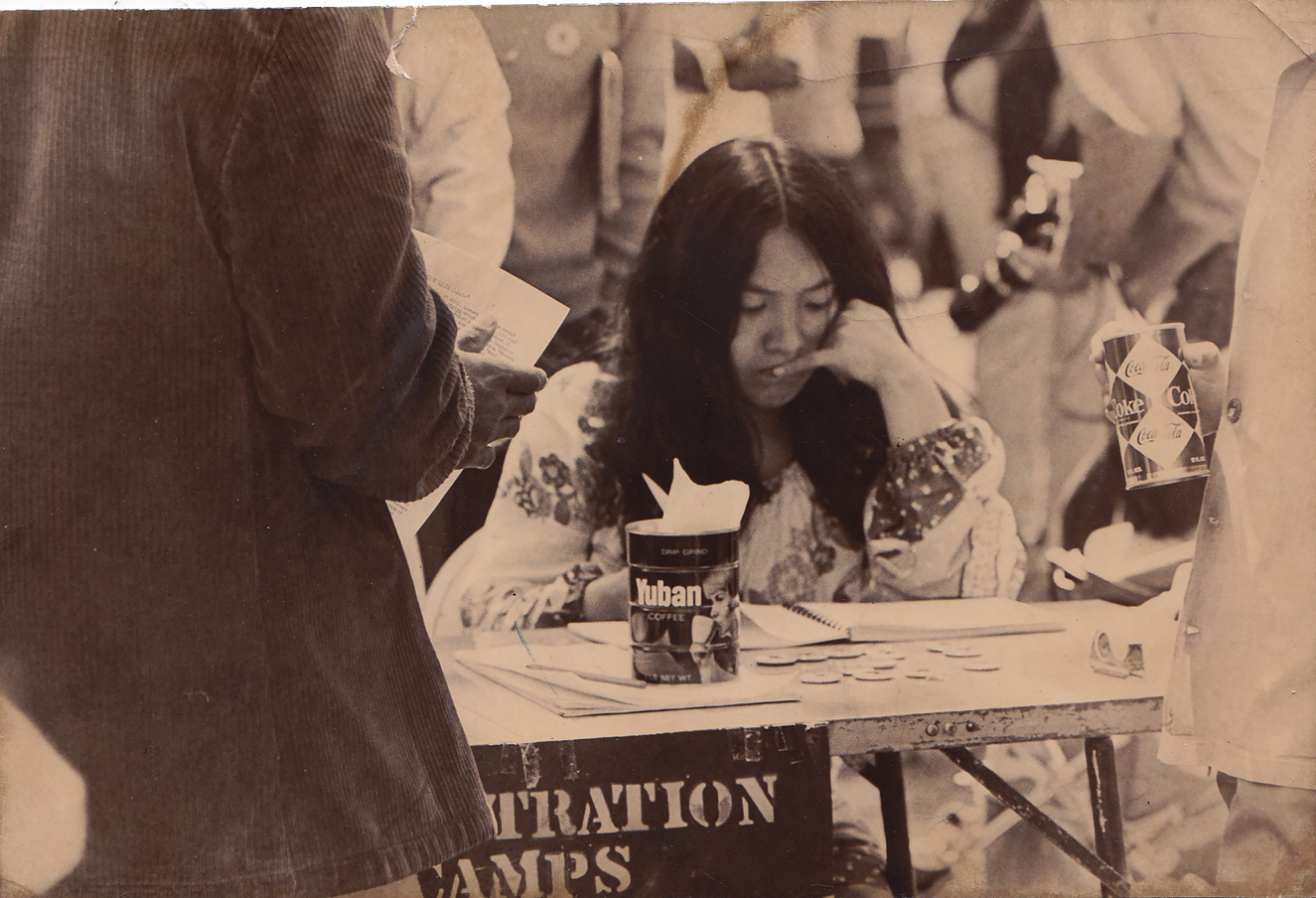
Early on, Lillian gathered signatures for AAPA’s campaign to repeal the McCarran Act, including at Sproul Plaza on Berkeley’s campus and at a Free Huey rally at Defremery Park in July 1968. But such pan-Asian solidarity was not automatic. Lillian had intense discussions with Yuji Ichioka about the Japanese American concentration camps and retorted, “The Japanese invaded the Philippines and had real concentration camps, not at all what Japanese Americans experienced in America.” By seriously engaging dialogue and struggle, Lillian came to distinguish between the people and the government and between Japanese Americans and Japan. Her approach was both transactional (reasoning that if Filipinos supported Japanese American issues, then non-Filipinos should support Filipino struggles) and transformational (in building joint struggle across difference as a matter of principle).Footnote 58
Based partly on Fabros’s experience in the fields, an Asian American student group trekked the 250 miles south and inland from Berkeley to Delano, California. Four years earlier, in September 1965, Filipino farmworkers began what became the historic, five-year grape boycott in solidarity with Chicanas/os in the United Farm Workers of America.Footnote 59 Fabros, fellow Salinas farmworker Vicci Wong, and other AAPA and non-AAPA students made the weekend trip to learn firsthand about the conditions in Delano, including bodies poisoned by pesticides, scarce healthcare, extractive labor practices, and exploitative pay. The students also learned about the organizing taking place, including the UFW’s work to build Agabayani Village to house elder farmworkers, primarily Filipinos, and aspirational plans to develop a cooperative store and a farmworker hospital. One student wrote,
Our visit to Delano brought to us a greater sense of reality. Many of us had the aura of academic success, but in this experience with basic human relations, we were painfully inadequate … Luckily the able labor organizers of the Chicano and Filipino communities understood our weakness and we found that we were able to learn about the problems through them.Footnote 60
This statement reflected Harvey Dong’s insistence on the importance of listening and learning from the community in order to develop experiential knowledge and critical praxis. Moreover, these words were from a Chinese American student expressing the kind of pan-Asian solidarity that Lillian Fabros was calling into being.
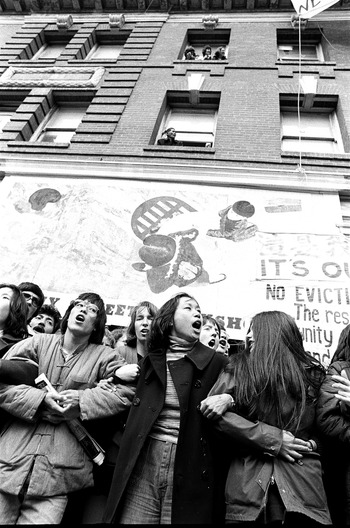
AAPA further participated in one of the most important activist struggles in San Francisco. The nine-year campaign to save the International Hotel transformed the AAM and connected a generation of Asian American activists with community issues. The I-Hotel, at 848 Kearny Street, was in what remained of Manilatown, in the heart of Chinatown. The hotel rented low-income housing, at forty-five dollars per month, for single-room-occupancy units that, while small, provided a space of one’s own. The I-Hotel enabled a community to form, where the mostly Filipino bachelor elder men could eat at Mabuhay Restaurant, play pool at Lucky M Poolhall, and get haircuts at Tino’s Barbershop – and create a sense of belonging among friends. By the 1960s, the process of gentrification was intensifying, with corporate ambitions to make San Francisco into the “Wall Street of the West.” When the hotel’s owner, Milton Meyer and Co., sent eviction notices to tenants in October 1968, AAPA joined the campaign to stop the evictions and protest gentrification. The intensive, diverse movement (involving labor, churches, schools, and community sectors) couldn’t stop the evictions, which took place on 4 August 1977 (Figure 4). But activists were eventually able to gain $17 million in federal and city grants; in 2005, they opened the doors of the International Hotel Manilatown Center with low-income housing and meeting space in the location of its former building. Curtis Choy made the powerful documentary The Fall of the I-Hotel, and Estella Habal wrote the most extensively researched book on the I-Hotel movement.Footnote 61 My purpose is not to renarrate the I-Hotel struggle, but rather to show its significance to AAPA’s model of relational, experiential, and collaborative organizing.
Students and youth linked arms to defend the I-Hotel tenants from evictions on 4 August 1977, San Francisco. Organizers like former AAPA member Pam Tau Lee (center) lived in Chinatown SROs (single-room-occupancy hotels) and used knowledge and skills learned in this struggle to improve housing, employment, and environmental health and safety conditions in their communities. Photograph by Chris Fujimoto.

Following a suspicious fire at the I-Hotel in March 1969 that killed three tenants and damaged the third floor, college students, including AAPA members from UC Berkeley and San Francisco State College, joined the tenants in renovating the hotel. After professionals lent their expertise to fix code violations and meet safety regulations, the work of refurbishing turned from experts to laypersons and, through fieldwork courses in Asian studies, Berkeley students were especially active. An article in AAPA’s newspaper reports that students, along with the community-based United Filipino Association, painted and refurbished the majority of the rooms at the hotel. Despite financial problems and the difficulties of winning anti-gentrification struggles, AAPA activists were transforming the I-Hotel and in the process transforming themselves. Emil de Guzman, a Filipino AAPA member who played a leading role in the I-Hotel campaign, commented,
The Hotel has changed from a flophouse to something better … We weren’t only getting the place to look nice, but we were developing a relationship between the tenants and supporters. We painted, tore out old rugs, fixed walls, to make the hotel a better place to live and we also won the trust of the tenants.Footnote 62
This focus on building trust and social movement over time, and through service, were central to AAPA’s praxis-focussed, rhizomatic approach to organizing.
For Habal, Filipino social identity was crucial: enduring relationships developed between the Manongs (a term of respect for their elders), mostly bachelors without children, and the students, who learned about their Filipino activist past from the old-timer farmworkers and labor organizers. But for AAPA, pan-Asian solidarity was key. They wrote,
As to how the image of the Hotel has changed since the crisis, no longer can anyone refer to the International Hotel as just a Filipino Hotel in a Filipino community, but more precisely, it is an Asian Hotel in an Asian community. The enemy that threatens Chinatown is the same one that threatens Manilatown – expansion of the Financial District.Footnote 63
The pan-Asian social formation formed by AAPA lies in this very tension between particularizing ethnic community formation and cross-ethnic solidarity. Someone like Lillian Fabros could chose a both/and approach, identifying as deeply Filipino working on Filipino issues and simultaneously engage in coalitional pan-Asian and Third World politics with her Chinese American best friend, Vicci Wong, who shared her cross-racial politics. The basis of unity between the two positions is linked through a shared oppression, in this case of racial capitalist interests promoting gentrification and displacing working-class Filipino and Chinese American communities.
The I-Hotel struggle galvanized the Asian American activists and its fall signaled the end of the most significant phase of the AAM.Footnote 64 As May Fu discusses, the I-Hotel housed not only tenants, but also numerous AAM organizations, including UC Berkeley’s Asian American Studies Field Office, with AAPA members and former AAPA members at the helm. AAPA’s Steve Wong observed that “without Asian American Studies, without the students of Asian American Studies, without the people who were involved in Third World Strike going to the community connecting up, [the proliferation of service organizations] wouldn’t have happened.”Footnote 65 After AAPA ended, former AAPA activists like Emil de Guzman, Bruce Occena, Harvey Dong, Pam Tau Lee, and many others continued in this struggle. It also became personal, with AAPA and former AAPA activists living at the hotel and some choosing to get married there. The I-Hotel activism was crucial to learning “how power was challenged and rearranged between everyday people and the elite in one community.” This struggle enabled AAPA or former AAPA activists to develop their political Asian American or political Filipino identities and advance organizing knowledge and skills that they carried forward in countless struggles for the next several decades. For Harvey Dong, “The most important contribution of that period … was the willingness of the youth to go to the masses and learn from them.”Footnote 66
EXPANDING AAPA THROUGH RHIZOMATIC RELATIONS AND NETWORKS
In ways both planned and accidental, AAPA Berkeley grew into a national formation, with AAPA chapters forming in multiple cities across the nation.Footnote 67 This growth reflects a rhizomatic approach in the way AAPA chapters emerged and in the way chapters operated with independence from one another. My argument here is that AAPA, whether the original group in Berkeley or its national formation, operated primarily, though not exclusively, through rhizomatic, horizontal networks. Each node of the rhizome represented an AAPA chapter that was loosely, but noticeably, intertwined. The local groups not only named themselves the Asian American Political Alliance, but many attended statewide meetings together, contributed articles to or had their activities covered in the AAPA newspaper, and engaged in joint campaigns. While horizontality, autonomy, and collaboration are appropriate ways to characterize the relationship among AAPA chapters and its growth nationally, Berkeley AAPA remained the prominent chapter. Berkeley was the largest and most active AAPA chapter, developed the clearest organizational structure, and was the most responsible for sprouting new AAPA groups. In this case, there is a more central body within the rhizomatic network. In nature too, not all rhizomatic plants are like Bermuda grass with a sprawling root system; some, like turmeric, have a “mother rhizome” from which auxiliary “fingers” grow. Berkeley remained the most influential chapter within the national network of AAPA chapters, and others formed independent, yet coordinated, local chapters, all going by the name of AAPA.
AAPA expanded through social relationships and networks, in addition to its public events and rallies, campaigns and petitions, and meetings. With propinquity as a driving force, AAPA grew first in the Bay Area, including interest by high-school and junior high-school students.Footnote 68 AAPA at San Francisco State College (SF State), formed in September 1968, was the second most influential chapter, after Berkeley. It was started by two Japanese American women students, Penny Nakatsu and Masayo Suzuki, who met in the spring 1968 series of rallies, teach-ins, and events to gain Third World special admissions and to remove the Air Force ROTC from campus. Masayo’s brother Takashi Suzuki introduced them to his organization at UC Berkeley. The two women soon began making the twenty-mile trek across the Bay Bridge to attend AAPA meetings at the Ichioka–Gee apartment, where they met Vicci Wong, Floyd Huen, and Jean Quan, and were especially impressed with Yuji Ichioka’s forceful speaking style and Richard Aoki’s involvement with the Black Panther Party. In the spirit of open, horizontal leadership, Berkeley organizers invited the newly formed group to lead AAPA’s next meeting in Berkeley. Shortly after forming, the SF State AAPA turned its major focus on organizing the intensive Third World Liberation Front strike that lasted five months and won the first school of ethnic studies in the nation.Footnote 69 Sixty miles south of Berkeley, Adna Louie founded AAPA at San Jose State College (SJSC), a campus propelled into international headlines when two of its student athletes, Tommie Smith and John Carlos, raised their fists in the Black Power salute on the awards podium at the 1968 Olympics in Mexico City. Social relationships mattered in AAPA’s rhizomatic networking. Interestingly, the farming town of Salinas plays prominently in AAPA’s development as the location that fostered the initial activism of Adna; her close childhood friends, Vicci Wong and Lillian Fabros; and her younger brother, Belvin Louie, also with AAPA Berkeley.Footnote 70 Moreover, UC Davis AAPA asked the Berkeley group for help as they faced obstacles organizing on what seemed to be an “extremely conservative” campus, and AAPA further helped to organize at Mills College in Oakland.Footnote 71
As AAPA grew, news of the organization spread through circuits of personal and political relationships and the sharing of AAPA’s leaflets and newspaper, especially to southern California. In Los Angeles, the most active AAPA was based at University of Southern California’s Center for Social Action. The center’s assistant director, Alan Nishio, founded the AAPA group in fall 1968, after inviting Yuji Ichioka to speak. Nishio, born in the Manzanar concentration camp, but unaware of the politicized nature of the camps until his senior year at UC Berkeley, would have been drawn to Ichioka’s leaflet, “Concentration Camps U.S.A.,” and AAPA’s Title II campaign.Footnote 72 A short-lived AAPA seems to have started across town at UCLA, formed by spring 1969, through relationships with people like Yuji Ichioka and Alan Nishio and supported by the Asian American Studies Center.Footnote 73 In addition, there were political and social trips to visit one another, including in October 1968 when Ben Tong took a group of “AAPA-ites” to Los Angeles to meet and “rap” with members of Oriental Concern.Footnote 74 Many young people from throughout California came to Berkeley’s The Asian Experience/Yellow Identity symposium and the next day’s AAPA statewide conference, held on 11 and 12 January 1969 respectively. At that time, AAPA groups existed at Berkeley, San Francisco, San Mateo, Hayward, San Jose, Sacramento, Los Angeles, Hawaii, and New York, according to AAPA’s newspaper and documents. Other chapters apparently formed after the January 1969 meeting, including Mills College, UC Santa Cruz, and UC Davis, and were “just getting started” at Sacramento city and state colleges. AAPA could also be found “in some form or contact” in Oakland, Chicago, New Hampshire and British Columbia.Footnote 75
Outside California, AAPA formed at Columbia University, in spring 1969, strengthening bicoastal Asian American activism. Rooted in rhizomatic relationships and exchanges, Columbia’s AAPA members attended the Asian American Studies conference at UC Berkeley in September 1969 and AAPA’s newspaper contained New York City news and collaborative projects.Footnote 76 In addition, the Ichioka–Gee apartment in north Berkeley, referred to as “AAPA Home,” served as AAPA’s meeting space and mailing address. After Ichioka and Gee moved to New York in late August 1968, Vicci Wong moved in and became a witness to AAPA’s geographic reach. Wong recounted, “I was getting letters from all over. From Missouri, Hawaii, and even parts of Asia, people wanted to know, ‘I never heard of such a thing, Asian Americans? What’s that?’ It just caused this whole storm.” At one point, “a professor from Dartmouth showed up at my door and he was so excited. He wanted to join AAPA and ended up staying the rest of the summer, coming every day to help in any way to grow AAPA. When he went back to Dartmouth, he formed an AAPA chapter in Hanover, New Hampshire.”Footnote 77
My point in this section has been to show that a rhizomatic approach that relied on personal and political relationships, multidirectionality, and independent organizing were crucial to expanding AAPA groups nationally. AAPA never developed centralized ways of working, any national membership process, or even a routinized system of communication across chapters. Even when AAPA Berkeley created an organizational structure, it appears that this was intended for its local chapter. Across chapters, AAPA relied on the autonomous self-governance of each locale, while sharing ideas and activities via travel and communication, conferences, and AAPA’s newspaper, even as Berkeley’s AAPA remained the central hub and most influential chapter.
CONCLUSION: THE SIGNIFICANCE OF SMALL GROUPS AND RHIZOMATIC STRUGGLES
It would be a mistake to underestimate the power of small groups with short lifespans, just as it would be to misjudge the resiliency of rhizomatic root systems. AAPA as an organization seems to have ended by about 1970, with the exception of the Columbia chapter.Footnote 78 But AAPA’s impact carried on through its members’ work to build programs in Asian American studies and ethnic studies, in numerous activist organizations, and in Asian American service groups (e.g. the Asian Law Caucus, East Bay Japanese for Action).Footnote 79 During its lifetime, AAPA chapters formed in Berkeley, San Francisco, San Mateo, San Jose, Hayward, Davis/Sacramento, Los Angeles, Hawaii, and New York, and also “in some form or contact” at Oakland, Chicago, New Hampshire and British Columbia.Footnote 80 The groups were never centrally structured but instead formed a loose association of autonomous organizations, with the Berkeley AAPA as its hub. The growth of nationwide AAPA groups is significant in itself. Beyond these numbers, AAPA’s influence can be viewed through the ideas, activities, and networks it fostered that continue to the present.
Doug McAdam shows that those who participated in high-risk activities like Freedom Summer remained far more politically active for years to come, compared to those who signed up but withdrew.Footnote 81 Likewise, participating in intensive organizing with AAPA and through AAPA, the TWLF strikes or I-Hotel struggles, seems to have strengthened many members’ commitments to liberation and inspired a change in consciousness, and for many had a radicalizing effect. Harvey Dong is one of the many AAPA Berkeley members who established the Asian Community Center (ACC), emerging from the UC Berkeley Asian Field Office, that supported Everybody Book Store and the Chinatown Co-op Free Food Program. Numerous AAPA Berkeley members, including Dong, joined Wei Min Se, the ideologically advanced sister organization to ACC, and helped to organize the Jung Sai garment workers in San Francisco Chinatown.Footnote 82 Bruce Occena, also from Berkeley AAPA, helped to found the foremost Filipino American radical organization, the Union of Democratic Filipinos or KDP and later the multinational revolutionary group Line of March, which was soon joined by the Third World Women’s Alliance.Footnote 83 From UC Davis’s AAPA, Pam Tau Lee joined I Wor Kuen, the first national Asian American revolutionary organization, and was an early organizer in Asian American and People of Color environmental-justice movements.Footnote 84 From Los Angeles AAPA, Miya Iwataki and Alan Nishio went on to leadership roles in the National Coalition for Redress/Reparations. Iwataki was also a long-time radio host on KPFK Pacifica Radio and contributing editor to East Wind, the Asian publication of the League of Revolutionary Struggle.Footnote 85 AAPA, through its political vision and model of collective leadership, and its countless members, including Dong, Occena, Lee, Iwataki, and Nishio, continues to shape Asian American and multinational organizing up to the present.
It is important to note that while coalitions are often ephemeral, AAPA made coalition politics not a tactic but a point of principle. Even as they formed alliances on an ad hoc basis as a means of reaching particular tactical objectives, they also elevated solidarity to a political stance where gains for one’s own group had to be connected with liberation for “all oppressed people.” AAPA’s politics show that we do not have to succumb to either–or binaries, but instead can choose both–and ways of working that are at once independent and interconnected, pan-Asian and Third Worldist, local and global. AAPA felt it didn’t have to choose between Asian American self-determination and internationalist solidarity.
Ultimately, AAPA was an experiment in which Asian American young people struggled to prefigure the kinds of relationships and ways of knowing they wanted to develop in a new emancipatory society. They elevated collective leadership in ways that forced an interdependency of relations and collaborative practices, while also creating space for women’s decision making. Some of these ideas continue to evolve, such as in sociocratic methods that replicate AAPA’s prioritizing democracy and effectiveness, while offering an alternative to AAPA’s overly long meetings.Footnote 86 In short, AAPA shows us the power of the rhizomatic nature of people’s struggles that spread indispensable ideas, innovative cultural expressions, and alternative narratives and consciousness, and improved material conditions throughout nodal networks that, because they are deeply rooted, interconnected, and resilient, outlast any single organization.



 Open access

