

1. Introduction
Colombellinidae Fischer, 1884, is an extinct family of gastropods occurring in Jurassic and Cretaceous calcareous sediments (Figure 1), where their thick shells are frequently relatively well preserved. Colombellinids captured the attention of researchers in the mid-19th century due to their unusual morphology, displaying robust ornamentation and elongate siphonate apertures, as well as their similarity to neogastropods, stromboids and tonnoids. Initially, the family was considered as relatives of living Columbellidae Swainson, Reference Swainson1840 (Deshayes, Reference Deshayes1853; Rolle, Reference Rolle1861; Pictet & Campiche, 1861–Reference Pictet and Campiche1864; Stoliczka, 1867–Reference Stoliczka1868), an extremely diverse family of small-sized, mostly epibenthic marine gastropods distributed worldwide, being most abundant in the tropics and with a Neogene fossil record. The placement of Columbellidae within Buccinoidea Rafinesque, Reference Rafinesque1815, and its monophyly, is supported by molecular data (Osca et al. Reference Osca, Templado and Zardoya2015, deMaintenon & Strong, Reference deMaintenon and Strong2022).
Stratigraphic ranges of the species of Colombellinidae. Solid lines indicate well-constrained taxa ranges, while dashed lines are poorly constrained ranges.

Several different scenarios for the origin of the Colombellinidae were proposed in the past. The relationship of the Jurassic colombellinid genus Zittelia Gemmellaro, Reference Gemmellaro1869, with recent cypraeids was discussed by Sayn (Reference Sayn1932). Taylor et al. (Reference Taylor, Morris and Taylor1980) included Colombellinidae in the Cassoidea (= Tonnoidea Suter, Reference Suter1913 (1825)) and postulated their emergence from the Stromboidea Rafinesque, Reference Rafinesque1815, during the Jurassic. Colombellinidae were included in Stromboidea by Bouchet & Rocroi (Reference Bouchet and Rocroi2005) in the first edition of the gastropod nomenclator. Kollmann (Reference Kollmann2009: p. 60) disagreed with such a relationship of Colombellinidae, arguing that the origin of the family ‘is not known and the connection with the modern Stromboidea is not evident’. Taylor & Morris (Reference Taylor and Morris1988) considered Colombellinidae as the stem group of Cypraeoidea Rafinesque, Reference Rafinesque1815, and Tonnoidea, and as close relatives of Purpurinidae Zittel, Reference Zittel1895. They also stated that the group is most closely related to Neogastropoda Wenz, 1938 (Taylor & Morris, Reference Taylor and Morris1988). Subsequently, Collombellinidae were placed among taxa of uncertain position within Latrogastropoda Riedel, Reference Riedel2000, in the second edition of the gastropod nomenclator by Bouchet et al. (Reference Bouchet, Rocroi, Hausdorf, Kaim, Kano, Nützel, Parkhaev, Schrödl and Strong2017). Uncertainties regarding the systematic position of the group are primarily caused by the lack of data on their protoconch morphology and the general rarity of the group in the Jurassic and Cretaceous fossil record. Ponder and Lindberg (Reference Ponder and Lindberg2020: p. 680) regard Colombellinidae as an ‘unplaced family’ and noted that it was previously included in Stromboidea.
The aim of this contribution is to provide a revision of the family Colombellinidae, pending since the monograph of Wenz (Reference Wenz and Schindewolf1940). As a part of it, we re-figure and present re-descriptions of type material of Guirand & Ogérien (Reference Guirand and Ogérien1865) and Zittel (Reference Zittel1873) from the Upper Jurassic–Lower Cretaceous of France and Czechia, as well as a single colombellinid specimen from Stoliczka’s collection from the Cretaceous (Cenomanian) of India (Stoliczka, 1867–Reference Stoliczka1868). We also present new materials from the Upper Jurassic (Tithonian) of Czechia, the Upper Jurassic–Lower Cretaceous (Barremian–Aptian) of Bulgaria and the Upper Cretaceous (Campanian) of Tennessee, USA (Table 1). A comprehensive revision of the genus Zittelia is presented in a separate paper (Bakayeva et al. Reference Bakayeva, D’Arpa, Berthet, Hryniewicz, Nützel and Kaim2025). The new materials, along with the examination of the type materials, provide additional insights for the systematics and mutual relations of the taxa discussed herein.
New or revisited material discussed in the paper. Revisited type series are asterisked

2. Materials and methods
Colombellinidae have been described from several areas, with most records coming from Europe (Figure 2). Two species have been reported from Japan (Nagao, Reference Nagao1934; Kase, Reference Kase1984), and one, in open nomenclature, from India (Stoliczka, 1867–Reference Stoliczka1868). Some species from North America have also been previously included in this family (Wade, Reference Wade1926; Sohl, Reference Sohl1960; Dockery, Reference Dockery III1993; Bandel & Dockery, Reference Bandel and Dockery III2012).
Spatial distribution of Colombellinidae. Material revised or studied herein is marked with asterisks.

This study is based on materials from archival collections stored at the Bavarian State Collection for Palaeontology and Geology in Munich, Germany (11 specimens from the Hohenegger collection studied by Zittel (Reference Zittel1873) and one from the Wetzler collection), Museum of Confluences in Lyon, France (3 specimens from Guirand & Ogérien’s collection), Prof. Pošepný’s Geological Pavilion, VSB – Technical University, Ostrava, Czechia (2 specimens from P.S. collection), National Museum of Natural History, Bulgarian Academy of Sciences, Sofia, Bulgaria (3 specimens: one collected by R. Popov from the Barremian, one collected by B. Krumov from the Late Jurassic and one collected by G. Shishkov from the Aptian) and materials of Ferdinand Stoliczka, stored at the Geological Survey of India, Kolkata, India (one specimen, revisited in 2023 by S.B. and A.K.). Additional materials used come from the collections of the Institute of Paleobiology, Polish Academy of Sciences, Warsaw, Poland (2 specimens), acquired during 2022 excavations in the type locality of Coon Creek Formation in Tennessee, USA (Table 1). We also reviewed all species within the family described so far.
The specimens from NMNHS and VSB collections were coated with ammonium chloride and photographed in the photo laboratory of the Institute of Paleobiology PAS. SNSB-BSPG specimens were also coated with ammonium chloride and photographed by Katharina Peter (Bremen) in the course of an internship at SNSB-BSPG. MDC specimens were photographed by Didier Berthet using a Sony Alpha 7RV camera equipped with a 24 × 36 mm full-frame sensor and macro extension tubes (10 mm and 16 mm, depending on the specimen). The specimens from the ZPAL collections were photographed with SEM in the Electron Microscopy and Electron Microprobe Laboratory of the Institute of Paleobiology PAS. The GSI specimen was photographed by using a Nikon D-200 and a copy stand Kaiser RS 2 XA.
The preservation of shells varies depending on the lithological composition of the sediments. Thick collombellinid shells with robust ornamentation are well preserved in mixed siliciclastic-carbonate sediments. In sediments with a higher carbonate content, mainly moulds can be preserved, e.g., de Loriol’s material (de Loriol, Reference de Loriol1861). Most specimens described herein have shells preserved by calcite replacements of original aragonite, with some specimens from Zittel’s (Reference Zittel1873) material and the Indian specimen preserved as internal moulds.
3. Historical background
The taxonomic history of the family Colombellinidae is marked by significant confusion, particularly due to the several spelling errors in the family and type genus names. During the long history of debate on its systematic position, the family Colombellinidae has been proposed to belong to several higher-rank taxa ranging from Stromboidea to Buccinidae and Tonnoidea. Below, we provide a historical overview of the family Colombellinidae and discuss some colombellinid and colombellinid-like gastropods that have historically been associated with this group (Table 2).
List of species, which were originally or once included within Colombellinidae

3.a. Colombellinidae
The family Colombellinidae (= Columbellinidae in his spelling) was established by Fischer (1884: p. 657, text in brackets added by us), who noted that ‘this small family includes only fossils, which show affinities with Tritonidae on one hand, and Strombidae on the other, but not with Columbellidae [Swainson, Reference Swainson1840], despite the similarity in shape between the genus Columbellina [= Colombellina d’Orbigny, 1842] and Columbella harpiformis Sowerby [Reference Sowerby1832]. The posterior sinus of Columbellinidae [= Colombellinidae] is sometimes very oblique and resembles the sinus of Pentadactylus (Ricinula Lamarck [Reference Lamarck1816]) or some Ranella [Lamarck, Reference Lamarck1816]. The aperture has some resemblance to that of Persona [Montfort, Reference Denys de Montfort1810 = Distorsio Röding, 1798]’. Fisher included the following genera into the family: Colombellina d’Orbigny, 1842; Columbellaria Rolle, Reference Rolle1861; Zittelia Gemmellaro, Reference Gemmellaro1869; Petersia Gemmellaro, Reference Gemmellaro1869; and ?Alariopsis Gemmellaro, Reference Gemmellaro1878. Later, Zittel (Reference Zittel1895: p. 346) excluded Alariopsis from the family. Subsequently, Cossmann (Reference Cossmann1901, p. 230) designated the type species of Colombellina, Columbellaria and Zittelia and simultaneously excluded these genera from the family Columbellidae, supporting Fischer’s (1884) opinion on the systematic position of Colombellinidae between Ranella Lamarck, Reference Lamarck1816, and Cassis Scopoli, Reference Scopoli1777, i.e., within the tonnoideans. However, Cossmann (Reference Cossmann1904) soon changed his earlier opinion, suggesting a placement ‘after winged shells and before cerithids’, i.e., between aporrhaids and cerithiids. He excluded Petersia from the family Colombellinidae, leaving Colombellina (with subgenera Columbellaria and Zittelia), Alariopsis and Pterodonda within it.
Wenz (Reference Wenz and Schindewolf1940: p. 926) considered Colombellinidae to be ‘the starting point’ for Cypraeoidea and Tonnoidea, suggesting that Zittelia may have been the ancestral group of Cypraeoidea. Wenz’s systematic review (1940) remains the most recent classification of the family Colombellinidae to date. The same generic composition of the family was reiterated by Pchelintsev & Korobkov (Reference Pchelintsev and Korobkov1960).
3.a.1. Colombellina d’Orbigny, 1842
The genus Colombellina was established by d’Orbigny (1842: p. 346) within the family Buccinidae Rafinesque, Reference Rafinesque1815. D’Orbigny (1842) provided the following diagnosis of Colombellina: ‘a thick, inflated oval shell with a narrow, curved aperture, often constricted in the middle, and a deep anterior part without a canal; the posterior part features an outwardly expanded canal; the outer lip is notably thickened in the middle; the columellar margin is also significantly thickened externally’. The type species of Colombellina d’Orbigny, 1842, was originally described from the Hauterivian of France by Deshayes (in Leymerie, Reference Leymerie1842) as Rostellaria monodactylus and was initially placed within Aporrhaidae Gray, Reference Gray1850. Later, Deshayes (Reference Deshayes1853) placed it in Columbella Lamarck, 1799 (Buccinoidea Rafinesque, Reference Rafinesque1815) (Table 2). Geinitz (1845–Reference Geinitz1846) placed Columbellina, an unjustified emendation of Colombellina (d’Orbigny, 1842), within the family Buccinidae and compared it with Columbella, noting that its distribution is limited to the Cretaceous (Geinitz, 1845–Reference Geinitz1846: p. 377).
In his diagnosis of Colombellina, d’Orbigny (1842) included two species in the genus: C. monodactylus (Deshayes in Leymerie, Reference Leymerie1842) and his new species C. ornata d’Orbigny, 1842. The shell morphology of both species was not accurately depicted in d’Orbigny’s figures. Especially the length of the parietal canal seems to be much exaggerated (Kollmann, Reference Kollmann2005: pl. 17, figs 4, 5). d’Orbigny (1842) also noted that the species of Colombellina rarely occur in the Cretaceous. He transferred two more species from the Senonian of India into the genus: C. contorta (Forbes, Reference Forbes1846) and C. uncata (Forbes, Reference Forbes1846), initially placed within Strombus Linnaeus, Reference Linnaeus1758. Later, these species were re-described by Stoliczka (1867–Reference Stoliczka1868) and included in the stromboid genus Pugnellus Conrad, Reference Conrad1860.
De Loriol (Reference de Loriol1861) added two new species to Colombellina – C. dentata de Loriol, Reference de Loriol1861, and C. maxima de Loriol, Reference de Loriol1861 – from the Neocomian of Mont Salève, France. However, the specimens used for the establishment of these species are preserved as internal moulds, so their attribution to the genus is questionable and requires revision of the original material. De Loriol (Reference de Loriol1866) subsequently added C. hebertina to Colombellina.
Pictet (Reference Pictet1855; 1853–1857) primarily listed only the species of Colombellina documented earlier from the Cretaceous by d’Orbigny (1842). In a subsequent publication (Pictet & Campiche, 1861–Reference Pictet and Campiche1864), two new species – Colombellina brevis and C. neocomiensis – and one previously known – C. maxima – were re-described. Pictet & Campiche (1861–Reference Pictet and Campiche1864) also provided a list of Cretaceous species of Colombellina, which included four Neocomian (C. brevis, C. maxima, C. monodactylus, C. neocomiensis), one Cenomanian (C. ornata) and two Senonian species (C. contorta, C. uncata). Pictet & Campiche (1861–Reference Pictet and Campiche1864) shared Rolle’s (Reference Rolle1861) view on the relation of Colombellina with recent Columbella and its placement within Buccinidae. They also observed that in some species of Colombellina, a true anterior canal closely resembles that of muricid gastropods. The morphology of this canal was therefore interpreted as being subjected to large intrageneric variability, allowing for placing Colombellina in another family. Pictet & Campiche (1861–Reference Pictet and Campiche1864) noted a resemblance of species of Colombellina to those of the Ranellidae Gray, Reference Gray1854 (Tonnoidea), due to the presence of the parietal canal, which is more elongated in the species of Colombellina than in ranellids, and to the presence of varices in some species (Pictet & Campiche, 1861–Reference Pictet and Campiche1864: p. 665).
Three new Kimmeridgian (Upper Jurassic) species of Colombellina – C. aloysia, C. sofia and C. victoria – were described from France by Guirand & Ogérien (Reference Guirand and Ogérien1865). This material was subsequently re-described by de Loriol (1886–1888) and de Loriol & Koby (1890) and has also been examined in our study on Zittelia (Table 1; Bakayeva et al. Reference Bakayeva, D’Arpa, Berthet, Hryniewicz, Nützel and Kaim2025).
Stoliczka (1867–Reference Stoliczka1868) placed Colombellina within Columbellidae (Buccinoidea), discussing the relationship of the family with other taxa and noting that Cretaceous species are most closely allied to some tropical modern forms due to their long posterior canal. He found one specimen he attributed to Colombellina, but due to its poor preservation, described it in open nomenclature (Stoliczka, 1867–Reference Stoliczka1868: p. 139, pl. 12, fig. 1). The material of Stoliczka was reinvestigated by A.K. and S.B. in 2023 and is re-figured herein (see below). This species appears to be the first and only specimen of Colombellinidae known from India so far.
Péron (Reference Péron1899) provided descriptions of two previously known species of Colombellina from the Neocomian of France – C. monodactylus and C. neocomiensis. The quantity and preservation of the material allowed him to assert that Colombellina neocomiensis and Fusus neocomiensis are the same species, thereby resolving the uncertainty regarding their identity previously discussed by Pictet & Campiche (1861–Reference Pictet and Campiche1864).
Cossmann (Reference Cossmann1904) added a new species to Colombellina – C. verneuili from the Aptian of Spain, which almost certainly is an aporrhaid, showing similarity to the Columbellina (sic!) fusiformis described later by Douvillé (Reference Douvillé1916) and likely belonging to the same genus. Cossmann (Reference Cossmann1904) questioned the presence of convincing characteristics to distinguish the genera Columbellaria and Zittelia as separate taxa and therefore assigned them as subgenera of the genus Colombellina. Subsequently, Cossmann (Reference Cossmann1913) noted that Colombellina sensu stricto was recorded only from the Lower Cretaceous, while Columbellaria and Zittelia occur in the Upper Jurassic. He re-described (Cossmann, Reference Cossmann1913) previously known Jurassic species of Colombellina – C. (Columbellaria) bathonica, C. (Columbellaria) corallina, C. (Columbellaria) aloysia, C. (Zittelia) oppeli and C. (Zittelia) victoria. Cossmann (Reference Cossmann1916) described a new species from the Lower Cretaceous (Barremian) of Orgon, France, Colombellina obsoleta, which resembles the earlier described C. verneuili (Cossmann, Reference Cossmann1904) and most likely is an aporrhaid. It is interesting to note that in the later work, Cossmann (Reference Cossmann1916) did not adhere to his previously proposed (Cossmann, Reference Cossmann1913) taxonomy of Colombellina, which featured a division into subgenera, including Columbellaria and Zittelia as subgenera of Colombellina.
Wenz (Reference Wenz and Schindewolf1940) disagreed with Cossmann’s (Reference Cossmann1904) assertion regarding the placement of Zittelia as a subgenus within Colombellina. Instead, he classified only Columbellaria as a subgenus within Colombellina, while Zittelia was reinstated as a separate genus along with Alariopsis, Pterodonta and Pterodonticeras within Colombellinidae, although for the latter two with reservations. Some authors (Rossi Ronchetti, Reference Rossi Ronchetti1959; Kollmann, Reference Kollmann1978; Berndt, Reference Berndt2004) identified Pterodonta and Pterodonticeras as colombellinids, despite Wenz’s (Reference Wenz and Schindewolf1940) reservations about their systematic position and the notable differences in shell shape, particularly in the morphology of the aperture. Recently, Pacaud (Reference Pacaud2023) proposed a replacement name for Pterodonta d’Orbigny, 1842 (preoccupied) – Eopterodonta – and justified placing the genus within Tylostomatidae Stoliczka, 1868–1868 (Campaniloidea Douvillé, Reference Douvillé and de Morgan1904).
Pchelintsev (Reference Pchelintsev1927) described Colombellina dupini from the Albian of Balaklava (Crimea, Ukraine) based on two internal moulds. Moreover, this name is an unjustified emendation of Fusus dupinianus d’Orbigny, 1842. According to Kollmann (Reference Kollmann2005: p. 145), this species belongs to his new genus Iscafusus within Fasciolariidae Gray, Reference Gray1853 (Neogastropoda).
Nagao (Reference Nagao1934) described Colombellina brevisiphonata from the Aptian (Lower Cretaceous) of Honshu (Japan). The same specimen (pers. comm. with Tomoki Kase in 2024) was subsequently re-described by Kase (Reference Kase1984), who also recorded an additional new species, C. oginoi Kase, Reference Kase1984.
Kollmann (Reference Kollmann2002) recorded Colombellina maxima de Loriol, 1861, from the Valanginian–Hauterivian (Lower Cretaceous) of Haslach (Vorarlberg, Austria). One of the specimens described by Kollmann (Reference Kollmann2002), housed in the collection of the SNSB-BSPG, has also been re-examined in the present study (see below). Unlike the material described by de Loriol (Reference de Loriol1861) and Pictet & Campiche (1861–Reference Pictet and Campiche1864), the specimens of Kollmann (Reference Kollmann2002: pl. 2, figs 23, 24) have preserved shells with some visible spiral striation. However, the detailed morphology of the aperture and the ornamentation of the spire are not preserved, making the assignment of the species to Colombellina and even to the family Colombellinidae rather uncertain.
In North America, Colombellina and similar gastropods were documented only in the Upper Cretaceous. Wade (Reference Wade1926) described a new species – Columbellina (sic!) americana – from the Campanian of Tennessee. Sohl (Reference Sohl1960) questionably left C. americana in Colombellina, noting that it is more similar to Columbellaria due to the shorter posterior canal. Later, Dockery (Reference Dockery III1993) described Colombellina cancellata, also from the Campanian of Mississippi. This species was later designated as the type species of the new genus Neocolombellina established by Bandel & Dockery (Reference Bandel and Dockery III2012: p. 102) and assigned to the family Colombellinidae. In addition to the type species, they included two further species in the genus: N. americana (Wade, Reference Wade1926) and N. carlea (Dockery, Reference Dockery III1993). However, Riedel (Reference Riedel2000) noted that Dockery’s (Reference Dockery III1993) suggestion of a systematic relationship of C. cancellata to colombellinids is unclear and that even the knowledge of its protoconch does not facilitate a clarification because it is ‘seemingly uncharacteristic’ (Riedel, Reference Riedel2000: p. 167). Bandel & Dockery (Reference Bandel, Dockery III, Ehret, Harrell and Ebersole2016: p. 51) returned to the combination Colombellina americana and remarked that C. cancellata ‘resembles a sculptured Erato [Eratoidae Gill, Reference Gill1871] in shape’.
3.a.2. Columbellaria Rolle, 1861
The genus Columbellaria was erected by Rolle (Reference Rolle1861), based on a single species, C. corallina (von Quenstedt, Reference von Quenstedt1852), which was described from Upper Jurassic shallow-water carbonate deposits of Nattheim, Germany, and Štramberk, Czechia. Shortly before, this species was ascribed by Étallon (Reference Étallon1859) to the genus Colombellina, erroneously adopting the spelling of the genus as Columbellina, as previously used by Geinitz (1845–Reference Geinitz1846). This incorrect spelling was later followed by several other authors (Rolle, Reference Rolle1861; Pictet & Campiche, 1861–Reference Pictet and Campiche1864; Guirand & Ogérien, Reference Guirand and Ogérien1865; Stoliczka, 1867–Reference Stoliczka1868; de Loriol, Reference de Loriol1866; Zittel, Reference Zittel1873, Reference Zittel1903; Péron, Reference Péron1899; Cossmann, Reference Cossmann1901, Reference Cossmann1904, Reference Cossmann1913; Douvillé, Reference Douvillé1916; Wade, Reference Wade1926; Pchelintsev, Reference Pchelintsev1927; Nagao, Reference Nagao1934; Ayoub-Hannaa & Fürsich, Reference Ayoub-Hannaa and Fürsich2011; Berndt, Reference Berndt2004). De Loriol (1886–Reference de Loriol1888) compared three specimens from the Étallon (Reference Étallon1859) collection, identified as C. corallina, with C. aloysia from the Guirand & Ogérien (Reference Guirand and Ogérien1865) collection. He concluded that these specimens represent the same species – C. aloysia. The current repository of the Étallon (Reference Étallon1859) collection remains unknown.
Rolle (Reference Rolle1861) justified changing the genus name of Colombellina (d’Orbigny, 1842), replacing it with Columbellina, and sought to organize previously described species by discussing the relationships between Columbella, Colombellina and Columbellaria. He regarded these genera as closely related based on morphological similarities, particularly in the aperture characters. Rolle (Reference Rolle1861: p. 269) proposed that the lineage of Colombellinidae leads from Columbellaria corallina as the oldest Jurassic taxon through the Cretaceous Colombellina to the recent Columbella. He attributed the absence of transitional forms in the Oligocene and Eocene to the incompleteness of the fossil record. However, Quenstedt (Reference von Quenstedt1884: p. 685) expressed the opinion that the type species of Columbellaria, Cassis corallina, bears a closer resemblance to Tonnoidea and stated that its grouping with Columbella by Rolle (Reference Rolle1861) was wrong.
Zittel (Reference Zittel1873) compared members of Colombellina, Columbellaria and Zittelia, noting both their similarities and differences. He considered Rolle’s (Reference Rolle1861) justification for establishing the genus Columbellaria to be unclear and presented his own interpretation of species classification within these genera. Additionally, Zittel (Reference Zittel1873) described four new species of Columbellaria – C. magnifica, C. denticulata, C. dubia and C. granulata – from the Tithonian–Berriasian of Štramberk, Czechia. The Hohenegger collection studied by Zittel (Reference Zittel1873) is housed in the Bavarian State Collection for Palaeontology and Geology in Munich, Germany.
Subsequently, Péron (Reference Péron1899) described a new species of Columbellaria – C. subaloysia – recorded from the Neocomian of Volvent, France.
Cossmann (Reference Cossmann1899) documented the oldest known species of Colombellinidae, Columbellaria bathonica, from the Bathonian of Saint-Gaultier, Indre, France.
Brösamlen (Reference Brösamlen1909) provided a renewed description of Columbellaria corallina, which he considered, following Quenstedt (Reference von Quenstedt1884), as the possible earliest ancestor of Cassidae Latreille, 1825. Tsan-Hsun (Reference Tsan-Hsun1931) recorded Columbellaria denticulata Zittel, Reference Zittel1873, from southern France, although the available images do not provide a view of the aperture, and the descriptions also lack any information about the morphology of the aperture. Columbellaria cf. subaloysia was documented as well from the Barremian–Aptian (Urgonian) limestones of the surroundings of Barcelonne, France, by Sayn (Reference Sayn1932).
Kiel & Bandel (Reference Kiel and Bandel2004) identified Columbellaria cf. tuberculosa (Binkhorst, Reference Binkhorst Van Den Binkhorst1861) from the Cenomanian (Upper Cretaceous) of the Kassenberg quarry (Mühlheim, Germany).
Gründel et al. (Reference Gründel, Keupp and Lang2019) synonymized Zittelia with Columbellaria. Gründel et al. (Reference Gründel, Hostettler and Menkveld-Gfeller2022) described a new species, Columbellaria rara, from the middle Oxfordian coral-reef limestones of St-Ursanne, Switzerland, which we assign to Zittelia (Bakayeva et al. Reference Bakayeva, D’Arpa, Berthet, Hryniewicz, Nützel and Kaim2025). Additionally, Gründel et al. (Reference Gründel, Keupp and Lang2019) and Gründel & Nützel (Reference Gründel and Nützel2024) identified as Columbellaria several specimens from the Kimmeridgian of Saal near Kelheim (Bavaria, Germany), which we also assigned to Zittelia (Bakayeva et al. Reference Bakayeva, D’Arpa, Berthet, Hryniewicz, Nützel and Kaim2025).
Several species from the Campanian–Maastrichtian (Upper Cretaceous) of Europe have been assigned to the genus Columbellaria, including C. tuberculosa (Binkhorst, Reference Binkhorst Van Den Binkhorst1861), C. granulata Kaunhowen, Reference Kaunhowen1897 and C. laevicostata Abdel-Gawad, Reference Abdel-Gawad1986 (Table 2). Binkhorst (Reference Binkhorst Van Den Binkhorst1861) originally included C. tuberculosa in Pyrula Lamarck, 1799 – an unaccepted name of Ficus Röding, 1798, a genus that is currently placed in Ficidae Meek, Reference Meek1864 (1840). Kaunhowen (Reference Kaunhowen1897: p. 78) transferred this species to Columbellaria and classified it within the family Columbellidae. He illustrated the aperture of C. tuberculosa with a thickened peristome and folds on the outer and columellar lips (Kaunhowen, Reference Kaunhowen1897: pl. 9, fig. 7, 8). Columbellaria granulata was illustrated by Kaunhowen (Reference Kaunhowen1897: pl. 9, fig. 5, 6) with only the outer lip preserved, which also exhibits folds. However, all these species are based on materials consisting mostly of composite moulds with aperture features rarely preserved; thus, their revision is pending.
3.b. Cypraea Linnaeus, 1758
Sayn (Reference Sayn1932) discovered shells similar to modern Cypraea from the Barremian–Albian (Lower Cretaceous) limestones in the surroundings of Barcelonne (France), which he used to describe a new species – Cypraea antiqua. He considered this species to be the earliest known member of Cypraea, although the oldest record of cypraeids dates back to the Tithonian–Valanginian of Sicily, Italy, as documented by Di Stefano (Reference Di Stefano1882) and reviewed by Nützel et al. (Reference Nützel, Schneider, Bakayeva and Kaim2025). Sayn (Reference Sayn1932) discussed the possible common origin of Cypraea and Colombellina. He noted a particular similarity to the species of Zittelia, noting some degree of similarity of its ventral side to Cypraea. Sayn (Reference Sayn1932) also observed certain differences between C. antiqua and the type species of Cypraea, C. tigris Linnaeaus, 1752. Consequently, he proposed a new generic name, Palaeocypraea (Sayn, Reference Sayn1932: p. 30), unaware that the name was a homonym and had previously been assigned to a group of Paleocene species by Schilder (Reference Schilder1928). The relationship of C. antiqua with recent members of Cypraea as well as Palaeocypraea is pending a careful revision.
3.c. Other taxa
Some other gastropods identified as colombellinids were documented from the Cretaceous by Abdel-Gawad (Reference Abdel-Gawad1986), Bakayeva (Reference Bakayeva2011), Hansen (Reference Hansen2019) and Pietzonka et al. (Reference Pietzonka, Wieneke and Weber2024). They differ greatly from the type species in shell shape and ornamentation and do not belong to Colombellinidae.
4. Systematic palaeontology
Superorder Latrogastropoda F. Riedel, Reference Riedel2000
Taxa of Uncertain Position
4.a. Family Colombellinidae Fischer, 1884 (= Columbellariidae Zittel, 1895; = Zitteliidae Schilder, 1936)
Type genus: Colombellina d’Orbigny, 1842
Emended diagnosis. Thick oval shell with low spire ornamented with spirals and axial ribs; last whorl large, inflated; peristome siphonostomatous, thickened; aperture narrow, elongated and curved with anterior and posterior canals; columellar lip with plaits or sinuosity; outer lip denticulate with thickened edge.
Genera included. Colombellina d’Orbigny, 1842, and Zittelia Gemmellaro, Reference Gemmellaro1869.
Remarks. As outlined in the historical background above, the family name (and its type species) was commonly misspelled by the replacement of the second letter ‘o’ with ‘u’, thus replacing Colombellinidae with Columbellinidae, which was previously discussed by Riedel (Reference Riedel2000). This confusion was caused initially by Geinitz (1845–Reference Geinitz1846) and later by Rolle (Reference Rolle1861), who unjustifiably emended d’Orbigny’s (1842) name Colombellina to Columbellina. We assume that it was due to the superficial similarity of Colombellina and Columbella and the initial inclusion of both genera within buccinids. In some cases, the type species of Colombellina was even included in Columbella (e.g., Deshayes, Reference Deshayes1853). Here we follow the spelling of the family name and its authorship as given in Bouchet et al. (Reference Bouchet, Rocroi, Hausdorf, Kaim, Kano, Nützel, Parkhaev, Schrödl and Strong2017).
The family was established by Fischer (1884: p. 657) and originally spelled Columbellinidae, reflecting an unjustified emendation of the name of the type genus Colombellina d’Orbigny, 1842. Fischer (1884) included in Columbellinidae fossil gastropods with ‘thick generally cancellate shell, rough, subvaricose, tuberous; very narrow aperture; short anterior canal; posterior canal oblique, more or less long; thick outer lip; columella callous’ and denied their relationship with Columbella.
Zittel (Reference Zittel1895: p. 346) also provided the family diagnosis, indicating Fischer (1884) as the author of the family Columbellariidae, though Fischer (1884) had actually established the family Columbellinidae. Thus, the authorship of Columbellariidae should be attributed to Zittel (Reference Zittel1895) (see Bouchet et al. Reference Bouchet, Rocroi, Hausdorf, Kaim, Kano, Nützel, Parkhaev, Schrödl and Strong2017: p. 74).
Diagnoses of the family also were provided by Cossmann (Reference Cossmann1904), Wenz (Reference Wenz and Schindewolf1940) and Bandel (Reference Bandel2007). Cossmann (Reference Cossmann1904) fixed the incorrect family name as Columbellinidae after Fischer (1884) and fixed type species for the genera Colombellina, Columbellaria and Zittelia (Cossmann, Reference Cossmann1901), and later also for other genera he included into the family (Cossmann, Reference Cossmann1904).
The correct spelling of the family as Colombellinidae was first presented by Wenz (Reference Wenz and Schindewolf1940), who included the following genera in the family: Colombellina d’Orbigny, 1842 (with Columbellaria Rolle, Reference Rolle1861, as a subgenus), Zittelia Gemmellaro, Reference Gemmellaro1869, Alariopsis Gemmellaro, Reference Gemmellaro1878, Pterodonta d’Orbigny, 1842 and ?Pterodonticeras Blanckenhorn, Reference Blanckenhorn1927. Wenz’s (Reference Wenz and Schindewolf1940) work is the latest exhaustive review of the family to date. However, an unjustified emendation of the spelling of the type genus as Columbellina rather than Colombellina occasionally appears in the subsequent literature (Berndt, Reference Berndt2004; Ayoub-Hannaa & Fürsich, Reference Ayoub-Hannaa and Fürsich2011).
We argue below that only two genera, Colombellina d’Orbigny, 1842, and Zittelia Gemmellaro, Reference Gemmellaro1869, should be retained in the family Colombellinidae. Other genera included in this family by both Fischer (1884) and Wenz (Reference Wenz and Schindewolf1940) do not correspond to the diagnosis of the family, particularly in respect to the characteristic aperture morphology.
Stratigraphic and geographic occurrence. Bathonian (Middle Jurassic) – Cenomanian (Late Cretaceous) of Euroasia (Italy, France, Switzerland, Austria, Belgium, Germany, Bulgaria, Czechia, Poland, India and Japan).
4.a.1. Genus Colombellina d’Orbigny, 1842 (= Columbellaria Rolle, 1861)
Type species. Rostellaria monodactylus Deshayes in Leymerie, Reference Leymerie1842; subsequent designation, Cossmann, Reference Cossmann1901, Cretaceous, France.
Emended diagnosis. Thick oval shell with low spire, ornamented with spiral cords and axial ribs; last whorl large and inflated, with axial ribs either disappearing towards aperture or completely absent; peristome siphonostomatous, thickened; aperture narrow and curved; anterior canal weakly developed; posterior canal elongated; columellar lip with folds, expanded, which can be either tightly adjacent to the last whorl or retreat from edge, often allowing the ornament of the last whorl to be visible through it; outer lip denticulate with a thickened edge and bent outward.
Species included. Colombellina monodactylus (Deshayes in Leymerie, Reference Leymerie1842), C. aloysia Guirand & Ogérien, Reference Guirand and Ogérien1865, C. bathonica (Cossmann, Reference Cossmann1899), C. brevis Pictet & Campiche, Reference Pictet and Campiche1864, C. brevisiphonata Nagao, Reference Nagao1934, C. corallina (von Quenstedt, Reference von Quenstedt1852), C. crassigranulata sp. n., C. denticulata (Zittel, Reference Zittel1873), C. dubia (Zittel, Reference Zittel1873), C. granulata (Zittel, Reference Zittel1873), C. hebertina de Loriol, Reference de Loriol1866, C. magnifica (Zittel, Reference Zittel1873), C. neocomiensis (d’Orbigny, 1842), C. oginoi Kase, Reference Kase1984, C. ornata d’Orbigny, 1842, C. subaloysia (Péron, Reference Péron1899), Colombellina sp. 1 sensu Stoliczka, 1867–Reference Stoliczka1868, Colombellina sp. 2 sensu Zittel, Reference Zittel1873. Species C.? dentata de Loriol, Reference de Loriol1861 and C.? maxima de Loriol, Reference de Loriol1861 can be attributed to Colombellina; however, the original material is pending a revision.
Remarks. Rolle (Reference Rolle1861) erected a new genus, Columbellaria, noting its similarity to Colombellina and its possible relations to Columbella. Apparently, the main reason for distinguishing this new taxon was the stratigraphic difference, as d’Orbigny (1842) described Colombellina from the Early Cretaceous (Neocomian), while Rolle’s (Reference Rolle1861) material was from the Jurassic. After analysing all available published material and type species of these two genera, we failed to find any diagnostic characters differentiating them, and Columbellaria Rolle, Reference Rolle1861, should be treated as a junior subjective synonym of Colombellina d’Orbigny, 1842.
Stratigraphic and geographic occurrence. Bathonian (Middle Jurassic) – Cenomanian (Upper Cretaceous) of France, Switzerland, Austria, Belgium, Germany, Bulgaria, Czechia, Poland, India and Japan.
Colombellina monodactylus (Deshayes in Leymerie, Reference Leymerie1842)
Figure 3
Colombellina monodactylus (Deshayes in Leymerie, Reference Leymerie1842) from the Barremian; Veliko Tarnovo, Bulgaria. A–C, NMNHS-12538. A, apertural view; B, apical view; C, abapertural view. Scale bars represent 5 mm.

1842 Rostellaria monodactylus Deshayes in Leymerie, p. 14, pl. 17, fig. 15.
1842 Colombellina monodactylus d’Orb.; d’Orbigny p. 347, pl. 226, figs 2–5.
1850 Colombellina monodactylus d’Orb.; d’Orbigny p. 72.
1853 Columbella monodactylus Deshayes; Deshayes, p. 73, pl. 120, fig. 14.
1855 Columbellina monodactylus Deshayes; Pictet, p. 248, pl. 66, fig. 18.
1899 Colombellina monodactylus Deshayes (sub Rostellaria); Péron, p. 140.
1940 Colombellina (Colombellina) monodactylus d’Orb.; Wenz, p. 926, fig. 2711.
2005 Colombellina monodactylus (Deshayes in Leymerie, Reference Leymerie1842); Kollmann, p. 151, pl. 17, fig. 4.
Holotype. Pl. 17, fig. 15 in Leymerie (Reference Leymerie1842).
Material. One specimen (NMNHS-12538) from the Barremian (Lower Cretaceous) of Veliko Tarnovo, Bulgaria.
Description. Shell partly preserved, thick, oval, relatively high-spired; apex not preserved; teleoconch consists of 3.5 convex whorls increasing rapidly in size and separated by moderately incised suture; shell surface sculptured by strong, opisthocline, round axial ribs (14 on the penultimate whorl), which reach sutures; axial ribs covered by nodose spiral cords of different thickness; last whorl large, partly preserved, with height of about four-fifths of shell height; the ornamentation on the last whorl differs from that on the spire – the spirals become more massive, with one or more thinner spirals occurring in the interspaces, while the axial ribs become less pronounced and gradually change into rows of rounded nodes, numbering five with two smaller adapical rows; the nodes on the rows situated at a distance slightly larger than their diameter; the nodose spirals occur in the interspaces between the rows and their number increases abapically; ornamentation of the base same as on last whorl; aperture and outer lip broken; inner lip not complete in parietal part and strongly spread over the base with five wide folds on the preserved part of the lip.

Remarks. Colombellina monodactylus, the type species of the genus Colombellina, is known from the Neocomian of France (Leymerie, Reference Leymerie1842; d’Orbigny, 1842; Kollmann, Reference Kollmann2005). The species is represented by a single specimen in the Bulgarian materials. Although not perfectly preserved, it exhibits the strong spread of the inner lip over the base, as well as the characteristic shell outline and ornamentation, which are diagnostic for this species. The specimen shows folds on the inner lip that are not visible on the figures of Deshayes (Deshayes in Leymerie, Reference Leymerie1842; Deshayes, Reference Deshayes1853) and d’Orbigny (1842) but are reported in the original species description (Deshayes in Leymerie, Reference Leymerie1842: p.14). In his revision of d’Orbigny’s collection, Kollmann (Reference Kollmann2005) figured only the lateral view of the specimen and noted that the labral edge is thick with an indeterminate number of denticles inside.
The species differs from C. ornata (d’Orbigny, 1842; Kollmann, Reference Kollmann2005) in having less convex and higher whorls and a nodose ornamentation of the last whorl.
Deshayes (in Leymerie, Reference Leymerie1842; Deshayes, Reference Deshayes1853) did not specify the number of studied specimens (we presume he had only one), and d’Orbigny (1842) stated that the species occurs rarely. It is also unknown how many specimens were examined by Pictet (Reference Pictet1855) and Péron (Reference Péron1899). Kollmann (Reference Kollmann2005) noted that the specimen described by Deshayes (in Leymerie, Reference Leymerie1842) was not found and should be considered lost. Additionally, Kollmann (Reference Kollmann2005: p. 151) designated a lectotype for this species (n°EM-30440-1) out of five more or less complete specimens from Dupin’s collection, which was also cited by d’Orbigny (1842).
Stratigraphic and geographic occurrence. Hauterivian of Marolles-sous-Lignières, Aube, St-Sauveur and Leugny et Gy-l’Evêque, France and Fontenoy, Belgium; Barremian of Veliko Tarnovo, Bulgaria.
Colombellina aloysia Guirand & Ogérien, Reference Guirand and Ogérien1865
Figure 4
Colombellina aloysia Guirand & Ogérien, Reference Guirand and Ogérien1865, from the Kimmeridgian, Valfin, France. A–B, as figured by Guirand & Ogérien, 1865 (Reference Guirand and Ogérien1865: 387, figs. 36, 37). C–G, lectotype MDC 20014048/1, designated herein; we assume that this specimen was also figured by Loriol (1886–1888: pl. 3, fig. 16), as its size and shape correspond to the illustration, although no number is inscribed on the specimen. C, apertural view; D, abapertural view; E, apical view; F, basal view; G, close apertural view. H–J, MDC 20014048/2; this specimen was also figured by Loriol (1886–1888: pl. 3, fig. 17), as the number 17 is inscribed on the shell. H, apertural view; I, abapertural view; J, apical view. K–M, MDC 20014048/3. K, apical view; L, apertural view; M, abapertural view. Scale bars represent 5 mm. For A–B an approximate scale bar is added.

1859 Columbellina corallina Étallon, p. 119 (non von Quenstedt, Reference von Quenstedt1852).
*1865 Columbellina (sic!) Aloysia (Guirand et Ogérien); Guirand & Ogérien, p. 387, text-figs. 36, 37.
1867 Columbellina Aloysia (Guirand et Ogérien); Ogérien, p. 593, figs. 207, 208.
1873 Columbellaria Aloysia Guirand & Ogérien; Zittel, p. 202.
1886 Columbellaria Aloysia (Guirand et Ogérien), Zittel; de Loriol, p. 61, pl. 3, figs. 16, 17.
? 1890 Columbellaria Aloysia Guirand; de Loriol & Koby, p. 168, pl. 18, fig. 10.
1904 Columbellina (Collumbelaria) Aloysia (Guir. et Ogér.); Cossmann, pl. 7, figs. 10, 11.
1913 Columbellina (Collumbellaria) Aloysia Guirard et Ogérien; Cossmann, p. 35, text-fig. 12.
Lectotype. MDC 20014048/1.
Material. Three specimens (lectotype MDC 20014048/1, designated herein, and MDC 20014048/2, 3) from the Kimmeridgian (Upper Jurassic) of Valfin, France.
Description. Shell thick, oval; spire distinctly elevated, gradate, with more or less pronounced angulation; apex not preserved; teleoconch consists of at least 6 convex whorls separated by incised suture; shell surface sculptured by orthocline axial ribs numbering 13 on the penultimate whorl; axial ribs covered by nodose spiral cords of different thickness; a larger nodose spiral cord occurs in the middle of the spire whorls (at angulation) along with a single subsutural adapical and a single abapical cord; last whorl large, with height of about three-fourths of shell height; last whorl ornamented with 14 spiral cords and numerous thinner axial ribs, with nodes at their intersections; interspaces between the spiral cords exceed their thickness; nodes oval in shape, axially elongated and situated at a distance almost equal to their diameter; base also ornamented with spirals, while the nodes become ribs; peristome siphonostomatous and thickened; aperture narrow and S-shaped; anterior canal narrow; posterior canal elongated, expanding outward; columellar lip thickened by callus spreading over base, with 7 denticles and an irregular thickened edge which does not fit tightly to the base; outer lip denticulate, with a thickened edge and bent outward.

Remarks. This species closely resembles C. corallina, from which it differs in having a more convex last whorl, a more curved, S-shaped aperture, as well as a narrower and more elongated posterior canal.
In the original description, Guirand & Ogérien (Reference Guirand and Ogérien1865) depicted three columellar folds, while the inner part of the outer lip was figured as smooth, i.e., without any denticles. The subsequent description and illustration of the same specimens by de Loriol (1886–1888) correspond more closely to the actual material; however, one specimen was depicted without a columellar lip (de Loriol, 1886–1888: pl. 3, fig. 17), which is present in the actual specimen.
De Loriol (1886–1888) revised Guirand & Ogérien’s (Reference Guirand and Ogérien1865) specimen and three specimens from Étalon’s collection, which Étallon (Reference Étallon1859) identified as Columbellina (sic!) corallina. All these specimens were collected from the Kimmeridgian (Upper Jurassic) of Valfin, France. Later, de Loriol (1890) documented another partially preserved specimen of C. aloysia from the Oxfordian of Saint-Ursanne, Switzerland. Cossmann (Reference Cossmann1913) identified this specimen as C. corallina, but it remains unclear whether he examined it directly or relied on the description by de Loriol (1890). We consider this determination to be rather doubtful due to the poor preservation; therefore, we have indicated its stratigraphic range from the Oxfordian as poorly constrained (Figure 1).
Cossmann (Reference Cossmann1904, Reference Cossmann1913) re-described C. aloysia based on the specimen from the Guirand & Ogérien (Reference Guirand and Ogérien1865) collection. However, the dimensions of this specimen are somewhat different (height 33 mm and width 20 mm instead of 27 and 18 mm, respectively, in the original description), and they also do not match our measurements.
Guirand & Ogérien (Reference Guirand and Ogérien1865) originally placed this species in Columbellina, which is an incorrect spelling of Colombellina, and therefore, the combination Colombellina aloysia Guirand & Ogérien, Reference Guirand and Ogérien1865, is used herein without authors and year in parentheses (ICZN 1999, Art. 51.3.1.).
Stratigraphic and geographic occurrence. ?Oxfordian of Saint-Ursanne, Switzerland; Kimmeridgian of Valfin, France.
Colombellina bathonica (Cossmann, Reference Cossmann1899)
Figure 5C
Species of Colombellina. A, C. monodactylus (Deshayes in Leymerie, Reference Leymerie1842) from the Barremian; Veliko Tarnovo, Bulgaria; NMNHS-12538. B, C. aloysia Guirand & Ogérien, Reference Guirand and Ogérien1865 from the Kimmeridgian; Valfin, France; lectotype MDC 20014048/1. C, C. bathonica (Cossmann, Reference Cossmann1899) from the Bathonian; Saint-Gaultier, France; specimen figured by Cossmann (Reference Cossmann1899: pl. 15, fig. 22), likely the one that was sold at the beginning of the 20th century. D, C. brevis Pictet & Campiche, Reference Pictet and Campiche1864 from the Aptian; Veliko Tarnovo, Bulgaria; NMNHS-2780. E, C. brevisiphonata Nagao, Reference Nagao1934 from the Aptian–Albian; Miyako area, Japan; lectotype GMH 7086 designated by Hanzawa et al. (Reference Hanzawa, Asano and Takai1961: 150) and figured by Kase (Reference Kase1984: pl. 23, fig. 13). F, C. corallina (von Quenstedt, Reference von Quenstedt1852) from the Tithonian; Kotouč Quarry near Štramberk, Czechia; VSB GP101101. G, C. crassigranulata sp. n. from the Upper Jurassic; Leskovets/Kopanitsa, Bulgaria; holotype NMNHS-20680. H, C. denticulata (Zittel, Reference Zittel1873) from the Tithonian–Berriasian; Štramberk, Czechia; lectotype SNSB-BSPG AS III 890. I, C. dubia (Zittel, Reference Zittel1873) from the Tithonian–Berriasian; Štramberk, Czechia; lectotype SNSB-BSPG AS III 893. J, C. granulata (Zittel, Reference Zittel1873) from the Tithonian–Berriasian; Koňákov, Czechia; lectotype SNSB-BSPG AS III 895. K, C. hebertina de Loriol, Reference de Loriol1866 from the Barremian–Aptian; Essert, France; figured by de Loriol specimen (Reference de Loriol1866: pl. B, fig. 16). L, C. magnifica (Zittel, Reference Zittel1873) from the Tithonian; Štramberk, Czechia; figured by Zittel specimen (1873: pl. 40, fig. 4a, b). M, C. neocomiensis (d’Orbigny, 1842) from the Hauterivian; Gy-l’Evêque, France; specimen LPMP-R61077-2, figured by Kollmann (Reference Kollmann2005: pl. 17, fig. 2). N, C. oginoi Kase, Reference Kase1984 from the upper Aptian; Miyako area, Japan; holotype GIYU-122, figured by Kase (Reference Kase1984: pl. 23, fig. 14). O, C. ornata d’Orbigny, 1842 from the Cenomanian; Cassis, France; neotype LPMP-B17561, figured by Kollmann (Reference Kollmann2005: pl. 17, fig. 5). P, C. subaloysia (Péron, Reference Péron1899) from the Neocomian; Volvent, France; holotype MNHN R61078 from www.stromboidea.de (Wieneke et al. Reference Wieneke, Stoutjesdijk, Simonet and Liverani2023). All species are presented in apertural view. Scale bars represent 5 mm.

1899 Columbellaria bathonica Cossmann, p. 552, pl. 15, fig. 22, pl. 17, fig. 13.
1913 Columbellina (Columbellaria) Cossmann; Cossmann, p. 34, text-fig. 11.
Holotype. Pl. 15, fig. 22 and pl. 17, fig. 13 in Cossmann (Reference Cossmann1899); topotype: MNHN LPMP no. 1501 (coll. Cossman).
Remarks. Cossmann (Reference Cossmann1899, Reference Cossmann1913) did not specify the number of specimens in his original description. According to the data continuously moderated by Wieneke et al. on their webpage (Wieneke et al., last modified: May 24, 2018), there were two specimens of the species, one of which (the most complete) was sold at the beginning of the 20th century (the information is taken from the webpage stromboidea.de (Wieneke et al. Reference Wieneke, Stoutjesdijk, Simonet and Liverani2023)).
Stratigraphic and geographic occurrence. Bathonian of Saint-Gaultier, Indre, France.
Colombellina brevis Pictet & Campiche, Reference Pictet and Campiche1864
Figure 6
Colombellina brevis Pictet & Campiche, Reference Pictet and Campiche1864, from the Aptian; Veliko Tarnovo, Bulgaria. A–C, NMNHS-2780. A, apertural view; B, apical view; C, abapertural view. Scale bars represent 5 mm.

1864 Columbellina (sic!) brevis Pictet & Campiche 1861–Reference Pictet and Campiche1864, p. 667, pl. 96, figs. 6–7.
Holotype. Pl. 96, figs. 6–7 in Pictet & Campiche (1861–Reference Pictet and Campiche1864).
Material. One specimen (NMNHS-2780) from the Aptian (Lower Cretaceous) of Veliko Tarnovo, Bulgaria.
Description. Shell fragment of two incomplete whorls and partly eroded shell surface; whorls convex, separated by incised suture; shell surface sculptured by orthocline, strong and round axial ribs (about ten) covered by nodose spiral cords of two orders; axial ribs do not reach sutures; two stronger spiral cords occur in the middle part of whorls, where axial ribs become stronger too; a row of round nodes with sharp tops situated close to the adapical suture, the distance between them approximately equal to their diameter; the aperture and outer lip broken; the callus of the inner lip spread over the base with an irregular thickened edge.

Remarks. The specimen NMNHS-2780, although partially preserved, displays a shape and ornamentation matching that of C. brevis was described from the Valanginian of Sainte-Croix, Switzerland, by Pictet & Campiche (1861–Reference Pictet and Campiche1864). It differs from C. neocomiensis Pictet & Campiche, 1861, which is similarly ornamented, in having a wider last whorl, a difference already noted by Pictet & Campiche (1861–Reference Pictet and Campiche1864). Colombellina brevis differs from C.? maxima de Loriol, 1861, in having a wider shell and richer spiral ornamentation.
Pictet & Campiche (1861–Reference Pictet and Campiche1864) originally placed this species in Columbellina, which is an incorrect spelling of Colombellina and therefore the combination Colombellina brevis Pictet & Campiche, 1861, is used herein without authors and year in parentheses (ICZN 1999, Art. 51.3.1.).
The species was previously recorded only from the Valanginian of Sainte-Croix, Switzerland; however, the number of specimens was not specified, with only a note that they ‘are not rare’ (Pictet & Campiche, 1861–Reference Pictet and Campiche1864: p. 668).
Stratigraphic and geographic occurrence. Valanginian of Sainte-Croix, Switzerland and Aptian of Veliko Tarnovo, Bulgaria.
Colombellina brevisiphonata Nagao, Reference Nagao1934
Figure 5E
1934 Columbellina (sic!) brevisiphonata Nagao, p. 260, pl. 39, fig. 6.
1977 Colombellina (Columbellaria) brevisiphonata Nagao; Hayami & Kase, p. 59, pl. 7, fig. 3.
1984 Colombellina (Collumbellaria) brevisiphonata Nagao; Kase, p. 147, pl. 23, fig. 13.
Lectotype. GMH 7086 (Hanzawa et al. Reference Hanzawa, Asano and Takai1961: 150).
Remarks. Nagao (Reference Nagao1934) did not specify the number of specimens in his original description. According to Kase (Reference Kase1984: p. 147), Nagao’s collection originally contained two specimens; however, the whereabouts of the second specimen remain unknown (Hayami & Kase, Reference Hayami and Kase1977).
Nagao (Reference Nagao1934) originally placed this species in Columbellina, a name we consider an incorrect spelling of Colombellina, and therefore, the combination Colombellina brevisiphonata Nagao, Reference Nagao1934, is used herein without authors and year in parentheses (ICZN 1999, Art. 51.3.1.).
Stratigraphic and geographic occurrence. Aptian–Albian of Hiraiga Formation, Haipe, Miyako area, Honshu, northeastern Japan.
Colombellina corallina (Quenstedt, Reference von Quenstedt1852)
Figure 7
Colombellina corallina (von Quenstedt, Reference von Quenstedt1852) from the Tithonian; Kotouč Quarry near Štramberk, Czechia. A–D, VSB GP101101, A, apertural view; B, lateral view of thickened edge of outer lip; C, apical view; D, abapertural view. E–H, VSB GP101102; E, apertural view; F, lateral view of thickened edge of outer lip; G, apical view; H, abapertural view. Scale bars represent 5 mm.

1852 Cassis corallina Quenstedt, p. 435, pl. 35, fig. 1.
1858 Cassis corallina Quenstedt; Quenstedt, p. 775, pl. 95, fig. 21.
Non 1859 Columbellina corallina Et.; Étallon, p. 119 (= Colombellina aloysia Guirand & Ogérien, Reference Guirand and Ogérien1865).
1861 Columbellaria corallina Quenstedt sp.; Rolle, p. 261, fig. 1.
1884 Cassis corallina Quenstedt; Quenstedt, p. 684, pl. 212, figs. 59–63.
1903 Columbellaria corallina Quenstedt; Zittel, p. 374, fig. 914.
1909 Columbellaria corallina Quenstedt; Brösamlen, p. 316, pl. 22, figs. 37–38.
1913 Columbellina (Columbellaria) corallina (Quenstedt); Cossmann, p. 35, pl. 2, fig. 45–47.
1940 Colombellina (Columbellaria) corallina (Quenstedt); Wenz, p. 926, fig. 2712.
1997 Columbellina (Columbellaria) corallina (von Quenstedt, Reference von Quenstedt1852); Hägele (Reference Hägele1997), p. 106, fig. on p. 108, upper left, pl. 11, fig. 5.
Non 2017 Columbellaria corallina (von Quenstedt, Reference von Quenstedt1852); Gründel, p. 32, pl. 13, Figure A.
Non 2017 Columbellaria cf. corallina (von Quenstedt, Reference von Quenstedt1852); Werner et al., p. 32, pl. 3, figs. A–C.
Non 2019 Columbellaria cf. corallina (von Quenstedt, Reference von Quenstedt1852); Gründel et al., p. 133, pl. 9, figs. 11–17.
Non 2024 Columbellaria corallina (von Quenstedt, Reference von Quenstedt1852); Gründel & Nützel, p. 50, pl. 10, figs. 12–15.
Holotype. Pl. 35, fig. 1 in von Quenstedt (Reference von Quenstedt1852).
Material. Two specimens (VSB GP101101, 101102) from the Tithonian (from the upper lower Tithonian to the basal upper Tithonian) of Kotouč Quarry (locality 4 in Vašíček and Skupien (Reference Vašíček and Skupien2016)) near Štramberk, Czechia.
Description. Shell thick, oval, relatively high-spired; apex not preserved; spire distinctly elevateted, gradate with angulation at mid-whorl of whorl face, rounded in penultimate whorl; teleoconch in the more completely preserved specimen consists of five convex whorls separated by incised suture; spire whorls sculptured by strong, wide, round axial ribs (12 on the penultimate whorl), which reach sutures and are most prominent in the middle part of whorls; axial ribs covered by nodose spiral cords of different thickness and orders; last whorl large, of about three-fourths of shell height; ornamentation on last whorl differs from that on spire – strong axial ribs absent, as well as spiral cords of the second order in the interspaces between the ribs of the first order; spiral cords (ca. 12–13) are wide and nodose, with distance between them only slightly greater than their width, forming small wing-like expansions of outer lip; one smaller tuberculate spiral cord located close to adapical suture; surface of last whorl densely covered with thin growth lines, which, unlike spire whorls, do not form nodules when intersected with very thin spiral threads; peristome siphonostomatous and thickened; aperture narrow, oblique and slightly curved; anterior canal narrow; posterior canal elongated, expanding outward; columellar lip thickened by callus spreading over base, with nine massive denticles; callus with an irregular thickened edge, which is not tightly adherent to base; adapical part of the columellar lip ornamented similarly to last whorl, underlying ornament is showing through the lip layer; outer lip denticulate with a thickened edge, bent outward.

Remarks. Besides the denticles, there are separate nodes on the columellar lip of C. corallina, which was also observed in a new species, C. crassigranulata sp. n., described below and which were not documented before.
C. corallina is distinguished from C. aloysia by its more elongated shell outline, a larger last whorl and a less curved aperture. It differs from C. subaloysia Péron, Reference Péron1899, by a more elongated last whorl, a higher spire and differences in ornamentation.
Von Quenstedt (Reference von Quenstedt1852, Reference von Quenstedt1858) did not specify the number of studied specimens. From his later work (Quenstedt, Reference von Quenstedt1884), we can assume that he had at least five specimens in total, all of which were illustrated. Three specimens identified as C. corallina by Étallon (Reference Étallon1859) from the Kimmeridgian of Valfin, France, were reviewed by Loriol (1886–Reference de Loriol1888), who compared them with the type specimen of C. aloysia and concluded that they are identical. The number of specimens examined by Rolle (Reference Rolle1861) is unknown. Brösamlen (Reference Brösamlen1909) examined 19 silicified specimens from Nattheim, Germany. One specimen of C. corallina from Péron’s collection in the National Museum of Natural History in Paris was identified by Cossmann (Reference Cossmann1913).
It should be noted that the illustrations in von Quenstedt (Reference von Quenstedt1852, Reference von Quenstedt1884) differ from those in Quenstedt (Reference von Quenstedt1858), depicting a comparatively narrower shell, which may represent either intraspecific variability or a different species.
Stratigraphic and geographic occurrence. Tithonian of Nattheim, Württemberg, Germany; Tithonian–Berriasian of Štramberk, Czechia.
Colombellina crassigranulata sp. n.
Figure 8
Colombellina crassigranulata sp. n. from the Upper Jurassic; Leskovets/Kopanitsa, Bulgaria. A–E, NMNHS-20680, holotype. A, lateral view; B, apertural view; C, abapertural view; D, detail view of the adapical part of the columellar lip, arrows indicate round nodules in the interspaces between the teeth; E, apical view. Scale bars represent 5 mm.

LSID: urn:lsid:zoobank.org:act:3547AB81-2F8E-46BC-89FD-A589D73864CE
Etymology. In reference to its coarse nodose ornamentation.
Type material. Holotype, NMNHS-20680.
Type horizon & locality. Upper Jurassic of Leskovets/Kopanitsa, Bulgaria.
Diagnosis. Shell thick, oval, ornamented with axial and spiral ribs forming nodes at the intersections. Last whorl large, with strong spiral cords and thin axial ribs. The columellar lip is thickened by callus and provided with massive denticles.
Description. Shell partly preserved, thick, oval, relatively high-spired; apex not preserved; preserved part of teleoconch consists of three convex whorls increasing rapidly in size and separated by moderately incised suture; ornamentation of two preserved whorls of spire consists of round axial ribs (12 on the penultimate whorl) covered by spirals bearing spirally elongated nodes at the intersections; one smaller spiral tuberculate cord is located close to adapical suture; last whorl large, with height of about four-fifths of shell height; ornamentation of the last whorl differs from that of the spire and it is sculptured by about 11 regularly spaced, strong spirals and thin axial ribs; round nodules developed at the intersections of the axial cords and spiral ribs; aperture broken; columellar lip thickened by callus which spread over base, with about ten massive denticles and an irregular thickened edge, which does not adhere tightly to the base; in the adapical part of the columellar lip, there are three round nodes in the interspaces between the denticles.

Remarks. The shell is partially preserved, missing the apex, and the last whorl is partially destroyed in the apertural part. Despite its incompleteness, the characters of the shell outline and of the columellar lip allow us to attribute the specimen to the genus Colombellina. The well-preserved characters of the ornament are different from those of the other known species of Colombellina and allow us to establish a new species.
The new species differs from C. corallina in its ornamentation, specifically in having larger nodules on the last whorl, shorter distances between spiral rows and differences in the morphology of the columellar lip. Compared to C. subaloysia, it has a narrower and less convex last whorl, higher spire whorls and larger nodules on the spirals of the last whorl. The new species also differs from C. aloysia in having narrower last whorl and spire whorls, in the absence of a prominent keel in the middle of the spire whorls and in bearing larger nodules on the spirals of the last whorl. It differs from C. monodactylus by the shell outline, ornamentation of the last whorl without axial ribs in the adapical third and the morphology of the columellar lip. C. bathonica has a concave middle part of the last whorl, between the ramp and base, and smaller tubercles on the spiral rows, while C. ornata exhibits a reticulate ornamentation and an almost globular last whorl.
Colombellina crassigranulata sp. n. differs from C. brevisiphonata by having higher spire whorls, a less convex last whorl and the absence of axial ribs in the adapical part of the last whorl. It differs from C. hebertina and C. oginoi in overall shell shape and the nodose ornamentation of the last whorl. Both C. brevis and C. neocomiensis show a differently shaped last whorl with a keel in the adapical third, while C. dubia exhibits an almost globular last whorl. C. denticulata is distinguished by its more convex last whorl and a greater number of axial ribs on the spire whorls. C. magnifica differs in having a more rounded last whorl and greater spacing between the spiral rows of nodes on the last whorl. Colombellina granulata also exhibits a more rounded last whorl and axially elongated nodules of spiral cords on the last whorl.
Stratigraphic and geographic occurrence. Upper Jurassic of Leskovets/Kopanitsa, Bulgaria.
Colombellina denticulata (Zittel, Reference Zittel1873)
Figure 9
Colombellina denticulata (Zittel, Reference Zittel1873) from the Tithonian–Berriasian; Štramberk, Czechia. A–D, figured by Zittel specimens (1873: pl. 40, figs. 6a, b, 7a, b), A, fig. 6a, B, fig. 6b, C, fig. 7b, D, fig. 7a. E–G, lectotype SNSB-BSPG AS III 890, designated herein; it can be assumed that this specimen was figured by Zittel (Reference Zittel1873) (A–B herein); E, apertural view; F, abapertural view; G, apical view. H–J, SNSB-BSPG AS III 892; it can be assumed that this specimen was figured by Zittel Reference Zittel1873 (C–D herein); H, apertural view; I, abapertural view; J, apical view. K–L, SNSB-BSPG AS III 908, K, abapertural view, L, apical view. M, SNSB-BSPG AS III 891, abapertural view. N–O, SNSB-BSPG AS III 889, from the Tithonian; Koňákov, Czechia. N, apertural view; O, abapertural view. Scale bars represent 10 mm. For A–D approximate scale bars are added.

*1873 Columbellaria denticulata Zittel, p. 204, pl. 40, fig. 6–7.
1897 Columbellaria denticulata Zittel; Roman, p. 287, pl. 2, fig. 5, 5a (non 4, 4a).
?1931 Zittelia denticulata Zittel; Tsan-Hsun, p. 37, pl. 3, fig. 2.
Lectotype. SNSB-BSPG AS III 890.
Material. Five specimens from the Tithonian–Berriasian of Czechia: four from Štramberk (lectotype SNSB-BSPG AS III 890, designated herein, SNSB-BSPG AS III 889, 891, 892) and one from Koňákov (SNSB-BSPG AS III 908).
Description. Shell thick, oval, relatively high-spired; apex not preserved; spire elevated, gradate with median angulation; last whorl evenly rounded; teleoconch in more completely preserved specimens consists of four to five whorls separated by incised suture; spire whorls sculptured by strong axial ribs (14–16 on the penultimate whorl), which are most prominent just below the middle of the whorls, where they carry a keel; axial ribs covered by nodose spiral cords; last whorl large, of about two-thirds of shell height; ornamentation of last whorl differs from that on spire in the absence of axial ribs; it bears ca. 13–15 nodose spiral cords with interspaces almost twice their width; spiral cords turn into small wing-like expansions of the outer lip; one smaller nodose spiral cord occurs close to the adapical suture; the surface of the last whorl densely covered with thin growth lines, which form nodules when intersected with spiral cords; peristome siphonostomatous and thickened; the aperture narrow and almost straight anteriorly and slightly curved posteriorly; the anterior canal narrow; the posterior canal elongated and expanding outward; the columellar lip thickened by callus spreading over the base, with at least 9 denticles and an irregular thickened edge; the outer lip denticulate, with a thickened edge and bent outward.

Remarks. Spiral cords on the spire are more prominent on the keel and below it, possibly due to shell preservation.
Zittel (Reference Zittel1873) studied six specimens, five of which we examined from the Hohenegger collection, stored at the Bavarian State Collection for Palaeontology and Geology in Munich, Germany. The number of specimens, coming from Murles, France, examined by Roman (Reference Roman1897) is unknown. Tsan-Hsun (Reference Tsan-Hsun1931) studied two specimens from the same locality.
Stratigraphic and geographic occurrence. Tithonian–Berriasian of Štramberk and Koňákov (both Czechia); Tithonian of Murles (France).
Colombellina dubia (Zittel, Reference Zittel1873)
Figure 10
Colombellina dubia (Zittel, Reference Zittel1873) from the Tithonian–Berriasian; Štramberk, Czechia. A–B, figured by the Zittel specimen (1873: pl. 40, fig. 8a, b). C–E, lectotype SNSB-BSPG AS III 893, designated herein, it can be assumed that this specimen was figured by Zittel Reference Zittel1873 (A–B herein), C, apertural view, D, abapertural view, E, apical view. F–H, SNSB-BSPG AS III 894, F, apertural view, G, abapertural view, H, apical view. Scale bars represent 10 mm. For A–B an approximate scale bar is added.

*1873 Columbellaria dubia Zittel, p. 204, pl. 40, fig. 8.
Lectotype. SNSB-BSPG AS III 893.
Material. Two specimens from the Tithonian–Berriasian of Štramberk, Czechia (lectotype SNSB-BSPG AS III 893, designated herein, and SNSB-BSPG AS III 894).
Description. Shell oval, relatively high-spired; apex not preserved; spire elevated, gradate with median angulation; last whorl evenly rounded; teleoconch consists of four preserved whorls separated by incised suture; spire whorls sculptured by strong axial ribs (about ten on the penultimate whorl); axial ribs covered by spiral cords with a keel in the middle part of the whorls; last whorl large, of about three-fourths of shell height; last whorl ornamented with ca. 11–12 nodose spiral cords and broad interspaces between them; one smaller nodose spiral cord occurs close to the adapical suture; peristome siphonostomatous and thickened; aperture narrow and curved in the adapical part; anterior and posterior canals present; columellar lip eroded, with denticles; outer lip denticulate with a thickened edge.

Remarks. We examined two specimens from the Hohenegger collection studied by Zittel (Reference Zittel1873) housed at the Bavarian State Collection for Palaeontology and Geology in Munich, Germany, although six were mentioned in the original description. One of these is an eroded shell, and the other is an internal mould. Zittel (Reference Zittel1873) observed that C. dubia exhibits a high similarity to C. denticulata and differs from the latter in lacking denticles on the columellar lip. However, the columellar lip of C. dubia does bear denticles, as evidenced by their imprints preserved in the abapical part of the aperture of the specimen SNSB-BSPG AS III 893 (Figure 10C). Colombellina dubia differs from C. denticulata in having higher spire whorls and fewer spiral cords on the last whorl, with broader interspaces between them. It is important to note that the species was established based on incomplete shells and moulds with partially preserved diagnostic characters. Although it is possible that better-preserved material could support synonymy with C. denticulata, we retain the original taxonomic assignment proposed by Zittel (Reference Zittel1873).
Stratigraphic and geographic occurrence. Tithonian–Berriasian of Štramberk, Chotěbuz (Kotzobendz) (Czechia) and Wilamowice (Willamowitz) (Poland).
Colombellina granulata (Zittel, Reference Zittel1873)
Figure 11
Colombellina granulata (Zittel, Reference Zittel1873) from the Tithonian–Berriasian; Koňákov, Czechia. A–B, figured by the Zittel specimen (1873: pl. 40, fig. 9a, b). C–D, lectotype SNSB-BSPG AS III 895, designated herein; it can be assumed that this specimen was figured by Zittel Reference Zittel1873 (A–B herein); C, apertural view; D, abapertural view. Scale bars represent 10 mm. For A–B an approximate scale bar is added.

*1873 Columbellaria granulata Zittel, p. 205, pl. 40, fig. 9.
Lectotype. SNSB-BSPG AS III 895.
Material. One specimen from the Upper Jurassic–Neocomian of Koňákov, Czechia (lectotype SNSB-BSPG AS III 895, designated herein).
Description. Shell thick, oval; apex and most of spire whorls not preserved; teleoconch consists of two preserved whorls separated by incised suture; spire whorls sculptured by strong axial ribs and spiral cords; last whorl large, ornamented with 12 strong, nodose spiral cords; nodules on the cords densely spaced and axially elongated; interspaces between spiral cords narrower than width of cords; peristome siphonostomatous and thickened; aperture narrow, slightly expanded in the abapical part; anterior canal narrow; posterior canal elongated, expanding outward; columellar lip thickened by callus spreading over base, with denticles and an irregular thickened edge; outer lip denticulate with a thickened edge and bent outward.

Remarks. Zittel (Reference Zittel1873) studied two specimens, and we examined one of those present at the Bavarian State Collection for Palaeontology and Geology in Munich, Germany. Due to the state of shell preservation, we can only assume the presence of a subsutural cord near the adapical suture. This species differs from C. crassigranulata sp. nov., which shows a similar ornamentation of the last whorl, in its more inflated shell shape, smaller denticles on the columellar lip and axially elongated nodules, whereas in C. crassigranulata sp. nov. they are round.
Stratigraphic and geographic occurrence. Upper Jurassic–Neocomian of Štramberk and Koňákov, Czechia.
Colombellina hebertina de Loriol, Reference de Loriol1866
Figure 5K
1866 Columbellina (sic!) Hebertina Loriol, p. 71, pl. B, fig. 16.
Holotype. Pl. B, fig. 16 in de Loriol (Reference de Loriol1866).
Remarks. De Loriol (Reference de Loriol1866) stated that the species is rare, without specifying the number of specimens examined. He believed that this species is intermediate between Colombellina monodactylus and Colombellina ornata. Zittel (Reference Zittel1873) placed this species in the genus Columbellaria.
De Loriol (Reference de Loriol1866) originally placed this species in Columbellina, a name we consider an incorrect spelling of Colombellina, and therefore, the combination Colombellina hebertina de Loriol, Reference de Loriol1866, is used herein without authors and year in parentheses (ICZN 1999, Art. 51.3.1.).
Stratigraphic and geographic occurrence. Barremian–Aptian of Essert (France).
Colombellina magnifica (Zittel, Reference Zittel1873)
Figure 12
Colombellina magnifica Zittel, Reference Zittel1873, from the Tithonian; Štramberk, Czechia. A–B, figured by the Zittel specimen (1873: pl. 40, fig. 4a, b). C–D, SNSB-BSPG AS III 888, syntype from the Hohenegger collection described by Zittel (Reference Zittel1873). C, aperture view with partly preserved aperture; D, lateral view. The scale bar represents 10 mm; for A–B the scale bar is an approximate.

*1873 Columbellaria magnifica Zittel, p. 203, pl. 40, fig. 4.
Holotype. Pl. 40, fig. 4 in Zittel (Reference Zittel1873).
Material. One specimen from the Upper Jurassic–Neocomian of Koňákov, Czechia (SNSB-BSPG AS III 888).
Description. Shell thick, oval; apex and most spire whorls not preserved; teleoconch consists of 2 preserved whorls separated by incised suture; large last whorl ornamented with 11 nodose spiral cords, with interspaces approximately one and a half times wider than cords; peristome siphonostomatous and thickened; aperture narrow, slightly expanded in the abapical part; anterior canal not preserved; posterior canal elongated, expanding outward; columellar lip not preserved; outer lip denticulate with a thickened edge and bent outward, strongly expanding.

Remarks. We examined one partially preserved specimen from the Hohenegger collection studied by Zittel (Reference Zittel1873) at the Bavarian State Collection for Palaeontology and Geology in Munich, Germany. Zittel (Reference Zittel1873) studied three specimens. This species stands out among other species of Colombellina due to its larger size (Figure 13). Given the poor preservation of the specimen, we refrained from designating a lectotype.
Size comparison of Zittelia and Colombellina with regression curves for each genus. Each point represents the mean of all specimens of a separate species.

Stratigraphic and geographic occurrence. Upper Jurassic–Neocomian of Štramberk (Czechia).
Colombellina neocomiensis (d’Orbigny, 1842)
Figure 5M
1842 Fusus neocomiensis d’Orbigny, p. 331, pl. 222, fig. 1.
1861 Fusus neocomiensis d’Orbigny; de Loriol, p. 47, pl. 5, figs. 7, 8.
1861 Columbellina neocomiensis, Pictet & Campiche; Pictet & Campiche, p. 665, pl. 96, figs. 4, 5.
1899 Columbellina neocomiensis d’Orbigny (sub Fusus); Péron, p. 141, pl. 4, fig. 11.
2005 Columbellina neocomiensis (d’Orbigny); Kollmann, p. 143–144, pl. 17, figs. 1–3.
Lectotype. MNHN LPMP-B14490-1.
Remarks. D’Orbigny (1842) did not specify the number of studied specimens. Kollmann (Reference Kollmann2005) noted that the type specimen figured by d’Orbigny (1842) could not be found. However, six internal moulds are stored in d’Orbigny’s collection at MNHN in Paris, two of them with shell fragments preserved (Kollmann, Reference Kollmann2005: p. 144). Kollmann also notes that his figured specimen is a lectotype from the d’Orbigny collection (MNHN LPMP-B14490-1). De Loriol (Reference de Loriol1861) stated that the species is quite common. Pictet & Campiche (1861–Reference Pictet and Campiche1864) did not specify the number of studied specimens, noting that the species is not rare in the Neocomian. Péron (Reference Péron1899) also mentioned that the species is quite common.
Stratigraphic and geographic occurrence. Valanginian of Sainte-Croix, Locle, Switzerland, and Neocomian of Marolles-sous-Lignières, La Varappe, d’Auxerre, Métairie Foudriat and Gy-l’Evêque, France.
Colombellina oginoi Kase, Reference Kase1984
Figure 5N
1984 Colombellina (Colombellina) oginoi Kase, p. 146, pl. 23, fig. 14.
Holotype. GIYU-122.
Remarks. Kase (Reference Kase1984) examined a single specimen.
Stratigraphic and geographic occurrence. Upper Aptian of Haipe, Miyako area, Iwate Prefecture, Honshu, Japan.
Colombellina ornata d’Orbigny, 1842
Figure 5O
1842 Colombellina ornata d’Orbigny, p. 348, pl. 226, figs. 6, 7.
1855 Columbellina ornata d’Orbigny; Pictet, p. 248, pl. 66, fig. 19.
1884 Columbellina ornata A. d’Orbigny; Fischer, p. 657, fig. 409.
2004 Columbellaria cf. tuberculosa (Binkhorst, Reference Binkhorst Van Den Binkhorst1861); Kiel & Bandel, p. 121, figs. 7O, P.
2005 Colombellina ornata d’Orbigny; Kollmann, p. 152, pl. 17, fig. 5.
Neotype. LPMP-B17561.
Remarks. Only one specimen represents the species in d’Orbigny’s collection, which Kollmann (Reference Kollmann2005) designated as the neotype (LPMP-B17561).
Kiel & Bandel (Reference Kiel and Bandel2004) described a colombellinid species based on six specimens from Kassenberg quarry, Germany. They identified them as Columbellaria cf. tuberculosa with some doubt due to the higher spire compared to the type material described by Kaunhowen (Reference Kaunhowen1897: p. 79, pl. 9, figs 7–8). In our opinion, the shell outline and inner lip morphology of the figured specimen correspond to C. ornata, whereas the non-reticulate ornamentation of the last whorl can be due to its defective preservation.
Stratigraphic and geographic occurrence. Cenomanian of Cassis, France, and the Kassenberg quarry in Mühlheim, Germany.
Colombellina subaloysia (Péron, Reference Péron1899)
Figure 5P
1899 Colombellaria subaloysia Péron, p. 144, pl. 4, fig. 12.
1904 Columbellina subaloysia Peron; Cossmann, p. 109, pl. 7, figs. 8, 9.
Holotype. Pl. 4, fig. 12 in Péron (Reference Péron1899).
Remarks. Péron (Reference Péron1899) studied two specimens, and it is likely that Cossmann (Reference Cossmann1904) illustrated one of them. Notably, Péron (Reference Péron1899) did not mention the presence of denticles on the columellar lip. Photographs of the type material are displayed in www.stromboidea.de (Wieneke et al. Reference Wieneke, Stoutjesdijk, Simonet and Liverani2023).
Stratigraphic and geographic occurrence. Neocomian of Volvent, France.
Colombellina sp. 1 sensu Stoliczka, 1867–Reference Stoliczka1868
Figure 14
Colombellina sp. 1 sensu Stoliczka, 1867–Reference Stoliczka1868 from Cenomanian (Upper Cretaceous) Ootatoor (Uttattur) Group; near Odium, southern India. A–B, Figured by Stoliczka specimen (1867: pl. 12, fig. 5, 5a). C–F, Stoliczka collection in Geological Survey of India, No GSI-577. C, aperture view, D, abapertural view, E, lateral view, showing traces of folds on the outer side of the thickened outer lip, F, apical view. Scale bars represent 5 mm. For A–B an approximate scale bar is added.

*1867 Columbellina (sic!) sp.; Stoliczka, p. 139, pl. 12, fig. 1.
Material. One specimen (GSI-577) from the Cenomanian? (Upper Cretaceous) Ootatoor (=Uttattur) Group near Odium, India.
Description. Preserved fragment of three whorls with a dissolved outer layer of the shell surface and a broken half of the last whorl; whorls convex, separated by an incised suture; ornamentation of shell surface unknown; a weakly expressed trace of a cord situated in the middle part of the penultimate whorl is visible and could be the place where the axial ribs became thickest. Judging from the cast, the aperture is narrow, curved and with an anterior canal; the outer lip is thickened with folds, traces of which are preserved on the outer side of the outer lip; traces of folds are visible on the columellar part; traces of varices occur on the surface of the last whorl close to the aperture, which can indicate the place of thickening of the outer lip.

Remarks. Stoliczka (1867–Reference Stoliczka1868) indicated preservation of this specimen as a cast, noting the absence of any surface ornamentation on it. Consequently, he classified it as Colombellina due to aperture characters, leaving the species name in open nomenclature. We consider this specimen undoubtedly belonging to the genus Colombellina, but its preservation does not allow a species-level identification.
A detailed provenance of this specimen is unknown. The area around Odiyam (Odium) in Tamil Nadu was mapped by Watkinson et al. (Reference Watkinson, Hart and Joshi2007) as exposing Karai Shale ranging from Albian to Turonian in age. The GSI collection data indicated that the specimen is Cenomanian in age, although we use this information with caution, pending more data on the origin of the specimen.
Colombellina sp. 2 sensu Zittel, Reference Zittel1873
Figure 15
Colombellina sp. 2 sensu Zittel, Reference Zittel1873 from the Tithonian; Chotěbuz (Kotzobenz), Czechia. A–B, figured by the Zittel specimen (1873: pl. 40, fig. 5a, b). C–D, SNSB-BSPG AS III 912, C apertural view, D, abapertural view. E–F, SNSB-BSPG AS III 911. E, apertural view; F, abapertural view. It can be hypothesised that these specimens were utilised by Zittel (Reference Zittel1873) for creating a compiled figure (A–B herein). Scale bars represent 10 mm. For A–B an approximate scale bar is added.

*1873 Columbellaria sp. Zittel, pl. 40, fig. 5.
Material. Two specimens from the Tithonian–Berriasian of Chotěbuz (Kotzobenz in Zittel Reference Zittel1873), Czechia (SNSB-BSPG AS III 911, 912).
Description. Shell with 1.5 preserved whorls; last whorl large and oval, ornamented with ca. 13 nodose spiral cords; interspaces between spiral cords wider in adapical part; peristome siphonostomatous; aperture narrow with anterior and posterior canals; morphology of lips unknown.

Remarks. Two specimens from the SNSB-BSPG collection described by Zittel (Reference Zittel1873) are assigned to Colombellina sp. 2 sensu Zittel, Reference Zittel1873, but their poor preservation – one being a mould and the other a fragment of an eroded shell – prevents a more precise identification.
Colombellina? dentata de Loriol, Reference de Loriol1861
Figure 16. A–C
A–C, Colombellina? dentata de Loriol, Reference de Loriol1861, from the Neocomian; La Varappe, France, specimen figured by de Loriol (Reference de Loriol1861: pl. 5, figs 5, 6), A, apertural view, B, lateral view, C, abapertural view. D–F, Colombellina? maxima de Loriol, Reference de Loriol1861, from the middle Neocomian; Breiterberg, close to Bad Haslach, Germany; SNSB-BSPG 1867 XII 530, D, apertural view; E, abapertural view; F, lateral view. This specimen was also figured by Kollmann (Reference Kollmann2002: pl. 2, fig. 24). Scale bars represent 10 mm.

1861 Colombellina dentata de Loriol, p. 49, pl. 5, figs. 5, 6.
Remarks. De Loriol (Reference de Loriol1861) did not indicate the number of examined specimens, noting that this species is rare. One of the specimens figured by him was from the Pictet collection. In the description, de Loriol (Reference de Loriol1861) also noted that the axial ribs are nodose and the outer lip has traces of four folds. We assigned this species to the genus Colombellina with some reservations since the species is represented only by composite moulds with only partly preserved generic characters.
Stratigraphic and geographic occurrence. Neocomian of La Varappe, France.
Colombellina? maxima de Loriol, Reference de Loriol1861
Figure 16. D–F
1861 Colombellina maxima de Loriol, p. 48, pl. 5, figs. 2–4.
1864 Columbellina maxima de Loriol; Pictet & Campiche, p. 669, pl. 96, fig. 8, 10, pl. 97, fig. 1.
2002 Colombellina maxima de Loriol; Kollmann, p. 45, pl. 2, figs. 23, 24.
Material. One specimen from the middle Neocomian of Breiterberg, close to Bad Haslach, Austria (SNSB-BSPG 1867 XII 530).
Description. Shell fusiform; apex not preserved; spire distinctly elevated, gradate; teleoconch consists of 4 preserved whorls separated by incised suture; spire whorls angulated and sculptured by strong prosocline axial ribs; last whorl large, ornamented with fine spiral cords of two orders and ca. 9 strong axial ribs, which become more prominent in the adapical third with pronounced nodes at the shoulder; two strong spiral cords occur below the shoulder, extending onto the outer part of the flared outer lip; aperture narrow, with anterior and posterior canals.

Remarks. De Loriol (Reference de Loriol1861) noted that the species is rare. He illustrated three specimens, one of which was from the collection of Pictet. Pictet & Campiche (1861–Reference Pictet and Campiche1864) did not specify the number of studied specimens, but they indicated collections from different researchers, who collected C? maxima from five localities. Kollmann (Reference Kollmann2002) examined three specimens, one of which – housed at the Bavarian State Collection for Palaeontology and Geology in Munich, Germany – was also studied by us and is illustrated herein (Figure 15) (the same specimen was illustrated by Kollmann, Reference Kollmann2002: pl. 2, figs. 23, 24). De Loriol (Reference de Loriol1861) and other researchers examined only internal moulds of this species. The specimen we investigated has a partially preserved shell. Since the aperture morphology remains poorly known, we assign this species to Colombellina with some reservation.
Stratigraphic and geographic occurrence. Lower Cretaceous of Mont Salève (Suisse) and Mauremont, France, and Sainte-Croix, Landeron, and Russille near Orbe and Bôle near Boudry, Switzerland (Sainte-Croix, Landeron, Russille near Orbe, and Bôle near Boudry), and upper Valanginian–basal lower Hauterivian of Breiterberg and Bad Haslach, Austria.
4.b. Superfamily Tonnoidea Suter, 1913 (1825)
Family Personidae Gray, Reference Gray1854
4.b.1. Genus Wadeina nov.
Type species. Colombellina americana Wade, Reference Wade1926; Tennessee, USA, upper Campanian (Upper Cretaceous).
LSID: urn:lsid:zoobank.org:act:3F54A8D1-EA55-4459-8A74-72E8B44AB8A5
Etymology. In honour of Bruce Wade (1889–1973) for his contribution to the study of Late Cretaceous gastropods and other molluscs from USA localities.
Diagnosis. Thick, oval shell with a low spire, ornamented with broad, nodose spiral cords and axial ribs; protoconch obtusely conical; last whorl large and inflated; peristome siphonostomatous and thickened; columella with folds; aperture oval with a deep, curved, short anterior canal and a short posterior canal; columellar lip expanded, plicato-dentate, spreading out onto the last whorl; outer lip armoured, denticulate, with a thickened edge and bent outward.
Species included. Type species only.
Remarks. The genus is represented by a single species so far, whose shell shape and aperture morphology clearly distinguish it from other Upper Cretaceous gastropods. Although only partly preserved in the examined specimens, the protoconch still allows comparison with members of the family Personidae due to its obtusely conical shape with convex whorls (see also Kronenberg, Reference Kronenberg1994; Beu, Reference Beu1998). The expanded and thickened peristome and plicato-dentate lips also indicate an attribution to Personidae. However, the varices typical in Tonnoidea in Wadeina are represented only by a varicose outer lip.
Wadeina gen. n. differs from Colombellina by its wider oval aperture, with a parietal canal that is almost perpendicular to the shell axis, does not extend to the penultimate whorl and does not notch the peristome. Wadeina also possesses three columellar folds and has an inner lip that is not closely adjacent to the last whorl and has a thickened edge. Additionally, the ornamentation of Wadeina comprises thick nodose spiral cords instead of rows of nodes on the last whorl as in Colombellina.
Stratigraphic and geographic occurrence. Campanian of Tennessee and Mississippi, USA.
Wadeina americana (Wade, Reference Wade1926)
Wadeina americana (Wade, Reference Wade1926) from the upper Campanian, Coon Creek Formation, Coon Creek, Tennessee, USA. A–H, ZPAL Ga.21/3. A, lateral view of thickened edge of outer lip; C, abapertural view; B, lateral view, detail of early whorls; D, oblique basal view; E, apertural view; F, apertural view, detail of columellar lip morphology; G, apical view; H, apical view, detail view of early whorls. White arrows indicate the protoconch margin. Scale bars represent 2 mm (A, C-E, G), 0.5 mm (B, H), and 0.1 mm (F).

Wadeina americana (Wade, Reference Wade1926) from the upper Campanian, Coon Creek Formation, Coon Creek, Tennessee, USA. A–H, ZPAL Ga.21/4. A, oblique basal view; B, lateral view, detail of early whorls; C, lateral view; D, apertural view, detail of columella folds; E, apertural view; F, lateral view, detail of last whorl ornamentation; G, apical view; H, apical view, detail view of early whorls. The white arrow indicates the protoconch margin. Scale bars represent 1 mm (A, C, E) and 0.5 mm (B, D, F-H).

1926 Columbellina americana Wade, p. 153, pl. 53, figs. 14, 15.
1960 Colombellina? americana Wade; Sohl, p. 111, pl. 14, figs. 1–3, 6, 7.
2012 Neocolombellina americana (Wade); Bandel & Dockery, p. 102.
2016 Colombellina americana Wade; Bandel & Dockery, p. 51.
Holotype. USNM PAL 32933.
Material. Two specimens (ZPAL Ga.21/3, 4) from the upper Campanian of Coon Creek, McNairy County, Tennessee, USA.
Description. Shell thick, oval, with low spire; protoconch obtusely conical with 1.2 preserved whorls, the demarcation between the protoconch and the teleoconch is clearly visible; teleoconch consists of 2.5 convex whorls increasing rapidly in size and separated by incised suture; spire whorls ornamented with two thick nodose spiral cords and much thinner axial ribs; one thin nodose spiral cord located close to adapical suture; last whorl large and inflated, height of about five-sixths of shell height; last whorl ornamented with six strong nodose spiral cords with interspaces slightly wider than their thickness and thinner axial ribs; the interspaces between the massive elements of ornamentation are covered with spiral and axial threads, which are clearly visible on the less eroded specimen ZPAL Ga.21/4 (Figure 18); peristome siphonostomatous and thickened; columella with three folds; aperture oval with deep, curved short anterior canal and short posterior canal, which does not notch the peristome; columellar lip thickened by a callus spreading out onto the last whorl, with thickened edge which does not fit tightly to last whorl; columellar lip featuring approximately nine additional folds; surface of columellar lip with micro-ornamentation of distinct tubercles; outer lip with five denticles, two of which close to posterior canal are larger, with thickened edge and bent outward.

Remarks. Originally, this species was included in the family Columbellariidae (Wade, Reference Wade1926) and then in Colombellinidae (Sohl, Reference Sohl1960; Bandel & Dockery, Reference Bandel and Dockery III2012, Reference Bandel, Dockery III, Ehret, Harrell and Ebersole2016). Wade (Reference Wade1926: p. 153) noted that ‘there is no known American species of this genus with which it may be compared’, so he compared it with Colombellina from the Neocomian (Lower Cretaceous) of France, although the Campanian specimens are two times smaller and have less acute spires.
In the description of W. americana, Wade (Reference Wade1926) noted that the protoconch is submerged. Sohl (Reference Sohl1960: p. 111) examined his own material comprising ten specimens, listed in a table with measurements and Wade’s (Reference Wade1926) type material. He observed that ‘many of the specimens show the protoconch to be broken and the teleoconch to be sealed by a septum, which is adapically hemispherical and continuous with the inner shell layer’. In our specimens, the protoconch is only partially preserved, missing the initial whorls, so we cannot definitively assert whether it is submerged. However, from the preserved part, it is evident that the protoconch is obtusely conical.
Bandel & Dockery (Reference Bandel and Dockery III2012) described a new genus, Neocolombellina, with a type species, N. cancellata (Dockery, 1993) and assumed that it could be conspecific with C. americana. Later, Bandel & Dockery (Reference Bandel, Dockery III, Ehret, Harrell and Ebersole2016) reverted to the earlier definition and placed C. cancellata and C. americana in Colombellina, but the reasons for this change were not disclosed.
Wadeina americana differs from Neocolombellina cancellata (allegedly tonnoid, see below) by its wider shell outline and the aperture morphology with a thickened and dentate outer lip, which Bandel & Dockery (Reference Bandel and Dockery III2012) interpreted as probable maturity differences, though no evidence was provided to support this assumption. Additionally, W. americana differs from N. cancellata in its non-reticulate ornamentation and in a thickened peristome, at nearly having the same size and number of whorls (hence, approximately at the same growth stage). We therefore do not consider the thickened peristome of W. americana as a result of a different maturity stage when compared to N. cancellata. In our opinion, the different aperture morphology of these species indicates that they belong to different genera.
Stratigraphic and geographic occurrence. Upper Campanian (Coon Creek Formation) of Tennessee and Mississippi, USA.
5. Discussion
5.a. Family taxonomy and comparison with related taxa
Our revision has revealed that Colombellinidae should be restricted to two genera only – Colombellina d’Orbigny, 1842, and Zittelia Gemmellaro, Reference Gemmellaro1869. All the other genera previously assigned to the family (Table 2) should be moved to other high-rank taxa. After comparing the type species of Colombellina and Columbellaria, we did not find any significant differences to justify separating these two genera. Therefore, we consider Columbellaria as a junior subjective synonym of Colombellina. The genus Zittelia is fully justified by the presence of a unique diagnostic character, i.e., a sinuosity that is present in the abapical part of the aperture (Bakayeva et al. Reference Bakayeva, D’Arpa, Berthet, Hryniewicz, Nützel and Kaim2025), which may, however, also be present in Coffeacypraea (see below).
The oldest record of cypraeids is known from two species – Coffeacypraea gemmellaroi (Di Stefano, Reference Di Stefano1882) and Coffeacypraea tithonica (Di Stefano, Reference Di Stefano1882) – documented from the Tithonian of Italy (Sicily) by Di Stefano (Reference Di Stefano1882) and recently reviewed by Nützel et al. (Reference Nützel, Schneider, Bakayeva and Kaim2025). This is followed by the Barremian–Aptian Cypraea antiqua Sayn, Reference Sayn1932, and Coffeacypraea drumensis (Sayn, Reference Sayn1932) from Barcelonne, France, where they are accompanied by a single species of Colombellina (Sayn, Reference Sayn1932).
Sayn (Reference Sayn1932: p. 32, text-fig. 10, pl. 3, figs. 8, 9) originally assigned Coffeacypraea drumensis to the genus Zittelia (Bakayeva et al. Reference Bakayeva, D’Arpa, Berthet, Hryniewicz, Nützel and Kaim2025). Although the species, according to Sayn (Reference Sayn1932), seems to display the characteristic anterior sinuosity typical of Zittelia, it also bears approximately twenty fine columellar teeth – a feature not observed in other species of Zittelia. Since the shell outline and gross aperture morphology more closely resemble the recently described genus Coffeacypraea Nützel & Schneider, 2025, and the presence of an anterior sinuosity in the latter is uncertain (Nützel et al. Reference Nützel, Schneider, Bakayeva and Kaim2025), Bakayeva et al. (Reference Bakayeva, D’Arpa, Berthet, Hryniewicz, Nützel and Kaim2025) placed this species in Coffeacypraea with some hesitation. This might be an intermediate species (with a mix of characters) between Zittelia and Coffeacypraea.
Cypraea antiqua, which was compared by Sayn (Reference Sayn1932) to some species of Palaeocypraea Schilder, Reference Schilder1928, from the Danian, Paleocene (Schilder, Reference Schilder1928), lacks denticles in the aperture, although this absence could also be due to preservation. On the other hand, this could represent a variation in family characters, as is observed in the recent cypraeids. Coffeacypraea from the Tithonian exhibits characteristics (shell outline, aperture morphology) similar to modern and Late Cretaceous (Roman & Mazeran, Reference Roman and Mazeran1920; Groves, Reference Groves1990, Reference Groves2004; Groves et al., Reference Groves, Filkorn and Alderson2011) as well as to the Paleocene species (Schilder, Reference Schilder1928; Groves & Squires, Reference Groves and Squires2023). However, none of these authors noted the presence of anything resembling the anterior sinuosity that is diagnostic for Zittelia (Bakayeva et al. Reference Bakayeva, D’Arpa, Berthet, Hryniewicz, Nützel and Kaim2025) and, perhaps, also present in Coffeacypraea.
Nonetheless, some relationship between Zittelia and Cypraeidae, previously considered also by Sayn (Reference Sayn1932) and Groves (Reference Groves1994), is still indicated by the presence of a prominent infracolumellar groove (which might be a homologue of the anterior sinuosity in Zittelia) at the abapical end of the aperture in the Oligocene species Cypraeorbis Conrad, Reference Conrad1865 (Cypraeidae), as demonstrated by Darragh (Reference Darragh2011: fig. 1). Comparison between colombellinids and cypraeids, showing the morphological gradient between both groups, was recently discussed by Nützel et al. (Reference Nützel, Schneider, Bakayeva and Kaim2025).
The protoconchs of Colombellinidae (as revised herein) remain unknown to date. Some protoconchs were described from species of Neocolombellina from the Campanian (Upper Cretaceous) of Tennessee and Mississippi, USA (Dockery, Reference Dockery III1993; Bandel & Dockery, Reference Bandel and Dockery III2012, Reference Bandel, Dockery III, Ehret, Harrell and Ebersole2016), which were previously included in Colombellinidae (Wade, Reference Wade1926; Sohl, Reference Sohl1960) but are excluded from this family in the present study. During this research we noticed that another species, previously classified as Columbellina americana by Wade (Reference Wade1926), Colombellina? americana by Sohl (Reference Sohl1960) and Bandel & Dockery (Reference Bandel, Dockery III, Ehret, Harrell and Ebersole2016) and Neocolombellina americana by Bandel & Dockery (Reference Bandel and Dockery III2012), differs from both colombellinids and Neocolombellina in the morphology of the peristome, characters of ornamentation and the absence of varices. We, therefore, decided to describe the new genus, Wadeina, to accommodate this species. We assigned this new genus to the family Personidae (Tonnoidea) due to its peristome morphology and the obtusely conical protoconch. Neocolombellina also resembles tonnoids in protochonch morphology and the presence of varices, but most likely it belongs to yet another family within Tonnoidea – mostly due to the significant differences in the peristome morphology. Despite the evident diagnostic differences, primarily expressed in the morphology of the aperture and posterior canal, there is some similarity between Wadeina and colombellinids in shell outline and siphonostomatous peristome gross morphology, with thickened plicato-dentate lips (Figure 19). Interestingly, the obtusely conical protoconch of Wadeina, with a clear demarcation with the teleoconch, also resembles purpurinid protoconchs which may indicate a potential relationship of purpurinids with tonnoids and, by extension, also with colombellinids (Figure 20).
Comparison of colombellinid genera Colombellina d’Orbigny, 1842 (A, B) and Zittelia Gemmellaro, Reference Gemmellaro1869 (C) with tonnoid genus Wadeina gen. n. (D). A – Colombellina corallina (von Quenstedt, Reference von Quenstedt1852) – the type species of Columbellaria Rolle, 1961, that is synonymized with Colombellina herein. B – Colombellina monodactylus (Deshayes in Leymerie, Reference Leymerie1842) – the type species of Colombellina. C – Zittelia cipraeaeformis Gemmellaro, Reference Gemmellaro1869 – the type species of Zittelia. D – Wadeina americana (Wade, Reference Wade1926) – the type species of Wadeina. Drawings are based on the specimens figured herein (Figs 5, 3 and 8, respectively). Type species of Zittelia from G.G. Gemmellaro collection (1869) is re-described by Bakayeva et al. (Reference Bakayeva, D’Arpa, Berthet, Hryniewicz, Nützel and Kaim2025). Scale bars represent 5 mm.

Hypothesised relationship of Colombellinidae with other clades. The earliest documented records of genera are indicated by yellow triangles.

5.b. Spatial and temporal distribution of Colombellinidae
A total of eighteen colombellinid species have so far been recorded from the Jurassic (Figure 1, Tabl. 2), with eleven of them hypothetically crossing the Jurassic/Cretaceous boundary. However, this is not entirely clear, as stratigraphical ranges of some species are poorly constrained in the original descriptions, e. g., Tithonian–Valanginian of Sicily, Italy and Tithonian–Berriasian of Štramberk, Czechia, and may prove to be much narrower. The earliest species – Colombellina bathonica – comes from the Bathonian (Middle Jurassic) of France (Cossmann, Reference Cossmann1899, Reference Cossmann1913). Other species have been found in the Upper Jurassic of Germany, France, Switzerland, Italy, Czechia and Poland and are complemented herein by new materials from Bulgaria (a new species) and Czechia (Table 1).
Twenty-two species have been recorded from the Lower Cretaceous. In Europe, the family distribution includes France, Belgium, Switzerland, Austria, Czechia, Poland and, recently, Bulgaria. Also, some species were identified in Asia, where they were documented in the Aptian–Albian (Lower Cretaceous) of Japan. It is noteworthy that while Colombellina extended beyond Europe, Zittelia is more geographically restricted and occurs in Europe only.
In the Cenomanian (lower Upper Cretaceous), the latest occurrence of the family Colombellinidae was recorded with two documented species: Colombellina ornata from France (d’Orbigny, 1842; Kollmann, Reference Kollmann2005) and Germany (Kiel & Bandel, Reference Kiel and Bandel2004) and possibly Colombellina sp. 1 from southern India (Stoliczka, 1867 and herein).
The majority of colombellinid species were described based on a single specimen, with only a few species being recorded in larger numbers. For instance, Joukowsky and Favre (Reference Joukowsky and Favre1913) recorded 25 specimens of Zittelia picteti from the Tithonian of Salève, France, whereas the original description by Gemmellaro (Reference Gemmellaro1869) was based on two specimens (Bakayeva et al. Reference Bakayeva, D’Arpa, Berthet, Hryniewicz, Nützel and Kaim2025).
Another species represented by a relatively large number of specimens is Zittelia oppeli from the Kimmeridgian of Valfin, France. It was noted by Guirand and Ogérien (Reference Guirand and Ogérien1865) and Ogérien (Reference Ogérien1867) as being abundant enough to characterize a zone, although the authors did not specify the number of studied specimens. We were able to examine the original material described by Guirand and Ogérien (Reference Guirand and Ogérien1865), which is housed at the Museum of Confluences in Lyon, France. The collection comprises a total of 13 shells (Bakayeva et al. Reference Bakayeva, D’Arpa, Berthet, Hryniewicz, Nützel and Kaim2025). Apart from Valfin, Zittelia oppeli was also recorded in Rixouse and Salève, France (Étallon, Reference Étallon1859; de Loriol, 1886–1888; Joukowsky & Favre, Reference Joukowsky and Favre1913; Cossmann, Reference Cossmann1904, Reference Cossmann1913).
Two more species – Zittelia laeviuscula and Z. crassissima – are also relatively common, judging from Zittel Reference Zittel(1873), who listed 12 and ten specimens, respectively, from the Tithonian–Berriasian of Štramberk and Koňákov (both Czechia) and Wilamowice (Poland).
The genus Colombellina is represented by relatively few specimens. Only C. corallina has been recorded in greater numbers – Brösamlen (Reference Brösamlen1909) documented 19 specimens from the Upper Jurassic of Nattheim and Württemberg, Germany, where the species had also been previously reported by von Quenstedt (Reference von Quenstedt1852, Reference von Quenstedt1858, Reference von Quenstedt1884) and Cossmann (Reference Cossmann1913). Additionally, this species has been recorded from the Tithonian–Berriasian deposits of Štramberk, Czechia (Rolle, Reference Rolle1861; this study).
5.c. Palaeoecological insights
Colombellina is confined to shallow-water sediments with significant carbonate content in most of the cases where it was documented. The siliciclastic material (sand, silt or clay) is mostly either absent or one of the subordinate components of the sediment. Thus, we assume that Colombellina was environmentally restricted to relatively shallow waters where carbonate was a main component of the sediment. Colombellina and the other colombellinid, Zittelia, are absent in the silty and clayey facies from the Jurassic and Cretaceous shelf areas extensively studied by Kaim (Reference Kaim2001, Reference Kaim2004, Reference Kaim2008, Reference Kaim2011, Reference Kaim2012), Gründel (Reference Gründel2003, Reference Gründel2007, Reference Gründel2010, Reference Gründel2012) and Tracey Reference Tracey, Young, Gale, Knight and Smith(2010). This clearly shows that the type of substrate (carbonate) and the water depth (shallow shelf, in or close to the photic zone) had a strong influence on the distribution of the group. An association with peri-reefal carbonates is likely (Bakayeva et al. Reference Bakayeva, D’Arpa, Berthet, Hryniewicz, Nützel and Kaim2025). A small number of findings might, to some extent, result from the family members being carnivores and therefore their populations being relatively small. Because Zittelia and Colombellina preferred different types of bottom substrate and also displayed different distribution and especially abundance, it is possible that Zittelia could be a scavenger or scavenger/predator, which commonly display gregarious behaviour (e.g., Morton, Reference Morton1990; Morton & Jones, Reference Morton and Jones2003), and Colombellina could be an apex predator. The differences in their feeding strategies may have also been expressed in size difference (Colombellina is larger in size than Zittelia, Figure 13). Another reason for their scarcity could be taphonomic, as carbonate sediments frequently undergo recrystallization during diagenesis, with dissolution and recrystallization being common processes among aragonitic fossils. The diagenesis would be most detrimental to the preservation of juvenile and larval shells, which to date have not been recorded. Notably, both colombellinid genera are absent from the very shallow water, lagoonal and peritidal carbonates in the study interval, which are instead dominated by nerineid and acteonellid gastropods (Kollmann, Reference Kollmann2014).
The Middle–Late Jurassic occurrences of Colombellina come from the northwestern part of the Tethys, where tropical carbonates were deposited. This was a time when western Tethys was tectonically fragmented into horst-and-graben structures, characterized by high horizontal and vertical facies variability, from peritidal to relatively deep marine (e.g., Basilone & Sulli, Reference Basilone and Sulli2016; Granado et al., Reference Granado, Roca, Strauss, Relz and Muñoz2019). Therefore, insights into the palaeoecology of Colombellina based on facies alone might be equivocal. In the case of some materials with well-established origins, like those from the Tithonian–Berriasian of the Štramberk area, it is clear that the materials come from peri-reefal facies associated with coral reefs (Vaňková et al. Reference Vaňková, Elbra, Pruner, Vašiček, Skupien, Reháková, Schnabl, Košťák, Švábenická, Svobodová, Bubík, Mazuch, Čižková and Kdýr2019). The same is true for Late Jurassic materials from the Jura Platform in France and Switzerland, which contains coral reefs (e.g., Enay, Reference Enay1965; Bernier, Reference Bernier1984).
The Early Cretaceous, especially the Barremian–Aptian, was a time of widespread formation of the so-called Urgonian reefs, formed chiefly of rudist bivalves and corals, with contributions from other biota like chaetitids, stromatoporoids and algae (e.g., Masse & Fenerci-Masse, Reference Masse and Fenerci-Masse2013; Bonvallet et al., Reference Bonvallet, Arnaud-Vanneau, Arnaud, Adatte, Spangenberg, Stein, Godet and Föllmi2019). It is noteworthy that at least some French materials (Colombellina hebertina and Colombellina cf. subaloysia) could come from Urgonian reef-associated facies. This is also true for the Bulgarian specimens from Veliko Tarnovo, where the presence of Urgonian facies is well recognized (e.g., Kołodziej et al. Reference Kołodziej, Ivanov and Idakieva2012).
Colombellina was apparently restricted to the Western Tethys for most of its stratigraphic range (Bathonian–Aptian). It is only by the Aptian when the first record from outside this area is known, that being Colombellina oginoi from the Iwate Mts, northern Honshu, Japan (Kase, Reference Kase1984). It is difficult to explain why Colombellina spread from the Western Tethys to Panthalassa only by the Aptian, ca. 47 Ma after it emerged. Its occurrence in the Aptian of Japan coincides with the extension of rudist-bearing shallow-water facies as far northeast as Hokkaido (Sano, Reference Sano1995), which could have been a contributing factor. Indeed, some small Aptian coral-rudist bioconstructions have been reported from the Miyako Group in the Iwate Mountains, where C. oginoi comes from (Sano, Reference Sano1991), an argument for the hypothesis that Colombellina dispersed via shallow-water peri-reefal environments where it lived. The timing of this dispersal is, however, unclear. Two possibilities are that (i) it was a gradual processes taking place prior to the Aptian, but it has no reflection in the fossil record, and hence, the apparent isolated record in the Aptian of Japan, or (ii) it was a more rapid process taking place shortly before and during the Aptian, and the occurrence of Colombellina in present-day Japan reflects this. An arguments second possibility is a wide-spread distribution of Urgonian facies in Central Asia in the Barremian–Aptian, e.g., Iran and Turkmenistan (e.g., Prosorovsky, Reference Prosorovsky1990; Cerević et al. Reference Cerević, Khalil Abad, Ljubović-Obradović, Vaziri, Mirković, Ashgar Aryaei, Stejić and Ashouri2013), indicating that the route of dispersal east via shallow-water carbonate facies was available at that time.
Although the protoconch of colombellinids remains unknown, the spatial restriction and even endemism of most species indicates a limited dispersal potential and probably a non-planktotrophic development. It is striking that their range was limited to the European shallow carbonate shelf seas, extending further eastwards (Japan) only when a widespread reef belt was established around the Barremian–Aptian, enhancing their dispersal. Further studies of the Central Asian Early Cretaceous gastropod faunas are needed before this hypothesis can be discussed further.
With the onset of Cenomanian transgression and progressive drowning of shallow-water carbonates, Colombellina progressively disappears from the fossil record. Two unusual records of Colombellina from the Cenomanian break the pattern of association between this genus and shallow-water peri-reefal facies. First record comes from Kassenberg quarry near Mühlheim am den Ruhr (Northern Germany), where Cenomanian carbonate fillings in Carboniferous sandstone containing Colombellina represent deposit of the Cenomanian rocky shore (Kiel & Bandel, Reference Kiel and Bandel2004). The second occurrence is Colombellina sp. coming from Cauvery Basin in southern India and is remote in comparison with other occurrences of Colombellina. The precise geological context is unknown; its alleged occurrence is near Odium (Odiyam) in Tamil Nadu, where the outcrops of Karai Shale occur (Watkinson et al. Reference Watkinson, Hart and Joshi2007). If this is to be taken literally, than this would be the only record of Colombellina coming from fine grained shale deposits. However, we are uncertain as to how precisely this locality is indicated and are aware of shallow-water carbonates with corals occurring in the vicinity of Odium (Odiyam) (Watkinson et al. Reference Watkinson, Hart and Joshi2007). Likewise, Karai Shale does contain some shallow water sandstone beds (Watkinson et al. Reference Watkinson, Hart and Joshi2007) and beds of carbonates redeposited from shallow water situations (Chakraborty et al. Reference Chakraborty, Mandal, Chouduri, Mandal and Sarkar2018); therefore, the Indian specimen may just as well originally come from shallow water siliciclastic or carbonate environments.
The available data thus indicate that, similarly to Zittelia (Bakayeva et al. Reference Bakayeva, D’Arpa, Berthet, Hryniewicz, Nützel and Kaim2025), Colombellina occurred mostly in shallow-water, peri-reefal environments of the tropical Tethys and adjacent areas and reached the peak of its palaeogeographic distribution when such environments became available in the Early Cretaceous. The Cenomanian transgression, while extending the geographic range of the genus even further beyond the tropical Tethys, contributed to its extinction as it eventually flooded the shallow-water environments where Colombellina lived.
5.d. Phylogenetic considerations
Wadeina is similar to Colombellina in peristome morphology and was previously considered congeneric (Wade, Reference Wade1926; Sohl, Reference Sohl1960; Dockery, Reference Dockery III1993; Bandel & Dockery, Reference Bandel and Dockery III2012, Reference Bandel, Dockery III, Ehret, Harrell and Ebersole2016). The obtusely conical protoconch with a clear demarcation between the teleoconch in Wadeina resembles the protoconch of both purpurinids and tonnoids. As discussed earlier (Bakayeva et al. Reference Bakayeva, Nützel and Kaim2024), tonnoids possibly evolved from purpurinids in the Early Jurassic, indicating that Colombellina may have similar ancestry. Temporal succession indicates that the common ancestor of colombellinids and tonnoids could be purpurinids, from which they separated probably in the Early Jurassic (Figure 20). During the Middle Jurassic, these lineages further diverged, with one branch giving rise to tonnoids and the other to colombellinids.
Cypraea seems to be related to Zittelia due to the diagnostic characteristics mentioned above and discussed in detail by Nützel et al. (Reference Nützel, Schneider, Bakayeva and Kaim2025). The oldest record of cypraeids comes from the Tithonian (Di Stefano, Reference Di Stefano1882; Groves, Reference Groves1994; Nützel et al., Reference Nützel, Schneider, Bakayeva and Kaim2025), while forms similar to recent Cypraea were documented from the Barremian–Albian alongside Colombellina from the same strata (Sayn, Reference Sayn1932). This may indicate that the branching of Cypraeidae from Colombellinidae occurred earlier than the Tithonian, perhaps around the Middle–Late Jurassic, when the radiation of colombellinids is observed.
6. Conclusions
The study of all available published data and recently collected materials has allowed a revision of the diagnosis and taxonomic composition of the family Colombellinidae. We include two genera – Colombellina d’Orbigny, 1842, and Zittelia Gemmellaro, Reference Gemmellaro1869 – within the family, while all other previously assigned genera should be excluded. Columbellaria Rolle, Reference Rolle1861, was synonymized with Colombellina as a junior subjective synonym. Colombellina comprises 19 species, and Zittelia includes nine species. One genus of Tonnoidea, Wadeina gen. n. from the Campanian of Tennessee (USA) and one species of Colombellinidae,Colombellina crassigranulata sp. nov. from the Upper Jurassic of Bulgaria, are described.
The similarities in shell morphology of Wadeina gen. n., in particular the aperture, indicate a possible phylogenetic connection between colombellinids and tonnoids, leading to a refined understanding of their relationship.
Colombellina monodactylus (Deshayes, Reference Leymerie1842) has been recorded from the Barremian (Lower Cretaceous) of Veliko Tarnovo (Bulgaria) for the first time. In addition, a new species, C. crassigranulata sp. nov. is described from the Upper Jurassic of Leskovets/Kopanitsa, also in Bulgaria. These records have expanded the known range of the genus, as C. monodactylus was previously known exclusively from France.
The occurrence of the group representatives exclusively in carbonate deposits indicates that they inhabited carbonate depositional environments, preferring shallow shelf seas, most likely the peri-reefal areas. Their low abundance and high endemism indicate that they could have been carnivorous.
The presence of an infracolumellar groove in some cypraeids, which might be a homologue of the anterior sinuosity, a diagnostic character of Zittelia, highlights their phylogenetic relations and supports the hypothesis that Zittelia is a stem group of the Cypraeidae. The separation of Cypraea from other colombellinids could have occurred around the Middle–Late Jurassic.
Acknowledgements
We thank the Curatorial Division of the Geological Survey of India, directed by A. Bhattacharyya and supervised by Koyel Bhatta, for providing access to the Stoliczka’s collection. Special thanks are extended to David Ware from the Museum für Naturkunde Berlin, Germany, for kindly providing photographs of specimens from the Binkhorst collection (Upper Cretaceous, Maastrichtian) for comparative analysis with colombellinids. We are deeply grateful to Neda Motchurova-Dekova and the staff of the National Museum of Natural History, Bulgarian Academy of Sciences, Sofia, for their support and assistance. Ulrich Wieneke (Murnau) is warmly acknowledged for fruitful discussions and insights. We also are grateful to Katharina Peter (Bremen) for photographing the specimens at the Bayerische Staatssammlung für Paläontologie und Geologie in München (SNSB-BSPG) during her internship at this institution. We express our sincere gratitude to Didier Berthet for his photographic documentation of the Guirand & Ogérien type material and to the dedicated staff of the Museum of Confluences in Lyon, France, for their gracious cooperation in providing access to this material and for their meticulous preservation of it over an extensive time period. We sincerely thank Michael A. Gibson, the director of UT Martin Coon Creek Science Center, for granting the access to the type locality of the Coon Creek Formation and the facilities of the center. The help of all students and researchers participating in the field is highly appreciated. The technicians in the Paleontology Laboratory of ZPAL are thanked for processing the samples and picking the specimens up from the residues.
We would like to heartily thank Stefano Monari (University of Padova) and an anonymous reviewer for constructive criticism.
This research was financially supported by the National Science Centre, Poland (S.B., K.H. and A.K., Grant Number 2018/31/B/ST10/03415, titled ‘The origin and rapid diversification of carnivorous neogastropod snails: the turnover in gastropod faunas around the Early/Late Cretaceous transition’); MSCA4Ukraine (S.B., ID number 1245545); and the Ministry of Education, Youth and Sports of the Czech Republic (P.S., grant SP2025/086). S.B. is greatly thankful for the generous support of a fellowship from the Institute of International Education’s Scholar Rescue Fund.


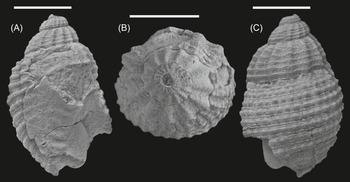


 Open access

