

1. Introduction
Approximately 37% of heat-related deaths during warm months can be attributed to global human-caused climate change.Footnote 1 Such statistics exemplify the progress that scientific research has made to establish the links between health and climate. No longer debating the ‘potential effects’ of climate change on health,Footnote 2 current research addresses the present and future risks,Footnote 3 ‘irreversible harms’,Footnote 4 and ‘record-breaking threats’ to health.Footnote 5 This evolution has led to increased attention on how social factors exacerbate climate vulnerability. For example, studies assess the contribution of population ageing to heat-related mortality,Footnote 6 how exposure to flooding risks is unevenly distributed among households based on their income or age,Footnote 7 or how social inequalities can mediate exposure to hurricanes.Footnote 8 These are a few examples of the unequal distribution of health impacts between individuals and population groups,Footnote 9 which highlights that marginalized groups and individuals have an increased sensitivity to climate impacts, are more likely to face greater exposure to environmental risks, and have fewer resources to adapt to changing conditions.Footnote 10
The legal interest in health and climate, and particularly in the role of health arguments in climate litigation, follows a similar pattern. Over the past few years, a growing body of research has examined how health-focused arguments are incorporated into different legal frameworks,Footnote 11 whether through international litigation,Footnote 12 human rights litigation,Footnote 13 domestic litigation in Latin AmericanFootnote 14 and African countries,Footnote 15 or through procedural rights.Footnote 16 More specifically, the differentiated health impacts of climate change have also gained attention, as they are increasingly invoked in Latin America’s climate litigation and international human rights-based litigation over the past few years.Footnote 17 Legal scholars have subsequently investigated the judicial approach to health issues of vulnerable groups,Footnote 18 and the potential of intersectional health claims in human rights-based climate litigation.Footnote 19 Yet, there is a lack of empirical data to assess the prevalence and characteristics of such cases globally, and how cases about unequal health impacts are constructed and adjudicated remains understudied at the transnational level.
This article presents a preliminary study within a broader research project that examines how plaintiffs argue that the health impacts of climate change are unequally distributed, how intersectional perspectives emerge in their claims, and how these arguments evolve throughout the judicial process. Through a transnational and cross-jurisdictional approach, the broader research project gathers climate cases (n=59) selected for their emphasis on the unequal distribution of health impacts and the intersectional nature of their claims. This article serves as an initial step in the methodology by focusing specifically on six cases and on the scientific evidence.Footnote 20 The choice of studying six cases inherently enables a qualitative examination of complaints and decisions.Footnote 21 As a qualitative analysis, this preliminary investigation does not offer empirical results representative of broader practices in the use of scientific evidence. Rather, it seeks to stimulate reflection and guide future empirical research by identifying key themes and trends.
Scientific evidence is examined to explore how claimants use scientific health-related arguments to substantiate their claims, and how judges assess, incorporate, or overlook scientific evidence in their decisions. Through a systematic content analysis (SCA) of the complaint and the first-related decision, this article examines whether scientific evidence supports the unequal health impacts. In doing so, it seeks to answer one main research question: how is scientific evidence regarding unequal health impacts and intersectional claims used in litigation? The following questions arise and will be addressed in the case study:
-
• Do claimants substantiate their claims with health-related scientific evidence?
-
• If so, do they use it to demonstrate their vulnerability to climate change and the necessity of being protected by the state?
-
• How do judges use scientific evidence in their decisions?
Section 2 begins by examining the evolution of scientific knowledge to highlight both the specialization of expertise and the interdisciplinary efforts of scientific and legal researchers in providing health-related climate information to support climate policies and litigation. Section 3 goes on to explore the potential of an intersectional lens in climate litigation and its prevalence in health-related cases. This section demonstrates the theoretical framework of the study and empirically exposes the prevalence of ‘unequal health impacts cases’ across jurisdictions worldwide. In global health-related climate litigation, 60% raise issues of intersecting vulnerabilities. Based on this observation, Section 4 breaks down the six selected cases and the use of scientific evidence by plaintiffs and courts. Section 5 discusses the findings by focusing on the procedural hurdles that plaintiffs face at the first judicial stage, as well as another form of health knowledge that seems to require scholarly attention: plaintiffs’ health narratives.
2. Unequal Health Impacts of Climate Change: From Scientific Literature to Case Material
Before delving into the cases, it is worth recalling how the scientific literature evolved around climate and health, from a broad understanding of health and climate interlinkages to studies specializing in different climate vulnerabilities (2.1). The field has evolved to produce evidence that could be used in a meaningful legal way (2.2). This overview of the evolution of scientific literature illustrates the range of scientific evidence that litigants can mobilize to demonstrate unequal health impacts.
2.1. Climate and Health: From Broad to Targeted Research
Climate and health scholarship currently encompasses a broad range of stakeholders, such as researchers from climate science, public health, epidemiology, law, as well as international organizations and national institutions. Among international organizations, the Intergovernmental Panel on Climate Change (IPCC), the World Health Organization (WHO), and the Lancet Commission have become crucial sources of knowledge. When the first IPCC report was published in 1990, health issues were scarcely addressed.Footnote 22 However, reports have rapidly shifted their focus to heat-related mortality, infectious disease outbreaks, and displacement effects, and underlined that vulnerable groups (such as the elderly, people experiencing poverty, and those in disease-prone regions) were the most at risk from climate change.Footnote 23 Confidence levels in these claims significantly increased,Footnote 24 with more details on how specific groups face adverse health impacts through different pathways.Footnote 25 On the health side, the WHO coordinates the collection and analysis of scientific data about climate and health, such as vulnerability and adaptation assessments, as well as developing research agendas for policymakers.Footnote 26 For instance, the Research Agenda for Action on Climate and Health (REACH) initiative aims to support the translation of evidence into policy and practice.Footnote 27 The Lancet also became an essential knowledge base when it established, in 2015, a Commission to assess the health impacts of climate change and develop policy guidelines. The Lancet Countdown on Health and Climate Change produces annual reports on the state of science on the interconnections between health and climate. Each yearly report dedicates a section to public and political engagement with health and climate change, showing that the number of scientific papers constitutes a growing body of literature.Footnote 28 Epidemiologists have also contributed to the investigation of health and climate since the 1990s. The late epidemiologist Anthony McMichael, in particular, was a pioneer in exploring the relevance of epidemiological research in studying the health risks associated with climate change.Footnote 29 He contributed to providing scientific evidence to strengthen the need for adaptive policies and participated in several IPCC reports.Footnote 30
Regarding the unequal distribution of impacts among vulnerable populations, scientific research has underlined the importance of considering social determinants to understand the health impacts of climate change. According to the IPCC, ‘intersections of age, gender, socioeconomic class, ethnicity and race are recognized as important to the climate risks and differential impacts and losses experienced by vulnerable, marginal and poor in societies’.Footnote 31 It encourages considering social structures and power dynamics in the climate agenda.Footnote 32 Similarly, the WHO emphasized the unequal distribution of climate change impacts and their consequences on disparities between nations and populations.Footnote 33 The WHO reports underline the importance of the social determinants of health to understand climate impacts and detail how gender, for example, influences climate adverse effects on the health of both women and men.Footnote 34 Scientific scholarship has also engaged with such issues, as demonstrated by Li and co-authors’ scoping review of studies on social vulnerability, health and climate published between 2012 to 2022.Footnote 35 The review, which includes 230 scientific papers, shows that some factors are more covered than others, despite the identification of 113 social vulnerability factors overall. Age, sex, education, economic status, poverty, ethnicity, and race are among the most widely studied factors globally.Footnote 36 Aligning with the IPCC and WHO statements, Li and co-authors highlighted that the efforts to examine such issues resulted in a large body of literature able to ‘provide strong evidence for the role of social vulnerability and capacity in exacerbating or mitigating the negative impacts of climate change on a range of health outcomes – rendering some groups more susceptible to health-related harm than others’.Footnote 37
2.2. Climate and Health: Science for the Courtroom
The link between climate change and health outcomes, particularly for vulnerable groups, goes beyond academic consensus. This has opened up new opportunities for using this evidence in legal contexts where establishing causation is crucial, such as in climate litigation. The sub-branch of climate science that assesses the extent to which greenhouse gas (GHG) emissions have caused specific types of climate-related harm, called attribution science,Footnote 38 turned out to be essential for legal practice. The first attribution science study was conducted by climate scientists in 2004 to assess the extent to which human activities may have increased the risk of European heat waves in the summer of 2003.Footnote 39 Since then, interdisciplinary work drawing on climate science, epidemiology, or economics has developed methodologies, particularly in the context of extreme event attribution, to determine how climate change affects the probability of specific extreme events.Footnote 40
Since 2016, detection and attribution methods have been applied to health outcomes to detect changes in health over time and pinpoint which factors, including climate change, are responsible for the observed change.Footnote 41 Epidemiologists have conducted detection and attribution studies to determine whether climate change contributes to adverse health outcomes.Footnote 42 Through attribution methodologies, studies have revealed that deaths and illnesses can be attributed to climate change and that, based on these results, policymakers can make significant changes in health responses to climate change.Footnote 43 Studies on health projections show a high level of agreement on the health risks associated with climate change; however, the diversity of methods used across these studies makes it challenging to combine their results quantitatively, and climate and health attribution research remains geographically limited.Footnote 44
Current scientific knowledge on health and climate is nevertheless advanced enough to inform public policies or climate litigation.Footnote 45 The stream bridging scientific climate knowledge and legal practice emerged to better integrate scientific evidence into legal claims and is now well established. Attribution studies can now link a weather event and its damage to GHG emitters, and the findings can be used to challenge their responsibilities.Footnote 46 They are therefore particularly relevant for climate litigation, as they provide specific causal evidence.Footnote 47 Scientists have worked to advance attribution science to help in overcoming the challenges of causation tests, the toughest in climate litigation.Footnote 48 They have helped to link scientific evidence and standing, showing explicitly how attribution science helps to prove the alleged harm and, therefore, how climate change consequences are causing a concrete and particularized injury.Footnote 49 Lawyers, in turn, have translated the methodology, framing, and results of climate studies into legal jargon to help the legal community to better understand them.Footnote 50 The initiatives are numerous, whether to advise scientists on legal needs, educate judges on climate science, or conduct interdisciplinary litigation-focused research.Footnote 51 Rather than erasing disciplinary boundaries, this evolution reflects a growing collaboration between climate science, health sciences, and law. As a result, the study of scientific evidence related to health cannot be confined to a narrow disciplinary typology; it must instead consider a broad spectrum of evidence on health impacts.
3. Unequal Health Impacts and the Intersectional Lens in Climate Litigation
This section draws upon the efforts within legal scholarship that explore the potential of intersectionality in climate litigation. The literature described in Section 3.1 illustrates how an intersectional lens offers benefits for accessing the courts and demonstrating state responsibility in exacerbating health inequalities as a result of climate change. After outlining the promises associated with this perspective, this section addresses the empirical gap concerning the number of such cases worldwide. Section 3.2 outlines the data collection process for creating a sample that is focused specifically on the unequal distribution of health impacts and the emergent intersectional dimensions.
3.1. The Rise of Intersectional Health Claims in Climate Litigation
The concept of ‘intersectionality’ has been used increasingly in the climate literature to help in understanding the causes and consequences of the climate crisis,Footnote 52 to the point that it has been described as a lens for examining the social determinants of health.Footnote 53 Intersectionality is often attributed to Kimberlé Crenshaw’s work, but its origins are rooted in Critical Race Theory, the Black feminist movement, and the work of many authors, including Angela Davis, Patricia Hill Collins, and Bell Hooks.Footnote 54 Intersectionality highlights how various forms of social identity – such as race, gender, class, and ability – interact to shape individual experiences of privilege and oppression.Footnote 55 Crenshaw’s famous essays, ‘Demarginalizing the Intersection of Race and Gender’ and ‘Mapping the Margins’, revealed the limitations of discrimination law in understanding the intersection of factors contributing to oppression.Footnote 56
In health-related climate litigation, an intersectional approach appears to be valuable, as some authors have already argued, for both its procedural and substantive promises.Footnote 57 On the procedural side, admissibility criteria require that concrete and severe harm be demonstrated to grant standing. Although these requirements may vary from jurisdiction to jurisdiction, explaining how climate change disproportionately affects some individuals is often necessary to establish victim status. As intersectionality highlights the structural vulnerability of certain groups to climate change compared with the rest of the population, it should contribute to satisfying standing requirements.Footnote 58 On the substantive side, intersectionality underlines that identities are not fixed categories that can be analyzed in a linear way and that some experiences can be understood only when integrating the intersection of factors such as race, gender, class, and age.Footnote 59 For instance, an intersectional approach to the right to health in climate litigation helps to recognize overlapping inequalities that uniquely heighten the vulnerability of certain groups to climate change impacts.Footnote 60 This would be valuable especially for the assessment of standing and the imminence of harm,Footnote 61 hence contributing to demonstrate a particularized health-related harm caused by climate change in the causal chain.
Despite the benefits of the intersectional approach for health-related climate litigation, several precautions relating to intersectionality should be considered. Firstly, there is a risk of essentializing plaintiffs and reducing their condition to an inherent vulnerability tied to their identity without highlighting the systemic and external aspects of these intersecting vulnerabilities.Footnote 62 As Hefti explains, the terms ‘victims’ and ‘vulnerable’ must be understood in their legal and procedural senses, not in the essentialist character they might imply.Footnote 63 This is particularly relevant for health-related harm, where the claim should also be framed around the systemic aspects of the government’s failure to protect, rather than on the plaintiff’s vulnerability as an unchangeable parameter. Another potential risk related to essentialism revolves around the capitalization of plaintiffs’ lived experiences in climate litigation and the imposition of a burden to litigate. The intersectional approach for health claims is not merely used to leverage plaintiffs’ lived experience, but also to bring an intrinsic critical approach to the analysis of the legal reasoning. Here, it is worth recalling Crenshaw’s original aim in formulating intersectionality, which was to provide a critical tool for legal reasoning.Footnote 64
With these precautions in mind, it is also important to clarify how intersectionality functions as an analytical lens in the present study. As demonstrated below, the legal claims filed in ‘unequal health impacts cases’ rarely, if ever, mention the term ‘intersectionality’. However, they often concern intersecting vulnerabilities, which, under current legal frameworks, are only partially recognized or codified. Given this gap between adverse effects and legal recognition, it is precisely in this context that intersectionality, as a tool for legal analysis, becomes crucial. It clarifies how various discrimination-related factors overlap to create specific types of harm and make this overlapping intelligible in a legal context. Indeed, the intersectional lens reveals the structurally produced, multilayered vulnerabilities, making them justiciable and therefore assessable through legal standards such as equality, non-discrimination, or the positive obligations of the state. This statement constitutes a foundational premise: intersectional analysis, as a critical interpretive framework for the study, serves as both an analytical tool and a normative bridge, without assuming that courts currently have the institutional capacity to recognize these intersecting vulnerabilities as justiciable. In this respect, the article refers to ‘intersectional health claims’ as a doctrinal interpretation of the claims, rather than their original formulation.
3.2. A Case Review of the ‘Unequal Health Impacts Cases’
This subsection provides the methodological rationale for the case selection. The sample aims to gather cases that, even if not explicitly mentioning ‘intersectionality’, raise issues of intersecting health vulnerabilities to climate change. Case selection was made through four steps, which can be summarized as follows: (i) searching all health-related cases, (ii) refining the sample based on vulnerability factors, (iii) including only cases against governments, and (iv) selecting cases that have at least a complaint and a decision.
With regard to the first stage of the methodology, a sample of ‘health-related cases’ was created, followed by a selection of cases based on discrimination factors. Cases were filtered with different word searches. The first search was made in the Sabin Center database with the words ‘health’, ‘illness’, ‘sickness’, and ‘disease’ to select cases where health arguments were explicitly used in the lawsuit. Across both the United States (US) and non-US litigation filed from 1994 to 2024, 235 health-related cases were found – 129 in the US and 106 in other jurisdictions worldwide.
Cases were also chosen based on their consideration of factors such as race, gender, status, or age, thereby highlighting questions of intersectionality. Gender,Footnote 65 race,Footnote 66 Indigenous status,Footnote 67 and ageFootnote 68 are recognized as factors that exacerbate vulnerability to climate change. Different categories of plaintiffs bring health issues before the courts, mainly young people, women, and Indigenous groups. Therefore, ‘women’, ‘gender’, ‘race’, ‘ethnicity’, ‘Indigenous’, and ‘age’ were systematically searched in the entire database. Knowing that young people often bring issues of age before climate courts and that legal translation of their interest lies in the intergenerational equity principle,Footnote 69 ‘future generations’ and ‘youth’ were also looked up to cover all cases that discuss age as a discrimination factor but would mention it differently.
In this second stage of the methodology, each category was placed in a table with six columns: cases involving health issues, cases related to gender, race/ethnicity, cases initiated by Indigenous peoples, cases about age and future generations, and cases based on the right to a healthy environment. Duplicates were extracted to include cases with health arguments and at least one other discrimination factor. After finding duplicates, these were put in another table: the ‘unequal health impacts climate litigation’ sample.
On a global scale, out of 106 health-related cases, 64 present other discrimination factors and bring intersecting health vulnerability issues. Regarding US litigation, only 5 cases bring out different discrimination factors out of 129. In this context, US cases are considered outliers based on the preference for global data to avoid US-centric results. Giving priority to global data serves a more comprehensive and inclusive understanding of legal patterns, transcending specific jurisdictional nuances. The case study includes the 5 relevant US cases; however, the US context is not used to conclude global phenomena in climate litigation. The aim is to ensure the broader applicability and relevance of findings, accounting for diverse legal frameworks beyond the specificities of the US.
Within this cross-jurisdictional analysis, a third specification on the methodology is that the study focuses on cases against governments, because these are considered to have a more significant duty to protect public health than private entities, bringing the total number of cases to 59. Finally, the fourth specification is that a case was considered adequate for the study when there was at least one complaint and a decision available to analyze how claimants frame their complaints and the judges’ reception of them.
This first step in the research brings one empirical finding and one substantive conclusion:
-
(1) In health-related climate litigation, 60% of claims focus on how health impacts are unequally distributed and present an intersectional dimension. Not only do plaintiffs argue that their health is at greater risk than the rest of the population, but they do so based mainly on intersecting factors.
-
(2) This ‘unequal health impacts climate litigation’ sample is meant to examine how legal systems address or fail to address the health needs of marginalized or disadvantaged groups, particularly in the context of broader social determinants of health. It can be defined as a collection of legal cases selected because they involve situations where health inequities arise from factors such as race, ethnicity, gender, or age. The unequal health impacts of climate change, as well as the intersectional lens, are reflected in climate litigation, as is now evidenced by empirical data.
4. Unequal Health Impacts and Evidence: Tracking Science Pathways in the Courtroom
4.1. Tracing Scientific Evidence in Six Cases
The systematic case selection is based on criteria that address the research question’s ambitions (1). A coding scheme or an analysis protocol is then defined to ensure the best objectivity and reproducibility of the study (2). Finally, a qualitative analysis is produced from the collected empirical data (3).Footnote 70 Firstly, the criteria for selecting the cases have been outlined in Section 3.2. Then, the coding scheme or analysis protocol is created on the research questions mentioned in the introduction and health arguments are systematically examined to answer whether they are legal, scientific, or factual. The study analyses, firstly, how health arguments and their legal and scientific bases are formulated in complaints; secondly, how judges receive these arguments in their decisions and the judicial reasoning mechanisms that they employ.
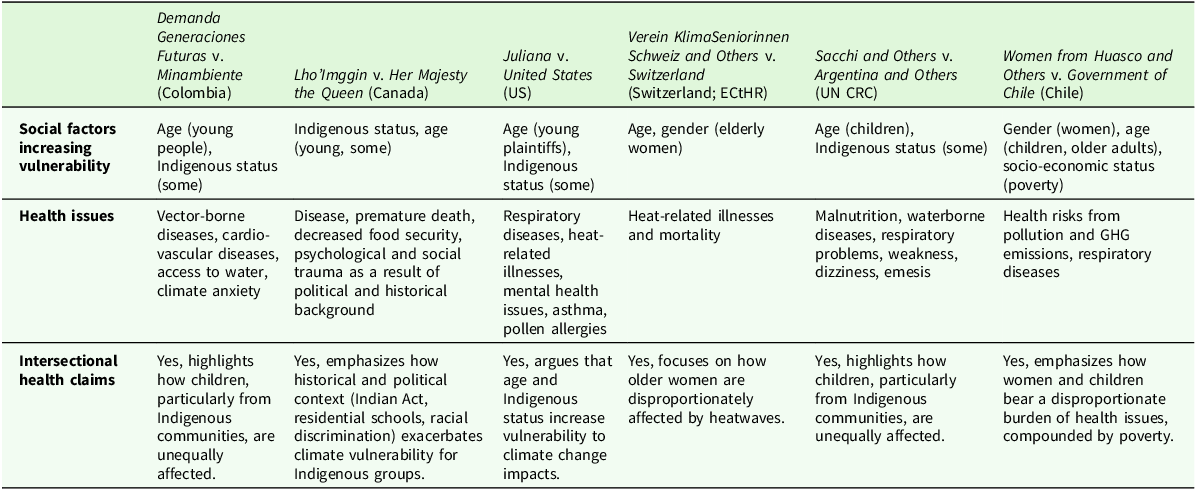
The six cases studied are the following: Demanda Generaciones Futuras v. Minambiente (Colombia); Dini Ze’ Lho’Imggin et al. v. Her Majesty the Queen (Canada); Juliana v. United-States; Verein KlimaSeniorinnen Schweiz and Others v. Switzerland; Sacchi and Others v. Argentina and Others; and Women from Huasco and Others v. Government of Chile, Ministry of Energy, Environment and Health. The cases were selected because they best represent the various jurisdictions, plaintiffs, and legal systems of the larger sample. They reflect the diversity of the larger sample in terms of jurisdiction (both domestic and international), legal system (civil and common law), and procedural status (pending and decided). Care was taken to ensure a geographically balanced selection that includes cases from the global north and global south, rather than focusing solely on one region. These cases also involve a diverse range of plaintiffs, including elderly women, young people, and Indigenous groups, encompassing a broad spectrum of identities across age, gender, and ethnicity (Table 1).
Introduction of the Six Cases and the Intersectional Lens

Table 1 Long description
A table comparing six legal cases involving climate change and health issues. The table has six rows and four columns. The columns are labeled Social factors increasing vulnerability, Health issues, and Intersectional health claims. Each row corresponds to a different case: Demanda Generaciones Futuras v. Minambiente (Colombia), LhoImggin v. Her Majesty the Queen (Canada), Juliana v. United States (US), Verein KlimaSeniorinnen Schweiz and Others v. Switzerland (Switzerland; ECTHR), Sacchi and Others v. Argentina and Others (UN CRC), and Women from Huasco and Others v. Government of Chile (Chile). Row 1: Demanda Generaciones Futuras v. Minambiente (Colombia). Social factors increasing vulnerability: Age (young people), Indigenous status (some). Health issues: Vector-borne diseases, cardiovascular diseases, access to water, climate anxiety. Intersectional health claims: Yes, highlights how children, particularly from Indigenous communities, are unequally affected. Row 2: LhoImggin v. Her Majesty the Queen (Canada). Social factors increasing vulnerability: Indigenous status, age (young, some). Health issues: Disease, premature death, psychological and social trauma as a result of political and historical background. Intersectional health claims: Yes, emphasizes how historical and political context (Indian Act, residential schools, racial discrimination) exacerbates climate vulnerability for Indigenous groups. Row 3: Juliana v. United States (US). Social factors increasing vulnerability: Age (young plaintiffs), Indigenous status (some). Health issues: Respiratory diseases, heat-related illnesses, mental health issues, asthma, pollen allergies. Intersectional health claims: Yes, argues that age and Indigenous status increase vulnerability to climate change impacts. Row 4: Verein KlimaSeniorinnen Schweiz and Others v. Switzerland (Switzerland; ECTHR). Social factors increasing vulnerability: Age, gender (elderly women). Health issues: Heat-related illnesses and mortality. Intersectional health claims: Yes, focuses on how older women are disproportionately affected by heatwaves. Row 5: Sacchi and Others v. Argentina and Others (UN CRC). Social factors increasing vulnerability: Age (children), Indigenous status (some). Health issues: Malnutrition, waterborne diseases, respiratory problems, weakness, dizziness, emesis. Intersectional health claims: Yes, highlights how children, particularly from Indigenous communities, are unequally affected. Row 6: Women from Huasco and Others v. Government of Chile (Chile). Social factors increasing vulnerability: Gender (women), age (children, older adults), socio-economic status (poverty). Health issues: Health risks from pollution and GHG emissions, respiratory diseases. Intersectional health claims: Yes, emphasizes how women and children bear a disproportionate burden of health issues, compounded by poverty.
4.2. Complaints: Plaintiffs’ Scientific Claims
In Dini Ze’ Lho’Imggin et al. v. Her Majesty the Queen (Lho’Imggin),Footnote 71 two Indigenous groups filed a complaint in 2020, claiming that Canada’s climate policy objectives were insufficient and violated principles of public trust, equitable waste, and intergenerational equity. The plaintiffs argued that their right to life was infringed by an increased risk of premature death caused by climate change. They further contended that their health was at heightened risk, exacerbated by systemic discrimination based on their Indigenous status, which compounded their vulnerability to climate-related impacts. In 2021, the Federal Court of Canada dismissed the case on grounds of competency.Footnote 72 On 26 September 2025, the Federal Court struck down the plaintiffs’ further amended claim but granted them leave to amend once again, allowing them to pursue a novel common law tort claim based on alleged breaches of customary international law.Footnote 73
The legal basis of the complaint is rooted in health- and equality-related rights enshrined in the Canadian Charter of Rights and Freedoms.Footnote 74 Specifically, it drew on Section 7, which protects every individual’s right to life, liberty, and security of the person, and Section 15(1), which guarantees equality before and under the law, equal protection, and the benefit of the law without discrimination.Footnote 75 The plaintiffs invoked the risk of disease, premature death, and decreased food security.Footnote 76 They explained how:
Social and cultural context is the aftermath of the imposition of the Indian Act reserve system, of the banning of the potlatch, of land-speculator theft of their farmland and destruction of their farm homes, of the removal of children from their families into residential schools, of the removal of children from their families into non-indigenous foster homes (known as the Sixties Scoop), and ongoing racial discrimination. This previous conduct was partly by, or facilitated by, the defendant. It makes the plaintiffs particularly vulnerable to further psychological and social trauma caused by global warming.Footnote 77
This claim highlights the intersectional approach to health impacts from climate change and emphasizes that historical and political contexts are crucial in understanding climate vulnerability. The plaintiffs also underlined the vital role of their lands, as well as their connection to fisheries and aquatic ecosystems, to explain that damage to their natural habitat has a direct impact on their health and well-being.Footnote 78 Finally, with regard to scientific evidence, the Lho’Imggin complaint did not contain any citations or references to scientific studies. The health-related arguments, therefore, were only of a factual and legal nature, and relied primarily on descriptive narratives of climate impacts.Footnote 79
Demanda Generaciones Futuras v. Minambiente (Colombia)Footnote 80 was filed by 25 young plaintiffs challenging Colombia’s climate policies, particularly regarding the deforestation of the Amazon. The plaintiffs argued that climate change, exacerbated by inadequate governmental efforts to curb deforestation, violated their rights to a healthy environment, life, health, food, and water.Footnote 81 Using a tutela action (a constitutional mechanism in Colombia designed to protect fundamental rightsFootnote 82 ), they claimed that the deterioration of the Amazon ecosystem jeopardized their health and livelihoods.Footnote 83 In 2018, the Supreme Court of Colombia overturned an initial dismissal and recognized the fundamental links between health, life, minimum subsistence, freedom, human dignity, and the environment.Footnote 84 Notably, the Court declared the Amazon Forest to be a subject of rights, emphasizing the direct impact of climate change on the plaintiffs’ health and well-being.Footnote 85
In the complaint, the plaintiffs challenged the state’s inaction to stop deforestation in the Colombian Amazon as a threat to their fundamental right to life with dignity, to water, to health, and to food.Footnote 86 They used the Colombian Constitution, which protects the right to health and its correlative obligation for the state to organize, direct, regulate, and guarantee its provision.Footnote 87 The complaint offered a very detailed record of the way in which the plaintiffs’ lives and health are affected by climate change.Footnote 88 Whether it is the threat of contracting vector-borne or cardiovascular diseases, access to water, or climate anxiety, the plaintiffs explained how these risks affected their right to health. They successfully explained how the temperature increase had an impact on their daily lives, outdoor activities, social relationships, and professional projects. Most of the claims were substantiated by references to scientific studies. For example, they referred to many reports from the WHO about heatwaves, waterborne diseases, and environmental health. They also based their claims on studies by the Institute for Hydrology, Meteorology, and Environmental Studies (IDEAM)Footnote 89 about rainfalls, risks, and vulnerability.Footnote 90 There was a strong mobilization of health-related climate science showing the impacts of the climate crisis on specific health outcomes, such as outbreaks of illness.
Women from Huasco and Others v. Government of Chile, Ministry of Energy, Environment and Health was a constitutional action filed on 25 November 2021 by a group of women against the Chilean government’s decision to shut down two units of a thermoelectric power plant.Footnote 91 Despite Chile’s commitment to the Paris Agreement and its decarbonization agenda, the government scheduled the plant’s closure for 2040, against which the plaintiffs argued. The Court of Appeals of Copiapo considered the petition a disagreement with the state’s decarbonization policy rather than a legal omission warranting constitutional review. It dismissed the case, arguing that the issue was not a judicial matter but rather a question that fell within the scope of political decision-making.Footnote 92
The complaint highlighted the health risks posed by prolonged exposure to pollution and GHG emissions, with particular emphasis on the health of women and children, who bear a disproportionate burden of climate-related health issues. The claimants invoked the constitutional right to life and the physical and mental integrity of the person,Footnote 93 the right to equality before the law,Footnote 94 and the right to health, which is protected under constitutional law regulating the exercise of the constitutional right to health protection.Footnote 95 In this case, factual and scientific grounds were intertwined as well. The plaintiffs explained:
The population’s vulnerability conditions, which are associated with the level of poverty, access to health, education and the presence of susceptible groups such as children, pregnant women, and older adults. International evidence shows that the risk emissions associated with this type of sources are high and with impacts throughout the life cycle, especially in children under 15 and pregnant women.Footnote 96
The climate-related science in this complaint was framed primarily around decarbonization policies and the impact of fossil fuel combustion on GHG emissions. With regard to health-related science, the complaint mobilized numerous studies, from international organizations such as the WHO, and from local institutions such as the Municipality of Huasco and the Regional Ministerial Secretariat of Health of the Atacama Region, both of which recognize the health impacts of pollution.Footnote 97 The plaintiffs explicitly cited epidemiological and medical studies on changes in pulmonary function and respiratory symptoms, and referred to studies on lung function in children, as well as those on increased mortality and respiratory consultations.Footnote 98 They also integrated local evidence with disease statistics compiled by the Municipality of Huasco and a 2021 study by the School of Public Health of the Pontificia Universidad Católica de Chile, which showed higher morbidity rates in Huasco and records of hospital discharges being higher as a result of respiratory diseases.Footnote 99 The complaint combined environmental studies, epidemiological evidence, and institutional reports, highlighting the health impacts of climate change.
Juliana v. United States Footnote 100 was initiated in 2015 by 21 young plaintiffs, who challenged the US government for violating their constitutional rights by failing to address climate change adequately. The plaintiffs asserted that the government’s inaction endangers their rights to life, liberty, and property, and undermines their ability to live in a stable climate, in violation of the Fifth Amendment of the US Constitution.Footnote 101 They further argued that climate change has serious health implications, including increased risks of respiratory diseases, heat-related illnesses, and mental health challenges caused by environmental degradation. After years of procedural battles, Judge Aiken allowed an amended complaint to proceed to trial in 2018.Footnote 102 However, in May 2024, the Ninth Circuit dismissed the case for lack of standing, followed by a decision of the US Supreme Court in March 2025, denying the plaintiffs’ petition for a writ of certiorari.Footnote 103
In the complaint, the plaintiffs described themselves as ‘an insular minority with no voting rights and little, if any, political power or influence’.Footnote 104 Although age, Indigenous status, and health issues do not intersect for each plaintiff, they argued that the age and the Indigenous status of some of them were increasing risk factors for climate change.Footnote 105 The complaint also provided a detailed record of the plaintiffs’ health impacts, ranging from psychological and emotional harm, health and bodily integrity, personal well-being, recreational interests, asthma, pollen allergies, to disruptions to cultural practices.Footnote 106 The plaintiffs mentioned the fact that fossil fuel extraction and combustion are contributing to many different health impacts,Footnote 107 that 8,000 Americans died from health-related illnesses, and pointed out the increase in Lyme disease and asthma over the last three decades.Footnote 108 The plaintiffs cited the scientific consensus regarding climate change risks, the role of climate change in sea-level rise, and National Aeronautics and Space Administration (NASA) records of the hottest years.Footnote 109 The complaint integrated various scientific evidence to substantiate health claims, combining personal experiences of harm, links between fossil fuel extraction and health impacts, and references to empirical evidence.Footnote 110
Verein KlimaSeniorinnen and Others v. Switzerland,Footnote 111 challenging the Swiss government’s climate policies, was initiated in 2016 by a group of elderly women, asserting that these omissions breach the sustainability principle,Footnote 112 the precautionary principle,Footnote 113 and their right to life.Footnote 114 The plaintiffs claimed that the government’s inaction violates their rights to life and health, emphasizing their heightened vulnerability to climate-related health impacts as a result of their age and gender. Specifically, they argued that rising temperatures disproportionately affect older women, leading to higher rates of heat-related illnesses and mortality. To substantiate their claims, they relied on IPCC reports, WHO reports on gender, health and climate, and reports of national institutions such as the Federal Office of Public Health, the Federal Office for Agriculture, and the Federal Office for the Environment.Footnote 115 They underlined the state’s obligation to protect them as the ‘most vulnerable group’.Footnote 116 The Swiss case was especially interesting for its combination of diverse scientific evidence (international reports, local studies, medical certificates), and its strategic focus on localized data specific to Switzerland.Footnote 117
After being dismissed by the Swiss Federal Tribunal, the plaintiffs brought the case before the European Court of Human Rights (ECtHR). In April 2024, the ECtHR issued its first ruling on climate change,Footnote 118 recognizing violations of Articles 6 and 8 of the European Convention on Human Rights (ECHR).Footnote 119 While beyond the scope of the study, the ECtHR decision is worth underlining as it set standards for victim status and underlined the need to consider ‘local conditions and individual specificities and vulnerabilities’.Footnote 120 The Grand Chamber emphasized ‘a high intensity of exposure to the adverse effects of climate change’ requiring significant levels of harm or risk and demonstrating the ‘pressing need to ensure the applicant’s individual protection’.Footnote 121 While the Court described this threshold as ‘especially high’,Footnote 122 it also insisted on considering local conditions, individual specificities, and vulnerabilities. This decision suggests that intersectional health claims may be increasingly relevant in climate litigation, as they can help to narrow the specificity of vulnerability required to meet this high threshold. However, this is nuanced by the fact that the ECtHR rejected the individual claims because they did not prove sufficient vulnerability,Footnote 123 which raises questions about the health-related evidence that would be needed to meet this ‘especially high’ threshold.
Sacchi et al. v. Argentina et al. Footnote 124 is the first case to be heard before the United Nations (UN) Committee on the Rights of the Child (CRC). The petition was filed by 16 children against Argentina, Brazil, France, Germany, and Turkey. They argued that the countries’ failure to reduce GHG emissions violated their rights to life, health, and cultural practices, affecting particularly children from Indigenous communities.Footnote 125 They highlighted the health risks of climate change, including malnutrition, waterborne diseases, and respiratory problems, which disproportionately affect children in vulnerable populations.Footnote 126 The petition called for recognizing these violations and urged the CRC to recommend mitigation and adaptation measures to address climate-induced health disparities. It triggered Article 24 of the UN Convention on the Rights of the Child, which requires states to ‘pursue full implementation’ of the ‘right of the child to the enjoyment of the highest attainable standard of health’.Footnote 127 The plaintiffs revealed numerous adverse consequences of climate change: sea-level rise is threatening Pacific islands, forcing people to leave their homes;Footnote 128 storms and sea-level rise have caused flooding in Tunisia;Footnote 129 and diseases such as malaria and dengue fever have increased significantly in the Marshall Islands.Footnote 130 The narratives around health impacts were very detailed, including symptoms such as weakness, dizziness, and emesis.Footnote 131 Regarding the scientific evidence, the plaintiffs also used reports from the IPCC, the UN Environment Programme (UNEP), and Climate Analytics, to support their claims and show how climate change can cause various health impacts.Footnote 132
The cases discussed present some similarities worth outlining. With regard to the legal basis, the plaintiffs all refer to fundamental rights. Despite diverse legal traditions, there is a consistent use of national constitutions or charters. Reliance on fundamental rights in climate litigation has been observed for some time, and described as ‘the human rights turn in climate litigation’.Footnote 133 Indeed, it is common for the legal protection of health to fall under the umbrella of fundamental rights, enshrined in approximately 67.5% of constitutions worldwide, as well as in international treaties and domestic statutes that establish the binding obligations of states to protect public health.Footnote 134 Constitutional rights are recognized as a platform to address health inequalities and vulnerabilities, and to hold states accountable for their obligations in the judicial arena.Footnote 135 It follows that cases from both common law and civil law countries ground claims in high-order legal norms, such as constitutional provisions, fundamental rights charters, or international human rights treaties.
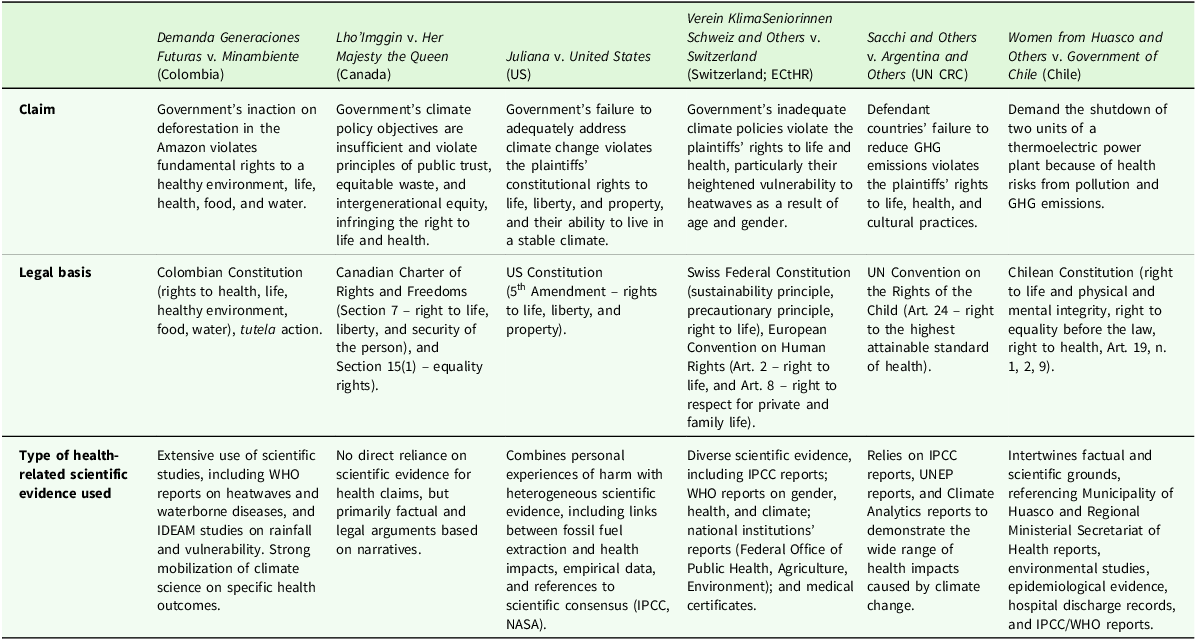
The scientific evidence serves as a cornerstone in the building of complaints (Table 2). Lho’Imggin stands apart as the only complaint that did not rely explicitly on scientific evidence. In contrast, Generaciones Futuras, Women from Huasco, Juliana, KlimaSeniorinnen, and Sacchi all integrate diverse forms of climate and health-related scientific evidence. From epidemiological studies, public health data, and attribution science, the complaints mobilize international (WHO, IPCC, UNEP) and national (IDEAM, national health offices, universities) scientific bodies and reports to substantiate their arguments. Despite this real reliance on health-related scientific evidence, it appears that issues of intersecting vulnerabilities are not addressed through scientific evidence but mainly through plaintiffs’ narratives. Most cases effectively bridge global climate science with concrete, localized health impacts and personal narratives (for example, Women from Huasco, Generaciones Futuras, Juliana, KlimaSeniorinnen, and Sacchi). This is particularly visible in Generaciones Futuras, Juliana, and Sacchi, in which health narratives help to ground climate impacts into real lives and experiences, and exemplify the direct and concrete impacts on population and individual health. The plaintiffs highlight how climate affects their health and how their status (gender, age, race, ethnicity) is a vulnerability factor in climate adaptation. They seem to stand as context for judges, evidence for the plaintiffs’ standing and to function as climate impacts’ ‘mini laboratories’.Footnote 136
Health-related Legal and Scientific Claims in the Six Complaints
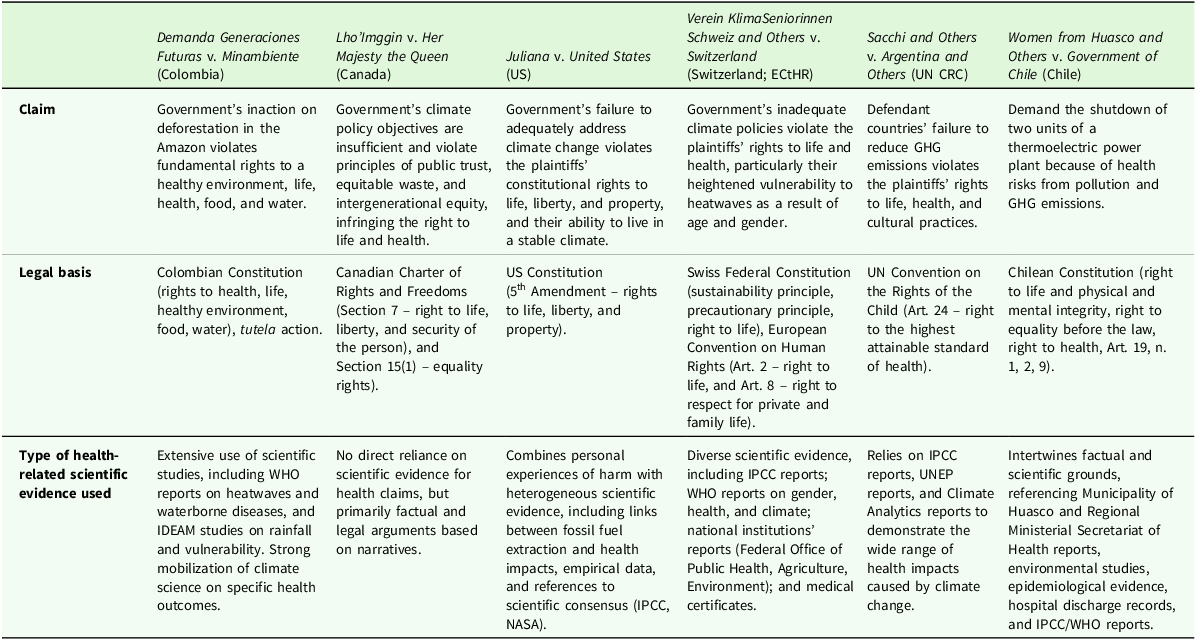
Table 2 Long description
A table with six rows and five columns comparing health-related legal and scientific claims in six complaints. The columns are labeled Claim, Legal basis, Type of health-related scientific evidence used, and EDH. The rows are labeled with the names of the complaints: Demanda Generaciones Futuras v. Minambiente (Colombia), LhoImggin v. Her Majesty the Queen (Canada), Juliana v. United States (US), Verein KlimaSeniorinnen Schweiz and Others v. Switzerland (Switzerland; ECHR), Sacchi and Others v. Argentina and Others (UN CRC), and Women from Huasco and Others v. Government of Chile (Chile). Each row details the specific claims, legal basis, and types of scientific evidence used in each complaint. The table highlights the diverse forms of scientific evidence and legal arguments presented in each case.
4.3. Decisions: Judicial Engagement with Scientific Evidence
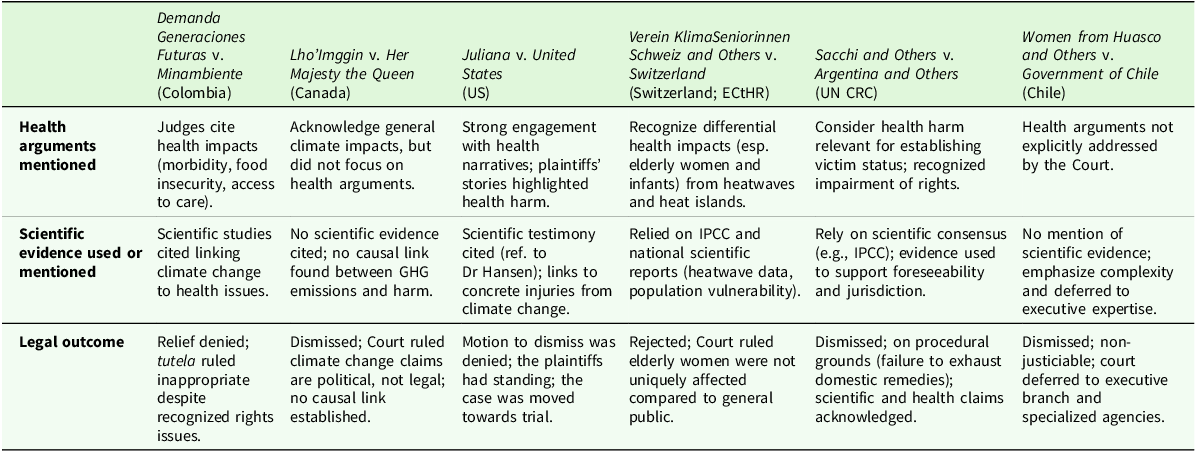
Among the six decisions, five dismissed the case for procedural reasons: lack of standing to sue/victim status, lack of competence, or failure to exhaust domestic remedies (Table 3).
First-related Decisions: Health Arguments and Scientific Evidence
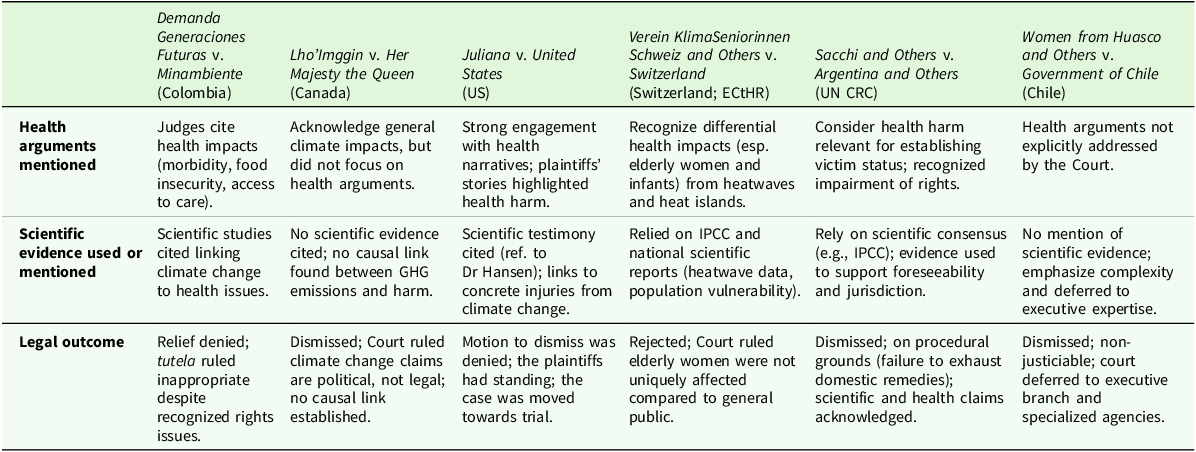
Table 3 Long description
A table comparing health arguments and scientific evidence in legal cases across different countries. The table has six rows and four columns. Column headers are Health arguments mentioned, Scientific evidence used or mentioned, and Legal outcome. Row labels are Demanda Generaciones Futuras v. Minambiente (Colombia), Lho'Imgngin v. Her Majesty The Queen (Canada), Juliana v. United States (US), Verein KlimaSeniorinnen Schweiz and Others v. Switzerland (Switzerland; ECTHR), Sacchi and Others v. Argentina and Others (UN CRC), and Women from Huasco and Others v. Government of Chile (Chile). Each row provides details on health arguments mentioned, scientific evidence used or mentioned, and legal outcomes for each case.
In Lho’Imggin, the Federal Court studied the case and concluded that ‘while undoubtedly important, the issue of climate change is fundamentally political, not legal, and falls within the executive and legislative powers of government’Footnote 137 and that the claims were doomed to fail.Footnote 138 The judge emphasized that, although climate change impacts are real, there was no demonstrated direct causal link between GHG emissions and Canadian laws, and thus no connection with the alleged harm.Footnote 139 As the plaintiffs did in the complaint, the Canadian Federal Court did not explicitly mention scientific evidence in the decision.
In the Colombian case, Generaciones Futuras, judges cited scientific studies showing how climate change has led to increased morbidity, difficulties in accessing healthcare services, and food insecurity.Footnote 140 Most references to the scientific evidence presented by the plaintiffs were made in the background section of the decision. With regard to climate-related scientific studies, the Court reiterated the IDEAM temperature projections and the study of economic impacts of climate change.Footnote 141 As for health-related science, the Court referred to scientific evidence about the risk of increase in vector-borne diseases, respiratory diseases, and the difficulty in accessing health services because of climate change.Footnote 142 It also noted that Julio Carrizosa, a renowned environmental researcher and former head of IDEAM, supported the appeal, as did the Legal Clinic of Environment and Public Health (MASP) attached to the Faculty of Law at the University of the Andes in Bogotá (Colombia).Footnote 143 However, the Court denied relief and stated that a tutela action was not the appropriate legal mechanism for such issues.Footnote 144
Comparably, in Women from Huasco, the Court dismissed the case on justiciability grounds, stating that the issue was beyond its competence and concerned the executive branch. The Court explained that such matters require expertise and consideration of social, cultural, economic, and environmental factors, which fall beyond judicial review.Footnote 145 It dedicated a significant portion of its written decision to transcribing the plaintiffs’ arguments, including all the scientific and health-related evidence they brought through the complaint.Footnote 146 This extensive review of the scientific evidence presented by the plaintiffs cannot be interpreted as a validation from the Court, because in a recurso de protección the court must demonstrate that it has thoroughly considered the different bases of the claims.Footnote 147 Consequently, while the Court’s engagement with the record acknowledged the importance of the evidence, the dismissal on justiciability grounds precluded the case from reaching a substantive assessment of the merits.
In Juliana, Judge Aiken denied the motion to dismiss, allowing the case to go to trial. Given that the motion to dismiss stage does not analyze the merits of the case, scientific evidence is not subjected to the same review as it would be at trial. The Court stated explicitly that ‘at the motion to dismiss stage, a federal court is in no position to say it is impossible to introduce evidence to support a well-pleaded causal connection’.Footnote 148 It does not undertake a definitive assessment of scientific evidence but a control to determine if the plaintiffs’ allegations, which incorporate scientific concepts, are sufficient to proceed. The cited scientific elements are embedded within judicial decisions; Washington Environmental Council v. Bellon Footnote 149 was used as a reference about scientific knowledge, with the mention, for example, that the effect on climate change of emissions from the five oil refineries was ‘scientifically indiscernible’.Footnote 150 The decision further cited the work of Engel and Overpeck,Footnote 151 as well as Dr Hansen’s expert testimony.Footnote 152 As for health-related science, there was no specific mention made by the judge; however, health impacts appeared within the detailed descriptions of the plaintiffs’ alleged injuries. The parties indeed had to prove the specific and personal injuries they have experienced caused by climate change.Footnote 153 The judge used the plaintiffs’ narratives to counter the government’s argument that these injuries were not particular to the plaintiffs, as climate impacts are affecting everyone globally. She explained that the widespread nature of the damage does not automatically make it a general grievance. Among others, Judge Aiken quoted the narrative of a 13-year old plaintiff about the damage caused by a flood. The testimony reported that ‘floodwaters were pouring into our home through every possible opening. … Soon the sewage was everywhere. We had a stream of sewage and water running through our house’, and also that the family had to stay in the flooded house for weeks after the event.Footnote 154 Based on these narratives, the judge claimed that the alleged damage had an impact on the personal, economic, and aesthetic interests of the plaintiffs, qualifying the injuries as concrete and particularized.Footnote 155
In KlimaSeniorinnen, the first instance tribunal acknowledged the variations of adverse impacts among different population groups.Footnote 156 It mentioned IPCC reports and the Federal Office of the Environment report, and relied on scientific studies of past summer heatwaves, which had confirmed the statistical finding that older women, in particular, were affected most by summer heatwaves in terms of mortality and adverse health effects.Footnote 157 The Court also noted the general impacts of climate change on people, animals, and plants, with varying effects across population groups. It cited heatwaves as a particular health burden, as a result of the formation of heat islands and the vulnerability of children to dehydration.Footnote 158 The judges rejected the case by finding that elderly women (over 75) in Switzerland are not uniquely affected by climate change compared to the general public.
The UN CRC, in Saachi, dismissed the petition on procedural grounds, as the parties had not exhausted available remedies. While there were no specific scientific references, the CRC acknowledged the consensus that states’ GHG emissions contribute to climate change and its impact on human rights.Footnote 159 It also acknowledged that existing scientific evidence demonstrates the impact of cumulative GHG emissions on the enjoyment of human rights.Footnote 160 The CRC appreciated the allegations made by the parties and believed that:
the authors have sufficiently justified, for the purposes of establishing jurisdiction, that the impairment of their Convention rights as a result of the State party’s acts or omissions regarding the carbon emissions originating within its territory was reasonably foreseeable. It further concludes that the authors have prima facie established that they have personally experienced real and significant harm in order to justify their victim status.Footnote 161
In this case, the role of scientific evidence was essential, and the CRC relied on the scientific consensus while also considering health narratives as crucial in demonstrating victim status.
5. Discussion
Section 5.1 discusses the observed use of procedural rights and their connections with scientific evidence in the context of health-related climate litigation. Section 5.2 then moves further to focus on emerging health narratives and discusses how future research might investigate their normative value in the courtroom.
5.1. Scientific Evidence and Procedural Thresholds
Plaintiffs in climate-related cases rely consistently on scientific data to substantiate their claims, with ‘almost obligatory references to the findings of the IPCC’.Footnote 162 Yet, from the analysis above, it appears that unequal health impacts and vulnerability factors are not systematically addressed through scientific evidence, either in the complaints or the decisions. The scientific evidence presented by plaintiffs generally emphasizes broad knowledge about health and climate, rather than specific vulnerabilities to climate change, except for KlimaSeniorinnen, where the plaintiffs relied on scientific data to support claims tied to intersecting factors of age and gender. This oversight might stem from several factors. Firstly, many of these cases were initiated several years ago, and even though many studies had already demonstrated links between intersecting vulnerabilities, climate change, and health impacts, scientific knowledge has evolved significantly, and some data may not have been available when the cases were filed. Furthermore, some regions remain poorly covered by scientific data, making it more difficult to establish proof of the alleged risks or damage in some areas.
The review of judges’ engagement with scientific evidence suggests a pattern of judicial awareness of climate change origins and consequences, particularly when informed by institutional scientific consensus from bodies such as the IPCC or the WHO. There is clear judicial recognition of the urgency of climate change and its impact on vulnerable populations (such as elderly women in KlimaSeniorinnen, children in Sacchi, and youth plaintiffs in Juliana). In the initial stages of the judicial process, courts may indeed acknowledge that plaintiffs suffer real harm from climate change or are more vulnerable to its impacts. As explained by Sulyok, the IPCC or national scientific advisory bodies benefit from their ‘legally privileged position’,Footnote 163 which provides judges with a logical framework to justify the acceptance of this scientific evidence, rather than engaging in a direct scientific assessment of the content itself. This approach allows judges to acknowledge the scientific reality of climate change and its projected impacts without necessarily ruling in favour of the claimant in a specific climate case. Therefore, a deeper understanding of the types of epistemic justification that courts use to accept climate science reveals how the use of procedural arguments is not a denial of science, but a classic application of legal constraint.
Additionally, this acknowledgement coexists with a judicial cautiousness. Courts sometimes show reluctance to overstep perceived institutional boundaries, including concerns about court backlogs, their judicial competence, or the exhaustion of remedies. For instance, the CRC could have declared the communication admissible if domestic ‘remedies [were] unreasonably prolonged or unlikely to bring effective relief’.Footnote 164 This reliance on procedural arguments does not suggest a fundamental disconnection between judges and scientific evidence; nor does it necessarily indicate a strategic manoeuvre to avoid assessing scientific findings. However, while judges may not use them with that intention, the consequence remains that procedural mechanisms limit the in-depth examination of scientific evidence. The study reveals that procedural dismissals do not signal a lack of judicial engagement with science, but a tendency to acknowledge, rather than evaluate or integrate scientific evidence into decision-making.
This analysis underlines a link between procedural rights and scientific evidence. Climate and health-related science can help to overcome barriers: directly, by enabling plaintiffs to meet admissibility thresholds and prove alleged harm to obtain victim status; and indirectly, by supporting engagement with domestic litigation and the exhaustion of legal remedies over the long term. However, the fact that most cases were brought on appeal, with half of them ending in victories for the plaintiffs, raises questions about the role of first instance tribunals. From a critical perspective, the function of judges at these initial levels of litigation warrants deeper investigation. It should question their gatekeeping role in climate litigation, how they assess scientific evidence, and the epistemic value they attribute to evidence about the health impacts of climate change. The fact that judges acknowledge the scientific consensus on climate change severity yet dismiss cases on institutional or standing grounds raises theoretical questions about the judicial reasoning behind the assessment of evidence, especially how ‘non-scientific’ forms, such as health narratives, are and should be considered. Empirical research on a broader scale would help to determine whether such early dismissals reflect a consistent pattern and, in turn, whether there are identifiable ways in which health claims can be scientifically framed to overcome procedural hurdles at the first judicial stage.
5.2. Health Narratives as Elements to Investigate
As already mentioned, the intersectional dimensions of health claims emerge through the detailed lived experience in plaintiffs’ complaints. These narratives provide the pathway for plaintiffs to demonstrate how health impacts are unequally distributed and to explain how their intersectional position increases their vulnerability to climate change. The personal stories in Lho’Imggin about their cultural practices and experiences with racial discrimination, and in Sacchi and Juliana, through lengthy written testimonies about lived climate impacts, can be labelled as ‘health narratives’. Because intersectional dimensions emerge most fully through these narratives rather than primarily through scientific evidence, this final section examines the role of health narratives and their potential complementarity with scientific evidence.
Legal scholarship has already discussed the strategic use of narrative or storytelling in environmental law or climate litigation.Footnote 165 Hilson explains how narratives, by injecting an emotional dimension into complaints, become powerful strategic and instrumental tools for litigation.Footnote 166 This phenomenon – interchangeably termed ‘narratives’, ‘storytelling’, or ‘lived experience’ – has been described as transformative and beneficial for social change effects beyond the courts.Footnote 167 Even if unsuccessful in court, such litigation can frame climate change in moral and emotional terms and affect governmental (in)action.Footnote 168 As Wewerinke-Singh and Ramsay point out, the potential role also lies in raising awareness of systemic issues in addition to storytelling’s capacity to bring legal arguments to life.Footnote 169 In this context, Berti Suman introduces the concept of civic evidence,Footnote 170 which includes qualitative narratives and lived experiences of individuals and communities directly affected by climate change.Footnote 171 It encompasses environmental data collected through personal observations and technology-enhanced civic monitoring. The recognized function of these narratives appears so far to be more symbolic than legal.
Yet, the place and length of health narratives in several complaints raises two key questions. The first is whether this pattern truly represents an emerging trend across multiple jurisdictions, rather than an isolated and visible occurrence within this limited sample. Its prevalence should firstly be tested in a broader range of cases to confirm whether health narratives are a growing phenomenon that warrants scholarly attention. Considering the amount of information conveyed through health narratives, the second question revolves around their normative function, their legal character beyond mere factual description, and thus their evidentiary value.
Building on Berti Suman’s concept of civic evidence could provide a framework to question the evidentiary potential of health narratives. Civic evidence may hold strategic value in climate litigation, by enriching the evidentiary base and informing judicial reasoning, particularly in addressing questions of standing or causation.Footnote 172 Investigating whether health narratives could fall within the scope of civic evidence is a relevant avenue for legal scholarship. Indeed, if judges considered these narratives as valid civic evidence requiring judicial consideration, they could become critical in establishing legal standing. This observation is particularly well-suited to the KlimaSeniorinnen case and the issues of standing and health-related evidence that were raised earlier. The volume of scientific evidence submitted, its focus on the Swiss context, on the intersection of age and gender, and the health narratives of the plaintiffs, all raise questions about what proof is needed to secure standing before the Court, and before domestic courts more broadly. Understanding the evidentiary function of health narratives and their potential complementary roles of evidence could help in answering these questions. While scientific evidence provides broad, population-level evidence of health-climate impacts, personal narratives seem to localize and humanize these impacts, to help to demonstrate their unequal distribution and individual consequences. Narratives thus may serve as moral appeals as well as bridges between scientific evidence and lived experience, suggesting that health narratives and scientific findings are not mutually exclusive, but rather complementary forms of evidence.
6. Conclusion
The empirical investigation of climate cases raising health inequality issues through an intersectional lens revealed that 60% of these health-related cases focus on the unequal distribution of adverse health outcomes among individuals. This suggests that the growing interest in intersectionality as a relevant lens for analyzing health and climate issues is justified not only theoretically but also by its global prevalence.
Furthermore, the article examined the scientific and legal understanding of the unequal distribution of the health impacts of climate change in six climate cases. Through a systematic content analysis, the multi-case study explored how scientific evidence is used to substantiate claims about unequal health impacts, or not. The study shows that while litigants rely heavily on scientific evidence to provide general knowledge about health and climate change, studies on intersecting vulnerabilities are not strategically used in the complaints. With regard to the judicial recognition of scientific evidence, there is a clear engagement of judges with scientific data alongside a significant use of procedural rights that prevent them from going further than acknowledging climate-related science.
Finally, several points for future research have been suggested. Firstly, questions were raised about procedural rights and the epistemic injustice that vulnerable groups may face, inviting researchers to focus on how health-related cases can be subject to more systemic injustices and epistemic biases in understanding individuals’ health and well-being. Secondly, the observed growing importance of health narratives points to the need for legal scholarship to clarify the evidentiary value of health narratives and their potential normative character as civic evidence.
Acknowledgements
The early drafts of this article benefited from discussions with researchers at the Living Law Conference at Wageningen University (The Netherlands), in 2024. My sincere thanks to Anna Berti Suman for opening new perspectives in my thinking and for her invaluable guidance at that time. I am deeply grateful to Mélanie Levy, and to my colleagues Marie Desaules and Félix Delerm, who provided thoughtful feedback at every stage of this article’s development. Finally, I would like to thank the three anonymous reviewers for TEL for their time and for their constructive and insightful comments, which significantly contributed to strengthening both the manuscript and its final scope.
Funding statement
Not applicable.
Competing interests
The author declares none.

 Open access

