





Impact statement
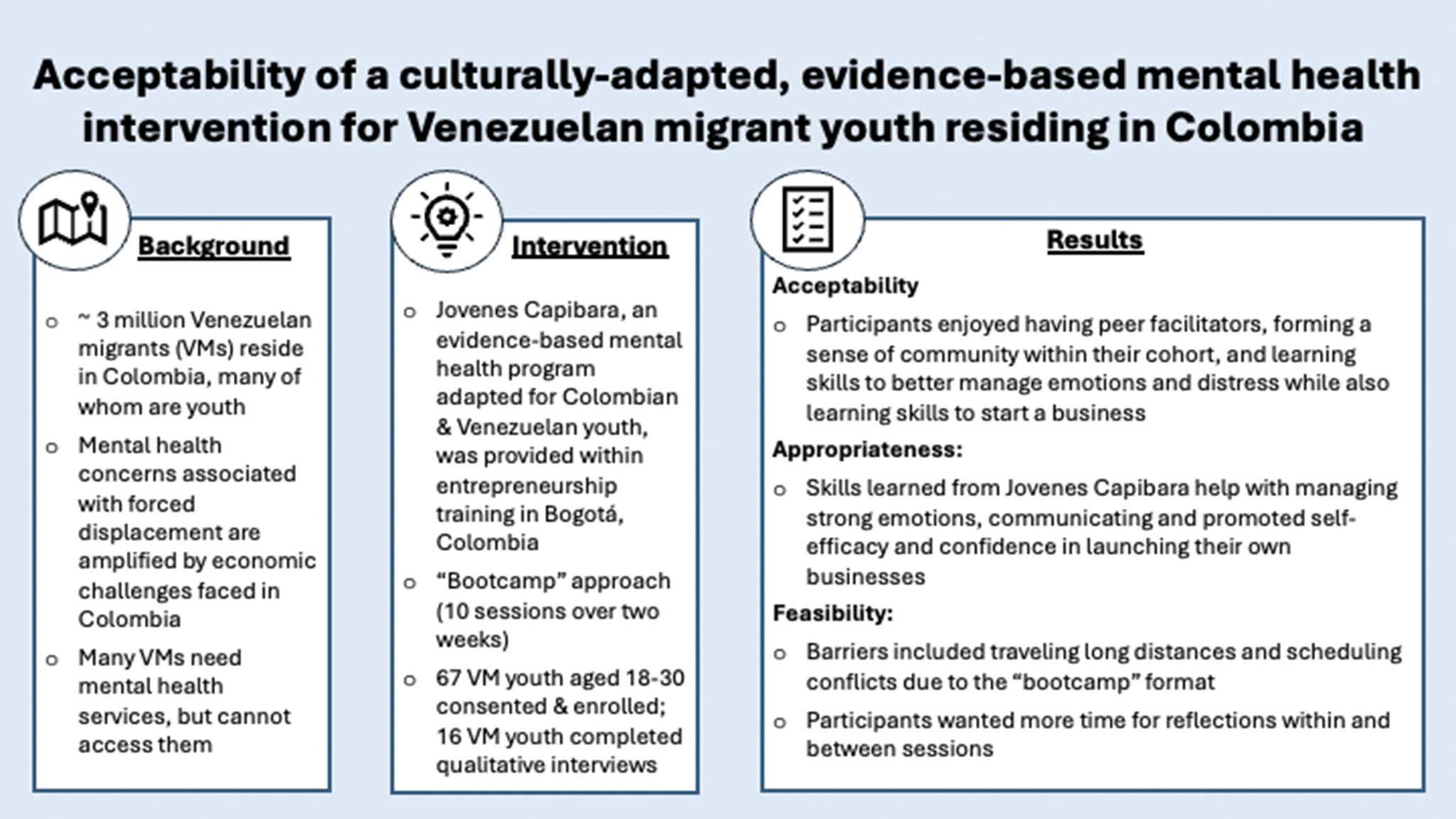
Close to three million Venezuelan migrants and refugees have fled to Colombia. Many Venezuelan migrants are in need of mental health services, but access to formal services is limited. In this context, it is critical to explore ways to adapt existing interventions and integrate them within delivery settings that may promote access to services. Task-sharing approaches, like peer-delivery models, can also increase access and uptake of services. The current study used community-based participatory methods to further adapt a culturally appropriate, evidence-based mental health intervention for Venezuelan migrant youth in Colombia and pilot tested the intervention delivered by peer facilitators within an entrepreneurship training program.
Introduction
Venezuela is experiencing a complex humanitarian crisis due to political instability, food and medical supply shortages and ongoing violence (Van Roekel and De Theije, Reference Van Roekel and De Theije2020; Cubides et al., Reference Cubides, Peiter, Garone and Antierens2022). Over 7.7 million Venezuelan migrants (VMs) and refugees have departed the nation as of November 2023 (R4V, 2023). Most VMs (approximately 2.9 million) reside in Colombia, and one out of every four is under age 18 (UNHCR, 2021; R4V, 2023). This forced displacement of VMs is associated with heightened levels of mental health problems (Carroll et al., Reference Carroll, Luzes, Freier and Bird2020; Alarcón et al., Reference Alarcón, Lozano-Vargas, Velásquez, Gaviria, Ordoñez- Mancheno, Lucio and Uribe2022), which are amplified by ongoing challenges within Colombia due to unstable employment conditions (i.e., informal and intermittent work), overcrowded living environments and legal status acquisition (Miller and Rasmussen, Reference Miller and Rasmussen2010; Cubides et al., Reference Cubides, Peiter, Garone and Antierens2022; Alarcón et al., Reference Alarcón, Lozano-Vargas, Velásquez, Gaviria, Ordoñez- Mancheno, Lucio and Uribe2022). It is estimated that at least one out of three VMs in Colombia may require some form of mental health support for symptoms of anxiety and depression (Cubides et al., Reference Cubides, Peiter, Garone and Antierens2022), but many do not seek care due to a lack of health insurance, limited information about health care utilization procedures or fear of discrimination or mistreatment (Bowser et al., Reference Bowser, Agarwal-Harding, Sombrio, Shepard and Harker Roa2022; Cubides et al., Reference Cubides, Peiter, Garone and Antierens2022). Given the limited access to mental health services, it is important to identify alternative settings for the integration of mental health care that might improve accessibility for this growing, high-risk population (Espinel et al., Reference Espinel, Chaskel, Berg, Florez, Gaviria, Bernal, Berg, Muñoz, Larkin and Shultz2020; Bowser et al., Reference Bowser, Agarwal-Harding, Sombrio, Shepard and Harker Roa2022).
While interventions have been designed to address mental health concerns among forcibly displaced youth in other resource-limited settings (Barron et al., Reference Barron, Abdallah and Smith2013; El-Khani et al., Reference El-Khani, Cartwright, Ang, Henshaw, Tanveer and Calam2018; Desrosiers et al., Reference Desrosiers, Freeman, Mitra, Bond, Santo, Farrar, Borg, Jambai and Betancourt2023), prior research developing and evaluating mental health interventions in Colombia has primarily focused on Colombian citizens and/or adult populations (González Ballesteros et al., Reference González Ballesteros, Flores, Ortiz Hoyos, Londoño Tobón, Hein, Bolívar Rincon, Gómez and Ponguta2021; Martínez et al., Reference Martínez, Espinosa-Duque, Jiménez-Molina, Rojas, Vöhringer, Fernández-Arcila, Luttges, Irarrázaval, Bauer and Moessner2021; Perera et al., Reference Perera, Aldamman, Hansen, Haahr-Pedersen, Caballero-Bernal, Caldas-Castañeda, Chaparro-Plata, Dinesen, Wiedemann and Vallières2022). Although populations from countries within Latin America may share certain commonalities, including language, there are important differences across countries and even across regions within the same country (Alarcón et al., Reference Alarcón, Parekh, Wainberg, Duarte, Araya and Oquendo2016; Namen et al., Reference Namen, Rodríguez Chatruc and Romero Bejarano2021). For example, previous research indicates that Colombians perceive Venezuelans as being more extroverted (Namen et al., Reference Namen, Rodríguez Chatruc and Romero Bejarano2021). In addition, there are some notable cultural differences related to dialectic as well as cuisine and food customs (Namen et al., Reference Namen, Rodríguez Chatruc and Romero Bejarano2021; González Vélez, Reference González Vélez2022) that have been observed. Given these cultural distinctions, adapting an existing evidence-based intervention through participatory methods can help to improve the cultural fit of the intervention to the VM population by increasing its acceptability and cultural appropriateness (Proctor et al., Reference Proctor, Silmere, Raghavan, Hovmand, Aarons, Bunger, Griffey and Hensley2011). Exploring factors (e.g., acceptability, appropriateness) that ultimately influence uptake of evidence-based interventions by engaging community members at early stages in the cultural adaptation process can increase the likelihood of intervention scalability and sustainability (Jewkes and Murcott, Reference Jewkes and Murcott1998; Zamboni et al., Reference Zamboni, Schellenberg, Hanson, Betran and Dumont2019).
In prior work, we culturally adapted and piloted an evidence-based mental health intervention for Colombian youth with histories of forced internal displacement due to decades of armed conflict in the country (Pineros-Leano et al., Reference Pineros-Leano, Desrosiers, Piñeros-Leaño, Moya, Canizares-Escobar, Tam and Betancourt2024). The Assessment, Decision, Adaptation, Production, Topical experts-Integration, Training, Testing (ADAPT-ITT) framework guided the cultural adaptation process (Magidson et al., Reference Magidson, Lejuez, Kamal, Blevins, Murray, Bass, Bolton and Pagoto2015; Munro-Kramer et al., Reference Munro-Kramer, Rominski, Seidu, Darteh, Huhman and Stephenson2020). The original intervention – the Youth Readiness Intervention – was developed and evaluated for youth with histories of violence exposure and forced displacement in Sierra Leone via several randomized controlled trials (Betancourt et al., Reference Betancourt, McBain, Newnham, Akinsulure-Smith, Brennan, Weisz and Hansen2014; Freeman et al., Reference Freeman, Desrosiers, Schafer, Kamara, Farrar, Akinsulure-Smith and Betancourt2023). The intervention, called Jovenes Capibara in Colombia, incorporates core components of interpersonal and cognitive behavior therapies and mindfulness techniques and can be feasibly delivered by nonspecialists. Community partners in Colombia selected this intervention for adaptation to the Colombian context because of its strong evidence base and potential relevance for other youth populations with histories of exposure to violence and forced displacement in resource-constrained settings.
Purpose of the study
To better address the mental health needs of VM youth and increase the cultural fit and accessibility of evidence-based mental health services for this population, we adapted and pilot-tested Jovenes Capibara integrated within entrepreneurship training for VM youth residing in Bogotá, Colombia. We opted for entrepreneurship training as the delivery setting for Jovenes Capibara in order to also address the economic difficulties faced by VM youth in Colombia and the limited opportunities to participate in occupational or job skills training programs (Garcia-Suaza et al., Reference Garcia-Suaza, Mondragon-Mayo and Sarango-Iturralde2024; Lebow, Reference Lebow2024). We partnered with The Rebel Business School, an organization that offers entrepreneurship skills training to socially disadvantaged young people in Colombia, to provide the delivery platform for both entrepreneurship training and Jovenes Capibara during a two-week “bootcamp.” By culturally adapting and then integrating an evidence-based mental health intervention into an existing delivery setting, barriers to care experienced by VM youth in Colombia may be reduced; and both mental health and economic challenges can be addressed simultaneously (which streamlines service delivery).
Methods
Adaptation
The ADAPT-ITT framework, which consists of eight phases, guided adaptations of Jovenes Capibara for the VM population. The present study focused primarily on phases 5–8 of the ADAPT-ITT framework for several reasons. First, a needs assessment (phase 1) was conducted in earlier work related to a different project to explore the mental health needs of Venezuelan migrants in Colombia, and findings suggested a clear need and limited access to services (Pineros-Leano et al., under review). Additionally, our community partners reviewed the adapted Jovenes Capibara manual produced through the prior adaptation process involving Colombian youth with histories of forced displacement (Pineros-Leano et al., Reference Pineros-Leano, Desrosiers, Piñeros-Leaño, Moya, Canizares-Escobar, Tam and Betancourt2024) and determined it was largely appropriate for VM youth (i.e., translated to Spanish, metaphors and activities relevant for VM populations); thus, a decision (phase 2) was made to select the Jovenes Capibara intervention and focus exclusively on ADAPT-ITT phases 5–8 to further refine the manual for Venezuelan youth. This is consistent with prior research that selected specific ADAPT-ITT phases to focus on during adaptation activities when adaptations were expected to be minimal (Freeman et al., Reference Freeman, Desrosiers, Schafer, Kamara, Farrar, Akinsulure-Smith and Betancourt2023).
ADAPT-ITT phases 5–8 included: topical expert review of the manual (phase 5), integration of expert feedback into the manual (phase 6), training of facilitators (phase 7) and pilot testing of the intervention (phase 8). In phase 5, a topical expert with over 13 years of experience working with displaced populations and migrants in Colombia was selected to review the intervention manual, evaluate its cultural and linguistic appropriateness and provide feedback on each of the 10 modules. The expert also provided recommendations for facilitator training to ensure that facilitators were well-equipped to deliver the program effectively and with cultural sensitivity. In phase 6, comments from the topical expert were reviewed and integrated into the manual. This included adding examples to the manual about the experience of migration and how migrating can bring about positive and negative feelings and experiences. Specifically, during session 6, participants were encouraged to think about the positive and negative aspects of migrating to a new country.
During phase 7, we held a two-week (10-day) training with youth community member facilitators and Rebel School facilitators. Colombian peer facilitators were selected based on their prior experience completing Jovenes Capibara training and serving as peer facilitators of the prior Jovenes Capibara pilot trial with Colombian youth. Training involved a combination of didactics, practice and discussion and role-play sessions where extensive feedback was provided. At the end of the training, we assessed facilitators’ competency by rating role-plays of sessions using a structured competency checklist and via a short survey assessing knowledge of the Jovenes Capibara components and techniques. During phase 8 (testing), we pilot tested the adapted Jovenes Capibara sessions integrated within the entrepreneurship bootcamp. Participants received entrepreneurship skills training from 8:00 am to 12:00 pm, had a lunch break and then participated in Jovenes Capibara group sessions from 1:30 pm to 3:00 pm. Facilitators participated in feedback and supervision sessions led by the research coordinator of Jovenes Capibara three times a week. After the two-week intervention delivery period, we conducted qualitative exit interviews with VM participants to obtain feedback to further refine and revise the manual.
Recruitment: Intervention pilot study
Participants were recruited through social media platforms using a series of targeted posts aimed at Venezuelan migrants in Bogotá. This procedure was led by our partner agency, The Rebel Business School. Social media posts led interested people to a screening questionnaire that included demographic information on nationality, age, gender, year of arrival in Colombia, mode of arrival and contact details. A total of 129 individuals completed the screening questionnaire.
Sample and procedure: Intervention pilot study
In partnership with a Colombian data collection agency, all prospective participants were contacted to verify the inclusion criteria via phone call. The inclusion criteria required participants to be between 18 and 30 years of age, of Venezuelan nationality and to have arrived in Colombia after 2016. Out of the 129 prospective participants, 67 met eligibility criteria. Of those who were not eligible, 24 people did not meet inclusion criteria and 38 people could not be reached through the contact method provided in the screening questionnaire.
After verifying participants’ eligibility, trained enumerators from the data collection agency explained the study to prospective participants by reading the consent form to them, explaining it, and encouraging them to ask questions. Research Assistants (RAs) then asked participants for their verbal consent to participate in the study. Once consented, The Rebel Business School study coordinator contacted each of the 67 participants via phone, email and/or WhatsApp to confirm their interest in attending the program and provide details about the program location, incentives (i.e., meals, transportation stipends),and logistics (i.e., transportation and/or childcare support). All study procedures were reviewed and approved by Boston College Institutional Review Board under number 22.258.01-3 and by Universidad de los Andes Institutional Review Board under Act Number 1609 of 2022.
Intervention: Jovenes Capibara + entrepreneurship training
Jovenes Capibara consists of ten 90-min sessions delivered by pairs of facilitators to groups of 10–12 youth. Session content focuses on: psychoeducation on trauma and stress, emotion regulation and relaxation skills; effective communication and interpersonal skills; goal setting; problem-solving skills; positive coping skills and cognitive restructuring. The entrepreneurship training program consisted of the following core components: creating a business without seed funding, developing essential business skills, such as sales pitches, digital marketing strategies, identifying target audiences, navigating legal requirements to establish a business, overcoming usual business obstacles and fostering a supportive community.
VM participants attended Jovenes Capibara sessions from November 28 to December 9, 2022. Participants were grouped by gender and paired with facilitators of the same gender, maintaining the original intervention format (Betancourt et al., Reference Betancourt, McBain, Newnham, Akinsulure-Smith, Brennan, Weisz and Hansen2014). This approach was used primarily because some of the topics discussed during sessions can be perceived as sensitive in nature (Freeman et al., Reference Freeman, Desrosiers, Schafer, Kamara, Farrar, Akinsulure-Smith and Betancourt2024). Creating a safe and supportive space for open dialogue is a fundamental aspect of the Youth Readiness Intervention (YRI) sessions, ensuring participants feel comfortable sharing their experiences and engaging in meaningful discussions.
Data collection: Interview sample and procedures
A semi-structured interview guide was developed to explore our target implementation outcomes based on Proctor’s implementation outcomes framework (Proctor et al., Reference Proctor, Silmere, Raghavan, Hovmand, Aarons, Bunger, Griffey and Hensley2011): acceptability, appropriateness and feasibility. Acceptability refers to participant satisfaction with the intervention, or likeability; appropriateness refers to the intervention’s fit or relevance; and feasibility refers to the extent to which the intervention can be practically delivered (Proctor et al., Reference Proctor, Silmere, Raghavan, Hovmand, Aarons, Bunger, Griffey and Hensley2011). Qualitative interviews were conducted 1–2 weeks after intervention completion. We selected VM participants (N = 16) based on stratified randomized selection and invited them to participate in exit interviews. Stratification criteria were: (a) 50% < 25 years of age; (b) biological sex; and (c) 40% attended all 10 sessions, remaining participants attended 5–9 sessions. RAs conducted interviews with participants (N = 16; 13 females). Interviews lasted an average of 47 min and took place either at participants’ homes or at a location of their choice, such as a community center. RAs reviewed the consent form with participants prior to starting the interviews. Participants received an equivalent of a 5 USD gift card as compensation for their time.
Data analysis: Qualitative interview data
Interviews were transcribed by native Spanish speakers. Two bilingual RAs coded the interviews using thematic network analysis (Attride-Stirling, Reference Attride-Stirling2001) and Dedoose (9.0) software. An inductive approach was used to code the interviews. Data units were defined in an interview. As a first step, RAs read all the transcripts and engaged in open-coding. Then, a codebook was developed after reading the transcripts a second time. In the next step, the RAs coded all the transcripts using the newly developed codebook. During team meetings, the codes were grouped into categories, which were further organized into main themes, creating a thematic network that explained the experiences that participants had in the intervention. To promote reliability (Lincoln and Guba, Reference Lincoln and Guba1982), intercoder agreement was calculated by exporting each coder’s coding into Excel and identifying the times both coders had used the same code to code a data unit. A percentage was then calculated by identifying the number of times a specific code was assigned to the same data unit out of the total number of data units (Miles and Huberman, Reference Miles and Huberman1994; O’Connor and Joffe, Reference O’Connor and Joffe2020). A threshold of 80% intercoder reliability was used (Miles and Huberman, Reference Miles and Huberman1994). Intercoder reliability agreement for this study was 81.6%. Relevant quotes were translated back and forth between English and Spanish by native speakers to ensure linguistic accuracy, following the three-step process recommended by the World Health Organization (2019). Results of the thematic network analysis were mapped onto the three implementation outcomes: acceptability, appropriateness and feasibility.
Results
Twenty-nine VM youth attended the first day of the program. Attendance for the remaining sessions ranged from 26–33 participants per day. For the purpose of this study, we report demographic information from the 16 participants who completed qualitative interviews (see Appendix Table 1 for demographics on the total sample). Most participants were female (81.25%), and the average age was 26.89 (SD = 3.5). In terms of education, one participant completed an undergraduate degree, four attended university, nine participants completed high school and the remaining two completed middle school. Only five participants were employed at the time of the study, though not all held formal jobs. Most participants (93.75%) stated that they traveled by bus from Venezuela to Colombia. Jovenes Capibara groups were as follows: group one (n = 4 male participants); group two (n = 3 male participants); group three (n = 13 female participants); group four (n = 13 female participants).
Acceptability
Overall, participants discussed their positive experiences with the intervention. A total of 15 (93.75%) participants indicated that they appreciated the sense of community that was created in the groups, and they also mentioned a high degree of acceptance that they felt with each other. One participant stated:
It’s like being at home with people who know what you like to eat, the music they listen to is practically the same, the way of talking is the same, the way of expressing yourself, that maybe you had stopped talking like that, or referring to yourself like that because the context was not the same, so that makes you feel more at home. Yes, that is the word. – Female participant, age 23
Participants also expressed that they enjoyed having peer facilitators lead the intervention. The participants stated that the facilitators were receptive to participants’ real-life experiences, such as parenting challenges. Participants appreciated that the facilitators were not just focused on teaching skills, but were also open to listening, which made them feel valued and understood. Participants also added that the facilitators were always respectful, even when they had to redirect participants’ attention back to the learning material to ensure that all session activities were completed as planned. One participant said:
They [Jovenes Capibara facilitators] listen to people. They take the time to listen to all the people, what they have to say, their stories…. They do not interrupt them. They…take us very much into consideration, every single thing we say… [they listen]without going out of what they were supposed to teach us during the day…We were a spectacular group. – Female participant, age 29
Additionally, participants stated that they valued the integrated design of the intervention that combined entrepreneurship skills training with psychosocial support. Participants indicated that this combined approach helped them understand that resilient entrepreneurship requires emotion regulation alongside tangible business skills. One participant remarked, “As an entrepreneur, you need to regulate the emotional part, and I think it is amazing that we had everything in one place.” – Female participant, age 22
Appropriateness
Several participants (n = 14, 87.5%) stated that the program helped them overcome problems that they faced in their daily lives, which were primarily related to emotional, interpersonal and entrepreneurship skills. Participants mentioned that the skills learned from Jovenes Capibara sessions positively affected their sense of emotional well-being and promoted their interpersonal skills. Participants reported improved emotional stability, and they attributed this improvement to specific Jovenes Capibara skills, such as deep breathing exercises and mindfulness practices. All participants described the intervention group as a “safe space” where they could express their feelings without judgment, fostering emotional safety and support between participants and in interactions with program administrators and group facilitators. For example, one participant stated:
Because [of this Jovenes Capibara group] I was able to let go, I was able to go through mourning because I had my mother passed away last year, I have 5 years here in Colombia, and she passed away last year, and I was closed [off], and I never had time to cry, I’d still say, “no, mom is here,” I did not get over it, and that kept me frozen… thanks to those sessions I started to let go and to believe, to believe a lot, yes, because it did affect me. – Female participant, age 29
Participants also described challenges in their relationships with peers, friends and family. Participants mentioned that using skills like deep breathing helped them improve their interpersonal relationships. Some participants who were parents also perceived that practicing the skills that they learned facilitated healthier interactions with their children. For example, one participant helped their child to use breathing techniques to regulate their emotions:
[I share] with my little girl because she is little, she throws tantrums, so I say ‘well, let us practice deep breathing.’ She did it at school as well, and now she says, ‘The teacher tells me to [do it]’, so now I can combine this with her at time[s] when we are both stressed by some situation, I think it’s great. – Female participant, age 25
All participants described an appreciation for entrepreneurship skills acquisition; they felt that they learned valuable skills in marketing, sales and graphic design, which they identified as crucial for starting and running their entrepreneurship. According to participants, the most important concept was “no need of seed capital.” Participants described this as “starting a business does not necessarily require a big investment,” which participants perceived as encouraging, and it motivated them to try to become entrepreneurs. Also, some participants expressed a deep appreciation for the opportunity to learn and network with other entrepreneurs, which could support their own entrepreneurial endeavors and enhance their business growth and collaboration opportunities. One participant shared:
The main thing is that…you do not need to have all the money you thought you needed to start something, and you can do it from scratch. I have learned from the [motto] that Rebel has of “No Days at Zero”; something, that is, every day you have to do something in pursuit of the venture or the goal you have. – Female participant, age 28
Another participant noted how skills learned from the entrepreneurship training and the Jovenes Capybara sessions, such as developing self-efficacy and interpersonal skills, were complementary.
In the entrepreneurship program, I am applying [the skills about] the part of the [social] connection, the networking, because that part has always been complicated for me and I think I have acquired a little clarity in the matter and development because the issue of fear of rejection. That has always paralyzed me, but by receiving the information you have given me, it has allowed me to see life in a slightly broader way, that is to say, a little more flexible. – Male participant, age 29
Feasibility
Although participants liked the intervention, many also mentioned that they faced barriers to attending regularly due to work and family responsibilities (N = 15). While they appreciated the bootcamp approach, their other responsibilities and commitments sometimes hindered their ability to fully engage with the intervention. Participants mentioned that although transportation subsidies helped alleviate the financial burden of travel, they still encountered difficulties due to traffic and the long distance between their homes and the convening site. For example, one participant stated:
The complicated thing was, in my case, the time. Because from 8 to 3 o’clock I had to stop doing my things, or assign them to other people. Sometimes I did not concentrate much in some classes because I was waiting for some shopping to be done or some order [to be placed], so it was very difficult for me… – Male participant, age 30.
Participants also offered recommendations for future implementations of the intervention. They suggested adding a day between sessions to allow more time for reflection on session content and ideas. Some felt that the Jovenes Capibara sessions were rushed and suggested allotting more time for sessions and discussion. Additionally, participants recommended implementing the program within their neighborhoods to increase accessibility and raise awareness among other community members. For example, one participant stated, “It could work a lot for people… For example, in the Santa Fé neighborhood, they are very lonely and have many problems and they might want to talk about it or feel that an institution is listening to them.” – Male participant, age 30
Discussion
This study used participatory research methods and phases from the ADAPT-ITT framework to further adapt and test the Jovenes Capibara intervention (Pineros-Leano et al., Reference Pineros-Leano, Desrosiers, Piñeros-Leaño, Moya, Canizares-Escobar, Tam and Betancourt2024) for VM youth residing in Colombia. Findings suggest that the adapted intervention integrated within the entrepreneurship bootcamp was acceptable and appropriate, and participants perceived a number of benefits from attending Jovenes Capibara sessions, including improved emotional stability and acquisition of skills to better manage stress and communicate effectively in interpersonal relationships. Additionally, participants observed that the skills learned through the Jovenes Capibara sessions were relevant to their experiences and challenges as entrepreneurs. Participants also noted some challenges regarding feasibility (i.e., travel and transportation time; pace of “bootcamp” format) and provided suggestions for reducing barriers to participation. Overall, study findings highlight the importance of involving community members (i.e., target audience or end-users) to culturally adapt and test evidence-based mental health and entrepreneurship interventions to improve implementation efforts at a larger scale.
Based on findings related to feasibility, acceptability and appropriateness, continued adaptations to the Jovenes Capibara + Entrepreneurship program could reduce barriers to participation and improve future participants’ experiences. Participants jointly discussed challenges with long commute times and feeling as if there was not sufficient time to engage with all the content within a condensed period. Accordingly, digital mental health tools could be leveraged to transfer some of the in-person components to remote settings, permitting reduced travel needs and providing more time for in-person discussion. Telemedicine initiatives are well-established in Colombia, with the nation having over 2,500 telemedicine service centers (Ministry of Health and Social Protection, 2015). For example, a recent psychosocial intervention for conflict-affected adults in Colombia found that in-person, hybrid and virtual formats were all efficacious at reducing symptoms of distress, anxiety, depression and posttraumatic stress (Rattner et al., Reference Rattner, James, Botero, Chiari, Bastidas Beltrán, Bernal, Cardona and Gantiva2023). As such, translating components of Jovenes Capibara and/or the combined Jovenes Capibara + Entrepreneurship program into digital platforms could help increase the feasibility of participating in Jovenes Capibara among VM youth in Colombia. Additionally, continuing to leverage task sharing approaches by training nonspecialist, peer facilitators to deliver the intervention could increase scalability and the potential for Jovenes Capibara to reach rural and other underserved regions (van Ginnekan et al., Reference van Ginneken, Tharyan, Lewin, Rao, Meera, Pian, Chandrashekar and Patel2013), as well as other populations of underserved and/or displaced youth (e.g., nonurban youth).
Limitations
This study’s findings are subject to a few limitations. First, the absence of quantitative data on feasibility, acceptability and appropriateness limits a comprehensive assessment of these factors. Second, while participant interviews provided valuable insights, the inclusion of facilitator interviews could offer a more nuanced understanding of barriers and facilitators to program implementation. Future studies should also include information from facilitators to further assess the feasibility of the intervention delivery format. Further, this study was conducted in an urban setting, which may not have fully captured the challenges and opportunities faced by VM in rural areas. Finally, further adaptations will be required to meet the cultural and contextual needs of other marginalized populations in Colombia, such as Indigenous and Afro-Colombian youth; however, this is a positive first step toward addressing the unmet needs of marginalized and displaced populations of youth in Colombia.
Conclusion
This study aimed to better address the mental health needs of VM youth in Bogotá, Colombia, by adapting and integrating the Jovenes Capibara intervention into an entrepreneurship training program. We carried out several phases of the ADAPT-ITT framework to improve the cultural fit and accessibility of mental health services for VM youth. Overall, findings suggest that the program may offer benefits for improving emotion regulation, stress management and interpersonal communication skills among VM youth, which may in turn facilitate their experiences as entrepreneurs. While findings from the current study are promising, further research via a fully-powered randomized controlled trial is needed to determine the effectiveness of the adapted intervention on mental health outcomes and in more diverse settings (i.e., rural areas) with diverse populations (i.e., Indigenous, Afro-Colombian).
Open peer review
To view the open peer review materials for this article, please visit http://doi.org/10.1017/gmh.2025.10011.
Supplementary material
The supplementary material for this article can be found at http://doi.org/10.1017/gmh.2025.10011.
Data availability statement
Data will be available upon reasonable request.
Author contribution
A.D. and M.P. made a substantial contribution to the conceptualization and design of the work, interpretation of data, drafting the work and revising and finalizing the work. N.P. made a substantial contribution to acquisition of the data, analysis of data and drafting of the work. S.P. made a substantial contribution to interpretation of the data and drafting the work. M.J. made a substantial contribution to acquisition of the data and drafting the work. All authors approve the final version to be published. All authors agree to be accountable for all aspects of the work.
Financial support
Funding for this study was provided by a Hilton Foundation Award (no grant number).
Competing interests
The authors declare no competing interests exist.
Ethics statement
All study procedures were approved by the Boston College Institutional Review Board (protocol number 22.258.01-3) and by Universidad de los Andes Institutional Review Board (Act Number 1609 of 2022).


 Open access


Comments
December 20, 2024
Dear Editorial Board,
I would like to submit the attached manuscript, entitled “Acceptability of a culturally-adapted, evidence-based mental health intervention for Venezuelan migrant youth residing in Colombia”, for consideration in Cambridge Prisms: Global Mental Health.
The content of this manuscript has not been published or submitted for publication elsewhere in the same form in any language beyond this submission to Cambridge Prisms: Global Mental Health. All authors have approved the manuscript for submission, there are no competing interests, conflicts of interest, or issues relating to journal policies. This study has received Institutional Review Board approval.
I will be serving as the corresponding author for this manuscript, and I will inform the coauthors about the status of the manuscript, including editorial decisions and content of revisions. Thank you for considering this manuscript for publication in Cambridge Prisms: Global Mental Health. We look forward to hearing from you.
Kind Regards,
Alethea Desrosiers, Ph.D.
Associate Professor
Brown University
Department of Psychiatry and Human Behavior
345 Blackstone Blvd
Providence, RI 02906
alethea_desrosiers@brown.edu