


Introduction
Ecosystem services (i.e. nature’s contribution to people) are nowadays recognised as a main pillar for biodiversity conservation because of their profound implications for environmental management and policy (Daily and Matson Reference Daily and Matson2008; Geijzendorffer et al. Reference Geijzendorffer, Cohen-Shacham, Cord, Cramer, Guerra and Martín-López2017; IPBES Reference Grilli, Bildstein and Lambertucci2019). Typically, ecosystem services refers to the various benefits that humans obtain from ecosystems, which can be categorised into three main groups: provisioning, regulation/maintenance, and cultural (Haines-Young and Potschin-Young Reference Haines-Young and Potschin-Young2018). Provisioning services are direct products obtained from ecosystems, such as food, water, raw materials, and medicinal plants, which fulfil human needs for sustenance and economic activities. Regulation and maintenance services involve the ecological processes that contribute to the overall balance and stability of ecosystems. These services include climate regulation, water purification, pollination, and disease control, which ensure the health and resilience of ecosystems. Cultural services encompass the non-material benefits that ecosystems provide to humans, including aesthetic, spiritual, educational, and recreational values. These services contribute to the cultural identity, inspiration, and overall well-being of humans.
Birds play a vital role in maintaining ecological balance, conserving biodiversity, and enhancing human well-being (Sekercioglu et al. Reference Sekercioglu, Wenny and Whelan2016). As such, birds are often associated with key ecosystem services, including pollination for plant reproduction, natural pest control by feeding on insects, and seed dispersal that supports biodiversity and ecosystem regeneration. Birds also hold a cultural value, symbolising freedom, beauty, and connection to nature, contributing to recreational opportunities and ecotourism (Becker et al. Reference Becker, Inbar, Bahat, Choresh, Ben-Noon and Yaffe2005; García-Jiménez et al. Reference García-Jiménez, Morales-Reyes, Pérez-García and Margalida2021; Gupta et al. Reference Gupta, Qureshi and Kumar2020; Moleón et al. Reference Moleón, Sánchez-Zapata, Margalida, Carrete, Owen-Smith and Donázar2014). Their role in controlling insect-borne diseases, such as mosquitoes, benefits both wildlife and humans (Sekercioglu et al. Reference Sekercioglu, Wenny and Whelan2016). Additionally, the presence of birds in the environment enriches the cultural heritage through folklore, art, and traditional practices (Tidemann and Gosler Reference Tidemann and Gosler2010).
Old and New World vultures play a crucial role in maintaining the ecosystem’s health (Berlinguer et al Reference Berlinguer, Ahmed, Tamponi, Carta, Scala and Cappai2021; Craig et al. Reference Craig, Thomson and Santangeli2018; Gangoso et al. Reference Gangoso, Agudo, Anadón, de la Riva, Suleyman and Porter2013; Grilli et al. Reference Grilli, Bildstein and Lambertucci2019; Morales-Reyes et al. Reference Morales-Reyes, Martín-López, Moleón, Mateo-Tomás, Botella and Margalida2018; Mateo-Tomás et al. Reference Mateo-Tomás, Olea, Moleón, Selva and Sánchez-Zapata2017; Plaza et al. Reference Plaza, Blanco and Lambertucci2020; Santangeli et al. Reference Santangeli, Girardello, Buechley, Botha, Minin and Moilanen2019). Being the only obligate scavengers among vertebrates, they efficiently remove carrion, curbing disease spread and reducing the potential for pathogen proliferation impacting both wildlife and domestic animals (Berlinguer et al. Reference Berlinguer, Ahmed, Tamponi, Carta, Scala and Cappai2021; Plaza et al. Reference Plaza, Blanco and Lambertucci2020). Beyond disease control, vultures contribute to waste reduction by consuming animal remains, and therefore prevent the release of greenhouse gases (GHG) and aid nutrient cycling (Morales-Reyes et al. Reference Morales-Reyes, Pérez-García, Moleón, Botella, Carrete and Lazcano2015). In addition to their ecological services, vultures hold cultural significance, associated with death and rebirth in some cultures, enriching the spiritual identity of communities (Van Dooren Reference Van Dooren2012). These birds are also central to ecotourism in several regions, providing economic benefits to local communities and raising awareness about vulture conservation and their broader ecological services (Aguilera-Alcalá et al. Reference Aguilera-Alcalá, Morales-Reyes, Martín-López, Moleón and Sánchez-Zapata2020; Becker et al. Reference Becker, Inbar, Bahat, Choresh, Ben-Noon and Yaffe2005; García-Jiménez et al. Reference García-Jiménez, Morales-Reyes, Pérez-García and Margalida2021). Finally, by being apex scavengers, vultures regulate population dynamics across the food chain, influencing the structure of ecological communities and contributing to ecosystem stability (Morales-Reyes et al. Reference Morales-Reyes, Sánchez-Zapata, Sebastián-González, Botella, Carrete and Moleón2017; Ogada et al. Reference Ogada, Torchin, Kinnaird and Ezenwa2012). Understanding and conserving these species is essential for maintaining the ecological balance and functioning of their habitats. In the agropastoral landscapes of Europe, including Sardinia, the Griffon Vulture Gyps fulvus is the most abundant avian scavenger, providing an irreplaceable scavenging service through its efficient carcass consumption (Berlinguer et al. Reference Berlinguer, Ahmed, Tamponi, Carta, Scala and Cappai2021; Oliva-Vidal et al. Reference Oliva-Vidal, Sebastián-González and Margalida2022a).
Research on vultures and their associated ecosystem services has witnessed a substantial growth, with numerous studies shedding light on their vital roles in disease control, waste reduction, and cultural significance (Carucci et al. Reference Carucci, Whitehouse-Tedd, Yarnell, Collins, Fitzpatrick and Botha2022; Plaza and Lambertucci Reference Plaza and Lambertucci2022; van den Heever et al. Reference van den Heever, Thompson, Bowerman, Smit-Robinson, Shaffer and Harrell2021). However, despite this progress, significant gaps still persist in our understanding of ecosystem services associated with these species. For example, there are no studies, to the best of our knowledge, on how vultures mitigate GHG emissions on Mediterranean islands. The complex and context-dependent nature of the ecosystem services provided by vultures underscores the importance of studying them at the local to regional scale. Such studies are essential for comprehensively assessing the specific services of vultures in diverse ecosystems, enabling targeted conservation strategies, and ensuring the sustained provision of these critical services. Closing these knowledge gaps is crucial for the effective conservation and management of vulture populations and to leverage the potential of vultures in providing key services that are so fundamental for modern societies. This also applies to the agropastoral communities of Sardinia, and the rest of Europe, that live on marginal landscapes, such as steppes, whose conservation is often neglected but are crucial for sustainable development and biodiversity conservation. In such landscapes, Griffon Vultures play a role in carcass decomposition, with potential implications for disease control, saving costs to livestock farmers for artificial disposal, as well as savings in GHG emissions from the process. Moreover, local and foreign visitors to areas within the vulture range may have an interest in watching, photographing or simply contributing to the species conservation (García-Jiménez et al. Reference García-Jiménez, Morales-Reyes, Pérez-García and Margalida2021, Reference García-Jiménez, Pérez-García, Margalida and Morales-Reyes2022; Oliva-Vidal et al. Reference Oliva-Vidal, Hernández-Matías, García, Colomer, Real and Margalida2022a). Therefore, in this study we aim to fill the above knowledge gap in the ecosystem service provision by vultures in Sardinia. Specifically, we here aim: (1) to quantify key cultural services associated with Griffon Vultures in Sardinia, specifically focused on the perceptions of ecotourists towards vultures and their interest and willingness to pay for watching vultures and for their conservation; (2) to quantify key regulation services associated with Griffon Vultures in Sardinia, specifically focused on waste decomposition and associated climate regulation and opportunity cost services. Essentially, how much animal waste they dispose, and what are the net savings in GHG emissions and money due to the natural waste disposal by vultures compared with carcass transport and incineration.
Methods
Perceptions on vultures and associated ecosystem services
Between August 2022 and October 2023, we quantified how visitors at eight protected areas in Sardinia (n = 116) perceived Griffon Vultures and their associated ecosystem services, by means of a structured questionnaire survey. Questionnaires (see Supplementary material appendix and some broad details below) were completed on-site (n = 100) or filled in online (n = 16). We employed these two different approaches for the questionnaire delivery to achieve a larger sample size. While we combined data from both online and on-site-filled questionnaires, the results were largely the same when the online-filled questionnaires were excluded. The questionnaire was divided into specific sections asking questions related to: the frequency of visits to Sardinia and its natural reserves; willingness to pay for observing, photographing or conserving vultures (using pre-defined numerical amounts); the ecosystem services that were perceived as being delivered by vultures (using a five-point bipolar scale from strongly disagree to strongly agree); the demographic attributes of respondents (see SM appendix). In compliance with the General Data Protection Regulation of the EU (https://gdpr.eu/), informed consent was collected at the beginning of the questionnaire. Participants were informed about the scope and objectives of the study, that participation was totally voluntary, and that individual anonymity and confidentiality were ensured.
Regulation services
We calculated the amount of GHG emissions, in CO2 equivalent, resulting from the artificial disposal of all carcasses that had been disposed and consumed by vultures at supplementary feeding stations in north-western Sardinia during 2017–2022. That is, what would have been the GHG emissions of those carcasses without their consumption by vultures. To address this question, we tracked the artificial carcass disposal process from the moment the animal dies at the farm, to the point when it is incinerated, by following the framework of Morales-Reyes et al. (Reference Morales-Reyes, Pérez-García, Moleón, Botella, Carrete and Lazcano2015). Namely, we separated the process into three steps: (1) carcass transport to an intermediate accumulation plant; (2) transport from the accumulation plant to the incineration plant; (3) incineration at the end of the process (Figure 1).
Schematic representation of the natural versus artificial disposal process for livestock carcasses in central-western Sardinia. Top left figure represents the landscape where the livestock dies (farm locations depicted as green circles on the map) and requires disposal, either via the natural scavenger decomposition (the Griffon Vulture Gyps fulvus role; green area in the figure) or through artificial disposal (grey area). The latter process involves three different steps (locations marked as red circles in the map). The carcass, as it becomes available, is collected from the farm and transported to an intermediate plant (step 1). At this intermediate plant, carcasses are stored and piled up to fill a large truck that then brings them to mainland Italy (step 2), where they are incinerated at a specific plant (step 3).

In step 1, we assumed that one small truck (7.5 tons) would collect a carcass at each farm which has a supplementary feeding station and assumed that if multiple carcasses become available in the same day at the same farm, these are jointly collected within a single trip. We calculated the distance (km), from each farm to the intermediate plant, located in the municipality of Bitti (central Sardinia). This distance was calculated using Google Maps. We assumed the consumption of the truck to be 0.21 l/km on a diesel engine, with 2.7 kg CO2 emitted per litre of diesel fuel consumed (Morales-Reyes et al. Reference Morales-Reyes, Pérez-García, Moleón, Botella, Carrete and Lazcano2015). Then we used historical data on daily carcass provisions for each supplementary feeding station to obtain the total mileage of all trips, and we used the conversion factors mentioned above to estimate the total CO2 emissions associated with carcass collection. Indeed, the total mileage was doubled, as we assumed that the truck always made a return trip on each collection journey.
In step 2, based on available evidence about carrion disposal, we estimated CO2 emissions by assuming that biomass is moved from Sardinia to peninsular Italy via trucks (approximately 538 km) and ferry transport (approximately 313 km). In Sardinia, we assumed that carrion is moved on the road network from the intermediate centre in Bitti to the harbour of Olbia. Then the truck is shipped across the Tyrrhenian Sea, from Olbia to Livorno, on a ferry. Finally, the truck would deliver the biomass from the harbour of Livorno to the incineration plant in Bologna. For this task, usually large trucks (24 tons), operating at a full load, are used. It was considered that the carrion disposed at supplementary feeding stations in 2017–2022 amounted to 95.7 tons, we estimated that four trips would have been required to deliver the biomass from Bitti to the incinerating plant. In terms of emissions, following Morales-Reyes et al. (Reference Morales-Reyes, Pérez-García, Moleón, Botella, Carrete and Lazcano2015), we also assumed that a large truck with a diesel engine would consume 0.26 l/km, with 2.7 kg CO2 emitted per litre of diesel fuel consumed. For the ferry, an average emission factor of 25 g CO2 per ton-km was assumed based on EU maritime transport data (www.data.europa.eu/data/datasets/co2-emissions-data). Emissions were doubled to account for the return trip of the truck to Sardinia.
We calculated CO2 emissions from step 3, the artificial carcass disposal process, by assuming a rendering procedure, where high-temperature incineration is used, which has a conversion factor of 200 kg CO2 equivalent per each ton of carcass burned (Plaza and Lambertucci Reference Plaza and Lambertucci2022).
By summing up the emissions from each of the three steps, we quantified the total CO2 emissions equivalent related to the artificial disposal of the carcasses in a scenario where vultures are absent from Sardinia to consume this biomass.
Next, we calculated the total amount of potential CO2 emissions mitigated by the whole Griffon Vulture population in Sardinia, per year. We used the total population estimate from the year 2022 (316–338 individuals; Berlinguer et al. Reference Berlinguer, Campus, De Rosa and Aresu2022), each consuming 208–305 kg biomass/year (Plaza and Lambertucci Reference Plaza and Lambertucci2022), amounting to a total annual biomass consumed by the entire population as 65.6–103.1 tons. We then converted the biomass to potential CO2 emissions assuming that all that material would be disposed of artificially, by using the ratio of emissions from the tons of carcass as calculated in the steps above (which is very close to one, that is, 1 ton of biomass would emit 1 ton of CO2 equivalent).
Finally, we calculated the economic opportunity costs (in euros) for all carcasses consumed by vultures at supplementary feeding stations in north-western Sardinia during 2017–2022. Essentially, how much it would have cost if the above carcasses where to be disposed of artificially, as in Figure 1. For this, we used the total sum of biomass (kg) disposed of at the supplementary feeding stations as above, separated by three livestock categories: cattle, horses/donkeys, and sheep/goats. We obtained the maximum cost (in €/kg biomass) of collection, transport, and incineration of carcasses by each of the three livestock categories from the Official Bulletin of the Italian Republic (series n. 123, date: 27 May 2023) for the Sardinia region in 2023 (as an average across the region). Total maximum disposal costs were reported as: €0.97/kg for cattle, €1.07/kg for horses/donkeys, and €3.08/kg for sheep/goats. We then multiplied the total biomass (kg) for the cost of disposal per each livestock category, and then summed the three to yield the total opportunity cost for disposing of those carcasses.
Results
Socio-demographics of respondents
Overall, 116 respondents filled in the questionnaire about the perception of vultures and their associated ecosystem services. This sample was balanced across genders, with 58 male and 57 female respondents, and across various age classes: 28 respondents aged 18–30 years old, 30 aged 31–40, 25 aged 41–50, and 29 aged >51. Moreover, the majority of respondents had a high level of education, with 45 having at least a high school degree, 42 having some basic university degree, and 23 with a higher than basic university degree (e.g. MSc or PhD). As expected, most respondents (n = 91, 79% of the total sample) were Italian, while the remaining respondents came from Germany and France (seven for each), Czech Republic (four), and Netherlands, Austria, and Poland (two for each). Moreover, 57 respondents (50% of the 114 that replied to this question) were resident in Sardinia, while the others were visiting the island for the first time (24) or had already visited Sardinia on two (10), three or more previous occasions (6), or visited the island every year (17). Only eight respondents stated that they have a profession somewhat related to nature (e.g. biologist, nature guide, veterinarian, naturalist), while others had different private social or government employment jobs, likely unrelated to nature and its conservation. The sample of respondents was rather balanced among those that enjoy photography (51, amounting to 45% of the total; not necessarily nature related) and those that do not practise this activity (63, 55% of the total). Among all respondents who replied to the question about the frequency with which they visited a protected area, 30 had visited for the first time, 44 visited once a year, 8 once a month, and 9 once a week.
Perceptions on vultures’ ecosystem services
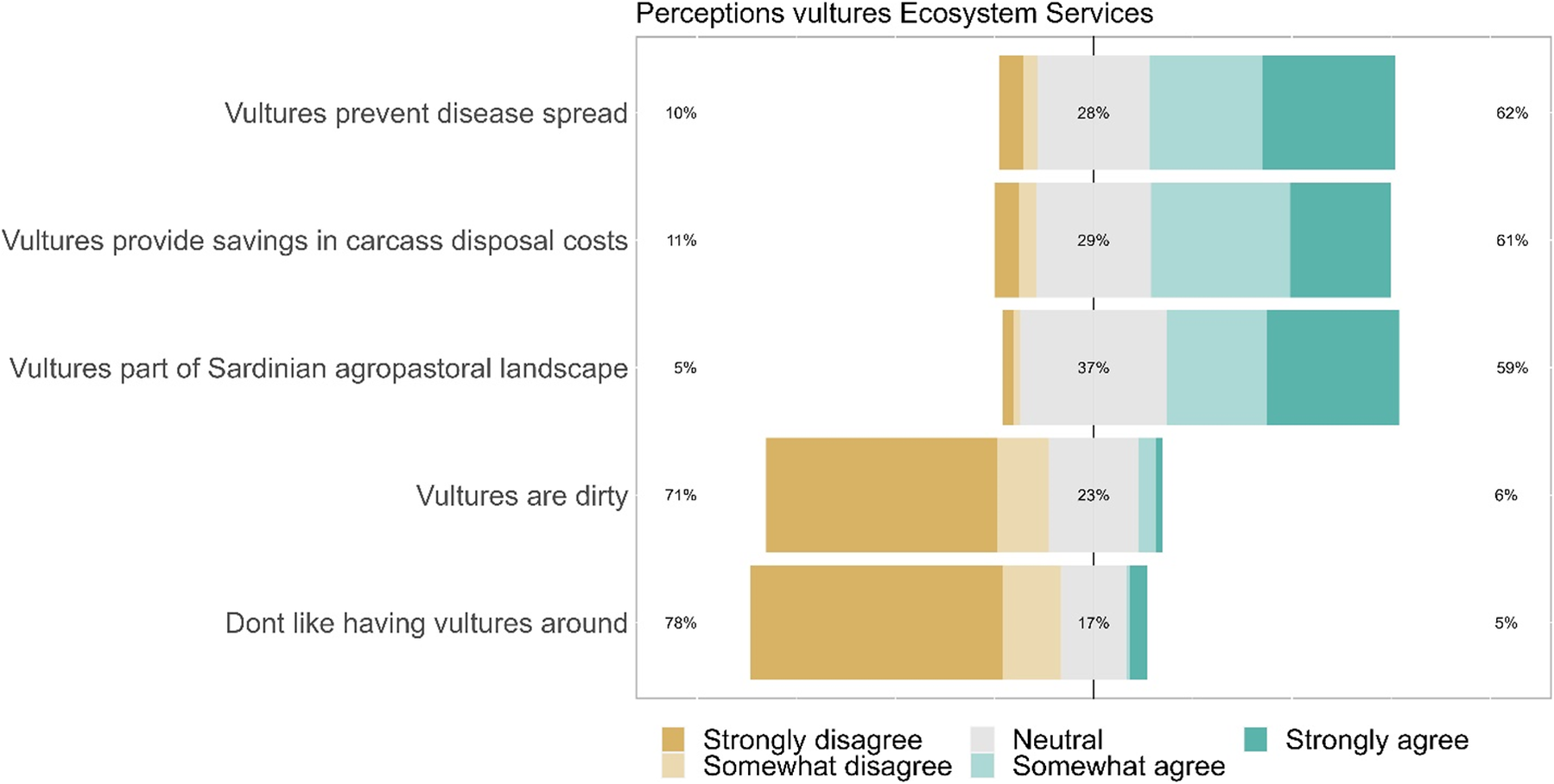
With regard to the respondents’ perceptions towards vultures and their associated ecosystem services, the results are rather clear that respondents had a broadly positive perception of vultures and were also aware of some of their main ecosystem services (Figure 2). Specifically, most respondents (almost two out of three) believed that vultures can counteract the spread of diseases, and reduce costs associated with carcass disposal, e.g. due to carcass transport and incineration (regulation services). Moreover, most respondents agreed that vultures belong to the agropastoral traditional ecological landscape of Sardinia (cultural service). Even more clear was the respondents’ perception towards vultures, whereby most (71%) of the respondents did not agree that vultures are dirty, and an even higher percentage (78%) of respondents did not agree with the statement affirming that they do not like to have vultures around, i.e. they like to have vultures in the surrounding landscape.
Perceptions of visitors to natural reserves on vultures and their associated ecosystem services. The top two bars represent regulation and maintenance services, whereas the bottom three bars represent cultural services.
Cultural ecosystem services
We also attempted to quantify the willingness to pay for observing and photographing vultures, as a monetary quantification of their potential cultural ecosystem service. Specifically, to the question whether respondents would be willing to visit an observation hide for watching and photographing vultures, 92 (79%) responded positively, 10 negatively, and 14 don’t know. Similarly, 85 (73%) would be willing to pay an entrance fee to access such a hide. Among the latter, the average they would pay was €13 each. However, there was a large variation in the amount respondents would be willing to pay, with 54 respondents willing to pay only €10 or less, and the rest a larger sum. The results were similar with regards to willingness to join a guided visit to such a vulture observation place (92, 80% of 115 responses), while 89 (79% of 112 responses) were willing to pay an entrance fee for such a place. Among the latter, the average they would pay is €15 each, with 46 respondents willing to pay only €10 or less, 23 respondents willing to pay €20, and 9 willing to pay €30 or more. Over half (55) of the respondents stated that they would visit the vultures observation hide only as part of an entire trip to the island, whereby 34 respondents would visit it on purpose. In more general terms, about half of the respondents (58 of 114 who replied) were willing to make a donation for the conservation of the Griffon Vulture in Sardinia, amounting to an average of €21 per person. Specifically, 29 of the 51 respondents willing to support vulture conservation would donate €10 or less, 6 would donate €20, and the remaining 16 would donate €30 or more.
Regulation services
During the period 2017–2022, a total of 30 supplementary feeding stations in north-central Sardinia provisioned 95.7 tons of livestock (mainly sheep, goats, and cattle) carcasses during 609 provisioning events (each event could include from one to seven animal carcasses). These carcasses were almost entirely consumed by the local Griffon Vulture population. The CO2 equivalent that would have been emitted into the atmosphere from the artificial disposal of such a total amount of biomass amounts to 96.07 tons, according to the calculations and related assumptions as detailed in the methods. Out of the total CO2 emissions from the full process of artificial disposal of the above biomass, almost three-quarters (77%, 73.9 tons) of the emissions were due to local carcass transport (from the farm to the intermediate plant), only 3% (3.0 tons) were due to long haul carcass transport (from the intermediate plant in Sardinia to the final incineration plant in mainland Italy), and one fifth (20%, 19.1 tons) of the total CO2 was emitted during the incineration phase.
Extrapolating the above CO2 emissions to the total annual potential biomass consumed by the entire population of Griffon Vultures in Sardinia would amount to 65.9–103.5 tons of CO2 equivalent per year (minimum and maximum estimates based on minimum and maximum vulture food intake and population estimate).
The economic opportunity costs that are saved by the disposal service of the vultures at the supplementary feeding stations are also substantial and equate to €134,016 for the period 2017–2022 at the 30 supplementary feeding stations in north-central Sardinia.
Discussion
To the best of our knowledge, this study is the first one to explore the public perception, magnitude, and economic value of ecosystem services delivered by Griffon Vultures on a Mediterranean island. We acknowledge that the study has some limitations, including the representativeness of the pool of respondents for this study, as well as the uncertainty in the economic and GHG emission savings associated with the vultures’ scavenging services. Nevertheless, we believe that the figures provided are broadly representative of the local situation based on a few key facts: i.e. it was a local study of a restricted area, which reduced spatial heterogeneity while allowing detailed information on carcass availability, carcass disposal, and vulture population numbers.
Our study revealed a broadly positive public perception of the ecosystem services associated with Griffon Vultures in Sardinia. Most respondents acknowledged the role played by vultures in preventing disease and saving costs associated with carcass disposal. Economic aspects are highlighted by the willingness of 73% of respondents to pay for vulture-watching, with an average proposed fee of €13, indicating the potential cultural value of these birds, also in economic terms. Additionally, about half of the respondents were willing to donate money for conserving vultures, averaging €21. Moreover, from an ecological perspective, vultures play a role in GHG mitigation. Between 2017 and 2022, vultures contributed to preventing 96 tons of CO2 equivalent that would have been emitted from artificial carcass disposal, and a potential annual CO2 mitigation of 66–103 tons for the whole vulture population in Sardinia. During the same period, the economic savings from carcass disposal by vultures at supplementary feeding stations was substantial, reaching well over €100,000.
The positive perception of Griffon Vultures among resident and foreign visitors to natural sites in Sardinia is encouraging and aligns with recent studies on the positive cultural value associated with vultures in modern society (Craig et al. Reference Craig, Thomson and Santangeli2018; Carucci et al. Reference Carucci, Whitehouse-Tedd, Yarnell, Collins, Fitzpatrick and Botha2022; García-Jiménez et al. Reference García-Jiménez, Pérez-García, Margalida and Morales-Reyes2022; Santangeli et al Reference Santangeli, Arkumarev, Rust and Girardello2016). These findings underscore the deep integration of vultures into the cultural and ecological landscape of Sardinia. The acceptance and appreciation of vultures are crucial for conservation efforts, as public perception often drives policy and funding support (Oliva-Vidal et al. Reference Oliva-Vidal, Hernández-Matías, García, Colomer, Real and Margalida2022a).
In turn, the positive perception of vultures is reflected in the visitor’s willingness to pay for observing and photographing these animals. This underscores a great ecotourism potential especially related to those local livestock farms interested in managing a supplementary feeding station that would bring a financial revenue, e.g. through entrance fees for visiting the site. Indeed such cultural services related to vultures bringing local financial revenues have been quantified, at least for a few sites (Becker et al. Reference Becker, Inbar, Bahat, Choresh, Ben-Noon and Yaffe2005; García-Jiménez et al. Reference García-Jiménez, Morales-Reyes, Pérez-García and Margalida2021). These activities not only contribute to local economies but also foster a deeper appreciation for wildlife. The monetary valuation of these services is important for conservation strategies, demonstrating that protecting vultures aligns with local economic interests. Moreover, the variation in the willingness to pay suggests a diverse range of values and interests among different visitor demographics, which could be targeted by future tourism and conservation strategies. We believe that future studies should also explore how local livestock farm owners would be available to develop activities associated with ecotourism. This would allow a better understanding of which conditions the demand and offer for observing and photographing vultures would align. In turn, this could also allow the development of vulture sighting activities that would maximise the value of this cultural service for both tourists and farmers, while minimising the potential disturbance to vultures (Donázar et al. Reference Donázar, Cortés-Avizanda, Arrondo, Delgado-González and Ceballos2023).
Aside from the above cultural services, we also show that the local population of Griffon Vultures in Sardinia can contribute to important regulation/mitigation services through the carcass disposal that, if artificially performed, would result in GHG emissions and also economic costs. To place this finding in context, the net annual savings in CO2 emissions resulting from the total population of Griffon Vultures in Sardinia equate to the annual CO2 emissions of 16–34 households in Sardinia. Previous studies have quantified the role of vultures in preventing GHG emissions via their scavenging role, at a global as well as national level (Morales-Reyes et al. Reference Morales-Reyes, Pérez-García, Moleón, Botella, Carrete and Lazcano2015; Plaza and Lambertucci Reference Plaza and Lambertucci2022). By quantifying the CO2 equivalent emissions prevented by vulture scavenging, we contribute another compelling case for the conservation of these birds, whose ecological role spans broad contexts of global environmental challenges (Santangeli et al. Reference Santangeli, Lambertucci, Margalida, Carucci, Botha and Whitehouse-Tedd2024). Moreover, we believe that translating reductions of GHG emissions into tangible examples, such as household CO2 emissions, could be useful for communication initiatives targeting both residents and visitors in Sardinia, with the goal of increasing overall awareness of the important ecosystem services associated with vultures. To this end, future studies should use approaches from the social sciences to test for the effectiveness of similar messaging through, for example, information panels at protected areas (Abrams et al. Reference Abrams, Leong, Melena and Teel2020).
Interestingly, we show that, in the context of Sardinia, over three-quarters of the emissions of the full artificial disposal process are related to local carcass collection and transport, while only one-fifth of emissions are related to the incineration process. This finding is relevant, as it indicates that local carcass transport plays a key role in CO2 emission mitigation scenarios related to vultures. For example, a recent study quantified the global emission mitigation relative to the incineration of all biomass that is currently consumed by all vulture populations in the world as 3–61 Tg CO2 eq. (Plaza and Lambertucci Reference Plaza and Lambertucci2022). That value did not consider the emissions related to carcass transport. Our findings indicate that global values could be up to five times higher, underscoring the importance of considering the full carcass collection, transport, and incineration process when estimating emission and cost mitigation.
Overall, the findings on perception and economic valuation of vultures’ ecosystem services have important implications for conservation efforts. They underscore the potential benefits these birds could bring to local peoples and their economies. They also highlight the need for continued education and awareness programmes to maintain and enhance public support for vulture conservation. This study adds important insights into our understanding of the Griffon Vulture’s role for the ecosystems of Sardinia, with far-reaching implications across other Mediterranean islands and beyond where vulture populations occur. It provides a compelling case for their conservation, not only for their ecological benefits, but also for their cultural and economic services. This holistic understanding is vital for developing effective bottom-up conservation strategies that are supported by the public and aligned with sustainable development goals. As the Griffon Vulture plays a key and irreplaceable scavenging role in European agropastoral systems (Oliva-Vidal et al. Reference Oliva-Vidal, Hernández-Matías, García, Colomer, Real and Margalida2022b), its conservation is paramount to keeping such ecosystems in balance, in Sardinia and beyond. It is now clear that the consequences of vulture declines could be severe, for both the ecosystem and human societies (Frank and Sudarshan Reference Frank and Sudarshan2024). This further reinforces the urgency and relevance of conserving healthy vulture populations locally and globally.
Supplementary material
The supplementary material for this article can be found at http://doi.org/10.1017/S0959270924000327.
Acknowledgements
We thank all those who helped us with monitoring and management activities within the LIFE “Under Griffon Wings” project. The study was founded by the European Commission through the Life Under Griffon Wings project (LIFE14/NAT/IT/000484) and the Life Safe for Vultures project (LIFE19 NAT/IT/000732). The present research was carried out within the framework of the activities of the Spanish Government through the “Maria de Maeztu Centre of Excellence” accreditation to IMEDEA (CSIC-UIB) (CEX2021-001198). AS acknowledges support from the European Commission through the Horizon 2020 Marie Skłodowska-Curie Actions individual fellowships (Grant no. 101027534). We also thank two anonymous referees for their valuable comments on an early version of the article.


 Open access

