


We live in an era of intensified geopolitical competition, with key actors in international politics engaging in bloc building—the creation of coalitions with “equally minded” states (Ikenberry Reference Ikenberry2024). This process is going on in both the East and West, and across democratic and authoritarian countries (Brands Reference Brands2018). The amplified cooperation between the two foremost authoritarian powers—Russia and China—is a particularly important example (S. Zhao Reference Zhao2021). Authoritarian states cooperate in different forms, such as formal organizations (Obydenkova and Libman Reference Obydenkova and Libman2019) and informal coalitions (Lo Reference Lo2004; Von Soest Reference von Soest2015). The literature argues that this cooperation potentially has multiple benefits for autocracies: besides direct gains from cooperation in the security, political, and economic spheres, it can boost domestic legitimacy (Debre Reference Debre2021; Libman and Obydenkova Reference Libman and Obydenkova2018). Essentially, authoritarian states can show to their domestic audiences (both elites and the general public) that they are not isolated in the world and enjoy the support of other countries.
However, external recognition from authoritarian counterparts may be a double-edged sword, especially when those allies are notoriously aggressive (Ambrosio Reference Ambrosio2022; Onuch and Sasse Reference Onuch and Sasse2022) or have an otherwise poor reputation. Not all forms of cooperation with authoritarian partners boost legitimacy in the eyes of the domestic population and elites. Our paper suggests that authoritarian states try to solve this problem by carefully crafting strategic narratives—that is, presenting their partnership with other autocracies in a way that would be particularly beneficial from the point of view of legitimacy. The importance of strategic narratives as tools for legitimizing international coalitions and foreign policy in general can hardly be overestimated (Roselle, Miskimmon, and O’Loughlin Reference Roselle, Miskimmon and O’Loughlin2014; Walker and Ludwig Reference Walker and Ludwig2017), especially during periods of crisis and international confrontation (Götz and Staun Reference Götz and Staun2022; Hagström and Gustafsson Reference Hagström and Gustafsson2021; Jaworsky and Qiaoan Reference Jaworsky and Qiaoan2021; Repnikova and Zhou Reference Repnikova and Zhou2022). Recent research has observed narrative coordination between authoritarian states on international platforms (Budnitsky and Jia Reference Budnitsky and Jia2018; Flonk Reference Flonk2021; Ghiselli and Alsudairi Reference Ghiselli and Alsudairi2023; Lams et al. Reference Lams, de Smaele, De Coninck, Lippens and Smeyers2022; Rasheed Reference Rasheed2021; Wong and Ho Reference Wong and Ho2022). But how do authoritarian leaders navigate communication with their domestic public and elites regarding their bloc-building efforts?
Our paper offers a systematic investigation of this topic by studying Russia’s and China’s narratives of bloc building after Russia’s full-scale invasion of Ukraine in 2022. The cooperation between these two countries had already started before the invasion and continued after February 2022, when the prospects of global geoeconomic and geopolitical fragmentation became more tangible. However, the question of how the regimes present this cooperation at home to increase possible legitimacy gains remains. For China, the war in Ukraine is a challenge from this point of view: the Chinese leadership has long advanced the principles of sovereignty and territorial integrity as key elements of its foreign policy, yet weeks before the full-scale invasion it nevertheless declared a limitless partnership with a country that openly disregards the sovereignty of another state. Similarly, Russia’s cooperation with China under the shadow of Western sanctions can be perceived as asymmetric, leading to Russian dependence on a foreign partner—an outcome that would clearly contradict the self-representation of Vladimir Putin’s regime as being absolutely independent in its policy choices (Umarov Reference Umarov2023).
We conduct a computational and qualitative analysis of bloc-building narratives in major state-affiliated Russian and Chinese mass media that were published during the first 12 months of the full-scale invasion. These media are heavily manipulated for political purposes (Alrababa’h and Blaydes Reference Alrababa’h and Blaydes2021; Tyushka Reference Tyushka2021), and at least some experimental evidence suggests that they do have an impact on public opinion (Rozenas and Stukal Reference Rozenas and Stukal2019)—although our study refrains from making any statements about the effectiveness of propaganda. State media in authoritarian regimes also serve as a tool used by leaders to communicate with political elites, as we discuss below. We study how China and Russia talk about cooperation and confrontation with respect to a broad set of countries in the West and in the East (Ikenberry Reference Ikenberry2024). We also cover how Russia and China talk about each other in their propaganda; however, this is not the exclusive focus of the paper. We adopt a broader focus for two reasons. First, “bloc building” today frequently refers to the construction of broad coalitions of countries (BRICS, the intergovernmental organization established by Brazil, Russia, India, and China, is the most prominent example for China and Russia), and thus limiting attention only to one partner would constrain our analysis too much. Second, media coverage of third countries can provide a comparative reference, enabling observers to more clearly discern how Russian and Chinese media portray each other (Dittmer Reference Dittmer1981). The focus of the study is on the differences in narratives between Russia and China: this allows us to show how two regimes, depending on other aspects of their propaganda and their overall status-seeking strategy, can reframe their cooperation in their communication with domestic audiences.
In a nutshell, while we observe several similarities in the narratives Russia and China employ, there are important differences. Both Russia and China depict the United States and NATO negatively in their propaganda, presenting them as responsible for global instability and at the same time as weak and plagued by problems. However, when it comes to justifying the emerging non-Western bloc, the two countries differ quite strikingly. China portrays bloc building as a “bridge” for various international actors, including to some extent both Western and non-Western countries, whereas Russia regards the non-Western bloc as a “fortress” of non-Western states (see also Miskimmon, O’Loughlin, and Roselle Reference Miskimmon, O’Loughlin and Roselle2014). For Russia, hostility toward the West seems to be reason enough to engage in bloc building, while China points out the substantial benefits of cooperation. Russia sees the European Union and the US as parts of a unified Western front, while China offers a more differentiated picture. In media coverage of authoritarian regional institutions and in the statements their member-states make about the Russia–Ukraine War, China underscores the necessity of respecting the sovereignty and territorial integrity of all parties in this conflict. Official Russian media presents Russia’s continued involvement in bilateral and multilateral diplomatic activities as a global endorsement of its actions in Ukraine.
Theoretical Argument
Friendship with Autocrats: A Path to External Legitimacy?
There is abundant evidence of authoritarian countries providing each other with mutual support. Contemporary China and Russia are good examples of such collaboration (Kaczmarski Reference Kaczmarski2020; Korolev Reference Korolev2018; Yarhi-Milo, Lanoszka, and Cooper Reference Yarhi-Milo, Lanoszka and Cooper2016). “Clubs of autocrats” provide tangible benefits to their members. These benefits can be categorized into two broad groups: material advantages and legitimacy benefits (Debre Reference Debre2022; Obydenkova and Libman Reference Obydenkova and Libman2019). In this paper, we focus on the latter. Essentially, the literature argues that autocrats can “sell” the collaboration with other autocracies (even if it is limited to the establishment of international institutions and fora or regular summits) to their domestic public (including both the general public and the elites) as a sign that the regimes enjoy sufficient support abroad. This can have the effect of boosting their domestic legitimacy (Libman and Davidzon Reference Libman and Davidzon2023).
This argument, which is extremely widespread in the literature, ignores an important challenge authoritarian regimes face. Whether membership within such authoritarian clubs and, more broadly, friendship with other autocrats benefit an autocrat’s legitimacy hinges on public perception of the partners and the nature of cooperation. If the public or the elites perceive such alliances as detrimental to the national interest or to their individual benefits, the association with particular authoritarian states might transform into a liability—a “toxic asset”—for the autocrats. To provide an extreme example, the fact that representatives of the Taliban were invited to the St. Petersburg Economic Forum (one of Russia’s most important events, where international economic relations are discussed) in 2022 as substitutes for now absent Western companies and politicians (Kondratieva Reference Kondratieva2022) hardly increased Putin’s legitimacy; for many in Russia, it could even have strengthened the perception that their country was isolated and reliant on highly problematic allies.
Many studies highlight the domestic backlash that authoritarian bloc building can generate. For example, alliances with Russia triggered protests in Belarus (Onuch and Sasse Reference Onuch and Sasse2022). China’s aid to developing countries has prompted widespread complaints about the misuse of public funds (Schrader Reference Schrader2018). The policy of rapprochement and acceptance toward the Taliban regime has also been met with dissatisfaction in China, since Afghanistan has regularly been portrayed as a haven for terrorist organizations in the Chinese media (BBC News 2021). The Chinese government’s pro-Russian stances have been claimed to exacerbate domestic polarization in China, as part of Chinese society perceives Russia’s war against Ukraine as inconsistent with China’s professed respect for sovereignty (Yan Reference Yan2022). Conversely, feelings of nationalism and opposition to immigrants, associated with negative attitudes and hostility toward China, are major factors in Russia (Gerber and He Reference Gerber and He2022). There exists a long tradition of Russian concerns about possible Chinese claims to the Russian Far East, which also negatively affects the attitude of the public toward cooperation with China (Blank Reference Blank, Wimbush and Portale2016). Similar concerns exist in Kazakhstan, where cooperation with China has been the cause of protests in the past (Pamfilova Reference Pamfilova2019).
Thus, endorsements from international authoritarian peers and authoritarian blocs and alliances do not necessarily translate into domestic public approval. To deal with this problem, authoritarian regimes can try to craft strategic narratives that prevent cooperation with toxic partners from leading to a loss of legitimacy. Strategic narratives allow political actors to shape the understanding and behavior of domestic and global audiences by redefining the collective meaning of international politics (Miskimmon, O’Loughlin, and Roselle Reference Miskimmon, O’Loughlin and Roselle2014). They are frequently employed by powerful states to either promote the image of their own country or discredit other targeted states (Fu Reference Fu2023; Herd Reference Herd2022). From the point of view of our paper, we expect these narratives to fit other aspects of domestic propaganda. Using similar narratives enhances their impact because of information intensity and perceived objectiveness. The public tends to believe and be affected by information they receive repeatedly and from multiple sources, even if they are informed of potential biases.
We define a “narrative of bloc building” as the story constructed by a state to affect the public’s perception and understanding of strategic alignment. Authoritarian bloc-building narratives are defined as the rhetoric and discourse authoritarian leaders utilize to “frame” their bloc-building initiatives, including narratives about rival blocs and discourse about self-bloc construction. These narratives can be distributed across different channels, particularly state-controlled public media, and be directed toward foreign or domestic audiences; we focus on the latter. In somewhat simplified terms, it is possible to distinguish between three types of these narratives: narratives about the international system as a whole (justifying the need for an alliance by features of the international order); about individual countries and their role in international politics (justifying the need for an alliance by how individual countries act); and about individual political events (e.g., wars or conflicts). We will look at how China and Russia develop bloc-building narratives of each of these types.
Because authoritarian states lack domestic accountability, they place less importance on gaining domestic public support for their policies than democracies do (Fearon Reference Fearon1994). However, public support is not irrelevant (Weeks Reference Weeks2008). Recent literature highlights the importance of legitimacy for autocracies (Gerschewski Reference Gerschewski2018; Przeworski Reference Przeworski2023). For our investigation, it is relevant for two reasons. First, while foreign policy typically is not an issue of primary importance, it can have a mobilizing effect on a public concerned about other grievances and lead to a weakening of the autocracy’s power or even to protests. In Ukraine, it was the foreign policy of Viktor Yanukovych that triggered the Revolution of Dignity in February 2014—although the roots of public dissatisfaction were most likely not only related to foreign policy decisions (Shveda and Park Reference Shveda and Park2016). The regimes of Xi Jinping and Putin are much more stable than that of Yanukovych, but are not immune from protests. Conversely, a foreign policy that enjoys broad support can distract the public from domestic problems (Hale Reference Hale2022) or, in more competitive regimes, be used by the incumbent to accuse the opposition of serving foreign interests against the nation’s objectives (Libman and Davidzon Reference Libman and Davidzon2023).
Second, an encompassing propaganda narrative without obvious contradictions can serve as an important tool for regimes in their communications with elites. Elite support is crucial for any authoritarian regime, and regime stability depends on the expectations of the elites. Clever and consistent propaganda directed at the general public could communicate to the elites that the regime is sufficiently in control of the country; obvious contradictions between propaganda and policies or erratic and unclear decisions could increase elite doubts and concerns (Stanovaya Reference Stanovaya2023). Thus, even if a regime could disregard the support of the general public, it would still be interested in ensuring the consistency of its propaganda to prevent unrest among the elites.Footnote 1
Both Russia and China are known to invest substantial effort in their propaganda (for a review, see Rosenfeld and Wallace Reference Rosenfeld and Wallace2024). As an electoral authoritarian regime, Russia is likely to place more importance on gaining public approval for its policies than China does (Smyth Reference Smyth2020). Putin, for example, has been known to avoid taking personal responsibility for decisions that have the potential to damage his approval ratings, shifting them instead to the government (Busygina and Klimovich Reference Busygina and Klimovich2024; Sirotkina and Zavadskaya Reference Sirotkina and Zavadskaya2020) and using public opinion polls conducted by the Federal Guard Service (FSO, the Russian analog of the US Secret Service) (Pertsev and Solopov Reference Pertsev and Solopov2020) to inform his decisions. After 2022, the stress experienced by the Russian state and political system increased the relevance of propaganda. However, the Chinese regime also appears to care about how the public perceives its policies. It has developed an elaborate system to identify public grievances (Dimitrov Reference Dimitrov2023) and manipulate public opinion. This means that it is reasonable to expect the development of strategic narratives to be an issue of substantial importance for both countries.
Context and Narratives of Bloc Building in Authoritarian State Media
In what follows, we develop several hypotheses on the similarities and differences between the Chinese and Russian bloc-building narratives. We start with possible similarities. Here, one issue appears to be of paramount importance for both countries’ propaganda: the generally negative attitude toward the West, and in particular, the US and the NATO as a US-led alliance. Both China (Colley and Moore Reference Colley and Moore2023) and Russia (Stent Reference Stent2019) engage in intensive criticism of the West in their domestic propaganda, and it is reasonable to expect this issue to play an important role in both countries’ bloc-building narratives. The war in Ukraine made anti-Western, and in particular anti-US, rhetoric the key element of Russian propaganda. However, Chinese propaganda has also become increasingly hostile toward the US in recent years. This brings us to our first hypothesis:
H1: both China and Russia emphasize criticism of the West (and especially the US and NATO) in their bloc-building narratives.
In the next step, we develop more specific hypotheses by focusing on three types of narratives we highlighted in the previous subsection. Two of these are on a higher level of abstraction than the third and refer to the general depiction of the international system and Western countries. The third looks at a specific event: the war in Ukraine. We still include this third hypothesis in our analysis due to the importance of the war for both countries.
First, in terms of narratives about the international system, we expect the existing international order to be presented in Chinese and Russian propaganda as based on a set of hegemonic rules disproportionately favoring the US, which exploits this power asymmetry. Second, in terms of narratives about individual countries, we expect China and Russia to present the US (and possibly other Western democracies) as both dysfunctional and flawed—that is, plagued by major internal contradictions that cannot be resolved through internal reforms and which lead to poor-quality public policy (Lams et al. Reference Lams, de Smaele, De Coninck, Lippens and Smeyers2022)—and aggressive—that is, willing to trigger external conflicts or exaggerate rival threats from ideologically different states to divert the attention of its domestic audience and allies (Bolt Reference Bolt2014). Third, we expect China and Russia to present the US as ultimately responsible for the war in Ukraine, disregarding Russia’s security concerns and generally behaving in an aggressive and imperialistic manner. These narratives seem to fit each other quite closely. Our hypotheses can be formulated as follows:
H1a: both China and Russia present the international system as unequally benefiting the US, which exploits these advantages.
H1b: both China and Russia present the US (and other democracies) as harboring irresolvable contradictions and accuse it of behaving in an aggressive and imperialistic manner to hide these contradictions.
H1c: both China and Russia present the US (and the US-led Western alliance) as ultimately responsible for the war in Ukraine.
There are, however, also reasons to expect narrative divergence between Russia and China. While they both attempt to elevate their international status, they pursue different strategies in doing so (Kaczmarski Reference Kaczmarski2017; Krickovic and Zhang Reference Krickovic and Zhang2020). Under Putin’s leadership, Russia has lost its last chance to collaborate with the West, and promoting an independent or parallel bloc to the West is its only viable option. While China has faced disengagement pressure (e.g., trade wars or decoupling) similar to what Russia has encountered in the past, it still pursues opportunities for multilevel dialogue and aims to expand its global influence by further accelerating its trade partnership with other countries, including the US and other Western states (Dai and Luqiu Reference Dai and Luqiu2022). In other words, being captured by Russia and becoming involved in larger and more intensive geopolitical conflicts does not align with China’s approach to seeking status and influence. This is likely to be reflected in the narratives China and Russia construct for their domestic publics, which leads us to the following hypothesis:
H2: Russia’s narratives base the main reason for bloc building on the inherent and fundamental nature of confrontation with the West; China pursues a more nuanced approach, even allowing for some forms of cooperation with Western countries.
More specifically, the following three subhypotheses can be suggested concerning individual aspects of authoritarian bloc-building narratives. First, at the level of narratives about the international system, Russia and China will present somewhat different pictures of the emerging authoritarian bloc. Russia will present the new emerging authoritarian bloc as a “fortress” for those states that have been marginalized by the West (Tyushka Reference Tyushka2021). Authoritarian bloc building will be presented as a critical means to maintain Russia’s great-power status, expand its influence, and reshape the global political landscape (Kari and Pynnöniemi Reference Kari and Pynnöniemi2019; Sharafutdinova Reference Sharafutdinova2020). Given that it remains deeply integrated into the global economic system and is seeking a transformation toward what it considers to be a more unified and inclusive world order, China will, in contrast, base its rhetoric of bloc building on what one could call a bridge philosophy, pointing out the need of a more equal and integrated world system. China will also emphasize the economic benefits derived from bloc building (Kaczmarski Reference Kaczmarski2017), eschewing characterizations of the process as a tool for expanding China’s influence and global status. Instead, it will promote bloc building in terms of mutual benefits and international public goods. Consequently, we expect China to use more “cooperative” narratives than Russia.
At the level of narratives about individual countries, while China will champion the strategic autonomy of Europe, Russia will largely treat Europe and the US as a single unified actor. Russia will present authoritarian bloc building as key to competing with Europe (Izotov and Obydenkova Reference Izotov and Obydenkova2021), while China will claim to welcome European participation in its bloc-building process, presenting it as a tool to promote the EU’s strategic independence from US influence. This will result in more favorable narratives about the EU in China than in Russia.
Finally, yet another divergent self-bloc narrative is likely to be found in Russia’s and China’s different tones regarding the Russia–Ukraine War. While both China and Russia will blame NATO for instigating the war (Hanley, Kumar, and Durumeric Reference Hanley, Deepak and Durumeric2023), they will differ in their accounts of how their allies reacted to the war. Faced with sanctions and isolation, Russia’s leaders have a strong incentive to prove their military operation is supported by their counterparts in the non-Western camp. What China cannot accept, however, is Russia’s annexation of four Eastern regions of Ukraine; the primacy of issues of territorial integrity and sovereignty for Chinese rhetoric makes narrating China–Russia cooperation to its domestic public a difficult endeavor (Liff Reference Liff2018; Sakwa Reference Sakwa2015). Territorial integrity and borders are some of the most sensitive issues in bilateral relationships among Shanghai Cooperation Organization (SCO) and BRICS countries (Henry Reference Henry2020); it is also a topic of paramount importance in domestic propaganda. To justify its military action, we expect Russia to point to its authoritarian allies’ unconditional support for its aggression. By contrast, China’s rhetoric will pay more attention to highlighting the core principles of the regional organizations in which it participates—particularly respect for the other members’ sovereignty and territorial integrity—and downplay the fact that its cooperation with Russia allows the latter to violate the territorial integrity of Ukraine.
This allows us to formulate a set of three hypotheses:
H2a: Russia presents bloc building as a substitute for the Western-dominated global order in its narratives, while China regards bloc building as a bargaining chip and emphasizes existing international connections.
H2b: China uses a more nuanced image of Western countries in its narratives, while Russia clearly presents them all as part of a unified, US-dominated anti-Russian alliance.
H2c: Russia portrays statements from authoritarian regional institutions as unambiguous endorsements for the war in Ukraine, while China maintains a more neutral stance, emphasizing respect for each country’s sovereignty as the core principle of authoritarian bloc building.
Importantly, while our study looks at narratives of the period following the full-scale invasion of Ukraine, we do not see the Ukraine war as the cause of narrative divergence. Differences in status-seeking strategies preceded the war (and are the result of fundamental differences between Russia and China in, for example, economic potential). Some of the arguments we presented above regarding strategic narratives toward domestic audiences would have already been valid for China and Russia before the war, although they would probably have been less prominent (Kaczmarski Reference Kaczmarski2019). We treat the war merely as an event strengthening the differences between Russia and China, and one that has made the development of strategic narratives more important as a consequence.
Relation to the Scholarly Literature
Before we discuss our results, we identify several literatures that this study engages with. First, at the conceptual level, it contributes to our understanding of the dynamics of cooperation between authoritarian regimes. Supported by democratic peace theory (Baum and Potter Reference Baum and Philip2019; Rosato Reference Rosato2003), the idea that democracies are more likely to cooperate with each other has gained wide acceptance. This could be driven by differences in the way decisions are made in different regimes (the issue of credible commitments) and by ideational clashes that prevent autocracies from working together, as well as by the existence of common values in the democratic camp. Our study demonstrates that authoritarian regimes will to some extent try to work around differences in ideology, at least when it comes to justifying cooperation to their domestic audiences, by developing strategic narratives.Footnote 2
While our study looks at the domestic rhetoric of authoritarian regimes, it downplays the influence that domestic politics has on the direction foreign of policy in autocracies, where opposition can be silenced and domestic opinion can be managed by propaganda. Paradoxically, we provide a comparative politics argument for the importance of the more international relations–oriented view of foreign policy.Footnote 3 Two important caveats—lack of causal evidence on the effectiveness of narratives, and external validity—are discussed in the conclusion to this paper.
Second, our research bridges the literatures on authoritarian regionalism and authoritarian propaganda. While the former, as we have already mentioned, suggests that membership in regional or multilateral organizations of autocracies or other forms of cooperation with fellow autocrats provides external legitimacy to authoritarian regimes (Cooley Reference Cooley2015; Debre Reference Debre2021; Obydenkova and Libman Reference Obydenkova and Libman2019), our findings indicate that the legitimacy associated with “authoritarian friendship” requires propaganda as a catalyst. Recent studies indicate authoritarian leaders are also subject to domestic audience costs (Bell and Quek Reference Bell and Quek2018; Lams Reference Lams2018; Li and Chen Reference Li and Chen2021; Smetana Reference Smetana2024; Weiss and Dafoe Reference Weiss and Dafoe2019) and are responsive to bottom-up requests (Chen, Pan, and Xu Reference Chen, Pan and Xu2016; Meng, Pan, and Yang Reference Meng, Pan and Yang2017). Our study posits critical nuance: public opinion in such contexts is not entirely exogenous but can be, and often is, influenced and shaped by the state’s narratives. Furthermore, we expand the current scope of authoritarian propaganda research, which has largely focused on negative propaganda against adversaries and positive propaganda about self-achievements (Deng Reference Deng2023; Mattingly and Yao Reference Mattingly and Yao2022; Pan, Shao, and Xu Reference Pan, Shao and Xu2022) by studying propaganda techniques used by authoritarian leaders to justify their alliances with other authoritarian regimes. And while much research has focused on negative messaging about “adversaries” by authoritarian states (Alrababa’h and Blaydes Reference Alrababa’h and Blaydes2021; Fu Reference Fu2023), there has been less exploration of the narratives about the authoritarian “in-group.”
Third, our study offers insights into the narrative construction of authoritarian bloc building for domestic publics. Compared to their counterparts in democracies (Tomz, Weeks, and Yarhi-Milo Reference Tomz, Jessica and Yarhi-Milo2020), authoritarian leaders enjoy advantages in “leading” or “manipulating” rather “following” public opinion, given the sophisticated media control strategies at hand to repress divergent voices. Our study reveals that, unlike strategic communication in democracies that emphasizes the stance and communication skills of top leaders (Kertzer and Brutger Reference Kertzer and Brutger2016; Nomikos and Sambanis Reference Nomikos and Sambanis2019), more subtle means of manipulating mainstream media coverage concerning specific international events and foreign actors are used by authoritarian leaders in shaping public perception about the state’s diplomatic initiatives.
Fourth, at the more empirical level, our study contributes to the large literature on the substance and evolution of the China–Russia alliance (Ambrosio Reference Ambrosio2017; Lams et al. Reference Lams, de Smaele, De Coninck, Lippens and Smeyers2022; Wong and Ho Reference Wong and Ho2022). Our research shows that, on the one hand, the two countries still follow very different bloc-building visions and patterns, at least in terms of how they present bloc building to their domestic audiences. On the other hand, however, obvious contradictions in important propaganda narratives do not necessarily pose an unsolvable threat to the domestic legitimacy of Sino-Russian cooperation. The findings of our paper also complement the studies focusing on the increasingly converging narratives between authoritarian states on international platforms (Hinck, Cooley, and Kluver Reference Hinck, Cooley and Kluver2019) and demonstrate the importance of examining the discourse of authoritarian states in both domestic propaganda and international domains (Lu and Pan Reference Lu and Pan2022). In addition, this paper offers an in-depth examination of the divergent narratives between two major authoritarian powers regarding perspectives on international order. This enriches our understanding of how authoritarian states communicate about international norms (Faizullaev and Cornut Reference Faizullaev and Cornut2017; Hagström and Gustafsson Reference Hagström and Gustafsson2019).
Data and Methods
To empirically validate our hypotheses, we compiled data from the main state-affiliated mass media outlets in Russia and China for the period of one year after the start of Russia’s full-scale invasion of Ukraine (Ma et al. Reference Ma, Romanov, Libman and Kostka2024). Despite the burgeoning growth of social media, traditional media remains a critical vehicle for disseminating propaganda and shaping public opinion in authoritarian regimes (Alyukov Reference Alyukov2022). Recent research affirms that mass media sometimes outperform social media when it comes to manipulating public opinion (Alyukov Reference Alyukov2022; Maschmeyer et al. Reference Maschmeyer, Abrahams, Pomerantsev and Yermolenko2023). They command more legitimacy, as states often sacrifice rigor for popularity in their social media propaganda efforts (Lu and Pan Reference Lu and Pan2022).
For China, we applied specific keywords (see the online appendix, section A2) to identify and gather discourse materials related to bloc building from People’s Daily, Xinwen Lianbo, Global Times, Xinhua News, and regular conference statements by the Foreign Affairs Ministry. For Russia, also based on keyword searches, our dataset comprises news articles by three main state-owned and state-affiliated channels (Pervyi Kanal, NTV, and Vesti), as well as the five major pro-regime newspapers. A more detailed description of the process of data collection is provided in section A1 of the online appendix.
Computational text analysis is becoming increasingly popular in the field of news-frame extraction and narrative analysis (Eisele et al. Reference Eisele, Heidenreich, Litvyak and Boomgaarden2023; Grimmer and Stewart Reference Grimmer and Stewart2013; Guo et al. Reference Guo, Su, Paik, Bhatia, Akavoor, Gao, Betke and Wijaya2023). Its main advantage is the ability to detect patterns in large corpora; this is what makes it a suitable tool for our study, as we are interested in how bloc building is regularly discussed in government-loyal media rather than in analyses of individual high-profile speeches. We employ a structural topic model (STM) to systematically uncover principal themes related to bloc building as portrayed in state-affiliated media outlets in the two countries. As the public’s perception was not only influenced by the content of the narrative but also by the repetition of certain narratives (Cacioppo and Petty Reference Cacioppo and Petty1979), STM allows us to quantify the text dataset and examine both the narrative content and also the propagation intensity of different narrative clues.
Topic modeling, an unsupervised machine-learning technique, facilitates the categorization of vast text corpora into discernible “topics”—clusters of words that signify distinct thematic elements (Blei Reference Blei2012)—and is frequently used in the identification of frames and narratives (Chen et al. Reference Chen, Molder, Duan, Boulianne, Eckart, Mallari and Yang2023; Eisele et al. Reference Eisele, Heidenreich, Litvyak and Boomgaarden2023; Guo et al. Reference Guo, Su, Paik, Bhatia, Akavoor, Gao, Betke and Wijaya2023). In this paradigm, each document is visualized as a composite of these latent topics, with each topic characterized by a distinctive word distribution. This setup allows us to assign a probabilistic score to each document, indicating its alignment with specific topics.
There are several topic-modeling algorithms, including the well-known latent Dirichlet allocation, but STM stands out due to its capacity to integrate document-specific metadata into the analysis. This flexibility allows the model to incorporate external details like the document’s authorship, publication date, and length, thus yielding richer insights (Roberts, Stewart, and Airoldi Reference Roberts, Stewart and Airoldi2016). As pertinent metadata for our study, we included the publication date of each news article and a binary variable indicating its origin (either Russia or China).
For data preprocessing, we translated documents from their original languages to English and adopted the procedure outlined by Eshima, Imai, and Sasaki (Reference Eshima, Imai and Sasaki2024), which entails the removal of punctuation, stop words, and numbers, as well as stemming and retaining words that occur a minimum of 50 times in the corpus. To determine the optimal number of topics (K) for our model, we sought a balance between topic specificity and semantic clarity, eventually settling on K = 10 (online appendix, figure A3).
Beyond topic identification, our analysis delved into the tone of the discourse, since sentimental appeal also plays an essential role. To this end, we segmented our text corpora, originally in Chinese or Russian, at the sentence level, and conducted sentiment analysis by fine-tuning the DeBERT (decoding-enhanced bidirectional encoder representations from transformers with disentangled attention) model. We used a stratified sampling strategy to select two thousand cases for annotation. Two master’s degree–level research assistants, both proficient in Chinese and Russian, labeled the sentences as negative (−1), neutral (0), or positive (1). The intercoder consistency of Krippendorff’s alpha stood at 0.84, and disagreement was resolved through discussion. We followed the standardized pipeline of fine-tuning and eventually achieved an F1 macro score of 0.83 (online appendix, figure A4), and then predicted the sentiment of all the sentences in our datasets using a fine-tuned model. The integration of STM and sentiment analysis enables us to gain a more subtle understanding about not only the two states’ general sentiment toward other international actors, but also the sentiment differences across multiple topic arenas.
Existing literature suggests STM is effective at extracting topics but might not always capture framing strategies and narratives (Eisele et al. Reference Eisele, Heidenreich, Litvyak and Boomgaarden2023). Given the exploratory nature of this study on bloc-building discourse, topic analysis can serve well in elucidating the agenda setting of authoritarian states when discussing international cooperation or confrontation. Acknowledging its limitation in extracting narratives that encompass more complete stories and drawing ideas from previous work by Li, Chandra, and Kapucu (Reference Li, Chandra and Kapucu2020) and Xia, Huang, and Zhang (Reference Xia, Huang and Zhang2022), we also conducted a critical discourse analysis of two thousand randomly selected articles to get a better understanding of the underlying narratives behind the topics and the more macrolevel correlation among narratives, which is challenging for computers to capture and interpret.
Results
Narrative Topics for Bloc Building
We start by presenting the results of the STM analysis. For this purpose, we read the topic words and the most representative documents of each topic and suggested suitable labels (online appendix, table A7). Our analysis identifies ten topics, which we label as follows: (1) global inflation and the pandemic (articles pointing out the problems of global price increases and the spread of COVID-19); (2) Western partisan politics (articles focusing on domestic political dynamics in Western countries, often highlighting the countries’ internal contradictions and flaws); (3) BRICS and international cooperation (articles about the BRICS and cooperation in this and similar formats); (4) Taiwan sovereignty issue; (5) Russia–Ukraine War; (6) cultural and technological exchange (articles focusing on cooperation across societies in the area of culture and technology); (7) disasters and accidents (in this group we also have reports about various catastrophes in Western countries); (8) sanctions and finance (these articles report on Western sanctions and the overall development of the global financial system); (9) NATO expansion; and (10) energy trade and prices.
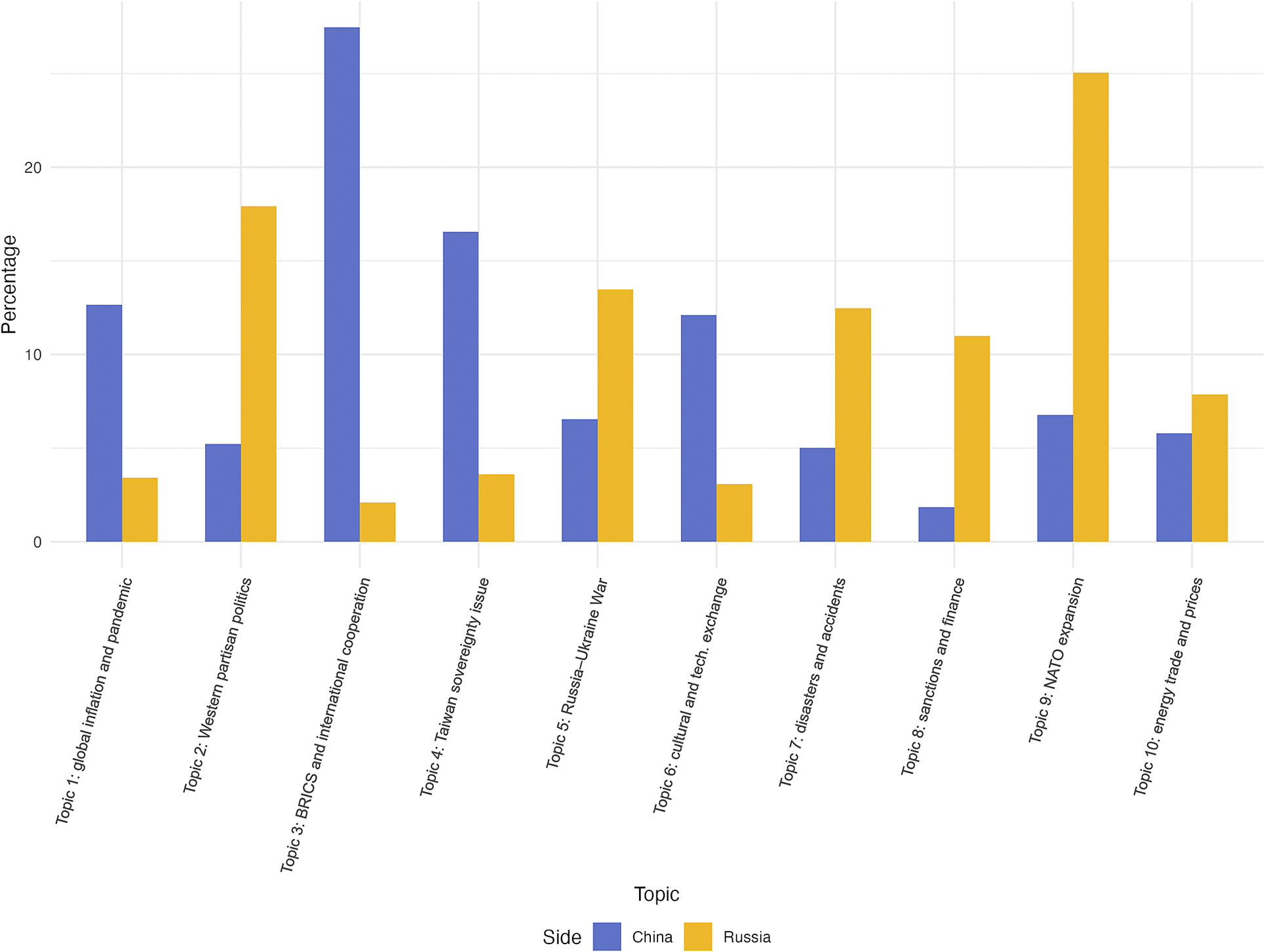
While we calculated expected topic proportions and rankings across the 10 topics for the entire dataset (online appendix, figure A8), given the imbalanced document count between China and Russia, a more meaningful comparison lies in the topic distribution for each country. According to figure 1, the dominant topics for Chinese state media texts are topic 3 (BRICS and international cooperation) and topic 4 (Taiwan sovereignty issue). By contrast, prominent topics for Russia are topic 9 (NATO expansion) and topic 2 (Western partisan politics). This aligns with previous studies finding that the China Global Television Network (CGTN) is less inclined to report on partisan politics than Russia Today (RT) (Moore and Colley Reference Moore and Colley2024).
Topic Proportion for Each Side (Russia and China)

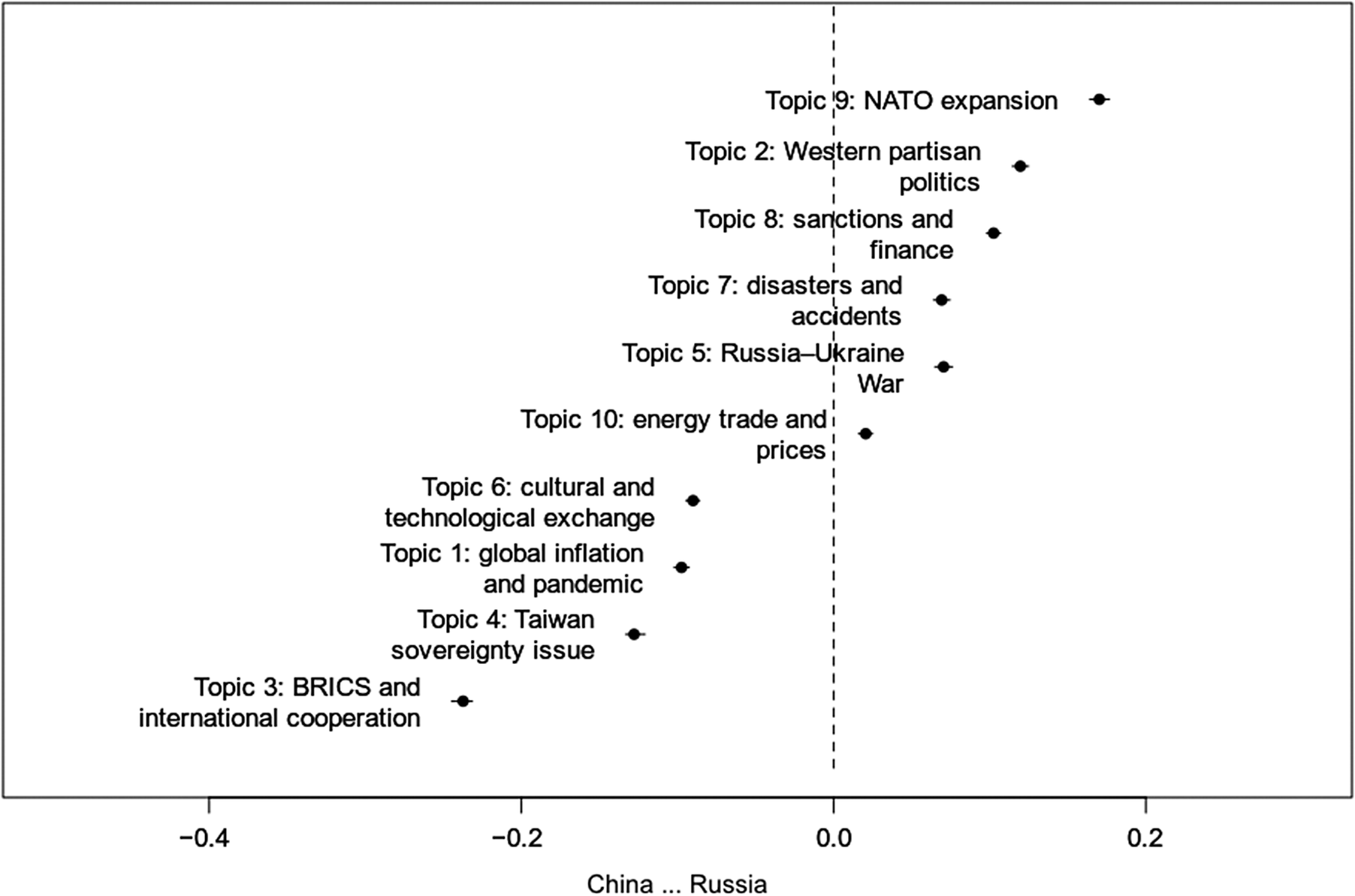
Another way of presenting the differences between the two countries is offered in figure 2, which depicts the variations in the anticipated proportions of 10 topics (Chinese state media are used as the benchmark group). Russian state media place greater emphasis on issues like NATO expansion, Western partisan politics, sanctions and finance, disasters and accidents, the Russia–Ukraine War, and energy trade and prices (i.e., topics 9, 2, 8, 7, 5, and 10). By contrast, China’s state media focus more on themes like BRICS and international collaboration, the Taiwan sovereignty issue, global inflation and the pandemic, and cultural and technological exchanges (i.e., topics 3, 4, 1, and 6).
Topic Prevalence Comparison for Both Sides (China and Russia)
Notes: Topic distribution differences between China and Russia. The graph displays the point estimate along with a 95% confidence interval, showcasing the mean variation in topic percentages between Chinese and Russian state media. The latter serves as the benchmark group.

While some of the differences can be driven by the idiosyncratic importance of certain topics (like Taiwan’s sovereignty) for one of the countries, our findings go in the direction of our basic hypotheses. On the one hand, for both countries topic 9 (NATO expansion)—the most obvious narrative criticizing the West—plays an important role, as H1 would suggest. On the other hand, however, topics 3 and 6 appear much more frequently in the Chinese media than they do in the Russian media. Topic 3 (BRICS and international cooperation) suggests China promotes institutional cooperation with other nations via regional institutions to contribute to the global community. Topic 6 (cultural and technological exchange) portrays China’s efforts in expanding technical, cultural, and digital innovations and exchange, and in facilitating trade and economic ties with other countries. The predominance of these topics in China as opposed to Russia is consistent with H2a: Chinese media are more likely to talk about the substance of cooperation and not merely about its anti-Western nature. Interestingly, Russia highlights topic 7 (disasters and accidents, often referring to the poor performance of Western states in this respect) more than China; again, the focus is on unrestricted and complete criticism of the West.
The Dynamics of Bloc-Building Narratives
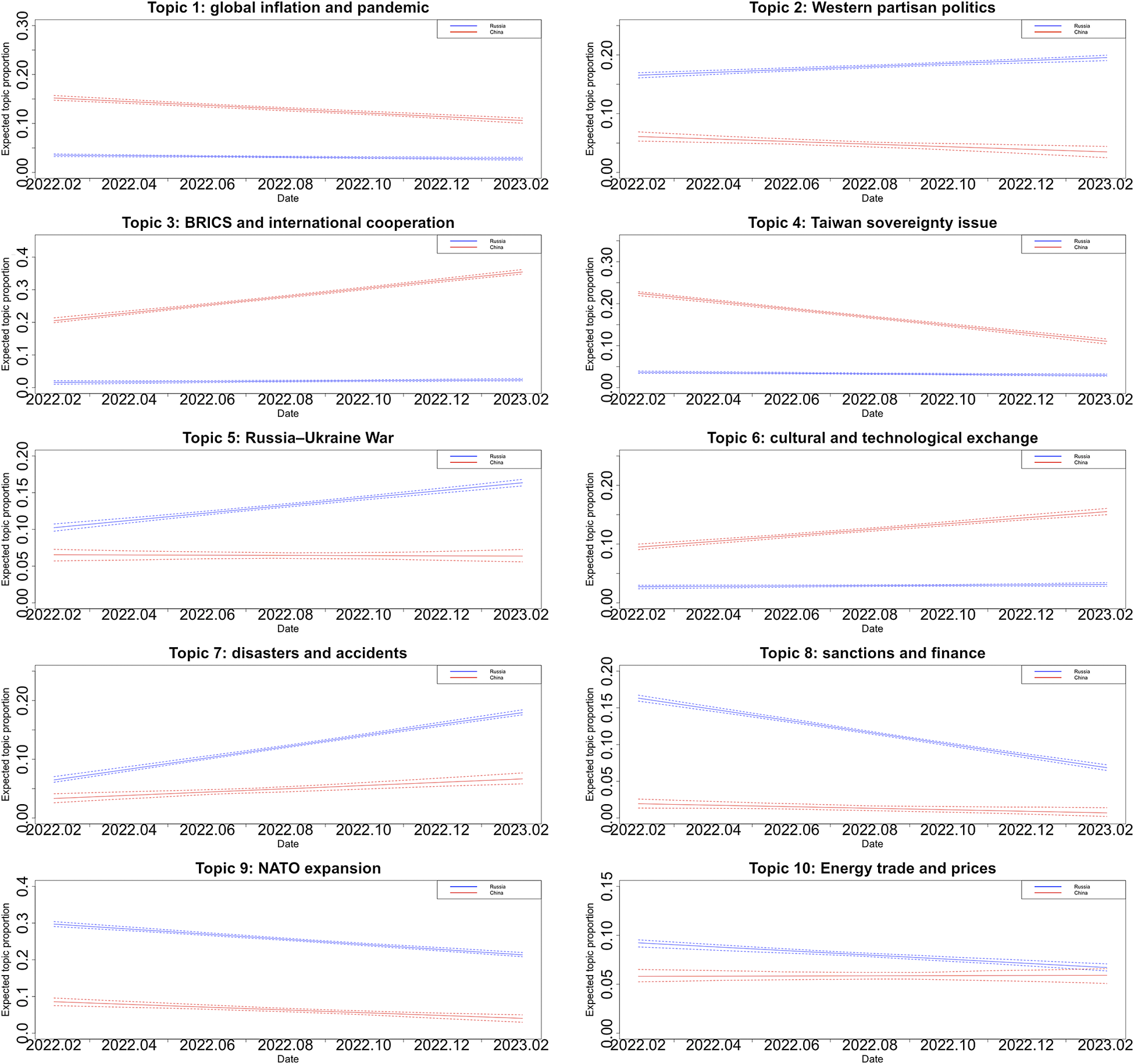
Are there any changes in the frequency of topics during the observation period, one year after the full-scale invasion of Ukraine? To answer this question, we recalculated the STM, incorporating an interaction between country variables and dates. Figure 3 illustrates the linear trends in topic reporting by Russia’s and China’s state media.
Russian and Chinese State Media Reporting Trends on Each Topic over Time
Note: The red line and blue line represent topic prevalence in Chinese media and Russian media, respectively.

The findings highlight both growing similarities and expanding differences across varied topics over the one-year period of our study. The prevalence of topic 1 (global inflation and the pandemic) slightly declined in Chinese official media, while its presence in Russian media remained at a low level. Topic 2 (Western partisan politics) saw an increase in coverage within Russian official media, while its proportion decreased among official Chinese outlets. Topic 3 (BRICS and international cooperation) dominated official Chinese media, revealing a significant surge. However, this theme remained marginally represented in official Russian narratives. A similar trend can also be observed for topic 6 (cultural and technological exchange). Topic 4 (Taiwan sovereignty issue) had a low profile in Russian media, but its previously high prevalence in Chinese official outlets experienced a decline over the past year. A more detailed examination of daily changes in topic proportion (online appendix, figure A5) reveals that the prevalence of topic 4 peaked around the time Speaker of the US House of Representatives Nancy Pelosi visited Taiwan in August 2022.
Topic 5 (the Russia–Ukraine War) experienced a marked surge in Russian official media, whereas its coverage in Chinese media saw a slight decline. Topic 7 (disasters and accidents) noticeably increased in Russian state media but only increased slightly among their Chinese counterparts. After the full-scale invasion, Finland and Sweden decided to seek NATO membership. The prominence of topic 9 (NATO expansion) in Russian official reports peaked during this period, but when the two nations officially joined NATO, interest in the topic decreased significantly. Conversely, this theme has always held relatively little importance among official Chinese media channels. Topic 8 (sanctions and finance) showed a similar trend. Furthermore, the representation of topic 10 (energy trade and prices) in both countries’ official media remained relatively stable and parallel.
Summing up, we observe dynamic shifts in narrative congruence between Russia and China over the period of our observation. First, the topics that saw converging prevalence over the year predominantly relate to broad, ongoing themes like topic 1 (global inflation and the pandemic) or topic 10 (energy trade and prices). Second, some topic divergences remained consistent between the two, with Russia prominently featuring topic 2 (Western partisan politics) and topic 5 (the Russia–Ukraine War), and China focusing on topic 3 (BRICS and international collaboration) and topic 6 (cultural and technological exchange). Again, in line with H2a, China points out the more substantive aspects of collaboration. Moreover, the differences in topic prevalence between the two countries have gradually become more pronounced. Over time, Chinese state media have begun to deliberately downplay the Taiwan issue in its rhetoric to somewhat lessen the focus on confrontation with the West. By contrast, Russia increasingly uses a “diversionary strategy” that emphasizes external disasters, accidents, threats, and conflicts. In essence, the narratives around bloc building between Russia and China are diverging rather than converging. These observations should not be treated as evidence of long-term convergence or divergence patterns—they cover only one year of observations—but are still interesting given how turbulent that year was for two countries we study.
Qualitative Examples
The qualitative analysis corroborates the topic-modeling results and aligns with our expectation about Chinese and Russian narratives. Both countries emphasize (1) the dysfunctionality of developed democratic systems, (2) the US’s exploitation of its allies, and (3) the US’s responsibility for international conflicts. These narratives are interconnected and mutually reinforced, which provides a more complete and more persuasive story for their domestic audiences.
The narrative about individual countries begins with the dysfunctionality of developed democratic regimes, including political polarization and manipulation, shooting incidents, violent police enforcement, poor pandemic response, and racial discrimination (State Council Information Office 2022), all classic themes authoritarian states employ for “downward comparison” (Fu Reference Fu2023). Some news reports are negative but not explicitly framed as persistent problems in democracies. For instance, in May 2022 Russia’s NTV (2022a) cited a report from Rosselkhoznadzor (the governmental agency responsible for the agricultural sector) stating that the US was experiencing its largest avian influenza outbreak in seven years. Similarly, an article in the Chinese People’s Daily states that “for some time now, the costs of fossil fuels such as natural gas, oil, and coal in the United States have surged, further driving up electricity prices. The rise in electricity prices in turn exacerbates inflation issues, leaving middle- and low-income households struggling to cover expenses for food, mortgages, and utilities like water and gas” (Li Reference Li2022). To show the “objectiveness” of their media coverage and delineate their propaganda warfare, Chinese outlets sometimes quote critical news articles from Western media, such as a Global Times piece that cites an article in The Guardian about racism in the US (Namkung and Chen Reference Namkung and Chen2022).
Although a significant portion of negative propaganda is centered on the US, as indicated by the topic-modeling results, the qualitative analysis also demonstrates that Russia and China disseminate negative news about US allies, including the United Kingdom and Germany. One article from Xinhua states, “The UK government’s move [to coexist with COVID-19] will undoubtedly promote the spread of the coronavirus. Multiple datasets show that the UK’s epidemic situation has continuously deteriorated since March, with infection levels reaching an all-time high” (X. Zhao Reference Zhao2022). Another piece from Xinhua states, “Germany is facing its most severe energy crisis in decades, and the public is being forced to revert to the era of heating with wood, which is deeply thought-provoking” (L. Wu Reference Wu2022). Similarly, NTV (2022d) reported on social unrest in France, where thousands of protesters gathered in the heart of Paris near the Palais Royal, stating that “[t]he demonstrators are demanding the resignation of the French President.” Pervyi Kanal (2022d) also mentioned public demonstrations in Germany, noting that “[i]n Leipzig, Germany, over a thousand people participated in a rally protesting against the rise in food and energy prices. They are demanding compensation for the public due to losses from inflation.”
The two states also stress that the US exploits its relationship with its allies and highlight the disparities within the Western bloc. This narrative seeks to expose the vulnerability of the Western bloc and insinuate that cooperating with the US may be harmful to a country’s interests. The responsibility of the US and the Western bloc it dominates for the world’s problems is used to justify attempts to formulate a new multipolar international system and more inclusive norms. As an example of the disparities within the Western bloc, Vesti reports, “German authorities accuse Poland of poisoning the Oder River” (Krasulin Reference Krasulin2022). Another article from Vesti mentions that “there are not only sharp divisions within the EU but also significant disagreements within NATO” regarding sanctions against Russia (Emelyanova Reference Emelyanova2022). Guangming Daily quotes France’s then finance minister, Bruno Le Maire, as saying, “The US establishment of a strong industry should not come at the expense of Europe,” highlighting concerns that the US Inflation Reduction Act might harm European interests (Wang Reference Wang2023). Meanwhile, an article in the Global Times claims that “the United States, deeply mired in political divisions and economic stagnation, on one hand pursued an ‘America First’ policy by undermining its allies and other countries, while on the other hand, it continued to meticulously advance its strategy to contain China” (Chen and Ding Reference Chen and Yazhi2022).
Turning to the narratives about the international system, both Russian and Chinese media suggest that external conflicts are produced and used by the US to distract from its domestic problems. For example, Russia’s Pervyi Kanal (2022b) alleges that “the more internal issues one has, the more actively one needs to create problems externally—this is a long-tested American approach.” Xinhua echoes this sentiment in an article that reads, “For politicians in Washington, China seems to have become their ‘savior.’ Ever since they had China as the ‘scapegoat,’ they felt a burden lifted off their shoulders. Issues like inadequate pandemic response, unemployment, and social injustices within the US seem to no longer be problems. As long as they can place the blame on China, it seems that all problems are resolved” (H. Zhao Reference Zhao2022).
These international conflicts are also depicted as attempts by the US to sustain its hegemony and strategic interests. An article in Vesti (2022a) states, “As Washington loses its influence over global developments, it will become increasingly aggressive and reckless.” Chinese Foreign Ministry spokesperson Zhao Lijian remarked, “Think about what the United States did on its own in the 1960s to Cuba and Panama, in the 1980s to Grenada, in the 1990s to the Federal Republic of Yugoslavia, at the beginning of this century to Afghanistan and Iraq, and later to Syria and Libya. The actions of the US are the widely recognized examples of ‘big countries’ bullying small countries” (Chinese Ministry of Foreign Affairs 2022a). A series of commentary articles in the People’s Daily detailed instances where the US incited color revolutions to disrupt the political stability of countries like Venezuela, Chile, and Georgia, as well as various nations in the Middle East (Xu Reference Xu2022).
Finally, for the narratives about the salient political issue—the Russia–Ukraine War—Russia and China consistently frame it as an example of the US manufacturing external threats to divert domestic focus from its internal problems and consolidate the security of its allies. Vesti (2022c) quotes Lu Shaye, China’s ambassador to France, as saying that “the United States played a role in creating the crises in Ukraine and Taiwan.” NTV (2022b) remarks that, since the start of Russia’s military operation in Ukraine, the stock prices of most US military companies have risen by at least a third, using this as evidence that the US is profiting from the Russia–Ukraine War. People’s Daily published an article stating that “[n]ot only did NATO not disband after the end of the Cold War, but under the leadership of the United States, it expanded eastward five times, ultimately leading to the Russo-Ukrainian conflict” (C. Wu Reference Wu2022).
At the same time, we also need to highlight important differences. At the level of narratives of the international system, as already mentioned, China is critical of US bloc-building initiatives—as illustrated by its stance on bloc confrontation, trade war, and technological blockades (Chinese Ministry of Foreign Affairs 2022b)—and insists that open collaboration is beneficial not only for China and the US but also for other countries. By contrast, Russia uses the narrative of an emerging non-Western bloc and champions the idea of a “power center independent from the West.” NTV (2022c) cites Putin as saying, “The world is heading to real multipolarization, and the new power center in Asia has been rising.” Vesti (2022b) even references Indian astrologer Ajay’s statement that “America’s role in global affairs has been declining and the power center will be transferred from West to East.”
While talking about authoritarian regional organizations, China and Russia have exhibited distinct reporting tendencies concerning regional institutions’ stances on the Russia–Ukraine War. When referencing statements from the BRICS and SCO summits, China places greater emphasis on respecting the sovereignty and territorial integrity of all parties (People’s Daily 2022). Conversely, Russian official media interpret these meetings as non-Western nations endorsing Russia’s war actions. For instance, a report from Pervyi Kanal (2022a) proclaimed, “Half of humanity stands with Moscow. The events surrounding Ukraine did not result in a large-scale isolation of Russia. The summit of the Shanghai Cooperation Organization that concluded yesterday clearly demonstrated this.” Another article from Pervyi Kanal (2022c) quoted the Brazilian president as saying, “The conflict in Ukraine was instigated by NATO and the EU. Sanctions against Moscow are a mistake.” These differences, again, are fully consistent with our expectations.
Similar Tones about Enemies and Divergent Perspectives on Bloc Building
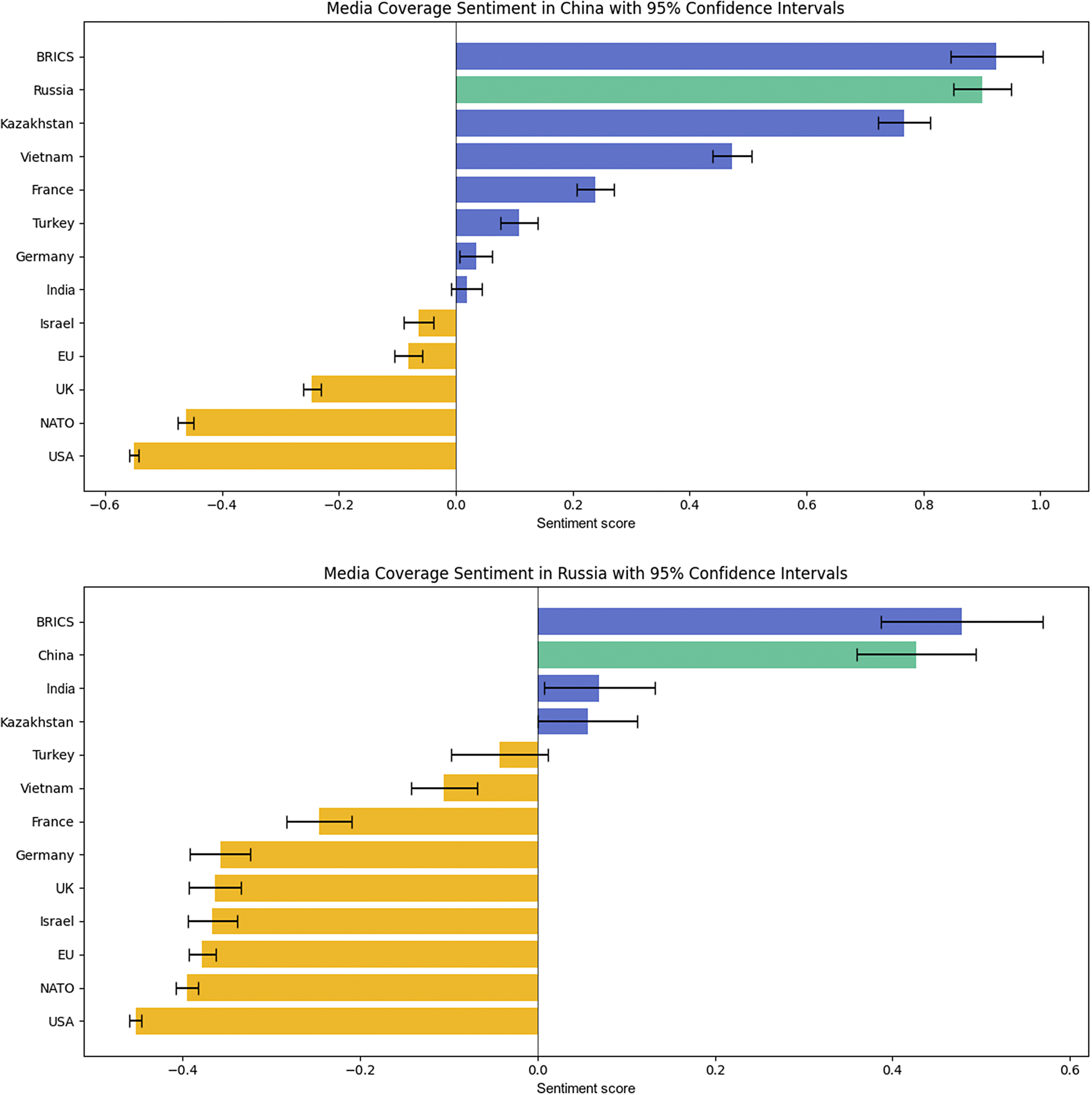
In the next step, we look at sentiment in reports about individual countries by Chinese and Russian media in our corpus. This is important to test hypotheses H1b and H2b. Figure 4 reports the results of the sentiment analysis.
Sentiment Analysis of Russian and Chinese Media Coverage about Other Actors
Notes: We compute sentiment score at sentence level. To achieve this, we generate dummy variables for each sentence, enabling us to track the presence of specific nations or regional institutions. We focus exclusively on sentences that reference solely the target country or regional institution. In other words, sentences incorporating references to two or more entities are systematically excluded. One exception is Russia’s and China’s media coverage of each other, where we allow the sentence if it contains both the country name and BRICS. For each score, 5% confidence intervals are also indicated.

As expected, Chinese and Russian state media consistently employ negative sentiments in their coverage of the US, NATO, and the UK. Russia and China employ highly positive sentiments when reporting about each other and about other BRICS countries. A more interesting difference, however, is in the depiction of European countries (e.g., Germany and France). While there is hardly any difference in the way Russian media report about these countries and the way they report about the US, Chinese media are more nuanced: their negative attitude toward the UK and the US is not matched by a similar attitude toward France and Germany. This is in line with our expectations (H2b).
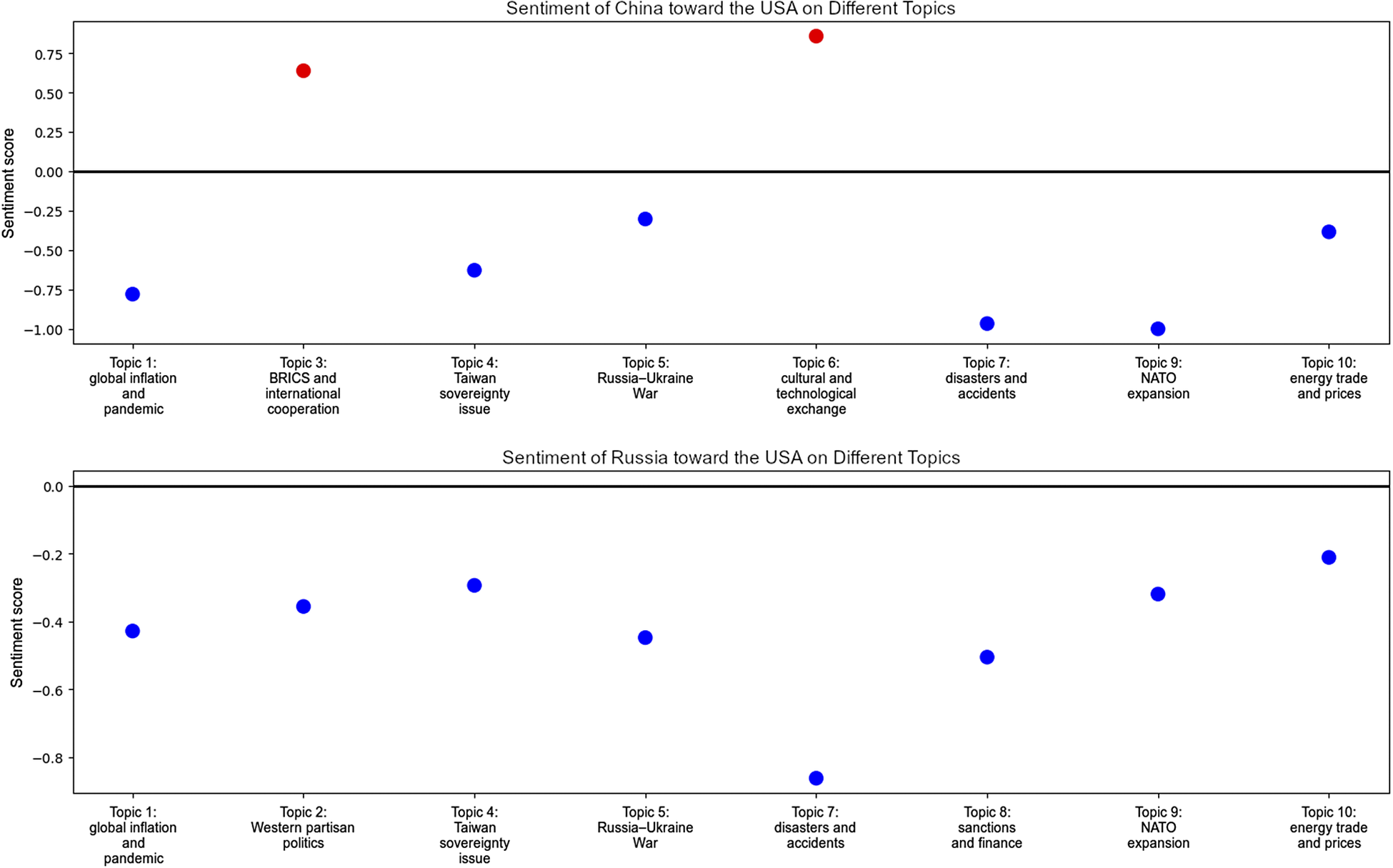
Combining the STM and the sentiment analysis, we find even stronger confirmation of our hypotheses. Figure 5 shows that China uses positive sentiments toward the US in the arenas of topic 3 (BRICS and international cooperation) and topic 6 (cultural and technological exchange), while Russia uses negative sentiments toward the US in all topics. Thus, even the US is a recipient of some types of positive reporting in Chinese propaganda, leaving open avenues for cooperation.
Chinese and Russian Media Coverage about the US across Topics
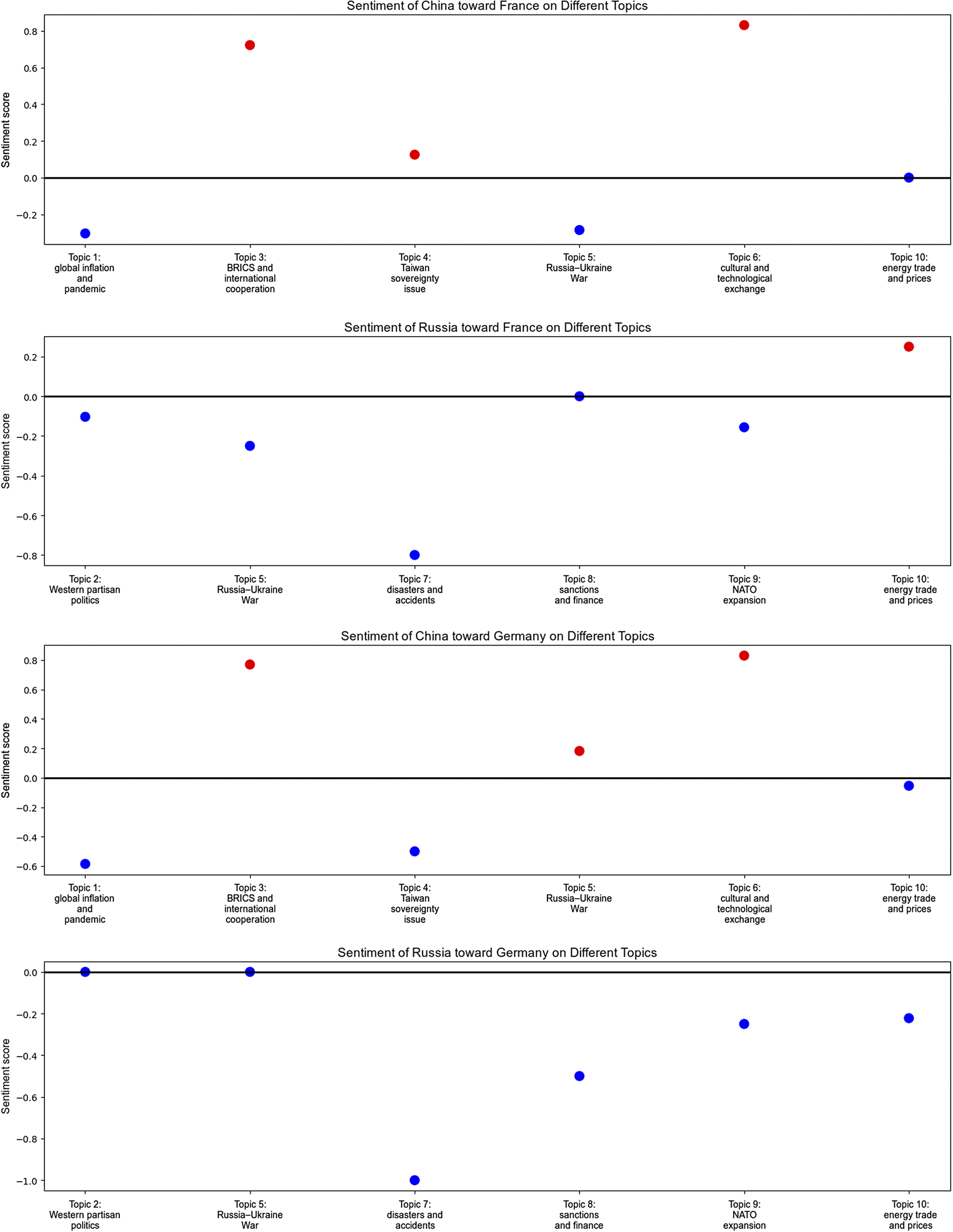
Notes: We assign the most salient topic to each document, and the sentiment across topics is calculated by aggregating the sentiment score of sentences. One document may contain multiple topics, which will cause systematic bias in our approach. To mitigate this problem, we set 80% as the threshold for the salient topics’ estimated proportion of that document. In other words, we mainly select the documents that have a single dominant topic and where the content related to other topics amounts to less than 20%.

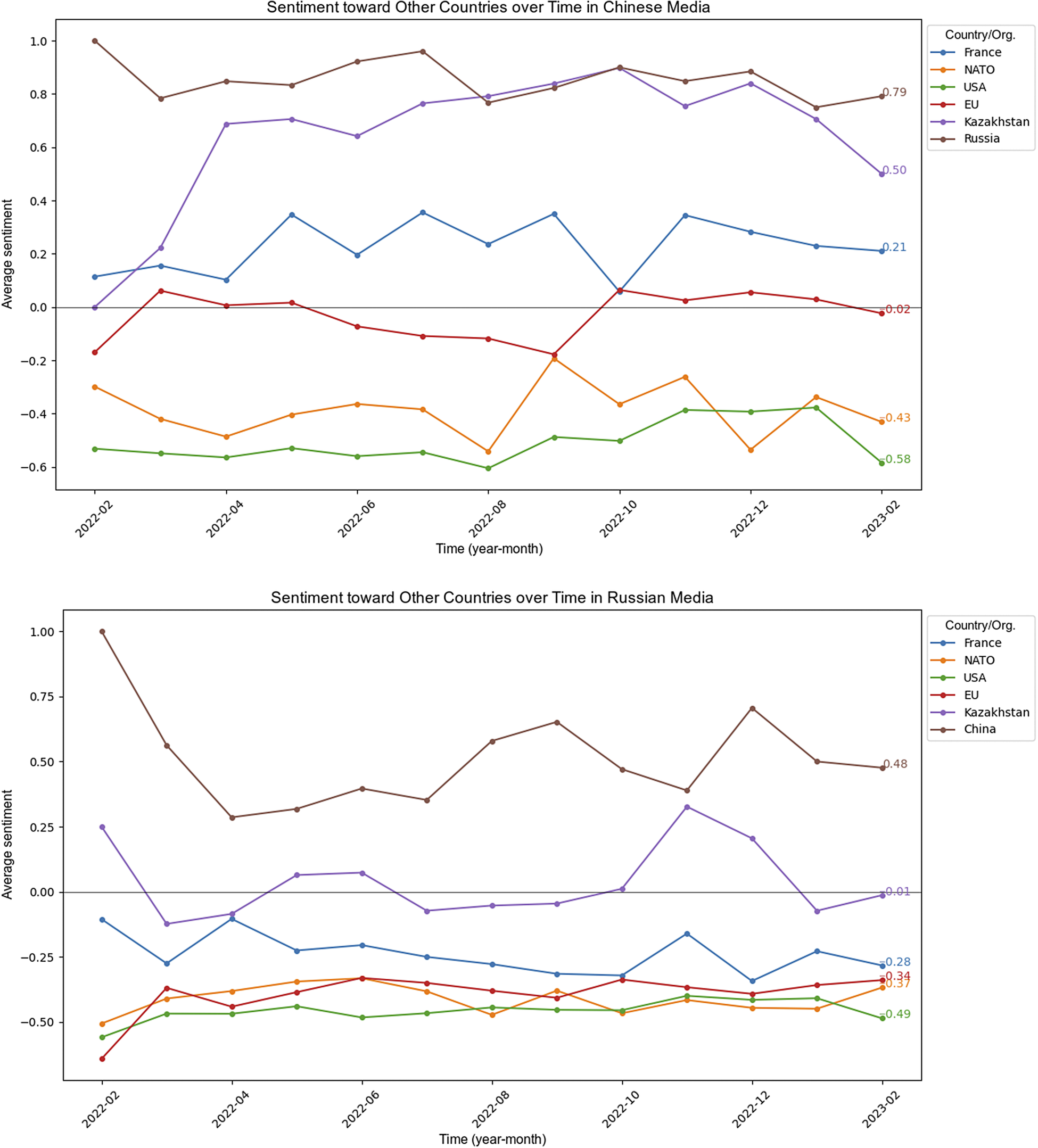
For France and Germany, the results diverge even more. As shown in figure 6, sentiment analysis reveals a difference in the way Chinese and Russian state media report about France and Germany. China directs a relatively high degree of positive sentiment toward France and Germany in areas relating to topic 3 and topic 6, while Russian sentiment toward France and Germany is generally negative for almost all topics. Figure 7 indicates that sentiment toward the EU and France in Russian state media declined rapidly after the outbreak of the war and has been mostly negative since then. In the same period, sentiment toward the EU and France in Chinese state media remained relatively stable for the first six months, with a slight uptick beginning in August 2022. It is clear that China’s state media portray France, Germany, and the EU in a more positive light than Russia’s state media.
Chinese and Russian Media Coverage about France and Germany across Topics

Trends in Chinese and Russian Media Coverage about Other Actors

In addition to examining the full corpus of Russian and Chinese coverage of other countries, we also investigate how each country portrays the other. Using STM and sentiment analysis applied to the subset of Russian reports on China and Chinese reports on Russia, we find both sides have emphasized the threats posed to them by the Western bloc while talking about each other, as shown in the STM results (see topics 3, 4, and 7 in figure A6 in the online appendix). Additionally, China places greater emphasis on multilateral (BRICS) cooperation (topic 10 in figure A6), while Russia stresses bilateral cooperation more (topics 8 and 9 in figure A6). Figures 4 and 7 indicate that China and Russia display significantly more positive sentiment toward each other than toward other international actors. To sum up, Russia and China depict each other as fellow victims of Western hegemony and underscore their comprehensive and deep bilateral cooperation. Beyond the concrete narrative content, we could also identify a strategy of narrative manipulation on a grander level: the deliberate avoidance of arenas where the two states share competing interests, as suggested by previous studies (Chang-Liao Reference Chang-Liao2023; Kaczmarski Reference Kaczmarski2017).
Conclusion
This study has offered a comprehensive view on bloc-building narratives in Russia and China. Some of our findings are more intuitive; others are more unexpected. In terms of intuitive findings confirmed, we have shown that China and Russia both engage in massive anti-US rhetoric as part of their bloc-building narratives directed at their domestic audiences; this is consistent with common perceptions of their foreign policy stance. Against the backdrop of this cooperation, one would expect Chinese and Russian narratives to converge over time; we, however, do not confirm this rather intuitive expectation. On the contrary, China points out tangible benefits from cooperation (e.g., in the economic and cultural sphere), while for Russia anti-Westernism is reason enough. From this point of view, our study comes to another, and to some extent counterintuitive, finding: China and Russia present each other in a highly positive light, even though the actions of one are sometimes at odds with central tenets of the other’s propaganda. Strategic narratives allow the countries to navigate around this problem, reframing their cooperation in a more attractive way.
The results of our analysis have important implications for the literature on cooperation between autocracies. Unlike existing studies, which often assume that a partnership between authoritarian regimes helps to bolster their political legitimacy, our research indicates that having a strategic narrative could be essential in transferring external recognition from authoritarian peers to domestic audiences. These narratives can be adjusted to respond to specific domestic audiences and to ensure consistency with aspects of other narratives. Our findings also engage with propaganda and authoritarian legitimation literature. Previous studies have shown that negative propaganda about adversaries helps authoritarian leaders to divert attention from internal issues (Alrababa’h and Blaydes Reference Alrababa’h and Blaydes2021; Barberá et al. Reference Barberá, Gohdes, Iakhnis and Zeitzoff2024; Fu Reference Fu2023). The results of our study reinforce the long-standing viewpoint that Russia’s state media predominantly highlight external threats and conflict (Alyukov Reference Alyukov2022; Miskimmon and O’Loughlin Reference Miskimmon and O’Loughlin2017; Tyushka Reference Tyushka2021). Narratives constructed by authoritarian states may, however, serve not only to divert attention but also, more ambitiously, to manipulate the public’s perception of geopolitical events and justify their international alignments.
Although our main focus is on the communication of authoritarian regimes with their domestic audiences, we can draw several conclusions with respect to the discussion about the emergence of international illiberal norms (Flonk Reference Flonk2021) and the durability of strategic partnerships between authoritarian regimes (Chang-Liao Reference Chang-Liao2023). We show that at the domestic level, autocracies, united in their discontent with the global order (Andal and Muratshina Reference Andal and Muratshina2022), pursue quite different narrative strategies to frame this discontent, characterizing it as driven by a desire to form an alternative bloc for non-Western states or to reshape international norms for all countries. Russia’s official discourse has been pushing for confrontation with the West, which not only illustrates its diminishing, if not entirely lost, opportunities to cooperate with Western countries, but also impacts its conceptualization and shaping of the functions and directions of the regional organizations it leads. China does not explicitly oppose the West’s dominant ideologies (Aydin Reference Aydin2007), but its use of the term “West” often implicitly criticizes US allies for their submission to US interests and expresses concern about the spread of US imperialism. Our argument from this point of view echoes the analysis of Kaczmarski (Reference Kaczmarski2019), looking at the perception of the world order. Differences in domestic rhetoric can be indicative of the relative weakness of alliances between authoritarian states—in our case, Russia and China (see also Kaczmarski Reference Kaczmarski2017). At the same time, these differences show that regimes have substantial opportunities to “repackage” their cooperation (driven by strategic interests—see Khomyakov Reference Khomyakov2018) to suit various domestic narratives, even when they find the partner’s behavior to be problematic.
Existing literature primarily sheds light on the synergies and disparities in the international communication strategies of authoritarian states (Fan, Pan, and Sheng Reference Fan, Pan and Sheng2024; Moore and Colley Reference Moore and Colley2024; Morales Reference Morales2022; Wagnsson, Blad, and Hoyle Reference Wagnsson, Blad and Hoyle2023). This study enriches our understanding by examining domestic propaganda. Rawnsley (Reference Rawnsley2015) compares the outward digital presences of Russia and China and finds that China’s state news agency focuses on redressing perceived biases and misrepresentations in international news coverage of China, while its counterpart in Russia concentrates on events within the US in the international broadcasting arena. Our examination of Chinese and Russian domestic propaganda is in line with this observation, as we highlight that although Chinese official media have adopted several (mostly anti-West) Russian narratives since the start of the war in Ukraine, they have refrained from replicating narratives centered on jointly endorsed regional organizations and bloc-building endeavors.
This research presents certain limitations. Empirically, our dependence on specific keywords to define the analytical corpus might have inadvertently excluded some representative discourses. Moreover, the use of machine translation for cross-lingual analysis may have introduced elements of information loss. The time frame of this study, limited to the year following the full-scale invasion, might require validation over a more extended period and in broader contexts.
Conceptually, while our study documents the differences between China and Russia, it explains them primarily through the foreign policy orientation of each country. We acknowledge, however, that there may be other differences between the two regimes that explain the differences in their propaganda. For example, the personalities of Xi and Putin could play a certain role—though developing hypotheses to test this would be difficult. The fact that Russia is, at least according to the traditional definitions, an electoral authoritarian regime (although after the full-scale invasion this is contested; see Freedom House 2023) could also matter; for example, Russia could be more interested in constructing “simple” narratives for the general public (to mobilize voters), while China could be offering a more nuanced narrative, focusing to a larger extent on elites. To understand the differences in Russian and Chinese propaganda, one needs to look at how decisions are made in Russia and in China—another fascinating topic for future research.
Furthermore, our study focuses on narrative construction and does not systematically examine the effects of these narratives. While we speculate that authoritarian regimes can solve the problems of cooperating with toxic allies by using strategic narratives, we did not explicitly test for it. Such an analysis would go beyond the framework of this paper and require different tools (like survey experiments). Empirically, while before the invasion the Sino-Russian relationship had long been described as “hot above and cold below”—characterized by close interactions at the leadership level but lacking deep understanding and mutual trust among the general public (Gerber and He Reference Gerber and He2022; Wong and Ho Reference Wong and Ho2022)—recent surveys have revealed a dramatic increase in mutual favorability between the two nations, with the populations of both countries expressing higher regard for each other than for Western countries.Footnote 4 Whether this is indeed a result of propaganda narratives is a question requiring further investigation.
Finally, while China and Russia are very important examples of cooperation between authoritarian states in the modern world, the question of external validity remains. Can (and will) other authoritarian regimes use the same strategy of narrative construction used by China and Russia to extract legitimacy gains from cooperation with other autocrats? For some states this a plausible possibility (e.g., Belarus, which since the mid-1990s has been run by a regime that has extracted legitimacy, among other things, from the promise of closer cooperation with Russia, and has reframed this cooperation to fit its domestic propaganda), but we are cautious of making a general claim. Russia and China are ultimately autocracies with extremely powerful propaganda machines; other regimes may face greater constraints in this respect. We hope our study will stimulate further research on this topic.
Supplementary material
To view supplementary material for this article, please visit http://doi.org/10.1017/S1537592724002202.
Data replication
Data replication sets are available in Harvard Dataverse at: https://doi.org/10.7910/DVN/WWUPFI
Acknowledgments
The authors are grateful to five referees, King-wa Fu, Huang Haifeng, Guo Danqi, Anton Bogs, and participants of “The Digital Reach of the Chinese State: Emerging Research Fields” workshop and the American Political Science Association annual meeting for their helpful comments. We thank Feng Yuyan, Zhang Shilong, Zhang Kaiqi, Katja Schönmeier, Guram Kvaratskhelia, Vladislav Siiutkin, and Svetlana Krupko for their excellent research assistance. Research for this contribution is part of the Cluster of Excellence “Contestations of the Liberal Script” (EXC 2055, Project ID 390715649), funded by the Deutsche Forschungsgemeinschaft (DFG, German Research Foundation) under Germany’s Excellence Strategy.


 Open access

