


People suffering from psychiatric symptoms, even if severe, often do not seek professional help (Reference Bebbington, Meltzer and BrughaBebbington et al, 2000). This is a source of concern in view of the availability of effective treatments for many psychological problems (Reference Meltzer, Bebbington and BrughaMeltzer et al, 2000). The main determinant for seeking help for mental health problems from a health professional is the severity of the symptoms (Reference Bebbington, Meltzer and BrughaBebbington et al, 2000). The lay support system can play an important role in helping people with mental health symptoms (Reference Angermeyer, Matschinger and Riedel-HellerAngermeyer et al, 2001). The initial recognition and response to mental health problems generally takes place in the community (Reference HorwitzHorwitz, 1978) but there has been little research on the attitudes and behaviour of people with regard to non-professional help-seeking. In this paper our aim was to investigate the patterns of lay and professional help-seeking in people aged 16–64 years in relation to severity of symptoms and socio-demographic variables.
METHOD
Survey methods
This analysis is based on a postal questionnaire survey of the prevalence of common mental disorders in Somerset. A computerised random sample of 15 222 adults aged 16–64 years registered with a general practitioner (GP) in Somerset was obtained in January 2001. The sample was stratified by primary care group area (n=4) and population density (n=3 groups). The sample size within each stratum was calculated so that we had 80% power to detect a difference of 5% in the prevalence of minor psychiatric morbidity between subgroups at a 5% significance level, assuming a prevalence in the population as a whole of 10% and a response rate of 60%.
Subjects were mailed a questionnaire that included the 12-item version of the General Health Questionnaire (GHQ–12; Reference GoldbergGoldberg, 1978) and two questions on help-seeking attitudes and behaviour (see below). Because of the possible stigma associated with mental health, the phrase ‘stress or strain’ was used instead of mental health. Participants were asked ‘Have you discussed with anyone in the past few weeks any concerns about the effect on your health of stress or strain in your life?’ and requested to tick one or more of the following response categories: relatives or friends; counsellor; GP; and other (please specify). The second question asked ‘If you felt that your health might be suffering as a result of stress or strain in your life would you consider consulting any of these people?’. The response categories were the same as used in the first question (see above) and for each possible source of help the participants were asked to select one of the following options: yes, maybe or no.
Analysis
The questionnaires were scored using the GHQ–12, a maximum score of 12 indicating a high likelihood of psychiatric illness (Reference Goldberg and WilliamsGoldberg & Williams, 1991). A GHQ–12 score of ≥4 was used as the cut-off point to define common mental disorder (Reference Weich and LewisWeich & Lewis, 1998; Reference Erens and PrimatestaErens & Primatesta, 1999). High GHQ–12 scores were classified into two severity groups (4–7 and 8–12) and the results were analysed using STATA version 7.0 (Stata Corporation, 2001). Univariable differences between groups were tested using χ2 tests. Logistic regression analyses were used to examine the association of help-seeking with symptom severity (GHQ–12 score) and socio-demographic variables. Weights were applied to take into account the sampling fractions used to draw the stratified sample.
RESULTS
Response rates
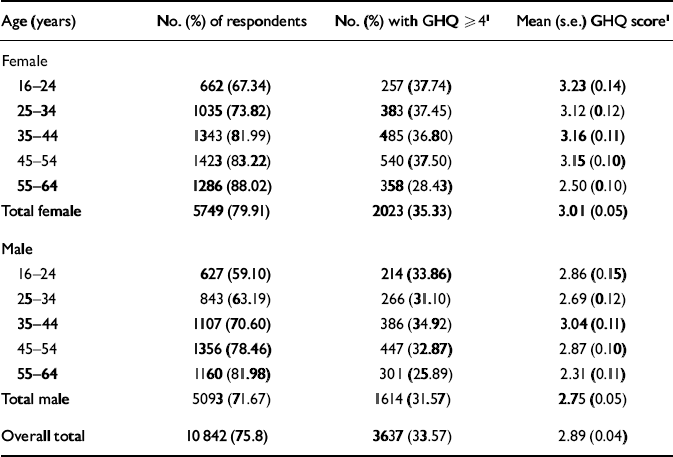
In total 10 842 completed questionnaires were returned after two reminders. By excluding 922 people who were unknown at their recorded address, had moved away or had died, the adjusted response rate was 75.8% (10 842/14 300). The response rate was higher in women than in men (79.9% v. 71.7%; P<0.001) and increased with age (Table 1). The response rates were lower in the more socio-economically deprived wards, as classified by their Townsend score (Reference Townsend, Phillimore and BeattieTownsend et al, 1988). One in three people (33.5%) had a GHQ–12 score of ≥4.
Age and gender distribution of the respondents and the high-scorers: mean GHQ—12 scores by gender and age groups
| Age (years) | No. (%) of respondents | No. (%) with GHQ ≥41 | Mean (s.e.) GHQ score1 |
|---|---|---|---|
| Female | |||
| 16-24 | 662 (67.34) | 257 (37.74) | 3.23 (0.14) |
| 25-34 | 1035 (73.82) | 383 (37.45) | 3.12 (0.12) |
| 35-44 | 1343 (81.99) | 485 (36.80) | 3.16 (0.11) |
| 45-54 | 1423 (83.22) | 540 (37.50) | 3.15 (0.10) |
| 55-64 | 1286 (88.02) | 358 (28.43) | 2.50 (0.10) |
| Total female | 5749 (79.91) | 2023 (35.33) | 3.01 (0.05) |
| Male | |||
| 16-24 | 627 (59.10) | 214 (33.86) | 2.86 (0.15) |
| 25-34 | 843 (63.19) | 266 (31.10) | 2.69 (0.12) |
| 35-44 | 1107 (70.60) | 386 (34.92) | 3.04 (0.11) |
| 45-54 | 1356 (78.46) | 447 (32.87) | 2.87 (0.10) |
| 55-64 | 1160 (81.98) | 301 (25.89) | 2.31 (0.11) |
| Total male | 5093 (71.67) | 1614 (31.57) | 2.75 (0.05) |
| Overall total | 10842 (75.8) | 3637 (33.57) | 2.89 (0.04) |
Attitudes to seeking help
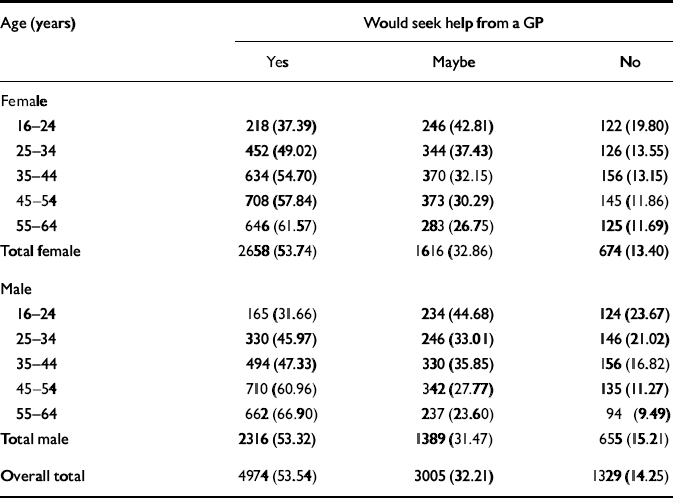
A total of 10 302 (95.0%) respondents completed at least part of the question regarding their attitudes to seeking help for mental health problems. Of these, 8368 (81.2%) said that they would seek some form of help if they thought their health was suffering as a result of stress or strain. Men were less likely than women to say that they would seek help (OR=0.78, 95% CI 0.72–0.88, P<0.001). The preferred source of help was friends or relatives: 6503 (63.1%) respondents said that they would seek help from this source. A total of 14.3% of respondents said that they would not seek help from their GP. The proportion of respondents who indicated that they would consult their GP increased with age (Table 2): 31.7% of 16- to 24-year-old men said that they would consult their GP, compared with 66.9% of 55- to 64-year-olds.
Participants' attitudes towards seeking help from their GP for psychiatric symptoms (weighted data)1
| Age (years) | Would seek help from a GP | ||
|---|---|---|---|
| Yes | Maybe | No | |
| Female | |||
| 16-24 | 218 (37.39) | 246 (42.81) | 122 (19.80) |
| 25-34 | 452 (49.02) | 344 (37.43) | 126 (13.55) |
| 35-44 | 634 (54.70) | 370 (32.15) | 156 (13.15) |
| 45-54 | 708 (57.84) | 373 (30.29) | 145 (11.86) |
| 55-64 | 646 (61.57) | 283 (26.75) | 125 (11.69) |
| Total female | 2658 (53.74) | 1616 (32.86) | 674 (13.40) |
| Male | |||
| 16-24 | 165 (31.66) | 234 (44.68) | 124 (23.67) |
| 25-34 | 330 (45.97) | 246 (33.01) | 146 (21.02) |
| 35-44 | 494 (47.33) | 330 (35.85) | 156 (16.82) |
| 45-54 | 710 (60.96) | 342 (27.77) | 135 (11.27) |
| 55-64 | 662 (66.90) | 237 (23.60) | 94 (9.49) |
| Total male | 2316 (53.32) | 1389 (31.47) | 655 (15.21) |
| Overall total | 4974 (53.54) | 3005 (32.21) | 1329 (14.25) |
Help-seeking behaviour of the participants with a high GHQ–12 score
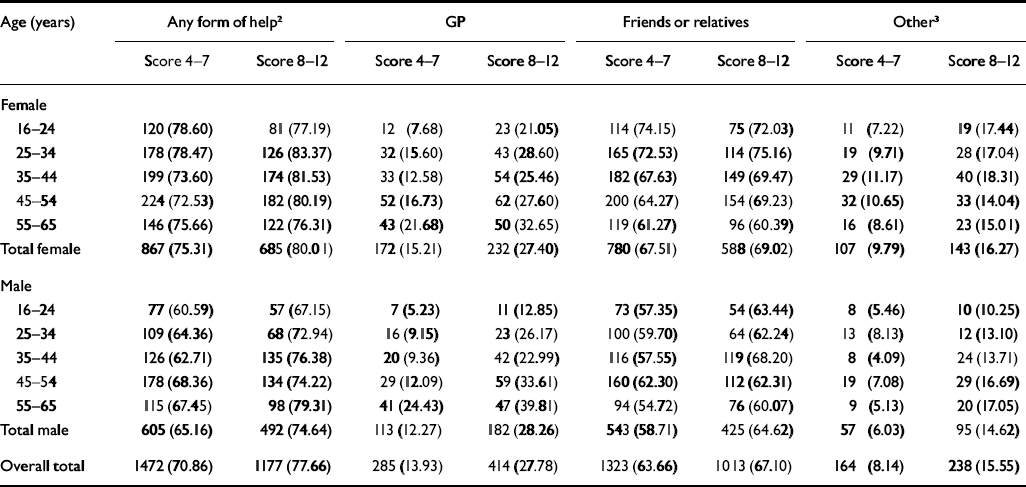
Table 3 shows the reported patterns of help-seeking behaviour for the respondents with a score of ≥4 in the GHQ–12; results are stratified according to the GHQ–12 score (4–7 and 8–12). Over 20% of those with higher scores (≥8) had not sought help from anyone. Men were less likely than women to have sought some form of help (OR=0.66, 95% CI 0.56–0.77, P<0.001). The most commonly used source of help was friends and relatives. Participants with GHQ–12 scores of 8–12 were more likely to have sought help from their GP than those with scores of 4–8 (OR=2.38, 95% CI 1.99–2.84, P<0.001), but only 28% of people with the highest GHQ–12 scores (≥8) had sought GP help.
Number (%) of respondents with raised 12-item General Health Questionnaire (GHQ—12) scores of ≥4 seeking help from various sources according to their GHQ—12 score (weighted data)1
| Age (years) | Any form of help2 | GP | Friends or relatives | Other3 | ||||
|---|---|---|---|---|---|---|---|---|
| Score 4-7 | Score 8-12 | Score 4-7 | Score 8-12 | Score 4-7 | Score 8-12 | Score 4-7 | Score 8-12 | |
| Female | ||||||||
| 16-24 | 120 (78.60) | 81 (77.19) | 12 (7.68) | 23 (21.05) | 114 (74.15) | 75 (72.03) | 11 (7.22) | 19 (17.44) |
| 25-34 | 178 (78.47) | 126 (83.37) | 32 (15.60) | 43 (28.60) | 165 (72.53) | 114 (75.16) | 19 (9.71) | 28 (17.04) |
| 35-44 | 199 (73.60) | 174 (81.53) | 33 (12.58) | 54 (25.46) | 182 (67.63) | 149 (69.47) | 29 (11.17) | 40 (18.31) |
| 45-54 | 224 (72.53) | 182 (80.19) | 52 (16.73) | 62 (27.60) | 200 (64.27) | 154 (69.23) | 32 (10.65) | 33 (14.04) |
| 55-65 | 146 (75.66) | 122 (76.31) | 43 (21.68) | 50 (32.65) | 119 (61.27) | 96 (60.39) | 16 (8.61) | 23 (15.01) |
| Total female | 867 (75.31) | 685 (80.01) | 172 (15.21) | 232 (27.40) | 780 (67.51) | 588 (69.02) | 107 (9.79) | 143 (16.27) |
| Male | ||||||||
| 16-24 | 77 (60.59) | 57 (67.15) | 7 (5.23) | 11 (12.85) | 73 (57.35) | 54 (63.44) | 8 (5.46) | 10 (10.25) |
| 25-34 | 109 (64.36) | 68 (72.94) | 16 (9.15) | 23 (26.17) | 100 (59.70) | 64 (62.24) | 13 (8.13) | 12 (13.10) |
| 35-44 | 126 (62.71) | 135 (76.38) | 20 (9.36) | 42 (22.99) | 116 (57.55) | 119 (68.20) | 8 (4.09) | 24 (13.71) |
| 45-54 | 178 (68.36) | 134 (74.22) | 29 (12.09) | 59 (33.61) | 160 (62.30) | 112 (62.31) | 19 (7.08) | 29 (16.69) |
| 55-65 | 115 (67.45) | 98 (79.31) | 41 (24.43) | 47 (39.81) | 94 (54.72) | 76 (60.07) | 9 (5.13) | 20 (17.05) |
| Total male | 605 (65.16) | 492 (74.64) | 113 (12.27) | 182 (28.26) | 543 (58.71) | 425 (64.62) | 57 (6.03) | 95 (14.62) |
| Overall total | 1472 (70.86) | 1177 (77.66) | 285 (13.93) | 414 (27.78) | 1323 (63.66) | 1013 (67.10) | 164 (8.14) | 238 (15.55) |
Other sources of help also played an important role: 6.1% of people with a GHQ–12 score of ≥4 reported to have sought help from a counsellor and 6.2% cited other sources of help. These other sources more commonly included work-related sources such as the manager or boss and work colleagues (2.0%) and medical professionals other than the GP (e.g. psychiatrists, nurses or psychologists, 1.9%).
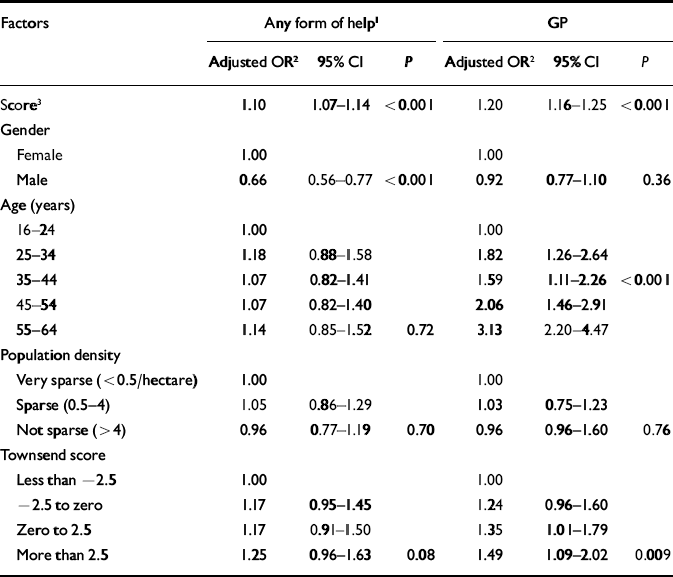
Table 4 presents the results of the logistic regression analysis based on survey respondents with a GHQ–12 score of ≥4 who completed the question on help-seeking behaviour (n=3589). We examined the association of GHQ–12 score and socio-demographic variables with reported help-seeking from all sources but specifically from the GP.
Factors associated with help-seeking for mental health problems among those scoring ≥4 on the 12-item General Health Questionnaire (GHQ—12, n=3559; weighted data)
| Factors | Any form of help1 | GP | ||||
|---|---|---|---|---|---|---|
| Adjusted OR2 | 95% CI | P | Adjusted OR2 | 95% CI | P | |
| Score3 | 1.10 | 1.07-1.14 | <0.001 | 1.20 | 1.16-1.25 | <0.001 |
| Gender | ||||||
| Female | 1.00 | 1.00 | ||||
| Male | 0.66 | 0.56-0.77 | <0.001 | 0.92 | 0.77-1.10 | 0.36 |
| Age (years) | ||||||
| 16-24 | 1.00 | 1.00 | ||||
| 25-34 | 1.18 | 0.88-1.58 | 1.82 | 1.26-2.64 | ||
| 35-44 | 1.07 | 0.82-1.41 | 1.59 | 1.11-2.26 | <0.001 | |
| 45-54 | 1.07 | 0.82-1.40 | 2.06 | 1.46-2.91 | ||
| 55-64 | 1.14 | 0.85-1.52 | 0.72 | 3.13 | 2.20-4.47 | |
| Population density | ||||||
| Very sparse (<0.5/hectare) | 1.00 | 1.00 | ||||
| Sparse (0.5-4) | 1.05 | 0.86-1.29 | 1.03 | 0.75-1.23 | ||
| Not sparse (>4) | 0.96 | 0.77-1.19 | 0.70 | 0.96 | 0.96-1.60 | 0.76 |
| Townsend score | ||||||
| Less than -2.5 | 1.00 | 1.00 | ||||
| -2.5 to zero | 1.17 | 0.95-1.45 | 1.24 | 0.96-1.60 | ||
| Zero to 2.5 | 1.17 | 0.91-1.50 | 1.35 | 1.01-1.79 | ||
| More than 2.5 | 1.25 | 0.96-1.63 | 0.08 | 1.49 | 1.09-2.02 | 0.009 |
The factors most strongly associated with some form of help-seeking were female gender and GHQ–12 score. For every one unit increase in the GHQ–12 the likelihood of help-seeking increased by 10% (95% CI 7–14%). The factors most strongly associated with GP consultation were increasing age, GHQ–12 score and living in a more socio-economically deprived ward. People aged 55–64 years were three times more likely to consult their GP than those aged 16–24 years.
We found no evidence that the association of GHQ–12 score with any form of help-seeking differed with gender (P interaction=0.40) or with age (P interaction=0.26). The same applied for the association between GHQ–12 score and GP help-seeking (score and gender P interaction=0.14 and score and age P interaction=0.21).
DISCUSSION
Main findings
The respondents’ preferred source of help was their friends and relatives; of note, nearly a quarter of respondents said that they would not seek any form of help and one in six people said that they would not seek help from their GP if their health was suffering as a result of stress and strain in their lives. These intentions correlate well with what those with GHQ–12 scores ≥4 reported they had actually done. The largest proportion had sought help from their lay support networks, only one in five (or 14% of those with GHQ–12 scores of 4–7 and 28% of those with scores of 8–12) said that they had consulted their GP and approximately a quarter said that they had not sought help from anyone.
Women with common mental disorders were more likely to have sought some form of help than men. Young people were less likely to have sought help from their GP but more likely to have used lay sources of help.
In our study, only 16% of the respondents with common mental disorder had sought help from a counsellor and only 14% said that they would consult a counsellor if they developed health problems as a result of stress or strain, therefore counselling did not appear to be a significant alternative source of help to GPs in terms of people's preferences. This finding contrasts with those from a recent qualitative study in the UK that reported that counselling was the preferred option for the management of minor psychiatric disorders (Reference Pill, Prior and WoodPill et al, 2001).
After controlling for severity of symptoms, age, gender and population density, we found that people living in the most socio-economically deprived wards were more likely to consult their GP. Possible reasons for this could include weaker social support networks or having more time to visit the GP, for example, as a result of unemployment.
It has been reported that levels of GP consultation are lower in rural compared with urban areas (Gunnell & Martin, 2003). We did not find any association between rurality and help-seeking behaviour. This could be due to differences in the classification of rural areas. Somerset is a rural county and even the most densely populated areas are relatively sparsely populated.
Strengths and limitations
This was a large study that provided a unique opportunity to explore help-seeking behaviour for mental health problems in the community. Unlike most published studies, we studied both lay and professional sources of help. Our response rate was relatively high (75.8%) but only 59% of 16- to 24-year-old men responded and non-respondents differed from respondents in terms of the distribution of socioeconomic variables. It is known that nonrespondents to the GHQ–12 have a higher prevalence of psychiatric morbidity (Reference Williams and MacdonaldWilliams & MacDonald, 1986) and it is possible that the attitudes and behaviour towards seeking help among the nonrespondents in our study are different from those of the respondents.
There are limitations with cross-sectional data. We asked people if they had sought help in the previous few weeks but we did not have information about their subsequent and earlier patterns of help-seeking. Furthermore, our study does not provide information about the personal beliefs and motivations underlying the help-seeking intentions and behaviour of the participants. Qualitative studies are needed to provide such information.
What is already known in this area area?
Little has been published in terms of help-seeking attitudes and behaviour from lay sources of help. A study of 16- to 24-year-olds in Britain reported that lay sources were preferred for mental health problems (Reference Biddle, Gunnell and SharpBiddle et al, 2004). In Germany the lay support system is the preferred source of help for depression (Reference Angermeyer, Matschinger and Riedel-HellerAngermeyer et al, 2001), however in an Israeli study friends and family were only the third major source of help after health professionals and GPs (Reference Rabinowitz, Gross and FeldmanRabinowitz et al, 1999). This latter finding may reflect differences in questionnaire design because the respondents could choose just one preferred source of help. A study of the informal response of social networks to mental illness found that the friendship network was a particularly striking source of help for people with mental health problems (Reference HorwitzHorwitz, 1978).
Common mental health problems such as depression are self-limiting conditions and it is unclear whether the lack of treatment for mild mood disorders results in worse outcomes (Reference Coryell, Endicott and WinokurCoryell et al, 1995). However, a high initial GHQ–12 score is associated with a chronic course of psychiatric illness and high consultation rates (Reference Lloyd, Jenkins and MannLloyd et al, 1996). It is possible that the people who do not seek help from any source may be at an increased risk of suicide or chronic morbidity. Young men are particularly reluctant to seek help unless severely distressed, which may be important in understanding the high suicide rate for men (Reference Biddle, Gunnell and SharpBiddle et al, 2004).
Patients with psychiatric disorders most commonly consult their GPs for physical symptoms so it has been argued that improving the recognition of mental health problems, for example by using patient-completed questionnaires, will directly benefit patient care (Reference WrightWright, 1996). Possible reasons for the reluctance to seek help from GPs include stigma associated with mental health problems (Reference Paykel, Hart and PriestPaykel et al, 1998), concerns that GPs are not well trained (Reference Paykel, Hart and PriestPaykel et al, 1998), concerns that a record in their notes will compromise future job prospects and concerns that the GP will prescribe pills.
It has been argued that because only a minority of people seek professional help, self-help skills are of great importance (Reference JormJorm, 2000) and that self and informal care should be supported and developed for some problems (Reference Rogers, Entwistle and PencheonRogers et al, 1998).
Implications
This study indicates that people prefer to seek help for minor mental health problems from lay sources, and many individuals, particularly males, choose not to seek any form of help.
Health services should promote and support self and lay care for minor mental health problems and improve people's knowledge of both when and how to seek professional help and how to provide effective support for a depressed friend or family member.
There is a need to investigate further the beliefs that underlie the decision not to seek any form of help by some people and whether these people are at particular risk of the most adverse outcomes.
Clinical Implications and Limitations
CLINICAL IMPLICATIONS
-
▪ Most people with minor mental health problems seek help from their friends and relatives rather than from health professionals.
-
▪ Only a quarter of people with high scores on the 12-item version of the General Health Questionnaire (GHQ–12) (≥8) had sought help from their general practitioner (GP) in the previous few weeks.
-
▪ Younger people (aged 16–24 years) with psychiatric symptoms are least likely to seek help from their GP.
LIMITATIONS
-
▪ It is possible that the attitudes and behaviour towards seeking help for mental health problems could be different among the non-respondents to the questionnaire, which could have introduced non-response bias.
-
▪ There are limitations with cross-sectional data. We asked people if they had sought help in the previous few weeks but we did not have information about their subsequent and earlier patterns of help-seeking.
-
▪ We screened a sample of the population for psychiatric morbidity with the GHQ–12 but we did not attempt to diagnose specific psychiatric disorders.
Acknowledgements
The authors thank all the people who participated in this study. We also. thank Jacq Clarkson for her advice and Nigel Holland for providing ward-level. data on deprivation and population density.




eLetters
No eLetters have been published for this article.