





Introduction
Comorbidity of common mental health disorders, such as anxiety, mood, and stress disorders, with substance use disorders is prevalent and associated with substantial negative health and socioeconomic consequences (Barrio, Reynolds, García-Altés, Gual, & Anderson, Reference Barrio, Reynolds, García-Altés, Gual and Anderson2017; Kelly & Daley, Reference Kelly and Daley2013; Morojele, Saban, & Seedat, Reference Morojele, Saban and Seedat2012; Rehm & Shield, Reference Rehm and Shield2019; Roberts, Roberts, Jones, & Bisson, Reference Roberts, Roberts, Jones and Bisson2015; Santucci, Reference Santucci2012; Torrens, Rossi, Martinez-Riera, Martinez-Sanvisens, & Bulbena, Reference Torrens, Rossi, Martinez-Riera, Martinez-Sanvisens and Bulbena2012; Trautmann, Rehm, & Wittchen, Reference Trautmann, Rehm and Wittchen2016; Wilmer, Anderson, & Reynolds, Reference Wilmer, Anderson and Reynolds2021; Woodward et al., Reference Woodward, Wilens, Glantz, Rao, Burke and Yule2023). Furthermore, there are behaviors that are considered potentially addictive, similar to substances. While disorders due to some behaviors (internet gaming, gambling) are formally categorized with substances in the International Classification of Diseases version 11 (ICD-11) (ICD-11, 2024), one (compulsive sexual behavior) is categorized with impulse control disorders, and others (technology-related behaviors) have not been formally defined. Yet, these problematic behaviors are often associated with and share many features of substance addiction, including negative consequences (Baggio et al., Reference Baggio, Starcevic, Billieux, King, Gainsbury, Eslick and Berle2022; Burleigh, Griffiths, Sumich, Stavropoulos, & Kuss, Reference Burleigh, Griffiths, Sumich, Stavropoulos and Kuss2019; Chung & Lee, Reference Chung and Lee2023; Latvala, Lintonen, & Konu, Reference Latvala, Lintonen and Konu2019) and comorbidity with mental health disorders (Freimuth et al., Reference Freimuth, Waddell, Stannard, Kelley, Kipper, Richardson and Szuromi2008; Hussain & Griffiths, Reference Hussain and Griffiths2018; Petry, Zajac, & Ginley, Reference Petry, Zajac and Ginley2018; Starcevic & Khazaal, Reference Starcevic and Khazaal2017).
To help development of efficacious prevention strategies and integrated treatment protocols, a more precise understanding of the comorbidity is needed. Although many studies have shown association between pairs of disorders, such as depression and specific substance use disorders (Hunt, Malhi, Lai, & Cleary, Reference Hunt, Malhi, Lai and Cleary2020), the interactions between common mental health disorders and substance and other behavioral addictions are complex (Boschloo et al., Reference Boschloo, van Borkulo, Rhemtulla, Keyes, Borsboom and Schoevers2015). (For ease of reading, the term addiction is used to refer to both problematic substance use and potentially addictive behaviors.) Thus, analytical methods that consider multiple measures simultaneously may be advantageous to use to identify which specific addictions are most strongly and uniquely associated with common mental health disorders.
While many studies have shown that mood (e.g. depression), anxiety, and stress disorders (e.g. post-traumatic stress disorder [PTSD]), and addictions, are often associated (Hunt et al., Reference Hunt, Malhi, Lai and Cleary2020; Kelly & Daley, Reference Kelly and Daley2013; María-Ríos & Morrow, Reference María-Ríos and Morrow2020; Santucci, Reference Santucci2012; Turner, Mota, Bolton, & Sareen, Reference Turner, Mota, Bolton and Sareen2018), most studies tend to be granular, looking at the association of one addiction and at most a few mental health disorders (e.g. PTSD with alcohol use disorder (Smith & Cottler, Reference Smith and Cottler2018) and problematic gambling (Moore & Grubbs, Reference Moore and Grubbs2021; Tang, Kim, Hodgins, McGrath, & Tavares, Reference Tang, Kim, Hodgins, McGrath and Tavares2020); and depression and anxiety with problematic use of social media (Hussain, Wegmann, Yang, & Montag, Reference Hussain, Wegmann, Yang and Montag2020), internet (Carli et al., Reference Carli, Durkee, Wasserman, Hadlaczky, Despalins, Kramarz and Kaess2013; Cerniglia et al., Reference Cerniglia, Zoratto, Cimino, Laviola, Ammaniti and Adriani2017; Chung & Lee, Reference Chung and Lee2023), and cell phones (De-Sola Gutiérrez, Rodríguez de Fonseca, & Rubio, Reference De-Sola Gutiérrez, Rodríguez de Fonseca and Rubio2016; Thomée, Reference Thomée2018)). Yet, it is often unclear if these associations are unique or are due to the co-occurrence of other addictions or mental health disorders (Marmet et al., Reference Marmet, Studer, Wicki, Bertholet, Khazaal and Gmel2019). For example, one study that investigated multiple substance and behavioral addictions with mental health disorders, including depression, showed that addictions explained a substantive percent of variance in mental health disorders (20%–25%), with about half from specific addictions, and half shared across all addictions, with more variance explained by addictive behaviors (Marmet et al., Reference Marmet, Studer, Wicki, Bertholet, Khazaal and Gmel2019). These results suggest that due to the shared variance, studies that simultaneously explore interactions between multiple addictions and other mental health disorders, that are all expected to be associated with each other, may perform better at identifying which associations appear to be unique, i.e. not due to other, related measures.
Network analysis, a set of statistical tools that can be used to disentangle reciprocal associations between many variables, is an ideal approach for exploring comorbidity by determining which specific disorders are most strongly and uniquely associated (Borsboom, Reference Borsboom2017; Borsboom & Cramer, Reference Borsboom and Cramer2013). Networks include nodes (e.g. addiction and other mental health variables), which are connected through edges, based on the association between the variables, adjusted for all the other variables in the network. This adjustment results in estimation of the unique association between variables, i.e., not due to relationships with other variables (Epskamp & Fried, Reference Epskamp and Fried2018). Furthermore, networks can be viewed as a series of linked multiple regression models, with each node being predicted by all other variables, but also predicting the other nodes. This inter-connectedness can suggest possible mechanisms underlying observed correlations. For example, if two variables (A and B) are both connected to a third variable C, this suggests that the relationship between variables A and B may at least partially be due to variable C (Epskamp & Fried, Reference Epskamp and Fried2018).
Network analysis studies have investigated comorbidity between a wide range of physical and mental disorders, (e.g. Aguado, Moratalla-Navarro, López-Simarro, & Moreno, Reference Aguado, Moratalla-Navarro, López-Simarro and Moreno2020; Kuan et al., Reference Kuan, Denaxas, Patalay, Nitsch, Mathur and Gonzalez-Izquierdo2023), and identified clusters of related disorders, such as depression, anxiety, and alcohol and drug misuse (Kuan et al., Reference Kuan, Denaxas, Patalay, Nitsch, Mathur and Gonzalez-Izquierdo2023). But there is a lack of network analysis studies that include a wide range of substance and behavioral addictions and mood, anxiety, and stress disorders, with the goal of identifying the unique associations underlying the comorbidity rather than describing co-occurrence that may be due to other measures. Some of the associations previously identified in less complex models are expected to be replicated, adding strong evidence that such associations are key to comorbidity, while other associations are expected to not be replicated, possibly because they are due to related addictions or mental health disorders (not included in simpler models). This information can inform the development of interventions that are appropriately targeted to the uniquely associated addictions and other mental health disorders.
Therefore, in data from a general population sample in Israel, network analysis methods were used to explore the simultaneous associations between problematic non-medical substance use (alcohol; tobacco; cannabis; and prescription sedatives; stimulants; and opioid painkillers) and other addictive behaviors (electronic gaming; gambling; compulsive sexual behavior; and pornography, internet, social media, and smartphone use), and common mental health problems (general anxiety, depression, and PTSD). The main aim of these analyses is to identify which addictions are most uniquely and strongly related to which common mental health problems, to provide information for designing prevention and intervention strategies. Additionally, this study shows the applicability of network analysis for simplifying complex relationships between multiple related variables and suggesting how variables may be related.
Methods
From a general population sample of adults in Israel, cross-sectional data were collected from 27 November—12 December 2023, similar to an epidemiological survey from 2022 (Shmulewitz, Eliashar, Levitin, & Lev-Ran, Reference Shmulewitz, Eliashar, Levitin and Lev-Ran2023). Respondents were recruited from a diverse panel of individuals who choose to participate in surveys (iPanel, n.d.). Respondents were Hebrew speaking and Jewish, since substantial adaptations would be required to include different cultural groups (Gjersing, Caplehorn, & Clausen, Reference Gjersing, Caplehorn and Clausen2010), and aged 18–70, as older individuals are less likely to participate in online surveys. To construct a quasi-representative sample of the adult, Hebrew-speaking, Jewish population in Israel, a stratified sample was drawn from the panel, utilizing specified quotas (Fricker R, Reference Fricker R, Fielding, Lee and Blank2016) based on age, gender, geographic area, and religiosity. Quotas were set based on Israel Census Bureau data for 2023 (Central Bureau of Statistics, 2023); deviations of up to 3% from the quotas were allowed. Potential participants were selected in two ways: all respondents surveyed previously (in 2022) were invited to participate, as were a random sample of other panel members. Individuals who accepted the invitation were screened against the quotas until the target numbers were met. All participants provided electronic informed consent. Confidentiality was maintained by iPanel not having access to survey responses, and identifying information not being available to the researchers. Survey methodology was consistent with the ICC/ESOMAR International Code on Market and Social Research (iPanel, n.d.). The Institutional Review Board of the Reichman University approved the study.
Qualtrics (Qualtrics XM, n.d.) was used to conduct the online survey, which assessed sociodemographics, substance use, addictive behaviors, psychopathology, and risk and protective factors, utilizing valid, widely used instruments. Anonymous online surveys may be better for collecting potentially sensitive information such as substance use (Belackova & Drapalova, Reference Belackova and Drapalova2022). Upon survey completion, participants received online gift cards worth 20 ILS. Quality assurance was maintained by: inviting registered individuals; 4 attention checks; and removing incomplete surveys. Of those invited to participate (17 267), 6765 agreed, 1318 were excluded due to quotas, and 1445 did not complete the survey (638 failed attention checks, 807 dropped out), for an analytical sample of 4002.
Measures
Problematic substance use
The Alcohol, Smoking and Substance Involvement Screening Test (ASSIST 3.1) was administered (Humeniuk, Henry-Edwards, Ali, Poznyak, & Monteiro, Reference Humeniuk, Henry-Edwards, Ali, Poznyak and Monteiro2010; Shmulewitz et al., Reference Shmulewitz, Eliashar, Levitin and Lev-Ran2023). Respondents selected substances they ever used non-medically (tobacco, alcohol, cannabis, sedatives, prescription stimulants, prescription opioid painkillers), and then answered six questions related to the frequency of use, craving, and consequences of use, for each substance ever used. Responses were weighted and summed into substance involvement scores (Humeniuk et al., Reference Humeniuk, Henry-Edwards, Ali, Poznyak and Monteiro2010) (Supplementary Table 1). Symptoms that were not assessed due to logical skips, e.g., symptoms for a substance that was never used, were coded as 0 (no/never) (Borsboom & Cramer, Reference Borsboom and Cramer2013; Rhemtulla et al., Reference Rhemtulla, Fried, Aggen, Tuerlinckx, Kendler and Borsboom2016).
Problematic gambling
The Problem Gambling Severity Index (PGSI) (Currie, Hodgins, & Casey, Reference Currie, Hodgins and Casey2013; Stinchfield, Govoni, & Frisch, Reference Stinchfield, Govoni, Frisch, Smith, Hodgins and Williams2007) includes 9 items assessing the frequency of gambling behaviors in the past 12 months, with four response options: (0) never; (1) sometimes; (2) most of the time; and (3) almost always. Items were summed for an overall score (range: 0–27).
Problematic gaming
The Game Addiction Scale (GAS) (King et al., Reference King, Chamberlain, Carragher, Billieux, Stein, Mueller and Delfabbro2020; Lemmens, Valkenburg, & Peter, Reference Lemmens, Valkenburg and Peter2009) includes 7 items assessing the frequency of gaming behaviors in the past 6 months, with five response options: (1) never; (2) rarely; (3) sometimes; (4) often; (5) very often. Items were summed for an overall score (range: 7–35).
Problematic compulsive sexual behavior
The Bergen-Yale Sex Addiction Scale (BYSAS) (Andreassen, Pallesen, Griffiths, Torsheim, & Sinha, Reference Andreassen, Pallesen, Griffiths, Torsheim and Sinha2018) includes 6 items assessing frequency of current sexual behaviors, with 5 response options: (0) very rarely; (1) rarely; (2) sometimes; (3) often; (4) very often. Items were summed for an overall score (range: 0–24).
Problematic pornography use
The Problematic Pornography Use Scale (PPUS) (Kor et al., Reference Kor, Zilcha-Mano, Fogel, Mikulincer, Reid and Potenza2014) includes 12 items assessing statements about pornography use within the past year, with 6 response options: (0) never true; (1) rarely true; (2) sometimes true; (3) often true; (4) very often true; (5) almost always true. Items were summed for an overall score (range: 0–60).
Problematic social media use
The Bergen Social Media Addiction Scale (BSMAS) (Andreassen et al., Reference Andreassen, Billieux, Griffiths, Kuss, Demetrovics, Mazzoni and Pallesen2016; Casale, Akbari, Seydavi, Bocci Benucci, & Fioravanti, Reference Casale, Akbari, Seydavi, Bocci Benucci and Fioravanti2023) includes 6 items assessing frequency of social media behaviors in the past 12 months, with 5 response options: (1) very rarely; (2) rarely; (3) sometimes; (4) often; (5) very often. Items were summed for an overall score (range: 6–30).
Problematic smartphone use
The Smartphone Addiction Scale, short version (SAS-SV) (Bouazza, Abbouyi, El Kinany, El Rhazi, & Zarrouq, Reference Bouazza, Abbouyi, El Kinany, El Rhazi and Zarrouq2023; Kwon, Kim, Cho, & Yang, Reference Kwon, Kim, Cho and Yang2013) includes 10 items assessing degree of agreement with statements about current smartphone use, with 6 response options, from very strongly disagree (1) to very strongly agree (6). Items were summed for an overall score (range: 10–60)
Problematic internet use
The Internet Addiction Test (IAT) (Pawlikowski, Altstötter-Gleich, & Brand, Reference Pawlikowski, Altstötter-Gleich and Brand2013; Young, Reference Young1998) includes 20 items assessing frequency of internet use behaviors in the past month, with 6 response options: (0) not relevant; (1) rarely; (2) sometimes; (3) often; (4) very often; (5) always. Items were summed for an overall score (range: 0–100).
Post-trauma stress disorder (PTSD)
The Posttraumatic Stress Disorder Checklist – DSM-5 version (PCL-5) (Blevins, Weathers, Davis, Witte, & Domino, Reference Blevins, Weathers, Davis, Witte and Domino2015; Forkus et al., Reference Forkus, Raudales, Rafiuddin, Weiss, Messman and Contractor2023; Weathers et al., Reference Weathers, Litz, Keane, Palmieri, Marx and Schnurr2013) was used to assess past month PTSD symptoms, due to the Hamas attacks of October 7th and the subsequent war. The PCL-5 includes 20 items assessing how much respondent was bothered by PTSD-related problems, with 5 response options: (0) not at all; (1) a little bit (2) moderately; (3) quite a bit; (4) extremely. Items were summed for an overall score (range: 0–80).
General anxiety
The General Anxiety Disorder 7 (GAD-7) (Spitzer, Kroenke, Williams, & Löwe, Reference Spitzer, Kroenke, Williams and Löwe2006) includes 7 items assessing how many days respondent was bothered by anxiety-related problems over the past two weeks, with 4 response options: (0) not at all; (1) several days; (2) more than half the days; (3) nearly every day. Items were summed for an overall score (range: 0–21).
Depression
The Patient Health Questionnaire 9 (PHQ-9) (Kroenke, Spitzer, & Williams, Reference Kroenke, Spitzer and Williams2001) includes 9 items assessing how many days respondent was bothered by depression-related problems over the past two weeks, with 4 response options: (0) not at all; (1) several days; (2) more than half the days; (3) nearly every day. Items were summed for an overall score (range: 0–27).
Sociodemographics
Sociodemographic variables included gender, age (18–25; 26–34; 35–49; 50–70), religiosity, and residential area.
Statistical analysis
Prevalence was calculated for sociodemographics and binary variables related to problematic substance use and other addictive behaviors and mental health issues. For the continuous score variables, means and Cronbach's alpha were calculated, using the R package ltm version 1.2–0 (Rizopoulos, Reference Rizopoulos2022). All score variables were standardized before subsequent analysis. For each pair of scores, zero-order correlations were calculated using the R package psych version 2.3.3 (Revelle, Reference Revelle2024).
Network analysis
Network analysis was carried out to explore the relationships between the score variables, by configuring a network with nodes (observed scores) connected through edges, reflecting association between the nodes. This study of cross-sectional data used methodology based on recently developed standards (Blanken, Isvoranu, & Epskamp, Reference Blanken, Isvoranu, Epskamp, IsIsvoranu, Epskamp, Waldorp and Borsboom2022; Borsboom et al., Reference Borsboom, Deserno, Rhemtulla, Epskamp, Fried, McNally and Waldorp2021; Burger et al., Reference Burger, Isvoranu, Lunansky, Haslbeck, Epskamp, Hoekstra and Blanken2023; Epskamp, Haslbeck, Isvoranu, & Van Borkulo, Reference Epskamp, Haslbeck, Isvoranu, Van Borkulo, Isvoranu, Epskamp, Waldorp and Borsboom2022; Fried, Epskamp, Veenman, & van Borkulo, Reference Fried, Epskamp, Veenman, van Borkulo, Isvoranu, Epskamp, Waldorp and Borsboom2022).
The network model was a pairwise Markov random field, with edges indicating the magnitude of conditional association between the two scores (nodes), controlling for all other scores in the model (partial correlations) (Epskamp et al., Reference Epskamp, Haslbeck, Isvoranu, Van Borkulo, Isvoranu, Epskamp, Waldorp and Borsboom2022). Specifically, the Gaussian graphical model (ggm), appropriate for continuous (score) variables (Blanken et al., Reference Blanken, Isvoranu, Epskamp, IsIsvoranu, Epskamp, Waldorp and Borsboom2022), was used. The sparsest models were preferred, for easier visualization and interpretation of the overall network structures. Therefore, a regularization technique was used to estimate edge-weights (partial correlations between scores) while penalizing model fit for more complex models (i.e. including more edges) (Blanken et al., Reference Blanken, Isvoranu, Epskamp, IsIsvoranu, Epskamp, Waldorp and Borsboom2022). The goal of regularization is to keep edges that are most likely to be true-positives in the network (high specificity); this may result in false-negatives, but those are expected to be weaker or less reliable associations (Epskamp & Fried, Reference Epskamp and Fried2018). The graphical least absolute shrinkage and selection operator (GLASSO) was used, which excludes some edge-weights from the network by estimating them at zero, and the extended Bayesian Information Criterion (EBIC) was used to estimate model fit. The best-fitting model was chosen from 100 models with different degrees of sparsity, to balance the trade-off between including false-positive edges and excluding true edges. The Fruchterman-Reingold algorithm was used to graph the network based on the matrix of edge-weights, with blue edges indicating positive correlation and red edges indicating negative correlation, and edge thickness/darkness indicating association strength. Analysis was done in R, using bootnet version 1.5.3 (Epskamp & Fried, Reference Epskamp and Fried2023; Epskamp, Borsboom, & Fried, Reference Epskamp, Borsboom and Fried2018) with the EBICglasso function, calling qgraph version 1.9.5 (Epskamp et al., Reference Epskamp, Costantini, Haslbeck, Isvoranu, Cramer, Waldorp and Borsboom2023; Epskamp, Cramer, Waldorp, Schmittmann, & Borsboom, Reference Epskamp, Cramer, Waldorp, Schmittmann and Borsboom2012) for plots.
Similar to stepwise regression, building more complicated network models in a stepwise fashion can elucidate what changes as different measures are included. For example, if an edge becomes weaker with the addition of more variables, this suggests that at least some of the original effect (edge) is related to the new variables. Thus, network analysis was carried out in steps. Model 1 included the six problematic substance use scores with depression, anxiety, and PTSD scores. Model 2 included the seven problematic behavior scores with depression, anxiety, and PTSD scores. Model 3A included the 13 addiction scores, and then depression, anxiety, and PTSD scores were added (model 3B).
Network density, the percent of present edges/total number of possible edges, and edge-weights, which indicate the strength of association between each pair of disorder measures (scores), were calculated. The main aim was to identify scores that connected cross-categories, e.g., which substances where most related to which behaviors (model 3A); which of depression, anxiety, and PTSD were most related to which substances (model 1) and which behaviors (model 2), and whether including both substances and behaviors changed the observed associations (model 3B). Therefore, to focus on cross-category edges that indicate associations between scores from different pre-defined categories, for each network model, graphics with these edges only were also created.
Stability
Only networks that are stable are interpretable. Stability of edge weights was assessed using case-drop bootstrapping, which calculates the correlation of measures from the original sample with measures from subsamples created by iteratively ‘dropping’ increasing percents of the sample. The correlation stability coefficient (CS) indicates the maximum proportion of the sample that can be dropped, such that in 95% of the bootstrapped samples, the correlation is 0.7 or higher. The CS coefficient can range from 0–0.75. Measures with CS values above 0.50 are considered substantively interpretable; lower CS values may indicate lower stability or that all scores are equivalent for that measure (Fried et al., Reference Fried, Epskamp, Veenman, van Borkulo, Isvoranu, Epskamp, Waldorp and Borsboom2022).
Community analysis
To identify scores that were strongly associated, exploratory graph analysis was used to determine communities, i.e., groups of scores with greater connectivity within than between communities (Golino & Epskamp, Reference Golino and Epskamp2017). Analysis was done using the R package EGAnet version 2.0.1 (Golino, Christensen, Moulder, Garrido, & Jamison, Reference Golino, Christensen, Moulder, Garrido and Jamison2022), with the Louvain clustering algorithm (Christensen, Garrido, Guerra-Peña, & Golino, Reference Christensen, Garrido, Guerra-Peña and Golino2024).
Results
Descriptives
About half the sample were women, secular; and about 40% were aged 18–34, lived in the Tel Aviv/Central region (Table 1). Problematic substance use ranged from 33% (tobacco) to 4% (prescription opioids), and problematic behaviors from 28% (smartphone use) to 3% (pornography). Of the sample, 17% showed high anxiety, 9% depression, and 25% potential PTSD. All continuous measures showed acceptable Cronbach's alpha values (⩾0.77; Supplemental Table 1). Pairwise, all addiction and mental health score measures were associated with each other (range of zero-order correlations: 0.11–0.80; p values <0.0001; Supplemental Table 2).
Sample descriptives (N = 4002)
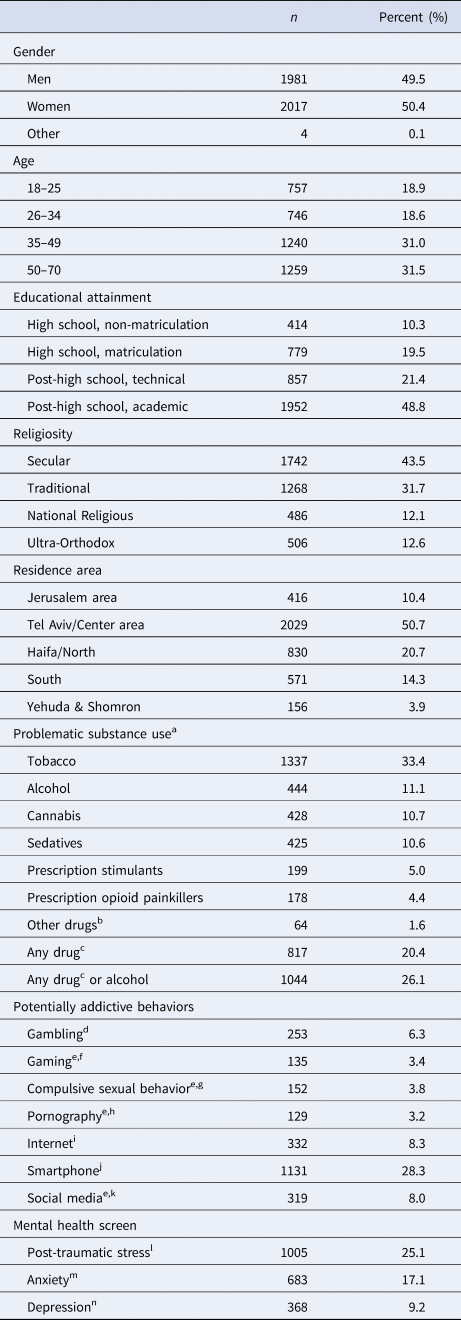
a Alcohol, Smoking and Substance Involvement Screening Test (ASSIST) 3.1 moderate (score of ⩾11 or more for alcohol, ⩾4 for other substances) or severe (⩾27) risk levels (Shmulewitz et al., Reference Shmulewitz, Eliashar, Levitin and Lev-Ran2023).
b Cocaine, amphetamines, hallucinogens, inhalants, street opioids, or other.
c Cannabis, sedatives, prescription stimulants, prescription opioids painkillers, other drugs.
d Moderate (5–7) or severe (8–27) on the Problem Gambling Severity Index (PGSI) (Currie et al., Reference Currie, Hodgins and Casey2013).
e Responded often or very often on more than half of items from the relevant screening measure.
f Game Addiction Scale (GAS) (Lemmens et al., Reference Lemmens, Valkenburg and Peter2009).
g Bergen-Yale Sex Addiction Scale (BYSAS) (Andreassen et al., Reference Andreassen, Pallesen, Griffiths, Torsheim and Sinha2018).
h Problematic Pornography Use Scale (PPUS) (Kor et al., Reference Kor, Zilcha-Mano, Fogel, Mikulincer, Reid and Potenza2014).
i Score of ⩾50 or more on the Internet Addiction Test (IAT) (Pawlikowski et al., Reference Pawlikowski, Altstötter-Gleich and Brand2013).
j Score of ⩾31 (men) or ⩾33 (women) on the Smartphone Addiction Scale-short version (SAS-SV) (Kwon et al., Reference Kwon, Kim, Cho and Yang2013).
k Bergen Social Media Addiction Scale (BSMAS) (Andreassen et al., Reference Andreassen, Billieux, Griffiths, Kuss, Demetrovics, Mazzoni and Pallesen2016, Reference Andreassen, Pallesen, Griffiths, Torsheim and Sinha2018).
l Score of ⩾33 on the Post-traumatic stress disorder (PTSD) DSM-5 version Checklist (PCL-5) (Forkus et al., Reference Forkus, Raudales, Rafiuddin, Weiss, Messman and Contractor2023).
m Score of ⩾10 on the Generalized Anxiety Disorder 7 (GAD-7) (Spitzer et al., Reference Spitzer, Kroenke, Williams and Löwe2006).
n Score of ⩾15 on the Patient Health Questionnaire 9 (PHQ-9) (Kroenke et al., Reference Kroenke, Spitzer and Williams2001).
Model 1: problematic substance use and anxiety, depression, PTSD
Scores for problematic substance use formed one community (i.e. were strongly associated with each other), and for anxiety, depression, and PTSD formed a second community (Table 2; Supplemental Fig. 1a). Descriptively, stronger cross-category edges were observed between depression and sedatives, cannabis, and opioids to a lesser extent; and between PTSD and alcohol, stimulants, and sedatives (Supplemental Fig. 1b; Supplemental Table 3). At most, very weak edges were observed between anxiety and substances or between tobacco and anxiety, depression, or PTSD.
Networks descriptives and stability
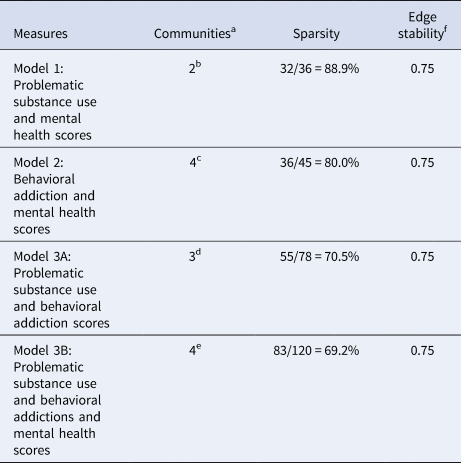
All scores were standardized before analysis.
a Based on Exploratory graph analysis to identify groups of measures that are highly correlated with each other.
Communities:.
b (1) substances; (2) anxiety, depression, and post-traumatic stress disorder (PTSD).
c (1) pornography, compulsive sexual behavior; (2) gambling, gaming; (3) internet, social media, smartphone; (4) anxiety, depression, and PTSD.
d (1) substances, gambling; (2) pornography, compulsive sexual behavior; (3) internet, social media, gaming, smartphone.
e (1) substances, gambling; (2) pornography, compulsive sexual behavior; (3) internet, social media, gaming, smartphone; (4) anxiety, depression, and PTSD.
f Stability is assessed using the correlation stability coefficient, which indicates the maximum proportion of the sample that can be dropped, with the correlation of measures from the original sample with measures from the bootstrapped subsamples remaining 0.7 or higher. Values ranging from 0.5–0.75 (maximum value) are considered stable.
Model 2: problematic behaviors and anxiety, depression, PTSD
Scores for anxiety, depression, and PTSD formed one community, and for problematic behaviors formed three communities: (1) pornography and compulsive sexual behavior; (2) gambling and electronic gaming; and (3) internet, social media, and smartphone use (Table 2; Supplemental Fig. 2a). Descriptively, strong cross-category edges were observed between PTSD and social media and smartphone use and gambling; and between depression and internet use and gaming (and pornography to a lesser extent) (Supplemental Fig.e 2b; Supplemental Table 4). A weaker edge was observed between anxiety and smartphone use.
Model 3a: problematic substance use and behaviors
When substances and behaviors were modeled together, they formed three communities: (1) substances and gambling; (2) pornography and compulsive sexual behavior; and (3) electronic gaming, and internet, social media, and smartphone use (Table 2; Supplemental Fig. 3a). Strong cross-category edges were observed between gambling and substances (tobacco, opioids, stimulants, alcohol, and sedatives, to a lesser extent); alcohol was also associated with sexual behavior and gaming; sedatives was also more weakly associated with gaming and smartphone use; and cannabis was associated with pornography and sexual behavior (Supplemental Fig. 3b; Supplemental Table 5). Internet and social media use showed very weak edges with substances.
Model 3b: problematic substances, behaviors and anxiety, depression, PTSD
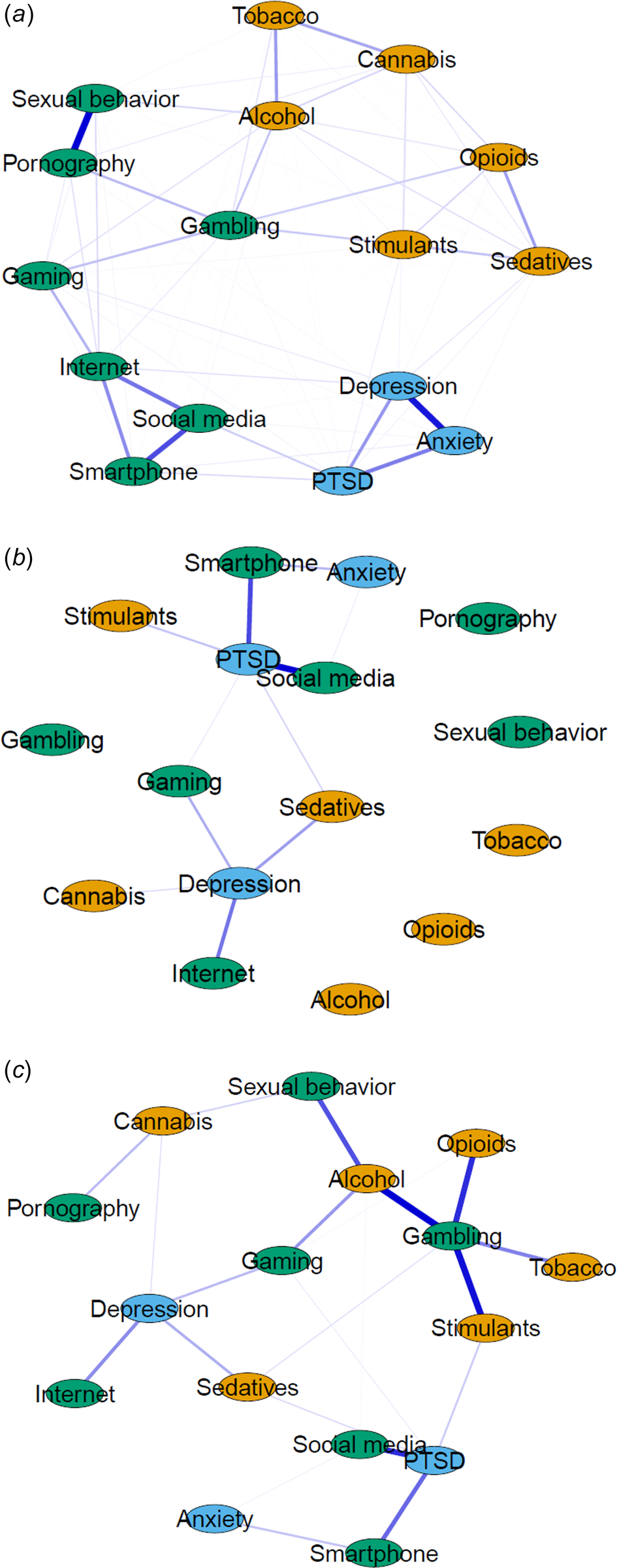
When anxiety, depression, and PTSD were added to the model, they formed one community, separate from the three substance/behavioral communities identified above (Table 2; Fig. 1a). The main cross-category correlations of interest were between addictions and anxiety/depression/PTSD. Such edges (Fig. 1b) were observed between depression and internet use and gaming, and also sedatives and cannabis; PTSD and social media and smartphone use, and also sedatives and stimulants; anxiety and smartphone use (Supplemental Table 6). Results were similar to previous models (Supplemental Figs 1b, 2b), except for three edges that became weaker or were no longer observed: depression with pornography and PTSD with alcohol and gambling. Additionally, cross-category edges between three categories (substances, behaviors, and depression/anxiety/PTSD; Fig. 1c), showed what changed between substances and behaviors when other mental health issues were included: the edges between sedatives and smartphone use and gaming became much weaker.
Networks of Model 3B: problematic substance use and other addictive behaviors, with depression, anxiety, and PTSD. (a) All edges. (b) Cross-category edges, connecting addictions and other mental health problems. (c) Cross-category edges, connecting problematic substance use, other addictive behaviors, and other mental health problems.
Discussion
This novel network analysis study simultaneously explored associations between substance use and other addictive behavior measures and depression, anxiety, and PTSD, to provide a more precise understanding of the relationships between those measures. By adjusting for all measures in the model (i.e. using partial correlations), results showed which specific addictions were most strongly and uniquely associated with common mental health issues, and which addictions were associated in a less direct manner. Technology-related addictive behaviors were most strongly associated with PTSD (social media, smartphone use), anxiety (smartphone use), and depression (internet use and gaming). Of the substances, problematic use of sedatives, stimulants, and cannabis showed strongest associations with PTSD and depression. These results suggest specific pathways for the associations underlying the observed comorbidity, with implications for treatment strategies.
All sixteen addiction and other mental health measures were related to each other in zero-order (pairwise) correlation, as expected, based on those commonly co-occurring. To better understand what may be underlying these relationships, unique connections between specific addiction and mental health measures were isolated. Additionally, which pairwise correlations might be due to association with other measures were identified.
The strongest unique associations were observed between problematic use of technology (i.e. smartphone, social media, internet) and PTSD, anxiety, and depression; such associations were found in previous studies (e.g. (Armour et al., Reference Armour, Greene, Contractor, Weiss, Dixon-Gordon and Ross2020; Augner, Vlasak, Aichhorn, & Barth, Reference Augner, Vlasak, Aichhorn and Barth2023; Contractor, Frankfurt, Weiss, & Elhai, Reference Contractor, Frankfurt, Weiss and Elhai2017; Fan et al., Reference Fan, Wang, Wang, Xie, Zhang, Liao and Guo2020; Lee et al., Reference Lee, Kim, Kang, Kim, Bae, Kim and Yoon2017; Melca, Teixeira, Nardi, & Spear, Reference Melca, Teixeira, Nardi and Spear2023; Tullett-Prado, Doley, Zarate, Gomez, & Stavropoulos, Reference Tullett-Prado, Doley, Zarate, Gomez and Stavropoulos2023)), but this study provides stronger evidence by adjusting for all measures included in the network model. Other addictive behaviors (e.g. pornography, sexual behavior, and gambling) were previously shown to be associated with PTSD, anxiety, and depression (e.g. (Camilleri, Perry, & Sammut, Reference Camilleri, Perry and Sammut2020; Kessler et al., Reference Kessler, Hwang, LaBrie, Petukhova, Sampson, Winters and Shaffer2008; Soraci et al., Reference Soraci, Melchiori, Del Fante, Melchiori, Guaitoli, Lagattolla and Griffiths2021; Sundqvist & Wennberg, Reference Sundqvist and Wennberg2022)); results from this study suggest that those relationships may be because of associations with other technology-based addictions. Thus, the current study adds to existing knowledge and emphasizes the importance of such behaviors for mental health, although formal disorders have not yet been defined. Further studies should determine how to best define and diagnose possible disorders related to problematic use of technology, in a clinically useful manner. Additionally, health providers should discuss technology use with patients at risk for or diagnosed with PTSD, anxiety, or depression, to understand if those behaviors may be exacerbating their symptoms. For example, those who experience traumatic events and ongoing severe stress show greater prevalence of depression, anxiety and PTSD (Charlson et al., Reference Charlson, van Ommeren, Flaxman, Cornett, Whiteford and Saxena2019; Coventry et al., Reference Coventry, Meader, Melton, Temple, Dale, Wright and Gilbody2020; Lee, Kim, & Kim, Reference Lee, Kim and Kim2020; Pat-Horenczyk & Schiff, Reference Pat-Horenczyk and Schiff2019; Rigutto, Sapara, & Agyapong, Reference Rigutto, Sapara and Agyapong2021); problematic use of internet or social media may cause re-exposure to the traumatic event and increase exposure to stress, worsening the mental health issues.
Since technology-based addictions were strongly related to each other, as were the other mental health disorders, one might expect similar associations between those groups; but different unique associations were observed: PTSD and anxiety were mostly associated with smartphone and social media use, while depression was mostly associated with internet use and electronic gaming. While there are similarities between PTSD, anxiety, and depression, the current study and others also found differences (Lazarov et al., Reference Lazarov, Suarez-Jimenez, Levi, Coppersmith, Lubin, Pine and Neria2020); identifying what is driving these specific associations can provide further insight into the etiology of PTSD, anxiety, and depression, which has clinical importance in deciding the best integrative treatment.
While problematic substance use is known to be related to PTSD, anxiety, and depression, e.g., (Kelly & Daley, Reference Kelly and Daley2013; Santucci, Reference Santucci2012; Smith & Cottler, Reference Smith and Cottler2018; Torrens et al., Reference Torrens, Rossi, Martinez-Riera, Martinez-Sanvisens and Bulbena2012), the current study isolated these unique associations: PTSD was associated with problematic stimulants and sedatives use, while depression showed associations with sedatives and cannabis. In contrast, problematic use for other substances (alcohol, opioids, tobacco) showed very weak unique associations with PTSD or depression, and anxiety showed very weak unique association with problematic use of any substance. This suggests that the observed comorbidity between mental health disorders and problematic substance use might have different drivers for different substances, which could affect how they are addressed clinically. For example, those with PTSD and/or depression might be misusing prescribed medications used to treat symptoms such as sleep and concentration problems, or self-medicating, which could also increase risk for PTSD, depression, and problematic substance use (Fan et al., Reference Fan, Wang, Wang, Xie, Zhang, Liao and Guo2020; Feingold & Weinstein, Reference Feingold and Weinstein2021; Guina, Rossetter, DeRhodes, Nahhas, & Welton, Reference Guina, Rossetter, DeRhodes, Nahhas and Welton2015); health care providers should discuss this concern with their patients. Alternatively, for other substances and anxiety, the comorbidity appears to be less direct, which suggests a different mechanism, such as shared vulnerability or common causes. While the increased risk of problematic substance use should be addressed among all patients with mental health disorders, to more directly address these issues, further studies should identify what is underlying the observed comorbidity.
In addition to simplifying complex relationships and identifying key associations, this network analysis suggests new avenues of research to elucidate mechanisms behind the observed unique associations and associations that were no longer observed after adjusting for related variables. First, there may be other aspects of addiction or mental health that were not included in the network models. Second, networks can explore which specific symptoms underly the unique associations, which can provide precise targets for intervention (Borsboom, Reference Borsboom2017), similar to studies on symptoms of problematic social media use and stress, depression, and anxiety (Tullett-Prado et al., Reference Tullett-Prado, Doley, Zarate, Gomez and Stavropoulos2023) and depression and problematic cannabis use (Williamson, Macia, Burton, & Wickham, Reference Williamson, Macia, Burton and Wickham2024). Third, many variables have been suggested to explain the comorbidity (Armour et al., Reference Armour, Greene, Contractor, Weiss, Dixon-Gordon and Ross2020; María-Ríos & Morrow, Reference María-Ríos and Morrow2020). For example, people may use addictive substances (e.g. sedatives, stimulants) or behaviors (e.g. smartphone, social media) to cope with trauma, stress, anxiety and depression, which may increase risk of addictive disorders, which may increase risk for anxiety, depression, and PTSD, leading to self-reinforcing feedback spirals (Levin et al., Reference Levin, Lev Bar-Or, Forer, Vaserman, Kor and Lev-Ran2021; Starcevic & Khazaal, Reference Starcevic and Khazaal2017; Turner et al., Reference Turner, Mota, Bolton and Sareen2018). Personality factors (e.g. impulsivity, neuroticism) may be related to both addictions and other mental health problems (Contractor et al., Reference Contractor, Frankfurt, Weiss and Elhai2017; File, Bőthe, File, & Demetrovics, Reference File, Bőthe, File and Demetrovics2022; Guo et al., Reference Guo, Liang, Ren, Yang, Qiu, He and Zhu2022; Rajesh & Rangaiah, Reference Rajesh and Rangaiah2022; Satici, Gocet Tekin, Deniz, & Satici, Reference Satici, Gocet Tekin, Deniz and Satici2023), and problems with emotional regulation may underly both addictions and other mental health disorders (D'Agostino, Covanti, Rossi Monti, & Starcevic, Reference D'Agostino, Covanti, Rossi Monti and Starcevic2017; Gioia, Rega, & Boursier, Reference Gioia, Rega and Boursier2021; Haws et al., Reference Haws, Brockdorf, Gratz, Messman, Tull and DiLillo2022; Sloan et al., Reference Sloan, Hall, Moulding, Bryce, Mildred and Staiger2017). Possible explanatory variables can be added to the network models, which may help elucidate their potential roles in comorbidity. Last, results can be used to design studies, such as structural equation modelling and path analysis, to determine more precise mechanisms of effects. For example, mediation analysis can estimate how much of the association between PTSD and smartphone use is direct, and how much is indirect through social media use.
Constructing models in a stepwise fashion provided valuable information, showed how the choice of variables for inclusion can affect results, and emphasized the advantages of network analysis in informing about associations between related variables. For example, although the association between PTSD and problematic alcohol use is well-established (Smith & Cottler, Reference Smith and Cottler2018), and was observed in this study when substances were modeled together with PSTD, depression and anxiety (model 1), that edge was no longer included when problematic behaviors were included (model 3B). Additionally, the edge between depression and pornography (model 2) was no longer included when substances were included (model 3B). Although the lack of an edge may be due to regularization, that most likely occurs for weaker, less reliable associations (Epskamp & Fried, Reference Epskamp and Fried2018). Thus, the exclusion of edges suggests that the included variables at least partially account for the initially observed associations, perhaps as potential mediators, confounders, or proxies for other related measures not included in the network.
Additionally, there has been discussion about the relationships between types of addictions, with some suggesting that addictions are all manifestations of one underlying ‘addiction syndrome’ (Goodman, Reference Goodman2008; Shaffer et al., Reference Shaffer, LaPlante, LaBrie, Kidman, Donato and Stanton2004). Substance and behavioral addictions have much in common, such as neurobiology, phenomenology, risk factors and consequences (Shaffer & Shaffer, Reference Shaffer, Shaffer and Friedman2016), but there are also differences, such as route of ingestion/use and physiological dependence (Kim, Hodgins, Kim, & Wild, Reference Kim, Hodgins, Kim and Wild2020). In this study, there were separate communities for behaviors (except gambling) and substances. Gambling clustered with the substance measures, consistent with the inclusion of gambling with substance use disorders in ICD-11. As expected, compulsive sexual behavior and pornography use formed one community, as did technology-based behaviors, but even those highly related measures showed unique effects. For example, problematic smartphone and social media use both showed associations with PTSD, adjusted for each other. Similarly, problematic pornography and sexual behavior were both uniquely associated with cannabis. Also, internet use was related to depression, suggesting that other internet-based behaviors (that were not assessed) are driving the association, or that internet use itself is associated, not through specific behaviors. Thus, results from this study suggest that different addictions represent discrete (albeit related) phenomena (Baggio et al., Reference Baggio, Starcevic, Billieux, King, Gainsbury, Eslick and Berle2022; Gomez, Brown, Tullett-Prado, & Stavropoulos, Reference Gomez, Brown, Tullett-Prado and Stavropoulos2023), rather than one ‘addiction syndrome’. Further studies should more precisely identify what is similar and different across the addiction types.
Limitations
First, network analysis of cross-sectional data cannot determine the directionality of the associations, which are likely reciprocal, as addictions may exacerbate severity of mental health issues, and mental health issues may increase problematic use, but the exploratory analyses presented here can provide insight for the development of hypotheses for future study. Longitudinal studies are needed to better understand the temporal and causal relationships around comorbidity. Second, a range of substance use and other addictive behaviors were included, with three main mental health issues, but there may be other important psychopathological measures that should be included for a more complete picture. Additional studies in other samples should confirm and build on these results. Third, there may have been selection bias, as participants were limited to those able to participate in the online survey, but quotas were used to collect a quasi-representative sample of the adult, Jewish, Hebrew-speaking population of Israel, with respect to key sociodemographic factors. Fourth, the sample was not representative of population sectors that would need methodological adaptations, e.g., those less likely to complete online surveys or with cultural differences; more fully representative samples should be collected for future studies. Fifth, only Hebrew speakers were included, but >90% of Jews in Israel have mastery of Hebrew (Israel Central Bureau of Statistics, 2022). Sixth, participants responded based on their understanding of the questions, but standard, validated screening instruments were used. There may be reluctance to report stigmatized or illegal behaviors, which may be mitigated by using a confidential online platform (Belackova & Drapalova, Reference Belackova and Drapalova2022). Last, additional studies should explore whether the comorbidity network differs by age or gender.
Conclusions
In data from a general population sample of adult Jews in Israel, network analysis was used to simplify the relationships between addictions and depression, anxiety, and PTSD by identifying unique associations, with potential implications. The possible role of technology-based addictive behaviors (e.g. problematic internet, smartphone, and social media use) in common mental health issues suggests clinical attention on such behaviors. Additionally, clinicians could discuss concerns related to misuse of substances used to treat symptoms of common mental health issues with patients. Furthermore, network analysis suggested possible mechanisms for associations of addictions and common mental health disorders, identified important differences between types of addictions and mental health disorders, and led to new avenues of research. Thus, improved understanding of the associations that may underly observed comorbidity provides information for designing better prevention models and more targeted and effective interventions.
Supplementary material
The supplementary material for this article can be found at https://doi.org/10.1017/S0033291724002794.
Funding statement
This research received no specific grant from any funding agency, commercial or not-for-profit sectors.
Competing interests
The authors declare none.
Ethical standards
The authors assert that all procedures contributing to this work comply with the ethical standards of the relevant national and institutional committees on human experimentation and with the Helsinki Declaration of 1975, as revised in 2008.


 Open access

