


1. Introduction
Formal electoral agency models usually portray challengers as passive alternatives available to replace the incumbent if and when voters desire. Although this premise is plausible in economic contexts “where the market can readily provide a substitute for deficient manager-agents,” it is likely to be faulty in elections (Gordon et al., Reference Gordon, Huber and Landa2007, p. 304). Indeed, due to the considerable cost of organizing an election campaign, empirical research has shown that candidates strategically decide whether and when to run for office (e.g., Jacobson, Reference Jacobson1980; Jacobson and Kernell, Reference Jacobson and Kernell1983; Cox and Katz, Reference Cox and Katz1996, Reference Cox and Katz2002; Stone et al., Reference Stone, Maisel and Maestas2004).
The endogeneity of candidates’ entry decisions has two implications: (i) challengers strategically choose to run for office or forfeit, and (ii) this decision is based on a trade-off between their probability of winning and the cost of running a campaign. Consequently, “challengers may be deterred from running against incumbents who are perceived to [have] a high ability,” because they expect a low probability of being elected (Ashworth and Bueno de Mesquita, Reference Ashworth and Bueno de Mesquita2008, p. 1006). Furthermore, “if entering a race is a costly action for a challenger, then the very fact that a race is competitive can convey valuable information to voters about the relative merits of challengers and incumbents” because some challengers may have higher incentives to run than others (Gordon et al., Reference Gordon, Huber and Landa2007, p. 303).
Formal political theory has previously studied the role of challengers in electoral accountability. For instance, Gordon et al. Reference Gordon, Huber and Landa(2007) formulated a model of electoral competition with endogenous challenger entry with no policymaking involved. Ashworth and Shotts Reference Ashworth and Shotts(2011) explored how challengers’ public criticisms may strengthen the incumbent’s incentives to carry out desirable policies. Dewan and Hortala-Vallve Reference Dewan and Hortala-Vallve(2019) studied how a noisy signal about an opponent affects the incumbent’s willingness to undertake a risky reform. Alexander Reference Alexander(2021) analyzed policy competition between a valence-advantaged incumbent and a challenger. Finally, Izzo Reference Izzo(n.d.) showed that electoral accountability can deter good candidates from running during crises.
Like most electoral agency models, those analyzed by Ashworth and Shotts (Reference Ashworth and Shotts2011), Dewan and Hortala-Vallve (Reference Dewan and Hortala-Vallve2019), and Alexander Reference Alexander(2021) operate under the premise that challengers always run for office. No existing model of electoral agency with adverse selection accounts for the endogeneity of challengers’ decision to run. This article seeks to fill this void.
Given the empirical evidence that the intensity of electoral competition influences policymaking, endogenous challenger entry is not innocuous for electoral accountability (Gordon and Huber, Reference Gordon and Huber2007; Lim, Reference Lim2013; Lim and Snyder, Reference Lim and Snyder2021). Its effect, however, is ambiguous. On the one hand, it incentivizes the incumbent to distort her policy decisions, as she expects challengers to cave in if she projects a sufficiently high level of ability, thereby boosting her reelection prospects. On the other hand, endogenous challenger entry can improve policymaking when electoral accountability inadvertently influences policy decisions. The availability of viable challengers is indispensable for electoral accountability, allowing voters to discipline officeholders by threatening to replace them if they do not implement desired policies. Therefore, when a challenger surrenders to the incumbent, ensuring her automatic reelection, electoral accountability is weakened. However, this may be beneficial if electoral accountability negatively affects policymaking.
To resolve this ambiguity, I analyze a two-period model of electoral agency with three players: an Incumbent, a Challenger, and a Voter. In the first period, the Incumbent enacts one of two policies. The Challenger observes the Incumbent’s policy decision and chooses whether to run or withdraw. If the Challenger withdraws, the Incumbent is automatically reelected. If the Challenger decides to run, the Voter updates their beliefs about the Incumbent’s private characteristics and chooses whether to reelect her or replace her with the Challenger. In the second period, the elected candidate again enacts one of two policies.
I assume that politicians are simultaneously concerned with holding office and enacting policies that generate the most benefits during their tenure. Politicians’ policy preferences align with the Voter’s while in office, but they are indifferent between enacting a suboptimal policy and letting an opponent govern. Consequently, politicians are ready to distort their policy decisions to improve their reelection prospects.
Politicians vary in their ability to discern the state of the world, which defines the optimal policy in each period. There are two types of politicians: high-ability politicians, who perfectly observe the state in each period, and low-ability ones, who only know its prior distribution. A sharper ability to discern the state allows politicians to enact optimal policies reliably. Therefore, the Voter seeks to elect a high-ability politician to hold office in the second period.
Unlike standard models, my model accounts for the possibility that the Incumbent’s type is revealed before the election. As a result, candidates’ electoral prospects depend directly on the Incumbent’s type, not just the Voter’s beliefs. All else equal, a high-ability incumbent has a greater reelection probability, and the Challenger’s chances decline as the Incumbent’s expected ability increases. This assumption is key for analyzing the effect of endogenous challenger entry on policymaking.
The Voter does not observe candidates’ type but wishes to elect a high-ability politician. To this end, they infer candidates’ hidden characteristics from their observable actions. In turn, the Incumbent can exploit the information asymmetry between herself and the other players to manipulate their beliefs about her type, thereby improving her reelection prospects. For instance, she can enact a policy that signals a high ability. Since the loss from enacting a suboptimal policy exceeds the benefits of securing reelection for a high-ability incumbent, the latter must implement the optimal policy. On the other hand, when a low-ability incumbent considers which policy to enact, she weighs the loss from enacting a suboptimal policy against the resulting increase in her reelection probability.
I analyze the model’s equilibria assuming the Challenger learns his type only after the election, representing a scenario where his decision to contest the election is endogenous but uninformative about his type.
My analysis reveals that the first-order effect of endogenous challenger entry is to make policy distortions more valuable than when the Challenger always runs for office. The reason is that policy distortions now allow the Incumbent to secure reelection if she projects a high enough level of ability and dissuades the Challenger from running. Consequently, with endogenous challenger entry, the Incumbent is willing to distort her policy decisions under a broader range of conditions, specifically for larger values of the cost of enacting a suboptimal policy.
In cases where low-ability incumbents are initially willing to distort their policy decisions when the Challenger always runs, the effect of endogenous challenger entry on policymaking is ambiguous: it can either worsen or ease policy distortions depending on model parameters. Indeed, while endogenous challenger entry creates additional incentives for the Incumbent to distort her policy decisions to dissuade the Challenger from running, it eliminates these incentives if the Challenger forfeits.
When endogenous challenger entry deepens policy distortions, it necessarily decreases voter welfare. In contrast, when endogenous challenger entry mitigates policy distortions, it can increase it. However, such an improvement is not guaranteed because endogenous challenger entry also disrupts electoral selection by preventing the Voter from replacing the Incumbent when she is exogenously revealed to have a low ability before the election. For endogenous challenger entry to improve voter welfare, the benefits from lower policy distortions must outweigh the losses from weaker electoral selection. I outline conditions under which endogenous challenger entry does improve voter welfare compared to when the Challenger always runs.
The findings outlined in this paper suggest a provocative implication: imposing barriers to entry in elections can, in some circumstances, improve policymaking and voter welfare.
This paper builds on a recent study by Camargo and Degan Reference Camargo and Degan(2020) but takes a distinct and complementary approach. I describe three specific differences between our approaches. First, our models represent different policymaking environments. I analyze a model with adverse selection, whereas Camargo and Degan considered a model with moral hazard. The scope of electoral accountability is different in both models. In Camargo and Degan’s model, electoral accountability pushes the Incumbent to exert more effort, resulting in better policy outcomes. In my model, it has adverse consequences, encouraging the Incumbent to enact suboptimal policies that enhance her reputation. It is significant that Camargo and Degan’s findings hold in a different setting, like mine.
Second, the mechanisms underlying our findings differ. In my model, marginally increasing the cost of running for office reduces the level of ability the Incumbent must project to dissuade the Challenger from running, resulting in fewer policy distortions. In Camargo and Degan’s model, all else equal, exerting more effort increases the likelihood of a policy success, an outcome that improves her reelection prospects. Accordingly, the Incumbent’s incentives to exert more effort are proportional to the increase in her reelection probability resulting from a policy success. Higher barriers to entry in elections always increase the Incumbent’s reelection probability, regardless of the success of her policies. Accordingly, the Incumbent may exert more or less effort depending on whether their effect on her reelection prospects is greater when her policies succeed or fail.
Third, from a methodological perspective, I opt for a simpler and slightly less general model, wherein officeholders have finite rather than continuous choice sets, allowing for closed-form solutions to be derived. This choice streamlines the presentation of my findings and enhances the transparency of the conditions under which endogenous challenger entry strengthens and weakens electoral accountability.
This article is structured as follows. I begin by outlining my model. I then characterize and compare its equilibria with and without endogenous challenger entry. Using this comparison, I examine the welfare implications of endogenous challenger entry. Finally, I summarize my findings, discuss their implications, and identify open questions.
2. Model
The description of the model proceeds in two steps. First, I outline the baseline framework adapted from Levy Reference Levy(2004) and Fox and Stephenson Reference Fox and Stephenson(2011) on which it builds. I subsequently describe how it departs from this framework.
The game occurs over two periods. In the first period, the Incumbent (she/her/hers) enacts either policy a or b. Her choice is denoted  $y_{1} \in Y = \left\{a, b\right\}$. The Voter (they/them/theirs) observes the Incumbent’s policy decision and decides whether to reelect her or replace her with the Challenger (he/him/his). In the second period, the elected candidate enacts a policy $y_{2} \in Y$.
In each period t, players’ policy preferences depend on the state of the world, denoted  $\omega_{t} \in \Omega = \left\{a, b\right\}$. The state is identically and independently distributed over time. One of the possible states is more likely than the other. Without loss of generality, in each period, there is a probability $\pi \gt \frac{1}{2}$ that the state is a.
The Voter’s policy preferences are represented by the utility function  $u: Y \times \Omega \rightarrow \mathbb{R}$. Their preference is for the policy enacted in each period to match the state of the world. For simplicity, I assume that $u\left(y_{t}, \omega_{t}\right) = \mathbf{1}\left\{y_{t} = \omega_{t}\right\}$, meaning that the Voter receives a payoff of one when the policy equals the state, and zero otherwise. The state remains unknown to the Voter until the game’s termination, preventing them from evaluating the efficacy of the Incumbent’s first-period policy decision before the election.
Politicians’ preferences are represented by the utility function  $u_{p}: \left\{0, 1\right\} \times Y \times \Omega \rightarrow \mathbb{R}$. This function is defined as $u_{p}\left(o_{t}, y_{t}, \omega_{t}\right) = \mathbf{1}\left\{o_{t} = 1\right\} \ u\left(y_{t}, \omega_{t}\right)$, where ot equals one if the politician holds office in period t, zero otherwise. Also, I assume that the Incumbent applies a discount factor $\delta \in \left(0, 1\right)$ to her second-period payoffs, which reflects the weight she assigns to career considerations. Under these preferences, politicians are simultaneously concerned with holding office and enacting policies that match the state during their tenure. While in office, politicians’ policy preferences align with the Voter’s such that, absent career considerations, there is no disagreement between them over which policy to implement. While out of office, politicians’ payoffs are zero, implying their indifference between enacting a policy they dislike and having opponents govern.
Politicians have hidden characteristics. They differ in the quality of their information on the state of the world, encapsulated in their private type  $\theta \in \Theta = \left\{h, \ell\right\}$, where h stands for high and $\ell$ for low ability. θi and θc denote the Incumbent’s and the Challenger’s type, respectively. High-ability politicians have perfect knowledge of the state in each period, while low-ability politicians only know its prior distribution. The Incumbent and the Challenger come from different candidate pools, with a probability κ and γ of having a high ability, respectively. The Incumbent knows her type but is uncertain about the Challenger’s. On the other hand, the Challenger is unaware of the Incumbent’s type and his own.Footnote 1 Thus, while endogenously determined, the Challenger’s decision does not convey information about his type.
My model departs from the previously described baseline framework in two ways:
(i) Endogenous Challenger Entry. The Challenger chooses whether to run for office or not.Footnote 2 Running for office is costly: the Challenger must incur a cost of c > 0 times his expected benefits from holding office in the second period.Footnote 3 Therefore, the Challenger enters the race only if the probability that he will be elected exceeds c; otherwise, the Challenger forfeits, resulting in the Incumbent’s automatic reelection.
(ii) Exogenous Information Disclosure. Apart from the Incumbent’s first-period policy decision, the Voter may directly observe her private type before the election. Specifically, there is a probability $q_{i} \in \left(0, 1\right)$ that Nature publicly reveals the Incumbent’s type before the election.Footnote 4

The full sequence of events in the game is as follows:
(i) The Incumbent enacts a policy
$y_{1} \in Y$;(ii) The Challenger chooses whether to run for office;
(iii) Nature may publicly reveal the Incumbent’s type;
(iv) The Voter updates their beliefs about the Incumbent’s type and elects the candidate who will hold office in period 2; and
(v) The elected candidate enacts a policy
$y_{2} \in Y$.


I adopt the perfect Bayesian equilibrium as this model’s solution concept (Fudenberg and Tirole, Reference Fudenberg and Tirole1991). Also, to eliminate equilibria based on unrealistic beliefs, I require that the Voter’s off-the-equilibrium-path beliefs adhere to the following condition: if the Challenger never (resp., always) runs for office, then his posterior probability of having a high ability contingent upon running (resp., not running) equals his prior probability of having a high ability. Table 1 presents the notation used to denote beliefs and strategies.
Notation

3. Exogenous information disclosure and candidates’ electoral prospects
My model accounts for the possibility that Nature publicly reveals the Incumbent’s type before the election. In this section, I show that this directly connects candidates’ chances of being elected to the Incumbent’s type. Specifically, holding the Voter’s behavior constant, a high-ability Incumbent has a higher reelection probability. Analogously, the Challenger’s probability of being elected decreases with the posterior probability of the Incumbent having a high ability. This feature distinguishes my model from standard electoral agency models, wherein the relationship between candidates’ electoral prospects and the Incumbent’s type operates exclusively through the Voter’s beliefs and behavior.
To calculate candidates’ probability of winning the election, we must determine who the Voter elects in the second period. In equilibrium, the Voter elects the candidate with the highest expected ability because they anticipate higher policy payoffs when a high-ability politician holds office in the second period. In the second period, the officeholder enacts the policy that maximizes policy payoffs based on their information about the state of the world. High-ability politicians, having perfect knowledge of the state, consistently enact the “correct” policy, whereas low-ability politicians enact policy a, committing a mistake with probability  $1 - \pi$.
Consistently with the Voter’s preference for the candidate with the highest expected ability, should Nature reveal that the Incumbent has a high ability, the Voter reelects her. In contrast, should Nature reveal that the Incumbent has a low ability, the Voter replaces her with the Challenger. When Nature does not reveal the Incumbent’s type before the election, the Voter elects the candidate most likely to have a high ability based on their posterior beliefs conditional on the Incumbent’s policy decision.
Overall, assuming the Challenger runs, the Incumbent’s reelection probability after she enacts policy y equals:
 \begin{equation*}
\bar{\nu}_{i}\left(\theta_{i}, \nu^{y}\right) =
\begin{cases}
\begin{array}{cl}
q_{i} \times 0 + \left(1 - q_{i}\right) \nu^{y} & \text{if}\ \theta_{i} = \ell \\
q_{i} \times 1 + \left(1 - q_{i}\right) \nu^{y} & \text{if}\, \theta_{i} = h.
\end{array}
\end{cases}
\end{equation*}
\begin{equation*}
\bar{\nu}_{i}\left(\theta_{i}, \nu^{y}\right) =
\begin{cases}
\begin{array}{cl}
q_{i} \times 0 + \left(1 - q_{i}\right) \nu^{y} & \text{if}\ \theta_{i} = \ell \\
q_{i} \times 1 + \left(1 - q_{i}\right) \nu^{y} & \text{if}\, \theta_{i} = h.
\end{array}
\end{cases}
\end{equation*}Analogously, if the Challenger runs for office after the Incumbent enacts policy y, his probability of being elected equals:
 \begin{align*}
\bar{\nu}_{c}\left(\kappa^{y}, \nu^{y}\right) & = \kappa^{y} \left[1 - \bar{\nu}_{i}\left(h, \nu^{y}\right)\right] + \left(1 - \kappa^{y}\right) \left[1 - \bar{\nu}_{i}\left(\ell, \nu^{y}\right)\right] \\
& = q_{i} \left[\kappa^{y} \times 0 + \left(1 - \kappa^{y}\right) \times 1\right] + \left(1 - q_{i}\right) \left(1 - \nu^{y}\right)\!.
\end{align*}
\begin{align*}
\bar{\nu}_{c}\left(\kappa^{y}, \nu^{y}\right) & = \kappa^{y} \left[1 - \bar{\nu}_{i}\left(h, \nu^{y}\right)\right] + \left(1 - \kappa^{y}\right) \left[1 - \bar{\nu}_{i}\left(\ell, \nu^{y}\right)\right] \\
& = q_{i} \left[\kappa^{y} \times 0 + \left(1 - \kappa^{y}\right) \times 1\right] + \left(1 - q_{i}\right) \left(1 - \nu^{y}\right)\!.
\end{align*}The exogenous information disclosure mechanism is crucial for analyzing the effect of endogenous challenger entry on policymaking. The reason is that endogenous challenger entry affects policymaking only if the Incumbent seeks to project a level of ability different from when the Challenger always runs. In general, the Incumbent may improve her reelection prospects in two ways: (i) by altering the Voter’s beliefs about who has the highest expected ability, or (ii) by dissuading the Challenger from entering the race. The latter stems specifically from endogenous challenger entry. Absent a direct connection between the Incumbent’s type and the candidates’ electoral prospects, this second mechanism becomes entangled with the first. In this case, the Incumbent’s only way of influencing the Challenger’s beliefs about his electoral prospects and entry decision is through the Voter’s beliefs about who has the highest expected ability, just as when the Challenger always runs.
The exogenous information disclosure mechanism creates opportunities for endogenous challenger entry to affect policymaking. If there is a direct connection between the Incumbent’s type and the candidates’ electoral prospects, the Challenger always has a positive probability of winning. Indeed, there is always a chance that the Incumbent is exogenously revealed to have a low ability before the election, prompting the Voter to replace her. Therefore, the Challenger may find it valuable to run even after the Incumbent enacted a policy that makes her appear more attractive than the Challenger. Also, the Challenger’s electoral prospects vary with the posterior probability that the Incumbent has a high ability beyond this point. Accordingly, the Incumbent may wish to distort her policy decisions beyond the level required to secure her reelection when her type is not revealed before the election. Analogously, even if the Incumbent does not find it worthwhile to distort her policy decisions to project a higher ability than the Challenger, she may still wish to distort her policy decisions enough to deter him from running.
4. Equilibrium analysis without endogenous challenger entry
In this section, I characterize the Incumbent’s equilibrium first-period policy decisions when the Challenger always runs for office. This entry strategy is sequentially rational if running for office is costless. The Incumbent’s policy decisions in this scenario represent the benchmark against which I later compare those made with endogenous challenger entry.
I begin by characterizing high-ability incumbents’ equilibrium policy decisions. High-ability politicians perfectly observe the state of the world, allowing them to align their policy decisions with it. Given that the discount factor δ is lower than one, the losses from enacting the wrong policy in the first period outweigh the benefits of securing reelection. Consequently, high-ability incumbents must enact the policy corresponding to the state in the first period. This fact persists when the Challenger’s entry decision is endogenous. Thus, from this point onward, I focus on characterizing low-ability incumbents’ policy decisions.
Since low-ability politicians only know the state’s prior distribution, they maximize policy payoffs by enacting the policy associated with the most probable state, policy a. However, the Voter seeks to infer the Incumbent’s type from her first-period policy decision. Consequently, the latter affects her reelection chances, prompting low-ability incumbents to distort it to enhance her reelection prospects.
To appreciate this, let us assume the Incumbent behaved to maximize policy payoffs in the first period. Then, the Voter would deduce that the Incumbent must have a high ability if she enacts policy b, ensuring her reelection. On the other hand, the Incumbent’s reelection after enacting policy a would depend on the value of her posterior probability of having a high ability. In particular, if the posterior probability that the Incumbent has a high ability after enacting policy a were lower than the Challenger’s expected ability, the Voter would replace the Incumbent with the Challenger when they do not exogenously observe her type before the election. In this case, low-ability incumbents have incentives “to ‘posture’ by taking [some] bold but unwarranted action” to improve their reelection prospects (Fox and Stephenson, Reference Fox and Stephenson2011, p. 397).
In choosing which policy to enact, a low-ability incumbent weighs the loss from enacting policy b against the resulting improvement in her reelection prospects. Formally, it is sequentially rational for low-ability incumbents to enact policy a if and only if the expected payoffs from doing so over both periods are greater than those from enacting the alternative policy:
 \begin{equation*}
\pi + \delta \pi \ \bar{\nu}_{i}\big(\ell, \nu^{a}\big) \geq 1 - \pi + \delta \pi \ \bar{\nu}_{i}\big(\ell, \nu^{b}\big).
\end{equation*}
\begin{equation*}
\pi + \delta \pi \ \bar{\nu}_{i}\big(\ell, \nu^{a}\big) \geq 1 - \pi + \delta \pi \ \bar{\nu}_{i}\big(\ell, \nu^{b}\big).
\end{equation*}In equilibrium, the difference in reelection probabilities after enacting both policies must be lower than or equal to the loss from enacting policy b instead of policy a relative to the expected benefits of holding office in the second period:
 \begin{equation*}
\bar{\nu}_{i}\big(\ell, \nu^{b}\big) - \bar{\nu}_{i}\big(\ell, \nu^{a}\big) \leq \frac{2 \pi - 1}{\delta \pi}.
\end{equation*}
\begin{equation*}
\bar{\nu}_{i}\big(\ell, \nu^{b}\big) - \bar{\nu}_{i}\big(\ell, \nu^{a}\big) \leq \frac{2 \pi - 1}{\delta \pi}.
\end{equation*}If the opposite were true, it would be sequentially rational for low-ability incumbents to enact policy b. In turn, if the Incumbent enacted policy a, the Voter would conclude that she had a high ability and reelect her. However, this would negate the electoral benefits associated with policy b, thereby eliminating the Incumbent’s incentives to distort her policy decisions in the first place.
The maximal gain low-ability incumbents can achieve by posturing equals the range of their reelection probability, which is  $1 - q_{i}$ when the Challenger always runs. If the expected losses from enacting policy b relative to the benefits of holding office in the second period exceed this range, the Incumbent maximizes policy payoffs in equilibrium. In contrast, if they are lower than this range, the Incumbent places sufficient weight on her reelection prospects for posturing to be worthwhile.
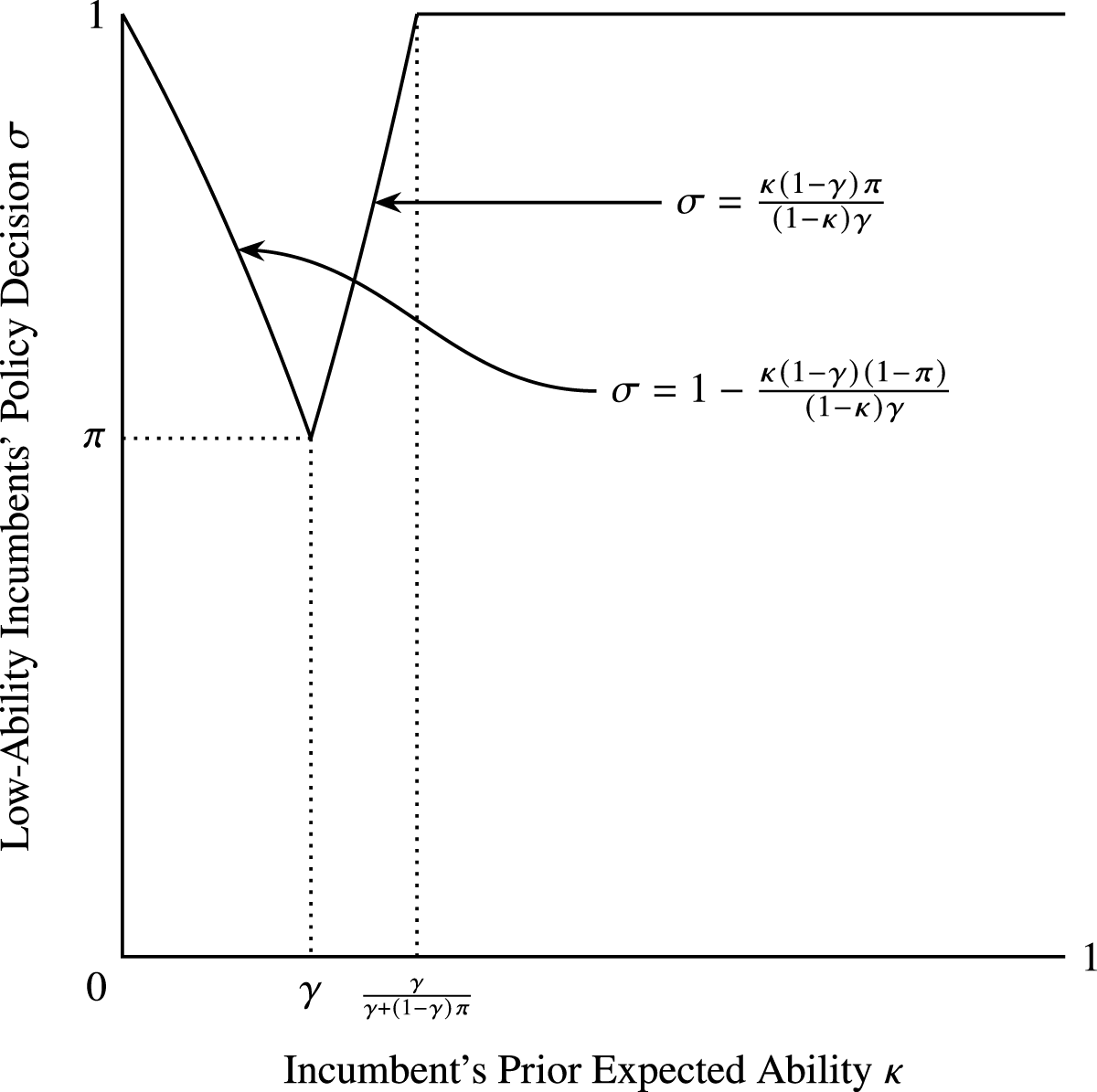
As low-ability incumbents engage in posturing, the Voter updates their beliefs, and the electoral advantage associated with policy b falls. In equilibrium, low-ability incumbents distort their policy decisions to the extent that the posterior probability that the Incumbent has a high ability after enacting some policy equals the Challenger’s expected ability. In particular, if the Incumbent initially has a higher expected ability than the Challenger, she distorts her policy decisions to the extent that the Voter is indifferent after enacting policy a. Otherwise, she distorts her policy decisions to the extent that the Voter is indifferent after enacting policy b. Figure 1 illustrates the probability that low-ability incumbents enact policy a in equilibrium, represented on the vertical axis, as a function of the Incumbent’s prior expected ability, represented on the horizontal axis.
Low-ability incumbents’ equilibrium policy decisions without endogenous challenger entry.

5. Equilibrium analysis with endogenous challenger entry
In this section, I solve for the model’s equilibria with endogenous challenger entry. I sequentially characterize the Challenger’s entry decision, low-ability incumbents’ reelection probability, and their first-period policy decisions.
5.1. The challenger’s entry strategy
It is sequentially rational for the Challenger to enter the election if and only if his expected probability of being elected, given the posterior probability that the Incumbent has a high ability, exceeds the relative cost of running:
 \begin{equation*}
\bar{\nu}_{c}\left(\kappa^{y}, \nu^{y}\right) \geq c.
\end{equation*}
\begin{equation*}
\bar{\nu}_{c}\left(\kappa^{y}, \nu^{y}\right) \geq c.
\end{equation*}After substituting the left-hand side’s definition from Section 3 and simplifying, it appears that this inequality defines a threshold strategy such that the Challenger runs if and only if the posterior probability that the Incumbent has a high ability conditional on her first-period policy decision is below some threshold:
 \begin{equation}
\kappa^{y} \leq \frac{1 - \left(1 - q_{i}\right) \nu^{y} - c}{q_{i}}.
\end{equation}
\begin{equation}
\kappa^{y} \leq \frac{1 - \left(1 - q_{i}\right) \nu^{y} - c}{q_{i}}.
\end{equation}Equation (1) implies that the Incumbent’s first-period policy decision directly impacts the Challenger’s decision to participate in the election. Indeed, the Incumbent can dissuade the Challenger from standing in the election by enacting a policy suggesting a high probability that she has a high ability.
The threshold governing the Challenger’s decision to enter the election depends on three variables: (i) the probability that Nature reveals the Incumbent’s type before the election, (ii) the cost of running a campaign, and (iii) the probability that the Voter reelects the Incumbent absent exogenous information about her type before the election. All else equal, the Challenger’s inclination to enter the race decreases as the latter increases.
In general, there is a range of possible threshold values below which the Challenger chooses to run for office, each corresponding to a value of ν y. However, sequential rationality imposes that the Voter elects the candidate most likely to have a high ability to hold office in the second period:
 \begin{equation*}
\kappa^{y} \gt \left( \lt \right) \gamma \Rightarrow \nu^{y} = 1 \left(0\right).
\end{equation*}
\begin{equation*}
\kappa^{y} \gt \left( \lt \right) \gamma \Rightarrow \nu^{y} = 1 \left(0\right).
\end{equation*}As echoed in Lemma 1, this requirement reduces the range of possible values to a single threshold for each value of the Challenger’s expected ability.
Lemma 1. Given the Incumbent’s first-period policy decision y and the posterior probability that she has a high ability, the Challenger runs for office in equilibrium if and only if:
 \begin{equation}
\kappa^{y} \leq
\begin{cases}
\begin{array}{cl}
\bar{\kappa} & \text{if}\ \gamma \gt \bar{\kappa} \\
\gamma & \text{if}\ \gamma \in \left(\underline{\kappa}, \bar{\kappa}\right) \\
\underline{\kappa} & \text{if}\ \gamma \lt \underline{\kappa},
\end{array}
\end{cases}
\end{equation}
\begin{equation}
\kappa^{y} \leq
\begin{cases}
\begin{array}{cl}
\bar{\kappa} & \text{if}\ \gamma \gt \bar{\kappa} \\
\gamma & \text{if}\ \gamma \in \left(\underline{\kappa}, \bar{\kappa}\right) \\
\underline{\kappa} & \text{if}\ \gamma \lt \underline{\kappa},
\end{array}
\end{cases}
\end{equation} where  $\underline{\kappa} = 1 - \frac{c}{q_{i}}$ and $\bar{\kappa} = \frac{1 - c}{q_{i}}$. The Challenger may arbitrarily randomize his entry decision if this condition holds with equality. Further, if $\gamma \in \left(\underline{\kappa}, \bar{\kappa}\right)$, the Challenger may arbitrarily randomize his entry decision only if the Voter reelects the Incumbent with probability $\nu^{y} = \hat{\nu}$, where $\hat{\nu} = \frac{q_{i}\left(\bar{\kappa} - \gamma\right)}{1 - q_{i}}$, when the Incumbent’s type is not exogenously revealed before the election; otherwise, the Challenger runs for office whenever $\nu^{y} \leq \hat{\nu}$.
There are three cases to consider depending on the relative intensity of the Challenger’s motivation to contest the election.
The first case occurs when the prior probability that the Challenger has a high ability, which is the threshold above which the Voter finds the Incumbent more attractive than the Challenger, exceeds Equation (1)’s right-hand side if  $\nu^{y} = 0$, denoted $\bar{\kappa}$. For instance, this occurs when the cost of running for office is high. In this case, the Challenger runs if the posterior probability that the Incumbent has a high ability is lower than $\bar{\kappa}$ and may arbitrarily randomize his entry decision if it equals the latter. This means that the Challenger can be dissuaded from running even if he is more likely to have a high ability than the Incumbent, reflecting a weak motivation to run for office.
The second case occurs when the prior probability that the Challenger has a high ability is lower than Equation (1)’s right-hand side if  $\nu^{y} = 1$, denoted $\underline{\kappa}$. For instance, this occurs when the cost of organizing a campaign is positive but low. In this case, the Challenger runs if the posterior probability that the Incumbent is lower than $\underline{\kappa}$ and may arbitrarily randomize his entry decision if it equals to the latter. This means that the Challenger is willing to compete in the election even when the Incumbent has a higher expected ability than him, reflecting a strong motivation to run for office.
The third case occurs when the prior probability that the Challenger has a high ability is greater than the value of Equation (1)’s right-hand side if  $\nu^{y} = 1$ but lower than its value if $\nu^{y} = 0$, meaning that $\gamma \in \left(\underline{\kappa}, \bar{\kappa}\right)$. In this case, the Challenger runs if he is more likely to have a high ability than the Incumbent and forfeits otherwise. If the candidates’ expected abilities are equal, the Challenger may arbitrarily randomize his entry decision.
5.2. The incumbent’s reelection probability
Given the Challenger’s entry strategy and the Voter’s electoral choice, low-ability incumbents’ reelection probability after enacting policy y in the first period equals:
 \begin{equation*}
\rho^{y} \ \bar{\nu}_{i} \left(\ell, \nu^{y}\right) + \left(1 - \rho^{y}\right) \times 1.
\end{equation*}
\begin{equation*}
\rho^{y} \ \bar{\nu}_{i} \left(\ell, \nu^{y}\right) + \left(1 - \rho^{y}\right) \times 1.
\end{equation*}If the Challenger participates in the election, the Incumbent’s reelection probability is as defined in Section 3. In this case, the Incumbent’s reelection probability depends on: (i) the probability that Nature publicly reveals her type before the election, and (ii) her reelection probability when her type is not exogenously revealed before the election. On the other hand, if the Challenger withdraws, the Incumbent is reelected with certainty.
Lemma 2 defines low-ability incumbents’ reelection probability as a function of the posterior probability that the Incumbent has a high ability, factoring in the Challenger’s equilibrium entry strategy and the Voter’s electoral behavior when the Incumbent’s type is not exogenously revealed before the election. I denote this probability as  $\bar{\nu}\left(\kappa^{y}\right)$. I simplify the notation by denoting low-ability incumbents’ reelection probability as an interval when all values within its range are consistent with equilibrium.
Lemma 2. In equilibrium, the reelection probability of low-ability incumbents, given the Incumbent’s first-period policy decision y and the posterior probability that she has a high ability, equals:
(i) If
$\gamma \lt \underline{\kappa}$:
\begin{equation*}
\bar{\nu}\left(\kappa^{y}\right) = \begin{cases}
\begin{array}{cl}
0 & \text{if}\ \kappa^{y} \lt \gamma \\
\left[0, 1 - q_{i}\right] & \text{if}\ \kappa^{y} = \gamma \\
1 - q_{i} & \text{if}\ \kappa^{y} \in \left(\gamma, \underline{\kappa}\right) \\
\left[1 - q_{i}, 1\right] & \text{if}\ \kappa^{y} = \underline{\kappa} \\
1 & \text{if}\ \kappa^{y} \gt \underline{\kappa};
\end{array}
\end{cases}
\end{equation*}(ii) If
$\gamma \in \left(\underline{\kappa}, \bar{\kappa}\right)$:
\begin{equation*}
\bar{\nu}\left(\kappa^{y}\right) =
\begin{cases}
\begin{array}{cl}
0 & \text{if}\ \kappa^{y} \lt \gamma \\
\left[0, 1\right] & \text{if}\ \kappa^{y} = \gamma \\
1 & \text{if}\ \kappa^{y} \gt \gamma;
\end{array}
\end{cases}
\end{equation*}(iii) If
$\gamma \gt \bar{\kappa}$:
\begin{equation*}
\bar{\nu}\left(\kappa^{y}\right) =
\begin{cases}
\begin{array}{cl}
0 & \text{if}\ \kappa^{y} \lt \bar{\kappa} \\
\left[0, 1\right] & \text{if}\ \kappa^{y} = \bar{\kappa} \\
1 & \text{if}\ \kappa^{y} \gt \bar{\kappa}.
\end{array}
\end{cases}
\end{equation*}


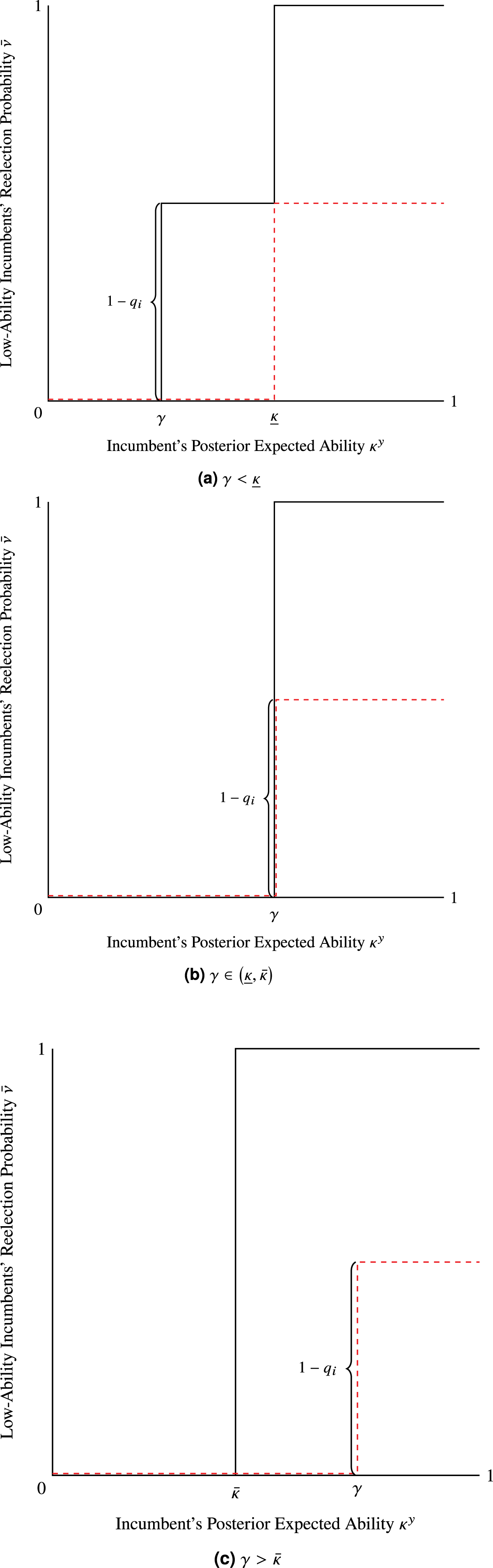
Figure 2 illustrates low-ability incumbents’ equilibrium reelection probability as a function of the posterior probability that the Incumbent has a high ability conditional on her first-period policy decision. For comparison, low-ability incumbents’ equilibrium reelection probability when the Challenger always enters the race is depicted with a dashed line.
Low-ability incumbents’ reelection probability with endogenous challenger entry. (a)  $\gamma \lt \underline{\kappa}$, (b) $\gamma \in \left(\underline{\kappa}, \bar{\kappa}\right)$, (c) $\gamma \gt \bar{\kappa}$.

Low-ability incumbents’ reelection probability is a step function. A higher posterior probability that the Incumbent has a high ability improves her reelection prospects through two mechanisms, each associated with a “jump” in low-ability incumbents’ reelection probability:
(i) The Voter’s decision to reelect or replace the Incumbent when her type is not exogenously revealed before the election; and
(ii) The Challenger’s decision to enter the race.
When the Challenger always runs, there is only one jump in low-ability incumbents’ reelection probability associated with the first mechanism, occurring where the posterior probability that the Incumbent has a high ability equals the Challenger’s expected ability. The discontinuity’s height equals the likelihood that Nature does not exogenously reveal the Incumbent’s type before the election. The second mechanism is inactive.
Endogenous challenger entry has three effects on low-ability incumbents’ reelection probability. First, when the Challenger’s motivation to run for office is the strongest, endogenous challenger entry can introduce a second discontinuity point at the threshold above which the Challenger withdraws his candidacy. Second, endogenous challenger entry can change the location of the existing discontinuity. For instance, when the Challenger’s motivation to run is the weakest, the discontinuity in low-ability incumbents’ reelection probability occurs at a lower value of the posterior probability that the Incumbent has a high ability, as the jump at which the Challenger withdraws his candidacy supersedes the original discontinuity at which the Voter changes their vote absent exogenous information disclosure. Third, endogenous challenger entry raises the total height of the discontinuities because the Incumbent can now dissuade the Challenger from running altogether, thereby securing her reelection.
5.3. The incumbent’s policy decisions
Similarly to when the Challenger always runs, low-ability incumbents weigh the loss from enacting policy b against the electoral advantage it provides when choosing which policy to enact in the first period.
Low-ability incumbents’ incentives to distort their policy decisions stem from the discontinuities in their reelection probability. If low-ability incumbents behave to maximize policy payoffs, the Voter will conclude that the Incumbent has a high ability after enacting policy b, resulting in her automatic reelection. Uncertainty about her type persists after enacting policy a. If the posterior probability that the Incumbent has a high ability after enacting policy a is lower than the value where a jump occurs, then low-ability incumbents’ reelection probability depends on the policy they enact.
If the discontinuity is sufficiently large, low-ability incumbents will find it profitable to enact policy b with some probability to improve their reelection prospects. In this case, they distort their policy decisions to the extent that the posterior probability that the Incumbent has a high ability after enacting one of the policies equals the value at which the closest discontinuity occurs. Accordingly, the closer the Incumbent’s prior probability of having a high ability is to the location of the jump, the more pronounced policy distortions will be.
Since endogenous challenger entry moves the discontinuities in low-ability incumbents’ reelection probabilities, it inevitably affects policymaking. Propositions 1, 2, and 3 outline the key differences in low-ability incumbents’ equilibrium policy decisions with and without endogenous challenger entry.
Proposition 1. Low-ability incumbents may distort their policy decisions in the first period when the Challenger’s entry decision is endogenous but not when the Challenger always runs if:
 \begin{equation*}
\frac{2 \pi-1}{\delta \pi} \in \left(1 - q_{i}, 1\right).
\end{equation*}
\begin{equation*}
\frac{2 \pi-1}{\delta \pi} \in \left(1 - q_{i}, 1\right).
\end{equation*}Proposition 1 implies that the first-order effect of endogenous challenger entry is to increase the absolute value of policy distortions compared to when the Challenger always runs. The reason is that the Incumbent can now secure her reelection by dissuading the Challenger from entering the race rather than facing the risk of being exogenously revealed to have a low ability before the election. This effect is reflected by the wider range of low-ability incumbents’ reelection probability in Figure 2. Consequently, low-ability incumbents are willing to distort their policy decisions for larger values of the loss from enacting policy b. It follows that there are conditions under which they find it too costly to distort their policy decisions when the Challenger always runs but are willing to do so with endogenous challenger entry.
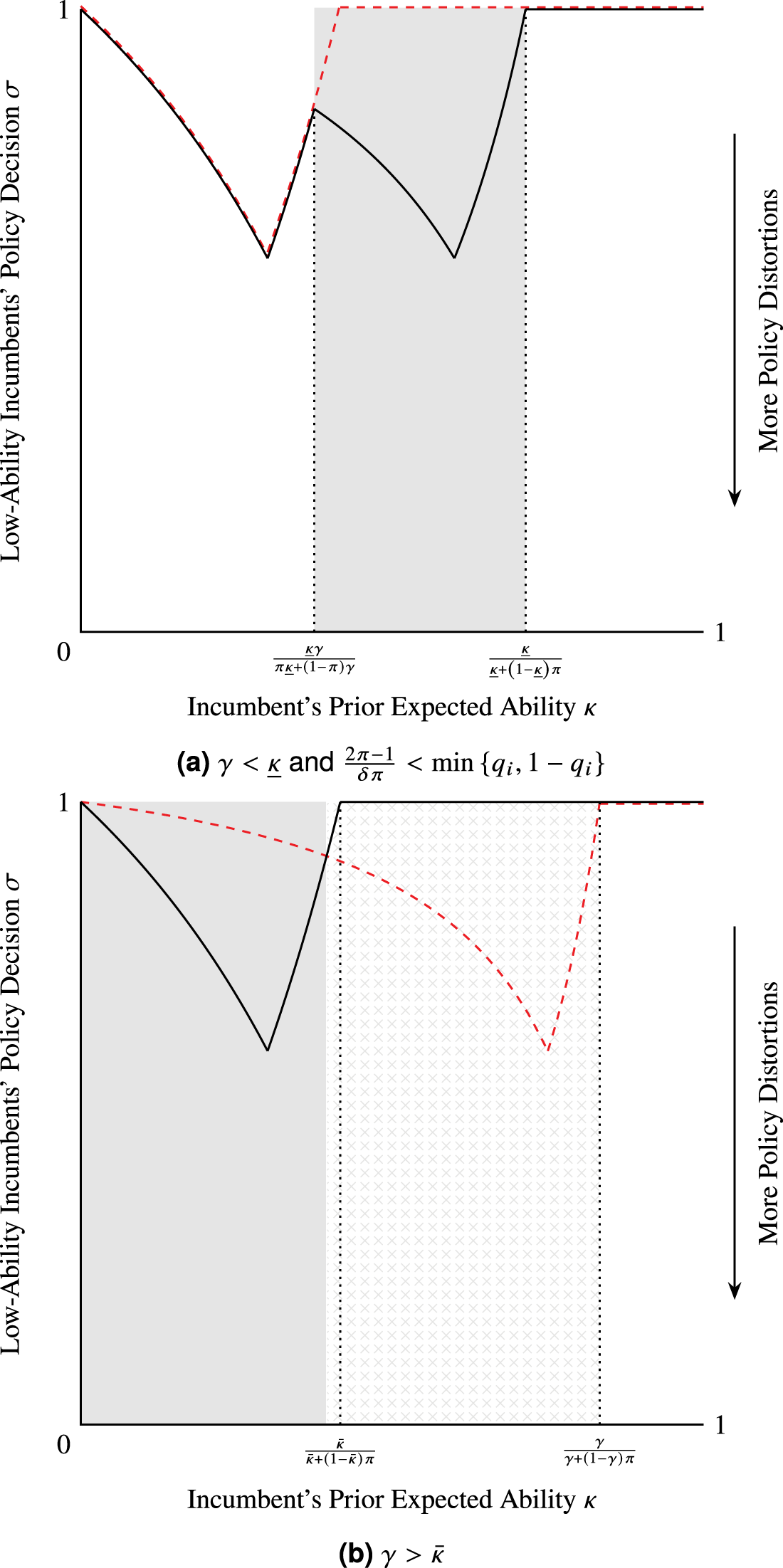
In circumstances where low-ability incumbents are willing to manipulate their policy decisions when the Challenger always runs, endogenous challenger entry can prompt changes in the magnitude of policy distortions. This effect is described in Proposition 2 and illustrated in Figure 3.
Low-ability incumbents’ equilibrium policy decisions with endogenous challenger entry. (a)  $\gamma \lt \underline{\kappa}$ and $\frac{2 \pi - 1}{\delta \pi} \lt \min\left\{q_{i}, 1 - q_{i}\right\}$, (b) $\gamma \gt \bar{\kappa}$.

Proposition 2. Consider the case in which low-ability incumbents may distort their policy decisions when the Challenger always runs for office:
 \begin{equation*}
\frac{2 \pi - 1}{\delta \pi} \lt 1 - q_{i}.
\end{equation*}
\begin{equation*}
\frac{2 \pi - 1}{\delta \pi} \lt 1 - q_{i}.
\end{equation*}In this case, endogenous challenger entry deepens policy distortions compared to when the Challenger always runs under the following conditions:
(i)
$\gamma \lt \underline{\kappa}$,
$\frac{2 \pi - 1}{\delta \pi} \lt \min\left\{q_{i}, 1 - q_{i}\right\}$, and
$\kappa \in \left(\frac{\underline{\kappa} \gamma}{\pi \underline{\kappa} + \left(1 - \pi\right) \gamma}, \frac{\underline{\kappa}}{\underline{\kappa} + \left(1 - \underline{\kappa}\right) \pi}\right)$; or(ii)
$\gamma \gt \bar{\kappa}$ and
$\kappa \lt \frac{\gamma \bar{\kappa}}{\pi \gamma + \left(1 - \pi\right) \bar{\kappa}}$.


In contrast, endogenous challenger entry mitigates policy distortions compared to when the Challenger always runs if  $\gamma \gt \bar{\kappa}$ and $\kappa \in \left(\frac{\gamma \bar{\kappa}}{\pi \gamma + \left(1 - \pi\right) \bar{\kappa}}, \frac{\gamma}{\gamma + \left(1 - \gamma\right) \pi}\right)$.
In Figure 3, the vertical axis represents the equilibrium probability that low-ability incumbents enact policy a in the first period. A higher probability reflects fewer policy distortions. The horizontal axis represents the prior probability that the Incumbent has a high ability. Policy decisions made with endogenous challenger entry are illustrated with solid lines, while those made when the Challenger always runs are depicted with dashed lines. The shaded region highlights the ranges of values over which endogenous challenger entry worsens policy distortions, whereas the crosshatched area highlights the interval over which it mitigates policy distortions.
Endogenous challenger entry alters the severity of low-ability incumbents’ policy distortions in three scenarios. First, when the Challenger’s motivation to run for office is the strongest, endogenous challenger entry creates a second point around which the Incumbent distorts her policy decisions. This effect is illustrated in Figure 3’s upper panel. Where low-ability incumbents’ equilibrium reelection probability was previously constant between policies, and there were no incentives for posturing, the Incumbent can now dissuade the Challenger from running. If the cost of enacting policy b is sufficiently low, low-ability incumbents distort their policy decisions over this range to deter the Challenger from running for office. Therefore, endogenous challenger entry deepens policy distortions.
In this case, endogenous challenger entry alters the relationship between policy distortions and the prior probability that the Incumbent has a high ability. When the Challenger always runs, policy distortions increase before decreasing as the prior probability that the Incumbent has a high ability increases. With endogenous challenger entry, policy distortions initially increase, then decrease, before rising again as the prior probability that the Incumbent has a high ability nears the threshold at which the Challenger withdraws his candidacy. Policy distortions decrease once more after the Incumbent’s prior expected ability surpasses this threshold. In other words, with endogenous challenger entry, the relationship between policy distortions and the prior probability that the Incumbent has a high ability takes the shape of a “W” rather than a “V.”
Second, when the Challenger runs if and only if he is more likely to have a high ability than the Incumbent, multiple equilibria can arise, which vary in the probability that the Challenger runs for office and the likelihood of the Voter reelecting the Incumbent absent exogenous information about her type before the election. However, these equilibria ultimately result in the same policy decisions as in the benchmark scenario. Therefore, endogenous challenger entry does not alter low-ability incumbents’ policy decisions.
Third, when the Challenger’s motivation to run for office is the weakest, endogenous challenger entry causes a shift in the Incumbent’s policy distortions. Specifically, it pulls them toward lower values of the prior probability that the Incumbent has a high ability as low-ability incumbents now manipulate their policy decisions to make the Challenger indifferent between running and forfeiting, at a lower posterior probability that the Incumbent has a high ability than the one making the Voter indifferent between reelecting and replacing the Incumbent. This effect is illustrated in Figure 3’s lower panel. In this scenario, if the prior probability that the Incumbent has a high ability is low, endogenous challenger entry deepens policy distortions compared to when the Challenger always runs. Conversely, if the prior probability that the Incumbent has a high ability is high, endogenous challenger entry improves policymaking because the Challenger now withdraws from the election even if low-ability incumbents invariably enact policy a, leading to an uncontested election and eliminating low-ability incumbents’ incentives to distort their policy decisions.
To conclude this section, I show that the magnitude of policy distortions can change non-monotonically with marginal variations in the cost of running for office. Under certain conditions, endogenous challenger entry can mitigate policy distortions when the Challenger’s motivation to run for office is weak but exacerbate these distortions when motivation is strong. This suggests that increasing the cost of running for office at the margin may initially deepen policy distortions before easing them. Proposition 3 outlines specific conditions under which marginally increasing the cost of running for office improves policymaking locally.
Proposition 3. With endogenous challenger entry, the equilibrium probability that low-ability incumbents enact policy a in the first period marginally increases with the cost for the Challenger of running for office under the following conditions:
(i)
$\frac{2 \pi - 1}{\delta \pi} \lt q_{i}$ and
$q_{i} \left(1 - \kappa\right) \lt c \lt q_{i} \left(1 - \max\left\{\frac{\pi \kappa}{1 - \left(1 - \pi\right) \kappa}, \gamma\right\}\right)$; or(ii)
$1 - q_{i} \min\left\{\kappa, \gamma\right\} \lt c \lt 1 - \frac{q_{i} \pi \kappa}{1 - \left(1 - \pi\right) \kappa}$.


The first condition may hold only if  $\kappa \gt \gamma$ and the second condition only if $\gamma \gt \frac{\pi \kappa}{1 - \left(1 - \pi\right) \kappa}$.
There are two cases where increasing the cost of running for office reduces policy distortions at the margin. In the first case, the cost of running for office is so low that the Challenger is ready to run even if the Incumbent is more likely to have a high ability than him. In the second case, the cost is so high that the Challenger can be dissuaded from running even if he is more likely to have a high ability than the Incumbent. In both cases, the Incumbent’s prior expected ability exceeds the threshold above which the Challenger forfeits but is not sufficiently high to deter him from running after the Incumbent enacts policy a in the first period, assuming she behaves to maximize policy payoffs. Thus, low-ability incumbents are motivated to distort their policy decisions to dissuade the Challenger from entering the election after she enacts policy a.Footnote 5 The first set of conditions can only be satisfied if the Incumbent initially has a higher expected ability than the Challenger. On the other hand, the second set of conditions can only be satisfied if the Challenger has a sufficiently high expected ability relative to the Incumbent’s and the probability that the state is a.
Marginally increasing the cost of running for office lowers the threshold at which the Challenger withdraws from the election. Consequently, low-ability incumbents need to distort their policy decisions to a lesser extent to dissuade the Challenger from running after the Incumbent enacts policy a, resulting in better policymaking under either set of conditions.
6. Welfare implications of endogenous challenger entry
In this section, I consider the welfare implications of endogenous challenger entry.
Depending on model parameters, endogenous challenger entry may worsen or alleviate low-ability incumbents’ policy distortions in the first period. All else equal, fewer policy distortions increase voter welfare, and more policy distortions decrease it. However, endogenous challenger entry also affects the selection of officeholders in the second period. Elections not only represent a means for the Voter to punish or reward the Incumbent for their past actions but are also the occasion for them to pick who will hold office in the second period. Regardless of its effect on policymaking, endogenous challenger entry deprives the Voter of the opportunity to replace the Incumbent when the Challenger concedes the election, which is costly if the Incumbent is exogenously revealed to have a low ability before the election. As a result, the second-period officeholder has a lower expected ability with endogenous challenger entry.
In light of this, if endogenous challenger entry induces more policy distortions, it inevitably decreases voter welfare, with weaker electoral selection compounding its adverse effects on policymaking. If endogenous challenger entry reduces policy distortions, it is impossible to draw immediate conclusions about voter welfare because the adverse impact of endogenous challenger entry on electoral selection offsets, at least partly, the benefits of better policymaking. Whether endogenous challenger entry improves voter welfare depends on the magnitude of its positive effect on policymaking relative to its negative effect on electoral selection. Proposition 4 outlines the conditions under which endogenous challenger entry effectively improves voter welfare.
Proposition 4. Endogenous challenger entry may improve voter welfare compared to when the Challenger always runs for office only under the following conditions:
(i)
$\gamma \gt \bar{\kappa}$; and(ii)
$2 \pi - 1 \gt q_{i} \gamma$ if
$\gamma \gt \frac{\bar{\kappa}}{\bar{\kappa} + \left(1 - \bar{\kappa}\right) \pi} = \frac{1 - c}{\pi q_{i} + \left(1 - \pi\right) \left(1 - c\right)}$, or
$\left[q_{i} \gamma - \left(1 - c\right) \right] \left(2 \pi - 1\right) \gt q_{i} \gamma^{2} \left[q_{i} - \left(1 - c\right) \right] \left(1 - \pi\right)$ if
$\gamma \lt \frac{\bar{\kappa}}{\bar{\kappa} + \left(1 - \bar{\kappa}\right) \pi}$.


When these conditions hold, endogenous challenger entry improves voter welfare if and only if the prior probability that the Incumbent has a high ability is in an interval containing the value  $\max\left\{\gamma, \frac{\bar{\kappa}}{\bar{\kappa} + \left(1 - \bar{\kappa}\right) \pi}\right\}$ and contained in the interval $\left(\frac{\gamma \bar{\kappa}}{\pi \gamma + \left(1 - \pi\right) \bar{\kappa}}, \frac{\gamma}{\gamma + \left(1 - \gamma\right) \pi}\right)$.
Proposition 2 asserts that Condition (i) is necessary for endogenous challenger entry to lessen policy distortions. When this condition holds, there are fewer policy distortions if the Incumbent’s expected ability is in the range  $\frac{\gamma \bar{\kappa}}{\pi \gamma + \left(1 - \pi\right) \bar{\kappa}}$ to $\frac{\gamma}{\gamma + \left(1 - \gamma\right) \pi}$. Endogenous challenger entry may only improve voter welfare in this range.
Over this interval, the benefits of endogenous challenger entry in terms of fewer policy distortions are maximized when the Incumbent’s expected ability equals the highest of two values: the one at which policy distortions are the greatest without endogenous challenger entry (γ), or the one above which low-ability incumbents no longer distort their first-period policy decisions with endogenous challenger entry ( $\frac{\bar{\kappa}}{\bar{\kappa} + \left(1 - \bar{\kappa}\right) \pi}$). On the other hand, the loss from weaker electoral selection decreases with the Incumbent’s expected ability because the opportunity to replace the Incumbent is valuable to the Voter when Nature reveals that she has a low ability before the election, an event becoming less likely when she has a higher expected ability. Therefore, if endogenous challenger entry improves voter welfare for some value of the Incumbent’s expected ability, it must necessarily do so when the latter equals the highest of γ and $\frac{\bar{\kappa}}{\bar{\kappa} + \left(1 - \bar{\kappa}\right) \pi}$. Condition (ii) captures the circumstances under which this occurs.
All else equal, Condition (ii) holds if the state a is sufficiently likely. The reason is that as this parameter increases, the cost of policy distortions increases while the loss from having a low-ability politician hold office in the second period decreases, making it increasingly likely that the benefits from fewer policy distortions outweigh the losses from weaker electoral selection. This condition also depends on the Challenger’s expected ability and the probability that Nature publicly reveals the Incumbent’s type before the election. In general, whether this condition is satisfied depends ambiguously on their values because the benefits from fewer policy distortions and the losses from weaker electoral selection parallelly increase with these parameters. However, if  $\gamma \gt \frac{\bar{\kappa}}{\bar{\kappa} + \left(1 - \bar{\kappa}\right) \pi}$, the effect of these parameters on the losses from weaker electoral selection dominates. In this case, Condition (ii) holds if and only if the Challenger’s expected ability and the probability that Nature publicly reveals the Incumbent’s type before the election are sufficiently low.
7. Conclusion
This paper fills a void in the formal literature on electoral accountability by incorporating endogenous challenger entry into a model of electoral agency with adverse selection. I use this model to study the effects of endogenous challenger entry on policymaking and voter welfare.
The first-order effect of endogenous challenger entry is to make policy distortions more valuable compared to when the Challenger always runs for office. The reason is that policy distortions now allow the Incumbent to completely secure her reelection if she projects a sufficiently high level of ability. Accordingly, with endogenous challenger entry, the Incumbent is willing to manipulate her policy decisions under a broader range of conditions.
In cases where low-ability incumbents are disposed to distort their policy decisions when the Challenger always runs, the effect of endogenous challenger entry on policy distortions is ambiguous: it can either deepen or mitigate policy distortions. I distinguish three scenarios. When the Challenger’s incentives to run for office are the strongest, endogenous challenger entry creates a second point around which the Incumbent distorts her policy decisions, worsening policy distortions. When the Challenger’s incentives to run are of moderate intensity, endogenous challenger entry does not affect the Incumbent’s policy decisions in equilibrium. Finally, when the Challenger’s incentives to run are the weakest, endogenous challenger entry shifts the Incumbent’s policy distortions toward lower values of the prior probability that the Incumbent has a high ability. In this case, if the prior probability that the Incumbent has a high ability is sufficiently but not excessively high, endogenous challenger entry reduces policy distortions.
If endogenous challenger entry worsens policy distortions, it necessarily lowers voter welfare. On the other hand, if endogenous entry lowers policy distortions, it can increase voter welfare. However, this welfare improvement is not guaranteed because endogenous challenger entry weakens electoral selection. Therefore, the second-period officeholder’s expected ability is lower than when the Challenger always runs. For endogenous challenger entry to improve voter welfare, the benefits from better policy decisions must outweigh the losses from weaker electoral selection. I characterized conditions under which endogenous challenger entry effectively improves voter welfare.
Overall, this paper’s findings have a provocative implication: imposing barriers to entry in elections in the form of a higher cost of running for office can lead, in some circumstances, to better policy decisions and a welfare improvement for voters.
In conclusion, my analysis assumed that the Challenger’s decision to participate in the election is endogenous but does not convey information about his type. If the Challenger knew his type when choosing to run for office or not, his decision could convey such information to the Voter. For instance, if the Challenger sometimes decided to withdraw, the Voter could infer that he is more likely to have a high ability when he runs (Gordon et al., Reference Gordon, Huber and Landa2007). Accordingly, the Incumbent’s investments in deterrence could allow high-ability challengers to distinguish themselves from low-ability challengers. If this were the case, it would probably weaken low-ability incumbents’ incentives to distort their policy decisions to dissuade the Challenger from running. Indeed, while deterrence is valuable when it works, it would backfire whenever the Challenger decided to run despite these efforts, as he becomes more appealing to the Voter then. I leave a complete analysis of this scenario for future research.
Supplementary material
The supplementary material for this article can be found at https://doi.org/10.1017/psrm.2025.15.
Acknowledgements
I thank Mike Alvarez, Peter Buisseret, Arnaud Dellis, Saba Devdariani, Danny Ebanks, Lindsey Gailmard, Mike Gibilisco, Alex Hirsch, Jonathan Katz, the Associate Editor Ken Shotts, and three anonymous reviewers for their thoughtful feedback.
Funding
None.
Competing interest
None.





 Open access

