


The global scientific community, as represented through the Intergovernmental Panel on Climate Change (IPCC), has long agreed that anthropogenic causes – emissions from the combustion of fossil fuels in particular – are to a large degree responsible for increasing temperatures in many areas of the world and the global average. Nevertheless, designing and implementing appropriate policy responses has turned out to be very difficult. The complexity and unprecedented scale of climate change, the scientific uncertainty that is involved, as well as disagreements over the costs and benefits of reducing greenhouse gas (GHG) emissions have discouraged ambitious policies at the international level (Bernauer Reference Bernauer2013).
At the national level, however, policymakers have devoted considerable attention and resources to the issue. Despite this, there is strong variation in the extent to which Annex I countries (advanced industrialised countries that had specific reduction targets under the Kyoto Protocol) have adopted and implemented domestic climate change mitigation policies (Bernauer and Böhmelt Reference Bernauer and Böhmelt2013; Burck et al. Reference Burck, Marten and Bals2014; see also Victor et al. Reference Victor, House and Joy2005). Climate policy outputs thus differ between countries with regard to their scope, scale, and timing. Overall, however, scientific evidence (e.g. Masson-Delmotte et al. Reference Masson-Delmotte, Zhai, Pörtner, Roberts, Skea, Shukla and Waterfield2018; UNEP Emissions Gap report 2020) suggests that the climate policies implemented so far will lead to massively overshooting the designated goal of the Paris agreement, which is limiting the global temperature well below 2°C compared to preindustrial levels.
Additionally, public awareness of anthropogenic global warming, and particularly of the impacts of climate change and measures needed to mitigate or adapt to its consequences, has steadily increased in many countries since the mid-1990s (Lorenzoni and Pidgeon Reference Lorenzoni and Pidgeon2006; Stoutenborough et al. Reference Stoutenborough, Bromley-Trujillo and Vedlitz2014; Kachi et al. Reference Kachi, Bernauer and Gampfer2015; Mildenberger et al. Reference Mildenberger, Howe, Lachapelle, Stokes, Marlon and Gravelle2016, Oehl et al. Reference Oehl, Schaffer and Bernauer2017). Gradually, climate change has moved from a niche issue on the public agenda to one of central concern. The 2019 European Parliament (EP) has been termed as the first climate election in history (Die Zeit 2019; The Guardian 2019), and climate-change-related issues figured more prominently than ever in the 2020 United States (US) election campaign. Overall, in light of the heightened public interest in climate change policy that has been triggered partly by social movements (the Fridays for Future movement, and Extinction Rebellion, etc.) and the observation that countries still need to implement more stringent climate policy to achieve the necessary emissions cuts (UNEP Emissions Gap Report 2020), more knowledge about the public demand and policy output nexus is clearly needed.
In this article, we seek to explain the observed variation in national climate change policy outputs by focusing on domestic demand for climate change mitigation. The reason is that any government’s decision about policies for mitigating climate change is ultimately based upon domestic political decisions that are shaped by home-grown electoral preferences, special interests, national discourses, and domestic political institutions (Aklin and Urpelainen Reference Aklin and Urpelainen2013). In the case of democracies, conventional wisdom holds that policy choices are, at least to some degree, driven by what the public wants (i.e. public demand). The general presumption here is that democratic policymakers are more attentive and responsive to public demands than their nondemocratic counterparts. The literature offers mixed empirical evidence about whether public demand is in fact, ceteris paribus, a significant determinant of variation in climate policy across countries and over time (Fankhauser et al. Reference Fankhauser, Gennaioli and Collins2014).
Our article aims to identify the extent to which differences in public demand for climate change mitigation lead to differences in public policy targeted at GHG mitigation across countries. To this end, we first theoretically distinguish different components of public demand and link them to government responsiveness in climate change policy. A major hindrance to testing the proposed relationship relates to what measures of public demand for climate change mitigation are available and commensurable. As Konisky et al. (Reference Konisky, McAdam and Urpelainen2017: 5) rightly point out, “the relationship between societal demand for change and policy outputs under various political institutions remains poorly understood largely because of the lack of empirical material.”
Public opinion surveys arguably provide the most direct measure of public demand. However, using such data imposes major limitations on undertaking comparative cross-country research over time. In most policy areas, surveys either are not implemented in a large cross-section of countries over long periods of time and/or survey items (in our case, those related to climate change issues) change over time. As Burstein (Reference Burstein2010, p. 75) succinctly put it: “It has to be a bad idea to measure public opinion’s impact on policy by using whatever survey items are around, however loosely they may be connected to the policy in question.” In other words, filling survey data gaps in a meaningful manner ex-post is not possible. Footnote 1
Hence, for the research described herein, we use original data that was hand-coded via extensive print media content analysis, as well as new data on legislative activity concerning climate change mitigation in six Annex I countries for the period 1995–2010. We cover the US, Canada, Germany, Switzerland, Italy, and Spain to ensure the representation of different continents (North America and Europe), better- (Germany, Switzerland), and worse climate policy performers (Canada, US) with respect to GHG emissions and climate protection in general, and different levels of exposure to climate-change-related risks. Footnote 2
In our article, we empirically test two different notions of policy responsiveness that take into account the relationship between general demand for climate change policies and the supply of the latter. Our results indeed show that public demand matters for climate change policy adoption. The second notion, target-specific responsiveness, then links demand for different climate policy targets (e.g. policies targeted at the energy supply vis-à-vis policies targeted at buildings) to the supply of policies within these specific domains. While this more detailed analysis exposes our general results to a hard test, it nevertheless confirms the conclusions from our primary analysis about general responsiveness. Both parts of the analysis, but especially the latter part, are highly innovative and – to our knowledge – are novel within the literature on comparative climate change policy in terms of the detail incorporated in both the dependent and independent variables.
The research presented in this article adds to the literature on comparative climate change policy and on policy responsiveness in several important ways. First, we use a more fine-grained concept of public demand for climate change and original data to measure related public demand across countries and time (our independent variable). This is a substantial improvement over other medium-to-large-N studies in comparative climate change policy, which usually approximate public demand for climate change via votes or numbers of seats for green parties (Holzinger et al. Reference Holzinger, Knill and Sommerer2008, Hughes and Urpelainen Reference Hughes and Urpelainen2015), or via survey data that stems from questions about – for example – the environment, as the most important problem (Bakaki et al. Reference Bakaki, Böhmelt and Ward2020).
Second, further merit of our data is that we are able to look at policy responsiveness in relation to subcategories (targets) of climate change policies. This means that we can link target-specific public demand (e.g. claims concerning wind energy promotion) to target-specific policies (e.g. policies on renewable energy). We argue that policy choices between countries vary not only in their absolute number but also to what extent different sectors (targets) are targeted. We thus heed the call of scholars such as Stokes and Breetz (Reference Stokes and Breetz2018) or Schaffer and Levis (Reference Schaffer, Levis, Hettich and Kachi2021) for a more disaggregated sectoral analysis of climate policy to eventually be able to theorise on differences between sectoral demand and policy supply. This disaggregation exposes our general responsiveness analysis to a hard test. To our knowledge, this is the first analysis of target-specific responsiveness in comparative environmental politics. Future research may continue in this direction and theorise and analyse differences in responsiveness depending on the sectors targeted in more detail.
Third, with respect to the broader literature on policy responsiveness, we add to existing scholarship by covering a topic of moderate saliency (i.e. climate change). The bulk of studies on responsiveness deal with topics that are highly salient to people (e.g. welfare policy) and research has only recently begun to systematically explore other topics (Lax and Phillips Reference Lax and Phillips2012; Vandeweerdt et al. Reference Vandeweerdt, Kerremans and Cohn2016). Scholars such as Burstein (Reference Burstein2003, Reference Burstein2006) thus note that overall conclusions about the extent of policy responsiveness in democracies may suffer from a confirmatory bias (in the sense of inflated estimates of policy responsiveness) because they are based on items from public opinion surveys that, by design, ask questions about highly salient issues. While we do not have a theoretical explanation for the differences in cross-issue responsiveness, our study, and data collection related to early developments in climate change policy may prove a very useful resource considering that the issue of climate change has increased in saliency from low to high over the past 25 years.
Moreover, we add to the literature by comparing comprehensive climate change policy output for several countries, while most studies on policy responsiveness either rely on public opinion survey data from a single country (Dolšak and Houston Reference Dolšak and Houston2014; Bromley-Trujillo and Poe Reference Bromley-Trujillo and Poe2020) or one component of climate change policy (Anderson et al. Reference Anderson, Böhmelt and Ward2017).
The remainder of the article is structured as follows. After a brief review of the literature on policy responsiveness in democracies, we outline our theoretical arguments. The subsequent section provides information on the research design and data. We then present the empirical findings and end by discussing their implications for future research and for policymakers.
The responsiveness of democratic policymakers
Conventional wisdom holds that public demand is an important determinant of public policy choices, particularly in democracies. As noted by Dahl (Reference Dahl1971, p. 1), “ [a] key characteristic of democracy is the continued responsiveness of the government to the preferences of the people.” The logic underlying this presumption is that political leaders that are faced with public demand for or against a particular policy (in the present case, climate change mitigation) have an incentive to satisfy this demand if they wish to remain in office. In democracies, however, citizens do not only hold and express their preferences on election day, but they can and do observe their elected government’s policy choices and their alignment with their own preferences throughout the electoral cycle.
What ideally happens in democracies corresponds to the notion of dynamic representation, as Stimson et al. (Reference Stimson, Mackuen and Erikson1995, p. 560) define it: “a simple idea and an old one. Public sentiment shifts. Political actors sense the shift. And then they alter their policy behaviour at the margin.” Moreover, the concept of “thermostatic representation” proposed by Wlezien (Reference Wlezien1995) views representation as a dynamic process in which the public and the government respond to one another. As mentioned above, one limitation of prior research about the relationship between mass public opinion and government policy is its geographical concentration on the US, and lack of cross-national comparisons. Footnote 3 Accordingly, within the domain of environmental policy responsiveness, most academic contributions have examined responsiveness in the US states (Ringquist Reference Ringquist1994; Hays et al. Reference Hays, Esler and Hays1996; Johnson et al. Reference Johnson, Brace and Arceneaux2005; Agnone Reference Agnone2007; Dolšak and Houston Reference Dolšak and Houston2014). Hays et al. (Reference Hays, Esler and Hays1996), for instance, find that US state environmental regulation is “quite responsive” to public opinion. Johnson et al. (Reference Johnson, Brace and Arceneaux2005) use a modified (environmental policy) “thermostatic” model of the reciprocal links between citizen preferences (state-level environmental opinions) and government policy outputs, taking into account the effectiveness of policies. They find a thermostatic adjustment in environmental policy, but only in cases when policy responsiveness has improved environmental conditions. Agnone (Reference Agnone2007) examined time series data from the US states in the period 1960–1998 to gauge the impact of the environmental movement on environmental policymaking using public opinion data, as well as data on protests. He found that, when controlling for the saliency-enhancing effect of protests, public opinion influenced changes in pro-environmental public policy. Dolšak and Houston (Reference Dolšak and Houston2014) examined subnational climate change policies in the US. Their method resembles the approach adopted in this article: they used newspaper coverage to explain policy outputs and conclude that legislative activity increased when the consequences of climate change were discussed in the media. In their recent contribution, Bromley-Trujilllo and Poe (Reference Bromley-Trujillo and Poe2020) also link issue salience on climate change and environmental issues to a broad range of climate change policies within US states. They find that variation in salience across states impacts climate policy output. Moreover, various interactions between problem status and issue attention amplify the connection between public issue salience and policy output (Bromley-Trujillo and Poe Reference Bromley-Trujillo and Poe2020: 298).
Recent country-comparative contributions by Anderson et al. (Reference Anderson, Böhmelt and Ward2017) and Bakaki et al. (Reference Bakaki, Böhmelt and Ward2020) have used survey data from the Eurobarometer to proxy citizens’ environmental concerns (Anderson et al. Reference Anderson, Böhmelt and Ward2017) as well as data on media attention to environmental issues (Bakaki et al. Reference Bakaki, Böhmelt and Ward2020) to explain policy output in the area of energy policy and have found evidence that policymakers react to public demand. Both contributions do not directly test policy responsiveness in the specific area of climate change as they rely on different environmental questions on, for example, pollution from the Eurobarometer (Anderson et al. Reference Anderson, Böhmelt and Ward2017: 6; Bakaki et al. Reference Bakaki, Böhmelt and Ward2020: 9) as their public opinion proxy.
In summary, while there is some confirmatory evidence for the public demand–policy output nexus in environmental policy, research does not yet offer much comparative insight into public demand concerning the issue of climate change. Our contribution can be regarded as the first comparative and comprehensive effort to directly link demand for climate change policies to climate change policy output.
What explains climate policy output?
We consider policy output (in our study measured by public policy output related to climate change mitigation) to be a function of policymakers’ attentiveness to the issue of climate change, related public demand, and the institutional context they operate in.
We thus argue that public policy output tends to occur when policymakers are attentive to a specific issue or problem, and when they feel they need to do something about it in order to respond to public demand (c.f. Shapiro Reference Shapiro2011). Our baseline hypothesis is thus simple and straightforward:
Hypothesis: Stronger public demand for climate change mitigation is likely to lead to more climate policy output. This applies both in aggregate terms, and with respect to the demand for and output of climate policy measures that address specific targets.
The notion that policy responsiveness is present both if we look at the influence of aggregate public demand on aggregate climate change policy output and if we look at target-specific demand and target-specific policy output is central to our study and needs to be explained in greater detail. Policymakers can be responsive and satisfy public demand in different ways. They can – for example – react to the general saliency of an issue or to differences in saliency by increasing public policy output with respect to the issue. We believe this requires a broad definition of governmental issue responsiveness that can help us establish a link between public demand and public policy.
A more specific conceptualisation of government responsiveness to public demand involves looking at public policy output in specific target areas that appear to be dear to the public. To provide a more nuanced view of responsiveness, we will examine both the effect of public demand on the number of climate change mitigation policies adopted per year and country (general responsiveness definition), and the number of climate change mitigation policies adopted with respect to specific targets such as buildings or appliances (specific responsiveness definition) in our empirical analysis. To our knowledge, we are the first to explore target-specific responsiveness in the area of environmental politics. We argue that future comparative research should proceed along this avenue to actually describe and explain climate policy outputs in more detail. Below, we elaborate further on the implications of these two conceptualisations of policy responsiveness and how they relate to our measures of public demand that are described in the following paragraph.
What is public demand?
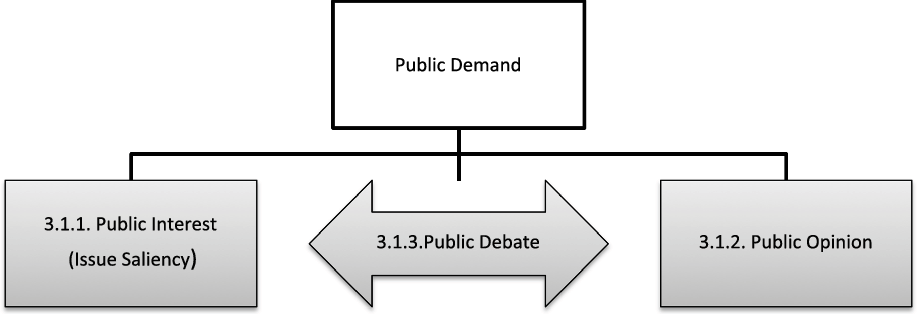
We regard the concept of public demand as consisting of a combination of public interest (issue salience) and public opinion concerning the respective issue (in our case, climate change) (Oehl Reference Oehl2015; Oehl et al. Reference Oehl, Schaffer and Bernauer2017). Figure 1 shows how we conceptualise public demand. The public interest concept (issue salience) captures how important a given issue is from the viewpoint of members of a given social unit (e.g. a country). The opinion concept captures what people think about a given societal problem and, more importantly, what they think should be done about it, if anything, and by whom. The two dimensions are distinct in the sense that individuals may hold opinions about a given issue, whereas the issue may or may not be important (salient) to them. We also argue that the combined effect of the latter (public debate) further enhances policymakers’ responsiveness, or more precisely, that higher issue salience increases the impact of opinion on policy responsiveness. We elaborate on this relationship in more detail below.
Three dimensions of public demand (c.f. Oehl et al. (Reference Oehl, Schaffer and Bernauer2017)).
Public interest (issue saliency)
Issue salience matters for policy responsiveness because, due to electoral motivations in democracies, policymakers’ attentiveness is greater in the case of salient issues. In other words, when policymakers want (and need) to be re-elected, they will turn their attention in policymaking to problems that resonate more strongly with citizens; i.e. salient issues from the public’s perspective. Several studies have found that both the public and policymakers tend to prioritise legislation in economic and welfare domains, meaning that responsiveness is relatively high in these areas (Jones and Baumgartner Reference Jones and Baumgartner2005). In relation to the above-mentioned, two implications arise: first, the issue salience of climate change over time is likely to be an influential factor in terms of policy responsiveness in general. We thus expect that greater public interest (issue salience) will be linked with greater legislative activity on climate change.
Second, however, as we have noted above, the attentiveness of policymakers and thus policy outputs are probably generally greater for the key issues on a government´s agenda, such as policies dealing with the economy and social welfare (redistribution). This means that we should pay attention to confirmatory bias when studying issues of high salience. Of course, this begs the question of whether climate change is a medium salience issue relative to other issues on the public agenda. We presume that, despite recent increases in climate concern, climate change policy is of moderate salience in most countries, especially concerning the 1990s (and relative to other policy issues on national agendas). In most countries, climate-change-related issues do not play a prominent role in processes of electoral competition – at least not yet. Overall, this supports our assertion that climate change is an issue of moderate salience with respect to other national policy issues such as unemployment, welfare, and immigration.
Public opinion
Another component of public demand that matters for legislative activity is public opinion vis-à-vis the respective issue. In earlier research, public opinion has primarily been measured with survey data. There is a burgeoning literature that seeks to measure and explain individual attitudes towards climate change using survey data (Leiserowitz Reference Leiserowitz2006; McCright and Dunlap Reference McCright and Dunlap2011; Brulle et al. Reference Brulle, Carmichael and Jenkins2012; Donner and McDaniels Reference Donner and McDaniels2013; Scruggs and Benegal Reference Scruggs and Benegal2013; Lee et al. Reference Lee, Markowitz, Howe, Ko and Leiserowitz2015), as well as regarding opinion towards different climate policies (Lachapelle et al. Reference Lachapelle, Borick and Rabe2012; Beiser-McGrath and Bernauer Reference Beiser-McGrath and Bernauer2019; Douenne and Fabre Reference Douenne and Fabre2020; Umit and Schaffer Reference Umit and Schaffer2020; Schaffer Reference Schaffer, Hakelberg and Seelkopf2021). There has been very little work, however, that connects data on public opinion on climate change to climate change policy outputs (Bromley-Trujillo and Poe Reference Bromley-Trujillo and Poe2020).
As noted above, the concept of opinion is distinct from salience inasmuch as the former shows people’s agreement or disagreement with governmental activity in relation to an issue. Footnote 4 In our case, opinion refers to whether people desire more or less governmental activity in the area of climate change, and the concept is thus more closely linked to public preferences related to public policy than the mere salience of the issue. Footnote 5 Positive opinions about more climate change legislation should thus influence whether policymakers become more attentive, and, as we argue, more active in relation to an issue. Conversely, if public opinion about an issue is negative (less desire for regulation), we expect to observe less public policy output.
Interaction between salience and opinion (public debate)
While public interest (issue salience) and public opinion are, in our view, the most important single components of issue-specific public demand, we acknowledge that these two components interact, and that issue salience is important in the opinion-policy responsiveness nexus by enhancing public debate and creating scope for policy action. Our concept of public debate thus brings together both issue salience and issue-related opinion. We submit that, in addition to their direct effects on policy action, the main effect of opinion on responsiveness is contingent on different manifestations of issue salience. Public interest in an issue and stated opinions about an issue may thus mutually enhance policymaking activity as regards creating scope for policy action. The question, however, is which combinations of public interest and public opinion enhance responsiveness, and which combinations tend to dampen policymaking. Does the impact of opinion indeed change as issue salience increases?
We hypothesise that the more salient an issue is, the larger the effect of opinion on policy responsiveness is likely to be (Burstein Reference Burstein2003; Lax and Phillips Reference Lax and Phillips2009). In their study on public opinion and policy responsiveness regarding the issue of gay rights, Lax and Phillips (Reference Lax and Phillips2009) found that the higher the salience of gay rights issues, the greater the policy responsiveness to issue-specific public opinion. We accordingly submit that, from the viewpoint of policymakers, opinion may only matter given that an issue is salient. We propose that the co-occurrence of high levels of issue salience and positive opinion amplifies the direct effect of both on policy output and creates the most favourable conditions for inducing further climate change policies. Our theoretical rationale here is that when the salience of the issue of climate change is high (low) and opinion regarding public policies on climate change is clearly positive (negative), the attentiveness of policymakers will be highest (lowest), as will the related electoral gains (losses) from action (inaction).
Table 1 shows our theoretical expectations concerning the effect of opinion for different levels of salience. This means that we assume that the direction of the effect on policy responsiveness (i.e. whether positive or negative) is determined mainly by whether opinion is positive or negative. Issue salience will then enhance this effect (if high), or diminish it (if low). In considering the level effect of salience, we further expect that positive (negative) changes in salience from one year to another also have the potential to amplify (dampen) the effect of opinion on policy responsiveness.
Expected conditional effect of opinion on different levels of issue salience (scope for action)

Partisan preferences
It is commonly assumed that left-leaning governments pursue greener policies; i.e. that they are more inclined to adopt and implement environmental legislation (Neumayer Reference Neumayer2003; Schaffer and Bernauer Reference Schaffer and Bernauer2014) and are more responsive in general (Brooks Reference Brooks1985, Reference Brooks1987).
Conversely, right-leaning governments, especially in Anglo-Saxon countries, have been associated with climate scepticism (McCright and Dunlap Reference McCright and Dunlap2011). Parties on the political left tend to have issue ownership of environmental topics in many countries, and issue ownership has been shown to have a significant impact when an issue is salient (Bélanger and Meguid Reference Bélanger and Meguid2008; Schaffer and Lüth Reference Schaffer and Lüth2021). In general, governments have some capacity to enact legislation during their terms in office and will try to concentrate on legislation that caters to their core constituencies because their aim is to be re-elected. As governments in parliamentary systems have considerable influence to set the agenda within the policymaking process (Tsebelis Reference Tsebelis2009), left-leaning governments are supposed to introduce more climate change legislation. In presidential systems, veto power by the executive makes the partisanship of the government relevant to explain policy choices (Tsebelis Reference Tsebelis2009), as, for example, the executive branch in the US might veto progressive action on climate change Footnote 6 . In any case, it is important to control for the partisanship of the government to explain climate change policy output. And while the effect of partisanship has turned out to be ambiguous in several studies (Ward and Cao Reference Ward and Cao2012; Schaffer and Bernauer Reference Schaffer and Bernauer2014), for simplicity we hypothesise that left-leaning governments are more likely to adopt climate change legislation.
Institutional context
While our main theoretical and empirical contribution focuses on the effects of public demand on climate policy output, we need to control for supply side factors – notably, the institutional context. We thus add a brief discussion on the effects of electoral system type, which we regard as a crucial variable.
Electoral system: The type of electoral system may matter for policy responsiveness, but exactly how has been a matter of debate in scholarly research. Powell (Reference Powell2000) finds that majoritarian systems pay greater attention to the ebb and flow of public opinion because a shift in opinion has greater consequences on election day in such systems. Through testing this argument empirically, Wlezien and Soroka (Reference Wlezien and Soroka2012) found that governments in proportional systems are less responsive to changing public opinion. However, in terms of government rhetoric, Hobolt and Klemmemsen (Reference Hobolt and Klemmemsen2005) find that government is more responsive in Denmark (a proportional system) than in the UK (a majoritarian system).
Institutions are relevant in relation to responsiveness because they change the incentive for policymakers to actually be responsive to the public (Hobolt and Klemmemsen Reference Hobolt and Klemmemsen2005, p. 384). As Fredriksson and Millimet (Reference Fredriksson and Millimet2004) note, parties in majoritarian electoral systems only need to win the majority of votes in half of all districts, and can therefore strategically focus on (regional) subsets of the population with the electoral platforms they offer. In contrast, in proportional systems, a party has to cater to the preferences of half of the electorate with its platform in order to obtain a majority. Therefore, issues relevant to the entire population should receive more attention from parties in proportional systems. We thus expect that proportional representation is conducive to more legislative activity on climate change.
Data and empirical design
Measuring policy output (dependent variable)
To explain differences in climate change policy output across countries and over time, we need indicators that provide accurate and useful information about laws, regulations, and various other types of public policy measures. Footnote 7 In contrast to other studies that concentrate on a specific subfield of climate policy, such as renewable energy (Matisoff Reference Matisoff2008; Schaffer and Bernauer Reference Schaffer and Bernauer2014; Anderson et al. Reference Anderson, Böhmelt and Ward2017), we analyse a rather broad range of policies.
To construct our measure of national climate “policy output”, we identified the most important sectors, targets, and instruments used in climate policy. We identified five instruments – taxes, tax incentives, regulations, labels, and subsidies – and four sectors: energy supply, transport, buildings, and appliances and collected data for each country in our sample. With respect to the energy supply and transport sectors, we further distinguished whether a policy targeted renewable energy or fossil fuels (energy supply) or whether it targeted private transport or public transport (transport). For these six targets (renewable energy supply, fossil fuel supply, private transport, public transport, buildings, and appliances), we coded whether in any given year – from 1995 onwards – the country adopted a policy that used a particular instrument and aimed at a particular target (see appendix Figure A.1 for more information). In federal systems, we restricted the measurement to the national level. Footnote 8
We used various information sources, including IEA and EU databases, country reports to the UNFCCC, and information from national environmental and energy agencies to code the data for the dependent variable. Especially useful in this context were the IEA database on Climate Change Policies and Measures (http://www.iea.org/textbase/pm/?mode=cc) and the national communications (NCs), which Annex I countries to the Kyoto Protocol submitted under the UNFCCC.
To examine the different conceptualisations of policy responsiveness that are inherent to our main hypothesis, we used two dependent variables. One variable counts the total number of climate policies enacted during a given year (general responsiveness) as a proxy for public policy in the field of climate change. In our sample, the values of this variable range from 0 (=no new policies) to 16 new policies (see Table A.3 in the appendix for summary statistics). Data for this dependent variable also provide us with a policy stock variable [i.e. the cumulated number (sum) of all policy adoptions], which we use as a control variable. Our second dependent variable details the specific targets of policies; for example whether they target appliances or public transport (target-specific responsiveness). It thus also provides information about the total number of climate policies enacted within a specific policy target during a given year.
These two dependent variables implicate two different units of analysis. In the first analysis, which looks at the overall influence of public demand on total climate policy output, the unit of analysis is the country-year. Thus, we analysed one observation per year from the US, Canada, Switzerland, Germany, Italy, and Spain, the six countries in our sample. The second analysis then explored the different policy targets in more detail. Accordingly, the unit of analysis here was the country-year-target. For example, we used one observation per year from the US for the target “renewable energy,” one observation from the US for the target “fossil fuels,” and so on. All targets were then pooled (Boehmke Reference Boehmke2009, pp. 234–235, 242–244). For this target-specific part of the analysis, the independent variables (public demand) were also measured in a target-specific way to provide the same level of detail.
Measuring public demand (independent variable)
To operationalise our theoretical construct, public demand, we need to translate its three facets, namely public interest, public opinion, and public debate, into measurable indicators. The data for our public demand variable is constructed based on a media content analysis of two newspapers in each of the six OECD countries – US, Canada, Germany, Switzerland, Italy, and Spain – and the observation period from 1995 to 2010 Footnote 9 (Oehl Reference Oehl2015; Oehl et al. Reference Oehl, Schaffer and Bernauer2017). The main advantage of this approach is that data can be collected ex post for any topic in any country for which online newspaper archives exist. Because we intended to test whether policymakers respond to the preferences of the public, we needed to take into account information sources policymakers are likely to use in order to gauge public sentiment. Many studies show that the main information source for policymakers indeed is the news media (Herbst Reference Herbst1993, Reference Herbst1998; Powlick Reference Powlick1995), and that policymakers tend to consider published opinion to be equivalent to public opinion. At the conceptual level, we relate to Neidhardt, Reference Neidhardt1994, who views “public opinion as an output of public communication” (Eilders Reference Eilders1997, p. 1). We derived two indicators, published opinion and media salience, to proxy for public opinion and public interest as the most important elements of public demand for policy responsiveness (c.f. Lax and Philips Reference Lax and Phillips2009).
Published opinion
To proxy for the public opinion dimension of public demand (c.f. 3.2.), we used the published opinion in news media sources. In our media content analysis, we thus coded claims for more climate protection, for the preservation of the status quo, and claims for less climate protection Footnote 10 . Based on these claims, we then estimated the published opinion indicator. Claims (for or against climate change policies) are expressions of opinions and point towards the future; the claim-maker seeks to influence something beyond the sphere of their own immediate influence. Footnote 11 Therefore, statements by government members were excluded. The requirement of a future orientation was also necessary to avoid endogeneity problems in the analysis. This means that statements appearing in the news media after the adoption of a policy (e.g. referring to the specific policy) were not coded as claims (since they appeared after the fact).
The question remains whether our focus on published opinion can produce a valid and reliable proxy for public demand for climate change policy. In a previous article (Oehl et al. Reference Oehl, Schaffer and Bernauer2017), we compared our public demand measures with the best available survey and Internet search data to determine whether there are some cross-correlations between those and our measures over time. Only in the US, however, we were able to obtain at least some time series data on climate change indicators. Footnote 12 Moreover, the indicators we could compare our measures to foremostly proxied for the attention to or concern about global warming and climate change and thus, could not exactly approximate the demand for political responses on climate change (which our opinion measure is focused on). Overall, our study found that indeed the one period lag of the Gallup Most important problem question on the environment in the previous period is a decent predictor of our published opinion measure. While the cross-correlations with respect to issue salience are much higher, this result still gives us confidence in our choice of a more fine-grained indicator to proxy public demand for climate change policy.
To further deal with endogeneity, we use both the one year lag of published opinion (for the same reason) and the difference in published opinion from the previous to the current period (Δ). Therefore we can, with some caution, interpret our results as evidence of potential causal effects. In terms of measurement, published opinion captures the ratio of claims for (pro) and against (con) climate change action, defined as “pro” minus “con” claims divided by the total number of claims made within a certain time period (c.f. Oehl et al. Reference Oehl, Schaffer and Bernauer2017). Hence, a positive value of published opinion means a larger share of positive statements in relation to climate change policy, and vice versa for negative ones.
Media salience
Media salience captures the public interest (issue salience, c.f. 3.1.) aspect of public demand. It is an indicator of the relative issue salience of climate change compared to other topics covered in the news. As noted in the theory section above, issue salience is linked to the attentiveness of policymakers and should thus impact policy responsiveness. Our media salience variable measures the share of media articles on climate change as a percentage of the absolute number of articles in the given newspaper (Oehl et al. Reference Oehl, Schaffer and Bernauer2017). This can be considered the issue attention of the media towards climate change (Bromley-Trujillo and Poe Reference Bromley-Trujillo and Poe2020).
Political debate
As stipulated in the theoretical section above, we propose that higher (lower) issue salience may enhance (dampen) the effect of published opinion on public policy output. Accordingly, the indicator related to political debate reflects the conditional effects of opinion and salience. Since this is only a multiplicative interaction term consisting of published opinion and media salience that is used to test for the scope for action, it is not separately shown, but its influence on legislative activity in the area of climate change is assessed in the quantitative analysis.
Descriptive evidence
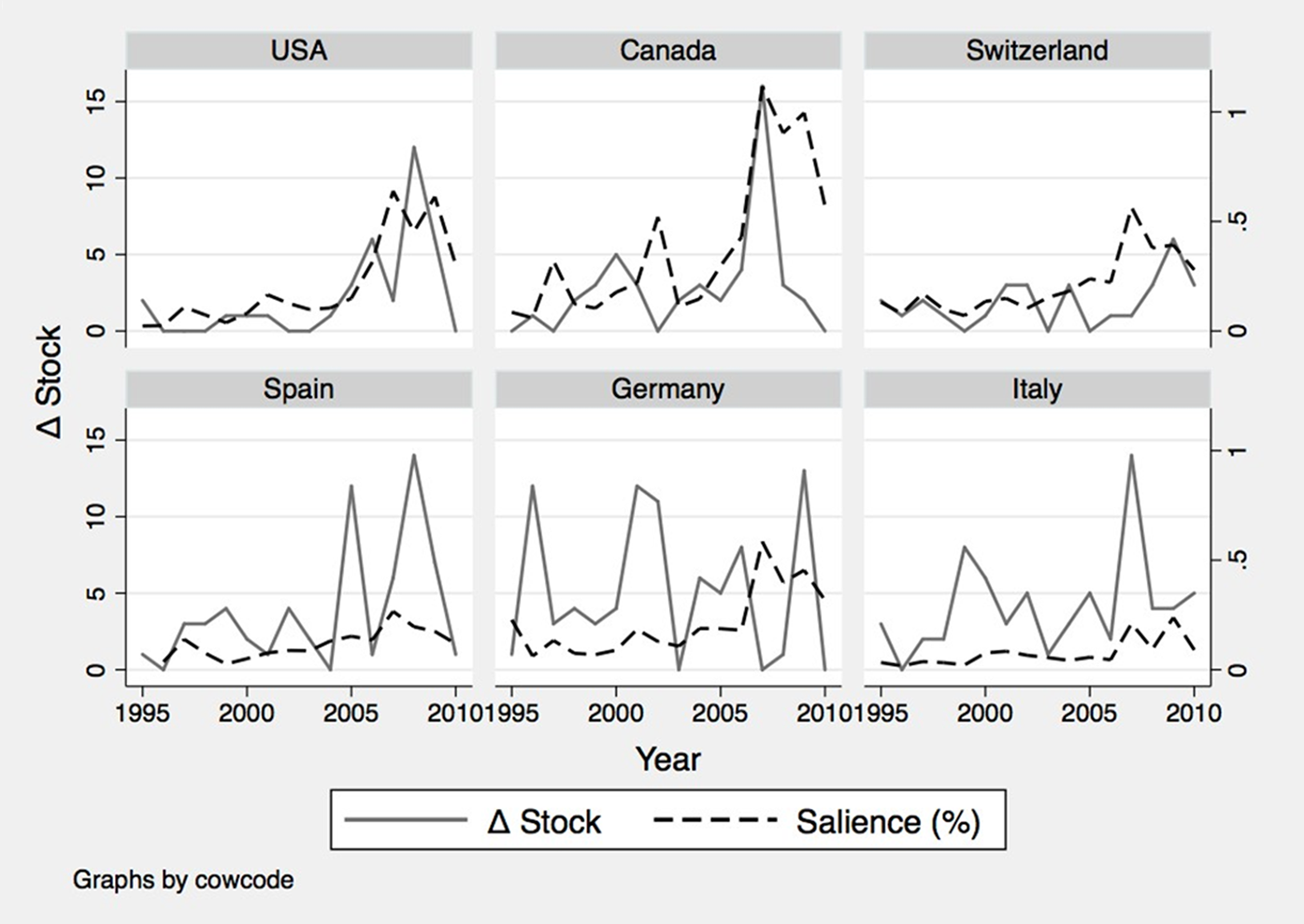
Figures 2a and 2b show the demand and output data for the six countries in the sample. While salience levels differ to a wide extent by country, their development over time is much smoother in most countries compared to the opinion variable. In 2007, US, German, and Swiss newspapers’ relative share of reporting on climate change was three times greater than in their Spanish and Italian counterparts. In Canada, media salience was as much as six times as great. The peak in the number of adopted policies in Switzerland followed after the salience peak, and the largest increase in media salience. In general, Figures 2a and 2b show us that media salience and policy output follow a similar trend, particularly in the US, Canada (with the exception of the year 2002), Switzerland, and Italy.
Descriptive evidence: demand and output data (media salience).
Note: The y-axis on the left indicates the yearly number of climate change policies adopted and the right y-axis provides the scale for media salience.
Descriptive evidence: demand and output data (published opinion).
Note: The y-axis on the left indicates the yearly number of climate change policies adopted and the right y-axis provides the scale for published opinion.
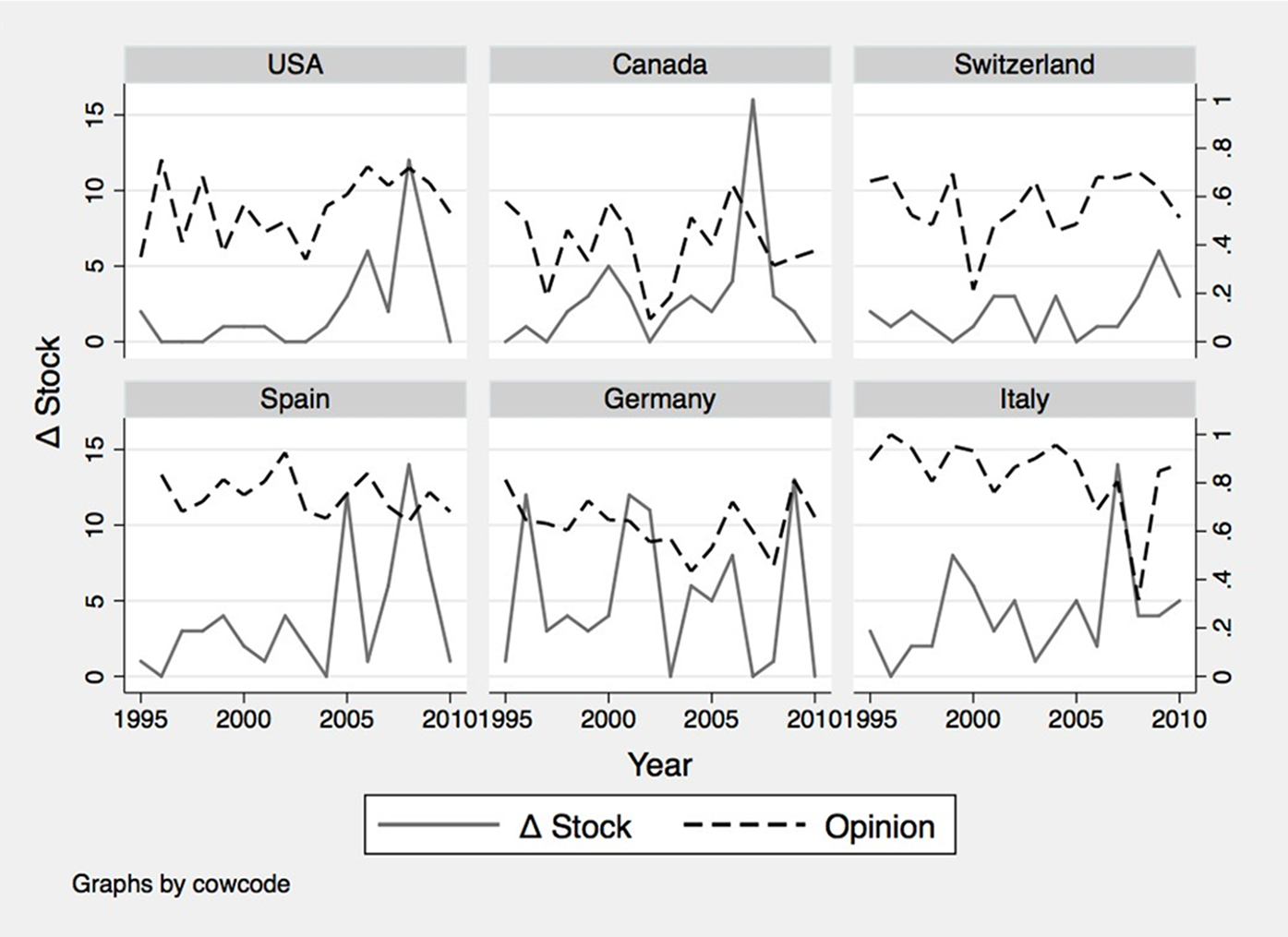
For the US and Canada, we observe that peaks in policy adoptions in 2007/08 follow after several years of very stable published opinion values. Footnote 13 The positive values for published opinion throughout our time series indicate that claims in favour of climate protection have always prevailed in the countries and newspapers we studied. The values for published opinion in Italy drop suddenly in 2008 after a long period of stable values, following a large number of policy adoptions in 2007. This observation hints at a thermostatic adjustment. Spain and Germany have similar values for published opinion (and media salience), but Germany became active in policymaking much earlier and to a larger extent than Spain.
Analogous to our treatment of our two dependent variables (general responsiveness and target-specific responsiveness), the first analysis uses the overall values for published opinion and media salience, which are based on all articles related to climate change. The second analysis then relies on the target-specific versions, referred to as target opinion and target salience. To generate these measures, we again look at the relevant newspapers. For each policy target (specified in Figure A.1) we developed a search string with keywords related to the target and then used only articles that mentioned these keywords and the respective target at least twice (see Table A.2 in the appendix for the search strings and translations employed).
Data and methods
Table 2 provides an overview of all variables, how they are operationalised, and their data source (the corresponding summary statistics are shown in the appendix, Table A.3).
Variables and data sources

We are interested in explaining variation over time regarding the total number of policies adopted per year within and between countries (ΔStock) as well as with respect to different policy targets (Δ(target)Stock) Footnote 14 . To this end, we analysed our time series and cross-sectional data with a random-effects panel model using clustered standard errors at the country level Footnote 15 . Random effects were chosen because this enabled us to test both for the effect of demand within a country and between all countries. A Hausman test performed on the basic model (but without clustered standard errors) justified the use of random effects estimators.
To explain differences in climate change policy output (yt − yt−1), we use both differences (xt − xt−1) and (lagged) levels (xt−1) of the independent variables published opinion and salience. This allows us to examine how policymakers react when facing high and low levels of demand, and changes thereof. Both are potentially influential, as one could argue that policymakers react to sudden increases in public opinion from the past period or to higher levels because constant demand leads to action. Thus, if it is levels or differences that matter is ultimately an empirical question.
We also include a variable measuring the one year lag of the (target) stock (total number) of climate change policies already in place to model various patterns of policy adoption over time for both dependent variables (Boehmke Reference Boehmke2009:8). Over time, we would expect to either observe potential path dependency (countries having already adopted several climate policies may develop an appetite for enacting more) or saturation (countries having already adopted several climate policies may not be willing to adopt even more).
Results
In this section, we first report results for the relationship between aggregate measures of public demand and climate policy output, wherein we analyse the general, unspecific demand for climate protection, including demand for various policies, and the general policy output (general responsiveness). We then look at specific targets of climate policymaking (e.g. buildings, and appliances) and explore whether target-specific demand has an effect on target-specific policy output (target-specific responsiveness).
The effect of aggregate demand on aggregate climate policy output (general responsiveness)
The aim of the analysis here is to test our main hypothesis that public demand, alongside partisanship and institutional factors, influences climate policymaking. The outcome variable in this analysis indicates how many new policies have been enacted altogether (within the four sectors shown in Figure A.1) in a given year. Table 3 shows the results of the basic models with our demand measures regressed on the policy output measure (Models 1–4).
Basic models (general responsiveness)

t statistics in parentheses.
*p < 0.10, **p < 0.05, ***p < 0.01.
As shown in Table 3, we observe that both a higher level of support for climate protection and an increase thereof from one period to the next leads to more climate policy adoption. When there are as many claims for and against climate protection in the previous period (opinion, t−1 = 0) and only claims for climate protection in the current period (Δopinion=1), we expect to observe 4.5 new policy adoptions. Thus, with all models, positive (negative) public opinion (claims regarding climate change) is related to more (less) policy output. The same applies to the salience of the issue of climate change. While the interaction effect between salience and opinion, which measures scope for action (or public debate), does not seem to be significantly related to policy output, graphical inspection of the predictive margins (see appendix Figure A.3a/b) shows that salience does indeed enhance the effect of opinion on policy output. This is the first confirmation of our expectations regarding the conditionality of opinion and salience, which we will return to in our detailed analysis of the interaction effects below. Overall, it seems to be opinion rather than the mere salience of an issue (measured via the climate-change-relevant articles) that drives policy output. This indicates that our efforts to come up with a more accurate measure of published opinion are indeed adding something to our knowledge about the process of how public demand may turn into policy. Given that most studies only analyse the salience of climate change in the media (Schmidt et al. Reference Schmidt, Ivanova and Schäfer2013; Schäfer et al. Reference Schäfer, Ivanova and Schmidt2014; Anderson et al. Reference Anderson, Böhmelt and Ward2017), our measure makes a novel contribution to the field.
In the following models in Table 4, we estimate the effects of different combinations of the explanatory factors discussed in the theory section. Footnote 16 The effects of opinion, both in terms of level and change, and the level of salience are robust to the inclusion of control variables. Of these control variables, only partisanship matters: a higher share of cabinet posts held by left party members significantly increases the number of climate protection policies that are adopted. The strong results for partisanship are all the more powerful when we consider that the situation in two countries in the sample clearly deviates from the hypothesised pattern. In Switzerland, the composition of the government is predetermined and fixed (a quasi-permanent large coalition) and does not change after elections. Additionally, in Germany, climate policy has become a topic without clear issue ownership by any party. In fact, Chancellor Angela Merkel from the country’s main conservative party has frequently been referred to as the “Klimakanzlerin” (“climate chancellor”).
Basic models for general responsiveness with stepwise inclusion of control variables

Target-specific demand and policy output
We now examine the impact of target-specific public demand (target-related opinion and salience) on policymaking with respect to those targets (Δ target stock). To create target-specific public demand we used different search strings for each of the policy targets (renewable energy supply, fossil fuel supply, private transport, public transport, buildings, and appliances; for more information, the reader is referred to the appendix, Table A.2). We believe that this disaggregation should significantly add to our understanding of the workings of issue-specific policy responsiveness by making it possible to map demand onto policy output in a more fine-grained way. Using target-specific demand confronts our hypothesis of climate change policy responsiveness with a stronger test to see whether the responsiveness link we find overall is also present in terms of target-specific responsiveness.
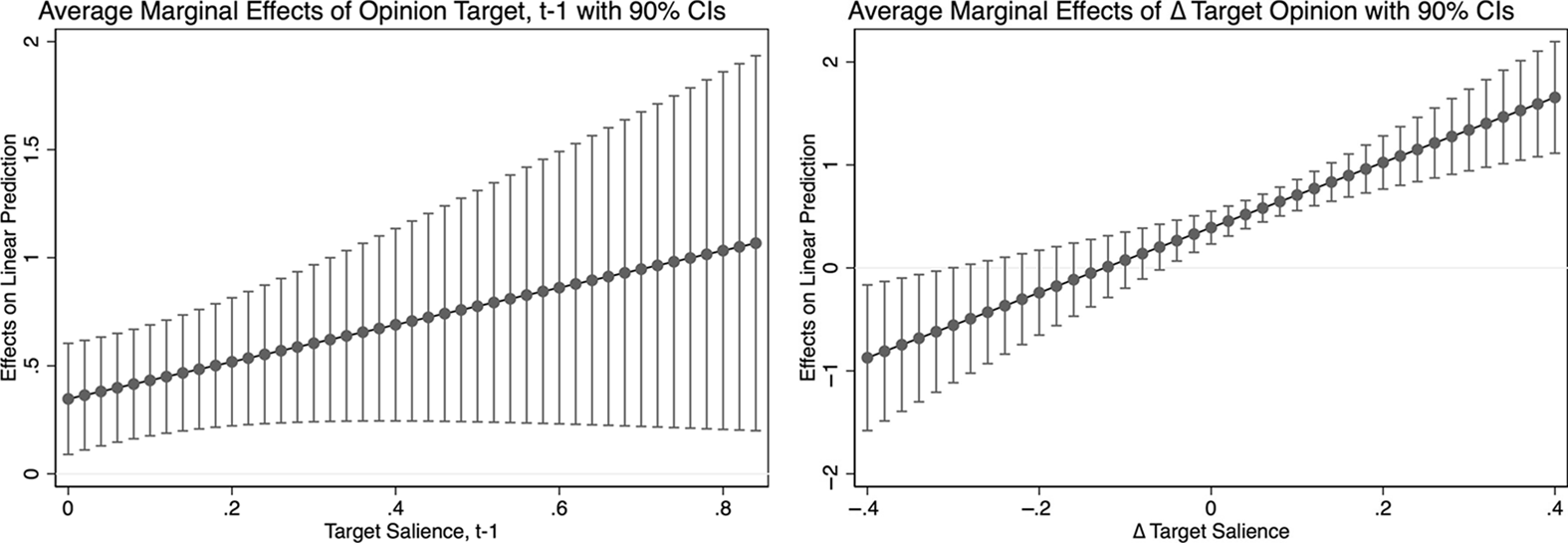
The first three models in Table 5 show the basic models, while the following Models 4–6 include the covariates. Footnote 17 Indeed, we can see again, that of the target-specific public demand measures, especially our measure on the target-specific opinion is significantly related to target-specific policy output. Both measures show the hypothesised sign and are significantly and robustly related to target-specific policy output throughout all of the models. Thus, more claims for target-specific climate change policy increase the responsiveness of policymakers. Moreover, as argued above, issue salience and opinion may have mutually enhancing effects on legislative activity. Thus, our demand measure of scope for action sheds light on whether the main effect of published opinion on policy output changes for different levels of salience; i.e. on whether the more salient an issue is, the greater the effect of opinion on policy responsiveness is likely to be. We indeed find some significant effects when interacting both level variables and the two differences with each other. For two coefficients of the interaction, one on levels, the other on differences, we plotted the average marginal effect given the changing values of the other variable (see Figure 3, and Table A.4 in the appendix). In the left part of Figure 3, we can see that a higher level of salience in the previous period increases the impact target-specific opinion has on policy output, but confidence intervals are large. However, it could also be that policymakers react to changes in the salience rather than the levels, for example, a marked rise in articles about renewable energy from one year to the next. Above we have argued that positive (negative) changes in salience will amplify (dampen) the effect of our opinion measure on policy responsiveness. Indeed, from the right part of Figure 3, we can see that an increase in salience combined with an increase in the share of positive claims boosts the impact both factors have on policy output. Policymakers indeed seem to react to positive target-specific opinions on given targets much more if these targets have also become more salient and thus potentially promise a higher electoral reward for policy action.
Interaction effects of salience and opinion (scope for action).
Basic models for target-specific responsiveness with stepwise inclusion of control variables

t statistics in parentheses.
* p < 0.10, ** p < 0.05, *** p < 0.01.
Lastly, in contrast to our findings regarding the general responsiveness, we here find the first indication for path dependency with respect to policy targets, as the coefficient on the lagged policy stock of the respective targets (target stock t−1) shows a robustly significant effect in all models of Table 5. That is, more target-specific policies adopted earlier are associated with more policies in the following period.
Models 4–7 then include political and institutional variables, such as the partisanship of the government and the electoral system. Counter to what we had hypothesised for the electoral systems, we find that systems with proportional representation are less likely to adopt target-specific policies. However, institutional variables as the electoral system may also moderate the influence of public demand on policy output. To this end, we estimated models with interaction terms for the demand indicators and the electoral system (Table A.5 in the appendix).
Figure 4 (a–d) shows, for the purpose of illustration, the effects on the linear prediction for different electoral systems for both our measures of lagged opinion and salience (subfigures a and c) and for the changes in opinion and salience from the previous period (subfigures b and d).
Interaction effect of the electoral system with our four public demand measures.

The most striking result from interacting our demand measures with the electoral system lies in the differentiated reaction to published opinion on a certain target (subfigures c and d). While for countries with proportional representation, the level of target opinion seems to have very little (cf. subfigure c) effect on policymaking, in majoritarian electoral systems policy output is clearly affected by the positive or negative levels of published opinion. Hence, the more positive (negative) the opinion with respect to climate change policy in the previous period (Target opiniont−1) is, the more positive (negative) is the effect on the target-specific policy output. An increase (decrease) in the calls for action (Δ Target opinion) (subfigure d) has a positive (negative) effect on the target-specific policy output for both electoral systems, however, also there, the relation is steeper for majoritarian systems. Quite contrarily, from subfigures a and b, we can conclude that the effect of the electoral system on the number of adopted policies does not vary significantly with respect to the level and changes of the salience of a target.
While these are interesting findings suggesting that policymakers in majoritarian systems are more sensitive to levels and change in the sentiment of published opinion on climate change action, in light of our small sample on the country level, these results might be driven by country-specific factors that coincide with the electoral systems. Hence, we should interpret them with caution. Future cross-country comparative studies may consider the conditioning effect the electoral system has on the link between public demand and output and see whether our results hold in a broader context.
Discussion and conclusion
Our main result is that public demand, measured in terms of overall media salience and calls for or against climate change mitigation (published opinion) matters in relation to the total number of climate change mitigation policies that are adopted. That is, we are able to show that policy output in the area of climate change is affected quite consistently by changes in published opinion – i.e. the more direct claims put forward within news media – whereas, the effect of mere issue salience is not so clear cut. This demonstrates the added value of using a more comprehensive measure of public demand for climate change policies.
Moreover, disaggregating both the public demand and our policy output measures at the climate policy target level (e.g. whether a policy targets the buildings or the transport sector) supports our main findings. Overall, more positive opinions (those that demand more climate action) are robustly and significantly related to policy output. The effect of issue salience is strongest in combination with an opinion as this creates a scope for action. Another finding of our target-related analysis is that the lagged policy stock has a consistently positive effect in the large majority of our statistical models. We cautiously interpret this as positive news from a climate change mitigation perspective as it suggests path dependency rather than a saturation effect (c.f. Aklin and Urpelainen Reference Aklin and Urpelainen2013). That is, it suggests that when countries adopt more climate mitigation policies at one point in time, this makes them more likely to adopt climate change mitigation policies thereafter, rather than less.
Additionally, we examined the (moderating) influences of several political/institutional factors. For partisanship of government, we found that leftist governments not only adopt more climate policies, but also appear to be more responsive to public demand. The type of electoral system indirectly affects climate policymaking via demand: especially policymakers in majoritarian systems seem to react much more strongly to the opinion measure of public demand, compared to their counterparts in political systems with proportional representation.
By and large, we thus observe a considerable degree of responsiveness of policymakers to public demand in the climate policy area right from the beginning of serious national climate change efforts in the mid-1990s. This finding is new and important for at least three reasons. First, whereas the large majority of related studies deal with high salience issues and thus run the risk of confirmatory bias, our study deals with a moderate saliency issue. The fact that we still observe a considerable degree of responsiveness can be regarded as good news from a normative perspective as it emphasises that the main advantage of democracy is that policymakers are more accountable, and thus also more responsive, to public demand.
Second, whereas the large majority of related studies cover one single country over time, or compare subnational units within one country, our study is the first to compare the climate change policy output of several countries over time to find that responsiveness to public demand is present in different country contexts. Moreover, we find interesting differences on how public demand for climate change is linked to policy output depending on institutional factors such as the electoral system. Future research may study more thoroughly the (institutional and political) context conditions of climate policy responsiveness.
Third, our study is the first within the broader realm of comparative environmental studies to disaggregate both the public demand and our policy output measures at the climate policy target level (e.g. whether a policy targets the buildings or the transport sector). Employing such a fine-grained test of policy responsiveness, we still find a considerable degree of responsiveness, especially concerning changes in published opinion. Future studies should inquire in more detail how responsiveness differs between countries and policy targets, and why this may be the case.
While our contribution made headway to address the problems associated with measuring demand, there are – of course – many remaining questions. The broader issues connected to our measure are whether, first, our method focusing on published opinion can produce a valid and reliable proxy for public opinion, and second whether published opinion as such can be measured in a valid and reliable manner and acts as a driver of climate policy choices. These two issues are connected in our case in the sense that we are trying to show not only that published opinion drives climate policy choices (this may also apply in an autocracy), but also that this reflects a policy responsiveness mechanism in liberal democracies – and this requires that published opinion reflects public opinion of the demos. However, at this stage, we do not have enough high-quality and commensurable survey data for several countries over time to run robust tests of the hypotheses we have outlined. Hence, our concepts and empirical measures for published opinion/demand are a good alternative, and perhaps the only one for the time being. Our comprehensive assessment in another article (Oehl et al. Reference Oehl, Schaffer and Bernauer2017) has shown that we have a good proxy, and we also think our data coding effort has been comprehensively conducted and has addressed potential endogeneity problems well. Overall, we thus are quite confident that our results speak not only to whether published opinion affects policy choices (which could be the case also in autocracies), but contributes to the policy responsiveness debate in democracies.
As a final remark, future research needs to look more carefully into whether climate change mitigation policies that are adopted are effective at reducing GHG emissions – this task is beyond the scope of this article (Eskander and Fankhauser Reference Eskander and Fankhauser2020). Indeed, a high degree of responsiveness of policy output to variation in public demand does not necessarily bring about ambitious climate policies as there appears to be a gap between words and deeds in this area, particularly in democratic countries (as observed by Bättig and Bernauer Reference Bättig and Bernauer2009). High-quality democracy in terms of responsiveness is not necessarily inductive to deeper cuts in GHG emissions, but means that citizens tend to get from the government what they want (and thus deserve).
Acknowledgements
The authors would like to thank Alba Mohedano Roldán, Basil Schläpfer, Brittany Rodriguez, Nicole Ponta, Pascal Scheiwiller, Pia Struntz, Samantha Suarez, Sara Eliason, and Florian Lichtin for their excellent research assistance in data collection and coding. Funding by the Swiss National Science Foundation (SNSF) within the project “Explaining Spatial and Temporal Dynamics in Climate Change Policy Making” (100017_135261) is gratefully acknowledged. We also thank participants of the Brownbag Seminar Series at the University of Konstanz, the Midwest Political Science Association Annual Meeting 2018, and the staff seminar at the University of Geneva in May 2018 and two anonymous reviewers for their helpful comments. Replication materials are available at: https://doi.org/10.7910/DVN/WPRN15.
Data availability statement
Replication materials are available in the Journal of Public Policy Dataverse at: https://doi.org/10.7910/DVN/WPRN15.
Supplementary material
To view supplementary material for this article, please visit https://doi.org/10.1017/S0143814X21000088.


 Open access

