


1. Introduction
In recent years, sustainability has become a cornerstone of global efforts to address environmental challenges such as resource scarcity. Central to these efforts is the transition from linear to circular patterns, which aim to minimize waste and maximize efficiency. Circular strategies, as emphasized by the United Nations' R-strategies (UNEP, 2019), offer a range of approaches, from recycling to remanufacturing (Reference Tolio, Bernard, Colledani, Kara, Seliger, Duflou, Battaia and TakataTolio et al., 2017). Among the R-strategies, remanufacturing reaches high efficiency in retaining gained value in products (Reference Benoy, Owen and FolkersonBenoy et al., 2014), while also maintaining quality and warranty standards (Reference Matsumoto, Ijomah, Kauffman and LeeMatsumoto & Ijomah, 2013). However, current remanufacturing is limited to reconditioning, which might lead to outdated products and is a reason for the low market share compared to linearly produced products with up-to-date functionality (Reference Parker, Riley, Robinson, Symington, Tewson, Jansson, Ramkumar and PeckParker et al., 2015). To provide for the primary market, remanufactured products must compete with linear products in terms of functionality and warranty. This idea is taken up by the concept of a circular factory (CF), which seeks to reprocess used products and transfer them to the current product generation (Reference Grauberger, Dörr, Lanza, Kaiser, Albers, Düser, Tusch, Seidler, Dietrich, Schulze and MatthiesenGrauberger et al., 2024).
During product development, design decisions need to be made on how to define the product's embodiment in order to achieve the desired system behavior. In linear production, a distinct embodiment is determined beforehand and documented by technical drawings, including associated tolerances. Afterward, standardized raw materials are used in the production process. In contrast, the raw materials in a CF consist of used subsystems and components, whose embodiment parameters change throughout life cycles and eventually exceed their specified tolerances. Additionally, influences on the embodiment emerge, that obscure its relations to the system behavior. This leads to individual systems with high uncertainty regarding their condition (Reference Heizmann, Beyerer, Dietrich, Hoffmann, Kaiser, Lanza, Roitberg, Stiefelhagen, Stricker, Wexel and ZangerHeizmann et al., 2024). To form a “new” product from these materials, instance-individual design decisions regarding reprocessing and recombination are required, rather than merely restoring a predefined embodiment. For these design decisions, qualitative and quantitative specific design knowledge (SDK) (Reference Hubka and EderHubka & Eder, 1990) is necessary.
There are several approaches that focus on SDK in the context of used products. Failure Mode and Effect Analysis (FMEA) assesses the failure of systems in a qualitative manner (Reference StamatisStamatis, 2003). However, the approach is limited to optimizing the current product in the form of risk mitigation actions. The VDI 3822 provides a hypothesis-based analysis of failure causes (Verein Deutscher Ingenieure, 2023), which is able to build quantitative knowledge for subsystems and components. Still, the norm considers failure as an individual event and does not account for functional interdependencies in the overall system. Hence, the problem is that existing approaches do not model knowledge in such a way that it can be utilized for design decisions on the reuse of subsystems and components to fulfill the functional requirements of new product generations. Focusing on the buildup and the structure of the SDK, the following research question is derived:
How can the specific design knowledge required to reuse components in a circular factory be built up and structured?
To answer this question, we develop a hypotheses-based modeling approach for SDK. In doing so, we draw on essential elements of existing models and methods and integrate them into the approach. The application of the approach is demonstrated using the example of a CF for angle grinders.
2. Materials and methods
2.1. General terms applied in the approach
The presented approach focuses on geometric changes in the product's physical embodiment and their relations to the system's functional behavior. This relation between specific parameters of the embodiment and the functional behavior is called embodiment-function relation (EFR). It provides a basis for SDK, which represents the share of those EFRs that enable the synthesis of a product's embodiment (Reference Matthiesen and GraubergerMatthiesen & Grauberger, 2024). In the context of the Function-Behavior-Structure ontology (Reference Gero, Kannengiesser, Chakrabarti and BlessingGero & Kannengiesser, 2014), functional behavior spans both, expected behavior, reflecting the intended function, and behavior derived from structure. Physical embodiment is a subset of the structure, containing the parameters that contribute to the functional behavior.
2.2. Circular factory - requirements for the approach
In this publication, the concept of a CF is interpreted as a system that seeks to reprocess used products and transfer them to the current product generation. This is accomplished by combining linear production with the targeted application of R-strategies. One of the main issues with R-strategies is determining the optimal approach (Reference Bakker, Wang, Huisman and HollanderBakker et al., 2014). To make informed decisions on reprocessing and recombining, functional fulfillment is used as a key criterion in a CF. This necessitates its prediction at various times, one being the reassembly of products (Reference Grauberger, Dörr, Lanza, Kaiser, Albers, Düser, Tusch, Seidler, Dietrich, Schulze and MatthiesenGrauberger et al., 2024). For reassembly, the optimal combination of components and subsystems must be chosen from all available options. As in linear product development, the defined embodiment parameters determine the functional behavior of the product. That is why a predictive model is needed to estimate the functional behavior based on the special requirements of used components and subsystems. And to form just such a predictive EFR model, quantitative SDK is necessary (Reference Grauberger, Dörr, Lanza, Kaiser, Albers, Düser, Tusch, Seidler, Dietrich, Schulze and MatthiesenGrauberger et al., 2024).
Based on the conditions of a CF, several requirements can be derived for the approach. Since expert knowledge is required to develop a predictive model, direct quantification of individual EFRs is not feasible. Instead, establishing a solid foundation for quantification takes priority, directing the approach to focus on qualitative SDK first. Given the many uncertainties and unknowns related to used products, clear and understandable documentation of knowledge is essential. The approach must provide a well-defined structure into which any SDK can be integrated. Failure modes such as wear and degradation are caused by various potential embodiment parameters whose relevance for the functional behavior is not always known. Accordingly, the approach should include a prioritization of the EFRs. Since some qualitative relations initially rely on assumptions, these assumptions must be made investigable. That is why the approach should be hypothesis-based. In the current state, the approach excludes the quantification itself but aims to link qualitative and quantitative knowledge. Therefore, it should support further system analysis and eventual data collection. Due to the various characteristics of individual EFRs, tailored strategies appear to be promising.
2.3. Methodological elements
The individual methodological elements of the approach must address the derived requirements. For each requirement, elements from various methods and models can be considered. The need for a clear structure focuses on the different types of knowledge and their traceability. Since SDK is based on EFRs, referring to the domains of function and structure is reasonable. Different elements, such as product structure, function structure, or their relation in the form of a product architecture (Reference UlrichUlrich, 1995) enable this reference. By differentiating between integral and modular types, the architecture discloses the current design. This procedure is also conducted by the initial steps of an FMEA (Reference StamatisStamatis, 2003).
Based on the unknown and uncertain relations between embodiment parameters and functional behavior, a qualitative assessment should be preferred. A modeling approach already utilized to build SDK in such tasks is the contact and channel (C&C²) approach (Reference Grauberger, Wessels, Gladysz, Bursac, Matthiesen and AlbersGrauberger et al., 2020). It models a system with the help of certain elements. Connectors (Cs) integrate relevant aspects of the environment into the defined system boundaries. Inside the system boundaries, energy or information is exchanged through working surface pairs (WSPs). Lastly, channel and support structures (CSSs) transfer these system variables between the WSPs. This simplification helps to identify potential relations between embodiment and functional behavior. The estimated impact of EFRs or their interdependencies may be used to determine priorities, which is supported by matrix structures like the Design Structure Matrix.
Similar to the VDI 3822, hypotheses are used to document knowledge and its underlying mechanisms. They formulate assumptions in a way that makes them investigable. In the context of SDK, design hypotheses can be used (Reference Matthiesen and GraubergerMatthiesen & Grauberger, 2024). Their formulation follows a certain structure: If embodiment parameter changes, then functional behavior is affected, because of the (assumed) relation between embodiment and functional behavior.
The linkage between qualitative and quantitative SDK requires further investigation, whereby testing and its different strategies play an important role. Ewins (Reference Ewins2016) suggests “identification” through theoretical modeling and experimental tests, “simulation” through numerical analysis or theoretical modeling, and “validation” through numerical or experimental approaches. Tahera et al. (Reference Tahera, Wynn, Earl and Eckert2018) distinguish various forms of testing, in which different strategies can lead to success. “Testing for learning” can be conducted to identify unknown relations of embodiment and functional behavior.
3. Approach to model specific design knowledge
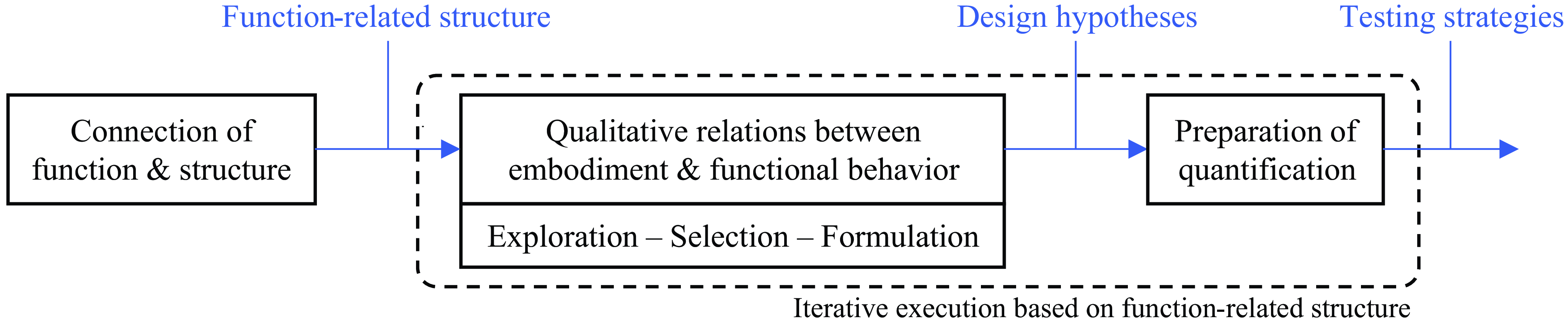
The description of the proposed approach is based on the elements of design methods by Gericke and Eckert (Reference Gericke and Eckert2017). Its core idea revolves around the systematic identification and analysis of EFRs relevant to circular economy. The approach combines graphical models, such as matrices and sketches, with written lists for representation. Figure 1 shows the procedure comprising three steps for the structured buildup of SDK. The procedure begins by establishing a function-related structure of the system to identify connections between the two domains. This foundation supports the subsequent exploration, selection, and formulation of qualitative EFRs, which results in design hypotheses. Finally, the link between qualitative and quantitative knowledge is set up through the preparation of the quantification by assigning testing strategies. The rightmost arrow in Figure 1 indicates the transition to the quantification, which lies beyond the scope of this paper. The intended use of the approach is to develop the necessary qualitative SDK in order to enable reprocessing of existing products within a CF.
Overview of the approach's procedure including the individual steps

3.1. Connection of function and structure
The approach starts with the connection of function and structure, analogous to a product architecture. Initially, the two domains are considered independently. A product structure is then created for the domain of structure, hierarchically dividing the system into subsystems. For the domain of function, a function tree is created, identifying primary and secondary functions. As a detailed analysis of EFRs follows in the later steps, a low level of descriptive detail is sufficient here. Once the individual models have been created, they are connected. Questions such as “Which subsystems contribute to a specific function” and vice versa can support this process. To obtain the function-related structure, the existing connections are visualized in the form of an allocation matrix. An exemplary function-related structure can be seen in Figure 3 of the case study.
The following steps of the approach, are performed iteratively for each connection within the function-related structure. Therefore, it serves as a basis for the detailed system analysis. Generated results will be assigned to a specific subsystem and function. This storage ensures that information is documented in a comprehensive and understandable manner. Because additional knowledge and insights are continuously accumulated, the function-related structure should be seen as a living basis, where existing connections can dissolve and new ones can form.
3.2. Qualitative relations between embodiment and functional behavior
In the second step, a detailed analysis of the system is conducted to identify qualitative relations between embodiment and functional behavior as the basis for SDK. This identification involves the most effort of the approach's steps, hence it is broken down into three sub-steps: Exploration of potential EFRs - identify as many relations as possible. Selection of relevant EFRs - narrow it down and prioritize. Formulation of specific EFRs - derive design hypotheses.
3.2.1. Exploration of potential embodiment-function relations
The aim of the exploration is to identify as many potential EFRs as possible to minimize the risk of missing relevant information. In an iterative manner, one particular function is chosen from the function-related structure. Hereby, the use of EFRs necessitates a shift from function to functional behavior and from structure to embodiment. Expert knowledge about the system is essential to facilitate this shift. A functional behavior is derived by which the function can be characterized. This functional behavior indicates the type of SDK to be developed, determining whether the knowledge focuses on static, transient, or dynamic behavior. Afterward, one particular subsystem is selected according to the function-related structure. Additional subsystems that are tied to the same root function and have a direct physical connection are also considered. The subsystems are broken down into individual components, which serve as the system boundary of the subsequent C&C² model. By marking the flow of energy or information and assigning the C&C² elements, the system can be assessed at a detailed level.
To identify the relevant properties of the C&C² elements, it is essential to consider how the embodiment of the components affects the functional behavior. This paper defines the underlying mechanisms as functional effects. In the context of circular economy, the emphasis is on changes in functional behavior due to wear and degradation. A comprehensive list of potential functional effects must be created, with methodologies, such as the VDI 3822, supporting this process. Next, the C&C² elements are reduced to individual embodiment properties that influence these effects. With the list of functional effects and the C&C² model, exemplified in Figure 4 of the case study, a repertoire of potential EFRs is given.
3.2.2. Selection of relevant embodiment-function relations
The selection focuses on narrowing down and prioritizing the potential EFRs. This involves the estimation of each effect's impact on the functional behavior and the assessment of whether interactions exist between different effects. The two aspects help to indicate the priority of each effect for further investigations and determine which type of SDK will be built. Hereby, individual elements from FMEA can be utilized. Regarding the C&C² elements, an initial selection of embodiment properties is conducted. As the approach focuses on geometric design changes, a key criterion is whether the property can be influenced by such a parameter variation. Additionally, it must be considered whether embodiment properties and functional effects are accessible in the context of reprocessing within a CF. External factors like the capabilities of remanufacturing processes are restricting in this case.
Finally, the embodiment properties are connected to the functional effects within a refined allocation matrix, as illustrated in Figure 5 of the case study. The visualization is similar to the function-related structure, but the aforementioned shift to functional behavior and embodiment was carried out. It enables conclusions on the relevance of individual EFRs. When only a few properties influence a priority effect, a relation seems to be important. A functional effect appears to have a high degree of integration if it is impacted by numerous properties. Such a functional effect is relevant, but an upstream sensitivity analysis is required for a focused parameter variation. Less relevant parameters and effects can be identified in the same manner. This visualization develops dynamically, just like the function-related structure, consistently incorporating insights as knowledge accumulates over time.
3.2.3. Formulation of specific embodiment-function relations
The previous steps excluded an explicit formulation of the EFRs. Because relations may still be based on assumptions, a definite statement is not always feasible. A refined version of the design hypothesis is used to document the relations and make them investigable. Instead of the generic relation between embodiment and functional behavior, the precise relation between embodiment property and functional effect is used: If embodiment parameter changes, then functional behavior is affected, because of the (assumed) relation between embodiment property and functional effect. After exploration and selection, the final step in formulating these design hypotheses is to focus on a specific embodiment parameter within the embodiment property to investigate. As mentioned before, the focus is on parameter variation by geometric design changes, making the EFR accessible for testing.
3.3. Preparation of quantification
The last step prepares the quantification of the formulated design hypotheses. This quantification is necessary to evaluate the assumed underlying mechanism. Moreover, the quantitative EFRs ultimately form the predictive model for instance-individual design decisions required in a CF. More specific SDK on each individual design hypothesis must be built. Hereby, the approach uses the concept of testing strategies. In order to minimize potential interdependencies at the overall system level, further analysis is initially conducted at the subsystem level.
Depending on the combination of embodiment parameter and functional behavior, various strategies can be suitable to obtain the required SDK. Therefore, each design hypothesis is assigned a tailored strategy. The approach distinguishes between theoretical modeling, numerical analysis, and experimental testing. If substantial research has been conducted on an embodiment property or a functional effect, theoretical modeling represents the starting point. If the circumstances of the relation can be adequately represented in a simulation model, numerical analysis is practical. Experimental tests are employed for EFRs that are not tangible by theory or simulation. In this form, testing allows for an evaluation, of whether a hypothesis is falsified or kept with specific uncertainty.
4. Case study
To demonstrate the application of the developed approach, a case study of a fast-rotating rotor system in the form of an angle grinder is carried out. Certain functions and subsystems are chosen to show detailed results of the individual steps.
4.1. Angle grinder - the technical system
Angle grinders are used to cut, grind, and polish various materials. They consist of a drive shaft and a spindle, coupled by a gearbox. Each shaft is mounted in the housing utilizing a fixed-loose bearing arrangement. A motor applies a defined speed at the drive shaft, while the load acts on the tool. In terms of functionality, vibration emission can be used to characterize the system's dynamic behavior (Reference Rimell, Notini, Mansfield and EdwardsRimell et al., 2008). Vibrations occur in the powertrain and are caused, for example, by imbalance or deflection. Particular attention must be paid to the gearbox. It emits significant vibrations even during nominal operation (Reference Gasch, Nordmann, Pfützner, Gasch, Nordmann and PfütznerGasch et al., 2002). Figure 2 depicts a principal sketch of the technical system.
Regarding circular economy, the various use cases of an angle grinder result in instance-individual wear and degradation of the used products. Additionally, the high functional density causes substantial interactions between certain subsystems and components. For reprocessing and recombination in a CF, the state estimation of the powertrain is of primary importance.
Principal sketch of the structural assembly of an angle grinder (Reference Fein GmbHC. & E. Fein GmbH, 2024)

4.2. Connection of function and structure
Figure 3 shows the function-related structure of an angle grinder. At the first level of the product structure, the angle grinder is divided into powertrain and housing. This initial division roughly distinguishes the dynamic subsystems from the stationary ones. Descendants of the powertrain can be identified by tracing the energy flow through the motor control to the spindle. Further subdivision of the housing is based on the present interfaces. The gearbox housing is a stand-alone component, while the motor housing includes the nesting of polymer and stator housing. Additionally, the housing subsystem also contains the user interface, which includes handles and buttons. On the functional side, a distinction is made between electrical and mechanical energy. Individual functions therefore include their transmission and conversion. The last primary function focuses on user interaction, encompassing both the user's safety and state changes of an angle grinder.
The connections in the function-related structure reveal a modular architecture for electrical energy, linked to the motor and its control. User interaction also has a clear connection to the motor control and the overall housing subsystem. The integral architecture of mechanical energy highlights the system's functional density. While the transformation of energy takes place in the gearbox, the transmission extends via the shafts into the housing. Given the significance of vibration emission in an angle grinder, the following investigations focus on the transformation of mechanical energy within the gearbox.
Function-related structure of an angle grinder connecting the two domains

4.3. Qualitative relations between embodiment and functional behavior
4.3.1. Exploration of potential embodiment-function relations
As both transformation and transmission are tied to the same root of mechanical energy, the two adjacent shafts and housings are also considered. Only the gearbox housing has a direct physical connection to the gearbox in the form of bearings, which is why the motor housing is neglected. The left side of Figure 4 lists potential effects on vibration emission, incorporating various mechanisms caused by wear and degradation of an angle grinder. Geometric deviation alone accounts for misalignment, while imbalance and deflection are also influenced by material characteristics. Material defects and impulse loads relate to the transfer of loads, whereas natural frequencies refer to the technical system as a whole.
The rest of Figure 4 shows the C&C² model. Axial fixation of the bearings and the gears is neglected and for reasons of analogy, not all C&C² elements are labeled. With a direct press fit between each pair of gear and shaft, the two components are modeled as a single CSS. Further simplifications were achieved by representing the bearings in the same manner. The WSP of the gearbox transforms the mechanical energy. Cs integrate the remaining embodiment of the shafts and the surrounding gearbox housing. Properties such as stiffness, damping, and mass distribution characterize the CSSs of gear and shaft. The WSP of the gearbox is defined by properties such as gear backlash and meshing overlap. Due to bending moments caused by the gearbox, the effective length of the drive shaft is of interest. Clearance is relevant for the bearings, while their WSPs to the shaft and the gearbox housing are determined by the alignment. The CSS of the gearbox housing furthermore includes bearing seat stiffness. With the list of functional effects and the C&C² model, a repertoire of potential EFRs is given.
List of effects on vibration emission and C&C² model focusing the gearbox

4.3.2. Selection of relevant embodiment-function relations
The prioritization of the functional effects mainly focuses on interdependencies. Deflection appears to be particularly relevant because it simultaneously affects both imbalance and misalignment. All of these effects are related to SDK on dynamic behavior. Impact loads may favor the development of material defects, whereas natural frequencies are influenced by all effects. Since natural frequencies should lie outside the typical operating parameters, SDK on this effect relates to transient behavior. Regarding their microscopic scale, material defects miss the scope of reprocessing an angle grinder through geometric changes. As a result, this functional effect is not considered any further. Mesh overlap is a WSP property of the gearbox that ultimately depends on the gear or shaft mounting and cannot be affected directly through geometric changes. Therefore, it is excluded from the selection. Figure 5 shows the connections based on the remaining embodiment properties and functional effects.
Interactions between embodiment parameters and functional effects

As mentioned above, the misalignment depends on the mounting of the shaft inside the gearbox housing.
The connections indicate that the shaft's effective length and bending stiffness have an impact on deflection. Besides the bearing clearance, the bevel gear's mass distribution influences the imbalance because of its large diameter. In this context, the two shafts also play an important role due to their substantial mass. Impact loads are related to various embodiment properties. In accordance with the previously stated interdependencies of the effects, each property directly influences the natural frequencies. It implies that, while natural frequencies should always be measured, a systematic variation of individual parameters requires an upstream sensitivity analysis.
4.3.3. Formulation of specific embodiment-function relations
For the formulation, three different relations between embodiment property and functional effect are selected. To make geometric changes accessible, a specific embodiment parameter within the embodiment property is focused. The first design hypothesis includes the drive shaft and its deflection. While the shaft’s bending stiffness may be optimized in terms of diameter and material parameters, the effective length can easily be adjusted by varying the spacing between the bearings of the fixed/loose bearing arrangement. The second design hypothesis includes the mounting of the spindle and the axial misalignment of the gearbox. Hereby, the alignment can be varied by the axial fixation of the shaft. Lastly, the impact loads are inspected. As a first approach to the functional effect, the assumption is made that gear backlash is the main cause of impact loads. Similar to abrasive wear, the gear backlash can be influenced by a change in the tooth geometry. With the derived embodiment parameters, the following design hypotheses are obtained:
1) If the distance between the fixed and loose bearing of the drive shaft changes, then vibration emission is affected, because the effective length is related to the deflection of the drive shaft in terms of applied bending moment.
2) If the axial fixation of the spindle changes, then vibration emission is affected, because the bearing alignment is related to the axial misalignment of the gears in terms of shaft positioning.
3) If the tooth geometry changes, then vibration emission is affected, because the gear backlash is related to impulse loads in the gearbox in terms of torque transmission.
4.4. Preparation of quantification
A theoretical modeling approach utilizing analytical equations appears suitable for testing the effective length. Relations between effective length and applied bending moment are well known, and their impact can be identified through equations. A simulation-based approach, combining theoretical modeling and numerical analysis, seems fitting for examining the bearing alignment. The forces resulting from varying gear mesh overlaps can be determined through a finite element simulation. These results then serve as input for a multibody simulation to identify the impact on vibration emission. For gear backlash, the effort required for numerical analysis is significantly higher. Abrasive wear occurs irregularly, and material-specific changes due to temperature influences must also be considered. Therefore, the design hypothesis is best investigated directly through experimental measurements. The pairing of gears in individual wear states provides information about the corresponding relation.
In the context of a CF, the later quantified EFRs enable instance-individual design decisions regarding reprocessing and recombination of used angle grinders. This includes decisions such as “What effective length is optimal to reduce the current deflection of the drive shaft”, “Is axial displacement of the shaft mounting necessary, to counteract the present misalignment” or “Which bevel gear and pinion should be recombined to minimize the impact loads in the gearbox”.
5. Discussion
The approach provides an answer to the research question “How can the specific design knowledge required to reuse components in a circular factory be built up and structured?” in the form of a systematic procedure for building and structuring qualitative SDK. It aims to identify and analyze EFRs relevant to circular economy, by building qualitative knowledge and creating a link to the subsequent quantification process. As a result, the approach represents an initial step towards the utilization of SDK to reprocess used products and transfer them to the current product generation.
The function-related structure displays interdependencies between and within the two domains. This enables not only the identification of where targeted focus is required but also serves as documentation of the built knowledge. The direct assignment to a specific subsystem and function makes the information accessible and enables a synthesis with the SDK of other entries. A breakdown into the sub-steps of exploration and selection ensures that the type of knowledge is meaningful for the reuse of products. Therefore, aspects of wear and degradation as well as limitations regarding the reprocessing capabilities of a CF are incorporated. The formulation of design hypotheses makes the underlying assumption of the EFRs investigable. In combination with the tailored testing strategies, an efficient analysis is supported. Together, these two aspects pave the way for the subsequent quantification, facilitating a robust knowledge foundation for instance-individual decision-making within a CF.
Integrating essential elements of existing models and methods, the approach overcomes their limitations in relation to circular economy. Compared to FMEA, the approach picks up the structuring idea of a product architecture. However, the subsequent analysis does not stop at the evaluation of failure criticality and probability. Instead, the approach focuses on the underlying mechanism in the form of functional effects. Similar to the VDI 3822, the approach utilizes the formulation and investigation of hypotheses. Despite that, it goes beyond the investigation of individual failures on their own, to account for the interdependencies of both, functional behavior and functional effects. As a result, the approach is not limited to risk mitigation actions but rather enables the synthesis of new products from used components and subsystems by building and structuring SDK. The selection of elements is flexible in terms of the derived requirements outlined in Section 2.2. Accordingly, the integration of elements in the approach is not restricted to the ones chosen in this contribution. This flexibility makes the approach adaptable to various settings, allowing users to incorporate their individual preferences.
Still, there are limitations to the approach that need to be addressed in future work. The current state of the approach is based on the theoretical application in a single case study. Even though this case study rendered useful results, no statement can be made about the applicability. Future studies will need to test the approach in practice across a wide range of use cases. As mentioned in the description of the approach, it still relies on expert knowledge about the technical system. This knowledge is utilized, for example, when deriving a functional behavior or effect. The limitation is related to the intended use for existing products, which have already gone through a development process. The current focus of the approach lies on mechanical aspects by geometric design changes. While it can be easily adapted for material-specific changes, subsystems with electronic components such as the motor control of an angle grinder cannot be analyzed using the chosen elements. Finally, the current version of the approach only addresses the linkage between qualitative and quantitative SDK. Since the knowledge is needed in a quantitative EFR model for predictions in a CF, it needs to be expanded to incorporate this aspect.
6. Conclusion and outlook
The hypothesis-based modeling approach represents an initial step towards the utilization of SDK in a circular economy. Based on the conditions of a CF, requirements for the approach are derived. In combination with the systematic procedure, these requirements enable existing elements of common product models to be integrated. Hereby, the approach overcomes the limitations of the individual product models in relation to circular economy. By following a sequential order of steps, it provides guidance and documentation for qualitative SDK. The approach has been demonstrated using the theoretical case study of an angle grinder. A function-related structure highlights the architectures of different subsystems and design hypotheses formulate individual EFRs on vibration emission in the gearbox. The assignment of individual testing strategies closes the gap to quantitative SDK.
Future research will focus on quantifying this knowledge to develop a model for predicting the functional behavior of reprocessed products. Therefore, the approach supports engineering designers in making the required instance-individual design decisions to synthesize new products from used components and subsystems. But the approach can also be used outside the context of circular economy. A key aspect of the approach is dealing with the unknown and uncertainties in the relation between embodiment and functional behavior. This is particularly relevant for predictive maintenance, where wear mechanisms and their impact must be systematically analyzed, as well as for reverse engineering, where missing design data require a structured approach to reconstruct functional dependencies.
As we progress with the practical application and quantification of the identified EFRs, we anticipate further insights regarding the required knowledge. With the concept of a CF still in its early phase, a conclusive assessment of its full capabilities remains premature. As the capabilities evolve, so too must the approach be adapted to fit new processes and technologies. Conversely, the built SDK can also influence the conceptual layout of a CF. Moving forward, a close co-development of the approach and the CF will be essential.
Acknowledgment
Funded by the Deutsche Forschungsgemeinschaft (DFG, German Research Foundation) – SFB 1574 – 471687386.


 Open access

