

Introduction
COVID-19 aside, France spent 2021 preparing for the presidential campaign. After a difficult implementation of the national health emergency law in March 2020, the government enforced a highly controversial law establishing the ‘health pass’, which requires proof of vaccination for people aged 16 and over to access leisure activities, restaurants and pubs, seminars as well as long-distance public transport. In July, protests spread across France against Emmanuel Macron's plan to require COVID-19 vaccinations for health workers, along with other restrictions on unvaccinated citizens. In 2021, all the French parties were then mostly focusing on the upcoming presidential election, to be held in April 2022. Electoral polls started to flood the news and revealed a new strong challenger on the far right, Eric Zemmour. With a clear shift to the right by President Macron, dynamics were clearly ones of asymmetric polarization towards the far right.
Election report
Regional elections
As a result of the pandemic, regional elections took place under special conditions. Initially scheduled in March, they were held in June. Turnout was the lowest ever recorded: only 33.3 per cent of French voters went to the polls in the first round. The second round was held on 27 June. Again, turnout was the lowest on record with 34.7 per cent of voters.
The elections did not change the status quo. All incumbents from the country's traditional centre-right and centre-left parties kept their seat. In the Paris region, Valérie Pécresse (The Republicans/Les Républicains – LR) was comfortably re-elected. The Socialist Party/Parti socialiste (PS), sometimes in second-round alliances with the far-left France Unbowed/La France Insoumise (LFI) and Europe Ecology The Greens/Europe Ecologie Les Verts (EELV), also kept most of their seats.
One of the main results is the National Rally's/Rassemblement National (RN) failure to capture a single region. The leader of the far-right party, Marine Le Pen, was confident of winning three or even five regions. In the end, she failed to win a single one (Johannès Reference Johannès2021). The RN's highest hopes were for the Provence-Alpes-Côte d'Azur region, but its candidate, Thierry Mariani, managed to get only 43 per cent, against 57 per cent for the centre-right's Renaud Muselier in the runoff.
Among the other key results, President Macron's party failed to have its ‘local moment’. Having lost heavily in local polls the year before, The Republic on the Move/La République en Marche (LREM) failed to win a single region. The party scored around 7 per cent of the vote, despite several ministers standing for election and Macron undertaking a nationwide tour. LREM's poor performance raised questions about whether his party could win another parliamentary majority in 2022.
New Caledonian independence referendum
A third referendum was held in December in New Caledonia about its independence. This series of referenda were scheduled in the 1988 agreement aimed at easing tensions on the island. This referendum, as the previous ones, led to a minority for those in favour of independence.
Cabinet report
In 2021, formal changes in the government were very limited (Table 1). Alain Griset, serving as Minister Delegate in Charge of Small and Medium-Sized Enterprises, announced his resignation on 8 December 2021 from the government after being found guilty of underpayment of taxes. He was not replaced. Jean Baptiste Lemoyne, Minister for Tourism and Francophonie, took his portfolio.
Table 1. Cabinet composition of Castex I in France in 2021

Source: Assemblée Nationale et Sénat (2020).
Besides, the coming presidential election led to some informal power shifts in the Castex government. Whereas Jean-Michel Blanquer, Minister for Education, was at the forefront of the government in 2020, attracting public and media interest, in 2020–21, Gérald Darmanin, Minister for Home Affairs, took an informal leadership. Be it to defend the ‘passe sanitaire’ or to support the governmental action on the fight on drugs, he was particularly active. This shift signals a ‘right wing’ turning point of the government, President Macron certainly anticipating a confrontation with Marine Le Pen in 2022. Despite the launch of the vaccination campaign against COVID-19 and the propagation of new variants, Olivier Veran, Minister for Health, also suffered from this move.
Parliament report
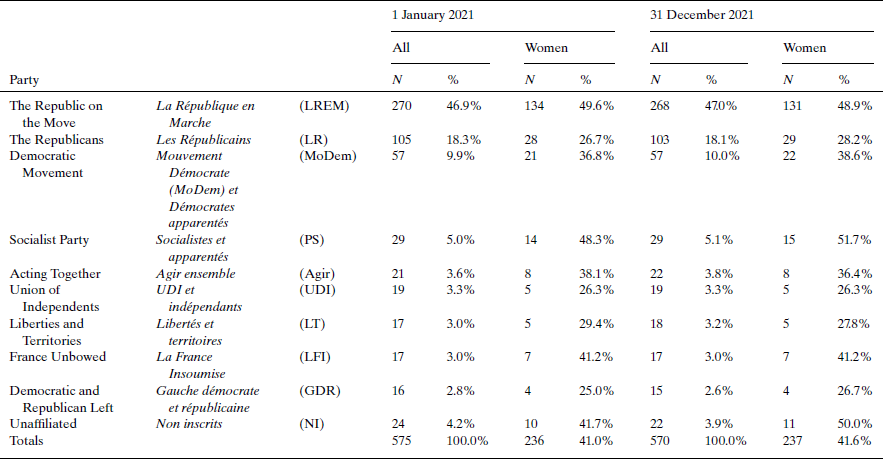
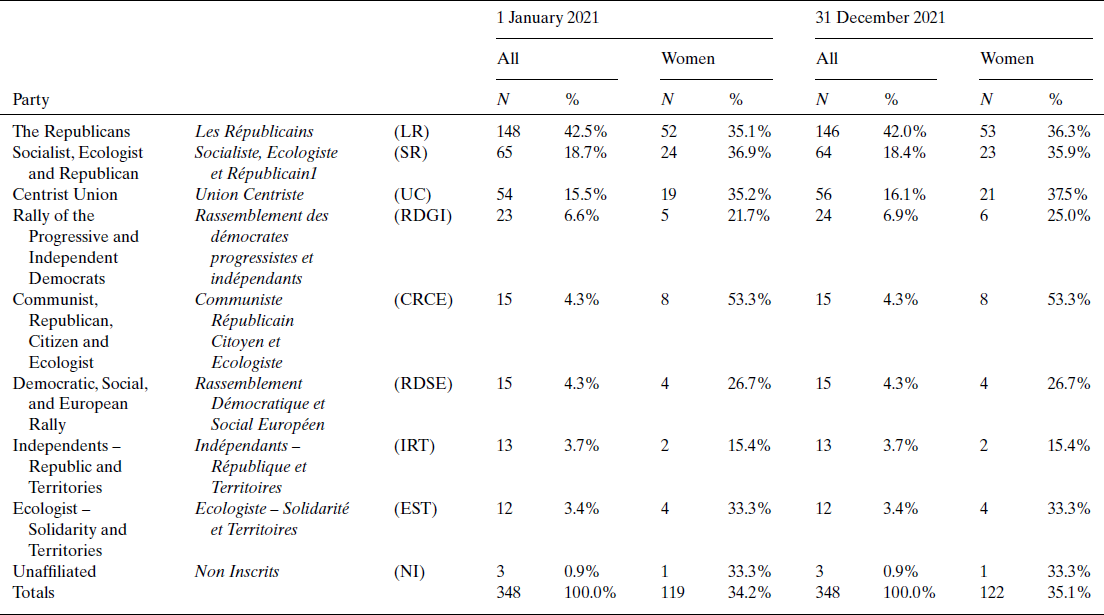
In the French Assemblée Nationale, limited developments can be reported (Tables 2 and 3).
Table 2. Party and gender composition of National Assembly (Assemblée nationale) in France in 2021

Notes: With regard to the ‘Democratic Movement’, groups’ members and related members (apparentés) are counted indifferently.
Totals may vary across the period as some seats may be left empty for short periods of time. The maximum number of seats is 577.
Source: Assemblée Nationale website (2022).
Table 3. Party and gender composition of the Senate (Senát) in France in 2021

Note: ‘Socialist, Ecologist and Republican’ formerly was Socialiste et républicain (‘Socialist and Republican’).
Source: Sénat website (2022).
First, some party switching was observed between the Republicans and LREM in the aftermath of the regional elections. The most prominent case is the open dispute between Renaud Muselier and Eric Ciotti, both from the Provence-Alpes-Côte d'Azur region. In the regional election runoff, Muselier (the Republicans) benefited from the endorsement of the LREM. This was highly controversial in the Republicans headquarters. In one of the biggest cities of the region, Nice, this led to a split between the mayor and head of the metropole, Christian Estrosi, who called for closing ties with LREM, and Eric Ciotti, MP and prospective nominee in the centre-right's primary election, who said he would vote for Eric Zemmour in the second round of the presidential election.
Second, there was another crack in the LREM. The party ‘whip’, Pacome Rupin, resigned in July following repeated disputes with the other members of the party on the implementation of the passe sanitaire. This resignation came up in a difficult context for the LREM. Party discipline has become harder to maintain as the group split up and lost, since the beginning of the legislative term, around 15 per cent of its MPs.
Political party report
From the political party side, 2021 was mostly devoted to preparing for the 2022 presidential elections, first by the creation of two parties, and second through the organization of primaries.
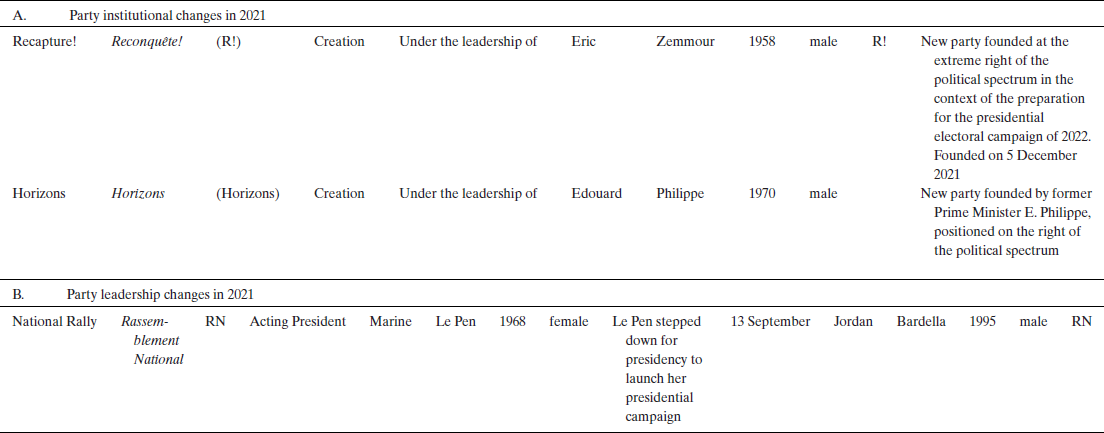
First, 15 months after leaving Matignon, in October former Prime Minister Edouard Philippe launched his own party, Horizons/Horizons, mainly with the goal of expanding to the right the base of support for Emmanuel Macron (who remained Horizons’ presidential candidate). President Macron's re-election in 2022 required broadening his electoral base. However, Horizons’ launching may also signal that Edouard Philippe might want to go it alone in the 2027 presidential election. It was also likely that Horizons would endorse its own candidates for the legislative elections in 2022 to build a strong base of support for its leader.
With a shorter term perspective, the day after the centre-right the Republicans voted to choose Valérie Pécresse as its candidate for president, the far-right candidate Eric Zemmour launched a new party called Reconquest/Reconquête. Its main agenda is to ‘immediately’ stop immigration into France, including by drastically limiting the right of asylum, and to ‘abolish’ the right to family reunification for migrants. Like former US President Donald Trump, Zemmour calls for France to be ‘great again’. His party explicitly called for an alliance of the right, meaning both core voters of the National Rally and the Republicans, and it proved itself a significant competitor for both parties in polls at the end of 2021.
Finally, in November 2021, the presidential majority launched a new electoral coalition called Ensemble Citoyens/Citizens Together, which is the alliance of six political parties, including LREM, Act/Agir, Democratic Movement/Mouvement Démocrate (MoDem), Horizons, Territories of Progress/Territoires de Progrès (TDP), and In Common/En Commun (EC). The official aim of this political force is to nominate only one candidate per district in the 2022 legislative elections. It may also signal that the post-Macron era has already been opened.
Second, parties also launched primaries for designating their candidates for the 2022 race. Yet, the parties that endorsed three of the four main candidates in 2017 (LREM, RN and LFI) chose either to wait (as President Macron did not declare in 2021 his intentions to run for the presidency again) or to endorse the same candidate as in 2017 (Marine Le Pen, who stepped down as leader of RN during the campaign, and Jean-Luc Mélenchon, leader of LFI). Initiated in 2011 by the Socialists, primaries have also been held in 2017 by the Republicans and EELV.
In 2021, EELV organized their own primaries in September. All citizens aged 16 years or over were allowed to vote. Yannick Jadot, MEP since 2009, won with a short margin of 51 per cent against Sandrine Rousseau. Jadot appeared clearly as the moderate candidate in this race, while Rousseau went stronger on all issues emphasizing especially her position on feminism.
After the trauma of the 2016 open primary, which left the party weakened, the Republicans chose in September 2021 a ‘closed’ (internal) primary. Valérie Pécresse, who had left the party in 2019, won in December 2021 with over 60 per cent of the vote, embodying a short victory of the moderates against hardliners such as Eric Ciotti, who made it to the runoff.
Finally, on the left-wing side, Anne Hidalgo, Mayor of Paris, won more than 72 per cent of the votes cast by Socialist members. But being split into around seven candidates, the left-wing's chances to reach the second round seemed close to zero. In this unfavourable context, two activists initiated the People's Primary/La Primaire populaire with the hope of designating a single candidate across all left-wing parties. However, no leading figure supported it. Jean-Luc Mélenchon, leader of the far-left wing party LFI, declared the People's Primary was a poll without any of the basic rules respected to ‘guarantee its sincerity’ (Le Monde–AFP 2022). The environmentalist candidate Yannick Jadot said he was not concerned with the outcome. And Anne Hidalgo did so as well.
All in all, all the primaries held in 2021, if not as successful as in 2017, met satisfactory levels of participation. As an example, 122,670 voters registered for the EELV primary, many more than in 2016, with only 17,000 participants. However, and contrary to 2017, all the winners’ chances to reach the second round of the presidential election seemed to be close to zero. This may be seen either as a consequence of the erosion of the model or, more probably, as a partial reconfiguration of the partisan landscape. Eric Zemmour's electoral rise reveals the increasingly deeper divisions within the right-wing electorate between pro-European voters, on one hand, and others focused on sovereignty and immigration issues, on the other. It also reflects years of popular fatigue, and in particular since the election of Macron in 2017, with traditional duels between Le Pen and alternately mainstream parties.
Data on changes in political parties can be found in Table 4.
Table 4. Changes in political parties in France in 2021

Source: Commission nationale des comptes de campagne et des financements politiques (2022).
Institutional change report
Changes in institutions were very limited in 2021.
Issues in national politics
As presidential elections were on the horizon, political news in the second half of 2021 largely focused on polls, with most of the significant candidates known by the end of the year (with the exception of Christiane Taubira, waiting for the Peoples’ Primary in January 2022, and President Macron, who decided to postpone his official start for re-election as long as he could).
President Macron benefited from a clear (though limited) advantage in the polls, with his forecast support by the end of the year standing at about 25 per cent in the first round of elections. Three candidates came tied second in the polls, with vote intentions between 15 per cent and 17 per cent: Valérie Pécresse, Marine Le Pen and Eric Zemmour. Jean-Luc Mélenchon reached 10 per cent, and no other candidate attained this threshold.Footnote i
The reading of these results offered various perspectives. President Macron has a solid chance. Pécresse was also perceived as a strong contender, with some polls positioning her as the winner against Macron in the runoff, if she were able to make it. But the bigger news was the very high level of support of the far right, with two candidates at about 15 per cent each. If it was not clear which one of them was in the better position at that time, their prospects in a runoff were promising. This also meant that the traditional left (i.e., Socialist and Ecologist parties) was down to about 20 per cent in the polls.
In terms of governmental practice, the government reinforced its willingness to organize public ‘consultations’. Initially launched in 2020 in the midst of the pandemic crisis with le Ségur de la Santé (talks on the national health system), this consists of the organization of talks between the government, directly interested bodies (for instance, medical unions for the Ségur), citizens and elected officials. This format was reproduced on security issues, with the consultation named Beauvau de la sécurité involving representatives of law enforcement agencies, citizens and elected officials. It took place from February to September 2021, with the aim of reforming the police. Among the reforms announced, the number of police officers on public roads is expected to double over the next 10 years. A month later, in October, President Macron launched the Etats généraux de la Justice (General Reviews of Justice), which should lead to proposals for a reform of the French judicial system. Gathering judges, prosecutors, lawyers and others, the assembly should put forward reforms to streamline the justice system from 2022 and beyond.
Besides, two issues in national politics are worth mentioning. On the one hand, French MPs were largely asked to vote on health emergency bills. In force since June, the state of health emergency was regularly extended, up to 31 July 2022. This regime, a sort of toolbox available to the government, allows it to order restrictions (movement of people, demonstrations, access to establishments open to the public, etc.), including the health pass. On the other hand, France has been affected by major developments on the international stage. The AUKUS pact – a trilateral security pact between Australia, the UK and United States for the Indo-Pacific region – acted as a hard blow for France, and President Macron more particularly. His motto is to be a fully independent power, developing its own ‘strategic autonomy’. AUKUS may be seen as a warning that France is facing a hard time fulfilling this goal.


 Open access

