



INTRODUCTION
Hand, foot and mouth disease (HFMD) is an emerging infectious gastrointestinal disease mainly affecting infants and children. The main clinical symptoms include mouth ulcers and vesicles on the hands, feet, and mouth [Reference Jiang1]. The disease is usually mild and self-limiting. However, sometimes serious neurological and cardiopulmonary complications may occur [2].
At present, there is no vaccine or specific treatment available for HFMD. Although integrated intervention measures, including increased education and enhanced surveillance to identify outbreaks are being implemented, HFMD remains a severe public health problem in China. A nationwide surveillance system has reported over 5 million cases from January 2011 to December 2013, with an average annual incidence rate of 138·95/ 100 000 population. In Sichuan province, the reported number of HFMD cases has increased markedly over the past 5 years. In 2009, the incidence rate of reported HFMD cases in Sichuan province was 26·48/ 100 000 population. This number almost doubled in 2010 (51·98/ 100 000 population). The annual incidence of HFMD is now the highest of the 39 reportable infectious diseases in Sichuan province.
The incidence of HFMD has variability in different areas and periods. Previous studies have demonstrated that HFMD cases are not equally distributed across geographical areas [Reference Liu3–Reference ZHU6]. In addition, seasonality in the incidence of HFMD has been reported in a number of countries [Reference Blomqvist7–Reference Fujimoto9]. A good understanding of the spatio-temporal patterns of HFMD might help to determine high-risk areas and periods, and thus help to initiate more location-specific public health interventions to control or prevent HFMD. An emerging approach to achieve this understanding is the application of spatio-temporal cluster detection methods, which provide the information about where and when the incidence is abnormally high. However, studies on spatio-temporal analysis of HFMD in China are very limited, especially on smaller spatial and temporal units [Reference Xie10].
The objective of this study was to examine the spatio-temporal pattern of HFMD daily cases at the county level in Sichuan province. Spatial, temporal and spatio-temporal analyses were conducted in order to understand the trend and dynamics of transmission and to identify high-risk areas and periods of HFMD, thereby providing information on where and when the prevention and control measures should be targeted.
MATERIALS AND METHODS
Study area
Sichuan province, situated at latitude 26·40° N to 33·68° N and longitude 98·31° E to 107·99° E, is an inland province in southwestern China with a population of ~80 million people. The province covers an area of 485000 km2, which is divided into 21 prefectures and 180 counties. The median county area is 1633 km2.
Data sources
The daily data of reported HFMD cases in Sichuan province from 2008 to 2013 were obtained from the China Information System for Disease Control and Prevention (CISDCP), which is a web-based reporting system. HFMD has been classified as a class ‘C’ notifiable disease from 2008. Since then, all HFMD cases are required to be reported to CISDCP within 24 h after diagnosis [11]. For each HFMD case, the information entered into the system includes age, gender, status, date of symptom onset, etc. In this study, all HFMD cases were confirmed according to the unified diagnostic criteria issued by the Ministry of Health of China [11]. For the purpose of performing a spatio-temporal analysis, county-level polygon maps at a 1:1000000 scale were obtained. Demographic information was obtained from the National Bureau of Statistics of China. HFMD cases were geocoded and matched to the county-level layers of the polygons by administrative code.
Spatial autocorrelation analysis
The autocorrelation statistic (Moran's I) was used to detect the global spatial autocorrelation of HFMD cases in the study area by year. We used the GeoDa software (http://geodacenter.asu.edu/software/downloads) to compute Moran's I test statistic. We used the standardized first-order ‘queen neighbours’ as the definition of neighbours. The spatial autocorrelation statistic for HFMD incidence was calculated based on the assumption of constant variance. This assumption might be violated when incidence at the county level varies greatly across the whole study region. Empirical Bayesian smoothing was performed to adjust for this violation [Reference Hui12]. After computing the statistics from the smoothed rates, we evaluated the test statistic using the Monte Carlo P value, which was derived from 999 randomizations of the dataset.
Spatio-temporal cluster analysis
A retrospective space–time scan statistic, based on a discrete Poisson model, was performed to identify the presence of high-risk space–time clusters of HFMD cases by using SaTScan software version 9.2 (http://www.satscan.org/). The space–time scan statistic is defined by a cylindrical window with a circular geographical base and with height corresponding to time [Reference Kulldorff13]. The cylindrical window is then moved in space and time. The base and the height of the windows are in dynamic flux to detect possible spatio-temporal clusters. For each scanning window, a log likelihood ratio (LLR) was calculated to test for elevated risk within the window in comparison to outside the window. Significance was evaluated based on Monte Carlo simulation. The scanning window with the maximum LLR was defined as the most-likely cluster. Other scanning windows where the likelihood values are statistically significant are defined as secondary clusters ranked according to their likelihood ratio test statistic.
In this study, we performed yearly scans to observe changes in clustering and to control the time trend in the whole study period. For each year, we used 180 counties of Sichuan province as spatial units, and 365/366 days from 1 January to 31 December as the time unit. For the setting of the maximum size of the spatial cluster size, we first used the default value of 50% of the population. Next we conducted the scan again at a smaller maximum cluster size of 20% as recommended by previous researches [Reference Deng4, Reference Xie10]. The yearly scan results of HFMD cases were displayed using a value of 20% as it has more power to detect the true cluster. For each run, the number of Monte Carlo replications was set to 999 to ensure sufficient statistical power. Clusters with statistical significance of P < 0·05 were all reported.
RESULTS
Demographic characteristics
From 2008 to 2013, there were 212267 HFMD cases notified in Sichuan province with an average annual incidence rate of 43·65/ 100 000 population. Table 1 showed the incidence rate of HFMD by year. The incidence rate increased markedly over time (P value for linear trend < 0·001).
Incidence of HFMD in Sichuan province, 2008–2013
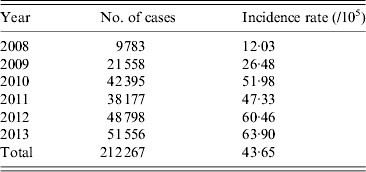
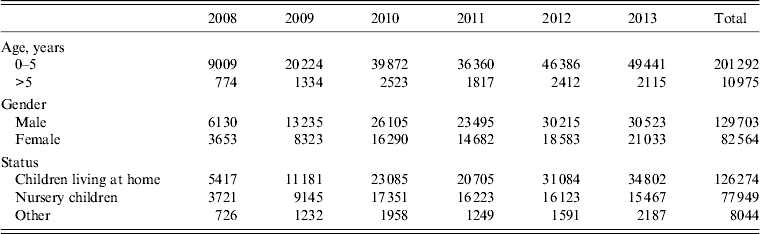
Table 2 summarizes the sociodemographic characteristics of HFMD cases from 2008 to 2013. It shows that the 0–5 years age group contributed most of the cases, which accounted for 94·83% (201292 cases) of all reported cases over the study period. Of 212267 HFMD cases, 129 703 were males and 82 564 were females, with a male–female sex ratio 1·57. In China, all children aged 0–5 years spend their daytime at home, kindergarten or school. Table 2 shows that most of HFMD cases were preschoolers (59·49% children living at home and 36·72% nursery children). In the 6-year study period, children living at home were the predominant group of HFMD cases. The proportion of cases in this group increased from 55·37% in 2008 to 67·50% in 2013. Nevertheless, a gradual decline in the proportion of HFMD cases in nursery children was observed (from 37·21% in 2008 to 30·00% in 2013).
Sociodemographic characteristics of HFMD cases in Sichuan province, 2008–2013
Temporal pattern
Figure 1 illustrates the monthly distribution of HFMD cases. A general rising trend of HFMD cases was evident with clear seasonality and large and small alternating peaks. The first large seasonal peak occurred between April to July followed by smaller peak from October to December. More than half (52·27%) of the cases were reported during the first peak. The highest peak occurred in April–June for each year except 2013; the highest peak in 2013 occurred in November.
Monthly distributions of reported HMFD cases in Sichuan, China, from 2008 to 2013.

Spatial pattern
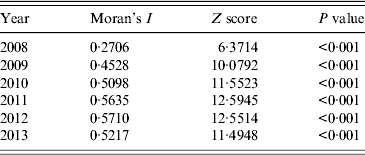
The spatial distribution of annual incidence rate of HFMD cases is shown in Figure 2. It clearly indicates that the distribution of HFMD was heterogeneous at the county level. Relatively high incidence rates appeared in the northeastern–southwestern belt whereas the northwestern and southeastern parts had relatively low incident rates. Table 3 lists the results of the spatial autocorrelation test. The value of global Moran's I increased from 0·27 to 0·52 between 2008 and 2013. The formal test of spatial dependence was significant for each year, implying that distribution of HFMD was spatially autocorrelated in Sichuan provice.
Yearly incidence rates (per 100000) of HFMD at the county level in Sichuan, China, 2008–2013.

The results of the spatial autocorrelation test on HFMD cases in Sichuan province, 2008–2013
Spatio-temporal cluster analysis
Using the maximum spatial cluster size of 20% of the total population, spatio-temporal cluster analysis identified one most-likely cluster and four secondary clusters in 2008. The most-likely cluster included 12 counties, of which the cluster centre was (30·69° N, 104·12° E) and the cluster radius was 39·87 km. The cluster time was 19 April in 2008 to 5 August in 2008, and the average annual incidence rate inside the window was 116·0/100 000 with a relative risk (RR) value of 12·53 (P < 0·001). Similarly, we found most-likely clusters in the other 5 years (Table 4, Fig. 3). The cluster centres were all within Chengdu district, which is the capital city of Sichuan province. In addition, 10 counties identified in cluster analysis of all 6 years were all within Chengdu. In each year, apart from the most-likely cluster, several secondary clusters with relative risk ranging from 1·74 to 22·68 were also detected (Fig. 3). Most of the clusters were located in the northeastern–southwestern belt of the province and occurred from April to July. The most-likely clusters in 2009, 2013 and four secondary clusters in 2011, 2013 occurred in the second peak period from October to December.
Spatio-temporal clusters of HFMD in Sichuan, China, 2008–2013, setting 20% as the maximum cluster size.

The most-likely clusters of HFMD in Sichuan province, China, 2008–2013 (setting 20% as the maximum cluster size)

LLR, Log likelihood ratio; RR, relative risk.
DISCUSSION
We observed most HFMD cases (94·38%) in children aged 0–5 years during the study period in Sichuan province. In addition, we found an upward trend in the proportion of children living at home and a downward trend in the proportion of nursery children (children in kindergartens). One possible reason was that the Chinese public health departments have initiated several prevention measures to control the epidemic of HFMD in institutional settings in recent years. The implementation of these strategies might contribute to the decrease in the proportion of nursery children.
The temporal analysis showed that there was a large peak that occurred in late spring, along with a smaller peak in early winter. This was consistent with the findings in some areas of China. Double seasonal peaks were also found in Guangxi and Guangdong provinces [Reference Deng4, Reference Xie10]. However, there was a little difference. For instance, the second peak occurred from September to November in Guangxi province, which is 1 month earlier than that in Sichuan province. This difference might be attributed to environmental factors such as climatic, geographical, social factors, etc. [Reference Hu14–Reference Onozuka and Hashizume17].
During the 6-year study period, HFMD incidence in Sichuan province increased markedly from 12·23/100 000 in 2008 to 63·90/100 000 in 2013. The value of global Moran's I increased from 0·27 to 0·52 between 2008 and 2013, indicating that the spatial distribution of HFMD has become more uneven (i.e. the clustering of high and low values is becoming more prominent).
The scanning results show that the centres of the most-likely cluster were all located in the provincial capital city Chengdu during the whole study period. The most-likely cluster covered areas located in Chengdu and its neighboring cities for each year, including Meishan, Ya'an, Leshan, Deyang. The finding was consistent with previous research that clusters were mostly detected in locations with high population density and mobility [Reference Ma18, Reference Bie19]. In addition, these areas were located in the major transit centres of highways and railways in Sichuan province, which indicates that HFMD might be transmitted via highways and railways. The results also reminded us that prevention and control measures for HFMD should be focused on Chengdu and its neighbouring areas to maximize cost-effectiveness.
SaTScan software was thought to be the most developed and robust software for implementation in an automated cluster detection system when performing spatio-temporal disease surveillance [Reference Robertson and Nelson20]. However, the results of the spatio-temporal scan statistic are sensitive to the parameter choices of cluster size [Reference Chen21]. When choosing 50% of the total population at risk as the maximum cluster size, the clusters included a large number of low-risk areas. For instance, the most-likely cluster in 2010 (50% scale) covered ~80% of the counties in Sichuan province, which contained a considerable proportion of low-risk areas (36·04%). When using the 20% scale setting, the proportion of low-risk areas decreased greatly (11·48%). Many small clusters with higher levels of risk were detected which might provide more usable information for HFMD prevention initiatives.
In our study, we used county as the spatial analysis unit. However, smaller spatial units may provide more location-specific information which could inform the design and implementation stages of public health programmes. We plan to use a finer areal unit scale (e.g. township level) in further research, which will focus on Chengdu and its neighbouring areas to identify clusters within counties with higher burdens of HFMD.
There are limitations associated with using cases reported through the CISDCP system. (1) The surveillance system of HFMD in China has only been in operation since 2008. The sensitivity and positive predictive value of the system in Sichuan province have not been assessed. As a result, the number of HFMD cases reported through the CISDCP system might not accurately reflect the true extent of the epidemic, especially in 2008. The rapid increase of reported HFMD incidence from 2008 to 2013 could partly be attributed to the real high incidence of HFMD. Moreover, the enhanced supervision and improved diagnostic capacity of HFMD might play an important role. We still need a longer period of observation to obtain more accurate conclusions. (2) In our study, the spatio-temporal clusters were mainly located in Chengdu and the nearby counties, which are the more developed areas in Sichuan province. However, HFMD cases in other counties, which are less developed, could just be underreported or undetected due to limited resources. (3) Natural disasters also influence the number of reported HFMD cases. On 12 May 2008, an earthquake with a magnitude of 8·0 struck the northwestern part of Sichuan province. After the earthquake, the number of reported cases decreased by 17·8% compared to the average number in the same period in 2005–2007 [Reference Yang22]. However, lacking HFMD data before 2008 it was difficult to evaluate the influence of the earthquake on the reported HFMD cases. On 20 April 2013, an earthquake with a magnitude of 7·0 struck the Ya'an district of Sichuan province. The earthquake paralysed the system in the surrounding areas. Lushan, Bao'an and Tianquan counties were most affected most by the earthquake. A sharp decline was observed in the number of reported HFMD cases following the earthquake. Only 36 cases were reported in these three counties during April–July in 2013, while the average number during the same period in 2010–2012 was 245 cases.
In conclusion, our study provides a good understanding of the spatio-temporal patterns of HFMD in Sichuan, and might help to determine allocation of resources to high-risk areas at suitable times with the goal of reducing HFMD incidence. With the help of the spatio-temporal framework provided in our study, HFMD control programmes could be focused on locations and periods where they will have the greatest impact.
DECLARATION OF INTEREST
None.



