




Since the invention of the printing press and the publication of the first Gutenberg bible in 1455, books have held a sacred role as repositories of knowledge and learning. Within paediatric cardiology, the significance of comprehensive references such as Anderson’s Pediatric Cardiology have also been highly recommended for trainees and faculty. Facilitating medical education for trainees is a growing challenge, with rapid technological advancements and social networking creating new opportunities and problems. Medical education transitions learners away from a pedagogic style into embracing andragogy, including experiential learning and self-directed/regulated learning. Textbooks are still recommended and frequently referenced. Their sufficiency in the digital era, however, has been questioned. Reference Waldum, Zhao and Chen1 Textbooks are now supplemented in alternative or supplemental formats, including e-Books and video libraries, in order to meet the needs of learners who may prefer the use of computers and electronic tablets. Reference Wernovsky2 Other educational modalities are also gaining popularity, including YouTube, podcasts, online references such as UpToDate, and dedicated educational websites exemplified by Heart University (www.heartuniversity.org), and LearnPICU (www.learnpicu.com). The growing question is whether textbooks retain a place in medical education or have they become obsolete?Reference Purcell3-Reference Egle, Smeenge, Kassem and Mittal6 The perception and use of textbooks amongst contemporary paediatric cardiology trainees are not well described.
Paediatric cardiology as a subspecialty encompasses a wide breadth and depth of information, including embryology, anatomy, physiology, clinical history, diagnostic data, surgical and interventional procedures, and outcomes. In addition to textbooks, the current era has encouraged innovation within medical education with the various forms of asynchronous learning environments. These include online compendiums, such as UpToDate, Heart University, high-yield condensed content as found in YouTube, podcasts, and webinars, and communities connected via the internet and social media, for example, subspecialty interest groups, and Twitter/X. In addition to the ease of access, content in this field was also made in order to condense the vast volume of information in order to utilise it more efficiently. Reference Rochelson, Clark and Motonaga7 Whether any of these modalities have demonstrated favorability and reliability over textbooks is not known.
We sought to understand if textbooks are useful to trainees, how trainees in paediatric cardiology learn best when reading textbooks, and what other mediums they use to supplement their training. We hypothesised that, in spite of the advances of technology, and the rise of increasingly accessible information, textbooks still serve as a reliable and high-yield source of information for trainees in paediatric cardiology.
Methods
This was a prospective mixed-methods study, recruiting participants from six cardiac centres. Centres that participated had established fellowship programmes in paediatric cardiology, and were intentionally represented across three continents, being drawn from the United States of America, Ireland, and India. We sought a diverse group of fellows to participate in this study in order to determine if there were clear differences in perceptions of textbooks. Participants were contacted first if they were a current trainee in a paediatric cardiology fellowship programme. A second criterion was that the participant held a faculty position within the programme providing training. Informed consent was obtained through their participation in the study.
Once enrolled, individuals were assigned at random one of three chapters from Anderson’s Pediatric Cardiology, 4rd Edition, which included “Coarctation of the Aorta,” “Ventricular Septal Defect,” and “Echocardiography.” Upon completion of reading the chapter, they were asked to complete an anonymous online survey. The survey instrument was initially developed by two cardiologists and reviewed independently by a third independent cardiologist. Questions were designed in determining the feasibility, acceptability, and utility of Anderson’s (and textbooks in paediatric cardiology as a whole). Open-ended questions were also included that asked the participants to offer their general opinions on textbooks, and their learning preferences in fellowship.
Results
Demographics
The survey instrument was disseminated to programmes in the United States of America, Ireland, and India. In total, there were 36 respondents, made up of 29 trainees and seven faculty, drawn from seven training programmes (Table 1). A total of 60 fellows were contacted to participate yielding a 49% participation rate from trainees. Almost nine-tenths (88.5%) of the respondents listed English as their primary language. An even distribution in seniority was found amongst the trainees.
Survey participant demographics

Chapter content
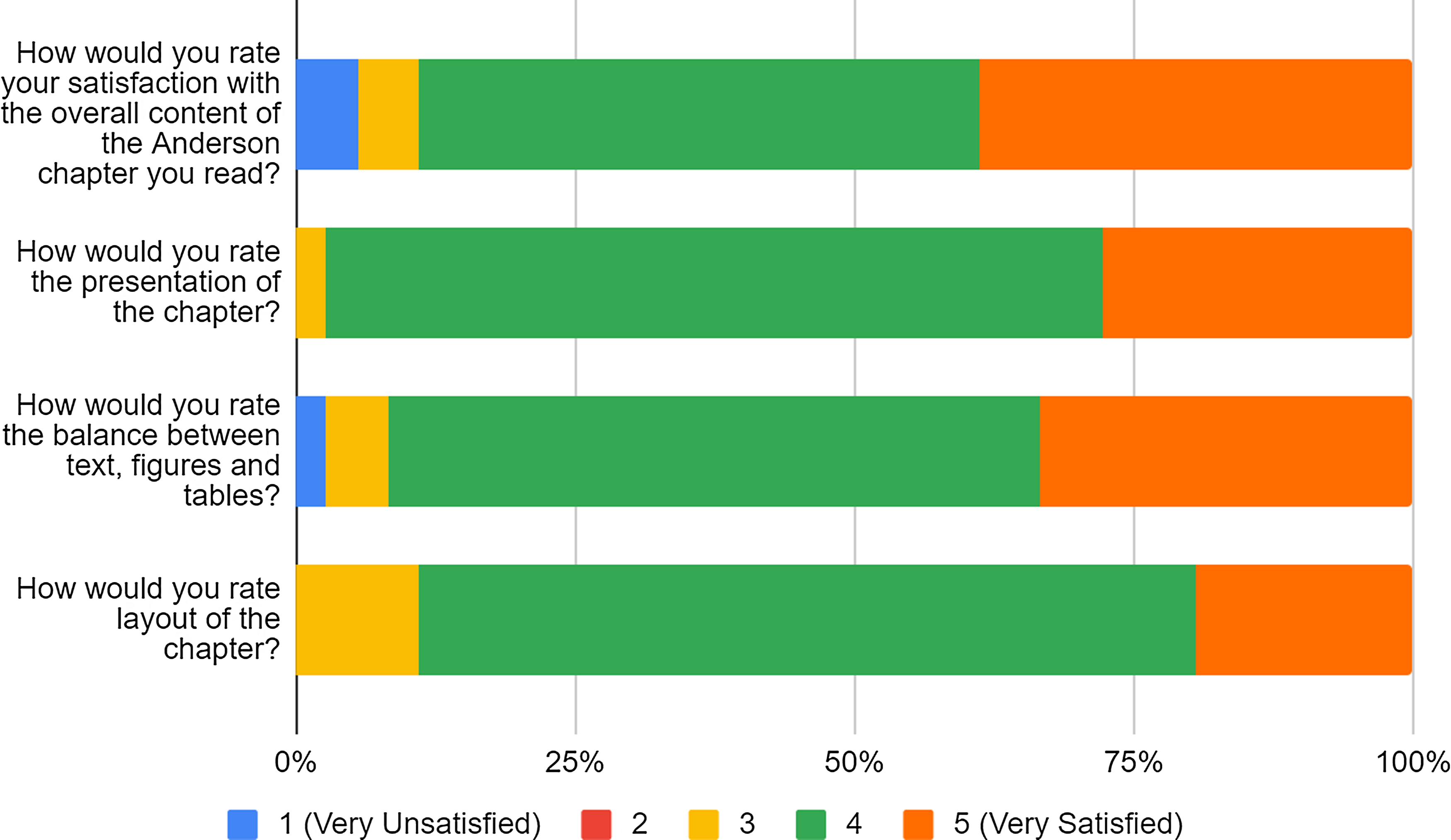
Respondents were assigned to review a single chapter from Anderson’s Pediatric Cardiology randomly (Fig 1, Supplemental Table 1). Items 9−12 asked respondents about their overall impression of the textbook chapter and its contents, which were rated positively at four out of five or higher. Items 13−17 asked respondents about the sufficiency of detail within the chapter, which were rated positively, with greater than 89% stating “Yes.” There were favourable responses when asked whether the structure of each chapter had aligned the content appropriately (Item 18). Respondents unanimously favoured reading chapters with mixed amounts of text with figures and tables (Items 36, 37).
Participant satisfaction with textbook chapter assignment (Items 9−12).
There was significant parity when asked about more contentious impressions of the chapter in terms of details, verbosity, and clearly stated objectives (Items 19, 21, 22, 27). Respondents considered the chapters to contain an adequate amount of figures, tables, and references (Items 23−25). When asked about difficulties in reading, with one rated hardest, and 10 easiest, the reported mean was 6.91, with standard deviations from plus or minus 1.72. Suggestions to incorporate additional content to chapters, including additional visuals, videos, and review questions, were all favoured well (Items 26, 28, 31).
Impressions on textbooks
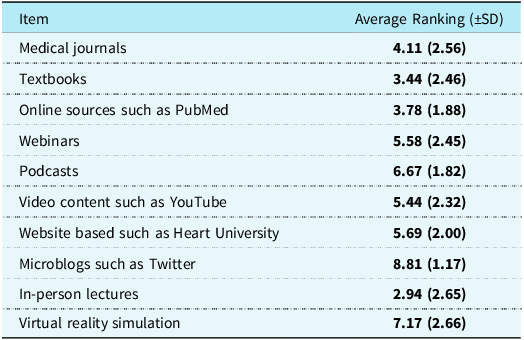
Respondents unanimously reported learning from their reading (Item 28). When asked about the frequency in which they usually use textbooks, in comparison to other sources, responses varied significantly (Items 30, 33, 34). When asked to rank the value of a wide variety of learning mediums, textbooks were ranked second highest, with in-person teaching taking first place (Table 2). Barriers to use of textbook included their physical size and price. When asked if textbooks were out of date, thirty respondents (88%) responded “No.”
Item 39: ranking of educational content amongst survey participants. The lower the ranking, the higher esteem amongst participants
Open-ended feedback
Respondents were also asked about their experiences with using textbooks and ways to improve their education, on the basis of the themes shown in Supplemental Table 2. When asked about specific learning points related to textbooks, several themes emerged from the responses, including the relative authority of textbooks within a trainee’s education, the limitations of textbooks, and ways textbooks might be improved in the modern era. When asked “what is one thing you could change to improve your learning?”, there was a near-unanimous response in needing more time dedicated to reading and self-study. Several answers alluded to advocating the increased use of online webinars, visual references and figures, and self-testing.
Discussion
Textbooks are not obsolete. We gleaned opinions from a wide variety of trainees and those faculty members early in their careers, with their responses demonstrating congruence in the importance of textbooks, and their position within the field of paediatric cardiology. It is important to note that the responses were equivocal across the various programmes noting that textbook use and disadvantages were seen similarly regardless of cultural backgrounds. Several components of a “good textbook” were emphasised, including the need for clear statement of objectives, alignment of content across the various disciplines, thoughtful use of supplemental visuals, and minimisation of lengthy paragraphs of text. The notion also emerged of the importance in which textbooks could possess further potential as a study tool with the inclusion of review questions, and “roadmaps” to assist learners in understanding their progress through the content.
This information is not counterculture to the use of more modern technologies for learning. Conversely, most respondents listed examples of alternative sources of education yet prioritised the value of textbooks. This highlights the fact that, as asynchronous learners, there is importance in having an accurate and reliable tool for reference. Unsurprisingly, textbooks are not used in high frequency relative to other forms of learning. This did not, however, diminish the perception of their importance to the trainee.
Critical opinions on the chapters chosen for our survey revealed the potential downside to having them as the sole or preferred learning modality. There is no denying that textbooks are expensive, and physical copies are cumbersome. These features often become significant barriers of access to trainees. Due to the complexity and depth of information they contain, it is also not surprising that the process of reading through chapters in their entirety provides diminishing returns. These observations, nonetheless, should not dismiss the value of textbooks, but rather redefine how they should be used.
We recognise that our study has its limitations. The sample size is small and may not accurately reflect the entire body of trainees in paediatric cardiology. We attempted to mitigate these issues by enrolling participants from programmes globally and in different sized programmes where their learning models varied. We acknowledge the survey instrument itself has not been validated – we attempted to mitigate this with the independent development and review of the survey prior to dissemination. This survey was also completed after reading their assigned chapter from Anderson’s textbook, which may also yield more positive answers due to the temporal effect of recalling the information more readily. We attempted to address any bias, or pressure for respondents to give positive answers, by making the survey anonymous. We also stated explicitly that the information would not be provided to anyone outside of the study. It is also important to acknowledge that the primary author of the textbook used in our study is one of the study authors; however, he was not involved in the dissemination or development of the survey instrument.
We conclude that participation in a training fellowship for paediatric cardiology places a significant cognitive burden on trainees, often requiring them to seek supplemental education outside of their clinical practice. The rise of technologies has not diminished the value of textbooks. Our survey highlights the opportunities in which future editions of textbooks and supplemental materials can be modified in order to address the needs of adult learners. Future studies should include examining more thoroughly how trainees might acquire and retain information in order optimally to provide the support needed throughout their fellowship.
Supplementary material
The supplementary material for this article can be found at https://doi.org/10.1017/S1047951124000611
Competing interests
One of the authors (Robert H. Anderson) is the primary author of the textbook, Anderson’s Pediatric Cardiology, utilised in this study. He did not take part in the recruitment of participants, nor did he take part in the survey design and data analysis.


 Open access

