


1. Introduction
Artificial intelligence (AI) is increasingly recognized as a key enabler for transforming product development (PD) by enhancing efficiency, creativity, and decision quality throughout the innovation process (Reference CooperCooper, 2024). The growing accessibility of AI models and rapid technological progress have made AI development more attainable, even for small and medium-sized enterprises. Despite this advantageous environment, present adoptions within the industry frequently prove ineffective and fail to generate sustainable value. These failures are attributed not to the immaturity of AI technologies themselves, but rather to insufficient process integration, inadequate contextualization, and poor data quality – aspects that ought to be considered on a case-by-case basis in the early stages of AI system development. Successful AI initiatives are consistently characterized by early interdisciplinary collaboration and a shared understanding of objectives and expected outcomes (Reference LeeLee et al., 2023; Reference Kim, Shin, Yadgarova, Son, Subramonyam and KimKim et al., 2024). Central to this are well-defined AI use cases, which serve as the conceptual bridge between domain-specific problems and technological implementation (Reference Kirschbaum, Posselt and RothKirschbaum et al., 2022). Well-formulated use cases – characterized by clear problem definitions, realistic data requirements, and measurable outcomes – help organizations anticipate obstacles such as poor data quality or integration challenges before they impede model development and validation (Reference LeeLee et al., 2023; Reference Romeo and LackoRomeo & Lacko, 2025). Their effective formulation requires structured collaboration between domain experts, who contextualize the problem and data environment, and AI experts, who translate these requirements into technically viable solutions; absent such alignment, projects risk being technology-driven rather than need-driven, increasing the likelihood of post-deployment deficiencies. This phenomenon is not uncommon in the context of product development. Companies promptly formulate preliminary concepts for AI applications (e.g., “using AI to generate requirements lists”), yet the structured elaboration and specification of company-specific requirements, data existence, and quality is sub-sequently disregarded in favor of rapid progression to AI developments. To coordinate such complex, interdisciplinary efforts, organizations rely on readiness models to assess progress transparently. The well-established Technology Readiness Level (TRL) framework evaluates technological maturity (Reference LavinLavin et al., 2022), yet its narrow focus is increasingly questioned in the context of AI system development. Many projects reach high TRL scores but still fail due to poor data quality or vague problem definition – meaning the technology may be ready, but the use case is not. This underscores the need for a use case-centered readiness logic that extends its focus beyond technology to include data and problem perspectives.
1.1. Objectives and research question
Based on a literature review, this study examines whether existing readiness frameworks adequately address the interdisciplinary and multidimensional nature of AI use cases in AI system development. It considers the continuum from AI idea (abstract opportunity) to AI use case (contextualized plan) to AI system/application (technical realization). Understanding readiness along this path is crucial for transparent communication and realistic assessment between domain and AI experts. The aim is to analyze and integrate existing frameworks in order to derive an adapted conceptual readiness logic suited to early-stage AI projects, reflecting both technological and domain-specific challenges. The resulting framework is designed for AI customers and developers in engineering-driven organizations providing a structured basis for assessing and steering AI development projects, enabling informed decision-making across technological feasibility and application domain-specific requirements. Accordingly, the guiding research questions are: RQ1: Which dimensions of readiness are relevant for evaluating AI use cases in early-stage system development? RQ2: How can the identified readiness dimensions be operationalized into a framework for assessing AI use cases in early-stage development?
The remainder of the contribution is structured as follows: Section 2 reviews conceptual foundations and existing readiness approaches in AI system development. Section 3 introduces the adapted conceptual AI use case readiness framework, combining planning and implementation stages into a unified twelve-level structure. Section 4 discusses the theoretical and practical implications of the framework, emphasizing its value for interdisciplinary collaboration and lifecycle alignment. Section 5 concludes with key contributions, limitations, and directions for future research.
2. Related work
This section synthesizes extant research on readiness approaches and AI development lifecycles to derive criteria that must be satisfied by a viable AI-specific readiness framework with a focus extending beyond technology. The text commences with the clarification of conceptual foundations (Section 2.1) and project characteristics (Section 2.2). It then synthesizes requirements specific to AI use cases (Section 2.3) and concludes with a review of existing AI-related readiness approaches (Section 2.4).
2.1. Conceptual foundations
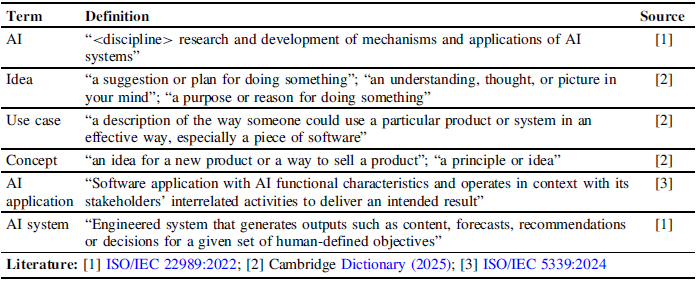
Readiness is critical when it comes assessing organizational and technological progress in AI system development. Readiness describes an organization’s preparedness to implement AI-related change and its ability to align technological opportunities with strategic objectives, data assets, and human capabilities (Reference Jöhnk, Weißert and WyrtkiJöhnk et al., 2021). Maturity, in contrast, reflects the degree to which technologies and processes are developed and optimized for effectively deploying and improving AI systems (Reference Reichl and GruenbichlerReichl & Gruenbichler, 2023). Together, they provide a systematic basis for evaluating capabilities, identifying gaps, and guiding improvement (Reference Becker, Knackstedt and PöppelbußBecker et al., 2009). Readiness models have been applied as diagnostic and benchmarking tools in innovation and R&D management to support structured assessment and transparent communication (Reference LavinLavin et al., 2022; Reference Eljasik-Swoboda, Rathgeber and HasenauerEljasik-Swoboda et al., 2019). In AI system development, these frameworks have evolved beyond purely technological perspectives, emphasizing multi-dimensional readiness by integrating technological, data, organizational, and human factors (Reference Eljasik-Swoboda, Rathgeber and HasenauerEljasik-Swoboda et al., 2019; Reference Naheed, Pinto and PirolaNaheed et al., 2025). Successful development depends equally on problem-, data-, and technology-oriented dimensions. Readiness frameworks can provide a common foundation for interdisciplinary collaboration and shared understanding among experts, engineers, and decision-makers. In this contribution, readiness is examined at the level of AI use cases, focusing on project-specific individual applications throughout their conceptual and technical evolution rather than on enterprise-wide adoption maturity. Accordingly, the contribution centers on assessing the content-related and methodological progress of AI use cases as the key interface between domain expertise and technical realization, rather than on organizational enablers or strategic preconditions at the enterprise level. Table 1 provides an overview of related terminologies, although the terminology surrounding use cases remains inconsistent: AI is variously seen as a field of study, a capability, or a system (Reference Bawack, Fosso Wamba and CarilloBawack et al., 2021). Generally, a use case describes how a product or system is applied to achieve a goal (Cambridge Dictionary, 2025). When adapted to AI, it can be understood as a description of how an AI system or AI application operates within a specific context to achieve defined objectives through human-machine interaction. Related definitions (Reference Gerschütz, Goetz and WartzackGerschütz et al., 2023; Reference Kirschbaum, Posselt and RothKirschbaum et al., 2022) emphasize that use cases integrate problem, data, and technical dimensions but vary in depth and specificity depending on context. In this contribution, the terms AI idea, AI use case, and AI application/system are treated as a continuum: Ideas represent abstract opportunities, use cases are contextualized and domain-specific descriptions, and applications correspond to implemented systems. The AI readiness framework proposed mirrors this logic by assessing progress along this continuum.
Comparison of different terminologies

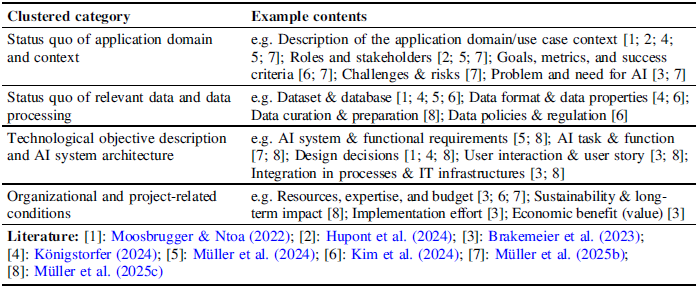
The existing literature identifies recurring descriptive elements (see Table 2) that pertain to the following: domain context, data properties, system architecture, and organizational conditions. As Reference Kirschbaum, Posselt and RothKirschbaum et al. (2022) highlight, AI use cases vary in their specificity. General AI use cases describe potential applications at a conceptual level, whereas domain-specific AI use cases provide detailed, context-rich information about technologies, data, and expected results within a specific application domain (company-specific content). The specificity depends on multiple factors, including the AI literacy of involved stakeholders, the domain knowledge of AI experts, and the complexity or sensitivity of the data (Reference Kim, Shin, Yadgarova, Son, Subramonyam and KimKim et al., 2024). Achieving mutual understanding across these perspectives is crucial for ensuring transparent communication and coherent interdisciplinary collaboration.
AI use case-related content

Reference Königstorfer and ThalmannKönigstorfer and Thalmann (2022) further demonstrate that documentation practices vary by organizational readiness and risk perception. Across domains, a lack of standards and testing procedures remains a major barrier to adoption. Nonetheless, comprehensive documentation is recognized as a central enabler for transparency, traceability, and ethical accountability in AI projects, an aspect equally relevant for AI applications in product development. Conceptual distinctions: A reviewed body of literature reveals persistent ambiguities regarding readiness in AI system development, particularly in defining evidence of progress, relevant artifacts, and criteria for achievement. Existing approaches use different dimensions and assessment criteria, underscoring the need for a standardized, reliable conceptual framework. Moreover, AI use cases vary in specificity - from general concepts to domain-specific implementations - depending on interdisciplinary team competencies and contextual knowledge maturity, resulting in different levels of readiness across projects and domains.
2.2. AI system development project and process model characteristics
AI system development projects differ fundamentally from conventional IT or software projects due to their high complexity, data dependency, and continuous experimentation (Reference Müller, Roth and KreimeyerMüller et al., 2025a; Reference MartinsMartins, 2023). The development process is inherently iterative and feedback-driven, requiring ongoing model refinement, validation, and adaptation as new data and insights emerge (ISO/IEC 22989:2022). Uncertainty is inherent, as outcomes can vary significantly between experimental and production environments (Reference MartinsMartins, 2023). Effective execution depends on managing dynamic interactions between humans, data, and machines within an evolving learning system (ISO/IEC 22989:2022). Moreover, AI projects are inherently interdisciplinary, involving AI specialists, data engineers, and domain experts, supported by management, IT, and regulatory stakeholders (ISO/IEC 22989:2022; Reference Müller, Roth and KreimeyerMüller et al., 2024). Domain experts provide contextual framing, goal definition, and relevance assessment, while AI experts focus on model design, data preparation, and validation (Reference Müller, Roth and KreimeyerMüller et al., 2024; Reference Luley, Deriu, Yan, Schatte and StadelmannLuley et al., 2023). Early and structured stakeholder involvement is therefore critical to align technological feasibility with domain needs and to ensure meaningful solutions (Reference Müller, Roth and KreimeyerMüller et al., 2025a), underscoring the necessity of cross-functional communication and shared conceptual frameworks. Several lifecycle models structure AI system development. ISO/IEC 22989 (2022) outlines a comprehensive AI system life cycle spanning data preparation, model training, validation, deployment, and operation. Complementary deep learning and end-to-end frameworks emphasize technical iteration and DevOps-based processes (Reference Müller, Roth and KreimeyerMüller et al., 2024), yet often underrepresent preceding conceptual and organizational phases. Addressing this gap, Reference Brakemeier, Gebert, Hartmann, Schamberger and WaldmannBrakemeier et al. (2023) highlight industrial early phases -preparation, ideation, assessment, and prioritization - while Reference Müller, Roth and KreimeyerMüller et al. (2025a) integrate conceptual and technical perspectives into a holistic lifecycle model centered on the AI use case as the interface between exploration and realization. Across this lifecycle, stakeholder information and transparency requirements evolve: pre-modeling stresses representativeness and contextual clarity, modeling emphasizes accuracy and robustness, and post-modeling requires interpretability, usability, and performance evaluation (IEEE Std 2894-2024). These shifting demands reinforce the need for structured mechanisms to coordinate activities and communicate progress. Project characteristics: AI system development follows an end-to-end continuum from initial idea to defined use case and implemented application, structured across the phases of pre-modeling, modeling, and post-modeling. Each phase entails distinct objectives and information requirements, from conceptual framing and data preparation to validation and operational learning. The process is inherently iterative, characterized by feedback loops and stage transitions as models evolve. Typically, domain experts lead ideation and problem framing, while AI experts drive technical realization, focusing on efficiency and scalability. Depending on implementation strategy - enterprise-ready, self-developed, or hybrid - progress across readiness levels may be nonlinear. These characteristics necessitate frameworks that accommodate iteration, interdisciplinary roles, and stage-specific readiness assessment.
2.3. Requirements for readiness approaches in the context of AI use cases
Building on the conceptual distinctions (Section 2.1) and the specific characteristics of AI system development projects (Section 2.2), this section derives requirements for readiness approaches tailored to AI use cases. AI use cases constitute the central unit of analysis, as they connect abstract AI ideas with concrete system implementations. They vary in their specificity – from general (conceptual, transferable) to domain-specific (context-rich, operational) – and in their lifecycle phases (pre-modeling, modeling, post-modeling). Their description integrates problem, data, technology, and organizational facets (cf. Table 2) to ensure transparent and verifiable progression across stages (cf. Reference Naheed, Pinto and PirolaNaheed et al., 2025). Challenges typically arise from unclear problem framing, limited data/information accessibility due to the lack of interdisciplinary collaboration in the early stages, and insufficient coordination between domain and AI experts. Accordingly, readiness approaches should help structure and question the interdisciplinary collaboration, ensuring that each stage of development builds on transparent and verifiable foundations. They are diagnostic and guiding instruments that assess the current state and indicate improvement paths (Reference Reichl and GruenbichlerReichl & Gruenbichler, 2023). From a methodological standpoint, a viable readiness approach for AI use cases should therefore meet the following core criteria:
-
1. First, it must be use case-centric and stage-aware, guiding the transition from an initial AI idea to a domain-specific use case and integrated AI application – all while aligning assessment criteria with the respective lifecycle phases of pre-modeling, modeling, and post-modeling.
-
2. Second, it must be multidimensional, capturing application domain contexts, related data aspects, and technology implications (cf. Reference Müller, Roth and KreimeyerMüller et al., 2025a).
-
3. Third, it should remain role-explicit and literacy-sensitive, clarifying the contributions of domain experts, data specialists, and AI engineers (cf. Reference Kim, Shin, Yadgarova, Son, Subramonyam and KimKim et al., 2024).
-
4. Fourth, it must be evidence-based, linking each level to tangible artifacts such as data profiles, method cards (cf. Reference Müller, Roth, Kreimeyer and HölzleMüller et al., 2025c), or validation reports that allow traceability of decisions.
-
5. Fifth, the framework should be actionable, providing clear criteria for progress assessment.
-
6. Finally, it needs to be comparable and adaptable, enabling organizations to benchmark projects while remaining flexible to specific domain conditions.
Design implication: The derived core criteria imply a two-part structure: planning levels ensure complete (domain-specific) specification and feasibility before any technical implementation, while implementation levels follow TRL logic. This implication guides our model choice and evaluation in Section 2.4, also providing direct motivation for the adapted conceptual framework in Section 3.
2.4. AI-related readiness approaches
Readiness approaches assess the development stage and implementation capability of technologies or project states. In the context of AI, several frameworks adapt or extend established concepts such as Technology Readiness Levels (TRLs) to address AI-specific characteristics. Figure 1 summarizes the key frameworks identified in the literature to establish a conceptual understanding and evaluates their applicability to AI system development projects against the core criteria defined in Section 2.3.
The TRL framework developed by NASA measures the maturity of technologies across nine levels, ranging from the identification of basic principles to operational use (cf. Reference Meystel, Albus, Messina and LeedomMeystel et al., 2003). In the context of AI, TRL has been applied to classify and benchmark the maturity of AI technologies (Reference Martínez-Plumed, Gómez and Hernández-OralloMartínez-Plumed et al., 2020). Its strengths lie in its standardized evidence logic and comparability across domains. However, it remains technology-centric, with limited consideration of data quality or application domain context in individual domain-specific AI use cases.
The TRL for machine learning systems (MLTRL) by Reference LavinLavin et al. (2022) extends the TRL concept to ML pipelines with levels ranging from 0 (first principles) to 9 (deployment). It integrates aspects such as data readiness, validation, robustness, and continuous monitoring through gated reviews and artifact documentation (e.g., MLTRL cards). MLTRL strengthens use case centricity, multidimensionality (technology and data, but not problem orientations), and evidence linkage, but addresses organizational and human factors only indirectly. The approach is particularly relevant for managing the technical maturation and deployment readiness of ML-based AI use cases and only transferable to other AI approaches (e.g., LLMs) to a limited extent, which restricts its industrial applicability.
Reference Eljasik-Swoboda, Rathgeber and HasenauerEljasik-Swoboda et al. (2019) propose a multidimensional AI and data readiness model that evaluates an organization’s ability to develop and deploy AI innovations. The framework introduces six specific dimensions – specification readiness (AI), algorithmic readiness (AI), data existence readiness, data legal readiness, data format and quality readiness, and expert knowledge readiness (data) – each with defined maturity levels. It supports gap analysis and action planning, fulfilling multidimensionality but lacking a consistent cross-level scale for comparability, actionability, and artifact traceability.
The three approaches differ fundamentally in scope and application. While the general TRL focuses on technology maturity, MLTRL extends this to the ML pipeline and operational environment. In contrast, AI and data readiness refers to an organization’s capability to effectively implement and derive value from AI. Across these approaches, the evolution of AI-related readiness concepts reflects a gradual shift from technology maturity toward socio-technical and data-driven readiness. However, no single framework fully captures the iterative, interdisciplinary, lifecycle-, and use case-oriented nature of AI system development. A consolidated, stage-sensitive framework - combining evidence logic of MLTRL with multidimensional orientation of AI and data readiness - appears essential for supporting consistent assessment along the AI idea-use case-application continuum.
Comparison and assessment of AI-related readiness approaches

Figure 1 Long description
A table comparing different AI readiness approaches across various criteria. The table has four columns and six rows, including the header row. The columns are labeled as Technology-centered readiness without use case logic, Stage-aware for machine learning (ML) - but model-focused, Multi-dimensional checklist without project guidance, and Use case-centered, multi-dimensional and project-accompanying AI maturity. The rows are labeled with criteria such as Use case-centric & stage-aware, Multi-dimensional (problem/data/techn.), Role-explicit & literacy-sensitive, Evidence-based (artifacts), Actionable (progress criteria), and Comparable & adaptable. Each cell contains specific details about how each approach fulfills, partially fulfills, or does not cover the criteria. The table includes a legend indicating the fulfillment status with symbols (+), (0), and (-).
Another use of TRL is demonstrated by Reference Uren and EdwardsUren and Edwards (2023), who empirically reposition TRL from a technology lens to the project as unit of analysis. They propose an adoption model that complements People–Process–Technology with Data in order to capture socio-technical readiness as well as technological progress. Utilizing TRL as a reference framework in interviews, they identify stage-specific success factors: in TRL 2–4, exploratory prototyping with realistic data and early end-user involvement supports effective problem framing; in TRL 5–7, bridging the lab-to-operations gap requires access to operational data, governance structures, and expert judgment; and at TRL 9, integration with the organization’s MIS and alignment between developers and business functions become decisive. The study’s practical implication is to build a bridge - that is, to form cross-functional teams and develop data/technology skills - to sustain operational AI. Theoretically, it argues that people, process, and data readiness are co-requirements with technology readiness for successful adoption.
2.5. Interim summary
The literature underscores that technology-centric readiness alone is an insufficient predictor of AI project success. Effective assessment must consider the entire AI use case, combining multidimensional readiness. It must also treat the AI idea–use case–application continuum as a continuous, evidence-based path. Existing models each cover parts of this path; none spans it end-to-end with actionable checkpoints. This provides motivation for a unified framework that (i) finishes domain-specific planning before implementation and (ii) considers technological readiness as one part of the holistic AI use case.
3. Conceptual development of an adapted AI readiness framework
The development of the proposed use case-centered AI readiness framework follows a conceptual design approach aimed at integrating and extending existing readiness approaches for the specific context of AI system development. It follows the structure of TRL adapted to AI (cf. Reference Martínez-Plumed, Gómez and Hernández-OralloMartínez-Plumed et al., 2020), extends the multidimensional perspective of the AI and data readiness (Reference Eljasik-Swoboda, Rathgeber and HasenauerEljasik-Swoboda et al., 2019), and integrates methodological features of the MLTRL (Reference LavinLavin et al., 2022), such as evidence-based documentation. The focus is on the progression from nascent ideas, through the formulation of general use cases and subsequent domain-specific specifications, to the implementation of applications. While established approaches such as TRL, MLTRL, and AI & Data Readiness (cf. Section 2.4) primarily assess technological maturity, pipeline robustness, or data prerequisites, they remain largely technology-centric and underrepresent early problem framing and domain-oriented planning phases that precede technical implementation. In contrast, the present framework shifts the evaluative focus from technology readiness to use case maturity (cf. Figure 1). Readiness is conceptualized as the progressive coherence of problem, data, and system within a specific application context. Rather than asking whether a technology is deployable, the framework examines whether an AI use case is contextually grounded, systematically specified, and operationally implementable. The proposed framework is guided by three conceptual design principles: Continuity, ensuring a logical transition from idea exploration to continuous operation across the full AI life cycle; interdisciplinarity, providing a shared structure that enables collaboration between domain and AI experts (typical outputs guide domain experts to assign progress), and transparency, linking every readiness level to tangible artifacts and typical outputs that document progress and decision rationale. An overview of the eleven levels, including corresponding readiness dimensions, typical outputs, and methodological support, is provided in Figure 2.
Proposed use case-centered AI readiness level (UCAIRL)

The framework comprises eleven levels (UCAIRL 0–10) that form a continuous pathway from the conceptual AI idea to the operational AI application. It is structured along the AI idea-use case-application continuum and merges planning and implementation phases into a traceable approach:
-
• UCAIRL 0–1 (AI idea): Early exploratory stages where theoretical foundations, initial ideas of AI utilization, and problem hypotheses are formulated and linked to data existence readiness.
-
• UCAIRL 2–3 (General AI use case): Transition from abstract ideas to general use case formulation. At these levels, the problem, data context, and technological concept are consolidated, and algorithmic feasibility is validated under controlled laboratory conditions.
-
• UCAIRL 4–5 (Domain-specific AI use case): Refinement toward domain-specific application scenarios. These stages cover proof-of-concept validation, legal and data quality readiness, and demonstration of AI capabilities in realistic environments. The result is a context-specific AI solution with verified robustness and traceability under company-specific requirements.
-
• UCAIRL 6–10 (Domain-specific AI application): Implementation-related levels that reflect progression consistent with MLTRL, from prototype adaptation (UCAIRL 6) through integration and qualification (UCAIRL 7–8) to deployment and operation (UCAIRL 9–10). These levels address scaling, monitoring, and continual learning within the product development application environment.
To illustrate the logic of the UCAIRL, the framework is applied to the ReqGPT use case based on Reference Schiller, Haddad and SeibelSchiller et al. (2025), a fine-tuned large language model designed to generate structured requirements lists from historical product development documents. The vignette demonstrates how an initially observed efficiency gap in early-phase requirements engineering (UCAIRL 0) evolves into a formalized AI concept with defined objectives and data readiness considerations (UCAIRL 1). Experimental validation under controlled conditions confirms technical feasibility and establishes a reproducible ML pipeline (UCAIRL 2–3), thereby positioning the current state of development at UCAIRL 3, corresponding to a validated general AI use case. Crucially, the example highlights the stage-aware and iterative nature of AI system maturation: deficiencies observed during pilot deployment in a domain-specific environment (e.g., missing regulatory constraints or terminology inconsistencies) would trigger structured switchbacks to earlier stages for targeted refinement. This non-linear progression reflects established system engineering principles in MLTRL (cf. Reference LavinLavin et al., 2022). The vignette is intended as a conceptual illustration of maturity transitions rather than as empirical evidence of industrial deployment beyond laboratory validation.
The proposed framework thus offers a stage-sensitive, interdisciplinary, and evidence-based navigation tool that supports transparent collaboration between domain and AI experts. It enables consistent assessment across the full life cycle – from ideation to sustained operation – while maintaining alignment with the logic of existing readiness concepts. It should be emphasized that the AI readiness framework represents a conceptual proposition derived from literature synthesis rather than an empirically validated model. Its practical validation remains the subject of future research.
4. Discussion
This study introduces an integrated readiness logic that places AI use case readiness on an equal footing with technological maturity. The proposed UCAIRL framework merges planning and implementation stages into a single continuum, ranging from idea exploration to operational deployment. Levels 0–5 (idea to domain-specific AI use case) cover conceptual and detailed specification – clarifying problem, data, and algorithmic feasibility – while UCAIRL 6–10 follow a MLTRL-consistent trajectory tailored to AI systems, encompassing application/system development, validation, integration, and operation. Each level is defined by concise indicators and verifiable artifacts (e.g., application domain, data, and use case cards; validation reports; deployment documentation) that enable transparent decision-making and reproducible assessment across interdisciplinary teams. The framework addresses a long-recognized limitation of existing TRL-based approaches: AI projects often achieve high technological maturity at a time when they are still not ready for adoption due to deficiencies in problem framing, data quality, or organizational preparedness. By centering readiness on the AI use case – the bridge between domain requirements and technical realization – the framework provides a mechanism to reduce late reworking, strengthen interdisciplinary alignment, and prioritize resource allocation. Accordingly, RQ1 is answered through a multidimensional view of readiness encompassing problem-related, data, technical, and organizational dimensions, while RQ2 is addressed through level-specific indicators that operationalize shared understanding and structured decision quality.
Theoretical implications: The framework extends the conceptual scope of TRL theory by embedding multidimensional and socio-technical perspectives into readiness assessment. Rather than equating maturity with technical performance, readiness is reconceptualized as a phase-sensitive, evidence-linked construct that integrates the interplay between problem definition, data readiness, technical realization, and organizational adoption. This expansion situates the model within the lifecycle logic of ISO/IEC 22989:2022 and aligns it with the explainability principles of IEEE 2894-2024. By assigning auditable artifacts to each level, the framework operationalizes transparency and traceability – enhancing the validity of the construct and the comparability of maturity judgments. It thereby transforms TRL from a unidimensional measure of technological progress into a multidimensional, interdisciplinary readiness instrument that reflects the entire AI system life cycle.
Practical implications: From an applied perspective, the framework provides actionable guidance for planning and managing AI projects in industrial product development contexts. Early readiness gates (UCAIRL 0–5) serve as checkpoints for verifying conceptual clarity, data availability, and stakeholder alignment before resource-intensive modeling begins. Integration of supporting methods facilitates structured risk identification and informed go/no-go decisions. During implementation, the standardized documentation and gated reviews allow teams to track progress across technical and organizational dimensions, promoting accountability and comparability across project portfolios.
5. Conclusion, limitations, and future research needs
This contribution presents the use case-centered AI Readiness Level (UCAIRL 0–10) as a conceptual framework derived from existing AI-related readiness models. The UCAIRL introduces an integrated readiness logic that completes domain-specific planning before implementation and then follows a TRL-consistent trajectory through deployment and operation. By operationalizing multidimensional readiness - problem, data, technology, and organizational - through concise, evidence-linked artifacts, the framework supports shared understanding and disciplined decision-making across interdisciplinary teams. The UCAIRL extends the traditional TRL paradigm by framing readiness as an integrative property of systems, data, and context rather than a purely technological measure. It thereby improves the theoretical robustness and practical applicability of maturity assessment for AI development. For practitioners, it provides a lightweight structure that enhances comparability, portfolio governance, and accountability, especially in data-intensive or regulated domains. As a conceptual framework, the proposed UCAIRL require empirical validation. Future work should therefore focus on (i) expert interviews and workshops to test completeness, usefulness, and usability, (ii) comparative studies featuring the UCAIRL and traditional TRL assessments, and (iii) development of domain-specific indicators and gate criteria calibrated to regulatory risk classes. Longitudinal analyses – such as pilot-to-production conversion rates or time-to-value – can further clarify the practical benefits. In addition, integrating digital documentation tools with traceability features and linking readiness levels to governance and compliance mechanisms offer promising avenues for responsible AI adoption.


 Open access

