


This article presents new empirical evidence about the effect of Jihadist terrorist attacks on far-right party preferences, as well as attitudes that have been linked with such preferences, using the “unexpected event during survey” research design, which exploits the occurrence of a salient and unforeseen event during the fieldwork of a public opinion survey (e.g. Muñoz, Falcó-Gimeno, and Hernández Reference Muñoz, Falcó-Gimeno and Hernández2020). While similar methodologies have been previously used to identify the effects of terrorist attacks on attitudes, populism, and voting patterns either comparatively (Legewie Reference Legewie2013; Larsen, Cutts and Goodwin Reference Larsen, Cutts and Matthew2020; Giani Reference Giani2021) or in single case studies (Jakobsson and Blom Reference Jakobsson and Blom2014 on Norway; Geys and Qari Reference Geys and Salmai Qari2017 on Sweden; Bali Reference Bali2007 and Balcells and Torrats-Espinosa Reference Balcells and Torrats-Espinosa2018 on Spain; Castanho Silva Reference Castanho Silva2018 on France; Baccini et al. Reference Baccini, Brodeur, Nossek and Shor2021 on the United States; Bove, Efthyvoulou, and Pickard Reference Bove, Efthyvoulou and Pickard2022 on Brexit), they have not been used to identify changes specifically in far-right preferences despite recent debates about the impact of security threats on the rise of the far right in Europe (Mudde Reference Mudde2019; Vasilopoulos et al. Reference Vasilopoulos, Marcus, Valentino and Foucault2019; Hutchins and Halikiopoulou Reference Hutchins and Halikiopoulou2020).
We theorise and test three distinct hypotheses about the impact of Jihadist terrorist attacks on far-right preferences taking into account different combinations of potential attitudinal changes including out-group prejudice and trust in institutions, which have been linked with far-right party support. First, if Jihadist terrorist attacks reinforce out-group prejudice and simultaneously weaken institutional trust then they are likely to increase individuals’ self-declared proximity to far-right parties. Second, if Jihadist terrorist attacks either a) simultaneously increase out-group prejudice and institutional trust or b) simultaneously reduce out-group prejudice and institutional trust, then we should expect a null (i.e., non-significant) effect on far-right party preferences. Under both of these latter circumstances, the two attitudinal dimensions cancel each other out. Third, if Jihadist terrorist attacks increase institutional trust but not out-group prejudice, then they are likely to deter people from far-right parties when these are not in government, favouring instead mainstream parties or the incumbent.
Our quasi-experimental research design matches individual-level data from the European Social Survey (ESS) to data on Jihadist terrorist attacks, allowing us to compare respondents’ party preferences before and after a terrorist attack during the same survey period in four European countries: the Netherlands, Sweden, Germany, and France. The use of the unexpected event during survey identification strategy addresses a range of methodological concerns. First, because terrorist attacks in our dataset affect those respondents who were interviewed post-attack, but not those who were interviewed pre-attack, and because the day and person interviewed are fixed in advance and unaffected by the attack, our design resembles a natural experiment. Leveraging terrorist attacks as “random treatments” allows us to address issues of endogeneity and to maximise internal validity. Second, the inclusion of representative samples from four separate countries in our empirical analysis increases external validity. Third, our examination of individual-level data safeguards us from ecological fallacy issues inherent in analyses of aggregated electoral results, including those that have strong internal validity but do not use individual-level data. Last, our focus on party proximity as the dependent variable allows us to disentangle the effect of terrorist attacks on attitudes from their effect on individuals’ self-declared closeness to political parties.
We test our hypotheses in the four European countries mentioned earlier that experienced Jihadist terrorist attacks of various intensities during the ESS fieldwork period. We find no statistically significant effect of Jihadist terrorist attacks on self-declared proximity to far-right parties (Vlandas & Halikiopoulou Reference Vlandas and Halikiopoulou2023), thereby challenging the expectation that terrorism benefits the far right. We also find no statistically significant effect on any other political party including the incumbent. Our results are consistent with our second hypothesis as terrorist attacks have a positive effect on both anti-immigration attitudes and trust in institutions. In terms of prejudice, the effect of Jihadist terrorist attacks on overall negative attitudes towards immigrants and refugees is positive and statistically significant, but their effect on cultural concerns over immigration is not. In terms of trust, Jihadist terrorist attacks are associated with greater confidence in parliament and satisfaction with government, but not with trust in politicians or political parties.
Finally, while we find no heterogeneity in terms of proximity to the attack, we show that our null result is concealing substantial heterogeneity in the treatment effect among individuals with different characteristics. Individuals typically associated with far-right party support, such as being unemployed, are deterred from far-right parties after Jihadist terrorist attacks. Conversely, Jihadist terrorist attacks have a positive effect on individuals not typically associated with the far right, for example on respondents with tertiary education. Certain socio-demographic and attitudinal characteristics such as gender and subjective income insecurity do not seem to moderate the effect of Jihadist terrorist attacks.
To ensure the validity of our results, we follow best practice by testing their robustness across a broad range of different models, restrictions and specifications (refer to Muñoz, Falcó-Gimeno, and Hernández Reference Muñoz, Falcó-Gimeno and Hernández2020), summarised in table 4. We also replicate our analysis using a completely different dataset that compiles data from several Eurobarometer surveys (see Böhmelt, Bove, and Nussio Reference Böhmelt, Bove and Nussio2020; Nussio, Böhmelt, and Bove Reference Nussio, Böhmelt and Bove2021). This dataset covers a considerably larger sample than our own ESS dataset, allowing us to test the potential effect of terrorist attacks on far-right preference in different cases during different time periods and with a much larger number of observations. These analyses consistently yield a null result.
Our research design gives us confidence about the validity of our null result in the following ways. First, we document strong media attention to the terrorist attacks which ensures full compliance. Second, our design ensures that the treatment does not affect response rates and composition of respondents. The ESS does not alter its interview dates (Giani Reference Giani2021) and we checked that our treatment does not affect the distribution of covariates nor missing values in our dependent variable. The results are also unchanged when we apply entropy weighting to compensate for any population differences pre- and post-treatment. In addition, rerunning results with different time bandwidths shows the effect is also null very shortly after the attack, while the analysis for each country separately confirms that this non-significant effect holds across different contexts and varying degrees of intensity of Jihadist terrorist attacks. Therefore, our results are neither conditional on the treatment time window, nor on which country is considered. Third, we are confident that our null result is not driven by the choice of our dependent variable. Previous literature has shown that party proximity is both a valid measure of party preference and can often change, thus not necessarily signifying long-term attachments to the party (Chiru and Gherghina Reference Chiru and Gherghina2012; Dassoneville, Hooghe, and Vanhoutte Reference Dassonneville, Hooghe and Vanhoutte2012; Lucassen and Lubbers Reference Lucassen and Lubbers2012).
While our sample size is not large enough to fully rule out concerns about low statistical power, we believe our null result is unlikely to be driven by this issue for the following reasons. First, we do find some conditional effects of terrorist attacks on far-right party proximity for certain groups of individuals in our heterogeneity analyses. Second, studies using similar designs with that same dataset but on different dependent variables have found statistically significant results (e.g., Giani Reference Giani2021). Consistent with these previous findings, our analysis also shows that there are significant effects on several attitudes. Third, the extensive robustness checks we have carried out as well as the replication of our analysis with the much larger Eurobarometer dataset (Böhmelt, Bove, and Nussio Reference Böhmelt, Bove and Nussio2020; Nussio, Böhmelt, and Bove Reference Nussio, Böhmelt and Bove2021) yield similar results. Future research could further address this potential limitation by testing the effect of Jihadist terrorism on far-right preferences using different and larger samples.
This article makes a substantive contribution to our understanding of a highly topical and salient issue. First, our study, which is among the first to offer a comparative assessment of the impact of Jihadist terrorism specifically on far-right party identification in Europe, highlights the presence of significant regional variation. Despite significant advances in the study of terrorism, it remains unclear to what extent findings can be generalized across different research contexts (Godefroidt Reference Godefroidt2022). Indeed, the context in European countries where attacks are perceived as coming from a foreign group even if perpetrated by homegrown militants is very different to that in countries such as Israel and Turkey where Jihadist attacks occur due to domestic armed conflicts. Contrary to such cases where we might observe significant effects (see e.g., Berrebi and Klorr Reference Berrebi and Klor2008; Kibris Reference Kibris2011; Getmansky and Zeitzoff Reference Getmansky and Zeitzoff2014; Aytaç and Çarkoğlu Reference Aytaç and Çarkoğlu2021), we show that Jihadist terrorism is unlikely to have a direct positive significant effect on far-right party preferences in Western Europe. Future research could further unpack the dynamics behind these differences, including region-specific factors, the nature of the conflict, the structure of the political system, and particular historical trajectories.
Second, we make sense of our result by examining how certain attitudes are distinct from political preferences. Specifically, we posit that terrorist attacks are unlikely to decisively change party support, despite attracting significant public attention (Nussio, Böhmelt, and Bove Reference Nussio, Böhmelt and Bove2021) and affecting political attitudes (Echebarria-Echabe and Fernandez-Guede Reference Echebarria-Echabe and Fernández-Guede2006; Balcells and Torrats-Espinosa Reference Balcells and Torrats-Espinosa2018; Bove, Böhmelt, and Nussio Reference Nussio2020; Ferrín, Mancosu, and Cappiali Reference Ferrín, Mancosu and Cappiali2020; Baccini et al. Reference Baccini, Brodeur, Nossek and Shor2021). Even if terrorist attacks carried out in the name of Islam have a significant effect on out-group hostility (Ferrín, Mancosu, and Cappiali Reference Ferrín, Mancosu and Cappiali2020; Van Hauwaert and Huber Reference Van Hauwaert and Huber2020; Godefroidt Reference Godefroidt2022), this does not necessarily and automatically translate into support for the far right. Indeed, responses to terrorist attacks may be limited in size and duration (Sniderman et al. Reference Sniderman, Petersen, Slothuus, Stubager and Petrov2019). This is important as it implies that prejudices do not necessarily translate into political extremism. They may instead be channelled into support for more moderate parties, or not at all, if they constitute the short-term effect of an emotional response (Nussio Reference Nussio2020).
Third, we follow a growing literature that reports null effects (Schaub, Gereke, and Baldassarri Reference Max, Gereke and Delia Baldassarri2021; Blair, Christensen, and Rudkin Reference Blair, Christensen and Rudkin2021; Masterson and Yasenov Reference Masterson and Yasenov2021) thus contributing to endeavours to balance scientific findings and overcome confirmation bias in the social sciences (Gerber and Malhotra Reference Gerber and Malhotra2008; Franco, Malhotra, and Simonovits Reference Franco, Malhotra and Simonovits2014; Abadie Reference Abadie2020).
The article unfolds as follows. In the next section, we theorise the effect of terrorist attacks on far-right party support by identifying different attitudinal mechanisms. Next, we present our data and methods. We then proceed with our empirical analyses, discuss our results and carry out a wide range of robustness checks and additional analyses. The last section concludes with some wider implications for future research.
Theorising the Effect of Jihadist Terrorist Attacks on Far-Right Parties
This article does not aim to offer a comprehensive review of the extant literature that examines the impact of terrorism on public attitudes (see Godefroidt Reference Godefroidt2022 for a comprehensive review). Instead, we focus our discussion specifically on the ways in which Jihadist terrorism might benefit the far right. We build on existing literature to theorise and test a set of hypotheses about how different combinations of attitudinal changes resulting from a terrorist attack might impact on individuals’ self-declared proximity to far-right parties. In our conceptualisation, the effect of terrorist attacks on far-right party preferences is likely to be associated with changes in two types of attitudes: out-group prejudice and trust in institutions.
Table 1 summarises the ways in which distinct combinations of these two types of attitudes may lead to four potential outcomes. An increase in far-right party preference is likely only when out-group prejudice increases and trust in institutions decreases. Under the remaining three scenarios, far-right party preference will either stay the same or decrease, either because out-group attitudes remain unchanged or because institutional trust increases. It is important to note here that, for the purposes of parsimony, this conceptualisation assumes that far-right parties are not in government. While this is not always the case, it applies to the universe of cases we examine in our empirical analyses: none of the countries in our dataset had a far-right party in government when the terrorist attacks took place.
Conceptualising the relationship between Jihadist terrorism, attitudes, and far-right party preferences

Note: Authors’ conceptualisation based on the literature reviewed in this section.
Under scenario 1, we expect a simultaneous increase in out-group prejudice and institutional distrust resulting from a Jihadist terrorist attack to benefit the far right. Our logic is as follows. Far-right parties center their programmatic agendas on a purported conflict between in-groups and out-groups (Lucassen and Lubbers Reference Lucassen and Lubbers2012; Halikiopoulou and Vlandas Reference Halikiopoulou and Vlandas2019). As such, these parties focus on limiting immigration (see e.g., Van de Brug, Fennema, and Tillie Reference Van der Brug, Fennema and Tillie2005) and seek electoral support mainly from individuals with anti-immigrant attitudes (Ivarsflaten Reference Ivarsflaten2008; Hainmueller and Hopkins Reference Hainmueller and Hopkins2014; Golder Reference Golder2016; Halikiopoulou and Vlandas Reference Halikiopoulou and Vlandas2020). Jihadist terrorism is likely to fuel out-group prejudice, reinforcing anti-immigration attitudes. Indeed, a substantial body of literature finds a positive effect between terrorist attacks and out-group prejudice (e.g. Echebarria-echade and Fernandez-Guede Reference Echebarria-Echabe and Fernández-Guede2006; Legewie Reference Legewie2013; Ferrín, Mancosu and Cappiali Reference Ferrín, Mancosu and Cappiali2020; see Godefroidt Reference Godefroidt2022 for an extensive overview). Note this may not be the case for other types of terrorism. For example, far-right terrorism is likely to have a different effect on attitudes: after a far-right attack people tend to distance themselves from the ideology associated with the perpetrator and shift away from ideological positions at the right end of the political spectrum (Pickard, Efthyvoulou, and Bove Reference Pickard, Efthyvoulou and Bove2023).
By explicitly linking Jihadist terrorist attacks to immigration, far-right parties are well placed to exploit them to their benefit (Larsen, Cutts and Goodwin Reference Larsen, Cutts and Matthew2020). Far-right parties target Muslims and rely heavily on Islamophobic narratives (Zuquette Reference Zúquete2008; Kortmann, Stecker and Weiß. Reference Kortmann, Stecker and Weiß2019). Terrorist attacks carried out in the name of Islam are likely to reinforce anti-Muslim attitudes that far-right parties capitalise on (Zúquete Reference Zúquete2008). As a result, attacks perpetrated in the name of Islam offer the far right an opportunity to capitalise on terrorist threats in their official documents, speeches, and programmatic agendas (Wood and Finlay Reference Wood and Finlay2010; Hutchins and Halikiopoulou Reference Hutchins and Halikiopoulou2020). In short, terrorism could be beneficial to the far right by increasing out-group hostility.
At the same time, far-right parties are often described as protest- or niche- parties which thrive on anti-system narratives. These parties draw upon trust-related grievances over government and state institutions and attempt to mobilise those who express discontent with the political establishment (van der Brug and Fennema Reference Van der Brug and Fennema2007). Indeed, many empirical studies confirm a positive association between institutional distrust and far-right support (see e.g., Akkerman, Zaslove, and Spruyt Reference Akkerman, Zaslove and Spruyt2017; Vasilopoulou and Halikiopoulou Reference Vasilopoulou and Halikiopoulou2023). Terrorist attacks can prompt blame attributions and elicit a range of negative emotions including anxiety, fear, and anger associated with discontent against the establishment. Social psychology literature has demonstrated how different emotions may generate different responses to terrorism: while fear is expected to lead to the support of more risk-averse measures, anger is likely to evoke risk-prone responses often associated with far-right party support (Vasilopoulos et al. Reference Vasilopoulos, Marcus, Valentino and Foucault2019; Godefroidt Reference Godefroidt2022). Terrorist attacks, therefore, might have a negative impact on institutional trust if they trigger anger, and more general discontent against the establishment. In this instance, individuals may hold the government accountable for the attacks and perceive it as offering inadequate crisis management solutions. This then creates further opportunities for far-right parties, as individuals are prompted to punish the incumbent parties whom they hold accountable.
In sum, under this scenario, individuals may be steered towards the far right through two different mechanisms: increasing out-group hostility on the one hand and increasing institutional distrust on the other hand. The simultaneous presence of these two mechanisms maximises opportunities for the far right.
These two types of attitudes, however, may not change, or may change in different directions. Indeed, recent reviews of the literature demonstrate empirically that the effects of terrorism on attitudes can vary widely (Godefroidt Reference Godefroidt2022). In terms of out-group hostility, some work suggests that views on immigration may have stabilized in the European context, thus being less susceptible to shock events (Castanho Silva Reference Castanho Silva2018). Alternatively, it is plausible that the public has become increasingly desensitised to terrorism, hence attacks no longer affect out-group attitudes (Nussio Reference Nussio2020). In terms of trust, terrorist attacks may have the opposite effect of that outlined in scenario 1, leading to greater trust in institutions and the government (Mueller Reference Mueller1970; Dinesen and Jæger Reference Dinesen and Jæger2013; Epifanio, Giani, and Ivandic Reference Epifanio, Giani and Ivandic2023). Indeed, the finding that terrorism tends to bolster trust in the nation and its leaders is very common in the extant literature (Van Hauwaert and Huber Reference Van Hauwaert and Huber2020; Godefroidt Reference Godefroidt2022). The mechanism is the well-known rally-around-the-flag effect: intense, international, specific, and sharply focused events are likely to boost the popularity of the incumbent (Mueller Reference Mueller1970, 21; see also Baker and Oneal Reference Baker and Oneal2001). Islamic terrorist attacks are such events, likely to lead to higher levels of trust in government institutions and incumbent politicians (Epifanio, Giani and Ivandic Reference Epifanio, Giani and Ivandic2023) either by triggering a surge of patriotism, as the public is likely to react to dramatic events by setting aside its disagreement with the incumbent policies (Baker and Oneal Reference Baker and Oneal2001); or by boosting levels of trust and turning individuals towards parties perceived as ideologically moderate and competent for office (Getmansky and Zeitzoff Reference Getmansky and Zeitzoff2014; Godefroidt Reference Godefroidt2022).
In sum, far-right parties are unlikely to benefit if out-group attitudes do not change (see e.g., Castanho Silva Reference Castanho Silva2018; Nussio Reference Nussio2020) or if trust in institutions increases (Dinesen and Jæger Reference Dinesen and Jæger2013; Godefroidt Reference Godefroidt2022). These possibilities are captured by scenarios 2 and 3 in table 1. Under scenario 2, when out-group attitudes do not change but decreasing institutional trust reduces support for mainstream political actors, other niche parties such as the Greens or the far left might be more likely to benefit than the far right, hence the effect on individual far-right preferences is likely null. Under scenario 3, when out-group attitudes and institutional trust both increase, far-right parties are also unlikely to benefit. In this scenario, attacks might be more likely to benefit centre-right, Christian Democratic or Conservative parties either in government or with significant office experience through a “conservative shift” mechanism (Bonnano and Jost Reference Bonanno and Jost2006; Echebarria- Echabe and Fernandez-Guede Reference Echebarria-Echabe and Fernández-Guede2006; Getmansky and Zeitzoff Reference Getmansky and Zeitzoff2014; Brouard, Vasilopoulos, and Foucault Reference Brouard, Vasilopoulos and Foucault2018; Godefroidt Reference Godefroidt2022) or a rally-around-the-flag mechanism (Godefroidt Reference Godefroidt2022). These latter parties may also adopt strict positions on immigration but are more likely than the far right to be perceived as experienced and competent actors that can implement effective policies (see, for example, Hunter et al. Reference Hunter, Robbins, Martha, Ginn and Hutton2019). As such they are more likely than far-right parties to benefit electorally from this process.
Scenario 4 combines prejudice and trust dynamics that are least beneficial to far-right parties. Under this scenario, out-group attitudes do not change in response to Jihadist terrorist attacks (Castanho Silva Reference Castanho Silva2018; Nussio Reference Nussio2020), and trust in institutions increases (Dinesen and Jæger Reference Dinesen and Jæger2013). Unchanged out-group attitudes suggest no new opportunities for the far right. At the same time, government satisfaction and increased levels of trust in institutions, as a result of concerns about competence in the context of external threats, will likely lead to higher support for political parties with government experience (Bozzoli and Müller Reference Bozzoli and Catherine Müller2009).
Data and Method
Our dataset merges data from the Global terrorism dataset and the ESS to identify those terrorist attacks that occurred during the ESS fieldwork period. Four Jihadist terrorist attacks match this combined criterion: Netherlands (2004), Sweden (2010), France (2015), and Germany (2016).
The attack in the Netherlands took place in Amsterdam on November 2, 2004, when radical Islamist Mohammed Bouyeri shot and stabbed filmmaker Theo van Gogh. Bouyeri claimed to be a martyr, prepared to die for his faith, and framed his attack as an act of retaliation for van Gogh’s critique of Islam. According to the Global Terrorism database, authorities reported that Bouyeri was part of the Hofstad Network, a radical Islamic group that claimed responsibility for the assassination. In Sweden, the attack that took place in Stockholm on December 11, 2010, involved the detonation of an improvised explosive device by a suicide bomber. This was one of two related attacks in the Drottningatan area of Stockholm. The resulting blast killed the bomber and wounded two civilians. The bomber identified as Taimour Abdlwahab had suspected links to Al-Qaeda in Iraq. While indiscriminate, this attack was also carried out in the name of Islam. The attack in France took place in Paris on January 7, 2015, when brothers Cherif and Said Kouachi stormed the offices of satirical magazine Charlie Hebdo, opening fire on journalists and building security. They killed 12 people and injured 12 others. Al-Qaeda in the Arabian Peninsula (AQAP) claimed responsibility for the incident, stating that the attack was an act of retaliation for the magazine’s depiction of Prophet Muhammad. While this attack was more broad ranging, it is similar to the Dutch case in that it was framed as an act of retribution for the depiction of Islam in media outlets intended for the broader public. Finally, the attack in Germany took place on December 19, 2016, when an assailant drove a truck into a Christmas market in Breitscheidplatz, Berlin, killing 12 people and injuring 48 others. This was one of two attacks carried out on the same day; in an earlier event, the assailant hijacked the vehicle and killed the driver. The perpetrator, identified as Anis Amri, had pledged allegiance to the Islamic State of Iraq and the Levant (ISIL) which claimed responsibility for the incident.
While these four attacks vary in intensity, number of casualties, and target range, they share certain important similarities which suggests they are comparable. First, all attacks were cultural-ideological in nature, perpetrated in the name of Islam, and specifically targeting the Western democratic way of life and its ideals. Second, in all cases the perpetrator(s) had links to broader Islamist networks. Third, while two of the attacks were indiscriminate (Germany and Sweden) and the remaining two were targeted towards specific individuals (Netherlands) or organisations (France), they all aimed at harming civilians for their beliefs, as well as damaging private property. Finally, all attacks received significant media and public attention as demonstrated by the intensity of newspaper coverage of the attacks, Google searches, and the attacks making front page news in all four countries (refer to online appendix section A7, where we present a systematic analysis).
These commonalities in terms of the motives and background of the perpetrators suggest that all these attacks would likely strengthen far-right party support through the prejudice mechanism, which expects an increase in anti-immigration attitudes. All attacks had the potential of having an intended intimidating effect on the public, potentially eliciting blame attributions to foreigners and Muslim individuals perceived as foreigners regardless of their citizenship status, and triggering a range of negative emotions including anxiety, fear, and anger. Far-right elites often link Jihadist terrorism to the main issue they “own,” i.e., immigration, in order to expand their electoral appeal (e.g., Vasilopoulos et al. Reference Vasilopoulos, Marcus, Valentino and Foucault2019; Hutchins and Halikiopoulou Reference Hutchins and Halikiopoulou2020). They frame terrorism as an external problem and the perpetrators as outsiders regardless of whether they are citizens of the country in which the attacks take place. They also portray terrorism as a value conflict, perpetrated by individuals who are hostile to western democratic ideals such as democracy and liberty (Hutchins and Halikiopoulou Reference Hutchins and Halikiopoulou2020).
Figure 1 shows the date of each terrorist attack during the fieldwork period, while table 2 presents background information about each terrorist attack. None of the four countries in our research design had a far-right party in government when the attack took place. In online appendix section A1, we provide detailed information about the number and distribution of survey responses, before and after the attack in each country, as well as share of far-right party supporters.
Jihadist terrorist attacks as a random shock to survey respondents

Overview of the four Jihadist terrorist attacks that took place during the ESS fieldwork

Notes: This information is taken from the Global Terrorism database, which defines terrorist attacks as “the threatened or actual use of illegal force and violence by a non-state actor to attain a political, economic, religious, or social goal through fear, coercion, or intimidation”, available at https://www.start.umd.edu/gtd/ (retrieved September 8, 2021)
Party abbreviation: French Socialist Party (PS); German Christian Democratic Union (CDU); German Christian Social Union (CSU); German Social Democratic Party (SPD); Dutch Christian Democratic Appeal (CDA); Dutch People’s Party for Freedom and Democracy (VVD); Swedish Moderate Party (M); Swedish Liberals (L); Swedish Centre Party (C); Swedish Christian Democrats (Kd)
We model the local effect of terrorist attacks on self-declared proximity to far-right parties by estimating the following equation:
 $$ {y}_{i,g}=\alpha +{\beta T}_{i,g}+{\gamma}^{\prime }{\mathrm{X}}_{i,g}+{\theta}_g+{\mu}_{i,g} $$
First, our outcome is a dummy variable yi,g that takes the score of 1 if the respondent i indicates “feeling close to” any far-right party in their country g, and 0 otherwise (i.e., if they select any of the remaining political parties as their answer). To code our dependent variable, we use the ESS question about “party closeness” (henceforth proximity). This is the most appropriate question to capture party preference within the context of our research design because it is the only available party preference proxy that allows us to accurately compare respondents’ responses before and after a terrorist attack. Using party proximity as a proxy for party preference is also common practice in voting behaviour literature (e.g., Rosema Reference Rosema2006, Söderlund and Kestilä-Kekkonen Reference Söderlund and Kestilä‐Kekkonen2009; Dassonneville, Hooghe, and Vanhoutte Reference Dassonneville, Hooghe and Vanhoutte2012; Lucassen and Lubbers Reference Lucassen and Lubbers2012; Hooghe and Kern Reference Hooghe and Kern2015). By contrast, party voting, which is also indicated by respondents in the ESS, cannot be used in our design because we cannot compare responses to this question pre and post the terrorist attacks as vote cast would not change between different times of a survey interview. It is worth noting that our secondary analysis using Eurobarometer data, which examines a different dependent variable (left-right placement) yields similar results (refer to online appendix section A6).
We focus on closeness to far-right parties. We adopt the term “far right”, in line with a growing body of literature (Lucassen and Lubbers Reference Lucassen and Lubbers2012; Vlandas and Halikiopoulou Reference Vlandas and Halikiopoulou2022; Mudde Reference Mudde2019), to refer to parties that all adopt authoritarianism, populism, and nationalism in their programmatic agendas. We use the PopuList classification (Rooduijn et al. Reference Rooduijn, Andrea, Halikiopoulou, Froio, van Kessel, de Lange, Mudde and Taggart2023a; Rooduijn et al. Reference Rooduijn, Andrea, Halikiopoulou, Froio, van Kessel, de Lange, Mudde and Taggart2023b) to code the following far-right parties in our sample: the French Front National (FN) and Movement for France (MPF); the Sweden Democrats (SD); the Wilders Group in the Netherlands; and the Alternative for Germany (AfD). We also add the Dutch List Pim Fortuyn (LPF) and the German National Democratic Party (NPD) based on the far-right classification offered in Vlandas and Halikiopoulou (Reference Vlandas and Halikiopoulou2022). We code the remaining parties (centre-right, centre-left and far left) using the Manifesto Project Dataset (Lehmann et al. Reference Lehmann, Lewandowski, Matthieß, Merz, Regel and Werner2018). For a full list of parties see online appendix table A1.1, while appendix table A1.6 also reports the share of respondents in each country that declared support for far-right parties in each country. For the next step in our empirical analysis, which explores additional observable implications concerning potential mechanisms, we rely on questions that ask respondents about their attitudes towards immigrants and refugees as well as their trust in politicians, legislators, and political parties.
While social desirability bias might lead respondents to under-report their proximity to far-right parties, there is no a priori reason for this bias to be affected by the terrorist attack treatment itself. Indeed, there is no statistically significant effect of our treatment on missing responses (refer to online appendix table A1.5) and we show that the treatment does not affect the distribution of most of our covariates, and in the few cases where it does entropy weighting addresses the issue (see Appendix Table A1.4– we return to this question further below). In addition, the far-right parties included in our sample vary in terms of their extremism. The FN (now Rassemblement National RN), the AfD, and the LPF are often treated as more moderate parties in the literature because by adopting “normalisation strategies” they have modernised their narratives and distanced themselves from extremism and fascism (Koopmans and Muis Reference Koopmans and Muis2009; Betz Reference Betz2013; Arzheimer Reference Arzheimer2015; Ivaldi Reference Ivaldi2015; Hutchins and Halikiopoulou Reference Hutchins and Halikiopoulou2020). As such they have managed to appeal to a broad range of voters and extend their support beyond their secure voter base. This suggests that support for these parties does not carry the same stigma as support for extreme or neo-nazi parties, and as such survey respondents would not be as reluctant to indicate their preferences for them. In our robustness checks, we show that our results hold when restricting our analysis to each country separately (refer to online appendix section A3).
Second, the effect of our treatment (Jihadist terrorist attacks) is captured by β. Our research design allows us to causally identify the effect of Jihadist terrorist attacks on support for the far right. As these terrorist attacks occur unexpectedly, the exact date of the attack is as good as random with respect to the date during which interviews are scheduled, which is decided at the sampling stage and crucially, according to the ESS sampling procedures, is never changed. Nevertheless, it could be the case that—for reasons unrelated to our identification strategy—the distribution of the chosen covariates could be different between the control group (i.e., individuals interviewed before terrorist attacks) and the treatment group (individuals interviewed after terrorist attacks). This could happen, for instance, because individuals in the control group are more reachable by interviewers than individuals in the treatment group. Reachability may then correlate with some individual characteristics that are not fully accounted for by controls. The fact that the survey collection rates are not themselves affected by an attack minimises the risk of attrition (refer to online appendix table A1.5), while full compliance issues are unlikely to be present given that respondents most certainly have heard about a terrorist attack in their country and all four Jihadist terrorist attacks received substantial media attention on the day they took place (Giani Reference Giani2021, 13-14; see online appendix section A7 for an analysis of media attention and Google search trends). Equally, there is no plausible a priori reason why treatment status would be conditional on their potential outcomes.
It is important to note that the treatment (Jihadist terrorist attacks) is “bundled” (Enos, Kaufman, and Sands Reference Enos, Aaron, Kaufman and Sands2019), i.e. it is associated with a series of related events which immediately follow the attack. These include most notably media coverage, which we document in online appendix section A7, and elite reactions, for instance by politicians and the government. We follow previous literature and use the phrase “effect of the terrorist attack” to refer to the bundled effect of all the treatments associated with the attack (refer to Enos, Kaufman, and Sands Reference Enos, Aaron, Kaufman and Sands2019), consistent with the notion that the terrorist attacks treat respondents precisely because they read or hear about them via media mentions and elite reactions. Although we cannot conclusively disentangle the bundled treatment, we expect the attack itself to have causal primacy because it comes first and is likely to have at least some independent effect on party preferences.
Third, α is the intercept and x i,g is a vector of baseline covariates for each individual i in country g. Following previous literature (e.g., Lucassen and Lubbers Reference Lucassen and Lubbers2012; Vlandas and Halikiopoulou Reference Vlandas and Halikiopoulou2022), we control for relevant individual characteristics: the age and gender of respondents; having children at home; residing in rural areas; level of education; subjective income insecurity (higher values indicate lower insecurity) and unemployment. The definitions for all variables are shown in online appendix table A1.2.
Fourth, we include θg dummies for each country g (and also report results without country fixed effects in the online appendix) and the standard errors μi,g are robust and clustered at the country-level. Standard clustering techniques are problematic when the number of clusters is small (in our case, four countries), so we check robustness for two alternatives: pairs clustered bootstrapped and clustered adjusted T-stat (see Giani Reference Giani2021; Menger Reference Menger2017).
Fifth, all coefficients are estimated using Ordinary Least Squares regressions, but using binary logistic or multinomial logistic regressions does not change our results. Descriptive statistics for all variables before and after the treatment (terrorist attacks) are shown in figure 2 (but please refer to online appendix section A1 for much more detailed descriptive statistics). We only control for socio-demographic variables because attitudinal variables would be endogenous to the treatment, but the results do not change if we control for these attitudinal variables. In some cases, the treatment seems to lead to a statistically significant change in the mean of certain characteristics (online appendix table A1.3). For this reason, we further show that using entropy balancing (Hainmueller Reference Hainmueller2012) to achieve covariate balance (refer to online appendix table A1.4), does not affect our results. This procedure weighs units in the control group such that the weighted distribution of each covariate mimics—in terms of mean and variance—the one empirically observed in the treatment group. We further check that our results hold when changing standard errors, estimation methods, time bandwidth, dataset and dependent variable, as well as carry out placebo tests (refer to the online appendix).
Descriptive statistics before and after the treatment

Results
The Non-Effect of Terrorist Attacks on Far-Right Party Preferences
Results from the linear regression of our treatment (Jihadist terrorist attacks) on proximity to far-right parties suggest no evidence of a causal effect. We observe the same null effect when rerunning the analysis for each country separately and changing the bandwidth (online appendix section A.3). Model 1 in table 3 presents the results when robust standard errors and design weights are applied but no controls are included. Next, models 2 to 7 include stepwise standard objective controls, which have results consistent with the conventional wisdom: for example, with regards to age, gender, and education (e.g., Lucassen and Lubbers Reference Lucassen and Lubbers2012; Vlandas and Halikiopoulou Reference Vlandas and Halikiopoulou2022).
The effect of terrorist attacks (treatment) on proximity to far-right parties
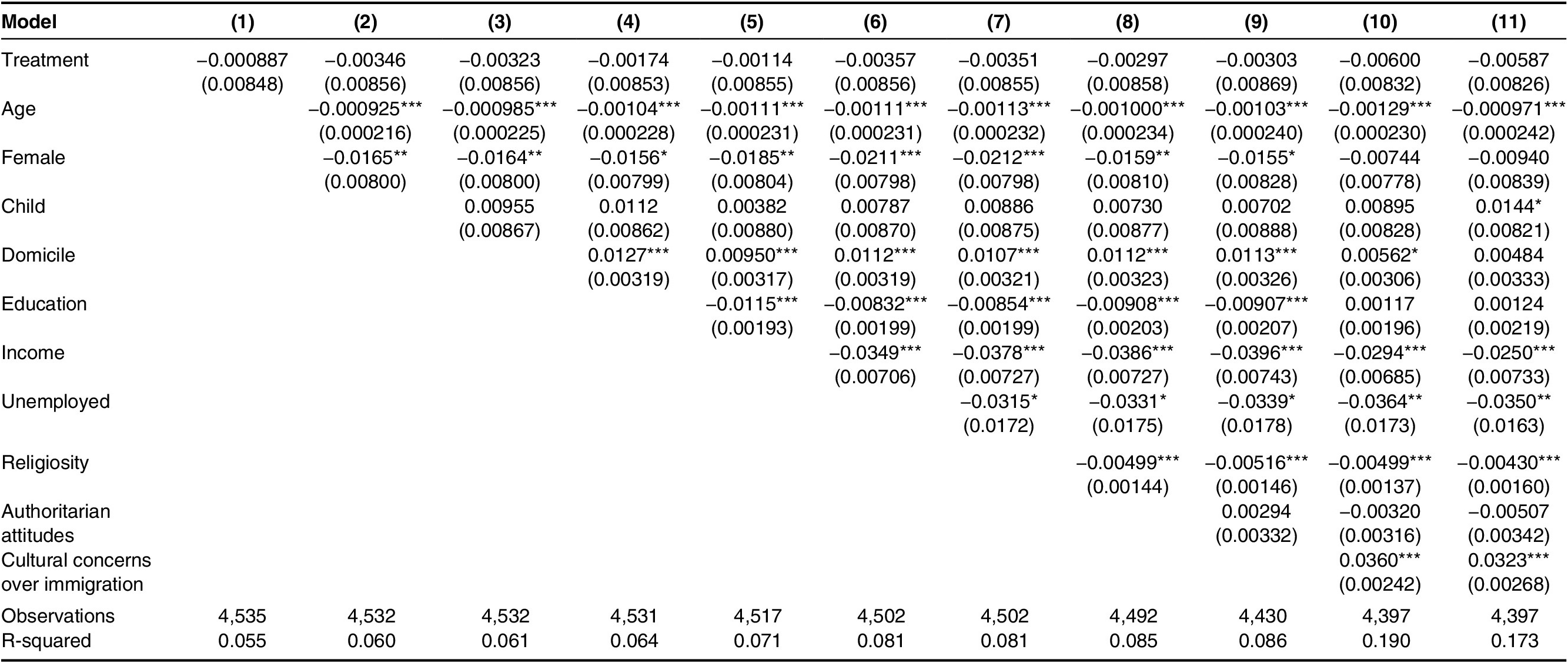
Note: Robust standard errors in parentheses and design weights applied; *** p<0.01, ** p<0.05, * p<0.1. Country fixed effects and constant included (but not shown) and rerunning the analyses without these country effects does not change results, nor does changing the standard errors (see Appendix Table A2.1).
Moreover, rerunning the analysis while adding a quadratic age term does not change the null result. The results suggest that employed individuals who are struggling on their income, rather than the unemployed, are more likely to express a preference for the far right. In models 8 to 11, we include more subjective controls for religiosity, authoritarian attitudes, and cultural concerns over immigration. As we are testing three hypotheses, note that Bonferroni corrections do not change the null result since it further lowers the threshold for statistical significance. In online appendix section A8, we explore whether our results are affected by issues of statistical power.
Robustness Checks
To ensure the validity of our results we carry out an extensive number of robustness checks that we summarise in table 4. First, we show that the results are not dependent on whether controls, country fixed effects or design weights are included (refer to online appendix table A2.1, models 1 to 5). Second, applying entropy weighting to ensure that the distributions of relevant characteristics of individuals before the terrorist attack matches the distribution after the attack does not change the results (model 6 in online appendix table A2.1). Third, model 7 then reports results with robust standard errors. Fourth, model 8 shows results with robust standard errors clustered by country. However, these are typically argued to be excessively unforgiving with a small number of clusters. Thus, fifth, in model 9, we use instead the pairs cluster bootstrap-t procedure, in which the t-statistics and 95% confidence intervals are robust to clustering with a small number of sampling units. In model 10, we then use the clustered adjusted test procedure which runs the model in each of 4 clusters and then conducts Wald tests against null hypotheses. Sixth, to lend further credibility to our causal estimates and to account for the possibility that simultaneous events may be affecting our outcome, or that the average effect may be “watered down” by those whose responses are too far from the event, we rerun the analysis while changing the bandwidth to 10, 20, 30, and 40 days before/after terrorist attacks in each country, as well as 7, 14, and 21 days before/after the terrorist attacks in the whole sample (online appendix table A3.9). We also run placebo tests by changing the precise day of attacks. These robustness checks confirm there is no statistically significant effect (refer to online appendix section A3).
Robustness check summary

Note: this summary table is based on results presented in the results section and in the online appendix.
Moreover, using a logistic regression or a penalized maximum likelihood logistic regression analysis does not change the results (models 1 and 2 in online appendix table A2.2). It might also be inappropriate to collapse self-reported proximity to any other political party in the 0 category. We therefore rerun the analysis using a multinomial logistic regression distinguishing between far right, centre-right, centre-left, and far left. We find no statistically significant effect on any party family in models 3 to 5 in online appendix table A2.2. In appendix table A2.3, we then explore the possibility that terrorist attacks have an effect on support for the incumbent. We find no support for an incumbent effect. Next, it might be argued that both the attacks and the country context vary substantially. We address this to some extent by including country fixed effects; rerunning the analysis for each country separately does not change this null finding either (online appendix A3). Throughout, the effect of the terrorist attack treatment remains statistically insignificant. In sum, we find robust evidence for a null effect of terrorist attacks using different estimation methods, operationalisation of the dependent variable, control inclusion, fixed effects, weights, and error structures.
Finally, we rerun our analysis using a completely different cross-national dataset which combines several Eurobarometer surveys (see Böhmelt, Bove, and Nussio Reference Böhmelt, Bove and Nussio2020; Nussio, Böhmelt, and Bove Reference Nussio, Böhmelt and Bove2021). This dataset comprises information on public opinion and Jihadist terrorist attacks that have taken place in Europe and, similarly to our own ESS dataset, it allows us to contrast the responses of individuals surveyed before and after each attack. However, it covers a much larger sample of respondents and a broader range of attacks than the ones we examine with our ESS dataset including, for example, in London (2013), Paris and Saint Denis (2015), Manchester (2017), Carcassonne (2018), and Utrecht (2019). Replicating our analysis using this dataset allows us to test the potential effect of terrorist attacks on far-right preferences in different cases during different time periods and with a much larger number of observations. We focus on all the Islamist terrorist attacks that took place in European countries identified in this dataset (refer to online appendix table A6.1) but run our analysis on left-right self-placement as the dependent variable.
This analysis provides us with an additional test of whether terrorist attacks affect partisan preferences. In line with the analysis of our own dataset, the analysis of this different dataset shows there is no statistically significant effect of terrorist attacks on political preferences in Europe. Rerunning the analysis for each country separately and varying the time window yields similar results. More details about the data, empirical approach, as well as several robustness checks are presented in online appendix A6. This increases our confidence that the null result yielded in our primary analysis using ESS data is not likely to be driven by insufficient statistical power (refer to online appendix section A8).
Exploring the Prejudice and Trust Mechanisms
We proceed to uncover the mechanisms and heterogeneity behind this null result. First, we examine certain individual attitudes that may be indirectly linking Jihadist terrorist attacks to far-right preferences, to account for the possibility that the anti-immigration and trust dimensions in our conceptual framework may be cancelling each other out. We do so by examining the effect of the treatment on different proxies of prejudice, captured by negative attitudes towards immigrants and refugees, and trust, which we measure with trust in institutions and political actors.
Table 5 reports no effect on cultural concerns over immigration, but Jihadist terrorism is associated with lower support for the claim that immigrants make the country a better place to live. Jihadist terrorism also makes it more likely that respondents disagree with the claim that government should be generous when judging applications for refugee status. Thus, there is some evidence that Jihadist terrorism does increase anti-immigration and anti-refugee attitudes. Note that this result holds even when using Bonferroni adjustments for multiple hypothesis testing.
The effect of terrorist attacks (treatment) on out-group attitudes

Note: Robust standard errors in parentheses and design weights applied; *** p<0.01, ** p<0.05, * p<0.1. Country fixed effects and constant included but not shown. Question about refugee status in model (3) only has information about France and Germany.
Regarding trust, we find no evidence for an effect on support for the party in power and we explore in table 6 the effect of Jihadist terrorist attacks on trust in politicians, political parties, parliament, and the judiciary. The coefficient is positive in all cases, but statistically significant only in the case of trust in parliament. Next, Jihadist terrorist attacks are also associated with greater levels of government satisfaction. As with the case of immigration attitudes, these results hold when using Bonferroni adjustments for multiple hypothesis testing. In online appendix section A4, we show that the effect of attacks on these attitudes mostly materialise in the medium to long terms.
The effect of terrorist attacks (treatment) on trust

Note: Robust standard errors in parentheses and design weights applied; *** p<0.01, ** p<0.05, * p<0.1. Country fixed effects and constant included but not shown.
In online appendix A3, we check whether these results are dependent on country fixed effects, design or entropy weights, the inclusion of controls, and robust and small cluster errors. The effect of terrorist attacks is statistically significant and positive for all specifications for the cases where the dependent variables are anti-refugee attitudes, trust in legislative institutions, and satisfaction with government. By contrast, the results are not stable for the dependent variables capturing immigration attitudes, trust in politicians, and parties. In summary, our analysis provides some support for the claim that terrorist attacks increase both anti-immigration attitudes, which would lead to higher support for far right, and trust in institutions and satisfaction with government, which would deter individuals from the far right while potentially benefiting other political parties.
Heterogeneity Analysis
In this section, we examine two forms of heterogeneity: geographical and individual. First, with respect to the former, online appendix table A2.4 identifies regional proximity to the attack. We create a variable that is coded to distinguish between respondents living in the area where the attack took place (the regional proximity variable is coded 1), those in locations that were in neighbouring regions (the regional proximity variable is coded 0.5) and respondents living elsewhere further away (the regional proximity variable is coded 0). We then rerun our analysis while interacting our treatment with this regional proximity variable capturing closeness of respondents to the attack. Next, we calculate the marginal effect of the Treatment for different levels of geographical proximity and show the results in online appendix figures A2.5 and A2.6. There appears to be no significant heterogeneity by geographical proximity.
Second, we explore the possibility that different individuals react to Jihadist terrorist attacks in opposing ways, thereby leading to a null average effect. We carry out heterogeneity analysis by interacting the treatment with a range of individual characteristics and then plotting the conditional marginal effects (with 95% confidence intervals) for different variables: age, gender, education, unemployment, subjective income, and rural-urban domicile. The results are mixed in terms of statistical significance and in some cases counterintuitive. Individuals with characteristics typically associated with the far right, such as the unemployed, are deterred by terrorist attacks, whereas certain “unlikely” supporter individuals, such as those with a tertiary education, appear to be drawn closer to far-right parties (for detailed results refer to online appendix figures A5.1-A5.6). Overall, this analysis suggests that our null result may be concealing a degree of heterogeneity in the effect of the terrorist attack treatment on far-right party preferences of different individuals (cf. other literature that reports null results such as Schaub, Gereke, and Baldassarri Reference Max, Gereke and Delia Baldassarri2021).
Conclusion
This article empirically assesses the extent to which Jihadist terrorist attacks benefit the far right. Using the “unexpected event during survey design” identification strategy, we match individual-level data from the ESS to data on terrorist attacks to compare respondents’ party preferences before and after a terrorist attack in the Netherlands, Sweden, France, and Germany. While Jihadist terrorism is often seen as an opportunity for far-right parties to capitalise on anti-immigrant and Islamophobic narratives, we find no statistically significant effect of Jihadist terrorist attacks on self-declared proximity to the far right. We do find some evidence supporting the prejudice and trust mechanisms, entailing the possibility that the two dimensions may be cancelling each other out as well as some evidence that our null result may be concealing a degree of heterogeneity in the effect of the terrorist attack treatment on far-right party preferences of different individuals.
We take several steps to ensure that our argument is both theoretically and empirically convincing. In terms of theory, we succinctly conceptualise possible hypotheses in a unified theoretical framework that synthesises work on terrorism and political attitudes that either focuses on trust or anti-immigrant/racist prejudice. Because our theoretical framework identifies different possible scenarios, it allows us to show that a “no effect” finding is theoretically possible. In terms of our empirical analysis, we are confident about the validity of our findings for two reasons. First, while our data is not without its limitations—notably the group of far-right respondents is small in our dataset and we cannot fully rule out issues of low statistical power—we test our results across a very broad range of different models, restrictions and specifications yielding similar results. Second, we replicate our findings using completely different data from a much larger dataset combining several Eurobarometer surveys and again find null results.
This article contributes to our understanding of how shock events might impact domestic politics and opens several avenues for future research. First, we have provided strong empirical evidence that in the Western European context, Jihadist terrorist attacks are unlikely to decisively change party support, despite potential changes in political attitudes (Balcells and Torrats-Espinosa Reference Balcells and Torrats-Espinosa2018; Baccini et al. Reference Baccini, Brodeur, Nossek and Shor2021). The absence of a direct causal link between terrorist attacks and far-right party preferences in our sample challenges the idea that Jihadist terrorism fuels right-wing extremism in the European context and highlights significant variation between European and non-European countries (see e.g., Berrebi and Klorr Reference Berrebi and Klor2008; Kibris Reference Kibris2011; Getmansky and Zeitzoff Reference Getmansky and Zeitzoff2014; Aytaç and Çarkoğlu Reference Aytaç and Çarkoğlu2021). This suggests that European and non-European cases may not be directly comparable because of important contextual differences. For example, in Western Europe, Jihadist terrorist attacks are perceived as instigated by foreign groups even if the perpetrators are homegrown militants, and are not caused by domestic armed conflicts as is the case in countries such as Turkey and Israel.
This opens new questions about the spatial dimension of the political impact of Jihadist terrorism, i.e., the circumstances under which shock events might be affecting political behaviour differently in different regions. Future work could further disentangle these dynamics by examining the ways in which supply-side factors, such as issue salience, the adoption of accommodative strategies and party competition, as well as historical trajectories, condition the relationship between shock events and changing party support. Our focus on cases that did not have a far-right incumbent limits the generalisability of our argument. It is indeed plausible that our findings do not apply to cases that have far-right parties in government when terrorist attacks take place. Future research could examine the extent to which our results are transferable to such cases and identify how incumbent effects impact on far-right preferences in these circumstances.
Second, the null relationship between Jihadist terrorist attacks and far-right preferences prompted us to carry out further analyses of the mechanisms that may be behind this result. As noted earlier, we know from our analyses that while attitudinal changes do occur in the aftermath of Jihadist terrorist attacks, these barely translate into party preferences. A number of factors, alone or in combination, could be driving this. For example, the prejudice and trust mechanisms may be cancelling each other. The same may apply for individual-level heterogeneity, which may be cancelling out each result. We indeed find some evidence for both possibilities. Finally, although the extensive robustness checks we have carried out, as well as the replication of our analysis with Eurobarometer data, largely confirm our results, it is possible that the null effect is at least partly driven by the small number of far-right respondents in our sample. Future research could use new data to delve into these dynamics in greater depth. For example, it is plausible that some individuals are galvanised by terrorist attacks, while others are simultaneously deterred. While there may not be an average population-wide effect, there may be a composition effect resulting in changes in the make-up of the pool of people who feel close to the far right. In the longer run, this might lead to changes in party positions. To fully understand these complex relationships between terrorist attacks, attitudes, and party preferences, future research should focus more on these composition effects, the motives that drive different social groups closer to far-right parties, and whether the effects of terrorist attacks are resilient over time or instead ebb away after the initial shock.
Third, our article responds to recommendations for visible reporting of nonsignificant results (e.g., Abadie Reference Abadie2020) and illustrates how these may advance debates in the social sciences. While this practice has increased in recent years, there remains an overall publication imbalance in favour of statistically significant effects, resulting in a selective reporting of scientific findings (Gerber and Malhotra Reference Gerber and Malhotra2008; Franco, Malhotra, and Simonovits Reference Franco, Malhotra and Simonovits2014). The visible reporting of null results can help avoid confirmation bias and challenge deeply rooted assumptions about certain phenomena, prompting researchers to delve into more complex—and not initially directly visible—dynamics (e.g. Schaub, Gereke, and Baldassarri Reference Max, Gereke and Delia Baldassarri2021). In this case, our findings contribute to the understanding of the ways in which citizens behave politically in the aftermath of Jihadist terrorist attacks in Western Europe. This is important, particularly in the context of a far-right populist hype, as the dissemination of research impacts not only academia but also the policy world (Godefroidt Reference Godefroidt2022). Far-right parties attempt to capitalise on terrorist attacks using perceived shifts in political preferences as justification for their exclusionist platforms. In turn, centre-right parties often adopt co-optation strategies on the basis of similar perceptions about public preferences and the ensuing need to “re-capture” this electorate from the far right. If we are right, at least in Europe, their bids are exaggerated. Indeed, responses to Jihadist terrorist attacks may be limited in size and duration offering less fertile ground for far-right mobilisation than is often assumed.
Supplementary Material
To view supplementary material for this article, please visit http://doi.org/10.1017/S1537592723002980.
Acknowledgements
The authors received valuable feedback from Christian von Soest and the participants of the “Voters, Populism and Far Right Parties” panel at the APSA 2020 annual conference; Ronja Sczepanski and the participants of the “Elections” panel at the Swiss Political Science Association 2021 annual conference; and the participants of the “Populism, Terror and Security” panel of the Council for European Studies 2021 annual conference. They are especially grateful to Ekkehard Ernst, Margaryta Klymak, and Christoph Arndt for their advice and extensive comments on previous versions. They would like to further thank Marco Giani for sharing his dataset and providing extensive and insightful comments during the initial stages of this research project, and Tobias Böhmelt for sharing the Eurobarometer dataset—and replication code—developed in his research with Enzo Nuzio and Vincenzo Bove. Finally, they are grateful to the three anonymous reviewers of Perspectives on Politics for their extremely helpful and constructive comments that helped improve this article significantly, as well as the previous editor Michael Bernhard, and current editors Ana Arjona and Wendy Pearlman for a very smooth and constructive review process.


 Open access

