



1 INTRODUCTION
Supermassive black holes (SMBHs) reside in the centres of massive galaxies (e.g. Kormendy & Ho Reference Kormendy and Ho2013), and the presence of quasars at the highest redshifts (e.g. Willott et al. Reference Willott2003; Fan et al. Reference Fan2006; Mortlock Reference Mortlock2011; Venemans et al. Reference Venemans2013) powered by some of the most massive black holes (BHs) (e.g. Wu et al. Reference Wu2015) suggests that this has been the case since the dawn of galaxy formation. It is a subject of intense research how these BHs initially formed and subsequently grew so rapidly (see previous reviews by e.g. Volonteri Reference Volonteri2010, Reference Volonteri2012; Volonteri & Bellovary Reference Volonteri and Bellovary2012; and Alexander & Hickox Reference Alexander and Hickox2012; Haiman Reference Haiman2013).
The formation of the first massive BHs begins with the collapse of the primordial gas to form their stellar progenitors. Depending on the environment in which these progenitors form, the mass scale of the seed BHs they leave behind can vary wildly, from ~ 10 to ~ 105 M⊙. In turn, the rate at which these BHs initially grow is determined by their initial masses and the conditions of the gas reservoirs from which they accrete. While most BHs which form in the early universe are expected to grow at relatively modest rates, a small fraction may grow extremely rapidly, either due to their large initial masses and or to accretion flows which are heavy enough to stymie the radiation emitted in the accretion process. The final fates of the first massive BHs are dictated by the availability of gas to accrete on cosmological scales and by the impact of the merging and coalescence of these BHs with one another.
Here, we review recent theoretical exploration of these processes, from the formation of the first massive seed BHs, to the early stages of their growth and how they meet their fates as the supermassive BHs powering high-redshift quasars.
2 INITIAL FORMATION OF THE FIRST MASSIVE BLACK HOLES
We begin by discussing the factors determining the masses to which primordial stars grow prior to their collapse into the first massive BHs. We consider first the impact of the environment on the growth of the first stars. We then discuss the processes which determine their final masses.
2.1. Impact of external sources of radiation
The first stars form from the collapse of the primordial gas, a process which is facilitated by the radiative cooling of both atomic and molecular hydrogen (H2) (e.g. Bromm & Larson Reference Bromm and Larson2004; Greif Reference Greif2015). Which of these two species of hydrogen dominates the cooling rate largely dictates the mode of star formation and the masses of the stars which form.
If molecular hydrogen forms in sufficient abundance, the primordial gas is expected to cool to ~ 100 K and to collapse into protostars which accrete at rates of 10−4–10−3 M⊙ yr−1 (e.g. Yoshida, Omukai, & Hernquist Reference Yoshida, Omukai and Hernquist2008). At these accretion rates, the typical final masses of the stars which form are likely between ~ 10 and ~ 103 M⊙ (e.g. Hirano et al. Reference Hirano2014). The outcome of the evolution of a large fraction of these stars is expected to be the formation of a BH with a mass approaching that of the star itself (e.g. Heger et al. Reference Heger2003).
If by some means H2 formation is suppressed, then atomic hydrogen is left as the principle coolant. In this case, the gas cools only to ~ 104 K and is expected to collapse at extremely high rates of up to ~ 1 M⊙ yr−1 into a supermassive star (SMS), as shown in Figure 1 (e.g. Koushiappas, Bullock, & Dekel Reference Koushiappas, Bullock and Dekel2004; Lodato & Natarajan Reference Lodato and Natarajan2006; Wise, Turk, & Abel Reference Wise, Turk and Abel2008; Choi, Shlosman, & Begelman Reference Choi, Shlosman and Begelman2013, Reference Choi, Shlosman and Begelman2015). The typical final masses of such SMSs are expected to be ~ 105 M⊙, orders of magnitude larger than primordial stars formed from gas cooled by molecular hydrogen (e.g. Latif et al. Reference Latif, Schleicher, Schmidt and Niemeyer2013). The typical final outcome of the evolution of such massive objects is the formation of a BH with a mass which is a significant fraction of the SMS itself (e.g. Shibata & Shapiro Reference Shibata and Shapiro2002; Begelman Reference Begelman2010; Ball et al. Reference Ball, Tout, Zytkow and Eldridge2011; Fryer & Heger Reference Fryer and Heger2011), although in some cases, it may be much lower due to winds that are generated during the collapse of the star (e.g. Dotan, Rossi, & Shaviv Reference Dotan, Rossi and Shaviv2011; Fiacconi & Rossi Reference Fiacconi and Rossi2016).
The projected gas density in halos hosting one (top row) and two (bottom row) rapidly growing primordial protostars, along the three axes in a cosmological simulation, as labelled. At the early stages of accretion shown here, the objects have masses a few times that of the Sun, but they are expected to grow rapidly to become ⩾ 104 M⊙ supermassive stars within a few million years. From Latif, Schleicher, & Hartwig (Reference Latif, Schleicher and Hartwig2015).

While it is possible that a variety of processes can lead to the suppression of gas cooling and, in turn, to the formation of SMSs (e.g. Sethi, Haiman, & Pandey Reference Sethi, Haiman and Pandey2010; Inayoshi & Omukai Reference Inayoshi and Omukai2012; Tanaka & Li Reference Tanaka and Li2014; Inayoshi, Visbal, & Kashiyama Reference Inayoshi, Visbal and Kashiyama2015a), the process which is perhaps most likely to play a decisive role is the destruction of H2 molecules by intense ultraviolet radiation which is absorbed in the Lyman–Werner (LW) bands of the molecule (e.g. Haiman Reference Haiman2013; Fernandez et al. Reference Fernandez, Bryan, Haiman and Li2014; Visbal, Haiman, & Bryan Reference Visbal, Haiman and Bryan2014a; Latif, Niemery, & Schleicher Reference Latif, Niemery and Schleicher2014). For H2 cooling to be effectively suppressed, however, requires extraordinarily intense LW radiation (e.g. Bromm & Loeb Reference Bromm and Loeb2003). This suggests that SMS formation occurs only in relatively rare regions of the early universe, in pristine dark matter (DM) halos that are nearby galaxies which harbour stars producing sufficient LW radiation (e.g. Dijkstra et al. Reference Dijkstra, Haiman, Mesinger and Wyithe2008, Dijkstra, Ferrara, & Mesinger Reference Dijkstra, Ferrara and Mesinger2014; Agarwal et al. Reference Agarwal, Khochfar, Johnson, Neistein, Dalla Vecchia and Livio2012; Visbal, Haiman, & Bryan Reference Visbal, Haiman and Bryan2014b; but see Petri, Ferrara, & Salvaterra Reference Petri, Ferrara and Salvaterra2012).
Estimates of the number density of SMSs, and of the seed BHs into which they collapse, are difficult to make, due to the sensitivity of the required level of LW radiation to the state of the collapsing gas (e.g. Wolcott-Green, Haiman, & Bryan Reference Wolcott-Green, Haiman and Bryan2011; Hartwig et al. Reference Hartwig2015a) and to uncertainties in the rates of key chemical reactions (e.g. Glover Reference Glover2015). In addition, as H2 molecules typically form from H− and H2 + ions, there is a strong sensitivity as well to the shape of the stellar spectrum producing the LW radiation, as these ions can be destroyed by lower senergy photons (e.g. Shang, Bryan, & Haiman Reference Shang, Bryan and Haiman2010; Sugimura, Omukai, & Inoue Reference Sugimura, Omukai and Inoue2014; Sugimura et al. Reference Sugimura, Coppola, Omukai, Galli and Palla2015; Agarwal & Khochfar Reference Agarwal and Khochfar2015; Latif et al. Reference Latif2015). Also, the same galaxies which produce LW radiation may also be sources of X-rays, which can penetrate deeply into collapsing halos and ionise the gas, leading to enhanced H2 formation rates (e.g. Machacek, Bryan, & Abel Reference Machacek, Bryan and Abel2003; Glover & Brand Reference Glover and Brand2003) and, in turn, to suppression of SMS formation (e.g. Inayoshi & Omukai Reference Inayoshi and Omukai2011; Inayoshi & Tanaka Reference Inayoshi and Tanaka2015). Finally, even ionising radiation, at energies only slightly higher than LW radiation, can heat and ionise the gas at early phases in the collapse, leading to further suppression of SMS formation (e.g. Johnson et al. Reference Johnson, Whalen, Agarwal, Paardekooper and Khochfar2014; Yue et al. Reference Yue, Ferrara, Salvaterra, Xu and Chen2014; Regan, Johansson, & Wise Reference Regan, Johansson and Wise2015).
It is worth noting that, while the impact of radiation on the prevalence of SMSs is complex, even moderate levels of LW radiation can lead to enhancements in the masses of primordial stars which collapse into seed BHs (e.g. O’Shea & Norman Reference O’Shea and Norman2007; Xu, Wise, & Norman Reference Xu, Wise and Norman2013; Latif et al. Reference Latif2014; Hirano et al. Reference Hirano2015). Next, we turn to discuss other factors which determine the final masses of BH progenitors in the early universe.
2.2. Expected mass scale of black hole progenitors
The expected initial masses of the first seed BHs are determined largely by the masses to which their progenitor stars grow during their brief lifetimes. In turn, a number of processes can dictate how large these progenitors grow, depending on the environment in which they form.
The initial mass function of primordial stars formed from gas cooled by H2 in DM minihalos is likely set at the smallest mass scales by the ejection of sub-solar protostars by gravitational interactions, and at the largest scales by radiative feedback from the stars themselves which eventually halts their accretion of gas (see e.g. Bromm Reference Bromm2013; Greif Reference Greif2015). Recent radiation hydrodynamics simulations with cosmological initial conditions suggest that the upper end of the initial mass function extends up to ~ 103 M⊙ (Susa, Hasegawa, & Tominaga Reference Susa, Hasegawa and Tominaga2014; Hirano et al. Reference Hirano2014, Reference Hirano2015). Such massive primordial stars are expected to collapse to seed BHs with similar masses (e.g. Madau & Rees Reference Madau and Rees2001; Schneider et al. Reference Schneider, Ferrara, Natarajan and Omukai2002; Heger et al. Reference Heger2003; see also Islam, Taylor, & Silk Reference Islam, Taylor and Silk2003).
If the first generations of stars form in tightly bound clusters, it is possible that mergers may drive the most massive stars to masses in excess of 103 M⊙ (e.g. Portegies Zwart et al. Reference Zwart2004; Devecchi & Volonteri Reference Devecchi and Volonteri2009; Davies, Miller, & Bellovary Reference Davies, Miller and Bellovary2011; Katz, Sijacki, & Haehnelt Reference Katz, Sijacki and Haehnelt2015). This avenue of BH formation from slightly metal-enriched star clusters (e.g. Lupi et al. Reference Lupi, Colpi, Devecchi, Galanti and Volonteri2014) can also produce seeds which may subsequently grow to larger, supermassive scales (e.g. Devecchi et al. Reference Devecchi2012; Yajima & Khochfar Reference Yajima and Khochfar2016).
The expected mass scale of much more massive SMSs formed from accretion of atomically cooled primordial gas is likely set either by their limited lifetimes (e.g. Begelman Reference Begelman2010; Johnson et al. Reference Johnson, Whalen, Fryer and Li2012) or by the depletion of the gas reservoirs from which they accrete (e.g. Schleicher et al. Reference Schleicher, Palla, Ferrara, Galli and Latif2013). The radiative feedback from these objects is expected to be relatively weak, owing to the low temperatures of the bloated outer envelopes characteristic of such rapidly accreting objects (e.g. Hosokawa, Omukai, & Yorke Reference Hosokawa, Omukai and Yorke2012, Reference Hosokawa, Yorke, Inayoshi, Omukai and Yoshida2013; Begelman Reference Begelman2012). Even under intermittent high accretion rates, as expected due to accretion from a clumpy disk (e.g. Inayoshi & Haiman Reference Inayoshi and Haiman2014; Latif & Volonteri Reference Latif and Volonteri2015; Sakurai Reference Sakurai2015a; Luo, Nagamine, & Shlosman Reference Luo, Nagamine and Shlosman2015), rapid gas infall appears to drive the expansion of the star episodically, limiting the emission of ionising photons, as shown in Figure 2 (Sakurai et al. Reference Sakurai, Hosokawa, Yoshida and Yorke2015b). Likewise, high accretion rates are likely to be realised even in highly turbulent atomically cooled collapsing gas (e.g. Prieto, Jimenez, & Haiman Reference Haiman2013; Van Borm et al. Reference Van Borm2014). Once the conditions are met for the formation of a SMS, it thus appears there is little to limit its growth to a characteristic mass scale of at least ~ 105. The fate of most such massive objects is to collapse to a BH with a similarly large mass, although a large fraction of its mass may instead be lost if sufficiently large accretion rates persist up until its collapse (e.g. Begelman, Volonteri, & Rees Reference Begelman, Volonteri and Rees2006; Dotan et al. Reference Dotan, Rossi and Shaviv2011; Schleicher et al. Reference Schleicher, Palla, Ferrara, Galli and Latif2013).
The properties of a growing supermassive star, as functions of time, for two different assigned time-varying accretion rates (shown by red and blue lines). During periods of slow accretion, the stellar radius shrinks, the emitting surface becomes hotter, and the rate of ionising photon emission increases. However, the impact of the ionising radiation on the accretion flow is not sufficient to stop the growth of the star. From Sakurai et al. (Reference Sakurai, Hosokawa, Yoshida and Yorke2015b).

An avenue for the formation of even more massive seed BHs, with initial masses up to 108–109 M⊙, has been suggested to be rapid gas inflow into the centre of rare, Milky Way-sized galaxies triggered by gas-rich mergers at high redshift (Mayer et al. Reference Mayer, Kazantzidis, Escala and Callegari2010; Bonoli, Mayer, & Callegari Reference Bonoli, Mayer and Callegari2014; Mayer et al. Reference Mayer2015). While the nature of the initial conditions in this scenario is more complex than those based on the collapse of primordial gas in less massive DM halos, and may involve complications such as the pre-existence of BHs in the centres of the merging galaxies, somewhat idealised simulations suggest that heavy, optically thick accretion flows may well lead to the formation of such massive central objects (Mayer et al. Reference Mayer2015; see also Ferrara, Haardt, & Salvaterra Reference Ferrara, Haardt and Salvaterra2013).
3 INITIAL GROWTH OF SEED BLACK HOLES
The rate at which seed BHs grow, immediately following their formation, is dictated both by the mechanical and radiative feedback from their progenitor stars and by the impact of the radiation produced in the accretion process itself. Here, we discuss these processes and the basic expectations for the early growth of BH seeds.
3.1. Impact of radiation emitted from the progenitor
BH progenitors being massive stars with large luminosities, in many cases, the radiation they emit dramatically alters their surroundings. In turn, as it is from these surroundings that the nascent BHs accrete, the radiation from progenitor stars can play a key role in determining how quickly the first BHs grow.
Massive primordial stars formed from H2-cooled gas in minihalos are expected to produce copious amounts of ionising radiation for at least 1–2 Myr before their collapse (e.g. Schaerer Reference Schaerer2002). The gas surrounding them is therefore heated to well above the virial temperature of their host DM halos, and a large, low-density H II region is left when the star collapses (e.g. Kitayama et al. Reference Kitayama, Yoshida, Susa and Umemura2004; Whalen, Abel, & Norman Reference Whalen, Abel and Norman2004; Alvarez, Bromm, & Shapiro Reference Alvarez, Bromm and Shapiro2006; Abel, Wise, & Bryan Reference Abel, Wise and Bryan2007). Such BHs are thus expected to be born into very low-density environments, from which gas accretion is exceedingly slow, leading to a significant delay of perhaps up to ~ 100 Myr in the growth of these seeds (Johnson & Bromm Reference Johnson and Bromm2007; Alvarez, Wise, & Abel Reference Alvarez, Wise and Abel2009; Johnson et al. 2013).
In contrast, the radiative feedback from SMSs is likely to be much weaker, due to their cool surfaces from which little ionising radiation is emitted (e.g. Hosokawa et al. Reference Hosokawa, Yorke, Inayoshi, Omukai and Yoshida2013; Schleicher et al. Reference Schleicher, Palla, Ferrara, Galli and Latif2013; Sakurai Reference Sakurai2015a; Sakurai et al. Reference Sakurai, Hosokawa, Yoshida and Yorke2015b). This is likely to result in a large reservoir of dense gas from which such a so-called direct collapse black hole (DCBH) can accrete. Cosmological simulations of this process suggest that Eddington-limited accretion is possible starting from the formation of the DCBH (Johnson et al. Reference Johnson, Khochfar, Greif and Durier2011; Aykutalp et al. Reference Aykutalp, Wise, Meijerink and Spaans2014), and more idealised models of the accretion flow at smaller scales near the DCBH suggest that even higher rates of growth are attainable (e.g. Pacucci & Ferrara Reference Pacucci and Ferrara2015; Inayoshi, Haiman, & Ostriker Reference Inayoshi, Haiman and Ostriker2015b). Thus, not only do SMSs produce large initial BH seeds, these seeds are also likely to grow rapidly starting from birth.
3.2. Impact of progenitor explosion
The supernovae (SNe) which mark the end of life of many massive primordial stars dramatically impact their surroundings, blowing out the gas from the centres of their host DM halos, thereby limiting the gas reservoir available for accretion onto any seed BHs that are left behind.
Primordial stars with masses of 140–260 M⊙ are expected to explode as pair-instability SNe, with energies of ~ 1053 erg (e.g. Heger et al. Reference Heger2003). Such energetic explosions can easily evacuate the gas from the centres of DM minihalos (e.g. Greif et al. Reference Greif, Johnson, Bromm and Klessen2007; Vasiliev, Vorobyov, & Shchekinov Reference Vasiliev, Vorobyov and Shchekinov2008; Wise & Abel Reference Wise and Abel2008). While such SNe leave behind no BH remnant, it is likely that primordial stars in this environment form in clusters (e.g. Greif Reference Greif2015) and such strong mechanical feedback can leave the BH remnants of other stars to accrete from low-density gas, resulting in very slow growth. Lower mass primordial stars may also explode as less energetic SNe, which may or may not effectively evacuate their host minihalos of gas for long periods, depending on the energy of the explosion and on the mass of the minihalo (Kitayama & Yoshida Reference Kitayama and Yoshida2005; Whalen et al. Reference Whalen, van Veelen, O’Shea and Norman2008; and Ritter et al. Reference Ritter2012). Indeed, it is expected that a large fraction of primordial SNe may leave behind a remnant BH, which may accrete gas that is not evacuated in the explosion, although some fraction of these BHs may be relegated to the low-density intergalactic medium (IGM) due to natal kicks imparted to them in assymetric SNe (Whalen & Fryer Reference Whalen and Fryer2012).
It is also a possibility that some SMS explode in extremely energetic SNe (e.g. Montero, Janka, & Müller Reference Montero, Janka and Müller2012; Chen et al. Reference Chen2014). While these violent events may not leave behind a remnant BH, it is possible that some SMSs form in binary systems (Regan & Haehnelt Reference Regan and Haehnelt2009; Reisswig et al. Reference Reisswig2013; Whalen et al. Reference Whalen2013c; Latif, Schleicher, & Hartwig Reference Latif, Schleicher and Hartwig2015; Becerra et al. Reference Becerra, Greif, Springel and Hernquist2015) and accretion onto a BH formed from the collapse of a companion SMS would likely be strongly inhibited due to the evacuation of high-density gas from the centre of the host halo (Johnson et al. Reference Johnson2013b; Whalen et al. Reference Johnson, Whalen, Li and Holz2013a,b). Finally, if a relativistic jet is launched from the centre of a collapsing SMS, perhaps powering a gamma-ray burst, it could also drive out the surrounding gas, resulting in a similar suppression of accretion onto the DCBH that is left behind (Matsumoto et al. Reference Matsumoto, Nakauchi, Ioka, Heger and Nakamura2015).
3.3. Impact of radiation emitted in the accretion process
The interaction between the accretion flow onto a BH and the radiation emitted in the accretion process is highly complex, and is sensitive to the initial conditions of the flow as well as to physical effects on both small scales near the BH and larger scales where the flow originates.
In cases where a seed BH is accreting from a relatively low-density medium, such as occurs when the radiative and/or mechanical feedback from the progenitor effectively clears out the gas, the high-energy radiation that is generated in the accretion disk can travel large distances (e.g. Kuhlen & Madau Reference Kuhlen and Madau2005), heating and expelling the gas. This can result in a dramatic suppression of accretion onto the BH seeds left by primordial stars formed in DM minihalos (e.g. Alvarez et al. Reference Alvarez, Wise and Abel2009), and can be exacerbated if there is additional radiative feedback from X-ray binaries (e.g. Mirabel et al. Reference Mirabel2011; Fragos et al. Reference Fragos2013; Jeon et al. Reference Jeon, Pawlik, Bromm and Milosavljević2014; Xu et al. Reference Xu2014; Chen et al. Reference Chen, Bromm, Heger, Jeon and Woosley2015; Ryu, Tanaka, & Perna Reference Ryu, Tanaka and Perna2015), as shown in Figure 3.
Accretion rates of BHs in simulations with (top) and without (below) radiative feedback from high-mass X-ray binaries. In conjunction with the radiative feedback from their stellar progenitors, the impact of this X-ray feedback is to dramatically limit the accretion of gas onto BHs formed from primordial stars in minihalos. From Jeon et al. (Reference Jeon, Pawlik, Bromm and Milosavljević2014).

In cases where a seed BH is accreting from relatively dense gas, as is expected to occur for DCBHs born in dense regions little affected by feedback from the progenitor SMS, growth via accretion is much more rapid. Cosmological simulations resolving the Bondi radius of DCBHs and including ionising radiation (Johnson et al. Reference Johnson, Khochfar, Greif and Durier2011) and X-ray (Aykutalp et al. Reference Aykutalp, Wise, Meijerink and Spaans2014) feedback, suggest that the accretion rate may at times peak near the Eddington rate, although it is on average well below this value. Similar periodic behaviour is found in more idealised calculations which resolve smaller scales near the BH, as well (e.g. Milosavljević et al. Reference Milosavljević, Bromm, Couch and Oh2009; Park & Ricotti Reference Park and Ricotti2011, Reference Park and Ricotti2012). While this suggests that accretion onto DCBHs may occur at, on average, somewhat sub-Eddington rates, if accretion proceeds from sufficiently dense gas then radiation from the accretion disk can be stymied and the accretion rate may exceed the Eddington rate for long periods (e.g. Inayoshi et al. Reference Inayoshi and Tanaka2015; Pacucci, Volonteri, & Ferrara Reference Pacucci, Volonteri and Ferrara2015). Given the strong dependence of the final BH mass on the early accretion rate, it is clearly critical to determine the state of the environment in which a DCBH is formed in order to model its subsequent evolution and fate.
Intriguingly, the recently detected bright Lyman-α source in the CR7 system (Sobral et al. Reference Sobral2015) may provide strong empirical constraint on the feedback resulting from accretion onto DCBHs. Modelling of this source, in which no emission lines from heavy elements have been detected, suggests that it is likely to be powered by a DCBH accreting primoridial gas (e.g. Pallottini et al. Reference Pallottini2015). This is consistent with an observed nearby galaxy which may have produced the LW radiation required for DCBH formation (Agarwal et al. Reference Agarwal2015; see also Regan et al. Reference Regan, Johansson and Wise2015), as shown in Figure 4. This is also consistent with modelling that suggests that lower mass seed BHs formed in minihalos would not likely evolve into a system consistent with the data (Hartwig et al. Reference Hartwig2015b), as shown in Figure 5. The lack of heavy elements inferred for this source implies that star formation has been suppressed continually for at least ~ 108 yr (Pallottini et al. Reference Pallottini2015) and perhaps longer (Agarwal et al. Reference Agarwal2015). This may be explained by suppression of H2 formation due to the intense LW radiation emitted from a DCBH accreting continually at a substantial fraction of the Eddington rate (e.g. Johnson et al. Reference Johnson, Khochfar, Greif and Durier2011) in conjunction with the strong LW radiation emitted from its neighbouring galaxies, although a countervailing effect is that the X-rays emitted from the accretion disk may promote molecule formation and star formation (Aykutalp et al. Reference Aykutalp, Wise, Meijerink and Spaans2014), as shown in Figure 6. Cosmological simulations directed at modelling the formation of systems specficially like CR7 will help to shed more light on its nature.
The distribution of possible masses of the DM halo hosting the candidate DCBH in the CR7 system (thin lines) and the corresponding masses of the larger DM halo with which it merges, as functions of redshift z. The mass of a DM halo with a virial temperature of 104 K is denoted by the dotted line. In this scenario, the LW radiation emitted from stars formed in the larger halo destroys the H2 molecules in the smaller one until its virial temperature exceeds 104 K, at which point the gas collapses rapidly and forms a supermassive star that later collapses into a DCBH. From Agarwal et al. (Reference Agarwal2015).

The metallicity of the bright Lyman-α emitter in CR7, as produced by modelling its emission as due to a cluster of primordial stars (blue), an accreting BH formed from the collapse of a primordial star in a minihalo (green), and an accreting DCBH (red), with the masses of these respective objects shown along the horizontal axis. The dashed and solid contours correspond to the range of properties found in 68 and 99%, respectively, of the model realisations studied. The gray region is that in which the properties are consistent with CR7; only an accreting DCBH can simultaneously produce the bright emission observed while also suppressing metal enrichment strongly enough so as to limit the strength of metal emission lines to a level consistent with the observations. From Hartwig et al. (Reference Hartwig2015b).

The metallicity (left), the X-ray flux (middle), and the H2 fraction (right) within a 1 kpc region surrounding a central 5 x 10⁴ M⊙ accreting DCBH. With a background LW radiation field of J 21 = 103 (bottom panels), the gas is able to cool and collapse more readily than with J 21 = 105 (top panels), due to stronger cooling by H2 molecules. As a result, the BH accretes more rapidly in the former case, although the X-rays it emits do not propagate as widely as in the latter. From Aykutalp et al. (Reference Aykutalp, Wise, Meijerink and Spaans2014).

4 SUPER-EDDINGTON ACCRETION AS A PATH TO SUPERMASSIVE BLACK HOLES
The need to ease the requirements set by z ≃ 6 QSOs was discussed, among others, by Volonteri & Rees (Reference Volonteri and Rees2005), who envisaged an early phase of super-critical accretion in the growth of SMBHs. Within primordial halos with virial temperature ${\mathrel {\rlap{\lower3pt \hbox{$\sim $}} \raise2.0pt \hbox{$>$}}}10^4$
K, in particular, conditions exist for the formation of a rotationally supported disk at the centre of the halo. The authors showed that if the disk rotates as a solid body, then a tiny accretion disk can form inside the radiation trapping radius, and hence the BH can accrete most of the infalling gas. On similar theoretical grounds, Kawakatu & Wada (Reference Kawakatu and Wada2009) proposed a simple model for the co-evolution of a clumpy circumnuclear disk and of a SMBH, and showed that the observed bright QSOs at
${\mathrel {\rlap{\lower3pt \hbox{$\sim $}} \raise2.0pt \hbox{$>$}}}10^4$
K, in particular, conditions exist for the formation of a rotationally supported disk at the centre of the halo. The authors showed that if the disk rotates as a solid body, then a tiny accretion disk can form inside the radiation trapping radius, and hence the BH can accrete most of the infalling gas. On similar theoretical grounds, Kawakatu & Wada (Reference Kawakatu and Wada2009) proposed a simple model for the co-evolution of a clumpy circumnuclear disk and of a SMBH, and showed that the observed bright QSOs at $z\mathrel {\rlap{\lower3pt \hbox{$\sim $}} \raise2.0pt \hbox{$>$}}6$
are best explained by a late growth (
$z\mathrel {\rlap{\lower3pt \hbox{$\sim $}} \raise2.0pt \hbox{$>$}}6$
are best explained by a late growth ( $z\mathrel {\rlap{\lower3pt \hbox{$\sim $}} \raise2.0pt \hbox{$<$}}10$
) of the BH seed at super-Eddington (SE) rates. This is consistent with Wyithe & Loeb (Reference Wyithe and Loeb2012), who found that a large fraction of galaxies at
$z\mathrel {\rlap{\lower3pt \hbox{$\sim $}} \raise2.0pt \hbox{$<$}}10$
) of the BH seed at super-Eddington (SE) rates. This is consistent with Wyithe & Loeb (Reference Wyithe and Loeb2012), who found that a large fraction of galaxies at $z\mathrel {\rlap{\lower3pt \hbox{$\sim $}} \raise2.0pt \hbox{$>$}}6$
may exhibit Bondi accretion rates large enough to trap the produced photons, hence allowing for SE accretion. The authors pointed out that photon trapping can operate only for BH with masses
$z\mathrel {\rlap{\lower3pt \hbox{$\sim $}} \raise2.0pt \hbox{$>$}}6$
may exhibit Bondi accretion rates large enough to trap the produced photons, hence allowing for SE accretion. The authors pointed out that photon trapping can operate only for BH with masses ${\mathrel {\rlap{\lower3pt \hbox{$\sim $}} \raise2.0pt \hbox{$<$}}}10^5 \text{M}_\odot$
, as in larger holes the Bondi accretion radius exceeds the disk scale height.
${\mathrel {\rlap{\lower3pt \hbox{$\sim $}} \raise2.0pt \hbox{$<$}}}10^5 \text{M}_\odot$
, as in larger holes the Bondi accretion radius exceeds the disk scale height.
Observationally, evidence for near-Eddington or SE flows has been accumulating in recent years. A study of a large sample of active galactic nuclei (AGNs) suggests that many of them emit considerably more energy and have higher Eddington ratios than previously assumed (Netzer & Trakhtenbrot Reference Netzer and Trakhtenbrot2014). Kormendy & Ho (Reference Kormendy and Ho2013) have argued that the normalisation of the local BH scaling relations should be increased by a factor of five to M BH = 0.5% of the bulge mass. This increases the local mass density in BHs by the same factor, decreases the required mean radiative efficiency to 1–2%, and may be evidence for radiatively inefficient SE accretion (e.g. Soltan Reference Soltan1982; Novak Reference Novak2013; see also Li Reference Li2012). At high redshifts, the very soft X-ray spectrum of ULAS J1120+0641 appears to suggest that this quasar is accreting at super-critical rates (Page et al. Reference Page, Simpson and Mortlock2013). Moreover, super-critical accretion onto stellar-mass BHs has been invoked to explain the nature of the ultraluminous X-ray sources (e.g. Gladstone, Roberts, & Done Reference Gladstone, Roberts and Done2009; Middleton et al. Reference Middleton, Miller-Jones and Markoff2013).
The properties of flows accreting onto BHs at SE rates were first investigated by Abramowicz et al. (Reference Abramowicz, Czerny, Lasota and Szuszkiewicz1988), who found the so-called ‘slim-disk solution’ to the Navier–Stokes equations. The standard Shakura–Sunyaev disc solution (Shakura & Sunayev Reference Shakura and Sunyaev1973) assumes that the viscosity-generated heat is locally radiated away as a black body. It is effectively a 0th dimension model, described by algebraic equations valid at any particular radial location in the disk, independent of the flow physical conditions at larger or shorter radii. As already pointed out in the original work by Shakura & Sunayev, at high accretion rates, i.e. when the produced luminosity is larger than ≃ 30% the Eddington limit, the local assumption is no longer valid. Abramowicz et al. (Reference Abramowicz, Czerny, Lasota and Szuszkiewicz1988) derived a more general set of non-local solutions valid in the high-accretion rate regime. The slim disk (sometimes nicknamed ‘the Polish doughnut’) has the form of a stationary, optically and geometrically thick accreting flow, and it is obtained by numerical integration of the two-dimensional stationary Navier–Stokes equations with a transonic point. Such solution allows for the generated heat to be advected in by the accreting gas. In simple terms, in slim disks the flow opacity is so high that the diffusion timescale of photons exceeds the accretion time scale. Part of the radiation produced is then ‘trapped’ within the accreting flow, and fated to feed the BH (i.e. to add to its mass). The reduced radiative efficiency opens the possibility of having extremely high mass accretion rates unimpeded by radiation, well above the Eddington limit.
Among the most advanced studies to date of the Polish doughnut are those by Sadowski and collaborators (see, e.g. Sadowski Reference Sadowski2009, Sadowski et al. Reference Sadowski, Narayan, McKinney and Tchekhovskoy2014), who performed MHD general relativistic axisymmetric simulations of SE accretion flows. State-of-the-art three dimensional simulations with full radiative transfer (Jiang, Stone, & Davis Reference Jiang, Stone and Davis2014; McKinney et al. Reference McKinney, Tchekhovskoy, Sadowski and Narayan2014) show how vertical advection of radiation caused by magnetic buoyancy transports energy faster than photon diffusion, allowing a significant fraction of the photons to escape from the system before being advected into the hole. In the context of early BH seed growth, the interesting properties are: (i) even for the somewhat larger (compared to, e.g. Sadowski’s studies) radiative efficiencies found by Jiang et al. (Reference Jiang, Stone and Davis2014), radiation does not halt accretion as the outflowing gas and photons leave the system through a funnel near the rotation axis (while mass is accreted in the plane of the disk), and (ii) the radiative efficiency at SE rates is almost independent upon the BH spin. As highlighted by Volonteri, Silk, & Dubus (Reference Volonteri, Silk and Dubus2015), this has the important consequence that the expected BH spin-up caused by the accreted gas would not hinder the BH growth through a high radiative efficiency, as shown in Figure 7.
Radiative efficiency and total luminosity of an accreting BH are plotted in the left and right panels, respectively, as a function of the accretion rate $\dot{M}$
(in units of the Eddington rate). The blue points are the results of the numerical integration of the relativistic slim disk equations obtained by Sadowski (Reference Sadowski2009), while the solid curves from top to bottom show best-fit functions. From Madau, Haardt, & Dotti (Reference Madau, Haardt and Dotti2014).
$\dot{M}$
(in units of the Eddington rate). The blue points are the results of the numerical integration of the relativistic slim disk equations obtained by Sadowski (Reference Sadowski2009), while the solid curves from top to bottom show best-fit functions. From Madau, Haardt, & Dotti (Reference Madau, Haardt and Dotti2014).

SE accretion of stellar-sized BHs has been recently recognised as a possible alterative able to explain the very existence of billion solar mass way BHs at redshifts as high as ≃ 7 (Madau et al. Reference Madau, Haardt and Dotti2014; Tal & Natarajan Reference Tal and Natarajan2014; Volonteri et al. Reference Volonteri, Silk and Dubus2015). Volonteri et al. (Reference Volonteri, Silk and Dubus2015) made specific predictions that long-lived SE accretion occurs only in galaxies with copious low-angular momentum gas, and pointed out how the duty-cycle of a BH can be as low as ~ 0.01, to be compared to ~ unity required if accretion proceeds at sub-critical pace. Madau et al. (Reference Madau, Haardt and Dotti2014) used the numerical solutions provided by Sadowski et al. (2013) in terms of radiative efficiency vs. accretion rate, and showed that, under the assumption that a gas supply rate a few times the Eddington rate ( $\mathrel {\rlap{\lower3pt \hbox{$\sim $}} \raise2.0pt \hbox{$>$}}$
0.01M
5 M⊙ yr−1 (where M
5 is the mass of the hole in units of 105
$\mathrel {\rlap{\lower3pt \hbox{$\sim $}} \raise2.0pt \hbox{$>$}}$
0.01M
5 M⊙ yr−1 (where M
5 is the mass of the hole in units of 105 $\text{M}_\odot$
) is indeed able to reach the central MBH for a period of 20 Myr or so, a few episodes of SE accretion may turn a light seed holes into the population of rare bright quasars observed at z ~ 6 by the SDSS. The high rates required may both be determined by local physics within the accretion flow (e.g. Dotan & Shaviv Reference Dotan and Shaviv2011) as well as by the large-scale cosmological environment in which MBHs and their hosts are growing (e.g. Mayer et al. Reference Mayer, Kazantzidis, Escala and Callegari2010). By means of a semi-analytical approach, Smole, Micic, & Matinović (Reference Smole, Micic and Matinović2015) found that low-mass seeds (
$\text{M}_\odot$
) is indeed able to reach the central MBH for a period of 20 Myr or so, a few episodes of SE accretion may turn a light seed holes into the population of rare bright quasars observed at z ~ 6 by the SDSS. The high rates required may both be determined by local physics within the accretion flow (e.g. Dotan & Shaviv Reference Dotan and Shaviv2011) as well as by the large-scale cosmological environment in which MBHs and their hosts are growing (e.g. Mayer et al. Reference Mayer, Kazantzidis, Escala and Callegari2010). By means of a semi-analytical approach, Smole, Micic, & Matinović (Reference Smole, Micic and Matinović2015) found that low-mass seeds ( $M\simeq 100 \text{M}_\odot$
) accreting at 3–4 times the Eddington rates could in principle explain the mass function of SMBH at z ~ 7.
$M\simeq 100 \text{M}_\odot$
) accreting at 3–4 times the Eddington rates could in principle explain the mass function of SMBH at z ~ 7.
The key aspect to assess the importance of SE accretion in the early growth of BHs is the mass supply from large, kpc scales, and the ability of stellar-size BHs to intercept and accrete such inflowing gas. Two kind of approaches has been pursued so far. Small scale radiation hydrodynamical simulations, and larger scale hydro simulations in a cosmological framework.
Recently, Pacucci et al. (Reference Pacucci, Volonteri and Ferrara2015) and Inayoshi et al. (Reference Inayoshi and Tanaka2015) elaborated upon the same concept through one dimensional and two dimensional radiation hydro-dynamical simulations of the converging flow, and found that, in certain conditions, rapid gas supply at SE rates from the Bondi radius can occur without being impeded by radiation feedback. In this regime, accretion is steady, and larger than 3 000 times the Eddingtion rate (defined there as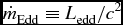 $\dot{m}_{\rm Edd}\equiv L_{\rm edd}/c^2$
). As originally found by Milosavljevic et al. (Reference Milosavljević, Bromm, Couch and Oh2009) and by Park & Ricotti (Reference Park and Ricotti2011), at lower Bondi rates accretion is instead episodic, because of radiative feedback. A two dimensional analysis, performed by Yang et al. (Reference Yang, Yuan, Ohsuga and Bu2014), showed the importance of radiation in stabilising convection in slim disks.
$\dot{m}_{\rm Edd}\equiv L_{\rm edd}/c^2$
). As originally found by Milosavljevic et al. (Reference Milosavljević, Bromm, Couch and Oh2009) and by Park & Ricotti (Reference Park and Ricotti2011), at lower Bondi rates accretion is instead episodic, because of radiative feedback. A two dimensional analysis, performed by Yang et al. (Reference Yang, Yuan, Ohsuga and Bu2014), showed the importance of radiation in stabilising convection in slim disks.
Though extremely detailed, such simulations do not capture the dynamics of gas feeding of the BH from large scales. As an example, the three dimensional simulations by Jiang et al. (Reference Jiang, Stone and Davis2014) cover only a small region well within the trapping radius. For such reasons, larger scale simulations of the three dimensional circum-nuclear disk have been performed. The drawback of this approach to the problem is that simulations on ${\mathrel {\rlap{\lower3pt \hbox{$\sim $}} \raise2.0pt \hbox{$>$}}}100\ {\rm pc}$
scale cannot resolve the small accretion disk around the BH, and hence one must employ ‘subgrid recipes’ to model the gas down to the accretion radius. Given that feedback from primordial stars and their BH remnants tends to strongly limit accretion (e.g. Alvarez et al. Reference Alvarez, Wise and Abel2009), stellar-size BH seeds may not be prone to early growth (and incidentally, may not be shining as miniquasars).
${\mathrel {\rlap{\lower3pt \hbox{$\sim $}} \raise2.0pt \hbox{$>$}}}100\ {\rm pc}$
scale cannot resolve the small accretion disk around the BH, and hence one must employ ‘subgrid recipes’ to model the gas down to the accretion radius. Given that feedback from primordial stars and their BH remnants tends to strongly limit accretion (e.g. Alvarez et al. Reference Alvarez, Wise and Abel2009), stellar-size BH seeds may not be prone to early growth (and incidentally, may not be shining as miniquasars).
The situation is likely to be quite different in more evolved galaxies, where gas is thought to form a circum-nuclear disk. In this context, very recently Lupi et al. (Reference Lupi, Haardt, Dotti, Fiacconi, Mayer and Madau2016) studied the selective accretion of stellar-mass seeds in the gaseous circum-nuclear disk expected to exist in the cores of high-redshift galaxies. Their sub-pc resolution hydrodynamical simulations showed that stellar-mass holes orbiting within the central 100 pc of the circum-nuclear disk bind to very high-density gas clumps that arise from the fragmentation of the surrounding gas. Owing to the large reservoir of dense cold gas available, a stellar-mass BH growing at SE rates according to the slim disc solution can increase its mass by three orders of magnitudes within a few million years. The low radiative efficiency of super-critical accretion flows is instrumental to the rapid mass growth of the BHs, as they imply modest radiative heating of the surrounding nuclear environment. The left panels of Figure 8 show BH masses as functions of time, while central and right panels compare the case of SE accretion with a standard case of 10% radiative efficiency. The results of Lupi et al. (Reference Lupi, Haardt, Dotti, Fiacconi, Mayer and Madau2015) indicate that a short phase of SE accretion onto stellar-size BHs in the core of star-forming galaxies at $z\mathrel {\rlap{\lower3pt \hbox{$\sim $}} \raise2.0pt \hbox{$>$}}10$
may be a first step toward the formation of the supermassive BHs powering the brightest QSOs observed at
$z\mathrel {\rlap{\lower3pt \hbox{$\sim $}} \raise2.0pt \hbox{$>$}}10$
may be a first step toward the formation of the supermassive BHs powering the brightest QSOs observed at $z\mathrel {\rlap{\lower3pt \hbox{$\sim $}} \raise2.0pt \hbox{$<$}}7$
.
$z\mathrel {\rlap{\lower3pt \hbox{$\sim $}} \raise2.0pt \hbox{$<$}}7$
.
Left panels: BH masses as a function of time, assuming 10% radiative efficiency of accretion (top), and the radiatively inefficient slim-disk solution (bottom). The red lines correspond to the most massive BHs at the end of the runs, while the blue-dashed lines trace accretion histories at fixed Eddington ratios of 500, 400, 300, 200, and 100, respectively. Central panels: gas density maps for the two runs at t = 0.73 Myr. Right panels: zoom in of a region heated by BH feedback. The white dots mark the positions of the BHs. From Lupi et al. (Reference Lupi, Haardt, Dotti, Fiacconi, Mayer and Madau2015).

5 IMPLICATIONS FOR THE FATE OF THE FIRST MASSIVE BLACK HOLES
In order to explain the formation of the largest SMBHs inferred to power quasars at high redshift, it is necessary to model their growth across cosmic time, starting from the smaller BH seeds that form from the collapse of the earliest stars. As the relatively small DM halos in which these seeds form merge with many other halos and end up in much more massive systems, large-scale simulations are required to track their long term evolution. In turn, given finite computational resources, such large-scale simulations generally cannot capture accretion of gas and the associated radiative feedback in great detail (e.g. Debuhr et al. Reference Debuhr, Quataert, Ma and Hopkins2010; Power, Nayakshin, & King Reference Power, Nayakshin and King2011; Hobbs et al. Reference Hobbs, Power, Nayakshin and King2012; Curtis & Sijacki Reference Curtis and Sijacki2015; Rosas-Guevara et al. Reference Rosas-Guevara2015; but see also Pelupessy, Di Matteo, & Ciardi Reference Pelupessy, Di Matteo and Ciardi2007).
Nonetheless, there is some encouraging consistency between models of BH seed formation and the observational data on high-redshift quasars, which is strengthened by large-scale cosmological simulations of the evolution linking the former to the latter. In particular, the masses of BH seeds which are typically adopted in large-scale, relatively low-resolution cosmological simulations (e.g. Bellovary et al. Reference Bellovary2011; Kim et al. Reference Kim, Wise, Alvarez and Abel2011) are often consistent with the masses expected for seeds formed from the collapse of SMSs in the direct collapse model (e.g. Ferrara et al. Reference Ferrara, Salvadori, Yue and Schleicher2014). These simulations generally show that the growth of ~ 109 M⊙ SMBHs from these seeds, fueled by accretion of low angular momentum gas (e.g. Hopkins & Quataert Reference Hopkins and Quataert2010) delivered by cold flows (e.g. Dubois et al. Reference Dubois2012, Reference Dubois2013), could proceed fast enough to explain the highest redshift quasars (Li et al. Reference Li2007; Sijacki, Springel, & Haehnelt Reference Sijacki, Springel and Haehnelt2009; Sijacki et al. Reference Sijacki2015; Di Matteo et al. Reference Matteo2012), as shown in Figure 9.
The accretion rate (bottom) and mass (top) of three BHs, as functions of redshift z, as found in a large-scale cosmological simulation. These BHs are seeded with masses consistent with DCBHs, grow to masses ⩾ 109 M⊙ before z = 6, and are broadly consistent with observations of quasars at these redshifts. From Di Matteo et al. (Reference Matteo2012).

Observations of BHs inhabiting more local, dwarf galaxies (e.g. Reines et al. Reference Reines2011; Reference Reines2014; Greene Reference Greene2012; Mezcua et al. Reference Mezcua, Civano, Fabbiano, Miyali and Marchesi2015) and Milky Way satellites (see e.g. van Wassenhove et al. Reference van Wassenhove, Volonteri, Walker and Gair2010) may also be explained by the DCBH seed model, although it is likely that other seeding processes populate such galaxies as well. Future observations which constrain the properties of BHs in dwarf galaxies, of the BHs powering high redshift quasars, and of those which may reside in the brightest primordial systems, for which CR7 is a strong candidate, will be critical to determining how the first massive BHs are seeded and grow in the early universe.
ACKNOWLEDGEMENTS
The authors would like to thank Rosa Valiante, Rafaella Schneider, and Marta Volonteri for the opportunity to contribute this review. Work at LANL was done under the auspices of the National Nuclear Security Administration of the US Department of Energy at Los Alamos National Laboratory under Contract No. DE-AC52-06NA25396.



