

Introduction
The disappearance of Neanderthals in Europe and in the northern regions of the Mediterranean basin is a debated topic in which the archaeological record plays a leading role in the development of models focused on the settlement dynamics of indigenous populations. In the last decades the investigation of markers that could shed light on the possible interactions between Neanderthals and Anatomically Modern Humans are again at the centre of attention, for chronometric refinements (Higham et al.2009; Reference HighamHigham 2011) as well as for the re-examination of some human remains (Benazzi et al. 2011).
In large areas of the Northern Adriatic region, the latest Middle Palaeolithic is undocumented. Only in the Veneto region and ephemerally along the Dalmatian coast do archaeological sites show that the remarkable ecological diversity between the alluvial plains and the Prealps was exploited, with some key cave sites showing evidence of intense and repeated occupation. Within this context, sites are characterised by short-term use associated with neighbouring flint outcrops or used as logistical stops along seasonal routes.
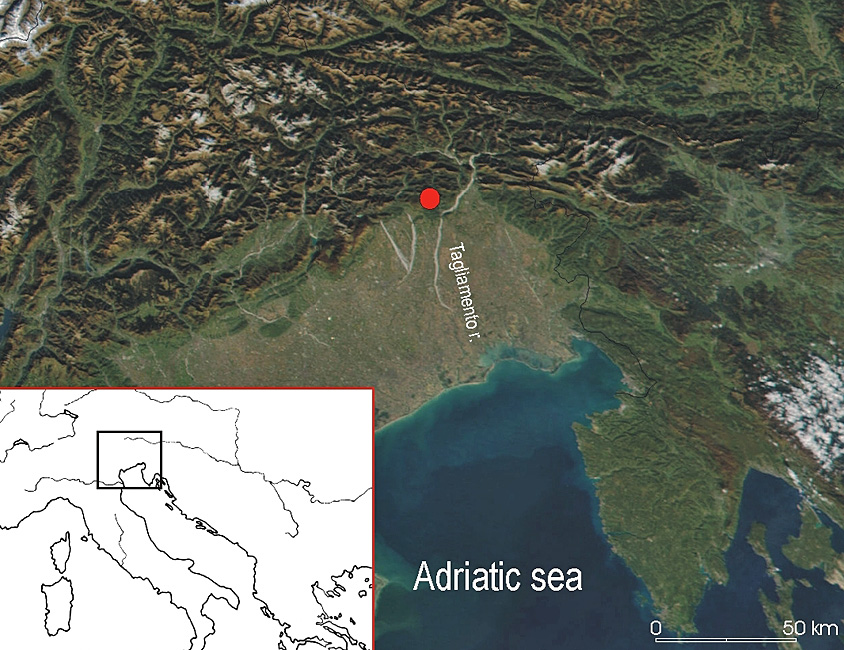
Summer image of the Northern Adriatic region (by ) with position of the Rio Secco Cave in the Pradis Plateau indicated (red spot).

The Rio Secco Cave
At the bottom of the Carnic and Julian Prealps evidence appears more limited, suggesting a marginal use of the mountain zone during the whole of the Middle Palaeolithic. In this respect the Rio Secco Cave makes a new contribution. It is located in Friuli-Venezia Giulia in north-eastern Italy; at 580m asl on the Pradis Plateau close to the river Tagliamento (Figure 1). The Pradis Plateau is permeated by a dense system of more than 200 explored cavities, some several kilometres deep and varying in altitude by a few dozen metres. A few waterways run through the bottom of deep and narrow gorges with several shelters and caves opening on the rock face. Discovered in 2002, the Rio Secco Cave is a large cavity oriented south and characterised by a wide gallery almost totally filled with rubble. Its importance was confirmed during a first survey which exposed a group of layers with faunal remains and lithic artefacts of the final Middle Palaeolithic period, dated to 42 200 cal BP (Peresani & Gurioli 2007).
This site is likely to provide evidence for human occupation in lands which archaeological research in the Northern Adriatic region has neglected up to now. Given these goals, a three-year research project, supported by the Administration of the village of Clauzetto and coordinated by the University of Ferrara under the auspices of the Archaeological Soprintendenza of Friuli-Venezia Giulia, has been set up.
First results
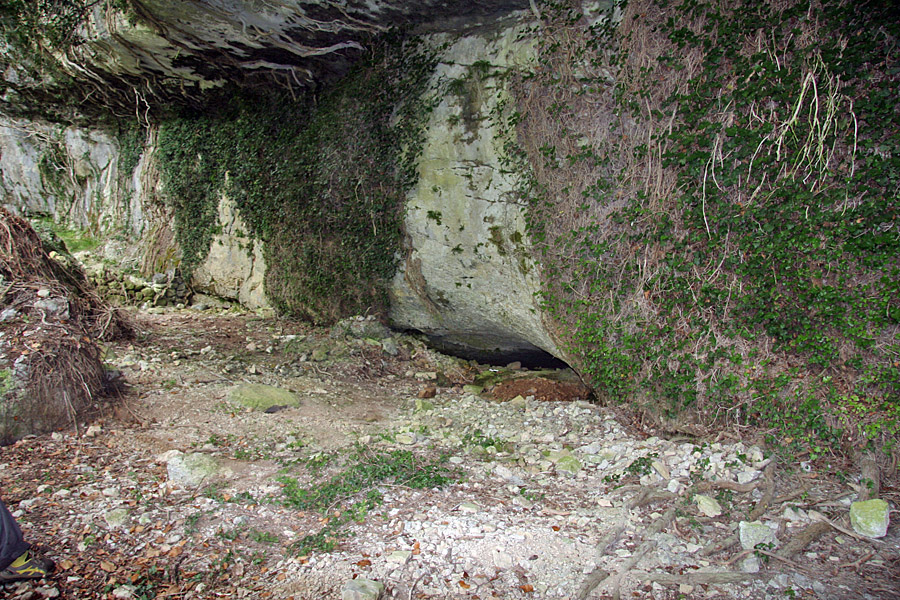
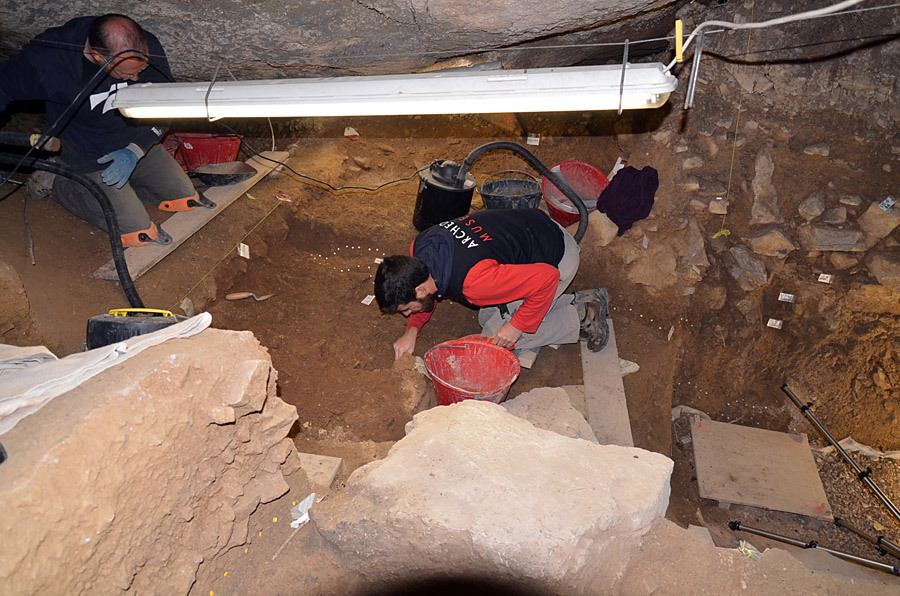
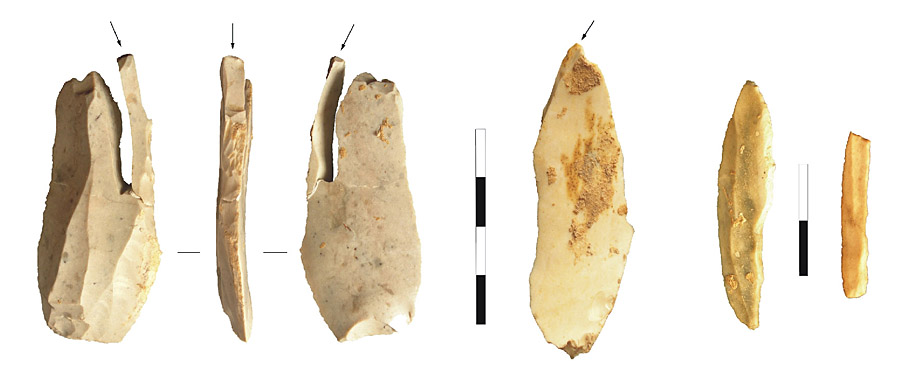
In 2010 and 2011 two field campaigns were carried out to clear the cave from its rubble (Figure 2) and to explore, without reaching the bedrock, the 2.6m of stratigraphic sequence formed by sedimentary deposits of different shape, composition and origin (Figure 3). The uppermost part includes the stratigraphic units 1 and BR1 composed mainly of stones. Within BR1 there is also an anthropic level (4) with three hearths containing charcoal fragments of considerable size and Upper Palaeolithic lithic artefacts such as burins, bladelet-cores and backed points (Figure 4). The animal bones most frequently represented belong to marmot and cave bear, while beaver, ibex and chamois are fewer. No relevant human taphonomic features have been observed on these bones.
A view of the cave before the start of the excavation in 2010.

Excavation in 2011.

Upper Palaeolithic burins, also with a refitted burin spall, and backed implements.

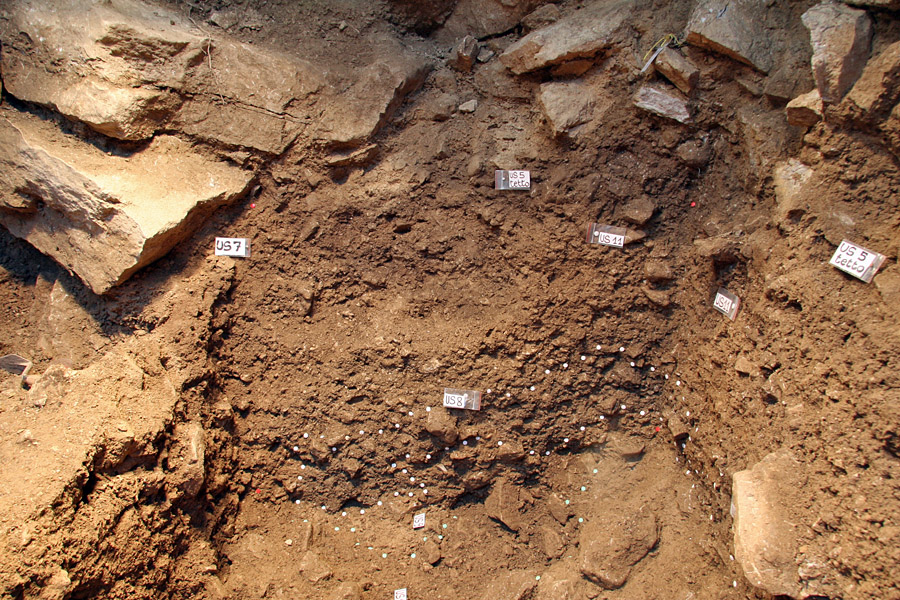
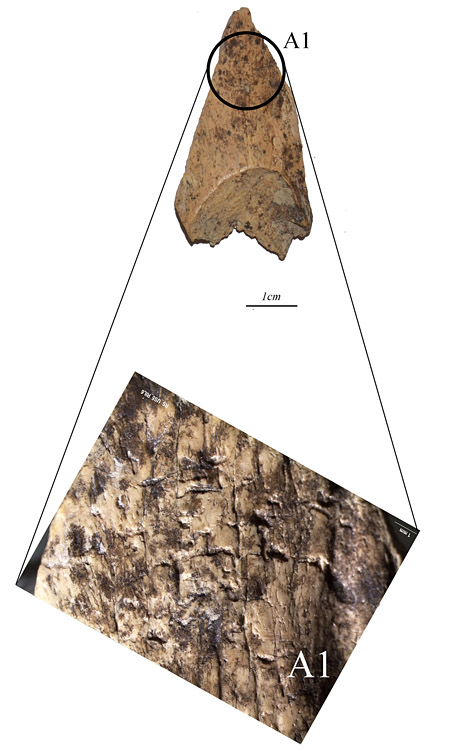
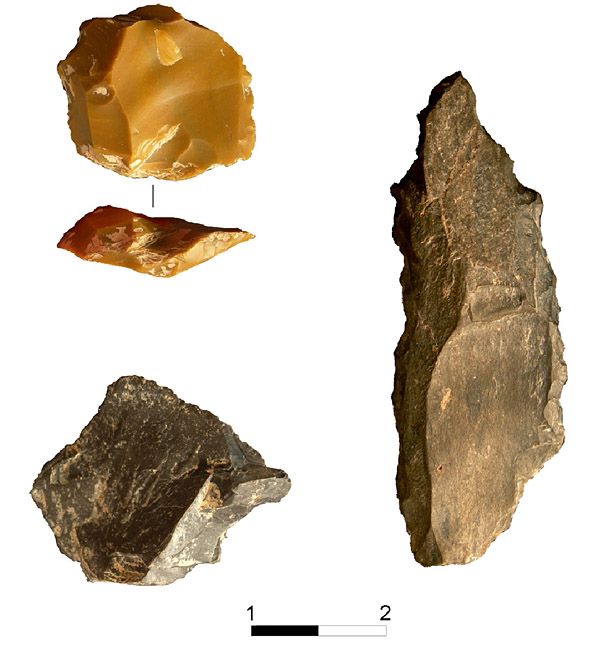
Below, unit BR2 is composed of large angular stones and this context seals Unit BIO1 which comprises Mousterian levels (5tetto, 7, 5 and 8) (Figure 5) that yielded bones of cave bear, large ungulates (Cervus elaphus and Alces alces) and bovid (Bos/Bison), lithic artefacts and bone retouchers (Figure 6). Bones with human-made modifications suggest that some ungulates were fully exploited at the site. Moreover, 7 contains rare but clearly documented evidence for skinning and defleshing of brown bear. The lithic artefacts include scrapers, flakes and Levallois blades, and discoid flakes made of flint supplied from the fluvial basins a few kilometres distant from the Pradis Plateau (Figure 7).
A section showing the Mousterian layers 7 and 8 below the large boulders of unit BR2 (trowel on left gives an indication of scale).

Fragmented bone shaft of a large mammal used for retouching, from Layer 5. A1: linear impressions observed by stereomicroscope Leica S6D (magnification 10-64X) (University of Ferrara, Laboratory of Archaeozoology and Taphonomy).

Mousterian lithic implements made using discoid and Levallois technologies.

The few Upper Palaeolithic artefacts suggest short-term occupation by hunter-gatherers equipped with retouched tools produced on high quality flint collected outside the Carnic Prealps. This evidence fits the scenario of a marginal colonisation, probably related to the distribution of the flint sources. In the Mousterian assemblages, on the other hand, the use of the Levallois unidirectional method might not be related to the quality of the raw material, which is modest, but to functional needs linked with mobility in territories where flints nodules are scarce. Changes in technical behaviour might thus reflect the diverse demands of groups that occupied this area or represent an expression of different cultural tradition.
Perspectives
The Rio Secco Cave has the potential to preserve an archive of markers of mobility, settlements and exploitation of resources between the plain and the alpine region. Excavation and laboratory analyses can contribute new elements towards reconstructing the factors that led to a Neanderthal presence in this area, considered so peripheral compared to the vast north Adriatic plain that extended further south. Comparison of this site with those with more intense and/or longer residential occupation, like the cave of Fumane in the province of Verona (Peresani et al. 2011; Reference PeresaniPeresani 2012), may be particularly informative concerning Middle Palaeolithic inter-assemblage variability. In addition, the Rio Secco project can provide insights into the cultural strategies of the last Neanderthal populations, prior to the appearance of the first modern humans.
Acknowledgments
Andrea Picin is beneficiary of the Fuhlrott Research Fellowship of the Neanderthal Museum Foundation in cooperation with the Neanderthaler-Gesellschaft. Financial support for the project is also ensured by public institutions, foundations and private companies.