


1. Introduction
The global food system faces unprecedented environmental and social challenges. Current modes of food production, distribution, and consumption contribute substantially to greenhouse gas emissions, resource depletion, and waste generation (Reference Baroni, Cenci, Tettamanti and BeratiBaroni et al., 2006; Reference Dury, Bendjebbar, Hainzelin, Giordano and BénéDury et al., 2019). The food-service sector, commonly referred to as food-away-from-home (FAFH) sector, represents a critical node within this system, connecting upstream supply chains with end consumers. Its operations influence not only environmental outcomes but also social practices and patterns of urban consumption. Despite its strategic position, the sector remains underexplored in terms of its potential contribution to circular and regenerative transitions. In Brazil, the FAFH sector has expanded rapidly, reflecting new lifestyles and increased demand for convenience and diversity in food services. However, this growth also amplifies systemic inefficiencies related to energy, water, and material use, as well as food waste and the lack of sustainable procurement practices. Addressing these inefficiencies requires more than incremental improvements, it calls for a systemic redesign of the sector’s processes, relationships, and infrastructures. Design for Sustainability (DfS) is a solution-oriented, purpose-driven approach that seeks to intentionally reshape products, services, and systems to facilitate behavioural and structural change towards sustainability (Reference Ceschin and GaziulusoyCeschin & Gaziulusoy, 2020; Reference Bocken, Short, Rana and EvansBocken et al., 2016). Within the food-service system, DfS enables the redesign of value chains, stakeholder relationships, and user practices, bridging micro-level interventions (e.g., product design, resource efficiency) with macro-level systemic transitions (e.g., circular and regenerative food networks). By integrating principles of design thinking and systems innovation, DfS extends beyond eco-efficiency to encompass new socio-technical configurations that redefine how value is created and sustained across the food chain. In this perspective, food-service establishments can be understood as product–service systems (PSS), hybrid configurations that combine tangible products (food, packaging, infrastructure) with intangible services (experience, hospitality, education). Applying DfS to this context involves designing and managing these PSSs to minimize resource throughput, foster social learning, and generate positive environmental and community impacts. This article builds upon the national diagnosis of Circular Economy (CE) practices in the Brazilian FAFH sector, developed in partnership with ABRASEL (Brazilian FAFH association) and SEBRAE (Brazilian organization that support small and medium enterprises). The diagnostic survey engaged over one thousand establishments across Brazil, revealing the current stage of circular maturity within the sector. By reinterpreting these findings through the lens of DfS, this paper identifies key leverage points for systemic redesign within the food-service value chain, from resource consumption and waste recovery to governance, partnerships, and user engagement. Ultimately, this study aims to position the FAFH sector as an active agent in Brazil’s transition towards a circular and regenerative food system. The paper contributes to the DfS discourse by providing empirical evidence from a developing-country context and by outlining future research directions for interdisciplinary design research that supports systemic change towards sustainable and circular economies.
2. Theoretical framework
2.1. Circular economy and the food-system perspective
The Platform for Accelerating the CE (PACE, 2018) identifies three principles for transforming the food system: eliminating food loss and waste, productively using discarded resources, and producing food through ecosystem regeneration. These principles require that managerial decisions across the food chain consider efficiency, resource recovery, and ecological regeneration simultaneously. Figure 1 presents this systemic perspective by positioning the FAFH sector within the broader food system and summarizing key life-cycle stages, resources, stakeholders, and associated impacts (FAO, 2020).
Integrated framework of food system flows, actors and impacts

Figure 1 Long description
A diagram of the global food system flows, actors, and impacts. The diagram is structured into four main sections: Chain, Resources, Stakeholders, Operations, and Externalities. The Chain section includes Cultivation, Distribution, Processing, Consumption, and Disposal. The Resources section lists Water, Energy, Inputs, and Soil for Cultivation, Water and Energy for Distribution, Processing, Consumption, and Disposal. The Stakeholders section identifies Producers, Logistics Providers, Beneficiaries or Processors, Retailers, Food Service Providers, and Waste Management Service Providers. The Operations section details Growing Food, Aggregation/Distribution/Storage, Processing, Consumption, and Waste Management. The Externalities section outlines various environmental and social impacts associated with each operation, such as loss of biodiversity, climate crisis, soil degradation, healthiness, waste, packaging pollution, and pollution from waste not intended for treatment.
The contemporary food system operates within complex socio-technical structures that span production, processing, distribution, consumption, and waste management. Although vital for human wellbeing, this system contributes significantly to greenhouse gas emissions, biodiversity loss, soil degradation, and inefficient resource use (FAO, 2020). Within this context, the FAFH sector plays an intermediary role by shaping procurement, influencing consumption practices, and determining daily resource management. The CE offers a systemic paradigm that shifts food systems from linear “take–make–dispose” models to regenerative resource cycles (Ellen MacArthur Foundation, 2019). In food systems, CE principles translate into reducing loss and waste, maximizing material value, and regenerating ecosystems through responsible sourcing (PACE, 2018). This perspective conceptualizes food systems as interconnected socio-ecological networks where material and value flows must be integrated. Despite conceptual advances, CE implementation in the FAFH sector remains limited. Operationalizing circularity requires digital technologies, adequate infrastructure, behavioural engagement, institutional coordination, service redesign, and new governance arrangements. Existing organizational frameworks, such as the CE maturity categories proposed by Reference Sacco, Vinante, Borgianni and OrzesSacco et al. (2021) strategic management, supplier cooperation, employee engagement, resource efficiency, and waste recovery offer diagnostic value but provide limited guidance on transforming socio-technical practices. This gap underscores the need for approaches that support design-led transitions. DfS offers conceptual and methodological tools to enable behavioural change, redesign product-service systems, and reconfigure value chains toward circular and regenerative outcomes.
2.2. Design for sustainability and systemic transitions in food-service systems
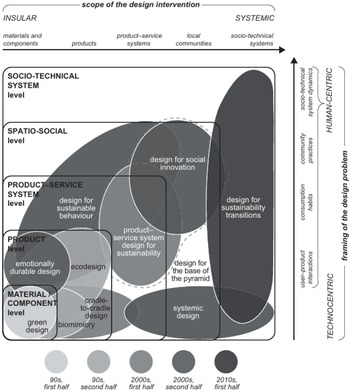
DfS offers a strategic, solution-oriented approach for reshaping products, services, practices, and socio-technical systems toward sustainability (Reference Ceschin and GaziulusoyCeschin & Gaziulusoy, 2020). It moves beyond incremental eco-efficiency to address how social, technological, and institutional elements co-evolve, enabling transitions at multiple scales. DfS is structured around a multi-level innovation framework comprising five progressive levels (Figure 2). 1. Material/component innovation, focused on improving physical elements or substituting materials; 2. Product innovation, redesigning products across their life cycles; 3. Product–Service System (PSS) innovation, integrating products and services to transform value creation; 4. Spatio-social innovation, targeting community-level dynamics, infrastructures, and place-based practices; 5. Socio-technical system innovation, enabling structural shifts in how societal needs, such as food provision, are fulfilled. Complementing these levels, DfS introduces two analytical axes that guide intervention strategies. The horizontal axis ranges from insular interventions, directed at specific components or processes, to systemic interventions that transform networks, institutions, and socioecological relations. The vertical axis distinguishes technocentric, humancentric, and Earth centric perspectives. Technocentric approaches focus on technical optimization and efficiency. Humancentric approaches emphasize behaviours, routines, cultural norms, and social interactions. Earth centric approaches extend the focus to ecological regeneration, interspecies relations, and planetary dynamics.
The food service sector, defined by the interaction of tangible products such as food, packaging, and equipment and intangible services such as experience and staff–customer relations, aligns with the multi-level orientation of DfS. Restaurants and similar establishments operate as Product Service Systems in which resource flows, routines, and user practices jointly shape environmental impact. Applying DfS to food service systems supports interventions including redesigning kitchen workflows to reduce losses, co designing training programs and supplier partnerships, and developing regenerative waste ecosystems and ecologically oriented sourcing networks. DfS thus connects broad sustainability objectives with the reconfiguration of service processes, infrastructures, and social practices, creating a foundation for integrating CE principles into operational contexts.
2.3. Integrating circular economy and design for sustainability
While the CE establishes strategic principles for regenerating resources and closing material loops, it does not provide the methodological pathways needed to redesign the socio-technical configurations that sustain food-service systems. DfS addresses this limitation by offering an intervention-oriented framework that translates CE objectives into transformations across technologies, practices, behaviours, infrastructures, and ecosystems. Central to DfS is a dual-axis structure that guides how sustainability problems are interpreted. The horizontal axis defines the scope of intervention, ranging from insular efficiency improvements to systemic transformations that reshape value chains, institutional arrangements, and socio-ecological relationships (Figure 3). The vertical axis distinguishes technocentric, humancentric, and Earth-centric approaches. Technocentric interventions prioritise technical optimisation, humancentric approaches emphasise behaviours and social dynamics, and Earth-centric approaches consider ecological systems, interspecies relations, and long-term planetary wellbeing (Reference Ceschin and GaziulusoyCeschin & Gaziulusoy, 2020). Integrating CE and DfS enables circularity across this entire spectrum. CE efforts focused on efficiency, waste reduction, and resource circulation generally align with technocentric and insular actions such as adopting high-efficiency equipment, monitoring resource use, or improving packaging. Although necessary, these actions remain largely incremental. Greater transformative potential emerges when CE is approached through humancentric and systemic perspectives, in which design intervenes in organisational routines, consumer practices, staff engagement, and collaboration across the food-service ecosystem. At this level, DfS supports the redesign of workflows, training strategies, behavioural incentives, and multi-actor platforms that strengthen circular practices among suppliers, restaurants, consumers, and waste cooperatives. The most expansive perspective corresponds to Earth-centric and systemic approaches, where CE’s regenerative aims converge with DfS’s focus on socio-technical-ecological systems. Circularity extends beyond efficiency to encompass ecosystem regeneration, biodiversity protection, and community resilience. Interventions may include rethinking production landscapes, aligning restaurants with ecological cycles such as composting and nutrient recovery, and establishing infrastructures that embed environmental stewardship. This perspective also relates to long-term transitions in which human and non-human wellbeing are jointly considered. In the literature on sustainability transitions, institutional structures and regulatory pressure play a central role in shaping the pace and direction of systemic change (Reference GeelsGeels, 2011; Reference KöhlerKöhler et al., 2019). However, in contrast to European food-service contexts, the Brazilian FAFH sector operates under relatively low regulatory pressure regarding circularity, waste prevention, and regenerative practices. This institutional condition contributes to the predominance of voluntary, fragmented, and insular initiatives observed in the diagnosis. Rather than acting through coercive instruments, the transition in this context depends primarily on organisational capabilities, relational governance, and coordination mechanisms across actors. From a Design for Sustainability perspective, this absence of strong regulatory constraints reinforces the relevance of design-led approaches as non-coercive instruments capable of enabling coordination, learning, and systemic alignment toward circular and regenerative outcomes in service-based socio-technical systems. Applied to the FAFH sector, the integrated DfS and CE framework highlights five leverage dimensions identified in the diagnosis: management and governance, supplier partnerships, resource use, energy and water management, and waste recovery. Each can be reframed through technocentric, humancentric, or Earth-centric lenses at insular or systemic scales. Examples include high-efficiency equipment and digital loss monitoring, collaborative supplier networks and consumer education, and regenerative sourcing, composting ecosystems, and circular territorial infrastructures. By combining CE’s strategic orientation with DfS’s multi-level innovation capabilities, the analysis frames circularity as a continuum of design opportunities across scales and perspectives. This integrated approach shifts the sector from isolated actions to the deliberate development of socio-technical configurations capable of sustaining circular and regenerative food-service systems over time.
Key elements and the evolution of DfS Field (Reference Ceschin and GaziulusoyCeschin & Gaziulusoy, 2020)

The DfS innovation framework with the additional sociotechnical-ecological system level (Reference Ceschin and GaziulusoyCeschin & Gaziulusoy, 2020)

3. Methodology
This study employed a design-informed and DfS-aligned methodological approach to diagnose the current stage of CE practices in Brazil’s FAFH sector and to identify leverage points for systemic redesign. The methodological strategy combines quantitative rigor with systemic design interpretation, in line with DfS principles that emphasize understanding socio-technical systems and intentionally reshaping them toward sustainable, regenerative futures. The methodological process unfolded across five integrated stages, each explicitly connected to the DfS framework.
Stage 1 – Contextual analysis
The first stage consisted of a review of academic and institutional literature on food systems, CE principles, organizational circularity, and sustainability transitions. Guided by DfS’s system mapping and problem-framing practices, this step generated a conceptual understanding of the AFL sector as a socio-technical system composed of actors, infrastructures, material flows, and behavioural patterns.
This mapping enabled the translation of CE principles into analytical dimensions appropriate for design intervention, anticipating later comparison with DfS levels (material; product; PSS; spatio-social; socio-technical) and framing perspectives (technocentric; humancentric; Earth-centric).
Stage 2 – Questionnaire design and validation
Based on the conceptual synthesis, a structured questionnaire was developed to operationalize the core CE dimensions relevant to the AFL system. The instrument drew on maturity frameworks such as Reference Sacco, Vinante, Borgianni and OrzesSacco et al. (2021), resulting in 23 variables organized across five dimensions: 1. Management and governance for circularity; 2. Resource consumption; 3. Water management; 4. Energy management; 5. Waste and resource recovery. Experts in food-service operations and sustainability validated the clarity and applicability of the instrument. A reliability assessment yielded a Cronbach’s alpha of 0.94, indicating internal coherence (Appendix A).
Stage 3 – Data collection
The questionnaire was disseminated nationally through SurveyMonkey®, generating 1,002 valid responses from managers of bars, restaurants, snack bars, and similar establishments across all five Brazilian regions. Within a DfS perspective, this stage represents the first phase of a design-led systemic diagnosis, gathering data on behaviours, resource flows, managerial routines, and infrastructural conditions. The diversity of respondents provides insight into the multi-actor and multi-context nature of the AFL system, which is essential for later identifying intervention opportunities aligned with different DfS innovation levels. The questionnaire consisted of 23 variables organized into five analytical dimensions and measured using a five-point Likert scale, ranging from “never adopted” to “fully adopted”. Internal consistency was assessed using Cronbach’s alpha, which reached a value of 0.94, indicating high reliability for exploratory analysis. Following established guidelines for multivariate exploratory research, the instrument was considered suitable for Principal Component Analysis and cluster analysis aimed at identifying patterns and design-relevant archetypes (Reference Hair, Black, Babin and AndersonHair et al., 2019).
Stage 4 – Quantitative and systemic data analysis
Data were analysed using descriptive statistics, Principal Component Analysis (PCA), and cluster analysis, complemented by radar visualisations. These techniques revealed structural patterns in CE adoption and demonstrated that knowledge about CE is the dominant differentiating factor, surpassing regional, economic, or typological differences. From a DfS viewpoint, this stage corresponds to the activity of identifying leverage points, where statistical patterns reveal: (i) behavioural drivers (humancentric); (ii) infrastructural limitations (technocentric); (iii) relational gaps across the value chain (systemic); and (iv) absence of regenerative connections (Earth-centric). The clusters identified in this analysis serve as design archetypes, representations of distinct stages of circular transition that will later be compared to the DfS framework to identify where interventions are most needed.
Stage 5 – Design-led interpretation and opportunity synthesis
Finally, the results were synthesised to reveal opportunities for intentional redesign across the food-service value chain. This synthesis aligns directly with the DfS framework by interpreting the findings through the lenses of: DfS innovation levels (e.g., PSS redesign, spatio-social reorganizations, socio-technical transitions); DfS framing axis (technocentric, humancentric, Earth-centric gaps), and Scope of intervention (insular, systemic). This step positions the diagnosis not as a descriptive endpoint but as a strategic starting point for future design-oriented interventions, such as co-design sessions with suppliers and cooperatives; redesign of waste ecosystems; service innovations to reduce losses; behavioural and learning interventions for managers and staff; and, territorial circular infrastructures. Importantly, the gaps identified in each dimension will be analysed against the DfS framework, allowing the study to map where interventions should occur, whether at the level of materials, products, services, community interactions, or broader socio-technical systems.
4. Results and discussion
This section presents the results of the national diagnosis of CE practices in Brazil’s FAFH sector, interpreted through the DfS framework, as outlined in the methodological approach.
4.1. Management and governance for circular economy (DfS framing: humancentric–systemic)
The survey of 1,002 establishments shows that managerial engagement with circularity is mainly driven by internal motivations, while external pressures remain limited. More than 70% of establishments never consider criteria requested by investors, suppliers, or partners in sustainability decisions, which reflects evidence that governance structures often lag behind operational sustainability initiatives. At the organisational level, 54% do not value environmental or social experience during recruitment, and 66% have not considered process changes related to circularity. These results align with studies identifying governance and skill development as central barriers to sustainability transitions in service sectors. Overall, the findings confirm that governance practices remain technocentric and insular rather than part of a systemic circular strategy. Relational governance also shows gaps. Although 64% frequently seek partners to receive waste, 51% have never engaged in partnerships for projects or product co development, indicating underused collaborative potential. This reflects broader evidence linking supply chain sustainability failures to weak interorganisational coordination. From a DfS perspective, these patterns reveal predominance of humancentric awareness without systemic integration, highlighting the need for organisational and relational design interventions to embed circular governance in the AFL ecosystem.
4.2. Resource consumption and supplier relationships (DfS framing: spatio-social + humancentric–systemic)
Survey results indicate that although 67% of establishments purchase ingredients locally, this does not translate into regenerative or strategically circular sourcing. The data show that 42% never buy from family farming and 53% have never purchased organic or agroecological products, reflecting broader sustainability gaps in supply chains. Local procurement therefore appears driven by convenience rather than CE principles. Supplier criteria reinforce this pattern. Circular attributes such as sustainable packaging, low impact logistics, and certified sourcing are rarely considered, consistent with findings on the limited adoption of sustainability metrics in food service procurement. Moreover, while 58% seek partners for waste collection, 51% have never pursued partnerships for project development, shared logistics, or innovation, suggesting that collaboration remains mostly transactional. From a DfS perspective, these results show that resource consumption is framed in a human centered yet weakly systemic manner. Although relational potential exists, the lack of structured supplier criteria and collaborative networks positions this dimension within spatio social innovation, where design interventions are needed to strengthen value chain relationships and embed circular procurement practices.
4.3. Water and energy management (DfS framing: technocentric–insular, with potential for systemic redesign)
The results indicate that water and energy practices in the FAFH sector remain limited to basic operational routines, aligning with the expected technocentric and insular adoption. Consistent with national and international guidelines for rational water use (ABRAFAC, 2022; CADTERC, 2015) most establishments implement low-complexity actions such as avoiding potable water waste and performing routine maintenance, yet do not adopt systemic or regenerative strategies. This supports the finding that structured water management plans are generally absent. Energy practices follow a similar pattern focused on incremental efficiency. The study indicates that most establishments purchase A rated equipment, conduct periodic maintenance, and monitor consumption, reflecting mainstream efficiency approaches (EPA, 2022; UNIFESP, 2018). However, 66% have never considered circularity-oriented process changes, indicating the predominance of equipment-based measures rather than integrated energy systems. The data also highlights limited environmental training, since 54% do not consider environmental skills in recruitment, reinforcing organisational barriers discussed in energy transition studies (Reference Schutze, Cardoso, Renck and RochaSchutze et al., 2021). From a DfS perspective, water and energy management remain at technocentric innovation levels, with redesign opportunities largely unexplored.
4.4. Resource and waste recovery (DfS framing: technocentric–insular, with potential for systemic redesign)
The diagnosis indicates that resource and waste recovery remains the weakest circularity dimension in the AFL sector. Data show that 69% of establishments do not commercialize organic waste and 79% have never composted, revealing an absence of regenerative practices. This aligns with studies identifying persistent barriers in restaurants, such as operational limitations, inadequate infrastructure, and insufficient staff training (Reference Filimonau, Krivcova and PettitFilimonau et al., 2019). Although 66% commercialize used cooking oil, this isolated action does not represent systemic resource recovery. Food-waste prevention also demonstrates low maturity. While 54% offer training to reduce waste, the lack of complementary measures such as menu redesign or inventory planning indicates practices limited to operational routines. Similar patterns have been observed in Brazilian restaurants, where awareness initiatives prevail over structural interventions (Reference Álvares, Guarnieri and Ouro-SalimÁlvarez et al., 2022). Waste recovery systems show further fragmentation. Although 64% identify partners to receive waste and 58% work with collection partners, collaborations for innovation, reverse logistics, or product development remain uncommon, with 51% never participating. This reflects a predominance of isolated and technocentric practices rather than systemic strategies aligned with CE principles (PACE, 2018). From a DfS perspective, the absence of composting, nutrient cycling, and coordinated recovery loops positions this dimension as a missed opportunity. Recovery processes require systemic and socio-technical integration, yet current practices focus mainly on material handling. The design of waste ecosystems involving cooperatives, composting facilities, and bioenergy infrastructures (Ellen MacArthur Foundation, 2019), could promote transitions from isolated actions to regenerative, territorially embedded solutions.
4.5. Cross-scale synthesis and systemic leverage points (DfS multilevel innovation)
The cross-scale synthesis shows how gaps in each analytical dimension appear across food-system stages, confirming that circularity in the FAFH sector requires multi-level and multi-actor redesign. Data indicate limited regenerative sourcing, since 42% never buy from family farming and 53% never buy organic or agroecological foods, low process redesign, with 66% never considering circularity-related changes, and minimal recovery practices, as 79% never compost and 69% do not valorise organics. These results are consistent with systemic analyses that identify procurement, processing, and recovery inefficiencies (PACE, 2018). At the cultivation and supply stage, the lack of regenerative procurement reinforces evidence of weak sustainability integration in food-service chains, placing the sector at an early maturity level. In distribution and logistics, partnerships remain transactional, centre on waste collection (58%) rather than co-development or reverse logistics, which 51% never adopt. This fragmentation aligns with barriers discussed by Reference Kirchherr, Reike and HekkertKirchherr et al. (2018). In processing and operations, establishments adopt incremental efficiency measures, such as purchasing A-rated equipment (76%) and maintaining devices (66%) yet rarely implement integrated circular workflows. This reflects technocentric and insular innovationby Reference Álvares, Guarnieri and Ouro-SalimÁlvarez et al. (2022). At the consumption stage, heterogeneous communication practices suggest limited engagement with consumer behaviour, despite evidence that behavioural strategies are key for reducing food waste. In recovery, the absence of composting and nutrient cycling contradicts core principles of circular food systems (Ellen MacArthur Foundation, 2019; FAO, 2020). Even establishments with more advanced partnerships lack regenerative outputs, indicating that Earth-centric system innovation is the least developed. Overall, the synthesis shows that descriptive statistics and cluster analysis reveal convergent systemic misalignments. From a DfS perspective, opportunities emerge at the PSS, spatio-social, and socio-technical levels, where redesign of relationships, infrastructures, and regenerative loops is essential for circular transitions.
4.6. Design implications for systemic circularity
Interpreting the empirical results through the DfS Innovation Framework shows that circularity in the Brazilian AFL sector remains dispersed and largely insular. Practices such as the use of efficient equipment, preventive maintenance, staff training for waste reduction, partnerships for recyclable collection, and local purchasing indicate initial forms of circularity, yet the sector lacks the systemic conditions required for coordinated and regenerative change. Material and Product Innovation: Many establishments implement technocentric practices such as efficient equipment, water-saving devices, LED lighting, and maintenance routines. Although these actions decrease resource intensity, they remain limited to component-level innovation within the initial stages of the DfS framework. Advancing circularity requires product-level redesign, including sustainable packaging, materials aligned with reverse logistics, and reusable utensils, which remain largely overlooked. Product–Service System Innovation: Although staff training for waste reduction is common, there is minimal adoption of integrated circular services such as returnable packaging, take-back programs, shared composting, or menu redesign. Current practices remain operational rather than systemic and do not reconfigure service propositions in line with PSS innovation. Broader circular service integration is therefore essential. Spatio-Social Innovation: A significant share of establishments do not engage in co-development, shared logistics, or joint projects. However, emerging collaborative actions, such as partnerships with cooperatives and selective oil collection, indicate potential for more structured cooperation. These practices highlight the need for territorial solutions such as micro-hubs for waste recovery, cooperative purchasing networks, and shared transport routes to reduce fragmentation and strengthen governance.
Sociotechnical System Innovation: Many establishments do not incorporate environmental criteria in hiring and do not rethink processes through a circular lens, evidencing limited organizational capabilities for systemic transitions. Nonetheless, internal monitoring routines, staff engagement, and local sourcing demonstrate existing leverage points. These behaviours support the development of governance structures, circular objectives, and coordination platforms essential for sectoral transformation. Sociotechnical-Ecological System Innovation: The most significant gaps involve Earth-centric practices. A large proportion of establishments do not compost, do not valorize organics, and do not purchase from family farming. Yet practices such as proper oil disposal, partnerships with cooperatives, and training in food-waste prevention offer entry points for regenerative redesign. Potential interventions include nutrient-cycling infrastructures, composting networks, biodigestion systems, and collaborations with agroecological producers to shift the sector toward socioecological regeneration. Synthesis, From Isolated Best Practices to Systemic Redesign: The sector exhibits fragmented islands of circularity across different DfS innovation levels. What remains absent is systemic integration through redesigned services, infrastructures, governance mechanisms, and ecological relations. Interpreted through the DfS framework, these practices reveal both the sector’s current position and its most transformative opportunities: progressing from isolated technocentric actions toward coordinated humancentric and Earth-centric interventions capable of reshaping sociotechnical-ecological systems. Overall, the findings show that the sector possesses numerous initiatives but lacks systemic integration. Current practices remain isolated across DfS levels. A transition requires linking actions through redesigned services, shared infrastructures, strengthened governance, and ecological partnerships. The most promising pathways involve shifting from technocentric and insular efforts toward humancentric and Earth-centric redesign capable of transforming socio-technical-ecological systems. Circularity thus demands interventions beyond equipment-level improvements toward relational, infrastructural, and ecosystem-level redesign consistent with the systemic orientation of DfS (Appendix B – Table 1 and Table 2).
4.7. Design archetypes of circular maturity
The archetypes identified through cluster analysis should not be interpreted as fixed or deterministic categories, but rather as transitional representations of different stages of circular maturity within the food-away-from-home (FAFH) sector. This understanding is consistent with circular economy maturity frameworks, which emphasize learning processes, gradual capability building, and context-dependent transition pathways rather than linear or uniform adoption trajectories (Reference Sacco, Vinante, Borgianni and OrzesSacco et al., 2021; Reference Kirchherr, Reike and HekkertKirchherr et al., 2018). From a Design for Sustainability perspective, these archetypes function as analytical devices that support the identification of leverage points for intervention across different innovation levels, ranging from operational improvements to systemic and socio-technical transformations. The analysis tested the hypothesis that different types of food-service establishments, such as bars, restaurants, and snack bars, would show distinct patterns in the adoption of CE practices. However, the cluster analysis revealed no clear separation among the four predefined clusters, indicating that CE practices are not determined by establishment type. Radar chart analyses demonstrated that the variable most strongly associated with differences in CE adoption was managers’ level of knowledge about CE, rather than factors such as company age, revenue, or business category. In terms of performance across thematic blocks, energy-related practices consistently received the highest median scores, particularly because they are associated with cost reduction. In contrast, suppliers, management, and waste-related practices scored lower and showed no statistically significant regional differences, with the exception of the North region, which exhibited higher scores in the Suppliers block, possibly reflecting greater environmental awareness due to regional proximity to the Amazon (Appendix C). Overall, establishments with lower annual revenues (up to R$81,000) demonstrated higher scores across all CE blocks, suggesting that microbusinesses perceive immediate financial benefits from implementing practices related to energy savings, waste reduction, and resource efficiency. Respondents with greater CE knowledge also consistently reported adopting more practices in all blocks, reinforcing the importance of education, training, and capacity-building for advancing CE maturity in the sector. No significant differences were found across business categories, company age, or other structural characteristics, indicating that CE practices are still adopted in similar ways across the sector and are primarily influenced by managers’ awareness rather than organizational profile. These results reveal that enhancing CE knowledge is a key lever for accelerating the transition toward circular practices in the food-away-from-home sector. From a managerial perspective, these archetypes highlight that advancing circularity in the FAFH sector depends less on structural characteristics and more on managerial awareness, learning, and coordination capabilities. Establishments at lower maturity stages would benefit from design-led capacity-building initiatives focused on circular literacy, process visualization, and service redesign. More advanced archetypes indicate opportunities for collaborative experimentation, such as shared waste infrastructures, co-developed supplier criteria, and redesigned product–service systems. These implications reinforce the role of Design for Sustainability as a strategic tool to support managers in navigating circular transitions through the intentional redesign of practices, relationships, and governance structures (Reference Bocken, Short, Rana and EvansBocken et al., 2016).
5. Final considerations
This study presents the first large-scale, design-informed diagnosis of CE practices in Brazil’s FAFH sector, revealing incremental improvements, fragmented initiatives, and limited systemic coordination. By integrating quantitative results with the DfS framework, the research moves beyond descriptive analysis and offers a systemic interpretation of gaps and leverage points shaping circularity. Findings show that establishments remain concentrated in early DfS innovation levels focused on material, product, and partial PSS approaches, while higher-order spatio-social, sociotechnical, and socioecological innovations remain largely absent. Survey data reinforces this pattern: 66% have never considered process redesign, 51% have never participated in collaborative projects, and 79% have never adopted regenerative waste practices, indicating motivation constrained by structural limitations. The study demonstrates that CE adoption is driven more by behavioural, relational, and governance conditions than by technical or economic barriers. This underscores the relevance of DfS for enabling systemic transformation by redesigning not only technologies and services, but also relationships, routines, and local infrastructures. The results contribute to discussions on operationalizing CE through design-led strategies in complex service sectors. The research also identifies structural obstacles, including weak governance, limited supplier integration, low consumer engagement, and the absence of regenerative practices linking food services to ecological cycles. Overcoming these issues requires shifting from isolated operational actions to socio-technical-ecological redesign aligned with upper DfS levels. Future studies should combine quantitative and qualitative approaches, investigate circular transition cases, test design interventions in real contexts, and assess regional or typological differences. Further examination of public policy, supply-chain incentives, and territorial cooperation is also needed to accelerate systemic redesign. In conclusion, the study frames circularity in Brazil’s FAFH sector as an emerging opportunity that depends on coordinated, design-led strategies. By identifying structural gaps across DfS levels, it provides a conceptual and empirical basis for advancing sustainable, regenerative, and socially inclusive food-service systems.
Appendix
Appendix A Survey
https://drive.google.com/drive/folders/17-YQk9tkcNqVgJYDweZk5ug15L8Conxa?usp=sharing
Appendix B Tables of Results
https://drive.google.com/drive/folders/17-YQk9tkcNqVgJYDweZk5ug15L8Conxa?usp=sharing
Appendix C Cluster Analysis
https://drive.google.com/drive/folders/17-YQk9tkcNqVgJYDweZk5ug15L8Conxa?usp=sharing



 Open access

