


After many years of hard work and training, the transition from trainee to consultant is potentially challenging. Having successfully negotiated the hurdles of pre-registration training, the MRCPsych examination and the specialist registrar (SpR) interview, trainees have to pass one final signpost to mark the end of their formal training – securing their first substantive consultant psychiatrist post. Despite overall vacancy rates of about 12% for consultant psychiatrists in the UK (Royal College of Psychiatrists, 2002), competition can be intense for some posts.
This paper aims to guide trainees in the transition from SpR to consultant, via RITA (record of in-training assessment) reviews, CCT (certificate of completion of specialist training) awards, specialist registers and the consultant interview.
Higher specialist training
The setting of educational objectives at the outset of each SpR post can ensure that trainees develop the relevant competency required during higher specialist training (HST). Such objectives should be set jointly by the trainee and trainer, and adhere to the acronym ‘SMART’ (i.e. be specific, measurable, achievable, realistic and time limited). They should relate to the College’s ‘core’ and ‘additional’ competencies required for HST, and be appropriate to the stage of SpR training. It can be convenient to group such objectives into four broad categories: research, clinical, teaching and management.
Good planning can ensure that trainees make constructive use of their research day sessions. Involvement in research projects can help trainees to develop an understanding of the principles of research methodology and audit, and refine their organisational, time management and leadership skills (Reference Strydom and HigginsStrydom & Higgins, 2004). It also provides experience in writing protocols and papers for peer review and obtaining ethical approval for projects. Publications can improve a trainee’s competitiveness at consultant selection (Reference Guthrie and BlackGuthrie & Black, 1991).
Although most SpRs believe research to be important (Reference Allsopp, Allen and FowlerAllsopp et al, 2002), there are concerns about the effectiveness of the current research day (Reference Vassilas, Tadros and DayVassilas et al, 2002). Only half of the SpRs in psychiatry have ever managed to secure a publication (Reference Smart and CottrellSmart & Cottrell, 2000). Recent surveys have suggested that problems with lack of experience, resources and supervision may be a reason for this (Reference Petrie, Anderson and HarePetrie et al, 2003).
Recommendation 1. Box 1 outlines our advice on how SpRs can make more effective use of their research day.
Many of our suggestions in Box 1 parallel the recent recommendations made by the Collegiate Trainees’ Committee, that there should be greater flexibility in the use of the research day (Reference Ramchandani, Corby and GuestRamchandani et al, 2001). Securing a publication by writing up how you modified an existing practice guideline will look more impressive than a half-completed randomised controlled trial that failed to get published.
Box 1. How can the SpR research day be used more effectively?
-
• Aim to do collaborative work, either with other SpRs or with consultants who have an established record of publications
-
• Attend local university courses on literature searching, writing protocols, research methodology, statistics, etc. before starting any projects
-
• Be realistic about the time-span of a project (e.g. literature searching and obtaining ethical approval may take up to18 months)
-
• Think innovatively – are there questionnaire surveys/audits that can be performed to help develop a new intervention or can modifications be made to existing practice guidelines?
-
• Consider spending some sessions with your trust’s clinical governance department, assisting them with any regional audits required by the Department of Health
-
• Consider what could be written as a paper at every stage in the research process, rather than leaving it to the end (e.g. a review paper after your literature search?)
-
• Target and select appropriate journals for submission of any papers, rather than attempt a blanket ‘top-down’ approach.
SpR, specialist registrar.
Special interest sessions should be organised in advance of each SpR post. Careful planning can ensure that they are linked to your intended career plans. Therefore, a trainee interested in organic aspects of psychiatry may organise their sessions in an epilepsy clinic and a liaison psychiatric service, over a 1- to 2-year period.
Recommendation 2. Utilise the‘bank’ of suitable special interest placements which the College encourages HST programme directors to keep, based upon feedback of previous trainees. Use some of the sessions to fill in training opportunities not readily available elsewhere, e.g. family therapy.
SpRs should aim to develop good teaching skills, including experience in examining (and giving constructive feedback to) senior house officers (SHOs) preparing for the MRCPsych examination and medical students. It is also important to gain experience in effective communication, negotiation (including resource and conflict management) and managing meetings (Reference Heard, Schiller and AitkenHeard et al, 2001). Regional and national courses provide good opportunities for training in these areas.
Recommendation 3. Use some of your special interest sessions to‘shadow’ the consultant representative on local committees for drugs and therapeutics, risk management and clinical governance. Be proactive in gaining other ‘hands-on’ local management experience, e.g. does your region need a new laptop computer/projector for their academic programme (find out what can facilitate funding, who provides the budget and who authorises it)?
Up to 12 months work in an ‘out-of-programme’ experience (Reference StratfordStratford, 2003), either abroad or in a related sub-specialty, can be of benefit to trainees. This should be planned in advance, and approval is needed from your programme director, regional advisor and the postgraduate dean. Such posts can count towards CCT approval with agreement of the College.
Log books provide an excellent means of recording the experience and competencies gained during SpR training (Reference Paice and GinsburgPaice & Ginsburg, 2003), and should be filled in prospectively.
RITA reviews
The annual review process should ideally be a positive and supportive experience but still be able to highlight additional or further training needs (Reference PiddPidd, 2003). Recent research analysing the outcome of RITAs for UK psychiatric SpRs showed that about 98% were assessed as satisfactory (RITA grade C) (Reference Tunbridge, Dickinson and SwanTunbridge et al, 2004). SpRs should use the RITA process to help identify their own preferred methods of systematically recording their yearly training experiences (e.g. log books, feedback letters, attendance certificates). Consider making use of ‘360-degree feedback’, by obtaining information on your performance from multi-professional colleagues. Many of these processes could be applied to your career as a consultant, aiding the mandatory appraisal process. They can also help to identify any deficits in the experiences available within your training scheme.
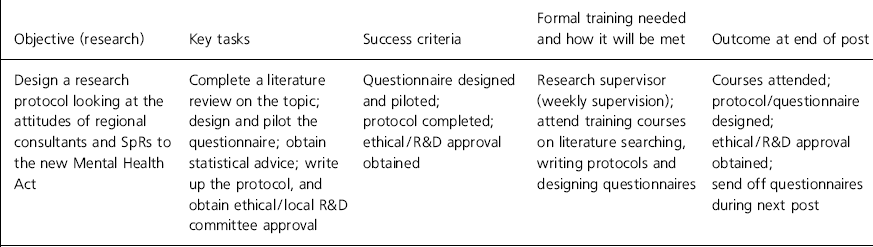
Recommendation 4. Get used to incorporating your yearly educational objectives (see Table 1) into the RITA process, as they closely resemble the format of personal development plans, which will be a central element of the consultant appraisal process (Reference NewbyNewby, 2003).
A sample educational objective that could be reviewed as part of the record of in-training assessment process
| Objective (research) | Key tasks | Success criteria | Formal training needed and how it will be met | Outcome at end of post |
|---|---|---|---|---|
| Design a research protocol looking at the attitudes of regional consultants and SpRs to the new Mental Health Act | Complete a literature review on the topic; design and pilot the questionnaire; obtain statistical advice; write up the protocol, and obtain ethical/local R&D committee approval | Questionnaire designed and piloted; protocol completed; ethical/R&D approval obtained | Research supervisor (weekly supervision); attend training courses on literature searching, writing protocols and designing questionnaires | Courses attended; protocol/questionnaire designed; ethical/R&D approval obtained; send off questionnaires during next post |
Acting up
During the final year of HST, up to 3 months spent in a locum consultant post (in the appropriate specialty) may count towards the CCT award. This provides a realistic ‘taster’ for consultant life (attending directorate meetings, running clinics, being team leader and deciding priorities) in a semi-protected environment (Reference Pickersgill, Alusi and HadjikoutisPickersgill et al, 2003).
Recommendation 5. In acting up, ensure that you have adequate supervision arrangements and litigation cover.
Specialist registers
Although SpRs can be interviewed for a substantive consultant post during the last 3 months of their training, they can only move into such a post once their details appear on the General Medical Council’s (GMC) specialist register. Upon successful completion of the final appraisal (RITA G), the postgraduate dean notifies the College, who will recommend to the Postgraduate Medical Education and Training Board that a CCT award is granted. Once the SpR has completed a CCT application form and sent off the application fee, a CCT certificate is issued (around 2-4 weeks before the CCT completion date). An accompanying form, sent with the CCT certificate, must be completed and forwarded to the GMC before entry onto the specialist register can be completed.
Recommendation 6. Consider using your 6 months ‘period of grace’ by remaining on the training programme and completing any research publications while actively looking for a substantive consultant post.
The new consultant entry scheme
SpRs who have completed their HST may opt to enter the new consultant entry scheme prior to applying for their first substantive consultant post. Placement on the scheme (in a locum consultant post) is usually limited to 6 months and is organised via National Health Service (NHS) Professionals (http://www.nhsprofessionals.nhs.uk/). Such placements have the advantage of having two protected sessions a week for professional development, a personal development plan and a mentor.
Selecting a consultant post
Available consultant posts are advertised in the weekly BMJ Careers. The website http://www.bmjcareers.com allows identification of advertised posts in particular regions. ‘ Adplus’ has helped to simplify the application process for some posts by providing job profiles, local trust information and application packs online. Regional advisors in psychiatry approve consultant job descriptions, and can be a useful source of information regarding the post itself.
Recommendation 7. Beware of large job adverts in glorious technicolour, showing beautiful, rural scenery! It could imply that the trust is awash with money (uncommon in the NHS), is led by enthusiastic clinical managers or is in the middle of a recruitment crisis.
Among the extensive lists of senior managers in the trust and the demographic details of the area, hidden within the job description should be the essential details of the post:
-
• is this a new post or an old one?
-
• has the catchment area size been changed – if so, why?
-
• do the in-patient beds still exist or are they being cut or still developed?
-
• are there vacancies (and plans to appoint) among the community based team?
-
• is there an identified full-time, or equivalent, secretary?
-
• does the post have a full-time staff grade or associate specialist doctor?
-
• is the post approved for regional SHO training and is there an opportunity for you to be approved as a SpR trainer?
-
• are there any local teaching/university commitments and/or the opportunity to participate in research?
-
• what are the on-call commitments – would you be on a sub-specialty or generic psychiatry rota and is there middle-tier cover?
The importance of each of these details will vary for different applicants – for example, some doctors enjoy the continued challenge of training SHOs, while others prefer the long-term support of an effective staff-grade doctor.
Recommendation 8. While there is no such thing as a perfect job, you may have scope for revising the proposed job plan, depending on your experience and specialist skills.
The consultant interview
Before the interview
Preparation is essential and should include time spent making visits (preferably before making a formal application, to avoid canvassing). Consider spending time in the service, by asking to attend team meetings and ward rounds. If relevant, try to find out why the last consultant left. Speak to the key consultants and follow up any suggested leads. The medical director will be able to explain how last year’s cost improvements were delivered and which aspects of the service will be reshaped in the coming year. You could also discuss issues relating to the consultant contract (including the ‘ programmed activities’). Ask the chief executive about the trust’s vision for the next 5 years. Ask the trust representatives what mentoring arrangements would be available if you were appointed – the College recommends that such arrangements are identified before the meeting of the appointments’ committee (Reference DeanDean, 2003). Do not be afraid to discuss informally why you want the job; others may have come to the trust for the same reasons!
Recommendation 9. Gather information about national and local trust policies, e.g. clinical governance plan, annual reports. Individual trust information can be accessed via http://www.nhs.uk/england/. Access other useful websites (e.g. http://www.healthcarecommission.org.uk, http://www.nice.org.uk/ and http://www.dh.gov.uk) and obtain papers on topical developments (e.g. appraisal) from Advances in Psychiatric Treatment.
Practise interview techniques with your educational supervisor or any recently appointed consultants, videotaping the sessions. You need to sound confident and natural, but not rehearsed.
At the interview
The appointments’ committee usually consists of:
-
• the chief executive of the trust
-
• the medical director
-
• a regional consultant
-
• a College-approved member from the same specialty but a different trust
-
• a lay member (often a non-executive board member).
Additional members can include university representatives for teaching and research, a representative from the primary care trust, a service manager and a carers’ representative. Good preparation can reduce anxiety levels, as you will have met some of these people before. Each panel member will have an appropriate area to question. The College representative will check HST issues, while the chief executive will be more interested in trust targets and clinical governance issues. The medical director will need to know what the successful candidate will offer to the trust (e.g. local service developments), whereas the local consultant will be interested in team-working skills. Be able to say what skills and experience you may bring to the trust, using objective evidence from your curriculum vitae. Be aware of your strengths and weaknesses and try to display a good understanding of current training and service development terminology (e.g. clinical governance, appraisal, revalidation, personal development plans).
Recommendation 10. At the end of the interview, when asked whether you have any questions for the panel, it helps if you can comment that you have met some of the panel members before and that they have already been helpful in answering your questions. Why would an interview panel wish to appoint someone who had not come to meet their possible future colleagues?
After the interview
If you are not successful, ask for a contact to obtain feedback. There may have been a better candidate on the day or you may need to improve your interview skills.
Conclusion
Despite the current vacancy rates of consultant psychiatrist posts, the SpR to consultant transition can be challenging. By introducing a SpR ‘ competency based curriculum’, the College has shown its commitment to ensuring that trainees develop the necessary skills needed to practise as a consultant. Offering new consultants a named mentor should also make the transition a smoother one.
While many regard securing a consultant post as marking the end of a long training process that started at medical school, it is better viewed as marking the start of another ‘new beginning’ – that of lifelong continuing professional development. As Sir Winston Churchill wrote in 1942:
‘This is not the end. It is not even the beginning of the end. But it is, perhaps, the end of the beginning.’


 Open access


eLetters
No eLetters have been published for this article.