

The migrant crisis poses possible detrimental effects for states that receive displaced persons. Whereas some displaced persons (e.g., Syrians and Iraqis) arrive with strong grounds for receiving asylum as refugees escaping conflict, others (e.g., sub-Saharan Africans) arrive as economic migrants fleeing poverty. However, for states receiving these displaced persons, the reasons motivating the clandestine migration matter less than the potential negative consequences of these individuals’ arrival. At the minimum, states fear that such displaced persons may stress social services, police workloads, and utilities such as electricity, water, and roads. At the maximum, they fear that the displaced persons could ignite conflicts with native citizens and cause domestic instability. Different strategies have been used to mitigate this crisis, including constructing refugee camps, providing free education, and donating funds.Footnote 2
Because of their position at the crossroads between Africa and Europe, North African countries – Morocco, Algeria, Libya, and Tunisia – have received particularly high numbers of migrants and refugees. In 2008, reports estimated that between 65,000 and 120,000 migrants trying to reach Europe transited to North African countries annually.Footnote 3 After 2010, however, that number increased dramatically. According to some estimates, in 2017, as many as 2.5 million foreign migrants and refugees were staying in North African countries, most of them intending to continue onwards to Europe.Footnote 4 Morocco has recently begun offering amnesty to displaced persons, including even those who entered its territory illegally and clandestinely, making it the first to do so among North African states.
This policy decision has made it an increasingly common topic of conversation among North African policymakers to discuss the merits of regularizing displaced persons. Emulating Morocco's policy, Algeria's Prime Minister Abdelmadjid Tebboune pledged in July 2017 to launch a similar campaign to regularize his country's approximately 430,000 displaced persons,Footnote 5 who are mostly sub-Saharan African economic migrants (especially from Mali, Niger, and Burkina Faso).Footnote 6 In part, Algeria's desire to regularize migrants stemmed from the negative international publicity it received following the #No_Africans_in_Algeria twitter campaign of June 2017 in which ordinary Algerians expressed racist opinions toward sub-Saharan African migrants in their country.Footnote 7 Ultimately, however, Tebboune retracted his proposed regularization campaign facing opposition from political party elites, who claimed that migrants exacerbate crime and drug trafficking.Footnote 8 Tunisia, with approximately 160,000 displaced persons,Footnote 9 similarly announced that by the end of 2018 it would finalize a new law to regularize refugeesFootnote 10 (as recently as 2012, it lacked asylum laws or any system to adjudicate and assess refugee applications). Given its ongoing civil war, Libya does not today seem to have a clear policy toward regularizing the approximately 770,000 foreign displaced personsFootnote 11 within its borders, though Muammar al-Qaddafi's regime had experimented with granting amnesty for some Arab economic migrants, mostly Egyptians and Sudanese, in the mid 2000s.Footnote 12 Meanwhile, Libya's sub-Saharan African migrants and refugees faced extensive discrimination, physical abuse, and human rights violations.Footnote 13 Such practices continue today.
Given that policymakers across North Africa have seriously considered implementing regularization policies, it is helpful to understand how native citizens of these states view such policies. In a poll of 1,500 native citizens from Morocco's Casablanca-Settat region, our survey found that over 59 percent of respondents support (agree or strongly agree with) Morocco's regularization campaign. By contrast, nearly 29 percent of respondents oppose (disagree or strongly disagree with) it. Moreover, our survey identified the specific cultural, economic, and security factors that correlate with either higher or lower citizen support for regularization. Native citizens voiced greater opposition to regularization when they expressed concerns about whether displaced persons hurt the economy, undermine cultural traditions, and reduce stability through increasing possible incidents of terrorism and crime. In contrast, citizens possessing certain demographic attributes – the wealthy, women, and ethnic minorities (specifically black Moroccans) – expressed greater support for regularization. In emphasizing how economic, cultural, and security variables influence variation in native Moroccan citizens’ attitudes, this article echoes findings from studies of native citizens of other geographic regions, notably Western Europe, that have also received influxes of displaced persons.
Morocco is a good case study for several reasons. First, it has a large number of clandestine displaced persons, about 50,000Footnote 14 as of 2017, and hundreds of thousandsFootnote 15 of migrants who have resettled in the country without official authorization or work visas since 2000. Displaced persons in Morocco include individuals not only from sub-Saharan African countries (primarily Nigeria, Congo, and Senegal) but also from Arab countries (mostly Syria).Footnote 16 In total, Morocco's regularization campaigns benefited clandestine migrants and refugees from 116 and 113 different countries, respectively, in 2014 and 2017.Footnote 17 Second, Morocco is the only North African state that has successfully implemented regularization campaigns, so it serves as a model for other states considering this policy approach.Footnote 18 Finally, from a methodological perspective, Morocco is a country in which public opinion polling can be realistically conducted to explore citizen attitudes toward these policies.Footnote 19
This article for the Review of Middle East Studies proceeds as follows. Section one explains migrant regularization and describes how such campaigns were implemented in Morocco.Footnote 20 Although definitions of “regularization” differ, here we define it as the state granting official legal documents (often a residency card and/or work permit) to clandestine migrants to formally codify their status within the country. This section also posits three theoretical approaches predicting variation in citizen support for regularization. The second section discusses our survey and its results. The third section presents conclusions and limitations. Particularly, the fact that the survey data covers only one region suggests that its findings are preliminary; future studies should assess generalizability.
Predicting Public Support for Migrant Regularization in Morocco
Although migrant regularization – more commonly known as amnesty – varies considerably by country, it typically allows displaced persons to acquire legal residency permits and work visas. Frequently, the state will also permit displaced persons to apply for asylum, assessing whether they can attain refugee status. Such campaigns encourage displaced persons, who often have entered a country illegally and clandestinely, to come out of the shadows and declare their presence to governmental authorities without arrest, detention, or expulsion. Regularization is advantageous for displaced persons because it allows them to reside within their host country peacefully, without fearing imprisonment or refoulement, while they search for family members, medical care, lodging, and financial resources.
In 2014 and 2017, Morocco launched two regularization campaigns that together benefited around 40,000 displaced persons.Footnote 21 The campaigns were well known among ordinary Moroccans, and the local media covered them extensively.Footnote 22 Additionally, Morocco's King Mohammed VI made three well-publicized public speeches in 2013,Footnote 23 2014,Footnote 24 and 2016Footnote 25 announcing his country's regularization campaigns and its “solidarity-based” policy for dealing with migrants.Footnote 26 The 2014 campaign regularized predominantly Arab and sub-Saharan African displaced persons, mostly Senegalese (25 percent), Syrians (20 percent), and Nigerians (9 percent).Footnote 27 Morocco established local offices operating under the auspices of the Ministry in Charge of Moroccans Abroad and Migration Affairs to receive regularization requests. The ministry approved, initially, 65 percent of regularization applications.Footnote 28 After appeals were processed, the approval rate increased to 92 percent.Footnote 29 The 2017 regularization campaign approved 82 percent of applications.Footnote 30 Although the nationalities of applicants approved have not yet been announced, the majority of 2017 requests came from sub-Saharan African displaced persons, notably Senegalese (24 percent), Ivoirians (18 percent), Guineans (6 percent), and Cameroonians (6 percent). A smaller number of applications came from Syrians (7 percent).Footnote 31
During both the 2014 and 2017 campaigns, each migrant undergoing regularization gained a one-year residency card and a work permit eligible for renewal. In processing applications, Morocco prioritized the following groups of migrants: women and their children, unaccompanied minors, migrants possessing a job with a work contract, migrants who had been married to Moroccans for two years or more, children of mixed Moroccan-foreign married couples, well-educated migrants, and chronically ill migrants undergoing care in Morocco.Footnote 32 An additional category included displaced persons who had lived continuously in Morocco for five years or longer. Indeed, most regularization applicants – about 64 percent – met this criterion.Footnote 33 Ultimately, those not approved for regularization in 2014 frequently could not provide required legal documents (like a valid work or marriage contract) to the authorities.Footnote 34 The 2017 campaign loosened requirements compared to the 2014 campaign in that it regularized displaced persons actively working without a valid work contact.Footnote 35 Crucially, Morocco's regularization campaign furnished displaced persons with information about education and healthcare services and also about the asylum system to evaluate whether they could become refugees (particularly helpful for Syrians and Congolese).Footnote 36
Next, drawing on extant studies of citizen attitudes toward migrants and refugees, this analysis presents three theories explaining variations in citizen support for, or opposition to, regularization campaigns. Since gauging public attitudes toward displaced persons is a relatively new research area for scholars of the Middle East and North Africa (MENA), these theories come from research completed in Western European countries, where the academic literature is well established. Studies from Western Europe indicate that economic, cultural, and security concerns tend to shape citizens’ attitudes toward migrants. Thus there are three distinct, though not mutually exclusive, theories to be tested in our Morocco-based survey.
Theory One argues that native citizens’ economic concerns likely shape their attitudes toward regularizing migrants. It has been found that, because migrants typically have lower skill levels than native citizens,Footnote 37 and because they often accept lower wages than native citizens,Footnote 38 unskilled native citizens’ wages decline after migrant influxes. Consequently, low-skilled native citizens often oppose migrants.Footnote 39 Citizens’ concerns about fiscal burdens also shape their attitudes toward migrants. Although the net fiscal effect of migration is not conclusive,Footnote 40 a substantial portion of citizens often believe that migrants place fiscal burdens on society by trying to access welfare benefits and services.Footnote 41 Finally, citizens’ assessment of the overall economic impact of migrants, such as their effect on the economy's size and growth,Footnote 42 can influence their preferences on migration. Extending this logic, Theory One hypothesizes that native citizens who view migrants as causing negative economic consequences will be more likely than other citizens to oppose regularization campaigns.
Theory Two emphasizes culture. Cultural tensions related to migration have intensified in many migrant-receiving countries of Western Europe in recent decades, following, first, the influxes of refugees from Southeastern Europe in the 1990s and, thereafter, new refugees from Muslim-majority countries in the 2000s.Footnote 43 Thus, multiculturalism (i.e., the coexistence of multiple cultures in a given society) has emerged as a contentious issue. Extant studies show that, in particular, certain characteristics of native citizens (gender, age, and political ideology) are associated with cultural bias against migrants. Specifically, older male citizens with right-wing affiliations tend to express cultural prejudice against migrants more often than do citizens with different attributes.Footnote 44 This cultural prejudice is associated with the historical connection these characteristics have had with nationalistic attitudes more generally. Such cultural prejudice attenuates with citizens’ higher education levels, however.Footnote 45 In short, native citizens more threatened by cultural tensions with migrants would be more likely to oppose regularization campaigns.
Theory Three focuses on security. Native citizens who express concerns that migrants may cause insecurity, such as terrorism or crime, will be more likely than other citizens to oppose regularization. While an increase in the number of migrants does not correlate with greater crime or terrorism, many native citizens misperceive that migrants exacerbate both problemsFootnote 46 because they see migrants as either suffering unfavorable economic circumstances (i.e., possessing lower levels of education, skills, and income) or having low social integration (i.e., lacking family, social, and community networks).Footnote 47 Some research indicates the opposite: migrants, in fact, often have tight familial and religious networks that deter criminality. Moreover, some studies have found that the rigor of the migration process itself seems to successfully screen out individuals likely to commit crimes.Footnote 48 Despite the empirical inaccuracy linking an increase in the number of migrants with higher crime rates, many surveys nonetheless find that native citizens mistakenly hold these views.Footnote 49
Original Survey and Empirical Analysis
Conducted in September 2017, our 1,500-respondent survey was statistically representative for the Casablanca-Settat region, Morocco's most populous and economically important region. During the regularization campaign, this region received the second-largest number of applications, indicating that it is a geographic area in which many migrants reside. The survey was administered house-to-house in Arabic, and the response rate was over 94 percent. The authors completed the survey in collaboration with a professional survey organization led by an academic and considered Morocco's most reputable survey firm. The organization contracted for this project acts as the local partner for both the Arab Barometer (previous three waves) and the Afrobarometer (previous four waves), which are the two major international survey initiatives conducting polling research in Morocco.
Random selection methods were used in all stages of sampling (for a 3 percent plus/minus margin of error). Province acted as the sampling stratum, and lowest-level urban and rural administrative districts (or “communes”) were selected randomly. Housing blocks within the communes were also selected randomly, and houses were selected randomly using the random walk method. The Kish table method was used to randomly select survey participants within each home. This multistage, randomized sample of Morocco's Casablanca-Settat region was obtained through a sampling frame provided by the National Institute of Statistics and generally followed the methodology of Benstead's previous Morocco-based surveys.Footnote 50 The full survey was launched after a 100-respondent pilot survey to test question understandability in Arabic. Additionally, the authors conducted randomly selected and unannounced observations of enumerators administering the survey in the field to supervise data collection. These unannounced observations of survey enumerators occurred in the following locations, both urban and rural, in the Casablanca-Settat region: Casablanca (Moulay Rachid, Ain Seba‘a, Sidi Moumen, and Anfa neighborhoods), Mohammedia, Mediouna, Sidi Bennour (twice), and Ain Harrouda. In total, the authors directly observed 9 of the 10 enumerators during data collection.
The survey was designed to determine which economic, cultural, and security variables seemed to raise or lower native citizens’ support for regularization.Footnote 51 In the main dependent variable question, the survey asked citizens how much they supported Morocco's regularization campaign (strongly agree, agree, neither agree nor disagree, disagree, or strongly disagree).Footnote 52 Through an ordered logistic model, the most robust correlates with either higher or lower levels of support were identified. The independent variable questions used herein were not randomized because this study focuses on elucidating more descriptive, correlative relationships as in traditional public opinion research. This approach aligns with practices used in the Arab Barometer and Afrobarometer public opinion initiatives, which also do not use randomized independent variable question items on their Morocco-based surveys. However because the placement of both the independent and dependent variables questions was uniform in all questionnaires, any potential ordering effects would be held constant and uniform among all respondents.
First, three economic questions captured native citizens’ perceptions about the possible negative consequences of migrant labor on their jobs, livelihoods, and the macroeconomy. Second, a question tracked whether citizens believed migrants undermine Moroccan culture to gauge perceptions of cultural threats or tensions. Two additional questions (incorporated as interaction terms) about ideology (preference for pan-Arab or pan-African ideologies) were included to assess whether native citizens holding such beliefs might be less susceptible to migrants’ potential cultural threats. That is, Moroccans who ascribe to either pan-Arab or pan-African ideologies might be less likely to feel cultural tensions with groups of displaced persons that were predominantly Arab or sub-Saharan African. An additional question tracked respondents’ levels of religiosity, as some more religious native citizens might be more susceptible to cultural threats, as some displaced persons (notably sub-Saharan Africans) are non-Muslims. Third, two questions measured to what degree native citizens believed that migrants increase crime or terrorism. Citizen views do not necessarily cohere with empirical reality; misperceptions might therefore depress support for regularization.
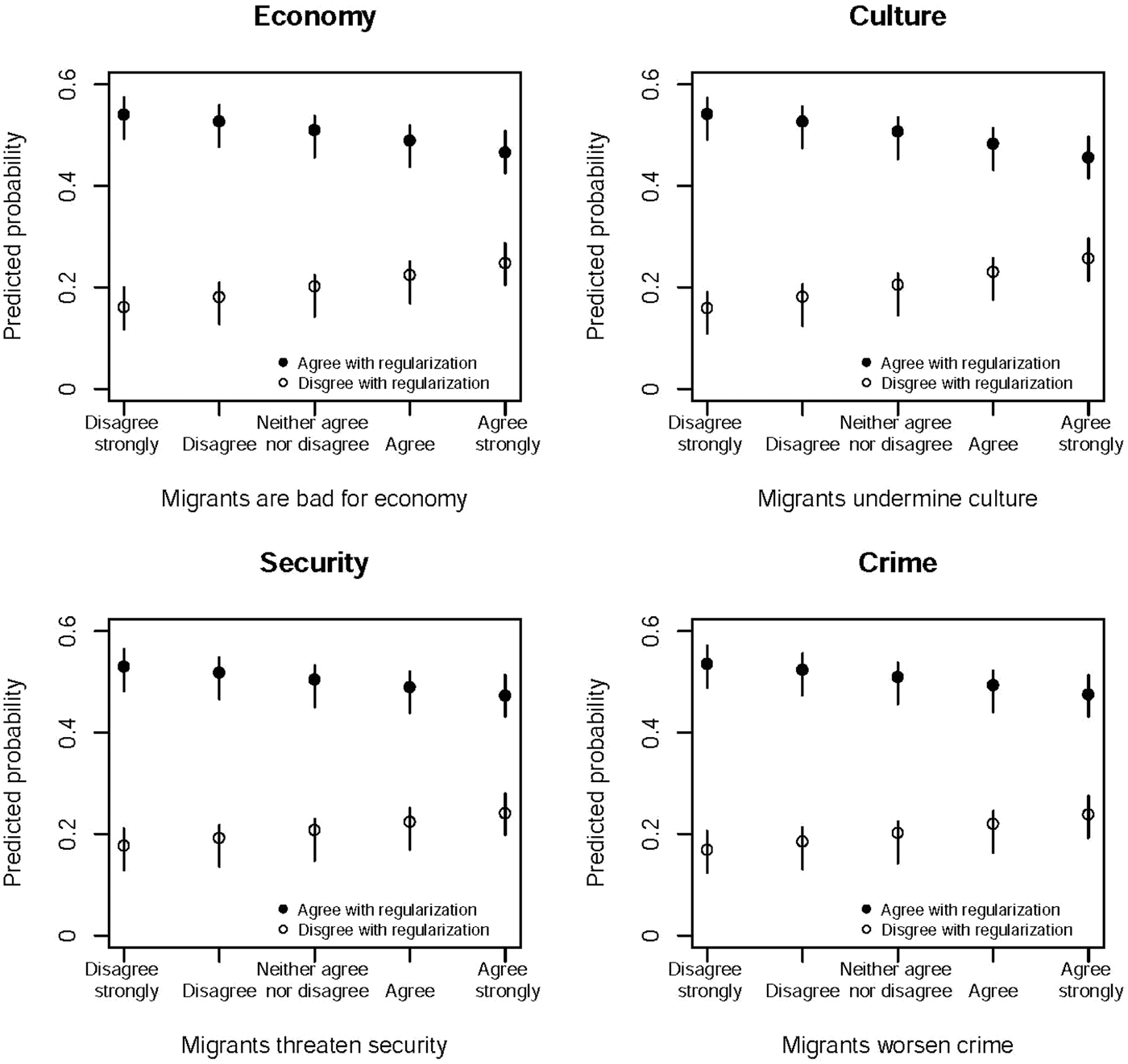
Figure 1 presents results on the correlates of either greater or lower levels of support from native citizens for Morocco's regularization campaign. The survey's findings indicate that all three theories – economic, cultural, and security factors – seem to affect support for regularization.Footnote 53 Citizens who think that migrants worsen Morocco's national economy, dilute its culture, and undermine its internal security are more likely to oppose regularization.Footnote 54 Though citizens with strong pan-Africanist ideologies are more likely to support the regularization program, their belief in either pan-Arab or pan-Africanist ideologies does not seem to dampen their likelihood of perceiving migrants as cultural threats (models 2 and 3). The predicted probabilities in Figure 1 highlight the correlation between negative perceptions of migrants’ effects on Morocco and opposition to regularization. As citizens’ responses to the survey questions moved from “disagree strongly” to “agree strongly,” their probability of supporting regularization dropped from 0.53~0.54 to 0.46~0.48; likewise, their probability of opposing regularization increased from 0.16~0.18 to 0.24~0.26.Footnote 55
Correlates of support for the regularization program.

Specific demographic attributes of native citizens predicted higher support for Morocco's regularization campaign. First, women expressed more support. This finding coheres with studies from Europe, which suggest that the historical connection between manhood and nationalism drives men to oppose migrants.Footnote 56 Second, richer citizens voiced more support for regularization, likely because they are less vulnerable to labor competition with migrants who work predominantly in lower-skilled and lower-income jobs.Footnote 57 Finally, native citizens self-identifying as black Moroccans (i.e., of historic sub-Saharan African roots) supported regularization more than Moroccans of other ethnicities. This result likely stems from the fact that black Moroccans might hold more empathy for sub-Saharan African migrants, who constitute the majority of displaced persons. Moreover, if the findings herein parallel those discovered in the European context, it may be that black Moroccans view sub-Saharan migrants as potential political allies.Footnote 58
Predicted probabilities of the attitudes toward the regularization program.
Conclusions, Limitations, and Future Research
Our key finding in this article was that a majority of native citizens – over 59 percent – supported Morocco's recent regularization campaign. However, different economic, cultural, and security variables correlated with either greater or lesser support. Similar to studies from Western Europe, this article discovered that native citizens concerned about clandestine migrants’ negative effects on the economy, culture, and internal security reported stronger opposition to regularization. Further, richer, female, and black native citizens supported regularization more strongly.
But this article faces constraints, underscoring the necessity for future studies. Foremost among these constraints is that the data came from one region within one North African state that has implemented regularization. Thus, it is difficult to know whether the attitudinal trends discovered herein extend to all of Morocco, or to neighboring North African states, like Algeria and Tunisia, that have also considered regularization policies. Yet after recognizing this limitation, this article still has value by providing the first-ever survey of public support for regularization campaigns for clandestine migrants in North Africa. It provides a starting point for future studies, which would likely use nationally representative public opinion polls.
Another question left unanswered relates to the underlying rationale for migrant regularization, more generally. It remains unclear why Morocco's regime has successfully executed regularization campaigns while many of its North African neighbors have not. Morocco may have pursued this policy to signal higher compassion for sub-Saharan African migrants, who throughout the 2000s and 2010s suffered harsh treatment from its police.Footnote 59 The regime may want to enhance its image first among European states, which have previously criticized its mishandling of migrants, and second among governments of sub-Saharan African countries, where Morocco has expanded its economic investment, religious outreach, and political influence since the early 2010s.Footnote 60 Only future research can help explore these emerging topics of inquiry.
Supplementary material
The supplementary material for this article can be found at https://doi.org/10.1017/rms.2018.92



