

Introduction
This chapter focuses on capability assessment. By assessment, I mean any mode of inquiry aimed at informing us about an individual’s (or a group of individuals’) capability, and especially if capability is found to be lacking, how this may be explained. Such an inquiry may be conducted for a variety of reasons, for instance, to learn about a programme’s impact, to see whether specific (groups of) individuals are structurally disadvantaged compared with their peers, and, if so, what sort of measures might be enacted to remediate this. Researchers conducting this type of inquiry face several challenges. Normatively, they need to make decisions regarding the content of the capability of their research subjects: what is it, exactly, that they should be able to do or be? Analytically, they need to make decisions regarding the factors that are likely to play a role in the development (or lack thereof) of capability in their research subjects. Finally, they need to make decisions regarding the methods that they are going to employ to collect the relevant empirical information (e.g., surveys, participatory observation, questionnaires, interviews, focus groups, or a combination thereof). The purpose of this chapter is to examine and discuss these challenges, specifically in relation to capability assessment in the workplace.
The chapter proceeds as follows: in the next section, the investigational requirements associated with adopting capability as the informational focus of a theory of justice are discussed. An apparent paradox will be foregrounded: whereas the CA has been dismissed as an unworkable idea by some, Sen himself has stated that capability deprivations can be readily observed by those who are willing to do so. Obviously, the issue is relevant to capability assessment: is it overwhelmingly complex, or fairly straightforward, as Sen himself seems to suggest? On the basis of what Sen has to say about capability deprivations and human rights violations and drawing on insights from policy sciences, I suggest that the apparent paradox can be resolved by distinguishing between two different stages in policymaking processes: listening and structuration. After pointing out that work can both help people develop their capabilities and act as a severe constraint in this regard, two case studies are presented. The first serves to illustrate in more detail the types of decisions that capability researchers need to make, both normatively and analytically as well as methodologically, and how such decisions can be taken into account during a structuration process. The case study is an example of how work can act as a strong promoter of capability. The second case study concerns forced labour and, as such, works as a potential constraint on capability development. It presents some data from globally conducted surveys and some of the critiques that these surveys have engendered. The following section presents an approach that can be used in the structuration process when findings from multiple sources are difficult to reconcile and appear to support different, incompatible actions. In the final section, it is argued that when making decisions in the context of capability assessment, we need to consider the realist and non-idealist nature of Sen’s CA.
Two disclaimers are in order. First, the work of Van der Klink et al. on the development of an instrument to assess workers’ capability (the capability set for work) will not be covered here since it is dealt with thoroughly in Chapter 2 of this volume. Second, this chapter does not intend to provide a systematic review of the literature of empirical studies of the relationship between capability and work, since this information was provided by Lessmann [Reference Lessmann1] and Julhe [Reference Julhe2]. Instead, it follows a case-study approach that is purposively meant to explore some of the challenges associated with applying the capability approach (CA) for empirical research in the area of work.
The Apparent Paradox Associated with Capability Assessment
Capability is the informational focus of the theory of justice developed by Amartya Sen [Reference Sen3]. This means that, according to this theory, people’s relative advantages and disadvantages should be assessed in terms of their capability. Capability refers to the real opportunities that people have to be and do things they have reason to value. The actual outcomes of the opportunities are called functionings. The focus on human capability has been developed by Sen as an alternative to other informational focal points of theories of justice, notably resources and utilities. Sen is critical of utility-based accounts of justice (utilitarianism) for various reasons, including the reduction of everything that can be of value to human beings into a single metric that is not possible or desirable. In his own account, the plurality of diverse values is preserved since the functionings (the doings and beings that people have reason to value) are left unspecified, and no attempt is made at commensuration.
Sen is critical of resource-based accounts of justice, primarily because these theories do not sufficiently acknowledge the substantial variation (“diversity”) across humans and over the life course in their ability to transform resources to achieve something that is of value to them. The focus on resources (usually commodities) without recognising human diversity leads to or further entrenches inequality in what people are supposed to enjoy from using these resources. In his own theory of justice, such human variation is explicitly taken into account by considering capability as a result of the dynamic interplay between the individual’s biopsychological characteristics (“endowments”), the external environment, including resources and conversion factors, and the ultimate functionings. Conversion factors here include how social environments address personal factors (e.g., age, gender, disability, proneness to illness), the physical environment (e.g., environmental conditions such as temperature ranges and flooding), the social climate (e.g., public health and healthcare, public educational arrangements, and the prevalence of crime and violence), and relational perspectives (e.g., the personal resources needed for taking part in the life of a community or to fulfil the elementary requirements of self-respect) [Reference Sen3].
The focus of the CA is not only on what people actually end up doing and being (achieving functionings) but also and primarily on what they are in fact able to do, irrespective of whether they choose to make use of such an opportunity [Reference Sen3]. To illustrate the conceptual and ethical differences, Sen offers the following example:
Consider the freedom of immigrants from non-Western countries to retain parts of the ancestral cultural traditions and lifestyles they value even after they have settled in a European country or in America … A significant argument can be constructed in favour of immigrants having the freedom to retain at least some parts of their ancestral culture … However, the importance of this cultural freedom cannot be seen as an argument in favour of someone pursuing her ancestral lifestyle, whether or not she finds reasons to choose to do this. The central issue, in this argument, is the freedom to choose how to live … and it cannot be turned into an argument in favour of her invariably pursuing those behaviour patterns, irrespective of whether she would like to do these things, or have reason to retain those practices.
This “freedom to choose how to live” aspect of the CA has significant implications for empirical inquiry into people’s capability. Taking the earlier example, an assessment of this specific capability – the ability to retain parts of ancestral cultural traditions and lifestyles – among a group of non-Western migrants in some jurisdictions could plausibly include the following:
An assessment of the arguments for which parts of ancestral culture (if any) would be reasonable for non-Western migrants to retain after they have settled in Europe or America (the ‘significant argument’). This initial part of the inquiry would serve as a justification for deciding which parts of ancestral culture do and which parts do not qualify as doings and beings that people have reason to value.
Second, there would need to be some sort of empirical inquiry into the current level of achievement of such functionings: is there any evidence suggesting that non-Western migrants actually retain or would like to retain such parts of their ancestral cultural traditions and lifestyle after they have settled in Europe or America? Which practices, so to speak, would count as supporting evidence? Equally importantly, is achievement fairly straightforward as a matter of course, or at great pains for individuals, and constantly contested by the new surrounding environment?
Third, it involves empirically exploring the levels and reasons for current non-achievement, specifically the extent to which non-achievement results from individual reasoned choices and the extent to which other factors are at play. In other words, is non-achievement evidence of capability deprivation?
Finally, and particularly if the exercise also aims at remediating observed capability constraints, it would include an inquiry into potential causes of the capability constraints, focusing on resources, conversion factors, functionings, and their interplay to identify potentially effective and appropriate avenues for remediation.
The challenges and complexities associated with such an inquiry can hardly be overstated. For this reason, some authors have dismissed the CA as an “unworkable idea” [Reference Rawls4, p. 13]. However, this apparent complexity in assessing capability is in sharp contrast with what Sen has to say on this matter when discussing the obligations associated with having capabilities: “if someone has the power to make a difference that he or she can see will reduce injustice in the world, then there is a strong and reasoned argument for doing just that” [Reference Sen3, p. 271].
The phrasing suggests that injustices (in terms of capability deprivations) are out there for us to be seen, and if we can do something to make a difference, we should do just that. None of the complexities mentioned in the earlier example seems to be at play here. Rather, it is a matter of acknowledging that having the power to do something about which one can see will reduce injustice in the form of capability deprivation. To be sure, it might require considerable moral courage, stamina, and discernment. However, a complex inquiry along the lines suggested earlier is not needed. There appears to be a paradox here, with capability assessment being tremendously complex and demanding (even ‘unworkable’) on the one hand and surprisingly simple to address on the other hand. This paradox is obviously relevant to the investigational requirements associated with capability assessment: how complex, or simple, may we expect it to be? In the following, I explore this apparent paradox. To this end, I briefly discuss the congruences between capabilities on the one hand and human rights on the other. The reason for this link is that Sen makes several observations regarding the determination of the violation of human rights that, in my view, are quite relevant and transferable to capability assessment as well.
Capabilities, Human Rights, and Investigational Requirements
There are some conceptual congruences between capabilities on the one hand and human rights on the other. International human rights law identifies certain basic human freedoms (e.g., freedom of speech, freedom of worship, freedom from want, freedom from fear) and the corresponding social obligations to promote or safeguard these freedoms [Reference Sen3]. The contents of such freedoms (what is it that humans should be free to be or do?) can arguably be conceived as functionings as defined by Sen (doings and beings that people have reason to value). Since capability is the freedom to achieve certain functionings, a clear parallel between capability and human rights emerges. There are, however, some differences. First, a distinction needs to be made between the opportunity aspect of freedom and the process aspect of freedom [Reference Sen3]. While the former refers to freedom to be or do X, the latter refers to how freedom is exercised. That is, a person forced to do X or doing X because there is no other choice would both be seen the same as someone wilfully doing X if the process aspect is also not recognised as important. Capability would be a good way of formalising the opportunity aspect of freedom and human rights, but as Sen says: “Issues related to the process aspect of freedom demand that we go beyond seeing freedoms only in terms of capabilities” [Reference Sen3, p. 371]. Second, in the CA, freedom is seen to result from the dynamic interplay between personal endowments, resources, conversion factors, and function in a way that is not usually seen in accounts of human rights [Reference Sen3]. Third, while human rights and capability are both linked to the obligations of others, the former can be viewed as levers of political articulation [Reference Critchley5], whereas the latter seems to focus on individual obligations. That is, there is Sen’s earlier quote about individual power and injustice. There is this further quote: “Freedom in general and agency freedom in particular are parts of an effective power that a person has, and it would be a mistake to see capability, linked with these ideas of freedom, only as a notion of human advantage: it is also a central concern in understanding our obligations” [Reference Sen3, p. 271]. In both, Sen seems to focus on individual obligations, whereas human rights are first and foremost obligations of governments towards their citizens.
Because of these parallels between capabilities and human rights and Sen’s own discussion on capabilities as the basis of some moral human rights, it is of interest to the present paper to understand what Sen has to say in the public discourse on human rights. Sen holds that different avenues exist for promoting human rights: “The ethical pronouncements, with distinct political content, that belong to a declaration of human rights may come from persons or institutions, and they may be presented as individual remarks or as social pronouncements” [Reference Sen3, p. 359]. Non-governmental organisations (NGOs) such as Human Rights Watch, Médecins sans Frontières, and Amnesty International, as well as the media and social movements, can play an important role in exposing, advocating for, and informing public discussion. An important question is how moral claims with reference to specific human rights can be tested for their validity and acceptability. For Sen, this would require “an interactive process of critical scrutiny with open impartiality” [Reference Sen3, p. 385]. In the following, some insights from policy sciences are presented that could help shed more light on what such an interactive process might look like.
Listening and Structuration: Two Distinct Stages in the Policymaking Process
Sen distinguishes, then, between, on the one hand, a process where human rights, especially perceived violations of human rights, are brought to the attention of a wider public and, on the other hand, a process where such claims are adopted more formally and transformed into collectively binding policymaking or legislation. In the policy sciences literature, these two processes have been designated ‘listening’ and ‘structuration and decision-making’, respectively [Reference Bächtiger and Parkinson6]. According to these authors, claims and concerns that are voiced in the public sphere belonging to the listening stage of the policymaking process include: 1) narratives and experiences that are considered to have implications for the community at large; 2) statements calling attention to perceived breaches of specific norms; 3) ontological claims as to who and what is being recognised to exist in the world and how; and 4) proposals for collective action or inaction, all of which are bundled with evidence and experience. In a deliberative democracy (Sen mostly uses the term democracy by discussion), it is a relatively wild, open, inclusive, and uncontrolled type of public debate. For such claims to be accepted as the basis for formal and collectively binding policy, some type of channelling of the arguments is needed, testing and filtering them in a structuration process that is both a transmission and a transformation.
Based on the foregoing, I will now make two suggestions. First, because of the parallels between human rights and capability, I suggest that what Sen has to say in the process of articulating and formally adopting human rights also holds for capability. Specifically, all sorts of claims may be made regarding capability and especially capability deprivations as long as they are considered part of the listening stage of the policy process. For such claims to be taken seriously, in the sense of being considered the basis for formal and collectively binding decisions, some sort of structuration is needed. This leads to my second suggestion, to wit that the proposed distinction helps to understand the apparent paradox signalled at the beginning of this chapter. In a deliberative democracy, it is important that claims regarding capability and capability deprivations can be made in relatively uncontrolled, wild, open, and inclusive ways. No specific restrictions or demands should be made, acknowledging that the ability to articulate such claims may differ across citizens and that relatively weak voices in particular may have something to say that is of significant importance to the community at large. However, some mechanisms should be in place, allowing for a publicly observable and defensible way of selecting, with reason, which of the ‘sounds’ that are being heard are to be taken seriously, in the sense of serving as a basis for collectively binding decisions and legislation. Whereas the former may, in a way, be considered relatively simple (even though it requires significant courage and stamina), the latter involves more complex types of inquiry into the validity, consistency, relevance, and coherence of the expressed claims and concerns. In the following, I explore how such critical scrutiny may be conducted by discussing claims or concerns regarding capability and human rights in relation to work.
Capability and Work: Complex Relations
The relationships between capability and work are complex. First, work has been, and continues to be, a battleground of glaring violations of human rights. Forced labour and exploitation are likely to constitute sources of momentous deprivations of people’s capabilities. Indeed, present-day instances of forced labour, exploitation, and unsafe and unhealthy work environments have been designated instances of modern slavery [7]. However, in the absence of structural and overt violence and force, work may also act as a significant constraint on capability development. The late anthropologist David Graeber coined the term ‘bullshit jobs’ for meaningless and numbing work [Reference Graeber8]. More poetically, the Argentinian filmmaker Rodrigo Moreno draws our attention to this phenomenon in his film Los Delincuentes (2023). We meet Morán (Daniel Elias), a bank employee. His days pass by, drab and cheerless. At some point in time, he concludes that the bank is, in fact, robbing him of his time. To settle the bill, he decides to rob, in turn, the bank of its money. He does this in such a way that it is clear that it was he who did the robbing (cameras). After a few days spent in bliss, he turns himself in at a police station. However, the money is gone. Three years, he reckons, will be his sentence. An offering that he is willing to make to regain his freedom. In addition, it seems, to clear his conscience. Time in prison is challenging and not without violence. However, he finds his way, and after his release, we see him relating to the people around him, to the world, and to himself in an entirely different manner.
Tragic (and humorous) this may be, we need to acknowledge, of course, that work can also be a means for people to develop important capabilities [Reference Van der Klink, Bültmann, Burdorf, Schaufeli, Zijlstra and Abma9]. Indeed, the very fact that work is considered a human right [10] may imply that work can be considered a valuable capability as defined by Sen. In the following, I turn to the question of what can be done to assess how work impacts individuals’ capability or human rights.
Two Case Studies: Microcredits and Capability Expansion and Forced Labour and Human Rights
To explore the challenges associated with the assessment of capability in the context of work, I present two case studies. First, the research objective was to determine whether there was any evidence suggesting that a specific intervention (microcredits) had resulted in an expansion of the capability of its beneficiaries. The second case study is more complex and involves two distinct approaches to explore the violation of human rights in the workplace context.
First Case Study: Microcredit for Purchasing Livestock
The following case derives from the work conducted by Sabina Alkire and her team [Reference Alkire11].
Background
In 1995, a local NGO in the village of Arab Solangi (Pakistan) obtained funding from Oxfam to initiate a number of income-generating projects for women. Among the projects was the establishment of a revolving fund, allowing local women to obtain a loan for the purchase of a goat. The beneficiaries were poor women interested in receiving a loan for the purpose of purchasing a goat, were willing to repay within one year, and were willing to take the associated financial risk [Reference Alkire11]. The NGO supported the borrowers in purchasing a goat and provided training in group meetings about issues such as goat care, goat health, goat sales, and financial management. After a period of five years, a total of 140 women participated in the programme. Alkire and her team were commissioned to conduct an evaluation of the project. In addition to social cost‒benefit analysis, they conducted a qualitative inquiry into the impact that the project had on the capability of participating women. The focus here will be on the qualitative capability assessment.
Methodology
The data for this assessment were collected during a meeting (focus group) where beneficiaries were invited to share their reflections on the various impacts that the project had. The meeting started by posing an open question: “what valuable and negative impacts have you noticed?” [Reference Alkire11, p. 225]. Having discussed the various impacts, the research team then tried to relate each of them to one or more of the basic forms of good, as defined by John Finnis [Reference Finnis12]. These include practical reflection, life, knowledge, play, aesthetic experience, sociability (friendship), and religion.
Results
Examples of specific goods that emerged during the meeting included the following. The texts are quotes from the focus group discussion; the relevant putative basic good is represented in capital letters.
“We had a workshop in livestock. I learned about inoculating livestock, about the medicines to be used for worms, and about injections for sick animals”, and “we learned to keep the fodder of sick goats away from that of well goats”, as examples of basic good KNOWLEDGE.
“The goat activity gave very positive help in religion. At first, we were too poor to offer at Qurbani Eid. Now, we are able to offer goats”, as an instance of the basic good RELIGION.
“When we got the first goats, we acted individually. We did not know how to provide their food. Then, we saw we could gather the goats in the morning and graze all together” as an instance of SOCIABILITY. [Reference Alkire11, pp. 250–1]
Conclusions
The authors conclude that goat owners indicated strong impacts on knowledge, relationships, empowerment, religion, and participation [Reference Das, Brandel and Motta13].
Issues That May Be Addressed in the Context of Structuration
Recall that a structuration process, in this context, serves the purpose of determining whether claims and concerns expressed in the public realm regarding a specific issue should be taken seriously, thereby providing a basis for collectively binding decisions. In the case of the study by Alkire and her team, the latter aspect might, for instance, consist of passing legislation aimed at mitigating the risks for loanees or setting up government funding to continue the programme that was set up by Oxfam. In the context of a structuration process, a key question concerns the validity of the study by Alkire. The relevant issues in this regard include the following:
Source of information. The information was obtained primarily by querying the participants in a focus group discussion. Such an approach – just like any approach for that matter – has certain advantages and disadvantages. An advantage is that the task that the research subjects were asked to fulfil was fairly straightforward and close to their own experience, enhancing its face validity. They were asked to reflect on what changes had occurred (retrospectively), what novel things they started to do (or familiar things in novel ways), how they experienced these changes, and what they meant to them. Moreover, they were able to express all this in their own words, in their own language. In addition, organising this as a group meeting probably helped participants make up their own minds and helped researchers gauge the extent to which suggested changes and meanings garnered wider support from the group. A notable disadvantage is the programme’s strong reliance on the reports of those who participated in it. Querying other stakeholders independently or some mode of participant observation could have been used to corroborate (or not) the findings (triangulation).
Realisation of value. There are two reasons why the observed changes may be considered an expansion of participants’ capability. First, it seems reasonable to assume that the changes that the participants reported are, in fact, important to them. Why, after all, would participants in this setting report changes that are unimportant to them? Second, researchers were able to categorise specific changes that were reported under some of the basic goods, as defined by Finnis. Although the complexities associated with such types of translation should not be underestimated [Reference Das, Brandel and Motta13], they do seem to confer wider generality to the findings [Reference Alkire11]. A limitation of the study was that it focused on functionings; extending the inquiry into changes in resources or conversion factors would have contributed to a better understanding of how the capability expansion was achieved. This would have provided more insight into how the programme had resulted in the observed outcomes (through what mechanisms) and what context factors appeared to be critical in this respect, or context–mechanism–outcome configurations [Reference Pawson and Tilley14].
In conclusion, despite some limitations and the fact that the researchers adopted a methodology that is generally considered relatively low quality (i.e., retrospective analysis, qualitative methods, observational design; see, for instance, Pati [Reference Pati15]), this approach may have been appropriate for the purpose of the study.
Second Case Study: Forced Labour
Nationally Representative Survey versus Local Mixed-Method Study
The second example differs from the first one in the sense that it is not about assessing the impact of a programme or intervention but rather about assessing to what extent a specific group of people’s human rights are being violated. Two different approaches for researching this issue are presented: a national survey giving rise to quantitative data and a local, mixed-method study.
Survey
One approach to research in this area is guided by the use of indicators. The United Nations International Labour Organization (ILO) has proposed the following list of indicators that can be used for identifying potential cases of forced labour [16]:
Abuse of vulnerability
Deception
Restriction of movement
Isolation
Physical and sexual violence
Intimidation and threats
Retention of identity documents
Withholding of wages
Debt bondage
Abusive working and living conditions
Excessive overtime
Such indicators have been used, among others, as a basis for calculating the prevalence of forced labour in countries worldwide [7]. Face-to-face interviews with individuals aged 15 years or older were held at their place of residence. In this way, from 2014 to 2016, 71,758 individuals were interviewed globally in 48 countries, providing data on themselves and those of their household (resulting in a total group of 575,310 individuals). The interviewees were asked whether they or their relatives had experienced any form of forced labour and, if so, when it last happened, the duration over the last five years, the country where it happened, the type of work, and the nature of the coercion (e.g., physical violence, threats of violence, withheld wages, withheld identity documents, locked-in living quarters, or obligation to repay debt). In addition, questions were asked about instances of forced marriage. Using statistical techniques such as imputation and regression modelling, national indices were calculated [17]. This has resulted in countries with a prevalence rate of modern slavery (defined as the removal of a person’s freedom – their freedom to accept or refuse a job, their freedom to leave one employer for another, or their freedom to decide if, when, and who to marry – to exploit them for personal or financial gain). The authors of the report reported countries with a prevalence rate of 0.6 per 1,000 or less (Switzerland, Norway, Germany, Netherlands, Sweden, and Denmark) and countries with a prevalence rate ranging from 15.6 per 1,000 (Turkey) to 104.6 per 1,000 (North Korea) [7].
Criticism
As influential as this research initiative may have been, and continues to be, it is not without its critics [Reference LeBaron and LeBaron18]. A major point of critique is that it tends to present modern slavery as an exceptional problem in an otherwise well-functioning global economy that, as such, “can be neatly isolated from broader structural dynamics within the global economy and eradicated without the fundamental transformation of said dynamics” [Reference LeBaron and LeBaron18, p. 9]. Major causes of modern slavery are “the greed and moral shortcomings of individual perpetrators, criminality and corruption, or vague and nebulous notions of poverty and globalisation”. Proposed solutions “tend to focus on awareness raising, criminal justice approaches, and passing legislation … avoiding politically contentious questions about corporate power and profitability, the role of states and their lacking enforcement of labour protections, or national and international political economic policies” [Reference LeBaron and LeBaron18, p. 9]. However, according to those critics, forced labour “is not an easily isolatable and discrete category, but is rather an extreme within a broader landscape of abuse and exploitation” [Reference LeBaron and LeBaron18, p. 13; Reference Quirk and LeBaron19]. The following is a concrete example of a study challenging a number of widely held assumptions about migration and forced labour among children in West Africa.
Mixed Methods Study of the Experiences of Child Migrants along the Abidjan–Lagos Corridor
Background
Within mainstream media and political discourse, children’s work and mobility have often been framed in terms of trafficking, new forms of slavery, or, for girls, sexual exploitation [Reference Howard and LeBaron20]. This framing contrasts with the view that, in times of peace, children who migrate often choose to do so to find work and earn money to access further education and technical training or support their families as part of their journey into social adulthood [Reference Bourdillon, Levison, Myers and White21]. To explore this issue in more depth, Terre des Hommes, Environment and Development Action, and the African Movement of Working Children and Youth commissioned, in 2017, a study to help guide future programming. It was conducted in the context of the child migrants along the Abidjan–Lagos Corridor programme in West Africa [Reference Howard and LeBaron20].
Methodology
With the assistance of a small number of child research assistants, a mixed-methods study was conducted, including a questionnaire, individual interviews, and focus groups. The questionnaire was administered among child migrants and children of migrants at eight research sites (markets located at the centre of major cities and border towns), collecting basic biographical data (age, gender, family, place of birth) and data on education, mobility, daily life, access to utilities and healthcare, work, and income and savings. The same subjects were covered during interviews with child migrants, supplemented with the children’s aspirations and their views of fairness. In addition, interviews and focus groups were held with child protection actors (e.g., state officials, NGO staff, community leaders), covering issues such as the existence of formal and informal child protection institutions, their interrelations, and perceived gaps.
Research Findings
In total, the study included 579 children (median age of 15 years for both boys and girls) and 46 adults (parents, guardians, employers, and protection actors). Researchers have found that the initiative to migrate could come from the person with whom a child travelled, their parent or caregiver, or themselves. Many of them migrated temporarily for work, including earning money to pay for school fees. Motivations to migrate included the desire to grow, learn, adventure, and contribute to one’s family, as well as pride in overcoming and surviving adversity. Apprenticeships were one of the main routes desired out of poverty; apart from transferring skills, they could also provide children with food and boards. However, apprenticeships could also stray into exploitation, requiring children to pay exorbitant fees for their release. Children younger than 12 years of age generally left their place of origin with a parent, sibling, or other relative; older children and adolescents often also moved with an adult or together with peers. Boys could also travel on their own; this was only rarely the case for girls. Some children cited their families as those to whom they would turn when they would find themselves in trouble; in contrast, for other children, fear of punishment and beatings were mentioned as the main reasons for leaving their family home. Although formal and informal support services exist in each area, many street children lack access to safe places to sleep and save money.
Recommendations
On the basis of their findings, researchers have recommended: 1) expanding existing spaces for children to gather, receive formal or informal support, including basic medical care, and sleep safely overnight; 2) setting up a child-led microbanking system, enabling children to safely accumulate from their small-scale economic activities; 3) reforming apprenticeships, rendering them more in line with changing realities of the labour market (e.g., meeting the demand for cellphone repair); and 4) adding literacy components.
Structuration in the Case of Incongruent Evidence: Reconstructing Interpretive Frames
In line with the logic I have set out, if governments were to decide to formally adopt such recommendations, some sort of structuration would be needed. Given the diversity in types of research, findings, and recommendations, this could be a challenging task. On the one hand, there are global research efforts (such as the one producing the Global Slavery Index), revealing and drawing attention to the wide and increasing prevalence of modern slavery while recommending its complete eradication to be achieved, among others, by criminal justice and by making it socially unacceptable. On the other hand, small-scale research efforts suggest that phenomena such as child migration in West Africa should, at least to some extent, be accepted and that the key issue is not complete eradication but rather protection of migrating children from harm as much as possible. The question is what policymakers can do when confronted with such apparently diverging perspectives. One approach could be to appraise the validity of the available evidence critically and determine whether some studies should carry more weight than others do. In such cases, such an approach is unlikely to bring the question close in a satisfactory way. The reason for this is that there is a certain incongruence between the various studies; they do not fit well. The studies do not merely differ in terms of their methods; they also differ in terms of how the problem is conceptualised. On the one hand, forced labour is considered an exceptional problem in an otherwise well-functioning global economy, mainly owing to the greed and moral shortcomings of its perpetrators. Solutions are sought in the area of criminal justice and raising awareness. On the other hand, structural poverty is considered to be the driving force of forced labour, originating from global political‒economic inequity.
In policy sciences, the method of reconstructing interpretive frames has been developed as a means of structuration in the case of incongruent evidence [Reference Fischer22, Reference Dodge and Metze23, Reference Mendoça, Simões, Ercan, Asenbaum, Curato and Mendoça24]. It consists of making explicit the following elements in the available evidence (see Figure 4.1):
The four elements constituting an interpretive frame.
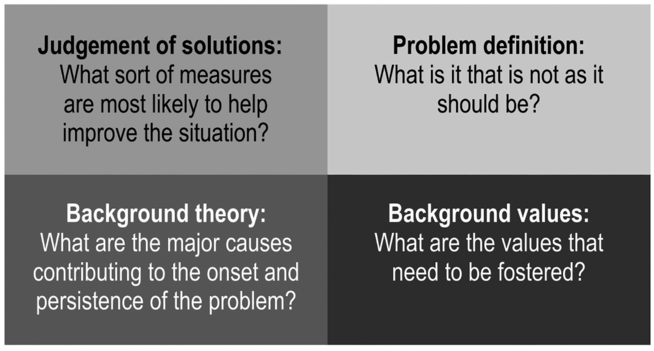
Figure 4.1 Long description
The four quadrants are labelled as follows. Problem Definition asks, What is it that is not as it should be. Judgement of Solutions asks, What sort of measures are most likely to help improve the situation. Background Theory asks, What are the major causes contributing to the onset and persistence of the problem. Background Values ask, What are the values that need to be fostered.
Jointly, these four elements constitute an interpretive frame. By making interpretive frames explicit, the mutual coherence between the various elements comes into view: a judgement of various solutions makes sense in view of how the problem is defined and vice versa; in turn, judgements of solutions and problem definitions are constituted by background theories and values. Stakeholders may reason and act from different interpretive frames; when they do, this will usually give rise to incongruent types of evidence. Importantly, a different approach is required for the process of structuration.
Although the global survey that gives rise to estimates of national rates of modern slavery and a study such as the one by Howard et al. [Reference Howard and LeBaron20] both testify, each in their own way, of a strong commitment to protect humans from the various types of forced labour, the underlying interpretive frames differ in a number of important ways. For example, in the study by Howard et al. [Reference Howard and LeBaron20], the problem is not so much that these children are on the move; the problem is that when they are on the move, they are subject to harm, including physical violence, robbery, and exploitation (problem definition). Potentially effective measures for resolution (judgement of solutions) include ensuring that, on their journey, children are accompanied by a relative and that if they run into trouble, they can continue to rely on their family for support. Additionally, when on the move, children should have easy access to safe and affordable places where they can sleep. Finally, as a journey into adulthood, the quality and relevance of apprenticeships should be enhanced, and there should be easy ways for children to keep their little money safe. In terms of background theory, poverty is considered among the main driving forces, resulting in failure of parents to sustain a family. Poverty itself is considered a result of global political and economic dynamics. Among the background values is a commitment to respect, at least to some extent, local culture: in Western African countries, it is not uncommon for children to leave their family home around the age of 15 as a ‘journey into adulthood’.
Importantly, interpretive frames define what is and what is not relevant evidence. For example, if the problem is not that these migrating children should be better protected but should not occur in the first place, the solutions of the sort proposed earlier are entirely misguided, and the associated background theory is largely irrelevant. Moreover, any research that aims to determine whether proposed solutions are effective is essentially a waste of money. The main lesson here is to resist the tendency to limit structuration to a critical scrutiny of the validity of the various evidentiary elements. Such scrutiny is important but may not be enough. The reason for this is that evidence is always produced in the context of some interpretive frame. As observed by Genevieve LeBaron: “The way that the problem of forced labour is framed and understood – who or what is demonstrated to bear responsibility, the way that data is collected and presented, and especially whether and how its causes are foregrounded or obscured – is shaped by researchers’ choices, whether they are aware of it or not” [Reference LeBaron and LeBaron18, p. 11].
Interpretive frames may, but need not, be widely shared. An important task of researchers in this respect is, then, to determine whether a specific issue (such as child migration and the associated risks of enforced labour and exploitation in Western Africa) is framed in multiple ways and, if so, what implications this might have for the interpretation of the available evidence. Importantly, this means that we should acknowledge that specific evidence is relevant only within a particular interpretive frame. Reconstructing interpretive frames as part of a structuration process is useful for several reasons:
It broadens the scope from a focus on the assessment of the validity of evidence to include an assessment of the relevance of evidence.
It offers the opportunity to assess and discuss the coherence of the interpretive frame in use.
It offers the opportunity to assess and discuss the reasonableness of the way that general notions (background theory and background values) are brought to bear on concrete situations (e.g., practical reasoning).
It offers an opportunity to assess and discuss the plausibility of background theory and support background values.
Finally, it offers an opportunity to suggest how the parties involved might proceed while acknowledging differences in their interpretive frames.
Clearly, this renders the task of the researcher who is conducting and assisting the structuration process more complex and demanding but also more interesting and relevant to the policy process. In fact, it results in a shift away from the authoritative appraisal of evidence towards the promotion of mutual learning among various stakeholders [Reference Fischer25, Reference Grin and Graaf26]. In addition, relevant to the present discussion, the method could be particularly useful in the context of capability assessment. The problem definition would specify the nature of the capability deprivation: what is it that (a group of) individuals are not well able to do or be? Solutions that are considered potentially effective in expanding or restoring capability typically refer to (lack of) resources, (deficits in) conversion factors, or both. Background theory would specify how, in a more general way, capability deprivation or capability expansion work, and background values would include the freedom to aspire and achieve and the associated responsibilities towards others.
Discussion and Conclusion
Starting from the observation that capability is the primary informational focus of the theory of justice developed by Amartya Sen, I have explored some of the investigational requirements that are associated with such choice. I have argued that there seems to be a paradox here, with capability assessment being prohibitively complex (if not unworkable) on the one hand and surprisingly simple on the other. The paradox can be understood, or so I have tried to argue, if we take into account the context in which capability claims or concerns are expressed. Specifically, when capability claims or concerns are intended as a basis for some sort of collective action (that is, politically), they should be able to withstand some test of criticism. I have presented two case studies to illustrate the strategies researchers may adopt to operationalise the capability concept or the related concept of human rights. Such strategies cover a wide range, varying from calculating national indices to questionnaires and focus groups, resulting in a wide diversity of data. I have offered some suggestions as to what may be done in terms of the structuration of such a variegated body of evidence, emphasising the importance of assessing both the validity and relevance of evidence, and I have argued that we may need to go beyond evidence to examine frameworks.
The Capability Model: A Realist and Non-ideal Theory
Capability, as developed by Sen, is a relatively novel concept. As such, it enables us to identify concrete situations as instances of more or less structural capability deprivation and to think through the implications for justice, freedom, and responsibility. Bringing conceptual reality and material reality to bear on each other is a complex and relatively poorly understood process. Which is, in a way, surprising since this is what we, humans, do, all the time. Grasping a concept means, among other things, knowing what needs to be done to determine whether it applies in a concrete situation [Reference Laugier, Brandel and Motta27]. In other words, if someone raises the question ‘is the capability of these people structurally deprived?’, we should know what needs to be done to answer that question. In this chapter, we have seen that there are still some significant challenges in that regard. However, I have also suggested some directions. Here, it is important to acknowledge the realist nature of the CA: Sen is interested in how people’s lives go, in the real opportunities that people have to be and do things they have reason to value. Likewise, with respect to justice, his primary focus is on how things work out in practice (what he refers to as ‘Nyaya’) rather than in devising and setting up ideal ways of organising society (‘Niti’) [Reference Sen3] Chapter 1). Moreover, Sen is critical of utility as an informational focus of a theory of justice because it reflects the mental reaction of people to the situation they find themselves in rather than the features of that situation itself [Reference Sen3]. We should, thus, be careful not to turn capability into ‘some mental construct’ and not to use individuals as the sole source of information regarding their ‘real opportunities’, but rather to try to see what has changed in terms of resources and conversion factors.
I think it is important to also acknowledge the non-ideal nature of Sen’s theory of justice [Reference Moen28, Reference Leopold29, Reference Meshelski30]. Rather than developing a theory for a perfectly just society, Sen is primarily looking for concrete, practical ways of rendering our world slightly less unjust by focusing on the worst cases, which are often clearly visible. Perhaps we should keep this in mind when conducting empirical inquiries that aim to learn about capability in real life. The capability model offers an opportunity for exploring how human (un)freedom, (lack of) resources, (absence of) conversion factors, and (unattainable) functionings are related. Rarely are all these elements of the capability model addressed within a single study. This should not, in my view, be a reason to discard such studies as useless. Instead, it should urge us to use results from multiple studies to load, as it was the formal model of capability. In doing so, we could broaden the evidence base by including studies that did not address the issue of capability in relation to work, at least not explicitly. These might include:
Studies that have examined how work can be of value to humans without explicitly using the CA as a theoretical framework. An example is the study by Ehn et al. [Reference Ehn, Wahlqvist, Möller and Anderzén-Carlsson31], who explored how work can be of value to people who are deaf-blind due to Usher syndrome and what conditions should be met to realise such values. The idea is that such studies could provide important insights into requisite resources and conversion factors, even though the researchers themselves did not use the capability model as a theoretical framework for their study.
Studies that have used the capability framework in domains other than work. An example is the ethnographic study by Visser and Haisma [Reference Visser and Haisma32], which explored the value of having a meal and the associated resources and conversion factors via participant observations and photo-elicitation interviews with children, parents, and grandparents. Such studies could be valuable for at least two reasons: first, they might contain interesting methods to be used for capability assessment in the context of work; second, they may reveal how the achievement of functioning in one domain (e.g., having meals) may support, or conflict with, the achievement of functioning in another domain (e.g., work).
The collected evidence may often be incongruent, as explained earlier. The method of reconstructing interpretive frames may be beneficial to help make sense of the data and support the various parties involved in deliberating and proceeding in a constructive way. This, in my view, is not only a challenge for researchers but also a great opportunity.

 Open access