





Introduction
The vein of Galen malformation is a rare congenital vascular malformation, seen in approximately 1 in 25,000 live births. Reference Frawley, Dargaville, Mitchell, Tress and Loughnan1 While it constitutes <1% of all cerebrovascular malformations, it accounts for ∼30% in children, Reference Raybaud, Strother and Hald2 making it the most common paediatric vascular brain malformation. Reference Di Meglio, Sica and Toscano3 Presentation varies by age: neonates typically present with cardiac manifestations—high-output failure, pulmonary hypertension, and right heart dilation—while older infants more often show neurological symptoms. Reference Merritt, Feit and Valente4,Reference Brevis Nuñez and Dohna-Schwake5 The mainstay of management of vein of Galen malformation remains endovascular embolisation of the brain malformation. Reference Devarajan, Goldman, Shigematsu, Berenstein and Fifi6 Another rare vascular anomaly is the isolated drainage of the large vein returning blood from the upper half of the body (superior vena cava) into the left atrium. Reference Baggett, Skeen, Gantt, Trotter and Birkemeier7 This case describes a newborn with vein of Galen malformation, superior vena cava draining into the left atrium, a sinus venosus atrial septal defect, and partial anomalous pulmonary venous return—an extremely rare combination.
Case presentation
A term male infant was transferred to a tertiary neonatal ICU at 51 hours of life from an outside facility following caesarean delivery to a Gravida1Para1 mother with normal Apgar scores, for concerns of macrocephaly (fronto-occipital circumference 38 cm; Z-score 2.65) that developed by day 2 of life. Birth weight was 3.47 kg (60th percentile), with appropriate-for-age length and head circumference. On admission, physical examination was notable for a prominent bruit over the anterior fontanelle and a mild posterior scalp abrasion attributed to birth trauma.
Head ultrasound demonstrated a large anechoic structure with prominent vascular flow. Subsequent MR venography confirmed a vein of Galen malformation with multiple arterial feeders, including branches of the basilar, bilateral posterior cerebral, pericallosal, and choroidal arteries, draining through an aneurysmal venous pouch into the superior sagittal sinus via a persistent falcine sinus, suggestive of a predominantly choroidal type of vein of Galen malformation. Using the Ellipsoid formula, the vein of Galen malformation measured 2.0 × 2.3 × 2.0 cm with an estimated volume of 4.8 cm3. Mild ventriculomegaly of the lateral and third ventricles secondary to mass effect on the midbrain was present. Echocardiogram on day 5 of life demonstrated mild left atrial dilation without evidence of right ventricular volume overload or pulmonary hypertension. A large sinus venosus atrial septal defect with left-to-right shunting and a partial anomalous pulmonary venous return of the right upper pulmonary vein into the superior vena cava were identified, with the superior vena cava overriding the atrial septum and draining into the left atrium (Figure 1). Haemodynamic assessment showed a superior vena cava velocity–time integral of 0.208 m/s, with estimated flow of 629 ml/kg/min, and a cardiac index of 11.71 l/min/m2 (808 ml/kg/min) without aortic diastolic flow reversal. Contrast-enhanced CT of the head and neck demonstrated dilated carotid arteries and jugular veins. The Bicêtre score, a 21-point clinical tool used to assess vein of Galen malformation severity, was 20, indicating clinical stability and supporting delaying embolisation until the age of 6 months to allow for neurologic maturation and reduce procedural risk, contingent on continued cardiac stability. Reference Lasjaunias, Chng, Sachet, Alvarez, Rodesch and Garcia-Monaco8
Echocardiography visualizing aberrant drainage of superior vena cava into the left atrium in addition to atrial septal defect.

Figure 1 Long description
The echocardiogram visualizes the heart's anatomy, highlighting the superior vena cava, right atrium, atrial septal connection, interatrial septum, left atrium, and inferior vena cava. The superior vena cava is shown draining into the left atrium, indicating aberrant drainage. The atrial septal defect is also visible, demonstrating the connection between the right and left atria.
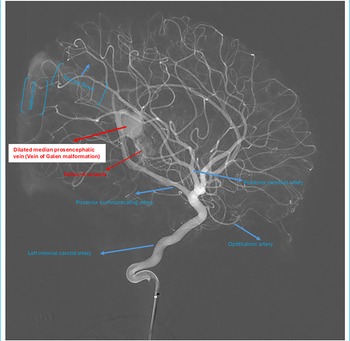
At 6 months of age, the patient was transferred to Boston Children’s Hospital for evaluation of endovascular treatment. Pre-operative MR angiogram and brain MRI demonstrated interval reduction in the size of the vein of Galen malformation with increased prominence of arterial feeders, including hypertrophy of approximately 5–10 distal posterior cerebral artery feeders, as well as dilation of the superior sagittal and transverse sinuses (Figure 2) with a reduction of the vein of Galen malformation volume from 4.8 cm3 in the neonatal period to 1.76 cm3 at 6 months of age. There was no diffusion restriction observed on diffusion-weighted and T2-sequence MRI (Supplementary Figure S1, Supplementary Figure S2).
Catheter-angiography demonstrating hypertrophy of posterior cerebral artery with nidus of vessels draining into dilated median prosencephalic vein, forming vein of Galen malformation. Dilated sagittal sinus and other venous structures are also visualized.

Figure 2 Long description
A catheter-angiography image displays the brain's arterial and venous structures. The posterior cerebral artery appears enlarged, with a cluster of vessels draining into a dilated median prosencephalic vein, forming a vein of Galen malformation. The dilated sagittal sinus and other venous structures are also visible. The image highlights the complex vascular anatomy involved in this rare congenital condition.
The patient underwent catheter angiography with a plan for embolisation; however, the distal posterior cerebral artery branches were deemed too small for embolisation using available instruments; therefore, the procedure was deferred. Angiography clarified lesion anatomy, demonstrating arterial inflow from a small right distal PCA, multiple left thalamoperforating, and medial posterior choroidal arteries, supplying a nidal network anterior to the Markowski varix. Venous outflow drained into a separate dilated venous pouch before emptying into the Markowski varix. These findings were most consistent with a choroidal-type vein of Galen malformation.
At 8-month follow-up, the patient remained clinically stable without evidence of cardiac-output heart failure. Echocardiography demonstrated moderate left atrial dilation with preserved biventricular size and function and mild aortic diastolic flow reversal. Despite initial plans for vein of Galen malformation intervention at 6 months of age, the patient’s continued stability allowed further delay in intervention to promote greater neurological and vascular maturation. Definitive repair of the atrial septal defect and partial anomalous pulmonary venous return is planned in the preschool years following vein of Galen malformation management.
Discussion
The high-flow, low-resistance arteriovenous shunting characteristic of vein of Galen malformation typically results in marked increases in circulating blood volume and cardiac output, often resulting in high-output cardiac failure. Reference Merritt, Feit and Valente4 Typically, an overriding superior vena cava would cause cyanosis secondary to increased return of deoxygenated blood into the left atrium. Reference Azizova, Onder, Arslan, Ardali and Hazirolan9 However, our patient exhibited neither cyanosis nor oxygen desaturation. We hypothesise that venous return via the superior vena cava has relatively higher oxygen saturation due to cerebral arteriovenous shunting that bypasses the capillary bed, thereby protecting against systemic desaturation. Additionally, the absence of in-utero right ventricular volume overload and limited exposure of highly oxygenated venous return to the developing pulmonary vascular bed might have conferred protection against postnatal high-output cardiac failure and severe pulmonary arterial hypertension. Heuchan et al. studied 15 neonates with vein of Galen malformation where superior vena cava flows of >400 mL/kg/min (normal 55–111 ml/kg/min at term) were linked to poor outcomes. Reference Heuchan and Bhattacharyha10 Despite a flow of 629 mL/kg/min, our patient remained clinically stable without need for early intervention, suggesting a potential protective effect of the patient’s unique cardiac anatomy.
Endovascular embolisation remains the mainstay of treatment. Reference Devarajan, Goldman, Shigematsu, Berenstein and Fifi6 To optimise the effectiveness of the intervention and minimise neurologic risk, patients with a Bicêtre score of >12 should be medically managed until at least the age of 5 months, if there is no failure to thrive. Reference Lasjaunias, Chng, Sachet, Alvarez, Rodesch and Garcia-Monaco8
Conclusion
This case proposes a possible paradoxical advantage of an overriding superior vena cava in the context of vein of Galen malformation. The presence of an overriding superior vena cava might have reduced the risk of pulmonary vascular compromise and high-output cardiac failure, thereby offering a protective mechanism in this unique clinical scenario.
Supplementary material
The supplementary material for this article can be found at https://doi.org/10.1017/S1047951126112116.
Acknowledgements
The authors would like to thank Dr Cesar Alves, MD, PhD, Neuroradiologist at Boston Children’s Hospital, for his valuable assistance with this manuscript. Dr Alves provided and reviewed the magnetic resonance imaging and venography studies, including dimensional measurements of the vein of Galen malformation, which were essential for estimating lesion volume and supporting the imaging-based interpretation of this case. The authors would also like to acknowledge Boston Children’s Hospital for facilitating access to the imaging studies that contributed to the radiologic evaluation of this case. We would also like to sincerely thank Dr Juliana Arroyo, DO, radiology resident at the University of Oklahoma, for her help in revising selected images and providing detailed labeling of radiographic studies.
Financial support
This research received no specific grant from any funding agency, commercial or not-for-profit sectors.
Competing interests
The authors declare none.
Ethical standard
Written informed consent was obtained from the patient’s legal guardian for publication of this case report and any accompanying images.



 Open access

